
Mathematics Books

World Scientific Publishing Co Pte Ltd Set Theory And Foundations Of Mathematics: An
Book SynopsisThis book provides an introduction to axiomatic set theory and descriptive set theory. It is written for the upper level undergraduate or beginning graduate students to help them prepare for advanced study in set theory and mathematical logic as well as other areas of mathematics, such as analysis, topology, and algebra.The book is designed as a flexible and accessible text for a one-semester introductory course in set theory, where the existing alternatives may be more demanding or specialized. Readers will learn the universally accepted basis of the field, with several popular topics added as an option. Pointers to more advanced study are scattered throughout the text.
£52.25

World Scientific Publishing Co Pte Ltd Introduction To Analysis With Complex Numbers
Book SynopsisThis is a self-contained book that covers the standard topics in introductory analysis and that in addition constructs the natural, rational, real and complex numbers, and also handles complex-valued functions, sequences, and series. The book teaches how to write proofs. Fundamental proof-writing logic is covered in Chapter 1 and is repeated and enhanced in two appendices. Many examples of proofs appear with words in a different font for what should be going on in the proof writer's head. The book contains many examples and exercises to solidify the understanding. The material is presented rigorously with proofs and with many worked-out examples. Exercises are varied, many involve proofs, and some provide additional learning materials.Table of ContentsHow We will Do Mathematics; Concepts with Which We will Do Mathematics; Construction of the Basic Number Systems; Limits of Functions; Continuity; Differentiation; Integration; Sequences; Infinite Series and Power Series; Exponential and Trigonometric Functions; Appendix A: Advice on Writing Mathematics; Appendix B: What One Should Never Forget;
£58.50

Springer Verlag, Singapore Microeconomic Theory
Book SynopsisThis book covers microeconomic theory at the Master’s and Ph.D levels for students in business schools and economics departments. It concisely covers major mainstream microeconomic theories today, including neoclassical microeconomics, game theory, information economics, and contract theory. The revamped, 3rd edition of "Microeconomic Theory" offers faculty, graduate and upper undergraduate students with a comprehensive curriculum solution. Table of ContentsChapter 1. Producer Theory.- Chapter 2. Consumer Theory.- Chapter 3. Risk Theory.- Chapter 4. Equilibrium Theory.- Chapter 5. Micro-Foundation for Financial Markets.- Chapter 6. Micro-Foundation for Industrial Markets.- Chapter 7. Imperfect Information Games.- Chapter 8. Incomplete Information Games.- Chapter 9. Cooperative Games.- Chapter 10. Signalling.- Chapter 11. Mechanism Design.- Chapter 12. Incentive Contracts.
£82.49

World Scientific Publishing Co Pte Ltd Lecture Notes On Mathematical Olympiad Courses:
Book SynopsisOlympiad mathematics is not a collection of techniques of solving mathematical problems but a system for advancing mathematical education. This book is based on the lecture notes of the mathematical Olympiad training courses conducted by the author in Singapore. Its scope and depth not only covers and exceeds the usual syllabus, but introduces a variety concepts and methods in modern mathematics.In each lecture, the concepts, theories and methods are taken as the core. The examples are served to explain and enrich their intension and to indicate their applications. Besides, appropriate number of test questions is available for reader's practice and testing purpose. Their detailed solutions are also conveniently provided.The examples are not very complicated so that readers can easily understand. There are many real competition questions included which students can use to verify their abilities. These test questions are from many countries, e.g. China, Russia, USA, Singapore, etc. In particular, the reader can find many questions from China, if he is interested in understanding mathematical Olympiad in China. This book serves as a useful textbook of mathematical Olympiad courses, or as a reference book for related teachers and researchers.Table of ContentsVolume 1: Operations on Rational Numbers; Linear Equations of Single Variable; Multiplication Formulae; Absolute Value and Its Applications; Congruence of Triangles; Similarity of Triangles; Divisions of Polynomials; Solutions to Testing Questions; Volume 2: Congruence of Integers; Decimal Representation of Integers; Pigeonhole Principle; Viete's Theorem and Its Applications; Linear Inequalities and System of Linear Inequalities; Inequalities with Absolute Values; Geometric Inequalities; Fundamental Properties of Circles; Solutions to Testing Questions; and other chapters.
£19.95

Springer Verlag, Singapore Quantum Mechanics
Book SynopsisThis book provides a clear understanding of quantum mechanics (QM) by developing it from fundamental postulates in an axiomatic manner, as its central theme. The target audience is physics students at master's level. It avoids historical developments, which are piecemeal, not logically well knitted, and may lead to misconceptions. Instead, in the present approach all of QM and all its rules are developed logically starting from the fundamental postulates only and no other assumptions. Specially noteworthy topics have been developed in a smooth contiguous fashion following the central theme. They provide a new approach to understanding QM. In most other texts, these are presented as disjoint separate topics. Since the reader may not be acquainted with advanced mathematical topics like linear vector space, a number of such topics have been presented as mathematical preliminary. Standard topics, viz. derivation of uncertainty relations, simple harmonic oscillator by operator method,boun
£47.49

Springer What a Coincidence!: On Unpredictability,
Book SynopsisHow does chance enter our world? And why is so much not predictable?In an understandable, exciting and amusing narrative, the author takes us into the world of chemistry, quantum physics and biology. Touching on astronomy and philosophy, we witness a rewarding journey of discovery. In the process, he develops a completely new view of chance based on the laws of nature. Here, the omnipresent non-equilibrium plays an extremely decisive role, because it generates the complex structures in our world. Finally, on this basis, he presents an equally simple and captivating hypothesis on the nature of time.This non-fiction book provides a deep insight into the fascination of research, the agonizing search for fundamental understanding, and the struggle for scientific knowledge.Table of ContentsChance takes its course.- Chance is everywhere.- Creativity is chance in the brain.- "Balance is good, non-balance is bad" - is it true?- Almost despairing of science.- The birth of chance in complex systems.- What is there when time flows, and where does it flow to?- Our perception of time.
£19.99

Oxford University Press Oxford IB Diploma Programme IB Mathematics
Book SynopsisFeaturing a wealth of digital content, this concept-based Print and Enhanced Online Course Book Pack has been developed in cooperation with the IB to provide the most comprehensive support for the new DP Mathematics: applications and interpretation HL syllabus, for first teaching in September 2019. Each Enhanced Online Course Book Pack is made up of one full-colour, print textbook and one online textbook - packed full of investigations, exercises, worksheets, worked solutions and answers, plus assessment preparation support.
£69.34

Princeton University Press Beautiful Geometry
Book SynopsisTrade ReviewHonorable Mention for the 2015 PROSE Award in Popular Science & Popular Mathematics, Association of American Publishers "A book that stimulates the mind as well as the eye."--Scientific American "The combination of art and exposition was quite effective. The writing is accessible to most reasonably well-educated laypeople, and I imagine that many such people would derive considerable pleasure dipping into this attractive and interesting book."--Mark Hunacek, MAA Reviews "Eli Maor's lively writing benefits in equal parts from the geometry of ancient Greece and the eye-popping images conjured by artist Eugen Jost."--Bill Cannon, Scientist's Bookshelf "Graphic illustrations serve as both beautiful abstract art and helpful explanations in this overview of geometric theorems and patterns."--Science News "[Beautiful Geometry] achieves its aim to demonstrate that there is visual beauty in Mathematics. I heartily recommend it."--LSE Review of Books "The explanations are clear, and cover the background to the paintings in a manner that will be appreciated by readers whatever their level of mathematical knowledge... Anyone with any interest in visual mathematics will love this book."--Times Higher Education "A good-looking, large-format book suitable for the coffee table, but with lots of mathematical ideas packed in among the colorful illustrations... [A] handsome book for browsing and for some deep thought, and would be a superb gift for anyone (especially a young person) who has interest in mathematics."--Rob Hardy, Columbus Dispatch "It is a handsome book for browsing and for some deep thought, and would be a superb gift for anyone (especially a young person) who has interest in mathematics."--Rob Hardy, Dispatch "The book by Maor and Jost should be given to everyone--young or old--embarking on the study of mathematics or anyone teaching mathematics. The book will act as a source of inspiration and as a reminder of why it is that mathematics has fascinated the human race for millennia."--Henrik Jeldtoft Jensen, LMS Newsletter "The content is accessible to anyone with even a high school course in geometry. The writing is very clear."--Choice "Clear and lively... The mathematics in this book is first-rate, but the real surprise is how well the art reflects and illuminates the topic at hand... All of it is lovely to look at... [Beautiful Geometry] rises to the level of a coffee-table art book, only with a lot more depth."--Mathematical Reviews "[E]erily captivating book... Maor's style of writing is conversational, and the writing is engaging."--Annalisa Crannell, Journal of Mathematics and the Arts "At a very reasonable price, this is a book which would grace the coffee-table of any mathematics department, and many of the ideas in it will stimulate valuable discussions in the classroom."--Gerry Leversha, Mathematical Gazette "It presents as a coffee-table book for mathematicians and would be a good addition to a classroom library, available for students of all ages to explore."--Susan Mielechowsky, Mathematics Teaching in the Middle School "Visually stunning... [Beautiful Geometry] raises fundamental questions, answered thousands of years later and evidencing the progress made... This is an engaging book of broad appeal and a colourful approach to the history of geometry."--Mathematics TodayTable of ContentsPrefaces ix 1.Thales of Miletus 1 2.Triangles of Equal Area 3 3.Quadrilaterals 6 4.Perfect Numbers and Triangular Numbers 9 5.The Pythagorean Theorem I
£22.50
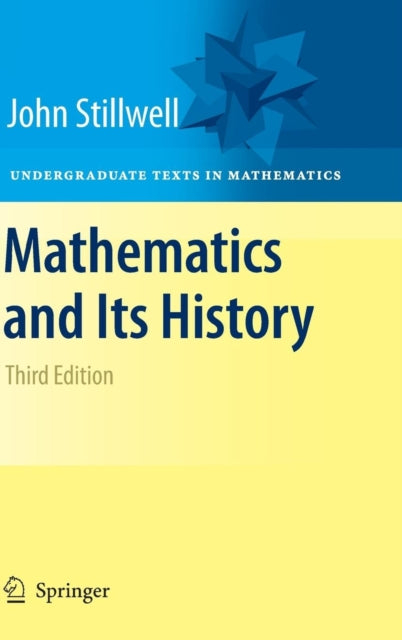
Springer-Verlag New York Inc. Mathematics and Its History
Book SynopsisFrom a review of the second edition:"This book covers many interesting topics not usually covered in a present day undergraduate course, as well as certain basic topics such as the development of the calculus and the solution of polynomial equations. The fact that the topics are introduced in their historical contexts will enable students to better appreciate and understand the mathematical ideas involved...If one constructs a list of topics central to a history course, then they would closely resemble those chosen here."(David Parrott, Australian Mathematical Society)This book offers a collection of historical essays detailing a large variety of mathematical disciplines and issues; it's accessible to a broad audience. This third edition includes new chapters on simple groups and new sections on alternating groups and the Poincare conjecture. Many more exercises have been added as well as commentary that helps place the exercises in context.Trade Review“Mathematics and Its History is an original, engaging and effective book, which I think would be enjoyed by students, lay readers with the right background, or indeed mathematicians themselves.” (Danny Yee, Danny Yee's Book Reviews, dannyreviews.com, March, 2019)From the reviews of the third edition:"The author’s goal for Mathematics and its History is to provide a “bird’s-eye view of undergraduate mathematics.” (p. vii) In that regard it succeeds admirably. ... Mathematics and its History is a joy to read. The writing is clear, concise and inviting. The style is very different from a traditional text. ... The author has done a wonderful job of tying together the dominant themes of undergraduate mathematics. ... While Stillwell does a wonderful job of tying together seemingly unrelated areas of mathematics, it is possible to read each chapter independently. I would recommend this fine book for anyone who has an interest in the history of mathematics. For those who teach mathematics, it provides lots of information which could easily be used to enrich an opening lecture in most any undergraduate course. It would be an ideal gift for a department’s outstanding major or for the math club president. Pick it up at your peril — it is hard to put down!"(Richard Wilders, MAA Reviews)“I appreciate and recommend Stillwell’s presentation of mathematics and history written in a lively style. The author’s concept (history mostly as the means of approaching mathematics) remains a matter of interest for both the mathematician and the historian … .” (Rüdiger Thiele, Zentralblatt MATH, Vol. 1207, 2011)From the reviews of the second edition:"This book covers many interesting topics not usually covered in a present day undergraduate course, as well as certain basic topics such as the development of the calculus and the solution of polynomial equations. The fact that the topics are introduced in their historical contexts will enable students to better appreciate and understand the mathematical ideas involved...If one constructs a list of topics central to a history course, then they would closely resemble those chosen here."(David Parrott, Australian Mathematical Society)"The book...is presented in a lively style without unnecessary detail. It is very stimulating and will be appreciated not only by students. Much attention is paid to problems and to the development of mathematics before the end of the nineteenth century... This book brings to the non-specialist interested in mathematics many interesting results. It can be recommended for seminars and will be enjoyed by the broad mathematical community." (European Mathematical Society)"Since Stillwell treats many topics, most mathematicians will learn a lot from this book as well as they will find pleasant and rather clear expositions of custom materials. The book is accessible to students that have already experienced calculus, algebra and geometry and will give them a good account of how the different branches of mathematics interact."(Denis Bonheure, Bulletin of the Belgian Society)Table of ContentsPreface to the Third Edition.- Preface to the Second Edition.- Preface to the First Edition.- The Theorem of Pythagoras.- Greek Geometry.- Greek Number Theory.- Infinity in Greek Mathematics.- Number Theory in Asia.- Polynomial Equations.- Analytic Geometry.- Projective Geometry.- Calculus.- Infinite Series.- The Number Theory Revival.- Elliptic Functions.- Mechanics.- Complex Numbers in Algebra.- Complex Numbers and Curves.- Complex Numbers and Functions.- Differential Geometry.- Non-Euclidean Geometry.- Group Theory.- Hypercomplex Numbers.- Algebraic Number Theory.- Topology.- Simple Groups.- Sets, Logic, and Computation.- Combinatorics.- Bibliography.- Index.-
£47.49

American Mathematical Society Curvature of Space and Time with an Introduction
Book SynopsisIntroduces advanced undergraduates to Riemannian geometry and mathematical general relativity. The overall strategy of the book is to explain the concept of curvature via the Jacobi equation which, through discussion of tidal forces, further helps motivate the Einstein field equations.Table of Contents Introduction to Riemannian geometry Differential calculus with tensors Curvature General relativity Introduction to geometry analysis Bibliography Index
£54.15

Springer Nature Switzerland AG Probability with Statistical Applications
Book SynopsisThis second edition textbook offers a practical introduction to probability for undergraduates at all levels with different backgrounds and views towards applications. Calculus is a prerequisite for understanding the basic concepts, however the book is written with a sensitivity to students’ common difficulties with calculus that does not obscure the thorough treatment of the probability content. The first six chapters of this text neatly and concisely cover the material traditionally required by most undergraduate programs for a first course in probability. The comprehensive text includes a multitude of new examples and exercises, and careful revisions throughout. Particular attention is given to the expansion of the last three chapters of the book with the addition of one entirely new chapter (9) on ’Finding and Comparing Estimators.’ The classroom-tested material presented in this second edition forms the basis for a second course introducing mathematical statistics.Table of ContentsProbability Space.- Conditional probabilities.- Discrete random variables.- Binomial random variables.- Poisson random variables.- Simulations of discrete random variables.- Combinatorics.- Continuous random variables.- The sample average and sample.- Estimating and testing proportions.- Estimating and testing means.- Small samples.- Chi-squared tests.- Design of experiments.- The cumulative distribution function.- Continuous joint distributions.- Covariance and independence.- Conditional distribution and expectation.- The bivariate normal distribution.- Sums of Bernoulli random variables.- Coupling random variables.- The moment generating function.- The chi-squared, Student and F distributions.- Sampling from a normal distribution.- Finding estimators.- Comparing estimators.- Best unbiased estimators.- Bayes’ estimator.- Multiple linear regression.- List of common discrete distributions.- List of common continuous distributions.- Further reading.- Normal table.- Student table.- Chi-squared table.- Index.
£39.99

Springer International Publishing AG Engineering Statistics: An Introduction
Book SynopsisThis book presents a concise and focused introduction to engineering statistics, emphasizing topics and concepts that a practicing engineer is mostly likely to use: the display of data, confidence intervals, hypothesis testing, fitting straight lines to data, and designing experiments to find the impact of process changes on a system or its output. It introduces the language of statistics, derives equations with sufficient detail so that there is no mystery as to how they came about, makes extensive use of tables to collect and summarize important formulas and concepts, and utilizes enhanced graphics that are packed with visual information to illustrate the meaning of the equations and their usage. The book can be used as an introduction to the subject, to refresh one’s knowledge of engineering statistics, to complement course materials, as a study guide, and to provide a resource in laboratories where data acquisition and analysis are performed.Created specifically for the book are 16 interactive graphics (IGs) that can be used to replicate all numerical calculations appearing in the book and many of its figures, numerically evaluate all formulas appearing in tables, solve all exercises, and determine probabilities and critical values for commonly used probability distributions. After downloading a free program, the IGs are ready to use and are self-explanatory in the context of the material.Table of Contents- 1. Descriptive Statistics and Discrete Probability Distributions. - 2. Continuous Probability Distributions, Confidence Intervals, and Hypothesis Testing. - 3. Regression Analysis and the Analysis of Variance. - 4. Experimental Design. - Appendix A: Moment Generating Function.
£38.24

Birkhauser Verlag AG Mathematics Research for the Beginning Student,
Book SynopsisMathematics research opportunities for undergraduate students have grown significantly in recent years, but accessible research topics for first- and second-year students with minimal experience beyond high school mathematics are still hard to find. To address this need, this volume provides beginning students with specific research projects and the tools required to tackle them. Most of these projects are accessible to students who have not yet taken Calculus, but students who know some Calculus will find plenty to do here as well. Chapters are self-contained, presenting projects students can pursue, along with essential background material and suggestions for further reading. Suggested prerequisites are noted at the beginning of each chapter. Some topics covered include: games on graphs modeling of biological systems mosaics and virtual knots mathematics for sustainable humanity mathematical epidemiology Mathematics Research for the Beginning Student, Volume 1 will appeal to undergraduate students at two- and four-year colleges who are interested in pursuing mathematics research projects. Faculty members interested in serving as advisors to these students will find ideas and guidance as well. This volume will also be of interest to advanced high school students interested in exploring mathematics research for the first time. A separate volume with research projects for students who have already studied calculus is also available.Table of ContentsGames on Graphs.- Mathematics for Sustainable Humanity--Population, Climate, Energy, Economy, Policy, and Social Justice.- Mosaics and Virtual Knots.- Graph Labelings: A Prime Area to Explore.- Acrobatics in a Parametric Arena.- But Who Should Have Won? Simulating Outcomes of Judging Protocols and Ranking Systems.- Modeling of biological systems: from algebra to calculus and computer simulations.- Population Dynamics of Infectious Diseases.- Playing with Knots.
£43.99

Springer International Publishing AG Advanced Graph Theory
Book Synopsis
£43.99
Introduction to Probability Models
Book SynopsisTable of Contents1. Introduction to Probability Theory 2. Random Variables 3. Conditional Probability and Conditional Expectation 4. Markov Chains 5. The Exponential Distribution and the Poisson Process 6. Continuous-Time Markov Chains 7. Renewal Theory and Its Applications 8. Queueing Theory 9. Reliability Theory 10. Brownian Motion and Stationary Processes 11. Simulation 12. Coupling 13. Martingales
£999.99

Pearson Education Limited Thomas Calculus Early Transcendentals SI Units
Book SynopsisTable of Contents1. Functions 1.1 Functions and Their Graphs 1.2 Combining Functions; Shifting and Scaling Graphs 1.3 Trigonometric Functions 1.5 Exponential Functions 1.6 Inverse Functions and Logarithms Questions to Guide Your Review Practice Exercises Additional and Advanced Exercises Technology Application Projects 2. Limits and Continuity 2.1 Rates of Change and Tangent Lines to Curves 2.2 Limit of a Function and Limit Laws 2.3 The Precise Definition of a Limit 2.4 One-Sided Limits 2.5 Continuity 2.6 Limits Involving Infinity; Asymptotes of Graphs Questions to Guide Your Review Practice Exercises Additional and Advanced Exercises Technology Application Projects 3. Derivatives 3.1 Tangent Lines and the Derivative at a Point 3.2 The Derivative as a Function 3.3 Differentiation Rules 3.4 The Derivative as a Rate of Change 3.5 Derivatives of Trigonometric Functions 3.6 The Chain Rule 3.7 Implicit Differentiation 3.8 Derivatives of Inverse Functions and Logarithms 3.9 Inverse Trigonometric Functions 3.10 Related Rates 3.11 Linearization and Differentials Questions to Guide Your Review Practice Exercises Additional and Advanced Exercises Technology Application Projects 4. Applications of Derivatives 4.1 Extreme Values of Functions on Closed Intervals 4.2 The Mean Value Theorem 4.3 Monotonic Functions and the First Derivative Test 4.4 Concavity and Curve Sketching 4.5 Indeterminate Forms and L'Hôpital's Rule 4.6 Applied Optimization 4.7 Newton's Method 4.8 Antiderivatives Questions to Guide Your Review Practice Exercises Additional and Advanced Exercises Technology Application Projects 5. Integrals 5.1 Area and Estimating with Finite Sums 5.2 Sigma Notation and Limits of Finite Sums 5.3 The Definite Integral 5.4 The Fundamental Theorem of Calculus 5.5 Indefinite Integrals and the Substitution Method 5.6 Definite Integral Substitutions and the Area Between Curves Questions to Guide Your Review Practice Exercises Additional and Advanced Exercises Technology Application Projects 6. Applications of Definite Integrals 6.1 Volumes Using Cross-Sections 6.2 Volumes Using Cylindrical Shells 6.3 Arc Length 6.4 Areas of Surfaces of Revolution 6.5 Work and Fluid Forces 6.6 Moments and Centers of Mass Questions to Guide Your Review Practice Exercises Additional and Advanced Exercises Technology Application Projects 7. Integrals and Transcendental Functions 7.1 The Logarithm Defined as an Integral 7.2 Exponential Change and Separable Differential Equations 7.3 Hyperbolic Functions 7.4 Relative Rates of Growth Questions to Guide Your Review Practice Exercises Additional and Advanced Exercises 8. Techniques of Integration 8.1 Using Basic Integration Formulas 8.2 Integration by Parts 8.3 Trigonometric Integrals 8.4 Trigonometric Substitutions 8.5 Integration of Rational Functions by Partial Fractions 8.6 Integral Tables and Computer Algebra Systems 8.7 Numerical Integration 8.8 Improper Integrals Questions to Guide Your Review Practice Exercises Additional and Advanced Exercises Technology Application Projects 9. Infinite Sequences and Series 9.1 Sequences 9.2 Infinite Series 9.3 The Integral Test 9.4 Comparison Tests 9.5 Absolute Convergence; The Ratio and Root Tests 9.6 Alternating Series and Conditional Convergence 9.7 Power Series 9.8 Taylor and Maclaurin Series 9.9 Convergence of Taylor Series 9.10 Applications of Taylor Series Questions to Guide Your Review Practice Exercises Additional and Advanced Exercises Technology Application Projects 10. Parametric Equations and Polar Coordinates 10.1 Parametrizations of Plane Curves 10.2 Calculus with Parametric Curves 10.3 Polar Coordinates 10.4 Graphing Polar Coordinate Equations 10.5 Areas and Lengths in Polar Coordinates 10.6 Conic Sections 10.7 Conics in Polar Coordinates Questions to Guide Your Review Practice Exercises Additional and Advanced Exercises Technology Application Projects 11. Vectors and the Geometry of Space 11.1 Three-Dimensional Coordinate Systems 11.2 Vectors 11.3 The Dot Product 11.4 The Cross Product 11.5 Lines and Planes in Space 11.6 Cylinders and Quadric Surfaces Questions to Guide Your Review Practice Exercises Additional and Advanced Exercises Technology Application Projects 12. Vector-Valued Functions and Motion in Space 12.1 Curves in Space and Their Tangents 12.2 Integrals of Vector Functions; Projectile Motion 12.3 Arc Length in Space 12.4 Curvature and Normal Vectors of a Curve 12.5 Tangential and Normal Components of Acceleration 13.6 Velocity and Acceleration in Polar Coordinates Questions to Guide Your Review Practice Exercises Additional and Advanced Exercises Technology Application Projects 13. Partial Derivatives 13.1 Functions of Several Variables 13.2 Limits and Continuity in Higher Dimensions 13.3 Partial Derivatives 13.4 The Chain Rule 13.5 Directional Derivatives and Gradient Vectors 13.6 Tangent Planes and Differentials 13.7 Extreme Values and Saddle Points 13.8 Lagrange Multipliers 13.9 Taylor's Formula for Two Variables 13.10 Partial Derivatives with Constrained Variables Questions to Guide Your Review Practice Exercises Additional and Advanced Exercises Technology Application Projects 14. Multiple Integrals 14.1 Double and Iterated Integrals over Rectangles 14.2 Double Integrals over General Regions 14.3 Area by Double Integration 14.4 Double Integrals in Polar Form 14.5 Triple Integrals in Rectangular Coordinates 14.6 Applications 14.7 Triple Integrals in Cylindrical and Spherical Coordinates 14.8 Substitutions in Multiple Integrals Questions to Guide Your Review Practice Exercises Additional and Advanced Exercises Technology Application Projects 15. Integrals and Vector Fields 15.1 Line Integrals of Scalar Functions 15.2 Vector Fields and Line Integrals: Work, Circulation, and Flux 15.3 Path Independence, Conservative Fields, and Potential Functions 15.4 Green's Theorem in the Plane 15.5 Surfaces and Area 15.6 Surface Integrals 15.7 Stokes' Theorem 15.8 The Divergence Theorem and a Unified Theory Questions to Guide Your Review Practice Exercises Additional and Advanced Exercises Technology Application Projects 16. First-Order Differential Equations 16.1 Solutions, Slope Fields, and Euler's Method 16.2 First-Order Linear Equations 16.3 Applications 16.4 Graphical Solutions of Autonomous Equations 16.5 Systems of Equations and Phase Planes Questions to Guide Your Review Practice Exercises Technology Application Projects 17. Second-Order Differential Equations 17.1 Second-Order Linear Equations 17.2 Nonhomogeneous Linear Equations 17.3 Applications 17.4 Euler Equations 17.5 Power-Series Solutions Questions to Guide Your Review Practice Exercises Additional and Advanced Exercises Technology Application Projects 18. Complex Functions (online) 18.1 Complex Numbers 18.2 Limits and Continuity 18.3 Complex Derivatives 18.4 The Cauchy-Riemann Equations 18.5 Complex Series 18.6 Conformal Maps 19. Fourier Series and Wavelets (online) 19.1 Periodic Functions 19.2 Summing Sines and Cosines 19.3 Vectors and Approximation in Three and More Dimensions 19.4 Approximation of Functions 19.5 Advanced Topic: The Haar System and Wavelets Appendix A A.1 Real Numbers and the Real Line A.2 Graphing with Software A.3 Mathematical Induction A.4 Lines, Circles, and Parabolas A.5 Proofs of Limit Theorems A.6 Commonly Occurring Limits A.7 Theory of the Real Numbers A.8 The Distributive Law for Vector Cross Products A.9 Probability A.10 The Mixed Derivative Theorem and the Increment Theorem Appendix B B.1 Determinants B.2 Extreme Values and Saddle Points for Functions of More than Two Variables B.3 The Method of Gradient Descent Answers to Odd-Numbered Exercises Applications Index Subject Index A Brief Table of Integrals Credits
£74.09

Pearson Education Linear Algebra
Book SynopsisTable of Contents 1. Vector Spaces. Introduction. Vector Spaces. Subspaces. Linear Combinations and Systems of Linear Equations. Linear Dependence and Linear Independence. Bases and Dimension. Maximal Linearly Independent Subsets. 2. Linear Transformations and Matrices. Linear Transformations, Null Spaces, and Ranges. The Matrix Representation of a Linear Transformation. Composition of Linear Transformations and Matrix Multiplication. Invertibility and Isomorphisms. The Change of Coordinate Matrix. Dual Spaces. Homogeneous Linear Differential Equations with Constant Coefficients. 3. Elementary Matrix Operations and Systems of Linear Equations. Elementary Matrix Operations and Elementary Matrices. The Rank of a Matrix and Matrix Inverses. Systems of Linear Equations—Theoretical Aspects. Systems of Linear Equations—Computational Aspects. 4. Determinants. Determinants of Order 2. Determinants of Order n. Properties of Determinants. Summary—Important Facts about Determinants. A Characterization of the Determinant. 5. Diagonalization. Eigenvalues and Eigenvectors. Diagonalizability. Matrix Limits and Markov Chains. Invariant Subspaces and the Cayley-Hamilton Theorem. 6. Inner Product Spaces. Inner Products and Norms. The Gram-Schmidt Orthogonalization Process and Orthogonal Complements. The Adjoint of a Linear Operator. Normal and Self-Adjoint Operators. Unitary and Orthogonal Operators and Their Matrices. Orthogonal Projections and the Spectral Theorem. The Singular Value Decomposition and the Pseudoinverse. Bilinear and Quadratic Forms. Einstein's Special Theory of Relativity. Conditioning and the Rayleigh Quotient. The Geometry of Orthogonal Operators. Appendices. Sets. Functions. Fields. Complex Numbers. Polynomials. Answers to Selected Exercises. Index.
£65.54

Cengage Learning, Inc Calculus Metric Edition
Book SynopsisTable of ContentsPreface. ��� To the Student. ��� Diagnostic Tests. A Preview of Calculus. 1. FUNCTIONS AND LIMITS. Four Ways to Represent a Function. Mathematical Models: A Catalog of Essential Functions. New Functions from Old Functions. The Tangent and Velocity Problems. The Limit of a Function. Calculating Limits Using the Limit Laws. The Precise Definition of a Limit. Continuity. Review. Principles of Problem Solving.��� 2. DERIVATIVES. Derivatives and Rates of Change. Writing Project: Early Methods for Finding Tangents. The Derivative as a Function. Differentiation Formulas. Applied Project: Building a Better Roller Coaster. Derivatives of Trigonometric Functions. The Chain Rule. Applied Project: Where Should a Pilot Start Descent? Implicit Differentiation. Discovery Project: Families of Implicit Curves. Rates of Change in the Natural and Social Sciences. Related Rates. Linear Approximations and Differentials. Discovery Project: Polynomial Approximations. Review. Problems Plus. 3. APPLICATIONS OF DIFFERENTIATION. Maximum and Minimum Values. Applied Project: The Calculus of Rainbows. The Mean Value Theorem. What Derivatives Tell Us About the Shape of a Graph. Limits at Infinity; Horizontal Asymptotes. Summary of Curve Sketching. Graphing with Calculus and Technology. Optimization Problems. Applied Project: The Shape of a Can.��� Applied Project: Planes and Birds: Minimizing Energy. Newton���s Method. Antiderivatives. Review. Problems Plus.��� 4. INTEGRALS. The Area and Distance Problems. The Definite Integral. Discovery Project: Area Functions. The Fundamental Theorem of Calculus. Indefinite Integrals and the Net Change Theorem. Writing Project: Newton, Leibniz, and the Invention of Calculus. The Substitution Rule. Review. Problems Plus. 5. APPLICATIONS OF INTEGRATION. Areas Between Curves. Applied Project: The Gini Index. Volumes. Volumes by Cylindrical Shells. Work. Average Value of a Function. Applied Project: Calculus and Baseball. Review. Problems Plus. 6. INVERSE FUNCTIONS: EXPONENTIAL, LOGARITHMIC, AND INVERSE TRIGONOMETRIC FUNCTIONS. Inverse Functions. Instructors may cover either Sections 6.2���6.4 or Sections 6.2*���6.4*. Exponential Functions and Their Derivatives. Logarithmic Functions. Derivatives of Logarithmic Functions. The Natural Logarithmic Function. The Natural Exponential Function. General Logarithmic and Exponential Functions. Exponential Growth and Decay. Applied Project: Controlling Red Blood Cell Loss During Surgery. Inverse Trigonometric Functions. Applied Project: Where to Sit at the Movies. Hyperbolic Functions. Indeterminate Forms and l���Hospital���s Rule. Writing Project: The Origins of l���Hospital���s Rule. Review. Problems Plus.��� 7. TECHNIQUES OF INTEGRATION. Integration by Parts. Trigonometric Integrals. Trigonometric Substitution. Integration of Rational Functions by Partial Fractions. Strategy for Integration. Integration Using Tables and Technology. Discovery Project: Patterns in Integrals. Approximate Integration. Improper Integrals. Review. Problems Plus. 8. FURTHER APPLICATIONS OF INTEGRATION. Arc Length. Discovery Project: Arc Length Contest. Area of a Surface of Revolution. Discovery Project: Rotating on a Slant. Applications to Physics and Engineering. Discovery Project: Complementary Coffee Cups. Applications to Economics and Biology. Probability. Review. Problems Plus. 9. DIFFERENTIAL EQUATIONS. Modeling with Differential Equations. Direction Fields and Euler���s Method. Separable Equations. Applied Project: How Fast Does a Tank Drain? Models for Population Growth. Linear Equations. Applied Project: Which Is Faster, Going Up or Coming Down? Predator-Prey Systems. Review. Problems Plus. 10. PARAMETRIC EQUATIONS AND POLAR COORDINATES. Curves Defined by Parametric Equations. Discovery Project: Running Circles Around Circles. Calculus with Parametric Curves. Discovery Project: B��zier Curves. Polar Coordinates. Discovery Project: Families of Polar Curves. Calculus in Polar Coordinates. Conic Sections. Conic Sections in Polar Coordinates. Review. Problems Plus. 11. SEQUENCES, SERIES, AND POWER SERIES. Sequences. Discovery Project: Logistic Sequences. Series. The Integral Test and Estimates of Sums. The Comparison Tests. Alternating Series and Absolute Convergence. The Ratio and Root Tests. Strategy for Testing Series. Power Series. Representations of Functions as Power Series. Taylor and Maclaurin Series. Discovery Project: An Elusive Limit. Writing Project: How Newton Discovered the Binomial Series. Applications of Taylor Polynomials. Applied Project: Radiation from the Stars. Review. Problems Plus. 12. VECTORS AND THE GEOMETRY OF SPACE. Three-Dimensional Coordinate Systems. Vectors. Discovery Project: The Shape of a Hanging Chain. The Dot Product. The Cross Product. Discovery Project: The Geometry of a Tetrahedron. Equations of Lines and Planes. Discovery Project: Putting 3D in Perspective. Cylinders and Quadric Surfaces. Review. Problems Plus. 13. VECTOR FUNCTIONS. Vector Functions and Space Curves. Derivatives and Integrals of Vector Functions. Arc Length and Curvature. Motion in Space: Velocity and Acceleration. Applied Project: Kepler���s Laws. Review. Problems Plus. 14. PARTIAL DERIVATIVES. Functions of Several Variables. Limits and Continuity. Partial Derivatives. Discovery Project: Deriving the Cobb-Douglas Production Function. Tangent Planes and Linear Approximations. Applied Project: The Speedo LZR Racer. The Chain Rule. Directional Derivatives and the Gradient Vector. Maximum and Minimum Values. Discovery Project: Quadratic Approximations and Critical Points. Lagrange Multipliers. Applied Project: Rocket Science. Applied Project: Hydro-Turbine Optimization. Review. Problems Plus. 15. MULTIPLE INTEGRALS. Double Integrals over Rectangles. Double Integrals over General Regions. Double Integrals in Polar Coordinates. Applications of Double Integrals. Surface Area. Triple Integrals. Discovery Project: Volumes of Hyperspheres. Triple Integrals in Cylindrical Coordinates. Discovery Project: The Intersection of Three Cylinders. Triple Integrals in Spherical Coordinates. Applied Project: Roller Derby. Change of Variables in Multiple Integrals. Review. Problems Plus. 16. VECTOR CALCULUS. Vector Fields. Line Integrals. The Fundamental Theorem for Line Integrals. Green���s Theorem. Curl and Divergence. Parametric Surfaces and Their Areas. Surface Integrals. Stokes��� Theorem. The Divergence Theorem. Summary. Review. Problems Plus. APPENDIXES. Numbers, Inequalities, and Absolute Values. Coordinate Geometry and Lines. Graphs of Second-Degree Equations. Trigonometry. Sigma Notation. Proofs of Theorems. Answers to Odd-Numbered Exercises. INDEX.
£73.99

No Starch Press,US Bayesian Statistics The Fun Way
Book SynopsisBayesian Statistics the Fun Way gets you understanding the theory behind data analysis without making you slog through a load of dry concepts first - with no programming experience necessary. You'll learn about probability with LEGO, statistics through Star Wars, distributions with bomb fuses, estimation through precipitation, and come away with some strong mathematical reasoning skills. This is a super approachable book for people who need to do data science and probability work in their lives, but never got a good grip on the underlying theory.Trade Review"An excellent introduction to subjects critical to all data scientists."—Inside Big Data"The author uses great examples to clarify key concepts . . . I would highly recommend as a supplement for any stats student or professional looking to refresh on Bayesian statistics." —Stan T., Design Collective
£28.04

Algebra and Trigonometry
Book SynopsisThis bestselling author team explains concepts simply and clearly, without glossing over difficult points. Problem solving and mathematical modeling are introduced early and reinforced throughout, providing students with a solid foundation in the principles of mathematical thinking. Comprehensive and evenly paced, the book provides complete coverage of the function concept, and integrates a significant amount of graphing calculator material to help students develop insight into mathematical ideas. The authors' attention to detail and claritythe same as found in James Stewart's market-leading Calculus bookis what makes this book the market leader.Table of ContentsPreface. To the Student. Prologue: Principles of Problem Solving. P. PREREQUISITES. P1. Modeling the Real-World with Algebra. P2. The Real Numbers. P3. Integer Exponents and Scientific Notation. P4. Rational Exponents and Radicals. P5. Algebraic Expressions. P6. Factoring. P7. Rational Expressions. P8. Solving Basic Equations. P9. Modeling with Equations. Chapter P Review. Chapter P Test. FOCUS ON MODELING: MAKING THE BEST DECISIONS. 1. EQUATIONS AND GRAPHS. 1.1 The Coordinate Plane. 1.2 Graphs of Equations in Two Variables; Circles. 1.3 Lines. 1.4 Solving Quadratic Equations. 1.5 Complex Numbers. 1.6 Solving Other Types of Equations. 1.7 Solving Inequalities. 1.8 Solving Absolute Value Equations and Inequalities. 1.9 Solving Equations and Inequalities Graphically. 1.10 Modeling Variations. Chapter 1 Review. Chapter 1 Test. FOCUS ON MODELING: Fitting Lines to Data. 2. FUNCTIONS. Chapter Overview.2.1 Functions. 2.2 Graphs of Functions. 2.3 Getting Information from the Graph of a Function. 2.4 Average Rate of Change of a Function. 2.5 Linear Functions and Models. 2.6 Transformations of Functions. 2.7 Combining Functions. 2.8 One-to-One Functions and Their Inverses. Chapter 2 Review. Chapter 2 Test. FOCUS ON MODELING: MODELING WITH FUNCTIONS. 3. POLYNOMIAL AND RATIONAL FUNCTIONS. Chapter Overview. 3.1. Quadratic Functions and Models. 3.2 Polynomial Functions and Their Graphs. 3.3 Dividing Polynomials. 3.4 Real Zeros of Polynomials. 3.5 Complex Zeros and the Fundamental Theorem of Algebra. 3.6 Rational Functions. 3.7 Polynomial and Rational Inequalities. Chapter 3 Review. Chapter 3 Test. FOCUS ON MODELING: FITTING POLYNOMIAL CURVES TO DATA. 4. EXPONENTIAL AND LOGARITHMIC FUNCTIONS. Chapter Overview. 4.1 Exponential Functions. 4.2 The Natural Exponential Function. 4.3 Logarithmic Functions. 4.4 Laws of Logarithms. 4.5 Exponential and Logarithmic Equations. 4.6 Modeling with Exponential Functions. 4.7 Logarithmic Scales. Chapter 4 Review. Chapter 4 Test. FOCUS ON MODELING: FITTING EXPONENTIAL AND POWER CURVES TO DATA. 5. TRIGONOMETRIC FUNCTIONS: RIGHT TRIANGLE APPROACH. Chapter Overview. 5.1 Angle Measure. 5.2 Trigonometry of Right Triangles. 5.3 Trigonometric Functions of Angles. 5.4 Inverse Trigonometric Functions and Triangles. 5.5 The Law of Sines. 5.6 The Law of Cosines. 5.7 Chapter 5 Review. Chapter 5 Test. FOCUS ON MODELING: SURVEYING. 1.TRIGONOMETRIC FUNCTIONS: UNIT CIRCLE APPROACH. Chapter Overview. 6.1 The Unit Circle. 6.2 Trigonometric Functions of Real Numbers. 6.3 Trigonometric Graphs. 6.4 More Trigonometric Graphs. 6.5 Inverse Trigonometric Functions and Their Graphs. 6.6 Modeling Harmonic Motion. Chapter 6 Review. Chapter 6 Test. FOCUS ON MODELING: FITTING SINUSOIDAL CURVES TO DATA. 7. CONIC SECTIONS. Chapter Overview. 7.1 Trigonometric Identities. 7.2 Addition and Subtraction Formulas. 7.3 Double-Angle, Half-Angle, and Sum-Product Formulas. 7.4 Basic Trigonometric Equations. 7.5 More Trigonometric Equations. Chapter 7 Review. Chapter 7 Test. FOCUS ON MODELING: TRAVELING AND STANDING WAVES. 8. POLAR COORDINATES AND PARAMETRIC EQUATIONS. Chapter Overview. 8.1 Polar Coordinates. 8.2 Graphs of Polar Equations. 8.3 Polar Form of Complex Numbers; De Moivre's Theorem. 8.4 Plane Curves and Parametric Equations. Chapter 8 Review. Chapter 8 Test. FOCUS ON MODELING: THE PATH OF A PROJECTILE. 9. VECTORS IN TWO AND THREE DIMENSIONS. Chapter Overview. 9.1 Vectors in Two Dimensions. 9.2 The Dot Product. 9.3 Three���Dimensional Coordinate Geometry. 9.4 Vectors in Three Dimensions. 9.5 The Cross Product. 9.6 Equations of Lines and Planes. Chapter 9 Review. Chapter 9 Test. FOCUS ON MODELING: VECTOR FIELDS. 10. SYSTEMS OF EQUATIONS AND INEQUALITIES. 10.1 Systems of Linear Equations in Two Variables. 10.2 Systems of Linear Equations in Several Variables. 10.3 Partial Fractions. 10.4 Systems of Nonlinear Equations. 10.5 Systems of Inequalities. Chapter 10 Review. Chapter 10 Test. FOCUS ON MODELING: LINEAR PROGRAMMING. 11. MATRICES AND DETERMINANTS. 11.1 Matrices and Systems of Linear Equations. 11.2 The Algebra of Matrices. 11.3 Inverses of Matrices and Matrix Equations. 11.4 Determinants and Cramer's Rule. Chapter 11 Review. Chapter 11 Test. FOCUS ON MODELING: COMPUTER GRAPHICS. 12. CONIC SECTIONS. Chapter Overview. 12.1 Parabolas. 12.2 Ellipses. 12.3 Hyperbolas. 12.4 Shifted Conics. 12.5 Rotation of Axes. 12.6 Polar Equations of Conics. Chapter 12 Review. Chapter 12 Test. FOCUS ON MODELING: CONICS IN ARCHITECTURE. 13. SEQUENCES AND SERIES. Chapter Overview. 13.1 Sequences and Summation Notation. 13.2 Arithmetic Sequences. 13.3 Geometric Sequences. 13.4 Mathematics of Finance. 13.5 Mathematical Induction. 13.6 The Binomial Theorem. Chapter 13 Review. Chapter 13 Test. FOCUS ON MODELING: MODELING WITH RECURSIVE SEQUENCES. 14. COUNTING AND PROBABILITY. 14.1 Counting. 14.2 Probability. 14.3 Binomial Probability. 14.4 Expected Value. Chapter 14 Review. Chapter 14 Test. FOCUS ON MODELING: THE MONTE CARLO METHOD. APPENDIX A: Geometry Review. APPENDIX B: Calculations and Significant Figures. APPENDIX C: Graphing with a Graphing Calculator. APPENDIX D: Using the TI-83/84 Graphing Calculator.
£81.99

HarperCollins Publishers KS3 Maths Advanced Revision Guide
Book SynopsisLevel: KS3Subject: Maths With clear and accessible explanations of all the KS3 content, this advanced Maths revision guide provides clear, concise revision notes, plus five practice opportunities for each topic.
£7.99

Wooden Books Islamic Design: A Genius for Geometry
Book SynopsisAcross the Islamic world, illuminating Korans from Morocco to Malaysia, and adorning mosques, mausoleums and palaces, are hidden some of the most exquisite geometrical devices ever conceived by man. In this excellent little book, geometer Daud Sutton unravels the mystery of Islamic patterns, explaining where they come from, how to draw them, and hinting at the Divine messages they encode. WOODEN BOOKS are small but packed with information. "Fascinating" FINANCIAL TIMES. "Beautiful" LONDON REVIEW OF BOOKS. "Rich and Artful" THE LANCET. "Genuinely mind-expanding" FORTEAN TIMES. "Excellent" NEW SCIENTIST. "Stunning" NEW YORK TIMES. Small books, big ideas.
£8.18

John Wiley & Sons Inc Biostatistics
Book SynopsisTable of ContentsPREFACE vii 1 INTRODUCTION TO BIOSTATISTICS 1 1.1 Introduction, 2 1.2 Basic Concepts and Definitions, 2 1.3 Measurement and Measurement Scales, 5 1.4 Sampling and Statistical Inference, 7Exercises, 12 1.5 The Scientific Method, 13Exercises, 15 1.6 Computers and Technology, 15 1.7 Summary, 16 Review Questions and Exercises, 16 References, 17 2 DESCRIPTIVE STATISTICS 18 2.1 Introduction, 19 2.2 The Ordered Array, 19 2.3 Frequency Tables, 21Exercises, 25 2.4 Measures of Central Tendency, 29 2.5 Measures of Dispersion, 34Exercises, 41 2.6 Visualizing Data, 43Exercises, 51 2.7 Summary, 51 Summary of Formulas for Chapter 2, 51 Review Questions and Exercises, 53 References, 56 3 SOME BASIC PROBABILITY CONCEPTS 57 3.1 Introduction, 57 3.2 Two Views of Probability: Objective and Subjective, 58 3.3 Elementary Properties of Probability, 60 3.4 Calculating the Probability of an Event, 61Exercises, 68 3.5 Bayes' Theorem, Screening Tests, Sensitivity, Specificity, and Predictive Value Positive and Negative, 69Exercises, 73 3.6 Summary, 74 Summary of Formulas for Chapter 3, 75 Review Questions and Exercises, 76 References, 79 4 PROBABILITY DISTRIBUTIONS 80 4.1 Introduction, 81 4.2 Probability Distributions of Discrete Variables, 81Exercises, 86 4.3 The Binomial Distribution, 87Exercises, 95 4.4 The Poisson Distribution, 96 Exercises, 1004.5 Continuous Probability Distributions, 101 4.6 The Normal Distribution, 103Exercises, 109 4.7 Normal Distribution Applications, 109Exercises, 113 4.8 Summary, 114 Summary of Formulas for Chapter 4, 114 Review Questions and Exercises, 115 References, 117 5 SOME IMPORTANT SAMPLING DISTRIBUTIONS 119 5.1 Introduction, 119 5.2 Sampling Distributions, 120 5.3 Distribution of the Sample Mean, 121Exercises, 128 5.4 Distribution of the Difference between Two Sample Means, 129Exercises, 133 5.5 Distribution of the Sample Proportion, 134Exercises, 136 5.6 Distribution of the Difference between Two Sample Proportions, 137Exercises, 139 5.7 Summary, 139 Summary of Formulas for Chapter 5, 140 Review Questions and Exercises, 140 References, 141 6 ESTIMATION 143 6.1 Introduction, 144 6.2 Confidence Interval for a Population Mean, 147Exercises, 152 6.3 The t Distribution, 153Exercises, 157 6.4 Confidence Interval for the Difference between Two Population Means, 158Exercises, 164 6.5 Confidence Interval for a Population Proportion, 165Exercises, 166 6.6 Confidence Interval for the Difference between Two Population Proportions, 167Exercises, 168 6.7 Determination of Sample Size for Estimating Means, 169Exercises, 171 6.8 Determination of Sample Size for Estimating Proportions, 171Exercises, 172 6.9 The Chi-Square Distribution and the Confidence Interval for the Variance of a Normally Distributed Population, 173Exercises, 177 6.10 The F-Distribution and the Confidence Interval for the Ratio of the Variances of Two Normally Distributed Populations, 177Exercises, 180 6.11 Summary, 181 Summary of Formulas for Chapter 6, 182 Review Questions and Exercises, 183 References, 186 7 HYPOTHESIS TESTING 189 7.1 Introduction, 190 7.2 Hypothesis Testing: A Single Population Mean, 200Exercises, 211 7.3 Hypothesis Testing: The Difference between Two Population Means, 213Exercises, 221 7.4 Paired Comparisons, 224Exercises, 229 7.5 Hypothesis Testing: A Single Population Proportion, 232Exercises, 234 7.6 Hypothesis Testing: The Difference between Two Population Proportions, 235Exercises, 236 7.7 Hypothesis Testing: A Single Population Variance, 238Exercises, 240 7.8 Hypothesis Testing: The Ratio of Two Population Variances, 241Exercises, 244 7.9 The Type II Error and the Power of a Test, 245Exercises, 249 7.10 Determining Sample Size to Control Type II Errors, 249Exercises, 251 7.11 Summary, 251 Summary of Formulas for Chapter 7, 252 Review Questions and Exercises, 254 References, 264 8 ANALYSIS OF VARIANCE 267 8.1 Introduction, 268 8.2 The Completely Randomized Design, 271Exercises, 289 8.3 The Randomized Complete Block Design, 294Exercises, 301 8.4 The Repeated Measures Design, 305Exercises, 313 8.5 The Factorial Experiment, 315Exercises, 326 8.6 Summary, 329 Summary of Formulas for Chapter 8, 329 Review Questions and Exercises, 331 References, 350 9 SIMPLE LINEAR REGRESSION AND CORRELATION 354 9.1 Introduction, 355 9.2 The Regression Model, 355 9.3 The Sample Regression Equation, 357Exercises, 364 9.4 Evaluating the Regression Equation, 366Exercises, 380 9.5 Using the Regression Equation, 380Exercises, 384 9.6 The Correlation Model, 384 9.7 The Correlation Coefficient, 386Exercises, 394 9.8 Some Precautions, 397 9.9 Summary, 398 Summary of Formulas for Chapter 9, 399 Review Questions and Exercises, 401 References, 413 10 MULTIPLE REGRESSION AND CORRELATION 416 10.1 Introduction, 417 10.2 The Multiple Linear Regression Model, 417 10.3 Obtaining the Multiple Regression Equation, 418Exercises, 423 10.4 Evaluating the Multiple Regression Equation, 427Exercises, 433 10.5 Using the Multiple Regression Equation, 433Exercises, 435 10.6 The Multiple Correlation Model, 435Exercises, 443 10.7 Summary, 446 Summary of Formulas for Chapter 10, 447 Review Questions and Exercises, 448 References, 454 11 REGRESSION ANALYSIS: SOME ADDITIONAL TECHNIQUES 455 11.1 Introduction, 455 11.2 Qualitative Independent Variables, 459Exercises, 472 11.3 Variable Selection Procedures, 474Exercises, 478 11.4 Logistic Regression, 485Exercises, 495 11.5 Poisson Regression, 497Exercises, 503 11.6 Summary, 504 Summary of Formulas for Chapter 11, 505 Review Questions and Exercises, 506 References, 517 12 ThE CHI-SQUARE DISTRIBUTION AND THE ANALYSIS OF FREQUENCIES 519 12.1 Introduction, 520 12.2 The Mathematical Properties of the Chi-Square Distribution, 520 12.3 Tests of Goodness-of-Fit, 523Exercises, 533 12.4 Tests of Independence, 535Exercises, 544 12.5 Tests of Homogeneity, 545Exercises, 551 12.6 The Fisher's Exact Test, 552Exercises, 557 12.7 Relative Risk, Odds Ratio, and the Mantel-Haenszel Statistic, 557Exercises, 567 12.8 Summary, 569 Summary of Formulas for Chapter 12, 570 Review Questions and Exercises, 571 References, 576 13 NONPARAMETRIC AND DISTRIBUTION-FREE STATISTICS 579 13.1 Introduction, 580 13.2 Measurement Scales, 581 13.3 The Sign Test, 581Exercises, 588 13.4 The Wilcoxon Signed-Rank Test for Location, 589Exercises, 593 13.5 The Median Test, 594Exercises, 596 13.6 The Mann–Whitney Test, 597Exercises, 602 13.7 The Kolmogorov–Smirnov Goodness-of-Fit Test, 604Exercises, 610 13.8 The Kruskal–Wallis One-Way Analysis of Variance by Ranks, 610Exercises, 615 13.9 The Friedman Two-Way Analysis of Variance by Ranks, 618Exercises, 622 13.10 The Spearman Rank Correlation Coefficient, 623Exercises, 629 13.11 Nonparametric Regression Analysis, 631Exercises, 634 13.12 Summary, 634 Summary of Formulas for Chapter 13, 635 Review Questions and Exercises, 636 References, 644 14 SURVIVAL ANALYSIS 646 14.1 Introduction, 647 14.2 Time-to-Event Data and Censoring, 647 14.3 The Kaplan–Meier Procedure, 651Exercises, 656 14.4 Comparing Survival Curves, 658Exercises, 661 14.5 Cox Regression: The Proportional Hazards Model, 663Exercises, 666 14.6 Summary, 667 Summary of Formulas for Chapter 14, 667 Review Questions and Exercises, 668 References, 669 15 VITAL STATISTICS 671 15.1 Introduction, 671 15.2 Death Rates and Ratios, 672Exercises, 677 15.3 Measures of Fertility, 679Exercises, 681 15.4 Measures of Morbidity, 682Exercises, 683 15.5 Summary, 683 Summary of Formulas for Chapter 15, 684 Review Questions and Exercises, 685 References, 686 INDEX 689 The following supplements are available through your instructor APPENDIX: STATISTICAL TABLES ANSWERS TO SELECTED PROBLEMS
£51.29

John Wiley & Sons Inc Practical Algebra
Book SynopsisTable of ContentsAcknowledgments vi Introduction vii 1 Basic Concepts 1 2 Fractions 21 3 Linear Equations 37 4 Ratios and Proportions 79 5 Linear Inequalities 111 6 Functions and Graphs with Two Variables 141 7 Linear Functions and their Graphs 173 8 Operations with Polynomials 233 9 Quadratic Functions 255 10 Exponential Functions 335 11 Sequences 353 12 Summary of Functions 373 13 Statistics 419 Formulas 477 Glossary of Mathematical Symbols 479 Glossary of Mathematical Terms 483 About the Authors 489 Index 491
£17.09
Taylor & Francis Ltd Mathematics of Tabletop Games
Book SynopsisMathematics of Tabletop Gamesprovides a bridge between mathematics and hobby tabletop gaming. Instead of focusing on games mathematicians play, such as nim and chomp, this book starts with the tabletop games played by avid gamers and hopes to address the question: which field of mathematics concerns itself with this situation?Readers interested in either mathematics or tabletop games will find this book an engaging way to begin exploring the other topic or the connection between the topics.Features Presents an entry-level exposition of interesting mathematical concepts that are not commonly taught outside of upper-level mathematics courses Acts as a resource for mathematics instructors who wish to provide new examples of standard mathematical concepts Features material that may help game designers and developers make design decisions about game mechanisms Provides working Python code that can be used to sol
£23.99

Pearson Education Limited Thomas Calculus SI Units
Book SynopsisJoel Hass received his PhD from the University of California - Berkeley. He is currently a professor of mathematics at the University of California - Davis. He has coauthored widely used calculus texts as well as calculus study guides. He is currently on the editorial board of several publications, including the Notices of the American Mathematical Society. He has been a member of the Institute for Advanced Study at Princeton University and of the Mathematical Sciences Research Institute, and he was a Sloan Research Fellow. Hass's current areas of research include the geometry of proteins, three dimensional manifolds, applied math, and computational complexity. In his free time, Hass enjoys kayaking. Christopher Heil received his PhD from the University of Maryland. He is currently a professor of mathematics at the Georgia Institute of Technology. He is the author of a graduate text on analysis and a number of highly cited research survey artTable of Contents1. Functions 1.1 Functions and Their Graphs 1.2 Combining Functions; Shifting and Scaling Graphs 1.3 Trigonometric Functions 1.4 Graphing with Software Questions to Guide Your Review Practice Exercises Additional and Advanced Exercises Technology Application Projects 2. Limits and Continuity 2.1 Rates of Change and Tangent Lines to Curves 2.2 Limit of a Function and Limit Laws 2.3 The Precise Definition of a Limit 2.4 One-Sided Limits 2.5 Limits Involving Infinity; Asymptotes of Graphs 2.6 Continuity Questions to Guide Your Review Practice Exercises Additional and Advanced Exercises Technology Application Projects 3. Derivatives 3.1 Tangent Lines and the Derivative at a Point 3.2 The Derivative as a Function 3.3 Differentiation Rules 3.4 The Derivative as a Rate of Change 3.5 Derivatives of Trigonometric Functions 3.6 The Chain Rule 3.7 Implicit Differentiation 3.8 Derivatives of Inverse Functions and Logarithms 3.9 Related Rates 3.10 Linearization and Differentials Questions to Guide Your Review Practice Exercises Additional and Advanced Exercises Technology Application Projects 4. Applications of Derivatives 4.1 Extreme Values of Functions on Closed Intervals 4.2 The Mean Value Theorem 4.3 Monotonic Functions and the First Derivative Test 4.4 Concavity and Curve Sketching 4.5 Applied Optimization 4.6 Newton's Method 4.7 Antiderivatives Questions to Guide Your Review Practice Exercises Additional and Advanced Exercises Technology Application Projects 5. Integrals 5.1 Area and Estimating with Finite Sums 5.2 Sigma Notation and Limits of Finite Sums 5.3 The Definite Integral 5.4 The Fundamental Theorem of Calculus 5.5 Indefinite Integrals and the Substitution Method 5.6 Definite Integral Substitutions and the Area Between Curves Questions to Guide Your Review Practice Exercises Additional and Advanced Exercises Technology Application Projects 6. Applications of Definite Integrals 6.1 Volumes Using Cross-Sections 6.2 Volumes Using Cylindrical Shells 6.3 Arc Length 6.4 Areas of Surfaces of Revolution 6.5 Work and Fluid Forces 6.6 Moments and Centers of Mass Questions to Guide Your Review Practice Exercises Additional and Advanced Exercises Technology Application Projects 7. Transcendental Functions 7.1 Inverse Functions and Their Derivatives 7.2 Natural Logarithms 7.3 Exponential Functions 7.4 Exponential Change and Separable Differential Equations 7.5 Indeterminate Forms and L'Hôpital's Rule 7.6 Inverse Trigonometric Functions 7.7 Hyperbolic Functions 7.8 Relative Rates of Growth Questions to Guide Your Review Practice Exercises Additional and Advanced Exercises 8. Techniques of Integration 8.1 Using Basic Integration Formulas 8.2 Integration by Parts 8.3 Trigonometric Integrals 8.4 Trigonometric Substitutions 8.5 Integration of Rational Functions by Partial Fractions 8.6 Integral Tables and Computer Algebra Systems 8.7 Numerical Integration 8.8 Improper Integrals Questions to Guide Your Review Practice Exercises Additional and Advanced Exercises Technology Application Projects 9. Infinite Sequences and Series 9.1 Sequences 9.2 Infinite Series 9.3 The Integral Test 9.4 Comparison Tests 9.5 Absolute Convergence; The Ratio and Root Tests 9.6 Alternating Series and Conditional Convergence 9.7 Power Series 9.8 Taylor and Maclaurin Series 9.9 Convergence of Taylor Series 9.10 Applications of Taylor Series Questions to Guide Your Review Practice Exercises Additional and Advanced Exercises Technology Application Projects 10. Parametric Equations and Polar Coordinates 10.1 Parametrizations of Plane Curves 10.2 Calculus with Parametric Curves 10.3 Polar Coordinates 10.4 Graphing Polar Coordinate Equations 10.5 Areas and Lengths in Polar Coordinates 10.6 Conic Sections 10.7 Conics in Polar Coordinates Questions to Guide Your Review Practice Exercises Additional and Advanced Exercises Technology Application Projects 11. Vectors and the Geometry of Space 11.1 Three-Dimensional Coordinate Systems 11.2 Vectors 11.3 The Dot Product 11.4 The Cross Product 11.5 Lines and Planes in Space 11.6 Cylinders and Quadric Surfaces Questions to Guide Your Review Practice Exercises Additional and Advanced Exercises Technology Application Projects 12. Vector-Valued Functions and Motion in Space 12.1 Curves in Space and Their Tangents 12.2 Integrals of Vector Functions; Projectile Motion 12.3 Arc Length in Space 12.4 Curvature and Normal Vectors of a Curve 12.5 Tangential and Normal Components of Acceleration 12.6 Velocity and Acceleration in Polar Coordinates Questions to Guide Your Review Practice Exercises Additional and Advanced Exercises Technology Application Projects 13. Partial Derivatives 13.1 Functions of Several Variables 13.2 Limits and Continuity in Higher Dimensions 13.3 Partial Derivatives 13.4 The Chain Rule 13.5 Directional Derivatives and Gradient Vectors 13.6 Tangent Planes and Differentials 13.7 Extreme Values and Saddle Points 13.8 Lagrange Multipliers 13.9 Taylor’s Formula for Two Variables 13.10 Partial Derivatives with Constrained Variables Questions to Guide Your Review Practice Exercises Additional and Advanced Exercises Technology Application Projects 14. Multiple Integrals 14.1 Double and Iterated Integrals over Rectangles 14.2 Double Integrals over General Regions 14.3 Area by Double Integration 14.4 Double Integrals in Polar Form 14.5 Triple Integrals in Rectangular Coordinates 14.6 Applications 14.7 Triple Integrals in Cylindrical and Spherical Coordinates 14.8 Substitutions in Multiple Integrals Questions to Guide Your Review Practice Exercises Additional and Advanced Exercises Technology Application Projects 15. Integrals and Vector Fields 15.1 Line Integrals of Scalar Functions 15.2 Vector Fields and Line Integrals: Work, Circulation, and Flux 15.3 Path Independence, Conservative Fields, and Potential Functions 15.4 Green’s Theorem in the Plane 15.5 Surfaces and Area 15.6 Surface Integrals 15.7 Stokes’ Theorem 15.8 The Divergence Theorem and a Unified Theory Questions to Guide Your Review Practice Exercises Additional and Advanced Exercises Technology Application Projects 16. First-Order Differential Equations 16.1 Solutions, Slope Fields, and Euler’s Method 16.1 Solutions, Slope Fields, and Euler’s Method 16.2 First-Order Linear Equations 16.3 Applications 16.4 Graphical Solutions of Autonomous Equations 16.5 Systems of Equations and Phase Planes Questions to Guide Your Review Practice Exercises Additional and Advanced Exercises Technology Application Projects 17. Second-Order Differential Equations (online) 17.1 Second-Order Linear Equations 17.2 Nonhomogeneous Linear Equations 17.3 Applications 17.4 Euler Equations 17.5 Power-Series Solutions 18. Complex Functions (online) 18.1 Complex Numbers 18.2 Functions of a Complex Variable 18.3 Derivatives 18.4 The Cauchy-Riemann Equations 18.5 Complex Power Series 18.6 Some Complex Functions 18.7 Conformal Maps Questions to Guide Your Review Additional and Advanced Exercises 19. Fourier Series and Wavelets (online) 19.1 Periodic Functions 19.2 Summing Sines and Cosines 19.3 Vectors and Approximation in Three and More Dimensions 19.4 Approximation of Functions 19.5 Advanced Topic: The Haar System and Wavelets Questions to Guide Your Review Additional and Advanced Exercises Appendix A A.1 Real Numbers and the Real Line A.2 Mathematical Induction A.3 Lines, Circles, and Parabolas A.4 Proofs of Limit Theorems A.5 Commonly Occurring Limits A.6 Theory of the Real Numbers A.7 Probability A.8 The Distributive Law for Vector Cross Products A.9 The Mixed Derivative Theorem and the Increment Theorem Appendix B (online) B.1 Determinants B.2 Extreme Values and Saddle Points for Functions of More than Two Variables B.3 The Method of Gradient Descent Answers to Odd-Numbered Exercises Applications Index Subject Index Credits A Brief Table of Integrals
£75.04

Bloomsbury Publishing PLC Wonders Beyond Numbers
Book SynopsisIn this book, Johnny Ball tells one of the most important stories in world history the story of mathematics. By introducing us to the major characters and leading us through many historical twists and turns, Johnny slowly unravels the tale of how humanity built up a knowledge and understanding of shapes, numbers and patterns from ancient times, a story that leads directly to the technological wonderland we live in today. As Galileo said, Everything in the universe is written in the language of mathematics', and Wonders Beyond Numbers is your guide to this language. Mathematics is only one part of this rich and varied tale; we meet many fascinating personalities along the way, such as a mathematician who everyone has heard of but who may not have existed; a Greek philosopher who made so many mistakes that many wanted his books destroyed; a mathematical artist who built the largest masonry dome on earth, which builders had previously declared impossible; a world-renowned pTrade ReviewThe great strength of this book is probably its wide coverage of practical applications of mathematics, especially in engineering and architecture. * The Mathematical Gazette *Johnny Ball's trademark enthusiasm for mathematics bubbles off every page. Clear, simple, readable, and informative – just as I expected. It's a winner! -- Ian Stewart, author of Significant FiguresI became an instant Johnny Ball fan when his TV series Think of a Number first aired in the UK, and I saw how he engaged and delighted my two young daughters in a way I, their maths professor dad, could not. With this new book, his passion for, and sheer enjoyment of, mathematics will surely entice yet more generations to the subject we both love. -- Keith Devlin, Stanford University mathematician, award-winning author and the 'Math Guy' on America's radio.I always found maths intriguing and baffling in equal measure - and the latter triumphed. If only I'd had Wonders Beyond Numbers when growing up. But I now have it and it is a re-awaking into a world of delight and wonder. It is a wonderful book. -- Anthony Seldon, Vice-Chancellor of the University of BuckinghamTable of ContentsPreface: Mathematics means everything to me... Wow Factor Mathematical Index Explained Introduction: Russian Sums in an English Pub, Circa 1946 Chapter 1: The Most Ancient Mathematical Legend Chapter 2: The First Two Great Mathematicians Chapter 3: The Great Age of Grecian Geeks Chapter 4: Archimedes – the Greatest Greek of Them All Chapter 5: The Glory That Was Alexandria Chapter 6: Total Eclipse of the Greeks Chapter 7: Maths Origins, Far and Wide Chapter 8: Mathematics Was Never a Religion Chapter 9: Discovering the Unknown World Chapter 10: The Huge Awakening and a New Age of Learning Chapter 11: The New Age of Mathematical Discovery Chapter 12: How to Calculate Anything and Everything Chapter 13: A Mathematician With Gravitas Chapter 14: The Simple Mathematics That Underpins Science Chapter 15: The Many Tentacles of Mathematics Wow Factor Mathematical Index Bibliography Image credits Index
£13.49

HarperCollins Publishers How Long is a Piece of String?: More hidden
Book Synopsis A fascinating book, from a leading maths educator and demystifier, that shows how maths is relevant to our everyday lives. Have you ever wondered how the meter in a taxi works? Or why a lift takes so long to respond to your call? Is there a mathematical secret to making a hit single? And how long is a piece of string? In this fascinating book you will find the answers to these and many other intriguing questions of everyday life. Discover the astonishing '37% rule' for blind dates, how to avoid the gentleman's urinal, and some extraordinary scams that people have devised to get rich quick. Here you will also find the origins of the seven-day week and the seven-note scale, an explanation of why underdogs sometimes win, some clever techniques for detecting fraud, and the reason why epidemics sweep across a nation and disappear just as quickly. How Long is a Piece of String? is the perfect book for anyone who is curious about the way in which maths underlies so much in our everyday lives. Whatever your mathematical ability level, you will find this book informative, thought-provoking and, most of all, fun. Word count: 35,000
£9.49

Princeton University Press Group Theory in a Nutshell for Physicists
Book SynopsisAlthough group theory is a mathematical subject, it is indispensable to many areas of modern theoretical physics, from atomic physics to condensed matter physics, particle physics to string theory. In particular, it is essential for an understanding of the fundamental forces. Yet until now, what has been missing is a modern, accessible, and self-coTrade ReviewHonorable Mention for the 2017 PROSE Award in Textbook/Best in Physical Sciences and Mathematics, Association of American Publishers "Another excellent entry in the 'Nutshell' series, Zee's latest has it all: broad scope, depth, thorough explanations, history, and an appealing sense of humor. The author's knowledge of mathematics and physics is encyclopedic, and he leavens the text generously with episodes and asides drawn from the life and work of the major figures in the development of group theory and its applications in physics."--Choice "In Group Theory in a Nutshell for Physicists, Anthony Zee ... combines clarity of presentation with mathematical detail at a level of rigor acceptable to physicists. The result is a tour de force that guides readers through the universe of group theory and leads them to recent particle physics, cosmology, and condensed matter. The book is unique in its laid-back presentation."--Physics Today "This book lives up to my high expectations and can stand shoulder to shoulder with Zee's other two Nutshell books."--Johannes Koelman, Science 2.0
£78.20

McGraw-Hill Education McGrawHill Education Algebra I Review and
Book SynopsisThis engaging review guide and workbook is the ideal tool for sharpening your Algebra I skills!This review guide and workbook will help you strengthen your Algebra I knowledge, and it will enable you to develop new math skills to excel in your high school classwork and on standardized tests. Clear and concise explanations will walk you step by step through each essential math concept. 500 practical review questions, in turn, provide extensive opportunities for you to practice your new skills. If you are looking for material based on national or state standards, this book is your ideal study tool!Features:â Aligned to national standards, including the Common Core State Standards, as well as the standards of non-Common Core states and Canadaâ Designed to help you excel in the classroom and on standardized testsâ Concise, clear explanations offer step-by-step instruction so you can easily grasp key conceptsâ Yo
£13.38

Cengage Learning, Inc An Introduction to Statistical Methods and Data
Book SynopsisOtt and Longnecker's AN INTRODUCTION TO STATISTICAL METHODS AND DATA ANALYSIS, Seventh Edition, provides a broad overview of statistical methods for advanced undergraduate and graduate students from a variety of disciplines who have little or no prior course work in statistics. The authors teach students to solve problems encountered in research projects, to make decisions based on data in general settings both within and beyond the university setting, and to become critical readers of statistical analyses in research papers and news reports. The first eleven chapters present material typically covered in an introductory statistics course, as well as case studies and examples that are often encountered in undergraduate capstone courses. The remaining chapters cover regression modeling and design of experiments.Table of ContentsPART 1: INTRODUCTION. 1. Statistics and the Scientific Method. Introduction. Why Study Statistics? Some Current Applications of Statistics. A Note to the Student. Summary. Exercises. PART 2: COLLECTING DATA. 2. Using Surveys and Scientific Studies to Collect Data. Introduction and Abstract of Research Study. Observational Studies. Sampling Designs for Surveys. Experimental Studies. Designs for Experimental Studies. Research Study: Exit Polls versus Election Results. Summary. Exercises. PART 3: SUMMARIZING DATA. 3. Data Description. Introduction and Abstract of Research Study. Calculators, Computers, and Software Systems. Describing Data on a Single Variable: Graphical Methods. Describing Data on a Single Variable: Measures of Central Tendency. Describing Data on a Single Variable: Measures of Variability. The Boxplot. Summarizing Data from More Than One Variable: Graphs and Correlation. Research Study: Controlling for Student Background in the Assessment of Teaching. Summary and Key Formulas. Exercises. 4. Probability And Probability Distributions. Introduction and Abstract of Research Study. Finding the Probability of an Event. Basic Event Relations and Probability Laws. Conditional Probability and Independence. Bayes' Formula. Variables: Discrete and Continuous. Probability Distributions for Discrete Random Variables. Two Discrete Random Variables: The Binomial and the Poisson. Probability Distributions for Continuous Random Variables. A Continuous Probability Distribution: The Normal Distribution. Random Sampling. Sampling Distributions. Normal Approximation to the Binomial. Evaluating Whether or Not a Population Distribution Is Normal. Research Study: Inferences about Performance Enhancing Drugs among Athletes. Minitab Instructions. Summary and Key Formulas. Exercises. PART 4: ANALYZING DATA, INTERPRETING THE ANALYSES, AND COMMUNICATING RESULTS. 5. Inferences about Population Central Values. Introduction and Abstract of a Research Study. Estimation of ��. Choosing the Sample Size for Estimating ��. A Statistical Test for ��. Choosing the Sample Size for ��. The Level of Significance of a Statistical Test. Inferences about �� for a Normal Population, �� Unknown. Inferences about �� when Population in Nonnormal and n is small: Bootstrap Methods. Inferences about the Median. Research Study: Percent Calories from Fat. Summary and Key Formulas. Exercises. 6. Inferences Comparing Two Population Central Values. Introduction and Abstract of a Research Study. Inferences about ��1 ��� ��2: Independent Samples. A Nonparametric Alternative: The Wilcoxon Rank Sum Test. Inferences about ��1 ��� ��2: Paired Data. A Nonparametric Alternative: The Wilcoxon Signed-Rank Test. Choosing Sample Sizes for Inferences about ��1 ��� ��2. Research Study: Effects of Oil Spill on Plant Growth. Summary. Exercises. 7. Inferences about Population Variances. Introduction and Abstract of a Research Study. Estimation and Tests for a Population Variance. Estimation and Tests for Comparing Two Population Variances. Tests for Comparing t > 2 Population Variances. Research Study: Evaluation of Methods for Detecting E. coli. Summary and Key Formulas. Exercises. 8. Inferences About More Than Two Population Central Values Introduction and Abstract of a Research Study. A Statistical Test About More Than Two Population Means: An Analysis of Variance. The Model for Observations in a Completely Randomized Design. Checking on the AOV Conditions. An Alternative Analysis: Transformations of the Data. A Nonparametric Alternative: The Kruskal-Wallis Test. Research Study: Effect on Timing on the Treatment of Port-Wine Stains with Lasers. Summary and Key Formulas. Exercises. 9. Multiple Comparisons. Introduction and Abstract of Research Study. Linear Contrasts. Which Error Rate Is Controlled? Fisher's Least Significant Difference. Tukey's W Procedure. Student-Neuman-Keuls Procedure. Dunnett's Procedure: Comparison of Treatments to a Control. Scheff��'s S Method. A Nonparametric Multiple-Comparison Procedure. Research Study: Are Interviewers' Decisions Affected by Different Handicap Types? Summary and Key Formulas. Exercises. 10. Categorical Data. Introduction and Abstract of Research Study. Inferences about a Population Proportion ���. Inferences about the Difference between Two Population Proportions, ���1 ��� ���2. Inferences about Several Proportions: Chi-Square Goodness-of-Fit Test. Tests for Independence and Homogeneity. Measuring Strength of Relaxation. Odds and Odd Ratios. Combining Sets of 2 ��� 2 Contingency Tables (optional). Research Study: Does Gender Bias Exist in the Selection of Students for Vocational Education? Summary and Key Formulas. Exercises. PART 5: ANALYZING DATA: REGRESSION METHODS AND MODEL BUILDING. 11. Linear Regression and Correlation. Introduction and Abstract of Research Study. Estimating Model Parameters. Inferences about Regression Parameters. Predicting New y Values Using Regression. Examining Lack of Fit in Linear Regression. The Inverse Regression Problem (Calibration). Correlation. Research Study: Two Methods for Detecting E. coli. Summary and Key Formulas. Exercises. 12. Multiple Regression and the General Linear Model. Introduction and Abstract of Research Study. The General Linear Model. Estimating Multiple Regression Coefficients. Inferences in Multiple Regression. Testing a Subset of Regression Coefficients. Forecasting Using Multiple Regression. Comparing the Slopes of Several Regression Lines. Logistic Regression. Some Multiple Regression Theory (Optional). Research Study: Designing an Electric Drill. Summary and Key Formulas. Exercises. 13. Further Regression Topics. Introduction and Abstract of Research Study. Selecting the Variables (Step 1). Formulating the Model (Step 2). Checking Model Assumptions (Step 3). Research Study: Construction Costs for Nuclear Power Plants. Summary and Key Formulas. Exercises. PART 6: DESIGN OF EXPERIMENTS AND ANALYSIS OF VARIANCE. 14. Analysis of Variance for Completely Randomized Designs. Introduction and Abstract of Research Study. Completely Randomized Design with Single Factor. Factorial Treatment Structure. Factorial Treatment Structures with an Unequal Number of Replications. Estimation of Treatment Differences and Comparisons of Treatment Means. Determining the Number of Replications. Research Study: Development of a Low-Fat Processed Meat. Summary and Key Formulas. Exercises. 15. Analysis of Variance for Blocked Designs. Introduction and Abstract of Research Study. Randomized Complete Block Design. Latin Square Design. Factorial Treatment Structure in a Randomized Complete Block Design. A Nonparametric Alternative���Friedman's Test. Research Study: Control of Leatherjackets. Summary and Key Formulas. Exercises. 16. Analysis of Covariance. Introduction and Abstract of Research Study. A Completely Randomized Design with One Covariate. The Extrapolation Problem. Multiple Covariates and More Complicated Designs. Research Study: Evaluations of Cool-Season Grasses for Putting Greens. Summary. Exercises. 17. Analysis of Variance for Some Fixed-, Random-, and Mixed-Effects Models. Introduction and Abstract of Research Study. A One-Factor Experiment with Random Treatment Effects. Extensions of Random-Effects Models. Mixed-Effects Models. Rules for Obtaining Expecting Mean Squares. Nested Factors. Research Study: Factors Affecting Pressure Drops Across Expansion Joints . Summary. Exercises. 18. Split-Plot, Repeated Measures, and Crossover Designs. Introduction and Abstract of Research Study. Split-Plot Designs. Single-Factor Experiments with Repeated Measures on One of the Factors. Two-Factor Experiments with Repeated Measures on One of the Factors. Crossover Design. Research Study: Effects of Oil Spill on Plant Growth. Summary. Exercises. 19. Analysis of Variance for Some Unbalanced Designs. Introduction and Abstract of Research Study. A Randomized Block Design with One or More Missing Observations. A Latin Square Design with Missing Data. Balanced Incomplete Block (BIB) Designs. Research Study: Evaluation of the Consistency of Property Assessment. Summary and Key Formulas. Exercises. PART 7: COMMUNICATING AND DOCUMENTING THE RESULTS OF ANALYSES 20. Communicating and Documenting the Results of a Study or Experiment. Introduction. The Difficulty of Good Communication. Communication Hurdles: Graphical Distortions. Communication Hurdles: Biased Samples. Communication Hurdles: Sample Size. The Statistical Report. Documentation and Storage of Results. Summary. Exercises.
£81.99

John Wiley & Sons Inc The Mathematical Universe
Book Synopsis"Dunham writes for nonspecialists, and they will enjoy his piquant anecdotes and amusing asides -- Booklist "Artfully, Dunham conducts a tour of the mathematical universe... he believes these ideas to be accessible to the audience he wants to reach, and he writes so that they are.Table of ContentsArithmetic. Bernoulli Trials. Circle. Differential Calculus. Euler. Fermat. Greek Geometry. Hypotenuse. Isoperimetric Problem. Justification. Knighted Newton. Lost Leibniz. Mathematical Personality. Natural Logarithm. Origins. Prime Number Theorem. Quotient. Russell's Paradox. Spherical Surface. Trisection. Utility. Venn Diagram. Where Are the Women? X-Y Plane. Z. Afterword. Notes. Index.
£17.00

Basic Books The Unfinished Game
Book SynopsisIn the early seventeenth century, the outcome of something as simple as a dice roll was consigned to the realm of unknowable chance. Mathematicians largely agreed that it was impossible to predict the probability of an occurrence. Then, in 1654, Blaise Pascal wrote to Pierre de Fermat explaining that he had discovered how to calculate risk. The two collaborated to develop what is now known as probability theory,a concept that allows us to think rationally about decisions and events. In The Unfinished Game , Keith Devlin masterfully chronicles Pascal and Fermat''s mathematical breakthrough, connecting a centuries-old discovery with its remarkable impact on the modern world.
£19.10
Oxford University Press Algebra
Book SynopsisThis Very Short Introduction invites readers to revisit algebra and appreciate the elegance and power of equations and inequalities. Offering a clear explanation of algebra through theory and example, Higgins shows how equations lead to complex numbers, matrices, groups, rings, and fields.Table of Contents1. Numbers and algebra ; 2. The laws of algebra ; 3. Linear equations and inequalities ; 4. Quadratic equations ; 5. The algebra of polynomials ; 6. Introduction to matrices ; 7. Matrices and groups ; 8. Determinants and matrices ; 9. Algebra and the arithmetic of remainders ; 10. Vector spaces ; Further Reading ; Index
£8.54

Oxford University Press Statistics
Book SynopsisModern statistics is very different from the dry and dusty discipline of the popular imagination. In its place is an exciting subject which uses deep theory and powerful software tools to shed light and enable understanding. And it sheds this light on all aspects of our lives, enabling astronomers to explore the origins of the universe, archaeologists to investigate ancient civilisations, governments to understand how to benefit and improve society, and businesses to learn how best to provide goods and services. Aimed at readers with no prior mathematical knowledge, this Very Short Introduction explores and explains how statistics work, and how we can decipher them. ABOUT THE SERIES: The Very Short Introductions series from Oxford University Press contains hundreds of titles in almost every subject area. These pocket-sized books are the perfect way to get ahead in a new subject quickly. Our expert authors combine facts, analysis, perspective, new ideas, and enthusiasm to make interesting and challenging topics highly readable.Table of ContentsPreface ; 1. Surrounded by Statistics ; 2. Simple descriptions ; 3. Collecting good data ; 4. Probability ; 5. Estimation and inference ; 6. Statistical models and methods ; 7. Statistical computing ; Further reading ; Index
£9.49

John Wiley & Sons Inc Causal Inference in Statistics
Book SynopsisMany of the concepts and terminology surrounding modern causal inference can be quite intimidating to the novice. Judea Pearl presents a book ideal for beginners in statistics, providing a comprehensive introduction to the field of causality.Trade Review"Despite the fact that quite a few high-quality books on the topic of causal inference have recently been published, this book clearly fills an important gap: that of providing a simple and clear primer...Use of counterfactuals [in the final chapter] is elegantly linked to the structural causal models outlined in the previous chapters...[while]intriguing examples are used to introduce and illustrate the main concepts and methods...Several thought provoking study questions, in the form of exercises, are given throughout the presentation, and they can be very helpful for a better understanding of the material and looking further into the subtleties of the concepts introduced. In summary, there is no doubt that a discussion of the basic ideas in causal inference should be included in all introductory courses of statistics. This book could serve as a very useful companion to the lectures." (Mathematical Reviews/MathSciNet April 2017)Table of ContentsAbout the Authors ix Preface xi List of Figures xv About the Companion Website xix 1 Preliminaries: Statistical and Causal Models 1 1.1 Why Study Causation 1 1.2 Simpson’s Paradox 1 1.3 Probability and Statistics 7 1.3.1 Variables 7 1.3.2 Events 8 1.3.3 Conditional Probability 8 1.3.4 Independence 10 1.3.5 Probability Distributions 11 1.3.6 The Law of Total Probability 11 1.3.7 Using Bayes’ Rule 13 1.3.8 Expected Values 16 1.3.9 Variance and Covariance 17 1.3.10 Regression 20 1.3.11 Multiple Regression 22 1.4 Graphs 24 1.5 Structural Causal Models 26 1.5.1 Modeling Causal Assumptions 26 1.5.2 Product Decomposition 29 2 Graphical Models and Their Applications 35 2.1 Connecting Models to Data 35 2.2 Chains and Forks 35 2.3 Colliders 40 2.4 d-separation 45 2.5 Model Testing and Causal Search 48 3 The Effects of Interventions 53 3.1 Interventions 53 3.2 The Adjustment Formula 55 3.2.1 To Adjust or not to Adjust? 58 3.2.2 Multiple Interventions and the Truncated Product Rule 60 3.3 The Backdoor Criterion 61 3.4 The Front-Door Criterion 66 3.5 Conditional Interventions and Covariate-Specific Effects 70 3.6 Inverse Probability Weighing 72 3.7 Mediation 75 3.8 Causal Inference in Linear Systems 78 3.8.1 Structural versus Regression Coefficients 80 3.8.2 The Causal Interpretation of Structural Coefficients 81 3.8.3 Identifying Structural Coefficients and Causal Effect 83 3.8.4 Mediation in Linear Systems 87 4 Counterfactuals and Their Applications 89 4.1 Counterfactuals 89 4.2 Defining and Computing Counterfactuals 91 4.2.1 The Structural Interpretation of Counterfactuals 91 4.2.2 The Fundamental Law of Counterfactuals 93 4.2.3 From Population Data to Individual Behavior – An Illustration 94 4.2.4 The Three Steps in Computing Counterfactuals 96 4.3 Nondeterministic Counterfactuals 98 4.3.1 Probabilities of Counterfactuals 98 4.3.2 The Graphical Representation of Counterfactuals 101 4.3.3 Counterfactuals in Experimental Settings 103 4.3.4 Counterfactuals in Linear Models 106 4.4 Practical Uses of Counterfactuals 107 4.4.1 Recruitment to a Program 107 4.4.2 Additive Interventions 109 4.4.3 Personal Decision Making 111 4.4.4 Sex Discrimination in Hiring 113 4.4.5 Mediation and Path-disabling Interventions 114 4.5 Mathematical Tool Kits for Attribution and Mediation 116 4.5.1 A Tool Kit for Attribution and Probabilities of Causation 116 4.5.2 A Tool Kit for Mediation 120 References 127 Index 133
£30.35

Cengage Learning, Inc Numerical Analysis
Book SynopsisThis well-respected book introduces readers to the theory and application of modern numerical approximation techniques. Providing an accessible treatment that only requires a calculus prerequisite, the authors explain how, why, and when approximation techniques can be expected to work-and why, in some situations, they fail. A wealth of examples and exercises develop readers' intuition, and demonstrate the subject's practical applications to important everyday problems in math, computing, engineering, and physical science disciplines. Three decades after it was first published, Burden, Faires, and Burden's NUMERICAL ANALYSIS remains the definitive introduction to a vital and practical subject.Table of Contents1. MATHEMATICAL PRELIMINARIES AND ERROR ANALYSIS. Review of Calculus. Round-off Errors and Computer Arithmetic. Algorithms and Convergence. Numerical Software and Chapter Summary. 2. SOLUTIONS OF EQUATIONS IN ONE VARIABLE. The Bisection Method. Fixed-Point Iteration. Newton's Method and Its Extensions. Error Analysis for Iterative Methods. Accelerating Convergence. Zeros of Polynomials and M��ller's Method. Numerical Software and Chapter Summary. 3. INTERPOLATION AND POLYNOMIAL APPROXIMATION. Interpolation and the Lagrange Polynomial. Data Approximation and Neville's Method. Divided Differences. Hermite Interpolation. Cubic Spline Interpolation. Parametric Curves. Numerical Software and Chapter Summary. 4. NUMERICAL DIFFERENTIATION AND INTEGRATION. Numerical Differentiation. Richardson's Extrapolation. Elements of Numerical Integration. Composite Numerical Integration. Romberg Integration. Adaptive Quadrature Methods. Gaussian Quadrature. Multiple Integrals. Improper Integrals. Numerical Software and Chapter Summary. 5. INITIAL-VALUE PROBLEMS FOR ORDINARY DIFFERENTIAL EQUATIONS. The Elementary Theory of Initial-Value Problems. Euler's Method. Higher-Order Taylor Methods. Runge-Kutta Methods. Error Control and the Runge-Kutta-Fehlberg Method. Multistep Methods. Variable Step-Size Multistep Methods. Extrapolation Methods. Higher-Order Equations and Systems of Differential Equations. Stability. Stiff Differential Equations. Numerical Software and Chapter Summary. 6. DIRECT METHODS FOR SOLVING LINEAR SYSTEMS. Linear Systems of Equations. Pivoting Strategies. Linear Algebra and Matrix Inversion. The Determinant of a Matrix. Matrix Factorization. Special Types of Matrices. Numerical Software and Chapter Summary. 7. ITERATIVE TECHNIQUES IN MATRIX ALGEBRA. Norms of Vectors and Matrices. Eigenvalues and Eigenvectors. The Jacobi and Gauss-Siedel Iterative Techniques. Relaxation Techniques for Solving Linear Systems. Error Bounds and Iterative Refinement. The Conjugate Gradient Method. Numerical Software and Chapter Summary. 8. APPROXIMATION THEORY. Discrete Least Squares Approximation. Orthogonal Polynomials and Least Squares Approximation. Chebyshev Polynomials and Economization of Power Series. Rational Function Approximation. Trigonometric Polynomial Approximation. Fast Fourier Transforms. Numerical Software and Chapter Summary. 9. APPROXIMATING EIGENVALUES. Linear Algebra and Eigenvalues. Orthogonal Matrices and Similarity Transformations. The Power Method. Householder's Method. The QR Algorithm. Singular Value Decomposition. Numerical Software and Chapter Summary. 10. NUMERICAL SOLUTIONS OF NONLINEAR SYSTEMS OF EQUATIONS. Fixed Points for Functions of Several Variables. Newton's Method. Quasi-Newton Methods. Steepest Descent Techniques. Homotopy and Continuation Methods. Numerical Software and Chapter Summary. 11. BOUNDARY-VALUE PROBLEMS FOR ORDINARY DIFFERENTIAL EQUATIONS. The Linear Shooting Method. The Shooting Method for Nonlinear Problems. Finite-Difference Methods for Linear Problems. Finite-Difference Methods for Nonlinear Problems. The Rayleigh-Ritz Method. Numerical Software and Chapter Summary. 12. NUMERICAL SOLUTIONS TO PARTIAL DIFFERENTIAL EQUATIONS. Elliptic Partial Differential Equations. Parabolic Partial Differential Equations. Hyperbolic Partial Differential Equations. An Introduction to the Finite-Element Method. Numerical Software and Chapter Summary. Bibliography. Answers to Selected Exercises.
£77.89

Oxford University Press Game Theory
Book SynopsisGames are played everywhere: from economics and online auctions to social interactions, and game theory is about how to play such games in a rational way, and how to maximize their outcomes. This VSI reveals, without mathematical equations, the insights the theory can bring to everything from how to play poker optimally to the sex ratio among bees.Table of ContentsPreface ; 1. The Name of the Game ; 2. Chance ; 3. Time ; 4. Convention ; 5. Reciprocity ; 6. Information ; 7. Auctions ; 8. Biology ; 9. Bargaining and Coalitions ; 10. Puzzles and Paradoxes
£9.49
Oxford University Press Symmetry
Book SynopsisIn the 1800s mathematicians introduced a formal theory of symmetry: group theory. Now a branch of abstract algebra, this subject first arose in the theory of equations. Symmetry is an immensely important concept in mathematics and throughout the sciences, and its applications range across the entire subject. Symmetry governs the structure of crystals, innumerable types of pattern formation, how systems change their state as parameters vary; and fundamental physics is governed by symmetries in the laws of nature.It is highly visual, with applications that include animal markings, locomotion, evolutionary biology, elastic buckling, waves, the shape of the Earth, and the form of galaxies. In this Very Short Introduction, Ian Stewart demonstrates its deep implications, and shows how it plays a major role in the current search to unify relativity and quantum theory. ABOUT THE SERIES: The Very Short Introductions series from Oxford University Press contains hundreds of titles in almost every subject area. These pocket-sized books are the perfect way to get ahead in a new subject quickly. Our expert authors combine facts, analysis, perspective, new ideas, and enthusiasm to make interesting and challenging topics highly readable.Table of ContentsIntroduction ; 1. What is symmetry? ; 2. Origins of symmetry ; 3. Types of symmetry ; 4. Structure of groups ; 5. Groups and games ; 6. Nature's patterns ; 7. Nature's laws ; 8. Atoms of symmetry ; Further reading ; References
£9.49

University of California Press The Principia The Authoritative Translation and
Book SynopsisIn his monumental 1687 work, Philosophiae Naturalis Principia Mathematica, known familiarly as the Principia, Isaac Newton laid out in mathematical terms the principles of time, force, and motion that have guided the development of modern physical science. This is a modern translation based on the 1726 edition.
£68.00

Taylor & Francis Ltd Crocheting Adventures with Hyperbolic Planes
Book SynopsisWinner, Euler Book Prize, awarded by the Mathematical Association of America. With over 200 full color photographs, this non-traditional, tactile introduction to non-Euclidean geometries also covers early development of geometry and connections between geometry, art, nature, and sciences. For the crafter or would-be crafter, there are detailed instructions for how to crochet various geometric models and how to use them in explorations. New to the 2nd Edition; Daina Taimina discusses her own adventures with the hyperbolic planes as well as the experiences of some of her readers. Includes recent applications of hyperbolic geometry such as medicine, architecture, fashion & quantum computing.Trade Review"This beautifully and profusely illustrated second edition of "Crocheting Adventures with Hyperbolic Planes" is a unique and extraordinary instructional manual and guide that is unreservedly recommended for personal, professional, community, and academic library"—James A. Cox, Editor-in-Chief, Midwest Book Review"This book shows just how fun deep mathematics can be and reveals the importance of thinking of mathematics with your hands, eyes and body — not just the brain. More importantly, it shows how good mathematics needs input from all sorts of people and cultures, in particular here the geometry essential to fibre arts."—Professor Edmund Harris, University of Arkansas, co-author of Patterns/Visions of the Universe with Alex Bellos"This is a lovely introduction to hyperbolic geometry and how to represent it in a tactile, playful way. The book takes you through a wonderful history of both the maths and the art, exploring how we have perceived the world around us over the centuries and how this applies today. You get to explore the concepts with your own hands and really see how it all works. As both a mathematician and a crocheter I’m itching to make my own hyperbolic planes and use them in all sorts of places!"—Samantha Durbin, The Royal Institution of Great BritainThis is the second edition of the book Crocheting Adventures with Hyperbolic Planes, which won the 2012 Euler Book Prize[. . . . ]This book presents an amazing hybrid approach to two seemingly different audiences: mathematicians and fiber artists.For the mathematician, the book presents a tactile approach to the very theoretical concepts in hyperbolic geometry, providing clear directions on how to construct objects in hyperbolic geometry. This book is a great introduction to hyperbolic geometry for anyone wanting to know about the subject and would be a great asset to any undergraduate math student studying non-Euclidean geometries.For the fiber artist interested in crochet, the book does a great job of explaining very advanced mathematics in an inviting and understanding way, encouraging artists to pursue more mathematics to incorporate into their creative works. It also provides insight into the creative process of developing mathematics, showing that mathematicians and artists both use very creative processes.This book is extremely well-written and organized. [. . . .] The book also weaves together the history and development of non-Euclidean geometries and their connections to many different areas such as art, biology and nature, physics, computer science, music, chemistry, and architecture. Each chapter has a clear purpose, and the imagery really complements the writing. At the end of the book, there is a section on how to make models. For the artist interested in crochet, the directions are a little bit more mathematical, but they are presented clearly. It will definitely be quite different than any pattern you have read before! For the mathematician who would like to have some tactile hyperbolic models, there are directions for making models out of paper as well. This book is more than just a great introduction to hyperbolic geometry, it is a great book to showcase the work of mathematicians and the process of discovering mathematics. As mathematicians, we often only present our finished and most-polished versions of our work, and we don’t let many people see the process by which this polished mathematics was developed.This book gives the reader insight into that process and illuminates the creativity involved in the development of mathematics.—Rachelle Bouchat, MAA Reviews October 2019Praise for previous edition"2012 Euler Book Prize Winner ...elegant, novel approach... that is perfectly capable of standing on its mathematical feet as a clear, rigorous, and beautifully illustrated introduction to hyperbolic geometry. It is truly a book where art, craft, science, and mathematics come together in perfect harmony."—MAA, December 2011"This book is richly illustrated with photographs and colored illustrations and it has been produced on high-quality paper. It would be a useful addition to the library of a school or university."—Gazette-Australia, May 2011"Daina's crochet models break through the austere, formal stereotype of mathematics and present a path to a whole-brain understanding of a beautiful cluster of simple and significant ideas. The book helps to change the way of thinking about mathematics - an art of human understanding!"—Corina Mohorianu, Zentralblatt MATH, September 2009"The models illustrated in this book are prime examples of art influencing mathematics. Daina provides the necessary instructions for even novices to crochet and create hyperbolic models of their own."—Swami Swaminathan, Canadian Mathematical Society Notes, October 2009"It lays out the fundamental knowledge for appreciation of tactile hyperbolic manifolds cautiously and accessibly. ... an enjoyable read for a general audience."—David Jacob Wildstrom, Mathematical Reviews, December 2009Table of ContentsForeword by William Thurston. Introduction. What Is the Hyperbolic Plane? Can We Crochet It?. What Can You Learn from Your Model?. Four Strands in the History of Geometry. Tidbits from the History of Crochet. What is Non-Euclidean Geometry?. Pseudosphere. Metamorphoses of the Hyperbolic Plane. Other Surfaces with Negative Curvature. Looking for Applications of Hyperbolic Geometry. Hyperbolic Crochet goes Viral. Appendix: How to Make Models.
£45.59

Springer International Publishing AG Real Analysis and Applications
Book SynopsisThis textbook introduces readers to real analysis in one and n dimensions. It is divided into two parts: Part I explores real analysis in one variable, starting with key concepts such as the construction of the real number system, metric spaces, and real sequences and series. In turn, Part II addresses the multi-variable aspects of real analysis. Further, the book presents detailed, rigorous proofs of the implicit theorem for the vectorial case by applying the Banach fixed-point theorem and the differential forms concept to surfaces in Rn. It also provides a brief introduction to Riemannian geometry. With its rigorous, elegant proofs, this self-contained work is easy to read, making it suitable for undergraduate and beginning graduate students seeking a deeper understanding of real analysis and applications, and for all those looking for a well-founded, detailed approach to real analysis.Table of ContentsChapter 01- Real Numbers.- Chapter 02- Metric Spaces.- Chapter 03- Real Sequences and Series.- Chapter 04- Real Function Limits.- Chapter 05- Continuous Functions.- Chapter 06- Derivatives.- Chapter 07- The Riemann Integral.- Chapter 08- Differential Analysis in Rn.- Chapter 09- Integration in Rn.- Chapter 10- Topics on Vector Calculus and Vector Analysis.
£49.49

Profile Books Ltd Professor Stewart's Cabinet of Mathematical
Book SynopsisSchool maths is not the interesting part. The real fun is elsewhere. Like a magpie, Ian Stewart has collected the most enlightening, entertaining and vexing 'curiosities' of maths over the years... Now, the private collection is displayed in his cabinet. There are some hidden gems of logic, geometry and probability -- like how to extract a cherry from a cocktail glass (harder than you think), a pop up dodecahedron, the real reason why you can't divide anything by zero and some tips for making money by proving the obvious. Scattered among these are keys to unlocking the mysteries of Fermat's last theorem, the Poincaré Conjecture, chaos theory, and the P/NP problem for which a million dollar prize is on offer. There are beguiling secrets about familiar names like Pythagoras or prime numbers, as well as anecdotes about great mathematicians. Pull out the drawers of the Professor's cabinet and who knows what could happen...Trade ReviewThis is a superb Cabinet of Mathematical Curiosities that deserves a place with the classics of the genre. * Mathematics today *The book's goofy and unabashed enthusiasm will charm any interested teenager * Daily Telegraph *interesting and illuminating... * BBC Focus *Stewart has a genius for explanation ... Find a comfortable chair for some holiday puzzling: mathematics doesn't come more entertaining than this. * New Scientist *A dizzying new book -- Tim Radford * Guardian *There is plenty here for the curious newcomer to enjoy -- Dr Martin Homer * BBC Focus Magazine *You don't need to be a maths guru . . . to enjoy his 'curiosities' * Good Book Guide *This is not pure maths. It is maths contaminated with whit, wisdom, and wonder.Ian really is unsurpassed as raconteur of the world of numbers. He guides us on a mind-boggling journey from the ultra trivial to the profound. Thoroughly entertaining. -- Jeremy Webb * New Scientist *'Stewart has served up the instructive equivalent of a Michelin-starred tasting menu, or perhaps a smorgasbord of appetisers. And of course, appetisers are designed to give you an appetite for more.' -- Tim Radford * Guardian *
£9.49

Profile Books Ltd The Perfect Bet: Taking the Luck out of Gambling
Book SynopsisGamblers have been trying to figure out how to game the system since our ancestors first made wagers over dice fashioned from knucklebones: in revolutionary Paris, the 'martingale' strategy was rumoured to lead to foolproof success at roulette ; today, professional gamblers are using cutting-edge techniques to tilt the odds in their favour. Science is giving us the competitive edge over opponents, casinos and bookmakers. But is there such a thing as a perfect bet? The Perfect Bet looks beyond probability and statistics to examine how wagers have inspired a plethora of new disciplines - spanning chaos theory, machine learning and game theory - which are not just revolutionising gambling, but changing our fundamental notions about chance, randomness and luck. Explaining why poker is gaming's last bastion of human superiority over AI, how methods originally developed for the US nuclear programme are helping pundits predict sports results and why a new breed of algorithms are losing banks millions, The Perfect Bet has the inside track on any wager you'd care to place.Trade ReviewThis book is full of magic. It's brimming with clever people and clever ideas... The links between betting and science run deep and wide, allowing Kucharski to cover some thrilling intellectual territory. * New Scientist *Terrific: beautifully written, solidly researched and full of surprises * New York Times Numberplay blog *Elegant and amusing ... anyone planning to enter a casino or place an online bet would be advised to keep this book handy * Wall Street Journal *Kucharski's clear prose and eye for an entertaining historical anecdote give his book an accessible feel ... an enjoyable account. * Racing Post *[An] enjoyable... paean to human ingenuity, and a Robin Hood tale of wealth redistribution. * Daily Telegraph *Great stories of how smart people have used maths, statistics and science to try and beat the odds - legally' -- David Spiegelhalter, Winton Professor for the Public Understanding of Risk, University of CambridgeA wild ride through the history, psychology, mathematics, and technology of gaming - a remarkable look behind the curtain of what most people think is intuitive, but isn't -- Paul Offit, author of Bad FaithWith an entertaining writing style, Adam Kucharski guides us through the history and state of the art of "The Perfect Bet," showing us how mathematics and computers are used to come up with optimal ways to gamble, play games, bluff, and invest our money. Extremely well-written and carefully researched. I highly recommend it. -- Arthur Benjamin, Author of 'The Magic of Maths'A lucid yet sophisticated look at the mathematics of probability as it's played out on gaming tables, arenas, and fields... Gamblers and math buffs alike will enjoy it for its smart approach to real-world problems * Kirkus Reviews *
£9.49

Atlantic Books Maths Tricks to Blow Your Mind: A Journey Through
Book SynopsisWhat is 4% of 75?Can you calculate 60 + 60 x 0 + 1?Which is bigger, an 18-inch pizza or two 12-inch pizzas?Join award-winning maths presenter Kyle D Evans on an entertaining tour of viral maths problems that have gone wild on social media in recent years. From the infamous 'Hannah's sweets' exam question to percentages 'life-hacks', viral maths problems seem to capture the public's imagination without fail. In Maths Tricks to Blow Your Mind, Kyle presents over 50 viral maths problems with background information, explanations and solutions to similar problems, all in a humorous, accessible and inclusive manner. Want to dazzle and delight your friends and family? This book shows you how!Trade ReviewA chirpy guide to the most shared maths nuggets on the internet. -- Alex Bellos, author of ALEX'S ADVENTURES IN NUMBERLANDA cornucopia of numerical tricks and other quirky delights. I loved it. -- Tim Harford, author of HOW TO MAKE THE WORLD ADD UPWith wit and wisdom, Kyle Evans has compiled what is - literally - the most popular maths on the planet. And he's brought new insights and back stories to many old favourites. -- Rob Eastaway, author of MATHS ON THE BACK OF AN ENVELOPETable of Contentsi: Introduction 1: THIS ONE COOL MATHS TRICK WILL BLOW YOUR MIND: Maths tricks and 'life hacks' 2: IT WAS DIFFERENT IN MY DAY: Pre-internet viral maths 3: BACK TO SCHOOL: Viral exam questions and classroom conundrums 4: OUT OF ORDER: The trouble with BODMAS 5: BAD MATHS: When Facebook meets algebra 6: GET INTO SHAPE: Genius geometry problems vii: CONCLUSION: A better viral maths future? viii: Solutions
£10.41

Oxford University Press The Spirit of Mathematics Algebra and all that
Book SynopsisWhat makes mathematics so special?Whether you have anxious memories of the subject from school, or solve quadratic equations for fun, David Acheson''s book will make you look at mathematics afresh. Following on from his previous bestsellers, The Calculus Story and The Wonder Book of Geometry, here Acheson highlights the power of algebra, combining it with arithmetic and geometry to capture the spirit of mathematics. This short book encompasses an astonishing array of ideas and concepts, from number tricks and magic squares to infinite series and imaginary numbers.Acheson''s enthusiasm is infectious, and, as ever, a sense of quirkiness and fun pervades the book. But it also seeks to crystallize what is special about mathematics: the delight of discovery; the importance of proof; and the joy of contemplating an elegant solution. Using only the simplest of materials, it conjures up the depth and the magic of the subject.Trade ReviewDavid Acheson captures the joy and wonder of mathematics in this little book, full of delightful and curious examples presented in a gentle, friendly way, yet packing in a number of profound ideas. * Hannah Fry, broadcaster and lecturer, author of The Mathematics of Love and The Indisputable Existence of Santa Claus *A delight. * Brian Clegg, Popular Science *[A] compendium of intriguing ideas which would fascinate and compel a keen mathematician wanting to learn more, and provide hours of intrigue and jumping-off points for further investigation. * Katie Steckles, The Aperiodical *[A] neat little book...every teacher, or at least every department, should have a copy. * Grant Macleod, Mathematics in Schools *This book is both interesting and entertaining, and it should appeal to any numerate person who has a casual interest in puzzles or mathematics. * SF2 Concatenation *Table of Contents1: Introduction 2: Whatever Happened to A, B, and C? 3: The 1089 Trick 4: Another Kind of Magic 5: Just Imagine... 6: A Most Unusual Lecture 7: Why are Mathematicians Obsessed by Proof? 8: Puzzling Mathematics 9: Why Does (-1) × (-1) = +1? 10: It's a Square World 11: Algebra in Action 12: 'Compleating the Square' 13: Slices of Pi 14: The Golden Ratio 15: Proof by Chocolate 16: The Puzzled Farmer 17: Mathematics and Snooker 18: The Wicked Schoolteacher 19: Trains, Boats, and Planes 20: I've Seen That Before, Somewhere ... 21: An Apple Falls ... 22: Rollercoaster Mathematics 23: The Electric Guitar Revisited 24: The Domino Effect 25: Real or Imaginary? 26: The Square Root of Minus One 27: Inspector Riemann Investigates ... 28: Infinite Danger 29: 1 + 1 to the Rescue! 30: And Finally ... Notes and references Further Reading Index
£14.39

Cambridge University Press A Course of Modern Analysis
Book SynopsisThis classic work has been a unique resource for thousands of mathematicians, scientists and engineers since its first appearance in 1902. Never out of print, its continuing value lies in its thorough and exhaustive treatment of special functions of mathematical physics and the analysis of differential equations from which they emerge. The book also is of historical value as it was the first book in English to introduce the then modern methods of complex analysis. This fifth edition preserves the style and content of the original, but it has been supplemented with more recent results and references where appropriate. All the formulas have been checked and many corrections made. A complete bibliographical search has been conducted to present the references in modern form for ease of use. A new foreword by Professor S.J. Patterson sketches the circumstances of the book''s genesis and explains the reasons for its longevity. A welcome addition to any mathematician''s bookshelf, this will aTrade Review'Generations of mathematicians have referred to W&W, as it has been affectionately called, for information that is difficult to locate elsewhere, in particular, on special functions. This improved new edition will enable future generations to access and learn from one of the great classical texts in the mathematical literature. My personal references to W&W are legion; the cover of my worn copy has long been separated from the text because of constant use.' Bruce C. Berndt, University of Illinois at Urbana-Champaign'Many of us who often use special functions revere the classics of complex analysis from the early 20th century. The names of Copson, MacRobert and Titchmarsh come to mind. However, the grandfather, indeed the overarching prototype, for most of these books is the one always referred to as "Whittaker and Watson." Fortunately for the world of mathematics, Victor Moll has presided over this wonderful fifth edition. Victor has provided an exceptionally valuable introduction that provides summaries of each chapter with ties to modern work. This new edition makes it easier for all to use the immense resources therein. Thank you, Victor! Thank you, Cambridge University Press.' George Andrews, The Pennsylvania State University'In many cases the coverage here is still the best or one of the best available, and is concise and all in one volume.' Allen Stenger, Mathematical Association of AmericaTable of ContentsForeword S. J. Patterson; Introduction; Part I. The Process of Analysis: 1. Complex numbers; 2. The theory of convergence; 3. Continuous functions and uniform convergence; 4. The theory of Riemann integration; 5. The fundamental properties of analytic functions – Taylor's, Laurent's and Liouville's theorems; 6. The theory of residues – application to the evaluation of definite integrals; 7. The expansion of functions in infinite series; 8. Asymptotic expansions and summable series; 9. Fourier series and trigonometric series; 10. Linear differential equations; 11. Integral equations; Part II. The Transcendental Functions: 12. The Gamma-function; 13. The zeta-function of Riemann; 14. The hypergeometric function; 15. Legendre functions; 16. The confluent hypergeometric function; 17. Bessel functions; 18. The equations of mathematical physics; 19. Mathieu functions; 20. Elliptic functions. General theorems and the Weierstrassian functions; 21. The theta-functions; 22. The Jacobian elliptic functions; 23. Ellipsoidal harmonics and Lamé's equation; Appendix. The elementary transcendental functions; References; Author index; Subject index.
£59.84
HarperCollins Publishers The Man Who Loved Only Numbers: The Story of Paul
Book SynopsisThe biography of a mathematical genius. Paul Erdos was the most prolific pure mathematician in history and, arguably, the strangest too. ’A mathematical genius of the first order, Paul Erdos was totally obsessed with his subject – he thought and wrote mathematics for nineteen hours a day until he died. He travelled constantly, living out of a plastic bag and had no interest in food, sex, companionship, art – all that is usually indispensible to a human life. Paul Hoffman, in this marvellous biography, gives us a vivid and strangely moving portrait of this singular creature, one that brings out not only Erdos’s genius and his oddness, but his warmth and sense of fun, the joyfulness of his strange life.’ Oliver Sacks For six decades Erdos had no job, no hobbies, no wife, no home; he never learnt to cook, do laundry, drive a car and died a virgin. Instead he travelled the world with his mother in tow, arriving at the doorstep of esteemed mathematicians declaring ‘My brain is open’. He travelled until his death at 83, racing across four continents to prove as many theorems as possible, fuelled by a diet of espresso and amphetamines. With more than 1,500 papers written or co-written, a daily routine of 19 hours of mathematics a day, seven days a week, Paul Erdos was one of the most extraordinary thinkers of our times.Trade Review"Hoffman's playful, plainspoken and often hilarious biography of a monkish, impish, generous genius is purest pleasure." Mail on Sunday "Paul Hoffman's wittily articulated life of the mathematical genius Paul Erdos opens a door to a sunlit upland of pure logic, populated by bungee-bouncing, bearded maniacs and absurdly intelligent men who never learnt to tie their own shoelaces...Anyone with an interest in the science of numbers should read this." Observer "The Man Who Loved Only Numbers is one of the most accessible and engaging introductions to the world of pure mathematics you are ever likely to come across." Graham Farmelo, Sunday Telegraph "A wonderful, playful, insightful life of this century's most unusual mathematician." Ian Stewart, Independent
£999.99


