
Non-Euclidean geometry Books

Oxford University Press Geometry A Very Short Introduction Very Short
Book SynopsisThe study of geometry is at least 2500 years old, and it is within this field that the concept of mathematical proof - deductive reasoning from a set of axioms - first arose. To this day geometry remains a very active area of research in mathematics. This Very Short Introduction covers the areas of mathematics falling under geometry, starting with topics such as Euclidean and non-Euclidean geometries, and ranging to curved spaces, projective geometry in Renaissance art, and geometry of space-time inside a black hole. Starting from the basics, Maciej Dunajski proceeds from concrete examples (of mathematical objects like Platonic solids, or theorems like the Pythagorean theorem) to general principles. Throughout, he outlines the role geometry plays in the broader context of science and art. Very Short Introductions: Brilliant, Sharp, Inspiring ABOUT THE SERIES: The Very Short Introductions series from Oxford University Press contains hundreds of titles in almost every subject area. These pocket-sized books are the perfect way to get ahead in a new subject quickly. Our expert authors combine facts, analysis, perspective, new ideas, and enthusiasm to make interesting and challenging topics highly readable.Trade ReviewIt is a lovely little book, to be recommended for sixth-formers or first year undergraduates: it will open their eyes to the amazing beauty and power of this ancient and modern subject. * Stephen Huggett, London Mathematical Society Newsletter, March 2023 *Various geometries are presented, each with particularly engaging examples of problems that are formulated in that particular geometry. * Victor V. Pambuccian, zb Math Open *Table of Contents1: What is geometry? 2: Euclidean geometry 3: Non-Euclidean geometry 4: Geometry of curved spaces 5: Projective geometry 6: Other geometries 7: Geometry of the physical world Further Reading Index
£9.49
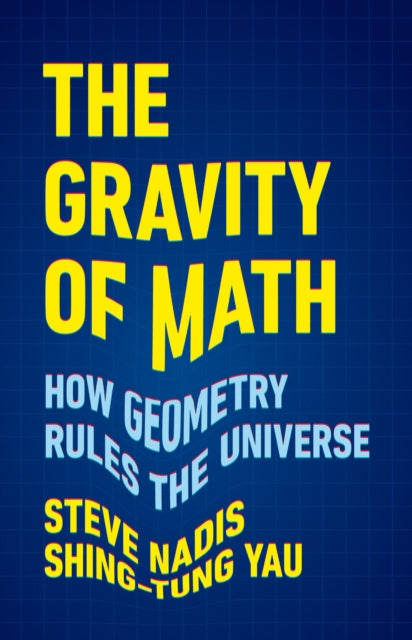
Basic Books The Gravity of Math
Book Synopsis'A must-read.”―Avi Loeb, New York Times–bestselling author of Extraterrestrial One of the preeminent mathematicians of the past half century shows how physics and math were combined to give us the theory of gravity and the dizzying array of ideas and insights that has come from it Mathematics is far more than just the language of science. It is a critical underpinning of nature. The famed physicist Albert Einstein demonstrated this in 1915 when he showed that gravity—long considered an attractive force between massive objects—was actually a manifestation of the curvature, or geometry, of space and time. But in making this towering intellectual leap, Einstein needed the help of several mathematicians, including Marcel Grossmann, who introduced him to the geometrical framework upon which his theory rest. In The Gravity of Math, Steve Nadis and Shing-Tung Yau consider how math can dr
£22.50
Springer International Publishing AG Metrical and Dynamical Aspects in Complex
Book SynopsisThe central theme of this reference book is the metric geometry of complex analysis in several variables. Bridging a gap in the current literature, the text focuses on the fine behavior of the Kobayashi metric of complex manifolds and its relationships to dynamical systems, hyperbolicity in the sense of Gromov and operator theory, all very active areas of research. The modern points of view expressed in these notes, collected here for the first time, will be of interest to academics working in the fields of several complex variables and metric geometry. The different topics are treated coherently and include expository presentations of the relevant tools, techniques and objects, which will be particularly useful for graduate and PhD students specializing in the area.Table of Contents1. Invariant Distances.- 2. Dynamics in Several Complex Variables.- 3. Gromov Hyperbolic Spaces and Applications to Complex Analysis.- 4. Gromov Hyperbolicity of Bounded Convex Domains.- 5. Quasi-conformal Mappings.- 6. Carleson Measures and Toeplitz Operators. References.
£999.99

Springer International Publishing AG The Spectrum of Hyperbolic Surfaces
Book SynopsisThis text is an introduction to the spectral theory of the Laplacian on compact or finite area hyperbolic surfaces. For some of these surfaces, called “arithmetic hyperbolic surfaces”, the eigenfunctions are of arithmetic nature, and one may use analytic tools as well as powerful methods in number theory to study them. After an introduction to the hyperbolic geometry of surfaces, with a special emphasis on those of arithmetic type, and then an introduction to spectral analytic methods on the Laplace operator on these surfaces, the author develops the analogy between geometry (closed geodesics) and arithmetic (prime numbers) in proving the Selberg trace formula. Along with important number theoretic applications, the author exhibits applications of these tools to the spectral statistics of the Laplacian and the quantum unique ergodicity property. The latter refers to the arithmetic quantum unique ergodicity theorem, recently proved by Elon Lindenstrauss. The fruit of several graduate level courses at Orsay and Jussieu, The Spectrum of Hyperbolic Surfaces allows the reader to review an array of classical results and then to be led towards very active areas in modern mathematics.Trade Review“The French book under review gives an introduction to hyperbolic surfaces with an emphasis on the Selberg conjecture. … it is intended for advanced graduate students but is also well suited for all those who want to acquaint themselves with harmonic analysis on hyperbolic surfaces and automorphic forms.” (Frank Monheim, zbMATH, August, 2017)“This book gives a very nice introduction to the spectral theory of the Laplace-Beltrami operator on hyperbolic surfaces of constant negative curvature. … mainly intended for students with a knowledge of basic differential geometry and functional analysis but also for people doing research in other domains of mathematics or mathematical physics and interested in the present day problems in this very active field of research. … book gives one of the best introductions to this fascinating field of interdisciplinary research.” (Dieter H. Mayer, Mathematical Reviews, August, 2017)Table of ContentsPreface.- Introduction.- Arithmetic Hyperbolic Surfaces.- Spectral Decomposition.- Maass Forms.- The Trace Formula.- Multiplicity of lambda1 and the Selberg Conjecture.- L-Functions and the Selberg Conjecture.- Jacquet-Langlands Correspondence.- Arithmetic Quantum Unique Ergodicity.- Appendices.- References.- Index of notation.- Index.- Index of names.
£56.99

Dover Publications Inc. Taxicab Geometry
Book Synopsis
£7.77
LEGARE STREET PR Elementary Synthetic Geometry
a huge range and FREE tracked UK delivery on ALL orders.
£23.70
LEGARE STREET PR Elementary Synthetic Geometry
a huge range and FREE tracked UK delivery on ALL orders.
£13.95
Legare Street Press Introduction à la géométrie noneuclidienne
a huge range and FREE tracked UK delivery on ALL orders.
£28.45
Legare Street Press Henri Poincare
a huge range and FREE tracked UK delivery on ALL orders.
£32.25
Creative Media Partners, LLC Plane and Solid Geometry
£34.74
Creative Media Partners, LLC Deskriptivnà Geometrie PromÃtànà ParallelnÃho
£33.20
Creative Media Partners, LLC Canadian Series of School Books the Elements of Euclid
£14.96
Cosimo Classics Geometrical Researches on the Theory of Parallels
£16.59
Cosimo Classics An Essay on the Foundations of Geometry
£8.69
Watchmaker Publishing The Theory Of Parallels
£8.67
Watchmaker Publishing Space and Geometry: In the Light of Physiological, Psychological, and Physical Inquiry
£10.15
Universal Publishers Geometry by Construction: Object Creation and Problem-solving in Euclidean and Non-Euclidean Geometries
£26.20
Echo Point Books & Media Fractals: Form, Chance and Dimension
£22.95
Echo Point Books & Media, LLC The Fractal Geometry of Nature
£45.95
Amazon Digital Services LLC - Kdp Hyperbolic Geometry
£999.99

Princeton University Press Nilpotence and Periodicity in Stable Homotopy
Book SynopsisDescribes some major advances made in algebraic topology, centering on the nilpotence and periodicity theorems. This book begins with some elementary concepts of homotopy theory that are needed to state the problem. The latter portion provides specialists with a coherent and rigorous account of the proofs.Trade Review"Familiarity with the material of this book is essential for any a serious homotopy theorist... [The author's] important role in the developments will ensure that [this book] will remain an important source for some time."--Bulletin of the London Mathematical SocietyTable of Contents*Frontmatter, pg. i*Contents, pg. vii*Preface, pg. xi*Introduction, pg. xiii*Chapter 1. The main theorems, pg. 1*Chapter 2. Homotopy groups and the chromatic filtration, pg. 11*Chapter 3. MU-theory and formal group laws, pg. 25*Chapter 4. Morava's orbit picture and Morava stabilizer groups, pg. 37*Chapter 5. The thick subcategory theorem, pg. 45*Chapter 6. The periodicity theorem, pg. 53*Chapter 7. Bousfield localization and equivalence, pg. 69*Chapter 8. The proofs of the localization, smash product and chromatic convergence theorems, pg. 81*Chapter 9. The proof of the nilpotence theorem, pg. 99*Appendix A. Some tools from homotopy theory, pg. 119*Appendix B. Complex bordism and BP-theory, pg. 145*Appendix C. Some idempotents associated with the symmetric group, pg. 183*Bibliography, pg. 195*Index, pg. 205
£78.20
De Gruyter Global Affine Differential Geometry of Hypersurfaces
Book SynopsisThis book draws a colorful and widespread picture of global affine hypersurface theory up to the most recent state. Moreover, the recent development revealed that affine differential geometry – as differential geometry in general – has an exciting intersection area with other fields of interest, like partial differential equations, global analysis, convex geometry and Riemann surfaces. The second edition of this monograph leads the reader from introductory concepts to recent research. Since the publication of the first edition in 1993 there appeared important new contributions, like the solutions of two different affine Bernstein conjectures, due to Chern and Calabi, respectively. Moreover, a large subclass of hyperbolic affine spheres were classified in recent years, namely the locally strongly convex Blaschke hypersurfaces that have parallel cubic form with respect to the Levi-Civita connection of the Blaschke metric. The authors of this book present such results and new methods of proof.
£123.98


