
Geometry Books

Wooden Books Ruler and Compass: Practical Geometric
Book SynopsisHow do you draw a heptagon? What about a heptakaidecagon? How do you fit circles perfectly into triangles? And around them? If the computer is down - could you do it with ruler and compass? In this unique little book, Andrew Sutton guides you through the once treasured principles of ruler and compass constructions, used for centuries by architects, carpenters, stonemasons and master craftsmen. Designed to last until the lights go out, this is a timeless book. WOODEN BOOKS are small but packed with information. "Fascinating" FINANCIAL TIMES. "Beautiful" LONDON REVIEW OF BOOKS. "Rich and Artful" THE LANCET. "Genuinely mind-expanding" FORTEAN TIMES. "Excellent" NEW SCIENTIST. "Stunning" NEW YORK TIMES. Small books, big ideas.
£8.18

Floris Books String, Straight-edge and Shadow: The Story of
Book SynopsisPlease note that this Floris Books edition has been revised for UK and European notation, language and metric systems.From the early peoples who marvelled at the geometry of nature -- the beehive and bird's nest -- to ancient civilisations who questioned beautiful geometric forms and asked 'why?', the story of geometry spans thousands of years. Using only three simple tools -- the string, the straight-edge and the shadow -- human beings revealed the basic principles and constructions of elementary geometry. Weaving history and legend, this fascinating book reconstructs the discoveries of mathematics's most famous figures. Through illustrations and diagrams, readers are able to follow the reasoning that lead to an ingenious proof of the Pythagorean theorem, an appreciation of the significance of the Golden Mean in art and architecture, or the construction of the five regular solids.This insightful and engaging book makes geometry accessible to everyone. Readers will be fascinated with how the knowledge and wisdom of so many cultures helped shape our civilisation today.String, Straight-edge and Shadow is also a useful and inspiring book for those teaching geometry in Steiner-Waldorf classrooms.Trade Review'Shows us what we don't realise we know, what civilisations before us learnt and passed down to us. It brings an awe and magic back to our learning Those that advanced knowledge of geometry had a grounded and practical understanding of where it came from. This book helps us to do that.'-- The Smart Happy Project'This was an enjoyable read for the everyday person of curious mind.' - Amazon.com'Fantastic, accurate, readable, teachable and Classical.' -- Amazon.com'The well constructed narrative brings these people and their excitement over these discoveries to life. I learned about the patterns in math from a new perspective and it made me wonder why math is always taught in the abstract format. These people understood it in a completely different way and I would think that some people would learn it better if it were explained this way.' -- Goodreads'This gem is about ancient Geometry that has definite application today. Knowing the stories behind many great discoveries make them so much more interesting and really helps math to come alive.' -- Goodreads'Whether you are learning geometry for the first time, teaching it to students at home or in the classroom, or are parents helping your children through their first geometry course, this is a must-read for everyone! You will be fascinated with the graphic illustrations and written depiction of how the knowledge and wisdom of so many cultures helped shape our civilization today.' -- Waldorf BooksString, Straight-edge and Shadow (is) an interesting and informative book and its numerous diagrams and illustrations are part of its appeal. Anyone interested in learning how discoveries made thousands of years ago still underpin much of our modern day science and mathematics will find this a useful and engaging read.-- New View
£9.49

Quarto Publishing Group USA Inc The Golden Ratio: The Divine Beauty of
Book SynopsisThe Golden Ratio examines the presence of this divine number in art and architecture throughout history, as well as its ubiquity among plants, animals, and even the cosmos. This gorgeous book—with layflat dimensions that closely approximate the golden ratio—features clear, enlightening, and entertaining commentary alongside stunning full-color illustrations by Venezuelan artist and architect Rafael Araujo. From the pyramids of Giza, to quasicrystals, to the proportions of the human face, the golden ratio has an infinite capacity to generate shapes with exquisite properties. This book invites you to take a new look at this timeless topic, with a compilation of research and information worthy of a text book, accompanied by over 200 beautiful color illustrations that transform this into the ultimate coffee table book. Author Gary Meisner shares the results of his twenty-year investigation and collaboration with thousands of people across the globe in dozens of professions and walks of life. The evidence will close the gaps of understanding related to many claims of the golden ratio’s appearances and applications, and present new findings to take our knowledge further yet. Whoever you are, and whatever you may know about this topic, you’ll find something new, interesting, and informative in this book, and may find yourself challenged to see, apply, and share this unique number of mathematics and science in new ways.
£18.99

Tarquin Publications The Fifty-nine Icosahedra
Book Synopsis
£9.99

Kumon Publishing North America, Inc Grade 6 Geometry Measurement Kumon Math
Book Synopsis
£8.99

Wooden Books Platonic and Archimedean Solids
Book SynopsisWhat sort of things happen when space crystallises? Why were primordial sages fascinated with five simple forms? Does the three-dimensional jigsaw fit simply together? If so how? Find out about one of the languages spoken throughout the universe! An understanding of the Platonic Solids, and their close cousins, the Archimedean Solids has long been required of students seeking entry into ancient wizdom schools. This book, illustrated by the author, is a beautiful introduction to three-dimensional mathemagical space. WOODEN BOOKS are small but packed with information. "Fascinating" FINANCIAL TIMES. "Beautiful" LONDON REVIEW OF BOOKS. "Rich and Artful" THE LANCET. "Genuinely mind-expanding" FORTEAN TIMES. "Excellent" NEW SCIENTIST. "Stunning" NEW YORK TIMES. Small books, big ideas.
£7.49

Penguin Books Ltd Shape
Book SynopsisThe international bestseller - a whip-smart, entertaining exploration of the geometry that underlies our world, from the author of How Not to Be WrongHow should a democracy choose its representatives? How can you stop a pandemic from sweeping the world? How do computers learn to play chess? Can ancient Greek proportions predict the stock market? (Sorry, no.) What should your kids learn in school if they really want to learn to think? The answers to all these questions can be found in geometry.If you''re like most people, geometry is a dimly-remembered exercise, handed down from the ancients, that you gladly left behind in school. It seemed to be a tortuous way of proving some fact about triangles that was obvious to you in the first place. That''s not geometry. OK, it is geometry, but only a tiny part, that has as much to do with the modern, fast-moving discipline as conjugating a verb has to do with a great novel.In Shape, SundTrade ReviewThis mind-bending book will change how you see the world (Five stars) -- Simon Ings * Telegraph *Shape is a triumph of mathematical exposition, exposing profound truths - from the nature of distance to the predictability of randomness - as well as profound mistakes - from historical misattributions to Supreme Court justice hardheadedness - with eloquence and hilarious wit. Ellenberg's evident affection for both his subject and his reader makes us feel like the lucky ones who get to hear him hold forth in an intimate setting about his favorite subject, mathematics -- Cathy O'NeilEllenberg's skill as a storyteller, combined with a natural ability to spot otherwise obscure connections, enables him to capitalize on geometry as math's gateway drug... A deeply enjoyable and insightful book -- Matt Parker * New York Times *Ellenberg, in both his arguments and his enthusiasm, is persuasive -- Michael Prodger * New Statesman *Serious mathematics at its intriguing, transporting best . . . [A] humorous, anecdotally rich dive into numerous mathematical theories * Kirkus *Unreasonably entertaining... reveals how geometric thinking can allow for everything from fairer American elections to better pandemic planning -- Parul Sehgal * New York Times *Droopy cheese and the curve of the Earth, the everyday and the cosmic, are beautifully interwoven in the mathematician Jordan Ellenberg's new book Shape -- Derek Thompson * Atlantic *Almost anyone is likely to enjoy Ellenberg's prose, and mind * Harvard Magazine *
£12.34

Dorling Kindersley Ltd Simply Maths
Book Synopsis
£11.69

Floris Books Drawing Geometry
Book SynopsisTeaches professionals how to draw two-dimensional geometric shapes in simple step-by-step instructions.Trade Review'The author has produced a reference work for those wishing to construct regular polyhedra and an interesting collection of photographs of plants.'-- Science Group of the Anthroposophical Society in Great Britain Newsletter 'Simply an excellent guide book... it subtly leads into a meditative state followed by the catharsis of achieving perfection. Beyond that it encourages the intelligent eye to go exploring for these shapes in nature...a splendid inspiration.'-- Francis Cameron, Pentacle Magazine'A simple and beautiful book...The beauty of the proportions is palpable, especially when illustrated alongside the flowers whose designs reflect the same principles. The instructions and illustrations are equally clear.'-- Scientific and Medical Network Review, Winter 2007
£11.69

Harvard University Press Measurement
Book SynopsisLockhart’s Mathematician’s Lament outlined how we introduce math to students in the wrong way. Measurement explains how math should be done. With plain English and pictures, he makes complex ideas about shape and motion intuitive and graspable, and offers a solution to math phobia by introducing us to math as an artful way of thinking and living.Trade ReviewA love song and a philosophical manifesto about the pleasures and frustrations, but mainly the pleasures, of doing math.In place of the usual boxed and high-lighted formulas and tricks, Measurement offers questions to be pondered. Lockhart invites readers to trade tutorial fake problems about actual objects, which lead students to abhor school mathematics, for real problems about fantastical objects, which lead mathematicians to love math. * Science *A conversational book about mathematics as an art that invites the reader to join in the fun. Sounding every bit the teacher whose love for his subject is infectious, he guides us through exercises in geometry and calculus—giving information and hints along the way while always encouraging us to ask, and answer, ‘Why?’ Lockhart does not try to make math seem easy; instead he wants his readers to understand that the difficulty brings rewards. * Scientific American *This invitation to tackle mathematical questions is infused with the joys of the rarefied reality of maths. Paul Lockhart largely avoids complex formulae and the wilder shores of jargon, opting instead for simple geometric drawings, lucid instructions and honest warnings about the hurdles. Covering size, shape, space and time, Lockhart, a maths teacher, gets through scores of problems, from showing that a cone in a hemisphere occupies half the volume to determining the size of the largest circle that can sit at the bottom of a parabola. Elegant, amusing and challenging. * Nature *This book forced me to use mental muscles I haven’t exercised in a long time, but it felt fantastic! Paul Lockhart is a mathematics evangelist; his passion for his subject is evident on every page, in every line. Looking at the subject of Measurement, he takes the reader on a journey that covers geometry, algebra, trigonometry, and on through differential calculus. He has a conversational tone and self-deprecating humor that sets the reader at ease. He understands that many people have been turned off of mathematics. His attitude is playful and joyous… Math is usually taught in such a compartmentalized way that it loses any meaning or coherence, and certainly any sense of wonder or beauty, but Measurement restores the connection. Paul Lockhart feels that math is the most beautiful, abstract and pure art form, and that it is actually fun! By the end of the book, you come to agree with him. * Sacramento Book Review *There are many books available these days on what mathematicians do, and this is one of the best… Lockhart’s approach is fresh and effective. * Choice *Lockhart presents math as an art and argues that just as there is no systematic way to create beautiful and meaningful art, there is also no method for producing beautiful and meaningful mathematical arguments. Doing mathematics, according to Lockhart, is to make a discovery (by, say, physical objects like string or rubber bands) and then to explain it in the simplest and most elegant way possible. Using illustrations of various shapes and mathematical formulas, he leads readers through several problems step by step, encouraging them to collaborate with others in working through the problem. Measuring, for example, is relative because it involves comparing the object being measured to another object. Measurement is only one of the many rivers in the ‘vast, ever-expanding jungle’ of mathematics, which for Lockhart satisfies our need to find patterns as well as our curiosity… His playful and ingenious approach not only takes the fear out of math but also elegantly illustrates that universe and the joy he finds in it. * Publishers Weekly *No matter what mathematical education you had, or didn’t have, you will be delighted by this enticing book if you take up Paul Lockhart’s invitation to engage in the mathematical sensibility that radiates from its pages, and try your own hand—not only at answering, but even more fruitfully, at formulating questions as you explore the world of mathematics.
£18.86

Princeton University Press Do Plants Know Math
Book Synopsis
£19.80

Taschen GmbH The Secret Code
Book SynopsisThe Divine Proportion reveals a number of simple patterns: It is seen in the seed patterns of fruits, the family tree of bees, the pyramids of Egypt, Gothic cathedrals, Renaissance paintings, the human body, shells ... the list is endless. Mathematicians use the Greek symbol Φ to represent the Divine Proportion and equate it to a number that is defined by the ratio (1 + √5) / 2 or 1.6180339.... Numbers do little, however, in describing this unique ratio that is found everywhere in nature and for 2500 years has been an aesthetic guide in art and architecture. Beginning with calculations found on clay tablets in ancient Babylon, the story of Divine Proportion can be traced alongside the history of numbers to the fractals of the digital age. As its many forms unfold we uncover the Golden Rectangle in the Parthenon, Golden Spirals in the human inner ear, a Golden Angle in the petal patterns of a rose, and the Fibonacci numbers in lilies, daisies, pineapples, and in our own DNA. With its natural balance and elegant beauty, the Divine Proportion is a perpetual reminder that our hope for regeneration and continuity lies in realizing the meaningful and harmonious relationship of all the parts to the whole. This book deals with the Divine Proportion, a secret code that rules art, nature, and science. It is known by many names: Golden Mean, Sacred Cut and Phi are only a few; and it is not by chance that the Divine Proportion was given its name. It has been called divine because over thousands of years it has been deemed to be so.
£14.25

Wooden Books The Diagram: Harmonic Geometry
Book SynopsisHow do you divide a line into three? Or five? Or seven? Is there a simple way to marry harmony and geometry? What is the secret diagram alluded to by writers of antiquity? In this groundbreaking book, philosopher Adam Tetlow reveals the long lost Helicon, the master diagram of the ancient arts and crafts.Watch in astonishment as this magical geometric figure produces simple fractions, musical harmonies, Pythagorean triangles, perspective and more. WOODEN BOOKS are small but packed with information. "Fascinating" FINANCIAL TIMES. "Beautiful" LONDON REVIEW OF BOOKS. "Rich and Artful" THE LANCET. "Genuinely mind-expanding" FORTEAN TIMES. "Excellent" NEW SCIENTIST. "Stunning" NEW YORK TIMES. Small books, big ideas.
£8.18

Stenhouse Publishers Which One Doesn't Belong?: A Shapes Book,
Book SynopsisEvery colorful page of Christopher Danielson’s children’s picture book, Which One Doesn’t Belong?, contains a thoughtfully designed set of four shapes. Each of the shapes can be a correct answer to the question “Which one doesn’t belong?” Because all their answers are right answers, students naturally shift their focus to justifications and arguments based on the shapes’ geometric properties. In the companion teacher’s guide, Danielson shows how to facilitate rich discussions and teach mathematical argumentation using Which One Doesn’t Belong? He models how to listen closely and respectfully to students’ ideas about shapes. Danielson synthesizes research about how children learn geometry, discusses the role of geometry in the mathematics curriculum, and gives plenty of practical advice about different ways to implement Which One Doesn’t Belong? in classrooms. He also discusses the mathematical ideas likely to emerge on each page and—drawing from his direct experience using Which One Doesn’t Belong? at several different grade levels—helps teachers anticipate and think about students’ likely answers. Most curricula treat geometry as little more than vocabulary lessons. Which One Doesn’t Belong? and its accompanying guide are powerful, flexible resources teachers can use to provoke lively discussions and deep learning about shapes with students of all ages.
£34.88

Floris Books The Hidden Geometry of Flowers
Book SynopsisA beautiful and original book in which renowned thinker and geometrist Keith Critchlow focuses on flowers as examples of symmetry and geometry. Fully illustrated with hand-drawn geometric patterns.Trade Review'I've been looking at plants all my life and it's one of my great pleasures, Keith Critchlow's book adds new dimensions to this enjoyment and shows how number and geometry are made manifest in the forms that we see in every garden, in wild flowers and in the cut flowers that decorate our rooms The plentiful illustrations help make this a book of inspiration and insight.'-- Dr Rupert Sheldrake'This is less a book for what we call "reading" than a book to be lived with as a delightful and instructive companion for a long time. It is a fascinating book, full of things useful and pleasing to know. And I admire the honest circularity of its plot that begins in mystery, passes through much knowledge, and returns again (in fact again and again) to mystery.'-- Wendell Berry'I have been waiting thirty-five years for this book.'-- Julian Barnard, author of Bach Flower Remedies: Form and Function'Like many people, I've been eagerly awaiting the publication of this book, and I have to say that it has been a real delight finally to read its inspirational thoughts and also to contemplate the large number of beautiful images and geometrical diagrams that is contains The Hidden Geometry of Flowers is a wonderful gift to the growing number of people who, dissatisfied with the impoverished and disenchanted worldview of materialistic science, are seeking to relate to the spiritual in nature once again. It is also a major contribution to the holistic science of the plant world, complementing studies by Goethean and anthroposophically inspired researchers into the formative forces at work in the plant kingdom Anyone who gives proper attention to [this book] will feel that they are indeed brought closer to the mysterious form-creating life-processes that emanate from the world of spirit, and for this reason it is an enormously valuable contribution to all who are endeavouring to work towards a more holistic and spiritual awareness of the plant world.'-- Jeremy Naydler, New View'Keith Critchlow has created a masterpiece, which speaks not only through his inspired and informative text, but also through 560 color [sic] illustrations combining his superb flower photography with hand-drawn geometric patterns. The result is a celebration of the geometric lawfulness of flower forms that embody universal spiritual archetypes The Hidden Geometry of Flowers is absolutely a must-read book for anyone who wants to be inspired by and appreciate the cosmic forces and archetypes that bestow the qualities we so cherish in each flower, and in their extraordinary healing qualities as flower essences.'-- Warren Kenton, Flower Essence Society'This book is a definitive work on the geometry of the relationship between Nature and the Cosmos. Its text and extraordinary set of photographs and diagrams indicate that there is a Divine Plan that governs the physical dimension as well as the hidden universes beyond. Professor Critchlow's masterpiece is the product of a lifelong labour of love and observation, illustrated with many of his personal drawings As well as being informative and eye-opening, reading this book is refreshing, like a visit to paradise. --- Z'ev ben Simn Halevi, Caduceus'In the quest to reconnect with the natural world, we need go no further than appreciating flowers for the beauty and hidden geometry that they encompass. In his elegantly presented large-format book, Prod. Keith Critchlow includes over 500 breathtaking colour photographs, illustrations and hand drawings to go with his engaging text Beauty is the language of flowers, and Critchlow helps entice us into their unfolding, spiralling domains to discover a higher realm of contemplation. Beauty really is truth, as this magnificent work shows.'-- Nexus'This remarkable and beautiful book is the culmination of years of research into the nature and geometry of flowers, drawing on the author's extensive understanding of Platonic philosophy as a means of expressing and understanding the Good, the Beautiful and the True Reading the book is a form of living education which means that you will never respond to (I did not say look at) flowers in quite the same way again. This is highlighted by the Prince of Wales in his foreword, when he talks about the perception of beauty as a resonance with the patterns which we ourselves are made of. The result is a feeling of harmony, the subject of the Prince's own book.'-- David Lorimer, Network Review, Winter 2011'Critchlow takes four different perspectives to explore how flowers connect us to deeper truths: material, social, cultural and inspirational.His thesis is illustrated with striking photos of plants, together with drawings, diagrams and quotes from Eastern and Western writers,classical philosophers and religious teachers This book reads like the unfurling of a lifetimes observation, and afterwards you look at the whole world differently, not just the garden.'-- Garden Design Journal'I eagerly awaited the publication of this book, and I have to say that it was a real delight finally to read its inspirational thoughts and also to contemplate the large number of beautiful images and geometrical diagrams it contains [The book's] analyses open one's eyes to the extraordinary ability of flowers to harness and express geometrical forms and proportions. They open one's eyes, that is to say, to an underlying order and harmony that are intrinsic to the natural world through contemplating the geometircal analyses in this book, the reader is directed in wonderment towards this vast domain of ordered and ordering forms The Hidden Geometry of Flowers is a wonderful gift to the gorwing number of people who, dissatisfied with the impoverished and disenchanted world-view of materialistic science, are seeking to relate to the spiritual in nature once again. It is also a major contribution to the holisitic science of the plant world [it] is an enormously valuable contribution to all who are endeavouring to work towards a more holistic and spiritual awareness of the plant world.'-- Temenos Academy Review'In his summary he contends that flowers have been so instrumental forming human ideas of paradise. His notions are supported by a broad range of illustrations that celebrate the great beauty of flowers in a variety of forms.'-- Chicago Botanic Garden website'At over 400 pages, this is a long work, but it is full of superb illustrations, providing instant appeal it is also a book of substance as far as the writing is concerned I consider this to be a book which will "grow" on the reader -- to extend the flower analogy -- and it is full of memorable quotes, which the mathematically challenged reader (like me), or the newcomer to the perennial philosophy, can hold on to while waiting for full understanding to emerge.-- Quest: Journal of the Theosophical Society in America
£31.50

Cambridge University Press Analytic Projective Geometry
Book SynopsisThis book introduces students to projective geometry from an analytic perspective, mixing recent results from the past 100 years with the history of the field in one of the most comprehensive surveys of the subject. The subject is taught conceptually, with worked examples and diagrams to aid in understanding.Trade Review'This book provides a lively and lovely perspective on real projective spaces, combining art, history, groups and elegant proofs.' William M. Kantor'This book is a celebration of the projective viewpoint of geometry. It gradually introduces the reader to the subject, and the arguments are presented in a way that highlights the power of projective thinking in geometry. The reader surprisingly discovers not only that Euclidean and related theorems can be realized as derivatives of projective results, but there are also unnoticed connections between results from ancient times. The treatise also contains a large number of exercises and is dotted with worked examples, which help the reader to appreciate and deeply understand the arguments they refer to. In my opinion this is a book that will definitely change the way we look at the Euclidean and projective analytic geometry.' Alessandro Siciliano, Università degli Studi della BasilicataTable of ContentsPreface; Part I. The Real Projective Plane: 1. Fundamental aspects of the real projective plane; 2. Collineations; 3. Polarities and conics; 4. Cross-ratio; 5. The group of the conic; 6. Involution; 7. Affine plane geometry viewed projectively; 8. Euclidean plane geometry viewed projectively; 9. Transformation geometry: Klein's point of view; 10. The power of projective thinking; 11. From perspective to projective; 12. Remarks on the history of projective geometry; Part II. Two Real Projective 3-Space: 13. Fundamental aspects of real projective space; 14. Triangles and tetrahedra; 15. Reguli and quadrics; 16. Line geometry; 17. Projections; 18. A glance at inversive geometry; Part III. Higher Dimensions: 19. Generalising to higher dimensions; 20. The Klein quadric and Veronese surface; Appendix: Group actions; References; Index.
£999.99

Princeton University Press Beautiful Geometry
Book SynopsisTrade ReviewHonorable Mention for the 2015 PROSE Award in Popular Science & Popular Mathematics, Association of American Publishers "A book that stimulates the mind as well as the eye."--Scientific American "The combination of art and exposition was quite effective. The writing is accessible to most reasonably well-educated laypeople, and I imagine that many such people would derive considerable pleasure dipping into this attractive and interesting book."--Mark Hunacek, MAA Reviews "Eli Maor's lively writing benefits in equal parts from the geometry of ancient Greece and the eye-popping images conjured by artist Eugen Jost."--Bill Cannon, Scientist's Bookshelf "Graphic illustrations serve as both beautiful abstract art and helpful explanations in this overview of geometric theorems and patterns."--Science News "[Beautiful Geometry] achieves its aim to demonstrate that there is visual beauty in Mathematics. I heartily recommend it."--LSE Review of Books "The explanations are clear, and cover the background to the paintings in a manner that will be appreciated by readers whatever their level of mathematical knowledge... Anyone with any interest in visual mathematics will love this book."--Times Higher Education "A good-looking, large-format book suitable for the coffee table, but with lots of mathematical ideas packed in among the colorful illustrations... [A] handsome book for browsing and for some deep thought, and would be a superb gift for anyone (especially a young person) who has interest in mathematics."--Rob Hardy, Columbus Dispatch "It is a handsome book for browsing and for some deep thought, and would be a superb gift for anyone (especially a young person) who has interest in mathematics."--Rob Hardy, Dispatch "The book by Maor and Jost should be given to everyone--young or old--embarking on the study of mathematics or anyone teaching mathematics. The book will act as a source of inspiration and as a reminder of why it is that mathematics has fascinated the human race for millennia."--Henrik Jeldtoft Jensen, LMS Newsletter "The content is accessible to anyone with even a high school course in geometry. The writing is very clear."--Choice "Clear and lively... The mathematics in this book is first-rate, but the real surprise is how well the art reflects and illuminates the topic at hand... All of it is lovely to look at... [Beautiful Geometry] rises to the level of a coffee-table art book, only with a lot more depth."--Mathematical Reviews "[E]erily captivating book... Maor's style of writing is conversational, and the writing is engaging."--Annalisa Crannell, Journal of Mathematics and the Arts "At a very reasonable price, this is a book which would grace the coffee-table of any mathematics department, and many of the ideas in it will stimulate valuable discussions in the classroom."--Gerry Leversha, Mathematical Gazette "It presents as a coffee-table book for mathematicians and would be a good addition to a classroom library, available for students of all ages to explore."--Susan Mielechowsky, Mathematics Teaching in the Middle School "Visually stunning... [Beautiful Geometry] raises fundamental questions, answered thousands of years later and evidencing the progress made... This is an engaging book of broad appeal and a colourful approach to the history of geometry."--Mathematics TodayTable of ContentsPrefaces ix 1.Thales of Miletus 1 2.Triangles of Equal Area 3 3.Quadrilaterals 6 4.Perfect Numbers and Triangular Numbers 9 5.The Pythagorean Theorem I
£23.75
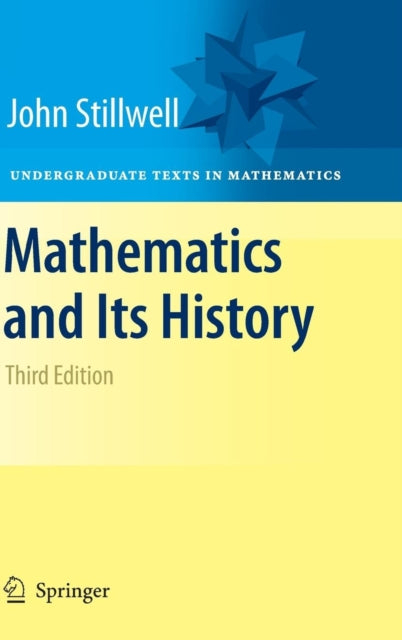
Springer-Verlag New York Inc. Mathematics and Its History
Book SynopsisFrom a review of the second edition:"This book covers many interesting topics not usually covered in a present day undergraduate course, as well as certain basic topics such as the development of the calculus and the solution of polynomial equations. The fact that the topics are introduced in their historical contexts will enable students to better appreciate and understand the mathematical ideas involved...If one constructs a list of topics central to a history course, then they would closely resemble those chosen here."(David Parrott, Australian Mathematical Society)This book offers a collection of historical essays detailing a large variety of mathematical disciplines and issues; it's accessible to a broad audience. This third edition includes new chapters on simple groups and new sections on alternating groups and the Poincare conjecture. Many more exercises have been added as well as commentary that helps place the exercises in context.Trade Review“Mathematics and Its History is an original, engaging and effective book, which I think would be enjoyed by students, lay readers with the right background, or indeed mathematicians themselves.” (Danny Yee, Danny Yee's Book Reviews, dannyreviews.com, March, 2019)From the reviews of the third edition:"The author’s goal for Mathematics and its History is to provide a “bird’s-eye view of undergraduate mathematics.” (p. vii) In that regard it succeeds admirably. ... Mathematics and its History is a joy to read. The writing is clear, concise and inviting. The style is very different from a traditional text. ... The author has done a wonderful job of tying together the dominant themes of undergraduate mathematics. ... While Stillwell does a wonderful job of tying together seemingly unrelated areas of mathematics, it is possible to read each chapter independently. I would recommend this fine book for anyone who has an interest in the history of mathematics. For those who teach mathematics, it provides lots of information which could easily be used to enrich an opening lecture in most any undergraduate course. It would be an ideal gift for a department’s outstanding major or for the math club president. Pick it up at your peril — it is hard to put down!"(Richard Wilders, MAA Reviews)“I appreciate and recommend Stillwell’s presentation of mathematics and history written in a lively style. The author’s concept (history mostly as the means of approaching mathematics) remains a matter of interest for both the mathematician and the historian … .” (Rüdiger Thiele, Zentralblatt MATH, Vol. 1207, 2011)From the reviews of the second edition:"This book covers many interesting topics not usually covered in a present day undergraduate course, as well as certain basic topics such as the development of the calculus and the solution of polynomial equations. The fact that the topics are introduced in their historical contexts will enable students to better appreciate and understand the mathematical ideas involved...If one constructs a list of topics central to a history course, then they would closely resemble those chosen here."(David Parrott, Australian Mathematical Society)"The book...is presented in a lively style without unnecessary detail. It is very stimulating and will be appreciated not only by students. Much attention is paid to problems and to the development of mathematics before the end of the nineteenth century... This book brings to the non-specialist interested in mathematics many interesting results. It can be recommended for seminars and will be enjoyed by the broad mathematical community." (European Mathematical Society)"Since Stillwell treats many topics, most mathematicians will learn a lot from this book as well as they will find pleasant and rather clear expositions of custom materials. The book is accessible to students that have already experienced calculus, algebra and geometry and will give them a good account of how the different branches of mathematics interact."(Denis Bonheure, Bulletin of the Belgian Society)Table of ContentsPreface to the Third Edition.- Preface to the Second Edition.- Preface to the First Edition.- The Theorem of Pythagoras.- Greek Geometry.- Greek Number Theory.- Infinity in Greek Mathematics.- Number Theory in Asia.- Polynomial Equations.- Analytic Geometry.- Projective Geometry.- Calculus.- Infinite Series.- The Number Theory Revival.- Elliptic Functions.- Mechanics.- Complex Numbers in Algebra.- Complex Numbers and Curves.- Complex Numbers and Functions.- Differential Geometry.- Non-Euclidean Geometry.- Group Theory.- Hypercomplex Numbers.- Algebraic Number Theory.- Topology.- Simple Groups.- Sets, Logic, and Computation.- Combinatorics.- Bibliography.- Index.-
£47.49

Wooden Books Islamic Design: A Genius for Geometry
Book SynopsisAcross the Islamic world, illuminating Korans from Morocco to Malaysia, and adorning mosques, mausoleums and palaces, are hidden some of the most exquisite geometrical devices ever conceived by man. In this excellent little book, geometer Daud Sutton unravels the mystery of Islamic patterns, explaining where they come from, how to draw them, and hinting at the Divine messages they encode. WOODEN BOOKS are small but packed with information. "Fascinating" FINANCIAL TIMES. "Beautiful" LONDON REVIEW OF BOOKS. "Rich and Artful" THE LANCET. "Genuinely mind-expanding" FORTEAN TIMES. "Excellent" NEW SCIENTIST. "Stunning" NEW YORK TIMES. Small books, big ideas.
£8.18

Oxford University Press Symmetry
Book SynopsisIn the 1800s mathematicians introduced a formal theory of symmetry: group theory. Now a branch of abstract algebra, this subject first arose in the theory of equations. Symmetry is an immensely important concept in mathematics and throughout the sciences, and its applications range across the entire subject. Symmetry governs the structure of crystals, innumerable types of pattern formation, how systems change their state as parameters vary; and fundamental physics is governed by symmetries in the laws of nature.It is highly visual, with applications that include animal markings, locomotion, evolutionary biology, elastic buckling, waves, the shape of the Earth, and the form of galaxies. In this Very Short Introduction, Ian Stewart demonstrates its deep implications, and shows how it plays a major role in the current search to unify relativity and quantum theory. ABOUT THE SERIES: The Very Short Introductions series from Oxford University Press contains hundreds of titles in almost every subject area. These pocket-sized books are the perfect way to get ahead in a new subject quickly. Our expert authors combine facts, analysis, perspective, new ideas, and enthusiasm to make interesting and challenging topics highly readable.Table of ContentsIntroduction ; 1. What is symmetry? ; 2. Origins of symmetry ; 3. Types of symmetry ; 4. Structure of groups ; 5. Groups and games ; 6. Nature's patterns ; 7. Nature's laws ; 8. Atoms of symmetry ; Further reading ; References
£9.49

Taylor & Francis Ltd Crocheting Adventures with Hyperbolic Planes
Book SynopsisWinner, Euler Book Prize, awarded by the Mathematical Association of America. With over 200 full color photographs, this non-traditional, tactile introduction to non-Euclidean geometries also covers early development of geometry and connections between geometry, art, nature, and sciences. For the crafter or would-be crafter, there are detailed instructions for how to crochet various geometric models and how to use them in explorations. New to the 2nd Edition; Daina Taimina discusses her own adventures with the hyperbolic planes as well as the experiences of some of her readers. Includes recent applications of hyperbolic geometry such as medicine, architecture, fashion & quantum computing.Trade Review"This beautifully and profusely illustrated second edition of "Crocheting Adventures with Hyperbolic Planes" is a unique and extraordinary instructional manual and guide that is unreservedly recommended for personal, professional, community, and academic library"—James A. Cox, Editor-in-Chief, Midwest Book Review"This book shows just how fun deep mathematics can be and reveals the importance of thinking of mathematics with your hands, eyes and body — not just the brain. More importantly, it shows how good mathematics needs input from all sorts of people and cultures, in particular here the geometry essential to fibre arts."—Professor Edmund Harris, University of Arkansas, co-author of Patterns/Visions of the Universe with Alex Bellos"This is a lovely introduction to hyperbolic geometry and how to represent it in a tactile, playful way. The book takes you through a wonderful history of both the maths and the art, exploring how we have perceived the world around us over the centuries and how this applies today. You get to explore the concepts with your own hands and really see how it all works. As both a mathematician and a crocheter I’m itching to make my own hyperbolic planes and use them in all sorts of places!"—Samantha Durbin, The Royal Institution of Great BritainThis is the second edition of the book Crocheting Adventures with Hyperbolic Planes, which won the 2012 Euler Book Prize[. . . . ]This book presents an amazing hybrid approach to two seemingly different audiences: mathematicians and fiber artists.For the mathematician, the book presents a tactile approach to the very theoretical concepts in hyperbolic geometry, providing clear directions on how to construct objects in hyperbolic geometry. This book is a great introduction to hyperbolic geometry for anyone wanting to know about the subject and would be a great asset to any undergraduate math student studying non-Euclidean geometries.For the fiber artist interested in crochet, the book does a great job of explaining very advanced mathematics in an inviting and understanding way, encouraging artists to pursue more mathematics to incorporate into their creative works. It also provides insight into the creative process of developing mathematics, showing that mathematicians and artists both use very creative processes.This book is extremely well-written and organized. [. . . .] The book also weaves together the history and development of non-Euclidean geometries and their connections to many different areas such as art, biology and nature, physics, computer science, music, chemistry, and architecture. Each chapter has a clear purpose, and the imagery really complements the writing. At the end of the book, there is a section on how to make models. For the artist interested in crochet, the directions are a little bit more mathematical, but they are presented clearly. It will definitely be quite different than any pattern you have read before! For the mathematician who would like to have some tactile hyperbolic models, there are directions for making models out of paper as well. This book is more than just a great introduction to hyperbolic geometry, it is a great book to showcase the work of mathematicians and the process of discovering mathematics. As mathematicians, we often only present our finished and most-polished versions of our work, and we don’t let many people see the process by which this polished mathematics was developed.This book gives the reader insight into that process and illuminates the creativity involved in the development of mathematics.—Rachelle Bouchat, MAA Reviews October 2019Praise for previous edition"2012 Euler Book Prize Winner ...elegant, novel approach... that is perfectly capable of standing on its mathematical feet as a clear, rigorous, and beautifully illustrated introduction to hyperbolic geometry. It is truly a book where art, craft, science, and mathematics come together in perfect harmony."—MAA, December 2011"This book is richly illustrated with photographs and colored illustrations and it has been produced on high-quality paper. It would be a useful addition to the library of a school or university."—Gazette-Australia, May 2011"Daina's crochet models break through the austere, formal stereotype of mathematics and present a path to a whole-brain understanding of a beautiful cluster of simple and significant ideas. The book helps to change the way of thinking about mathematics - an art of human understanding!"—Corina Mohorianu, Zentralblatt MATH, September 2009"The models illustrated in this book are prime examples of art influencing mathematics. Daina provides the necessary instructions for even novices to crochet and create hyperbolic models of their own."—Swami Swaminathan, Canadian Mathematical Society Notes, October 2009"It lays out the fundamental knowledge for appreciation of tactile hyperbolic manifolds cautiously and accessibly. ... an enjoyable read for a general audience."—David Jacob Wildstrom, Mathematical Reviews, December 2009Table of ContentsForeword by William Thurston. Introduction. What Is the Hyperbolic Plane? Can We Crochet It?. What Can You Learn from Your Model?. Four Strands in the History of Geometry. Tidbits from the History of Crochet. What is Non-Euclidean Geometry?. Pseudosphere. Metamorphoses of the Hyperbolic Plane. Other Surfaces with Negative Curvature. Looking for Applications of Hyperbolic Geometry. Hyperbolic Crochet goes Viral. Appendix: How to Make Models.
£63.04

Oxford University Press Introduction to Metric and Topological Spaces
Book SynopsisThis fully updated new edition of Wilson Sutherland's classic text, Introduction to Metric and Topological Spaces, establishes the language of metric and topological spaces with continuity as the motivating concept, before developing its discussion to cover compactness, connectedness, and completeness.Trade ReviewThe presentation, description and explanation throughout the seventeen short chapters are excellent, and the text can be described as self-contained, with many suitably chosen examples and exercises ,.. An interesting innovation for the new edition is having a companion web site in which more useful and relevant materials can be found. * Peter Shiu, The Mathematical Gazette *Table of ContentsPREFACE; REFERENCES; INDEX
£42.99

Cambridge University Press The Mathematics of Origami
a huge range and FREE tracked UK delivery on ALL orders.
£33.24

Tarquin Publications Geometrical Quilts
Book Synopsis
£16.76

Tarquin Publications Compound Polyhedra: Modular Origami
Book Synopsis
£11.35

Tarquin Publications Geometric Patterns from Roman Mosaics: and How to
Book Synopsis
£999.99

Dover Publications Inc. Excursions in Geometry Dover Books on Mathematics
Book SynopsisA straightedge, compass, and a little thought are all that's needed to discover the intellectual excitement of geometry. Harmonic division and Apollonian circles, inversive geometry, hexlet, Golden Section, more. 132 illustrations.
£10.44

Dover Publications Inc. Geometry
Book SynopsisLucid, well-written introduction to elementary geometry usually included in undergraduate and first-year graduate courses in mathematics. Topics include vector algebra in the plane, circles and coaxial systems, mappings of the Euclidean plane, similitudes, isometries, mappings of the intensive plane, much more. Includes over 500 exercises.
£19.94
Deltaspektri Drawing Circle Images: How to Draw Artistic Symmetrical Images with a Ruler and Compass
£9.58

Eglantyne Books The Sacred Geometry of Ancient Greece
Book SynopsisHow the Greek temples and Greek statues were entirely based upon principles of sacred geometry.
£17.99

Penguin Books Ltd Euclids Window The Story of Geometry from
Book SynopsisIn Euclid''s Window, Leonard Mlondinow takes us on a brilliantly entertaining journey through 3,000 years of genius and geometry, introducing the people who revolutionized the way we see the world around us. Ever since Pythagoras hatched a ''little scheme'' to invent a set of rules describing the entire universe, scientists and mathematicians have tried to seek order in the cosmos: Euclid, who in 300BC defined the nature of space; Descartes, a fourteenth-century gambler and idler who invented the graph; Gauss, the fifteen-year-old genius who discovered that space is curved; Einstein, who added time to the equation; and Witten, who ushered in today''s weird new world of extra, twisted dimensions. They all show how geometry is the key to understanding the universe. Once you have viewed life through Euclid''s Window, it will never be the same again... ''Elegant, attractive and concise ... also very readable. Buy it'' Ian Table of ContentsPart 1 The story of Euclid: the first revolution; the geometry of taxation; among the seven sages; the secret society; Euclid's manifesto; a beautiful woman, a library, and the end of civilization. Part 2 The story of Descartes: the revolution in place; the origin of latitude and longitude; the legacy of the rotten Romans; the discreet charm of the graph; a soldier's story; iced by the snow queen. Part 3 The story of Gauss: the curved space revolution; the trouble with Ptolemy; a Napoleonic hero; the fall of the fifth postulate; lost in hyperbolic space; some insects called the human race; a tale of two aliens; after 2000 years, a face-lift. Part 4 The story of Einstein: revolution at the speed of light; relativity's other Albert; the stuff of space; probationary technical expert, third class; a relatively Euclidean approach; Einstein's apple; from inspiration to perspiration; blue hair triumphs. Part 5 The story of Witten: the weird revolution; ten things I hate about your theory; the necessary uncertainty of being; clash of the Titans; a message in a Kaluza-Klein bottle; the birth of strings; particles, schmarticles!; the trouble with strings; the theory formerly known as strings.
£10.44

Dover Publications Inc. Geometry Relativity and the Fourth Dimension
Book SynopsisExposition of 4th dimension, concepts of relativity as Flatland characters continue adventures. Popular, easily followed yet accurate, profound. Topics include curved space time as a higher dimension, special relativity, and shape of space-time. Accessible to lay readers but also of interest to specialists. Includes 141 illustrations.
£9.99

Dover Publications Inc. Famous Problems in Geometry and How to Solve Them
Book SynopsisDelve into the development of modern mathematics and match wits with Euclid, Newton, Descartes, and others. Each chapter explores an individual type of challenge, with commentary and practice problems. Solutions.
£10.44

Cambridge University Press Results and Problems in Combinatorial Geometry
a huge range and FREE tracked UK delivery on ALL orders.
£35.14

CRC Press Geometry Topology and Physics
Book SynopsisDifferential geometry and topology have become essential tools for many theoretical physicists. In particular, they are indispensable in theoretical studies of condensed matter physics, gravity, and particle physics. Geometry, Topology and Physics, Second Edition introduces the ideas and techniques of differential geometry and topology at a level suitable for postgraduate students and researchers in these fields.The second edition of this popular and established text incorporates a number of changes designed to meet the needs of the reader and reflect the development of the subject. The book features a considerably expanded first chapter, reviewing aspects of path integral quantization and gauge theories. Chapter 2 introduces the mathematical concepts of maps, vector spaces, and topology. The following chapters focus on more elaborate concepts in geometry and topology and discuss the application of these concepts to liquid crystals, superfluid helium, generaTrade Review"…a very impressive book." -Australian and New Zealand Physicists "The clarity of the presentation is enhanced by explicit calculations and diagrams; the proof of a theorem is given only when it is instructive and not very technical. There is also a large number of exercises and problems, and last but not least, an index … superb layout…" - Zentralblatt fur Mathematick un ihre Grenzgebiete "I believe that the book will not only boost modernization of the traditional courses of theoretical physics but will prompt the specialist in topology and differential geometry to have a closer look at the applications. So I welcome this second edition." -Christopher GilmourTable of ContentsQuantum Physics. Mathematical Preliminaries. Homology Groups. Homotopy Groups. Manifolds. DeRham Cohomology Groups. Riemannian Geometry. Complex Manifolds. Fibre Bundles. Connections on Fibre Bundles. Characteristic Classes. Index Theorems. Anomalies in Gauge Field Theories. Bosonic String Theory. References. Index.
£84.99

CRC Press Differential Geometry of Curves and Surfaces
Book SynopsisThrough two previous editions, the third edition of this popular and intriguing text takes both an analytical/theoretical approach and a visual/intuitive approach to the local and global properties of curves and surfaces.Requiring only multivariable calculus and linear algebra, it develops studentsâ geometric intuition through interactive graphics applets. Applets are presented in Maple workbook format, which readers can access using the free Maple Player.The book explains the reasons for various definitions while the interactive applets offer motivation for definitions, allowing students to explore examples further, and give a visual explanation of complicated theorems. The ability to change parametric curves and parametrized surfaces in an applet lets students probe the concepts far beyond what static text permits. Investigative project ideas promote student research.At users of the previous editions' request, this third edition offers a broader list of exercises. More elementary exercises are added and some challenging problems are moved later in exercise sets to assure more graduated progress. The authors also add hints to motivate students grappling with the more difficult exercises.This student-friendly and readable approach offers additional examples, well-placed to assist student comprehension. In the presentation of the Gauss-Bonnet Theorem, the authors provide more intuition and stepping-stones to help students grasp phenomena behind it. Also, the concept of a homeomorphism is new to students even though it is a key theoretical component of the definition of a regular surface. Providing more examples show students how to prove certain functions are homeomorphisms.
£54.14

Taylor & Francis Ltd An Introduction To Chaotic Dynamical Systems
Book SynopsisThere is an explosion of interest in dynamical systems in the mathematical community as well as in many areas of science. The results have been truly exciting: systems which once seemed completely intractable from an analytic point of view can now be understood in a geometric or qualitative sense rather easily. Scientists and engineers realize the power and the beauty of the geometric and qualitative techniques. These techniques apply to a number of important nonlinear problems ranging from physics and chemistry to ecology and economics.Computer graphics have allowed us to view the dynamical behavior geometrically. The appearance of incredibly beautiful and intricate objects such as the Mandelbrot set, the Julia set, and other fractals have really piqued interest in the field.This is text is aimed primarily at advanced undergraduate and beginning graduate students. Throughout, the author emphasizes the mathematical aspects of the theory of discrete dynamicTable of ContentsI One Dimensional Dynamics1.A Visual and Historical Tour2.Examples of Dynamical Systems3.Elementary Definitions4.Hyperbolicity5.An Example: The Logistic Family6.Symbolic Dynamics7.Topological Conjugacy8.Chaos9.Structural Stability10.Sharkovsky's Theorem11.The Schwarzian Derivative 12.Bifurcations13.Another View of Period Three14.Period-Doubling Route to Chaos15.Homoclinic Points and Bifurcations16.Maps of the Circle17.Morse-Smale DiffeomorphismsII Complex Dynamics18.Quadratic Maps Revisited19.Normal Families and Exceptional Points 20.Periodic Points21.Properties of the Julia Set22.The Geometry of the Julia Sets23.Neutral Periodic Points24.The Mandelbrot Set25.Rational Maps26.The Exponential FamilyIII Higher Dimensional Dynamics27.Dynamics of Linear Maps28.The Smale Horseshoe Map29.Hyperbolic Toral Automorphisms30.Attractors31.The Stable and Unstable Manifold Theorem32.Global Results and Hyperbolic Maps33.The Hopf Bifurcation34.The Herron MapAppendix: Mathematical Preliminaries
£76.49

CRC Press Lectures on Differential Geometry with Maple
Book SynopsisThis text is designed to update the Differential Geometry course by making it more relevant to todayâs students. This new approach emphasizes applications and computer programs aimed at twenty-first-century audiences. It is intended for mathematics students, applied scientists, and engineers who attempt to integrate differential geometry techniques in their work or research.The course can require students to carry out a daunting amount of time-consuming hand computations like the computation of the Christoffel Symbols. As a result, the scope of the applied topics and examples possible to cover might be limited. In addition, most books on this topic have only a scant number of applications.The book is meant to evolve the course by including topics that are relevant to students. To achieve this goal the book uses numerical, symbolic computations, and graphical tools as an integral part of the topics presented. The provides students with a set of Maple/Matlab programs that will enable them to explore the course topics visually and in depth. These programs facilitate topic and application integration and provide the student with visual enforcement of the concepts, examples, and exercises of varying complexity.This unique text will empower students and users to explore in-depth and visualize the topics covered, while these programs can be easily modified for other applications or other packages of numerical/symbolic languages. The programs are available to download to instructors and students using the book for coursework.
£999.99

Cambridge University Press The Geometry of Physics
Book SynopsisTheodore Frankel explains those parts of exterior differential forms, differential geometry, algebraic and differential topology, Lie groups, vector bundles and Chern forms that are essential for a deeper understanding of both classical and modern physics and engineering. It can be used as a course text or for self study.Trade ReviewReview of previous edition: '… highly readable and enjoyable … The book will make an excellent course text or self-study manual for this interesting subject.' Physics TodayReview of previous edition: 'This book provides a highly detailed account of the intricacies involved in considering geometrical concepts.' Contemporary Physics'If you're looking for a well-written and well-motivated introduction to differential geometry, this one looks hard to beat.' Fernando Q. Gouvêa, MAA Online'… a first rate introductory textbook … the style is lively and exposition is clear which make the text easy to read … This book will be beneficial to students and scientists wishing to learn the foundations of differential geometry and algebraic topology as well as geometric formulations of modern physical theories.' Pure and Applied Geophysics'… this book should not be missing in any physics or mathematics library.' European Mathematical Society'This book is a great read and has a lot to offer to graduate students in both mathematics and physics. I wish I had had it on my desk when I began studying geometry.' AMS ReviewReview of previous edition: 'The layout, the typography and the illustrations of this advanced textbook on modern mathematical methods are all very impressive and so are the topics covered in the text.' Zentralblatt für Mathematik und ihre Grenzgebiete'… contains a wealth of interesting material for both the beginning and the advanced levels. The writing may feel informal but it is precise - a masterful exposition. Users of this 'introduction' will be well prepared for further study of differential geometry and its use in physics and engineering … As did earlier editions, this third edition will continue to promote the language with which mathematicians and scientists can communicate.' Jay P. Fillmore, SIAM ReviewTable of ContentsPreface to the Third Edition; Preface to the Second Edition; Preface to the revised printing; Preface to the First Edition; Overview; Part I. Manifolds, Tensors, and Exterior Forms: 1. Manifolds and vector fields; 2. Tensors and exterior forms; 3. Integration of differential forms; 4. The Lie derivative; 5. The Poincaré Lemma and potentials; 6. Holonomic and nonholonomic constraints; Part II. Geometry and Topology: 7. R3 and Minkowski space; 8. The geometry of surfaces in R3; 9. Covariant differentiation and curvature; 10. Geodesics; 11. Relativity, tensors, and curvature; 12. Curvature and topology: Synge's theorem; 13. Betti numbers and De Rham's theorem; 14. Harmonic forms; Part III. Lie Groups, Bundles, and Chern Forms: 15. Lie groups; 16. Vector bundles in geometry and physics; 17. Fiber bundles, Gauss–Bonnet, and topological quantization; 18. Connections and associated bundles; 19. The Dirac equation; 20. Yang–Mills fields; 21. Betti numbers and covering spaces; 22. Chern forms and homotopy groups; Appendix A. Forms in continuum mechanics; Appendix B. Harmonic chains and Kirchhoff's circuit laws; Appendix C. Symmetries, quarks, and Meson masses; Appendix D. Representations and hyperelastic bodies; Appendix E. Orbits and Morse–Bott theory in compact Lie groups.
£64.59

Cambridge University Press Origametry
Book SynopsisWritten by a world expert on the subject, Origametry is the first complete reference on the mathematics of origami. It is an essential reference for researchers of origami mathematics and applications in physics, engineering, and design. Educators, students, and enthusiasts will also enjoy this fascinating account of the mathematics of folding.Trade Review'This is a magnificent, comprehensive work. It gives a thorough overview of the underlying mathematics of flat-facet (polyhedral) origami, bringing together diverse contributions from many investigators (including the author's own seminal work), along with historical notes and context that ties everything together. This will be the standard reference for the mathematics of origami for years to come, and with the plethora of open problems, will also undoubtedly be the inspiration for many master's and Ph.D. theses in the future!' Robert J. Lang, author of Origami Design Secrets and Twists, Tilings, and Tessellations'Tom Hull has always been the authority and historian on origami mathematics. In this beautiful book, he ties together a wide range of classic and modern results, grounding them in their rich history.' Erik Demaine, Massachusetts Institute of Technology'Fans of classical geometry, geometry or topology of a combinatorial flavor, and even algebra and analysis will find much to appreciate in this book. Students and instructors alike will discover open problems, elegant theorems, and historical digressions, along with fascinating applications of concepts from standard courses. Origametry could easily function as a sourcebook for further explorations, capstone projects, or original research.' D. P. Tumer, Notices of the American Mathematical Society'… a delightful and informative read for mathematicians curious about the mathematics behind origami, essential for researchers starting out in this area, and handy for educators searching for ideas in topics connecting mathematics, origami and its applications.' Ana Rita Pires, European Mathematical Society MagazineTable of ContentsIntroduction; Part I. Geometric Constructions: 1. Examples and basic folds; 2. Solving equations via folding; 3. Origami algebra; 4. Beyond classic origami; Part II. The Combinatorial Geometry of Flat Origami: 5. Flat vertex folds: local properties; 6. Multiple-vertex flat folds: global properties; 7. Counting flat folds; 8. Other flat folding problems; Part III. Algebra, Topology, and Analysis in Origami: 9. Origami homomorphisms; 10. Folding manifolds; 11. An analytic approach to isometric foldings; Part IV. Non-Flat Folding: 12. Rigid origami; 13. Rigid foldings; 14. Rigid origami theory; References; Index.
£33.99

Cambridge University Press Künneth Geometry
Book SynopsisThis elegant introduction to symplectic geometry and Lagrangian foliations is suitable for students at both the undergraduate and the graduate level. It includes both new expositions of standard material and new material that has not appeared in book form previously, and provides a systematic study of bi-Lagrangian geometry.
£29.99

CRC Press Transformational Plane Geometry
Book SynopsisDesigned for a one-semester course at the junior undergraduate level, Transformational Plane Geometry takes a hands-on, interactive approach to teaching plane geometry. The book is self-contained, defining basic concepts from linear and abstract algebra gradually as needed.The text adheres to the National Council of Teachers of Mathematics Principles and Standards for School Mathematics and the Common Core State Standards Initiative Standards for Mathematical Practice. Future teachers will acquire the skills needed to effectively apply these standards in their classrooms. Following Felix Klein's Erlangen Program, the book provides students in pure mathematics and students in teacher training programs with a concrete visual alternative to Euclid's purely axiomatic approach to plane geometry. It enables geometrical visualization in three ways: Key concepts are motivated with explorTrade Review"This book is designed for a one-semester course at the junior undergraduate level and turns especially to future educators in the USA. … The arrangement and clarity of the text meet the most demanding pedagogical and mathematical requirements. Highlights of the book are the classification of isometries and similarities of the Euclidean plane. … a wonderful first step into transformational plane geometry …"—Zentralblatt MATH 1311 Table of ContentsAxioms of Euclidean Plane Geometry. Theorems of Euclidean Plane Geometry. Introduction to Transformations, Isometries, and Similarities. Translations, Rotations, and Reflections. Compositions of Translations, Rotations, and Reflections. Classification of Isometries. Symmetry of Plane Figures. Similarity. Appendix. Bibliography. Index.
£58.99

Troubador Publishing The Geometry of the Last Supper: Leonardo da
Book SynopsisHave you ever stopped to consider what goes into a painting beyond what you can see? Welcome to a fascinating journey of discovery... The Geometry of the Last Supper skilfully blends the worlds of Renaissance art, geometry and symbolism, allowing the reader to uncover, for the very first time, the simple and delicate geometry at play in the composition of Leonardo da Vinci’s masterpiece. Never before has a single and unified solution been proposed to explain the making of the Last Supper. During the Renaissance, symbolic significance was ascribed to geometrical shapes. These symbols, such as those encountered in The Geometry of the Last Supper, have an ancient history, deeply rooted in a tradition that goes back to Pythagoras and beyond. Thanks to them, the geometry presented in this book comes to life as the inner message of the Last Supper is revealed. Once the meaning of the geometry becomes clear, you will be left with the feeling of having been let into a priceless secret. Ideal for any art-lovers or any reader who enjoys looking behind the layers.
£21.24

Tarquin Publications Advanced Polyhedra 2: The Sixth Stellation of the
Book Synopsis
£7.41

Tarquin Publications Mindful Maths 2: Use your Geometry to Solve these
Book Synopsis
£999.99

Tarquin Publications Compound Polyhedra: Modular Origam
Book Synopsis
£999.99

Galerie Mingei Toshimasa Kikuchi: Mathematical Objects
Book SynopsisThe work of the Japanese sculptor Toshimasa Kikuchi (born in 1979) is somehow bewilderingly obvious. Trained in the restoration of Buddhist statues, mastering to perfection the techniques of classical Japanese statuary, he carves pure forms in wood - geometric, hydrodynamic or figurative. His scientific repertory is of all time (mathematics, engineering, natural history), but his preferred materials and techniques are firmly grounded in tradition (Japanese hinoki cypress, urushi lacquer, kinpaku gold leaf). The installation he presents for his Carte Blanche at the musee Guimet in Paris, brings together a series of slender sculptures in lacquered wood of mathematical objects, in the tradition of the celebrated photographs that Man Ray took of them. These abstract forms, hanging from the ceiling like mobiles or laid on the floor like devotional objects, take shape through a virtuosity and craftsmanship seldom found in contemporary art. The book is lavishly illustrated by the Japanese photographer Tadayuki Minamoto, who was able to capture the magnificence of the mathematical abstraction of the works of Kikuchi; by photographs and paintings by Man Ray; and with fascinating mathematical objects from the Institut Henri Poincare, Paris, photographed by the French photographer Bertrand Michau. It is essential reading for lovers of surrealism and of the early years of twentieth-century abstraction as well as for all who are intrigued by the close relationship between art and mathematics.Table of ContentsForeword by Sophie Makariou; Lustrous Abstractions: The Sculpture of Kikuchi Toshimasa by Kei Osawa; Needles : Works by Kikuchi Toshimasa, photographs by Minamoto Tadayuki; Human Equations: Man Ray's Photographs of Mathematical Models, by Edouard Sebline; Mathematical Objects - Works by Man Ray; The Collection of Mathematical Objects at the Institut Henri Poincare (IHP), by Sylvie Benzoni-Gavage; The Music of Surfaces, by Sylvie Benzoni-Gavage; Mathematical Models from the Collection of the Institut Henri Poincare, photographs by Bertrand Michau; Acknowledgements; Picture Credits
£27.00

Springer-Verlag Berlin and Heidelberg GmbH & Co. KG Computational Geometry: Algorithms and
Book SynopsisThis introduction to computational geometry focuses on algorithms. Motivation is provided from the application areas as all techniques are related to particular applications in robotics, graphics, CAD/CAM, and geographic information systems. Modern insights in computational geometry are used to provide solutions that are both efficient and easy to understand and implement.Trade Review"An excellent introduction to the field is given here, including a general motivation and usage cases beyond simple graphics rendering or interaction." from the ACM Reviews by William Fahle, University of Texas at Dallas, USATable of ContentsComputational Geometry: Introduction.- Line Segment Intersection: Thematic Map Overlay.- Polygon Triangulation: Guarding an Art Gallery.- Linear Programming: Manufacturing with Molds.- Orthogonal Range Searching: Querying a Database.- Point Location: Knowing Where You Are.- Voronoi Diagrams: The Post Office Problem.- Arrangements and Duality: Supersampling in Ray Tracing.- Delaunay Triangulations: Height Interpolation.- More Geometric Data Structures: Windowing.- Convex Hulls: Mixing Things.- Binary Space Partitions: The Painter's Algorithm.- Robot Motion Planning: Getting Where You Want to Be.- Quadtrees: Non-Uniform Mesh Generation.- Visibility Graphs: Finding the Shortest Route.- Simplex Range Searching: Windowing Revisited.- Bibliography.- Index.
£42.74


