
History of mathematics Books

Floris Books String, Straight-edge and Shadow: The Story of
Book SynopsisPlease note that this Floris Books edition has been revised for UK and European notation, language and metric systems.From the early peoples who marvelled at the geometry of nature -- the beehive and bird's nest -- to ancient civilisations who questioned beautiful geometric forms and asked 'why?', the story of geometry spans thousands of years. Using only three simple tools -- the string, the straight-edge and the shadow -- human beings revealed the basic principles and constructions of elementary geometry. Weaving history and legend, this fascinating book reconstructs the discoveries of mathematics's most famous figures. Through illustrations and diagrams, readers are able to follow the reasoning that lead to an ingenious proof of the Pythagorean theorem, an appreciation of the significance of the Golden Mean in art and architecture, or the construction of the five regular solids.This insightful and engaging book makes geometry accessible to everyone. Readers will be fascinated with how the knowledge and wisdom of so many cultures helped shape our civilisation today.String, Straight-edge and Shadow is also a useful and inspiring book for those teaching geometry in Steiner-Waldorf classrooms.Trade Review'Shows us what we don't realise we know, what civilisations before us learnt and passed down to us. It brings an awe and magic back to our learning Those that advanced knowledge of geometry had a grounded and practical understanding of where it came from. This book helps us to do that.'-- The Smart Happy Project'This was an enjoyable read for the everyday person of curious mind.' - Amazon.com'Fantastic, accurate, readable, teachable and Classical.' -- Amazon.com'The well constructed narrative brings these people and their excitement over these discoveries to life. I learned about the patterns in math from a new perspective and it made me wonder why math is always taught in the abstract format. These people understood it in a completely different way and I would think that some people would learn it better if it were explained this way.' -- Goodreads'This gem is about ancient Geometry that has definite application today. Knowing the stories behind many great discoveries make them so much more interesting and really helps math to come alive.' -- Goodreads'Whether you are learning geometry for the first time, teaching it to students at home or in the classroom, or are parents helping your children through their first geometry course, this is a must-read for everyone! You will be fascinated with the graphic illustrations and written depiction of how the knowledge and wisdom of so many cultures helped shape our civilization today.' -- Waldorf BooksString, Straight-edge and Shadow (is) an interesting and informative book and its numerous diagrams and illustrations are part of its appeal. Anyone interested in learning how discoveries made thousands of years ago still underpin much of our modern day science and mathematics will find this a useful and engaging read.-- New View
£9.49

Oxford University Press Gödels Theorem A Very Short Introduction Very
Book SynopsisWhen Kurt Gödel published his celebrated theorem, showing that no axiomatization can determine the whole truth and nothing but the truth concerning arithmetic, it had a profound impact on mathematical ideas and philosophical thought. Adrian Moore places the theorem in its intellectual and historical context, explaining the key concepts and misunderstandings.
£9.49

Penguin Books Ltd Turings Cathedral
Book SynopsisGeorge Dyson''s fascinating account of the early years of computers: Turing''s Cathedral is the story behind how the PC, ipod, smartphone and almost every aspect of modern life came into being.In 1945 a small group of brilliant engineers and mathematicians gathered at the Institute for Advanced Study in Princeton, determined to build a computer that would make Alan Turing''s theory of a ''universal machine'' reality. Led by the polymath émigré John von Neumann, they created the numerical framework that underpins almost all modern computing - and ensured that the world would never be the same again.George Dyson is a historian of technology whose interests include the development (and redevelopment) of the Aleut kayak. He is the author of Baidarka; Project Orion; and Darwin Among the Machines.''Unusual, wonderful, visionary'' Francis Spufford, Guardian''Fascinating . . . the story Dyson tells is intensely human . . . a grippiTrade ReviewRiveting . . . conveys the electrifying sense of possibility that the first computers unleashed . . . a page-turner * New Scientist *Brings to life a myriad cast of extraordinary characters, each of whom contributed to ushering in today's digital age * Daily Telegraph *An engrossing and well-researched book that recounts an important chapter in the history of 20th-century computing -- Evgeny Morozov * Observer *
£12.59

MIT Press On the Perspective of Painting
£64.35

Cambridge University Press Philosophers at War
Book SynopsisProbably the most celebrated controversy in all of the history of science was that between Newton and Leibniz over the invention of the calculus. Philosophers at War reveals how the dispute arose and became embittered, the dispositions of the chief actors, and the shifts in their opinions of each other.Table of ContentsPreface; Chronological outline; 1. Introduction; 2. Beginnings in Cambridge; 3. Newton states his claim: 1685; 4. Leibniz encounters Newton: 1672–1676; 5. The emergence of the calculus: 1677–1699; 6. The outbreak: 1693–1700; 7. Open warfare: 1700–1710; 8. The philosophical debate; 9. Thrust and parry: 1710–1713; 10. The dogs of war: 1713–1715; 11. War beyond death: 1715–1722; Appendix; Notes; Index.
£42.74

Oxford University Press Eulers Pioneering Equation P
Book SynopsisIn 1988 The Mathematical Intelligencer, a quarterly mathematics journal, carried out a poll to find the most beautiful theorem in mathematics. Twenty-four theorems were listed and readers were invited to award each a ''score for beauty''. While there were many worthy competitors, the winner was ''Euler''s equation''. In 2004 Physics World carried out a similar poll of ''greatest equations'', and found that among physicists Euler''s mathematical result came second only to Maxwell''s equations. The Stanford mathematician Keith Devlin reflected the feelings of many in describing it as like a Shakespearian sonnet that captures the very essence of love, or a painting which brings out the beauty of the human form that is far more than just skin deep, Euler''s equation reaches down into the very depths of existence. What is it that makes Euler''s identity, eip + 1 = 0, so special? In Euler''s Pioneering Equation Robin Wilson shows how this simple, elegant, and profound formula links together perhaps the five most important numbers in mathematics, each associated with a story in themselves: the number 1, the basis of our counting system; the concept of zero, which was a major development in mathematics, and opened up the idea of negative numbers; p an irrational number, the basis for the measurement of circles; the exponential e, associated with exponential growth and logarithms; and the imaginary number i, the square root of -1, the basis of complex numbers. Following a chapter on each of the elements, Robin Wilson discusses how the startling relationship between them was established, including the several near misses to the discovery of the formula.Trade ReviewAs ever, Robin Wilson's prose is witty, smooth, accurate and effortlessly enjoyable and I recommend this book unreservedly as a thoroughly good read * Nick Lord, The Mathematical Gazette *The distinguished mathematical historian Robin Wilson does his usual masterful job of telling a wonderfully entertaining story here about Euler's equation. * John J. Watkins, MathSciNet *Robin Wilson has produced a wonderful introduction to some of the most fundamental ideas in mathematics. I would highly recommend that you give a copy to any inquisitive young person you know. * Andrew Hone, LMS Newsletter *Excellent book... very readable... superb illustrations. * Peter Ransom, Symmetry Plus *The amount of information compressed in only 150 pages is amazing. This doesn't mean that it is so dense that it becomes unreadable. Quite the opposite. Because there are no long drawn-out detours, the story becomes straightforward and understandable ... I liked [this book] because it is quite broad, touching upon so many mathematical subjects, mainly in their historical context, while readability remains most enjoyable notwithstanding its conciseness. * Adhemar Bultheel, European Mathematical Society *Table of ContentsIntroduction 1: 1 2: 0 3: *p 4: e 5: i 6: e]iPi + 1 = 0 Further Reading Index
£11.39

Oxford University Press The History of Mathematics
Book SynopsisMathematics is a fundamental human activity that can be practised and understood in a multitude of ways; indeed, mathematical ideas themselves are far from being fixed, but are adapted and changed by their passage across periods and cultures. In this Very Short Introduction, Jacqueline Stedall explores the rich historical and cultural diversity of mathematical endeavour from the distant past to the present day. Arranged thematically, to exemplify the varied contexts in which people have learned, used, and handed on mathematics, she also includes illustrative case studies drawn from a range of times and places, including early imperial China, the medieval Islamic world, and nineteenth-century Britain.ABOUT THE SERIES: The Very Short Introductions series from Oxford University Press contains hundreds of titles in almost every subject area. These pocket-sized books are the perfect way to get ahead in a new subject quickly. Our expert authors combine facts, analysis, perspective, new ideas, and enthusiasm to make interesting and challenging topics highly readable.Trade ReviewStimulating and accessible. * Mathematical Gazette *Table of ContentsFURTHER READING
£9.49

Harvard University Press Measurement
Book SynopsisLockhart’s Mathematician’s Lament outlined how we introduce math to students in the wrong way. Measurement explains how math should be done. With plain English and pictures, he makes complex ideas about shape and motion intuitive and graspable, and offers a solution to math phobia by introducing us to math as an artful way of thinking and living.Trade ReviewA love song and a philosophical manifesto about the pleasures and frustrations, but mainly the pleasures, of doing math.In place of the usual boxed and high-lighted formulas and tricks, Measurement offers questions to be pondered. Lockhart invites readers to trade tutorial fake problems about actual objects, which lead students to abhor school mathematics, for real problems about fantastical objects, which lead mathematicians to love math. * Science *A conversational book about mathematics as an art that invites the reader to join in the fun. Sounding every bit the teacher whose love for his subject is infectious, he guides us through exercises in geometry and calculus—giving information and hints along the way while always encouraging us to ask, and answer, ‘Why?’ Lockhart does not try to make math seem easy; instead he wants his readers to understand that the difficulty brings rewards. * Scientific American *This invitation to tackle mathematical questions is infused with the joys of the rarefied reality of maths. Paul Lockhart largely avoids complex formulae and the wilder shores of jargon, opting instead for simple geometric drawings, lucid instructions and honest warnings about the hurdles. Covering size, shape, space and time, Lockhart, a maths teacher, gets through scores of problems, from showing that a cone in a hemisphere occupies half the volume to determining the size of the largest circle that can sit at the bottom of a parabola. Elegant, amusing and challenging. * Nature *This book forced me to use mental muscles I haven’t exercised in a long time, but it felt fantastic! Paul Lockhart is a mathematics evangelist; his passion for his subject is evident on every page, in every line. Looking at the subject of Measurement, he takes the reader on a journey that covers geometry, algebra, trigonometry, and on through differential calculus. He has a conversational tone and self-deprecating humor that sets the reader at ease. He understands that many people have been turned off of mathematics. His attitude is playful and joyous… Math is usually taught in such a compartmentalized way that it loses any meaning or coherence, and certainly any sense of wonder or beauty, but Measurement restores the connection. Paul Lockhart feels that math is the most beautiful, abstract and pure art form, and that it is actually fun! By the end of the book, you come to agree with him. * Sacramento Book Review *There are many books available these days on what mathematicians do, and this is one of the best… Lockhart’s approach is fresh and effective. * Choice *Lockhart presents math as an art and argues that just as there is no systematic way to create beautiful and meaningful art, there is also no method for producing beautiful and meaningful mathematical arguments. Doing mathematics, according to Lockhart, is to make a discovery (by, say, physical objects like string or rubber bands) and then to explain it in the simplest and most elegant way possible. Using illustrations of various shapes and mathematical formulas, he leads readers through several problems step by step, encouraging them to collaborate with others in working through the problem. Measuring, for example, is relative because it involves comparing the object being measured to another object. Measurement is only one of the many rivers in the ‘vast, ever-expanding jungle’ of mathematics, which for Lockhart satisfies our need to find patterns as well as our curiosity… His playful and ingenious approach not only takes the fear out of math but also elegantly illustrates that universe and the joy he finds in it. * Publishers Weekly *No matter what mathematical education you had, or didn’t have, you will be delighted by this enticing book if you take up Paul Lockhart’s invitation to engage in the mathematical sensibility that radiates from its pages, and try your own hand—not only at answering, but even more fruitfully, at formulating questions as you explore the world of mathematics.
£18.86

John Wiley & Sons Inc A History of Mathematics
Book SynopsisThe updated new edition of the classic and comprehensive guide to the history of mathematics For more than forty years, A History of Mathematics has been the reference of choice for those looking to learn about the fascinating history of humankind s relationship with numbers, shapes, and patterns.Trade Review"... the book is an essential reference that will help you explore the incredible history of mathematics and the men and women who created it." (Zentralblatt MATH, 2016) "... an 'engaging' read for the mathematically minded." (Inside OR, June 2011)Table of ContentsForeword by Isaac Asimov xi Preface to the Third Edition xiii Preface to the Second Edition xv Preface to the First Edition xvii 1 Traces 1 Concepts and Relationships 1 Early Number Bases 3 Number Language and Counting 5 Spatial Relationships 6 2 Ancient Egypt 8 The Era and the Sources 8 Numbers and Fractions 10 Arithmetic Operations 12 “Heap” Problems 13 Geometric Problems 14 Slope Problems 18 Arithmetic Pragmatism 19 3 Mesopotamia 21 The Era and the Sources 21 Cuneiform Writing 22 Numbers and Fractions: Sexagesimals 23 Positional Numeration 23 Sexagesimal Fractions 25 Approximations 25 Tables 26 Equations 28 Measurements: Pythagorean Triads 31 Polygonal Areas 35 Geometry as Applied Arithmetic 36 4 Hellenic Traditions 40 The Era and the Sources 40 Thales and Pythagoras 42 Numeration 52 Arithmetic and Logistic 55 Fifth-Century Athens 56 Three Classical Problems 57 Quadrature of Lunes 58 Hippias of Elis 61 Philolaus and Archytas of Tarentum 63 Incommensurability 65 Paradoxes of Zeno 67 Deductive Reasoning 70 Democritus of Abdera 72 Mathematics and the Liberal Arts 74 The Academy 74 Aristotle 88 5 Euclid of Alexandria 90 Alexandria 90 Lost Works 91 Extant Works 91 The Elements 93 6 Archimedes of Syracuse 109 The Siege of Syracuse 109 On the Equilibriums of Planes 110 On Floating Bodies 111 The Sand-Reckoner 112 Measurement of the Circle 113 On Spirals 113 Quadrature of the Parabola 115 On Conoids and Spheroids 116 On the Sphere and Cylinder 118 Book of Lemmas 120 Semiregular Solids and Trigonometry 121 The Method 122 7 Apollonius of Perge 127 Works and Tradition 127 Lost Works 128 Cycles and Epicycles 129 The Conics 130 8 Crosscurrents 142 Changing Trends 142 Eratosthenes 143 Angles and Chords 144 Ptolemy’s Almagest 149 Heron of Alexandria 156 The Decline of Greek Mathematics 159 Nicomachus of Gerasa 159 Diophantus of Alexandria 160 Pappus of Alexandria 164 The End of Alexandrian Dominance 170 Proclus of Alexandria 171 Boethius 171 Athenian Fragments 172 Byzantine Mathematicians 173 9 Ancient and Medieval China 175 The Oldest Known Texts 175 The Nine Chapters 176 Rod Numerals 177 The Abacus and Decimal Fractions 178 Values of Pi 180 Thirteenth-Century Mathematics 182 10 Ancient and Medieval India 186 Early Mathematics in India 186 The Sulbasutras 187 The Siddhantas 188 Aryabhata 189 Numerals 191 Trigonometry 193 Multiplication 194 Long Division 195 Brahmagupta 197 Indeterminate Equations 199 Bhaskara 200 Madhava and the Keralese School 202 11 The Islamic Hegemony 203 Arabic Conquests 203 The House of Wisdom 205 Al-Khwarizmi 206 ‘Abd Al-Hamid ibn-Turk 212 Thabit ibn-Qurra 213 Numerals 214 Trigonometry 216 Tenth- and Eleventh-Century Highlights 216 Omar Khayyam 218 The Parallel Postulate 220 Nasir al-Din al-Tusi 220 Al-Kashi 221 12 The Latin West 223 Introduction 223 Compendia of the Dark Ages 224 Gerbert 224 The Century of Translation 226 Abacists and Algorists 227 Fibonacci 229 Jordanus Nemorarius 232 Campanus of Novara 233 Learning in the Thirteenth Century 235 Archimedes Revived 235 Medieval Kinematics 236 Thomas Bradwardine 236 Nicole Oresme 238 The Latitude of Forms 239 Infinite Series 241 Levi ben Gerson 242 Nicholas of Cusa 243 The Decline of Medieval Learning 243 13 The European Renaissance 245 Overview 245 Regiomontanus 246 Nicolas Chuquet’s Triparty 249 Luca Pacioli’s Summa 251 German Algebras and Arithmetics 253 Cardan’s Ars Magna 255 Rafael Bombelli 260 Robert Recorde 262 Trigonometry 263 Geometry 264 Renaissance Trends 271 François Viète 273 14 Early Modern Problem Solvers 282 Accessibility of Computation 282 Decimal Fractions 283 Notation 285 Logarithms 286 Mathematical Instruments 290 Infinitesimal Methods: Stevin 296 Johannes Kepler 296 15 Analysis, Synthesis, the Infinite, and Numbers 300 Galileo’s Two New Sciences 300 Bonaventura Cavalieri 303 Evangelista Torricelli 306 Mersenne’s Communicants 308 René Descartes 309 Fermat’s Loci 320 Gregory of St. Vincent 325 The Theory of Numbers 326 Gilles Persone de Roberval 329 Girard Desargues and Projective Geometry 330 Blaise Pascal 332 Philippe de Lahire 337 Georg Mohr 338 Pietro Mengoli 338 Frans van Schooten 339 Jan de Witt 340 Johann Hudde 341 René François de Sluse 342 Christiaan Huygens 342 16 British Techniques and Continental Methods 348 John Wallis 348 James Gregory 353 Nicolaus Mercator and William Brouncker 355 Barrow’s Method of Tangents 356 Newton 358 Abraham De Moivre 372 Roger Cotes 375 James Stirling 376 Colin Maclaurin 376 Textbooks 380 Rigor and Progress 381 Leibniz 382 The Bernoulli Family 390 Tschirnhaus Transformations 398 Solid Analytic Geometry 399 Michel Rolle and Pierre Varignon 400 The Clairauts 401 Mathematics in Italy 402 The Parallel Postulate 403 Divergent Series 404 17 Euler 406 The Life of Euler 406 Notation 408 Foundation of Analysis 409 Logarithms and the Euler Identities 413 Differential Equations 414 Probability 416 The Theory of Numbers 417 Textbooks 418 Analytic Geometry 419 The Parallel Postulate: Lambert 420 18 Pre- to Postrevolutionary France 423 Men and Institutions 423 The Committee on Weights and Measures 424 D’Alembert 425 Bézout 427 Condorcet 429 Lagrange 430 Monge 433 Carnot 438 Laplace 443 Legendre 446 Aspects of Abstraction 449 Paris in the 1820s 449 Fourier 450 Cauchy 452 Diffusion 460 19 Gauss 464 Nineteenth-Century Overview 464 Gauss: Early Work 465 Number Theory 466 Reception of the Disquisitiones Arithmeticae 469 Astronomy 470 Gauss’s Middle Years 471 Differential Geometry 472 Gauss’s Later Work 473 Gauss’s Influence 474 20 Geometry 483 The School of Monge 483 Projective Geometry: Poncelet and Chasles 485 Synthetic Metric Geometry: Steiner 487 Synthetic Nonmetric Geometry: von Staudt 489 Analytic Geometry 489 Non-Euclidean Geometry 494 Riemannian Geometry 496 Spaces of Higher Dimensions 498 Felix Klein 499 Post-Riemannian Algebraic Geometry 501 21 Algebra 504 Introduction 504 British Algebra and the Operational Calculus of Functions 505 Boole and the Algebra of Logic 506 Augustus De Morgan 509 William Rowan Hamilton 510 Grassmann and Ausdehnungslehre 512 Cayley and Sylvester 515 Linear Associative Algebras 519 Algebraic Geometry 520 Algebraic and Arithmetic Integers 520 Axioms of Arithmetic 522 22 Analysis 526 Berlin and Göttingen at Midcentury 526 Riemann in Göttingen 527 Mathematical Physics in Germany 528 Mathematical Physics in English-Speaking Countries 529 Weierstrass and Students 531 The Arithmetization of Analysis 533 Dedekind 536 Cantor and Kronecker 538 Analysis in France 543 23 Twentieth-Century Legacies 548 Overview 548 Henri Poincaré 549 David Hilbert 555 Integration and Measure 564 Functional Analysis and General Topology 568 Algebra 570 Differential Geometry and Tensor Analysis 572 Probability 573 Bounds and Approximations 575 The 1930s and World War II 577 Nicolas Bourbaki 578 Homological Algebra and Category Theory 580 Algebraic Geometry 581 Logic and Computing 582 The Fields Medals 584 24 Recent Trends 586 Overview 586 The Four-Color Conjecture 587 Classification of Finite Simple Groups 591 Fermat’s Last Theorem 593 Poincaré’s Query 596 Future Outlook 599 References 601 General Bibliography 633 Index 647
£26.40

Penguin Books Ltd A Beautiful Question
Book SynopsisA Nobel Prize-winning physicist argues that beauty is the fundamental organizing principle for the entire universeIn this scientific tour de force, world-class physicist Frank Wilczek argues that beauty is at the heart of the logic of the universe. As the quest to find the beauty embodied in the universe has connected all scientific pursuit, from Pythagoras to Einstein, Wilczek shows us just how deeply intertwined our ideas about beauty and art are with our understanding of the cosmos. A Beautiful Question is a mind-expanding book combining the age-old human quest for beauty with the age-old human quest for truth.Trade ReviewA truly beautiful book ... Why do physicists call their theories beautiful? Immerse yourself in this book, wallow in it, sit back and relax as you wander through it, and you'll soon understand. -- Richard Muller, author of Physics for Future PresidentsAnyone who wants to see how science and transcendence can be compatible must read this book. Wilczek has caught the winds of change, and his thinking breaks through some sacred boundaries with curiosity, insight, and intellectual power. -- Deepak Chopra, M.D.Illuminating ... A fresh perspective on modern scientific thinking from an expert with a flair for jargon-free exposition ... Wilczek writes A Beautiful Question with bracing pizzazz ... Contains more beef than many a finely written scientific potboiler. -- Graham Farmelo * Guardian *The first book I've read in which I've felt that almost vertiginous sensation of peering through layers of theories down to the true nature of the universe ... At times this is a challenging text, but it is well worth the effort. Wilczek is admirably clear in his explanations. -- Lewis Dartnell * Telegraph *It's rare that scientists as brilliant as Wilczek give us a glimpse of what goes on inside their heads ... Expect to come away pretty dazzled. * BBC Focus *[A] searching and earnest book ... The book of a love-struck physicist ... A Beautiful Question is a meditation. -- Amy X. Wang * Slate *A Beautiful Question is both a brilliant exploration of largely uncharted territories and a refreshingly idiosyncratic guide to developments in particle physics. * Nature *Wilczek's sheer pleasure in the beauty of mathematics is the engine and joy of this book ... [A] rewarding read ... There is a lot of food for the mind here, but also some for the eye. -- Andrea Wulf * Financial Times *[An] eccentrically brilliant book -- Steven Poole * Spectator *
£12.34

Quercus Publishing 50 Maths Ideas You Really Need to Know
Book SynopsisWho invented zero? Why 60 seconds in a minute? How big is infinity? Where do parallel lines meet? And can a butterfly's wings really cause a storm on the far side of the world? In 50 Maths Ideas You Really Need to Know, Professor Tony Crilly explains in 50 clear and concise essays the mathematical concepts - ancient and modern, theoretical and practical, everyday and esoteric - that allow us to understand and shape the world around us. Packed with diagrams, examples and anecdotes, this book is the perfect overview of this often daunting but always essential subject. For once, mathematics couldn't be simpler. Contents include: Origins of mathematics, from Egyptian fractions to Roman numerals; Pi and primes, Fibonacci numbers and the golden ratio; What calculus, statistics and algebra can actually do; The very real uses of imaginary numbers; The Big Ideas of relativity, Chaos theory, Fractals, Genetics and hyperspace; The reasoning behind Sudoku and code cracking, Lotteries and gambling, Money management and compound interest; Solving of Fermat's last theorem and the million-dollar question of the Riemann hypothesis.Table of ContentsIntroduction. Zero. Number systems. Fractions. Squares and square roots. Pi e. Infinity. Imaginary numbers. Primes. Perfect numbers. Fibonacci numbers. Golden rectangles. Pascal's triangle. Algebra. Euclid's algorithm. Logic. Proof. Sets. Calculus. Constructions. Triangles. Curves. Topology. Dimension. Fractals. Chaos. The parallel postulate. Discrete geometry. Graphs. The four-colour problem. Probability. Bayes's theory. The birthday problem. Distributions. The normal curve. Connecting data. Genetics. Groups. Matrices. Codes. Advanced counting. Magic squares. Latin squares. Money mathematics. The diet problem. The travelling salesperson. Game theory. Relativity. Fermat's last theorem. The Riemann hypothesis. Glossary. Index.
£13.49

University of California Press The Principia The Authoritative Translation and
Book SynopsisIn his monumental 1687 work, Philosophiae Naturalis Principia Mathematica, known familiarly as the Principia, Isaac Newton laid out in mathematical terms the principles of time, force, and motion that have guided the development of modern physical science. This is a modern translation based on the 1726 edition.
£68.00

Princeton University Press Trust in Numbers
Book Synopsis
£25.20

Oneworld Publications The Biggest Number in the World
Book SynopsisThe weird and wonderful quest for unfathomably large numbersTrade Review‘A wonderful new book… if you love journeying into imagined mathematical worlds and simply exploring, then [this book] is pure, unadulterated escapism… brilliant.’ -- New Scientist‘We are taken on an amazing adventure… [with] witty humour and fascinating facts… a comprehensive read that I would struggle to find fault in and for anyone with a passion for maths, or a knack for numbers, I couldn’t recommend it enough!’ -- Astronomy Ireland‘The brilliant combination of an accomplished science writer and a young mathematical prodigy has resulted in page after page that oozes enthusiasm, clarity and intrigue.’ -- Bobby Seagull, on Weirder MathsTable of ContentsIntroduction 1 Of Sand and Stars 2 At the Limits of Reality 3 Maths Unbound 4 Up, Up and Away 5 G Whizz 6 Conway’s Chains 7 Ackermann and the Power of Recursion 8 Figure This – If You Can 9 Infinite Matters 10 Growing Fast 11 Does Not Compute! 12 The Strange World of the Googologist 13 Bridge to Beyond 14 The Biggest Number of All Acknowledgements Bibliography Useful websites and webpages References
£10.44

Icon Books Introducing Infinity: A Graphic Guide
Book SynopsisInfinity is a profoundly counter-intuitive and brain-twisting subject that has inspired some great thinkers - and provoked and shocked others.The ancient Greeks were so horrified by the implications of an endless number that they drowned the man who gave away the secret. And a German mathematician was driven mad by the repercussions of his discovery of transfinite numbers.Brian Clegg and Oliver Pugh's brilliant graphic tour of infinity features a cast of characters ranging from Archimedes and Pythagoras to al-Khwarizmi, Fibonacci, Galileo, Newton, Leibniz, Cantor, Venn, Gödel and Mandelbrot, and shows how infinity has challenged the finest minds of science and mathematics. Prepare to enter a world of paradox.
£8.54

Taschen GmbH Oliver Byrne. The First Six Books of the Elements
Book SynopsisNearly a century before Mondrian made geometrical red, yellow, and blue lines famous, 19th-century mathematician Oliver Byrne employed the color scheme for his 1847 edition of Euclid’s mathematical and geometric treatise Elements. Byrne’s idea was to use color to make learning easier and “diffuse permanent knowledge.” The result has been described as one of the oddest and most beautiful books of the 19th century. The facsimile of Byrne’s seminal publication is now available in a beautiful new edition. A masterwork of art and science, it is as remarkable in the boldness of its red, yellow, and blue figures and diagrams as it is in the mathematical precision of its theories. In the simplicity of forms and colors, the pages anticipate the vigor of De Stijl and Bauhaus design. In making complex information at once accessible and aesthetically engaging, this work is a forerunner to the information graphics that today define much of our data consumption.Trade Review“Every graphic designer, book lover and math nerd will be awestruck.” * The New York Times *
£38.00

Princeton University Press Music by the Numbers
Book SynopsisTrade Review"In this intriguing study, maths historian Eli Maor traces those echoes, along with the trajectories of the ‘scientists, inventors, composers, and occasional eccentrics’ behind them."---Barbara Kiser, Nature"The prolific author Eli Maor has released yet another very readable and enjoyable book on the history of mathematics from Princeton University Press. . . . As with all of Maor’s books, this one belongs in your library so that leading students can learn about unknowns like Joseph Sauveur in the fascinating story of how mathematics and music intersect."---Karl-Dieter Crisman, MAA Reviews"Maor is an experienced storyteller. His mixture of musical, mathematical, and physical history, enriched with personal experiences and some unexpected links and bridges are nice reading for anybody with a slight interest in music and science. No mathematical training required."---Adhemar Bultheel, European Mathematical Society"This is a fascinating study of the reciprocal relationship between music and mathematics in the West."---David Lorimer, Paradigm Explorer"For anyone who ponders the role mathematics has in music, this short and delightful book is a joy to read from cover to cover. It is full of anecdotes and interesting facts and, being by Eli Maor is intensely readable."---Phil Dyke, Leonardo Reviews"[Music by the Numbers] is enjoyable and readable"---Owen Toller, Mathematical Gazette
£18.00

John Murray Press The Story of Huge Numbers
£21.25
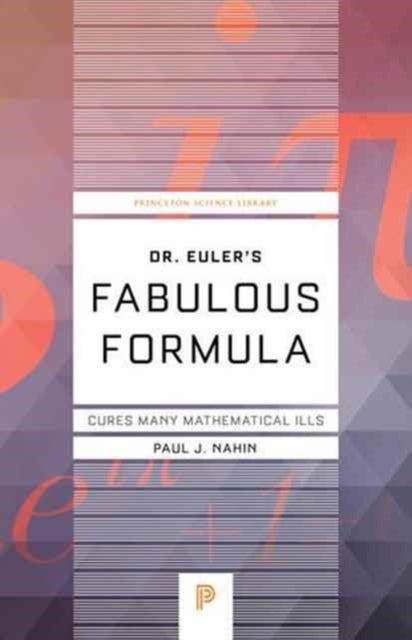
Princeton University Press Dr. Eulers Fabulous Formula
Book SynopsisTrade Review"Nahin includes gems from all over mathematics, ranging from engineering applications to beautiful pure-mathematical identities... It would be good to have more books like this."--Timothy Gowers, Nature "Nahin's tale of the formula e[pi] i+1=0, which links five of the most important numbers in mathematics, is remarkable. With a plethora of historical and anecdotal material and a knack for linking events and facts, he gives the reader a strong sense of what drove mathematicians like Euler."--Matthew Killeya, New Scientist "It is very difficult to sum up the greatness of Euler... This excellent book goes a long way to explaining the kind of mathematician he really was."--Steve Humble, Mathematics Today "What a treasure of a book this is! This is the fourth enthusiastic, informative, and delightful book Paul Nahin has written about the beauties of various areas of mathematics... This book is a marvelous tribute to Euler's genius and those who built upon it and would make a great present for students of mathematics, physics, and engineering and their professors."--Henry Ricardo, MAA Reviews "The heart and soul of the book are the final three chapters on Fourier series, Fourier integrals, and related engineering. One can recommend them to all applied math students for their historical development and sensible content."--Robert E. O'Malley, Jr., SIAM Review "This is a book for mathematicians who enjoy historically motivated mathematical explanations on a high mathematical level."--Eberhard Knobloch, Mathematical Reviews "It is a 'popular' book, written for a general reader with some mathematical background equivalent to a first-year undergraduate course in the UK."--Robin Wilson, London Mathematical Society NewsletterTable of Contents*FrontMatter, pg. i*Contents, pg. ix*Preface to the Paperback Edition, pg. xiii*Preface, pg. xxix*Introduction, pg. 1*Chapter 1. Complex Numbers, pg. 13*Chapter 2. Vector Trips, pg. 68*Chapter 3. The Irrationality of pi2, pg. 92*Chapter 4. Fourier Series, pg. 114*Chapter 5. Fourier Integrals, pg. 188*Chapter 6. Electronics and -1, pg. 275*Euler: The Man and the Mathematical Physicist, pg. 324*Notes, pg. 347*Acknowledgments, pg. 375*Index, pg. 377
£18.00

Princeton University Press Eulers Gem
Book SynopsisTrade Review"Everything in the book is very well illustrated with insightful graphics that, together with the text, make results almost like being obvious."---Adhemar Bultheel, European Mathematical Society
£16.19

HarperCollins Publishers The Road to Geometry
Book Synopsis Euclid's Elements of Geometry was a book that changed the world. Trade Review Praise for The Book of Wonders ‘An astonishingly readable and informative history of the greatest mathematical bestseller of all time, from ancient Greece to dark energy. The writing is vivid and the stories are gripping. Highly recommended!’Ian Stewart, author of Significant Figures ‘Benjamin Wardhaugh is an excellent storyteller and his collected short story approach to the history of The Elements works splendidly… simultaneously educational, entertaining and illuminating … A highly desirable read for all those, both professional and amateur, who interest themselves in the histories of mathematics, science and knowledge … over almost two and a half millennia’Thony Christie, The Renaissance Mathematicus ‘A fascinating tour through 2300 years of reading, re-imagining, & responding to perhaps most important textbook ever written’ Seb Falk, author of The Light Ages Praise for Benjamin Wardhaugh’s Gunpowder and Geometry ‘Meticulous yet lively biography, even those who have never heard of its subject could hardly disagree’ Sunday Times ‘Wardhaugh graphically describes the conditions Hutton escaped from and the importance of Newcastle and its coal to the changes taking place in Britain in the second half of the eighteenth century . . . like something from the pages of a Jane Austen novel . . . Wardhaugh has done a good job of rescuing Hutton from obscurity and setting the man and his achievements in the context of their times . . . This account of how “the pit boy turned professor” became “one of the most revered British scientists of his day” is well worth reading’ Literary Review
£21.25

Penguin Books Ltd The Poincaré Conjecture
Book SynopsisDonal O'Shea is professor of mathematics and dean of faculty at Mount Holyoke College. He has written scholarly books and monographs, and his research articles have appeared in numerous journals and collections. He lives in South Hadley, Massachusetts.Trade ReviewConveys topology's mind-bending contortions with great flair * New Scientist *One can't read The Poincaré Conjecture without an overwhelming awe at the infinite depths and richness of a mathematical realm not made by us * Martin Gardner, author of The Annotated Alice *Reveals the human story behind the challenge of the conjecture, and gives us a glimpse of the weird world inhabited by mathematicians * BBC Focus *Beautifully written * American Scientist *Intriguing * The Times *A truly marvellous book * Martin Gardner *One can't read The Poincaré Conjecture without an overwhelming awe at the infinite depths and richness of a mathematical realm not made by us * Martin Gardner, author of The Annotated Alice *
£11.69

Oxford University Press The Wonder Book of Geometry
Book SynopsisHow can we be sure that Pythagoras''s theorem is really true? Why is the ''angle in a semicircle'' always 90 degrees? And how can tangents help determine the speed of a bullet?David Acheson takes the reader on a highly illustrated tour through the history of geometry, from ancient Greece to the present day. He emphasizes throughout elegant deduction and practical applications, and argues that geometry can offer the quickest route to the whole spirit of mathematics at its best. Along the way, we encounter the quirky and the unexpected, meet the great personalities involved, and uncover some of the loveliest surprises in mathematics.Trade ReviewWell written, clear and informative. * Edward Rochead, Mathematics today *This delightful book should be available, at the minimum, in every high school library and in every public library. * F. -J. Papp, Mathematical Reviews Clippings *It would make an ideal addition both to readers' bookshelves and for every school library. * GERRY LEVERSHA, The Mathematical Gazette *Everything was explained clearly and concisely so that the wonders of geometry could definitely be seen. * Jasmine Wootten, LMS Newsletter *Don't Miss: The Wonder Book of Geometry is full of pretty surprises... * New Scientist *Give this to a curious teenager and they will fall in love with geometry. * Alex Bellos *David Acheson has set geometry free from the confines of stuffy textbooks and lets loose its potential to surprise and delight. Theres a rich and ancient history to be found in these pages, and a future for the field that extends beyond neat (yet elegant) equations. * BBC Science Focus, Books of the Year *This is by far the most approachable book on geometry I've ever read, and I wish it had been around in my day... if you need to learn the basics of geometry for whatever reason (there must be several reasons, surely) then this blows every known textbook on the topic out of the water... The Wonder Book of Geometry does what it does wonderfully. Acheson has done a remarkable job. * Popular Science *Anyone who has read David's earlier books will instantly recognise his almost playful style... I highly recommend it as a marvellous source book on geometry. * Ray Huntley, Mathematics in Schools *There is no better tour guide to the wonders of geometry than the delightful David Acheson. * Matt Parker, author of Humble Pi: A Comedy of Maths Errors and Things to Make and Do in the Fourth Dimension *Table of Contents1: Introduction 2: Getting Started 3: Euclid's Elements 4: Thales' Theorem 5: Geometry in Action 6: Pythagoras' Theorem 7: 'In Love with Geometry'? 8: 'Imagine my exultation, Watson...' 9: Congruence and Similarity 10: Conversely... 11: Circle Theorems 12: Off at a Tangent 13: From Tangents to Supersonic Flow 14: What is pi, exactly? 15: The Story of the Ellipse 16: Geometry by Coordinates 17: Geometry and Calculus 18: A Royal Road to Geometry? 19: Unexpected Meetings 20: Ceva's Theorem 21: A Kind of Symmetry 22: 'Pyracy' in Woolwich? 23: Fermat's Problem 24: A Soap Solution 25: Geometry in 'The Ladies' Diary' 26: What Euclid Did 27: Euclid on Parallel Lines 28: 'A New Theory of Parallels'? 29: Anti-Euclid? 30: When Geometry Goes Wrong... 31: New Angles on Geometry 32: And Finally...
£13.49

Duckworth Books The Remarkable Lives of Numbers A Mathematical
Book SynopsisPacked with illustrations, amusing facts, puzzles, brainteasers and anecdotes - an enthralling and thought-provoking numerical voyage through the history of mathematics. A must-have for trivia addicts, maths-lovers and even numberphobes.Trade Review'This book is a complete joy. It made me smile. A lot' Carol Vorderman'There's more to maths than just numbers - but, as this entertaining and engaging book amply demonstrates, the depth and variety of mathematical ideas that appear when you start with 1, 2, 3 and keep going is astonishing. Once you start reading 'Number Freak' it's just like the number system itself - impossible to stop' Ian Stewart, author of Professor Stewart's Cabinet of Mathematical Curiosities'A great maths book for geeks and non-geeks alike' Johnny Ball'A fun book... definitely challenging' Vanity Fair'A fascinating parade of diverse numerical characters... An entertaining mix of numerical fun and theory' Booklist'All sorts of fascinating mathematical minutiae' Time Out (Chicago)
£9.49

Quercus Publishing The Maths Handbook: Everyday Maths Made Simple
Book SynopsisThis is the perfect introduction for those who have a lingering fear of maths. If you think that maths is difficult, confusing, dull or just plain scary, then The Maths Handbook is your ideal companion. Covering all the basics including fractions, equations, primes, squares and square roots, geometry and fractals, Dr Richard Elwes will lead you gently towards a greater understanding of this fascinating subject. Even apparently daunting concepts are explained simply, with the assistance of useful diagrams, and with a refreshing lack of jargon. So whether you're an adult or a student, whether you like Sudoku but hate doing sums, or whether you've always been daunted by numbers at work, school or in everyday life, you won't find a better way of overcoming your nervousness about numbers and learning to enjoy making the most of mathematics.Trade Review'Elwes takes the key concepts, perfectly illustrates them with practical examples and easy-to-follow explanations, tests us with quizzes, and applies the principles to everyday situations. The effect is strangely liberating, and you might soon find yourself acquiring a love of logarithms and a respect for reflex quadrilaterals' Good Book Guide. * Good Book Guide *Table of ContentsIntroduction. The language of mathematics. Addition. Subtraction. Multiplication. Division. Primes, factors and multiples. Negative numbers and the number line. Decimals. Fractions. Arithmetic with fractions. Powers. The power of 10. Roots and logs. Percentages and proportions. Algebra. Equations. Angles. Triangles. Circles. Area and volume. Polygons and solids. Pythagoras' theorem. Trigonometry. Coordinates. Graphs. Statistics. Probability. Charts. Answers to quizzes. Index.
£10.44

Quercus Publishing How Big is Infinity?: The 20 Big Maths Questions
Book SynopsisWhat are the strangest numbers? Where do numbers come from? Can maths guarantee riches? Why are three dimensions not enough? Can a butterfly's wings really cause a hurricane? Can maths predict the future? In How Big is Infinity?, acclaimed writer Tony Crilly distills the wisdom of some of the greatest minds in history to help provide answers some of the most perplexing, stimulating and surprising questions in mathematics.Table of ContentsIntroduction. What is mathematics for? - An introduction to purposes and prospects. Where do numbers come from? - From notches on bones to hexadecimals. Why are primes the atoms of mathematics? - Building blocks and the fundamental theorem of arithmetic. Which are the strangest numbers? - Real, irrational and transcendental numbers. Are imaginary numbers truly imaginary? - From the imaginary 'I' to octonions. How big is infinity? - Set theory and the infinity revolution. Where do parallel lines meet? - The birth of new geometries. What is the mathematics of the universe? - The Calculus miracle. Are statistics lies? - Data, proof and 'damned lies'. Can mathematics guarantee riches? - Uncertainty, chance and probability theory. Is there a formula for everything? - Mathematical recipes and the search for knowledge. Why are three dimensions not enough? - Higher dimensions, monster curves and fractals. Can a butterfly's wings really cause a hurricane? - Chaos theory, weather equations and strange attractors. Can we create an unbreakable code? - Ciphers, the Enigma machine and quantum computers. Is mathematics beautiful? - Music, art, golden numbers and the Fibonacci sequence. Can mathematics predict the future? - Mathematical models, simulations and game theory. What shape is the universe? - Topology, manifolds and the Poincare conjecture. What is symmetry? - Patterns, dualities and the fundamental nature of reality. Is mathematics true? - From Plato's reality to Godel's incompleteness theorems. Is there anything left to solve? - The great unsolved problems and the future of mathematics. Glossary. Index.
£10.44

Springer International Publishing AG A History of Abstract Algebra: From Algebraic
Book SynopsisThis textbook provides an accessible account of the history of abstract algebra, tracing a range of topics in modern algebra and number theory back to their modest presence in the seventeenth and eighteenth centuries, and exploring the impact of ideas on the development of the subject. Beginning with Gauss’s theory of numbers and Galois’s ideas, the book progresses to Dedekind and Kronecker, Jordan and Klein, Steinitz, Hilbert, and Emmy Noether. Approaching mathematical topics from a historical perspective, the author explores quadratic forms, quadratic reciprocity, Fermat’s Last Theorem, cyclotomy, quintic equations, Galois theory, commutative rings, abstract fields, ideal theory, invariant theory, and group theory. Readers will learn what Galois accomplished, how difficult the proofs of his theorems were, and how important Camille Jordan and Felix Klein were in the eventual acceptance of Galois’s approach to the solution of equations. The book also describes the relationship between Kummer’s ideal numbers and Dedekind’s ideals, and discusses why Dedekind felt his solution to the divisor problem was better than Kummer’s. Designed for a course in the history of modern algebra, this book is aimed at undergraduate students with an introductory background in algebra but will also appeal to researchers with a general interest in the topic. With exercises at the end of each chapter and appendices providing material difficult to find elsewhere, this book is self-contained and therefore suitable for self-study.Trade Review“This volume is well written and nicely complements other works on the history of algebra. It can be recommended to all mathematicians and students of mathematics who want to understand how algebra turned into the rather abstract field it is today.” (C. Baxa, Monatshefte für Mathematik, Vol. 201 (4), August, 2023)“The book under review is an excellent contribution to the history of abstract algebra and the beginnings of algebraic number theory. I recommend it to everyone interested in the history of mathematics.” (Franz Lemmermeyer, zbMATH 1411.01005, 2019)“This is a nice book to have around; it reflects careful scholarship and is filled with interesting material. … there is much to like about this book. It is quite detailed, contains a lot of information, is meticulously researched, and has an extensive bibliography. Anyone interested in the history of mathematics, or abstract algebra, will want to make the acquaintance of this book.” (Mark Hunacek, MAA Reviews, June 24, 2019)Table of ContentsIntroduction.- 1 Simple quadratic forms.- 2 Fermat’s Last Theorem.- 3 Lagrange’s theory of quadratic forms.- 4 Gauss’s Disquisitiones Arithmeticae.- 5 Cyclotomy.- 6 Two of Gauss’s proofs of quadratic reciprocity.- 7 Dirichlet’s Lectures.- 8 Is the quintic unsolvable?.- 9 The unsolvability of the quintic.- 10 Galois’s theory.- 11 After Galois – Introduction.- 12 Revision and first assignment.- 13 Jordan’s Traité.- 14 Jordan and Klein.- 15 What is ‘Galois theory’?.- 16 Algebraic number theory: cyclotomy.- 17 Dedekind’s first theory of ideals.- 18 Dedekind’s later theory of ideals.- 19 Quadratic forms and ideals.- 20 Kronecker’s algebraic number theory.- 21 Revision and second assignment.- 22 Algebra at the end of the 19th century.- 23 The concept of an abstract field.- 24 Ideal theory.- 25 Invariant theory.- 26 Hilbert’s Zahlbericht.- 27 The rise of modern algebra – group theory.- 28 Emmy Noether.- 29 From Weber to van der Waerden.- 30 Revision and final assignment.- A Polynomial equations in the 18th Century.- B Gauss and composition of forms.- C Gauss on quadratic reciprocity.- D From Jordan’s Traité.- E Klein’s Erlanger Programm.- F From Dedekind’s 11th supplement.- G Subgroups of S4 and S5.- H Curves.- I Resultants.- Bibliography.- Index.
£31.34

Bloomsbury Publishing PLC Logicomix An Epic Search for Truth
Book SynopsisThe innovative, dramatic graphic novel based on the life of the philosopher and mathematician Bertrand Russell.
£15.29

HarperCollins Publishers The Code Book: The Secret History of Codes and
Book SynopsisThe Science of Secrecy from Ancient Egypt to Quantum Cryptography From the best-selling author of Fermat’s Last Theorem, The Code Book is a history of man’s urge to uncover the secrets of codes, from Egyptian puzzles to modern day computer encryptions. As in Fermat’s Last Theorem, Simon Singh brings life to an anstonishing story of puzzles, codes, languages and riddles that reveals man’s continual pursuit to disguise and uncover, and to work out the secret languages of others. Codes have influenced events throughout history, both in the stories of those who make them and those who break them. The betrayal of Mary Queen of Scots and the cracking of the enigma code that helped the Allies in World War II are major episodes in a continuing history of cryptography. In addition to stories of intrigue and warfare, Simon Singh also investigates other codes, the unravelling of genes and the rediscovery of ancient languages and most tantalisingly, the Beale ciphers, an unbroken code that could hold the key to a $20 million treasure.Trade Review‘A fascinating meander through the centuries; replete with tales of intrigue, political chicanery, military secrecy and academic rivalry.’The Times
£10.44

Penguin Books Ltd Humble Pi
Book Synopsis**The First Ever Maths Book to be a No.1 Bestseller**''Wonderful ... superb'' Daily MailWhat makes a bridge wobble when it''s not meant to? Billions of dollars mysteriously vanish into thin air? A building rock when its resonant frequency matches a gym class leaping to Snap''s 1990 hit I''ve Got The Power? The answer is maths. Or, to be precise, what happens when maths goes wrong in the real world.As Matt Parker shows us, our modern lives are built on maths: computer programmes, finance, engineering. And most of the time this maths works quietly behind the scenes, until ... it doesn''t. Exploring and explaining a litany of glitches, near-misses and mishaps involving the internet, big data, elections, street signs, lotteries, the Roman empire and a hapless Olympic shooting team, Matt Parker shows us the bizarre ways maths trips us up, and what this reveals about its essential place in our world.Mathematics doesn''t have good ''people skills'', but we would all be better off, he argues, if we saw it as a practical ally. This book shows how, by making maths our friend, we can learn from its pitfalls. It also contains puzzles, challenges, geometric socks, jokes about binary code and three deliberate mistakes. Getting it wrong has never been more fun.Trade ReviewMatt Parker has pulled off something wonderful . . . his stories are superb. -- Marcus Berkmann * The Daily Mail *Parker is consistently very funny . . . highly entertaining. * The Guardian *Numbers to die for. Four stars. -- Simon Griffith * Mail on Sunday *Bought it yesterday, enjoying it enormously, well done! -- Dara Ó Briain * Twitter *I just finished the new book by irrepressible maths enthusiast @standupmaths, and it's GREAT! -- Adam Savage, ex-host of 'Mythbusters' * Twitter *An entertaining and often alarming journey through the numerical blunders made over the years. * The Big Issue *Very funny. . . a compendium of stories about mathematical failures; some are amusing, others alarming, as in the case of the passenger aircraft that ran out of fuel because it had been measured in the wrong units * Telegraph Books of the Year *The surprise bestseller that makes maths fun * Sunday Times Magazine *Fun, informative, and relentlessly entertaining, Humble Pi is a charming and very readable guide to some of humanity's all-time greatest miscalculations - that also gives you permission to feel a little better about some of your own mistakes -- Ryan North, author of How to Invent Everything
£10.44

Princeton University Press Calculus Reordered
Book Synopsis
£17.09
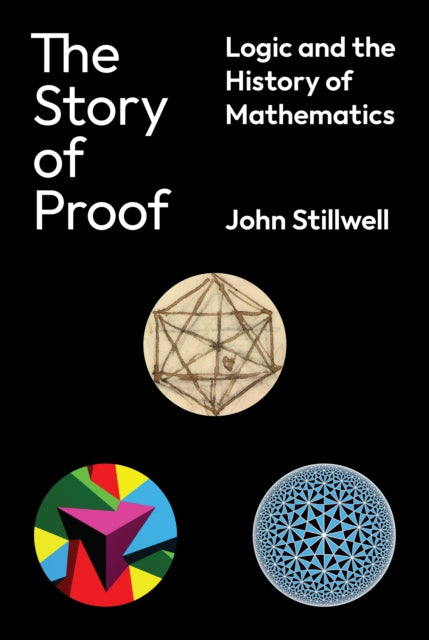
Princeton University Press The Story of Proof
Book SynopsisTrade Review"This book could well serve as a history of mathematics. … [Stillwell] has done an amazing job of collecting and categorizing many of the most important ideas in this area."---Jim Stein, New Books in Mathematics"Stillwell’s [The Story of Proof] joins his two other Princeton University Press books in having my highest recommendation. I just wish they had been around when I was a student."---George Hacken, Computing Reviews"I hugely enjoyed this book."---Jonathan Shock, Mathemafrica"This book would be perfect for any keen undergraduate, keen amateur, or indeed a teacher of mathematics, who wants a book to dip into to use for the classroom."---Jonathan Shock, Mathemafrica"A well-crafted, thought-provoking meditation on the concept of proof in mathematics. . . .It is a substantive book that deserves to be read and reflected upon."---Tommy Murphy, Irish Mathematical Society Bulletin"This is a work that mathematicians, historians, and philosophers will find especially engaging, as will anyone with a serious interest in mathematics and the limits of certainty that it is constantly probing."---J.W. Dauben, Choice
£34.20

Princeton University Press The Mathematics of Secrets
Book SynopsisTrade Review"In The Mathematics of Secrets, Joshua Holden takes the reader on a chronological journey from Julius Caesar’s substitution cipher to modern day public-key algorithms and beyond. . . . Written for anyone with an interest in cryptography." —Noel-Ann Bradshaw, Times Higher Education "Complete in surveying cryptography. . . . This is a marvelous way of illustrating the use of simple mathematics in an important application that has triggered the wit of the designers and the ingenuity of the attackers since antiquity." —Adhemar Bultheel, European Mathematical Society "The best book I have seen on this subject." —Phil Dyke, Leonardo Reviews "This is a fascinating tour of the mathematics behind cryptography, showing how its principles underpin the ways that different codes and ciphers operate. . . . While it’s all about maths, the book is accessible—basic high school algebra is all that’s needed to understand and enjoy it." —Cosmos Magazine
£15.19

HarperCollins Publishers The Undercover Mathematician
Book SynopsisCollins Big Cat supports every primary child on their reading journey from phonics to fluency. Top authors and illustrators have created fiction and non-fiction books that children love to read. Book banded for guided and independent reading, there are reading notes in the back, comprehensive teaching and assessment support and ebooks available.Born in 18th century France, Sophie Germain was not allowed to learn Maths, because she was a girl. Sophie went undercover to learn Maths in secret, using a boy's name as a code name. There was just one problem. Sophie was so good at Maths, people wanted to meet her. Would her cover be blown?Lime Plus/Band 11+ books provide challenging plots and vocabulary as well as opportunities to practise inference, prediction and reading stamina.Pages 46 and 47 allow children to re-visit the content of the book, supporting comprehension skills, vocabulary development and recall.Ideas for reading in the back of the book provide practical support and stimulat
£10.46

Penguin Books Ltd God Created the Integers The Mathematical
Book SynopsisGOD CREATED THE INTEGERS is Stephen Hawking''s personal choice of the greatest mathematical works in history. He allows the reader to peer into the mind of genius by providing us with excerpts from original mathematical proofs and results. He also helps us understand the progression of mathematical thought, and the very foundations of our presentday technologies. The book includes landmark discoveries spanning 2500 years and representing the work of mathematicians such as Euclid, Georg Cantor, Kurt Godel, Augustin Cauchy, Bernard Riemann and Alan Turing. Each chapter begins with a biography of the featured mathematician, clearly explaining the significance of the result, followed by the full proof of the work, reproduced from the original publication, many in new translations.
£17.09

Oxford University Press The Spirit of Mathematics Algebra and all that
Book SynopsisWhat makes mathematics so special?Whether you have anxious memories of the subject from school, or solve quadratic equations for fun, David Acheson''s book will make you look at mathematics afresh. Following on from his previous bestsellers, The Calculus Story and The Wonder Book of Geometry, here Acheson highlights the power of algebra, combining it with arithmetic and geometry to capture the spirit of mathematics. This short book encompasses an astonishing array of ideas and concepts, from number tricks and magic squares to infinite series and imaginary numbers.Acheson''s enthusiasm is infectious, and, as ever, a sense of quirkiness and fun pervades the book. But it also seeks to crystallize what is special about mathematics: the delight of discovery; the importance of proof; and the joy of contemplating an elegant solution. Using only the simplest of materials, it conjures up the depth and the magic of the subject.Trade ReviewDavid Acheson captures the joy and wonder of mathematics in this little book, full of delightful and curious examples presented in a gentle, friendly way, yet packing in a number of profound ideas. * Hannah Fry, broadcaster and lecturer, author of The Mathematics of Love and The Indisputable Existence of Santa Claus *A delight. * Brian Clegg, Popular Science *[A] compendium of intriguing ideas which would fascinate and compel a keen mathematician wanting to learn more, and provide hours of intrigue and jumping-off points for further investigation. * Katie Steckles, The Aperiodical *[A] neat little book...every teacher, or at least every department, should have a copy. * Grant Macleod, Mathematics in Schools *This book is both interesting and entertaining, and it should appeal to any numerate person who has a casual interest in puzzles or mathematics. * SF2 Concatenation *Table of Contents1: Introduction 2: Whatever Happened to A, B, and C? 3: The 1089 Trick 4: Another Kind of Magic 5: Just Imagine... 6: A Most Unusual Lecture 7: Why are Mathematicians Obsessed by Proof? 8: Puzzling Mathematics 9: Why Does (-1) × (-1) = +1? 10: It's a Square World 11: Algebra in Action 12: 'Compleating the Square' 13: Slices of Pi 14: The Golden Ratio 15: Proof by Chocolate 16: The Puzzled Farmer 17: Mathematics and Snooker 18: The Wicked Schoolteacher 19: Trains, Boats, and Planes 20: I've Seen That Before, Somewhere ... 21: An Apple Falls ... 22: Rollercoaster Mathematics 23: The Electric Guitar Revisited 24: The Domino Effect 25: Real or Imaginary? 26: The Square Root of Minus One 27: Inspector Riemann Investigates ... 28: Infinite Danger 29: 1 + 1 to the Rescue! 30: And Finally ... Notes and references Further Reading Index
£14.39

Oxford University Press Mathematics in Western Culture
Book SynopsisThis book gives a remarkably fine account of the influences mathematics has exerted on the development of philosophy, the physical sciences, religion, and the arts in Western life.Trade Review"[Kline] is unfalteringly clear in explaining mathematical ideas; he is learned but not pedantic; he has historical discernment, a sympathetic social outlook and a nice sense of fun and irony.... The beauty and fascination and rare excellence of mathematics emerge from his story. It is an exciting, provocative book."--Scientific American "Still the best textbook for the history and philosophy of mathematics for undergraduate liberal arts students. Especially good for the age of the Scientific Revulution."--Janet A. Fitzgerald, Molloy College, NY
£24.99

Oxford University Press Closing the Gap
Book SynopsisIn 2013, a little known mathematician in his late 50s stunned the mathematical community with a breakthrough on an age-old problem about prime numbers. Since then, there has been further dramatic progress on the problem, thanks to the efforts of a large-scale online collaborative effort of a type that would have been unthinkable in mathematics a couple of decades ago, and the insight and creativity of a young mathematician at the start of his career.Prime numbers have intrigued, inspired and infuriated mathematicians for millennia. Every school student studies prime numbers and can appreciate their beauty, and yet mathematicians'' difficulty with answering some seemingly simple questions about them reveals the depth and subtlety of prime numbers.Vicky Neale charts the recent progress towards proving the famous Twin Primes Conjecture, and the very different ways in which the breakthroughs have been made: a solo mathematician working in isolation and obscurity, and a large collaboration that is more public than any previous collaborative effort in mathematics and that reveals much about how mathematicians go about their work. Interleaved with this story are highlights from a significantly older tale, going back two thousand years and more, of mathematicians'' efforts to comprehend the beauty and unlock the mysteries of the prime numbers.Trade ReviewThe way [Closing the Gap] explores mathematics and at the same time describes the work mathematicians do, is very interesting and it keeps the reader invested in the book. It is easy to read and precise. The book could be definitely recommended to mathematics students and teachers but also to younger people with an interest in higher-level mathematics. * Panayiotis Vlamos, University of Athens, MAA *The book features a creative structure that lends itself well to the subject matter. A curious undergraduate mathematics major should enjoy this book and learn a great deal. For mathematicians who do not specialize in number theory but who are curious about the flurry of recent activity in the field, this book provides an excellent entry point. * Stephan Ramon Garcia, Notices of the American Mathematics Society *If you are looking for an introduction to the world of Polymath; if you are looking for the story of the Twin Primes Conjecture; if you are looking to show you friends and family what your life as a mathematician is; if you would like a bit of asymptotic mathematics explained to you plainly; if you would like a summary of Waring's problem; or if you just have a couple of hours and are looking for a nice diversion, then you have found it. * Deborah Chun, London Mathematical Society *The book is clearly and enthusiastically written and beautifully presented. * Owen Toller, The Mathematical Gazette *For myself, I learned a lot, even about subjects I thought I knew before... it is clear from every page in the book that Neale is superb teacher. In sum, I recommend this book highly to anyone interested in mathematics, young people and teachers but also to researchers. * Michael N. Fried, Mathematical Thinking and Learning *Written in an engaging and inclusive way, it makes a perfect read for beginners but it also picks up the pace fairly quickly, so even enthusiasts like myself are bound to enjoy it. Neale manages to take the readers on a journey to cutting edge research mathematics. * Nikoleta Kalaydzhieva and Sam Porritt, Chalkdust Magazine *Neale writes in an inviting style that draws readers into this challenging subject, convincing them that, with a little effort, they too can follow along. An enjoyable book and journey, complemented by a helpful reading list and index... Recommended. * J. Johnson, CHOICE *Closing the Gap is an excellent exposition of the study of prime numbers. Not only do we learn about the history of this area since the Greeks, but the book is the first aimed at a lay readership that provides insight into recent breakthroughs. Vicky Neale's passion in the subject is contagious and I enjoyed how she weaves together the mathematics with background on how mathematicians now work, as well as her reflections on what it is like to be a mathematician. This book would be ideal for a curious sixth former wanting to peek ahead at what might lie around the corner if they are considering studying mathematics at a higher level. * Alex Bellos, author of Alex's Adventures in Numberland and Alex Through the Looking-Glass *Her prose is clear but not patronizing, precise but accessible. The result is a very enjoyable book that can be read with profit not only by laypeople but also by mathematics students and the people who teach them. * Mark Hunacek, MAA Reviews *Closing The Gap has gone straight into my top ten books to give to interested students... The book's introduction starts with an extended analogy comparing mathematics to climbing [and] Neale sets herself up as this guide, and succeeds brilliantly. * Colin Beveridge, The Aperiodical *Closing the Gap is among the clearest popular accounts of maths I've read in a while. It's about prime numbers, as the title suggests, but it's also a master piece in the art of weaving. Apart from exploring the mathematics, the book gives an intimate description of the process of doing maths as experienced by those who do it every day, and an account of a particularly exciting, and recent, period when prime number theory made some great leaps forward. And it's a look at a completely new way of doing mathematics: in large online collaborations that anyone can join. * Marianne Freiberger, PLUS *Table of Contents1: Introduction 2: What is a prime? 3: May 2013 4: It's easy to ask hard questions 5: May 2013 6: Making hard problems easier 7: June 2013 8: How many primes are there? 9: July 2013 10: What's so mathematical about my mathematical pencil? 11: August 2013 12: If primes are hard, let's try something else 13: November 2013 14: Generalise . . . 15: April 2014 16: Where next?
£26.49

Oxford University Press Number Theory
Book SynopsisNumber theory is the branch of mathematics primarily concerned with the counting numbers, especially primes. It dates back to the ancient Greeks, but today it has great practical importance in cryptography, from credit card security to national defence. This book introduces the main areas of number theory, and some of its most interesting problems.Table of ContentsList of illustrations List of tables 1: What is number theory? 2: Divisibility 3: Primes I 4: Congruences I 5: Diophantine equations 6: Congruences II 7: Primes II 8: The Riemann hypothesis Appendix Further reading Index
£9.49

Yale University Press A Little History of Mathematics
£10.44

Black Dog & Leventhal Publishers Inc Math with Bad Drawings
Book SynopsisIn MATH WITH BAD DRAWINGS, Ben Orlin answers math''s three big questions: Why do I need to learn this? When am I ever going to use it? Why is it so hard? The answers come in various forms-cartoons, drawings, jokes, and the stories and insights of an empathetic teacher who believes that math should belong to everyone. Eschewing the tired old curriculum that begins in the wading pool of addition and subtraction and progresses to the shark infested waters of calculus (AKA the Great Weed Out Course), Orlin instead shows us how to think like a mathematician by teaching us a new game of Tic-Tac-Toe, how to understand an economic crisis by rolling a pair of dice, and the mathematical reason why you should never buy a second lottery ticket. Every example in the book is illustrated with his trademark bad drawings, which convey both his humor and his message with perfect pitch and clarity. Organized by unconventional but compelling topics such as Statistics: The Fine Art of Honest Lying, Design: The Geometry of Stuff That Works, and Probability: The Mathematics of Maybe, MATH WITH BAD DRAWINGS is a perfect read for fans of illustrated popular science.
£22.50

Dover Publications Inc. Levels of Infinity
Book SynopsisThis original anthology collects 10 of Weyl''s less-technical writings that address the broader scope and implications of mathematics. Most have been long unavailable or not previously published in book form. Subjects include logic, topology, abstract algebra, relativity theory, and reflections on the work of Weyl''s mentor, David Hilbert. 2012 edition.
£15.29

Cambridge University Press Underground Mathematics
Book SynopsisMorel tells the story of subterranean geometry, a forgotten discipline that developed in the silver mines of early modern Europe where mining and metallurgy were of great significance. Through vivid case studies, he illustrates how geometry was used in metallic mines, from surveying to map-making, by practitioners using esoteric manuscripts.
£28.49

Cambridge University Press Plato Was Not a Mathematical Platonist
Book SynopsisThis Element shows that Plato keeps a clear distinction between mathematical and metaphysical realism. It also shows that methodological commitments to mathematical objects are made in light of mathematical practice; foundational considerations; and, mathematical applicability. This title is also available as Open Access on Cambridge Core.Trade Review'… Landry's response to the Platonic call for collaboration with his text opens up the possibility of very fruitful debates.' Susanna Saracco, MetascienceTable of Contents1. Introduction; 2. The interprative lay of the land; 3. The divided line; 4. Book 7; 5. The good in mathematics; 6. Mathematics versus metaphysics; References.
£17.00
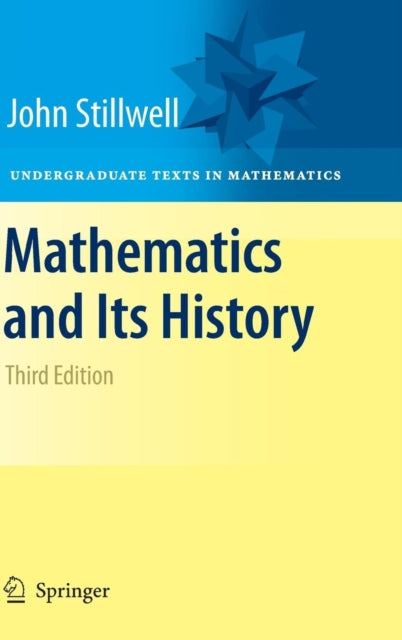
Springer-Verlag New York Inc. Mathematics and Its History
Book SynopsisFrom a review of the second edition:"This book covers many interesting topics not usually covered in a present day undergraduate course, as well as certain basic topics such as the development of the calculus and the solution of polynomial equations. The fact that the topics are introduced in their historical contexts will enable students to better appreciate and understand the mathematical ideas involved...If one constructs a list of topics central to a history course, then they would closely resemble those chosen here."(David Parrott, Australian Mathematical Society)This book offers a collection of historical essays detailing a large variety of mathematical disciplines and issues; it's accessible to a broad audience. This third edition includes new chapters on simple groups and new sections on alternating groups and the Poincare conjecture. Many more exercises have been added as well as commentary that helps place the exercises in context.Trade Review“Mathematics and Its History is an original, engaging and effective book, which I think would be enjoyed by students, lay readers with the right background, or indeed mathematicians themselves.” (Danny Yee, Danny Yee's Book Reviews, dannyreviews.com, March, 2019)From the reviews of the third edition:"The author’s goal for Mathematics and its History is to provide a “bird’s-eye view of undergraduate mathematics.” (p. vii) In that regard it succeeds admirably. ... Mathematics and its History is a joy to read. The writing is clear, concise and inviting. The style is very different from a traditional text. ... The author has done a wonderful job of tying together the dominant themes of undergraduate mathematics. ... While Stillwell does a wonderful job of tying together seemingly unrelated areas of mathematics, it is possible to read each chapter independently. I would recommend this fine book for anyone who has an interest in the history of mathematics. For those who teach mathematics, it provides lots of information which could easily be used to enrich an opening lecture in most any undergraduate course. It would be an ideal gift for a department’s outstanding major or for the math club president. Pick it up at your peril — it is hard to put down!"(Richard Wilders, MAA Reviews)“I appreciate and recommend Stillwell’s presentation of mathematics and history written in a lively style. The author’s concept (history mostly as the means of approaching mathematics) remains a matter of interest for both the mathematician and the historian … .” (Rüdiger Thiele, Zentralblatt MATH, Vol. 1207, 2011)From the reviews of the second edition:"This book covers many interesting topics not usually covered in a present day undergraduate course, as well as certain basic topics such as the development of the calculus and the solution of polynomial equations. The fact that the topics are introduced in their historical contexts will enable students to better appreciate and understand the mathematical ideas involved...If one constructs a list of topics central to a history course, then they would closely resemble those chosen here."(David Parrott, Australian Mathematical Society)"The book...is presented in a lively style without unnecessary detail. It is very stimulating and will be appreciated not only by students. Much attention is paid to problems and to the development of mathematics before the end of the nineteenth century... This book brings to the non-specialist interested in mathematics many interesting results. It can be recommended for seminars and will be enjoyed by the broad mathematical community." (European Mathematical Society)"Since Stillwell treats many topics, most mathematicians will learn a lot from this book as well as they will find pleasant and rather clear expositions of custom materials. The book is accessible to students that have already experienced calculus, algebra and geometry and will give them a good account of how the different branches of mathematics interact."(Denis Bonheure, Bulletin of the Belgian Society)Table of ContentsPreface to the Third Edition.- Preface to the Second Edition.- Preface to the First Edition.- The Theorem of Pythagoras.- Greek Geometry.- Greek Number Theory.- Infinity in Greek Mathematics.- Number Theory in Asia.- Polynomial Equations.- Analytic Geometry.- Projective Geometry.- Calculus.- Infinite Series.- The Number Theory Revival.- Elliptic Functions.- Mechanics.- Complex Numbers in Algebra.- Complex Numbers and Curves.- Complex Numbers and Functions.- Differential Geometry.- Non-Euclidean Geometry.- Group Theory.- Hypercomplex Numbers.- Algebraic Number Theory.- Topology.- Simple Groups.- Sets, Logic, and Computation.- Combinatorics.- Bibliography.- Index.-
£47.49

Little, Brown Book Group A Brief History of Mathematical Thought
Book SynopsisMathematics is a product of human culture which has developed along with our attempts to comprehend the world around us. In A Brief History of Mathematical Thought, Luke Heaton explores how the language of mathematics has evolved over time, enabling new technologies and shaping the way people think. From stone-age rituals to algebra, calculus, and the concept of computation, Heaton shows the enormous influence of mathematics on science, philosophy and the broader human story.The book traces the fascinating history of mathematical practice, focusing on the impact of key conceptual innovations. Its structure of thirteen chapters split between four sections is dictated by a combination of historical and thematic considerations. In the first section, Heaton illuminates the fundamental concept of number. He begins with a speculative and rhetorical account of prehistoric rituals, before describing the practice of mathematics in Ancient Egypt, Babylon and Greece. He
£10.44

Bloomsbury Publishing PLC Wonders Beyond Numbers
Book SynopsisIn this book, Johnny Ball tells one of the most important stories in world history the story of mathematics. By introducing us to the major characters and leading us through many historical twists and turns, Johnny slowly unravels the tale of how humanity built up a knowledge and understanding of shapes, numbers and patterns from ancient times, a story that leads directly to the technological wonderland we live in today. As Galileo said, Everything in the universe is written in the language of mathematics', and Wonders Beyond Numbers is your guide to this language. Mathematics is only one part of this rich and varied tale; we meet many fascinating personalities along the way, such as a mathematician who everyone has heard of but who may not have existed; a Greek philosopher who made so many mistakes that many wanted his books destroyed; a mathematical artist who built the largest masonry dome on earth, which builders had previously declared impossible; a world-renowned pTrade ReviewThe great strength of this book is probably its wide coverage of practical applications of mathematics, especially in engineering and architecture. * The Mathematical Gazette *Johnny Ball's trademark enthusiasm for mathematics bubbles off every page. Clear, simple, readable, and informative – just as I expected. It's a winner! -- Ian Stewart, author of Significant FiguresI became an instant Johnny Ball fan when his TV series Think of a Number first aired in the UK, and I saw how he engaged and delighted my two young daughters in a way I, their maths professor dad, could not. With this new book, his passion for, and sheer enjoyment of, mathematics will surely entice yet more generations to the subject we both love. -- Keith Devlin, Stanford University mathematician, award-winning author and the 'Math Guy' on America's radio.I always found maths intriguing and baffling in equal measure - and the latter triumphed. If only I'd had Wonders Beyond Numbers when growing up. But I now have it and it is a re-awaking into a world of delight and wonder. It is a wonderful book. -- Anthony Seldon, Vice-Chancellor of the University of BuckinghamTable of ContentsPreface: Mathematics means everything to me... Wow Factor Mathematical Index Explained Introduction: Russian Sums in an English Pub, Circa 1946 Chapter 1: The Most Ancient Mathematical Legend Chapter 2: The First Two Great Mathematicians Chapter 3: The Great Age of Grecian Geeks Chapter 4: Archimedes – the Greatest Greek of Them All Chapter 5: The Glory That Was Alexandria Chapter 6: Total Eclipse of the Greeks Chapter 7: Maths Origins, Far and Wide Chapter 8: Mathematics Was Never a Religion Chapter 9: Discovering the Unknown World Chapter 10: The Huge Awakening and a New Age of Learning Chapter 11: The New Age of Mathematical Discovery Chapter 12: How to Calculate Anything and Everything Chapter 13: A Mathematician With Gravitas Chapter 14: The Simple Mathematics That Underpins Science Chapter 15: The Many Tentacles of Mathematics Wow Factor Mathematical Index Bibliography Image credits Index
£14.24

Quercus Publishing 50 Maths Ideas You Really Need to Know
Book SynopsisIn a series of 50 accessible essays, Tony Crilly explains and introduces the mathematical laws and principles - ancient and modern, theoretical and practical, everyday and esoteric - that allow us to understand the world around us.From Pascal's triangle to money management, ideas of relativity to the very real uses of imaginary numbers, 50 Maths Ideas is a complete introduction to the most important mathematical concepts in history.
£9.49


