
Mathematics Books

Princeton University Press The Secret Formula
Book Synopsis
£15.19

John Wiley & Sons Inc Introductory Functional Analysis with
Book SynopsisProvides avenues for applying functional analysis to the practical study of natural sciences as well as mathematics. Contains worked problems on Hilbert space theory and on Banach spaces and emphasizes concepts, principles, methods and major applications of functional analysis.Table of ContentsMetric Spaces.Normed Spaces;Banach Spaces.Inner Product Spaces;Hilbert Spaces.Fundamental Theorems for Normed and Banach Spaces.Further Applications: Banach Fixed Point Theorem.Spectral Theory of Linear Operators in Normed Spaces.Compact Linear Operators on Normed Spaces and Their Spectrum.Spectral Theory of Bounded Self-Adjoint Linear Operators.Unbounded Linear Operators in Hilbert Space.Unbounded Linear Operators in Quantum Mechanics.Appendices.References.Index.
£130.46

Pearson Education Numerical Analysis
Book SynopsisTimothy Sauer earned his Ph.D. in mathematics at the University of CaliforniaBerkeley in 1982, and is currently a professor at George Mason University. He has published articles on a wide range of topics in applied mathematics, including dynamical systems, computational mathematics, and mathematical biology.Table of Contents Preface 1. Solving Equations 2. Systems of Equations 3. Interpolation 4. Least Squares 5. Numerical Differentiation and Integration 6. Ordinary Differential Equations 7. Boundary Value Problems 8. Partial Differential Equations 9. Random Numbers and Applications 10. Trigonometric Interpolation and the FFT 11. Compression 12. Eigenvalues and Singular Values References
£70.29

Cambridge University Press Mathematics Standard Level for the IB Diploma
Book SynopsisReviews topics covered on the examination, and offers test taking strategies and practice questions with detailed explanations.Table of ContentsIntroduction; Additional advice; 1. Polynomials; 2. Exponentials and logs; 3. Functions; 4. Sequences and series; 5. Trigonometry; 6. Vectors; 7. Differentiation; 8. Integration; 9. Descriptive statistics; 10. Probability; Answers; Worked solutions.
£20.25

Cengage Learning, Inc Calculus
Book SynopsisDesigned for the three-semester engineering calculus course, CALCULUS: EARLY TRANSCENDENTAL FUNCTIONS, Sixth Edition, continues to offer instructors and students innovative teaching and learning resources. The Larson team always has two main objectives for text revisions: to develop precise, readable materials for students that clearly define and demonstrate concepts and rules of calculus; and to design comprehensive teaching resources for instructors that employ proven pedagogical techniques and save time. The Larson/Edwards Calculus program offers a solution to address the needs of any calculus course and any level of calculus student. Every edition from the first to the sixth of CALCULUS: EARLY TRANSCENDENTAL FUNCTIONS has made the mastery of traditional calculus skills a priority, while embracing the best features of new technology and, when appropriate, calculus reform ideas.Trade Review1. PREPARATION FOR CALCULUS. Graphs and Models. Linear Models and Rates of Change. Functions and Their Graphs. Fitting Models to Data. Inverse Functions. Exponential and Logarithmic Functions. Review Exercises. P.S. Problem Solving. 2. LIMITS AND THEIR PROPERTIES. A Preview of Calculus. Finding Limits Graphically and Numerically. Evaluating Limits Analytically. Continuity and One-Sided Limits. Infinite Limits. Section Project: Graphs and Limits of Trigonometric Functions. Review Exercises. P.S. Problem Solving. 3. DIFFERENTIATION. The Derivative and the Tangent Line Problem. Basic Differentiation Rules and Rates of Change. Product and Quotient Rules and Higher-Order Derivatives. The Chain Rule. Implicit Differentiation. Section Project: Optical Illusions. Derivatives of Inverse Functions, Related Rates. Newton's Method. Review Exercises. P.S. Problem Solving. 4. APPLICATIONS OF DIFFERENTIATION. Extrema on an Interval. Rolle's Theorem and the Mean Value Theorem. Increasing and Decreasing Functions and the First Derivative Test. Section Project: Rainbows. Concavity and the Second Derivative Test. Limits at Infinity. A Summary of Curve Sketching. Optimization Problems. Section Project: Connecticut River. Differentials. Review Exercises. P.S. Problem Solving. 5. INTEGRATION. Antiderivatives and Indefinite Integration. Area. Riemann Sums and Definite Integrals. The Fundamental Theorem of Calculus. Section Project: Demonstrating the Fundamental Theorem. Integration by Substitution. Numerical Integration. The Natural Logarithmic Function: Integration. Inverse Trigonometric Functions: Integration. Hyperbolic Functions. Section Project: St. Louis Arch. Review Exercises. P.S. Problem Solving. 6. DIFFERENTIAL EQUATIONS. Slope Fields and Euler's Method. Differential Equations: Growth and Decay. Differential Equations: Separation of Variables. The Logistic Equation. First-Order Linear Differential Equations. Section Project: Weight Loss. Predator-Prey Differential Equations. Review Exercises. P.S. Problem Solving. 7. APPLICATIONS OF INTEGRATION. Area of a Region Between Two Curves. Volume: The Disk Method. Volume: The Shell Method. Section Project: Saturn. Arc Length and Surfaces of Revolution. Work. Section Project: Tidal Energy. Moments, Centers of Mass, and Centroids. Fluid Pressure and Fluid Force. Review Exercises. P.S. Problem Solving. 8. INTEGRATION TECHNIQUES, L'HOPITAL'S RULE, AND IMPROPER INTEGRALS. Basic Integration Rules. Integration by Parts. Trigonometric Integrals. Section Project: Power Lines. Trigonometric Substitution. Partial Fractions. Integration by Tables and Other Integration Techniques. Indeterminate Forms and L'Hopital's Rule. Improper Integrals. Review Exercises. P.S. Problem Solving. 9. INFINITE SERIES. Sequences. Series and Convergence. Section Project: Cantor's Disappearing Table. The Integral Test and p-Series. Section Project: The Harmonic Series. Comparisons of Series. Section Project: Solera Method. Alternating Series. The Ratio and Root Tests. Taylor Polynomials and Approximations. Power Series. Representation of Functions by Power Series. Taylor and Maclaurin Series. Review Exercises. P.S. Problem Solving. 10. CONICS, PARAMETRIC EQUATIONS, AND POLAR COORDINATES. Conics and Calculus. Plane Curves and Parametric Equations. Section Project: Cycloids. Parametric Equations and Calculus. Polar Coordinates and Polar Graphs. Section Project: Anamorphic Art. Area and Arc Length in Polar Coordinates. Polar Equations of Conics and Kepler's Laws. Review Exercises. P.S. Problem Solving. 11. VECTORS AND THE GEOMETRY OF SPACE. Vectors in the Plane. Space Coordinates and Vectors in Space. The Dot Product of Two Vectors. The Cross Product of Two Vectors in Space. Lines and Planes in Space. Section Project: Distances in Space. Surfaces in Space. Cylindrical and Spherical Coordinates. Review Exercises. P.S. Problem Solving. 12. VECTOR-VALUED FUNCTIONS. Vector-Valued Functions. Section Project: Witch of Agnesi. Differentiation and Integration of Vector-Valued Functions. Velocity and Acceleration. Tangent Vectors and Normal Vectors. Arc Length and Curvature. Review Exercises. P.S. Problem Solving. 13. FUNCTIONS OF SEVERAL VARIABLES. Introduction to Functions of Several Variables. Limits and Continuity. Partial Derivatives. Section Project: Moire Fringes. Differentials. Chain Rules for Functions of Several Variables. Directional Derivatives and Gradients. Tangent Planes and Normal Lines. Section Project: Wildflowers. Extrema of Functions of Two Variables. Applications of Extrema of Functions of Two Variables. Section Project: Building a Pipeline. Lagrange Multipliers. Review Exercises. P.S. Problem Solving. 14. MULTIPLE INTEGRATION. Iterated Integrals and Area in the Plane. Double Integrals and Volume. Change of Variables: Polar Coordinates. Center of Mass and Moments of Inertia. Section Project: Center of Pressure on a Sail. Surface Area. Section Project: Capillary Action. Triple Integrals and Applications. Triple Integrals in Cylindrical and Spherical Coordinates. Section Project: Wrinkled and Bumpy Spheres. Change of Variables: Jacobians. Review Exercises. P.S. Problem Solving. 15. VECTOR ANALYSIS. Vector Fields. Line Integrals. Conservative Vector Fields and Independence of Path. Green's Theorem. Section Project: Hyperbolic and Trigonometric Functions. Parametric Surfaces. Surface Integrals. Section Project: Hyperboloid of One Sheet. Divergence Theorem. Stokes's Theorem. Review Exercises. Section Project: The Planimeter. P.S. Problem Solving. 16. ADDITIONAL TOPICS IN DIFFERENTIAL EQUATIONS (Web). Exact First-Order Equations. Second-Order Homogeneous Linear Equations. Second-Order Nonhomogeneous Linear Equations. Series Solutions of Differential Equations. Review Exercises. P.S. Problem Solving. APPENDIX. A. Proofs of Selected Theorems (Web). B. Integration Tables. C. Precalculus Review. (Web). C.1 Real Numbers and the Real Number Line. C.2 The Cartesian Plane. C.3 Review of Trigonometric Functions. D. Rotation and the General Second-Degree Equation (Web). E. Complex Numbers. (Web).Table of Contents1. PREPARATION FOR CALCULUS. Graphs and Models. Linear Models and Rates of Change. Functions and Their Graphs. Fitting Models to Data. Inverse Functions. Exponential and Logarithmic Functions. Review Exercises. P.S. Problem Solving. 2. LIMITS AND THEIR PROPERTIES. A Preview of Calculus. Finding Limits Graphically and Numerically. Evaluating Limits Analytically. Continuity and One-Sided Limits. Infinite Limits. Section Project: Graphs and Limits of Trigonometric Functions. Review Exercises. P.S. Problem Solving. 3. DIFFERENTIATION. The Derivative and the Tangent Line Problem. Basic Differentiation Rules and Rates of Change. Product and Quotient Rules and Higher-Order Derivatives. The Chain Rule. Implicit Differentiation. Section Project: Optical Illusions. Derivatives of Inverse Functions, Related Rates. Newton's Method. Review Exercises. P.S. Problem Solving. 4. APPLICATIONS OF DIFFERENTIATION. Extrema on an Interval. Rolle's Theorem and the Mean Value Theorem. Increasing and Decreasing Functions and the First Derivative Test. Section Project: Rainbows. Concavity and the Second Derivative Test. Limits at Infinity. A Summary of Curve Sketching. Optimization Problems. Section Project: Connecticut River. Differentials. Review Exercises. P.S. Problem Solving. 5. INTEGRATION. Antiderivatives and Indefinite Integration. Area. Riemann Sums and Definite Integrals. The Fundamental Theorem of Calculus. Section Project: Demonstrating the Fundamental Theorem. Integration by Substitution. Numerical Integration. The Natural Logarithmic Function: Integration. Inverse Trigonometric Functions: Integration. Hyperbolic Functions. Section Project: St. Louis Arch. Review Exercises. P.S. Problem Solving. 6. DIFFERENTIAL EQUATIONS. Slope Fields and Euler's Method. Differential Equations: Growth and Decay. Differential Equations: Separation of Variables. The Logistic Equation. First-Order Linear Differential Equations. Section Project: Weight Loss. Predator-Prey Differential Equations. Review Exercises. P.S. Problem Solving. 7. APPLICATIONS OF INTEGRATION. Area of a Region Between Two Curves. Volume: The Disk Method. Volume: The Shell Method. Section Project: Saturn. Arc Length and Surfaces of Revolution. Work. Section Project: Tidal Energy. Moments, Centers of Mass, and Centroids. Fluid Pressure and Fluid Force. Review Exercises. P.S. Problem Solving. 8. INTEGRATION TECHNIQUES, L'HOPITAL'S RULE, AND IMPROPER INTEGRALS. Basic Integration Rules. Integration by Parts. Trigonometric Integrals. Section Project: Power Lines. Trigonometric Substitution. Partial Fractions. Integration by Tables and Other Integration Techniques. Indeterminate Forms and L'Hopital's Rule. Improper Integrals. Review Exercises. P.S. Problem Solving. 9. INFINITE SERIES. Sequences. Series and Convergence. Section Project: Cantor's Disappearing Table. The Integral Test and p-Series. Section Project: The Harmonic Series. Comparisons of Series. Section Project: Solera Method. Alternating Series. The Ratio and Root Tests. Taylor Polynomials and Approximations. Power Series. Representation of Functions by Power Series. Taylor and Maclaurin Series. Review Exercises. P.S. Problem Solving. 10. CONICS, PARAMETRIC EQUATIONS, AND POLAR COORDINATES. Conics and Calculus. Plane Curves and Parametric Equations. Section Project: Cycloids. Parametric Equations and Calculus. Polar Coordinates and Polar Graphs. Section Project: Anamorphic Art. Area and Arc Length in Polar Coordinates. Polar Equations of Conics and Kepler's Laws. Review Exercises. P.S. Problem Solving. 11. VECTORS AND THE GEOMETRY OF SPACE. Vectors in the Plane. Space Coordinates and Vectors in Space. The Dot Product of Two Vectors. The Cross Product of Two Vectors in Space. Lines and Planes in Space. Section Project: Distances in Space. Surfaces in Space. Cylindrical and Spherical Coordinates. Review Exercises. P.S. Problem Solving. 12. VECTOR-VALUED FUNCTIONS. Vector-Valued Functions. Section Project: Witch of Agnesi. Differentiation and Integration of Vector-Valued Functions. Velocity and Acceleration. Tangent Vectors and Normal Vectors. Arc Length and Curvature. Review Exercises. P.S. Problem Solving. 13. FUNCTIONS OF SEVERAL VARIABLES. Introduction to Functions of Several Variables. Limits and Continuity. Partial Derivatives. Section Project: Moir�� Fringes. Differentials. Chain Rules for Functions of Several Variables. Directional Derivatives and Gradients. Tangent Planes and Normal Lines. Section Project: Wildflowers. Extrema of Functions of Two Variables. Applications of Extrema of Functions of Two Variables. Section Project: Building a Pipeline. Lagrange Multipliers. Review Exercises. P.S. Problem Solving. 14. MULTIPLE INTEGRATION. Iterated Integrals and Area in the Plane. Double Integrals and Volume. Change of Variables: Polar Coordinates. Center of Mass and Moments of Inertia. Section Project: Center of Pressure on a Sail. Surface Area. Section Project: Capillary Action. Triple Integrals and Applications. Triple Integrals in Cylindrical and Spherical Coordinates. Section Project: Wrinkled and Bumpy Spheres. Change of Variables: Jacobians. Review Exercises. P.S. Problem Solving. 15. VECTOR ANALYSIS. Vector Fields. Line Integrals. Conservative Vector Fields and Independence of Path. Green's Theorem. Section Project: Hyperbolic and Trigonometric Functions. Parametric Surfaces. Surface Integrals. Section Project: Hyperboloid of One Sheet. Divergence Theorem. Stokes's Theorem. Review Exercises. Section Project: The Planimeter. P.S. Problem Solving. 16. ADDITIONAL TOPICS IN DIFFERENTIAL EQUATIONS (Web). Exact First-Order Equations. Second-Order Homogeneous Linear Equations. Second-Order Nonhomogeneous Linear Equations. Series Solutions of Differential Equations. Review Exercises. P.S. Problem Solving. APPENDIX. A. Proofs of Selected Theorems (Web). B. Integration Tables. C. Precalculus Review. (Web). C.1 Real Numbers and the Real Number Line. C.2 The Cartesian Plane. C.3 Review of Trigonometric Functions. D. Rotation and the General Second-Degree Equation (Web). E. Complex Numbers. (Web).
£91.99

CRC Press Risk Assessment and Decision Analysis with
Book SynopsisSince the first edition of this book published, Bayesian networks have become even more important for applications in a vast array of fields. This second edition includes new material on influence diagrams, learning from data, value of information, cybersecurity, debunking bad statistics, and much more. Focusing on practical real-world problem-solving and model building, as opposed to algorithms and theory, it explains how to incorporate knowledge with data to develop and use (Bayesian) causal models of risk that provide more powerful insights and better decision making than is possible from purely data-driven solutions.Features Provides all tools necessary to build and run realistic Bayesian network models Supplies extensive example models based on real risk assessment problems in a wide range of application domains provided; for example, finance, safety, systems reliability, law, forensics, cybersecurity and more Introduces all necessary
£42.74

John Wiley & Sons Inc Trigonometry Workbook For Dummies
Book SynopsisCovers topics such as cartesian coordinates, sines and cosines, secants and cosecants, tangents and cotangents, transforming functions, operating on identities, adding Heron's formula, and determining domain and range.Table of ContentsIntroduction 1 About This Book 1 Conventions Used in This Book 1 Foolish Assumptions 2 How This Book is Organized 2 Part I: Trying Out Trig: Starting at the Beginning 2 Part II: Trigonometric Functions 3 Part III: Trigonometric Identities and Equations 3 Part IV: Graphing the Trigonometric Functions 3 Part V: The Part of Tens 4 Icons Used in This Book 4 Where to Go from Here 4 Part I: Trying Out Trig: Starting at the Beginning 5 Chapter 1: Tackling Technical Trig 7 Getting Angles Labeled by Size 7 Naming Angles Where Lines Intersect 9 Writing Angle Names Correctly 10 Finding Missing Angle Measures in Triangles 11 Determining Angle Measures along Lines and outside Triangles 12 Dealing with Circle Measurements 14 Tuning In with the Right Chord 15 Sectioning Off Sectors of Circles 16 Answers to Problems on Tackling Technical Trig 17 Chapter 2: Getting Acquainted with the Graph 21 Plotting Points 21 Identifying Points by Quadrant 23 Working with Pythagoras 24 Keeping Your Distance 26 Finding Midpoints of Segments 27 Dealing with Slippery Slopes 28 Writing Equations of Circles 30 Graphing Circles 32 Answers to Problems on Graphing 33 Chapter 3: Getting the Third Degree 37 Recognizing First-Quadrant Angles 37 Expanding Angles to Other Quadrants 39 Expanding Angles beyond 360 Degrees 40 Coordinating with Negative Angle Measures 41 Dealing with Coterminal Angles 42 Answers to Problems on Measuring in Degrees 43 Chapter 4: Recognizing Radian Measure 45 Becoming Acquainted with Graphed Radians 45 Changing from Degrees to Radians 47 Changing from Radians to Degrees 49 Measuring Arcs 50 Determining the Area of a Sector 52 Answers to Problems on Radian Measure 53 Chapter 5: Making Things Right with Right Triangles 57 Naming the Parts of a Right Triangle 57 Completing Pythagorean Triples 59 Completing Right Triangles 61 Working with the 30-60-90 Right Triangle 62 Using the Isosceles Right Triangle 64 Using Right Triangles in Applications 65 Answers to Problems on Right Triangles 68 Part II: Trigonometric Functions 75 Chapter 6: Defining Trig Functions with a Right Triangle 77 Defining the Sine Function 78 Cooperating with the Cosine Function 79 Sunning with the Tangent Definition 80 Hunting for the Cosecant Definition 81 Defining the Secant Function 82 Coasting Home with the Cotangent 83 Establishing Trig Functions for Angles in Special Right Triangles 85 Applying the Trig Functions 86 Answers to Problems on Defining Trig Functions 88 Chapter 7: Discussing Properties of the Trig Functions 93 Defining a Function and Its Inverse 93 Deciding on the Domains 95 Reaching Out for the Ranges 97 Closing In on Exact Values 98 Determining Exact Values for All Functions 99 Answers to Problems in Properties of Trig Functions 102 Chapter 8: Going Full Circle with the Circular Functions 105 Finding Points on the Unit Circle 105 Determining Reference Angles 108 Assigning the Signs of Functions by Quadrant 111 Figuring Out Trig Functions around the Clock 113 Answers to Problems in Going Full Circle 115 Part III: Trigonometric Identities and Equations 119 Chapter 9: Identifying the Basic Identities 121 Using the Reciprocal Identities 121 Creating the Ratio Identities 123 Playing Around with Pythagorean Identities 124 Solving Identities Using Reciprocals, Ratios, and Pythagoras 127 Answers to Problems on Basic Identities 130 Chapter 10: Using Identities Defined with Operations 135 Adding Up the Angles with Sum Identities 135 Subtracting Angles with Difference Identities 138 Doubling Your Pleasure with Double Angle Identities 140 Multiplying the Many by Combining Sums and Doubles 142 Halving Fun with Half-Angle Identities 144 Simplifying Expressions with Identities 146 Solving Identities 148 Answers to Problems on Using Identities 151 Chapter 11: Techniques for Solving Trig Identities 161 Working on One Side at a Time 161 Working Back and Forth on Identities 164 Changing Everything to Sine and Cosine 165 Multiplying by Conjugates 167 Squaring Both Sides 168 Finding Common Denominators 169 Writing All Functions in Terms of Just One 171 Answers to Problems Techniques for Solving Identities 173 Chapter 12: Introducing Inverse Trig Functions 185 Determining the Correct Quadrants 185 Evaluating Expressions Using Inverse Trig Functions 187 Solving Equations Using Inverse Trig Functions 189 Creating Multiple Answers for Multiple and Half-Angles 191 Answers to Problems on Inverse Trig Functions 193 Chapter 13: Solving Trig Equations 195 Solving for Solutions within One Rotation 195 Solving Equations with Multiple Answers 197 Special Factoring for a Solution 200 Using Fractions and Common Denominators to Solve Equations 202 Using the Quadratic Formula 205 Answers to Problems on Solving Trig Equations 206 Chapter 14: Revisiting the Triangle with New Laws 213 Using the Law of Sines 213 Adding the Law of Cosines 215 Dealing with the Ambiguous Case 218 Investigating the Law of Tangents 219 Finding the Area of a Triangle the Traditional Way 220 Flying In with Heron’s Formula 221 Finding Area with an Angle Measure 222 Applying Triangles 223 Answers to Problems on Triangles 224 Part IV: Graphing the Trigonometric Functions 231 Chapter 15: Graphing Sine and Cosine 233 Determining Intercepts and Extreme Values 233 Graphing the Basic Sine and Cosine Curves 235 Changing the Amplitude 236 Adjusting the Period of the Curves 238 Graphing from the Standard Equation 239 Applying the Sine and Cosine Curves to Life 241 Answers to Problems on Graphing Sine and Cosine 243 Chapter 16: Graphing Tangent and Cotangent 249 Establishing Vertical Asymptotes 249 Graphing Tangent and Cotangent 250 Altering the Basic Curves 252 Answers to Problems on Graphing Tangent and Cotangent 253 Chapter 17: Graphing Cosecant, Secant, and Inverse Trig Functions 255 Determining the Vertical Asymptotes 255 Graphing Cosecant and Secant 256 Making Changes to the Graphs of Cosecant and Secant 257 Analyzing the Graphs of the Inverse Trig Functions 258 Answers to Problems on Cosecant, Secant, and Inverse Trig Functions 261 Chapter 18: Transforming Graphs of Trig Functions 263 Sliding the Graphs Left or Right 263 Sliding the Graphs Up or Down 264 Changing the Steepness 266 Reflecting on the Situation — Horizontally 267 Reflecting on Your Position — Vertically 268 Putting It All Together 269 Combining Trig Functions with Polynomials 270 Answers to Problems on Transforming Trig Functions 272 Part V: The Part of Tens 277 Chapter 19: Ten Identities with a Negative Attitude 279 Negative Angle Identities 279 Complementing and Supplementing Identities 279 Doing Fancy Factoring with Identities 280 Chapter 20: Ten Formulas to Use in a Circle 281 Running Around in Circles 281 Adding Up the Area 281 Defeating an Arc Rival 281 Sectioning Off the Sector 282 Striking a Chord 282 Ringing True 283 Inscribing and Radii 283 Circumscribing and Radii 283 Righting a Triangle 284 Inscribing a Polygon 284 Chapter 21: Ten Ways to Relate the Sides and Angles of Any Triangle 285 Relating with the Law of Sines 285 Hatching a Little Heron 286 Summing Sines 286 You Half It or You Don’t 286 Cozying Up with Cosines 286 Angling for an Angle 286 Mixing It Up with Cosines 286 Heron Again, Gone Tomorrow 287 Divide and Conquer with the Tangent 287 Heron Lies the Problem 287 Appendix: Trig Functions Table 289 Index 293
£17.09
Elsevier Science Fractional Differential Equations
Book SynopsisIntended for readers who are new to the fields of fractional derivatives and fractional-order mathematical models, this covers the topics necessary for initial study and immediate application of fractional derivatives fractional differential equations. It also includes tables of fractional derivatives.Trade Review"...This is by no means the first (or the last) book on the subject of fractional calculus, but indeed it is one that wouldundoubtedly attract the attention (and successfully serve the needs) of mathematical, physical, and engineering scientists looking for applications of fractional calculus. I, therefore, recommend this well-written book to all users of fractional calculus." --H. M. Srivastava, Zentralblatt MATHTable of ContentsPreface. Acknowledgments. Special Functions Of Preface. Acknowledgements. Special Functions of the Fractional Calculus. Gamma Function. Mittag-Leffler Function. Wright Function. Fractional Derivatives and Integrals. The Name of the Game. Grünwald-Letnikov Fractional Derivatives. Riemann-Liouville Fractional Derivatives. Some Other Approaches. Sequential Fractional Derivatives. Left and Right Fractional Derivatives. Properties of Fractional Derivatives. Laplace Transforms of Fractional Derivatives. Fourier Transforms of Fractional Derivatives. Mellin Transforms of Fractional Derivatives. Existence and Uniqueness Theorems. Linear Fractional Differential Equations. Fractional Differential Equation of a General Form. Existence and Uniqueness Theorem as a Method of Solution. Dependence of a Solution on Initial Conditions. The Laplace Transform Method. Standard Fractional Differential Equations. Sequential Fractional Differential Equations. Fractional Green's Function. Definition and Some Properties. One-Term Equation. Two-Term Equation. Three-Term Equation. Four-Term Equation. Calculation of Heat Load Intensity Change in Blast Furnace Walls. Finite-Part Integrals and Fractional Derivatives. General Case: n-term Equation. Other Methods for the Solution of Fractional-order Equations. The Mellin Transform Method. Power Series Method. Babenko's Symbolic Calculus Method. Method of Orthogonal Polynomials. Numerical Evaluation of Fractional Derivatives. Approximation of Fractional Derivatives. The "Short-Memory" Principle. Order of Approximation. Computation of Coefficients. Higher-order Approximations. Numerical Solution of Fractional Differential Equations. Initial Conditions: Which Problem to Solve? Numerical Solution. Examples of Numerical Solutions. The "Short-Memory" Principle in Initial Value Problems for Fractional Differential Equations. Fractional-Order Systems and Controllers. Fractional-Order Systems and Fractional-Order Controllers. Example. On Viscoelasticity. Bode's Analysis of Feedback Amplifiers. Fractional Capacitor Theory. Electrical Circuits. Electroanalytical Chemistry. Electrode-Electrolyte Interface. Fractional Multipoles. Biology. Fractional Diffusion Equations. Control Theory. Fitting of Experimental Data. The "Fractional-Order" Physics? Bibliography. Tables of Fractional Derivatives. Index.
£88.19

Princeton University Press Bayesian Models
Book SynopsisBayesian modeling has become an indispensable tool for ecological research because it is uniquely suited to deal with complexity in a statistically coherent way. This textbook provides a comprehensive and accessible introduction to the latest Bayesian methods--in language ecologists can understand. Unlike other books on the subject, this one emphasTrade Review"A refreshing and solid read for anyone confused or distracted by Bayesian recipe books."--Carsten F. Dormann, Quarterly Review of BiologyTable of ContentsPreface ix I Fundamentals 1 1 PREVIEW 3 1.1 A Line of Inference for Ecology 4 1.2 An Example Hierarchical Model 11 1.3 What Lies Ahead? 15 2 DETERMINISTIC MODELS 17 2.1 Modeling Styles in Ecology 17 2.2 A Few Good Functions 21 3 PRINCIPLES OF PROBABILITY 29 3.1 Why Bother with First Principles? 29 3.2 Rules of Probability 31 3.3 Factoring Joint Probabilities 36 3.4 Probability Distributions 39 4 LIKELIHOOD 71 4.1 Likelihood Functions 71 4.2 Likelihood Profiles 74 4.3 Maximum Likelihood 76 4.4 The Use of Prior Information in Maximum Likelihood 77 5 SIMPLE BAYESIAN MODELS 79 5.1 Bayes' Theorem 81 5.2 The Relationship between Likelihood and Bayes' 85 5.3 Finding the Posterior Distribution in Closed Form 86 5.4 More about Prior Distributions 90 6 HIERARCHICAL BAYESIAN MODELS 107 6.1 What Is a Hierarchical Model? 108 6.2 Example Hierarchical Models 109 6.3 When Are Observation and Process Variance Identifiable? 141 II Implementation 143 7 MARKOV CHAIN MONTE CARLO 145 7.1 Overview 145 7.2 How Does MCMC Work? 146 7.3 Specifics of the MCMC Algorithm 150 7.4 MCMC in Practice 177 8 INFERENCE FROM A SINGLE MODEL 181 8.1 Model Checking 181 8.2 Marginal Posterior Distributions 190 8.3 Derived Quantities 194 8.4 Predictions of Unobserved Quantities 196 8.5 Return to the Wildebeest 201 9 INFERENCE FROM MULTIPLE MODELS 209 9.1 Model Selection 210 9.2 Model Probabilities and Model Averaging 222 9.3 Which Method to Use? 227 III Practice in Model Building 231 10 WRITING BAYESIAN MODELS 233 10.1 A General Approach 233 10.2 An Example of Model Building: Aboveground Net Primary Production in Sagebrush Steppe 237 11 PROBLEMS 243 11.1 Fisher's Ticks 244 11.2 Light Limitation of Trees 245 11.3 Landscape Occupancy of Swiss Breeding Birds 246 11.4 Allometry of Savanna Trees 247 11.5 Movement of Seals in the North Atlantic 248 12 SOLUTIONS 251 12.1 Fisher's Ticks 251 12.2 Light Limitation of Trees 256 12.3 Landscape Occupancy of Swiss Breeding Birds 259 12.4 Allometry of Savanna Trees 264 12.5 Movement of Seals in the North Atlantic 268 Afterword 273 Acknowledgments 277 A Probability Distributions and Conjugate Priors 279 Bibliography 283 Index 293
£42.50
Oxford University Press 50 Visions of Mathematics
Book SynopsisRelax: no one understands technical mathematics without lengthy training but we all have an intuitive grasp of the ideas behind the symbols. To celebrate the 50th anniversary of the founding of the Institute of Mathematics and its Applications (IMA), this book is designed to showcase the beauty of mathematics - including images inspired by mathematical problems - together with its unreasonable effectiveness and applicability, without frying your brain. The book is a collection of 50 original essays contributed by a wide variety of authors. It contains articles by some of the best expositors of the subject (du Sautoy, Singh and Stewart for example) together with entertaining biographical pieces and articles of relevance to our everyday lives (such as Spiegelhalter on risk and Elwes on medical imaging). The topics covered are deliberately diverse and involve concepts from simple numerology to the very cutting edge of mathematics research. Each article is designed to be read in one sittinTrade ReviewMotorways; Sherlock Holmes; networks; mysterious numbers; sweets; champagne; interviews; mathematical poetry; ravens and even The Simpsons - this book has them all and more! Don't miss it! * Alan Stevens, Mathematics Today *The 50 essays in the book cover both pure and applied topics, and even the most esoteric subjects are addressed in an accessible way. * Physics World *Warmly recommended as recreational and stimulating reading to all mathematics aficionado! * Yuriy V. Rogovchenko, Zentralblatt MATH *Table of Contents1. What's the problem with mathematics? ; 2. The mathematics of messages ; 3. Decathlon: The art of scoring points ; 4. Queen Dido and the mathematics of the extreme ; 5. Can strings tie things together? ; 6. Grooves and knuckleballs ; 7. Pigs didn't fly but swine flu ; 8. Bill Tutte: Unsung Bletchley hero ; 9. What's the use of a quadratic equation? ; 10. Tony Hilton Royle Skyrme ; 11. The mathematics of obesity ; 12. It's a small world really ; 13. How does mathematics help at a murder scene? ; 14. Mathematics: The language of the universe ; 15. The troublesome geometry of CAT scanning ; 16. The mathematics of sports gambling ; Pythagoras's Theorem: a2 ; 17. A conversation with Freeman Dyson ; 18. A glass of bubbly ; 19. The influenza virus: It's all in the packaging ; 20. Mathematicians at the movies: Sherlock Holmes vs Professor Moriarty ; 21. Solving the Bristol bridge problem ; 22. All ravens are black: Puzzles and paradoxes in probability and statistics ; 23. The Tower of Hanoi: Where mathematics meets psychology ; 24. Career: A sample path ; 25. Sweets in the jar ; 26. Mary Cartwright ; 27. The fallibility of mathematics ; 28. Anecdotes of Dr Barrow ; 29. Finding Apollo ; 30. The golden ratio in astronomy and astrophysics ; 31. The high-power hypar ; 32. This is not a carrot: Paraconsistent mathematics ; 33. The mystery of Groombridge Place ; Pythagoras's Theorem: b2 ; 34. Mysterious number 6174 ; 35. Percolating possibilities ; 36. Milestones on a non-Euclidean journey ; 37. Simpson's rule ; 38. Risking your life ; 39. Networks and illusions ; 40. Emmy Noether: Against the odds ; 41. Of catastrophes and creodes: How maths benefits from collaboration with other fields ; 42. Conic section hide and seek ; 43. Sir James Lighthill: A life in waves ; 44. Fail safe or fail dangerous ; 45. Leapfrogging into the future: How child's play is at the heart of weather and climate models ; 46. Motorway mathematics ; 47. The philosophy of applied mathematics ; 48. Mighty Morphogenesis ; 49. Called to the barcode ; 50. Roughly fifty-fifty? ; Pythagoras's Theorem: c2
£999.99
Cambridge University Press Examples in Finite Differences Calculus and Probability
a huge range and FREE tracked UK delivery on ALL orders.
£19.99

Rudolf Steiner Press Projective Geometry: Creative Polarities in Space
Book SynopsisOlive Whicher's groundbreaking book presents an accessible - non-mathematician's - approach to projective geometry. Profusely illustrated, and written with fire and intuitive genius, this work will be of interest to anyone wishing to cultivate the power of inner visualization in a realm of structural beauty. Whicher explores the concepts of polarity and movement in modern projective geometry as a discipline of thought that transcends the limited and rigid space and forms of Euclid, and the corresponding material forces conceived in classical mechanics. Rudolf Steiner underlined the importance of projective geometry as, 'a method of training the imaginative faculties of thinking, so that they become an instrument of cognition no less conscious and exact than mathematical reasoning'. This seminal approach allows for precise scientific understanding of the concept of creative fields of formative (or etheric) forces at work in nature - in plants, animals and in the human being.
£22.50

Cambridge University Press New Cambridge Statistical Tables
Book SynopsisThe second edition of this very successful and authoritative set of tables still benefits from clear typesetting, which makes the figures easy to read and use. It has, however, been improved by the addition of new tables that provide Bayesian confidence limits for the binomial and Poisson distributions, and for the square of the multiple correlation coefficient, which have not been previously available. The intervals are the shortest possible, consistent with the requirement on probability. Great care has been taken to ensure that it is clear just what is being tabulated and how the values may be used; the tables are generally capable of easy interpolation. The book contains all the tables likely to be required for elementary statistical methods in the social, business and natural sciences. It will be an essential aid for teachers, researchers and students in those subjects where statistical analysis is not wholly carried out by computers.Trade Review'This is an excellent book offered at an unusually low price of £3.50. Any forensic scientist who analyses data will be well advised to ensure that a copy is always close to hand.' Journal of the Forensic Science Society' … very extensive...clear well explained tables.' P. J. Avery, British Journal of Biomedical Science' … these are among the best available and they are well set out.' P. Sprent, Journal of Applied EcologyTable of Contents1. The binomial distribution function; 2. The Poisson distribution function; 3. Binomial coefficients; 4. The normal distribution function; 5. Percentage points of the normal distribution; 6. Logarithms of factorials; 7. The chi-squared distribution function; 8. Percentage points of the chi-squared distribution; 9. The t-distribution function; 10. Percentage points of the t-distribution; 11. Percentage points of Behrens' distribution; 12. Percentage points of the F-distribution; 13. Percentage points of the correlation coefficient r when rho = 0; 14. Percentage points of Spearman's S; 15. Percentage points of Kendall's K; 16. The z-transformation of the correlation coefficient; 17. The inverse of the z-transformation; 18. Percentage points of the distribution of the number of runs; 19. Upper percentage points of the two-sample Kolmogorov–Smirnov distribution; 20 Percentage points of Wilcoxon's signed-rank distribution; 21. Percentage points of the Mann–Whitney distribution; 22A. Expected values of normal order statistics (normal scores); 22B. Sums of squares of normal scores; 23. Upper percentage points of the one-sample Kolmogorov–Smirnov distribution; 24. Upper percentage points of Friedmann's distribution; 25. Upper percentage points of the Kruskal–Wallis distribution; 26. Hypergeometric probabilities; 27. Random sampling numbers; 28. Random normal deviates; 29. Bayesian confidence limits for a binomial parameter; 30. Bayesian confidence limits for a Poisson mean; 31. Bayesian confidence limits for the square of a multiple correlation coefficient; A note on interpolation; Constants.
£14.99

Princeton University Press Fearless Symmetry
Book SynopsisMathematicians solve equations, or try to. But sometimes the solutions are not as interesting as the beautiful symmetric patterns that lead to them. This book discusses these elegant and mysterious patterns and the ingenious techniques mathematicians use to uncover them. It addresses representation theory and reciprocity laws.Trade Review"The authors are to be admired for taking a very difficult topic and making it ... more accessible than it was before."--Timothy Gowers, Nature "The authors ... outline current research in mathematics and tell why it should hold interest even for people outside scientific and technological fields."--Science News "The book ... does a remarkable job in making the work it describes accessible to an audience without technical training in mathematics, while at the same time remaining faithful to the richness and power of this work. I recommend it to mathematicians and nonmathematicians alike with any interest in this subject."--William M. McGovern, SIAM Review "Unique... [T]his book is an amazing attempt to provide to a mathematically unsophisticated reader a realistic impression of the immense vitality of this area of mathematics."--Lindsay N. Childs, Mathematical Reviews "To borrow one of the authors' favorite words, this book is an amazing attempt to provide to a mathematically unsophisticated reader a realistic impression of the immense vitality of this area of mathematics. But I think the book has another useful role. With a very broad brush, it paints a beautiful picture of one of the main themes of the Langlands program."--Lindsay N. Childs, MathSciNetTable of ContentsPART ONE: ALGEBRAIC PRELIMINARIES CHAPTER 1. REPRESENTATIONS 3 The Bare NotionofRepresentation 3 An Example: Counting 5 Digression: Definitions 6 Counting (Continued)7 Counting Viewed as a Representation 8 The Definition of a Representation 9 Counting and Inequalities as Representations 10 Summary 11 CHAPTER 2. GROUPS 13 The Group of Rotations of a Sphere 14 The General Concept of "Group" 17 In Praise of Mathematical Idealization 18 Digression: Lie Groups 19 CHAPTER 3. PERMUTATIONS 21 The abc of Permutations 21 Permutations in General 25 Cycles 26 Digression: Mathematics and Society 29 CHAPTER 4. MODULAR ARITHMETIC 31 Cyclical Time 31 Congruences 33 Arithmetic Modulo a Prime 36 Modular Arithmetic and Group Theory 39 Modular Arithmetic and Solutions of Equations 41 CHAPTER 5. COMPLEX NUMBERS 42 Overture to Complex Numbers 42 Complex Arithmetic 44 Complex Numbers and Solving Equations 47 Digression: Theorem 47 Algebraic Closure 47 CHAPTER 6. EQUATIONS AND VARIETIES 49 The Logic of Equality 50 The History of Equations 50 Z-Equations 52 Vari eti es 54 Systems of Equations 56 Equivalent Descriptions of the Same Variety 58 Finding Roots of Polynomials 61 Are There General Methods for Finding Solutions to Systems of Polynomial Equations? 62 Deeper Understanding Is Desirable 65 CHAPTER 7. QUADRATIC RECIPROCITY 67 The Simplest Polynomial Equations 67 When is -1 aSquaremodp? 69 The Legendre Symbol 71 Digression: Notation Guides Thinking 72 Multiplicativity of the Legendre Symbol 73 When Is 2 a Square mod p?74 When Is 3 a Square mod p?75 When Is 5 a Square mod p? (Will This Go On Forever?) 76 The Law of Quadratic Reciprocity 78 Examples of Quadratic Reciprocity 80 PART TWO. GALOIS THEORY AND REPRESENTATIONS CHAPTER 8. GALOIS THEORY 87 Polynomials and Their Roots 88 The Field of Algebraic Numbers Q alg 89 The Absolute Galois Group of Q Defined 92 A Conversation with s: A Playlet in Three Short Scenes 93 Digression: Symmetry 96 How Elements of G Behave 96 Why Is G a Group? 101 Summary 101 CHAPTER 9. ELLIPTIC CURVES 103 Elliptic Curves Are "Group Varieties" 103 An Example 104 The Group Law on an Elliptic Curve 107 A Much-Needed Example 108 Digression: What Is So Great about Elliptic Curves? 109 The Congruent Number Problem 110 Torsion and the Galois Group 111 CHAPTER 10. MATRICES 114 Matrices and Matrix Representations 114 Matrices and Their Entries 115 Matrix Multiplication 117 Linear Algebra 120 Digression: Graeco-Latin Squares 122 CHAPTER 11. GROUPS OF MATRICES 124 Square Matrices 124 Matrix Inverses 126 The General Linear Group of Invertible Matrices 129 The Group GL(2, Z) 130 Solving Matrix Equations 132 CHAPTER 12. GROUP REPRESENTATIONS 135 Morphisms of Groups 135 A4, Symmetries of a Tetrahedron 139 Representations of A4 142 Mod p Linear Representations of the Absolute Galois Group from Elliptic Curves 146 CHAPTER 13. THE GALOIS GROUP OF A POLYNOMIAL 149 The Field Generated by a Z-Polynomial 149 Examples 151 Digression: The Inverse Galois Problem 154 Two More Things 155 CHAPTER 14. THE RESTRICTION MORPHISM 157 The BigPicture andthe Little Pictures 157 Basic Facts about the Restriction Morphism 159 Examples 161 CHAPTER 15. THE GREEKS HAD A NAME FOR IT 162 Traces 163 Conjugacy Classes 165 Examples of Characters 166 How the Character of a Representation Determines the Representation 171 Prelude to the Next Chapter 175 Digression: A Fact about Rotations of the Sphere 175 CHAPTER 16. FROBENIUS 177 Something for Nothing 177 Good Prime, Bad Prime 179 Algebraic Integers, Discriminants, and Norms 180 A Working Definition of Frobp 184 An Example of Computing Frobenius Elements 185 Frobp and Factoring Polynomials modulo p 186 Appendix: The Official Definition of the Bad Primes fora Galois Representation 188 Appendix: The Official Definition of "Unramified" and Frobp 189 PART THREE. RECIPROCITY LAWS CHAPTER 17. RECIPROCITY LAWS 193 The List of Traces of Frobenius 193 Black Boxes 195 Weak and Strong Reciprocity Laws 196 Digression: Conjecture 197 Kinds of Black Boxes 199 CHAPTER 18. ONE- AND TWO-DIMENSIONAL REPRESENTATIONS 200 Roots of Unity 200 How Frobq Acts on Roots of Unity 202 One-Dimensional Galois Representations 204 Two-Dimensional Galois Representations Arising from the p-Torsion Points of an Elliptic Curve 205 How Frobq Acts on p-Torsion Points 207 The 2-Torsion 209 An Example 209 Another Example 211 Yet Another Example 212 The Proof 214 CHAPTER 19. QUADRATIC RECIPROCITY REVISITED 216 Simultaneous Eigenelements 217 The Z-Variety x2-W 218 A Weak Reciprocity Law 220 A Strong Reciprocity Law 221 A Derivation of Quadratic Reciprocity 222 CHAPTER 20. A MACHINE FOR MAKING GALOIS REPRESENTATIONS 225 Vector Spaces and Linear Actions of Groups 225 Linearization 228 Etale Cohomology 229 Conjectures about Etale Cohomology 231 CHAPTER 21. A LAST LOOK AT RECIPROCITY 233 What Is Mathematics? 233 Reciprocity 235 Modular Forms 236 Review of Reciprocity Laws 239 A Physical Analogy 240 CHAPTER 22. FERMAT'S LAST THEOREM AND GENERALIZED FERMAT EQUATIONS 242 The Three Pieces of the Proof 243 Frey Curves 244 The Modularity Conjecture 245 Lowering the Level 247 Proof of FLT Given the Truth of the Modularity Conjecture for Certain Elliptic Curves 249 Bring on the Reciprocity Laws 250 What Wiles and Taylor-Wiles Did 252 Generalized Fermat Equations 254 What Henri Darmon and Loyc Merel Did 255 Prospects for Solving the Generalized Fermat Equations 256 CHAPTER 23. RETROSPECT 257 Topics Covered 257 Back to Solving Equations 258 Digression: Why Do Math? 260 The Congruent Number Problem 261 Peering Past the Frontier 263 Bibliography 265 Index 269
£27.00
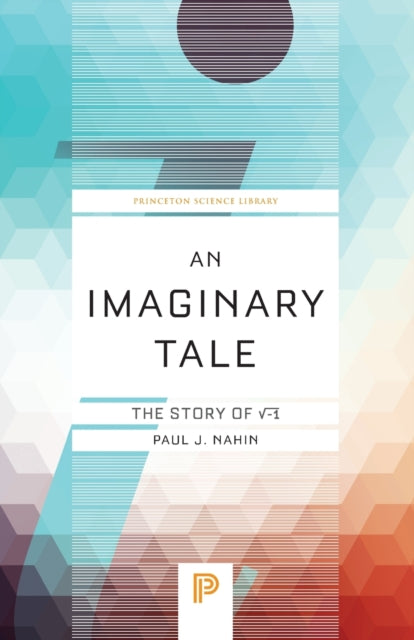
Princeton University Press An Imaginary Tale
Book SynopsisIn the title, "[the square root of minus one]" appears as a radical over "-1."Trade ReviewOne of Choice's Outstanding Academic Titles for 1999 Honorable Mention for the 1998 Award for Best Professional/Scholarly Book in Mathematics, Association of American Publishers "A book-length hymn of praise to the square root of minus one."--Brian Rotman, Times Literary Supplement "An Imaginary Tale is marvelous reading and hard to put down. Readers will find that Nahin has cleared up many of the mysteries surrounding the use of complex numbers."--Victor J. Katz, Science "[An Imaginary Tale] can be read for fun and profit by anyone who has taken courses in introductory calculus, plane geometry and trigonometry."--William Thompson, American Scientist "Someone has finally delivered a definitive history of this 'imaginary' number... A must read for anyone interested in mathematics and its history."--D. S. Larson, Choice "Attempting to explain imaginary numbers to a non-mathematician can be a frustrating experience... On such occasions, it would be most useful to have a copy of Paul Nahin's excellent book at hand."--A. Rice, Mathematical Gazette "Imaginary numbers! Threeve! Ninety-fifteen! No, not those kind of imaginary numbers. If you have any interest in where the concept of imaginary numbers comes from, you will be drawn into the wonderful stories of how i was discovered."--Rebecca Russ, Math Horizons "There will be something of reward in this book for everyone."--R.G. Keesing, Contemporary Physics "Nahin has given us a fine addition to the family of books about particular numbers. It is interesting to speculate what the next member of the family will be about. Zero? The Euler constant? The square root of two? While we are waiting, we can enjoy An Imaginary Tale."--Ed Sandifer, MAA Online "Paul Nahin's book is a delightful romp through the development of imaginary numbers."--Robin J. Wilson, London Mathematical Society Newsletter "You will definitely enjoy it. In fact it clearly reflects the the joy and delight that the author experienced when he was confronted with complex analysis during his engineering studies."--Adhemar Bultheel, European Mathematical SocietyTable of Contents*FrontMatter, pg. i*A Note to the Reader, pg. vii*Contents, pg. ix*Illustrations, pg. xi*Preface to the Paperback Edition, pg. xiii*Preface, pg. xxi*Introduction, pg. 1*CHAPTER ONE The Puzzles of Imaginary Numbers, pg. 8*CHAPTER TWO. A First Try at Understanding the Geometry of -1, pg. 31*CHAPTER THREE. The Puzzles Start to Clear, pg. 48*CHAPTER FOUR. Using Complex Numbers, pg. 84*CHAPTER FIVE. More Uses of Complex Numbers, pg. 105*CHAPTER SIX. Wizard Mathematics, pg. 142*CHAPTER SEVEN. The Nineteenth Century, Cauchy, and the Beginning of Complex Function Theory, pg. 187*APPENDIX A. The Fundamental Theorem of Algebra, pg. 227*APPENDIX B. The Complex Roots of a Transcendental Equation, pg. 230*APPENDIX C. ( -1)( -1) to 135 Decimal Places, and How It Was Computed, pg. 235*APPENDIX D. Solving Clausen's Puzzle, pg. 238*APPENDIX E. Deriving the Differential Equation for the Phase-Shift Oscillator, pg. 240*APPENDIX F. The Value of the Gamma Function on the Critical Line, pg. 244*Notes, pg. 247*Name Index, pg. 261*Subject Index, pg. 265*Acknowledgments, pg. 269
£13.29

Wolfram Media Inc Math(s) Fix: An Education Blueprint for the AI
Book SynopsisWhy are we all taught maths for years of our lives? Does it really empower everyone? Or fail most and disenfranchise many? Is it crucial for the AI age or an obsolete rite of passage?
£14.40
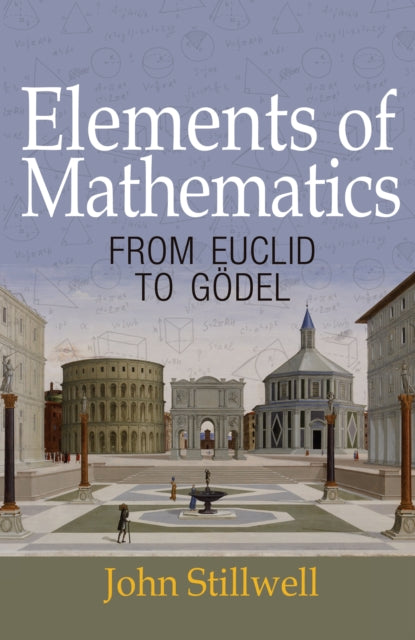
Princeton University Press Elements of Mathematics
Book SynopsisTrade Review"[Stillwell] writes clearly and engagingly... [Elements of Mathematics] can appeal to various constituencies at different levels of mathematical sophistication."--Mark Hunacek, MAA Reviews "A great exploration of elementary mathematics, its limitations, how infinity complicates things, and how various branches of mathematics fit together."--Antonio Cangiano, Math-Blog "Stillwell is ... One of the better current mathematical authors: he writes clearly and engagingly, and makes more of an effort than most to provide historical detail and a sense of how various mathematical ideas tie in with one another... The features we have learned to expect from Stillwell (including, but not limited to, excellent writing) are present in [Elements of Mathematics] as well."--MAA Reviews "An accessible read... Stillwell breaks down the basics, providing both historical and practical perspectives from arithmetic to infinity."--Gemma Tarlach, Discover "[A] sophisticated treatment of topics usually described as elementary."--John Allen Paulos "[Elements of Mathematics] is quite a tour de force, organized by areas of mathematics--arithmetic, computation, algebra, geometry, calculus, and so on--and in each area Stillwell manages to distill down the big ideas and the connections with other areas. He is a master expositor, and the text manages to be engaging and accessible without watering down the mathematics. I definitely learned new things from the book!"--Brent Yorgey, Math Less Traveled blog "From a lifetime of teaching, Stillwell has distilled some nice examples from the entire gamut of elementary mathematics."--Mathematical Reviews Clippings "[A] wonderful book... I think that [Elements of Mathematics] will itself become a modern classic and a reference work for anyone trying to learn basic topics in any of the major fields of mathematics."--Victor Katz, Bulletin of the American Mathematical Society "Elements of Mathematicsis a fine ... overview of the field of mathematics... The writing is clear, succinct, organized, and the diagrams [and] illustrations excellent... While some of the discussion is introductory or elementary, it always leads to deeper, more challenging ideas... [T]his will make a fine basic addition to most mathematicians' bookshelves."--Math Tango "Stillwell uses his broad and impressive command of mathematics to transport a reader through each topic and to a higher level of understanding and questioning."--Convergence "[A] wonderful book ... I think that [Elements of Mathematics] will itself become a modern classic and a reference work for anyone trying to learn basic topics in any of the major fields of mathematics."--Victor Katz, Bulletin of the American Mathematical Society "[Elements of Mathematics] is a book that everybody should read. You will be the better for it."--Reuben Hersh, American Mathematical MonthlyTable of Contents*Frontmatter, pg. i*Contents, pg. vii*Preface, pg. xi*1. Elementary Topics, pg. 1*2. Arithmetic, pg. 35*3. Computation, pg. 73*4. Algebra, pg. 106*5. Geometry, pg. 148*6. Calculus, pg. 193*7. Combinatorics, pg. 243*8. Probability, pg. 279*9. Logic, pg. 298*10. Some Advanced Mathematics, pg. 336*Bibliography, pg. 395*Index, pg. 405
£18.00

HarperCollins Publishers Higher Maths
Book SynopsisExam Board: SQALevel: HigherSubject: MathsTwo books in one! Combining a revision guide and a full set of practice test papers, this fantastic resource is all you need to revise for the exam.The revision guide Covers all of the topics in the CfE Higher Maths curriculum, broken down into manageable chunks for easy revision Clearly explains key concepts, research evidence and real-life applications Contains Quick Tests to let students check their knowledge and understanding as they go alongThe practice test papers Are in the format and the style of the SQA exam, giving students an opportunity to practice taking the Higher Maths examMarking instructions and sample answers are provided online, so students can check their progress.
£13.49

Oxford University Press Predicting Our Climate Future
Book SynopsisThis book is about how climate science works and why you should absolutely trust some of its conclusions and absolutely distrust others. Climate change raises new, foundational challenges in science. It requires us to question what we know and how we know it. The subject is important for society but the science is young and history tells us that scientists can get things wrong before they get them right. How, then, can we judge what information is reliable and what is open to question? Stainforth goes to the heart of the climate change problem to answer this question. He describes the fundamental characteristics of climate change and shows how they undermine the application of traditional research methods, demanding new approaches to both scientific and societal questions. He argues for a rethinking of how we go about the study of climate change in the physical sciences, the social sciences, economics, and policy. The subject requires nothing less than a restructuring of academic reseaTrade ReviewClimate is, in some respects, highly predictable; yet, in other respects, highly unpredictable. But there is no contradiction. The resolution of this seeming paradox in Predicting Our Climate Future leads in turn to a vision for how humankind must respond to this most important problem of all time. * George Akerlof, Nobel Laureate in Economics, 2001 *A profound yet very accessible guide to climate science, highlighting the significant uncertainties without apology. This book explains clearly why doubt creates a greater and more urgent need to act now to build a better future. * Trevor Maynard, Executive Director of Systemic Risks, Cambridge Centre for Risk Studies *The immense complexity of the climate system raises deep questions about what science can usefully say about the future. David Stainforth navigates philosophical and mathematical questions that could hardly be of greater practical importance. He questions what it is reasonable to ask of climate scientists and his conclusions challenge the way in which science should be conducted in the future. * Jim Hall, Professor of Climate and Environmental Risk, University of Oxford *Is the science settled? Are climate models rubbish? Stainforth's book serves up nuanced answers to big questions in climate science, in an easy conversational style. * Cameron Hepburn, Professor of Environmental Economics, University of Oxford *A thoughtful exploration of the foundations and limitations of climate prediction that explains how its chaotic and probabilistic nature lead to deep uncertainty when assessing climate risk. * Ramalingam Saravanan, Professor of Atmospheric Sciences, Texas A&M University *Predicting Our Climate Future is an erudite and very personal reflection on climate change, the state of climate science, and their implications for the decisions society needs to take. It should be top of the reading list for scientists, practitioners and anyone who wants to truly comprehend the challenge of climate prediction. * Simon Dietz, Professor of Environmental Policy, London School of Economics and Political Science *A provocative contribution to the literature of climate change. * Kirkus *Predicting Our Climate Future is an ambitious exploration of a critical topic. It is a recommended read for climate scientists, especially those trying to model the future, for the researchers-in many disciplines-that are focused on understanding and forecasting the physical and human impacts of the coming climate changes, and for policy makers engaged in climate issues. * Steven Earle, New York Journal of Books *Intelligent, accessible, well reasoned and working very hard to get it's teeth into a complex but vitally important issue. * Irish Tech News *Fascinating...[there is a] a refreshing honesty [in Stainforth's writing] about the limitations we have with certain kinds of prediction. * Brian Clegg, Popular Science *Stainforth is good at explaining the complexities [of climate modelling], leavening the highly technical bits with ... lots of relatable real-world analogies. * Geordie Torr, The Geographical *Table of ContentsSection 1 Chapter 1: The obvious and the obscure Chapter 2: A problem of prediction Chapter 3: Going beyond what we've seen Chapter 4: The one-shot bet. Chapter 5: From chaos to pandemonium Chapter 6: The curse of bigger and better computers Chapter 7: Talking at cross purposes Chapter 8: Not just of academic interest Section 2 Challenge 1: How to balance justified arrogance with essential humility. Chapter 9 - Stepping up to the task of prediction Chapter 10 The Times They Are A Changin' Chapter 11 Starting from scratch Chapter 12 Are scientists being asked to answer impossible questions? Challenge 2: Tying down what we mean by climate and climate change. Chapter 13 The essence of climate Chapter 14 A Walk in Three Dimensions Chapter 15 A walk in three dimensions over a two dimensional sea Challenge 3: When is a study with a climate model a study of climate change? Chapter 16 Climate change in climate models Challenge 4: How can we measure what climate is now and how it has changed? Chapter 17 Measuring climate change Challenge 5: How can we relate what happens in a model to what will happen in reality? Chapter 18 - Can climate models be realistic? Chapter 19 More models, better information? Chapter 20 How bad is too bad? Challenge 6: How can we use today's climate science well? Chapter 21 - What we do with what we've got Challenge 7: Getting a grip on the scale of future changes in climate? Chapter 22 - Stuff of the Genesis myth Chapter 23 Things ... can only get hotter Challenge 8: How can we use the information we have, or could have, to design a future that is better than it would otherwise be? Chapter 24 - Making it personal Chapter 25 - Where physics and economics meet. Challenge 9: How can we build physical and social science that is up to the task of informing society about what matters for society? Chapter 26 - Controlling factors. Chapter 27 - Beyond comprehension? No, just new challenges for human intellect.
£18.00

Oxford University Press Oxford IB Diploma Programme IB Mathematics
Book SynopsisFeaturing a wealth of digital content, this concept-based Print and Enhanced Online Course Book Pack has been developed in cooperation with the IB to provide the most comprehensive support for the new DP Mathematics: analysis and approaches SL syllabus, for first teaching in September 2019. Each Enhanced Online Course Book Pack is made up of one full-colour, print textbook and one online textbook - packed full of investigations, exercises, worksheets, worked solutions and answers, plus assessment preparation support.
£83.21

WW Norton & Co Astrophysics for Young People in a Hurry
Book SynopsisAmerica’s most celebrated astrophysicist invites young readers to explore the mysteries of the universe.
£13.29

Springer International Publishing AG Model Order Reduction and Applications: Cetraro,
Book SynopsisThis book addresses the state of the art of reduced order methods for modelling and computational reduction of complex parametrised systems, governed by ordinary and/or partial differential equations, with a special emphasis on real time computing techniques and applications in various fields.Consisting of four contributions presented at the CIME summer school, the book presents several points of view and techniques to solve demanding problems of increasing complexity. The focus is on theoretical investigation and applicative algorithm development for reduction in the complexity – the dimension, the degrees of freedom, the data – arising in these models.The book is addressed to graduate students, young researchers and people interested in the field. It is a good companion for graduate/doctoral classes.Table of Contents- 1. The Reduced Basis Method in Space and Time: Challenges, Limits and Perspectives. - 2. Inverse Problems: A Deterministic Approach Using Physics-Based Reduced Models. - 3. Model Order Reduction for Optimal Control Problems. - 4. Machine Learning Methods for Reduced Order Modeling.
£42.49

O'Reilly Media Make - Trigonometry: Build your way from
Book SynopsisTrigonometry has 2000-year-old roots in everyday useful endeavors, like finding the size of an object too big or far away to measure directly, or navigating from Point A to Point B. However, it is often taught very theoretically, with an emphasis on abstractions. Make: Trigonometry uses 3D printable models and readily-available physical objects like wire and cardboard tubes to develop intuition about concepts in trigonometry and basic analytic geometry. Readers will imagine the thought process of the people who invented these mathematical concepts, and can try out "math experiments" to see for themselves how ingenious ancient navigators and surveyors really were. The analytic geometry part of the book links equations to many of these intuitive concepts, which we explore through in-depth explanations of manipulative models of conic sections. This book is aimed at high school students who might be in Algebra II or Pre-Calculus. It shows the geometrical and practical sides of these topics that otherwise can drown in their own algebra. Make: Trigonometry builds on the basics of the authors' earlier book, Make: Geometry, and is intended as a bridge from that book to their Make: Calculus book. The user can read this book and understand the concepts from the photographs of 3D printable models alone. However, since many models are puzzle-like, we encourage the reader to print the models on any consumer-grade filament based 3D printer. The models are available for download in a freely-available open source repository. They were created in the free program OpenSCAD, and can be 3D printed or modified by the student in OpenSCAD to learn a little coding along the way.
£20.39

MP-AMM American Mathematical Glimpses of Soliton Theory The Algebra and
Book SynopsisReveals the hidden connections discovered over the last half-century that explain the existence of these mysterious mathematical objects. The book aims to convince the reader that the underlying algebro-geometric structure of soliton equations provides an elegant explanation of something seemingly miraculous.Trade ReviewThis book challenges and intrigues from beginning to end. It would be a treat to use for a capstone course or senior seminar." —William J. Satzer, MAA Reviews on Glimpses of Soliton Theory (First Edition)Table of Contents Differential equations Developing PDE intuition The story of solitons Elliptic curves and KdV traveling waves KdV $n$-solitons and $\tau$-functions Multiplying and factoring differential operators Eigenfunctions and isospectrality Lax form for KdV and other soliton equations The KP equation and bilinear KP equation $\Gamma_{2,4}$ and the bilinear KP equation Pseudo-differential operators and the KP hierarchy $\Gamma{k,n}$ and the bilinear KP hierarchy Concluding remarks Mathematica guide Complex numbers Ideas for independent projects References Glossary of symbols Index
£46.80

Pearson Education Limited Statistics The Art and Science of Learning from
Book SynopsisAlan Agresti is a Distinguished Professor Emeritus in the Department of Statistics at the University of Florida. He taught statistics there for 38 years, including the development of e-courses in statistical methods for social science students and three courses in categorical data analysis. He is the author of more than 100 refereed articles and six texts, including Statistical Methods for the Social Sciences (Pearson, 5th edition, 2018) and An Introduction to Categorical Data Analysis (Wiley, 3rd edition, 2019). Alan has also received teaching awards from the University of Florida and an Excellence in Writing award from John Wiley & Sons. Christine Franklin is the K-12 Statistics Ambassador for the American Statistical Association and elected ASA Fellow. She has retired from the University of Georgia as the Lothar Tresp Honoratus Honors Professor and Senior Lecturer Emerita in Statistics. She is the co-author of two textbooks aTable of ContentsPART I: GATHERING AND EXPLORING DATA Statistics: The Art and Science of Learning from Data Using Data to Answer Statistical Questions Sample Versus Population Organizing Data, Statistical Software, and the New Field of Data Science Chapter Summary Chapter Exercises Exploring Data with Graphs and Numerical Summaries Different Types of Data Graphical Summaries of Data Measuring the Center of Quantitative Data Measuring the Variability of Quantitative Data Using Measures of Position to Describe Variability Linear Transformations and Standardizing Recognizing and Avoiding Misuses of Graphical Summaries Chapter Summary Chapter Exercises Exploring Relationships Between Two Variables The Association Between Two Categorical Variables The Relationship Between Two Quantitative Variables Linear Regression: Predicting the Outcome of a Variable Cautions in Analyzing Associations Chapter Summary Chapter Exercises Gathering Data Experimental and Observational Studies Good and Poor Ways to Sample Good and Poor Ways to Experiment Other Ways to Conduct Experimental and Nonexperimental Studies Chapter Summary Chapter Exercises PART II: PROBABILITY, PROBABILITY DISTRIBUTIONS, AND SAMPLINGDISTRIBUTIONS Probability in Our Daily Lives How Probability Quantifies Randomness Finding Probabilities Conditional Probability Applying the Probability Rules Chapter Summary Chapter Exercises Random Variables and Probability Distributions Summarizing Possible Outcomes and Their Probabilities Probabilities for Bell-Shaped Distributions Probabilities When Each Observation Has Two Possible Outcomes Chapter Summary Chapter Exercises Sampling Distributions How Sample Proportions Vary Around the Population Proportion How Sample Means Vary Around the Population Mean Using the Bootstrap to Find Sampling Distributions Chapter Summary Chapter Exercises PART III: INFERENTIAL STATISTICS Statistical Inference: Confidence Intervals Point and Interval Estimates of Population Parameters Confidence Interval for a Population Proportion Confidence Interval for a Population Mean Bootstrap Confidence Intervals Chapter Summary Chapter Exercises Statistical Inference: Significance Tests About Hypotheses Steps for Performing a Significance Test Significance Tests About Proportions Significance Tests About a Mean Decisions and Types of Errors in Significance Tests Limitations of Significance Tests The Likelihood of a Type II Error Chapter Summary Chapter Exercises Comparing Two Groups Categorical Response: Comparing Two Proportions Quantitative Response: Comparing Two Means Comparing Two Groups with Bootstrap or Permutation Resampling Analyzing Dependent Samples Adjusting for the Effects of Other Variables Chapter Summary Chapter Exercises PART IV: ANALYZING ASSOCIATION AND EXTENDED STATISTICALMETHODS Analyzing the Association Between Categorical Variables Independence and Dependence (Association) Testing Categorical Variables for Independence Determining the Strength of the Association Using Residuals to Reveal the Pattern of Association Fisher's Exact and Permutation Tests Chapter Summary Chapter Exercises Analyzing the Association Between Quantitative Variables: Regression Analysis Modeling How Two Variables Are Related Inference About Model Parameters and the Association Describing the Strength of Association How the Data Vary Around the Regression Line Exponential Regression: A Model for Nonlinearity Chapter Summary Chapter Exercises Multiple Regression Using Several Variables to Predict a Response Extending the Correlation and R2 for Multiple Regression Using Multiple Regression to Make Inferences Checking a Regression Model Using Residual Plots Regression and Categorical Predictors Modeling a Categorical Response Chapter Summary Chapter Exercises Comparing Groups: Analysis of Variance Methods One-Way ANOVA: Comparing Several Means Estimating Differences in Groups for a Single Factor Two-Way ANOVA Chapter Summary Chapter Exercises Nonparametric Statistics Compare Two Groups by Ranking Nonparametric Methods for Several Groups and for Matched Pairs Chapter Summary Chapter Exercises Appendix Answers Index Index of Applications Credits
£66.49

Elsevier Science & Technology Simulation
Book SynopsisTrade Review"This textbook contains and describes all the tools one needs to plan and to carry out a simulation study as well as to analyze its results." --J.Wolters, zbMATH Open "It presents the statistics needed to analyze simulated data and to validate the simulation model. In this edition, several new topics are included as well as a number of new exercises." --Vigirdas Mackevicius, zbMATH OpenTable of Contents1. Introduction 2. Elements of Probability 3. Random Numbers 4. Generating Discrete Random Variables 5. Generating Continuous Random Variables 6. The Multivariate Normal Distribution and Copulas 7. The Discrete Event Simulation Approach 8. Statistical Analysis of Simulated Data 9. Variance Reduction Techniques 10. Additional Variance Reduction Techniques 11. Statistical Validation Techniques 12. Markov Chain Monte Carlo Methods
£69.26

Pearson Education Introductory Mathematical Analysis for Business
Book SynopsisTable of ContentsCHAPTER 0 Review of Algebra 0.1 Sets of Real Numbers 0.2 Some Properties of RealNumbers 0.3 Exponents and Radicals 0.4 Operations with AlgebraicExpressions 0.5 Factoring 0.6 Fractions 0.7 Equations, in ParticularLinear Equations 0.8 Quadratic Equations Chapter 0 Review CHAPTER 1 Applications and MoreAlgebra 1.1 Applications of Equations 1.2 Linear Inequalities 1.3 Applications of Inequalities 1.4 Absolute Value 1.5 Summation Notation 1.6 Sequences Chapter 1 Review CHAPTER 2 Functions and Graphs 2.1 Functions 2.2 Special Functions 2.3 Combinations of Functions 2.4 Inverse Functions 2.5 Graphs in RectangularCoordinates 2.6 Symmetry 2.7 Translations and Reflections 2.8 Functions of Several Variables Chapter 2 Review CHAPTER 3 Lines, Parabolas, andSystems 3.1 Lines 3.2 Applications and LinearFunctions 3.3 Quadratic Functions 3.4 Systems of Linear Equations 3.5 Nonlinear Systems 3.6 Applications of Systems ofEquations Chapter 3 Review CHAPTER 4 Exponential and LogarithmicFunctions 4.1 Exponential Functions 4.2 Logarithmic Functions 4.3 Properties of Logarithms 4.4 Logarithmic and ExponentialEquations Chapter 4 Review PART II FINITE MATHEMATICS CHAPTER 5 Mathematics of Finance 5.1 Compound Interest 5.2 Present Value 5.3 Interest CompoundedContinuously 5.4 Annuities 5.5 Amortization of Loans 5.6 Perpetuities Chapter 5 Review CHAPTER 6 Matrix Algebra 6.1 Matrices 6.2 Matrix Addition and ScalarMultiplication 6.3 Matrix Multiplication 6.4 Solving Systems by ReducingMatrices 6.5 Solving Systems by ReducingMatrices (continued) 6.6 Inverses 6.7 Leontief's Input--OutputAnalysis Chapter 6 Review CHAPTER 7 Linear Programming 7.1 Linear Inequalities in TwoVariables 7.2 Linear Programming 7.3 The Simplex Method 7.4 Artificial Variables 7.5 Minimization 7.6 The Dual Chapter 7 Review CHAPTER 8 Introduction toProbability and Statistics 8.1 Basic Counting Principle andPermutations 8.2 Combinations and OtherCounting Principles 8.3 Sample Spaces and Events 8.4 Probability 8.5 Conditional Probability andStochastic Processes 8.6 Independent Events 8.7 Bayes' Formula Chapter 8 Review CHAPTER 9 Additional Topics inProbability 9.1 Discrete Random Variables andExpected Value 9.2 The Binomial Distribution 9.3 Markov Chains Chapter 9 Review PART III CALCULUS CHAPTER 10 Limits and Continuity 10.1 Limits 10.2 Limits (Continued) 10.3 Continuity 10.4 Continuity Applied toInequalities Chapter 10 Review CHAPTER 11 Differentiation 11.1 The Derivative 11.2 Rules for Differentiation 11.3 The Derivative as a Rate ofChange 11.4 The Product Rule and theQuotient Rule 11.5 The Chain Rule Chapter 11 Review CHAPTER 12 AdditionalDifferentiation Topics 12.1 Derivatives of LogarithmicFunctions 12.2 Derivatives of ExponentialFunctions 12.3 Elasticity of Demand 12.4 Implicit Differentiation 12.5 Logarithmic Differentiation 12.6 Newton's Method 12.7 Higher-Order Derivatives Chapter 12 Review CHAPTER 13 Curve Sketching 13.1 Relative Extrema 13.2 Absolute Extrema on a ClosedInterval 13.3 Concavity 13.4 The Second-Derivative Test 13.5 Asymptotes 13.6 Applied Maxima and Minima Chapter 13 Review CHAPTER 14 Integration 14.1 Differentials 14.2 The Indefinite Integral 14.3 Integration with InitialConditions 14.4 More Integration Formulas 14.5 Techniques of Integration 14.6 The Definite Integral 14.7 The Fundamental Theorem ofCalculus Chapter 14 Review CHAPTER 15 Applications ofIntegration 15.1 Integration by Tables 15.2 Approximate Integration 15.3 Area Between Curves 15.4 Consumers' and Producers'Surplus 15.5 Average Value of a Function 15.6 Differential Equations 15.7 More Applications ofDifferential Equations 15.8 Improper Integrals Chapter 15 Review CHAPTER 16 Continuous RandomVariables 16.1 Continuous Random Variables 16.2 The Normal Distribution 16.3 The Normal Approximation tothe Binomial Distribution Chapter 16 Review CHAPTER 17 Multivariable Calculus 17.1 Partial Derivatives 17.2 Applications of PartialDerivatives 17.3 Higher-Order Partial Derivatives 17.4 Maxima and Minima forFunctions of Two Variables 17.5 Lagrange Multipliers 17.6 Multiple Integrals Chapter 17 Review APPENDIX A Compound InterestTables APPENDIX B Table of SelectedIntegrals APPENDIX C Areas Under theStandard Normal Curve
£71.99
CRC Press Statistical Learning with Sparsity
Book SynopsisDiscover New Methods for Dealing with High-Dimensional DataA sparse statistical model has only a small number of nonzero parameters or weights; therefore, it is much easier to estimate and interpret than a dense model. Statistical Learning with Sparsity: The Lasso and Generalizations presents methods that exploit sparsity to help recover the underlying signal in a set of data.Top experts in this rapidly evolving field, the authors describe the lasso for linear regression and a simple coordinate descent algorithm for its computation. They discuss the application of â1 penalties to generalized linear models and support vector machines, cover generalized penalties such as the elastic net and group lasso, and review numerical methods for optimization. They also present statistical inference methods for fitted (lasso) models, including the bootstrap, Bayesian methods, and recently developed approaches. In addition, the book examines matrix dTrade Review"The authors study and analyze methods using the sparsity property of some statistical models in order to recover the underlying signal in a dataset. They focus on the Lasso technique as an alternative to the standard least-squares method."—Zentralblatt MATH 1319Table of ContentsIntroduction. The Lasso for Linear Models. Generalized Linear Models. Generalizations of the Lasso Penalty. Optimization Methods. Statistical Inference. Matrix Decompositions, Approximations, and Completion. Sparse Multivariate Methods. Graphs and Model Selection. Signal Approximation and Compressed Sensing. Theoretical Results for the Lasso. Bibliography. Author Index. Index.
£999.99

Quercus Publishing The Maths Handbook: Everyday Maths Made Simple
Book SynopsisThis is the perfect introduction for those who have a lingering fear of maths. If you think that maths is difficult, confusing, dull or just plain scary, then The Maths Handbook is your ideal companion. Covering all the basics including fractions, equations, primes, squares and square roots, geometry and fractals, Dr Richard Elwes will lead you gently towards a greater understanding of this fascinating subject. Even apparently daunting concepts are explained simply, with the assistance of useful diagrams, and with a refreshing lack of jargon. So whether you're an adult or a student, whether you like Sudoku but hate doing sums, or whether you've always been daunted by numbers at work, school or in everyday life, you won't find a better way of overcoming your nervousness about numbers and learning to enjoy making the most of mathematics.Trade Review'Elwes takes the key concepts, perfectly illustrates them with practical examples and easy-to-follow explanations, tests us with quizzes, and applies the principles to everyday situations. The effect is strangely liberating, and you might soon find yourself acquiring a love of logarithms and a respect for reflex quadrilaterals' Good Book Guide. * Good Book Guide *Table of ContentsIntroduction. The language of mathematics. Addition. Subtraction. Multiplication. Division. Primes, factors and multiples. Negative numbers and the number line. Decimals. Fractions. Arithmetic with fractions. Powers. The power of 10. Roots and logs. Percentages and proportions. Algebra. Equations. Angles. Triangles. Circles. Area and volume. Polygons and solids. Pythagoras' theorem. Trigonometry. Coordinates. Graphs. Statistics. Probability. Charts. Answers to quizzes. Index.
£10.44
Taylor & Francis Inc The Geometry of Musical Rhythm
Book SynopsisThe original edition of The Geometry of Musical Rhythm was the first book to provide a systematic and accessible computational geometric analysis of the musical rhythms of the world. It explained how the study of the mathematical properties of musical rhythm generates common mathematical problems that arise in a variety of seemingly disparate fields. The book also introduced the distance approach to phylogenetic analysis and illustrated its application to the study of musical rhythm. The new edition retains all of this, while also adding 100 pages, 93 figures, 225 new references, and six new chapters covering topics such as meter and metric complexity, rhythmic grouping, expressive timbre and timing in rhythmic performance, and evolution phylogenetic analysis of ancient Greek paeonic rhythms. In addition, further context is provided to give the reader a fuller and richer insight into the historical connections between music and mathematics.Trade Review"The late Godfried Toussaint studied the rhythms of the world like a gold panner, collecting with meticulousness and passion all the motifs that different cultures have given birth to. Thanks to his skill as a mathematician, he extracted fascinating properties from them. There is no doubt that this unique book will survive for a very long time."—Marc Chemillier, Directeur d'études, École des Hautes Études en Sciences Sociales"Through the original use of distance geometry for analyzing musical rhythm and the visualization of rhythms as cyclic polygons, Gottfried Tousssaint’s fascinating book will be extremely valuable to any researcher involved in in the field of rhythm."—Simha Arom, Ethnomusicologist "The new edition of The Geometry of Musical Rhythm takes us further along Godfried Toussaint’s journey through the world’s rhythms. There are new discussions of metric complexity, rhythm visualization, rhythmic performance, and the evolution of rhythmic patterns. Almost every chapter has been expanded and informed by the latest scholarship in music theory, music psychology, ethnomusicology, and music informatics. Specialists and lay readers alike will find this edition even more engaging and valuable than the first, giving us even more reasons to delight in what makes a "good" rhythm good."— Professor Justin London, Carleton College "A unique and seminal work of original and meticulously detailed scholarship, this newly published second edition of "The Geometry of Musical Rhythm : What Makes a "Good" Rhythm Good?" is unreservedly recommended as a core addition to both college and university library collections."—Midwest Book ReviewPraise for the previous edition"Toussaint’s Geometry presents a whirlwind tour of the world’s rhythms … For a reader interested in musical rhythm, Geometry is a great introduction to the computer science and mathematics of rhythm. For a reader interested in algorithms and mathematical reasoning, the musical focus provides compelling examples lying at the intersection of the arts and the sciences."—William A. Sethares, Journal of Mathematics and the Arts, 2014"… a delightful, informative, and innovative study in the geometric interpretation of rhythm. … It is a pleasure to find an author who has such good command of mathematics and music and who can explain their interconnections with such literary skill. I recommend this book wholeheartedly to every serious student of geometry and music."—Ilhan M. Izmirli, Mathematical Reviews, March 2014"This dynamic fluid presentation of mathematics is exactly what our undergraduate and graduate students need. … I would highly recommend this book for everyone."—Russell Jay Hendel, MAA Reviews, May 2013"The author of this book, the Canadian professor of computer science Godfried Toussaint, who died in 2019, describes music as one of his passions. This is apparent throughout this work, which draws on his wide knowledge of different musical styles from all cultures.The book is very informative about a wide range of styles of music and musical instruments and their history. If you have an interest in music and in a range of areas of mathematics, you are likely to find plenty of topics of interest."—Mathematical Gazette"The late Godfried Toussaint studied the rhythms of the world like a gold panner, collecting with meticulousness and passion all the motifs that different cultures have given birth to. Thanks to his skill as a mathematician, he extracted fascinating properties from them. There is no doubt that this unique book will survive for a very long time."—Marc Chemillier, Directeur d'études, École des Hautes Études en Sciences Sociales"Through the original use of distance geometry for analyzing musical rhythm and the visualization of rhythms as cyclic polygons, Gottfried Tousssaint’s fascinating book will be extremely valuable to any researcher involved in in the field of rhythm."—Simha Arom, Ethnomusicologist "The new edition of The Geometry of Musical Rhythm takes us further along Godfried Toussaint’s journey through the world’s rhythms. There are new discussions of metric complexity, rhythm visualization, rhythmic performance, and the evolution of rhythmic patterns. Almost every chapter has been expanded and informed by the latest scholarship in music theory, music psychology, ethnomusicology, and music informatics. Specialists and lay readers alike will find this edition even more engaging and valuable than the first, giving us even more reasons to delight in what makes a "good" rhythm good."— Professor Justin London, Carleton College "A unique and seminal work of original and meticulously detailed scholarship, this newly published second edition of "The Geometry of Musical Rhythm : What Makes a "Good" Rhythm Good?" is unreservedly recommended as a core addition to both college and university library collections."—Midwest Book ReviewPraise for the previous edition"Toussaint’s Geometry presents a whirlwind tour of the world’s rhythms … For a reader interested in musical rhythm, Geometry is a great introduction to the computer science and mathematics of rhythm. For a reader interested in algorithms and mathematical reasoning, the musical focus provides compelling examples lying at the intersection of the arts and the sciences."—William A. Sethares, Journal of Mathematics and the Arts, 2014"… a delightful, informative, and innovative study in the geometric interpretation of rhythm. … It is a pleasure to find an author who has such good command of mathematics and music and who can explain their interconnections with such literary skill. I recommend this book wholeheartedly to every serious student of geometry and music."—Ilhan M. Izmirli, Mathematical Reviews, March 2014"This dynamic fluid presentation of mathematics is exactly what our undergraduate and graduate students need. … I would highly recommend this book for everyone."—Russell Jay Hendel, MAA Reviews, May 2013Table of ContentsWhat Is Rhythm?. A Steady Beat. Timelines, Ostinatos, and Meter. The Wooden Claves. The Iron Bells. The Clave Son. Six Distinguished Rhythm Timelines. The Distance Geometry of Rhythm. Classification of Rhythms. Binary and Ternary Rhythms. The Isomorphism of Rhythm and Scale. Binarization, Ternarization, and Quantization of Rhythms. Syncopated Rhythms. Necklaces and Bracelets. Rhythmic Oddity. Off-Beat Rhythms. Rhythm Complexity. Dispersion Problems and Maximally Even Rhythms. Euclidean Rhythms. Leap Years: The Rhythm of the Stars. Approximately Even Rhythms. Rhythms and Crystallography. Complementary Rhythms. Radio Astronomy and Flat Rhythms. Deep Rhythms. Shelling Rhythms. Phantom Rhythms. Reflection Rhythms and Rhythmic Canons. Toggle Rhythms. Symmetric Rhythms. Odd Rhythms. Other Representations of Rhythm. Rhythmic Similarity and Dissimilarity. Regular and Irregular Rhythms. Evolution and Phylogenesis of Musical Rhythm. Rhythmic Combinatorics. What Makes the Clave Son Such a Good Rhythm?. The Origin, Evolution, and Migration of the Clave Son. Epilogue. References. Index.
£47.49

Princeton University Press Eulers Gem
Book SynopsisTrade Review"Everything in the book is very well illustrated with insightful graphics that, together with the text, make results almost like being obvious."---Adhemar Bultheel, European Mathematical Society
£16.19
CRC Press The Magic Theorem
Book SynopsisThe Magic Theorem: a Greatly-Expanded, Much-Abridged Edition of The Symmetries of Things presents a wonderfully unique re-imagining of the classic book, The Symmetries of Things. Begun as a standard second edition by the original author team, it changed in scope following the passing of John Conway. This version of the book fulfils the original vision for the project: an elementary introduction to the orbifold signature notation and the theory behind it.The Magic Theorem features all the material contained in Part I of The Symmetries of Things, now redesigned and even more lavishly illustrated, along with new and engaging material suitable for a novice audience. This new book includes hands-on symmetry activities for the home or classroom and an online repository of teaching materials.
£999.99
HarperCollins Publishers Higher Maths
Book SynopsisExam Board: SQALevel: HigherSubject: MathsFirst Teaching: 2014, First Exam: 2015Masses of practice questions for every topic on the curriculum.Essential extra questions for every topic on the curriculum, to reinforce learning and build exam confidence.It can be used either alongside the N5 Maths Student Book or as a flexible standalone resource for homework, independent study or exam practice.Included in this book:Questions for every topic on the curriculum, with more of the tricky onesExample answers with workings-out help explain difficult conceptsHints and tips throughout give practical advice about the different kinds of questionAnswers can be downloaded from www.collins.co.uk/pages/scottish-curriculum-free-resources
£999.99

McGraw-Hill Education - Europe Schaums Outline of Partial Differential Equations
Book SynopsisThe ideal review for your partial differential equations courseMore than 40 million students have trusted Schaumâs Outlines for their expert knowledge and helpful solved problems. Written by renowned experts in their respective fields, Schaumâs Outlines cover everything from math to science, nursing to language. The main feature for all these books is the solved problems. Step-by-step, authors walk readers through coming up with solutions to exercises in their topic of choice. 290 fully worked problems of varying difficulty Clear, concise explanations of differential and difference methods Help with variation formulation of boundary value problems and variation approximation methods Outline format supplies a concise guide to the standard college course in partial differential equations Appropriate for the following courses: Partial Differential Equations I, Partial Differential Equations II, Applied Math I, Applied Math II Complete course cTable of Contents1. Introduction2. Classification and Characteristics3. Qualitative Behavior of Solutions to Elliptic Equations4. Qualitative Behavior of Solutions to Evolution Equations5. First-Order Equations6. Eigenfunction Expansions and Integral Transforms: Theory7. Eigenfunction Expansions and Integral Transforms: Applications8. Green's Functions9. Difference Methods for Parabolic Equations10. Difference and Characteristic Methods for Parabolic Equations11. Difference Methods for Hyperbolic Equations12. Difference Methods for Elliptic Equations13. Variational Formulation of Boundary Value Problems14. The Finite Element Method: An Introduction
£22.09

McGraw-Hill Education Glencoe Math Course 3 Student Edition Volume 1
Book SynopsisThe Glencoe Math Student Edition is an interactive text that engages students and assist with learning and organization. It personalizes the learning experience for every student. The write-in text, 3-hole punched, perfed pages allow students to organize while they are learning.
£12.87

Elsevier Science Applied Chaos Theory
Book Synopsis
£49.99

Elsevier Science Elements of Set Theory
Book SynopsisTable of ContentsContents Preface List of Symbols Chapter 1 Introduction Baby Set Theory Sets—An Informal View Classes Axiomatic Method Notation Historical Notes Chapter 2 Axioms and Operations Axioms Arbitrary Unions and Intersections Algebra of Sets Epilogue Review Exercises Chapter 3 Relations and Functions Ordered Pairs Relations n-Ary Relations Functions Infinite Cartesian Products Equivalence Relations Ordering Relations Review Exercises Chapter 4 Natural Numbers Inductive Sets Peano's Postulates Recursion on ? Arithmetic Ordering on ? Review Exercises Chapter 5 Construction of the Real Numbers Integers Rational Numbers Real Numbers Summaries Two Chapter 6 Cardinal Numbers and the Axiom of Choice Equinumerosity Finite Sets Cardinal Arithmetic Ordering Cardinal Numbers Axiom of Choice Countable Sets Arithmetic of Infinite Cardinals Continuum Hypothesis Chapter 7 Orderings and Ordinals Partial Orderings Well Orderings Replacement Axioms Epsilon-Images Isomorphisms Ordinal Numbers Debts Paid Rank Chapter 8 Ordinals and Order Types Transfinite Recursion Again Alephs Ordinal Operations Isomorphism Types Arithmetic of Order Types Ordinal Arithmetic Chapter 9 Special Topics Well-Founded Relations Natural Models Cofinality Appendix Notation, Logic, and Proofs Selected References for Further Study List of Axioms Index
£54.14

Elsevier Science Writing Small Omegas
Book SynopsisTrade Review"This is necessarily a very heavily mathematical book, which nevertheless manages to balance the need for such detail with an awareness of the historical context - great effort appears to have been taken, for example, to ensure that Cartan’s mathematics is interpreted on his terms, rather than in a modern way. The referencing throughout is sufficiently detailed to enable the reader to follow up on any points of interest, and a comprehensive index makes the book easy to navigate. This is an extremely valuable contribution to the study of the history of modern mathematics." --Zentralblatt MathTable of Contents1. Lie on the backstage2. Cartan’s doctoral dissertation3. Infinite Continuous Groups 1883-19024. Exterior Differential Systems5. Cartan’s Theory (1902-1909)6. The method of moving frames7. The geometry of continuous groups8. Conclusion
£135.00

Elsevier Science Publishing Co Inc Linear Algebra
Book SynopsisTable of Contents1. Matrices 2. Vector Spaces 3. Linear Transformations 4. Eigenvalues, Eigenvectors, and Differential Equations 5. Euclidean Inner Product Appendix A. Determinants B. Jordan Canonical Forms C. Markov Chains D. The Simplex Method, an Example E. A Word on Numerical Techniques and Technology Answers And Hints To Selected Problems
£106.40

Pearson Education Introduction to Mathematical Biology An
Book SynopsisIntended for advanced undergraduate and beginning graduate courses on Modeling, this book introduces a variety of mathematical models for biological systems, and presents the mathematical theory and techniques useful in analyzing those models. Its material is organized according to the mathematical theory rather than the biological application.Table of ContentsPreface xi 1 LINEAR DIFFERENCE EQUATIONS, THEORY, AND EXAMPLES 1 1.1 Introduction 1 1.2 Basic Definitions and Notation 2 1.3 First-Order Equations 6 1.4 Second-Order and Higher-Order Equations 8 1.5 First-Order Linear Systems 14 1.6 An Example: Leslie’s Age-Structured Model 18 1.7 Properties of the Leslie Matrix 20 1.8 Exercises for Chapter 1 28 1.9 References for Chapter 1 33 1.10 Appendix for Chapter 1 34 1.10.1 Maple Program:Turtle Model 34 1.10.2 MATLAB® Program:Turtle Model 34 2 NONLINEAR DIFFERENCE EQUATIONS, THEORY, AND EXAMPLES 36 2.1 Introduction 36 2.2 Basic Definitions and Notation 37 2.3 Local Stability in First-Order Equations 40 2.4 Cobwebbing Method for First-Order Equations 45 2.5 Global Stability in First-Order Equations 46 2.6 The Approximate Logistic Equation 52 2.7 Bifurcation Theory 55 2.7.1 Types of Bifurcations 56 2.7.2 Liapunov Exponents 60 2.8 Stability in First-Order Systems 62 2.9 Jury Conditions 67 2.10 An Example: Epidemic Model 69 2.11 Delay Difference Equations 73 2.12 Exercises for Chapter 2 76 2.13 References for Chapter 2 82 2.14 Appendix for Chapter 2 84 2.14.1 Proof of Theorem 2.1 84 2.14.2 A Definition of Chaos 86 2.14.3 Jury Conditions (Schur-Cohn Criteria) 86 2.14.4 Liapunov Exponents for Systems of Difference Equations 87 2.14.5 MATLAB Program: SIR Epidemic Model 88 3 BIOLOGICAL APPLICATIONS OF DIFFERENCE EQUATIONS 89 3.1 Introduction 89 3.2 Population Models 90 3.3 Nicholson-Bailey Model 92 3.4 Other Host-Parasitoid Models 96 3.5 Host-Parasite Model 98 3.6 Predator-Prey Model 99 3.7 Population Genetics Models 103 3.8 Nonlinear Structured Models 110 3.8.1 Density-Dependent Leslie Matrix Models 110 3.8.2 Structured Model for Flour Beetle Populations 116 3.8.3 Structured Model for the Northern Spotted Owl 118 3.8.4 Two-Sex Model 121 3.9 Measles Model with Vaccination 123 3.10 Exercises for Chapter 3 127 3.11 References for Chapter 3 134 3.12 Appendix for Chapter 3 138 3.12.1 Maple Program: Nicholson-Bailey Model 138 3.12.2 Whooping Crane Data 138 3.12.3 Waterfowl Data 139 4 LINEAR DIFFERENTIAL EQUATIONS: THEORY AND EXAMPLES 141 4.1 Introduction 141 4.2 Basic Definitions and Notation 142 4.3 First-Order Linear Differential Equations 144 4.4 Higher-Order Linear Differential Equations 145 4.4.1 Constant Coefficients 146 4.5 Routh-Hurwitz Criteria 150 4.6 Converting Higher-Order Equations to First-OrderSystems 152 4.7 First-Order Linear Systems 154 4.7.1 Constant Coefficients 155 4.8 Phase-Plane Analysis 157 4.9 Gershgorin’s Theorem 162 4.10 An Example: Pharmacokinetics Model 163 4.11 Discrete and Continuous Time Delays 165 4.12 Exercises for Chapter 4 169 4.13 References for Chapter 4 172 4.14 Appendix for Chapter 4 173 4.14.1 Exponential of a Matrix 173 4.14.2 Maple Program: Pharmacokinetics Model 175 5 NONLINEAR ORDINARY DIFFERENTIAL EQUATIONS: THEORY AND EXAMPLES 176 5.1 Introduction 176 5.2 Basic Definitions and Notation 177 5.3 Local Stability in First-Order Equations 180 5.3.1 Application to Population Growth Models 181 5.4 Phase Line Diagrams 184 5.5 Local Stability in First-Order Systems 186 5.6 Phase Plane Analysis 191 5.7 Periodic Solutions 194 5.7.1 Poincaré-Bendixson Theorem 194 5.7.2 Bendixson’s and Dulac’s Criteria 197 5.8 Bifurcations 199 5.8.1 First-Order Equations 200 5.8.2 Hopf Bifurcation Theorem 201 5.9 Delay Logistic Equation 204 5.10 Stability Using Qualitative Matrix Stability 211 5.11 Global Stability and Liapunov Functions 216 5.12 Persistence and Extinction Theory 221 5.13 Exercises for Chapter 5 224 5.14 References for Chapter 5 232 5.15 Appendix for Chapter 5 234 5.15.1 Subcritical and Supercritical Hopf Bifurcations 234 5.15.2 Strong Delay Kernel 235 6 BIOLOGICAL APPLICATIONS OF DIFFERENTIAL EQUATIONS 237 6.1 Introduction 237 6.2 Harvesting a Single Population 238 6.3 Predator-Prey Models 240 6.4 Competition Models 248 6.4.1 Two Species 248 6.4.2 Three Species 250 6.5 Spruce Budworm Model 254 6.6 Metapopulation and Patch Models 260 6.7 Chemostat Model 263 6.7.1 Michaelis-Menten Kinetics 263 6.7.2 Bacterial Growth in a Chemostat 266 6.8 Epidemic Models 271 6.8.1 SI, SIS, and SIR Epidemic Models 271 6.8.2 Cellular Dynamics of HIV 276 6.9 Excitable Systems 279 6.9.1 Van der Pol Equation 279 6.9.2 Hodgkin-Huxley and FitzHugh-Nagumo Models 280 6.10 Exercises for Chapter 6 283 6.11 References for Chapter 6 292 6.12 Appendix for Chapter 6 296 6.12.1 Lynx and Fox Data 296 6.12.2 Extinction in Metapopulation Models 296 7 PARTIAL DIFFERENTIAL EQUATIONS: THEORY, EXAMPLES, AND APPLICATIONS 299 7.1 Introduction 299 7.2 Continuous Age-Structured Model 300 7.2.1 Method of Characteristics 302 7.2.2 Analysis of the Continuous Age-Structured Model 306 7.3 Reaction-Diffusion Equations 309 7.4 Equilibrium and Traveling Wave Solutions 316 7.5 Critical Patch Size 319 7.6 Spread of Genes and Traveling Waves 321 7.7 Pattern Formation 325 7.8 Integrodifference Equations 330 7.9 Exercises for Chapter 7 331 7.10 References for Chapter 7 336 Index 339
£118.51

Pearson Education Path to College Mathematics
a huge range and FREE tracked UK delivery on ALL orders.
£178.26

Pearson Education Topology Classic Version
Book SynopsisTable of Contents I. GENERAL TOPOLOGY. 1. Set Theory and Logic. 2. Topological Spaces and Continuous Functions. 3. Connectedness and Compactness. 4. Countability and Separation Axioms. 5. The Tychonoff Theorem. 6. Metrization Theorems and Paracompactness. 7. Complete Metric Spaces and Function Spaces. 8. Baire Spaces and Dimension Theory. II. ALGEBRAIC TOPOLOGY. 9. The Fundamental Group. 10. Separation Theorems in the Plane. 11. The Seifert-van Kampen Theorem. 12. Classification of Surfaces. 13. Classification of Covering Spaces. 14. Applications to Group Theory. Index.
£89.12

Pearson Education Basic College Mathematics
a huge range and FREE tracked UK delivery on ALL orders.
£178.26

Pearson Education Direct Instruction Mathematics
Book SynopsisMarcy Stein is a professor in the School of Education at the University of Washington Tacoma where she is one of the founding faculty members of that program. She has published extensively in the areas of both special education and general education on reading and mathematics instruction, curriculum analysis, and textbook adoption. In 2006, she received the Distinguished Scholarship Award. In 2015, she and her colleagues received the UWT Community Engagement Award for her work with high-need partner schools. Dr. Stein also has a wealth of experience working in Follow Through, teacher education and consulting with teachers and administrators throughout the country. Diane Kinder is a professor in the School of Education at the University of Washington Tacoma. She has extensive experience teaching general and special education in public, private, and Department of Defense schools. She has received awards for K-12 and university teaching, and hasTable of ContentsPart I: PERSPECTIVE 1. Direct Instruction 2. Relevant Research on Mathematics Instruction 3. Curriculum Evaluation and Modification Part II: BASIC CONCEPTS AND SKILLS 4. Counting 5. Symbol Identification and Place Value 6. Basic Facts 7. Addition 8. Subtraction 9. Multiplication 10. Division 11. Problem Solving 12. Measurement, Time, and Money Part III: EXTENDED CONCEPTS AND SKILLS 13. Fractions 14. Decimals 15. Percent, Ratio, and Probability 16. Data Analysis 17. Geometry 18. Pre-Algebra Appendix A: Direct Instruction and CCSS
£89.12

Oxford University Press Gödels Theorem A Very Short Introduction Very
Book SynopsisWhen Kurt Gödel published his celebrated theorem, showing that no axiomatization can determine the whole truth and nothing but the truth concerning arithmetic, it had a profound impact on mathematical ideas and philosophical thought. Adrian Moore places the theorem in its intellectual and historical context, explaining the key concepts and misunderstandings.
£9.49

Oxford University Press Competition Theory in Ecology Oxford Series in
Book SynopsisThis novel textbook addresses the shortcomings of current competition theory and suggests a more useful approach that can provide a basis for future models that have far greater predictive ability in both ecology and evolution.Trade ReviewThis book offers readers a compelling introduction to these complexities. * Mark A. McPeek, Biological Sciences, Dartmouth College, Hanover, New Hampshire, The Quarterly Review of Biology *
£41.49

Oxford University Press Calculus Set Free Infinitesimals to the Rescue
Book SynopsisCalculus Set Free: Infinitesimals to the Rescue is a single-variable calculus textbook that incorporates the use of infinitesimal methods.Trade ReviewCalculus Set Free is a well-written and self-contained text which offers a novel and mathematically rigorous approach to the topics typically present in Calculus 1 and 2. The text is largely successful in what it sets out to accomplish, and teachers interested in offering an introduction to Calculus built on an alternative theoretical approach should consider this text. * John Ross, MAA Reviews *Table of ContentsReview 1: Hyperreals, Limits, and Continuity 2: Derivatives 3: Applications of the Derivative 4: Integration 5: Transcendental Functions 6: Applications of Integration 7: Techniques of Integration 8: Alternate Representations: Parametric and Polar Curves 9: Additional Applications of Integration 10: Sequences and Series
£59.00
OUP Oxford Oxford International AQA Examinations International A2 Level Mathematics Pure and Mechanics Print and Online Textbook Pack
a huge range and FREE tracked UK delivery on ALL orders.
£999.99


