
Mathematical logic Books

Cambridge University Press LMS 189 Locally Presentable London Mathematical
Book SynopsisThe concepts of a locally presentable category and an accessible category have turned out to be useful in formulating connections between universal algebra, model theory, logic and computer science. The aim of this book is to provide an exposition of both the theory and the applications of these categories at a level accessible to graduate students. Firstly the properties of l-presentable objects, locally l-presentable categories, and l-accessible categories are discussed in detail, and the equivalence of accessible and sketchable categories is proved. The authors go on to study categories of algebras and prove that Freyd's essentially algebraic categories are precisely the locally presentable categories. In the final chapters they treat some topics in model theory and some set theoretical aspects. For researchers in category theory, algebra, computer science, and model theory, this book will be a necessary purchase.Trade Review"...the authors have taken the indicated material, organized it effectively, written a very lucid, readable development of it in 280 pages, and added helpful historical remarks to each chapter and a brief appendix on large cardinals. There are some novel results...most notably a significant improvement of the Gabriel-Ulmer theorem on "local generation" of locally presentable categories." J.R. Isbell, Mathematical ReviewsTable of ContentsPreliminaries; 1. Locally presentable categories; 2. Accessible categories; 3. Algebraic categories; 4. Injectivity classes; 5. Categories of models; 6. Vopenka's principle; Appendix: Large cardinals; Open problems.
£87.99

Cambridge University Press Lectures in Logic and Set Theory Volume 2 Set Theory
a huge range and FREE tracked UK delivery on ALL orders.
£151.05

Cambridge University Press Basic Proof Theory 2ed 43 Cambridge Tracts in Theoretical Computer Science Series Number 43
Book SynopsisThis introduction to the basic ideas of structural proof theory contains a thorough discussion and comparison of various types of formalization of first-order logic. Examples are given of several areas of application, namely: the metamathematics of pure first-order logic (intuitionistic as well as classical); the theory of logic programming; category theory; modal logic; linear logic; first-order arithmetic and second-order logic. In each case the aim is to illustrate the methods in relatively simple situations and then apply them elsewhere in much more complex settings. There are numerous exercises throughout the text. In general, the only prerequisite is a standard course in first-order logic, making the book ideal for graduate students and beginning researchers in mathematical logic, theoretical computer science and artificial intelligence. For the new edition, many sections have been rewritten to improve clarity, new sections have been added on cut elimination, and solutions to selTrade Review'This is a fine book. Any computer scientist with some logical background will benefit from studying it. It is written by two of the experts in the field and comes up to their usual standards of precision and care.' Ray Turner, Computer JournalTable of Contents1. Introduction; 2. N-systems and H-systems; 3. Gentzen systems; 4. Cut elimination with applications; 5. Bounds and permutations; 6. Normalization for natural deduction; 7. Resolution; 8. Categorical logic; 9. Modal and linear logic; 10. Proof theory of arithmetic; 11. Second-order logic; Solutions to selected exercises. Bibliography; Symbols and notation; Index.
£42.74

Cambridge University Press Logic Induction and Sets 56 London Mathematical Society Student Texts Series Number 56
a huge range and FREE tracked UK delivery on ALL orders.
£94.99

Cambridge University Press PointCounting and the ZilberPink Conjecture
Book SynopsisPoint-counting results for sets in real Euclidean space have found remarkable applications to diophantine geometry, enabling significant progress on the AndréOort and ZilberPink conjectures. The results combine ideas close to transcendence theory with the strong tameness properties of sets that are definable in an o-minimal structure, and thus the material treated connects ideas in model theory, transcendence theory, and arithmetic. This book describes the counting results and their applications along with their model-theoretic and transcendence connections. Core results are presented in detail to demonstrate the flexibility of the method, while wider developments are described in order to illustrate the breadth of the diophantine conjectures and to highlight key arithmetical ingredients. The underlying ideas are elementary and most of the book can be read with only a basic familiarity with number theory and complex algebraic geometry. It serves as an introduction for postgraduate studTable of Contents1. Introduction; Part I. Point-Counting and Diophantine Applications: 2. Point-counting; 3. Multiplicative Manin–Mumford; 4. Powers of the Modular Curve as Shimura Varieties; 5. Modular André–Oort; 6. Point-Counting and the André–Oort Conjecture; Part II. O-Minimality and Point-Counting: 7. Model theory and definable sets; 8. O-minimal structures; 9. Parameterization and point-counting; 10. Better bounds; 11. Point-counting and Galois orbit bounds; 12. Complex analysis in O-minimal structures; Part III. Ax–Schanuel Properties: 13. Schanuel's conjecture and Ax–Schanuel; 14. A formal setting; 15. Modular Ax–Schanuel; 16. Ax–Schanuel for Shimura varieties; 17. Quasi-periods of elliptic curves; Part IV. The Zilber–Pink Conjecture: 18. Sources; 19. Formulations; 20. Some results; 21. Curves in a power of the modular curve; 22. Conditional modular Zilber–Pink; 23. O-minimal uniformity; 24. Uniform Zilber–Pink; References; List of notation; Index.
£90.25

Cambridge University Press Proof Complexity Generators
Book Synopsis
£42.75

LEGARE STREET PR The Cloud of Unknowing
Book Synopsis
£23.70

CRC Press Cryptography
Book SynopsisThrough three editions, Cryptography: Theory and Practice, has been embraced by instructors and students alike. It offers a comprehensive primer for the subjectâs fundamentals while presenting the most current advances in cryptography.The authors offer comprehensive, in-depth treatment of the methods and protocols that are vital to safeguarding the seemingly infinite and increasing amount of information circulating around the world.Key Features of the Fourth Edition: New chapter on the exciting, emerging new area of post-quantum cryptography (Chapter 9). New high-level, nontechnical overview of the goals and tools of cryptography (Chapter 1). New mathematical appendix that summarizes definitions and main results on number theory and algebra (Appendix A). An expanded treatment of stream ciphers, incluTable of ContentsIntroduction to Cryptography. Classical Cryptography. Shannon's Theory, Perfect Secrecy and the One-Time Pad. Block Ciphers and Stream Ciphers. Hash Functions and Message Authentication. The RSA Cryptosystem and Factoring Integers. Public-Key Cryptography and Discrete Logarithms. Post-quantum Cryptography. Identification Schemes and Entity Authentication. Key Distribution. Key Agreement Schemes. Miscellaneous Topics. Appendix A: Number Theory and Algebraic Concepts for Cryptography, Appendix B: Pseudorandom Bit Generation for Cryptography.
£43.99
Taylor & Francis Ltd An Introduction to Number Theory with
Book SynopsisBuilding on the success of the first edition, An Introduction to Number Theory with Cryptography, Second Edition, increases coverage of the popular and important topic of cryptography, integrating it with traditional topics in number theory. The authors have written the text in an engaging style to reflect number theory''s increasing popularity. The book is designed to be used by sophomore, junior, and senior undergraduates, but it is also accessible to advanced high school students and is appropriate for independent study. It includes a few more advanced topics for students who wish to explore beyond the traditional curriculum.Features of the second edition include Over 800 exercises, projects, and computer explorations Increased coverage of cryptography, including Vigenere, Stream, Transposition,and BlockTrade Review"… provides a fine history of number theory and surveys its applications. College-level undergrads will appreciate the number theory topics, arranged in a format suitable for any standard course in the topic, and will also appreciate the inclusion of many exercises and projects to support all the theory provided. In providing a foundation text with step-by-step analysis, examples, and exercises, this is a top teaching tool recommended for any cryptography student or instructor."—California Bookwatch Table of Contents20 1. Introduction; 2 Divisibility; 3. Linear Diophantine Equations; 4. Unique Factorization; 5. Applications of Unique Factorization; 6. Conguences; 7. Classsical Cryposystems; 8. Fermat, Euler, Wilson; 9. RSA; 10. Polynomial Congruences; 11. Order and Primitive Roots; 12. More Cryptographic Applications; 13. Quadratic Reciprocity; 14. Primality and Factorization; 15. Geometry of Numbers; 16. Arithmetic Functions; 17. Continued Fractions; 18. Gaussian Integers; 19. Algebraic Integers; 20. Analytic Methods, 21. Epilogue: Fermat's Last Theorem; Appendices; Answers and Hints for Odd-Numbered Exercises; Index
£999.99
Springer Reading Writing and Proving
a huge range and FREE tracked UK delivery on ALL orders.
£40.49

Cambridge University Press Descriptive Complexity Canonisation and Definable Graph Structure Theory 47 Lecture Notes in Logic Series Number 47
a huge range and FREE tracked UK delivery on ALL orders.
£147.25

Cambridge University Press Formal Languages in Logic
a huge range and FREE tracked UK delivery on ALL orders.
£85.50
Cambridge University Press Mathematics and Its Logics
Book SynopsisIn these essays Geoffrey Hellman presents a strong case for a healthy pluralism in mathematics and its logics, supporting peaceful coexistence despite what appear to be contradictions between different systems, and positing different frameworks serving different legitimate purposes. The essays refine and extend Hellman''s modal-structuralist account of mathematics, developing a height-potentialist view of higher set theory which recognizes indefinite extendability of models and stages at which sets occur. In the first of three new essays written for this volume, Hellman shows how extendability can be deployed to derive the axiom of Infinity and that of Replacement, improving on earlier accounts; he also shows how extendability leads to attractive, novel resolutions of the set-theoretic paradoxes. Other essays explore advantages and limitations of restrictive systems - nominalist, predicativist, and constructivist. Also included are two essays, with Solomon Feferman, on predicative foundations of arithmetic.Table of ContentsIntroduction; Part I. Structuralism, Extendability, and Nominalism: 1. Structuralism without Structures?; 2. What Is Categorical Structuralism?; 3. On the Significance of the Burali-Forti Paradox; 4. Extending the Iterative Conception of Set: A Height-Potentialist Perspective; 5. On Nominalism; 6. Maoist Mathematics? Critical Study of John Burgess and Gideon Rosen, A Subject with No Object: Strategies for Nominalistic Interpretation of Mathematics (Oxford, 1997); Part II. Predicative Mathematics and Beyond: 7. Predicative Foundations of Arithmetic (with Solomon Feferman); 8. Challenges to Predicative Foundations of Arithmetic (with Solomon Feferman); 9. Predicativism as a Philosophical Position; 10. On the Gödel-Friedman Program; Part III. Logics of Mathematics: 11. Logical Truth by Linguistic Convention; 12. Never Say 'Never'! On the Communication Problem between Intuitionism and Classicism; 13. Constructive Mathematics and Quantum Mechanics: Unbounded Operators and the Spectral Theorem; 14. If 'If-Then' Then What?; 15. Mathematical Pluralism: The Case of Smooth Infinitesimal Analysis.
£75.99
Cambridge University Press An Invitation to Applied Category Theory
Book SynopsisCategory theory reveals commonalities between structures of all sorts. This self-contained tour of applied category theory shows its potential in science, engineering, and beyond. Each chapter discusses a real-world application using category-theoretic tools, all of which are introduced in an accessible way with many examples and exercises.Trade Review'Category theory was always applied, but traditionally within pure mathematics. Now it is being used to clarify and synthesize a broad range of topics outside mathematics: from computer science to linguistics, from quantum theory to chemistry, and beyond. Charmingly informal yet crystal clear, Fong and Spivak's book does a wonderful job of demonstrating the power of category theory to beginners – even beginners without much background in pure mathematics.' John Baez, University of California, Riverside'The authors quite rightly describe category theory as a tool for thinking. So if your work requires thinking, this book is for you.' Bartosz Milewski, author of Category Theory for Programmers'This book provides a fantastic introduction to how category is not just abstract nonsense but can be applied to real-world engineering problems, pedagogical while still broad, and fun. A must read for all those entering the exciting emerging field of applied category theory by two key players of this community.' Bob Coecke, University of Oxford'An invitation to Applied Category Theory: Seven Sketches in Compositionality provides a grand tour of the fascinating emergent field of applied category theory that centers examples and use cases before gently introducing the accompanying abstract notions. Fong and Spivak should be congratulated for providing this accessible broad viewpoint to illustrate what category theory is all about vis-à-vis the real world.' Emily Riehl, The Johns Hopkins University'An Invitation to Applied Category Theory is clearly and entertainingly written, and provides a great entry into the world of applied category theory. It is chock full of concrete examples and illustrated with clear diagrams … Fong and Spivak will whet your appetite for learning about categories and how they - and the categorical way of thinking - can be applied in and beyond mathematics. And they will give you the means to do that in a self-contained text.' David Jaz Myers, MAA Reviews'Fong and Spivak's book is highly recommendable for anyone with even a passing interest in category theory in general. And it is mandatory reading for scholars aiming to apply category theory to real world problems.' Fernando A. Tohme, MathSciNet'The presentation is highly visual, employing graphs (nodes and edges), directed graphs, and hypergraphs. In addition, exercises intersperse each presentation, and the solutions to many of the exercises are included. Finally, the chapters include concluding summaries, with suggestions for further study. The book contains scores of references. In short, an excellent self-study resource for those interested in learning about applications of category theory to real-world problems.' J. T. Saccoman, Choice'… highly recommended.' Berthold Stoge, IUCr Journals CRYSTALLOGRAPHY JOURNALS ONLINETable of ContentsPreface; 1. Generative effects: orders and Galois connections; 2. Resource theories: monoidal preorders and enrichment; 3. Databases: categories, functors, and universal constructions; 4. Collaborative design: profunctors, categorification, and monoidal categories; 5. Signal flow graphs: props, presentations, and proofs; 6. Electric circuits: hypergraph categories and operads; 7. Logic of behavior: sheaves, toposes, and internal languages; Appendix. Exercise solutions; References; Index.
£43.99

Cambridge University Press Coend Calculus
Book SynopsisThe language of ends and (co)ends provides a natural and general way of expressing many phenomena in category theory, in the abstract and in applications. Yet although category-theoretic methods are now widely used by mathematicians, since (co)ends lie just beyond a first course in category theory, they are typically only used by category theorists, for whom they are something of a secret weapon. This book is the first systematic treatment of the theory of (co)ends. Aimed at a wide audience, it presents the (co)end calculus as a powerful tool to clarify and simplify definitions and results in category theory and export them for use in diverse areas of mathematics and computer science. It is organised as an easy-to-cite reference manual, and will be of interest to category theorists and users of category theory alike.Table of ContentsPreface; 1. Dinaturality and (co)ends; 2. Yoneda and Kan; 3. Nerves and realisations; 4. Weighted (co)limits; 5. Profunctors; 6. Operads; 7. Higher dimensional (co)ends; Appendix A. Review of category theory; Appendix B; References; Index.
£55.09
CRC Press The Beauty of Mathematics in Computer Science
Book SynopsisA series of essays introducing the applications of machine learning and statistics in natural language processing, speech recognition and web search for non-technical readersTrade Review"This volume originates from a series of blog articles by the author, who works as senior staff research scientist for Google China. The blog articles have been rewritten to make them more accessible to uninitiated readers. As a result, the book contains 29 chapters which may be read independently. The aim is to provide evidence for the beauty of mathematics and the wealth of its applications to the layman . . . The volume may be quite valuable for readers who want to get some insight into how enterprises like Google achieve their performance, and how much mathematics is at work in the background of many commonplace services . . . "~Dieter Riebesehl (Lüneburg), zbMathTable of ContentsWords, languages vs. numbers, information. Natural language processing: from rules to statistics. Statistical language models. Chinese, Japanese, and Korean Word segmentation. Hidden Markov models. Measurement and usage of information. Fred Jelinek and modern natural language processing. Beauty of simplicity: Boolean algebra and search engines. Graph theory and web crawlers. PageRank–Google’s democratic ranking algorithm. Determing the relevance of webpages and queries. Finite state machines and dynamic programming: Core technologies of Google local search. Cosine similarity and news classification. Matrix calculation and clustering of text documents. Information fingerprints and their applications. Mathematical principles of cryptography. All that is gold does not glitter: search engine anti-SPAM. The importance of mathematical models. Don’t put all your eggs in one basket: maximum entropy modeling. The principle of (Chinese pinyin) input method editor. Bloom filter. Bayesian networks: Extensions of hidden Markov models. Conditional random field, syntactic parsing, and other applications. Viterbi and his algorithm. God algorithm: Expectation-maximization algorithms. Logistic regression and web search advertisement. Divide and conquer and Google cloud computing fundamentals. Google Brain and neural networks. The power of big data.
£999.99

Central West Publishing Quantitative Aptitude: Volume I
Book Synopsis
£84.79

Springer Nature Switzerland AG Sequents and Trees: An Introduction to the Theory
Book SynopsisThis textbook offers a detailed introduction to the methodology and applications of sequent calculi in propositional logic. Unlike other texts concerned with proof theory, emphasis is placed on illustrating how to use sequent calculi to prove a wide range of metatheoretical results. The presentation is elementary and self-contained, with all technical details both formally stated and also informally explained. Numerous proofs are worked through to demonstrate methods of proving important results, such as the cut-elimination theorem, completeness, decidability, and interpolation. Other proofs are presented with portions left as exercises for readers, allowing them to practice techniques of sequent calculus.After a brief introduction to classical propositional logic, the text explores three variants of sequent calculus and their features and applications. The remaining chapters then show how sequent calculi can be extended, modified, and applied to non-classical logics, including modal, intuitionistic, substructural, and many-valued logics.Sequents and Trees is suitable for graduate and advanced undergraduate students in logic taking courses on proof theory and its application to non-classical logics. It will also be of interest to researchers in computer science and philosophers.Trade Review“Each chapter of the book is structured in a similar way and contains the basic definitions, facts and necessary discussion regarding the key notions, accompanied with new ideas and a wide reference list, followed by the author's clear and approachable style. This book is self-contained, presenting an extensive survey of the applications and usefulness of cut elimination, and seems to be an extremely interesting source not only for logicians and philosophers, but also for researchers in computer science.” (Branislav Boričić, Mathematical Reviews, May, 2022)Table of ContentsIntroduction.- Analytic Sequent Calculus for CPL.- Gentzen's Sequent Calculus LK.- Purely Logical Sequent Calculus.- Sequent Calculi for Modal Logics.- Alternatives to CPL.- Appendix.
£41.24
Springer Nature Switzerland AG Mathematical Logic
Book SynopsisThis introduction to first-order logic clearly works out the role of first-order logic in the foundations of mathematics, particularly the two basic questions of the range of the axiomatic method and of theorem-proving by machines. It covers several advanced topics not commonly treated in introductory texts, such as Fraïssé's characterization of elementary equivalence, Lindström's theorem on the maximality of first-order logic, and the fundamentals of logic programming.Trade Review“This newest edition has been reclassified, fittingly, as a graduate text, and it is admirably suited to that role. … Those who are already well-versed in logic will find this text to be a valuable reference and a strong resource for teaching at the graduate level, while those who are new to the field will come to know not only how mathematical logic is studied but also, perhaps more importantly, why.” (Stephen Walk, MAA Reviews, January 6, 2023)Table of ContentsA.- I Introduction.- II Syntax of First-Order Languages.- III Semantics of First-Order Languages.- IV A Sequent Calculus.- V The Completeness Theorem.- VI The Löwenheim–Skolem and the Compactness Theorem.- VII The Scope of First-Order Logic.- VIII Syntactic Interpretations and Normal Forms.- B.- IX Extensions of First-Order Logic.- X Computability and Its Limitations.- XI Free Models and Logic Programming.- XII An Algebraic Characterization of Elementary Equivalence.- XIII Lindström’s Theorems.- References.- List of Symbols.- Subject Index.
£52.24

Springer Nature Switzerland AG Computability
Book SynopsisThis survey of computability theory offers the techniques and tools that computer scientists (as well as mathematicians and philosophers studying the mathematical foundations of computing) need to mathematically analyze computational processes and investigate the theoretical limitations of computing. Beginning with an introduction to the mathematisation of “mechanical process” using URM programs, this textbook explains basic theory such as primitive recursive functions and predicates and sequence-coding, partial recursive functions and predicates, and loop programs. Advanced chapters cover the Ackerman function, Tarski’s theorem on the non-representability of truth, Goedel’s incompleteness and Rosser’s incompleteness theorems, two short proofs of the incompleteness theorem that are based on Lob's deliverability conditions, Church’s thesis, the second recursion theorem and applications, a provably recursive universal function for the primitive recursive functions, Oracle computations and various classes of computable functionals, the Arithmetical hierarchy, Turing reducibility and Turing degrees and the priority method, a thorough exposition of various versions of the first recursive theorem, Blum’s complexity, Hierarchies of primitive recursive functions, and a machine-independent characterisation of Cobham's feasibly computable functions.Trade Review“This textbook is suited for self-study … . As a second reading however a reader interested in rigorous proofs and/or different approaches to known concepts will benefit from this wealth of material.” (Dieter Riebesehl, zbMATH 1507.03002, 2023)Table of ContentsMathematical Background; a Review.- A Theory of Computability.- Primitive Recursive Functions.- Loop Programs.-The Ackermann Function.- (Un)Computability via Church's Thesis.- Semi-Recursiveness.- Yet another number-theoretic characterisation of P.- Godel's Incompleteness Theorem via the Halting Problem.- The Recursion Theorem.- A Universal (non-PR) Function for PR.- Enumerations of Recursive and Semi-Recursive Sets.- Creative and Productive Sets Completeness.- Relativised Computability.- POSSIBILITY: Complexity of P Functions.- Complexity of PR Functions.- Turing Machines and NP-Completeness.
£71.99

Springer Nature Switzerland AG New Foundations for Information Theory: Logical Entropy and Shannon Entropy
Book SynopsisThis monograph offers a new foundation for information theory that is based on the notion of information-as-distinctions, being directly measured by logical entropy, and on the re-quantification as Shannon entropy, which is the fundamental concept for the theory of coding and communications.Information is based on distinctions, differences, distinguishability, and diversity. Information sets are defined that express the distinctions made by a partition, e.g., the inverse-image of a random variable so they represent the pre-probability notion of information. Then logical entropy is a probability measure on the information sets, the probability that on two independent trials, a distinction or “dit” of the partition will be obtained. The formula for logical entropy is a new derivation of an old formula that goes back to the early twentieth century and has been re-derived many times in different contexts. As a probability measure, all the compound notions of joint, conditional, and mutual logical entropy are immediate. The Shannon entropy (which is not defined as a measure in the sense of measure theory) and its compound notions are then derived from a non-linear dit-to-bit transform that re-quantifies the distinctions of a random variable in terms of bits—so the Shannon entropy is the average number of binary distinctions or bits necessary to make all the distinctions of the random variable. And, using a linearization method, all the set concepts in this logical information theory naturally extend to vector spaces in general—and to Hilbert spaces in particular—for quantum logical information theory which provides the natural measure of the distinctions made in quantum measurement.Relatively short but dense in content, this work can be a reference to researchers and graduate students doing investigations in information theory, maximum entropy methods in physics, engineering, and statistics, and to all those with a special interest in a new approach to quantum information theory.Table of Contents- Logical entropy.- The relationship between logical entropy and Shannon entropy.- The compound notions for logical and Shannon entropies.- Further developments of logical entropy.- Logical Quantum Information Theory.- Conclusion.- Appendix: Introduction to the logic of partitions.
£54.99

Springer Nature Switzerland AG Logical Foundations of Computer Science: International Symposium, LFCS 2022, Deerfield Beach, FL, USA, January 10–13, 2022, Proceedings
Book SynopsisThis book constitutes the refereed proceedings of the International Symposium on Logical Foundations of Computer Science, LFCS 2022, held in Deerfield Beach, FL, USA, in January 2022. The 23 revised full papers were carefully reviewed and selected from 35 submissions. The scope of the Symposium is broad and includes constructive mathematics and type theory; homotopy type theory; logic, automata, and automatic structures; computability and randomness; logical foundations of programming; logical aspects of computational complexity; parameterized complexity; logic programming and constraints; automated deduction and interactive theorem proving; logical methods in protocol and program verification; logical methods in program specification and extraction; domain theory logics; logical foundations of database theory; equational logic and term rewriting; lambda and combinatory calculi; categorical logic and topological semantics; linear logic; epistemic and temporal logics; intelligent and multiple-agent system logics; logics of proof and justification; non-monotonic reasoning; logic in game theory and social software; logic of hybrid systems; distributed system logics; mathematical fuzzy logic; system design logics; other logics in computer science.Table of ContentsA Non-Hyperarithmetical Gödel Logic.- Shorten Resolution Proofs Non-Elementarily.- The Isomorphism Problem for FST Injection Structures.- Justification Logic and Type Theory as Formalizations of Intuitionistic Propositional Logic.- Hyperarithmetical Worm Battles.- Parametric Church’s Thesis: Synthetic Computability Without Choice.- Constructive and Mechanised Meta-Theory of Intuitionistic Epistemic Logic.- A Parametrized Family of Tversky Metrics Connecting the Jaccard Distance to an Analogue of the Normalized Information Distance.- A Parameterized View on the Complexity of Dependence Logic.- A Logic of Interactive Proofs.- Recursive Rules With Aggregation: A Simple Unified Semantics.- Computational Properties of Partial Non-deterministic Matrices and Their Logics.- Soundness and Completeness Results for LEA and Probability Semantics.- On Inverse Operators in Dynamic Epistemic Logic.- Computability Models Over Categories and Presheaves.- Reducts of Relation Algebras: The Aspects of Axiomatisability and Finite Representability.- Between Turing and Kleene.- Propositional Dynamic Logic With Quantification Over Regular Computation Sequences.- Finite Generation and Presentation Problems for Lambda Calculus and Combinatory Logic.- Exact and Parameterized Algorithms for Read-Once Refutations in Horn Constraint Systems.- Logical Principles.- Small Model Property Reflects in Games and Automata.
£58.49

Springer International Publishing AG The Real Numbers: An Introduction to Set Theory
Book SynopsisWhile most texts on real analysis are content to assume the real numbers, or to treat them only briefly, this text makes a serious study of the real number system and the issues it brings to light. Analysis needs the real numbers to model the line, and to support the concepts of continuity and measure. But these seemingly simple requirements lead to deep issues of set theory—uncountability, the axiom of choice, and large cardinals. In fact, virtually all the concepts of infinite set theory are needed for a proper understanding of the real numbers, and hence of analysis itself.By focusing on the set-theoretic aspects of analysis, this text makes the best of two worlds: it combines a down-to-earth introduction to set theory with an exposition of the essence of analysis—the study of infinite processes on the real numbers. It is intended for senior undergraduates, but it will also be attractive to graduate students and professional mathematicians who, until now, have been content to "assume" the real numbers. Its prerequisites are calculus and basic mathematics.Mathematical history is woven into the text, explaining how the concepts of real number and infinity developed to meet the needs of analysis from ancient times to the late twentieth century. This rich presentation of history, along with a background of proofs, examples, exercises, and explanatory remarks, will help motivate the reader. The material covered includes classic topics from both set theory and real analysis courses, such as countable and uncountable sets, countable ordinals, the continuum problem, the Cantor–Schröder–Bernstein theorem, continuous functions, uniform convergence, Zorn's lemma, Borel sets, Baire functions, Lebesgue measure, and Riemann integrable functions.Trade Review“This is a book of both analysis and set theory, and the analysis begins at an elementary level with the necessary treatment of completeness of the reals. … the analysis makes it valuable to the serious student, say a senior or first-year graduate student. … Stillwell’s book can work well as a text for the course in foundations, with its good treatment of the cardinals and ordinals. … This enjoyable book makes the connection clear.” (James M. Cargal, The UMAP Journal, Vol. 38 (1), 2017)“This book is an interesting introduction to set theory and real analysis embedded in properties of the real numbers. … The 300-plus problems are frequently challenging and will interest both upper-level undergraduate students and readers with a strong mathematical background. … A list of approximately 100 references at the end of the book will help students to further explore the topic. … Summing Up: Recommended. Lower-division undergraduates.” (D. P. Turner, Choice, Vol. 51 (11), August, 2014)“This is an informal look at the nature of the real numbers … . There are extensive historical notes about the evolution of real analysis and our understanding of real numbers. … Stillwell has deliberately set out to provide a different sort of construction where you understand what the foundation is supporting and why it is important. I think this is very successful, and his book … is much more informative and enjoyable.” (Allen Stenger, MAA Reviews, February, 2014)“This book will be fully appreciated by either professional mathematicians or those students, who already have passed a course in analysis or set theory. … The book contains a quantity of motivation examples, worked examples and exercises, what makes it suitable also for self-study.” (Vladimír Janiš, zbMATH, 2014)“The book offers a rigorous foundation of the real number system. It is intended for senior undergraduates who have already studied calculus, but a wide range of readers will find something interesting, new, or instructive in it. … This is an extremely reader-friendly book. It is full of interesting examples, very clear explanations, historical background, applications. Each new idea comes after proper motivation.” (László Imre Szabó, Acta Scientiarum Mathematicarum (Szeged), Vol. 80 (1-2), 2014)Table of ContentsThe Fundamental Questions.- From Discrete to Continuous.- Infinite Sets.- Functions and Limits.- Open Sets and Continuity.- Ordinals.- The Axiom of Choice.- Borel Sets.- Measure Theory.- Reflections.- Bibliography.- Index.
£32.39
Birkhauser Verlag AG Number Theory: An Introduction via the Density of
Book SynopsisNow in its second edition, this textbook provides an introduction and overview of number theory based on the density and properties of the prime numbers. This unique approach offers both a firm background in the standard material of number theory, as well as an overview of the entire discipline. All of the essential topics are covered, such as the fundamental theorem of arithmetic, theory of congruences, quadratic reciprocity, arithmetic functions, and the distribution of primes. New in this edition are coverage of p-adic numbers, Hensel's lemma, multiple zeta-values, and elliptic curve methods in primality testing.Key topics and features include: A solid introduction to analytic number theory, including full proofs of Dirichlet's Theorem and the Prime Number Theorem Concise treatment of algebraic number theory, including a complete presentation of primes, prime factorizations in algebraic number fields, and unique factorization of ideals Discussion of the AKS algorithm, which shows that primality testing is one of polynomial time, a topic not usually included in such texts Many interesting ancillary topics, such as primality testing and cryptography, Fermat and Mersenne numbers, and Carmichael numbers The user-friendly style, historical context, and wide range of exercises that range from simple to quite difficult (with solutions and hints provided for select exercises) make Number Theory: An Introduction via the Density of Primes ideal for both self-study and classroom use. Intended for upper level undergraduates and beginning graduates, the only prerequisites are a basic knowledge of calculus, multivariable calculus, and some linear algebra. All necessary concepts from abstract algebra and complex analysis are introduced where needed.Trade Review“In this text, Fine (mathematics, Fairfield Univ.) and Rosenberger (Univ. of Hamburg, Germany) successfully present number theory from the inception of primes to recent developments in algebraic and analytic number theory and cryptography. … Numerous exercises and open problems are provided. The breadth and depth of topics covered are impressive, making this an excellent text for those interested in the field of number theory. Summing Up: Recommended. Upper-division undergraduates and graduate students.” (J. T. Zerger, Choice, Vol. 54 (9), May, 2017)“The book is chatty and leisurely, with lots of historical notes and lots of worked examples. The exercises at the end of each chapter are good and there are a reasonable number of them. … a good text for an introductory course … .” (Allen Stenger, MAA Reviews, maa.org, November, 2016)Table of ContentsIntroduction and Historical Remarks.- Basic Number Theory.- The Infinitude of Primes.- The Density of Primes.- Primality Testing: An Overview.- Primes and Algebraic Number Theory.- The Fields Q_p of p-adic Numbers: Hensel's Lemma.- References.- Index.
£999.99

Springer International Publishing AG Martin Davis on Computability, Computational
Book SynopsisThis book presents a set of historical recollections on the work of Martin Davis and his role in advancing our understanding of the connections between logic, computing, and unsolvability. The individual contributions touch on most of the core aspects of Davis’ work and set it in a contemporary context. They analyse, discuss and develop many of the ideas and concepts that Davis put forward, including such issues as contemporary satisfiability solvers, essential unification, quantum computing and generalisations of Hilbert’s tenth problem. The book starts out with a scientific autobiography by Davis, and ends with his responses to comments included in the contributions. In addition, it includes two previously unpublished original historical papers in which Davis and Putnam investigate the decidable and the undecidable side of Logic, as well as a full bibliography of Davis’ work. As a whole, this book shows how Davis’ scientific work lies at the intersection of computability, theoretical computer science, foundations of mathematics, and philosophy, and draws its unifying vision from his deep involvement in Logic.Trade Review“It is welcome indeed to have the book under review on my desk and in my possession, particularly given that it’s something of a Festschrift, sporting all sorts of goodies. … To real logicians or even to folks like me … this is a wonderful book to have.” (Michael Berg, MAA Reviews, January 2018)Table of ContentsChapter 1. My Life as a Logician (Martin Davis).- Chapter 2. Martin Davis and Hilbert’s Tenth Problem (Yuri Matiyasevich).- Chapter 3. Extensions of Hilbert’s Tenth Problem: Definability and Decidability in Number Theory (Alexandra Shlapentokh).- Chapter 4. A Story of Hilbert’s Tenth Problem (Laura Elena Morales Guerrero).- Chapter 5. Hyperarithmetical Sets (Yiannis N. Moschovakis).- Chapter 6. Honest Computability and Complexity (Udi Boker and Nachum Dershowitz).- Chapter 7. Why Post Did [Not] Have Turing’s Thesis (Wilfried Sieg).- Chapter 8. On Quantum Computation, Anyons, and Categories (Andreas Blass).
£80.99
Springer International Publishing AG Combinatorial Set Theory: With a Gentle Introduction to Forcing
a huge range and FREE tracked UK delivery on ALL orders.
£999.99

Springer Fachmedien Wiesbaden Diagonalization in Formal Mathematics
Book SynopsisIn this book, Paulo Guilherme Santos studies diagonalization in formal mathematics from logical aspects to everyday mathematics. He starts with a study of the diagonalization lemma and its relation to the strong diagonalization lemma. After that, Yablo’s paradox is examined, and a self-referential interpretation is given. From that, a general structure of diagonalization with paradoxes is presented. Finally, the author studies a general theory of diagonalization with the help of examples from mathematics.Table of ContentsDiagonalization in Mathematics.- Diagonalization Lemma.- Fixed Point Theorems.- Paradoxes: Liar, Yablo’s Paradox, Curry’s Paradox.
£999.99

Springer-Verlag Berlin and Heidelberg GmbH & Co. KG Parameterized Complexity in the Polynomial Hierarchy: Extending Parameterized Complexity Theory to Higher Levels of the Hierarchy
Book SynopsisParameterized Complexity in the Polynomial Hierarchy was co-recipient of the E.W. Beth Dissertation Prize 2017 for outstanding dissertations in the fields of logic, language, and information. This work extends the theory of parameterized complexity to higher levels of the Polynomial Hierarchy (PH). For problems at higher levels of the PH, a promising solving approach is to develop fixed-parameter tractable reductions to SAT, and to subsequently use a SAT solving algorithm to solve the problem. In this dissertation, a theoretical toolbox is developed that can be used to classify in which cases this is possible. The use of this toolbox is illustrated by applying it to analyze a wide range of problems from various areas of computer science and artificial intelligence.Table of ContentsComplexity Theory and Non-determinism.- Parameterized Complexity Theory.- Fpt-Reducibility to SAT.- The Need for a New Completeness Theory.- A New Completeness Theory.- Fpt-algorithms with Access to a SAT Oracle.- Problems in Knowledge Representation and Reasoning.- Model Checking for Temporal Logics.- Problems Related to Propositional Satisfiability.- Problems in Judgment Aggregation.- Planning Problems.- Graph Problems.- Relation to Other Topics in Complexity Theory.- Subexponential-Time Reductions.- Non-Uniform Parameterized Complexity.- Open Problems and Future Research Directions.- Conclusion.- Compendium of Parameterized Problems.- Generalization to Higher Levels of the Polynomial Hierarchy.
£62.99

Springer Limits of Mathematics
Book Synopsis1 Historic Notes.- 2 Formal Systems.- 3 Foundations of Mathematics.- 4 Peoof Thory.- 5 Computability Theory.- 6 Algorithmic Information Theory.- Model Theory.
£999.99

World Scientific Publishing Co Pte Ltd Tale Of Discrete Mathematics A A Journey Through
Book SynopsisTopics covered in Discrete Mathematics have become essential tools in many areas of studies in recent years. This is primarily due to the revolution in technology, communications, and cyber security. The book treats major themes in a typical introductory modern Discrete Mathematics course: Propositional and predicate logic, proof techniques, set theory (including Boolean algebra, functions and relations), introduction to number theory, combinatorics and graph theory.An accessible, precise, and comprehensive approach is adopted in the treatment of each topic. The ability of abstract thinking and the art of writing valid arguments are emphasized through detailed proof of (almost) every result. Developing the ability to think abstractly and roguishly is key in any areas of science, information technology and engineering. Every result presented in the book is followed by examples and applications to consolidate its comprehension. The hope is that the reader ends up developing both the abstract reasoning as well as acquiring practical skills.All efforts are made to write the book at a level accessible to first-year students and to present each topic in a way that facilitates self-directed learning. Each chapter starts with basic concepts of the subject at hand and progresses gradually to cover more ground on the subject. Chapters are divided into sections and subsections to facilitate readings. Each section ends with its own carefully chosen set of practice exercises to reenforce comprehension and to challenge and stimulate readers.As an introduction to Discrete Mathematics, the book is written with the smallest set of prerequisites possible. Familiarity with basic mathematical concepts (usually acquired in high school) is sufficient for most chapters. However, some mathematical maturity comes in handy to grasp some harder concepts presented in the book.
£121.50

Springer-Verlag New York Inc. Geometry
Book SynopsisThis text is the fifth and final in the series of educational books written by Israel Gelfand with his colleagues for high school students. These books cover the basics of mathematics in a clear and simple format - the style Gelfand was known for internationally. Gelfand prepared these materials so as to be suitable for independent studies, thus allowing students to learn and practice the material at their own pace without a class. Geometry takes a different approach to presenting basic geometry for high-school students and others new to the subject. Rather than following the traditional axiomatic method that emphasizes formulae and logical deduction, it focuses on geometric constructions. Illustrations and problems are abundant throughout, and readers are encouraged to draw figures and move them in the plane, allowing them to develop and enhance their geometrical vision, imagination, and creativity. Chapters are structured so that only certaiTrade Review“This book is intended to engage the reader visually, tactilely, and kinesthetically. … It has a good set of material to enliven more traditional geometry instruction. … There are problems and exercises throughout. The exercises are accompanied by solutions.” (MAA Reviews, October 10, 2020) Table of ContentsPoints and Lines: A Look at Projective Geometry.- Parallel Lines: A Look at Affine Geometry.- Area: A Look at Symplectic Geometry.- Circles: A Look at Euclidean Geometry.
£33.24

Cambridge University Press The Joy of Abstraction
Book SynopsisJourney through the world of abstract mathematics into category theory with popular science author Eugenia Cheng. Featuring humanizing examples and demystification of mathematical thought processes, this book is for fans of How to Bake Pi who want to dig deeper into mathematical concepts and build their mathematical background.Trade Review'This book is an educational tour de force that presents mathematical thinking as a right-brained activity. Most 'left brain/right brain' education-talk is at best a crude metaphor; but by putting the main focus on the process of (mathematical) abstraction, Eugenia Cheng supplies the reader (whatever their 'brain-type') with the mental tools to make that distinction precise and potentially useful. The book takes the reader along in small steps; but make no mistake, this is a major intellectual journey. Starting not with numbers, but everyday experiences, it develops what is regarded as a very advanced branch of abstract mathematics (category theory, though Cheng really uses this as a proxy for mathematical thinking generally). This is not watered-down math; it's the real thing. And it challenges the reader to think-deeply at times. We 'left-brainers' can learn plenty from it too.' Keith Devlin, Stanford University (Emeritus), author of The Joy of Sets'Eugenia Cheng loves mathematics—not the ordinary sort that most people encounter, but the most abstract sort that she calls 'the mathematics of mathematics.' And in this lovely excursion through her abstract world of Category Theory, she aims to give those who are willing to join her a glimpse of that world. The journey will change how they view mathematics. Cheng is a brilliant writer, with prose that feels like poetry. Her contagious enthusiasm makes her the perfect guide.' John Ewing, President, Math for America'Eugenia Cheng's singular contribution is in making abstract mathematics relevant to all through her great ingenuity in developing novel connections between logic and life. Her latest book, The Joy of Abstraction, provides a long awaited fully rigorous yet gentle introduction to the 'mathematics of mathematics,' allowing anyone to experience the joy of learning to think categorically.' Emily Riehl, Johns Hopkins University, author of Category Theory in Context'Archimedes is quoted as having said once: 'Mathematics reveals its secrets only to those who approach it with pure love, for its own beauty.' In this fascinating book, Eugenia Cheng approaches the abstract mathematical area of Category Theory with pure love, to reveal its beauty to anybody interested in learning something about contemporary mathematics.' Mario Livio, astrophysicist, author of The Golden Ratio and Brilliant Blunders'Eugenia Cheng's latest book will appeal to a remarkably broad and diverse audience, from non-mathematicians who would like to get a sense of what mathematics is really about, to experienced mathematicians who are not category theorists but would like a basic understanding of category theory. Speaking as one of the latter, I found it a real pleasure to be able to read the book without constantly having to stop and puzzle over the details. I have learnt a lot from it already, including what the famous Yoneda lemma is all about, and I look forward to learning more from it in the future.' Sir Timothy Gowers, Collège de France, Fields Medalist, main editor of The Princeton Companion to Mathematics'At last: a book that makes category theory as simple as it really is. Cheng explains the subject in a clear and friendly way, in detail, not relying on material that only mathematics majors learn. Category theory – indeed, mathematics as a whole – has been waiting for a book like this.' John Baez, University of California, Riverside'Many people speak derisively of category theory as the most abstract area of mathematics, but Eugenia Cheng succeeds in redeeming the word 'abstract'. This book is loquacious, conversational, and inviting. Reading this book convinced me I could teach category theory as an introductory course, and that is a real marvel, since it is a subject most people leave for experts.' Francis Su, Harvey Mudd College, author of Mathematics for Human Flourishing'Finally, a book about category theory that doesn't assume you already know category theory! In this inviting but rigorous introduction to what she calls 'the mathematics of mathematics', Eugenia Cheng brings the subject to us with insight, wit, and a point of view. Her story of finding joy-and advantage-in abstraction will inspire you to find it, too.' Patrick Honner, award-winning high school math teacher, columnist for Quanta Magazine, author of Painless Statistics'This higher category theory is the mathematics of the twenty-first century (at least my corner of it). If you'd like a taste of it, I recommend Dr. Cheng's book. The first half is an accessible and thought-provoking insight into categorical thinking. The second half climbs into the rarified air of theoretic math, but it is worth a read to get a feel for what some parts of modern mathematics look like.' Jonathan Kujawa, 3 Quarks Daily'… a successful addition to the literature that I am sure students will use in the future and I would be happy to recommend.' Constanze Roitzheim, Mathematische SemesterberichteTable of ContentsPrologue; Part I. Building Up to Categories: 1. Categories: the idea; 2. Abstraction; 3. Patterns; 4. Context; 5. Relationships; 6. Formalism; 7. Equivalence relations; 8. Categories: the definition; Interlude: A Tour of Math: 9. Examples we've already seen, secretly; 10. Ordered sets; 11. Small mathematical structures; 12. Sets and functions; 13. Large worlds of mathematical structures; Part II. Doing Category Theory: 14. Isomorphisms; 15. Monics and epics; 16. Universal properties; 17. Duality; 18. Products and coproducts; 19. Pullbacks and pushouts; 20. Functors; 21. Categories of categories; 22. Natural transformations; 23. Yoneda; 24. Higher dimensions; 25. Epilogue: thinking categorically; Appendices: A. Background on alphabets; B. Background on basic logic; C. Background on set theory; D. Background on topological spaces; Glossary; Further reading; Acknowledgements; Index.
£19.00
Dover Publications Inc. On Formally Undecidable Propositions of Principia
Book SynopsisFirst English translation of revolutionary paper (1931) that established that even in elementary parts of arithmetic, there are propositions which cannot be proved or disproved within the system. Introduction by R. B. Braithwaite.
£9.49
Clarendon Press Set Theory and Its Philosophy
Book SynopsisMichael Potter presents a comprehensive new philosophical introduction to set theory. Anyone wishing to work on the logical foundations of mathematics must understand set theory, which lies at its heart.Potter offers a thorough account of cardinal and ordinal arithmetic, and the various axiom candidates. He discusses in detail the project of set-theoretic reduction, which aims to interpret the rest of mathematics in terms of set theory. The key question here is how to deal with the paradoxes that bedevil set theory. Potter offers a strikingly simple version of the most widely accepted response to the paradoxes, which classifies sets by means of a hierarchy of levels.What makes the book unique is that it interweaves a careful presentation of the technical material with a penetrating philosophical critique. Potter does not merely expound the theory dogmatically but at every stage discusses in detail the reasons that can be offered for believing it to be true. Set Theory and its PhilosophTrade Reviewa wonderful new book . . . Potter has written the best philosophical introduction to set theory on the market * Timothy Bays, Notre Dame Philosophical Reviews *Table of ContentsI. SETS ; II. NUMBERS ; III. CARDINALS AND ORDINALS ; IV. FURTHER AXIOMS
£31.49
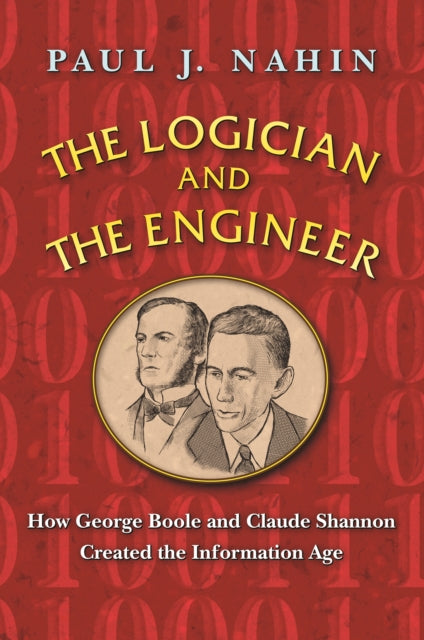
Princeton University Press The Logician and the Engineer
Book SynopsisThird printing. First paperback printing. Original copyright date: 2013.Trade Review"Meshing logic problems with the stories of two extraordinary men ... Paul Nahin fashions a tale of innovation and discovery. Alongside a gripping account of how Shannon built on Boole's work, Nahin explores others key to the technological revolution, from Georg Cantor to Alan Turing."--Nature "Engaging... Nahin assumes some rudimentary knowledge but expertly explains concepts such as relay circuits, Turing machines, and quantum computing. Reasoning through the problems and diagrams will give persistent readers genuine aha moments and an understanding of the two revolutionaries who helped to lay the foundation of our digital world."--Scientific American "Part biography, part history, and part a review of basic information theory, this book does an excellent job of fitting these interlocking elements together."--Library Journal "The reader is taken on a journey from the development of some abstract mathematical ideas through a nearly ubiquitous application of those ideas within the modern world with so many embedded digital computers... I enjoyed the discussion of Claude Shannon. In the history of the computer and development of the internet and World Wide Web, his ideas and contributions are too often overlooked. He is one of my heroes and I believe that everyone that reads this book will come to the same conclusion."--Charles Ashbacher, MAA Reviews "Paul J. Nahin really knows how to tell a good story... The Logician and the Engineer is truly a gem."--New York Journal of Books "A short but fairly detailed exploration of the genesis of Boolean logic and Shannon's information theory... [G]ood background reading for anyone studying electronics or computer science."--Christine Evans-Pughe, Engineering & Technology "Although the book is technical, it is always easily understandable for anyone (for those who need it, some basic rules for electrical circuits are collected in a short appendix). It is not only understandable but also pleasantly bantering and at occasions even facetious."--A. Bultheel, European Mathematical Society "Most valuable to this reviewer, and likely to many potential readers, is the closing chapter, aptly titled Beyond Boole and Shannon. Here is provided an introduction to quantum computing and its logic, possibly portending the future of computers, yet unmistakably bearing the footprints of the two early pioneers. It is an unexpected yet fitting conclusion to this thoroughly enjoyable read."--Ronald E. Prather, Mathematical Reviews Clippings "Nahin has had the very good idea of connecting the very different worlds and times of Boole, Shannon, and others to demonstrate that a little Victorian algebra can turn out to be very useful."--SIAM Review "The exposition is clear and does not assume any prior knowledge except elementary mathematics and a few basic facts from physics. I recommend this well-written book to all readers interested in the history of computer science, as well as those who are curious about the fundamental principles of digital computing."--Antonin Slavik, Zentralblatt MATH "[T]his is a useful and often interesting introduction to the life and work of two intellectual giants who are largely unknown to the general public."--Gareth and Mary Jones, London Mathematical Society Newsletter "The problems are varied and indeed intriguing, and the solutions are delightful."--Mathematics Magazine "This book is not light reading. It would be excellent for advanced high school juniors or seniors with a strong interest in computer science as well as mathematics."--Tom Ottinger, Mathematics Teacher "Nahin leavens the math and engineering with humor and an infectious intellectual curiosity, and the parallels between Boole and Shannon are convincingly drawn... [The Logician and the Engineer] will give your brain a workout, but an enjoyable one."--San Francisco Book ReviewTable of ContentsPreface xi 1 What You Need to Know to Read This Book 1 Notes and References 5 2 Introduction 6 Notes and References 14 3 George Boole and Claude Shannon: Two Mini-Biographies 17 *3.1 The Mathematician 17 *3.2 The Electrical Engineer 28 * Notes and References 39 4 Boolean Algebra 43 *4.1 Boole's Early Interest in Symbolic Analysis 43 *4.2 Visualizing Sets 44 *4.3 Boole's Algebra of Sets 45 *4.4 Propositional Calculus 48 *4.5 Some Examples of Boolean Analysis 52 *4.6 Visualizing Boolean Functions 59 * Notes and References 65 5 Logical Switching Circuits 67 *5.1 Digital Technology: Relays versus Electronics 67 *5.2 Switches and the Logical Connectives 68 *5.3 A Classic Switching Design Problem 71 *5.4 The Electromagnetic Relay and the Logical NOT 73 *5.5 The Ideal Diode and the Relay Logical AND and OR 76 *5.6 The Bi-Stable Relay Latch 81 * Notes and References 84 6 Boole, Shannon, and Probability 88 *6.1 A Common Mathematical Interest 88 *6.2 Some Fundamental Probability Concepts 89 *6.3 Boole and Conditional Probability 96 *6.4 Shannon, Conditional Probability, and Relay Reliability 99 *6.5 Majority Logic 106 * Notes and References 110 7 Some Combinatorial Logic Examples 114 *7.1 Channel Capacity, Shannon's Theorem, and Error-Detection Theory 114 *7.2 The Exclusive-OR Gate (XOR) 122 *7.3 Error-Detection Logic 127 *7.4 Error-Correction Theory 128 *7.5 Error-Correction Logic 132 * Notes and References 137 8 Sequential-State Digital Circuits 139 *8.1 Two Sequential-State Problems 139 *8.2 The NOR Latch 142 *8.3 The Clocked RS Flip-Flop 146 *8.4 More Flip-Flops 154 *8.5 A Synchronous, Sequential-State Digital Machine Design Example 158 * Notes and References 160 9 Turing Machines 161 *9.1 The First Modern Computer 162 *9.2 Two Turing Machines 164 *9.3 Numbers We Can't Compute 168 * Notes and References 173 10 Beyond Boole and Shannon 176 *10.1 Computation and Fundamental Physics 176 *10.2 Energy and Information 178 *10.3 Logically Reversible Gates 180 *10.4 Thermodynamics of Logic 184 *10.5 A Peek into the Twilight Zone: Quantum Computers 188 *10.6 Quantum Logic--and Time Travel, Too! 197 Notes and References 205 Epilogue For the Future: The Anti-Amphibological Machine 210 Appendix Fundamental Electric Circuit Concepts 219 Acknowledgments 223 Index 225
£16.14
Elsevier Science Categorical Logic and Type Theory
Book SynopsisAttempts to give a systematic presentation of both logic and type theory from a categorical perspective, using the unifying concept of fibred category. This book is useful for logicians, type theorists, category theorists and (theoretical) computer scientists.Trade Review"The author's achievement in collecting and organizing a very large body of material in coherent form,... this is first and foremost an encyclopaedic work, into which specialists will delve with much pleasure and profit... One very welcome feature of the book is a comprehensive bibliography of nearly 350 items..." --Zentralblatt für Mathematik, vol.905R.A.G. Seely"This book will be the standard reference in its field for some time to come." --The Bulletin of Symbolic Logic, Vol. 6Table of ContentsChapter Headings only. Preface. Contents. Preliminaries. Prospectus. Introduction to fibred category theory. Simple type theory. Equational logic. First order predicate logic. Higher order predicate logic. The effective topos. Internal category theory. Polymorphic type theory. Advanced fibred category theory. First order dependent type theory. Higher order dependent type theory. References. Notation index. Subject index.
£99.00
Cambridge University Press A Course in Model Theory
Book SynopsisThis concise introduction takes the reader from standard notions to more advanced topics. It introduces the classic results, as well as more recent developments in this vibrant area of mathematical logic. Many worked examples and exercises make the book a useful resource for graduate students as well as researchers.Trade Review'The book is very well written and a pleasure to read.' Tim Netzer, Zentralblatt MATHTable of ContentsPreface; 1. The basics; 2. Elementary extensions and compactness; 3. Quantifier elimination; 4. Countable models; 5. Aleph-1-categorical theories; 6. Morley rank; 7. Simple theories; 8. Stable theories; 9. Prime extensions; 10. The fine structure of 1-categorical theories; A. Set theory; B. Fields; C. Combinatorics; D. Solutions of exercises; Bibliography; Index.
£52.24

Birkhauser Verlag AG Who Killed Professor X?
Book SynopsisThis graphic novel is both a historical novel as well as an entertaining way of using mathematics to solve a crime. The plot, the possible motive of every suspect, and the elements of his or her character are based on actual historical figures.The 2nd International Congress of Mathematicians is being held in Paris in 1900. The main speaker, the renowned Professor X, is found dead in the hotel dining room. Foul play is suspected. The greatest mathematicians of all time (who are attending the Congress) are called in for questioning. Their statements to the police, however, take the form of mathematical problems. The Chief Inspector enlists the aid of a young mathematician to help solve the crime. Do numbers always tell the truth? Or don’t they?Trade Review“It is a detective story in which several of the greatest historic mathematicians become all suspects for a murder on a colleague. … This is a wonderful booklet of fiction, but based on historical incidents. … It is a fantastic present that you can give to anybody between 9 and 99.” (Adhemar Bultheel, euro-math-soc.eu, June, 2015)Table of ContentsThe Crime.- The Suspects: Mathematicians.- Credits.- Examination of the Statements.
£14.25
College Publications Philosophical Applications of Modal Logic
£26.60
Cambridge University Press Polygraphs From Rewriting to Higher Categories
a huge range and FREE tracked UK delivery on ALL orders.
£85.50

New York University Press Gödels Proof
Book SynopsisIn 1931 Kurt Godel published his fundamental paper, On Formally Undecidable Propositions of Principia Mathematica and Related Systems. This revolutionary paper challenged certain basic assumptions underlying much research in mathematics and logic. The authors provide an explanation of the main ideas and broad implications of Godel's discovery.Trade ReviewA little masterpiece of exegesis. * Nature *An excellent nontechnical account of the substance of Gödel's celebrated paper. -- American Mathematical SocietyTable of ContentsContents Foreword to the New Edition by Douglas R. Hofstadter ix Acknowledgments xxiii i Introduction 1 ii The Problem of Consistency 7 iii Absolute Proofs of Consistency 25 iv The Systematic Codification of Formal Logic 37 v An Example of a Successful Absolute Proof of Consistency 45 vi The Idea of Mapping and Its Use in Mathematics 57 vii Godel's Proofs 68 a Godel numbering 68 b The arithmetization of meta-mathematics 80 c The heart of Godel's argument 92 viii Concluding Reflections 109 Appendix: Notes 114 Brief Bibliography 125 Index 127
£999.99
Tarquin Publications Understanding Proof: Explanation, Examples and
Book Synopsis
£22.94
Cambridge University Press Logic Colloquium 2004
a huge range and FREE tracked UK delivery on ALL orders.
£105.45

Princeton University Press Predicative Arithmetic
Book SynopsisThis book develops arithmetic without the induction principle, working in theories that are interpretable in Raphael Robinson's theory Q. Certain inductive formulas, the bounded ones, are interpretable in Q. A mathematically strong, but logically very weak, predicative arithmetic is constructed. Originally published in 1986. The Princeton LegacyTable of Contents*FrontMatter, pg. i*Acknowledgments, pg. v*Table of Contents, pg. vii*Chapter 1. The impredicativity of induction, pg. 1*Chapter 2. Logical terminology, pg. 3*Chapter 3. The axioms of arithmetic, pg. 8*Chapter 4. Order, pg. 10*Chapter 5. Induction by relativization, pg. 12*Chapter 6. Interpretability in Robinson's theory, pg. 16*Chapter 7. Bounded induction, pg. 23*Chapter 8. The bounded least number principle, pg. 29*Chapter 9. The euclidean algorithm, pg. 32*Chapter 10. Encoding, pg. 36*Chapter 11. Bounded separation and minimum, pg. 43*Chapter 12. Sets and functions, pg. 46*Chapter 13. Exponential functions, pg. 51*Chapter 14. Exponentiation, pg. 54*Chapter 15. A stronger relativization scheme, pg. 60*Chapter 16. Bounds on exponential functions, pg. 64*Chapter 17. Bounded replacement, pg. 70*Chapter 18. An impassable barrier, pg. 73*Chapter 19. Sequences, pg. 82*Chapter 20. Cardinality, pg. 90*Chapter 21. Existence of sets, pg. 95*Chapter 22. Semibounded Replacement, pg. 98*Chapter 23. Formulas, pg. 101*Chapter 24. Proofs, pg. 111*Chapter 25. Derived rules of inference, pg. 115*Chapter 26. Special constants, pg. 134*Chapter 27. Extensions by definition, pg. 136*Chapter 28. Interpretations, pg. 152*Chapter 29. The arithmetization of arithmetic, pg. 157*Chapter 30. The consistency theorem, pg. 162*Chapter 31. Is exponentiation total?, pg. 173*Chapter 32. A modified Hilbert program, pg. 178*Bibliography, pg. 181*General index, pg. 183*Index of defining axioms, pg. 186
£33.25
Cambridge University Press Effective Mathematics of the Uncountable
Book SynopsisThis book provides an authoritative and multifaceted introduction to eight major approaches to computation on uncountable mathematical domains. The perspectives explored within reveal different aspects of effective uncountable mathematics, making it an ideal resource for graduate and advanced undergraduate students and researchers in this exciting new area of study.Table of ContentsList of contributors; Preface; 1. Introduction; 2. Borel structures: a brief survey Antonio Montalbán and André Nies; 3. Infinite time Turing machines and an application to the hierarchy of equivalence relations on the reals Samuel Coskey and Joel David Hamkins; 4. Some results on R-computable structures W. Calvert and J. E. Porter; 5. Effective model theory via the Σ-definability approach Alexey Stukachev; 6. Computable structure theory using admissible recursion theory on ω1 Noam Greenberg and Julia F. Knight; 7. E-recursive intuitions Gerald E. Sacks; 8. Local computability and uncountable structures Russell Miller; 9. Reverse mathematics, countable and uncountable: a computational approach Richard A. Shore.
£105.45
Cambridge University Press Abstract Recursion and Intrinsic Complexity
Book SynopsisThis book presents and applies a framework for studying the complexity of algorithms. It is aimed at logicians, computer scientists, mathematicians and philosophers interested in the theory of computation and its foundations, and it is written at a level suitable for non-specialists. Part I provides an accessible introduction to abstract recursion theory and its connection with computability and complexity. This part is suitable for use as a textbook for an advanced undergraduate or graduate course: all the necessary elementary facts from logic, recursion theory, arithmetic and algebra are included. Part II develops and applies an extension of the homomorphism method due jointly to the author and Lou van den Dries for deriving lower complexity bounds for problems in number theory and algebra which (provably or plausibly) restrict all elementary algorithms from specified primitives. The book includes over 250 problems, from simple checks of the reader''s understanding, to current open pTrade Review'… the author presents basic methods, approaches and results of the theory of abstract (first-order) recursion and its relevance to the foundations of the theory of algorithms and computational complexity …' Marat M. Arslanov, Mathematical Reviews ClippingsTable of ContentsIntroduction; 1. Preliminaries; Part I. Abstract (First Order) Recursion: 2. Recursive (McCarthy) programs; 3. Complexity theory for recursive programs; Part II. Intrinsic Complexity: 4. The homomorphism method; 5. Lower bounds from Presburger primitives; 6. Lower bounds from division with remainder; 7. Lower bounds from division and multiplication; 8. Non-uniform complexity in N; 9. Polynomial nullity (0-testing); References; Symbol index; General index.
£105.45
Cambridge University Press Formal Geometry and Bordism Operations
Book SynopsisThis text organizes a range of results in chromatic homotopy theory, running a single thread through theorems in bordism and a detailed understanding of the moduli of formal groups. It emphasizes the naturally occurring algebro-geometric models that presage the topological results, taking the reader through a pedagogical development of the field. In addition to forming the backbone of the stable homotopy category, these ideas have found application in other fields: the daughter subject ''elliptic cohomology'' abuts mathematical physics, manifold geometry, topological analysis, and the representation theory of loop groups. The common language employed when discussing these subjects showcases their unity and guides the reader breezily from one domain to the next, ultimately culminating in the construction of Witten''s genus for String manifolds. This text is an expansion of a set of lecture notes for a topics course delivered at Harvard University during the spring term of 2016.Trade Review'It has a down-to-earth and inviting style (no small achievement in a book about functorial algebraic geometry). It is elegant, precise, and incisive, and it is strong on both theory and calculation.' Michael Berg, MAA Reviews'This book is likely to be quite useful to graduate students in algebraic topology. For years it has been an informal tradition for students of algebraic topology to teach themselves enough of the foundations of algebraic geometry to be able to translate between theorems about Hopf algebroids and theorems about algebraic stacks, and then to proceed to translate, as much as possible, calculations and theorems in algebraic topology into equivalent formulations in terms of moduli stacks of formal groups and related objects. This book does a great service to such students (and their advisors!), as it gives good answers to many of the questions such students inevitably ask.' Andrew Salch, MatSciNet'The presentation is lucid, pedagogical, and also offers a fresh point of view on classical topics. It draws from several mostly unpublished sources, for instance Strickland's manuscripts or various sets of notes by Goerss, Hopkins, and Lurie, and combines them in a single uniform treatment. Moreover, it contains a wealth of references to the published and unpublished literature that guides the interested reader to further topics that are only discussed in passing.' Tobias Barthel, zbMATH OpenTable of ContentsForeword Matthew Ando; Preface; Introduction; 1. Unoriented bordism; 2. Complex bordism; 3. Finite spectra; 4. Unstable cooperations; 5. The σ-orientation; Appendix A. Power operations; Appendix B. Loose ends; References; Index.
£75.99
Cambridge University Press FiniteState Techniques
Book SynopsisFinite-state methods are the most efficient mechanisms for analysing textual and symbolic data, providing elegant solutions for an immense number of practical problems in computational linguistics and computer science. This book for graduate students and researchers gives a complete coverage of the field, starting from a conceptual introduction and building to advanced topics and applications. The central finite-state technologies are introduced with mathematical rigour, ranging from simple finite-state automata to transducers and bimachines as ''input-output'' devices. Special attention is given to the rich possibilities of simplifying, transforming and combining finite-state devices. All algorithms presented are accompanied by full correctness proofs and executable source code in a new programming language, C(M), which focuses on transparency of steps and simplicity of code. Thus, by enabling readers to obtain a deep formal understanding of the subject and to put finite-state methodsTrade Review'… this volume is well written and very detailed. It is thus a nice reference for those results for the interested graduate or researcher …' Andreas Maletti, ZB Math ReviewsTable of ContentsPart I. Formal Background: 1. Formal preliminaries; 2. Monoidal finite-state automata; 3. Classical finite-state automata and regular languages; 4. Monoidal multi-tape automata and finite-state transducers; 5. Deterministic transducers; 6. Bimachines; Part II. From Theory to Practice: 7. The C(M) language; 8. C(M) implementation of finite-state devices; 9. The Aho–Corasick algorithm; 10. The minimal deterministic finite-state automaton for a finite language; 11. Constructing finite-state devices for text rewriting; Bibliography; Index.
£66.99


