
Science: general issues Books

Princeton University Press Bedeviled
Book SynopsisTrade Review"Bedeviled admirably insists on recording the plain history of science. It just so happens that the history of that most rational of human endeavors reads at times like a Gothic tale, one replete with evil geniuses, time travelers and uncanny intelligences lurking in reality’s obscure corners."---Jess Keiser, Washington Post"Thought-provoking and highly readable . . . A welcome contribution to the philosophy of scientific discovery that deserves further scholarly attention."---Jan G. Michel, Science"A brilliant, challenging overview of the myth-driven scientific endeavors that transform human understandings of the world." * Foreword Reviews *"The workings of powerful computers, the processes of evolution, the market forces that drive the global economy. To conceptualize such unseen forces, researchers have long invoked thought experiments involving demons, devils, golems or genies . . . Canales has given us a glimpse into this haunted realm."---Ramin Skibba, Nature"At the very same time that science was said to be demystifying the world, Canales shows us, scientists were populating it all over again with the demonic. . . . [Canales] links her demonology to what she calls 'the audacity of our imagination,' our ability to imagine what does not yet exist or seems as if it cannot be real."---Casey Cep, New Yorker"In this fascinating and informative book Canales treats the reader to a rich feast of scientific demons, tracing their histories and relevance from atomic and molecular physics to computer science and biology, including a chapter on demons in the global economy."---V. V. Raman, Choice"A welcome, in-depth historical investigation of the many functions that demons have played and continue to play in science and technology."---Rawad El Skaf, History and Philosophy of the Life Sciences
£22.50

Princeton University Press More Things in the Heavens
Book SynopsisTrade Review"Finalist for the PROSE Award in Cosmology and Astronomy, Association of American Publishers""Spitzer . . . merits a detailed and authoritative account of its successes, and More Things in the Heavens is just that."---Michael Rowan-Robinson, Nature"For serious space fans, this ode to NASA’s Spitzer Space Telescope reveals what we’ve learned by looking at the universe through an infrared lens." * Science News *"Werner and Eisenhardt, both at the Jet Propulsion Laboratory, have been involved with Spitzer for decades and know their subject intimately. After a whirlwind tour of the universe as seen in the infrared, they cover in detail every aspect of astronomy that Spitzer has touched."---Rick Fienberg, Sky & Telescope"A fascinating insight into how the scientific process of discovery works, putting the results made by the huge team using Spitzer in context with the wider research field."---Dr. Chris North, BBC Sky at Night"More Things in the Heavens is a well-written account of the accomplishments of a great observatory over its more than 16-year lifetime."---Edward L. Wright, Physics Today"More Things in the Heavens is an unashamed celebration of one of the great scientific projects of the early 21st century. . . . It is a labour of love by two men who committed their lives to transform a dream into reality, to bringing us a deeper understanding of the Universe with a mirror no bigger than the one in most bathrooms."---Nick Smith, Engineering & Technology"This is a most impressive story, not just for specialists, clearly told and profusely illustrated. I found it a pleasure to read and recommend it strongly."---Peredur Williams, The Observatory"More Things in the Heavens reveals how important infrared astronomy has been to increasing our understanding of the cosmos."---Iain Todd, BBC Sky at Night"A timely and welcome addition to this genre."---Manoj Puravankara, Current Science
£28.80

Princeton University Press Quantum ManyBody Physics in a Nutshell
Book SynopsisTrade Review"This book provides an essential introduction to the physics of quantum many-body systems."---T. C. Mohan, Zentralblatt MATH
£68.00

Princeton University Press The Eternal Darkness
Book Synopsis"Featuring a new preface by the author."Trade ReviewWinner of the Commonwealth Award for Science and Invention, Sigma Xi Commonwealth Award for Science and Invention, Sigma Xi Association of American Publishers Award for Best Professional/Scholarly Book in Geography and Earth Sciences Honorable Mention for the 2000 Award for Best Professional/Scholarly Book in Geography and Earth Sciences, Association of American Publishers "A straightforward look at a complicated business that shows again not just that exploration is worth doing but that even at home here on earth it is far from over."--Michael Parfit, New York Times Book Review "An excellent book... It is impossible to put down."--Richard Shelton, Times Literary Supplement "The man who found the Titanic, discovered black smokers on the sea floor, and first ventured into the mid-Atlantic ridge tells the story of deep-sea exploration... Scores of photographs highlight the steadily absorbing text; together, words and pictures present a vital and authoritative general history of humanity's adventures deep beneath the waves."--Publishers Weekly "Drawing from the expertise gained during his more than one hundred trips into the abyss, Ballard highlights historical and scientific events that he and Hively weave into a series of scintillating tales."--Loretta DiPietro, Scientific American "Cool technology meets personal obsession in this history that's also a memoir by the discoverer of the wreck of the Titanic. Break out the bathospheres, the minisubs and the ROVs (Remote Operated Vehicles); it's time to take the plunge and see what's Down There."--Washington Post Book World "This book takes the reader into the deep-sea realm along the discovery paths of famous deep-sea explorers as chronicled by the preeminent explorer of our time. Ballard's book will leave readers enlightened and concerned about the expanding role the oceans are playing as the future evolves."--Choice "Pitched to the lay reader, Ballard's The Eternal Darkness is engaging, sometimes thrilling and always authentic... Ballard was also involved in the 1985 discovery of the Titanic, and his account of the sleuthing that went into the hunt makes for terrific reading."--Dennis Drabelle, Washington Post Book World "An informative and interesting book written with authority on a fascinating subject."--Daniel Lenihan, Naval History "A remarkable story of science and adventure, as fascinating as the exploration of space and the landing on the moon."--American Way (Airline Magazine) "The Eternal Darkness is a highly readable book... I am always on the lookout for books that will motivate and enthuse potential and present students. The Eternal Darkness will become a firm favourite on that list, as Ballard shows what can be achieved by hard work, determination and unbounded enthusiasm."--Paul Tyler, New Scientist "Doing science is exciting! This is the main message of Ballard's fascinating combination memoir and history of deep ocean science."--Library Journal "Titanic discoverer Ballard ... handily summarizes a technology unfamiliar to many readers. Ballard has published popular books about his recovery of other famous sunken ships besides the movie's namesake, which adds cachet to this more scholarly work."--Booklist "Dr. Ballard is a passionate advocate of deep-sea exploration, pointing out that all such expeditions so far undertaken have probably surveyed less than 1 percent of the sea floor... One can hardly disagree with Dr. Ballard's proposal that we should expand that 1 percent."--Phoebe-Lou Adams, Atlantic MonthlyTable of ContentsPreface to the 2017 Edition vii Acknowledgments xv Introduction 3 I Depth 1 A Simple Tethered Sphere 13 2 Bathyscaphs Race to the Bottom 33 3 The Tragic Dawn of the Modern Deep Submersible 58 II Discovery 4 Scientists Begin Exploring the Deep 93 5 The Midocean Ridge:Womb of the Earth 117 6 Hydrothermal Vents: Exotic Oases 157 7 Black Smokers: Recipe for a Salty Ocean 187 III Detachment 8 A Tethered Eyeball Races to Find the Titanic 217 9 Recovering Our Past by Remote Control 255 10 Should Humans Continue to Dive? Two Paradigms 299 A Note on Sources 313 Further Reading 315 Index 375
£20.90

Princeton University Press The Visioneers How a Group of Elite Scientists
Book SynopsisTrade ReviewWinner of the 2014 Watson Davis and Helen Miles Davis Prize, History of Science Society Winner of the 2012 Eugene E. Emme Award for Astronautical Literature, American Astronautical Society "In his fascinating new book, McCray profiles the larger-than-life characters and ideas that changed science and technology in the second half of the 20th century and beyond. The author describes the titular visioneers as 'hybrids'--creative combinations of futurist, scientist, and charismatic promoter. At the center of this story are physicist Gerard O'Neill and biotech pioneer K. Eric Drexler... McCray, a professor of history at UC Santa Barbara, discusses how O'Neill's vision of space as a tabula rasa for the human race spurred the formation of grassroots groups like the L5 Society and captured the imaginations of many young scientists and engineers like Drexler, as well as influential figures like Stewart Brand and Timothy Leary. Considered together, they 'took speculative ideas out of the hands of sci-fi writers' and had an enormous impact on generations of people, science, and political policy."--Publishers Weekly (starred review) "McCray focuses on Gerard K. O'Neill, the Princeton physicist and designer of space colonies, and on his protege, K. Eric Drexler, the 'speculative engineer' trained at the Massachusetts Institute of Technology in Cambridge who helped to put nanotechnology on political agendas in the early 1990s. Along the way, McCray introduces a large and colourful cast of others who, over four decades, promoted technological progress as the way to overcome every limit... McCray's book is especially convincing in following the various movements that arose in reaction to the Club of Rome's 1972 book (The Limits of Growth)... McCray's argument that visioneers play an important part in the 'technological ecosystem' is also compelling."--Cyrus Mody, Nature "The overarching narrative of The Visioneers--that of humankind's struggle against limits real and imagined--is compelling, and no less so because of how effectively it reflects the questions of technology surrounding today's big fears like peak oil and global warming... [The Visioneers] is an extremely edifying and well-researched history. Recommended for technology buffs, doomsayers, and anyone with an interest in the intersection of science, technology, and society."--ForeWord "[A] thoughtful, meticulous history."--Simon Ings, New Scientist "I recommend McCray's The Visioneers to all readers interested recent history of science in the making and, more generally, in the place of science in society. The marketing of science is entering a new era and many of the visioneers described by McCray may be seen as the first of a wave of new kind of figures in the history of science, both technoscientists and visionary promoters."--Roger F Malina, Leonardo Journal "McCray's narrative is often fascinating. He connects interest in space colonies with a pervasive fear in the 1970s that unchecked population growth would precipitate an apocalyptic environmental crisis on Planet Earth."--Glenn C. Altschuler, Tulsa World "Remember the late 20th century? When machines on the moon were spitting 10-pound spoonfuls of soil into orbit every few seconds, as raw material for space colonies and zero-gravity factories? When solar panels in orbit were beaming down the planet's power supply? When we were manufacturing everything we wanted, molecule by molecule, via machines smaller than the smallest objects we previously knew? In The Visioneers, the UC-Santa Barbara historian W. Patrick McCray revisits the birth and growth of those futures--or rather, those concepts of the future, which haven't (yet) come true... [W]ell-detailed."--Brian Doherty, Reason "[M]cCray focuses on the public relations efforts of [Gerard O'Neil and Eric Drexler] and how their agenda helped shape the national agenda for science and technology research and reveals how these visionaries worked tirelessly to make their dreams a reality. Recommended for readers with an interest in the history of science, especially in the space exploration or nanotechnology fields."--Library Journal "McCray skilfully weaves a narrative between O'Neill and Drexler in what is a superb and important book."--Keith Cooper, Astronomy Now "[H]istorians of contemporary science, technology and popular culture--in addition to a wide non-academic audience--will find much to savour in this rich and well-written book."--Peder Roberts, British Journal for the History of Science "In this engaging, highly detailed and meticulously researched account of late twentieth century technological dreaming and development, McCray ... does an impressive job of assembling a wealth of information and analysis of a particular period of futures-making in America's recent past... For those interested in the extensive early efforts to identify, consolidate and promote the nanotechnology field (or for that matter, space settlement), this book will provide a treasure trove of information and insight."--Georgia Miller, Nanoethics "The book is a worthy contribution to a growing historiography of the sprawling intellectual and cultural spaces that have existed around the edges of mainstream science and technology."--William Thomas, Technology & Culture "Brilliantly researched."--Brian Jirout, Oral History ReviewTable of ContentsList of Illustrations ix Acknowledgments xi Introduction: Visioneering Technological Futures 1 Chapter 1 Utopia or Oblivion for Spaceship Earth? 20 Chapter 2 The Inspiration of Limits 40 Chapter 3 Building Castles in the Sky 73 Chapter 4 Omnificent 113 Chapter 5 Could Small Be Beautiful? 146 Chapter 6 California Dreaming 183 Chapter 7 Confirmation, Benediction, and Inquisition 222 Chapter 8 Visioneering's Value 258 A Note on Sources 277 Notes 281 Index 325
£23.75

Princeton University Press The Social Origins of Language
Book SynopsisTrade Review"One of Choice Reviews' Outstanding Academic Titles of 2018"
£28.80

Princeton University Press Welcome to the Universe
Book SynopsisA companion to Welcome to the Universe, a ... bestseller that was inspired by the ... introductory astronomy course for non-science majors that Neil deGrasse Tyson, Michael A. Strauss, and J. Richard Gott taught together at Princeton. [It] features more than one hundred problems and exercises used in the original course--Amazon.com.Trade Review"This book provides a very valuable resource for anyone who wants to acquire a reasonably quantitative understanding of introductory astronomy. The questions cover a broad range of interesting topics, and the solutions are thorough and often enlightening, providing additional insights into the subject matter."—Alex Filippenko, University of California, Berkeley"The difference between a good astronomy course and a great astronomy course is great problems. This book is a gold mine of great problems for introductory astronomy, problems that can be solved with high school algebra and run the gamut from earth-smashing asteroids to neutron stars, black holes, the fate of the universe, and the search for life on other worlds. It will be a valuable resource for anyone teaching introductory astronomy and an exhilarating challenge for students who want to sharpen their wits against the cosmos."—David Weinberg, Ohio State University"A fantastic asset. The hardest part of teaching introductory astronomy courses is writing engaging, informative problems at the appropriate level. This book provides a treasure trove of wonderfully instructive material that is much better than anything else out there. I will be using Tyson, Strauss, and Gott for a long time to come."—James H. Applegate, Columbia University"A marvelous compendium. This companion book demonstrates in a playful manner how, with no more than high school algebra, we can obtain a deeper appreciation of the properties of the infinitely large and small, and deepen our conversation with the cosmos."—Trinh X. Thuan, University of Virginia"A wonderful collection of introductory problems that convey the wonders of the universe and fundamental concepts in astronomy through specific examples and numbers. A fantastic resource for the classroom and aspiring astronomers."—Abraham Loeb, Harvard University"Microorganisms on Europa, colliding black holes, cosmic inflation, and much more are covered in this expansive and thoughtfully selected collection of exciting problems in astrophysics—even a two-dimensional Tardis appears! Both students and experienced astronomers should come away enriched through study of these problems and the techniques presented to crack them."—W. Niel Brandt, Pennsylvania State University
£100.30

Princeton University Press Einstein for the 21st Century His Legacy in
Book SynopsisTrade Review"This book makes an entertaining, engaging and informative effort to tackle a notoriously difficult topic: Albert Einstein's influence on society and culture... [The book] give[s] a rather balanced and authoritative portrayal of the man and his cultural context, while drawing attention to several entertaining sidelights of his life and career."--Daniel Kennefick, American Scientist "This lovely compendium of essays on Einstein's cultural impact is as stunning in its breadth as Einstein was in his science. Among the book's contributors are such luminaries as Lisa Randall and E.L. Doctorow. Browsing through this book is like eavesdropping on the reminiscences of great artists, novelists, historians, and scientists as they discuss their favorite old teachers. How remarkable, then, that they are all discussing the same man."--Seed Magazine "Books on Einstein are scarcely in short supply but much of this collection feels fresh, probably because, astonishingly, Einstein's work is still, at the forefront of physics. But it's also because his life touched so many worlds outside science, including nuclear weapons, Nazi Germany, Zionism and the Arab-Israeli conflict, civil rights and the arts."--Andrew Robinson, Financial Times "A remarkable volume... At turns illuminating and disorientating, this is a book that I can recommend to all those interested in that eternal enigma, Albert Einstein."--Brian Foster, Physics World "There are many books written about Einstein, but this is one of the most important that this reviewer has ever read. This work clearly articulates the complex nature of this man, his thought, and this overwhelming influence on the cultural identity of much of the world, even though it has been over 50 years since his death."--G. D. Oberle III, Choice "The book is correctly advertised as speaking 'to everyone with an interest' in Einstein's work; it makes a wonderful gift. It also marks the way toward a gradual transformation of Albert Einstein as he lived into the Mythos Einstein."--Hubert Goenner, Journal for the History of AstronomyTable of ContentsIntroduction ix PART 1: Solitude and World Chapter 1: Who Was Einstein? Why Is He Still So Alive? by Gerald Holton 3 Chapter 2: A Short History of Einstein's Paradise beyond the Personal by Lorraine Daston 15 Chapter 3: Einstein's Jewish Identity by Hanoch Gutfreund 27 Chapter 4: Einstein and God by Yehuda Elkana 35 Chapter 5: Einstein's Unintended Legacy: The Critique of Common-Sense Realism and Post-Modern Politics by Yaron Ezrahi 48 Chapter 6: Subversive Einstein by Susan Neiman 59 Chapter 7: Einstein and Nuclear Weapons by Silvan S. Schweber 72 PART 2: Art and World Chapter 8: Einstein and 20th-Century Art: A Romance of Many Dimensions by Linda Dalrymple Henderson 101 Chapter 9: Rendering Time by Caroline A. Jones 130 Chapter 10: Into the Bleed: Einstein and 21st-Century Art by Matthew Ritchie 150 Chapter 11: Einstein and Music by Leon Botstein 161 Chapter 12: Seeing the Unseen by E. L. Doctorow 176 PART 3: Science and World Chapter 13: The Assassin of Relativity by Peter L. Galison 185 Chapter 14: Space, Time, and Geometry: Einstein and Logical Empiricism by Michael L. Friedman 205 Chapter 15: Einstein as a Student by Dudley Herschbach 217 Chapter 16: Learning from Einstein: Innovation in Science by Jurgen Renn 239 Chapter 17: Einstein and 'h: Advances in Quantum Mechanics by Jurg Frohlich 257 Chapter 18: Einstein's Unknown Contribution to Quantum Theory by A. Douglas Stone 270 Chapter 19: Einstein and the Quest for a Unified Theory by David Gross 287 Chapter 20: Energy in Einstein's Universe by Lisa Randall 299 Notes 311 Contributors 341 Index 349
£28.80
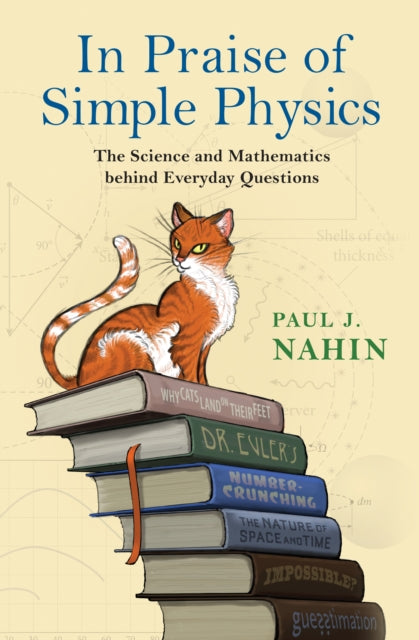
Princeton University Press In Praise of Simple Physics
Book SynopsisTrade Review"Nahin's writing style, as in previous books, is clear, conversational, humorous and chatty... [A]nd the discussions in the book are careful and appropriately rigorous."--MAA Reviews "Fun, accessible physics/math problems along with some humor."--Antonio Cangiano, Math-Blog "[Nahin] knows how to catch the attention of his reader. You will not regret buying any of his books, and I am sure after reading it, you will pick up this one to check again on one of his models and his solution methods."--European Mathematical Society "A superb book... [D]emonstrates clever ways to solve simply physics problems."--ChoiceTable of ContentsForeword by T. M. Helliwell ix Preface with Challenge Problems xi 1 How's Your Math? 1 2 The Traffic-Light Dilemma 20 3 Energy from Moving Air 25 4 Dragsters and Space Station Physics 32 5 Merry-Go-Round Physics and the Tides 42 6 Energy from Moving Water 51 7 Vectors and Bad Hair Days 63 8 An Illuminating Problem 67 9 How to Measure Depth with a Stopwatch 74 10 Doing the Preface Problems 79 11 The Physics of Stacking Books 92 12 Communication Satellite Physics 103 13 Walking a Ladder Upright 110 14 Why Is the Sky Dark at Night? 115 15 How Some Things Float (or Don't) 126 16 A Reciprocating Problem 141 17 How to Catch a Baseball (or Not) 146 18 Tossing Balls and Shooting Bullets Uphill 153 19 Rapid Travel in a Great Circle Transit Tube 163 20 Hurtling Your Body through Space 177 21 The Path of a Punt 194 22 Easy Ways to Measure Gravity in Your Garage 200 23 Epilogue Newton's Gravity Calculation Mistake 218 Postscript 227 Acknowledgments
£16.14
Princeton University Press The Collected Papers of Albert Einstein Volume 15
Book SynopsisTrade Review"This huge volume holds many surprises for readers, even those familiar with much of the recent literature on Einstein’s science, politics, and public life."---David E. Rowe, Metascience
£999.99

Princeton University Press Modeling Populations of Adaptive Individuals
Book SynopsisTrade Review"[A] welcome addition to the esteemed monographs in [the] Population Biology series from Princeton University Press."---Darcy Visscher, The Quarterly Review of Biology
£94.50

Princeton University Press Homology Genes and Evolutionary Innovation
Book SynopsisTrade Review"Winner of the 2018 Daniel Giraud Elliot Medal, National Academy of Sciences""Homology, Genes, and Evolutionary Innovation makes a seminal contribution to evolutionary biology. As Wagner argues, his view provides an opportunity for a major research program on the study of novelty as distinct from adaptation."---Carl Simpson and Douglas H. Erwin, Science"There is much information that is good here." * Choice *"The book is beautifully written, in a precise yet conversational and often humorous tone; still, it is not light reading. Like the chocolate tortes of the author's native Vienna, it requires time to savor. Buy it, and find a seat in your favorite library or café in which to appreciate its richness."---J. A. Bolker, Evolution and Development"This is a book I've waited for all of my professional life (plus a bit--I'm 80)."---Gorkana Group, Biologist"[A]s a treatise on the homology concept in relation to evolutionary morphological novelties, we cannot think of a better current treatment. We congratulate the author for having written a truly inspiring book that will influence the field for many years to come."---Lennart Olsson, Systematic Biology"It is with great pleasure that readers may learn in the pages of Günter Wagner's book how to solve such recalcitrant de Beerian puzzles by their own, guided by the author's expertise both as a gifted philosopher and first rank scientist. . . . Wagner's beautifully written four hundred and twenty five pages are full of important qualifications of the framework and excellent illustrations of each and every of the author's points."---Guillermo Lorenzo González, Theorema"Deeply thought provoking. . . . This survey of homology in the light of modern genetic research . . . is timely and helpful."---Peter Moore, The Bulletin
£28.80

Princeton University Press How Men Age
Book SynopsisTrade Review"Winner of the W.W. Howells Book Award, Biological Anthropology Section of the American Anthropological Association""2017 Regional Finalist in Science, ForeWord Reviews INDIEFAB Book of the Year Awards""The best short summation I've seen of a massive body of research."---Michael Shermer, Wall Street Journal"How Men Age is wry, sly, informative, and provocative."---Glenn Altschuler, Psychology Today"Bribiescas makes a wonderful case for considering evolutionary ideas in human health, and provides a great introduction for anyone wishing to join the conversation."---Emily Gregg, Lateral magazine"Charming. . . . [A]n enjoyable and humane look at what could have been a bleak subject, spiced with just the right amounts of humour, anecdote and quirky personal perspective."---David Bainbridge, Literary Review"[T]he lens through which Bribiescas views [male aging], evolutionary biology, offers a nuanced explanation of why, during almost every phase of human life, men die at a higher rate than women."---Brian Bethune, Maclean's"[Richard Bribiescas] applies anthropological and evolutionary biological lenses to a sweeping, succinct review of the phenomenon [of how men age], and does so with good humor." * Harvard Magazine *"Richard Bribiescas covers some interesting uncharted territory. This is not a mere description of ageing. Instead, by considering male ageing in the light of natural selection, it aims to answer big questions. . . . Testosterone peaks in early adulthood, so that men are past their physical prime by the age of 30. It's tempting to see it as all downhill from there. But with wit and insight, Bribiescas shows convincingly that's not the case."---Kate Douglas, New Scientist"[How Men Age] certainly enriches our understanding of male health and well-being."---Wan Lixin, Shanghai Daily
£14.24

Princeton University Press The Cosmic Web
Book SynopsisTrade Review"Winner of the 2017 PROSE Award in Cosmology & Astronomy, Association of American Publishers""One of Symmetry Magazine’s Physics Books of 2016""With an insider's insight and a storyteller's eye for detail. . . . Gott offers a thorough, vivid, and fascinating look at the cosmic web that makes up our universe." * Publishers Weekly *"The Cosmic Webis not just a well-told story about the frontiers of cosmological knowledge. It is also an inspiration to explore them further."---Michael Blanton, Nature"Weaving together personal anecdotes with physics and math, Princeton astrophysicist J. Richard Gott's The Cosmic Web chronicles the nearly 100-year quest to understand the anatomy of the universe. . . . Gott brings detailed insight to how our view of the cosmos has changed, providing a thorough accounting of how cosmologists arrived at these revelations."---Christopher Crockett, Science News"Provides an outstanding summation of [Gott's] search for understanding the spongy cosmic web that characterizes the universe at large scales. . . . [A] magnificent achievement."---David Eicher, Astronomy Magazine"With a style that's rich in fascinating detail, and bolstered by personal memories and anecdotes,The Cosmic Webdelivers everything we need in a book on this subject."---Alastair Gunn, BBC Sky at Night"An extraordinary book guiding the reader through the large scale of the Universe and the structure scientists encounter whilst looking at the Universe as a whole." * Read about Science *"I enjoyed this book hugely. It should be on the shelf of anyone who is intrigued by why the Universe looks the way it does."---Alan Longstaff, Astronomy Now"Full to the brim with wonderful analogies and genuinely interesting anecdotes that should be a component of all popular science books. If you've ever looked up at the night sky and wondered why it looks the way it does, this is one book you should really consider reading."---Amber Hornsby, Popular Astronomy"Fascinating. . . . I think it should be in every library which aims to cover astrophysics and cosmology."---G.W. Gibbons, Contemporary Physics
£15.29

Princeton University Press The SelfAssembling Brain
Book SynopsisTrade Review"Hiesinger elegantly moves through a variety of topics, ranging from biological development to AI and ending with a discussion of the advances that deep neural networks have brought to the field of brain-machine interfaces."---Kamila Maria Jóźwik, Science"Hiesinger suggests that instead of looking at the brain from an endpoint perspective, we should study how information encoded in the genome is transformed to become the brain as we grow. . . . The Self-Assembling Brain is organized as a series of seminar presentations interspersed with discussions between a robotics engineer, a neuroscientist, a geneticist, and an AI researcher. The thought-provoking conversations help to understand the views and the holes of each field on topics related to the mind, the brain, intelligence, and AI."---Ben Dickson, TechTalks"For anyone interested in the brain, or AI, or any of the myriad of branches and subbranches of each, I would highly recommend this!"---Jonathan Shock, Mathemafrica
£31.50

Princeton University Press Theology and the Scientific Imagination
Book SynopsisTrade Review"Theology and the Scientific Imagination should be read by every historian of science. I can also hardly imagine a philosopher of science who would remain indifferent to the roots of modern thinking. The reading of this book gives one a deep intellectual pleasure: to follow adventures in ideas is like experiencing the adventures themselves." —Michael Heller, Review of Metaphysics"A bold study of ideas . . . bristling with insight and perceptive reinterpretation of familiar episodes in the history of natural philosophy." —David C. Lindberg, Journal of the History of Medicine"Powerful. . . . Liberation from naive conceptions of historical continuity gives Funkenstein leave to concentrate on a finely nuanced exegesis of those philosophers who fall within his purview. The result is a work of discernment and distinction." —J. H. Brooke, Times Higher Education Supplement
£37.80

Princeton University Press Creatures of Cain
Book SynopsisTrade Review"Winner of the Suzanne J. Levinson Prize, History of Science Society""Shortlisted for the Pickstone Prize, British Society for the History of Science""A multifaced and original discussion of the curious life of the 'killer ape' theory within American culture."---Marcia Holmes, Times Higher Education"Coupling her study with research shifting from humankind’s inclination for violence to their more destructive treatment of the environment will reveal that those same factors will continue to remain progressive."---G. Donato, Choice Reviews"[A] fascinating and very well-documented account of disputes about human nature. . . . A major work like Creatures of Cain: The Hunt for Human Nature in Cold War America informs and intrigues, it raises questions, and points to avenues of more research. [Erika] Milam is to be congratulated."---Michael Ruse, The Quarterly Review of Biology"Milam’s book . . . is deeply researched as well as lucidly written. . . . Historians will find much to reward them in Creatures of Cain. . . . Historians broadly interested in the social and political landscapes of mid-century U.S. intellectual life will value Milam’s book for its deft interweaving of science, public intellectualism, and American social and political anxieties"---Joy Rohde, American Historical Review"Milam has made a significant and innovative contribution to the historiography of anthropology . . . . A novel perspective on anthropology’s impact and influence."---Robert Hancock, Journal of the Royal Anthropological Institute"A tour de force, a historical study that offers a well-researched, meticulous examination of how a diverse community of scientists debated the meaning of human nature in the United States after World War II."---Michal Shapira, Isis"Creatures of Cain brings to light the ways in which the circulation of knowledge actually took place."---Marianne Sommer, Journal of the History of Biology"Erika Lorraine Milam’s Creatures of Cain is an exemplary work in the cultural history of modern science. The research is thorough, the material fascinating, the writing lucid and, at times, gripping."---Alex Aylward, Birkhauser (N.T.M)"Creatures of Cain is likely to become a classic in history of science studies. The work is beautifully written and has layers of rich detail, much of which could be mined for gaining insights on contemporary debates."---Roger Chapman, Cercles
£31.50

Princeton University Press Time in Ecology
Book SynopsisTrade Review“Every once in a while, someone comes along and changes how we think by revealing something that has been hidden in plain sight. Using an engaging narrative, Eric Post has done just that. His new concept of an ecological space-time continuum will fundamentally enhance our ability to make sense of the contingency in species life-history strategies and associated ecological functioning that we see in nature.”—Oswald J. Schmitz, author of The New Ecology: Rethinking a Science for the Anthropocene“Eric Post poses the view that time is a resource, and that reframing our thinking in this way is essential to understanding how evolution and ecology influence the varied responses of species to environmental changes. Join him on this journey of exploration and discover the important role that time plays in shaping the interactions of species with the world around them.”—Heidi Steltzer, Fort Lewis College“A gem of a book! Post presents compelling theory and credible, concrete examples that demonstrate the ecological role of time as a limiting resource. This work will undoubtedly shape the future of phenological research for years to come.”—Andrew Richardson, Northern Arizona University“Global climate trends are changing the well understood abiotic phenological triggers such as photoperiod, thermal limits, and seasonal rainfall. In this provocative book, Post adds an additional variable, time, in a novel way to interpret observed variations in life history responses of plants and animals. His exploration of the added influence of timing of life history stages is compelling and challenging.”—Steven W. Running, University of Montana “Post argues that time is a resource used by organisms to perpetuate their genes. Changes in the use of the time-space continuum will determine the response of species and communities to rapid and dramatic changes in nature wrought by humans. This book offers a provocative new way to look at how and why species change their use of time and space.”—William H. Schlesinger, president emeritus, Cary Institute of Ecosystem Studies“Post’s book makes a significant contribution both as a compendium of some of his long-term data and a presentation of some novel perspectives on phenology.”—David William Inouye, coauthor of Techniques for Pollination Biologists
£33.25

Princeton University Press Darwins Unfinished Symphony
Book SynopsisTrade Review"Winner of the 2017 British Psychological Society Book Awards, Best Academic Monograph""Winner of the 2018 PROSE Award in Biological Science, Association of American Publishers""One of Forbes.com’s 10 Best Biology Books of 2017, chosen by GrrlScientist""Selected for Askblog’s Books of the year 2017""Not only philosophers and other human scientists interested . . . in cognitive and epistemological issues, but also educators and researchers in educational sciences can greatly benefit from reading this excellent book."---Lorenzo Magnani, Science and Education
£19.00

Princeton University Press Einstein on Einstein
Book SynopsisTrade Review"Physicist Hanoch Gutfreund and historian Jürgen Renn provide a sparky commentary."---Andrew Robinson, Nature"[Einstein on Einstein] provides context, commentary, and background and explores Einstein’s thinking, theories, and contributions."---Dan Aubrey, U.S. 1"The opportunity to read Einstein’s musings, interpreted by two current leaders in Einstein studies, is valuable to all interested in the history or philosophy of physics as well as in Einstein himself."---Jay Paschoff, The Key Reporter"The main commentaries give hugely valuable insights into the development of Einstein’s thinking and how he positioned himself with respect to his predecessors and contemporaries."---David Lorimer, Paradigm Explorer
£33.25

Princeton University Press No Shadow of a Doubt
Book SynopsisTrade Review"Finalist for the PROSE Award in History of Science, Medicine, and Technology, Association of American Publishers""One of BBC Sky at Night Magazine's Best Astronomy and Space Books of 2019""One of Nature's Top Ten Books of 2019""[No Shadow of a Doubt] offers a richly detailed account of the protagonists and their success against long odds. Mr. Kennefick is at his most compelling when dissecting and refuting accusations of bias that have shrouded the historic feat."---Ray Jayawardhana, Wall Street Journal"Kennefick brings a thrilling mix of ingredients together into a . . . rewarding read: the chutzpah of Einstein; the glamour, luck and sense of adventure of eclipse-chasing; the audacity of planning such a demanding experiment during the first world war and executing it in its chaotic aftermath."---Anjana Ahuja, Financial Times"Physicist Kennefick narrates the buildup to, and fallout from, the experiment that confirmed Einstein’s radical idea and made him an international star."---Andrea Gawrylewski, Scientific American"Meticulously researched and vividly written, [this] account is sure to become the standard reference work on this fascinating example of ‘Big Science’."---Peter Coles, Nature"[An] insightful biography."---Simon Ings, The Spectator"This is a fascinating book, full of insights into the relationship between theory and experimental proof, and the relationship between science, internationalism, and war."---Emily Winterburn, BBC Sky at Night Magazine"A detailed and scholarly examination of the 1919 eclipse expeditions . . . a wonderfully rich and authoritative study of the way science worked in 1919 (“a golden age for astronomy”)."---P. D. Smith, Times Literary Supplement"[Kennefick’s] purpose is to very thoroughly rebut the skeptics, which he accomplishes in part through a careful and technical review of the instruments, the data, and an astronomer’s 1978 reanalysis of the data using a computer, but also by standing up for Frank Dyson."---Karen Olsson, Bookforum"Daniel Kennefick’s wonderful No Shadow of a Doubt has something for everyone, and I highly recommend it, especially in this centennial year."---Jay M. Pasachoff, Key Reporter"[An] excellent book . . . [this] story, in Kennefick’s hands, is well told, with plenty to interest the non-specialist and the more expert reader alike"---Andy Sawyers, British Astronomical Association"Even if shadows and doubts about the 1919 findings remain, this thoughtful and rigorous book at least lays several old myths to rest."---Suman Seth, American Scientist"Daniel Kennefick’s is the most detailed study of the eclipse expedition to date."---Alexei B. Kojevnikov, American Journal of Physics"[Kennefick] celebrates the 100th anniversary of that eclipse by providing us with a detailed, engagingly written, and extremely well-referenced account of the results and their purported confirmation of General Relativity."---David W. Hughes, The Observatory"Rather than privileging the roles of Eddington and Einstein, as other works have done, Kennefick places Einstein and even, to some extent, Eddington in the back seat, focusing instead on Sir Frank Dyson, the instruments and methods used, and the astronomical institutions associated with the expedition. Such an approach shows that the experimental verification of a theory does not lie with single figures but is often driven by several individuals and institutions—their environments, epoch, and instrumentation."---Tiffany Nichols, Isis
£22.50

Princeton University Press digitalSTS A Field Guide for Science Technology
Book SynopsisTrade Review"Winner of the Olga Amsterdamska Award, European Association for the Study of Science and Technology"
£31.50
Princeton University Press AgentBased and IndividualBased Modeling A Practical Introduction Second Edition
a huge range and FREE tracked UK delivery on ALL orders.
£999.99

Princeton University Press A Most Interesting Problem
Book SynopsisTrade Review"DeSilva's volume provides a welcome opportunity to reflect on the history of evolutionary theory as a legacy complicated by Darwin's prescience as well as prejudice."---Erika Lorraine Milam, Science"Together with ten colleagues, DeSilva courageously takes up this perennially red-hot founding text of his discipline."---Jessica Riskin, New York Review of Books"A fascinating, comprehensive, and accessible collection of essays. . . . A Most Interesting Problem gives credit to Darwin where credit is due, but is unabashed in its systematic rejection of outdated science."---Lydia Pyne, JSTOR Daily"In this ‘tribute to how science operates,’ 10 contributors revisit Descent on the 150th anniversary of its publication in a ‘quest for understanding the origin, biological variation, behavior, and evolution of humans.’ . . . Each of the contributors adds something valuable to the conversation." * Kirkus Reviews *"This important new collection of commentaries on what is perhaps the most challenging of Darwin's books in our own time, takes up the evidence for human evolution, our place in the family tree, the origins of civilization, of human races, and of sex differences in ways that are both meaningful as well as accessible to those both inside and outside of the scholarly world who are interested in reading and wrestling with this important and core work of Charles Darwin for themselves."---Johannes E. Riutta, The Well-Read Naturalist"[A] unique presentation of the many scientific ideas and hypotheses of Darwin’s “Descent of Man”. [A Most Interesting Problem] is a very interesting book about how sometimes scientific beliefs that have existed for decades can easily be debunked using modern technology."---Molly Gabler-Smith, Integrative and Comparative Biology"This is an especially important and timely project because Darwin’s volume is chock-full of creative, thought-provoking arguments and speculations about human evolution that span an extremely wide range of subjects, and after 150 years, many of these are overdue for a fresh reconsideration."---Jason Winning, Quarterly Review of Biology"This summary of Darwin's contributions to understanding human evolution should interest not only biologists and anthropologists but all concerned about the fate of the human species."---J. S. Schwartz, CHOICE"A Most Interesting Problem is a fantastic run-down of today’s understanding of human evolution and a great showcase of the scientific process."---Tibi Puiu, ZME Science"Fascinating reading about the development of science, and the cultural blindspots than can misdirect even the most brilliant scientists."---Ian Angus, Climate & Capitalism
£19.80

Princeton University Press Modeling Populations of Adaptive Individuals
Book Synopsis
£37.80

Princeton University Press Unsolved Problems in Ecology
Book SynopsisTrade Review"The volume can be a provocative focus for a graduate reading group. ... Best of all, the essays show all of us that there is an enormous amount of good ecology to be done."---Joseph Travis, The Quarterly Review of Biology
£37.80

Princeton University Press The Strength in Numbers
Book Synopsis
£25.20

Princeton University Press Coexistence in Ecology A Mechanistic Perspective
Book SynopsisTrade Review"Highly recommended."---J. Burger, CHOICE
£94.50

Princeton University Press The Sky Is for Everyone
Book SynopsisTrade Review"A Choice Outstanding Academic Title of the Year""An inspiring anthology of writings by trailblazing female astronomers from 1960 to today."---Simon Ings, New Scientist"The particulars of each woman’s experience are unique, which is part of what makes their stories compelling. . . . As I read through the book, no single essay stood out to me. Instead, I was affected (sometimes deeply) by each woman’s story in a different way, and I often felt compelled to take note of some phrase or piece of sage advice."---Nicolle Zellner, American Scientist"Trimble and Weintraub bring together essays by women who reached for the stars in this uplifting anthology. . . . Filled with moving testimonies and awe-inspiring discoveries, this is a wonderful tribute to the joys of science and the tough road many women had on the way to forging their careers." * Publishers Weekly *"The essays in The Sky Is for Everyone illustrate the progress women have made in the field, although that push to equality is not complete."---Jeff Foust, Space Review"This anthology of 37 short autobiographies covers more than six decades of astronomy and shows the varied paths of female astronomers and the roadblocks that can slow or sideline their success."---Ashley Yeager, Science News"These stories will absolutely inspire our next generation of female scientists. . . . [The Sky Is for Everyone] is an absolute must-read for any young lady who is thinking of starting a career in astronomy. The same applies to anybody who is interested in the history of women in astronomy."---Mary McIntyre, Journal of the British Astronomical Association"[These autobiographical essays] provide a rich portrait of the experiences, ranging from triumphs to heartbreaks, that constitute the lives of women in contemporary astronomy. . . .They demonstrate that a rewarding career in astronomy is possible for anyone who gives it a try and succeeds at overcoming the many hurdles that confront us all regardless of gender."---David H. DeVorkin, Quest"A communal love letter to astronomy and the broader sciences. . . . The Sky Is for Everyone is a valuable read for astronomers and those interested in the status of women in science, but also for department heads and policymakers who should take note of how institutional barriers can be broken down and accommodations made to improve the astronomy community."---Joanna Behrman, Physics Today"[The] essays are universally well written."---H.D. Wong, Choice
£22.50

Princeton University Press Species Tree Inference
Book SynopsisTrade Review"A very well-constructed reference book."---April Marie Wright, Trends in Ecology & Evolution"A very good and thorough overview of methods and applications to infer evolutionary relationship between recently diverged taxa." * Conservation Biology *
£78.20

Princeton University Press The Collected Papers of Albert Einstein Volume
Book Synopsis
£49.60

Princeton University Press The Process of Animal Domestication
Book SynopsisTrade Review"The Process of Animal Domestication is a fascinating book that comes highly recommended. Its synthesis of a large body of research makes it incredibly valuable to evolutionary and developmental biologists, geneticists, anthropologists, and (zoo)archaeologists. However, the writing is accessible enough that (under)graduate students wanting to read up on animal domestication can safely turn to this book as well."---Leon Vlieger, Inquisitive Biologist"This well-referenced, scholarly publication will be valuable primarily for those geneticists, embryologists, comparative anatomists, and evolutionary biologists chiefly interested in the multifaceted issues and history associated with animal domestication."---D.A. Brass, CHOICE"[This book] covers all of the major topics in domestication and really does give an excellent overview of the subject . . . . I would absolutely recommend this book to those with a passing interest in the field, as well as a more specialised readership."---Dominic Wright, Trends in Ecology & Evolution"[The Process of Animal Domestication] will be the go-to publication on animal domestication for years to come. I salute what I believe is a superb job—highly recommended!"---Frank E. Zachos, Mammalian Biology
£89.25

Princeton University Press The Annotated Hodgkin and Huxley
Book SynopsisTrade Review"I had never read the Hodgkin–Huxley papers until this book came my way. I am grateful that it did."---Brian Hayes, American Scientist"With this guide, Raman and Ferster have not only provided lecturers with the opportunity to includea review of the original Hodgkin–Huxley papers in their courses as a rare learning experience, but also have made accessible these historical documents to any interested neuroscientist of the post-Hodgkin–Huxley generations who otherwise would probably never haven taken—and enjoyed!—the intellectual ride of reading them. For this great service, the authors deserve our applause."---Günther K. H. Zupanc, Journal of Comparative Psychology A
£37.80

Princeton University Press The Annotated Hodgkin and Huxley A Readers Guide
Book SynopsisTrade Review"I had never read the Hodgkin–Huxley papers until this book came my way. I am grateful that it did."---Brian Hayes, American Scientist"With this guide, Raman and Ferster have not only provided lecturers with the opportunity to includea review of the original Hodgkin–Huxley papers in their courses as a rare learning experience, but also have made accessible these historical documents to any interested neuroscientist of the post-Hodgkin–Huxley generations who otherwise would probably never haven taken—and enjoyed!—the intellectual ride of reading them. For this great service, the authors deserve our applause."---Günther K. H. Zupanc, Journal of Comparative Psychology A
£85.00

Princeton University Press Scaling in Ecology with a Model System
Book Synopsis
£40.50

Princeton University Press The Evolution of Biological Information
Book Synopsis
£52.70

Princeton University Press The Spike
Book SynopsisTrade Review"Finalist for the PROSE Award in Biomedicine, Association of American Publishers""[A] vivid tale." * New Scientist *"Humphries has woven together strands of experimental results and theoretical insights to compose a book that is engrossing, excites the imagination, beautifully encapsulates contemporary neuroscience in a light and breezy package, and points the way to future discovery."---Sean Noah, Knowing Neurons"A thorough and interesting description of what we know and don't know about neural spikes, as well as why they matter."---R. Forbes-Lorman, Choice
£15.19

Princeton University Press Hard to Break
Book SynopsisTrade Review"As he explores why humans evolved to be so habit-driven, Poldrack considers dopamine, which is crucial in forming habits for its impacts on brain plasticity; questions the efficacy of mindfulness (now a 'billion-dollar industry'); and covers the formation of addictions, which he calls 'habits gone bad.' Poldrack's study is strongest when he describes experiments on interrupting habit formation on a cellular level, which can potentially help one shed such undesirable behaviors as smoking and overeating. . . . This is a worthy intellectual adventure, one that’s well articulated for readers looking for rigorous study." * Publishers Weekly *
£15.19

Princeton University Press Bedeviled
Book SynopsisTrade Review"Bedeviled admirably insists on recording the plain history of science. It just so happens that the history of that most rational of human endeavors reads at times like a Gothic tale, one replete with evil geniuses, time travelers and uncanny intelligences lurking in reality’s obscure corners."---Jess Keiser, Washington Post"Thought-provoking and highly readable . . . A welcome contribution to the philosophy of scientific discovery that deserves further scholarly attention."---Jan G. Michel, Science"A brilliant, challenging overview of the myth-driven scientific endeavors that transform human understandings of the world." * Foreword Reviews *"The workings of powerful computers, the processes of evolution, the market forces that drive the global economy. To conceptualize such unseen forces, researchers have long invoked thought experiments involving demons, devils, golems or genies . . . Canales has given us a glimpse into this haunted realm."---Ramin Skibba, Nature"At the very same time that science was said to be demystifying the world, Canales shows us, scientists were populating it all over again with the demonic. . . . [Canales] links her demonology to what she calls 'the audacity of our imagination,' our ability to imagine what does not yet exist or seems as if it cannot be real."---Casey Cep, New Yorker"In this fascinating and informative book Canales treats the reader to a rich feast of scientific demons, tracing their histories and relevance from atomic and molecular physics to computer science and biology, including a chapter on demons in the global economy."---V. V. Raman, Choice"A welcome, in-depth historical investigation of the many functions that demons have played and continue to play in science and technology."---Rawad El Skaf, History and Philosophy of the Life Sciences
£19.00

Princeton University Press The SelfAssembling Brain
Book SynopsisTrade Review"Hiesinger elegantly moves through a variety of topics, ranging from biological development to AI and ending with a discussion of the advances that deep neural networks have brought to the field of brain-machine interfaces."---Kamila Maria Jóźwik, Science"Hiesinger suggests that instead of looking at the brain from an endpoint perspective, we should study how information encoded in the genome is transformed to become the brain as we grow. . . . The Self-Assembling Brain is organized as a series of seminar presentations interspersed with discussions between a robotics engineer, a neuroscientist, a geneticist, and an AI researcher. The thought-provoking conversations help to understand the views and the holes of each field on topics related to the mind, the brain, intelligence, and AI."---Ben Dickson, TechTalks"For anyone interested in the brain, or AI, or any of the myriad of branches and subbranches of each, I would highly recommend this!"---Jonathan Shock, Mathemafrica
£19.00
Princeton University Press Heavens Touch
Book SynopsisDid you know that as you read these words showers of high-speed particles from exploding stars are raining down on you? This book reveals the startling ways life on Earth is touched by our cosmic environment, and demonstrates why without such contact, life itself wouldn't be possible.Trade Review"One of Choice's Outstanding Academic Titles for 2010""Kaler's writing is enthusiastic, and he conveys his own wonder and excitement at the myriad mysteries of the universe. His description of the effect of the sun and moon on the tides is thorough, as are his explanations of the source of the sun's energy and how an asteroid belt between Mars and Jupiter was discovered." * Publisher's Weekly *"James Kaler has crafted an outstanding short introduction to astronomy and cosmology by adopting a point of view that I have not seen before in a popular account of the cosmos. . . . Heaven's Touch is a passionate account both of humanity's tangible contact with the Universe at large and the profound influence of the Universe on life on Earth."---Simon Mitton, Times Higher Education"With the avuncular Professor as our guide, we are taken on a whirlwind tour of the Universe as we know and understand it and how, possibly, we came to be and very nearly not to be. He has a pleasingly straightforward style and, wherever possible, tries to steer clear of complex scientific jargon. . . . Professor Kaler has attempted to enliven what could be a complicated and uninteresting topic, and through linking everything together via his well explained engaging text, he has admirably succeeded." * Astronomy Now *"This very readable book presents the many and various ways Earth and life here are connected to and affected by the universe, on scales ranging from local (within Earth's solar system) to cosmic (back to the big bang). Kaler, an experienced astronomy educator and researcher, provides a fascinating account of how human existence is due to events that happened long, long ago and far, far away. . . . For professional astronomers tempted to write a popular yet accurate account of their pet interest, this book is a lesson in how to do it superbly." * Choice *"Read this book. You will find yourself listening and capturing information from the mind of someone who treats science as more of an ethereal topic; not as a bunch of formulas, but as a thing of beauty. Anyone can read Heaven's Touch, from the hardcore scientist to the newly-introduced amateur, and come out with a better understanding of the subject."---Francine Jackson, Planetarian"Heaven's Touch is a stimulating, clarifying work of popular astronomy and cosmology." * Maui News *"Written in a style which reduces complex processes into manageable bites, yet containing numerous facts and figures, this book works well as good read and will also perform as a reference book, allowing the reader to dip in and out if a short explanation of a particular event is required. Overall this is a well written, eye opening account of how we are affected by Heaven's Touch."---Phil Brotherwood, FAS Newsletter"Among the many things I like about Heaven's Touch is that, as scary as some of the cosmic scenarios Kaler depicts may seem, the book's goals . . . are to inspire and inform rather than intimidate. . . . I applaud Kaler's achievement and recommend his book to teachers of astronomy and to their students."---Naomi Pasachoff, Newsletter of IAU Commission 46 on Education and Development"Heaven's Touch is a thought-provoking and inspiring book that will leave readers with a deeper appreciation for the vastness and complexity of the universe. . . .It is a must-read for anyone who is interested in astronomy, cosmology, or the origins of life."---Gerrard Russell, Magonia Review of Books
£20.90

Princeton University Press The Global Circulation of the Atmosphere
Book SynopsisTrade Review"This edited volume, derived from a three-day conference held in 2004, includes 12 comprehensive chapters covering various aspects of the global circulation. The authors are experts in their respective fields; hence the chapters are very informative."---S.C. Pryor, Choice"[This book] represents an outstanding aggregation of science at the forefront written by leading experts of the field. It is hard to imagine someone reading it without enhancing their insight into the fascinating field of the general circulation of the atmosphere."---Thomas Birner, Bulletin of the American Meteorological Society
£63.00

Princeton University Press Why Size Matters
Book SynopsisTrade Review"Bonner argues that size is a driving force for all of biology. . . . He demonstrates convincingly, size dictates everything from an animal's shape and appearance to its locomotion, speed, voice and social organization."---Wray Herbert, Washington Post Book World"A masterful and engaging work, elegant in its simplicity despite its subject's complexity."---Susan Lumpkin, Zoogoer"From giant dinosaurs to cellular clockworks, people are astonished by the large and fascinated by the small. But as this diminutive book describes with elegant simplicity, size is far more important than mere curiosity—it 'drives the form and function of everything that lives.' . . . Drawing parallels from physics, engineering, and human (and animal societies), Bonner vividly illustrates how something apparently so simple as size is actually so fundamentally important." * Choice *"An original and very interesting book."---Michel Cuisin, Mammalia"Bonner has written a book in a friendly voice that enlarges the picture of how everyone, big and small, thinks of size and why it matters very much." * Biology Digest *"[Bonner] examines the largest and smallest creatures on Earth. Size, asserts Bonner, determines five important biological features: strength, surface area, complexity, rate of metabolism, and organism abundance. In this diminutive book, he explains each feature and how it relates to the others. He concludes, size matters." * Science News *"The important point made by Bonner . . . is that differences in magnitude affect biological and physical properties directly, exposing the organisms to the action of different selection pressures. . . . Why Size Matters will be of major interest for readers from different disciplines, just as the topic and the principles discussed by Bonner apply to diverse scientific areas."---Andre J. Riveros, TRENDS in Ecology and Evolution
£13.29

Princeton University Press 40 Years of Evolution
Book Synopsis
£29.75

Princeton University Press Honeybee Ecology
Book Synopsis
£27.00

Princeton University Press Honeybee Ecology
Book Synopsis
£76.00

Princeton University Press The ManyWorlds Interpretation of Quantum
Book Synopsis
£29.75
Princeton University Press The Evolution of Theodosius Dobzhansky
Book SynopsisThis volume not only offers an intellectual biography of one of the most important biologists and social thinkers of the twentieth century but also illuminates the development of evolutionary studies in Russia and in the West. Theodosius Dobzhansky (1900-1975), a creator of the evolutionary synthesis and the author of its first modern statement,Trade Review"The 16 papers collected in this volume present a remarkably well-rounded portrait of one of the most important evolutionary biologists during the last century."--ScienceTable of ContentsPreface vii Acknowledgments A INTRODUCTION I Introduction: Theodosius Dobzhansky in Russia and America Mark B. Adams 3 Theodosius Dobzhansky: A Family Story Sophia Dobzhansky Coe 13 PART ONE: RUSSIAN ROOTS 29 Dobzhansky and Russian Entomology: The Origin of His Ideas on Species and Speciation Nikolai L. Krementsov 31 Filipchenko and Dobzhansky: Issues in Evolutionary Genetics in the 1920S Daniel A. Alexandrov 49 From the Archives: Dobzhansky in Kiev and Leningrad Mikhail B. Konashev 63 PART TWO: THE MORGAN LAB 85 Theodosius Dobzhansky, the Morgan Lab, and the Breakdown of the Naturalist/ Experimentalist Dichotomy, 1927-1947 Garland E. Allen 87 The Origin of Dobzhansky's Genetics and the Origin of Species Fly Room West: Dobzhansky, D. pseudoobscura, and Scientific Practice Robert E. Kohler 115 Dobzhansky on Evolutionary Dynamics: Some Questions about His Russian Background Richard M. Burian 129 PART THREE: THE SCIENTIFIC LEGACY 141 Dobzhansky, Waddington, and Schmalhausen: Embryology and the Modern Synthesis Scott F Gilbert 143 Theodosius Dobzhansky Remembered: Genetic Coadaptation Bruce Wallace 155 Dobzhansky, Artificial Life, and the "Larger Questions" of Evolution Charles E. Taylor 163 PART FOUR: DOBZHANSKY'S WORLDVIEW 177 The Evolutionary Worldview of Theodosius Dobzhansky Costas B. Krimbas 179 Dobzhansky and the Biology of Democracy: The Moral and Political Significance of Genetic Variation John Beatty 195 Dobzhansky in the "Nature-Nurture" Debate Diane B. Paul 219 Dobzhansky and the Problem of Progress Michael Ruse 233 Contributors 247
£999.99


