
Science: general issues Books

Princeton University Press Planetary Climates
Book SynopsisExplains the global physical and chemical processes that determine climate on any planet or major planetary satellite - from Mercury to Neptune and even large moons such as Saturn's Titan.Trade Review"Prof Andrew Ingersoll has made many important contributions to planetary science through his career, and in Planetary Climates he wields his immense expertise to really get across the weirdness of weather systems on other worlds."--Lewis Dartnell, BBC Sky at Night "[This] is an ideal introduction for science students and nonspecialist scientists, as well as general readers with a scientific background."--Lunar and Planetary Information Bulletin "Like all works in the excellent 'Princeton Primers in Climate' series, this book presents content in the main body in a nontechnical manner, with little mathematical detail, but then includes detailed technical/mathematical information in sidebars and boxes so that various levels of more advanced discussion can be individually tailored to a particular group of students."--ChoiceTable of Contents1 Introduction: The Diversity of Planetary Climates 1 2 Venus: Atmospheric Evolution 7 3 Venus: Energy Transport and Winds 26 4 Mars: Long-Term Climate Change 74 5 Mars: The Present Era 92 6 Titan, Moons, and Small Planets 111 7 Jupiter the Gas Giant 136 8 Jupiter Winds and Weather 162 9 Saturn 202 10 Uranus, Neptune, and Exoplanets 223 11 Conclusion 240 Glossary 247 Notes 257 Further Reading 271 Index 273
£72.00

Princeton University Press The Everett Interpretation of Quantum Mechanics
Book SynopsisHugh Everett III was an American physicist best known for his many-worlds interpretation of quantum mechanics, which formed the basis of his PhD thesis at Princeton University in 1957. This book presents the long and short versions of Everett's thesis along with a collection of his explanatory writings and correspondence.Trade Review"What can be said without dispute is that the present editors have done an excellent job in presenting the available material. Their book can be highly recommended to physicists in each of the two parallel branches of the mental universe!"--Peter J. Bussey, Contemporary Physics "This book will be very useful for historians as well any philosophers working on the development of interpretations of quantum theory."--K.-E. Hellwig, Zentralblatt MATH "[T]he book is a mandatory read for anyone interested in the history of the philosophy of quantum mechanics. The editors have skillfully grouped the material according to both chronological order and topical concern, and have added a fair amount of useful annotation, assisting the reader without being overly intrusive. Short but expertly written introductions provide necessary context on the biographical and conceptual dimensions. The book is also a fascinating and rewarding read."--Tilman Sauer, British Journal for the History of Science "In sum: Spinoza's metaphysics has returned in the work of Hugh Everett as physics--as a complete and consistent interpretation of QM that resolves the traditional puzzles of the standard interpretation."--Sheldon Richmond, Philosophy in ReviewTable of ContentsPREFACE xi PART I INTRODUCTION 1 CHAPTER 1: General Introduction 3 Everett and His Project 3 Everett's Target: The Measurement Problem 5 CHAPTER 2: Biographical Introduction 9 Basement Treasure 9 Life of Everett: The Short Story 10 Origins of the Theory 11 To Split or Not To Split 17 Operations Research 19 The Theory Matures 21 CHAPTER 3: Conceptual Introduction 26 The Quantum Measurement Problem 27 Everett's Proposed Resolution 34 Interpretations of Everett 37 On the Faithful Interpretation of Everett 50 PART II THE EVOLUTION OF THE THESIS 55 CHAPTER 4: Minipaper: Objective versus Subjective Probability (1955) 57 CHAPTER 5: Minipaper: Quantitative Measure of Correlation (1955) 61 CHAPTER 6: Minipaper: Probability in Wave Mechanics (1955) 64 CHAPTER 7: Correspondence: Wheeler to Everett (1955) 71 CHAPTER 8: Long Thesis: Theory of the Universal Wave Function (1956) 72 Introduction 72 Probability, Information, and Correlation 80 Quantum Mechanics 95 Observation 117 Supplementary Topics 133 Discussion 151 Appendix I 159 Appendix II: Remarks on the Role of Theoretical Physics 168 CHAPTER 9: Short Thesis: "Relative State" Formulation of Quantum Mechanics (1957) 173 Introduction 175 Realm of Applicability of the Conventional or "External Observation" Formulation of Quantum Mechanics 175 Quantum Mechanics Internal to an Isolated System 178 Concept of Relative State 179 Observation 183 Discussion 196 CHAPTER 10: Wheeler Article: Assessment of Everett's "Relative State" Formulation of Quantum Theory (1957) 197 PART III THE COPENHAGEN DEBATE 203 CHAPTER 11: Correspondence: Wheeler and Everett (1956) 205 Wheeler to Everett, May 22, 1956 205 Wheeler Notes on Conversation with Petersen, May 3, 1956 207 Wheeler to Everett, May 26, 1956 211 Wheeler to Everett, September 17, 1956 212 CHAPTER 12: Correspondence: Wheeler, Everett, and Stern (1956) 214 Stern to Wheeler, May 20, 1956 215 Wheeler to Stern, May 25, 1956 219 Wheeler to Everett, May 25, 1956 223 CHAPTER 13: Correspondence: Groenewold to Everett (1957) 225 Groenewold to Everett and Wheeler, April 11, 1957 226 CHAPTER 14: Correspondence: Everett and Wiener (1957) 231 Wiener to Wheeler, April 9, 1957 231 Everett to Wiener, May 31, 1957 234 CHAPTER 15: Correspondence: Everett and Petersen (1957) 236 Petersen to Everett, April 24, 1957 236 Everett to Petersen, May 31, 1957 238 CHAPTER 16: Correspondence: Everett and DeWitt (1957) 241 DeWitt to Wheeler, May 7, 1957 242 Everett to DeWitt, May 31, 1957 252 CHAPTER 17: Correspondence: Everett and Frank (1957) 257 Everett to Frank, May 31, 1957 257 Frank to Everett, August 3, 1957 259 CHAPTER 18 Correspondence: Everett and Jaynes (1957) 261 Everett to Jaynes, June 11, 1957 262 PART IV POST-THESIS CORRESPONDENCE AND NOTES 265 CHAPTER 19: Transcript: Conference at Xavier University (1959) 267 CHAPTER 20: Notes: Everett on DeWitt (1970) 280 CHAPTER 21: Notes: Everett on Bell (1971) 283 CHAPTER 22: Correspondence: Jammer, Wheeler, and Everett (1972) 291 Jammer to Wheeler, January 11, 1972 291 Wheeler to Jammer, March 19, 1972 292 Jammer to Everett, August 28, 1973 293 Everett to Jammer, September 19, 1973 294 CHAPTER 23: Transcript: Everett and Misner (1977) 299 CHAPTER 24: Correspondence: Everett and Levy-Leblond (1977) 311 Levy-Leblond to Everett, August 17, 1977 311 Everett to Levy-Leblond, November 15, 1977 313 CHAPTER 25: Correspondence: Everett and Raub (1980) 315 Everett to Raub, April 7, 1980 315 PART V APPENDIXES 317 Appendix A: Everett's Notes on Possible Thesis Titles 319 Appendix B: Early Draft Outline for Long Thesis 321 Appendix C: Universal Wave Function Note 324 Appendix D: Handwritten Draft Introduction to the Long Thesis 326 Appendix E: Handwritten Draft Conclusion to the Long Thesis 348 Appendix F: Handwritten Revisions to the Long Thesis for Inclusion in DeWitt and Graham (1973) 355 Appendix G: Handwritten Notes on Everett's Copy of DeWitt and Graham (1973) 364 CONCLUDING NOTES 367 BIBLIOGRAPHY 369 INDEX 375
£74.80

Princeton University Press From Dust to Life
Book SynopsisTells the story of how the celestial objects that make up the solar system arose from common beginnings billions of years ago, and how scientists and philosophers have sought to unravel this mystery down through the centuries, piecing together the clues that enabled them to deduce the solar system's layout, its age, and the likely way it formed.Trade Review"[T]here is much solid information to be gleaned from careful reading."--Publishers Weekly "[A] stellar read."--Nature "In this grand chronicle of the science behind the origins of our 4.6-billion-year-old Solar System, John Chambers and Jacqueline Mitton peruse everything from the giant collision thought to have formed our Moon to the nature of meteorites."--Rosalind Metcalfe, Nature "This is not your average tour of our solar system. Using clear, relatively jargon-free language, Chambers and Mitton provide a comprehensive examination of our current understanding of its formation, which should readily appeal to the general reader who enjoys scientific detail without getting into equations."--Library Journal "I recently built an app about the solar system, and my research would have been made a lot easier if I had possessed a copy of this excellent book. It provides a truly comprehensive overview of our solar system's origins and is written in plain, jargon-free language."--Marcus Chown, New Scientist "Chambers and Mitton stay focused on the science in From Dust to Life: unlike other books that create narratives around the scientists, they discuss the science and the history of its development, rather than the individuals who made it possible. That's a worthwhile trade: while there have been, and are today, interesting people studying the formation of the solar system, the science is even more fascinating as we find out just how complex the process is to turn a cloud of gas and dust into a star and planets."--Jeff Foust, Space Review "[I]ncredibly thorough and detailed, yet very accessible to non-scientists too... [A] compelling overview of the evolution of the Solar System."--Katia Moskvitch, BBC Sky at Night "Read From Dust to Life to gain a fascinating perspective on the current state of the science behind solar system formation."--David Dickinson, Astro Guys blog "This wild ride across the cosmos and through time covers a lot of territory but isn't merely a laundry list of observations. Instead, readers will find one lucid explanation piggybacked onto another... The authors, a planetary scientist and a space science writer, make celestial mechanics comprehensible even to readers with more curiosity than scientific background. Yet there are still insights for those who regularly pore over the astronomy stories in Science News. Best of all, the authors help readers glimpse the why of it all."--Science News "This book ... is accessible to a scientifically literate general reader... The author team is eminently qualified ... one is a well-known planetary scientist and the other an experienced science writer. The result of their efforts is a highly readable book."--Star Formation Newsletter "Chambers and Mitton present a well-researched, detailed, big-picture overview of the solar system that shows how all of people's observations of its contents contribute to a coherent model for its origin. The authors place the modern theory and latest observations in historical context by beginning each chapter with an overview of the development of these scientific ideas from their beginning."--Choice "This book is up-to date, thorough, and authoritative. It revels in the latest discussions and controversies... It is a joy to read and is accessible to any student with a scientific background... Read this book. Join the cosmogonists and help change the cosmogony/cosmology ratio."--David W. Hughes, Observatory "For the interested amateur with a degree of familiarity with the topics under discussion, From Dust to Life furnishes a comprehensive overview of current models for the formation of the solar system... Genuinely exciting."--Cait MacPhee, Times Higher EducationTable of ContentsList of Illustrations xi Preface xv ONE Cosmic Archaeology 1 A fascination with the past 1 A solar system to explain 3 Real worlds 9 Winding back the clock 12 Putting the pieces together 16 TWO Discovering the Solar System 19 Measuring the solar system 19 From wandering gods to geometrical constructions 22 The Sun takes center stage 25 Laws and order 27 Gravity rules 29 The missing planet 31 Asteroids enter the scene 34 Rocks in space 36 Uranus behaving badly 37 Completing the inventory 40 THREE An Evolving Solar System 43 A changing world 43 A nebulous idea begins to take shape 44 The nebular hypothesis in trouble 48 A chance encounter? 50 Nebular theory resurrected 54 FOUR The Question of Timing 56 Reading the cosmic clock 57 Early estimates: ingenious--but wrong 57 Geology versus physics 58 Radioactivity changes everything 61 Hubble and the age of the universe 63 How radioactive timers work 64 Meteorites hold the key 68 Dating the Sun 71 The age of the universe revisited 73 FIVE Meteorites 75 A dramatic entrance 75 Where do meteorites come from? 76 Irons and stones 80 Identifying the parents 83 Lunar and Martian meteorites 86 A rare and precious resource 87 What meteorites can tell us 88 SIX Cosmic Chemistry 92 Element 43: first a puzzle then a clue 92 An abundance of elements 94 The first elements 96 Cooking in the stellar furnace 98 Building heavier elements 104 Supernovae 105 SEVEN A Star Is Born 108 A child of the Milky Way 108 Where stars are born 110 First steps to a solar system 113 The solar system's birth environment 119 Essential ingredients 121 EIGHT Nursery for Planets 123 An excess of infrared 123 Two kinds of disks 125 Inside the solar nebula 129 Getting the dust to stick 131 The influence of gas 134 How to build planetesimals 135 The demise of the disk 137 NINE Worlds of Rock and Metal 140 Sisters but not twins 140 The era of planetesimals 141 Planetary embryos take over 144 The final four 147 Earth 148 Mercury 153 Venus 158 Mars 161 TEN the Making of the Moon 168 The Moon today 169 What the Moon is made of 170 The Moon's orbit 172 The fission theory 174 The capture hypothesis 175 The coaccretion hypothesis 176 The giant impact hypothesis 177 Encounter with Theia 179 Earth, Moon, and tidal forces 181 Late heavy bombardment 183 ELEVEN Earth, Cradle of Life 186 The Hadean era 186 The tree of life 191 The building blocks of life 193 The rise of oxygen 196 A favorable climate 199 Snowball Earth 202 Future habitability 204 TWELVE Worlds of Gas and Ice 205 Giants of the solar system 205 Building giants by core accretion 211 The disk instability model 214 Spin and tilt 215 Masters of many moons 217 Formation of regular satellites 219 The origin of irregular satellites 220 Rings 221 THIRTEEN What Happened to the Asteroid Belt? 225 The asteroid belt today 225 Ground down by collisions? 226 Emptied by gravity? 229 Asteroid families 231 The missing mantle problem 233 Asteroids revealed as worlds 236 FOURTEEN The Outermost Solar System 242 Where do comets come from? 242 Centaurs 246 Looking beyond Neptune 247 The Kuiper belt 248 Sedna 251 The nature of trans-Neptunian objects 252 Where have all the Plutos gone? 256 The Nice model 259 FIFTEEN Epilogue: Paradigms, Problems, and Predictions 263 The paradigm: solar system evolution in a nutshell 264 Unsolved puzzles 267 Searching the solar system for answers 268 Other planetary systems 271 Future evolution of the solar system 273 Glossary 277 Sources and Further Reading 291 Index 293
£25.20

Princeton University Press Paleoclimate
Book SynopsisEarth's climate has undergone dramatic changes over the geologic timescale. At one extreme, Earth has been glaciated from the poles to the equator for periods that may have lasted millions of years. This title presents the study of such changes and their causes.Trade Review"The work is well-written, with just enough mathematics to add to the reader's understanding, without causing confusion."--Choice "The author has succeeded admirably in producing a clear, concise, yet detailed summary of a very important topic. The text is supplemented by an excellent selection of diagrams and data displays ... and more than 300 references to the primary research literature. I found it easy to read yet thought provoking, consistently interesting and, perhaps best of all, not at all intimidating in bulk or style. Highly recommended!"--William R. Green, Leading Edge "Paleoclimate gives the reader a concise, clear view of how Earth's climate has changed over geologic time and the major drivers for this change. I heartily recommend the book for those interested in understanding Earth's rich climate complexity."--Jeffrey T Kiehl, Reports of the National Center for Science EducationTable of ContentsList of Boxes vi Preface vii Acknowledgments xiii 1 Earth's Climate System 1 2 The Faint Young Sun 24 3 Precambrian Glaciations 38 4 Regulation of the Earth System and Global Temperature 54 5 The Late Paleozoic Ice Ages 73 6 Equable Climates of the Mesozoic and Paleogene 97 7 The Paleocene-Eocene Thermal Maximum 125 8 The Long Cooling of the Cenozoic 144 9 The Origin of Northern Hemisphere Glaciation and the Pleistocene Ice Ages 172 10 Rapid Climate Change during the Last Glacial Period 235 11 The Holocene 264 12 Anthropogenic Global Warming in the Context of Paleoclimate 287 Glossary 295 Index 303
£74.80

Princeton University Press The Universe in a Mirror
Book SynopsisThe Hubble Space Telescope has produced the most stunning images of the cosmos humanity has ever seen. This book tells the story of this telescope and the visionaries responsible for its extraordinary accomplishments. It takes readers behind the scenes of one of the most ambitious scientific instruments ever sent into space.Trade ReviewOne of Booklist's Editors' Choice for Best Adult Titles for 2008 Finalist for the 2008 Eugene M. Emme Astronautical Literature Award, American Astronautical Society "The Universe in a Mirror ... [is] a breezy behind-the-scenes account by Robert Zimmerman, a freelance writer and space historian... Mr. Zimmerman has brought the story up to the present, and it's a great story."--Dennis Overbye, New York Times "Zimmerman vividly describes the building of the telescope, the turf wars among bureaucrats, scientists and congressional staffers, and the trials and tribulations of the Hubble itself once it was launched... [A] page-turner full of human drama."--Glenn Harlan Reynolds, Wall Street Journal "The Hubble project's struggle not to be strangled by bureaucracy was conveyed last year in a stirring history, and cautionary tale, by Robert Zimmerman--The Universe in a Mirror: The Saga of the Hubble Space Telescope and the Visionaries Who Built It. Worth a read."--Daniel Henninger, Wall Street Journal "A blow-by-blow account of how the Large Space Telescope, as it was originally called, got built--and a cracking good read it makes... Zimmerman has written an engrossing account of a great story."--Michael Disney, American Scientist "A fascinating inside look at how the great observatory came to be."--David Shiga, New Scientist "Must reading for armchair astrophysicists."--Bryce Christensen, Booklist (starred review) "The Universe in a Mirror is an epic biography of the Hubble telescope. But perhaps more poignant is the book's subtle reminder of all that will be lost in just a few years when Hubble falls from its orbit around Earth--and disintegrates."--Ashley Yeager, Science News "A just-in-time book that provides the reader key details regarding the Hubble Space Telescope (HST)--and why servicing the eye-on-the-universe is so important... Zimmerman has written an excellent book that details the rocky and twisted road that led to the creation of the HST--not only a technological marvel--but an on-orbit instrument that had to overcome a gravity well of politics and bureaucracy."--Space Coalition.com "Space historian Robert Zimmerman's crisp and balanced account of Hubble (based on many oral interviews as well as documents) reminds us not only of Hubble's battle with adversity, but also of the many scientists and engineers who shepherded the project through good times and bad."--Laurence A. Marschall, Natural History Magazine "Zimmerman, a science writer and historian of space exploration, brings back to life those long-forgotten scientists and engineers who engaged in a decades-long campaign to bring Hubble to the launch pad."--Tod R. Lauer, Physics World "Although there are a number of recent books that discuss some of the history and science behind the Hubble Space Telescope (HST), there are no other current works that cover the history behind the HST so extensively. In The Universe in a Mirror, science writer and historian Zimmerman drew from some of the same sources that Smith (The Space Telescope) used, but he dug deeper by using manuscripts, publications, and interviews that other writers did not access... Zimmerman did an excellent job conveying the personalities and the struggles of the people involved. The text of the book flows well, and it is a pretty easy read. Anyone with a basic interest in science would enjoy."--J.R. Kraus, Choice "Mirror is entrancing. It successfully communicates that astronomy isn't just a career but something that people do because they're driven by love, passion, and curiosity... If you love the Hubble, this book is a must-read."--Pamela L. Gay, Sky & Telescope "The Universe in a Mirror ... offers a history of the epoch-making telescope, as well as fascinating descriptions of its most enthralling discoveries."--Bill Gladstone, Canadian Jewish News "It is essentially a popular history, and as that, a very successful work. It is highly readable and enthusiastic without being rhapsodic, and is written from a point of view that reveals a longstanding intimacy with all things Hubble Space Telescope."--Nasser Zakariya, Endeavor "Robert Zimmerman not only offers more details about the Hubble soap operas that many of know but also provides information about the telescope's conception, design, construction, and launch that most of us don't know."--Civil EngineeringTable of ContentsIllustrations ix Preface xiii Chapter 1: Foggy Vision 1 Chapter 2: Slow Start 20 Chapter 3: Getting Money 47 Chapter 4: Building It 77 Chapter 5: Saving It 118 Chapter 6: "New Phenomena Not Yet Imagined" 157 Chapter 7: Abandonment 182 Chapter 8: The Lure of the Unknown 209 Afterword to the Paperback Edition 235 Notes 243 Bibliography 261 Index 279
£19.00

Princeton University Press Exoplanet Atmospheres Physical Processes
Book SynopsisDescribes the basic physical processes - including radiative transfer, molecular absorption, and chemical processes - common to the various planetary atmospheres, as well as the transit, eclipse, and thermal phase variation observations that are unique to exoplanets.Trade Review"Seager provides an excellent contribution to the Princeton Series in Astrophysics, which will appeal to graduate students and working professionals in astronomy."--Choice "The author, an acknowledged leader in the field, has written a text intended for advanced undergraduates, graduate students, and professional astronomers. The book is organized topically, and could easily be used alone or as part of a more general course in thermodynamics or radiation astrophysics... This is an excellent resource... The author's clear explanations are easy to follow."--April S. Whitt, Planetarian "As a basic textbook for an introductory course in atmospheric physics for undergraduates this book is fine; it's nicely and clearly written and includes model exam questions."--F. W. Taylor, Observatory "The book will certainly provide a useful starting point for what I suspect will be the increasing number of scientists wishing to work on the physics of exoplanets."--Jonathan Tennyson, Contemporary PhysicsTable of ContentsPreface xi Chapter 1: Introduction 1 1.1 Exoplanets from Afar 1 1.2 Two Paths to Observing Exoplanet Atmospheres 2 1.3 Types of Planets 4 Chapter 2: Intensity and Flux 9 2.1 Introduction 9 2.2 Intensity 9 2.3 Flux and Other Intensity Moments 10 2.4 Surface Flux 11 2.5 Observed Flux 14 2.6 Luminosity and Outgoing Energy 16 2.7 Incident Flux and Incident Energy 17 2.8 Black Body Intensity and Black Body Flux 19 2.9 Lambert Surface 20 2.10 Summary 22 Chapter 3: Temperature, Albedos, and Flux Ratios 25 3.1 Introduction 25 3.2 Energy Balance 25 3.3 Planetary Temperatures 27 3.4 Planetary Albedos 32 3.5 Planet-Star Flux Ratios 40 3.6 Planetary Phase Curves 45 3.7 Summary 47 Chapter 4: Composition of a Planetary Atmosphere 51 4.1 Introduction 51 4.2 Composition of Earth's and Jupiter's Atmospheres 51 4.3 Chemical Composition 56 4.4 Basic Cloud Physics 66 4.5 Atmospheric Escape 72 4.6 Atmospheric Evolution 81 4.7 Summary 83 Chapter 5: Radiative Transfer I: Fundamentals 87 5.1 Introduction 87 5.2 Opacity 87 5.3 Optical Depth 91 5.4 Local Thermodynamic Equilibrium 93 5.5 The Source Function 96 5.6 The Equation of Radiative Transfer 96 5.7 Summary 100 Chapter 6: Radiative Transfer II: Solutions 103 6.1 Introduction 103 6.2 A Conceptual Description of the Emergent Spectrum 103 6.3 An Introduction to Line Formation 108 6.4 Approximate Solutions to the Plane-Parallel Radiative Transfer Equation 113 6.5 Monte Carlo Radiative Transfer 125 6.6 Summary 127 Chapter 7: Polarization 133 7.1 Introduction 133 7.2 Description of Polarized Radiation 134 7.3 Polarization Calculations 138 7.4 Polarization from Planets 140 7.5 Summary 143 Chapter 8: Opacities 145 8.1 Introduction 145 8.2 Energy Levels in Atoms and Molecules 146 8.3 Molecular Absorption Cross Sections 161 8.4 Rayleigh Scattering 166 8.5 Condensate Opacities 167 8.6 Summary 176 Chapter 9: Vertical Thermal Structure of a Planetary Atmosphere 181 9.1 Introduction 181 9.2 Earth's Vertical Atmospheric Structure 181 9.3 Hydrostatic Equilibrium and the Pressure Scale Height 183 9.4 Surface Temperature for a Simplified Atmosphere 186 9.5 Convection versus Radiation 190 9.6 The Radiative Equilibrium Temperature Profile 192 9.7 The Adiabatic Temperature Profile 200 9.8 The One-Dimensional Temperature-Pressure Profile 202 9.9 Temperature Retrieval 205 9.10 Summary 207 10.Atmospheric Circulation 211 10.1 Introduction 211 10.2 Radiative and Advective Timescales 213 10.3 Large-Scale Flow and Patterns 215 10.4 Atmospheric Dynamics Equations 218 10.5 Connection to Observations 223 10.6 Summary 225 11.Atmospheric Biosignatures 229 11.1 Introduction 229 11.2 Earth's Biosignatures 229 11.3 The Ideal Biosignature Gas 230 11.4 Prospects 231 11.5 Summary 234 A. Planetary Data 237 Index 241
£999.99

Princeton University Press In Search of the Causes of Evolution
Book SynopsisEvolutionary biology has witnessed breathtaking advances over the years. This book describes the advances and explains why a cross-disciplinary and integrated approach to research questions is so essential. It discusses the origins of biological diversity, and mechanisms of evolutionary change at the molecular and developmental levels.Trade Review"Just under 20 pages each, these chapters are accessible, up-to-date, and authoritative summaries of the current status of the search for mechanisms of evolution. Sixteen color plates provide a visual perspective on the topics covered, all of which deal with multicellular organisms, plants, and animals, although the universal tree of life is discussed in several chapters."--Choice "In Search of the Causes of Evolution will inspire biologists in the field, at the laboratory bench, and in the classroom. Many of the individual chapters are gems of evolutionary thought. High points include an exploration of classical ideas from novel perspectives, touching on the authors' work, but they often delve into the historical, the whimsical, or just thoughtful speculation."--Ryan Calsbeek, BioScience "This is an important contributory book, which synthesizes the classical concepts of organic evolution with recent findings and developments in the field of Evolutionary Biology."--K. K. Verma, BionotesTable of ContentsList of Contributors ix Preface xi Introduction to Section I: The Origins of Biological Diversity 1 Chapter One: The Big Picture: A Tripartite View of Life and Environments through Time by Andrew H. Knoll and David T. Johnston 5 Chapter Two: Macroevolutionary Trends in Time and Space by David Jablonski 25 Chapter Three: Dinosaurs Live! 4 by Philip J. Currie 4 Chapter Four: Phylogeography and Phylogenetics in the Nuclear Age by Christopher N. Balakrishnan, June Y. Lee, and Scott V. Edwards 65 Introduction to Section II: Mechanisms, Molecules, and Evo-Devo 89 Chapter Five: The Flexibility of Butterfly Wing Color Patterns and Evolution in Morphospace by Paul M. Brakefield and Mathieu Joron 93 Chapter Six: Genetics, Geology, and Miracles by David Kingsley 115 Chapter Seven: Evolutionary Genetics of Pigmentation Loss in the Blind Mexican Cavefish by Joshua B. Gross and Clifford J. Tabin 131 Chapter Eight: A Developmental View of Exaggerated Growth and Conditional Expression in the Weapons of Sexual Selection by Douglas J. Emlen 149 Introduction to Section III: Morphology and Behavior 173 Chapter Nine: How Does Morphology Affect Performance in Variable Environments? By Mimi A. R. Koehl 177 Chapter Ten: In Search of the Elusive Behavior Gene by Hopi E. Hoekstra 192 Chapter Eleven: There Must Be Finches--Charles Darwin, Prickly Pears, and Pollination Biology by May R. Berenbaum 211 Chapter Twelve: The Adaptive Radiation of Coevolving Prodoxid Moths and Their Host Plants: Greya Moths and Yucca Moths by John N. Thompson 228 Introduction to Section IV: Ecological Diversity 247 Chapter Thirteen: Ecological and Geographical Influences on the Allopatric Phase of Island Speciation by Trevor Price, Albert B. Phillimore, Myra Awodey, and Richard Hudson 251 Chapter Fourteen: Geographical Mode and Evolutionary Mechanism of Ecological Speciation in Cichlid Fish by Ole Seehausen and Isabel Santos Magalhaes 282 Chapter Fifteen: A Tale of Two Radiations: Similarities and Differences in the Evolutionary Diversification of Darwin's Finches and Greater Antillean Anolis Lizards by Jonathan B. Losos 309 Chapter Sixteen: Clarifying the Mechanisms of Evolution in Sticklebacks Using Field Studies of Natural Selection on Genes by Rowan D. H. Barrett and Dolph Schluter 332 Chapter Seventeen: The Book and the Future: Perspective and Prospective by Peter R. Grant and B. Rosemary Grant 347 Chapter Eighteen: A Festival for Rosemary and Peter Grant by David B. Wake 360 Index 367
£55.25

Princeton University Press Ecology of Climate Change The Importance of
Book SynopsisRising temperatures are affecting organisms in all of Earth's biomes, but the complexity of ecological responses to climate change has hampered the development of a conceptually unified treatment of them. In a remarkably comprehensive synthesis, this book presents past, ongoing, and future ecological responses to climate change in the context of twTrade Review"In this book ... Post steps outside this traditional approach to offer a detailed exploration of the role that biotic interactions might play in ecosystem responses to climate change. The book is a highly detailed, well-illustrated, and thoroughly explained argument that these biotic interactions are not just factors that must be taken into consideration, but rather might be in fact determining how individuals, populations, communities, and ecosystems respond to climate change."--Choice "A truly extraordinary amount of information is contained in this book, ranging from historic climate change to future predictions, and from species through ecosystems. Post certainly achieves his stated goal of showcasing the role of biotic interactions in determining how ecological systems respond to climate change. I plan to assign course readings from this book in my future teaching career, and I foresee myself pulling it off the shelf frequently as a reference."--Amy M. Iler, Ecology "Eric Post's recent book, Ecology of Climate Change: The Importance of Biotic Interactions, has an important role to play. It can increase understanding among budding and established biologists by serving as a reference and tutorial... No volume can provide the definitive answer on a topic as broad and complex--or as important--as climate change ecology, but Post's contribution is a useful start."--BioScience "Researchers in the fields of ecology and conservation will greatly benefit from having this book."--Richard Kotter, International Journal of Environmental Studies "Post challenges the reader to think deeply about how climate change is intrinsic to ecosystem complexity. Post elegantly draws upon important theories in ecology (e.g., life history, niche, biodiversity) and rolls out the red carpet for clearly understanding the ecological impacts of climate change, while providing a theoretical structure for the direction of future research... Ecology of Climate Change is comprehensive and thorough, and I recommend it to anyone who wants to push the limits of our understanding of how ecosystems are responding to climate change."--Jerod A. Merkle, Journal of Wildlife ManagementTable of ContentsPreface: Purpose, Perspective, and Scope xiii The Tension and Facilitation Hypotheses of Biotic Response to Climate Change xiv Acknowledgments xxi 1. A Brief Overview of Recent Climate Change and Its Ecological Context 1 * Climate Change versus Global Warming 3 * Temperature Changes 3 * Precipitation Changes 9 * Changes in Snow and Ice Cover 11 * El Nino-Southern Oscillation 13 * Paleoclimatic Variation 15 * Studying the Ecological Effects of Climate Change 16 * The Study Site at Kangerlussuaq, Greenland 21 2. Pleistocene Warming and Extinctions 24 * The Pleistocene Environment As Indicated by Its Fauna 24 * Biogeography and Magnitude of Pleistocene Extinctions and Climate Change 29 * Case Studies of Pleistocene Megafaunal Extinctions 35 * Pleistocene Microfaunal Extinctions and Species Redistributions 44 * Spatial, Temporal, and Taxonomic Heterogeneity in * Pleistocene Redistributions: Lessons to Be Learned 46 * Reconsidering the Megafaunal Extinctions: The Zimov Model 50 * Relevance to Contemporary Climate Change 52 3. Life History Variation and Phenology 54 * Geographic and Taxonomic Variation in Phenological Response to Climate Change 54 * Pattern and Scale in Phenological Dynamics 59 * Phenology and the Aggregate Life History Response to Climate Change 64 * Temporal Dependence and a Model of Phenological Dynamics 67 * The Iwasa-Levin Model and Its Relevance to Climate Change 75 * Modeling the Contribution of Phenology to Population Dynamics 86 * Trends and Statistical Considerations 88 * Empirical Examples Linking Climate, Phenology, and Abundance 91 * More Complex and Subtle Forms of Phenological Variation 92 4. Population Dynamics and Stability 96 * Establishing the Framework for Addressing Population Response to Climate Change 97 * Classic Treatments of Population Stability Viewed Afresh through the Lens of Climate Change 102 * Incorporation of Climate into Time Series Models 106 * Simultaneous Thresholds in Population-Intrinsic and Population-Extrinsic Factors 111 * Population Synchrony and Extinction Risk 119 * Erosion of Population Cycles 124 * Global Population Dynamics, Population Diversity, and the Portfolio Effect 128 5. The Niche Concept 132 * Grinnellian Niches and Climate Change 134 * Niche Vacancy 138 * Niche Evolution 139 * Phenotypic Plasticity and Evolutionary Response to Climate Change 144 * Niche Conservatism 146 * Modes of Niche Response to Climate Change 149 * Bioclimatic Envelope Modeling and Environmental Niche Models 155 6. Community Dynamics and Stability 163 * Communities Defined through Lateral and Vertical Structuring 164 * Regional versus Local Diversity and the Community Concept 165 * Exploitation and Interference Interactions 167 * Gleasonian and Clementsian Communities 169 * Non-analogues: The Community Is Dead-Long Live the Community 171 * The Role of Climate in Mediating Species Interactions versus the Role of Species Interactions in Mediating Community Response to Climate Change 176 * Phenology and the Ephemeral Nature of Communities 181 * The Green World Hypothesis, and Phenology As an Index of Resource Availability 186 * Asynchrony and Trophic Mismatch 187 * The Cafeteria Analogy of Trophic Mismatch in Time and Space 198 * Gleasonian Dynamics and Stability in Laterally Structured Communities 200 * Dynamics and Stability in Vertically Structured Communities 203 * Development of the Process-Oriented Model for Vertical Communities 205 * Derivation of the Predator-Level Statistical Model 207 * Derivation of the Herbivore-Level Statistical Model 208 * Derivation of the Vegetation-Level Statistical Model 210 * The Community Matrix and Its Stability Properties 211 * Trophic Interactions, Dynamic Complexity, and Stability in Vertical Communities 213 7. Biodiversity, Distributions, and Extinction 217 * Distributional Shifts in Species' Ranges 222 * Scale and Pattern in Distribution and Abundance 224 * Biodiversity Changes through Elevational Colonization and Extinction 226 * Amphibian Extinction and the Climate-Pathogen Hypothesis 230 * Biodiversity and Stability 233 * Tropical Deforestation and Climate Change 245 * Biodiversity, Climate Change, and Human Exploitation 248 8. Ecosystem Function and Dynamics 249 * Stability, Diversity, and Ecosystem Resilience 254 * Nutrient, Temperature, and CO2 Manipulations 257 * Carbon Dynamics and Projected Responses to Global Climate Change 265 * Tropical Deforestation, Carbon Turnover, and Model Projections of Changes in Carbon Dynamics 276 * Role of Animals in Ecosystems of Relevance to Climate Change 286 * Herbivores, Warming, and Ecosystem Carbon Dynamics 289 9. Brief Remarks on Some Especially Important Considerations 297 * Trends and Variability Revisited 297 * Community Response to Climate Change: Further Considerations 299 * The Scale-Invariant Nature of Non-analogues 300 * Lack of Detection Does Not Always Mean Lack of Response 300 * A Greater Emphasis on Phenology 301 * Direct versus Indirect Ecological Responses and the Thief in the Night 302 References 303 Index 359
£55.80

Princeton University Press The Ultimate Book of Saturday Science
Book SynopsisA compendium of science experiments you can do in your own kitchen or backyard using common household items. It reveals important principles in physics, engineering, and chemistry through such marvels as the Helevator - a contraption that's half helicopter, half elevator - and the Rocket Railroad, which pumps propellant up from its own track.Trade Review"In his book, physicist Neil Downie provides a series of do-it-yourself science experiments that stand apart from your ho-hum Mr. Wizard-fare because, well, they involve a few high-speed projectiles... All you need are a few household items, some good judgment and, possibly, a carrotproof vest."--Aaron Leitko, Washington Post "To keep the kids entertained this summer, what better than a bit of Saturday science? Neil A. Downie's compendium of experiments--'chosen on the grounds that they are new, that they work, that they are spectacular, and that they are interesting'--includes electric gunpowder, the knife-through-butter clock, the impossible turbine and armour-piercing carrots. Each experiment is accompanied by a straightforward scientific explanation, the occasional hazard warning and 'just a little math.'"--Nature Physics "If you either run a science club or are a teenager who likes getting your hands dirty experimentally, you are going to love this. I certainly would have in my youth."--Popular Science blog (U.K) "[T]his ample resource encourages readers to consider everyday occurrences and enlivens complex ideas with lessons designed to inspire curiosity... Recommended as a follow-up to the author's previous collections in the series, and as a valuable treasury of projects for teachers, coordinators of science clubs, parents of advanced, older homeschoolers, and adult enthusiasts who have experience in the field and are seeking enjoyable activities to practice and share with others."--Karen Rigby, ForeWord Reviews "Downie's instructions are admirably clear and straightforward; his explanations of the underlying science admirably comprehensive and comprehensible; and his passion and enthusiasm, totally infectious."--Helen Mulley, Teach Secondary "This book is guaranteed fun."--New Scientist "[T]hose willing to put in the effort will get a real kick out of this book."--Clarissa Ai Ling Lee, Physics World "The Ultimate Book of Saturday Science is an absolutely fantastic book that contains one of the largest collections of fun-to-do experiments that you will ever come across in a science library... Downie does not just stop at the experiment--each one is backed up with the science behind it, the equipment you need and references for further reading. It truly is a wonderful book to read, and more importantly, a book to bring out the scientist in anyone."--Paul Wolstenholme-Hogg, Education in Chemistry "This really is the ultimate science project book and could be used as the basis of a great science club or for ideas for some interesting and unexpected physics demonstrations. The projects range from simple to quite challenging and all of them are original and guaranteed to work. There should be a copy of the book in the school and staff library. There is also a video on YouTube featuring the author that is well worth watching."--Sandra Baggley, School Science ReviewTable of ContentsPreface ix Acknowledgments xiii SIMPLE BUT SUBTLE ... SIMPLE BUT NOT ALWAYS EASY TO EXPLAIN 1 * Blunderspuds and Carrot Cannons--Artillery and Boyle's Law 3 * Mr. Bernoulli's Pop-Up Piston--More Bernoulli Weirdness 9 * The Rapid-Fire Vacuum Bazooka--Fire Projectiles or Clean the Floor 15 * Single-Blade Propellers--Venetian Gondolas 22 * Soda Mint Fountains--Thirst for Knowledge and Water Quenched at Once 29 * The Armor-Plated Sandcastle--Gas and Sand Combine 34 * The Riddle of the Sands--Weird but Beautiful Patterns Appear, All of Their Own Accord 39 * Tricks of Sideways Light--Magic Mondrians and Invisible Watches 47 * Sunbeam Exploders--Ray Guns Aren't Sci-Fi Any More 55 * The Dead-or-Alive Ball--To Bounce or Not to Bounce, Th at Is the Question 64 * Cowboy Coffee--Yee Haw! 68 * Electric Glue--The Modern Glue 77 * Electric Gunpowder--Explosive Electricity! 84 * An Eiffel Brick Tower--Eat Your Heart Out, Monsieur Eiffel! 90 * Dominoids--Four-Foot Brobdingnagian Monster Dominoes Will Hit the Floor at the End of a Row of Standard Dominoes 97 * Colloons--Civil and Aeronautical Engineering Combined: Neither Column nor Balloon 104 * Motor Brushes--The Science of Vibration-Driven Vehicles Is Applied to a Humble Household Brush 112 * A Smooth-Wheel Paddle Steamer--Invisible (well, almost) Marine Propulsion 117 * A String Amplifier--The Powerful Science of Loops of String 124 * The Punkah Pendulum--Air-Conditioning and Timekeeping Combined 130 * The Maharaja's Sunshade--Air in Motion Provides Tent and Air-Conditioning Rolled into One 136 SURPRISINGLY SUBTLE ... SURPRISES GALORE IN THIS MAVERICK COLLECTION 143 * An Electric Sundial--Tired of Running to Your Cave Entrance to Get the Time? 145 * The Kleenex Clock--Time from Tissue Paper 153 * The Torsion Time Pencil--Peeling off Atomic Layers as Time Goes by 160 * The Swell-Gel Flowstopper--Stop Water Going up Your Gas Lines 165 * The Vortex Pump--Whirling Water Magic 170 * Waxaulics--Hydraulics for Candles 175 * Telestrings--Remote-Controlled Art 182 * Squirting String--Getting String to Flow through Pipes 189 * Spider Technology--The Silken Secrets of Spiderman 194 SIMPLE SECRETS OF THE UNIVERSE ... FUNDAMENTALS OF THE PHYSICAL WORLD UNCOVERED IN ELEGANTLY SIMPLE DEMONSTRATIONS 203 * The Molecule Meter--I Speak Your Molecular Weight! 205 * Talking Sparks--Send Messages at 186 Million Miles per Hour: See How Radio Pioneer Marconi First Sent Radio a Thousand Miles 211 * Light and Lens Pipes--The Strong Focusing Principle Used in the Microscopes of Fundamental Particle Physics 221 * Fire from Water--The Power of Concentration 230 * The Heliracket--Waves, Molecules, and Music 239 * The Helitower--The Momentum Principle of Rockets and Helicopters 248 CLOXOTICA-- EXOTIC CLOCKS AND OSCILLATORS: A CORNUCOPIA OF UNUSUAL CLOCKS 257 * The Paperclip Clock--A Major Leap Forward in Horological Science, the Acme of Simplicity 259 * The Micropendulum--The Prestipendulous Tick-Tock Clock 266 * The String Thing--Ballet Dancing for Pendulums 274 * Eddy the Coniclock--A Spinning Disk Powers a Conical Pendulum 280 * The Humming Clock--Recycle Unwanted Mains Hum to Run Your Clock 285 * An Hourglass Wallah--The Sands of Time Updated 292 * The Knife-through-Butter Clock--Melting Time 300 * Creepy Clocks and Time Pencils--The Slow Flow of Solids 307 * A Polymerizing Clock--Telling Time with Glue and Chemistry 316 * Delay-Line Oscillators--Pass-the-Parcel Oscillators 322 * The Fan Flap Flip-Flop Clock--A Huffi ng and Puffing Clock 328 * The Faucet Oscillator--Measuring Time with Spurts of Water 333 * The Slugulator--Not an Oscillator for the Impatient! 338 * The Sloshulator--Time from Waves 344 GEEKONICS--SIMPLER THAN YOU MIGHT EXPECT, AND NOT JUST FOR GEEKS 351 * The Telebubblegraph--Sending Bubbly Messages the Electrolytic Way 353 * The Touchy-Feely Sensor--Putting a Number to Hotfeelingness and Coldfeelingness 361 * Fire Wire--Finding Fire along a Wire 368 * Electric Bubble Memory--Minute Electric Cells Keep Your 1s and 0s Safe 375 * Red-Hot Memory--Binary Memory: 0s Are Cold and 1s Are (ouch!) Hot 381 * Deflation Detection--Ultrasonic Tire Monitoring 390 MAD, BAD, AND DANGEROUS--PROJECTS THAT HAVE HAZARDS, ALTHOUGH THEY CAN BE MINIMIZED 397 * Deep Impact--Armor-Piercing Carrots: High-Speed Vegetables 399 * The Flying Soda Bottle--A Spectacular Piece of Practical Science Using the Rapid Release of Energy from Compressed Gas 409 * Oxygen Fireworks--The Greener, Safer Ground Fireworks System 419 GREAT STUFF--BIGGER PROJECTS THAT NEED SPACE AND LARGER PARTS 431 * The Helevator--The Elevator of Oz: Is It a Helicopter or an Elevator? 433 * An Airbag Oscillator--Your Body Forms Part of This Ride-On Brobdingnagian Oscillator 441 * A Bubble-Tube Oscillator--Trains of Bubbles Chase Each Other Upward 449 * The Preposterously Big Party Blowout--The Holiday Party Favorite Scaled up to Span Football Fields 457 * Pink-Noise Pipes--Make Music from Noise! 463 * Turbo Panjandrums--The Auto-Unicycle 469 * The Impossible Turbine--The Backward-Forward-Always-Clockwise Turbine 477 * A Rocket Railroad--Th is Rocket Pumps Propellant from the Track as It Goes Along 483 * The Hovertrain--A Railroad without Rails 489 * A Jet-Wash Rocket--The Superclean Rocket 496 * The Single-Helix Pump--You Don't Need a Double Helix to Squirt Water at Surprising Pressure 503 * Leonardo's Bridge--No Nails or Screws or String: It's Just a Subtle Stack of Sticks 509 * Your Personal Hovercraft--You Have a Personal Computer, Why Not Ride Around on Your Personal Hovercraft? 517 Tips and Tricks 527 Old-Fashioned Units 531 Bibliography 533 Index
£22.50

Princeton University Press The Princeton Guide to Evolution
Book SynopsisContains some articles on the important topics in seven major areas: phylogenetics and the history of life; selection and adaptation; evolutionary processes; genes, genomes, and phenotypes; speciation and macroevolution; evolution of behavior, society, and humans; and evolution and modern society.Trade Review"Biology students will find this material helpful, and those with a desire to learn more about the history of life, genes, evolutionary processes, and the like might also find this a worthwhile title to peruse. A comprehensive guide to all aspects of evolution. Great for students and teachers of the subject."--Library Journal "This comprehensive reference covers an enormous breadth of information on the major subjects and key concepts in evolutionary biology... The list of international contributors consists of leading evolutionary biologists from a variety of academic institutions."--Booklist "The writers have worked hard (and succeeded) to make the text as easily readable to the non-specialist reader ... losing the textbook rigor that will be required by the specialist, who wants an up to date and comprehensive reference. I would thoroughly recommend this book both for those who are struggling with epigenetics and for experts who need all the arguments for the facts about evolution easily to hand."--Brian Livingstone, Biological Journal of the Linnean Society "This massive compendium of 107 chapters covers just about everything there is to know about evolution... Overall, an excellent starting point for deeper investigation."--Choice "Princeton University Press, together with the editors and contributors to The Princeton Guide to Evolution, deserve massive congratulations for having produced an exhaustive and fascinating guide to one of the most important of all scientific truths."--Charles H. Middleburgh, Charles Middleburgh Blog "All in all, a good and useful book."--John Goodier, Reference Reviews "I will make extensive use ofThe Princeton Guide to Evolution, and I recommend it to everyone who has questions (and answers) about evolution--what it is, and how it works. Congratulations to the editors and the contributors for a work that will serve a very broad readership well."--Marvalee H. Wake, Reports of the National Center for Science Education "A fascinating tour de force through the multifaceted ideas and facts of one of the most important scientific fields."--Christoph Oberprieler, Journal of Plant PhysiologyTable of Contents837
£98.10

Princeton University Press Beyond UFOs
Book SynopsisDescribes the discoveries being made in the very real science of astrobiology, an intriguing field that blends astronomy, biology, and geology to explore the possibility of life on other planets. This book explains how the search for extraterrestrial life can help bridge the divide that sometimes exists between science and religion.Trade ReviewWinner of the 2010 US Review of Books's Eric Hoffer Book Award in Culture Winner of the 2009 Silver Nautilus Book Awards in Cosmology/New Science Finalist for the 2008 Eugene M. Emme Astronautical Literature Award, American Astronautical Society "In cogent and entertaining language, astrophysicist and popular writer Bennett explains that the determining factor in whether we can locate intelligent life elsewhere in the universe is whether such a civilization--and our own--can continue long enough to develop the highly sophisticated technology needed for interstellar travel...Bennett does a wonderful job of explaining the conditions necessary for simple life, how we might discern its existence and where we should be looking. He then does the same thing for intelligent life. While he is fair to those who believe life is incredibly rare, he makes a compelling case that life is likely to be abundant."--Publishers Weekly (Starred Review) "The old adage 'don't judge a book by its cover' (or, in this case, its title) certainly applies here. While one might expect a book of science fiction, Bennett presents this awe-inspiring topic in a scientifically accurate but personal way. I would recommend it to anyone interested in reading a creative summary of the status of the search for life elsewhere in the universe and would hope that it might provide a starting point to inspire the next generation of astronomers and astrobiologists."--Lisa Jardine-Wright, Times Higher Education "[Jeffrey Bennett] has taken a break from the treadmill of updating his textbook and has written a popular book instead, bringing the rest of us up to date on our extraordinary new and expanded universe--and on who else might live in it ... Beyond UFOs is crammed with neat analogies, startling imagery and mind-blowing illustrations of astronomical concepts. If you want to understand the universe and our place in it, you will not find a better primer. The first diagram alone--which shows how Earth's 10,000-kilometre span of real estate fits into a supercluster of galaxies a billion trillion kilometers across--bear a good 10 minutes of study. This truth is astonishing, and humbling--and Beyond UFOs is a great place to find it."--Michael Brooks, New Scientist "Planet by planet, moon by moon, [Beyond UFOs] explores the possibility of life elsewhere in this solar system. It then speculates about other solar systems in our galaxy where, according to the prevailing scientific view, simple life almost surely exists and intelligent life is plausible. For the most part, Bennett's search for extraterrestrial life adds up to a very satisfying package... At its core, this book delivers a combination that is hard to beat: solid yet highly speculative science plus accessible prose that add up to an out-of-this-world reading experience."--Fred Bortz, Seattle Times "Bennett walks us through the daunting calculations that lead to the conclusion that the existence of life elsewhere is not only possible, but highly likely. But as we wonder where else life exists and what forms it might take, scientists are forced back to more fundamental questions. What is the nature of life itself? Will we know it if we see it?...Bennett offers a host of lessons here not only about global warming and environmental degradation, but our place in the universe as well."--Matthew Battles, The Boston Globe "This exploration of potential alien life is a timely work, just as the steadily increasing discoveries of extra-solar planets makes the possibility of finding alien life more plausible... [Beyond UFOs] is a fully rounded examination of the subject, accessible to all. I guarantee that after reading this book you will be watching space probe results that much more closely. And maybe, you will be watching the skies too!"--Steve Ringwood, Astronomy Now "This is a highly readable and enjoyable book that centers on astrobiology--a discipline that melds astronomy, biology, geology--and a little bit of luck--to explore the prospect of life on other worlds... Bennett is an excellent writer, taking the reader on an exploration quest to find alien life, and how difficult solar system sleuthing can be, such as on Mars, Jupiter's Europa, or on Saturn's Titan. You'll also find an excellent treatment on current activities surrounding the on-going search for extraterrestrial intelligence."--The Coalition for Space Exploration "Particularly enjoyable is the down-to-earth writing; Bennett, an astrophysicist, author, and educator, tells the reader exactly how he feels about various topics (even the role of God in the scheme of things). Readers may not agree with everything he says, but he does offer food for thought."--B.R. Parker, Choice "Beyond UFOs gives a good impression from the moment you first take it into your hands. It is attractively produced, well written, and very thoroughly proofread. It's an interesting and challenging complement to focused research, and will be particularly enjoyed by anyone who has an appetite for broad science tinged with morals."--Elizabeth Griffin, The Observatory "Beyond UFOs is a rich, slow, and rewarding read. Rich because it is full of some of the most interesting current interdisciplinary science regarding planets and life that you can find, blending astronomy, geology, history, and astrobiology in a single narrative. Slow because each page is so full of interesting content that you don't want to skim. Rewarding because Bennett is simply a fantastic writer and presenter, making the read thoroughly enjoyable. No science expertise required."--Jennifer Wiseman, Books & CultureTable of ContentsPreface Alien Dreams xi Acknowledgments xv Chapter 1: Worlds beyond Imagination 1 Chapter 2: What Makes It Science? 22 Chapter 3: What I Know about Aliens 41 Chapter 4: What Is Life? 62 Chapter 5: Getting Life Started 87 Chapter 6: The Makings of a Truly Great Planet 111 Chapter 7: Life in the Solar System 137 Chapter 8: Life among the Stars 161 Chapter 9: The Search for Extraterrestrial Intelligence 184 Chapter 10: Where Is Everybody? 197 To Learn More 207 Afterword 209 Index 221
£20.90

Princeton University Press Developmental Neuroscience
Book SynopsisOffers an introduction to the field of developmental neuroscience, a discipline concerned with the mechanisms by which complex nervous systems emerge during embryonic growth. Beginning with a presentation of methods for studying neural development, this book provides an overview of human development, followed by an introduction to animal models.Trade Review"Written with a rare lucidity and grace, Susan Fahrbach's Developmental Neuroscience offers a systematic and logical account of the development of nerve cells and nervous systems, human and otherwise. The book is lecture friendly and the supplementary reading questions are ideal for college courses. It will be of surpassing interest to professors seeking a current treatment of developmental neuroscience."—Donald Pfaff, Rockefeller University and editor of Neuroscience in the 21st Century"The words 'delightful textbook' do not often occur together but they describe Developmental Neuroscience to a tee. Susan Fahrbach has an exceptional voice and, coupled with a deep scholarly bent, a keen ability for explaining the importance of developmental phenomena and how we come to understand them. There is much that is new here even for longtime instructors of the subject. This is a truly valuable addition to the field."—Darcy Kelley, Columbia University"Developmental Neuroscience is an elegantly written take on a subject rooted in classical embryology but now yielding to the contemporary tools of molecular genetics and neuroimaging. Fahrbach's approach is patient and steady, surveying the current state of understanding through humans and different model organisms, with a sensitive ear to the cultural issues and contexts that will inform and motivate students."—David Clayton, Queen Mary, University of London"This is the ideal textbook for students who want to think about particular big-picture topics and engage with the primary literature. With simple language, good points, interesting anecdotes, big ideas, and nice tie-in questions, the book provides broad brushstrokes on important issues, which then allows students, through guided discussion, to delve into specific developmental processes or signaling pathways."—Christopher Korey, College of CharlestonTable of ContentsList of Illustrations xi Preface xv Acknowledgments xix What Are Investigative Reading Questions? xxi Teaching Using the Primary Literature and Investigative Reading Questions to Complement the Text xxiii Chapter 1 Introduction* What Do We Mean When We Say "Neural Development"? 1 * What Is in This Book and How to Use It 1 * Methods for Studying Development of the Nervous System 3 * Human Brain Imaging 17 * The Future 19 * Notes 20 * Investigative Reading 20 Chapter 2 Overview of Nervous System Development in Humans* How Do We Know What We Know? 23 * Start by Working Backward 24 * The Carnegie Stages of Embryonic Development 26 * Development of the Fetal Brain 31 * Neural Tube Defects 33 * Notes 34 * Investigative Reading 35 Chapter 3 Animal Models* Model Organisms 37 * Some Helpful Concepts for Thinking about Animal Models 38 * Practical Considerations 40 * The Mouse, Mus musculus 41 * The Zebrafi sh, Danio rerio 44 * The Fruit Fly, Drosophila melanogaster 48 * The Nematode Worm, Caenorhabditis elegans 52 * Typical Neurons 55 * Gray Matter and White Matter 57 * Phylogenetic Relationships 57 * Notes 60 * Investigative Reading 61 Chapter 4 Early Events* Axis Determination and Neural Induction 63 * Defining Anterior and Making a Head 63 * Neural Induction 74 * Notes 77 * Investigative Reading 79 Chapter 5 Neurogenesis* Production of Neurons by Neural Progenitors 81 * Neurogenesis in C. elegans 83 * Neurogenesis in Drosophila 88 * Neurogenesis in Zebrafi sh 97 * Neurogenesis in the Mouse 99 * Neurogenesis in Humans 106 * Adult Neurogenesis 110 * Notes 116 * Investigative Reading 118 Chapter 6 Later Events* Not All Animals Are Segmented 121 * Regionalization in the Drosophila Nervous System 121 * Regionalization in the Vertebrate Nervous System 128 * Histogenesis of the Mammalian Cortex 135 * Notes 140 * Investigative Reading 141 Chapter 7 Becoming a Neuron* Axons, Dendrites, and the Formation of Synapses 143 * The Decision to Grow a Process 145 * Microtubules, Actin, and Growth Cones 147 * Axon Path Finding 152 * Synaptogenesis 160 * Notes 164 * Investigative Reading 166 Chapter 8 Glia* Glia and Neurons 169 * Glia in C. elegans 170 * Glia in Drosophila 171 * Glia in Zebrafish 176 * Glia in Mice 179 * Glia in Humans 189"li>Fruit Flies and Glioblastoma 192 * Notes 194 * Investigative Reading 195 Chapter 9 Maturation* Growing Up 197 * Metamorphosis 197 * Adolescence 206 * Summary 209 * Notes 210 * Investigative Reading 211 Chapter 10 Thinking about Intellectual Disability in the Context of Development* Neuroscience and Intellectual Disability 213 * Perturbations of Neuronal Migration 215 * Dendritic Abnormalities 219 * Neonatal Hypothyroidism 221 * Rett Syndrome 222 * Fragile X Syndrome 225 * Down Syndrome 228 * Fetal Alcohol Syndrome 231 * Nonmammalian Models 234 * Reality Check 237 * Notes 238 * Investigative Reading 239 Abbreviations 241 References 251 Online Resources 271 Full Citations for Investigative Reading Exercises 277 Index 281
£67.20

Princeton University Press How Do You Find an Exoplanet
Book SynopsisAn authoritative primer on the four key techniques that today's planet hunters use to detect the feeble signals of planets orbiting distant stars.Trade ReviewOne of Choice's Outstanding Academic Titles for 2016 "Johnson's enthusiasm for his vibrant field is palpable in this valuable, concise guide for amateur astronomers and anyone else not afraid of a few technicalities."--Lewis Dartnell, New Scientist "Johnson ... takes us on an enjoyable journey to the world of exoplanet hunters... An excellent book for anyone interested but also for astronomy students if their curriculum includes one?semester course in exoplanets."--Read about Science "This little red book is a thorough yet very understandable introduction to one of the hottest topics in astronomy--planets outside the solar system. Johnson, one of the leading scientists in the field, has created a great primer for undergraduate students wishing to gain enough knowledge to undertake a project or perhaps win an internship in the field."--ChoiceTable of ContentsPREFACE ix 1. Introduction 1 1.1 My Brief History 1 1.2 The Human Activity of Watching the Sky 3 1.3 Asking Why the Planets Move as They Do 8 1.4 Exoplanets and Completing the Copernican Revolution 16 2. Stellar Wobbles 23 2.1 At the Telescope 23 2.2 For Every Action 28 2.3 Eccentric Orbits 39 2.4 Measuring Precise Radial Velocities 45 2.5 Stellar Jitter 49 2.6 Design Considerations for a Doppler Survey 52 2.7 Concluding Remarks 57 3. Seeing the Shadows of Planets 59 3.1 Measuring and Reading Transit Signals 62 3.2 The Importance of a/R 71 3.3 Transit Timing Variations 74 3.4 Measuring the Brightness of a Star 77 3.5 Radial Velocities First, Transits Second 81 3.6 Transit First, Radial Velocities Second 83 3.7 From Close In to Further Out 89 4. Planets Bending Space-Time 90 4.1 The Geometry of Microlensing 94 4.2 The Microlensing Light Curve 103 4.3 The Microlensing Signal of a Planet 106 4.4 Microlensing Surveys 109 5. Directly Imaging Planets 114 5.1 The Problem of Angular Resolution 115 5.2 The Problem of Contrast 122 5.3 The Problem of Chance Alignment 129 5.4 Measuring the Properties of an Imaged Planet 130 6. The Future of Planet Hunting 132 6.1 Placing the Solar System in Context 133 6.2 Learning How Planets Form 138 6.3 Finding Life Outside the Solar System 141 6.4 Giant Planets as the Tip of the Iceberg 144 6.5 The Future of the Doppler Method: Moving to Dedicated Instrumentation 148 6.6 The Future of Transit Surveys 153 6.7 The Future of Microlensing 155 6.8 The Future of Direct Imaging 158 6.9 Concluding Remarks 160 BIBLIOGRAPHY 163 GLOSSARY 171 INDEX 177
£31.50

Princeton University Press Randomness in Evolution
Book SynopsisJohn Tyler Bonner, one of our most distinguished and insightful biologists, here challenges a central tenet of evolutionary biology. In this concise, elegantly written book, he makes the bold and provocative claim that some biological diversity may be explained by something other than natural selection. With his customary wit and accessible style,Trade Review"[I]ncredibly useful ... refreshingly honest ... witty and engaging."--Tiffany Taylor, Times Higher Education "[F]orthright, informal, and humorous. His reminder that not every trait has a biologically adaptive function is a welcome lesson, as is his self-deprecating description of his ideas as just another 'just-so' story... [A] call to the biologists who take over from him to do more research to confirm or to refute the often surprising ideas here."--Rob Hardy, Commercial Dispatch "[Bonner] provides a well-written, well-documented collection of evidence suggesting randomness as a primary engine behind natural selection... This is an excellent essay, valuable to a wide audience. Evolution is an important, timely topic, making Bonner's work a worthy contribution."--Choice "[T]he book provides a careful analysis of the relationship between randomness and size in evolution and makes a good case for neutral morphologies."--James Bradley, Quarterly Review of Biology "The main strength of this provocative book is that it undoubtedly provides a successful argument against the widespread tendency to give an adaptive explanation for any biological trait, and, above all, it opens the door to a fruitful way to reconsider the traditional view of evolution as mainly driven by natural selection."--Francesca Merlin, Biol TheoryTable of ContentsIllustrations vii Preface ix 1 Life and the Riddle of Randomness 1 2 Time, Size, and Complexity 17 3 Small Organisms and Neutral Morphologies 40 4 The Evolution of the Decrease of Randomness 63 5 An Exception: Where Small Organisms Suppress Randomness 93 6 The Division of Labor: Two Cases of the Return of Randomness in Higher Forms 101 7 Envoi 118 Acknowledgments 121 Bibliography 125 Index 131
£28.50

Princeton University Press Extended Heredity A New Understanding of
Book SynopsisTrade Review"The most compelling and accessible account of this topic to date."---Kevin Laland, Science"Extended Heredity [shows] how far the mainstream has shifted to include epigenetic forces alongside genes as drivers of who and what we are."---Liz Else and Simon Ings, New Scientist"Bonduriansky & Day have written a book of great clarity, and have done so with great care. Whether you are open to the idea of non-genetic inheritance or not, this thought provoking book deserves a close reading." * Inquisitive Biologist *"Extended Heredity (EH) has posed a challenge for twentieth and early twenty-first century ‘normal’ evolutionary biology, but the accumulation of models and experi-mental evidence for it obliges us to acknowledge its importance. This book . . . aims at making space for EH by systematizing its potential for explanation and prediction . . . this volume offers a particularly valuable state of the art of the literature on this important topic"---Gaëlle Pontarotti; Arantza Etxeberria, History and Philosophy of the Life Sciences
£31.50

Princeton University Press The Phytochemical Landscape
Book SynopsisTrade Review"[Phytochemical Landscape] is written well, carefully documented, and adequately illustrated."--ChoiceTable of ContentsAcknowledgments ix 1. Introduction 1 1.1 A Matter of Perspective 3 1.2 The Nature of Feedback 4 1.3 Which Autotrophs and Which Traits? 6 1.4 Trait Variation and Trait Diversity 7 1.5 Which Trophic Interactions? 9 1.6 Which Ecosystem Processes? 10 1.7 Webs of Green and Brown 11 2. The Phytochemical Landscape 13 2.1 Defining the Phytochemical Landscape 13 2.2 Variation on the Phytochemical Landscape 17 3. The Variable Chemistry of Primary Production 24 3.1 The Challenging Chemistry of Autotrophs 24 3.2 Origins of Variation in Autotroph Chemistry on the Phytochemical Landscape 25 3.3 Microbial Symbionts and Variation in Autotroph Chemistry: Whose Phenotype Is It Anyway? 30 3.4 Summary and Conclusions 38 4. Effects of Primary Producer Chemistry on Trophic Interactions 39 4.1 Herbivores and Herbivory: The Interactive Effects of Autotroph Chemistry and Natural Enemies 39 4.2 Effects of the Phytochemical Landscape on Natural Enemies 91 5. Effects of Trophic Interactions on the Chemistry of Primary Producers 109 5.1 Background 109 5.2 Effects of Herbivores and Predators on Autotroph Community Structure 111 5.3 Consumer Effects on Succession-Temporal Change on the Phytochemical Landscape 121 5.4 Phytochemical Induction-A Multiplier of Variation in Autotroph Chemistry on the Phytochemical Landscape 124 6. Effects of Autotroph Chemistry on Nutrient Dynamics 138 6.1 The Elements of Life 138 6.2 Recalcitrant Organic Chemistry 142 6.3 Nutrients, Stoichiometry, and the Decomposition of Autotroph Residues 148 6.4 Effects of Autotroph Identity and Diversity on Nutrient Dynamics 153 6.5 Effects of Phytoplankton Residue Chemistry on Nutrient Dynamics in Aquatic Ecosystems 160 6.6 Effects of Phytoplankton Stoichiometry on Nutrient Dynamics in Aquatic Ecosystems 168 7. Effects of Nutrient Availability on the Chemistry of Primary Producers 173 7.1 Introduction 173 7.2 Effects of Nutrient Dynamics on the Chemical Phenotype of Individual Autotrophs 175 7.3 Effects of Nutrient Availability on Primary Producer Diversity 185 7.4 Evolutionary Effects of Nutrient Availability on Autotroph Chemistry 192 7.5 Conclusions 195 8. Linking Trophic Interactions with Ecosystem Nutrient Dynamics on the Phytochemical Landscape 198 8.1 Putting It All Together: Linking Cycles and Generating Feedback 198 8.2 From Trophic Interactions to Ecosystem Processes 199 8.3 Effects of Herbivory on Nutrient Dynamics 200 8.4 Effects of Predators on Nutrient Dynamics 227 8.5 Effects of Nutrient Dynamics on Trophic Interactions 236 8.6 Final Thoughts on Feedback Loops 247 9. Synthesis and Prospects for Future Work 252 9.1 Introduction 252 9.2 Priority 1: Let's Make Some Maps 253 9.3 Priority 2: Assess the Frequency and Strength of Spatial Correlation 254 9.4 Priority 3: Understanding Time Lags and the Temporal Scale of Spatial Correlation on the Phytochemical Landscape 255 9.5 Priority 4: Exploring Variation in the Strength of Feedback between Trophic Interactions and Nutrient Dynamics on the Phytochemical Landscape 262 9.6 Priority 5: Comparing the Role of the Phytochemical Landscape in Terrestrial and Aquatic Ecosystems 272 9.7 Concluding Remarks 274 References Cited 277 Index 347
£55.80

Princeton University Press Dynamics and Evolution of Galactic Nuclei
Book SynopsisDeep within galaxies like the Milky Way, astronomers have found a fascinating legacy of Einstein's general theory of relativity: supermassive black holes. Connected to the evolution of the galaxies that contain these black holes, galactic nuclei are the sites of uniquely energetic events, including quasars, stellar tidal disruptions, and the generaTrade Review"[T]his is a book that would be useful to anybody interested in the astrophysics of galaxies... I can recommend this book enthusiastically."--Anvar Shukurov, Geophysical & Astrophysical Fluid DynamicsTable of ContentsPreface ix Chapter 1 INTRODUCTION AND HISTORICAL OVERVIEW 1 Chapter 2 OBSERVATIONS OF GALACTIC NUCLEI AND SUPERMASSIVE BLACK HOLES 11 2.1 Structure of galaxies and galactic nuclei 11 2.2 Techniques for weighing black holes 18 2.3 Supermassive black holes in the Local Group 29 2.4 Phenomenology 33 2.5 Evidence for intermediate-mass black holes 45 2.6 Evidence for binary and multiple supermassive black holes 47 2.7 Gravitational waves 52 Chapter 3 COLLISIONLESS EQUILIBRIA 57 3.1 Orbits, integrals, and steady states 59 3.2 Spherical nuclei 72 3.3 The adiabatic growth model 90 3.4 Axisymmetric nuclei 93 3.5 Triaxial nuclei 100 Chapter 4 MOTION NEAR SUPERMASSIVE BLACK HOLES 117 4.1 Keplerian orbits 120 4.2 Perturbed orbits 125 4.3 The post-Newtonian approximation 131 4.4 Newtonian perturbations 135 4.5 Relativistic orbits 157 4.6 Capture 176 4.7 Relativistic motion in the presence of a distributed mass 183 4.8 Motion in the presence of a second massive body 192 4.9 Stellar motions at the center of the Milky Way 203 Chapter 5 THEORY OF GRAVITATIONAL ENCOUNTERS 213 5.1 Basic concepts and time of relaxation 213 5.2 Diffusion coefficients 216 5.3 Fokker-Planck equation 236 5.4 Gravitational Brownian motion 246 5.5 Orbit-averaged Fokker-Planck equation 251 5.6 Gravitational encounters near a supermassive black hole 264 5.7 Encounters with a spinning supermassive black hole 277 Chapter 6 LOSS-CONE DYNAMICS 289 6.1 Spherical symmetry 297 6.2 Nonspherical nuclei 326 6.3 Binary and hypervelocity stars 341 6.4 Relativistic loss cones and extreme-mass-ratio inspirals 350 Chapter 7 COLLISIONAL EVOLUTION OF NUCLEI 361 7.1 Evolution of the stellar distribution around a supermassive black hole 366 7.2 Cusp (re)generation 383 7.3 Black-hole-driven expansion 390 7.4 Massive perturbers 391 7.5 Evolution of nuclei lacking massive black holes 395 Chapter 8 BINARY AND MULTIPLE SUPERMASSIVE BLACK HOLES 415 8.1 Interaction of a massive binary with field stars 417 8.2 Massive binary at the center of a galaxy: I. Early evolution 432 8.3 Massive binary at the center of a galaxy: II. Late evolution 446 8.4 Interaction of binary supermassive black holes with gas 462 8.5 Simulations of galaxy mergers 467 8.6 Dynamics of intermediate-mass black holes 468 8.7 Triple supermassive black holes and the final-parsec problem 483 Suggestions for Further Reading 489 References 493 Index 535
£72.00

Princeton University Press Modern Observational Physical Oceanography
Book SynopsisWith the advent of computers, novel instruments, satellite technology, and increasingly powerful modeling tools, we know more about the ocean than ever before. Yet we also have a new generation of oceanographers who have become increasingly distanced from the object of their study. Ever fewer scientists collect the observational data on which theyTrade ReviewHonorable Mention for the 2016 PROSE Award in Textbook/Physical Sciences & Mathematics, Association of American Publishers "[Wunsch's] latest book breaks new ground for an oceanographic text in successfully describing what observations have taught us about the ocean as a time-varying system... A major strength of the book is its clear discussion of what can safely be concluded from observations... In several places in Modern Observational Physical Oceanography, I read with real pleasure about some new insight or neatly described analysis, and I enjoyed diversions such as the discussion of paleotides and the increase by 1.7 microseconds per century in a day's length mostly due to tidal friction. This widely interesting book will be of value to anyone wishing to know more about how to observe the ocean, interpret the data, and gain insights on ocean behavior and on how oceanographers reach their understanding of it."--Stuart A. Cunningham, Physics Today "For physical scientists and engineers interested in oceanography, this book will be a resource for years to come."--S. R. Fegley, Choice "Whether the reader is a graduate student in physical oceanography, or a career scientist working in the field, they will find a wealth of material expertly and accessibly presented... An invaluable companion in teaching and research in ocean dynamics."--Andrew J. Willmott, Geophysical and Astrophysical Fluid Dynamics
£80.75

Princeton University Press Population Ecology
Book SynopsisEcology is capturing the popular imagination like never before, with issues such as climate change, species extinctions, and habitat destruction becoming ever more prominent. This title provides an accessible mathematical foundation for the advances in ecology. It introduces students to the key literature in the field.Trade ReviewPraise for first edition:"Superbly crafted."--Choice Praise for first edition:"Vandermeer and Goldberg do an admirable job of explaining the ecological meaning and assumptions behind all of the mathematical results presented. They include many figures that illustrate their points clearly and these are accompanied with detailed verbal explanations."--Helen M. Regan, Ecology "As population ecology continues to grow and develop as a discipline, this book will serve as a useful text for undergraduate courses in population ecology or quantitative techniques, and will also serve as a handy resource for professionals."--Tyler M. Harms, Journal of Wildlife ManagementTable of ContentsList of Figures xi List of Tables xvii Preface xix ONE Elementary Population Dynamics 1 Density Independence: The Exponential Equation 2 Density Dependence 9 The Logistic Equation 13 The Yield-Density Relationship 17 Density Dependence and Mortality: Thinning Laws 22 Density Dependence in Discrete Time Models 28 TWO Projection Matrices: Structured Models 30 Elementary Age-Structured Population Projection Matrices 30 Non-Age Structure: Stage Projection Matrices 39 Eigenvectors, Reproductive Value, Sensitivity, and Elasticity 45 Density Dependence in Structured Populations 48 Density Dependence in a Simple Age-Structured Model 48 Density Dependence in Size-Distributed Populations 50 Density Dependence in a Stage-Structured Model 56 Appendix: Basic Matrix Manipulations 57 Matrix Multiplication 57 Matrix Addition and Subtraction 58 The Identity Matrix 59 The Determinant of a Matrix 59 THREE Applications of Simple Population Models 62 Life History Analysis 63 Investment in Survivorship versus Reproduction: The r-K Continuum 64 The Cost of Reproduction 66 Optimal Reproductive Schedules 67 Applications of Population Projection Matrices 73 The Dall's Mountain Sheep: A Static Life Table 73 Palo de Mayo: A Dynamic Life Table 74 Population Viability Analysis 76 Demography of Invasive and Native Plant Populations 78 FOUR A Closer Look at the "Dynamics" in Population Dynamics 81 Intuitive Ideas of Equilibrium and Stability 83 Eigenvalues: A Key Concept in Dynamic Analysis 92 Basic Concepts of Equilibrium and Stability in One-Dimensional Maps 97 The One-Dimensional Map 98 Stability and Equilibrium in the Logistic Map 106 Basins of Attraction in the Logistic Map 108 Structural Stability 110 Bifurcation Diagrams 116 Concluding Remarks 122 FIVE Patterns and Dynamics in Space 126 The Poisson Distribution 129 Point Pattern Analysis and the Question of Scale 134 Mechanisms of Spatial Pattern Formation: Principles of Reaction/Diffusion 137 Mechanisms of Spatial Pattern Formation: Biological Causes 141 Metapopulations 142 Assumptions of Metapopulation Models 146 The Rescue Effect and Propagule Rain 148 Appendix: Data for Exercises 5.2, 5.3, and 5.4 150 SIX Predator-Prey (Consumer-Resource) Interactions 152 Predator-Prey Interactions: First Principles 153 Density Dependence 158 Functional Response 161 Functional Response and Density Dependence Together 166 Paradoxes in Applications of Predator-Prey Theory 168 Predator-Prey Dynamics: A Graphical Approach 170 Predator-Prey Interactions in Discrete Time 176 SEVEN Disease Ecology 187 Direct Disease Transmission 188 Indirect Transmission 194 EIGHT Competition 198 Competition: First Principles 199 Isocline Analysis of the Lotka-Volterra Competition Equations 203 Niches and Competitive Coexistence and Exclusion 209 The Competitive Production Principle: Applications of Competition Theory to Agriculture 211 Resource Competition 212 NINE Facilitation and Mutualism 225 TEN What This Book Was About 239 Glossary 243 References 247 Index 255
£66.30

Princeton University Press The New Ecology Rethinking a Science for the
Book SynopsisTrade Review"Featuring novel ideas communicated clearly, this book is likely to have broad appeal... The book proposes that humans integrate themselves and their activity into a natural ecological niche, striving to control their impact on the natural environment by understanding and engineering their place in it... The New Ecology is persuasive in its argument that conscientious stewardship is more productive than an attempt to separate humans from the environment completely... Conversational in tone, non-ecologists will comprehend the book easily, and ecologists will be interested in the fresh concepts."--Foreword "The New Ecology underlines the essential role that humans can play in shaping what the Earth will look like in the coming century. Ecologists can no longer act alone and Schmitz acknowledges that... This book is an excellent introduction to the new ecology. It helps us understand that we humans--and all of nature--are intertwined and that we have to work with nature for a sustainable world. And it offers hope that change is possible."--Arab News "I recommend [The New Ecology] for high school students in an ecology or environmental science class, or for college students. It was easy to read, but, unlike a textbook, interwove examples through several chapters. I found it a great resource, especially for teachers."--NSTA RecommendsTable of ContentsPreface vii 1 The Challenge of Sustainability 1 2 Valuing Species and Ecosystems 19 3 Biological Diversity and Ecosystem Functions 40 4 Domesticated Nature 69 5 Socio-ecological Systems Thinking 106 6 Hubris to Humility 136 7 Ecologies by Humans for Humans 162 8 The Ecologist and the New Ecology 193 Bibliography 205 Index 225
£34.20

Princeton University Press Ecological Forecasting
Book SynopsisTrade Review"Shortlisted for the 2018 TWS Wildlife Publication Awards, The Wildlife Society""This book is unique in its scope, and it will be for many years, until ecologists embrace its message: to understand how nature works, we have to propose mechanistic models and test them. Their uncertainties reveal what we do not know, and where prediction error can be minimised by future work. . . . [This book] will give any reader a wider view of the data-model tandem, and dense information on how to step up to the next level of ecological forecasting."---Carsten F. Dormann, Basic and Applied Ecology"[Dietze] does a great job of clearly explaining complex statistical procedures . . . . ecological modelers will find this book invaluable, and students who want to deepen their understanding of these topics will find it worthwhile." * Conservation Biology *Table of ContentsPreface ix Acknowledgments xi 1. Introduction 1 1.1 Why Forecast? 1 1.2 The Informatics Challenge in Forecasting 3 1.3 The Model-Data Loop 4 1.4 Why Bayes? 6 1.5 Models as Scaffolds 7 1.6 Case Studies and Decision Support 8 1.7 Key Concepts 10 1.8 Hands-on Activities 10 2. From Models to Forecasts 11 2.1 The Traditional Modeler's Toolbox 11 2.2 Example: The Logistic Growth Model 12 2.3 Adding Sources of Uncertainty 14 2.4 Thinking Probabilistically 23 2.5 Predictability 25 2.6 Key Concepts 33 2.7 Hands-on Activities 33 3. Data, Large and Small 34 3.1 The Data Cycle and Best Practices 34 3.2 Data Standards and Metadata 38 3.3 Handling Big Data 40 3.4 Key Concepts 43 3.5 Hands-on Activities 43 4. Scientific Workflows and the Informatics of Model-Data Fusion 44 4.1 Transparency, Accountability, and Repeatability 44 4.2 Workflows and Automation 45 4.3 Best Practices for Scientific Computing 48 4.4 Key Concepts 51 4.5 Hands-on Activities 52 5. Introduction to Bayes 53 5.1 Confronting Models with Data 53 5.2 Probability 101 54 5.3 The Likelihood 56 5.4 Bayes' Theorem 61 5.5 Prior Information 65 5.6 Numerical Methods for Bayes 68 5.7 Evaluating MCMC Output 71 5.8 Key Concepts 74 5.9 Hands-on Activities 75 6. Characterizing Uncertainty 76 6.1 Non-Gaussian Error 76 6.2 Heteroskedasticity 82 6.3 Observation Error 83 6.4 Missing Data and Inverse Modeling 87 6.5 Hierarchical Models and Process Error 90 6.6 Autocorrelation 94 6.7 Key Concepts 96 6.8 Hands-on Activities 97 7. Case Study: Biodiversity, Populations, and Endangered Species 98 7.1 Endangered Species 98 7.2 Biodiversity 104 7.3 Key Concepts 106 7.4 Hands-on Activities 107 8. Latent Variables and State-Space Models 108 8.1 Latent Variables 108 8.2 State Space 110 8.3 Hidden Markov Time-Series Model 111 8.4 Beyond Time 114 8.5 Key Concepts 116 8.6 Hands-on Activities 117 9. Fusing Data Sources 118 9.1 Meta-analysis 120 9.2 Combining Data: Practice, Pitfalls, and Opportunities 123 9.3 Combining Data and Models across Space and Time 127 9.4 Key Concepts 130 9.5 Hands-on Activities 130 10. Case Study: Natural Resources 131 10.1 Fisheries 131 10.2 Case Study: Baltic Salmon 133 10.3 Key Concepts 137 11. Propagating, Analyzing, and Reducing Uncertainty 138 11.1 Sensitivity Analysis 138 11.2 Uncertainty Propagation 145 11.3 Uncertainty Analysis 155 11.4 Tools for Model-Data Feedbacks 158 11.5 Key Concepts 162 11.6 Hands-on Activities 163 Appendix A Properties of Means and Variances 163 Appendix B Common Variance Approximations 164 12. Case Study: Carbon Cycle 165 12.1 Carbon Cycle Uncertainties 165 12.2 State of the Science 166 12.3 Case Study: Model-Data Feedbacks 171 12.4 Key Concepts 174 12.5 Hands-on Activities 174 13. Data Assimilation 1: Analytical Methods 175 13.1 The Forecast Cycle 175 13.2 Kalman Filter 178 13.3 Extended Kalman Filter 183 13.4 Key Concepts 185 13.5 Hands-on Activities 186 14. Data Assimilation 2: Monte Carlo Methods 187 14.1 Ensemble Filters 187 14.2 Particle Filter 190 14.3 Model Averaging and Reversible Jump MCMC 194 14.4 Generalizing the Forecast Cycle 195 14.5 Key Concepts 197 14.6 Hands-on Activities 198 15. Epidemiology 199 15.1 Theory 200 15.2 Ecological Forecasting 201 15.3 Examples of Epidemiological Forecasting 202 15.4 Case Study: Influenza 205 15.5 Key Concepts 207 16. Assessing Model Performance 208 16.1 Visualization 208 16.2 Basic Model Diagnostics 211 16.3 Model Benchmarks 215 16.4 Data Mining the Residuals 217 16.5 Comparing Model Performance to Simple Statistics 217 16.6 Key Concepts 219 16.7 Hands-on Activities 219 17. Projection and Decision Support 221 17.1 Projections, Predictions, and Forecasting 222 17.2 Decision Support 223 17.3 Key Concepts 235 17.4 Hands-on Activities 236 18. Final Thoughts 237 18.1 Lessons Learned 237 18.2 Future Directions 240 References 245 Index 261
£55.80

Princeton University Press How Men Age What Evolution Reveals about Male
Book SynopsisWhile the health of aging men has been a focus of biomedical research for years, evolutionary biology has not been part of the conversation--until now. How Men Age is the first book to explore how natural selection has shaped male aging, how evolutionary theory can inform our understanding of male health and well-being, and how older men may have cTrade Review"[T]he best short summation I've seen of a massive body of research."--Michael Shermer, Wall Street Journal "Bribiescas draws on the latest findings in anthropology, endocrinology, and genetics to help us understand the male-aging process... How Men Age is wry, sly, informative, and provocative."--Glenn Altschuler, Psychology Today "Bribiescas makes a wonderful case for considering evolutionary ideas in human health, and provides a great introduction for anyone wishing to join the conversation."--Emily Gregg, Lateral magazine "An enjoyable and humane look at what could have been a bleak subject, spiced with just the right amounts of humour, anecdote, and quirky personal perspective."--David Bainbridge, Literary Review "[T]he lens through which Bribiescas views [male aging], evolutionary biology, offers a nuanced explanation of why, during almost every phase of human life, men die at a higher rate than women."--Brian Bethune, Maclean's "[Richard Bribiescas] applies anthropological and evolutionary biological lenses to a sweeping, succinct review of the phenomenon [of male aging], and does so with good humor."--Harvard Magazine "Do not buy or borrow some book on aging written by a web site, a fake MD, or some other charlatan. Read a book on aging (in men) that first appeared many times in the peer reviewed literature, written by Harvard Trained Yale Expert Richard Bribiescas... You will enjoy this book, especially if you are a man of a certain age."--Greg Laden "Biological anthropologist Richard Bribiescas covers some interesting uncharted territory... Testosterone peaks in early adulthood, so that men are past their physical prime by the age of 30. It's tempting to see it as all downhill from there. But with wit and insight, Bribiescas shows convincingly that's not the case."--Kate Douglas, New Scientist "[How Men Age] certainly enriches our understanding of male health and well-being."--Wan Lixin, Shanghai DailyTable of ContentsAcknowledgments ix Chapter 1 A Gray Evolutionary Lens 1 Chapter 2 Dead Man's Curve 17 Chapter 3 Getting a Handle on Love Handles 45 Chapter 4 Older Fathers, Longer Lives 70 Chapter 5 Dear Old Dad 88 Chapter 6 Darwinian Health and Other Contradictions 106 Chapter 7 Older Men and the Future of Human Evolution 133 Notes 145 Index 169
£18.00

Princeton University Press Asteroseismic Data Analysis
Book SynopsisIncludes brief chapter bibliographies and index.Trade Review"Asteroseismology is a new, essential part of the stellar astronomy toolkit. Areas such as exoplanetary systems and galactic archaeology often employ asteroseismic analysis alongside traditional methods. This book is a comprehensive `how-to' for working with asteroseismic data—appropriate for all those who want to try asteroseismology for themselves."—Steve Kawaler, Iowa State University"The study of stellar properties using asteroseismology, based on observations of stellar oscillations, has exploded over the past decade thanks to a flood of space-based data. In this book, Basu and Chaplin provide a comprehensive and pedagogical overview of the field, emphasizing the required techniques. This is a valuable resource and a good introduction for those new to this revolution in stellar astrophysics."—Jørgen Christensen-Dalsgaard, Aarhus University"This excellent book represents a milestone in the study of stellar physics. Encyclopedic in scope and approachable to readers who may know little of the subject, Asteroseismic Data Analysis fills a genuine need."—David Soderblom, Space Telescope Science Institute"The data from the Kepler mission have completely transformed the field of asteroseismology. With extensive coverage, Asteroseismic Data Analysis presents a thorough and systematic treatment of the topic. The great strength of this book is that it uses Kepler data to illustrate many of the techniques."—Tim Bedding, University of Sydney
£63.75

Princeton University Press The Semiclassical Way to Dynamics and
Book SynopsisTrade Review"This thought-provoking and unique presentation of the semiclassical approach to quantum physics is by a grandmaster of the subject. All the explanations are original and the illustrations are beautiful. The subject deserves to be better known to researchers in physics and chemistry."—Michael Berry, University of Bristol"This book captures a lifetime of research, achievement, and deep understanding of the semiclassical approach to quantum mechanics. I know of no volume that covers the same eclectic mix of topics, and Heller's insights are invaluable. A heroic undertaking, this book will be a tremendous boon to many research fields."—Kieron Burke, University of California, Irvine"Among the books on quantum mechanics, this one is unique due to the originality of its content, presentation, and interpretation of the results. Heller succeeds in demonstrating remarkable and surprising connections between classical and quantum mechanics, which allows him to explain seemingly complicated quantum-mechanical phenomena in very simple terms. Filling an important gap in the field, this book will be welcome by specialists and nonspecialists alike."—Jiri Vanicek, École Polytechnique Fédérale de Lausanne
£80.75

Princeton University Press Time in Ecology
Book SynopsisTrade Review“Every once in a while, someone comes along and changes how we think by revealing something that has been hidden in plain sight. Using an engaging narrative, Eric Post has done just that. His new concept of an ecological space-time continuum will fundamentally enhance our ability to make sense of the contingency in species life-history strategies and associated ecological functioning that we see in nature.”—Oswald J. Schmitz, author of The New Ecology: Rethinking a Science for the Anthropocene“Eric Post poses the view that time is a resource, and that reframing our thinking in this way is essential to understanding how evolution and ecology influence the varied responses of species to environmental changes. Join him on this journey of exploration and discover the important role that time plays in shaping the interactions of species with the world around them.”—Heidi Steltzer, Fort Lewis College“A gem of a book! Post presents compelling theory and credible, concrete examples that demonstrate the ecological role of time as a limiting resource. This work will undoubtedly shape the future of phenological research for years to come.”—Andrew Richardson, Northern Arizona University“Global climate trends are changing the well understood abiotic phenological triggers such as photoperiod, thermal limits, and seasonal rainfall. In this provocative book, Post adds an additional variable, time, in a novel way to interpret observed variations in life history responses of plants and animals. His exploration of the added influence of timing of life history stages is compelling and challenging.”—Steven W. Running, University of Montana “Post argues that time is a resource used by organisms to perpetuate their genes. Changes in the use of the time-space continuum will determine the response of species and communities to rapid and dramatic changes in nature wrought by humans. This book offers a provocative new way to look at how and why species change their use of time and space.”—William H. Schlesinger, president emeritus, Cary Institute of Ecosystem Studies“Post’s book makes a significant contribution both as a compendium of some of his long-term data and a presentation of some novel perspectives on phenology.”—David William Inouye, coauthor of Techniques for Pollination Biologists
£94.50

Princeton University Press The Theory of Ecological Communities
Book SynopsisTrade Review"In 1986, Thomas W. Schoener wrote a thought-provoking book chapter describing ecological communities along five organismal and five environmental axes. It was thought-provoking in the sense that Schoener attempted to unify community ecology using a minimal set of variables at a time when ecologists were doubtful of any unifying principle in community ecology. After three decades of Schoener's chapter, community ecologists are still divided about whether there could be a general theory of community... Mark Vellend elegantly attempts to bridge this divide by introducing the theory of high-level processes in ecological communities in his Princeton Population Monograph entitled The Theory of Ecological Communities."--Madhav P. Thakur, Trends in Ecology and Evolution "Vellend (biology, Univ. de Sherbrooke, Canada) provides a useful historical account of the wide variety of methods used in the field to lay the foundation for his proposed resolution of the resulting 'mess.' The book is well written, profusely referenced, and a worthy addition to the distinguished 'Monographs in Population Biology' series from Princeton University Press."--ChoiceTable of ContentsAcknowledgments vii 1. Introduction 1 PART I APPROACHES, IDEAS, AND THEORIES IN COMMUNITY ECOLOGY 2. How Ecologists Study Communities 9 3. A Brief History of Ideas in Community Ecology 20 PART II THE THEORY OF ECOLOGICAL COMMUNITIES 4. The Pursuit of Generality in Ecology and Evolutionary Biology 39 5. High-Level Processes in Ecological Communities 49 6. Simulating Dynamics in Ecological Communities 69 PART III EMPIRICAL EVIDENCE 7. The Nature of Empirical Evidence 93 8. Empirical Evidence: Selection 107 9. Empirical Evidence: Ecological Drift and Dispersal 138 10. Empirical Evidence: Speciation and Species Pools 158 PART IV CONCLUSIONS, REFLECTIONS, AND FUTURE DIRECTIONS 11. From Process to Pattern and Back Again 175 12. The Future of Community Ecology 182 References 193 Index 225
£40.50

Princeton University Press Strange Glow The Story of Radiation
Book SynopsisTrade ReviewWinner of the 2017 PROSE Award in History of Science, Medicine & Technology, Association of American Publishers One of Physics World's Top Ten Books of the Year, 2016 One of Choice's Outstanding Academic Titles for 2016 #6 on The Telegraph's Top 50 Books of the Year 2016 One of Smithsonian Magazine's Best Science Books of 2016 Shortlisted for Physics World's Book of the Year 2016 "Jorgensen walks readers through the history of humanity's interaction with radiation... [Strange Glow] is a solid, accessible work, but perhaps its most beneficial aspect is that Jorgensen equips readers with enough knowledge to make their own risk assessments, whether it is of a potential medical diagnostic test or a particular consumer decision."--Publishers Weekly "Unbiased, comprehensible information on radiation risk is hard to come by...Strange Glowfills this gap."--Science "Narrative science at its best ... a propulsive story, each piece building on the next in a series of progressive revelations... A seismic piece of scientific inquiry, top shelf in narrative style and illumination."--Kirkus, starred review "The only antidote to irrational fear is knowledge, andStrange Glowimparts this in spades."--Independent "Strange Glow isn't about lessening what is largely a sensible fear, but about removing some of the mystery and misunderstanding... This is a long overdue and successful attempt to rationalise an emotional subject by telling its story in very human terms."--Engineering & Technology News "Strange Glow ... integrates detailed science and carefully illuminated medical statistics with the personal lives of scientists... The book's goal--'to present the facts about radiation as objectively and even-handedly as possible, leaving you to decide which aspects to fear'--is achieved with authority and style."--Andrew Robinson, Lancet "This book can be enjoyed as a sort of scientific QI--a string of interesting facts you can't wait to share with anyone who can be persuaded to listen... Jorgensen proves that there's no excuse for convoluted writing, however difficult the subject. His conversational style makes even the most complex equations seem attractive."--William Cook, The Spectator "[Strange Glow] is ... the story of human interaction with radiation--beginning with the one type that we can see (light) and continuing through radio waves, atomic blasts, cellphones, radon, microwave ovens, luggage scanners, the Fukushima accident, and on and on... Jorgensen avoids graphs and numbers, instead relying largely on entertaining--if alarming--anecdotes."--Nancy Szokan, Washington Post "What I certainly did not expect was to get caught up in the stories of the scientists [in Strange Glow]... Jorgensen has written a compelling book about the history of radiation... [His] gift is that he make us care about the scientists."--Jacqueline Cutler, Newark Star-Ledger "Strange Glow is a cracking good read, filled with fascinating stories about the people behind the science."--Literary Review "Timothy Jorgensen is a scientist with a knack for narrative storytelling."--Ryan Stellabotte, Fordham News "Strange Glow is clear, engaging and refreshingly willing to treat the reader as a thinking adult."--Japan Times "Strange Glow is a fantastic, well-written book about the benefits and risks of radiation. Jorgenson uses common prose so that a wide range of readers can follow the discussions...The book includes extensive, useful, and lucid discussions on medical x-rays and radon gas. Readers also learn the facts regarding the Three Mile Island, Chernobyl, and Fukushima nuclear reactor meltdowns and the problems they cause. [A] well-researched book."--Choice "Informative, fast paced and entertaining... I guarantee you will be engaged and surprised."--Chemistry World "Jorgensen's lucid writing and strong story-telling skills are demonstrated thoroughly in this book, making it a pleasure to read... In its simplicity and conciseness, it greatly contributes to removing some of the mystery and misunderstanding that surrounds radiation... I feel it will become a very useful resource to the general public as well as to radiation experts."--Jun Deng, Physics World "A narrative history, which integrates detailed science and statistics with the personal lives of the pioneers. [Jorgensen's] goal--'to present the facts about radiation as objectively and even-handedly as possible, leaving you to decide which aspects to fear'--is achieved with authority and style."--Andrew Robinson, The Telegraph "Jorgenson lays out the progression of mankind's understanding of radiation science over the past century, including the figures, breakthroughs and disasters that moved the field forward (for better or worse). An informative read that chronicles the history and science of humankind's 'ambivalent' relationship with this strange force."--Rachel Gross, Smithsonian "[Jorgensen] ... has chosen another original but interesting and straightforward way of storytelling, devoid of scientific jargon, to achieve the aim of reaching the widest possible audience of readers, regardless to their technical background... Strange Glow: The Story of Radiation ... Will certainly be useful due to the striking and exciting style of its presentation."--R.M. Alexakhin, Radiation Protection DosimetryTable of ContentsPREFACE ix 1. Nuclear Jaguars 1 PART ONE: RADIATION 101: THE BASICS 2. Now You See It: Radiation Revealed 7 3. Seek and You Shall Find: Radioactivity Everywhere 38 4. Splitting Hairs: Atomic Particles and Nuclear Fission 51 PART TWO: THE HEALTH EFFECTS OF RADIATION 5. Painted into a Corner: Radiation and Occupational Illness 81 6. The Hippocratic Paradox: Radiation Cures Cancer 116 7. Location, Location, Location: Radiation Sickness 141 8. Snow Warning: Radioactive Fallout 164 9. After the Dust Settles: Measuring the Cancer Risk of Radiation 187 10. Breeding Season: Genetic Effects 206 11. Crystal Clear: The Target for Radiation Damage 234 PART THREE: WEIGHING THE RISKS AND BENEFITS OF RADIATION 12. Silent Spring: Radon in Homes 275 13. A Tale of Two Cities: Diagnostic Radiography 293 14. Sorry, Wrong Number: Cell Phones 310 15. Hot Tuna: Radioactivity in Food 326 16. Blue Moon: Nuclear Power Plant Accidents 346 17. The Things They Carried: Geopolitical Radiation Threats 374 Epilogue: N-Rays 397 ACKNOWLEDGMENTS 407 NOTES AND CITATIONS 411 BIBLIOGRAPHY 453 INDEX 465
£27.00
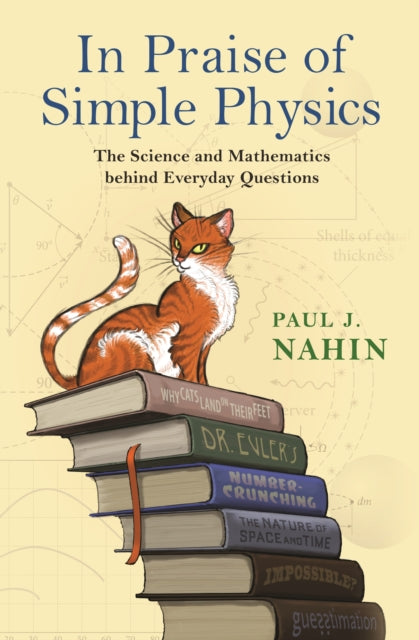
Princeton University Press In Praise of Simple Physics The Science and
Book SynopsisTrade Review"Nahin's writing style, as in previous books, is clear, conversational, humorous and chatty... [A]nd the discussions in the book are careful and appropriately rigorous."--MAA Reviews "Fun, accessible physics/math problems along with some humor."--Antonio Cangiano, Math-Blog "[Nahin] knows how to catch the attention of his reader. You will not regret buying any of his books, and I am sure after reading it, you will pick up this one to check again on one of his models and his solution methods."--European Mathematical Society "A superb book... [D]emonstrates clever ways to solve simply physics problems."--ChoiceTable of ContentsForeword by T. M. Helliwell ix Preface with Challenge Problems xi 1 How's Your Math? 1 2 The Traffic-Light Dilemma 20 3 Energy from Moving Air 25 4 Dragsters and Space Station Physics 32 5 Merry-Go-Round Physics and the Tides 42 6 Energy from Moving Water 51 7 Vectors and Bad Hair Days 63 8 An Illuminating Problem 67 9 How to Measure Depth with a Stopwatch 74 10 Doing the Preface Problems 79 11 The Physics of Stacking Books 92 12 Communication Satellite Physics 103 13 Walking a Ladder Upright 110 14 Why Is the Sky Dark at Night? 115 15 How Some Things Float (or Don't) 126 16 A Reciprocating Problem 141 17 How to Catch a Baseball (or Not) 146 18 Tossing Balls and Shooting Bullets Uphill 153 19 Rapid Travel in a Great Circle Transit Tube 163 20 Hurtling Your Body through Space 177 21 The Path of a Punt 194 22 Easy Ways to Measure Gravity in Your Garage 200 23 Epilogue Newton's Gravity Calculation Mistake 218 Postscript 227 Acknowledgments
£22.50

Princeton University Press Exoplanetary Atmospheres Theoretical Concepts
Book SynopsisTrade Review"Winner of the 2018 Chambliss Astronomical Writing Award, American Astronomical Society""An essential introduction to the theoretical foundations of this cutting-edge new science. . . . Authoritative and accessible. . . . Exoplanetary Atmospheres prepares Ph.D. students for research careers in the field and is ideal for self-study as well as for use in a course setting." * Lunar and Planetary Information Bulletin *Table of ContentsForeword by Sara Seager xi Preface xiii 1 Observations of Exoplanetary Atmospheres: A Theorist's Review of Techniques in Astronomy 1 1.1 The birth of exoplanetary science 1 1.2 Transits and occultations 2 1.3 Radial velocity measurements 8 1.4 Direct imaging 11 1.5 Gravitational microlensing 12 1.6 Future missions and telescopes 12 2 Introduction to Radiative Transfer 14 2.1 The optical depth: The most fundamental quantity in radiative transfer 14 2.2 Basic quantities in radiative transfer 16 2.3 The radiative transfer equation 20 2.4 Simple solutions of the radiative transfer equation 20 2.5 A practical checklist for radiative transfer calculations 23 2.6 Clouds 24 2.7 Atmospheric retrieval 27 2.8 Problem sets 31 3 The Two-Stream Approximation of Radiative Transfer 35 3.1 What is the two-stream approximation? 35 3.2 The radiative transfer equation and its moments 36 3.3 Two-stream solutions with isotropic scattering 39 3.4 The scattering phase function 45 3.5 Two-stream solutions with non-isotropic scattering 46 3.6 Different closures of the two-stream solutions 49 3.7 The diffusion approximation for radiative transfer 51 3.8 Problem sets 53 4 Temperature-Pressure Profiles 56 4.1 A myriad of atmospheric effects: Greenhouse warming and antigreenhouse cooling 56 4.2 The dual-band or double-gray approximation 57 4.3 The radiative transfer equation and the scattering parameter 58 4.4 Treatment of shortwave radiation 60 4.5 Treatment of longwave radiation 64 4.6 Assembling the pieces: Deriving the general solution 65 4.7 Exploration of different atmospheric effects 67 4.8 Milne's solution and the convective adiabat 71 4.9 Problem sets 72 5 Atmospheric Opacities: How to Use a Line List 74 5.1 From spectroscopic line lists to synthetic spectra 74 5.2 The Voigt profile 76 5.3 The quantum physics of spectral lines 78 5.4 The million- to billion-line radiative transfer challenge 81 5.5 Different types of mean opacities 88 5.6 Problem sets 89 6 Introduction to Atmospheric Chemistry 92 6.1 Why is atmospheric chemistry important? 92 6.2 Basic quantities: Gibbs free energy, equilibrium constant, rate coefficients 93 6.3 Chemical kinetics: Treating chemistry as a set of mass conservation equations 101 6.4 Self-consistent atmospheric chemistry, radiation and dynamics: A formidable computational challenge 106 6.5 Problem sets 107 7 A Hierarchy of Atmospheric Chemistries 110 7.1 A hierarchy of models for understanding atmospheric chemistry 110 7.2 Equilibrium chemistry with only hydrogen 110 7.3 Equilibrium C-H-O chemistry: Forming methane, water, carbon monoxide and acetylene 113 7.4 Equilibrium C-H-O chemistry: Adding carbon dioxide 115 7.5 Equilibrium C-H-O chemistry: Adding ethylene 121 7.6 Problem sets 122 8 Introduction to Fluid Dynamics 123 8.1 Why is the study of fluids relevant to exoplanetary atmospheres? 123 8.2 What exactly is a fluid? 124 8.3 The governing equations of fluid dynamics 124 8.4 Potential temperature and potential vorticity 128 8.5 Dimensionless fluid numbers 130 8.6 Problem sets 132 9 Deriving the Governing Equations of Fluid Dynamics 135 9.1 Preamble 135 9.2 The mass continuity equation (mass conservation) 135 9.3 The Navier-Stokes equation (momentum conservation) 136 9.4 The thermodynamic equation (energy conservation) 138 9.5 The conservation of potential vorticity 139 9.6 Various approximate forms of the governing equations of fluid dynamics 143 9.7 Magnetohydrodynamics 147 9.8 Problem sets 151 10 The Shallow Water System: A Fluid Dynamics Lab on Paper 155 10.1 A versatile fluid dynamics laboratory on paper 155 10.2 Deriving the shallow water equations 156 10.3 Gravity as the restoring force: The generation of gravity waves 158 10.4 Friction in an atmosphere: Molecular viscosity and Rayleigh drag 160 10.5 Forcing the atmosphere: Stellar irradiation 162 10.6 Like plucking a string: Alfv'en waves 163 10.7 Rotation: The generation of Poincar'e and Rossby waves 165 10.8 General coupling of physical effects 167 10.9 Shallow atmospheres as quantum harmonic oscillators 168 10.10 Shallow water systems and exoplanetary atmospheres 174 10.11 Problem sets 175 11 The de Laval Nozzle and Shocks 182 11.1 What is the de Laval nozzle? 182 11.2 What are shocks? 184 11.3 What does the de Laval nozzle teach us about shocks? 187 11.4 Applications to, and consequences for, exoplanetary atmospheres 191 11.5 Problem sets 192 12 Convection, Turbulence and Fluid Instabilities 196 12.1 Fluid motion induced by physically unstable configurations 196 12.2 Hot air rises and cold air sinks: Schwarzschild's criterion for convective stability 196 12.3 A simplified "theory" of convection: Mixing length theory 199 12.4 Implementing convection in numerical calculations: Convective adjustment schemes 200 12.5 A simple "theory" of turbulence: The scaling laws of Kolmogorov 202 12.6 Water over oil: The Rayleigh-Taylor instability 204 12.7 Shearing fluids: The Kelvin-Helmholtz instability 206 12.8 Weather at mid-latitudes: The baroclinic instability 207 12.9 Problem sets 209 13 Atmospheric Escape 211 13.1 The Knudsen number and Jeans parameter 211 13.2 Jeans escape 213 13.3 The classical Parker wind solution 213 13.4 Non-isothermal Parker winds: Using the nozzle solutions 216 13.5 Detailed processes: Photo-ionization, radiative cooling and nonthermal mechanisms 218 13.6 Problem sets 221 14 Outstanding Problems of Exoplanetary Atmospheres 223 Appendix A: Summary of Standard Notation 228 Appendix B: Essential Formulae of Vector Calculus 233 Appendix C: Essential Formulae of Thermodynamics 235 Appendix D: Gibbs Free Energies of Various Molecules and Reactions 237 Appendix E: Python Scripts for Generating Figures 240 Bibliography 250 Index 271
£78.20

Princeton University Press Exoplanetary Atmospheres
Book SynopsisThe study of exoplanetary atmospheres--that is, of planets orbiting stars beyond our solar system--may be our best hope for discovering life elsewhere in the universe. This dynamic, interdisciplinary field requires practitioners to apply knowledge from atmospheric and climate science, astronomy and astrophysics, chemistry, geology and geophysics, pTrade Review"Winner of the 2018 Chambliss Astronomical Writing Award, American Astronomical Society""An essential introduction to the theoretical foundations of this cutting-edge new science. . . . Authoritative and accessible. . . . Exoplanetary Atmospheres prepares Ph.D. students for research careers in the field and is ideal for self-study as well as for use in a course setting." * Lunar and Planetary Information Bulletin *Table of ContentsForeword by Sara Seager xi Preface xiii 1 Observations of Exoplanetary Atmospheres: A Theorist's Review of Techniques in Astronomy 1 1.1 The birth of exoplanetary science 1 1.2 Transits and occultations 2 1.3 Radial velocity measurements 8 1.4 Direct imaging 11 1.5 Gravitational microlensing 12 1.6 Future missions and telescopes 12 2 Introduction to Radiative Transfer 14 2.1 The optical depth: The most fundamental quantity in radiative transfer 14 2.2 Basic quantities in radiative transfer 16 2.3 The radiative transfer equation 20 2.4 Simple solutions of the radiative transfer equation 20 2.5 A practical checklist for radiative transfer calculations 23 2.6 Clouds 24 2.7 Atmospheric retrieval 27 2.8 Problem sets 31 3 The Two-Stream Approximation of Radiative Transfer 35 3.1 What is the two-stream approximation? 35 3.2 The radiative transfer equation and its moments 36 3.3 Two-stream solutions with isotropic scattering 39 3.4 The scattering phase function 45 3.5 Two-stream solutions with non-isotropic scattering 46 3.6 Different closures of the two-stream solutions 49 3.7 The diffusion approximation for radiative transfer 51 3.8 Problem sets 53 4 Temperature-Pressure Profiles 56 4.1 A myriad of atmospheric effects: Greenhouse warming and antigreenhouse cooling 56 4.2 The dual-band or double-gray approximation 57 4.3 The radiative transfer equation and the scattering parameter 58 4.4 Treatment of shortwave radiation 60 4.5 Treatment of longwave radiation 64 4.6 Assembling the pieces: Deriving the general solution 65 4.7 Exploration of different atmospheric effects 67 4.8 Milne's solution and the convective adiabat 71 4.9 Problem sets 72 5 Atmospheric Opacities: How to Use a Line List 74 5.1 From spectroscopic line lists to synthetic spectra 74 5.2 The Voigt profile 76 5.3 The quantum physics of spectral lines 78 5.4 The million- to billion-line radiative transfer challenge 81 5.5 Different types of mean opacities 88 5.6 Problem sets 89 6 Introduction to Atmospheric Chemistry 92 6.1 Why is atmospheric chemistry important? 92 6.2 Basic quantities: Gibbs free energy, equilibrium constant, rate coefficients 93 6.3 Chemical kinetics: Treating chemistry as a set of mass conservation equations 101 6.4 Self-consistent atmospheric chemistry, radiation and dynamics: A formidable computational challenge 106 6.5 Problem sets 107 7 A Hierarchy of Atmospheric Chemistries 110 7.1 A hierarchy of models for understanding atmospheric chemistry 110 7.2 Equilibrium chemistry with only hydrogen 110 7.3 Equilibrium C-H-O chemistry: Forming methane, water, carbon monoxide and acetylene 113 7.4 Equilibrium C-H-O chemistry: Adding carbon dioxide 115 7.5 Equilibrium C-H-O chemistry: Adding ethylene 121 7.6 Problem sets 122 8 Introduction to Fluid Dynamics 123 8.1 Why is the study of fluids relevant to exoplanetary atmospheres? 123 8.2 What exactly is a fluid? 124 8.3 The governing equations of fluid dynamics 124 8.4 Potential temperature and potential vorticity 128 8.5 Dimensionless fluid numbers 130 8.6 Problem sets 132 9 Deriving the Governing Equations of Fluid Dynamics 135 9.1 Preamble 135 9.2 The mass continuity equation (mass conservation) 135 9.3 The Navier-Stokes equation (momentum conservation) 136 9.4 The thermodynamic equation (energy conservation) 138 9.5 The conservation of potential vorticity 139 9.6 Various approximate forms of the governing equations of fluid dynamics 143 9.7 Magnetohydrodynamics 147 9.8 Problem sets 151 10 The Shallow Water System: A Fluid Dynamics Lab on Paper 155 10.1 A versatile fluid dynamics laboratory on paper 155 10.2 Deriving the shallow water equations 156 10.3 Gravity as the restoring force: The generation of gravity waves 158 10.4 Friction in an atmosphere: Molecular viscosity and Rayleigh drag 160 10.5 Forcing the atmosphere: Stellar irradiation 162 10.6 Like plucking a string: Alfv'en waves 163 10.7 Rotation: The generation of Poincar'e and Rossby waves 165 10.8 General coupling of physical effects 167 10.9 Shallow atmospheres as quantum harmonic oscillators 168 10.10 Shallow water systems and exoplanetary atmospheres 174 10.11 Problem sets 175 11 The de Laval Nozzle and Shocks 182 11.1 What is the de Laval nozzle? 182 11.2 What are shocks? 184 11.3 What does the de Laval nozzle teach us about shocks? 187 11.4 Applications to, and consequences for, exoplanetary atmospheres 191 11.5 Problem sets 192 12 Convection, Turbulence and Fluid Instabilities 196 12.1 Fluid motion induced by physically unstable configurations 196 12.2 Hot air rises and cold air sinks: Schwarzschild's criterion for convective stability 196 12.3 A simplified "theory" of convection: Mixing length theory 199 12.4 Implementing convection in numerical calculations: Convective adjustment schemes 200 12.5 A simple "theory" of turbulence: The scaling laws of Kolmogorov 202 12.6 Water over oil: The Rayleigh-Taylor instability 204 12.7 Shearing fluids: The Kelvin-Helmholtz instability 206 12.8 Weather at mid-latitudes: The baroclinic instability 207 12.9 Problem sets 209 13 Atmospheric Escape 211 13.1 The Knudsen number and Jeans parameter 211 13.2 Jeans escape 213 13.3 The classical Parker wind solution 213 13.4 Non-isothermal Parker winds: Using the nozzle solutions 216 13.5 Detailed processes: Photo-ionization, radiative cooling and nonthermal mechanisms 218 13.6 Problem sets 221 14 Outstanding Problems of Exoplanetary Atmospheres 223 Appendix A: Summary of Standard Notation 228 Appendix B: Essential Formulae of Vector Calculus 233 Appendix C: Essential Formulae of Thermodynamics 235 Appendix D: Gibbs Free Energies of Various Molecules and Reactions 237 Appendix E: Python Scripts for Generating Figures 240 Bibliography 250 Index 271
£55.80

Princeton University Press A Taste for the Beautiful
Book SynopsisFrom one of the world's leading authorities on animal behavior, the astonishing story of how the female brain drives the evolution of beauty in animals and humans Darwin developed the theory of sexual selection to explain why the animal world abounds in stunning beauty, from the brilliant colors of butterflies and fishes to the songs of birds andTrade Review"A delightful and enlightening review of current laboratory and field research into the aesthetic worlds of dozens of species. . . . If there’s a lesson to be learned from Ryan’s survey of sexual aesthetics, it’s that each species perceives the world through a uniquely tuned array of senses with a unique evolutionary history. Put succinctly, romance among the birds and the bees has one thing in common with romance between men and women . . . It’s complicated."---Laurence A. Marschall, Natural History"Ryan charms readers with his account of attraction in the animal kingdom, including humans. As he puts it, beauty is in the ‘brain of the beholder.’" * Scientific American *"The author's work with frogs launched a lifetime interest in discovering how beauty is found not just in animals' calls, but in the scents they give off and the colors they show. He argues that certain domains in the brain help determine what is perceived as beautiful. . . . Small, uncaptioned, black-and-white illustrations open each chapter, and what does come through clearly is the diversity of beauty--and the diversity of sexual behavior." * Kirkus Reviews *"Ryan works hard to write for general readers, and the narrative is replete with entertaining stories of the sexual marketplace that we and the rest of the animal world inhabit." * Kirkus Reviews *"In this appealing book, Ryan, professor of zoology at University of Texas, investigates the potential for a scientific understanding of what makes some biological traits sexually attractive. . . . Ryan leads a thoughtful and enlightening tour of brain function across an array of animals, focusing on three senses: sight, sound, and smell. In each case he presents current research, some of which is his own, detailing the nature of experimental design and the excitement of gaining new insights while discussing what remains unknown. . . . Ryan offers much to enjoy in his provocative book." * Publishers Weekly *"How Darwin would have loved a book such as this." * BBC Wildlife *"This is a hugely enjoyable book written with authority, easy charm and a great deal of wit. . . . This is science communication as it should be done: authoritative but never dull, engaging but never dumbed down. I’m in danger of straying into the territory of bad puns, but it really is a beautiful book."---Simon Underdown, Times Higher Education"Do read the book. You will see in nature a beauty you had previously failed to appreciate. You will evolve."---David Dobbs, Undark"This popular science book presents concepts and supporting research that will not come as any surprise to specialist evolutionary biologists, but it is recommended as an entertaining and very readable introduction to this field of study for the wider reader. And there are enough insect and related examples to keep the entomologist interested."---Andrew Wakeham-Dawson, Entomologist's Gazette"Ryan’s book is a balanced, clear, well-written study of factors affecting how sexual selection works."---Egbert Giles Leigh Jr., Evolution: Education and Outreach"It is a fascinating study, well written and full of interesting details."---Henrick Høgh-Olesen, Evolutionary Studies in Imaginative Culture"A Taste for the Beautiful is a much-welcomed addition to a public spotlight on sexual selection and mate choice. Ryan provides a fascinating take on how mate preferences arise, one that engages contemporary and historical research while simultaneously highlighting areas where further work is needed."---Stephen P. De Lisle, Trends in Ecology & Evolution
£19.80

Princeton University Press Can the Laws of Physics Be Unified
Book SynopsisTrade Review"This book is a very worthwhile, balanced, and useful summary of our current understanding of the fundamental laws of physics. Langacker covers a large amount of material in a very digestible way."—Savdeep Sethi, University of Chicago"Langacker is a renowned expert in particle physics who has made fundamental contributions to the field and lived through the golden era of the standard model. Not surprisingly, the scientific level of this informative book is impeccable."—Gian Francesco Giudice, author of A Zeptospace Odyssey: A Journey into the Physics of the LHC"Langacker has written a useful and informative book that brings the standard model to a broad audience of scientists and aspiring scientists who are interested in the current status of particle physics."—Tom Lubensky, University of PennsylvaniaTable of ContentsPreface vii 1. The Epic Quest 1 2 The Three Eras 7 2.1 The Ingredients 7 2.2 Prehistory 9 2.3 The Era of Exploration 12 2.4 The Standard Model Era 22 2.5 Beyond the Standard Model 26 3 Particles, Interactions, and Cosmology 29 3.1 The Fundamental Particles 29 3.2 The Interactions 35 3.3 Cosmology 41 4 The Standard Model 51 4.1 Gauge Invariance and QED 51 4.2 Internal Symmetries 65 4.3 Yang-Mills Theories 70 4.4 Quantum Chromodynamics 73 4.5 The SU(2) x U(1) Model 83 4.6 The Higgs Mechanism 86 4.7 The Electroweak Theory 91 5 What Don't We Know? 137 5.1 Arbitrariness and Tuning 138 5.2 Terra Incognita: Unanswered Questions 151 5.3 Are the Paradigms Correct? 163 6 How Will We Find Out? 175 6.1 The Ideas 175 6.2 The Tests 211 7. Epilogue: The Dream 223 Postscript: Run 2 226 Glossary 229 Bibliography 251 Index 259
£31.50

Princeton University Press Where the River Flows Scientific Reflections on
Book SynopsisTrade Review"[A] deft primer, brim with surprises when viewed through a physics lens."--Barbara Kiser, Nature "[Fleming] engenders a new appreciation for the waterways around us."--Library Journal "Fleming's decades of experience shine through in this book. Abstract physics concepts feel more relevant when applied to concrete phenomena that readers can visualize."--Laurel Hamers, Science NewsTable of ContentsAcknowledgments ix 1 Introduction 1 2 Why Rivers Are Where They Are 11 3 How Do Rivers Remember? 37 4 Clouds Talking to Fish: The Information Content of Rain 61 5 Searching for Buried Treasure 89 6 The Digital Rainbow 109 7 Landslides, Fractals, and Artificial Life 132 8 The Sky's Not the Limit 149 9 The Hydrologist's Final Exam: Watershed Modeling 168 10 Epilogue 183 Some References and Suggestions for Further Reading 189 Index 199
£31.50

Princeton University Press Dreams of Other Worlds The Amazing Story of
Book SynopsisTrade ReviewWinner of the 2013 Eugene E. Emme Award for Astronautical Literature, American Astronautical Society "Dreams of Other Worlds synthesizes that knowledge as it has been derived from unmanned spacecraft in the half-century since NASA was founded in 1958... One of the strengths of Dreams of Other Worlds is its discussion of how the data generated by any given mission continues to produce results long after the mission ends... An account of a magnificent panorama of knowledge."--Konstantin Kakaes, Wall Street Journal "Refreshing... [W]ell-analysed and presented in a scholarly yet engaging way... [F]rom the interior of the Sun to the outer reaches of our Solar System--Impey and Henry are able guides. They explain the scientific imperative of these missions in a way that is accessible and interesting to specialists and generalists."--John Zarnecki, Nature "Although less sexy than manned space travel, satellites, probes and landers have produced a scientific bonanza with more to come. Impey and Henry team up for an enthusiastic account of a dozen programs... The authors' largely uncritical, gee-whiz approach is entirely appropriate since these programs were not only technological marvels, but produced dazzling, quantum-leap discoveries."--Kirkus Reviews "[W]ell-balanced... This richly illustrated work of remarkable scholarship spans the depths of the solar system, the Milky Way, and beyond, revealing how the great leaps forward in astronomy have brought into focus a landscape few could have imagined. The authors present a combination of hard science and edifying narrative that is both informative and entertaining. Recommended for NASA 'nerds' and anyone with even a passing interest in astronomy."--Library Journal "Packed with absorbing insights and written in an accessible voice, this volume translates scientific discoveries into simple, visual terms... Diverse references--ranging from the caves at Lascaux and Pythagoras to Einstein, Carl Sagan, quantum mechanics, and, yes, even Virginia Woolf--enliven and enrich this engaging and beautifully crafted book."--Kristen Rabe, ForeWord Reviews "The book helps provide a bigger picture of the significance of studying the universe with these robotic explorers, be they spacecraft that remain in Earth orbit or, like Voyager 1, head out into the cosmos."--Jeff Foust, Space Review "[A] riveting read... The book is well told, and interweaves its story with wonderful little nuggets."--Katia Moskvitch, BBC Sky at Night "Dreams of Other Worlds is a substantial chronology of the exploration of the solar system objects that humans have wondered about ever since Galileo first pointed his telescope at Jupiter and peered through it. The undertaking spotlights all the struggles and setbacks that ultimately led to a complete mapping of the solar system."--D. Wayne Dworsky, San Francisco Book Review "Noted astronomer Impey has teamed up with English professor Henry to write an interesting book about NASA's unmanned space explorations... People with an interest in space exploration will want to read this fascinating work."--Choice "The achievement of this book is to present robotic spaceflight in intimate relation to the cultural world we all inhabit... Dreams of Other Worlds succeeds in connecting the cultural work of science to everyday dreams and stories."--De Witt Douglas Kilgore, Quest "A fantastic journey throughout the world of space exploration over the last 40 years. Even though at a first glance the well over 400 pages seem overwhelming, within just a few hours you will find yourself desperate for more... A smooth, skillfully written account of the beginning of the extraterrestrial history of humankind, a history that started just a few decades ago."--Read about ScienceTable of Contents1 Introduction 1 2 Viking: Discovering the Red Planet 13 3 MER: The Little Rovers That Could 40 4 Voyager: Grand Tour of the Solar System 74 5 Cassini: Bright Rings and Icy Worlds 111 6 Stardust: Catching a Comet by the Tail 137 7 SOHO: Living with a Restless Star 161 8 Hipparcos: Mapping the Milky Way 186 9 Spitzer: Unveiling the Cool Cosmos 211 10 Chandra: Exploring the Violent Cosmos 242 11 HST: The Universe in Sharp Focus 270 12 WMAP: Mapping the Infant Universe 302 13 Conclusion: New Horizons, New Worlds 327 Notes 343 Selected Bibliography 405 Index 417
£23.75
Princeton University Press Between Debt and the Devil Money Credit and
Book SynopsisAdair Turner became chairman of Britain's Financial Services Authority just as the global financial crisis struck in 2008, and he played a leading role in redesigning global financial regulation. In this eye-opening book, he sets the record straight about what really caused the crisis. It didn't happen because banks are too big to fail--our addictiTrade ReviewOne of Financial Times (FT.com) Best Economics Books of 2015, chosen by Martin Wolf One of the Strategy+Business Best Business Books 2016 in Economy One of The Independent's Best Economics Books 2015 One of Bloomberg Businessweek's Best Books of 2015, chosen by Vitor Constancio "Whether you agree with Turner's proposal or not, [Between Debt and the Devil] represents an important challenge to economic orthodoxy, which, as he rightly notes, has already failed us once."--John Cassidy, The New Yorker "Extensively researched and well-written."--Edward Chancellor, Wall Street Journal "[A] remarkable new book."--Will Hutton, Observer "Lucid and forcefully-argued."--Peter Thal Larsen, Reuters Breakingviews "Turner offers a convincing account of the debt-fuelled global economic cycle of the last 15 years or so. I found myself skimming over large sections and nodding in agreement."--Erik Britton, Management Today "An overdue challenge to a taboo against monetary finance held sacred for too long."--Giles Wilkes, Financial Times "Adair Turner, the former chairman of Britain's Financial Services Authority and described by The Economist as a man for all policy crises, upends financial orthodoxy in Between Debt and the Devil. He argues that nothing regulators have done thus far has addressed the fundamental underlying cause of financial instability... Turner's book is tightly argued and is packed with insights about the financial markets as well as the real economy."--Brenda Jubin, Investing.com "If developed economies fall back into recession, people may hear quite a bit more about Lord Turner's ideas."--The Economist "This is an important book because Turner thinks clearly where much analysis has been fuzzy ... [a] stimulating book."--Ben Chu, The Independent "Adair Turner's Between Debt and the Devil: Money, Credit and Fixing Global Finance--out this month--joins a select group of books that provide as clear an explanation of the financial crisis as one could hope for."--Diane Coyle, The Enlightened Economist "Some astonishingly original ideas."--Alex Brummer, Daily Mail "[A] brilliant new book... [The] prose crisply conveys analysis of real force."--Tom Clark, Guardian "[A] scintillating individual [contribution] to the debate not just on the future of finance but how we should run our economy."--Felix Martin, New Statesman "Adair Turner's new book Between Debt and the Devil is definitely worth your time."--Clive Crook, Bloomberg View "A challenging but relentlessly logical book about the flaws of the system that led us to the Great Recession: excess finance, excessive indebtedness. He adds to the literature that explains why more and more finance is not always good. The proposed cure requires going beyond the present financial regulatory reform. A bold and thought provoking book."--Vitor Constancio, Vice president, European Central Bank, one of Bloomberg's Best Books of 2015 "This book lays down a challenge which subsequent accounts of monetary policy will have to address."--David Willetts, Prospect "[An] excellent book."--Nick Butler, Financial Times "[H]is extensive work both at financial institutions and in academia, have given Turner an insider's view of the world of finance and economics. But his conclusions--that the banking system needs to be fundamentally restructured, and that periodically, instead of a government running up debt, the central bank should just print money for the government to spend--are far from conventional."--Matt Phillips, Quartz "This is a good book, well worth reading... It is well and clearly written and supported by good, non-technical analysis and empirical evidence."--Charles Goodhart, Financial World "These provocative and insightful arguments are particularly valuable at a time when austerity retains its intellectual luster despite its manifest failures."--Andrew Moravcsik, Foreign Affairs "Turner's book should make policymakers and commentators sit up and take notice."--TT Ram Mohan, Economic & Political Weekly "[An] excellent book."--Zagreb International Review of Econ & Business "A strong narrative and powerful argument for reform."--Sean O'Grady, The Independent "This seminal book details an important reality of today's economy: generating enough demand to absorb potential supply depends on explosive increases in indebtedness-private or public, or both."--Martin Wolf, Financial TimesTable of ContentsAcknowledgments ix Preface: The Crisis I Didn't See Coming xi Introduction: Too Important to Be Left to the Bankers 1 Part I Swollen Finance 17 1 The Utopia of Finance for All 19 2 Inefficient Financial Markets 34 Part II Dangerous Debt 49 3 Debt, Banks, and the Money They Create 51 4 Too Much of the Wrong Sort of Debt 61 5 Caught in the Debt Overhang Trap 74 6 Liberalization, Innovation, and the Credit Cycle on Steroids 88 7 Speculation, Inequality, and Unnecessary Credit 108 Part III Debt, Development, and Capital Flows 131 8 Debt and Development: The Merits and Dangers of Financial Repression 133 9 Too Much of the Wrong Sort of Capital Flow: Global and Eurozone Delusions 149 Part IV Fixing the System 161 10 Irrelevant Bankers in an Unstable System 163 11 Fixing Fundamentals 175 12 Abolishing Banks, Taxing Debt Pollution, and Encouraging Equity 186 13 Managing the Quantity and Mix of Debt 195 Part V Escaping the Debt Overhang 211 14 Monetary Finance-Breaking the Taboo 213 15 Between Debt and the Devil-A Choice of Dangers 231 Epilogue: The Queen's Question and the Fatal Conceit 241 Notes 253 Bibliography 277 Index 289
£999.99

Princeton University Press Odd Couples
Book SynopsisTrade ReviewOne of American Association for the Advancement of Science's Books for General Audiences and Young Adults 2014 "Balancing descriptive natural history with probing evolutionary biology, Fairbairn (Sex, Size & Gender Roles, coeditor), professor of biology at the University of California Riverside, examines eight striking cases of extreme size differences between males and females of the same species... The conclusion she draws from this amazing diversity is as profound as it is simple: 'there is no "normal" or "typical" pattern of sexual differentiation across the animal kingdom.' "--Publishers Weekly "I found reading the book like taking a holiday in a foreign land with an enthusiastic and expert guide. You will come back with good stories, and a new appreciation of the amazing diversity of life on Earth and the forces shaping it."--Suzanne Alonzo, Nature "I understand much more about these creatures now that I've read this lively new book... [L]ike all of the examples in this fine book, it's far from a traditional marriage."--Laurence A. Marschall, Natural History "Such insights into the lives of animals are what makes Odd Couples so enjoyable, and Fairbairn always takes an evolutionist-eye view to try to understand them."--Kate Douglas, New Scientist "When we discuss gender roles, we tend to think only of a narrow range of species conforming to our preconceptions about dominant men and domestic women. Fairbairn explodes these preconceptions... [F]ascinating reading."--Danielle Clode, Australian "The author has thought deeply about this topic and writes clearly about the many influences and consequences of sexual and natural selection and how they impinge upon reproductive fitness for different animal lineages. An utterly fascinating book that will change how you think about sexual differences."--GrrlScientist "Recommended."--Library Journal "[A]n amazing story... [A]n easy and enjoyable read... It is ambitious, it is an excellent natural history chronicle and it is a nice encyclopedia of sexual differences. Overall, a good one for the library."--D. J. Hosken, Current Biology "Looking at some of the most amazing creatures on the planet, Odd Couples sheds astonishing light on what it means to be male or female in the animal kingdom."--Northeastern and Southeastern Naturalist "[T]his accessible volume is well organized, and its impressive helpings of technical details never impede readability."--Adrian Barnett, BBC Wildlife Magazine "In observing the differences between genders, Darwin proposed both individual and natural selection. In this well-written, fascinating volume, Fairbairn explores how the two kinds of selection work to produce the 'odd couples' of the title... [Odd Couples] should appeal to lay and professional readers alike."--Choice "Odd Couples is a very informative and enjoyable book for anyone interested in animal life history... I can recommend it for any interested naturalist whether professional or nonprofessional."--Roger D. Applegate, Canadian Field Naturalist "Be prepared to be entertained and fascinated by this stimulating and provocative book. It is certain to spark your curiosity. Fairbairn lakes us on a romp through the animal kingdom... This book provides ample incentive for continued investigations."--Ann Hedrick, Ecology "Odd Couples present[s] a fun and enlightening plunge into the natural history of some very exceptional animals, along with an authoritative and accessible summary of current evolutionary theory on sex differences."--Robert Cox, Reports of the National Center for Science Education "Daphne Fairbairn has written an engaging and fascinating book... The well-written text flows nicely. Lay readers will enjoy natural history descriptions; discussions of fitness and Darwinian selection will ... appeal to professional biologists for whom this book is an excellent model of clear scientific writing."--AAASTable of ContentsChapter 1: Introduction 1 Chapter 2: The Roots of Sexual Differences: Why Male and Female Animals Differ 9 Chapter 3: Elephant Seals: Harems, Hierarchies, and Giant Males 23 Chapter 4: Great Bustards: Gorgeous Males and Choosy Females 46 Chapter 5: Shell-Carrying Cichlids: Protective Males and Furtive Females 64 Chapter 6: Yellow Garden Spiders: Sedentary Females and Roving Males 81 Chapter 7: Blanket Octopuses: Drifting Females and Dwarf Males 104 Chapter 8: Giant Seadevils: Fearsome Females and Parasitic Males 116 Chapter 9: Bone-Eating Worms: Female Tubeworms with Harems of Minuscule Males 133 Chapter 10: Shell-Burrowing Barnacles: Sac-Like Females with Harems of Phallic Males 147 Chapter 11: The Diversity of Sexual Differences: Differences between Males and Females across the Animal Kingdom 160 Chapter 12: Concluding Remarks 187 Acknowledgments 195 Appendix A: Scientific Names Corresponding to Common Names Used in the Text 197 Appendix B: Summary of Sexual Dimorphisms by Animal Phylum 203 Notes 207 Glossary of Technical Terms 239 Sources 247 Illustration Credits 287 Index 289
£19.00

Princeton University Press Natural Complexity
Book SynopsisTrade Review"This book is a clear introduction to experimentation with complex systems that will appeal to multiple audiences. . . . It will serve as an example of pedagogical clarity and skill for anyone responsible for teaching the physical sciences."---H. Van Dyke Parunak, Computing Reviews"There is a certain enthusiasm distilled by the author all through the book, transporting the reader on a journey of discovery of a chosen set of complex systems, from where diverse insights into complexity science can be grasped. . . . Natural Complexity constitutes an excellent introduction to some perspectives about complexity science that might be appealing to a broad range of readers."---Miguel A. F. Sanjuán, Contemporary PhysicsTable of ContentsPreface xiii 1. Introduction: What Is Complexity? 1 1.1 Complexity Is Not Simple 1 1.2 Randomness Is Not Complexity 4 1.3 Chaos Is Not Complexity 10 1.4 Open Dissipative Systems 13 1.5 Natural Complexity 16 1.6 About the Computer Programs Listed in This Book 18 1.7 Suggested Further Reading 20 2 Iterated Growth 23 2.1 Cellular Automata in One Spatial Dimension 23 2.2 Cellular Automata in Two Spatial Dimensions 31 2.3 A Zoo of 2-D Structures from Simple Rules 38 2.4 Agents, Ants, and Highways 41 2.5 Emergent Structures and Behaviors 46 2.6 Exercises and Further Computational Explorations 47 2.7 Further Reading 50 3 Aggregation 53 3.1 Diffusion-Limited Aggregation 53 3.2 Numerical Implementation 54 3.3 A Representative Simulation 58 3.4 A Zoo of Aggregates 60 3.5 Fractal Geometry 63 3.6 Self-Similarity and Scale Invariance 73 3.7 Exercises and Further Computational Explorations 76 3.8 Further Reading 78 4 Percolation 80 4.1 Percolation in One Dimension 80 4.2 Percolation in Two Dimensions 83 4.3 Cluster Sizes 85 4.4 Fractal Clusters 98 4.5 Is It Really a Power Law? 98 4.6 Criticality 100 4.7 Exercises and Further Computational Explorations 102 4.8 Further Reading 104 5 Sandpiles 106 5.1 Model Definition 106 5.2 Numerical Implementation 110 5.3 A Representative Simulation 112 5.4 Measuring Avalanches 119 5.5 Self-Organized Criticality 123 5.6 Exercises and Further Computational Explorations 127 5.7 Further Reading 129 6 Forest Fires 130 6.1 Model Definition 130 6.2 Numerical Implementation 131 6.3 A Representative Simulation 134 6.4 Model Behavior 137 6.5 Back to Criticality 147 6.6 The Pros and Cons of Wildfire Management 148 6.7 Exercises and Further Computational Explorations 149 6.8 Further Reading 152 7 Traffic Jams 154 7.1 Model Definition 154 7.2 Numerical Implementation 157 7.3 A Representative Simulation 157 7.4 Model Behavior 161 7.5 Traffic Jams as Avalanches 164 7.6 Car Traffic as a SOC System? 168 7.7 Exercises and Further Computational Explorations 170 7.8 Further Reading 172 8 Earthquakes 174 8.1 The Burridge-Knopoff Model 175 8.2 Numerical Implementation 182 8.3 A Representative Simulation 184 8.4 Model Behavior 189 8.5 Predicting Real Earthquakes 193 8.6 Exercises and Further Computational Explorations 194 8.7 Further Reading 196 9 Epidemics 198 9.1 Model Definition 198 9.2 Numerical Implementation 199 9.3 A Representative Simulation 202 9.4 Model Behavior 205 9.5 Epidemic Self-Organization 213 9.6 Small-World Networks 215 9.7 Exercises and Further Computational Explorations 220 9.8 Further Reading 222 10 Flocking 224 10.1 Model Definition 225 10.2 Numerical Implementation 228 10.3 A Behavioral Zoo 235 10.4 Segregation of Active and Passive Flockers 240 10.5 Why You Should Never Panic 242 10.6 Exercises and Further Computational Explorations 245 10.7 Further Reading 247 11 Pattern Formation 249 11.1 Excitable Systems 249 11.2 The Hodgepodge Machine 253 11.3 Numerical Implementation 260 11.4 Waves, Spirals, Spaghettis, and Cells 262 11.5 Spiraling Out 266 11.6 Spontaneous Pattern Formation 270 11.7 Exercises and Further Computational Explorations 272 11.8 Further Reading 273 12 Epilogue 275 12.1 A Hike on Slickrock 275 12.2 Johannes Kepler and the Unity of Nature 279 12.3 From Lichens to Solar Flares 285 12.4 Emergence and Natural Order 288 12.5 Into the Abyss: Your Turn 290 12.6 Further Reading 291 A. Basic Elements of the Python Programming Language 293 A.1 Code Structure 294 A.2 Variables and Arrays 297 A.3 Operators 299 A.4 Loop Constructs 300 A.5 Conditional Constructs 304 A.6 Input/Output and Graphics 305 A.7 Further Reading 306 B. Probability Density Functions 308 B.1 A Simple Example 308 B.2 Continuous PDFs 312 B.3 Some Mathematical Properties of Power-Law PDFs 313 B.4 Cumulative PDFs 314 B.5 PDFs with Logarithmic Bin Sizes 315 B.6 Better Fits to Power-Law PDFs 318 B.7 Further Reading 320 C Random Numbers and Walks 321 C.1 Random and Pseudo-Random Numbers 321 C.2 Uniform Random Deviates 323 C.3 Using Random Numbers for Probability Tests 324 C.4 Nonuniform Random Deviates 325 C.5 The Classical Random Walk 328 C.6 Random Walk and Diffusion 335 D Lattice Computation 338 D.1 Nearest-Neighbor Templates 339 D.2 Periodic Boundary Conditions 342 D.3 Random Walks on Lattices 345 Index 351
£43.20
Princeton University Press How Evolution Shapes Our Lives
Book SynopsisTrade Review"A compelling and important book about how evolution matters to humans today."--Biotechnology, Agronomy, Society, and EnvironmentTable of ContentsPreface vii Contributors ix Chapter 1 How Evolution Shapes Our Lives 1 Richard E. Lenski PART I BIOLOGICAL FOUNDATIONS Chapter 2 What Is Evolution? 15 Jonathan B. Losos Chapter 3 Human Evolution 31 John Hawks Chapter 4 Human Cooperation and Conflict 46 Joan E. Strassmann and David C. Queller Chapter 5 Human Behavioral Ecology 61 Virpi Lummaa Chapter 6 Evolutionary Psychology 77 Robert C. Richardson PART II EVOLUTION IN HEALTH AND DISEASE Chapter 7 Evolutionary Medicine 93 Paul E. Turner Chapter 8 Aging and Menopause 114 Jacob A. Moorad and Daniel E. L. Promislow Chapter 9 Evolution of Parasite Virulence 134 Dieter Ebert Chapter 10 Evolution of Antibiotic Resistance 147 Dan I. Andersson Chapter 11 Evolution and Microbial Forensics 163 Paul Keim and Talima Pearson PART III RESHAPING OUR WORLD Chapter 12 Domestication and the Evolution of Agriculture 179 Amy Cavanaugh and Cameron R. Currie Chapter 13 Directed Evolution 191 Erik M. Quandt and Andrew D. Ellington Chapter 14 Evolution and Computing 206 Robert T. Pennock Chapter 15 Evolution and Conservation 220 H. Bradley Shaffer Chapter 16 Adaptation to a Changing World: Evolutionary Resilience and Climate Change 238 Martha M. Munoz and Craig Moritz PART I V EVOLUTION IN THE PUBLIC SPHERE Chapter 17 Evolution and Religion: Conflict and Dialogue 255 Francisco J. Ayala Chapter 18 Creationism and Intelligent Design 284 Eugenie C. Scott Chapter 19 Evolution and the Media 300 Carl Zimmer PART V NATURE AND NURTURE Chapter 20 Linguistics and the Evolution of Human Language 313 Mark Pagel Chapter 21 Cultural Evolution 331 Elizabeth Hannon and Tim Lewens Chapter 22 Evolution and Notions of Human Race 346 Alan R. Templeton Chapter 23 The Future of Human Evolution 362 Alan R. Templeton Index 381
£999.99

Princeton University Press Doing Global Science A Guide to Responsible
Book SynopsisThis concise introductory guide explains the values that should inform the responsible conduct of scientific research in today's global setting. Featuring accessible discussions and ample real-world scenarios, Doing Global Science covers proper conduct, fraud and bias, the researcher's responsibilities to society, communication with the public, andTrade Review"The book highlights international efforts to set legal and ethical rules for the protection of human subjects... [W]ill help younger generations keep their enthusiasm and values intact as they progress in their careers."--Elisabeth Pain, Science "Clear, sober [and] well-referenced."--Karen Shook, Times Higher EducationTable of ContentsForeword vii Preface ix 1 Responsible Conduct of Research and the Global Context: An Overview 1 2 Planning and Preparing for Research 9 3 Preventing the Misuse of Research and Technology 21 4 Carrying Out Research 31 5 The Researcher's Responsibilities to Society 47 6 Preventing and Addressing Irresponsible Practices 59 7 Aligning Incentives with Responsible Research 73 8 Reporting Research Results 81 9 Benefits and Challenges of International Collaborations 93 10 Communicating with Policymakers and the Public 101 References 111 Committee on Research Integrity 139 Biographical Sketches of the Committee Members 141 Index 147
£16.14

Princeton University Press How Evolution Shapes Our Lives Essays on Biology
Book SynopsisTrade Review"A compelling and important book about how evolution matters to humans today."--Biotechnology, Agronomy, Society, and EnvironmentTable of ContentsPreface vii Contributors ix Chapter 1 How Evolution Shapes Our Lives 1 Richard E. Lenski PART I BIOLOGICAL FOUNDATIONS Chapter 2 What Is Evolution? 15 Jonathan B. Losos Chapter 3 Human Evolution 31 John Hawks Chapter 4 Human Cooperation and Conflict 46 Joan E. Strassmann and David C. Queller Chapter 5 Human Behavioral Ecology 61 Virpi Lummaa Chapter 6 Evolutionary Psychology 77 Robert C. Richardson PART II EVOLUTION IN HEALTH AND DISEASE Chapter 7 Evolutionary Medicine 93 Paul E. Turner Chapter 8 Aging and Menopause 114 Jacob A. Moorad and Daniel E. L. Promislow Chapter 9 Evolution of Parasite Virulence 134 Dieter Ebert Chapter 10 Evolution of Antibiotic Resistance 147 Dan I. Andersson Chapter 11 Evolution and Microbial Forensics 163 Paul Keim and Talima Pearson PART III RESHAPING OUR WORLD Chapter 12 Domestication and the Evolution of Agriculture 179 Amy Cavanaugh and Cameron R. Currie Chapter 13 Directed Evolution 191 Erik M. Quandt and Andrew D. Ellington Chapter 14 Evolution and Computing 206 Robert T. Pennock Chapter 15 Evolution and Conservation 220 H. Bradley Shaffer Chapter 16 Adaptation to a Changing World: Evolutionary Resilience and Climate Change 238 Martha M. Munoz and Craig Moritz PART I V EVOLUTION IN THE PUBLIC SPHERE Chapter 17 Evolution and Religion: Conflict and Dialogue 255 Francisco J. Ayala Chapter 18 Creationism and Intelligent Design 284 Eugenie C. Scott Chapter 19 Evolution and the Media 300 Carl Zimmer PART V NATURE AND NURTURE Chapter 20 Linguistics and the Evolution of Human Language 313 Mark Pagel Chapter 21 Cultural Evolution 331 Elizabeth Hannon and Tim Lewens Chapter 22 Evolution and Notions of Human Race 346 Alan R. Templeton Chapter 23 The Future of Human Evolution 362 Alan R. Templeton Index 381
£63.00

Princeton University Press The Edge of Objectivity
Book SynopsisTrade Review"Gillispie has written a bold, penetrating, and very personal book... Deft evocation of personality, bright flashes of biographical detail, and enough connected narrative to show the direction and complexity of scientific advance, are all subordinated to the task of examining the crucial attitudes and ideas, the signal commitments of thought, which have shaped modern science and troubled the mind of modern man... All told, this is an exciting book, based on wide and often deep scholarship, a pleasure to read and to meditate upon. It is sure to be widely read, often quoted, and interminably discussed."--Henry Guerlac, The New York Times "A provocative and readable interpretation of major advances in certain departments of scientific thought from Galileo to James Clerk Maxwell... [S]harp, enlightening and entertaining."--Scientific American "This is a wonderful book... Not attempting a survey, [Gillispie chooses] certain aspects to write about with originality and depth [and provides] a light of understanding which diffuses over a whole epoch... We have thus a set of panels starting with Galileo, Kepler, and seventeenth-century cosmology, the eighteenth-century Enlightenment culminating in Lavoisier, the life sciences leading up to Lamarck and Darwin, and nineteenth-century energetics and field physics."--Giorgio de Santillana, American Scientist "An excellent book, stimulating for someone just beginning to take an interest in the history of scientific thought, and sufficiently scholarly in its material and conclusions to be worth reading by the specialist, too."--R. Harr, Journal of the Royal Institute of Chemistry "A superbly interesting work, well written, informative and well produced."--Nation "By far the best account of the movement of scientific ideas in Galileo, Newton, Lavoisier, Darwin, Maxwell, Einstein and other scientists who have sharpened the cutting edge of scientific probing."--Journal of the History of Ideas "Admirably clear and elegant... [A]n excellent book."--Journal of the Royal Institute of ChemistryTable of ContentsPreface ix Foreword xxv Introduction to the New Paperback Edition I. Full Circle 3 II. Art, Life, and Experiment 54 III. The New Philosophy 83 IV. Newton with his Prism and Silent Face 117 V. Science and the Enlightenment 151 VI. The Rationalization of Matter 202 VII. The History of Nature 260 VIII. Biology Comes of Age 303 IX. Early Energetics 352 X. Field Physics 406 XI. Epilogue 493 Bibliographic Essay 521 Index 545
£28.80

Princeton University Press Scaling in Ecology with a Model System
Book Synopsis
£94.50

Princeton University Press Richters Scale Measure of an Earthquake Measure
Book SynopsisTrade Review"The true value of Richter's Scale resides in its unspoken commemoration of a nearly extinct mode of scientific endeavor."--Claudio Vita-Finzi, Times Literary Supplement "One thing this book, written by one professional scientist about another, communicates very clearly, is what it is actually like to be a scientist--a welcome contribution."--Roger M. W. Musson, Times Higher Education Supplement "[An] illuminating biography."--Emily Banham, Nature "[This book] reveals an unfamiliar side of the scientist famous for developing the first magnitude scale for earthquakes in 1935... Most of [Richter's] colleagues remained unaware of the scope of his thoughts and interests. Richter's Scale will change this. It reveals Richter to be an individual with more than his share of flaws, but also as an iconoclastic scientist worthy of his fame and of our admiration."--Gregory C. Beroza, Nature "Hough draws on a wealth of documents left behind by Richter ... to chronicle his rise to fame and explain his place in the history of seismology... The author describes Richter's tumultuous upbringing, his penchant for nudism, and his prolific writing of poems--many included in the book."--Science News "Written by a seismologist about the most famous seismologist, this biography of Charles Richter (1900-85) is the first researched from Richter's papers... Hough's inspections of Richter's psyche may expand her readership beyond that interested in earthquakes... Richter, however difficult to like in life--he had few friends, according to Hough--proves to have had the turbulent inner life and struggles with the external world of which compelling biographies are made."--Gilbert Taylor,Booklist "This is very much a behind-the-headlines portrait of the private man... The portrait that emerges is that of a scientist who was initially far more interested in astronomy and stargazing than seismology; who possessed powerful poetic longings, and, above all, abiding decency."--Steven Carroll, The Age "This thoughtful, well-researched book explores a central question: why Richter--an admittedly quirky, plainspoken scientist--became so much better known than some of his more accomplished colleagues... Richter's ability to communicate his findings with a general audience through the press, Hough demonstrates, gave him the kind of public profile that cemented his position in the popular lexicon."--Juliet Eilperin, Washington Post Book World "By developing the scale that bears his name, Charles Richter not only invented the concept of magnitude as a measure of earthquake size, he also turned his name into a household word. This behind-the-scenes look at Richter, the man, is an artful interweaving of the stories of Richter's life with the history of earthquakes exploration and seismology."--Natural Hazards Observer "Richter's Scale will last as long as this earth lasts and so will this story by Susan Hough Her exemplary work the like of which we do not see often, both in terms of content and humane and conscious approach, is of great importance to our present times. While it should have been written earlier, it could not have been written better. One almost falls in love with Susan Hough for this remarkably successful attempt to bring Richter back to life and make him stand before us. Many thanks, Susan Hough! We shall remember you for this wonderer gift to the scientific-minded and to most many others less so minded."--Current Engineering Practice "Susan Hough has done her job extraordinarily well, turning a tangled-up story of a man hardly understood by others into a very fascinating biography."--Pawel Wiejacz, Pure and Applied GeophysicsTable of ContentsPreface ix CHAPTER 1: The Magnitude of the Problem 1 CHAPTER 2: Formative Years 9 CHAPTER 3: Margaret Rose 25 CHAPTER 4: Harnessing the Horses 36 CHAPTER 5: Earthquake Exploration 51 CHAPTER 6: The Kresge Era 62 CHAPTER 7: Beno Gutenberg 82 CHAPTER 8: Earthquake! 102 CHAPTER 9: Richter Scale 112 CHAPTER 10: Charlie 132 CHAPTER 11: Lillian 153 CHAPTER 12: Richter's Women 181 CHAPTER 13: Autumn 192 CHAPTER 14: Asperger's Syndrome 212 CHAPTER 15: Here It Comes Again 241 CHAPTER 16: Predicting the Unpredictable 253 CHAPTER 17: Sizing Up Earthquake Hazard 269 CHAPTER 18: Hazard in a Nuclear Age 276 CHAPTER 19: Supernova 286 APPENDIX A Belated Farewell 309 Bibliography 313 Acknowledgments 325 Index 331 Earthquakes by Date 337
£19.00

Princeton University Press NearEarth Objects
Book SynopsisTrade ReviewDonald K. Yeomans, Winner of the 2013 Carl Sagan Medal, American Astronomical Society Donald K. Yeomans, One of Time Magazine's 100 most influential people 2013 "Balancing the wonders of astronomy with the looming potential for an epic, planet-wide disaster, Yeomans, a fellow and research scientist at NASA's Jet Propulsion Laboratory, explores the origins of near-Earth objects--asteroids, comets, meteors, and meteoroids--and the threat they can pose to our planet... Yeomans's book is an accessible and far-ranging primer on the science of near-Earth objects."--Publishers Weekly "As Earth creaks on its course around the Sun, it is exposed to a relentless barrage of asteroids and comets. Donald Yeomans, who manages NASA's Near-Earth Object Program Office, offers an introduction to the science of these lethal monsters, one of which may have seen off the dinosaurs 65 million years ago and created the Chicxulub crater. Yeomans shows how the threats are balanced by potential boons, such as the theoretical delivery of the building blocks of life on Earth. Can these reeling masses even become interplanetary pitstops on the road to Mars?"--Nature "[Near Earth Objects] gives readers an inside account of the latest efforts to find, track and study life-threatening asteroids and comets."--ScientificAmerican.com's Observations blog "Near-Earth Objects is a fascinating tour guide of the asteroids we should worry about."--Marcus Chown, New Scientist "Despite its title, Near-Earth Objects offers a concise and informative overview of the formation of the entire solar system: why the planets differ, the latest theories on how they lined up and the origin of such leftovers as comets and asteroids. Yeomans also makes a good case that a near-Earth asteroid is an accessible target for our next space adventure, readying us for Mars and preparing us for a time when we might depend on them as a source of rare minerals."--Marcia Bartusiak, Washington Post "[C]ompact and readable... [Near-Earth Objects's] main goal is to invite readers to share a topic that is fascinating beyond its practical importance."--Fred Bortz, Dallas Morning News "[Yeomans's] book offers an excellent introduction to the layperson on near-Earth asteroids (NEAs), those objects that can potentially pass within about 29 million miles of Earth as they orbit around the sun... I highly recommend the book. Since it covers so many aspects of these fascinating asteroids, I found it comprehensive and a great read. While Yeomans covers a topic that some of us worry about, he provides the facts needed to stay cool yet informed."--Astro Bob blog "Yeomans makes it seem like we're uncomfortably close to an asteroid-induced apocalypse. Luckily, he has a sense of humor about it, and he has some sensible scientific solutions."--Sarah Rothbard, Slate.com "This is a superb book that brings the reader up-to-speed on those menacing denizens of the deep--Near Earth Objects, or NEOs for short. Moreover, this book is good bedtime reading for those that stay awake at night awaiting celestial calamity."--Leonard David, Coalition for Space Exploration "The book has an impressive from-the-horse's-mouth authority, yet it also has a pleasing, storytelling style, wry humour and some fun facts."--Hazel Muir, BBC Sky at Night "Sixty-five million years ago, a 10-km-wide asteroid slammed into Earth, killing off the dinosaurs. While that's the best-known Earth-asteroid collision, the truth is, space debris rains down on us all the time, notes Yeomans, manager of NASA's Near-Earth Object Program Office. He and other scientists are on a mission to track the largest asteroids that swarm around our planet, and his book is a behind-the-scenes look at how they do it--hopefully finding them before they find us."--Maclean's Bookmarked blog "Unlike many books involving space exploration I didn't get the feeling of fantasy, wishful thinking or sabre rattling. Yeomans just gives us good, reasoned arguments, presented in the main in a likeable, friendly fashion... [I]f you are interested in astronomy, the solar system or the survival of the human race, this is a book that should spark your interest."--Brian Clegg, Popular Science "This authoritative book, written in a lucid style well suited to intelligent laypersons, addresses this subject... [E]xcellent."--Choice "Near-Earth Objects is an excellent, short, very detailed, complete reference on rocks flying through Earth-space... [T]his book is highly recommended. It is a wonderful resource, very well written and full of great footnotes."--Haym Benaroya, QuestTable of ContentsIllustrations vii Preface xi Acknowledgments xiii Chapter 1 Earth's Closest Neighbors 1 Chapter 2 The Solar System's Origin: The Classical View 15 Chapter 3 How and Where Do Near-Earth Objects Form? 29 Chapter 4 Near-Earth Objects as the Enablers and Destroyers of Life 47 Chapter 5 Discovering and Tracking Near-Earth Objects 57 Chapter 6 The Nature of Asteroids and Comets 79 Chapter 7 Nature's Natural Resources and the Human Exploration of Our Solar System 100 Chapter 8 Near-Earth Objects as Threats to Earth 109 Chapter 9 Predicting the Likelihood of an Earth Impact 125 Chapter 10 Deflecting an Earth-Threatening Near-Earth Object 140 References 155 Index of Asteroid and Cometary Objects 159 General Index 161
£17.09

Princeton University Press The White Planet The Evolution and Future of Our
Book Synopsis"First published in France under the title Planete blanche, les glaces, le climat et l'environnement, Odile Jacob, 2008."Trade ReviewJean Jouzel, one of the two winners of the Vetlesen Prize of the G. Unger Vetlesen Foundation for 2012 "[G]iven the public controversy over the nature and extent of climate change, [The White Planet] provides clear insights into the meticulous and exacting research that undergirds the scientific consensus. If you're feeling buffeted by the winds of uninformed opinion and misinformation that fill the media, then read The White Planet for a breath of fresh--if chilling--air."--Laurence A. Marschall, Natural History "Renowned French researchers Jean Jouzel, Claude Lorius, and Dominique Rayaud review the history of Earth's ice as well as the history of the study of that ice... Offering thorough evidence on a variety of concerns--including shrinking polar regions, the greenhouse effect, and changes in the ozone--the authors outline a clear path to preserve the viability of the cryosophere and our planet."--ForeWord "By analysing the climates of the past as captured in deep ice cores, ice sheets, and the atmospheric bubbles within them, the authors methodically address the many points of contention over the causes of warming and cooling. Their conclusion is unequivocal: climate change is one of the great challenges to civilisation."--Fiona Capp, Sydney Morning Herald "The authors relate their studies of the ice sheets and glaciers, and provide explanations of how the science works, discussing the climate history discovered in the ice, and the warming trends that have been observed therein... Highly recommended for all serious collections on glaciology and climate change and for anyone who wants to know more about the science of discovering ancient climates."--Library Journal (starred review) "This book is a factual, chronological narrative of Earth's cryosphere, covering the critical role that the ice-covered parts of our planet play in recording climate and how ice records reveal changes in Earth's climate over the last 800,000 years. French authors Jouzel, Lorius, and Raynaud are world leaders in ice-core climate research and have been instrumental in collecting and interpreting these important records."--Choice "[T]he book does provide a valuable look at the science, history ... and politics of ice-core drilling and glacial-archive analysis. It will be of immense interest to those already involved in cryospheric science even if it is less successful in its stated mission of bringing a message to the general public."--Liz Kalaugher, Physics World "Their collective work is a pleasure to read. Well organised, and written in a way that is both precise and personal, it captures clearly what we know about how all the ice on the planet contributes to the functioning of the global climate system, and demonstrates its evolution."--Valerie Masson-Delmotte, Antarctic Science "The strength of the book consists in enabling the reader to understand the stakes and implications of polar research without the need for scientific proficiency... The white planet makes a very convincing and solidly illustrated case of the crucial importance of polar research to enable our society to navigate through the anthropocene."--Sebastien Duyck, Polar RecordTable of ContentsPreface xi PART ONE THE WORLD OF ICE: PAST AND PRESENT 1 Chapter 1 The Ice on Our Planet 3* Snow and Ice: A Multifaceted World 3 * Mountain Glaciers and Ice Caps 5 * Polar Regions: The Omnipresence of the White Planet 7 * Greenland, Antarctica, and Ice Shelves 10 * Ice: An Agent and Indicator of Climate Change 14 * The White Planet and Sea Levels 16 Chapter 2 From Exploration to Scientific Observation 18 * The Flow of Mountain Glaciers 19 * Mass Balance: The Health of a Glacier 21 * The Arctic Ocean in the Time of the Explorers 23 * The Arctic Ocean: Vulnerable Ice 25 * Greenland: An Island Inhabited for Millennia 28 * Greenland: An Increasingly Negative Mass Balance 28 * Antarctica: A Much More Recent Exploration 31 * Antarctica: A Long Uncertain Mass Balance 34 Chapter 3 Ice through the Ages 37* The Time of the Pioneers 37 * Ice of Long Ago 40 * Glaciations of the Quaternary and Astronomic Theory 46 PART TWO POLAR ICE: AMAZING ARCHIVES 51 Chapter 4 Reconstructing the Climates of the Past 53 * The Round of Isotopes 54 * Going Back in Time 57 * The Recent Period 57 * The Distant Past 60 * Paleoceanography 61 * Continental Archives 62 * Dating Oceanic and Continental Archives 64 * A Cornucopia of Results 66 Chapter 5 Glacial Archives 68* The Long Story of a Snowflake 68 * The Ice and Its Isotopes: A Paleothermometer 70 * Impurities with Multiple Sources 71 * Air Bubbles in the Ice: A Very Beautiful Story 73 * The Headaches of Dating 77 Chapter 6 The Campaigns 82* Camps Century and Byrd: The First Deep Ice Core Drillings 82 * Fifty Years Ago: The French on the Polar Ice 86 * The First Drilling at Dome C: Success of the French Team 88 * Rapid Climate Variations: Initial Inklings 91 * Vostok: A Collaboration between French and Soviet Teams 92 * Europe and the United States: Two Drilling Operations in the Center of Greenland 96 * Europe Turns to Antarctica 98 * Vostok: More than 3,600 Meters of Ice 101 * Other Core Drilling in Antarctica 103 * The Glaciers of the Andes and the Himalaya 105 * A Return to Greenland 106 * The European EPICA Drilling: A Double Success beyond All Hopes 108 Chapter 7 Vostok: The Cornucopia 110* A Complete Glacial-Interglacial Cycle 112 * Climate and Greenhouse Effect Go Hand in Hand 113 * Much More Information 118 * A Huge Lake under the Ice 120 Chapter 8 Dome C: 800,000 Years and the Revolution of the Rhythm of Glaciations 122* Ice Older than That at Vostok 123 * Inversion of the Magnetic Field 126 Chapter 9 Rapid Climatic Variations 130* The First Indications 130 * Increasingly Clear Indications 132 * A Connection with Ocean Circulation? 133 * Confirmation 134 * Rapid Events during a Warm Period? 139 * Initially Underestimated Changes in Temperature 142 * The Connection with the Ocean Henceforth Demonstrated 143 * Consequences on a Planetary Scale 147 Chapter 10 The Last 10,000 Years: An Almost Stable Climate 149* Volcanism and Solar Activity: Natural Climatic Forcings 150 * How Long Has Human Activity Been Changing the Composition of the Atmosphere? 152 PART THREE THE WHITE PLANET TOMORROW157 Chapter 11 The Climate and Greenhouse Gases 159* The Greenhouse Effect: A Truly Beneficial Natural Phenomenon 159 * The Greenhouse Effect Due to Human Activity: A Slow Awareness 163 * How Did We Get to This Point? 168 Chapter 12 Have Humans Already Changed the Climate? 173* The Time of the Pioneers 173 * The Awareness 174 * The Establishment of the IPCC 177 * The Problem of Aerosols 180 * The Climate in the Last Millennium 183 * Warming Is a Certainty 185 * The Arguments of Skeptics 189 * The White Planet on the Front Lines of Global Warming 195 Chapter 13 What Will the Climate Be in the Future? 201* A True Upheaval if We Aren't Careful 202 * What Will Become of Our Glaciers? 206 * An Arctic Ocean without Ice? 209 * Surprises under the Frozen Ground 210 * A More Rapid and Higher Sea-Level Rise than Predicted 211 * The Halt of the Gulf Stream 214 Chapter 14 A Warming with Multiple Consequences 218* A True Upheaval on a Global Scale 218 * Mountain Regions 222 * Polar Regions: Multiple and Diverse Impacts 223 * The Political and Economic Stakes: Climate and Oil 225 Chapter 15 What We Must Do 227* Stabilizing the Greenhouse Effect: A True Challenge 228 * The Kyoto Protocol: A First Step 230 * The Bali Conference 234 * Can the Challenge Be Met? 236 * Copenhagen: Failure or Half-Success 238 * A Necessary Adaptation 241 * The "Grenelle de l'environnement" 242 PART FOUR THE POLES AND THE PLANET 245 Chapter 16 The Crucial Place of Research 247* A Short History of the Polar Years 249 * The International Polar Year 2007-2009 251 * Glacial Ice Coring: Ambitious Objectives 253 * The Microbiology of Ice and Subglacial Lakes: Life in an Extreme Environment 255 * Concordia: A Station Full of Promise 258 Chapter 17 Humans and the Rise of Pollution 261* The Story of Lead 262 * Other Heavy Metals, Including Copper 264 * Sulfates 266 * Radioactivity 268 * The Ozone Hole: An Emblematic Pollution 269 * The Anthropocene and Greenhouse Gases 271 Conclusion: The Anthropocene Era 272 Notes 277 Selected Bibliography 289 Index 291
£23.75

Princeton University Press The Strength in Numbers
Book SynopsisOnce upon a time, it was the lone scientist who achieved brilliant breakthroughs. No longer. Today, science is done in teams of as many as hundreds of researchers who may be scattered across continents and represent a range of hierarchies. These collaborations can be powerful, but they demand new ways of thinking about scientific research. When thrTrade Review"This book covers a fascinating piece of research and I truly believe that the ideas within it are ones which every researcher should be thinking about every time they embark on a new team effort."---Jonathan Shock, Mathemafrica"A helpful, well-structured reference point for university managers . . . reflecting on good practice in research collaboration. There is much sound advice, emerging from a synthesis of well-evidenced and diverse experience, that will provide an agenda for any research strategy committee."---Jonathan Adams, Research Fortnight
£28.80

Princeton University Press The Neuroscience of Emotion
Book SynopsisTrade Review"The sparsity of clear or robust answers spurred neuroscientists Ralph Adolphs and David Anderson to frame an integrated science of emotion. The result is scholarly, lucid and pertinent to both neurobiology and psychology."---Barb Kiser, Nature"There is a tight logic running throughout The Neuroscience of Emotion that integrates theories of emotions, recent studies, and commonsense analogies. . . . Adolphs and Anderson openly acknowledge that they do not provide a comprehensive theory of emotion. Indeed, despite the existence of substantial research on the subject, we are left with the impression that we actually know remarkably little about emotions at present. But their enthusiasm for the topic is genuine and makes The Neuroscience of Emotion compelling and engaging."---Elizabeth Bauer, Science"Their analysis is authoritative and unsurpassed in its intricate examination of the field. It is also fluent, but don’t expect a frolic: this is a commanding textbook for scientists and students."---Helen Thomson, New Scientist"This is an important, agenda-setting and clearly written book that should now be an essential starting point for the science of emotions."---Shane O'Mara, Times Higher Education
£40.50

Princeton University Press The Great Formal Machinery Works
Book SynopsisTrade Review"An important contribution to the study of the history of mathematics, and any student, educator, or practitioner of mathematics or computer science, would benefit from reading this work."---Mark Causapin, MAA Reviews"In reading von Plato’s book the attention of the scholarly reader will be always captured."---L. Bellotti, History and Philosophy of Logic"This book presents an informed and informative hisotry of a crucially important part of mathematics. . . . a valuable addition to our corporate understanding."---Rob Ashmore, Mathematics Today
£28.80


