
Philosophy of mathematics Books
Princeton University Press Reverse Mathematics
Book SynopsisTrade Review"The field has been due for a general treatment accessible to undergraduates and to mathematicians in other areas. . . . With Reverse Mathematics, John Stillwell provides exactly that kind of introduction."—Carl Mummert, Notices of the American Mathematical Society"Stillwell carefully situates the field in the broader context of the history of mathematics and its foundations, and does a fine job of making the whole endeavor accessible to a general mathematical audience."—Jeremy Avigad, Carnegie Mellon University"Filling an important niche, this book gives readers a good picture of the basics of reverse mathematics while suggesting several directions for further reading and study."—Denis Hirschfeldt, University of Chicago"Stillwell's book is self-contained and includes much background material in analysis, mathematical logic, combinatorics, and computability. I heartily commend this very readable and accessible book."—Stephen Simpson, Vanderbilt University
£17.09

Princeton University Press Sourcebook in the Mathematics of Ancient Greece
Book Synopsis
£84.00
Princeton University Press In Pursuit of Zeta3
Book SynopsisTrade Review"Nahin’s style is entertaining, directly addressing his readers. . . . Highly recommended."---Adhemar Bultheel, MAA Reviews"This book will be both enjoyable and a rich source of useful as well as intriguing information to a wide range of readers."---Michael Th. Rassias, zbMATH Open"I thoroughly enjoyed this book!"---Jonathan Shock, Mathemafrica.org"N/A"---Andrew Simoson, The Mathematical Intelligencer
£19.80

Princeton University Press The Irrationals
Book SynopsisTrade Review"The insides of this book are as clever and compelling as the subtitle on the cover. Havil, a retired former master at Winchester College in England, where he taught math for decades, takes readers on a history of irrational numbers--numbers, like v2 or p, whose decimal expansion 'is neither finite nor recurring.' We start in ancient Greece with Pythagoras, whose thinking most likely helped to set the path toward the discovery of irrational numbers, and continue to the present day, pausing to ponder such questions as, 'Is the decimal expansion of an irrational number random?'"---Anna Kuchment, Scientific American"The Irrationals is a true mathematician's and historian's delight."---Robert Schaefer, New York Journal of Books"From its lively introduction straight through to a rousing finish this is a book which can be browsed for its collection of interesting facts or studied carefully by anyone with an interest in numbers and their history. . . . This is a wonderful book which should appeal to a broad audience. Its level of difficulty ranges nicely from ideas accessible to high school students to some very deep mathematics. Highly recommended!"---Richard Wilders, MAA Reviews"It is a book that can be warmly recommended to any mathematician or any reader who is generally interested in mathematics. One should be prepared to read some of the proofs. Skipping all the proofs would do injustice to the concept, leaving just a skinny skeleton, but skipping some of the most advanced ones is acceptable. The style, the well documented historical context and quotations mixed with references to modern situations make it a wonderful read."---A. Bultheel, European Mathematical Society"To follow the mathematical sections of the book, the reader should have at least a second-year undergraduate mathematical background, as the author does not shrink from providing some detailed arguments. However, the presentation of historical material is given in modern mathematical form. Many readers will encounter unfamiliar and surprising material in this field in which much remains to be explored."---E. J. Barbeau, Mathematical Reviews Clippings"This is a well-written book to which senior high school students who do not intend to study mathematics at university should be exposed in their last two years at school. The ideas are challenging and provocative, with numerous clear diagrams. The topics are presented with numerous examples, and unobtrusive humour which renders the exposition even more palatable. The book would be an ideal source of ideas in a mathematics course within a liberal arts college because it links not only with the historical source of mathematics problems, but also with some of the great ideas of philosophy."---A. G. Shannon, Notes on Number Theory and Discrete Mathematics"Mathematicians and serious students of mathematics will find much to admire in this book. . . . Every mathematician and student of mathematics with appropriate background will find [it] to be a valuable resource."---Pamela Gorkin, Mathematical Intelligencer
£16.14
Princeton University Press An Imaginary Tale
Book SynopsisIn the title, "[the square root of minus one]" appears as a radical over "-1."Trade ReviewOne of Choice's Outstanding Academic Titles for 1999 Honorable Mention for the 1998 Award for Best Professional/Scholarly Book in Mathematics, Association of American Publishers "A book-length hymn of praise to the square root of minus one."--Brian Rotman, Times Literary Supplement "An Imaginary Tale is marvelous reading and hard to put down. Readers will find that Nahin has cleared up many of the mysteries surrounding the use of complex numbers."--Victor J. Katz, Science "[An Imaginary Tale] can be read for fun and profit by anyone who has taken courses in introductory calculus, plane geometry and trigonometry."--William Thompson, American Scientist "Someone has finally delivered a definitive history of this 'imaginary' number... A must read for anyone interested in mathematics and its history."--D. S. Larson, Choice "Attempting to explain imaginary numbers to a non-mathematician can be a frustrating experience... On such occasions, it would be most useful to have a copy of Paul Nahin's excellent book at hand."--A. Rice, Mathematical Gazette "Imaginary numbers! Threeve! Ninety-fifteen! No, not those kind of imaginary numbers. If you have any interest in where the concept of imaginary numbers comes from, you will be drawn into the wonderful stories of how i was discovered."--Rebecca Russ, Math Horizons "There will be something of reward in this book for everyone."--R.G. Keesing, Contemporary Physics "Nahin has given us a fine addition to the family of books about particular numbers. It is interesting to speculate what the next member of the family will be about. Zero? The Euler constant? The square root of two? While we are waiting, we can enjoy An Imaginary Tale."--Ed Sandifer, MAA Online "Paul Nahin's book is a delightful romp through the development of imaginary numbers."--Robin J. Wilson, London Mathematical Society Newsletter "You will definitely enjoy it. In fact it clearly reflects the the joy and delight that the author experienced when he was confronted with complex analysis during his engineering studies."--Adhemar Bultheel, European Mathematical SocietyTable of Contents*FrontMatter, pg. i*A Note to the Reader, pg. vii*Contents, pg. ix*Illustrations, pg. xi*Preface to the Paperback Edition, pg. xiii*Preface, pg. xxi*Introduction, pg. 1*CHAPTER ONE The Puzzles of Imaginary Numbers, pg. 8*CHAPTER TWO. A First Try at Understanding the Geometry of -1, pg. 31*CHAPTER THREE. The Puzzles Start to Clear, pg. 48*CHAPTER FOUR. Using Complex Numbers, pg. 84*CHAPTER FIVE. More Uses of Complex Numbers, pg. 105*CHAPTER SIX. Wizard Mathematics, pg. 142*CHAPTER SEVEN. The Nineteenth Century, Cauchy, and the Beginning of Complex Function Theory, pg. 187*APPENDIX A. The Fundamental Theorem of Algebra, pg. 227*APPENDIX B. The Complex Roots of a Transcendental Equation, pg. 230*APPENDIX C. ( -1)( -1) to 135 Decimal Places, and How It Was Computed, pg. 235*APPENDIX D. Solving Clausen's Puzzle, pg. 238*APPENDIX E. Deriving the Differential Equation for the Phase-Shift Oscillator, pg. 240*APPENDIX F. The Value of the Gamma Function on the Critical Line, pg. 244*Notes, pg. 247*Name Index, pg. 261*Subject Index, pg. 265*Acknowledgments, pg. 269
£13.29
Princeton University Press Elements of Mathematics
Book SynopsisTrade Review"[Stillwell] writes clearly and engagingly... [Elements of Mathematics] can appeal to various constituencies at different levels of mathematical sophistication."--Mark Hunacek, MAA Reviews "A great exploration of elementary mathematics, its limitations, how infinity complicates things, and how various branches of mathematics fit together."--Antonio Cangiano, Math-Blog "Stillwell is ... One of the better current mathematical authors: he writes clearly and engagingly, and makes more of an effort than most to provide historical detail and a sense of how various mathematical ideas tie in with one another... The features we have learned to expect from Stillwell (including, but not limited to, excellent writing) are present in [Elements of Mathematics] as well."--MAA Reviews "An accessible read... Stillwell breaks down the basics, providing both historical and practical perspectives from arithmetic to infinity."--Gemma Tarlach, Discover "[A] sophisticated treatment of topics usually described as elementary."--John Allen Paulos "[Elements of Mathematics] is quite a tour de force, organized by areas of mathematics--arithmetic, computation, algebra, geometry, calculus, and so on--and in each area Stillwell manages to distill down the big ideas and the connections with other areas. He is a master expositor, and the text manages to be engaging and accessible without watering down the mathematics. I definitely learned new things from the book!"--Brent Yorgey, Math Less Traveled blog "From a lifetime of teaching, Stillwell has distilled some nice examples from the entire gamut of elementary mathematics."--Mathematical Reviews Clippings "[A] wonderful book... I think that [Elements of Mathematics] will itself become a modern classic and a reference work for anyone trying to learn basic topics in any of the major fields of mathematics."--Victor Katz, Bulletin of the American Mathematical Society "Elements of Mathematicsis a fine ... overview of the field of mathematics... The writing is clear, succinct, organized, and the diagrams [and] illustrations excellent... While some of the discussion is introductory or elementary, it always leads to deeper, more challenging ideas... [T]his will make a fine basic addition to most mathematicians' bookshelves."--Math Tango "Stillwell uses his broad and impressive command of mathematics to transport a reader through each topic and to a higher level of understanding and questioning."--Convergence "[A] wonderful book ... I think that [Elements of Mathematics] will itself become a modern classic and a reference work for anyone trying to learn basic topics in any of the major fields of mathematics."--Victor Katz, Bulletin of the American Mathematical Society "[Elements of Mathematics] is a book that everybody should read. You will be the better for it."--Reuben Hersh, American Mathematical MonthlyTable of Contents*Frontmatter, pg. i*Contents, pg. vii*Preface, pg. xi*1. Elementary Topics, pg. 1*2. Arithmetic, pg. 35*3. Computation, pg. 73*4. Algebra, pg. 106*5. Geometry, pg. 148*6. Calculus, pg. 193*7. Combinatorics, pg. 243*8. Probability, pg. 279*9. Logic, pg. 298*10. Some Advanced Mathematics, pg. 336*Bibliography, pg. 395*Index, pg. 405
£18.00

Princeton University Press Eulers Gem
Book SynopsisTrade Review"Everything in the book is very well illustrated with insightful graphics that, together with the text, make results almost like being obvious."---Adhemar Bultheel, European Mathematical Society
£16.19

Oxford University Press Gödels Theorem A Very Short Introduction Very
Book SynopsisWhen Kurt Gödel published his celebrated theorem, showing that no axiomatization can determine the whole truth and nothing but the truth concerning arithmetic, it had a profound impact on mathematical ideas and philosophical thought. Adrian Moore places the theorem in its intellectual and historical context, explaining the key concepts and misunderstandings.
£999.99

Oxford University Press Mathematicians and Their Gods
Book SynopsisTo open a newspaper or turn on the television it would appear that science and religion are polar opposites - mutually exclusive bedfellows competing for hearts and minds. There is little indication of the rich interaction between religion and science throughout history, much of which continues today. From ancient to modern times, mathematicians have played a key role in this interaction. This is a book on the relationship between mathematics and religious beliefs. It aims to show that, throughout scientific history, mathematics has been used to make sense of the ''big'' questions of life, and that religious beliefs sometimes drove mathematicians to mathematics to help them make sense of the world. Containing contributions from a wide array of scholars in the fields of philosophy, history of science and history of mathematics, this book shows that the intersection between mathematics and theism is rich in both culture and character. Chapters cover a fascinating range of topics including the Sect of the Pythagoreans, Newton''s views on the apocalypse, Charles Dodgson''s Anglican faith and Gödel''s proof of the existence of God.Trade ReviewPerhaps this is the most valuable contribution of Mathematicians and their Gods as a whole: it discusses ideas which must often appear strange to modern readers, and in explaining their context and influence helps us to understand how they captured the imaginations of our mathematical predecessors. This book will appeal to all those with an interest in mathematical history, regardless of their own religious views. * Paul Taylor, Mathematics Today *Lawrence and McCartney's volume captures the various ways in which mathematics and religion have represented commensurable, even interconnected, systems of knowledge and belief. ... The collection will serve these readers well and could also benefit historians of science or theology unfamiliar with the ground covered in these essays. * Laura Kotevska, British Journal for the History of Science *Lawrence and McCartney have done an admirable job in assembling a book of remarkable scholarship on a topic which challenges readers working in science or technology. * Giovanni Pistone, ESSSAT News & Reviews *fascinating from cover to cover * Michael N. Fried, Mathematical Thinking and Learning *Table of Contents1. Introduction ; 2. The Pythagoreans: Number and Numerology ; 3. Divine light ; 4. Kepler and his Trinitarian Cosmology ; 5. The Lull before the storm: combinatorics in the Renaissance ; 6. Mystical Arithmetic in the Renaissance: From Biblical Hermeneutics to a Philosophical Tool ; 7. Newton, God, and the mathematics of the Two Books ; 8. Maria Gaetana Agnesi, mathematician of God ; 9. Capital G for Geometry: Masonic lore and the history of geometry ; 10. Charles Dodgeson's Work for God ; 11. P. G. Tait, Balfour Stewart and The Unseen Universe ; 12. Faith and Flatland ; 13. Godel's "proof" for the existence of God
£999.99

Oxford University Press Syllogistic Logic and Mathematical Proof
Book SynopsisDoes syllogistic logic have the resources to capture mathematical proof? This volume provides the first unified account of the history of attempts to answer this question, the reasoning behind the different positions taken, and their far-reaching implications. Aristotle had claimed that scientific knowledge, which includes mathematics, is provided by syllogisms of a special sort: ''scientific'' (''demonstrative'') syllogisms. In ancient Greece and in the Middle Ages, the claim that Euclid''s theorems could be recast syllogistically was accepted without further scrutiny. Nevertheless, as early as Galen, the importance of relational reasoning for mathematics had already been recognized. Further critical voices emerged in the Renaissance and the question of whether mathematical proofs could be recast syllogistically attracted more sustained attention over the following three centuries. Supported by more detailed analyses of Euclidean theorems, this led to attempts to extend logical theory to include relational reasoning, and to arguments purporting to reduce relational reasoning to a syllogistic form. Philosophical proposals to the effect that mathematical reasoning is heterogenous with respect to logical proofs were famously defended by Kant, and the implications of the debate about the adequacy of syllogistic logic for mathematics are at the very core of Kant''s account of synthetic a priori judgments. While it is now widely accepted that syllogistic logic is not sufficient to account for the logic of mathematical proof, the history and the analysis of this debate, running from Aristotle to de Morgan and beyond, is a fascinating and crucial insight into the relationship between philosophy and mathematics.Table of ContentsIntroduction 1: Aristotelian Syllogism and Mathematics in Antiquity and the Medieval Period 2: Extensions of the Syllogism in Medieval Logic 3: Syllogistic and Mathematics: The Case of Piccolomini 4: Obliquities and Mathematics in the 17th and 18th Centuries: From Jungius to Wolff 5: The Extent of Syllogistic Reasoning: From Rüdiger to Wolff 6: Lambert and Kant 7: Bernard Bolzano on Non-Syllogistic Reasoning 8: Thomas Reid, William Hamilton and Augustus De Morgan Conclusion
£999.99

The University of Chicago Press Reactionary Mathematics
Book SynopsisTrade Review“The complex relationship between tradition and modernization is the pulsing heart of this engaging book. Beside a valuable historical analysis, Reactionary Mathematics offers an interesting and useful synthesis vision to help us understand, in these times of rapid and convulsive transformation, the mathematics of the present and, most importantly, the reasons for the mathematics that will come.” * Nature *“Reactionary Mathematics is an ambitious book that is more than just a history of mathematics but an episode in the history of reason, furnished with a delightful display of different kinds of evidence, from archival documents to political satires to theological treatises to paintings to mathematics textbooks. . . . [It] is a deftly written and timely book brimming with empirical, conceptual and historiographical insights.” * British Journal for the History of Science *"For anyone interested in the "politics of mathematical modernity," this book shows how allegiances to particular types or styles of mathematics may indeed be related to Neapolitan academicians' personal responses to the urgent political pressures of their day." * Choice *“One notable strength of Mazzotti’s book is its ability to transition seamlessly between different levels of analysis. It connects an in-depth historical exploration of a specific local context, such as Naples, with the social and political constraints unique to that site. Simultaneously, it addresses major upheavals and broad conceptual changes such as the evolution of purity, rigor, and abstraction and the very definition of 'modernity' in mathematics. In doing so, the book tackles a critical methodological challenge in the social history of mathematics, bridging the gap between the claim of universality associated with mathematical knowledge and the intricate study of the local contexts and social practices that underpin the production of such knowledge. Mazzotti’s thought-provoking narrative not only demonstrates . . . that mathematics is intimately connected to its cultural, social and political context, but it also prompts readers to consider new avenues of research.” * Historia Mathematica *“Mazzotti offers us a superbly crafted historical study of the interweaving of mathematics, politics, religion, social order, and even olive oil presses in the Kingdom of Naples around 1800. This gives him a distinctive, striking platform from which to address big questions: the relationship between science and politics, the connections between mathematics and modernity, and how we should understand mathematics’ past.” -- Donald MacKenzie, University of Edinburgh“Mazzotti has written a fascinating case study of ‘mathematical resistance’ in late eighteenth- and nineteenth-century Naples. On the most fundamental level, the book’s exploration of ‘mathematics as politics’ observes the reciprocal interactions between the mathematical imagination of historical actors and their sociopolitical circumstances. Mazzotti’s keen attention to the political actors themselves tells a very human story of mathematics, and of the events and changes that led to the development of this seemingly quixotic Neapolitan resistance to mathematical modernity.” -- Sean Cocco, Trinity College“A landmark account of Neapolitan reactionary mathematics in context that contributes insightfully to the histories of Naples, reaction, and mathematics in their separate and interacting respects.” -- Michael Barany, University of EdinburghTable of ContentsIntroduction: Mathematics as Social Order 1 Adventures of the Analytic Reason 2 Mathematics at the Barricades 3 Empire of Analysis 4 The Shape of the Kingdom Intermezzo: Algorithm or Intuition? 5 The Geometry of Reaction 6 A Scientific Counterrevolution 7 A Reactionary Reason 8 Mathematical Purity as Return to Order Notes Bibliography Index
£90.00

The University of Chicago Press Reactionary Mathematics A Genealogy of Purity
Book SynopsisTrade Review“The complex relationship between tradition and modernization is the pulsing heart of this engaging book. Beside a valuable historical analysis, Reactionary Mathematics offers an interesting and useful synthesis vision to help us understand, in these times of rapid and convulsive transformation, the mathematics of the present and, most importantly, the reasons for the mathematics that will come.” * Nature *“Reactionary Mathematics is an ambitious book that is more than just a history of mathematics but an episode in the history of reason, furnished with a delightful display of different kinds of evidence, from archival documents to political satires to theological treatises to paintings to mathematics textbooks. . . . [It] is a deftly written and timely book brimming with empirical, conceptual and historiographical insights.” * British Journal for the History of Science *"For anyone interested in the "politics of mathematical modernity," this book shows how allegiances to particular types or styles of mathematics may indeed be related to Neapolitan academicians' personal responses to the urgent political pressures of their day." * Choice *“One notable strength of Mazzotti’s book is its ability to transition seamlessly between different levels of analysis. It connects an in-depth historical exploration of a specific local context, such as Naples, with the social and political constraints unique to that site. Simultaneously, it addresses major upheavals and broad conceptual changes such as the evolution of purity, rigor, and abstraction and the very definition of 'modernity' in mathematics. In doing so, the book tackles a critical methodological challenge in the social history of mathematics, bridging the gap between the claim of universality associated with mathematical knowledge and the intricate study of the local contexts and social practices that underpin the production of such knowledge. Mazzotti’s thought-provoking narrative not only demonstrates . . . that mathematics is intimately connected to its cultural, social and political context, but it also prompts readers to consider new avenues of research.” * Historia Mathematica *“Mazzotti offers us a superbly crafted historical study of the interweaving of mathematics, politics, religion, social order, and even olive oil presses in the Kingdom of Naples around 1800. This gives him a distinctive, striking platform from which to address big questions: the relationship between science and politics, the connections between mathematics and modernity, and how we should understand mathematics’ past.” -- Donald MacKenzie, University of Edinburgh“Mazzotti has written a fascinating case study of ‘mathematical resistance’ in late eighteenth- and nineteenth-century Naples. On the most fundamental level, the book’s exploration of ‘mathematics as politics’ observes the reciprocal interactions between the mathematical imagination of historical actors and their sociopolitical circumstances. Mazzotti’s keen attention to the political actors themselves tells a very human story of mathematics, and of the events and changes that led to the development of this seemingly quixotic Neapolitan resistance to mathematical modernity.” -- Sean Cocco, Trinity College“A landmark account of Neapolitan reactionary mathematics in context that contributes insightfully to the histories of Naples, reaction, and mathematics in their separate and interacting respects.” -- Michael Barany, University of EdinburghTable of ContentsIntroduction: Mathematics as Social Order 1 Adventures of the Analytic Reason 2 Mathematics at the Barricades 3 Empire of Analysis 4 The Shape of the Kingdom Intermezzo: Algorithm or Intuition? 5 The Geometry of Reaction 6 A Scientific Counterrevolution 7 A Reactionary Reason 8 Mathematical Purity as Return to Order Notes Bibliography Index
£36.19

The University of Chicago Press Science and an African Logic
Book SynopsisDoes two and two equal four? Ask someone and they should answer yes. An equation such as this seems the very definition of certainty, but is it? Helen Verran describes how she went from the conclusion that logic and maths are culturally relative, to a new understanding of all generalizing logic.
£26.60

Taylor & Francis Ltd Math and Art
Book SynopsisMath and Art: An Introduction to Visual Mathematics explores the potential of mathematics to generate visually appealing objects and reveals some of the beauty of mathematics. It includes numerous illustrations, computer-generated graphics, photographs, and art reproductions to demonstrate how mathematics can inspire or generate art.Focusing on accessible, visually interesting, and mathematically relevant topics, the text unifies mathematics subjects through their visual and conceptual beauty. Sequentially organized according to mathematical maturity level, each chapter covers a cross section of mathematics, from fundamental Euclidean geometry, tilings, and fractals to hyperbolic geometry, platonic solids, and topology. For art students, the book stresses an understanding of the mathematical background of relatively complicated yet intriguing visual objects. For science students, it presents various elegant mathematical theories and notions.Features Provides an accessible introduction to mathematics in art Supports the narrative with a self-contained mathematical theory, with complete proofs of the main results (including the classification theorem for similarities) Presents hundreds of figures, illustrations, computer-generated graphics, designs, photographs, and art reproductions, mainly presented in full color Includes 21 projects and approximately 280 exercises, about half of which are fully solved Covers Euclidean geometry, golden section, Fibonacci numbers, symmetries, tilings, similarities, fractals, cellular automata, inversion, hyperbolic geometry, perspective drawing, Platonic and Archimedean solids, and topology New to the Second Edition New exercises, projects and artworks Revised, reorganized and expanded chapters More use of color throughout Trade Review"A beautiful book that brings out a wide range of mathematics, ancient to modern, with rich and often unexpected connections to the visual arts."– Catherine A. Gorini, Maharishi International University"Kalajdzievski takes us on a fascinating journey through the most visual subjects in mathematics. This book has the rare quality of not only organizing topics in a sequence that reveals how geometric concepts build upon one another, but also presenting each topic in a compact and self-contained manner for readers who prefer to browse for different entry points into the text. Although verbal explanations and mathematical formulae abound here, it is the colorful diagrams and photographs that capture the attention and enchant the eye. "– James Mai, Professor of Art, Illinois State University"The book presents mathematical and geometrical topics which can be expressed as the artistic pieces and serve to inspiring the artists to explore visual beauty and power of mathematics. In comparison with the first edition (of 2008), this book is noticeably extended to 280 exercises (from 190 originally) with solutions given to a half of them, 740 figures and artworks (from 556 previously), and 21 projects suggested for students.[. . . ] The book contains various illustrations and computer-generated graphics, photographs and art reproductions almost in each page, revealing an astonishing interaction of mathematics and artistic findings in human civilization and culture. [. . . ] The book can be useful to instructors and students, and interesting to any readers wishing to extend their knowledge and understanding of the esthetics and science of the visual math and mathematical art."– Technometrics"There are many books about mathematics and art; this one distinguishes itself as an “unorthodox geometry textbook,” with exercises and fun art projects. The book is based on 20 years of offering a course to more than 10,000 students. It stops short of covering some of the mathematics (groups are mentioned but not defined), though one theorem (classification of similarities) is proved in an appendix. Topics are Euclidean geometry, transformations of the plane, similarities and fractals, hyperbolic geometry, perspective, three-dimensional objects, and topology. The book averages two figures per page, with many utterly beautiful in color. You might be surprised at the sophisticated mathematical content of some crop circles (no doubt made by aliens!), and amazed by some of the illustrations of artworks."– Mathematics Magazine, MAAPraise for the First Edition"This delightful book grew out of set of teaching notes for an interdisciplinary course called Math in Art that was co-taught by a mathematician and an artist or architect. … The mathematical ideas are presented visually in a way that seems quite natural, and it engages the reader through explorations with lots of hands-on exercises. The mathematical presentation is solid, and the choice of topics puts the focus on the visual presentation of mathematical concepts. The illustrations are beautiful! … This text is very readable. The mathematics is accessible to those with little mathematical background, and yet the presentation is still engaging for those with more background."—MAA Reviews, March 2009"All in all, this work offers an excellent account of art inspired by mathematics and art generated by mathematics, and it should interest readers in both fields. Summing Up: Highly Recommended."– R.M. Davis, emeritus, Albion College, in Choice: Current Review for Academic Libraries, February 2009, Vol. 46, No. 6Table of ContentsChapter 1. Euclidean Geometry. 1.0. Introduction. 1.1. The Five Axioms of Euclidean Geometry. 1.2. Ruler and Compass Constructions. 1.3. The Golden Ratio. 1.4. Fibonacci Numbers. Chapter 2. Plane Transformations. 2.1. Plane Symmetries. 2.2.* Plane Symmetries, Vectors, and Matrices (Optional). 2.3. Groups of Symmetries Of Planar Objects. 2.4. Frieze Patterns. 2.5. Wallpaper Designs and Tilings of the Plane. 2.6. Tilings and Art. Chapter 3. Similarities, Fractals, and Cellular Automata. 3.1. Similarities and some other Planar Transformations. 3.2.* Complex Numbers (Optional). 3.3. Fractals: Definition and Some Examples. 3.4. Julia Sets. 3.5. Cellular Automata. Chapter 4. Hyperbolic Geometry. 4.1. Non-Euclidean Geometries: Background and Some History. 4.2. Inversion. 4.3. Hyperbolic Geometry. 4.4. Some Basic Constructions in the Poincaré Model. 4.5. Tilings of the Hyperbolic Plane. Chapter 5. Perspective. 5.1. Perspective: A brief overview of the Evolution of the rules of perspective. 5.2. Perspective Drawing and Constructions of Some Two-Dimensional (Planar) Objects. 5.3. Perspective Images of Three-Dimensional Objects. 5.4.* Mathematics of Perspective Drawing: A Brief Overview (Optional). Chapter 6. Some Three-Dimensional Objects. 6.1. Regular and Other Polyhedra. 6.2. Sphere, Cylinder, Cone, and Conic Sections. 6.3. Geometry, Tilings, Fractals, and Cellular Automata in Three Dimensions. Chapter 7. Topology. 7.1. Homotopy of Spaces: An Informal Introduction. 7.2. Two-Manifolds and The Euler Characteristic. 7.3. Non-Orientable Two-Manifolds and Three-Manifolds. Appendix: Classification Theorem for Similarities. Solutions.
£58.99

Cambridge University Press Logic Induction and Sets 56 London Mathematical Society Student Texts Series Number 56
a huge range and FREE tracked UK delivery on ALL orders.
£94.99

Cambridge University Press Linguistics and the Formal Sciences The Origins of Generative Grammar 110 Cambridge Studies in Linguistics Series Number 110
a huge range and FREE tracked UK delivery on ALL orders.
£110.20

Faber & Faber I is a Strange Loop
Book SynopsisAlone in a cube that's glowing in the darkness, X is content within its little universe of infinite thought. This solitude is disturbed by the appearance of Y, who insists on exposing X to the richness of the physical world. Each begins to long for what the other has, luring them into a strange loop.In this play for two variables, Marcus du Sautoy and Victoria Gould use mathematics and theatre to navigate the furthest reaches of our world. Through a series of surreal episodes, X and Y tackle some of life's greatest questions: where did the universe come from, does time have an end, do we have free will?I is a Strange Loop was first performed by the authors at the Barbican Pit, London, in March 2019.''I is a Strange Loop is a play that plays with ideas, concepts, abstractions and relationships that are, usually, hidden from the sight of ordinary mortals, articulating the ineffable, incarnating the incorporeal, revealing the inconceivable. It makeTrade Review'I is a Strange Loop is a play that plays with ideas, concepts, abstractions andrelationships that are, usually, hidden from the sight of ordinary mortals, articulatingthe ineffable, incarnating the incorporeal, revealing the inconceivable.It makes us feel we know a great deal more than we do. It is also very funny,utterly compelling and marvellously human.' - Simon McBurney'[An] ambitious and stimulating piece.' - Financial Times'Tackles what it means to be human at a time when advances in technologyand scientific research are hurtling forward with unprecedented speed.' - British Theatre Guide
£9.49

Oneworld Publications Putting Ourselves Back in the Equation
Book SynopsisOne of the most unfathomable mysteries of quantum physics... could the answer be much closer than ever we thought?Trade Review'A delightful account of one of the deepest and most fascinating explorations going on today.' —Carlo Rovelli'The renowned science writer George Musser has taken on one of our time’s greatest issues: AI, how it works, and what makes it so powerful. This masterfully written book shows a surprising connection with theoretical physics.' —Max Tegmark, author of Life 3.0‘Musser is to be applauded for tackling both consciousness and the quantum realm... He joins a distinguished list of thinkers... Musser's book is readable and enthusiastic, packed with first-person anecdotes.’ —TLS'[Musser] has assembled a vast array of ideas from developments in artificial intelligence, heterodox interpretations of modern physics, and philosophies of science and mind, and has interviewed many of the scientists and philosophers behind these theories.' —Washington Post 'The philosopher Immanuel Kant wrote once: "The starry heavens begin at the place I occupy in the external world of sense, and they broaden the connection in which I stand into an unbounded magnitude of worlds beyond worlds." In this captivating book, George Musser takes us on a fascinating tour of the modern, surprising connections scientists discover between the cosmos and our inner world of consciousness.' —Mario Livio, astrophysicist and author of The Golden Ratio‘If you’re interested in how your mind works, what its limitations are and how it connects to the rest of the cosmos, [this is] a fascinating read.’ —BBC Sky at Night, ****'I couldn't put this book down. The science of what makes reality tick, and what makes us conscious, all explored with lively, inviting prose that draws the reader in, from cover to cover.' —Susan Schneider, author of Artificial You: AI and the Future of the Mind'Putting Ourselves Back in the Equation is a remarkable book. It offers a wonderful treatment of bleeding edge issues in the physics of consciousness, asking whether we are sentient observers of the universe or whether the universe emerges from our sentient observations. George Musser leaves the reader with burning questions about our place in the universe (or vice versa)—questions whose answers seem tantalizingly within reach.' —Karl J. Friston FRS, professor of neuroscience at UCL'Fifty years ago, the great theoretical physicist P. W. Anderson wrote an essay titled "More is different." He tried to explain how when "more" is large enough, it begets "new phenomena" entirely unlike the entities of which there are "more." In this book, George Musser entices the reader to ask whether in the gap between consciousness, qualia, and free will, on the one hand, and neurons, networks, electrophysiology, quantum mechanics, and neuroanatomy on the other, there might now be a new scientific synthesis necessary. Putting Ourselves Back in the Equation is sprightly, a good read, and beguiled this reader into thinking once again about "More is different."' —John Hopfield, professor emeritus at Princeton University and former president of the American Physical Society'George Musser is one of my favourite science writers of all time. Putting Ourselves Back in the Equation is an important book that will inform both the future of physics and the philosophy of mind.' —Annaka Harris, author of Conscious: A Brief Guide to the Fundamental Mystery of the Mind'George Musser delivers stunning clarity on mother nature’s toughest puzzles. The reader will discover some things they thought they understood they don't. And mercifully, some things they thought they would never understand they now do. Putting Ourselves Back in the Equation is a great book.' —Michael S. Gazzaniga, author of The Consciousness Instinct'In Putting Ourselves Back in the Equation, George Musser takes us on a fascinating journey that links the deepest mechanisms of human consciousness to the most advanced developments in AI.' —Guido Tonelli, author of Genesis
£20.00

CRC Press Playing with Infinity
Book SynopsisThis is a book about infinity â specifically the infinity of numbers, and how one kind of infinity is greater than all the rest. Along the way the author will demonstrate how infinity can be made to create beautiful âartâ, and how this process can help us to understand the fundamental nature of numbers. This book will provide a fascinating read for anyone interested in number theory, infinity, math art, and/or generative art, and could be used a valuable supplement to any course on these topics.Features Beautiful examples of generative art. Accessible to anyone with a reasonable high school level of mathematics. Full of challenges and puzzles to engage readers.
£31.99
Cambridge University Press Inside Mathforum.Org
Book SynopsisThe internet has dramatically transformed social space and time for many people in many different contexts. This dramatic warping of the social fabric has happened slowly over time as digital technologies have evolved and internet speeds have increased. While we are all aware of these changes, the impact is often little understood. There are few monographs about social groups made possible by the internet, and even fewer about educational communities made possible through digital technologies. Inside Mathforum.org details the ways that digital media are used to enhance the practices that teachers and students of mathematics engage in. The book also shows how different kinds of mathematical conversations and interactions become possible through the digital media. Unlike many other educational uses of digital media, the Math Forum''s community has provided online resources and sustained support for teachers and students, and it leads the way in showing the power of digital media for educTrade Review'This case study of The Math Forum highlights the contributions to mathematics education made by this online math resource center, making clear the essential components of the technology, invisible elements of the social structure its design invites and supports, and the cultural elements (e.g., values, ethos) that affected its original design and that have sustained its life over two decades. Shumar's analysis suggests lessons about building and sustaining communities of practice that have implications for teacher learning, online education more generally, and design of a wide range of other spaces for transformation.' Janet L. Kolodner, Chief Learning Scientist, Concord Consortium'One of the pleasures of reading Shumar's ethnography, Inside Mathforum.org, is the care he takes in portraying how larger neoliberal structures, digital technologies, and the affordances of the Math forum community unfold over the long term, almost twenty years. This portrait shows different strategic moments in the existence of Tthe Math Forum whose creative staff and online participants facilitate the emergence of community spaces both in spite of and because of the increasing commodification of the university. Rather than situate himself against some literature, his more intellectually generous approach is to use that literature to generate a sense of a broad interdisciplinary field where both structure, agency, and indeterminacy allow us to understand the potential for learning and pitfalls for organization faced by the Math Forum. Brilliant ideas and exegesis emerge on every page.' Jonathan Church, Arcadia University, Pennsylvania'Many years before Khan Academy, a distributed network of math educators were conducting Problems of the Week and inspiring learners. In my online learning communities courses, I've always enjoyed teaching with Wesley Shumar's ethnographic research writings on the pioneering Math Forum. This book now provides the ultimate resource on this seminal effort for spawning and sustaining community discourse about mathematics.' Roy Pea, Stanford University, California'Shumar presents a well-researched analysis of the political and cultural impacts to and the contributions of MathForum.org, as well as the broader scope of the internet in education. An ethnography in method and style, the book is organized in concise, yet dense, sections, offering a discussion that spans ethnography to neoliberalism. The inclusion of figures from the Forum, including the grading rubric and mentoring example, assist in transforming the community from an abstract idea to a tangible place of learning.' C. R. Hebert, ChoiceTable of Contents1. Introduction; 2. Ethnography with a leading internet-based educational center; 3. History of the Math Forum; 4. Possibilities and their foreclosure in the digital educational economy; 5. Mathematical conversations and mathematical thinking; 6. Mentoring students and faculty with digital technology; 7. Noticing and wondering in a mediated environment; 8. Space, affinity, and consciousness; 9. Identity and online interaction; 10. Conclusion; References; Index.
£999.99
Cambridge University Press Mathematics and Its Logics
Book SynopsisIn these essays Geoffrey Hellman presents a strong case for a healthy pluralism in mathematics and its logics, supporting peaceful coexistence despite what appear to be contradictions between different systems, and positing different frameworks serving different legitimate purposes. The essays refine and extend Hellman''s modal-structuralist account of mathematics, developing a height-potentialist view of higher set theory which recognizes indefinite extendability of models and stages at which sets occur. In the first of three new essays written for this volume, Hellman shows how extendability can be deployed to derive the axiom of Infinity and that of Replacement, improving on earlier accounts; he also shows how extendability leads to attractive, novel resolutions of the set-theoretic paradoxes. Other essays explore advantages and limitations of restrictive systems - nominalist, predicativist, and constructivist. Also included are two essays, with Solomon Feferman, on predicative foundations of arithmetic.Table of ContentsIntroduction; Part I. Structuralism, Extendability, and Nominalism: 1. Structuralism without Structures?; 2. What Is Categorical Structuralism?; 3. On the Significance of the Burali-Forti Paradox; 4. Extending the Iterative Conception of Set: A Height-Potentialist Perspective; 5. On Nominalism; 6. Maoist Mathematics? Critical Study of John Burgess and Gideon Rosen, A Subject with No Object: Strategies for Nominalistic Interpretation of Mathematics (Oxford, 1997); Part II. Predicative Mathematics and Beyond: 7. Predicative Foundations of Arithmetic (with Solomon Feferman); 8. Challenges to Predicative Foundations of Arithmetic (with Solomon Feferman); 9. Predicativism as a Philosophical Position; 10. On the Gödel-Friedman Program; Part III. Logics of Mathematics: 11. Logical Truth by Linguistic Convention; 12. Never Say 'Never'! On the Communication Problem between Intuitionism and Classicism; 13. Constructive Mathematics and Quantum Mechanics: Unbounded Operators and the Spectral Theorem; 14. If 'If-Then' Then What?; 15. Mathematical Pluralism: The Case of Smooth Infinitesimal Analysis.
£79.99
Cambridge University Press The Metaphysics and Mathematics of Arbitrary Objects
Book SynopsisBuilding on the seminal work of Kit Fine in the 1980s, Leon Horsten here develops a new theory of arbitrary entities. He connects this theory to issues and debates in metaphysics, logic, and contemporary philosophy of mathematics, investigating the relation between specific and arbitrary objects and between specific and arbitrary systems of objects. Hisbook shows how this innovative theory is highly applicable to problems in the philosophy of arithmetic, and explores in particular how arbitrary objects can engage with the nineteenth-century concept of variable mathematical quantities, how they are relevant for debates around mathematical structuralism, and how they can help our understanding of the concept of random variables in statistics. This fully worked through theory will open up new avenues within philosophy of mathematics, bringing in the work of other philosophers such as Saul Kripke, and providing new insights into the development of the foundations of mathematics from the eighteenth century to the present day.Trade Review'For the initiated reader, the book promises to add new life to research on arbitrary objects.' R. L. Pour, ChoiceTable of Contents1. Introduction; 2. Metaphysics of mathematics; 3. Arbitrary objects; 4. Mathematical objects as arbitrary objects; 5. Structure in mathematics; 6. Mathematical structures; 7. Kit fine; 8. Generic systems and mathematical structuralism; 9. Reasoning about generic w-sequences; 10. Probability and random variables; 11. Directions for future research.
£37.37
Cambridge University Press Ontology and the Foundations of Mathematics
Book SynopsisThis Element looks at the problem of inter-translation between mathematical realism and anti-realism and argues that so far as realism is inter-translatable with anti-realism, there is a burden on the realist to show how her posited reality differs from that of the anti-realist. It also argues that an effective defence of just such a difference needs a commitment to the independence of mathematical reality, which in turn involves a commitment to the ontological access problem the problem of how knowable mathematical truths are identifiable with a reality independent of us as knowers. Specifically, if the only access problem acknowledged is the epistemological problem i.e. the problem of how we come to know mathematical truths then nothing is gained by the realist notion of an independent reality and in effect, nothing distinguishes realism from anti-realism in mathematics.Table of Contents1. What are we Talking about?; 2. Inter-translatability; 3. Two Access Problems; 4. Independence; 5. Justification.
£21.54

Taylor & Francis The Rise of Analytic Philosophy 1879â1930
Book SynopsisIn this book Michael Potter offers a fresh and compelling portrait of the birth of modern analytic philosophy, viewed through the lens of a detailed study of the work of the four philosophers who contributed most to shaping it: Gottlob Frege, Bertrand Russell, Ludwig Wittgenstein, and Frank Ramsey. It covers the remarkable period of discovery that began with the publication of Frege's Begriffsschrift in 1879 and ended with Ramsey's death in 1930. Potterâone of the most influential scholars of this period in philosophyâpresents a deep but accessible account of the break with absolute idealism and neo-Kantianism, and the emergence of approaches that exploited the newly discovered methods in logic. Like his subjects, Potter focusses principally on philosophical logic, philosophy of mathematics, and metaphysics, but he also discusses epistemology, meta-ethics, and the philosophy of language. The book is an essential starting point for any student attempting to understand the workTrade Review"The book is an impressive achievement, and it will be an important contribution to the literature on Frege, Russell, Wittgenstein, Ramsey, and the history of early analytic philosophy. I thoroughly enjoyed reading it and learned a lot from it. It is not only a state-of-the-art contribution to scholarship but will also be a valuable textbook for courses on the history of early analytic philosophy, or on the work of one or more of the four philosophers discussed."--David G. Stern, University of Iowa, USA"This book is a significant contribution to studies in the history of analytic philosophy and will benefit upper-level undergraduates studying this material for the first time, as well as active researchers in the area."--James Levine, Trinity College Dublin, IrelandTable of ContentsIntroductionPart I Frege Biography Logic before 1879 Begriffsschrift I: Foundations of logic Begriffsschrift II: Propositional logic Begriffsschrift III: Quantification Begriffsschrift IV: Identity Begriffsschrift V: The ancestral Early philosophy of logic The Hierarchy Grundlagen I: The context principle Grundlagen II: Arithmetical truth Grundlagen III: Numbers Grundlagen IV: The formal project Sense and reference I: Singular terms Sense and reference II: Sentences Sense anad references III: Concept-words Grundgesetze I: Types Grundgesetze II: Extensions The Frege-Hilbert correspondence Later writings Frege's Legacy Part II Russell Biography Bradley Geometry McTaggart German Mathematics Whitehead Moore Leibniz Peano Early logicism Denoting concepts The contradiction On denoting Truth Types Middle logicism Acquaintance Matter Pre-war judgement Facts Late logicism Post-war judgement Neutral monism Russell’s legacy III Wittgenstein Biography Facts Pictures Propositions Sense Wittgenstein’s concept-script Objects Identity Solipsism Ordinary language Minds Logic The metaphysical subject Arithmetic Science Ethics The mystical The legacy of the Tractatus IV Ramsey Biography Truth Knowledge The foundations of mathematics I: Types The foundations of mathematics II: Logicism Universals Degrees of belief Facts and propositions Last papers Ramsey’s legacy Bibliography
£45.99

Bloomsbury Publishing PLC Mathematics and Information in the Philosophy of
Book SynopsisThis book introduces the reader to Serres' unique manner of doing philosophy' that can be traced throughout his entire oeuvre: namely as a novel manner of bearing witness. It explores how Serres takes note of a range of epistemologically unsettling situations, which he understands as arising from the short-circuit of a proprietary notion of capital with a praxis of science that commits itself to a form of reasoning which privileges the most direct path (simple method) in order to expend minimal efforts while pursuing maximal efficiency. In Serres' universal economy, value is considered as a function of rarity, not as a stock of resources. This book demonstrates how Michel Serres has developed an architectonics that is coefficient with nature. Mathematic and Information in the Philosophy of Michel Serres acquaints the reader with Serres' monist manner of addressing the universality and the power of knowledge that is at once also the anonymous and empty faculty of incandescent, inveTrade ReviewWhat happens when we take mathematics not as the elementary basis upon which science must bloom, but as an ‘architectonics’ that unfolds the world as it informs mass, space and time? With great rigor, in content and style, Bühlmann reads the concepts that Michel Serres produced in his oeuvre through his mathematics and information theory, revealing his highly original, inclusive and affirmative philosophy of the 21st century. -- Rick Dolphijn, Associate Professor of Theories of Arts and Culture, Utrecht University, the NetherlandsThe importance of Serres’ philosophy has mostly gone unrecognized in continental philosophy, even though this philosopher had a critical influence on many of its key figures, such as Deleuze and Foucault. The dearth of informed commentary is now reduced by this scholar whose knowledge of mathematics is able to bridge both the analytical and continental traditions. -- Gregg Lambert, Dean’s Professor of Humanities, Syracuse University, USATable of ContentsForeword Chapter one: Introduction The plan of this book Chapter two: Quantum literacy Elementary indecision Communication versus production: Bearing witness, and literacy Cultivating indecision: The quantum domain’s domesticity Ciphers, zeroness, equations: Architectonics of nothing Chance-bound objects Taking ignorance into account: Quantifying strangeness Entropy and negentropy The price of information as a measure for an object’s strangeness Quantum literacy: Towards a novel theory of the subject ‘La Langue est une Puissance’ Chapter three: Chronopedia I: Counting time Meteora: The wisdom of the weather Code: A rosetta stone, a double staircase Time modelled as contemporaneity Counting time: Equinox and solstice The turning points for modelled beginnings and ends Of tables and models Sense means significance and direction Meteora A logos genuine to the world – ‘Le Logiciél Intra-Matériel’ Software, hardware Economy of maxima and minima: An anarchic logos Chapter four: Chronopedia II: Treasuring time Homothesis as the locus in quo of the universal’s presence 1st iteration (acquiring a space of possibility) 2nd iteration (learning to speak a language in which no one is native) 3rd iteration (setting the stage for thought to comprehend itself) 4th iteration (intelligence that is immanent and coextensive with the universe) 5th iteration (inventing a scale of reproduction) 6th iteration (the formula, a double-articulating application) The amorous nature of intellectual conception 1st iteration (marking all that is assumed to be constant with a cipher) 2nd iteration (confluence of multiple geneses) 3rd iteration (the residence of that which is genuinely migrational) 4th iteration (universal genitality) 5th iteration (mathematics is the circuit of cunning reason’s ruses) 6th iteration (the real as a black spectrum) Chapter five: Banking universality: The magnitudes of ageing Metaphysics The quickness of a magnanimous universe Invariance: Genericness in terms of entropy and negentropy Genuine and immanent to the all of time: Le ‘logiciel intra-matériel’ White metaphysics: How old does the world think it is? Freedom The neutral element: Materialism of identity (Pan’s) glossematics: The economy that deals with ‘purport’ Quanta of contemporaneity: Heat to incandescence, storage to bank account Quantum writing: Substitutes step in to address things themselves Chapter six: The incandescent Paraclete: Tables of plenty Equatoriality generalized Coming of age, liking sunset and sunrise How to combine precision with finesse or: euphoria contained by instruments that behave like cornucopia The (mathematical) inverse of Pantopia is not a utopia: Law in the panonymy of the whole world The objective mentality and character of instruments The vicarious order of knowledge that is authentic to the world Pan: The excitable subject of universal knowledge Generational con-sequentiality Blessed curiosity Exodic discourse Chapter seven: Sophistication and anamnesis: Retrograde movement of truth, remembering an abundant past The currency of knowledge The price of truth, and the price of information The convertibility of truth Classicism: Remembering contemporaneity Classical analysis, symbolical analysis Interlude: The Tower of Eiffel, archetypical symbol of existentialism? Building a cipher A corpus of intelligent forms The technical order of an object that is comfortable How to reason the sum total of all archetypes? Towards critique with regard to the symbolic alchemy of myth-making A realist classicism Familiarizing ourselves as strangers, native to the universe The domain of the quasi: Instructive analysis, character dispositions How can reason in general learn from singularities? Of genealogical and of tabular orders: Eating ‘next to’ (parasite) Heterogeneous scales, logistical uniformality (forms of operation) Indexical address: The referential of the centre Respecting order by challenging it Cunning ruses: The anarchic architectonic way of paying respect How to address the third-person singular? Augmentation, not authorship Anarchic civility, and the meanings of cultures Chapter eight Coda: Quantum literacy and architectonic dispositioning Architecture and philosophy Chapter zero: Instead of a conclusion: The static tripod Notes Bibliography
£31.99

Springer Nature Switzerland AG Sequents and Trees: An Introduction to the Theory
Book SynopsisThis textbook offers a detailed introduction to the methodology and applications of sequent calculi in propositional logic. Unlike other texts concerned with proof theory, emphasis is placed on illustrating how to use sequent calculi to prove a wide range of metatheoretical results. The presentation is elementary and self-contained, with all technical details both formally stated and also informally explained. Numerous proofs are worked through to demonstrate methods of proving important results, such as the cut-elimination theorem, completeness, decidability, and interpolation. Other proofs are presented with portions left as exercises for readers, allowing them to practice techniques of sequent calculus.After a brief introduction to classical propositional logic, the text explores three variants of sequent calculus and their features and applications. The remaining chapters then show how sequent calculi can be extended, modified, and applied to non-classical logics, including modal, intuitionistic, substructural, and many-valued logics.Sequents and Trees is suitable for graduate and advanced undergraduate students in logic taking courses on proof theory and its application to non-classical logics. It will also be of interest to researchers in computer science and philosophers.Trade Review“Each chapter of the book is structured in a similar way and contains the basic definitions, facts and necessary discussion regarding the key notions, accompanied with new ideas and a wide reference list, followed by the author's clear and approachable style. This book is self-contained, presenting an extensive survey of the applications and usefulness of cut elimination, and seems to be an extremely interesting source not only for logicians and philosophers, but also for researchers in computer science.” (Branislav Boričić, Mathematical Reviews, May, 2022)Table of ContentsIntroduction.- Analytic Sequent Calculus for CPL.- Gentzen's Sequent Calculus LK.- Purely Logical Sequent Calculus.- Sequent Calculi for Modal Logics.- Alternatives to CPL.- Appendix.
£41.24

Springer Verlag, Singapore Essays on Pareto Optimality in Cooperative Games
Book SynopsisThe book focuses on Pareto optimality in cooperative games. Most of the existing works focus on the Pareto optimality of deterministic continuous-time systems or for the regular convex LQ case. To expand on the available literature, we explore the existence conditions of Pareto solutions in stochastic differential game for more general cases. In addition, the LQ Pareto game for stochastic singular systems, Pareto-based guaranteed cost control for uncertain mean-field stochastic systems, and the existence conditions of Pareto solutions in cooperative difference game are also studied in detail. Addressing Pareto optimality for more general cases and wider systems is one of the major features of the book, making it particularly suitable for readers who are interested in multi-objective optimal control. Accordingly, it offers a valuable asset for researchers, engineers, and graduate students in the fields of control theory and control engineering, economics, management science, mathematics, etc.Trade Review“The book provides a concise, clear summary of its subject matter. It will be a valuable reference for researchers looking to apply models of cooperative dynamic games in their work.” (Thomas Wiseman, zbMATH 1519.91003, 2023)Table of ContentsIntroduction.- Existence conditions of Pareto solutions in the finite horizon stochastic differential game.- Existence conditions of Pareto solutions in the infinite horizon stochastic differential game.- LQ Pareto game of the stochastic singular systems in finite horizon.- LQ Pareto game of the stochastic singular systems in infinite horizon.- Pareto-based guaranteed cost control of the uncertain mean-field stochastic systems.- Existence conditions of Pareto solutions in the finite horizon cooperative difference game.- Existence conditions of Pareto solutions in the infinite horizon cooperative difference game.- References.
£999.99

Broadview Press Ltd Opposition and Paradoxes: Philosophical
Book SynopsisSince antiquity, opposed concepts such a s t he One and the Many, the Finite and the Infinite, and the Absolute and the Relative, have been a driving force in philosophical, scientific, and mathematical thought. Yet they have also given rise to perplexing problems and conceptual paradoxes which continue to haunt scientists and philosophers. In Oppositions and Paradoxes, John L. Bell explains and investigates the paradoxes and puzzles that arise out of conceptual oppositions in physics and mathematics. In the process, Bell not only motivates abstract conceptual thinking about the paradoxes at issue, he also offers a compelling introduction to central ideas in such otherwise-di¬ cult topics as non-Euclidean geometry, relativity, and quantum physics.These paradoxes are often as fun as they are flabbergasting. Consider, for example, the Tristram Shandy paradox: an immortal man composing an autobiography so slowly as to require a year of writing to describe each day of his life—he would, if he had infinite time, never complete the work, although no individual part of it would remain unwritten … Or imagine an English professor who time-travels back to 1599 to offer a printing of Hamlet to William Shakespeare, so as to help the Bard overcome writer’s block and author the play which will centuries later inspire an English professor to travel back in time … These and many other of the book’s paradoxes straddle the boundary between physics and metaphysics, and demonstrate the hidden difficulty of many of our most basic concepts.Trade Review“Who else but John Bell could write a book like this one? One of the leading logicians of our day, Bell uses the role of conceptual oppositions and the paradoxes to which they occasionally give rise to take readers on a whirlwind tour through great swaths of the history of human thought. The sophisticated discussion of deep and difficult topics is highly digestible thanks to Bell wearing his expertise lightly and presenting things with dollops of his clever—and sometimes silly—humour.” — David DeVidi, University of Waterloo“Bell is a master of simplicity and clarity, while sacrificing nothing of accuracy and erudition. His enthusiasm for his subject is palpable and infectious. Oppositions and Paradoxes is a pleasure to read.” — Graham Priest, CUNY Graduate Center“John L. Bell is the true philosophical heir of Bertrand Russell, and his new book, Oppositions and Paradoxes, exemplifies all the best traits in Russell’s legacy. His presentation of philosophical paradoxes and perplexities in logic, mathematics, and physics is a model of lucidity and economy, and his analysis of these problems is secure and sane. Oppositions and Paradoxes is readily accessible and a sure path into some of philosophy’s greatest themes.” — Bradley Bassler, University of GeorgiaTable of ContentsAcknowledgementsWhat Is This Book About?Chapter I: The Continuous and the DiscreteContinuity and DiscretenessThe Pythagorean School and Incommensurable MagnitudesAtomismThe Stoics and the Continuum Theory of MatterZeno’s ParadoxesContemporary Versions of Zeno’s Paradoxes: SupertasksInfinitesimalsChapter II: Oppositions and Paradoxes in Mathematics: Set Theory and the InfiniteSet Theory and the One/Many OppositionParadoxes of the InfiniteUncountable InfinitiesSet-Theoretic AntinomiesThe Axiom of ChoiceChapter III: The Strange Universe of Non-Euclidean GeometryHyperbolic GeometryRiemannian GeometryChapter IV: Puzzles and Paradoxes of Time TravelTime Travel into the Past: Branching TimelinesTemporal LoopsTime Travel into the FutureThe Future Time ViewerTwo-Dimensional TimeTemporal InterdictsTime Travel as a Physical PossibilityChapter V: Puzzles and Paradoxes of Relativity TheorySpecial RelativitySpacetimeFaster-than-Light Particles in Special Relativity: TachyonsGeneral Relativity: The Principle of EquivalenceBlack HolesChapter VI: Puzzles and Paradoxes in Quantum PhysicsWaves vs. ParticlesHeisenberg’s Uncertainty Principle and Bohr’s Principle of ComplementarityQuantum TunnelingThe Riddle of PolarizationSchrödinger’s Cat ParadoxInterpretations of Quantum TheoryThe EPR Paradox and NonlocalityChapter VII: Cosmic EnigmasThe Beginnings of CosmologySteady-State vs. Big BangThe Problem of the Origin of the UniverseDark Matter, Dark Energy, and Cosmic AccelerationThe Argument from Design vs. the MultiverseA Philosophical CodaAppendix 1: Paradoxes in Logic and LanguageThe Liar ParadoxThe Liar, the Truth-Teller, and the Dice ManCurry’s ParadoxThe Grelling-Nelson ParadoxBerry’s ParadoxRichard’s ParadoxThe Paradox of the HeapAppendix 2: Reflections on the Constant and the ChangingAppendix 3: Oppositions in Kant’s PhilosophyAppendix 4: The Principle of Microstraightness, Nilpotent Infinitesimals, and the Differential CalculusFurther ReadingList of OppositionsList of ParadoxesIndex
£32.36
Princeton University Press Curves for the Mathematically Curious
Book SynopsisTrade Review"This is not your father’s – or grandfather’s – standard collection of conic sections."---Jim Stein, New Books Network"Undoubtedly [this book], written in the same entertaining unmistakable style of the author and containing a lot of information - mathematical, historical and general - will attract, as the previous ones, a large audience."---S. Cobzas, Studia Mathematica"What a beautiful book!"---Jonathan Shock, Mathemafrica.org"A wonderful addition to libraries where the mathematically curious find their reading." * Choice *"Havil’s narrative for each curve is a cornucopia of fun facts and rigorous explanation."---Andrew J. Simoson, Mathematical Intelligencer"Overall, the book was a delight to read. The writing is witty and entertaining, the history is at times peculiar and surprising, and the mathematics is rich and engaging. It would make a fine addition to a classroom bookcase or home coffee table, but while there are plenty of elegant diagrams and intriguing stories to give every curious reader the chance to glimpse mathematical beauty, only those with the ability to dig beneath the surface will understand just how much beauty this book has to offer."---Samuel Hewitt, Mathematical Gazette
£18.04

Princeton University Press The Enjoyment of Math
Book Synopsis
£16.14

Templeton Foundation Press,U.S. Mathematics and Religion: Our Languages of Sign
Book SynopsisMathematics and Religion: Our Languages of Sign and Symbol is the sixth title published in the Templeton Science and Religion Series, in which scientists from a wide range of fields distill their experience and knowledge into brief tours of their respective specialties. In this volume, Javier Leach, a mathematician and Jesuit priest, leads a fascinating study of the historical development of mathematical language and its influence on the evolution of metaphysical and theological languages.Leach traces three historical moments of change in this evolution: the introduction of the deductive method in Greece, the use of mathematics as a language of science in modern times, and the formalization of mathematical languages in the nineteenth and twentieth centuries. As he unfolds this fascinating history, Leach notes the striking differences and interrelations between the two languages of science and religion. Until now there has been little reflection on these similarities and differences, or about how both languages can complement and enrich each other.Table of ContentsPreface viiChapter 1: Mathematics and Natural Sciences 3Chapter 2: Metaphysical Language 16Chapter 3: Origins of Mathematics 35Chapter 4: Euclid and Beyond 44Chapter 5: Dawn of Science 55Chapter 6: Mathematics Formalized 67Chapter 7: Propositional Logic 93Chapter 8: Language and Meaning 106Chapter 9: Science, Language, and Religion 120Appendix 1: Syntax of Propositional Logic 133Appendix 2: Semantics of Propositional Logic 136Appendix 3: Syntax of First-Order Logic 139Appendix 4: Semantics of First-Order Logic 143Appendix 5: Numerical Systems:Their Role in First-Order Logic 147
£17.99

Oxford University Press Music and Mathematics
Book SynopsisFrom Ancient Greek times, music has been seen as a mathematical art, and this relationship has fascinated generations. This new in paperback edition of diverse, comprehensive and fully-illustrated papers, authored by leading scholars, links the two fields in a lucid manner that is suitable for students of each subject as well as the general reader.Trade ReviewAn attractive volume that covers almost al of the important aspects of the interplay between mathematics and music. * Ehrhard Behrends, The Mathematical Intelligencer, Vol 28, 3 *Table of ContentsPART I: MUSIC AND MATHEMATICS THROUGH HISTORY; PART II: THE MATHEMATICS OF MUSICAL SOUND; PART III: MATHEMATICAL STRUCTURE IN MUSIC; PART IV: THE COMPOSER SPEAKS
£39.89

Penguin Putnam Inc Humble Pi
Book Synopsis
£16.20

McGraw-Hill Education McGrawHill Education Math Grade 4 Second Edition
Book SynopsisAll the Math Your 4th Grader Needs to SucceedThis book will help your elementary school student develop the math skills needed to succeed in the classroom and on standardized tests. The user-friendly, full-color pages are filled to the brim with engaging activities for maximum educational value. The book includes easy-to-follow instructions, helpful examples, and tons of practice problems to help students master each concept, sharpen their problem-solving skills, and build confidence.Features include:â A guide that outlines national standards for Grade 4â Concise lessons combined with lot of practice that promote better scoresâin class and on achievement testsâ A pretest to help identify areas where students need more workâ End-of-chapter tests to measure studentsâ progressâ A helpful glossary of key terms used in the bookâ More than 1,000 math problems with answersTopics covered:â Adding and
£12.82

McGraw-Hill Education McGrawHill Education Math Grade 5 Second Edition
Book SynopsisAll the Math Your 5th Grader Needs to SucceedThis book will help your elementary school student develop the math skills needed to succeed in the classroom and on standardized tests. The user-friendly, full-color pages are filled to the brim with engaging activities for maximum educational value. The book includes easy-to-follow instructions, helpful examples, and tons of practice problems to help students master each concept, sharpen their problem-solving skills, and build confidence.Features include:â A guide that outlines national standards for Grade 5â Concise lessons combined with lot of practice that promote better scoresâin class and on achievement testsâ A pretest to help identify areas where students need more workâ End-of-chapter tests to measure studentsâ progressâ A helpful glossary of key terms used in the bookâ More than 1,000 math problems with answersTopics covered:â Opera
£12.49

Princeton University Press Philosophy of Mathematics
Book SynopsisTrade Review"Excellent. . . . [A]n exceptionally well-informed, very readable and clear introduction to the subject. If you are looking for an entry point into the extensive philosophical literature on the nature of mathematics, look no further."---A. C. Paseau, Mathematical Gazette"Linnebo's slender volume is an admirable addition to the many existing books on the philosophy of mathematics. It is clear, concise, and well written. . . . All in all, this is an excellent introduction to the philosophy of mathematics and should be seriously considered by any individual interested in the subject." * Choice *"This is a thought-provoking book, and is a useful addition to the textbook literature on this subject." * MAA Reviews *"This book provides a nice lay of the land for anyone interested in contemporary philosophy of mathematics."---Gregory Lavers, Philosophia Mathematica"[This book] is very, very good. Superbly clear, concise, well organised, it gives not only a very accessible introduction but also takes the reader all the way to the cutting edge of what philosophers are doing in the philosophy of mathematics. Above all, Linnebo writes as a fully engaged philosopher and makes his preferred choice of philosophical position clear. But this is no mere polemic: I felt he clearly and forcefully presents the strengths and weaknesses of all the philosophical positions he discusses."---Henri Laurie, Mathemafrica"[A] very readable and . . . superb introduction to the philosophy of mathematics."---Jason Wakefield, Avello Publishing JournalTable of ContentsAcknowledgments vii Introduction 1 1 Mathematics as a Philosophical Challenge 4 2 Frege's Logicism 21 3 Formalism and Deductivism 38 4 Hilbert's Program 56 5 Intuitionism 73 6 Empiricism about Mathematics 88 7 Nominalism 101 8 Mathematical Intuition 116 9 Abstraction Reconsidered 126 10 The Iterative Conception of Sets 139 11 Structuralism 154 12 The Quest for New Axioms 170 Concluding Remarks 183 Bibliography 189 Index 199
£27.00

Princeton University Press Ten Great Ideas about Chance
Book SynopsisTrade Review"A volume that should be on every scientist's reading list."—Barbara Kiser, Nature"A terrific book."—Mathematics Magazine"Fun and entertaining to read."—MAA Reviews"To anyone with an interest in probability or statistics, this is a book you must read. . . . [It] is far-ranging and can be read at many levels, from the novice to the expert. It is also thoroughly engaging."—David M. Bressoud, UMAP Journal"A very enriching journey. Your vision will be broadened."—Adhemar Bultheel, European Mathematical Society"A great book for anyone who wants to understand some of the central tenets of probability, how they were discovered, and how they can be tamed in our day-to-day lives."—ZME Science
£14.24

Princeton University Press Eulers Gem The Polyhedron Formula and the Birth
Book SynopsisLeonhard Euler's polyhedron formula describes the structure of many objects - from soccer balls and gemstones to Buckminster Fuller's buildings and giant all-carbon molecules. Yet Euler's formula is so simple it can be explained to a child. This title tells the story of this indispensable mathematical idea.Trade ReviewWinner of the 2010 Euler Book Prize, Mathematical Association of America One of Choice's Outstanding Academic Titles for 2009 "The author has achieved a remarkable feat, introducing a naive reader to a rich history without compromising the insights and without leaving out a delicious detail. Furthermore, he describes the development of topology from a suggestion by Gottfried Leibniz to its algebraic formulation by Emmy Noether, relating all to Euler's formula. This book will be valuable to every library with patrons looking for an awe-inspiring experience."--Choice "This is an excellent book about a great man and a timeless formula."--Charles Ashbacher, Journal of Recreational Mathematics "I liked Richeson's style of writing. He is enthusiastic and humorous. It was a pleasure reading this book, and I recommend it to everyone who is not afraid of mathematical arguments and has ever wondered what this field of 'rubbersheet geometry' is about. You will not be disappointed."--Jeanine Daems, Mathematical Intelligencer "The book is a pleasure to read for professional mathematicians, students of mathematicians or anyone with a general interest in mathematics."--European Mathematical Society Newsletter "I found much more to like than to criticize in Euler's Gem. At its best, the book succeeds at showing the reader a lot of attractive mathematics with a well-chosen level of technical detail. I recommend it both to professional mathematicians and to their seatmates."--Jeremy L. Martin, Notices of the AMS "I highly recommend this book for teachers interested in geometry or topology, particularly for university faculty. The examples, proofs, and historical anecdotes are interesting, informative, and useful for encouraging classroom discussions. Advanced students will also glimpse the broad horizons of mathematics by reading (and working through) the book."--Dustin L. Jones, Mathematics Teacher "The book should interest non-mathematicians as well as mathematicians. It is written in a lively way, mathematical properties are explained well and several biographical details are included."--Krzysztof Ciesielski, Mathematical ReviewsTable of ContentsPreface ix Introduction 1 Chapter 1: Leonhard Euler and His Three "Great" Friends 10 Chapter 2: What Is a Polyhedron? 27 Chapter 3: The Five Perfect Bodies 31 Chapter 4: The Pythagorean Brotherhood and Plato's Atomic Theory 36 Chapter 5: Euclid and His Elements 44 Chapter 6: Kepler's Polyhedral Universe 51 Chapter 7: Euler's Gem 63 Chapter 8: Platonic Solids, Golf Balls, Fullerenes, and Geodesic Domes 75 Chapter 9: Scooped by Descartes? 81 Chapter 10: Legendre Gets It Right 87 Chapter 11: A Stroll through Konigsberg 100 Chapter 12: Cauchy's Flattened Polyhedra 112 Chapter 13: Planar Graphs, Geoboards, and Brussels Sprouts 119 Chapter 14: It's a Colorful World 130 Chapter 15: New Problems and New Proofs 145 Chapter 16: Rubber Sheets, Hollow Doughnuts, and Crazy Bottles 156 Chapter 17: Are They the Same, or Are They Different? 173 Chapter 18: A Knotty Problem 186 Chapter 19: Combing the Hair on a Coconut 202 Chapter 20: When Topology Controls Geometry 219 Chapter 21: The Topology of Curvy Surfaces 231 Chapter 22: Navigating in n Dimensions 241 Chapter 23: Henri Poincare and the Ascendance of Topology 253 Epilogue The Million-Dollar Question 265 Acknowledgements 271 Appendix A Build Your Own Polyhedra and Surfaces 273 Appendix B Recommended Readings 283 Notes 287 References 295 Illustration Credits 309 Index 311
£17.09

Princeton University Press Mathematics without Apologies
Book SynopsisTrade ReviewWinner of the 2016 PROSE Award in Mathematics, Association of American Publishers One of Choice's Outstanding Academic Titles for the Year Winner of the 2016 PROSE Award in Mathematics, Association of American Publishers One of Choice's Outstanding Academic Titles for 2015 "Mathematics without Apologies is a kaleidoscope of philosophical, sociological, historical and literary perspectives on what mathematicians do, and why."--Amir Alexander, Nature "A wry and insightful look at what being a pure mathematician is all about, as seen from the inside."--Steven Strogatz, Physics Today "If you are interested at all in what mathematics really is and what the best mathematicians really do (and you're up for an intellectual challenge), I highly recommend that you get a copy and set some time aside for delving into this unusual book... Harris manages to move back and forth between the deepest ideas about mathematics at the frontiers of the subject, insightful takes on the sociology of mathematical research, and a variety of topics pursued in a sometimes gonzo version of post-modern academic style. You will surely sometimes be baffled, but definitely will come away knowing about many things you'd never heard of before, and with a lot of new ideas to think about."--Peter Woit, Not Even Wrong "Harris is the kind of mathematician one hopes to meet at an intimate dinner party. By sharing his professional and personal relationship to mathematics, [he] links art, philosophy, music, and literature to academic culture and research problems."--Library Journal "Extraordinary, extravagant... Harris is a polyglot, deeply learned. Threading through his remarkable book, unifying it, is Hardy's lament regarding whether a pure mathematician can make a claim that the vocation has a philosophically 'useful' purpose. Harris's reply is multivalent, persuasive, and profound. A book to be read and then read again."--Choice "The erudition displayed by Harris in this book is amazing... The satisfaction it gives is more than rewarding."--A. Bultheel, Adhemar Bultheel Blog "This book is a rich tapestry interweaving various aspects of culture and tradition--social, economic, religious, aesthetic--in an attempt to explicate the three basic philosophical questions underlying mathematics as a human endeavor: the What, Why and How of it."--Swami Vidyanathananda, Prabuddha Bharata "Michael Harris is more than a mathematician; he is a Parisian intellectual."--Brendan Larvor, London Mathematical Society Newsletter "Even apprentice number theorists can understand and enjoy this well-written book. Harris's theories are coherent and rational, and he provides lay readers clarity into what contemporary mathematicians really do."--Bernadette Trainer, Mathematics TeacherTable of ContentsPreface ix Acknowledgments xix Part 1 Chapter 1. Introduction: The Veil 3 Chapter 2. How I Acquired Charisma 7 Chapter alpha. How to Explain Number Theory at a Dinner Party 41 (First Session: Primes) 43 Chapter 3. Not Merely Good, True, and Beautiful 54 Chapter 4. Megaloprepeia 80 Chapter ss. How to Explain Number Theory at a Dinner Party 109 (Second Session: Equations) 109 Bonus Chapter 5. An Automorphic Reading of Thomas Pynchon's Against the Day (Interrupted by Elliptical Reflections on Mason & Dixon) 128 Part II 139 Chapter 6. Further Investigations of the Mind-Body Problem 141 Chapter ss.5. How to Explain Number Theory at a Dinner Party 175 (Impromptu Minisession: Transcendental Numbers) 175 Chapter 7. The Habit of Clinging to an Ultimate Ground 181 Chapter 8. The Science of Tricks 222 Part III 257 Chapter gamma. How to Explain Number Theory at a Dinner Party 259 (Third Session: Congruences) 259 Chapter 9. A Mathematical Dream and Its Interpretation 265 Chapter 10. No Apologies 279 Chapter delta. How to Explain Number Theory at a Dinner Party 311 (Fourth Session: Order and Randomness) 311 Afterword: The Veil of Maya 321 Notes 327 Bibliography 397 Index of Mathematicians 423 Subject Index 427
£19.00

Princeton University Press Elliptic Tales
Book SynopsisElliptic Tales describes the latest developments in number theory by looking at one of the most exciting unsolved problems in contemporary mathematics--the Birch and Swinnerton-Dyer Conjecture. In this book, Avner Ash and Robert Gross guide readers through the mathematics they need to understand this captivating problem. The key to the conjectureTrade Review"The authors present their discussion in an informal, sometimes playful manner and with detail that will appeal to an audience with a basic understanding of calculus. This book will captivate math enthusiasts as well as readers curious about an intriguing and still unanswered question."--Margaret Dominy, Library Journal "Minimal prerequisites and its clear writing make this book (which even has a few exercises) a great choice for a seminar for mathematics majors, who at some point should have such an excursion to one of the frontiers of mathematics."--Mathematics Magazine "The authors of Elliptic Tales do a superb job in demonstrating the approach that mathematicians take when they confront unsolved problems involving elliptic curves."--Sungkon Chang, Times Higher Education "One cannot help being impressed, in reading the book and pursuing a few of the references, by the magnitude of the enterprise it chronicles."--James Case, SIAM News "Ash and Gross thoroughly explain the statement and significance of the linchpin Birch and Swinnerton-Dyer conjection... [A]sh and Gross deliver ample and current intellectual and technical substance."--Choice "I would envision this book as an excellent text for an undergraduate 'capstone' course in mathematics; the book lends itself to independent reading, but topics may be explored in much greater depth and rigor in the classroom. Additionally, the book indeed brings together ideas from calculus, complex variables and algebra, showing how a single mathematical research question may require an integrated understanding of the various branches of mathematics. Thus, it encourages students to reinforce their understanding of these various fields, while simultaneously introducing them to an open question in mathematics and a vibrant field of study."--Lisa A. Berger, Mathematical Reviews Clippings "The book is very pleasantly written, and in my opinion, the authors have done an admirable job in giving an idea to non-experts what the Birch-Swinnerton Dyer conjecture is about."--Jan-Hendrik Evertse, Zentralblatt MATH "The book's most important contributions ... are the sense of discovery, invention, and insight into the habits of mind used by mathematicians on this journey. I would recommend this book to anyone who wants to be challenged mathematically or who wants to experience mathematics as creative and exciting."--Jacqueline Coomes, Mathematics Teacher "[T]his book is a wonderful introduction to what is arguably one of the most important mathematical problems of our time and for that reason alone it deserves to be widely read. Another reason to recommend this book is the opportunity to share in the readily apparent joy the authors have for their subject and the beauty they see in it, not least because ... joy and beauty are the most important reasons for doing mathematics, irrespective of its dollar value."--Rob Ashmore, Mathematics Today "This book has many nice aspects. Ash and Gross give a truly stimulating introduction to elliptic curves and the BSD conjecture for undergraduate students. The main achievement is to make a relative easy exposition of these so technical topics."--Jonathan Sanchez-Hernandez, Mathematical SocietyTable of ContentsPreface xiii Acknowledgments xix Prologue 1 PART I. DEGREE Chapter 1. Degree of a Curve 13 1.Greek Mathematics 13 2.Degree 14 3.Parametric Equations 20 4.Our Two Definitions of Degree Clash 23 Chapter 2. Algebraic Closures 26 1.Square Roots of Minus One 26 2.Complex Arithmetic 28 3.Rings and Fields 30 4.Complex Numbers and Solving Equations 32 5.Congruences 34 6.Arithmetic Modulo a Prime 38 7.Algebraic Closure 38 Chapter 3. The Projective Plane 42 1.Points at Infinity 42 2.Projective Coordinates on a Line 46 3.Projective Coordinates on a Plane 50 4.Algebraic Curves and Points at Infinity 54 5.Homogenization of Projective Curves 56 6.Coordinate Patches 61 Chapter 4. Multiplicities and Degree 67 1.Curves as Varieties 67 2.Multiplicities 69 3.Intersection Multiplicities 72 4.Calculus for Dummies 76 Chapter 5. B'ezout's Theorem 82 1.A Sketch of the Proof 82 2.An Illuminating Example 88 PART II. ELLIPTIC CURVES AND ALGEBRA Chapter 6. Transition to Elliptic Curves 95 Chapter 7. Abelian Groups 100 1.How Big Is Infinity? 100 2.What Is an Abelian Group? 101 3.Generations 103 4.Torsion 106 5.Pulling Rank 108 Appendix: An Interesting Example of Rank and Torsion 110 Chapter 8. Nonsingular Cubic Equations 116 1.The Group Law 116 2.Transformations 119 3.The Discriminant 121 4.Algebraic Details of the Group Law 122 5.Numerical Examples 125 6.Topology 127 7.Other Important Facts about Elliptic Curves 131 5.Two Numerical Examples 133 Chapter 9. Singular Cubics 135 1.The Singular Point and the Group Law 135 2.The Coordinates of the Singular Point 136 3.Additive Reduction 137 4.Split Multiplicative Reduction 139 5.Nonsplit Multiplicative Reduction 141 6.Counting Points 145 7.Conclusion 146 Appendix A: Changing the Coordinates of the Singular Point 146 Appendix B: Additive Reduction in Detail 147 Appendix C: Split Multiplicative Reduction in Detail 149 Appendix D: Nonsplit Multiplicative Reduction in Detail 150 Chapter 10. Elliptic Curves over Q 152 1.The Basic Structure of the Group 152 2.Torsion Points 153 3.Points of Infinite Order 155 4.Examples 156 PART III. ELLIPTIC CURVES AND ANALYSIS Chapter 11. Building Functions 161 1.Generating Functions 161 2.Dirichlet Series 167 3.The Riemann Zeta-Function 169 4.Functional Equations 171 5.Euler Products 174 6.Build Your Own Zeta-Function 176 Chapter 12. Analytic Continuation 181 1.A Difference that Makes a Difference 181 2.Taylor Made 185 3.Analytic Functions 187 4.Analytic Continuation 192 5.Zeroes, Poles, and the Leading Coefficient 196 Chapter 13. L-functions 199 1.A Fertile Idea 199 2.The Hasse-Weil Zeta-Function 200 3.The L-Function of a Curve 205 4.The L-Function of an Elliptic Curve 207 5.Other L-Functions 212 Chapter 14. Surprising Properties of L-functions 215 1.Compare and Contrast 215 2.Analytic Continuation 220 3.Functional Equation 221 Chapter 15. The Conjecture of Birch and Swinnerton-Dyer 225 1.How Big Is Big? 225 2.Influences of the Rank on the Np's 228 3.How Small Is Zero? 232 4.The BSD Conjecture 236 5.Computational Evidence for BSD 238 6.The Congruent Number Problem 240 Epilogue 245 Retrospect 245 Where DoWe Go from Here? 247 Bibliography 249 Index 251
£13.29

HarperCollins Publishers Inc The Music of the Primes
Book SynopsisInthe tradition of Fermat’s Enigma and Pi, Marcus du Sautoy tells the illuminating, authoritative, and engagingstory of Bernhard Reimann and the ongoing quest tocapture the holy grail of mathematics—the formula to predict prime numbers.Oliver Sacks, author of The Man Who Mistook His Wife for a Hat, calls TheMusic of the Primes “an amazing book. . . . I could not put it down once Ihad started.” Simon Winchester, author of The Professor and the Madman,writes, “this fascinating account, decoding the inscrutable language of themathematical priesthood, is written like the purest poetry. Marcus du Sautoy''s enthusiasm shines through every line of this hymnto the joy of high intelligence, illuminating as it does so even the darkestcorners of his most arcane universe.”
£16.19

The University of Chicago Press Wittgensteins Lectures on the Foundations of
Book SynopsisFrom his return to Cambridge in 1929 to his death in 1951, Wittgenstein influenced philosophy almost exclusively through teaching and discussion. These lecture notes indicate what he considered to be salient features of his thinking in this period of his life.
£29.70

MIT Press Ltd Mathematics in Biology
Book SynopsisA text on mathematical methods in the life sciences, aimed at advanced undergraduate & graduate students, providing a foundation for understanding the methods used in today''s quantitative biology--
£99.00

Princeton University Press The Mathematics of the Heavens and the Earth
Book SynopsisPresents the history in English of the origins and early development of trigonometry. This book identifies the earliest known trigonometric precursors in ancient Egypt, Babylon, and Greece, and examines the revolutionary discoveries of Hipparchus. It traces trigonometry's development into a full-fledged mathematical discipline in India and Islam.Trade Review"Fans of the history of mathematics will be richly rewarded by this exhaustively researched book, which focuses on the early development of trigonometry... Finally, the generous and lucid explanations provided throughout the text make Van Brummelen's history a rewarding one for the mathematical tourist."--Mathematics Teacher "[T]his new and comprehensive history of trigonometry is more than welcome--even more so because it is the first in English... [T]his book will be appreciated by many with an interest--general or more specific--in the history of mathematics."--Steven Wepster, Centaurus "[T]his book will have wide appeal, for students, researchers, and teachers of history and/or trigonometry. The excerpts selected are balanced and their significances well articulated... It is a book written by an expert after many years of exposure to individual sources and in this way Van Brummelen uniquely advances the field. The book will no doubt become a necessary addition to the libraries of mathematicians and historians alike."--Clemency Montelle and Kathleen M. Clark, Aestimatio "Van Brummelen's history does far more than simply fill a vacant spot in the historical literature of mathematics. He recounts the history of trigonometry in a way that is both captivating and yet more than satisfying to the crankiest and most demanding of scholars... The Mathematics of the Heavens and the Earth should be a part of every university library's mathematics collection. It's also a book that most mathematicians with an interest in the history of the subject will want to own."--Rob Bradley, MAA Reviews "I highly recommend the book to all those interested in the way in which the ancient people solve their practical problems and hope that the next volume of this interesting history of spherical and plane trigonometry will appear soon."--Cristina Blaga, Studia MathematicaTable of ContentsPreface xi The Ancient Heavens 1 Chapter 1: Precursors 9 What Is Trigonometry? 9 The Seqed in Ancient Egypt 10 * Text 1.1 Finding the Slope of a Pyramid 11 Babylonian Astronomy, Arc Measurement, and the 360 Circle 12 The Geometric Heavens: Spherics in Ancient Greece 18 A Trigonometry of Small Angles? Aristarchus and Archimedes on Astronomical Dimensions 20 * Text 1.2 Aristarchus, the Ratio of the Distances of the Sun and Moon 24 Chapter 2: Alexandrian Greece 33 Convergence 33 Hipparchus 34 A Model for the Motion of the Sun 37 * Text 2.1 Deriving the Eccentricity of the Sun's Orbit 39 Hipparchus's Chord Table 41 The Emergence of Spherical Trigonometry 46 Theodosius of Bithynia 49 Menelaus of Alexandria 53 The Foundations of Spherical Trigonometry: Book III of Menelaus's Spherics 56 * Text 2.2 Menelaus, Demonstrating Menelaus's Theorem 57 Spherical Trigonometry before Menelaus? 63 Claudius Ptolemy 68 Ptolemy's Chord Table 70 Ptolemy's Theorem and the Chord Subtraction/Addition Formulas 74 The Chord of 1 76 The Interpolation Table 77 Chords in Geography: Gnomon Shadow Length Tables 77 * Text 2.3 Ptolemy, Finding Gnomon Shadow Lengths 78 Spherical Astronomy in the Almagest 80 Ptolemy on the Motion of the Sun 82 * Text 2.4 Ptolemy, Determining the Solar Equation 84 The Motions of the Planets 86 Tabulating Astronomical Functions and the Science of Logistics 88 Trigonometry in Ptolemy's Other Works 90 * Text 2.5 Ptolemy, Constructing Latitude Arcs on a Map 91 After Ptolemy 93 Chapter 3: India 94 Transmission from Babylon and Greece 94 The First Sine Tables 95 Aryabhata's Difference Method of Calculating Sines 99 * Text 3.1 Aryabhata, Computing Sines 100 Bhaskara I's Rational Approximation to the Sine 102 Improving Sine Tables 105 Other Trigonometric Identities 107 * Text 3.2 Varahamihira, a Half-angle Formula 108 * Text 3.3 Brahmagupta, the Law of Sines in Planetary Theory? 109 Brahmagupta's Second-order Interpolation Scheme for Approximating Sines 111 * Text 3.4 Brahmagupta, Interpolating Sines 111 Taylor Series for Trigonometric Functions in Madhava's Kerala School 113 Applying Sines and Cosines to Planetary Equations 121 Spherical Astronomy 124 * Text 3.5 Varahamihira, Finding the Right Ascension of a Point on the Ecliptic 125 Using Iterative Schemes to Solve Astronomical Problems 129 * Text 3.6 Paramesvara, Using Fixed-point Iteration to Compute Sines 131 Conclusion 133 Chapter 4: Islam 135 Foreign Junkets: The Arrival of Astronomy from India 135 Basic Plane Trigonometry 137 Building a Better Sine Table 140 * Text 4.1 Al-Samaw'al ibn Yahya al-Maghribi, Why the Circle Should Have 480 Degrees 146 Introducing the Tangent and Other Trigonometric Functions 149 * Text 4.2 Abu'l-Rayhan al-Biruni, Finding the Cardinal Points of the Compass 152 Streamlining Astronomical Calculation 156 * Text 4.3 Kushyar ibn Labban, Finding the Solar Equation 156 Numerical Techniques: Approximation, Iteration, Interpolation 158 * Text .4 Ibn Yunus, Interpolating Sine Values 164 Early Spherical Astronomy: Graphical Methods and Analemmas 166 * Text 4.5 Al-Khwarizmi, Determining the Ortive Amplitude Geometrically 168 Menelaus in Islam 173 * Text 4.6 Al-Kuhi, Finding Rising Times Using the Transversal Theorem 175 Menelaus's Replacements 179 Systematizing Spherical Trigonometry: Ibn Mucadh's Determination of the Magnitudes and Nasir al-Din al-Tusi's Transversal Figure 186 Applications to Religious Practice: The Qibla and Other Ritual Needs 192 * Text 4.7 Al-Battani, a Simple Approximation to the Qibla 195 Astronomical Timekeeping: Approximating the Time of Day Using the Height of the Sun 201 New Functions from Old: Auxiliary Tables 205 * Text 4.8 Al-Khalili, Using Auxiliary Tables to Find the Hour-angle 207 Trigonometric and Astronomical Instruments 209 * Text 4.9 Al-Sijzi (?), On an Application of the Sine Quadrant 213 Trigonometry in Geography 215 Trigonometry in al-Andalus 217 Chapter 5: The West to 1550 223 Transmission from the Arab World 223 An Example of Transmission: Practical Geometry 224 * Text 5.1 Hugh of St. Victor, Using an Astrolabe to Find the Height of an Object 225 * Text 5.2 Finding the Time of Day from the Altitude of the Sun 227 Consolidation and the Beginnings of Innovation: The Trigonometry of Levi ben Gerson, Richard of Wallingford, and John of Murs 230 * Text 5.3 Levi ben Gerson, The Best Step Size for a Sine Table 233 * Text 5.4 Richard of Wallingford, Finding Sin(1 ) with Arbitrary Accuracy 237 Interlude: The Marteloio in Navigation 242 * Text 5.5 Michael of Rhodes, a Navigational Problem from His Manual 244 From Ptolemy to Triangles: John of Gmunden, Peurbach, Regiomontanus 247 * Text 5.6 Regiomontanus, Finding the Side of a Rectangle from Its Area and Another Side 254 * Text 5.7 Regiomontanus, the Angle-angle-angle Case of Solving Right Triangles 255 Successors to Regiomontanus: Werner and Copernicus 264 * Text 5.8 Copernicus, the Angle-angle-angle Case of Solving Triangles 267 * Text 5.9 Copernicus, Determining the Solar Eccentricity 270 Breaking the Circle: Rheticus, Otho, Pitiscus and the Opus Palatinum 273 Concluding Remarks 284 Bibliography 287 Index 323
£51.00
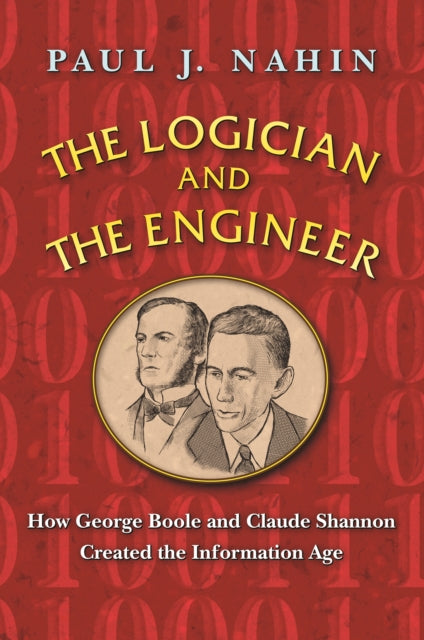
Princeton University Press The Logician and the Engineer
Book SynopsisThird printing. First paperback printing. Original copyright date: 2013.Trade Review"Meshing logic problems with the stories of two extraordinary men ... Paul Nahin fashions a tale of innovation and discovery. Alongside a gripping account of how Shannon built on Boole's work, Nahin explores others key to the technological revolution, from Georg Cantor to Alan Turing."--Nature "Engaging... Nahin assumes some rudimentary knowledge but expertly explains concepts such as relay circuits, Turing machines, and quantum computing. Reasoning through the problems and diagrams will give persistent readers genuine aha moments and an understanding of the two revolutionaries who helped to lay the foundation of our digital world."--Scientific American "Part biography, part history, and part a review of basic information theory, this book does an excellent job of fitting these interlocking elements together."--Library Journal "The reader is taken on a journey from the development of some abstract mathematical ideas through a nearly ubiquitous application of those ideas within the modern world with so many embedded digital computers... I enjoyed the discussion of Claude Shannon. In the history of the computer and development of the internet and World Wide Web, his ideas and contributions are too often overlooked. He is one of my heroes and I believe that everyone that reads this book will come to the same conclusion."--Charles Ashbacher, MAA Reviews "Paul J. Nahin really knows how to tell a good story... The Logician and the Engineer is truly a gem."--New York Journal of Books "A short but fairly detailed exploration of the genesis of Boolean logic and Shannon's information theory... [G]ood background reading for anyone studying electronics or computer science."--Christine Evans-Pughe, Engineering & Technology "Although the book is technical, it is always easily understandable for anyone (for those who need it, some basic rules for electrical circuits are collected in a short appendix). It is not only understandable but also pleasantly bantering and at occasions even facetious."--A. Bultheel, European Mathematical Society "Most valuable to this reviewer, and likely to many potential readers, is the closing chapter, aptly titled Beyond Boole and Shannon. Here is provided an introduction to quantum computing and its logic, possibly portending the future of computers, yet unmistakably bearing the footprints of the two early pioneers. It is an unexpected yet fitting conclusion to this thoroughly enjoyable read."--Ronald E. Prather, Mathematical Reviews Clippings "Nahin has had the very good idea of connecting the very different worlds and times of Boole, Shannon, and others to demonstrate that a little Victorian algebra can turn out to be very useful."--SIAM Review "The exposition is clear and does not assume any prior knowledge except elementary mathematics and a few basic facts from physics. I recommend this well-written book to all readers interested in the history of computer science, as well as those who are curious about the fundamental principles of digital computing."--Antonin Slavik, Zentralblatt MATH "[T]his is a useful and often interesting introduction to the life and work of two intellectual giants who are largely unknown to the general public."--Gareth and Mary Jones, London Mathematical Society Newsletter "The problems are varied and indeed intriguing, and the solutions are delightful."--Mathematics Magazine "This book is not light reading. It would be excellent for advanced high school juniors or seniors with a strong interest in computer science as well as mathematics."--Tom Ottinger, Mathematics Teacher "Nahin leavens the math and engineering with humor and an infectious intellectual curiosity, and the parallels between Boole and Shannon are convincingly drawn... [The Logician and the Engineer] will give your brain a workout, but an enjoyable one."--San Francisco Book ReviewTable of ContentsPreface xi 1 What You Need to Know to Read This Book 1 Notes and References 5 2 Introduction 6 Notes and References 14 3 George Boole and Claude Shannon: Two Mini-Biographies 17 *3.1 The Mathematician 17 *3.2 The Electrical Engineer 28 * Notes and References 39 4 Boolean Algebra 43 *4.1 Boole's Early Interest in Symbolic Analysis 43 *4.2 Visualizing Sets 44 *4.3 Boole's Algebra of Sets 45 *4.4 Propositional Calculus 48 *4.5 Some Examples of Boolean Analysis 52 *4.6 Visualizing Boolean Functions 59 * Notes and References 65 5 Logical Switching Circuits 67 *5.1 Digital Technology: Relays versus Electronics 67 *5.2 Switches and the Logical Connectives 68 *5.3 A Classic Switching Design Problem 71 *5.4 The Electromagnetic Relay and the Logical NOT 73 *5.5 The Ideal Diode and the Relay Logical AND and OR 76 *5.6 The Bi-Stable Relay Latch 81 * Notes and References 84 6 Boole, Shannon, and Probability 88 *6.1 A Common Mathematical Interest 88 *6.2 Some Fundamental Probability Concepts 89 *6.3 Boole and Conditional Probability 96 *6.4 Shannon, Conditional Probability, and Relay Reliability 99 *6.5 Majority Logic 106 * Notes and References 110 7 Some Combinatorial Logic Examples 114 *7.1 Channel Capacity, Shannon's Theorem, and Error-Detection Theory 114 *7.2 The Exclusive-OR Gate (XOR) 122 *7.3 Error-Detection Logic 127 *7.4 Error-Correction Theory 128 *7.5 Error-Correction Logic 132 * Notes and References 137 8 Sequential-State Digital Circuits 139 *8.1 Two Sequential-State Problems 139 *8.2 The NOR Latch 142 *8.3 The Clocked RS Flip-Flop 146 *8.4 More Flip-Flops 154 *8.5 A Synchronous, Sequential-State Digital Machine Design Example 158 * Notes and References 160 9 Turing Machines 161 *9.1 The First Modern Computer 162 *9.2 Two Turing Machines 164 *9.3 Numbers We Can't Compute 168 * Notes and References 173 10 Beyond Boole and Shannon 176 *10.1 Computation and Fundamental Physics 176 *10.2 Energy and Information 178 *10.3 Logically Reversible Gates 180 *10.4 Thermodynamics of Logic 184 *10.5 A Peek into the Twilight Zone: Quantum Computers 188 *10.6 Quantum Logic--and Time Travel, Too! 197 Notes and References 205 Epilogue For the Future: The Anti-Amphibological Machine 210 Appendix Fundamental Electric Circuit Concepts 219 Acknowledgments 223 Index 225
£16.14

Princeton University Press Heavenly Mathematics
Book SynopsisSpherical trigonometry was at the heart of astronomy and ocean-going navigation for two millennia. This title traces the rich history of this forgotten art, revealing how the cultures of classical Greece, medieval Islam, and the modern West used spherical trigonometry to chart the heavens and the Earth.Trade ReviewOne of Choice's Outstanding Academic Titles for 2013 Shortlisted for the 2013 BSHM Neumann Book Prize, British Society for the History of Mathematics "Once a mainstay of mathematics, spherical trigonometry no longer appears on school curricula. Here, Glen Van Brummelen reasserts the field's importance, sharing in illuminating detail how it figured in astronomy, cartography and our understanding of Earth's rotation."--Rosalind Metcalfe, Nature "The present book is very well written; it leaves a clear impression that the author intended to endear--not merely present and teach--spherical trigonometry to the reader. Although not a history book, there are separate chapters shedding light on the approaches to the subject in the ancient, medieval, and modern times. There are also chapters on spherical geometry, polyhedra, stereographic projection and the art of navigation. The book is thoroughly illustrated and is a pleasant read. Chapters end with exercises; the appendices contain a long list of available and not so available textbooks and recommendations for further reading organized by individual chapters. The book made a valuable addition to my library. I freely recommend it to math teachers and curious high schoolers."--Alexander Bogomolny, CTK Insights "A no-nonsense introduction to spherical trigonometry."--Book News, Inc. "A beautiful popular book."--ThatsMaths.com "Full of academic, textbook content, the book is a delight to math students. So if you are game for a journey into the world of spherical trigonometry, pick up the book. Van Brummelen gives exercises at the end of the chapters that can be fun."--R. Balashankar, Organiser "Heavenly Mathematicsis a truly enjoyable description of the somewhat forgotten science of spherical trigonometry... As readers discover this discipline, they will also appreciate the beauty inherent in the topic."--Choice "Heavenly Mathematics proves the value of bringing a fascinating piece of mathematical history within the grasp of the general reader."--Florin Diacu, Literary Review of Canada "Van Brummelen has written a wonderful introduction ... that draws on the history of [spherical trigonometry] to illuminate the mathematics itself and at the same time gives readers a real sense of what research in the history of early mathematics is all about."--Metascience "[Heavenly Mathematics] is an excellent survey of spherical trigonometry... Simply an appreciation of a beautiful lost subject, with historical overtones... [D]istinguishable for its appealingly fresh style."--Mathematical Reviews "[Heavenly Mathematics] is a lovely book to read... [A] wonderful introduction for anyone who wishes to learn more about this subject... I am in full agreement with the author that spherical trigonometry ought to be brought to a wider audience, and I believe that this is the book to do it."--Mathematics Today "Engaging, clear and not overly technical; you can safely lend this book to your friends in the history department... [Heavenly Mathematics] is excellent."--Zentralblatt MATH "Heavenly Mathematics will be of interest to mathematically inclined historians of science and also to students of mathematics and engineering. Because spherical trigonometry is relevant in applications of modern science, this elegant book may even contribute to a renaissance of the subject."--Jan P. Hogendijk, Isis "This book could serve as an excellent textbook for any secondary school mathematics classroom at or above the level of geometry and certainly trigonometry; as the basis for a high school honors class; or as a textbook and seminar topic for college students."--Teresa Floyd, Mathematics Teacher "Any reader of this book (and there should be many) will see how present day mathematics may be viewed through the kaleidoscope of its historical origins... Glen Van Brummelen has written a beautifully produced book that includes fascinating biographical detail at every stage of his narrative."--P.N. Ruane, Mathematical Gazette "An engaging read that will appeal to historians of science, mathematicians, trigonometry teachers, and anyone interested in the history of mathematics."--Elizabeth Hamm, Aestimatio Critical Reviews in the History of ScienceTable of ContentsPreface vii 1 Heavenly Mathematics 1 2 Exploring the Sphere 23 3 The Ancient Approach 42 4 The Medieval Approach 59 5 The Modern Approach: Right- Angled Triangles 73 6 The Modern Approach: Oblique Triangles 94 7 Areas, Angles, and Polyhedra 110 8 Stereographic Projection 129 9 Navigating by the Stars 151 Appendix A. Ptolemy's Determination of the Sun's Position 173 Appendix B. Textbooks 179 Appendix C. Further Reading 182 Index 189
£36.00
Princeton University Press Ten Great Ideas about Chance
Book SynopsisTrade Review"A historical and philosophical tour of major insights in the development of probability theory."---James Ryerson, New York Times Book Review"A volume that should be on every scientist’s reading list."---Barbara Kiser, Nature"Mathematically rigorous, yet also reasonably accessible; informative, yet fun and entertaining to read. Both students and faculty should find reading this to be a rewarding experience." * MAA Reviews *"The audience is quite specific, but for them it will be a gem. . . . I would recommend this to any student studying or having studied anything statistics related at university."---Jonathan Shock, Mathemafrica"A very enriching journey. Your vision will be broadened assimilating all these issues and solutions as well as open problems from the early history of probability, game theory, financial markets, politics, thermodynamics, quantum theory and much much more."---Adhemar Bultheel, European Mathematical Society"A great book for anyone who wants to understand some of the central tenets of probability, how they were discovered, and how they can be tamed in our day-to-day lives." * ZME Science *"This book will not increase your odds of winning at games of chance, but it will give you some greater understanding of why you lose." * Cosmos *"Ten Great Ideas about Chance isn’t just about 18th century philosophical arguments, World War II events or tests of expensive, hard-to-pronounce drugs. The book’s ideas are as down to earth and as current as your busted bracket for NCAA Men’s Basketball." * Herald Business Journal *"To anyone with an interest in probability or statistics, this is a book you must read. . . . [It] is far-ranging and can be read at many levels, from the novice to the expert. It is also thoroughly engaging, written in a conversational style with many examples and asides and an emphasis throughout on the people who have built the theory."---David M. Bressoud, UMAP Journal"A terrific book. The authors explain 10 great ideas in probability, starting from their history and pursuing their philosophical implications."---Eric S. Rosenthal, Mathematics Magazine
£19.80

Princeton University Press Gamma
Book SynopsisAmong the many constants that appear in mathematics, ?, e, and i are the most familiar. Following closely behind is ?,, or gamma, a constant that arises in many mathematical areas yet maintains a profound sense of mystery. In a tantalizing blend of history and mathematics, Julian Havil takes the reader on a journey through logarithms and the harmonTrade Review"[A] wonderful book... Havil's emphasis on historical context and his conversational style make this a pleasure to read... Gamma is a gold mine of irresistible mathematical nuggets. Anyone with a serious interest in maths will find it richly rewarding."--Ben Longstaff, New Scientist "This book is a joy from start to finish."--Gerry Leversha, Mathematical Gazette "Wonderful... Havil's emphasis on historical context and his conversational style make this a pleasure to read...Gammais a gold mine of irresistible mathematical nuggets. Anyone with a serious interest in math will find it richly rewarding."--New Scientist"A joy from start to finish."--Mathematical Gazette"[Gamma] is not a book about mathematics, but a book of mathematics... [It] is something like a picaresque novel; the hero, Euler's constantg, serves as the unifying motif through a wide range of mathematical adventures."--Notices of the American Mathematical Society "[Gamma] is enjoyable for many reasons. Here are just two. First, the explanations are not only complete, but they have the right amount of generality... Second, the pleasure Havil has in contemplating this material is infectious."--MAA Online "It is only fitting that someone should write a book about gamma, or Euler's constant. Havil takes on this task and does an excellent job."--Choice "Mathematics is presented throughout as something connected to reality... Many readers will find in [Gamma] exactly what they have been missing."--Mohammad Akbar, Plus Magazine, Millennium Mathematics Project, University of Cambridge "This book is written in an informal, engaging, and often amusing style. The author takes pains to make the mathematics clear. He writes about the mathematical geniuses of the past with reverence and awe. It is especially nice that the mathematical topics are discussed within a historical context."--Ward R. Stewart, Mathematics TeacherTable of ContentsForeword xv Acknowledgements xvii Introduction xix Chapter One The Logarithmic Cradle 1 1.1 A Mathematical Nightmare- and an Awakening 1 1.2 The Baron's Wonderful Canon 4 1.3 A Touch of Kepler 11 1.4 A Touch of Euler 13 1.5 Napier's Other Ideas 16 Chapter Two The Harmonic Series 21 2.1 The Principle 21 2.2 Generating Function for Hn 21 2.3 Three Surprising Results 22 Chapter Three Sub-Harmonic Series 27 3.1 A Gentle Start 27 3.2 Harmonic Series of Primes 28 3.3 The Kempner Series 31 3.4 Madelung's Constants 33 Chapter Four Zeta Functions 37 4.1 Where n Is a Positive Integer 37 4.2 Where x Is a Real Number 42 4.3 Two Results to End With 44 Chapter Five Gamma's Birthplace 47 5.1 Advent 47 5.2 Birth 49 Chapter Six The Gamma Function 53 6.1 Exotic Definitions 53 6.2 Yet Reasonable Definitions 56 6.3 Gamma Meets Gamma 57 6.4 Complement and Beauty 58 Chapter Seven Euler's Wonderful Identity 61 7.1 The All-Important Formula 61 7.2 And a Hint of Its Usefulness 62 Chapter Eight A Promise Fulfilled 65 Chapter Nine What Is Gamma Exactly? 69 9.1 Gamma Exists 69 9.2 Gamma Is What Number? 73 9.3 A Surprisingly Good Improvement 75 9.4 The Germ of a Great Idea 78 Chapter Ten Gamma as a Decimal 81 10.1 Bernoulli Numbers 81 10.2 Euler -Maclaurin Summation 85 10.3 Two Examples 86 10.4 The Implications for Gamma 88 Chapter Eleven Gamma as a Fraction 91 11.1 A Mystery 91 11.2 A Challenge 91 11.3 An Answer 93 11.4 Three Results 95 11.5 Irrationals 95 11.6 Pell's Equation Solved 97 11.7 Filling the Gaps 98 11.8 The Harmonic Alternative 98 Chapter Twelve Where Is Gamma? 101 12.1 The Alternating Harmonic Series Revisited 101 12.2 In Analysis 105 12.3 In Number Theory 112 12.4 In Conjecture 116 12.5 In Generalization 116 Chapter Thirteen It's a Harmonic World 119 13.1 Ways of Means 119 13.2 Geometric Harmony 121 13.3 Musical Harmony 123 13.4 Setting Records 125 13.5 Testing to Destruction 126 13.6 Crossing the Desert 127 13.7 Shuffiing Cards 127 13.8 Quicksort 128 13.9 Collecting a Complete Set 130 13.10 A Putnam Prize Question 131 13.11 Maximum Possible Overhang 132 13.12 Worm on a Band 133 13.13 Optimal Choice 134 Chapter Fourteen It's a Logarithmic World 139 14.1 A Measure of Uncertainty 139 14.2 Benford's Law 145 14.3 Continued-Fraction Behaviour 155 Chapter Fifteen Problems with Primes 163 15.1 Some Hard Questions about Primes 163 15.2 A Modest Start 164 15.3 A Sort of Answer 167 15.4 Picture the Problem 169 15.5 The Sieve of Eratosthenes 171 15.6 Heuristics 172 15.7 A Letter 174 15.8 The Harmonic Approximation 179 15.9 Different-and Yet the Same 180 15.10 There are Really Two Questions, Not Three 182 15.11 Enter Chebychev with Some Good Ideas 183 15.12 Enter Riemann, Followed by Proof(s)186 Chapter Sixteen The Riemann Initiative 189 16.1 Counting Primes the Riemann Way 189 16.2 A New Mathematical Tool 191 16.3 Analytic Continuation 191 16.4 Riemann's Extension of the Zeta Function 193 16.5 Zeta's Functional Equation 193 16.6 The Zeros of Zeta 193 16.7 The Evaluation of (x) and p(x)196 16.8 Misleading Evidence 197 16.9 The Von Mangoldt Explicit Formula-and How It Is Used to Prove the Prime Number Theorem 200 16.10 The Riemann Hypothesis 202 16.11 Why Is the Riemann Hypothesis Important? 204 16.12 Real Alternatives 206 16.13 A Back Route to Immortality-Partly Closed 207 16.14 Incentives, Old and New 210 16.15 Progress 213 Appendix A The Greek Alphabet 217 Appendix B Big Oh Notation 219 Appendix C Taylor Expansions 221 C.1 Degree 1 221 C.2 Degree 2 221 C.3 Examples 223 C.4 Convergence 223 Appendix D Complex Function Theory 225 D.1 Complex Differentiation 225 D.2 Weierstrass Function 230 D.3 Complex Logarithms 231 D.4 Complex Integration 232 D.5 A Useful Inequality 235 D.6 The Indefinite Integral 235 D.7 The Seminal Result 237 D.8 An Astonishing Consequence 238 D.9 Taylor Expansions-and an Important Consequence 239 D.10 Laurent Expansions-and Another Important Consequence 242 D.11 The Calculus of Residues 245 D.12 Analytic Continuation 247 Appendix E Application to the Zeta Function 249 E.1 Zeta Analytically Continued 249 E.2 Zeta's Functional Relationship 253 References 255 Name Index 259 Subject Index 263
£16.14


