
Mathematics Books

IMM Lifestyle Books The Little Book of Mathematical Principles,
Book SynopsisMaking serious maths simple, it explains Fibonacci numbers, Euclid's Elements and Zeno's paradoxes, as well as other fundamental principles such as chaos theory, game theory, and the game of life. This book simplifies the ancient discipline of mathematics and provides fascinating answers to intriguing questions, such as: 'What is The Greatest Pyramid?' and 'Is there a theory for stacking oranges'? Written by the author of CCEA GCSE Mathematics Higher 2 and Advanced Level Mathematics: Mechanics, The Little Book of Mathematical Principles is excellent either for dipping into or for reading from cover to cover for a more thorough and engaging understanding of mathematics.
£7.59

John Wiley & Sons Inc Basic Math PreAlgebra For Dummies Book Workbook
Book SynopsisTable of ContentsBasic Math and Pre-Algebra For Dummies, 2nd Edition Introduction 1 Part 1: Getting Started with Basic Math and Pre-Algebra 5 CHAPTER 1: Playing the Numbers Game 7 CHAPTER 2: It’s All in the Fingers: Numbers and Digits 23 CHAPTER 3: The Big Four: Addition, Subtraction, Multiplication, and Division 29 Part 2: Getting a Handle on Whole Numbers 47 CHAPTER 4: Putting the Big Four Operations to Work 49 CHAPTER 5: A Question of Values: Evaluating Arithmetic Expressions 63 CHAPTER 6: Say What? Turning Words into Numbers 75 CHAPTER 7: Divisibility 87 CHAPTER 8: Fabulous Factors and Marvelous Multiples 95 Part 3: Parts of the Whole: Fractions, Decimals, and Percents 109 CHAPTER 9: Fooling with Fractions 111 CHAPTER 10: Parting Ways: Fractions and the Big Four Operations 125 CHAPTER 11: Dallying with Decimals 149 CHAPTER 12: Playing with Percents 171 CHAPTER 13: Word Problems with Fractions, Decimals, and Percents 183 Part 4: Picturing and Measuring — Graphs, Measures, Stats, and Sets 195 CHAPTER 14: A Perfect Ten: Condensing Numbers with Scientific Notation 197 CHAPTER 15: How Much Have You Got? Weights and Measures 205 CHAPTER 16: Picture This: Basic Geometry 217 CHAPTER 17: Seeing Is Believing: Graphing as a Visual Tool 239 CHAPTER 18: Solving Geometry and Measurement Word Problems 247 CHAPTER 19: Figuring Your Chances: Statistics and Probability 259 CHAPTER 20: Setting Things Up with Basic Set Theory 271 Part 5: The X-Files: Introduction to Algebra 279 CHAPTER 21: Enter Mr X: Algebra and Algebraic Expressions 281 CHAPTER 22: Unmasking Mr X: Algebraic Equations 299 CHAPTER 23: Putting Mr X to Work: Algebra Word Problems 311 Part 6: The Part of Tens 321 CHAPTER 24: Ten Little Math Demons That Trip People Up 323 CHAPTER 25: Ten Important Number Sets to Know 329 Index 337 Basic Math and Pre-Algebra Workbook For Dummies, 3rd Edition Introduction 1 Part 1: Getting Started with Basic Math and Pre-Algebra 5 CHAPTER 1: We've Got Your Numbers 7 CHAPTER 2: Smooth Operators: Working with the Big Four Operations 23 CHAPTER 3: Getting Down with Negative Numbers 37 CHAPTER 4: It's Just an Expression 49 CHAPTER 5: Dividing Attention: Divisibility, Factors, and Multiples 69 Part 2: Slicing Things Up: Fractions, Decimals, and Percents 89 CHAPTER 6: Fractions Are a Piece of Cake 91 CHAPTER 7: Fractions and the Big Four 109 CHAPTER 8: Getting to the Point with Decimals 143 CHAPTER 9: Playing the Percentages 165 Part 3: A Giant Step Forward: Intermediate Topics 177 CHAPTER 10: Seeking a Higher Power through Scientific Notation 179 CHAPTER 11: Weighty Questions on Weights and Measures 189 CHAPTER 12: Shaping Up with Geometry 203 CHAPTER 13: Getting Graphic: Xy-Graphs 223 Part 4: The X Factor: Introducing Algebra 235 CHAPTER 14: Expressing Yourself with Algebraic Expressions 237 CHAPTER 15: Finding the Right Balance: Solving Algebraic Equations 259 Part 5: The Part of Tens 277 CHAPTER 16: Ten Alternative Numeral and Number Systems 279 CHAPTER 17: Ten Curious Types of Numbers 287 Index 293
£21.84

John Wiley & Sons Inc Quick Calculus
Book SynopsisTable of ContentsPreface iii Chapter One Starting Out 1 1.1 A Few Preliminaries 1 1.2 Functions 2 1.3 Graphs 5 1.4 Linear and Quadratic Functions 11 1.5 Angles and Their Measurements 19 1.6 Trigonometry 28 1.7 Exponentials and Logarithms 42 Summary of Chapter 1 51 Chapter Two Differential Calculus 57 2.1 The Limit of a Function 57 2.2 Velocity 71 2.3 Derivatives 83 2.4 Graphs of Functions and Their Derivatives 87 2.5 Differentiation 97 2.6 Some Rules for Differentiation 103 2.7 Differentiating Trigonometric Functions 114 2.8 Differentiating Logarithms and Exponentials 121 2.9 Higher-Order Derivatives 130 2.10 Maxima and Minima 134 2.11 Differentials 143 2.12 A Short Review and Some Problems 147 Conclusion to Chapter 2 164 Summary of Chapter 2 165 Chapter Three Integral Calculus 169 3.1 Antiderivative, Integration, and the Indefinite Integral 170 3.2 Some Techniques of Integration 174 3.3 Area Under a Curve and the Definite Integral 182 3.4 Some Applications of Integration 201 3.5 Multiple Integrals 211 Conclusion to Chapter 3 219 Summary of Chapter 3 219 Chapter Four Advanced Topics: Taylor Series, Numerical Integration, and Differential Equations 223 4.1 Taylor Series 223 4.2 Numerical Integration 232 4.3 Differential Equations 235 4.4 Additional Problems for Chapter 4 244 Summary of Chapter 4 248 Conclusion (frame 449) 250 Appendix A Derivations 251 A.1 Trigonometric Functions of Sums of Angles 251 A.2 Some Theorems on Limits 252 A.3 Exponential Function 254 A.4 Proof That dy/dx = 1/dx∕dy 255 A.5 Differentiating Xn 256 A.6 Differentiating Trigonometric Functions 258 A.7 Differentiating the Product of Two Functions 258 A.8 Chain Rule for Differentiating 259 A.9 Differentiating Ln X 259 A.10 Differentials When Both Variables Depend on a Third Variable 260 A.11 Proof That if Two Functions Have the Same Derivative They Differ Only by a Constant 261 A.12 Limits Involving Trigonometric Functions 261 Appendix B Additional Topics in Differential Calculus 263 B.1 Implicit Differentiation 263 B.2 Differentiating the Inverse Trigonometric Functions 264 B.3 Partial Derivatives 267 B.4 Radial Acceleration in Circular Motion 269 B.5 Resources for Further Study 270 Frame Problems Answers 273 Answers to Selected Problems from the Text 273 Review Problems 277 Chapter 1 277 Chapter 2 278 Chapter 3 282 Tables 287 Table 1: Derivatives 287 Table 2: Integrals 288 Indexes 291 Index 291 Index of Symbols 295
£17.09

Cambridge University Press Topological Phases of Matter
Book SynopsisTopological Phases of Matter are an exceptionally dynamic field of research: several of the most exciting recent experimental discoveries and conceptual advances in modern physics have originated in this field. These have generated new, topological, notions of order, interactions and excitations. This text provides an accessible, unified and comprehensive introduction to the phenomena surrounding topological matter, with detailed expositions of the underlying theoretical tools and conceptual framework, alongside accounts of the central experimental breakthroughs. Among the systems covered are topological insulators, magnets, semimetals, and superconductors. The emergence of new particles with remarkable properties such as fractional charge and statistics is discussed alongside possible applications such as fault-tolerant topological quantum computing. Suitable as a textbook for graduate or advanced undergraduate students, or as a reference for more experienced researchers, the book assTrade Review'… a timely and valuable introduction to the most important theoretical concepts in the topological study of matter … brief treatment of a vast, rapidly evolving subject that currently dominates condensed matter physics … This book is appropriate for physics collections within all university libraries.' M. C. Ogilvie, Choice ConnectTable of ContentsPreface; Acknowledgements; 1. Introduction; 2. Basic concepts of topology and condensed matter; 3. Integer topological phases; 4. Geometry and topology of wavefunctions in crystals; 5. Hydrogen atoms for fractionalisation; 6. Gauge and topological field theories; 7. Topology in gapless matter; 8. Disorder and defects in topological phases; 9. Topological quantum computation via non-Abelian statistics; 10. Topology out of equilibrium; 11. Symmetry, topology, and information; Appendix; References; Index.
£57.94

John Wiley & Sons Inc Startup Boards
Book SynopsisTable of ContentsForeword xiii Prefacex vii Section 1: Board Fundamentals 1 Chapter 1: Introduction 3 What’s New in the Second Edition 4 Who This Book Is For 6 Magic Words, Phrases, Abbreviations, and Style 7 Note 9 Chapter 2 : The Board’s Purpose 11 Accountability 12 General Responsibilities 12 Chapter 3: Legal Characteristics 15 A Board Member’s Legal Duties 16 Addressing Conflicting Duties 18 Benefit Corporations and the B Corp Movement 20 Should You Get D&O Insurance? 21 Note 23 Chapter 4: Board Member Roles 25 Chair or Lead Director 25 Executive Chair 28 Should You Be Chair of Your Board? 29 Independent Board Members 30 Board Observers 30 Outside Counsel 32 Note 34 Chapter 5: Board Functions 35 The Role of Board Committees 35 Informal Responsibilities of a Board 36 Control Priorities 37 Being Rich and Queen (or King) 39 Shareholder Rights 40 Economic and Performance Priorities 41 Emotional Priorities: Trust, Judgment, and Transparency 42 Notes 43 Section 2: Creating Your Board 45 Chapter 6: Size and Composition 47 Management 48 Investors 49 Independents 50 Matt’s Rule of 1s 51 Notes 52 Chapter 7: VCs and Boards 53 Notes 56 Chapter 8: Board Evolution 57 Startup Stages 57 Limiting the Number of Investor Board Members 59 Managing Independent Seats 60 Chapter 9: What to Look for in a Director 63 General Skills 63 Fit with Your Existing Board 64 What Does Your Company Need? 65 Experiences 66 Attributes 69 Governance Philosophy 69 Chapter 10: Recruiting and Interviewing Board Members 71 Sourcing 71 The Interview Process 73 Interviewing VCs Before They Join Your Board 76 Chapter 11: Compensation 77 VCs and Management 77 Independent Directors 78 Notes 80 Chapter 12: Board Diversity 81 Unconscious Bias 81 The First Step: Appoint Independent Directors Early 83 The Second Step: Open Your Search to Board- Ready First- Timers 83 Notes 86 Chapter 13: Onboarding Your Directors 87 Using Employee Onboarding as a Guide 87 Onboarding New Directors 88 Interacting with Your Team 89 Chapter 14: Removing a Board Member 91 Removing a Founder Director 92 Removing an Investor Director 92 Removing an Independent Director 93 Getting Rid of the Entire Board 94 Notes 95 Chapter 15: Is an Advisory Board Useful? 97 Board of Directors vs. Advisory Board 98 Attributes of a Useful Advisory Board Member 99 Selecting Advisory Board Members 100 Building an Advisory Board 100 Challenges of Advisory Boards 101 Notes 102 Section 3: Preparing for and Running the Board Meeting 103 Chapter 16: Preparing for the Board Meeting 105 The Value of Preparation 106 The Meeting Agenda 107 Focus on Critical Items 108 The Board Book 109 Creating an Annual Calendar 113 Notes 114 Chapter 17: Meeting Dynamics 115 Seating 115 The Meeting Length 116 Including Your Team in the Board Meeting 117 Slides or No Slides? 118 Discussion or Decision Item? 118 The Executive Session and the Closed Session 119 A Board Call Instead of a Meeting 120 Remote Attendees and Hybrid Meetings 121 The Post- Meeting Survey 123 Post Meeting 124 Notes 125 Chapter 18: Motions and Votes 127 Robert’s Rules of Order 127 Have Your Lawyer at the Meeting 128 The Mechanics of Voting 128 What If You Don’t Agree? 129 Dealing with Formal Items 130 Minutes 131 Unanimous Written Consent 131 Notes 132 Section 4: Between Meetings: Ongoing Work 133 Chapter 19: Managing Ongoing Communication 135 What the Board Expects from a CEO 135 Communicate Both Good and Bad News 136 Note 138 Chapter 20: Committees 139 Committee Meeting Formalities 139 Compensation 140 Audit 141 Nominating 142 CEO Expenses 142 Chapter 21: Mentors and Learning by Doing 145 Mentorship and Vulnerability 145 Learning by Doing 147 Chapter 22: CEO Transitions 149 Situations That Lead to a CEO Change 149 Scale Up with Growth 151 Why Boards Fire CEOs 152 Planning for Healthy Transitions 154 Notes 155 Section 5: Transactions 157 Chapter 23: Financings 159 New Investor- Led Round 159 Insider- Led Round 160 The Down Round and a Rights Offering 161 How Involved Should VCs Be in Financings? 161 Convertible Notes 162 Venture Debt 162 Notes 163 Chapter 24: Stock Option Grants and 409A Valuations 165 Chapter 25: Selling a Company 169 Confidentiality 169 Fiduciary Responsibility 170 Your Outside Counsel’s Role 171 Acquihire 172 Carve- Outs and 280G 173 Shareholder Representative 173 Note 174 Chapter 26: Buying a Company 175 Negotiating and Structuring the Deal 175 Financing an Acquisition 176 Board Approvals 177 Managing Transaction and Post- Deal Integration 178 Chapter 27: Going Public 179 Process 179 Committees 180 Confidentiality 180 Insider Status 181 VCs on Public Company Boards 181 SPACs 182 Chapter 28: Going Out of Business 185 The Zone of Insolvency 185 Responsibility to Creditors 186 Responsibility to Shareholders 187 Liability 188 Chapter 11 188 Chapter 7 189 Assignment for the Benefit of Creditors 189 Section 6: For Independent Directors and Aspiring Board Members 191 Chapter 29: Preparing for Your First Board Role 193 Note 196 Chapter 30: Interviewing for a Board Role 197 The Interview 197 Diligence Items to Explore 198 Chapter 31: Your First Board Meeting 201 Chapter 32: Communicating Effectively 205 Note 208 Chapter 33: How to Be a Great Board Member 209 Chapter 34: Conclusion 213 Acknowledgments 215 Bibliography 217 Index 221
£19.54
Stata Press A Gentle Introduction to Stata, Revised Sixth
Book SynopsisAlan C. Acock's A Gentle Introduction to Stata, Revised Sixth Edition is aimed at new Stata users who want to become proficient in Stata. After reading this introductory text, new users will be able to not only use Stata well but also learn new aspects of Stata.Acock assumes that the user is not familiar with any statistical software. This assumption of a blank slate is central to the structure and contents of the book. Acock starts with the basics; for example, the part of the book that deals with data management begins with a careful and detailed example of turning survey data on paper into a Stata-ready dataset. When explaining how to go about basic exploratory statistical procedures, Acock includes notes that will help the reader develop good work habits. This mixture of explaining good Stata habits and explaining good statistical habits continues throughout the book.Acock is quite careful to teach the reader all aspects of using Stata. He covers data management, good work habits (including the use of basic do-files), basic exploratory statistics (including graphical displays), and analyses using the standard array of basic statistical tools (correlation, linear and logistic regression, and parametric and nonparametric tests of location and dispersion). He also successfully introduces some more advanced topics such as multiple imputation and multilevel modeling in a very approachable manner. Acock teaches Stata commands by using the menus and dialog boxes while still stressing the value of Stata commands and do-files. In this way, he ensures that all types of users can build good work habits. Each chapter has exercises that the motivated reader can use to reinforce the material.The tone of the book is friendly and conversational without ever being glib or condescending. Important asides and notes about terminology are set off in boxes, which makes the text easy to read without any convoluted twists or forward referencing. Rather than splitting topics by their Stata implementation, Acock arranges the topics as they would appear in a basic statistics textbook; graphics and postestimation are woven into the material naturally. Real datasets, such as the General Social Surveys from 2002, 2006, and 2016, are used throughout the book.The focus of the book is especially helpful for those in the behavioral and social sciences because the presentation of basic statistical modeling is supplemented with discussions of effect sizes and standardized coefficients. Various selection criteria, such as semipartial correlations, are discussed for model selection. Acock also covers a variety of commands available for evaluating reliability and validity of measurements.The revised sixth edition is fully up to date for Stata 17, including updated discussion and images of Stata's interface and modern command syntax. In addition, examples include new features such as the table command and collect suite for creating and exporting customized tables as well as the option for creating graphs with transparency.Table of ContentsGetting started Entering data Preparing data for analysis Working with commands, do-files, and results Descriptive statistics and graphs for one variable Statistics and graphs for two categorical variables Tests for one or two means Bivariate correlation and regression Analysis of variance Multiple regression Logistic regression Measurement, reliability, and validity Structural equation and generalized structural equation modeling Working with missing values—multiple imputation An introduction to multilevel analysis Item response theory (IRT) What’s next? Glossary of acronyms Glossary of mathematical and statistical symbols References
£999.99

John Wiley & Sons Inc SPSS Statistics For Dummies
Book SynopsisTable of ContentsIntroduction 1 About This Book 1 About the Fourth Edition 2 Foolish Assumptions 2 Icons Used in This Book 3 Beyond the Book 3 Where to Go from Here 3 Part 1: Getting Started with SPSS 5 Chapter 1: Introducing SPSS 7 SPSS’s Job, Our Job, and Your Job 7 SPSS’s job 8 Our job 8 Your job 9 Garbage In, Garbage Out: Recognizing the Importance of Good Data 9 Talking to SPSS: Can You Hear Me Now? 12 The graphical user interface 12 Syntax 12 Programmability 13 How SPSS works 13 Getting Help When You Need It 15 Chapter 2: Finding the Best SPSS for You 17 Campus Editions 19 Subscription Plans 20 Commercial Editions 22 What’s New in Version 27 24 Chapter 3: Getting to Know SPSS by Running a Simple Session 25 Opening a Dataset 25 Running an Analysis 27 Interpreting Results 30 Creating Graphs 33 Investigating Data 37 Part 2: Getting Data into and out of SPSS 43 Chapter 4: Understanding SPSS Data: Defining Metadata 45 Entering Variable Definitions on the Variable View Tab 46 Name 47 Type 47 Width 51 Decimals 52 Label 52 Values 53 Missing 54 Columns 55 Align 55 Measure 55 Role 56 Entering and Viewing Data Items on the Data View Tab 56 Chapter 5: Opening Data Files 59 Getting Acquainted with the SPSS File Format 59 Reading Simple Data from a Text File 60 Transferring Data from Another Program 65 Reading an Excel file 67 Reading from an unknown program type 68 Saving Data 69 Chapter 6: Getting Data and Results from SPSS 71 Exporting Data to Another Program 71 Navigating SPSS Statistics Viewer 72 Moving SPSS Output to Other Applications 74 Copying and pasting output 74 Exporting output 75 Printing Data 80 Chapter 7: More about Defining Your Data 81 Working with Dates and Times 82 Using the Date and Time Wizard 84 Creating and Using a Multiple-Response Set 86 Copying Data Properties 90 Part 3: Messing with Data in SPSS 95 Chapter 8: The Transform and Data Menus 97 Sorting Cases 97 Selecting the Data You Want to Look At 100 Splitting Data for Easier Analysis 103 Counting Case Occurrences 104 Recoding Variables 107 Recoding into different variables 107 Automatic recoding 110 Binning 113 Optimal Binning 117 Chapter 9: Computing New Variables 119 Calculating a New Variable with a Formula 120 Calculating a New Variable with a Condition 122 Using System Variables 124 Contrasting $Sysmis with SYSMIS 125 Understanding Missing Data in Formulas 127 Efficiently Calculating with Multiple Formulas 129 Chapter 10: Some Useful Functions 133 The LENGTH Function 134 The ANY Function 137 The MEAN Function and Missing Data 139 RND, TRUNC, and MOD 141 Logicals, the MISSING Function, and the NOT Function 143 String Parsing and Nesting Functions 144 Calculating Lags 146 Chapter 11: Combining Files 147 Merging Files by Adding Cases 147 Merging Files by Adding Variables 152 Part 4: Graphing Data 161 Chapter 12: On the Menu: Graphing Choices in SPSS 163 Building Graphs the Chart Builder Way 164 The Gallery tab 164 The Basic Elements tab 168 The Groups/Point ID tab 169 The Titles/Footnotes tab 170 The Element Properties tab 170 The Chart Appearance tab 176 The Options tab 177 Building Graphs with Graphboard Template Chooser 178 Chapter 13: Building Graphs Using Chart Builder 183 Simple Graphs 184 Simple scatterplots 184 Simple dot plots 185 Simple bar graphs 186 Simple error bars 187 Simple histograms 189 Population pyramids 191 Stacked area charts 192 Fancy Graphs 194 Charts with multiple lines 194 Colored scatterplots 196 Scatterplot matrices 198 Stacked bar charts 199 Pie charts 200 Clustered range bar graphs 202 Differenced area graphs 202 Dual-axis graph 204 Fancy Maps Using Graphboard Template Chooser 205 Heat map 206 Choropleth of values 206 Coordinates on a reference map 209 Part 5: Analyzing Data 211 Chapter 14: Using Descriptive Statistics 213 Looking at Levels of Measurement 213 Defining the four levels of measurement 214 Defining summary statistics 215 Focusing on Frequencies for Categorical Variables 217 Understanding Frequencies for Continuous Variables 221 Summarizing Continuous Variables with the Descriptives Procedure 224 Chapter 15: Knowing When Not to Trust Your Data 227 Sampling 227 Understanding Sample Size 228 Testing Hypotheses 229 Calculating Confidence Intervals 231 Conducting In-Depth Hypothesis Testing 232 Using the Normal Distribution 235 Working with Z-Scores 236 Chapter 16: Testing One Group 239 Conducting Inferential Tests 239 Running the Chi-Square Goodness of Fit Test 240 Running the One-Sample T-Test Procedure 246 Chapter 17: Showing Relationships between Categorical Variables 251 Running the Crosstabs Procedure 252 Running the Chi-Square Test of Independence 256 Comparing Column Proportions 260 Adding Control Variables 261 Creating a Clustered Bar Chart 264 Chapter 18: Showing Relationships between Continuous Dependent and Categorical Independent Variables 267 Conducting Inferential Tests 268 Using the Compare Means Dialog 268 Running the Independent-Samples T-Test Procedure 269 Comparing the Means Graphically 275 Running the Summary Independent-Samples T-Test Procedure 277 Running the Paired-Samples T-Test Procedure 280 Chapter 19: Showing Relationships between Continuous Variables 285 Viewing Relationships 286 Running the Bivariate Procedure 288 Running the Simple Linear Regression Procedure 292 Part 6: Getting More Advanced with Analyzing Data 301 Chapter 20: Doing More Advanced Analyses 303 Running the One-Way ANOVA Procedure 303 Conducting Post Hoc Tests 311 Comparing Means Graphically 314 Running the Multiple Linear Regression Procedure 315 Viewing Relationships 325 Chapter 21: What Is Normal Anyway? 327 Understanding Nonparametric Tests 328 Understanding Distributions 328 Running a Nonparametric Independent Samples Test 331 Running a Nonparametric Related Samples Test 338 Chapter 22: When to Do What 345 Determining Which Statistical Test to Perform 346 Using Advanced Techniques 350 Part 7: Making SPSS Your Own 351 Chapter 23: Changing Settings 353 General Options 354 Language Options 356 Viewer Options 357 Data Options 358 Currency Options 360 Output Options 361 Chart Options 362 Pivot Tables Options 364 File Locations Options 365 Scripts Options 366 Multiple Imputations Options 368 Syntax Editor Options 369 Privacy Options 370 Chapter 24: Editing Charts and Chart Templates 371 Changing and Editing Axes 372 Changing the axis range 372 Scaling the axis range 373 Changing Style: Lines and Symbols 376 Editing chart lines 376 Editing data points 378 Applying Templates 380 Chapter 25: Editing Tables 383 Working with TableLooks 384 Style Output 387 Pivoting Trays 390 Part 8: Programming SPSS with Command Syntax 393 Chapter 26: Getting Acquainted with Syntax 395 Pasting 396 Performing a Series of Related Compute Statements 399 Labeling 400 Repeatedly Generating the Same Report 400 Chapter 27: Adding Syntax to Your Toolkit 403 Your Wish Is My Command 404 Understanding Keywords 405 Declaring Data 406 Commenting Your Way to Clarity 407 Running Your Code 408 Controlling Flow and Executing Conditionals 410 IF 410 DO IF 411 SELECT IF 412 Part 9: The Part of Tens 413 Chapter 28: Ten (or So) Modules You Can Add to SPSS 415 The Advanced Statistics Module 416 The Custom Tables Module 416 The Regression Module 418 The Categories Module 418 The Data Preparation Module 419 The Decision Trees Module 419 The Forecasting Module 420 The Missing Values Module 421 The Bootstrapping Module 421 The Complex Samples Module 422 The Conjoint Module 422 The Direct Marketing Module 422 The Exact Tests Module 423 The Neural Networks Module 424 Chapter 29: Ten Useful SPSS Resources 425 Supporting Websites for This Book 425 LinkedIn and LinkedIn Groups 426 IBM SPSS Statistics Certification 427 IBM Data Science Community 427 SPSSX-L 427 Online Videos 428 Twitter 429 Live Instruction 430 Asynchronous Instruction and Tutorials 431 SPSS Statistics for Data Analysis and Visualization 432 Chapter 30: Ten SPSS Statistics Gotchas 433 Failing to Declare Level of Measurement 433 Conflating String Values with Labels 434 Failing to Declare Missing Data 435 Failing to Find Add-on Modules and Plug-Ins 435 Failing to Meet Statistical and Software Assumptions 437 Confusing Pasting Syntax with Copy and Paste 438 Thinking You Create Variables in SPSS as You Do in Excel 438 Getting Confused by Listwise Deletion 439 Losing Track of Your Active Dataset 440 Forgetting to Turn Off Select and Split and Weight 441 Index 443
£23.99

Penguin Books Ltd Statistics without Tears
Book SynopsisTHE CLASSIC GUIDE, NOW FULLY REVISED AND UPDATEDWhy do we need Statistics?What do terms like ''dispersion'', ''correlation'', ''normal distribution'' and ''significance'' actually mean?How can I learn how to think statistically?This bestselling introduction is for anyone who wants to know how statistics works and the powerful ideas behind it. Teaching through words and diagrams instead of requiring you to do complex calculations, it assumes no expert knowledge and makes the subject accessible even to readers who consider themselves non-mathematical. This clear and informative ''tutorial in print'' includes questions for you to respond to in the light of what you have read so far, ensuring your developing ability to think statistically.
£10.44

Elsevier Science Differential Equations Dynamical Systems and an
Book SynopsisSuitable for students in the fields of mathematics, science, and engineering, this title provides a theoretical approach to dynamical systems and chaos. It helps them to analyze the types of differential equations that arise in their area of study.Table of Contents1. First-Order Equations 2. Planar Linear Systems 3. Phase Portraits 4. Classification of Planar Systems 5. Higher Dimension Linear Algebra 6. Higher Dimension Linear Systems 7. Nonlinear Systems 8. Equilibria in Nonlinear Systems 9. Global Nonlinear Techniques 10. Closed Orbits and Limit Sets 11. Applications in Biology 12. Applications in Circuit Theory 13. Applications in Mechanics 14. The Lorenz System 15. Discrete Dynamical Systems 16. Homoclinic Phenomena 17. Existence and Uniqueness Revisited
£75.04

MIT Press Category Theory for the Sciences The MIT Press
Book SynopsisAn introduction to category theory as a rigorous, flexible, and coherent modeling language that can be used across the sciences.Category theory was invented in the 1940s to unify and synthesize different areas in mathematics, and it has proven remarkably successful in enabling powerful communication between disparate fields and subfields within mathematics. This book shows that category theory can be useful outside of mathematics as a rigorous, flexible, and coherent modeling language throughout the sciences. Information is inherently dynamic; the same ideas can be organized and reorganized in countless ways, and the ability to translate between such organizational structures is becoming increasingly important in the sciences. Category theory offers a unifying framework for information modeling that can facilitate the translation of knowledge between disciplines.Written in an engaging and straightforward style, and assuming little background in mathematics, the book is
£49.40

Dover Publications Inc. Differential Forms with Applications to the
Book SynopsisA graduate-level text utilizing exterior differential forms in the analysis of a variety of mathematical problems in the physical and engineering sciences. Includes 45 illustrations. Index.
£11.24

Dover Publications Inc. Set Theory and Logic
Book SynopsisThe best introductory text we have seen. Cosmos. Lucidly and gradually explains sets and relations, the natural number sequence and its generalization, extension of natural numbers to real numbers, logic, informal axiomatic mathematics, Boolean algebras, informal axiomatic set theory, several algebraic theories, and 1st-order theories. Its clarity makes this book excellent for self-study.
£16.57

John Wiley & Sons Australia Ltd Speed Mathematics
Book Synopsis
£10.76

Oxford University Press The Concise Oxford Dictionary of Mathematics
Book SynopsisThis dictionary provides clear definitions for over 4,000 pure and applied mathematics terms, including key theories, concepts, methods, people, and terminology. The new edition expands its coverage across a wide range of pure and applied topics, particularly at first- and second-year university levels. It also includes a new historical timeline.Trade ReviewReview from previous edition 'The depth of information provided is admirable' * New Scientist *Table of ContentsList of contributors Preface A to Z entries Areas and volumes Centres of mass Moments of inertia SI units and constants Geometry: equations of lines and planes Basic algebra Derivatives Integrals Common ordinary differential equations and solutions Series Convergence tests for series Common inequalities Trigonometric formulae Probability distributions Vector algebra and differential operators Groups of orders up to 15 List of primes up to 1000 Symbols Greek letters Roman numerals Fields Medal winners Millennium Prize problems Historical timeline
£12.59

Stenhouse Publishers Which One Doesn't Belong?: A Shapes Book,
Book SynopsisEvery colorful page of Christopher Danielson’s children’s picture book, Which One Doesn’t Belong?, contains a thoughtfully designed set of four shapes. Each of the shapes can be a correct answer to the question “Which one doesn’t belong?” Because all their answers are right answers, students naturally shift their focus to justifications and arguments based on the shapes’ geometric properties. In the companion teacher’s guide, Danielson shows how to facilitate rich discussions and teach mathematical argumentation using Which One Doesn’t Belong? He models how to listen closely and respectfully to students’ ideas about shapes. Danielson synthesizes research about how children learn geometry, discusses the role of geometry in the mathematics curriculum, and gives plenty of practical advice about different ways to implement Which One Doesn’t Belong? in classrooms. He also discusses the mathematical ideas likely to emerge on each page and—drawing from his direct experience using Which One Doesn’t Belong? at several different grade levels—helps teachers anticipate and think about students’ likely answers. Most curricula treat geometry as little more than vocabulary lessons. Which One Doesn’t Belong? and its accompanying guide are powerful, flexible resources teachers can use to provoke lively discussions and deep learning about shapes with students of all ages.
£29.99

HarperCollins Publishers The Road to Geometry
Book Synopsis Euclid's Elements of Geometry was a book that changed the world. Trade Review Praise for The Book of Wonders ‘An astonishingly readable and informative history of the greatest mathematical bestseller of all time, from ancient Greece to dark energy. The writing is vivid and the stories are gripping. Highly recommended!’Ian Stewart, author of Significant Figures ‘Benjamin Wardhaugh is an excellent storyteller and his collected short story approach to the history of The Elements works splendidly… simultaneously educational, entertaining and illuminating … A highly desirable read for all those, both professional and amateur, who interest themselves in the histories of mathematics, science and knowledge … over almost two and a half millennia’Thony Christie, The Renaissance Mathematicus ‘A fascinating tour through 2300 years of reading, re-imagining, & responding to perhaps most important textbook ever written’ Seb Falk, author of The Light Ages Praise for Benjamin Wardhaugh’s Gunpowder and Geometry ‘Meticulous yet lively biography, even those who have never heard of its subject could hardly disagree’ Sunday Times ‘Wardhaugh graphically describes the conditions Hutton escaped from and the importance of Newcastle and its coal to the changes taking place in Britain in the second half of the eighteenth century . . . like something from the pages of a Jane Austen novel . . . Wardhaugh has done a good job of rescuing Hutton from obscurity and setting the man and his achievements in the context of their times . . . This account of how “the pit boy turned professor” became “one of the most revered British scientists of his day” is well worth reading’ Literary Review
£21.25
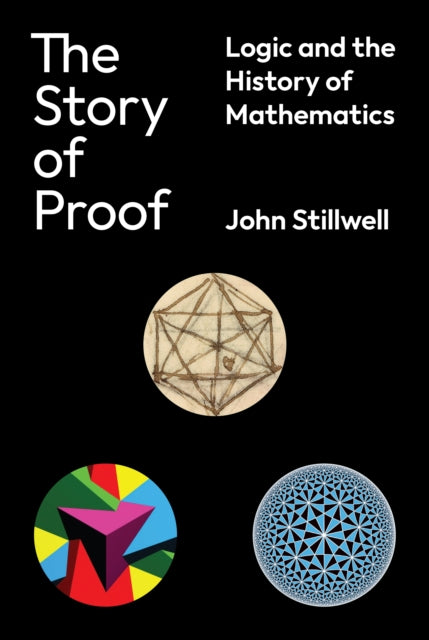
Princeton University Press The Story of Proof
Book SynopsisTrade Review"This book could well serve as a history of mathematics. … [Stillwell] has done an amazing job of collecting and categorizing many of the most important ideas in this area."---Jim Stein, New Books in Mathematics"Stillwell’s [The Story of Proof] joins his two other Princeton University Press books in having my highest recommendation. I just wish they had been around when I was a student."---George Hacken, Computing Reviews"I hugely enjoyed this book."---Jonathan Shock, Mathemafrica"This book would be perfect for any keen undergraduate, keen amateur, or indeed a teacher of mathematics, who wants a book to dip into to use for the classroom."---Jonathan Shock, Mathemafrica"A well-crafted, thought-provoking meditation on the concept of proof in mathematics. . . .It is a substantive book that deserves to be read and reflected upon."---Tommy Murphy, Irish Mathematical Society Bulletin"This is a work that mathematicians, historians, and philosophers will find especially engaging, as will anyone with a serious interest in mathematics and the limits of certainty that it is constantly probing."---J.W. Dauben, Choice
£34.20

Wooden Books Mathematical Functions
Book SynopsisWhat is a mathematical function? Why are they so important? How does plotting the graph of a function help us understand it? And where do gradients, differentials and calculus fit in? In this unique little book, packed with equations and their graphs, mathematics teacher Oliver Linton reveals the secrets of polynomial functions, polar functions, inverse functions, complex functions, vector functions and many more. Lines will never look the same again!Trade ReviewWooden Books are: "Fascinating" FINANCIAL TIMES. "Beautiful" LONDON REVIEW OF BOOKS. "Rich and Artful" THE LANCET. "Genuinely mind-expanding" FORTEAN TIMES. "Excellent" NEW SCIENTIST. "Stunning" NEW YORK TIMES. Small books, big ideas.
£8.18
Motilal Banarsidass, Vedic Mathematics
Book Synopsis
£15.52

HarperCollins Publishers Collins GCSE Revision and Practice New 2015
Book SynopsisExam Board: AQALevel: GCSE 9-1Subject: Maths FoundationSuitable for the 2025 examsComplete revision and practice to fully prepare for the GCSE grade 9-1 examsRevision that Sticks! Collins AQA GCSE 9-1 Maths Foundation Complete All-in-One Revision and Practice uses a revision method that really works: repeated practice throughout.A revision guide, workbook and practice paper in one book!With clear and concise revision for every topic, plus seven practice opportunities, Collins offers the best revision at the best price.For even more practice QR codes link directly from the topics in the revision guide to online interactive quick recall quizzes and to worked solution videos in the workbook.Includes: grading guidance on the page to indicate different levels quick tests as you go end-of-topic practice questions topic review questions later in the book mixed practice questions at the end of the book more topic-by-topic practice in the workbook a complete exam-style paper online quick recallTrade ReviewI have received the books and they look fantastic! I found them to be very thorough but not too overwhelming at the same time with regards to each topic on a double spread. I liked the glossary section too which helps students become more confident with using mathematical vocabulary, and the exam practice section also! I thought the inclusion of the mixed exam practice questions were a nice way for students to revisit topics that they may have encountered a while ago.Ama DicksonMaths Crunch Content Creator and Maths teacher@mathscrunch
£10.44

HarperCollins Publishers Gunpowder and Geometry The Life of Charles Hutton
Book SynopsisAugust, 1755. Newcastle, on the north bank of the Tyne.In the fields, men and women are getting the harvest in. Sunlight, or rain. Scudding clouds and backbreaking labour. Three hundred feet underground, young Charles Hutton is at the coalface. Cramped, dust-choked, wielding a five-pound pick by candlelight. Eighteen years old, he's been down the pits on and off for more than a decade, and now it looks like a life sentence. No unusual story, although Charles is a clever lad gifted at maths and languages and for a time he hoped for a different life. Many hoped.Charles Hutton, astonishingly, would actually live the life he dreamed of. Twenty years later you'd have found him in Slaughter's coffee house in London, eating a few oysters with the President of the Royal Society.By the time he died, in 1823, he was a fellow of scientific academies in four countries, while the Lord Chancellor of England counted himself fortunate to have known him. Hard work, talent, and no small share of luck Trade ReviewPraise for Gunpowder and Geometry ‘Benjamin Wardhaugh tells an almost incredible story of a boy working down the put hewing coal who went on to become a great mathmatician and national celebrity. He brings both the coal industry and Georgian London to life with style and wit.’ Matt Ridley Praise for Benjamin Wardhaugh: ‘Wardhaugh has done a brilliant job in revealing a most curious period in British life’ Steve Craggs, Northern Echo ‘Mathematics remains a bedrock of our society. This wonderful book goes a long way in highlighting why.’ Jamie Condliffe, New Scientist ‘Wardhaugh's fascinating account of Poor Robin's Almanac persuasively reveals the power of the almanac to give mathematics a human face.’ Marcus du Sautoy ‘Wardhaugh's book should be readily available and kept with your personal reference books. It should also be in your school library.’ Donald Cook, Mathematical Review
£9.49

HarperCollins Publishers The Times Kakuro Book 2
Book Synopsis
£7.59

McGraw-Hill Education - Europe Schaums Outline of Advanced Mathematics for
Book SynopsisTough Test Questions? Missed Lectures? Not Enough Time?Fortunately for you, there's Schaum's.More than 40 million students have trusted Schaum's Outlines to help them succeed in the classroom and on exams. Schaum's is the key to faster learning and higher grades in every subject. Each Outline presents all the essential course information in an easy-to-follow, topic-by-topic format. You also get hundreds of examples, solved problems, and practice exercises to test your skills. This Schaum's Outline gives you: Practice problems with full explanations that reinforce knowledge Coverage of the most up-to-date developments in your course field In-depth review of practices and applications Fully compatible with your classroom text, Schaum's highlights all the important facts you need to know. Use Schaum's to shorten your study time-and get your best test scores!Schaum's Outlines-Problem Solved.Table of Contents Schaum's Outline of Advanced Mathematics for Engineers and Scientists 1.Review of Fundamental Concepts 2.Ordinary Differential Equations 3.Linear Differential Equations 4.LaPlace Transforms 5.Vector Analysis 6.Multiple Line and Surface Integrals and Integral Theorems 7.Fourier Series 8.Fourier Integrals 9.Partial Differential Equations 10. Complex Variables and Conformal Mapping 11. Complex Inversion Formula for Laplace Transforms 12. Matrices 13. Calculus of Variations
£16.19

McGraw-Hill Education - Europe Schaums Easy Outline of Mathematical Handbook of
Book SynopsisIf you are looking for a quick nuts-and-bolts overview, turn to Schaum's Easy Outlines!Schaum's Easy Outline of Mathematical Handbook of Formulas and Tables is a pared-down, simplified, and tightly focused review of the topic. With an emphasis on clarity and brevity, it features a streamlined and updated format and the absolute essence of the subject, presented in a concise and readily understandable form. Graphic elements such as sidebars, reader-alert icons, and boxed highlights stress selected points from the text, illuminate keys to learning, and give you quick pointers to the essentials. Expert tips for mastering math formulas Last-minute essentials to pass the course Complete index to all topics Appropriate for the following courses: College Mathematics, Numerical Analysis, Calculus, Calculus II, Calculus III, Differential Equations, Probability and Statistics Clear and concise explanations of all procedures Formulas and tables f
£14.24

Oxford University Press Edexcel A Level Maths Year 1 and 2 Bridging
Book SynopsisThis Student Book is suitable for any student studying:Exam Board: Edexcel Level and subject: A Level MathsFirst teaching: 2017Endorsed for Edexcel, this Student Book provides full support for A Level Maths (2017 specification). Bridging units at the start of each Year 1 chapter provide the perfect springboard to support students in their transition from GCSE. Concise recap sections and abundant fluency-style questions ensure the whole class can be brought to the same level of readiness for A Level. The main chapters cover the full specification across pure, mechanics and statistics. Clear and concise explanations are supported by extensive worked examples showing key techniques and common pitfalls. For each topic, students can check their understanding with a fluency-style exercise before advancing to a dedicated problem-solving exercise. This Student Book supports the major changes in assessment style for the 2017 specification, with an assessment at the end of each chapter written i
£65.91

Oxford University Press AQA A Level Maths Year 1 AS Level Bridging
Book SynopsisThis Student Book is suitable for any student studying: Exam Board: AQA Level and subject: AS/A Level Maths First teaching: 2017 Approved by AQA, this Student Book provides full support for AS Level Maths and Year 1 of the full A Level (2017 specification). Bridging units at the start of each chapter provide the perfect springboard to support students in their transition from GCSE. Concise recap sections and abundant fluency-style questions ensure the whole class can be brought to the same level of readiness for A Level.The main chapters cover the full AS specification across pure, mechanics and statistics. Clear and concise explanations are supported by extensive worked examples showing key techniques and common pitfalls. For each topic, students can check their understanding with a fluency-style exercise before advancing to a dedicated problem-solving exercise. This book supports the major changes in assessment style for the 2017 specification, with an assessment at the end of each c
£42.14

Oxford University Press Discrete Mathematics
Book SynopsisBiggs'' Discrete Mathematics has been a best-selling textbook since the first and revised editions were published in 1986 and 1990, respectively. This second edition has been developed in response to undergraduate course changes and changes in students'' needs. New to this edition are chapters on statements and proof, logical framework, and natural numbers and the integers, in addition to updated chapters from the previous edition. The new chapters are presented at a level suitable for mathematics and computer science students seeking a first approach to this broad and highly relevant topic. Each chapter contains newly developed tailored exercises, and miscellaneous exercises are presented throughout, providing the student with over 1000 individual tailored exercises. This edition is accompanied by a website www.oup.com/mathematics/discretemath containing hints and solutions to all exercises presented in the text, providing an invaluable resource for students and lecturers alike. The bTrade ReviewThis is a new edition of a successful textbook ... this revision is particularly welcome ... The text is written in a fluent but rigorous style and should appeal to sixthformers and undergraduates who are alienated by more formal presentations. There are plenty of approachable exercises, ranging from easy riders to establish technique to more challenging problems which introduce new ideas, and a bonus is that all the answers are available on a companion web-site. I can thoroughly recommend this text. * The Mathematical Gazette *A well known definition says that a textbook is a book such that everybody thinks he can write a better one. Biggs' Discrete Mathematics is an exception - not only for its wide range of topics and its clear organization but notably for its excellent style of explanation. * EMS *... the ideal choice for introductory courses to discrete mathematicians. * Zentralblatt MATH *Table of ContentsTHE LANGUAGE OF MATHEMATICS; TECHNIQUES; ALGORITHMS AND GRAPHS; ALGEBRAIC METHODS
£62.70

Oxford University Press Combinatorics
Book SynopsisHow many possible sudoku puzzles are there? In the lottery, what is the chance that two winning balls have consecutive numbers? Who invented Pascal''s triangle? (it was not Pascal)Combinatorics, the branch of mathematics concerned with selecting, arranging, and listing or counting collections of objects, works to answer all these questions. Dating back some 3000 years, and initially consisting mainly of the study of permutations and combinations, its scope has broadened to include topics such as graph theory, partitions of numbers, block designs, design of codes, and latin squares. In this Very Short Introduction Robin Wilson gives an overview of the field and its applications in mathematics and computer theory, considering problems from the shortest routes covering certain stops to the minimum number of colours needed to colour a map with different colours for neighbouring countries.ABOUT THE SERIES: The Very Short Introductions series from Oxford University Press contains hundreds of titles in almost every subject area. These pocket-sized books are the perfect way to get ahead in a new subject quickly. Our expert authors combine facts, analysis, perspective, new ideas, and enthusiasm to make interesting and challenging topics highly readable.Trade ReviewClear and beautifully written ... this book is much more than a simple introduction ... [Its] great strength is that while examining a number of important concepts in detail, the author does so ... without using complicated abstract formulae. * Mathematics Today *Table of Contents1: What is combinatorics? 2: Four types of problem 3: Permutations and combinations 4: A combinatorial zoo 5: Tilings and polyhedra 6: Graphs 7: Square arrays 8: Designs and geometry 9: Partitions Further Reading Index
£9.49
Oxford University Press Mathematical Finance
Book SynopsisIn recent years the finance industry has mushroomed to become an important part of modern economies, and many science and engineering graduates have joined the industry as quantitative analysts, with mathematical and computational skills that are needed to solve complex problems of asset valuation and risk management. An important parallel story exists of scientific endeavour. Between 1965-1995, insightful ideas in economics about asset valuation were turned into a mathematical ''theory of arbitrage'', an enterprise whose first achievement was the famous 1973 Black-Scholes formula, followed by extensive investigations using all the resources of modern analysis and probability. The growth of the finance industry proceeded hand-in-hand with these developments. Now new challenges arise to deal with the fallout from the 2008 financial crisis and to take advantage of new technology, which has revolutionized the practice of trading. This Very Short Introduction introduces readers with no previous background in this area to arbitrage theory and why it works the way it does. Illuminating pricing theory, Mark Davis explains its applications to interest rates, credit trading, fund management and risk management. He concludes with a survey of the most pressing issues in mathematical finance today.ABOUT THE SERIES: The Very Short Introductions series from Oxford University Press contains hundreds of titles in almost every subject area. These pocket-sized books are the perfect way to get ahead in a new subject quickly. Our expert authors combine facts, analysis, perspective, new ideas, and enthusiasm to make interesting and challenging topics highly readable.Trade ReviewOnly a scholar of the highest order could provide the depth, breadth, clarity, precision, and brevity to be found in this work. Enjoy the resulting gem. * Dilip B. Madan, Professor of Finance, Robert H. Smith School of Business *This elegant little book will enthral readers looking for a clear sense of what mathematical finance is all about. Each chapter captures the essential ideas within a different aspect of the subject, without burying readers in abstruse models. Davis knows the subject so well, from both the mathematical and practical viewpoints, that he can make it accessible, relevant, and correct, all at the same time. * Darrell Duffie, Dean Witter Distinguished Professor of Finance, Stanford University *With concise explanations of the most important financial mathematical correlations and the mathematical formulas necessary for them, this book represents a successful very short introduction into this complex topic. * zbMATH *Table of ContentsPreface 1: Money, banking, and financial markets 2: Quantifying risks 3: The classical theory of option pricing 4: Interest rates 5: Credit risk 6: Fund management 7: Risk management 8: The banking crisis and its aftermatch Epilogue Further reading Index
£9.49
Oxford University Press Number Theory
Book SynopsisNumber theory is the branch of mathematics primarily concerned with the counting numbers, especially primes. It dates back to the ancient Greeks, but today it has great practical importance in cryptography, from credit card security to national defence. This book introduces the main areas of number theory, and some of its most interesting problems.Table of ContentsList of illustrations List of tables 1: What is number theory? 2: Divisibility 3: Primes I 4: Congruences I 5: Diophantine equations 6: Congruences II 7: Primes II 8: The Riemann hypothesis Appendix Further reading Index
£9.49

Oxford University Press Systems Biology
Book SynopsisSystems biology came about as growing numbers of engineers and scientists from other fields created algorithms which supported the analysis of biological data in incredible quantities. Whereas biologists of the past had been forced to study one item or aspect at a time, due to technical and biological limitations, it suddenly became possible to study biological phenomena within their natural contexts. This interdisciplinary field offers a holistic approach to interpreting these processes, and has been responsible for some of the most important developments in the science of human health and environmental sustainability. This Very Short Introduction outlines the exciting processes and possibilities in the new field of systems biology. Eberhard O. Voit describes how it enabled us to learn how intricately the expression of every gene is controlled, how signaling systems keep organisms running smoothly, and how complicated even the simplest cells are. He explores what this field is about, why it is needed, and how it will affect our understanding of life, particularly in the areas of personalized medicine, drug development, food and energy production, and sustainable stewardship of our environments. Throughout he considers how new tools are being provided from the fields of mathematics, computer science, engineering, physics, and chemistry to grasp the complexity of the countless interacting processes in cells which would overwhelm the cognitive and analytical capabilities of the human mind. ABOUT THE SERIES: The Very Short Introductions series from Oxford University Press contains hundreds of titles in almost every subject area. These pocket-sized books are the perfect way to get ahead in a new subject quickly. Our expert authors combine facts, analysis, perspective, new ideas, and enthusiasm to make interesting and challenging topics highly readable.Table of ContentsAcknowledgments 1: What is systems biology all about? 2: The exciting puzzles of computational systems biology 3: The -omics revolution 4: Computational systems biology (CSB) 5: Interdependencies of biological systems 6: Simulators 7: The lawless pursuit of biological systems References Further reading Index
£9.49
Oxford University Press Morality and Mathematics
Book SynopsisTo what extent are the subjects of our thoughts and talk real? This is the question of realism. In this book, Justin Clarke-Doane explores arguments for and against moral realism and mathematical realism, how they interact, and what they can tell us about areas of philosophical interest more generally. He argues that, contrary to widespread belief, our mathematical beliefs have no better claim to being self-evident or provable than our moral beliefs. Nor do our mathematical beliefs have better claim to being empirically justified than our moral beliefs. It is also incorrect that reflection on the genealogy of our moral beliefs establishes a lack of parity between the cases. In general, if one is a moral antirealist on the basis of epistemological considerations, then one ought to be a mathematical antirealist as well. And, yet, Clarke-Doane shows that moral realism and mathematical realism do not stand or fall together -- and for a surprising reason. Moral questions, insofar as they arTrade ReviewReview from previous edition Morality and Mathematics is an outstanding achievement and will be a standard point of reference for future work on the topics of which it treats. * Hallvard Lillehammer, International Journal for the Study of Skepticism *Clarke-Doane ... brings remarkable expertise and ... research to [this project]. The main argument [is] copiously defended in this lucid but highly technical treatise. ... Underlying [the argument] is the important distinction between realism and objectivity. * Sheila Mason, CHOICE *Clarke-Doane's book offers a coherent and plausible set of answers to the notorious epistemological questions provoked by morality, and to the analogous questions that are provoked by mathematics. It is striking for its creativity, its rigorous arguments, its many subtle but important distinctions, its unusual breadth of expertise (covering the philosophy of language, metaphysics, epistemology, philosophy of mathematics, and meta-ethics), and its rational control of a daunting battery of interacting considerations from these various branches of the subject. Exceptionally impressive philosophical talent and maturity are on display here. Needless to say, we probably haven't yet been given the final truth about these matters. But it's certain that anyone aiming to do better will have to grapple with Clarke-Doane's formidable arguments and conclusions. * Paul Horwich, New York University *Justin Clarke-Doane raises fascinating and important issues about evolutionary debunking arguments. He argues that insofar as our knowledge of the evolutionary origins of morality poses a challenge for moral realism, exactly similar difficulties will arise for mathematical realism. * Matthew Braddock, Andreas Mogensen, and Walter Sinnott-Armstrong, PEASoup *Clarke-Doane's overarching metaphilosophical conclusion ... is ... that across a large range of philosophical debates ... the real philosophical questions are not metaphysical ... but practical, about which concepts to use. ... [W]e are left with a purely practical question of which framework to pick, which cannot itself be justified by appeal to more normativity. ...[P]erhaps a monist response can be afforded via an adaptation of Quine's response to Carnap. ... But whether or not this response ... can be made to fly, Clarke-Doane's achievement ... is substantial. ... [I]ncreased specialization makes serious engagement across subfields of philosophy a challenge. Morality and Mathematics rises to this challenge, and will serve as a springboard to further serious engagement across the subdisciplines * Mary Leng, Mind *This excellent book ... compares morality and mathematics. Their similarities and differences are not what one might naively supposee, as the author demonstrates. The book is highly recommended to philosophers interested in both subjects, and to anyone who seeks a global understanding of how morality and mathematics fit into our belief system. ... The idea that practical questions alone resist deflation in the face of pluralist ... realism ... facilitated by the tension between realism and objectivity ... mak[es] ... for a rather striking metaphilosophical vision. * Michael Bevan & Alexander Paseau, Philosophia Mathematica *In this brilliantly original book, Justin Clarke-Doane ... has upended many long-held views on morality and mathematics. ... Accept it or reject it, it manifests Clarke-Doane's extraordinary combination of philosophical imagination and logical skill, and what I have discussed in this review is only a small sample of the philosophical gold to be found in his book. * David Gordon, Philosophical Quarterly *Table of ContentsIntroduction 1: Realism, Ontology, and Objectivity 2: Self-Evidence, Proof, and Disagreement 3: Observation and Indispensability 4: Genealogical Debunking Arguments 5: Explaining our Reliability 6: Realism, Objectivity, and Evaluation Conclusion
£999.99

Oxford University Press Networks
Book SynopsisFrom ecosystems to Facebook, from the Internet to the global financial market, some of the most important and familiar natural systems and social phenomena are based on a networked structure. It is impossible to understand the spread of an epidemic, a computer virus, large-scale blackouts, or massive extinctions without taking into account the network structure that underlies all these phenomena.In this Very Short Introduction, Guido Caldarelli and Michele Catanzaro discuss the nature and variety of networks, using everyday examples from society, technology, nature, and history to explain and understand the science of network theory. They show the ubiquitous role of networks; how networks self-organize; why the rich get richer; and how networks can spontaneously collapse. They conclude by highlighting how the findings of complex network theory have very wide and important applications in genetics, ecology, communications, economics, and sociology. ABOUT THE SERIES: The Very Short Introductions series from Oxford University Press contains hundreds of titles in almost every subject area. These pocket-sized books are the perfect way to get ahead in a new subject quickly. Our expert authors combine facts, analysis, perspective, new ideas, and enthusiasm to make interesting and challenging topics highly readable.Table of Contents1. A network point of view on the world ; 2. A fruitful approach ; 3. A world of networks ; 4. Connected and close ; 5. Superconnectors ; 6. Emergence of networks ; 7. Digging deeper into networks ; 8. Perfect storms on networks ; 9. All the world's a net. Or not? ; Further reading
£9.49
Oxford University Press Fractals
Book SynopsisMany are familiar with the beauty and ubiquity of fractal forms within nature. Unlike the study of smooth forms such as spheres, fractal geometry describes more familiar shapes and patterns, such as the complex contours of coastlines, the outlines of clouds, and the branching of trees. In this Very Short Introduction, Kenneth Falconer looks at the roots of the ''fractal revolution'' that occurred in mathematics in the 20th century, presents the ''new geometry'' of fractals, explains the basic concepts, and explores the wide range of applications in science, and in aspects of economics.This is essential introductory reading for students of mathematics and science, and those interested in popular science and mathematics.ABOUT THE SERIES: The Very Short Introductions series from Oxford University Press contains hundreds of titles in almost every subject area. These pocket-sized books are the perfect way to get ahead in a new subject quickly. Our expert authors combine facts, analysis, perspective, new ideas, and enthusiasm to make interesting and challenging topics highly readable.Trade ReviewFractals: A Very Short Introduction is an obvious starting point for lay readers interested in fractals. It presents the key ideas and explains their context and significance, while introducing and using some very basic mathematics. * Danny Yee's Book Reviews *a most enjoyable, 'short read' * Institute of Mathematics *[A] very well-written introduction to fractals for non-specialists ... Highly recommended. * CHOICE *Table of ContentsPreface ; 1. The fractal concept ; 2. Self-similarity ; 3. Fractal dimension ; 4. Julia sets and the Mandelbrot set ; 5. Random walks and Brownian motion ; 6. Fractals in the real world ; 7. A little history ; Further reading
£9.49

The University of Chicago Press Thinking Through Statistics
Book SynopsisA guide to using statistics properly in social science.
£29.45

MIT Press Ltd Essential Logic for Computer Science The MIT
Book SynopsisAn introduction to applying predicate logic to testing and verification of software and digital circuits that focuses on applications rather than theory.Computer scientists use logic for testing and verification of software and digital circuits, but many computer science students study logic only in the context of traditional mathematics, encountering the subject in a few lectures and a handful of problem sets in a discrete math course. This book offers a more substantive and rigorous approach to logic that focuses on applications in computer science. Topics covered include predicate logic, equation-based software, automated testing and theorem proving, and large-scale computation. Formalism is emphasized, and the book employs three formal notations: traditional algebraic formulas of propositional and predicate logic; digital circuit diagrams; and the widely used partially automated theorem prover, ACL2, which provides an accessible introduction to mechanized formalism
£43.20

MIT Press Ltd Introduction to Online Convex Optimization Second
Book SynopsisNew edition of a graduate-level textbook on that focuses on online convex optimization, a machine learning framework that views optimization as a process.In many practical applications, the environment is so complex that it is not feasible to lay out a comprehensive theoretical model and use classical algorithmic theory and/or mathematical optimization. Introduction to Online Convex Optimization presents a robust machine learning approach that contains elements of mathematical optimization, game theory, and learning theory: an optimization method that learns from experience as more aspects of the problem are observed. This view of optimization as a process has led to some spectacular successes in modeling and systems that have become part of our daily lives. Based on the “Theoretical Machine Learning” course taught by the author at Princeton University, the second edition of this widely used graduate level text features:Thoroughly updat
£51.30
Yale University Press Mathematica
Book Synopsis
£12.99

Taylor & Francis Ltd The Psychology of Prejudice
Book SynopsisWhy do we develop extreme attitudes to others? Can our personality contribute to our prejudices? How do we reduce prejudice and discrimination?The Psychology of Prejudice explores different forms of prejudice and discrimination, from racial jokes to genocide. It looks at what might cause our prejudiced attitudes, including our personalities, social influences, group identity, and evolutionary factors, and how prejudice can be reduced through education, campaigning, and consciousness raising.Offering insights into a topic of great public concern and debate, The Psychology of Prejudice shows us how we can confront our prejudiced attitudes and contribute to greater tolerance and understanding.Table of Contents1. What do we mean by ‘Prejudice’? 2. Prejudice within Biology, Psychology and Psychiatry 3. Prejudice and Personality 4. The Impact of Environmental Factors on Prejudice and Discrimination 5. The Influence of Group Membership 6. Reducing Prejudice and Discrimination
£15.58

Taylor & Francis Ltd PCI Compliance
Book SynopsisThe Payment Card Industry Data Security Standard (PCI DSS) is now in its 18th year, and it is continuing to dominate corporate security budgets and resources. If you accept, process, transmit, or store payment card data branded by Visa, MasterCard, American Express, Discover, or JCB (or their affiliates and partners), you must comply with this lengthy standard.Personal data theft is at the top of the list of likely cybercrimes that modern-day corporations must defend against. In particular, credit or debit card data is preferred by cybercriminals as they can find ways to monetize it quickly from anywhere in the world. Is your payment processing secure and compliant? The new Fifth Edition of PCI Compliance has been revised to follow the new PCI DSS version 4.0, which is a complete overhaul to the standard. Also new to the Fifth Edition are: additional case studies and clear guidelines and instructions for maintaining PCI compliance globally, including coverage of technoTable of ContentsForeword. Acknowledgments. Authors. Chapter 1 About PCI DSS and This Book. Chapter 2 Introduction to Fraud, Identity Theft, and Related Regulatory Mandates. Chapter 3 Why Is PCI Here? Chapter 4 Determining and Reducing Your PCI Scope. Chapter 5 Building and Maintaining a Secure Network. Chapter 6 Strong Access Controls. Chapter 7 Protecting Cardholder Data. Chapter 8 Using Wireless Networking. Chapter 9 Vulnerability Management. Chapter 10 Logging Events and Monitoring the Cardholder Data Environment. Chapter 11 Cloud and Virtualization. Chapter 12 Mobile. Chapter 13 PCI for the Small Business. Chapter 14 PCI DSS for the Service Provider. Chapter 15 Managing a PCI DSS Project to Achieve Compliance. Chapter 16 Don’t Fear the Assessor. Chapter 17 The Art of Compensating Control. Chapter 18 You’re Compliant, Now What? Chapter 19 Emerging Technology and Alternative Payment Schemes. Chapter 20 PCI DSS Myths and Misconceptions. Chapter 21 Final Thoughts. Index by Requirement. Alphabetical Index.
£40.84

Springer-Verlag New York Inc. Stochastic Calculus for Finance I
Book Synopsis1 The Binomial No-Arbitrage Pricing Model.- 1.1 One-Period Binomial Model.- 1.2 Multiperiod Binomial Model.- 1.3 Computational Considerations.- 1.4 Summary.- 1.5 Notes.- 1.6 Exercises.- 2 Probability Theory on Coin Toss Space.- 2.1 Finite Probability Spaces.- 2.2 Random Variables, Distributions, and Expectations.- 2.3 Conditional Expectations.- 2.4 Martingales.- 2.5 Markov Processes.- 2.6 Summary.- 2.7 Notes.- 2.8 Exercises.- 3 State Prices.- 3.1 Change of Measure.- 3.2 Radon-Nikodým Derivative Process.- 3.3 Capital Asset Pricing Model.- 3.4 Summary.- 3.5 Notes.- 3.6 Exercises.- 4 American Derivative Securities.- 4.1 Introduction.- 4.2 Non-Path-Dependent American Derivatives.- 4.3 Stopping Times.- 4.4 General American Derivatives.- 4.5 American Call Options.- 4.6 Summary.- 4.7 Notes.- 4.8 Exercises.- 5 Random Walk.- 5.1 Introduction.- 5.2 First Passage Times.- 5.3 Reflection Principle.- 5.4 Perpetual American Put: An Example.- 5.5 Summary.- 5.6 Notes.- 5.7 Exercises.- 6 Interest-Rate-DTable of Contents1. The Binomial No-Arbitrage Pricing Model 1.1. One-Period Binomial Model 1.2. Multiperiod Binomial Model 1.3. Computational Considerations 1.4. Summary 1.5. Notes 1.6. Exercises 2. Probability Theory on Coin Toss Space 2.1. Finite Probability Spaces 2.2. Random Variables, Distributions, and Expectations 2.3. Conditional Expectations 2.4. Martingales 2.5. Markov Processes 2.6. Summary 2.7. Notes 2.8. Exercises 3. State Prices 3.1. Change of Measure 3.2. Radon-Nikod\'ym Derivative Process 3.3. Capital Asset Pricing Model 3.4. Summary 3.5. Notes 3.6. Exercises 4. American Derivative Securities 4.1. Introduction 4.2. Non-Path-Dependent American Derivatives 4.3. Stopping Times 4.4. General American Derivatives 4.5. American Call Options 4.6. Summary 4.7. Notes 4.8. Exercises 5. Random Walk 5.1. Introduction 5.2. First Passage Times 5.3. Reflection Principle 5.4. Perpetual American Put: An Example 5.5. Summary 5.6. Notes 5.7. Exercises 6. Interest-Rate-Dependent Assets 6.1. Introduction 6.2. Binomial Model for Interest Rates 6.3. Fixed-Income Derivatives 6.4. Forward Measures 6.5. Futures 6.6. Summary 6.7. Notes 6.8. Exercises Proof of Fundamental Properties of Conditional Expectations References Index
£49.49
Springer-Verlag New York Inc. Introduction to Analytic Number Theory
Book SynopsisHistorical Introduction.- 1 The Fundamental Theorem of Arithmetic.- 2 Arithmetical Functions and Dirichlet Multiplication.- 3 Averages of Arithmetical Functions.- 4 Some Elementary Theorems on the Distribution of Prime Numbers.- 5 Congruences.- 6 Finite Abelian Groups and Their Characters.- 7 Dirichlet's Theorem on Primes in Arithmetic Progressions.- 8 Periodic Arithmetical Functions and Gauss Sums.- 9 Quadratic Residues and the Quadratic Reciprocity Law.- 10 Primitive Roots.- 11 Dirichlet Series and Euler Products.- 12 The Functions ?(s) and L(s, ?).- 13 Analytic Proof of the Prime Number Theorem.- 14 Partitions.- Index of Special Symbols.Trade ReviewFrom the reviews:T.M. ApostolIntroduction to Analytic Number Theory"This book is the first volume of a two-volume textbook for undergraduates and is indeed the crystallization of a course offered by the author at the California Institute of Technology to undergraduates without any previous knowledge of number theory. For this reason, the book starts with the most elementary properties of the natural integers. Nevertheless, the text succeeds in presenting an enormous amount of material in little more than 300 pages. The presentation is invariably lucid and the book is a real pleasure to read."—MATHEMATICAL REVIEWS“After reading Introduction to Analytic Number Theory one is left with the impression that the author, Tom M. Apostal, has pulled off some magic trick. … I must admit that I love this book. The selection of topics is excellent, the exposition is fluid, the proofs are clear and nicely structured, and every chapter contains its own set of … exercises. … this book is very readable and approachable, and it would work very nicely as a text for a second course in number theory.” (Álvaro Lozano-Robledo, The Mathematical Association of America, December, 2011)Table of Contents1: The Fundamental Theorem of Arithmetic. 2: Arithmetical Functions and Dirichlet Multiplication. 3: Averages of Arithmetical Function. 4: Some Elementary Theorems on the Distribution of Prime Numbers. 5: Congruences. 6: Finite Abelian Groups and Their Characters. 7: Cirichlet's Theorem on Primes in Arithmetic Progressions. 8: Periodic Arithmetical Functions and Gauss Sums. 9: Quadratic Residues and the Quadratic Reciprocity Law. 10: Primitive Roots. 11: Dirichlet Series and Euler Products. 12: The Functions. 13: Analytic Proof of the Prime Number Theorem. 14: Partitions.
£46.99

Springer-Verlag New York Inc. Basic Business Statistics A Casebook Textbooks in
Book SynopsisPreface Statistics is seldom the most eagerly anticipated course of a business student. Our goal in writing this casebook and the companion volume (Business Analysis Using Regression) was to change that impression by showing how statistics yields insights and answers interesting business questions.Trade Review"The manuscripts are divided into "classes" which tackle various statistical concepts. Material becomes increasingly complex as the data in later sections exhibit multiple deviations from ideal conditions. The casebooks use a combination of explanatory text and software output to guide the student. Almost no mathematics appears in these volumes; the authors make traditional texts available to their students who are curious about the technical details...I anticipate students will wholeheartedly endorse the FSW casebooks. The material is easy to digest as, for instance, the authors cleverly interweave probability, the standard error of the mean, and control charts. The casebooks effectively relay the message that statistics is relevant and doable. Ideally, that is the message that should be sent in all introductory business statistics courses." Marlene Smith, University of Colorado-DenverTable of ContentsOverview and Foundations * Statistical Summaries of Data * Sources of Variation * Standard Error * Confidence Intervals * Sampling * Making Decisions * Designing Tests for Better Comparisons * Confounding Effects in Tests: A Case Study * Covariance, Correlation, and Portfolios * A Preview of Regression
£48.74

John Wiley & Sons Inc A History of Mathematics
Book SynopsisThe updated new edition of the classic and comprehensive guide to the history of mathematics For more than forty years, A History of Mathematics has been the reference of choice for those looking to learn about the fascinating history of humankind s relationship with numbers, shapes, and patterns.Trade Review"... the book is an essential reference that will help you explore the incredible history of mathematics and the men and women who created it." (Zentralblatt MATH, 2016) "... an 'engaging' read for the mathematically minded." (Inside OR, June 2011)Table of ContentsForeword by Isaac Asimov xi Preface to the Third Edition xiii Preface to the Second Edition xv Preface to the First Edition xvii 1 Traces 1 Concepts and Relationships 1 Early Number Bases 3 Number Language and Counting 5 Spatial Relationships 6 2 Ancient Egypt 8 The Era and the Sources 8 Numbers and Fractions 10 Arithmetic Operations 12 “Heap” Problems 13 Geometric Problems 14 Slope Problems 18 Arithmetic Pragmatism 19 3 Mesopotamia 21 The Era and the Sources 21 Cuneiform Writing 22 Numbers and Fractions: Sexagesimals 23 Positional Numeration 23 Sexagesimal Fractions 25 Approximations 25 Tables 26 Equations 28 Measurements: Pythagorean Triads 31 Polygonal Areas 35 Geometry as Applied Arithmetic 36 4 Hellenic Traditions 40 The Era and the Sources 40 Thales and Pythagoras 42 Numeration 52 Arithmetic and Logistic 55 Fifth-Century Athens 56 Three Classical Problems 57 Quadrature of Lunes 58 Hippias of Elis 61 Philolaus and Archytas of Tarentum 63 Incommensurability 65 Paradoxes of Zeno 67 Deductive Reasoning 70 Democritus of Abdera 72 Mathematics and the Liberal Arts 74 The Academy 74 Aristotle 88 5 Euclid of Alexandria 90 Alexandria 90 Lost Works 91 Extant Works 91 The Elements 93 6 Archimedes of Syracuse 109 The Siege of Syracuse 109 On the Equilibriums of Planes 110 On Floating Bodies 111 The Sand-Reckoner 112 Measurement of the Circle 113 On Spirals 113 Quadrature of the Parabola 115 On Conoids and Spheroids 116 On the Sphere and Cylinder 118 Book of Lemmas 120 Semiregular Solids and Trigonometry 121 The Method 122 7 Apollonius of Perge 127 Works and Tradition 127 Lost Works 128 Cycles and Epicycles 129 The Conics 130 8 Crosscurrents 142 Changing Trends 142 Eratosthenes 143 Angles and Chords 144 Ptolemy’s Almagest 149 Heron of Alexandria 156 The Decline of Greek Mathematics 159 Nicomachus of Gerasa 159 Diophantus of Alexandria 160 Pappus of Alexandria 164 The End of Alexandrian Dominance 170 Proclus of Alexandria 171 Boethius 171 Athenian Fragments 172 Byzantine Mathematicians 173 9 Ancient and Medieval China 175 The Oldest Known Texts 175 The Nine Chapters 176 Rod Numerals 177 The Abacus and Decimal Fractions 178 Values of Pi 180 Thirteenth-Century Mathematics 182 10 Ancient and Medieval India 186 Early Mathematics in India 186 The Sulbasutras 187 The Siddhantas 188 Aryabhata 189 Numerals 191 Trigonometry 193 Multiplication 194 Long Division 195 Brahmagupta 197 Indeterminate Equations 199 Bhaskara 200 Madhava and the Keralese School 202 11 The Islamic Hegemony 203 Arabic Conquests 203 The House of Wisdom 205 Al-Khwarizmi 206 ‘Abd Al-Hamid ibn-Turk 212 Thabit ibn-Qurra 213 Numerals 214 Trigonometry 216 Tenth- and Eleventh-Century Highlights 216 Omar Khayyam 218 The Parallel Postulate 220 Nasir al-Din al-Tusi 220 Al-Kashi 221 12 The Latin West 223 Introduction 223 Compendia of the Dark Ages 224 Gerbert 224 The Century of Translation 226 Abacists and Algorists 227 Fibonacci 229 Jordanus Nemorarius 232 Campanus of Novara 233 Learning in the Thirteenth Century 235 Archimedes Revived 235 Medieval Kinematics 236 Thomas Bradwardine 236 Nicole Oresme 238 The Latitude of Forms 239 Infinite Series 241 Levi ben Gerson 242 Nicholas of Cusa 243 The Decline of Medieval Learning 243 13 The European Renaissance 245 Overview 245 Regiomontanus 246 Nicolas Chuquet’s Triparty 249 Luca Pacioli’s Summa 251 German Algebras and Arithmetics 253 Cardan’s Ars Magna 255 Rafael Bombelli 260 Robert Recorde 262 Trigonometry 263 Geometry 264 Renaissance Trends 271 François Viète 273 14 Early Modern Problem Solvers 282 Accessibility of Computation 282 Decimal Fractions 283 Notation 285 Logarithms 286 Mathematical Instruments 290 Infinitesimal Methods: Stevin 296 Johannes Kepler 296 15 Analysis, Synthesis, the Infinite, and Numbers 300 Galileo’s Two New Sciences 300 Bonaventura Cavalieri 303 Evangelista Torricelli 306 Mersenne’s Communicants 308 René Descartes 309 Fermat’s Loci 320 Gregory of St. Vincent 325 The Theory of Numbers 326 Gilles Persone de Roberval 329 Girard Desargues and Projective Geometry 330 Blaise Pascal 332 Philippe de Lahire 337 Georg Mohr 338 Pietro Mengoli 338 Frans van Schooten 339 Jan de Witt 340 Johann Hudde 341 René François de Sluse 342 Christiaan Huygens 342 16 British Techniques and Continental Methods 348 John Wallis 348 James Gregory 353 Nicolaus Mercator and William Brouncker 355 Barrow’s Method of Tangents 356 Newton 358 Abraham De Moivre 372 Roger Cotes 375 James Stirling 376 Colin Maclaurin 376 Textbooks 380 Rigor and Progress 381 Leibniz 382 The Bernoulli Family 390 Tschirnhaus Transformations 398 Solid Analytic Geometry 399 Michel Rolle and Pierre Varignon 400 The Clairauts 401 Mathematics in Italy 402 The Parallel Postulate 403 Divergent Series 404 17 Euler 406 The Life of Euler 406 Notation 408 Foundation of Analysis 409 Logarithms and the Euler Identities 413 Differential Equations 414 Probability 416 The Theory of Numbers 417 Textbooks 418 Analytic Geometry 419 The Parallel Postulate: Lambert 420 18 Pre- to Postrevolutionary France 423 Men and Institutions 423 The Committee on Weights and Measures 424 D’Alembert 425 Bézout 427 Condorcet 429 Lagrange 430 Monge 433 Carnot 438 Laplace 443 Legendre 446 Aspects of Abstraction 449 Paris in the 1820s 449 Fourier 450 Cauchy 452 Diffusion 460 19 Gauss 464 Nineteenth-Century Overview 464 Gauss: Early Work 465 Number Theory 466 Reception of the Disquisitiones Arithmeticae 469 Astronomy 470 Gauss’s Middle Years 471 Differential Geometry 472 Gauss’s Later Work 473 Gauss’s Influence 474 20 Geometry 483 The School of Monge 483 Projective Geometry: Poncelet and Chasles 485 Synthetic Metric Geometry: Steiner 487 Synthetic Nonmetric Geometry: von Staudt 489 Analytic Geometry 489 Non-Euclidean Geometry 494 Riemannian Geometry 496 Spaces of Higher Dimensions 498 Felix Klein 499 Post-Riemannian Algebraic Geometry 501 21 Algebra 504 Introduction 504 British Algebra and the Operational Calculus of Functions 505 Boole and the Algebra of Logic 506 Augustus De Morgan 509 William Rowan Hamilton 510 Grassmann and Ausdehnungslehre 512 Cayley and Sylvester 515 Linear Associative Algebras 519 Algebraic Geometry 520 Algebraic and Arithmetic Integers 520 Axioms of Arithmetic 522 22 Analysis 526 Berlin and Göttingen at Midcentury 526 Riemann in Göttingen 527 Mathematical Physics in Germany 528 Mathematical Physics in English-Speaking Countries 529 Weierstrass and Students 531 The Arithmetization of Analysis 533 Dedekind 536 Cantor and Kronecker 538 Analysis in France 543 23 Twentieth-Century Legacies 548 Overview 548 Henri Poincaré 549 David Hilbert 555 Integration and Measure 564 Functional Analysis and General Topology 568 Algebra 570 Differential Geometry and Tensor Analysis 572 Probability 573 Bounds and Approximations 575 The 1930s and World War II 577 Nicolas Bourbaki 578 Homological Algebra and Category Theory 580 Algebraic Geometry 581 Logic and Computing 582 The Fields Medals 584 24 Recent Trends 586 Overview 586 The Four-Color Conjecture 587 Classification of Finite Simple Groups 591 Fermat’s Last Theorem 593 Poincaré’s Query 596 Future Outlook 599 References 601 General Bibliography 633 Index 647
£26.40

John Wiley & Sons Inc Optimal Design of Experiments
Book SynopsisThis is an engaging and informative book on the modern practice of experimental design. The authors'' writing style is entertaining, the consulting dialogs are extremely enjoyable, and the technical material is presented brilliantly but not overwhelmingly. The book is a joy to read. Everyone who practices or teaches DOE should read this book. - Douglas C. Montgomery, Regents Professor, Department of Industrial Engineering, Arizona State University It''s been said: ''Design for the experiment, don''t experiment for the design.'' This book ably demonstrates this notion by showing how tailor-made, optimal designs can be effectively employed to meet a client''s actual needs. It should be required reading for anyone interested in using the design of experiments in industrial settings. Christopher J. Nachtsheim, Frank A Donaldson Chair in Operations Management, Carlson School of Management, University of Minnesota This book demonstraTable of ContentsPreface. Acknowledgments. 1 A simple comparative experiment. 1.1 Key concepts. 1.2 The setup of a comparative experiment. 1.3 Summary. 2 An optimal screening experiment. 2.1 Key concepts. 2.2 Case: an extraction experiment. 2.2.1 Problem and design. 2.2.2 Data analysis. 2.3 Peek into the black box. 2.3.1 Main-effects models. 2.3.2 Models with two-factor interaction effects. 2.3.3 Factor scaling. 2.3.4 Ordinary least squares estimation. 2.3.5 Significance tests and statistical power calculations. 2.3.6 Variance inflation. 2.3.7 Aliasing. 2.3.8 Optimal design. 2.3.9 Generating optimal experimental designs. 2.3.10 The extraction experiment revisited. 2.3.11 Principles of successful screening: sparsity, hierarchy, and heredity. 2.4 Background reading. 2.4.1 Screening. 2.4.2 Algorithms for finding optimal designs. 2.5 Summary. 3 Adding runs to a screening experiment. 3.1 Key concepts. 3.2 Case: an augmented extraction experiment. 3.2.1 Problem and design. 3.2.2 Data analysis. 3.3 Peek into the black box. 3.3.1 Optimal selection of a follow-up design. 3.3.2 Design construction algorithm. 3.3.3 Foldover designs. 3.4 Background reading. 3.5 Summary. 4 A response surface design with a categorical factor. 4.1 Key concepts. 4.2 Case: a robust and optimal process experiment. 4.2.1 Problem and design. 4.2.2 Data analysis. 4.3 Peek into the black box. 4.3.1 Quadratic effects. 4.3.2 Dummy variables for multilevel categorical factors. 4.3.3 Computing D-efficiencies. 4.3.4 Constructing Fraction of Design Space plots. 4.3.5 Calculating the average relative variance of prediction. 4.3.6 Computing I-efficiencies. 4.3.7 Ensuring the validity of inference based on ordinary least squares. 4.3.8 Design regions. 4.4 Background reading. 4.5 Summary. 5 A response surface design in an irregularly shaped design region. 5.1 Key concepts. 5.2 Case: the yield maximization experiment. 5.2.1 Problem and design. 5.2.2 Data analysis. 5.3 Peek into the black box. 5.3.1 Cubic factor effects. 5.3.2 Lack-of-fit test. 5.3.3 Incorporating factor constraints in the design construction algorithm. 5.4 Background reading. 5.5 Summary. 6 A "mixture" experiment with process variables. 6.1 Key concepts. 6.2 Case: the rolling mill experiment. 6.2.1 Problem and design. 6.2.2 Data analysis. 6.3 Peek into the black box. 6.3.1 The mixture constraint. 6.3.2 The effect of the mixture constraint on the model. 6.3.3 Commonly used models for data from mixture experiments. 6.3.4 Optimal designs for mixture experiments. 6.3.5 Design construction algorithms for mixture experiments. 6.4 Background reading. 6.5 Summary. 7 A response surface design in blocks. 7.1 Key concepts. 7.2 Case: the pastry dough experiment. 7.2.1 Problem and design. 7.2.2 Data analysis. 7.3 Peek into the black box. 7.3.1 Model. 7.3.2 Generalized least squares estimation. 7.3.3 Estimation of variance components. 7.3.4 Significance tests. 7.3.5 Optimal design of blocked experiments. 7.3.6 Orthogonal blocking. 7.3.7 Optimal versus orthogonal blocking. 7.4 Background reading. 7.5 Summary. 8 A screening experiment in blocks. 8.1 Key concepts. 8.2 Case: the stability improvement experiment. 8.2.1 Problem and design. 8.2.2 Afterthoughts about the design problem. 8.2.3 Data analysis. 8.3 Peek into the black box. 8.3.1 Models involving block effects. 8.3.2 Fixed block effects. 8.4 Background reading. 8.5 Summary. 9 Experimental design in the presence of covariates. 9.1 Key concepts. 9.2 Case: the polypropylene experiment. 9.2.1 Problem and design. 9.2.2 Data analysis. 9.3 Peek into the black box. 9.3.1 Covariates or concomitant variables. 9.3.2 Models and design criteria in the presence of covariates. 9.3.3 Designs robust to time trends. 9.3.4 Design construction algorithms. 9.3.5 To randomize or not to randomize. 9.3.6 Final thoughts. 9.4 Background reading. 9.5 Summary. 10 A split-plot design. 10.1 Key concepts. 10.2 Case: the wind tunnel experiment. 10.2.1 Problem and design. 10.2.2 Data analysis. 10.3 Peek into the black box. 10.3.1 Split-plot terminology. 10.3.2 Model. 10.3.3 Inference from a split-plot design. 10.3.4 Disguises of a split-plot design. 10.3.5 Required number of whole plots and runs. 10.3.6 Optimal design of split-plot experiments. 10.3.7 A design construction algorithm for optimal split-plot designs. 10.3.8 Difficulties when analyzing data from split-plot experiments. 10.4 Background reading. 10.5 Summary. 11 A two-way split-plot design. 11.1 Key concepts. 11.2 Case: the battery cell experiment. 11.2.1 Problem and design. 11.2.2 Data analysis. 11.3 Peek into the black box. 11.3.1 The two-way split-plot model. 11.3.2 Generalized least squares estimation. 11.3.3 Optimal design of two-way split-plot experiments. 11.3.4 A design construction algorithm for D-optimal two-way split-plot designs. 11.3.5 Extensions and related designs. 11.4 Background reading. 11.5 Summary. Bibliography. Index.
£63.60

Turner Publishing Company The Magical Maze Seeing the World Through
Book Synopsis
£23.39

John Wiley & Sons Inc Journey Through Genius
Book SynopsisPraise for William Dunham s Journey Through Genius The Great Theorems of Mathematics Dunham deftly guides the reader through the verbal and logical intricacies of major mathematical questions and proofs, conveying a splendid sense of how the greatest mathematicians from ancient to modern times presented their arguments.Table of ContentsPreface v Acknowledgements ix Chapter 1 Hippocrates' Quadrature of the Lune (ca 440 BC) 1 Chapter 2 Euclid's Proof of the Pythagorean Theorem (ca 300 BC) 27 Chapter 3 Euclid and the Infinitude of Primes (ca 300 BC) 61 Chapter 4 Archimedes' Determination of Circular Area (ca 225 BC) 84 Chapter 5 Heron's Formula for Triangular Area (ca AD 75) 113 Chapter 6 Cardano and the Solution of the Cubic (1545) 133 Chapter 7 A Gem from Isaac Newton (Late 1660s) 155 Chapter 8 The Bernoullis and the Harmonic Series (1689) 184 Chapter 9 The Extraordinary Sums of Leonhard Euler (1734) 207 Chapter 10 A Sampler of Euler's Number Theory (1736) 223 Chapter 11 The Non-Denumerability of the Continuum (1874) 245 Chapter 12 Cantor and the Transfinite Realm (1891) 267 Afterword 285 Chapter Notes 287 References 291 Index 295
£999.99

Cambridge University Press A Course in Financial Calculus
Book SynopsisFinance provides a dramatic example of the successful application of advanced mathematical techniques to the practical problem of pricing financial derivatives. This self-contained 2002 text is designed for first courses in financial calculus aimed at students with a good background in mathematics. Key concepts such as martingales and change of measure are introduced in the discrete time framework, allowing an accessible account of Brownian motion and stochastic calculus: proofs in the continuous-time world follow naturally. The Black-Scholes pricing formula is first derived in the simplest financial context. The second half of the book is then devoted to increasing the financial sophistication of the models and instruments. The final chapter introduces more advanced topics including stock price models with jumps, and stochastic volatility. A valuable feature is the large number of exercises and examples, designed to test technique and illustrate how the methods and concepts can be appTrade Review' … being relatively short and a paperback must make it appealing to students and those who need a quick introduction to the material. … nicely produced and elegantly laid out. I would consider adopting it as a text for a course in this topic. Publication of the International Statistical Institute'This is a well written textbook which should be suitable for final year undergraduate and first year graduate students having some background in probability theory.' Klaus Schrüger, Zentralblatt MATH' … this is a very well-organized text that makes it easy to learn.' Journal of the Royal Statistical Society'… it was necessary to supply the framework of the book with some theory of stochastic analysis and to provide a mathematical explanation of the notions used.' EMS NewsletterTable of ContentsPreface; 1. Single period models; 2. Binomial trees and discrete parameter martingales; 3. Brownian motion; 4. Stochastic calculus; 5. The Black-Scholes model; 6. Different payoffs; 7. Bigger models; Bibliography and further reading; Notation; Index.
£40.84


