
Geometry Books
de Gruyter Geometrie Konvexer Mengen Und Konvexe Analysis
Book Synopsis
£134.09
de Gruyter Konvexe Polyeder
Book Synopsis
£134.09

de Gruyter KorrelatenTabellen Für Trigonometrische Netze Aus
Book Synopsis
£134.09

de Gruyter KorrelatenTabellen Für Trigonometrische Netze Aus
Book Synopsis
£134.09

de Gruyter Die Verbiegung Konvexer Flächen
Book Synopsis
£134.09
de Gruyter Die Eindeutige Bestimmung Allgemeiner Konvexer
Book Synopsis
£134.09
de Gruyter Die Bedeutung Der Geometrie Bei Der Lösung
Book Synopsis
£134.09
Franz Steiner Verlag Wiesbaden GmbH Johannes de Muris, de Arte Mensurandi: A
Book Synopsis
£104.50

Springer Fachmedien Wiesbaden Elementargeometrie: Fachwissen für Studium und
Book SynopsisDas vorliegende Lehrbuch führt in alle unterrichtsrelevanten Themen der Elementargeometrie ein. Es eignet sich als Begleitbuch zur gleichnamigen Vorlesung für Studierende des Lehramts Mathematik sowohl in den Bachelor- als auch in den Staatsexamensstudiengängen. Die beiden letzten Kapitel eignen sich für vertiefende Lehrveranstaltungen und bieten viele mögliche Themen für Seminar- und Studienarbeiten. Die 4. Auflage wurde sorgfältig überarbeitet und erweitert. Manche Themenkomplexe sind nun ausführlicher dargestellt worden. Einige Abbildungen geometrischer Modelle wurden ergänzt und die Anzahl der Übungsaufgaben wurde weiter erhöht. Am Ende des Buches findet der Leser Lösungen ausgewählter Aufgaben zu allen Kapiteln; das Buch ist so sehr gut zur Prüfungsvorbereitung geeignet. Die Autoren bieten darüber hinaus einen besonderen Service an: Jeder Studierende, der beim Lösen der Übungsaufgaben auf Schwierigkeiten stößt, kann sich per E-Mail direkt an die Autoren wenden.Table of ContentsElementargeometrische Figuren und ihre Eigenschaften (Gerade, Kreis, Dreieck, Kegelschnitte, Polyeder).- Symmetrien der Ebene und des Raumes (Abbildungsgeometrie, Symmetrien von Bordüren und Ornamenten).- Hyperbolische Geometrie.- Sphärische Geometrie.
£27.99
Obelisco HIJOS DE LA GEOMETRIA
Book Synopsis
£23.99
McGraw-Hill Education - Europe Geometry Student Edition Ccss
Book Synopsis
£117.69
McGraw-Hill Education - Europe Geometry Student Edition
Book Synopsis
£129.54
McGraw-Hill Education Geometry Concepts and Applications Student
Book Synopsis
£118.01
Creative Media Partners, LLC Die IngenieurMathematik in Elementarer Behandlung
Book Synopsis
£28.88
Creative Media Partners, LLC Die IngenieurMathematik in Elementarer Behandlung
Book Synopsis
£21.38

Cambridge University Press Frameworks Tensegrities and Symmetry
Book SynopsisThis introduction to the theory of rigid structures explains how to analyze the performance of built and natural structures under loads, paying special attention to the simplifying role of symmetry. Written for researchers and graduate students in structural engineering and mathematics, and of interest to computer scientists and physicists.Trade Review'Rigidity theory mathematicians and structural engineers are like two branches of a tribe that separated long ago. In the intervening time, the language and knowledge of each group has evolved to where concepts no longer align and common terms no longer have common meanings. As a result, when they interact today, confusion reigns. Frameworks, Tensegrities and Symmetry is a guide that both groups can use to understand the other.' William F. Baker, Skidmore, Owings & Merrill'The authors promise 'an attempt to build a bridge between two cultures' and they have done a remarkable job of this unenviable task. Requiring only a minimum of mathematical and engineering prerequisites the book develops intuitively, and rigorously, the rigidity theory of both bar frameworks and tensegrity frameworks and applies this theory to analyse built structures. Two masters of the field have carefully designed the book to move seamlessly between the analysis and synthesis of specific structures and providing the general, generic and symmetric theories.' Anthony Nixon, Lancaster UniversityTable of Contents1. Introduction; Part I. The General Case: 2. Frameworks and Rigidity; 3. First-Order Analysis of Frameworks; 4. Tensegrities; 5. Energy Functions and the Stress Matrix; 6. Prestress Stability; 7. Generic Frameworks; 8. Finite Mechanisms; Part II. Symmetric Structures: 9. Groups and Representation Theory; 10. First-Order Symmetry Analysis; 11. Generating Stable Symmetric Tensegrities; A. Useful Theorems and Proofs.
£999.99
Princeton University Press The Geometry and Topology of Coxeter Groups.
Book SynopsisPresents a comprehensive treatment of Coxeter groups from the viewpoint of geometric group theory. This book discusses many important topics in geometric group theory and topology, including Hopf's theory of ends; contractible manifolds and homology spheres; the Poincare Conjecture; and Gromov's theory of CAT(0) spaces and groups.Trade Review"This book is one of those that grows with the reader: A graduate student can learn many properties, details and examples of Coxeter groups, while an expert can read about aspects of recent results in the theory of Coxeter groups and use the book as a guide to the literature. I strongly recommend this book to anybody who has any interest in geometric group theory. Anybody who reads (parts of) this book with an open mind will get a lot out of it."--Ralf Gramlich, Mathematical Reviews "The Geometry and Topology of Coxeter Groups is a comprehensive and authoritative treatment of Coxeter groups from the viewpoint of geometric group theory."--L'Enseignement Mathematique "[An] excellent introduction to other, important aspects of the study of geometric and topological approaches to group theory. Davis's exposition gives a delightful treatment of infinite Coxeter groups that illustrates their continued utility to the field."--John Meier, Bulletin of the AMSTable of ContentsPreface xiii Chapter 1: INTRODUCTION AND PREVIEW 1 1.1 Introduction 1 1.2 A Preview of the Right-Angled Case 9 Chapter 2: SOME BASIC NOTIONS IN GEOMETRIC GROUP THEORY 15 2.1 Cayley Graphs and Word Metrics 15 2.2 Cayley 2-Complexes 18 2.3 Background on Aspherical Spaces 21 Chapter 3: COXETER GROUPS 26 3.1 Dihedral Groups 26 3.2 Reflection Systems 30 3.3 Coxeter Systems 37 3.4 The Word Problem 40 3.5 Coxeter Diagrams 42 Chapter 4: MORE COMBINATORIAL THEORY OF COXETER GROUPS 44 4.1 Special Subgroups in Coxeter Groups 44 4.2 Reflections 46 4.3 The Shortest Element in a Special Coset 47 4.4 Another Characterization of Coxeter Groups 48 4.5 Convex Subsets of W 49 4.6 The Element of Longest Length 51 4.7 The Letters with Which a Reduced Expression Can End 53 4.8 A Lemma of Tits 55 4.9 Subgroups Generated by Reflections 57 4.10 Normalizers of Special Subgroups 59 Chapter 5: THE BASIC CONSTRUCTION 63 5.1 The Space U 63 5.2 The Case of a Pre-Coxeter System 66 5.3 Sectors in U 68 Chapter 6: GEOMETRIC REFLECTION GROUPS 72 6.1 Linear Reflections 73 6.2 Spaces of Constant Curvature 73 6.3 Polytopes with Nonobtuse Dihedral Angles 78 6.4 The Developing Map 81 6.5 Polygon Groups 85 6.6 Finite Linear Groups Generated by Reflections 87 6.7 Examples of Finite Reflection Groups 92 6.8 Geometric Simplices: The Gram Matrix and the Cosine Matrix 96 6.9 Simplicial Coxeter Groups: Lann'er's Theorem 102 6.10 Three-dimensional Hyperbolic Reflection Groups: Andreev's Theorem 103 6.11 Higher-dimensional Hyperbolic Reflection Groups: Vinberg's Theorem 110 6.12 The Canonical Representation 115 Chapter 7: THE COMPLEX 123 7.1 The Nerve of a Coxeter System 123 7.2 Geometric Realizations 126 7.3 A Cell Structure on 128 7.4 Examples 132 7.5 Fixed Posets and Fixed Subspaces 133 Chapter 8: THE ALGEBRAIC TOPOLOGY OF U AND OF 136 8.1 The Homology of U 137 8.2 Acyclicity Conditions 140 8.3 Cohomology with Compact Supports 146 8.4 The Case Where X Is a General Space 150 8.5 Cohomology with Group Ring Coefficients 152 8.6 Background on the Ends of a Group 157 8.7 The Ends of W 159 8.8 Splittings of Coxeter Groups 160 8.9 Cohomology of Normalizers of Spherical Special Subgroups 163 Chapter 9: THE FUNDAMENTAL GROUP AND THE FUNDAMENTAL GROUP AT INFINITY 166 9.1 The Fundamental Group of U 166 9.2 What Is Simply Connected at Infinity? 170 Chapter 10: ACTIONS ON MANIFOLDS 176 10.1 Reflection Groups on Manifolds 177 10.2 The Tangent Bundle 183 10.3 Background on Contractible Manifolds 185 10.4 Background on Homology Manifolds 191 10.5 Aspherical Manifolds Not Covered by Euclidean Space 195 10.6 When Is a Manifold? 197 10.7 Reflection Groups on Homology Manifolds 197 10.8 Generalized Homology Spheres and Polytopes 201 10.9 Virtual Poincar'e Duality Groups 205 Chapter 11: THE REFLECTION GROUP TRICK 212 11.1 The First Version of the Trick 212 11.2 Examples of Fundamental Groups of Closed Aspherical Manifolds 215 11.3 Nonsmoothable Aspherical Manifolds 216 11.4 The Borel Conjecture and the PDn-Group Conjecture 217 11.5 The Second Version of the Trick 220 11.6 The Bestvina-Brady Examples 222 11.7 The Equivariant Reflection Group Trick 225 Chapter 12: IS CAT(0): THEOREMS OF GROMOV AND ZMOUSSONG 230 12.1 A Piecewise Euclidean Cell Structure on 231 12.2 The Right-Angled Case 233 12.3 The General Case 234 12.4 The Visual Boundary of 237 12.5 Background on Word Hyperbolic Groups 238 12.6 When Is CAT(-1)? 241 12.7 Free Abelian Subgroups of Coxeter Groups 245 12.8 Relative Hyperbolization 247 Chapter 13: RIGIDITY 255 13.1 Definitions, Examples, Counterexamples 255 13.2 Spherical Parabolic Subgroups and Their Fixed Subspaces 260 13.3 Coxeter Groups of Type PM 263 13.4 Strong Rigidity for Groups of Type PM 268 Chapter 14: FREE QUOTIENTS AND SURFACE SUBGROUPS 276 14.1 Largeness 276 14.2 Surface Subgroups 282 Chapter 15: ANOTHER LOOK AT (CO)HOMOLOGY 286 15.1 Cohomology with Constant Coefficients 286 15.2 Decompositions of Coefficient Systems 288 15.3 The W-Module Structure on (Co)homology 295 15.4 The Case Where W Is finite 303 Chapter 16: THE EULER CHARACTERISTIC 306 16.1 Background on Euler Characteristics 306 16.2 The Euler Characteristic Conjecture 310 16.3 The Flag Complex Conjecture 313 Chapter 17: GROWTH SERIES 315 17.1 Rationality of the Growth Series 315 17.2 Exponential versus Polynomial Growth 322 17.3 Reciprocity 324 17.4 Relationship with the h-Polynomial 325 Chapter 18: BUILDINGS 328 18.1 The Combinatorial Theory of Buildings 328 18.2 The Geometric Realization of a Building 336 18.3 Buildings Are CAT(0) 338 18.4 Euler-Poincar'e Measure 341 Chapter 19: HECKE-VON NEUMANN ALGEBRAS 344 19.1 Hecke Algebras 344 19.2 Hecke-Von Neumann Algebras 349 Chapter 20: WEIGHTED L2-(CO)HOMOLOGY 359 20.1 Weighted L2-(Co)homology 361 20.2 Weighted L2-Betti Numbers and Euler Characteristics 366 20.3 Concentration of (Co)homology in Dimension 0 368 20.4 Weighted Poincar'e Duality 370 20.5 A Weighted Version of the Singer Conjecture 374 20.6 Decomposition Theorems 376 20.7 Decoupling Cohomology 389 20.8 L2-Cohomology of Buildings 394 Appendix A: CELL COMPLEXES 401 A.1 Cells and Cell Complexes 401 A.2 Posets and Abstract Simplicial Complexes 406 A.3 Flag Complexes and Barycentric Subdivisions 409 A.4 Joins 412 A.5 Faces and Cofaces 415 A.6 Links 418 Appendix B: REGULAR POLYTOPES 421 B.1 Chambers in the Barycentric Subdivision of a Polytope 421 B.2 Classification of Regular Polytopes 424 B.3 Regular Tessellations of Spheres 426 B.4 Regular Tessellations 428 Appendix C: THE CLASSIFICATION OF SPHERICAL AND EUCLIDEAN COXETER GROUPS 433 C.1 Statements of the Classification Theorems 433 C.2 Calculating Some Determinants 434 C.3 Proofs of the Classification Theorems 436 Appendix D: THE GEOMETRIC REPRESENTATION 439 D.1 Injectivity of the Geometric Representation 439 D.2 The Tits Cone 442 D.3 Complement on Root Systems 446 Appendix E: COMPLEXES OF GROUPS 449 E.1 Background on Graphs of Groups 450 E.2 Complexes of Groups 454 E.3 The Meyer-Vietoris Spectral Sequence 459 Appendix F: HOMOLOGY AND COHOMOLOGY OF GROUPS 465 F.1 Some Basic Definitions 465 F.2 Equivalent (Co)homology with Group Ring Coefficients 467 F.3 Cohomological Dimension and Geometric Dimension 470 F.4 Finiteness Conditions 471 F.5 Poincar'e Duality Groups and Duality Groups 474 Appendix G: ALGEBRAIC TOPOLOGY AT INFINITY 477 G.1 Some Algebra 477 G.2 Homology and Cohomology at Infinity 479 G.3 Ends of a Space 482 G.4 Semistability and the Fundamental Group at Infinity 483 Appendix H: THE NOVIKOV AND BOREL CONJECTURES 487 H.1 Around the Borel Conjecture 487 H.2 Smoothing Theory 491 H.3 The Surgery Exact Sequence and the Assembly Map Conjecture 493 H.4 The Novikov Conjecture 496 Appendix I: NONPOSITIVE CURVATURE 499 I.1 Geodesic Metric Spaces 499 I.2 The CAT(?)-Inequality 499 I.3 Polyhedra of Piecewise Constant Curvature 507 I.4 Properties of CAT(0) Groups 511 I.5 Piecewise Spherical Polyhedra 513 I.6 Gromov's Lemma 516 I.7 Moussong's Lemma 520 I.8 The Visual Boundary of a CAT(0)-Space 524 Appendix J: L2-(CO)HOMOLOGY 531 J.1 Background on von Neumann Algebras 531 J.2 The Regular Representation 531 J.3 L2-(Co)homology 538 J.4 Basic L2 Algebraic Topology 541 J.5 L2-Betti Numbers and Euler Characteristics 544 J.6 Poincar'e Duality 546 J.7 The Singer Conjecture 547 J.8 Vanishing Theorems 548 Bibliography 555 Index 573
£92.00
MP-AMM American Mathematical Classical Groups and Geometric Algebra
Book SynopsisIntended for graduate students who have completed standard courses in linear algebra and abstract algebra, this title provides a single source for the basic facts about the classical groups and also includes the required geometrical background information from the first principles.Table of ContentsPermutation actions The basic linear groups Bilinear forms Symplectic groups Symmetric forms and quadratic forms Orthogonal geometry (char $F\not= 2$) Orthogonal groups (char $F \not= 2$), I $O(V)$, $V$ Euclidean Clifford algebras (char $F \not = 2$) Orthogonal groups (char $F \not = 2$), II Hermitian forms and unitary spaces Unitary groups Orthogonal geometry (char $F = 2$) Clifford algebras (char $F = 2$) Orthogonal groups (char $F = 2$) Further developments Bibliography List of notation Index.
£79.20
MP-AMM American Mathematical A Terse Introduction to Lebesgue Integration
Book SynopsisProvides a student's first encounter with the concepts of measure theory and functional analysis. This book reflects the belief that difficult concepts should be introduced in their simplest and most concrete forms. It is suitable for an advanced undergraduate course or for the start of a graduate course.
£47.70

MP-AMM American Mathematical Groups and Geometric Analysis Integral Geometry
Book SynopsisGroup-theoretic methods have taken an increasingly prominent role in analysis. Some of this change has been due to the writings of Sigurdur Helgason. This book is an introduction to such methods on spaces with symmetry given by the action of a Lie group.Trade ReviewFrom reviews of the original edition:""The book is excellent both as a text and as a reference work; it will clearly become another instant classic."" —American Scientist""This volume makes an excellent companion to the author's Differential Geometry, Lie Groups, and Symmetric Spaces, putting to work many of the abstract concepts developed in the earlier volume. The introductory material and large number of exercises (with answers!) will make the book quite appropriate for students. Researchers will find numerous useful references on geometric analysis, along with proofs, connections with other parts of mathematics, and valuable historical remarks. This book, like the author's previous work on differential geometry, will no doubt inspire considerable further research and become the standard text on the subjects it covers."" —Mathematical Reviews""Few treatises today can lay claim to being ""aere perennius"", but all of Helgason's books certainly do with a vengeance ... [He] sets a model of style and clarity that has not been matched since Enriques's Geometria proiettiva. This is the kind of mathematics that will live forever."" —The Bulletin of Mathematics Books""A most valuable contribution to Lie theory and to the interplay between geometry and analysis. It is remarkable that the beautiful theory in Chapter IV can be presented in a textbook form with complete proofs."" —Bulletin of the London Mathematical Society""The diversity of subjects treated is great. Nevertheless the author has managed to achieve coherence of presentation by clearly putting forward a few main themes and basic problems. The first third of the book is suitable as a text for beginning graduate students; the book is also an excellent source of reference for experts. No doubt it will become a new standard in the field."" —CWI QuarterlyTable of Contents Geometric Fourier analysis on spaces of constant curvature Integral geometry and Radon transforms Invariant differential operators Invariants and harmonic polynomials Spherical functions and spherical transforms Analysis on compact symmetric spaces Appendix Some details Bibliography Symbols frequently used Index Errata
£101.70
MP-AMM American Mathematical Differential Topology
Book Synopsis
£57.95

MP-AMM American Mathematical The Hyperbolization Theorem for Fibered
Book SynopsisThe influence of Thurston's hyperbolization theorem on the geometry and topology of 3-manifolds has been tremendous. This book presents a proof of the hyperbolization theorem for 3-manifolds that fiber over the circle, following the plan of Thurston's original proof, though the double limit theorem is dealt with in a different way.Table of ContentsTeichmuller spaces and Kleinian groups Real trees and degenerations of hyperbolic structures Geodesic laminations and real trees Geodesic laminations and the Gromov topology The double limit theorem The hyperbolization theorem for fibered manifolds Sullivan's theorem Actions of surface groups on real trees Two examples of hyperbolic manifolds that fiber over the circle Geodesic laminations Bibliography Index.
£42.70
MP-AMM American Mathematical Analysis and Geometry of Metric Measure Spaces
Book SynopsisContains lecture notes from most of the courses presented at the 50th anniversary edition of the Seminaire de Mathematiques Superieure in Montreal. This 2011 summer school was devoted to the analysis and geometry of metric measure spaces, and featured much interplay between this subject and the emergent topic of optimal transportation.
£87.30
MP-CTM National Council of T Developing Essential Understanding of Geometry
Book SynopsisFocuses on essential knowledge for teachers about geometry. It is organized around four big ideas, supported by multiple smaller, interconnected ideas—essential understandings. Taking you beyond a simple introduction to geometry, the book will broaden and deepen your mathematical understanding of one of the most challenging topics for students—and teachers.
£32.21
Pearson Education Finite Mathematics for Business Economics Life
Book SynopsisAbout our authors Raymond A. Barnett, a native of California, received his B.A. in mathematical statistics from the University of California at Berkeley and his M.A. in mathematics from the University of Southern California. He has been a member of the Merritt College Mathematics Department, and was chairman of the department for 4 years. Raymond Barnett has authored or co-authored 18 textbooks in mathematics, most of which are still in use. In addition to international English editions, a number of books have been translated into Spanish. The late Michael R. Ziegler received his B.S. from Shippensburg State College and his M.S. and Ph.D. from the University of Delaware. After completing postdoctoral work at the University of Kentucky, he was appointed to the faculty of Marquette University where he held the rank of Professor in the Department of Mathematics, Statistics and Computer Science. Dr. Ziegler published over a dozen researc
£84.86

Springer-Verlag New York Inc. An Invitation to 3D Vision
Book SynopsisThis book introduces the geometry of 3-D vision, that is, the reconstruction of 3-D models of objects from a collection of 2-D images. It details the classic theory of two view geometry and shows that a more proper tool for studying the geometry of multiple views is the so-called rank consideration of the multiple view matrix. It also develops practical reconstruction algorithms and discusses possible extensions of the theory.Trade ReviewFrom the reviews: "Computer vision is invading our daily lives … . Covering all the aspects would be too vast an area to cover in one book, so here, the authors concentrated on the specific goal of recovering the geometry of a 3D object … . The 22 pages of references form a good guide to the literature. The authors found an excellent balance between a thorough mathematical treatment and the applications themselves. … the text will be a pleasure to read for students … ." (Adhemar Bultheel, Bulletin of the Belgian Mathematical Society, Vol. 12 (2), 2005) "This is primarily a textbook of core principles, taking the reader from the most basic concepts of machine vision … to detailed applications, such as autonomous vehicle navigation. … It is a clearly written book … . Everything that is required is introduced … . an entirely self-contained work. … The book is aimed at graduate or advanced undergraduate students in electrical engineering, computer science, applied mathematics, or indeed anyone interested in machine vision … . is highly recommended." (D.E. Holmgren, The Photogrammetric Record, 2004) "This very interesting book is a great book teaching how to go from two-dimensional (2D)-images to three-dimensional (3D)-models of the geometry of a scene. … A good part of this book develops the foundations of an appropriate mathematical approach necessary for solving those difficult problems. … Exercises (drill exercises, advanced exercises and programming exercises) are provided at the end of each chapter." (Hans-Dietrich Hecker, Zentralblatt MATH, Vol. 1043 (18), 2004) "This book gives senior undergraduate and beginning graduate students and researchers in computer vision, applied mathematics, computer graphics, and robotics a self-contained introduction to the geometry of 3D vision. That is the reconstruction of 3D models of objects from a collection of 2D images. … Exercises are provided at the end of each chapter. Software for examples and algorithms are available on the author’s website." (Daniel Leitner, Simulation News Europe, Vol. 16 (1), 2006)Table of ContentsPreface 1 Introduction 1.1 Visual perception: from 2-D images to 3-D models 1.2 A mathematical approach 1.3 A historical perspective I Introductory material 2 Representation of a three-dimensional moving scene 2.1 Three-dimensional Euclidean space 2.2 Rigid body motion 2.3 Rotational motion and its representations 2.4 Rigid body motion and its representations 2.5 Coordinate and velocity transformations 2.6 Summary 2.7 Exercises 2.A Quaternions and Euler angles for rotations 3 Image formation 3.1 Representation of images 3.2 Lenses, light, and basic photometry 3.3 A geometric model of image formation 3.4 Summary 3.5 Exercises 3.A Basic photometry with light sources and surfaces 3.B Image formation in the language of projective geometry 4 Image primitives and correspondence 4.1 Correspondence of geometric features 4.2 Local deformation models 4.3 Matching point features 4.4 Tracking line features 4.5 Summary 4.6 Exercises 4.A Computing image gradients II Geometry of two views 5 Reconstruction from two calibrated views 5.1 Epipolar geometry 5.2 Basic reconstruction algorithms 5.3 Planar scenes and homography 5.4 Continuous motion case 5.5 Summary 5.6 Exercises 5.A Optimization subject to epipolar constraint 6 Reconstruction from two uncalibrated views 6.1 Uncalibrated camera or distorted space? 6.2 Uncalibrated epipolar geometry 6.3 Ambiguities and constraints in image formation 6.4 Stratified reconstruction 6.5 Calibration with scene knowledge 6.6 Dinner with Kruppa 6.7 Summary 6.8 Exercises 6.A From images to Fundamental matrices 6.B Properties of Kruppa's equations 7 Segmentation of multiple moving objects from two views 7.1 Multibody epipolar constraint and Fundamental matrix 7.2 A rank condition for the number of motions 7.3 Geometric properties of the multibody Fundamental matrix 7.4 Multibody motion estimation and segmentation 7.5 Multibody structure from motion
£49.49

MP-AMM American Mathematical The Role of Nonassociative Algebra in Projective
Book Synopsis
£79.20

MP-AMM American Mathematical Ergodic Theory and Fractal Geometry
Book SynopsisTrade ReviewFractals are beautiful and complex geometric objects. Their study, pioneered by Benoît Mandelbrot, is of interest in mathematics, physics and computer science. Their inherent structure, based on their self-similarity, makes the study of their geometry amenable to dynamical approaches. In this book, a theory along these lines is developed by Hillel Furstenberg, one of the foremost experts in ergodic theory, leading to deep results connecting fractal geometry, multiple recurrence, and Ramsey theory. In particular, the notions of fractal dimension and self-similarity are interpreted in terms of ergodic averages and periodicity of classical dynamics; moreover, the methods have deep implications in combinatorics. The exposition is well-structured and clearly written, suitable for graduate students as well as for young researchers with basic familiarity in analysis and probability theory." - Endre Szemerédi, Rényi Institute of Mathematics, BudapestTable of Contents Introduction to fractals Dimension Trees and fractals Invariant sets Probability trees Galleries Probability trees revisited Elements of ergodic theory Galleries of trees General remarks on Markov systems Markov operator $\mathcal{T}$ and measure preserving transformation $T$ Probability trees and galleries Ergodic theorem and the proof of the main theorem An application: The $k$-lane property Dimension and energy Dimension conservation Ergodic theorem for sequences of functions Dimension conservation for homogeneous fractals: The main steps in the proof Verifying the conditions of the ergodic theorem for sequences of functions Bibliography Index
£30.35
MP-AMM American Mathematical New Complex Analytic Methods in the Study of
Book SynopsisThe aim of this work is to adapt the complex analytic methods originating in modern Oka theory to the study of non-orientable conformal minimal surfaces in $\mathbb{R}^n$ for any $n\ge 3$.
£68.40

MP-AMM American Mathematical Algebraic Geometry over Cinfty Rings
Book SynopsisExplains the foundations of a version of algebraic geometry in which rings or algebras are replaced by $C^\infty $-rings. As schemes are the basic objects in algebraic geometry, the new basic objects are $C^\infty $-schemes, a category of geometric objects which generalize manifolds and whose morphisms generalize smooth maps.Table of Contents Introduction $C^\infty$-rings The $C^\infty$-ring $C^\infty (X)$ of a manifold $X$ $C^\infty $-ringed spaces and $C^\infty $-schemes Modules over $C^\infty$-rings and $C^\infty $-schemes $C^\infty $-stacks Deligne-Mumford $C^\infty $-stacks Sheaves on Deligne-Mumford $C^\infty $-stacks Orbifold strata of $C^\infty $-stacks Appendix A. Background material on stacks Bibliography Glossary of Notation Index.
£64.80

MP-AMM American Mathematical From Groups to Geometry and Back
Book SynopsisGroups arise naturally as symmetries of geometric objects, and so groups can be used to understand geometry and topology. Conversely, one can study abstract groups by using geometric techniques and ultimately by treating groups themselves as geometric objects. This book explores these connections between group theory and geometry.Trade ReviewDespite the beauty of the subject and the many applications to other areas of mathematics and physics, the geometry of group actions is not a common part of an undergraduate mathematics curriculum. The book under review attempts to fill that gap...The text is well written in a conversational style with many nice figures. It is a pleasure to read, for the instructor." — Cristopher H. Cashen, Mathematical Reviews"The clarity of the exposition and the richness of the topics make this a valuable addition to undergraduate math libraries." — J. McCleary, CHOICETable of Contents Elements of group theory Symmetry in the Euclidean world: Groups of isometries of planar and spatial objects Groups of matrices: Linear algebra and symmetry in various geometries Fundamental group: A different kind of group associated to geometric objects From groups to geometric objects and back Groups at large scale Hints to selected exercises Suggestions for projects and further reading Bibliography Index
£46.80

MP-AMM American Mathematical Algebra and Geometry
Book SynopsisThe second of three volumes that, together, give an exposition of the mathematics of grades 9-12 that is simultaneously mathematically correct and grade-level appropriate. The volumes are consistent with CCSSM (Common Core State Standards for Mathematics) and aim at presenting the mathematics of K-12 as a totally transparent subject.Table of Contents Linear functions. Quadratic functions and equations. Polynomial and rational functions. Exponential and logarithmic functions. Polynomial forms and complex numbers. Basic theorems of plane geometry. Ruler and compass constructions. Axiomatic systems. Facts from [Wu2020a]. Glossary of symbols. Bibliography. Index.
£39.56
MP-AMM American Mathematical Subgroup Decomposition in mathrm OutFn
Book SynopsisDevelops a decomposition theory for subgroups of $\mathsf{Out}(F_n)$ which generalizes the decomposition theory for individual elements of $\mathsf{Out}(F_n)$ found in the work of Bestvina, Feighn, and Handel, and which is analogous to the decomposition theory for subgroups of mapping class groups found in the work of Ivanov.
£68.40

MP-AMM American Mathematical Polynomial Methods in Combinatorics
Book SynopsisExplains some recent applications of the theory of polynomials and algebraic geometry to combinatorics and other areas of mathematics. One of the first results in this story is a short elegant solution of the Kakeya problem for finite fields. The author also discusses in detail various problems in incidence geometry associated to Paul Erdos's distinct distances problem in the plane from the 1940s.Trade ReviewSome of the greatest advances in geometric combinatorics and harmonic analysis in recent years have been accomplished using the polynomial method. Larry Guth gives a readable and timely exposition of this important topic, which is destined to influence a variety of critical developments in combinatorics, harmonic analysis and other areas for many years to come." - Alex Iosevich, University of Rochester, author of The Erdos Distance Problem and A View from the Top"It is extremely challenging to present a current (and still very active) research area in a manner that a good mathematics undergraduate would be able to grasp after a reasonable effort, but the author is quite successful in this task, and this would be a book of value to both undergraduates and graduates." - Terence Tao, University of California, Los Angeles, author of An Epsilon of Room I, II and Hilbert's Fifth Problem and Related Topics"In the 273 page long book, a huge number of concepts are presented, and many results concerning them are formulated and proved. The book is a perfect presentation of the theme." - Béla Uhrin, Mathematical Reviews "One of the strengths that combinatorial problems have is that they are understandable to non-experts in the field...One of the strengths that polynomials have is that they are well understood by mathematicians in general. Larry Guth manages to exploit both of those strengths in this book and provide an accessible and enlightening drive through a selection of combinatorial problems for which polynomials have been used to great effect." - Simeon Ball, Jahresbericht der Deutschen Mathematiker-VereinigungTable of Contents Introduction Fundamental examples of the polynomial method Why polynomials? The polynomial method in error-correcting codes On polynomials and linear algebra in combinatorics The Bezout theorem Incidence geometry Incidence geometry in three dimensions Partial symmetries Polynomial partitioning Combinatorial structure, algebraic structure, and geometric structure An incidence bound for lines in three dimensions Ruled surfaces and projection theory The polynomial method in differential geometry Harmonic analysis and the Kakeya problem The polynomial method in number theory Bibliography
£999.99

MP-AMM American Mathematical Probabilistic Methods in Geometry Topology and
Book SynopsisContains the proceedings of the CRM Workshops on Probabilistic Methods in Spectral Geometry and PDE, held in 2016 at the Centre de Recherches Mathematiques. This volume covers developments in active research areas at the interface of Probability, Semiclassical Analysis, Mathematical Physics, Theory of Automorphic Forms and Graph Theory.Table of Contents L. Chen and N. Shu, A geometric treatment of log-correlated Gaussian free fields S. Eswarathasan, Tangent nodal sets for random spherical harmonics J. Friedman, Formal zeta function expansions and the frequency of Ramanujan graphs D. Jakobson, T. Langsetmo, I. Rivin, and L. Turner, Rank and Bollobas-Riordan polynomials: Coefficient measures and zeros V. Konakov, S. Menozzi, and S. Molchanov, The Brownian motion on $\mathrm{Aff}(\mathbb{R})$ and quasi-local theorems N. Laaksonen, Quantum limits of Eisenstein series in $\mathbb{H}^3$ F. Macia and G. Riviere, Observability amd quantum limits for the Schrodinger equation on $\mathbb{S}^d$ M. Rossi, Random nodal lengths and Wiener chaos L. Silberman and A. Venkatesh, Entropy bounds and quantum unique ergodity for Hecke eigenfunctions on division algebras.
£103.50

MP-AMM American Mathematical Integrability Quantization and Geometry II.
Book SynopsisOffers a collection of articles written in memory of Boris Dubrovin (1950-2019). The authors express their admiration for his remarkable personality and for the contributions he made to mathematical physics. For many of the authors, Dubrovin was a friend, colleague, inspiring mentor, and teacher.Table of Contents T. Bridgeland, Geometry from Donaldson-Thomas invariants V. M. Buchstaber and A. P. Veselov, Fricke identities, Frobenius $K$-characters and Markov equation I. Cherednik, On Harish-Chandra theory of global nonsymmetric functions N. C. Combe and Y. I. Manin, Symmetries of genus zero modular operad R. Coquereaux and J.-B. Zuber, On Schur problem and Kostka numbers P. Etingof, E. Frenkel, and D. Kazhdan, An analytic version of the Langlands correspondence for complex curves D. Gaiotto, T. Johnson-Freyd, and E. Witten, A note on some minimally supersymmetric models in two dimensions O. Garcia-Prada and D. Salamon, A moment map interpretation of the Ricci form, Kahler-Einstein structures, and Teichmuller spaces E. Getzler and S. W. Pohorence, Global gauge conditions in the Batalin-Vilkovisky formalism V. Golyshev and D. Zagier, Interpolated Apery numbers, quasiperiods of modular forms, and motivic gamma functions Y.-P. Lee, H.-W. Lin, and C.-L. Wang, Quantum flips I: Local model M. Marcolli, Aspects of $p$-adic geometry related to entanglement entropy S. Merkulov, Grothendieck-Teichmuller group, operads and graph complexes: A survey O. Ogievetsky and S. Shlosman, Platonic compounds of cylinders.
£108.00

MP-AMM American Mathematical A Mathematical Gallery
Book SynopsisEmbark on a playful mathematical tour, aided by Lisl Gaal's illustrations of familiar scenes and whimsical triggers for the imagination. Along the way, find fruit stands arranged using polynomial multiplication, checkerboard tablecloths sewed with patterns of primes in a two-dimensional number system, and deceptive cats revealing that simple counting is not always so simple.Trade ReviewThe book is well written and easy to follow. The mathematics is easily accessible to a variety of readers. The highlight of the book is how the use of a simple illustration can jump start the imagination and provide a basis for the mathematical concepts. I would recommend this book to anyone interested in recreational mathematics." — Douglas Puharic, Mathematics Teacher"The art is colorful and whimsical. Merry-go-rounds, fruit stands, dogs, and more are used to clarify the complex plane, Markov chains, generalized approaches to volume, and concepts up to basic calculus. Each chapter is an overview illustration supported by a few pages of text and additional figures. The material is ready for the reader seeking introduction to these ideas without rigor, or as classroom capsules to enliven presentation to high school and first-year college audiences." — Tom Schulte, MAA ReviewsTable of Contents Counting The Pythagorean theorem The volume of a pyramid The area of a circle Archimedes's proof for the volume of a sphere Pascal's triangle Gaussian integers Permutations The mathematics of probability and Markov processes Desargue's theorem Seven circle theorem Calculus Multiplying ordinals A daughter's perspective About the author.
£24.65

MP-AMM American Mathematical Topology and Geometry of Biopolymers
Book SynopsisContains the proceedings of the AMS Special Session on Topology of Biopolymers, held April 2018, at Northeastern University. The papers cover recent results on the topology and geometry of DNA and protein knotting using techniques from knot theory, spatial graph theory, differential geometry, molecular simulations, and laboratory experimentation.Table of Contents The topology and geometry of DNA: J. M. Fogg and L. Zechiedrich, Beyond the static DNA model of Watson and Crick P. Liu, R. Polischuk, Y. Diao, and J. Arsuaga, Characterizing the topology of kinetoplast DNA using random knotting A. Kasman and B. LeMesurier, Did sequence dependent geometry influence the evolution of the genetic code? T. Deguchi and E. Uehara, Topological sum rules in the knotting probabilities of DNA D. Buck and D. O'Donnol, Knotting of replication intermediates is narrowly restricted A. H. Moore and M. Vazquez, Recent advances on the non-coherent band surgery model for site-specific recombination The topology and geometry of proteins: S. E. Jackson, Why are there knots in proteins? A. Nunes and P. F. N. Faisca, Knotted proteins: Tie etiquette in structural biology D. Goundaroulis, J. Dorier, and A. Stasiak, Knotoids and protein structure K. C. Millett, Topological linking and entanglement in proteins E. Panagiotou and K. W. Plaxco, A topological study of protein folding kinetics.
£96.30

MP-AMM American Mathematical Integrability Quantization and Geometry The Set
Book SynopsisOffers a collection of articles written in memory of Boris Dubrovin (1950-2019). The authors express their admiration for his remarkable personality and for the contributions he made to mathematical physics. For many of the authors, Dubrovin was a friend, colleague, inspiring mentor, and teacher.Table of Contents Part I. Integrable Systems: K. Aleshkin and K. Saito, Primitive forms without higher residue structure and integrable hierarchies (I) M. Alkadhem, G. Antoniou, and M, Feigin, Solutions of $BC_n$ type of WDVV equations P. P. Boalch, Topology of the Stokes phenomenon G. Cotti and A. Varchenko, Equivariant quantum differential equation and qKZ equations for a projective space: Stokes bases as exceptional collections, Stokes matrices as Gram matrices, and $\mathcyr{B}$-theorem L. David and C. Hertling, Meromorphic connections over F-manifolds G. Jorjadze and S. Theisen, Canonical maps and integrability in $T\bar{T}$ deformed 2d CFTs I. Krichever and A. Varchenko, Incarnations of XXX $\widehat{\mathfrak{sl}_N}$ Bethe ansatz equations and integrable hierarchies F. Magri, The Kowalewski separability conditions O. Mokhov and N. A. Strizhova, On the Liouville integrable reduction of the associativity equations in the case of three primary fields S. M. Natanzon and A. Yu. Orlov, Hurwitz numbers from matrix integrals over Guassian measure N. Reshetikhin, Spin Calogero-Moser models on symmetric spaces M. Semenov-Tian-Shansky, Quantum toda lattice: A challenge for representation theory A. O. Smirnov, M. V. Pavlov, V. B. Matveev, and V. S. Gerdjikov, Finite-gap solutions of the Mikhalev equation I. A. B. Strachan, Flat coordinates on orbit spaces: From Novikov algebras to cyclic quotient singularities K. Takasaki, Cubic Hodge integrals and integrable hierarchies of Volterra type G. Tian and G. Xu, Gauged Witten equation and adiabatic limit Part II. Quantum Theories and Algebraic Geometry: T. Bridgeland, Geometry from Donaldson-Thomas invariants V. M. Buchstaber and A. P. Veselov, Fricke identities, Frobenius $K$-characters and Markov equation I. Cherednik, On Harish-Chandra theory of global nonsymmetric functions N. C. Combe and Y. I. Manin, Symmetries of genus zero modular operad R. Coquereaux and J.-B. Zuber, On Schur problem and Kostka numbers P. Etingof, E. Frenkel, and D. Kazhdan, An analytic version of the Langlands correspondence for complex curves D. Gaiotto, T. Johnson-Freyd, and E. Witten, A note on some minimally supersymmetric models in two dimensions O. Garcia-Prada and D. Salamon, A moment map interpretation of the Ricci form, Kahler-Einstein structures, and Teichmuller spaces E. Getzler and S. W. Pohorence, Global gauge conditions in the Batalin-Vilkovisky formalism V. Golyshev and D. Zagier, Interpolated Apery numbers, quasiperiods of modular forms, and motivic gamma functions Y.-P. Lee, H.-W. Lin, and C.-L. Wang, Quantum flips I: Local model M. Marcolli, Aspects of $p$-adic geometry related to entanglement entropy S. Merkulov, Grothendieck-Teichmuller group, operads and graph complexes: A survey O. Ogievetsky and S. Shlosman, Platonic compounds of cylinders.
£195.30

MP-AMM American Mathematical Integrability Quantization and Geometry I.
Book SynopsisOffers a collection of articles written in memory of Boris Dubrovin (1950-2019). The authors express their admiration for his remarkable personality and for the contributions he made to mathematical physics. For many of the authors, Dubrovin was a friend, colleague, inspiring mentor, and teacher.Table of Contents K. Aleshkin and K. Saito, Primitive forms without higher residue structure and integrable hierarchies (I) M. Alkadhem, G. Antoniou, and M, Feigin, Solutions of $BC_n$ type of WDVV equations P. P. Boalch, Topology of the Stokes phenomenon G. Cotti and A. Varchenko, Equivariant quantum differential equation and qKZ equations for a projective space: Stokes bases as exceptional collections, Stokes matrices as Gram matrices, and $\mathcyr{B}$-theorem L. David and C. Hertling, Meromorphic connections over F-manifolds G. Jorjadze and S. Theisen, Canonical maps and integrability in $T\bar{T}$ deformed 2d CFTs I. Krichever and A. Varchenko, Incarnations of XXX $\widehat{\mathfrak{sl}_N}$ Bethe ansatz equations and integrable hierarchies F. Magri, The Kowalewski separability conditions O. Mokhov and N. A. Strizhova, On the Liouville integrable reduction of the associativity equations in the case of three primary fields S. M. Natanzon and A. Yu. Orlov, Hurwitz numbers from matrix integrals over Guassian measure N. Reshetikhin, Spin Calogero-Moser models on symmetric spaces M. Semenov-Tian-Shansky, Quantum toda lattice: A challenge for representation theory A. O. Smirnov, M. V. Pavlov, V. B. Matveev, and V. S. Gerdjikov, Finite-gap solutions of the Mikhalev equation I. A. B. Strachan, Flat coordinates on orbit spaces: From Novikov algebras to cyclic quotient singularities K. Takasaki, Cubic Hodge integrals and integrable hierarchies of Volterra type G. Tian and G. Xu, Gauged Witten equation and adiabatic limit.
£108.00
MP-AMM American Mathematical Higher Orbifolds and DeligneMumford Stacks as
Book SynopsisThe author develops a universal framework to study smooth higher orbifolds on the one hand and higher Deligne-Mumford stacks (as well as their derived and spectral variants) on the other, and uses this framework to obtain a completely categorical description of which stacks arise as the functor of points of such objects.
£67.50

MP-AMM American Mathematical Topics in Hyperplane Arrangements
Book SynopsisStudies the interplay between various algebraic, geometric and combinatorial aspects of real hyperplane arrangements. This volume provides a careful, organised and unified treatment of several recent developments in the field, and brings forth many new ideas and results. It has two parts, each divided into eight chapters, and five appendices with background material.Table of Contents Part I: Hyperplane arrangements Cones Lunes Category of lunes Reflection arrangements Braid arrangement and related examples Descent and lune equations Distance functions and Varchenko matrix Part II: Birkhoff algebra and Tits algebra Lie and Zie elements Eulerian idempotents Diagonalizability and characteristic elements Loewy series and Peirce decompositions Dynkin idempotents Incidence algebras Invariant Birkhoff algebra and invariant Tits algebra Appendices: Regular cell complexes Posets Incidence algebras of posets Algebras and modules Bands References: Bibliography Notation index Subject index.
£133.20

MP-AMM American Mathematical Convexity of Singular Affine Structures and
Book SynopsisA systematic study of symplectic convexity for integrable Hamiltonian systems with elliptic and focus-focus singularities. Peculiarly, these systems' base spaces are still smooth manifolds, analogous to the toric case, but their associated integral affine structures are singular, with non-trivial monodromy, due to focus singularities.
£68.40
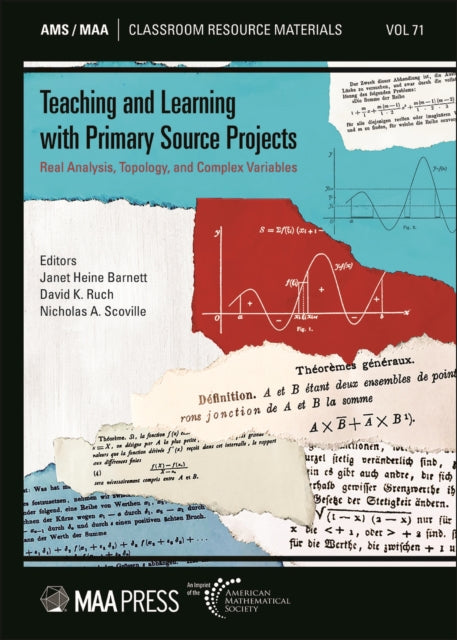
American Mathematical Society Teaching and Learning with Primary Source
Book SynopsisA collection of 24 classroom modules (PSPs) produced by TRIUMPHS that incorporate the reading of primary source excerpts to teach core mathematical topics. The selected excerpts are intertwined with thoughtfully designed student tasks that prompt students to actively engage with and explore the source material.Trade ReviewPrimary sources provide motivation in the words of the original discoverers of new mathematics, draw attention to subtleties, encourage reflection on today's paradigms, and enhance students' ability to participate equally, regardless of their background. These beautifully written primary source projects that adopt an ``inquiry'' approach are rich in features lacking in modern textbooks. Prompted by the study of historical sources, students will grapple with uncertainties, ask questions, interpret, conjecture, and compare multiple perspectives, resulting in a unique and vivid guided learning experience. -- David Pengelley, Oregon State UniversityTable of ContentsJ. H. Barnett, D. K. Ruch, and N. A. Scoville, Contents; Introduction: J. H. Barnett, D. K. Ruch, and N. A. Scoville, Teaching and Learning with Primary Source Projects; J. H. Barnett, D. K. Ruch, and N. A. Scoville, PSP Summaries: The Collection at a Glance; J. H. Barnett, Historical Overview; Real Analysis: J. H. Barnett, Why Be So Critical? Nineteenth-Century Mathematics and the Origins of Analysis; D. Ruch, Investigations into Bolzano's Bounded Set Theorem; M. P. Saclolo, Stitching Dedekind Cuts to Construct the Real Numbers; D. Ruch, Investigations into d'Alembert's Definition of Limit; D. Ruch, Bolzano on Continuity and the Intermediate Value Theorem; N. Somasunderam, Understanding Compactness: Early Work, Uniform Continuity to the Heine-Borel Theorem; D. Ruch, An Introduction to a Rigorous Definition of Derivative; J. H. Barnett, Rigorous Debates over Debatable Rigor: Monster Functions in Introductory Analysis; D. Ruch, The Mean Value Theorem; D. Ruch, Euler's Rediscovery of $e$; D. Ruch, Abel and Cauchy on a Rigorous Approach to Infinite Series; D. Ruch, The Definite Integrals of Cauchy and Riemann; J. H. Barnett, Henri Lebesgue and the Development of the Integral Concept; Topology: N. A. Scoville, The Cantor Set before Cantor; N. A. Scoville, Topology from Analysis; N. A. Scoville, Nearness without Distance; N. A. Scoville, Connectedness: Its Evolution and Applications; N. A. Scoville, Connecting Connectedness; N. A. Scoville, From Sets to Metric Spaces to Topological Spaces; N. A. Scoville, The Closure Operation as the Foundation of Topology; N. A. Scoville, A Compact Introduction to a Generalized Extreme Value Theorem; Complex Variables: D. Klyve, The Logarithm of $-1$; D. Ruch, Riemann's Development of the Cauchy-Riemann Equations; D. Ruch, Gauss and Cauchy on Complex Integration.
£51.30
American Mathematical Society Topics in Spectral Geometry
Book SynopsisA book for a graduate or an advanced undergraduate course on spectral geometry, starting from the basics but at the same time covering some of the exciting recent developments which can be explained without too many prerequisites.Table of Contents Strings, drums, and the Laplacian The spectral theorems Variational principles and applications Nodal geometry of eigenfunctions Eigenvalue inequalities Heat equation, spectral invariants, and isospectrality The Steklov problem and the Dirichlet-to-Neumann map A short tutorial on numerical spectral geometry Background definitions and notation Image credits Bibliography Index
£106.20

MP-AMM American Mathematical Cell Complexes Poset Topology and the
Book Synopsis
£67.50

American Mathematical Society Cocycles de groupe pour mathrm GLn et
Book SynopsisCe livre constitue un expose detaille de la serie de cours donnes en 2020 par le Prof. Nicolas Bergeron, titulaire de la Chaire Aisenstadt au CRM de Montreal. L'objet de ce texte est une ample generalisation d'une famille d'identites classiques, notamment la formule d'addition de la fonction cotangente ou celle des series d'Eisenstein.Trade ReviewI think that the text ``Cocycles de groupe pour $\mathrm{GL}_n$ et arrangements d'hyperplans'' is terrific. I like how it begins in a leisurely, enticing way with an elementary example that neatly gets to the topic. The construction of these ``meromorphic function''-valued modular symbols are fundamental objects, and play (and will continue to) play an important role. -- Barry Mazur, Harvard UniversityTable of ContentsConstruction de cocycles : aspects topologiques; Enonces des principaux resultats : cocycles explicites; Cohomologie d'arrangements d'hyerplans : representants canoniques; Formes differentielles sur l'espace symetrique associe a $textrm{SL}_n(C)$; Compactifications de Satake, de Tits et symboles modulaires; Cocycles de $\textrm{GL}_n(C)$ explicites; Series d'Eisenstein associees a $\psi$; Cocycle multicatif du groupe rationnel $\textrm{GL}_n(Q)^+$; Cocycle elliptique du groupe rationnel $\textrm{GL}_n(Q)^+$; Annexe A. Cohomologie equivariante et complexe de de Rham simplicial; Annexe B. Classe d'Eisenstein affine et theorie de l'obstruction; Bibliographie.
£102.60

MP-AMM American Mathematical Topics in Spectral Geometry
Book SynopsisTable of Contents Strings, drums, and the Laplacian The spectral theorems Variational principles and applications Nodal geometry of eigenfunctions Eigenvalue inequalities Heat equation, spectral invariants, and isospectrality The Steklov problem and the Dirichlet-to-Neumann map A short tutorial on numerical spectral geometry Background definitions and notation Image credits Bibliography Index
£70.20


