
Calculus and mathematical analysis Books
Princeton University Press The Golden Ticket
Book SynopsisTrade ReviewOne of Amazon.com's 2013 Best Science Books One of Choice's Outstanding Academic Titles for 2013 Honorable Mention for the 2013 PROSE Award in Popular Science & Mathematics, Association of American Publishers "As Fortnow describes... P versus NP is 'one of the great open problems in all of mathematics' not only because it is extremely difficult to solve but because it has such obvious practical applications. It is the dream of total ease, of the confidence that there is an efficient way to calculate nearly everything, 'from cures to deadly diseases to the nature of the universe,' even 'an algorithmic process to recognize greatness.'... To postulate that P ? NP, as Fortnow does, is to allow for a world of mystery, difficulty, and frustration--but also of discovery and inquiry, of pleasures pleasingly delayed."--Alexander Nazaryan, New Yorker "Fortnow effectively initiates readers into the seductive mystery and importance of P and NP problems."--Publishers Weekly "Fortnow's book is just the ticket for bringing one of the major theoretical problems of our time to the level of the average citizen--and yes, that includes elected officials."--Veit Elser, Science "Without bringing formulas or computer code into the narrative, Fortnow sketches the history of this class of questions, convincingly demonstrates their surprising equivalence, and reveals some of the most far-reaching implications that a proof of P = NP would bring about. These might include tremendous advances in biotechnology (for instance, more cures for cancer), information technology, and even the arts. Verdict: Through story and analogy, this relatively slim volume manages to provide a thorough, accessible explanation of a deep mathematical question and its myriad consequences. An engaging, informative read for a broad audience."--J.J.S. Boyce, Library Journal "A provocative reminder of the real-world consequences of a theoretical enigma."--Booklist "The definition of this problem is tricky and technical, but in The Golden Ticket, Lance Fortnow cleverly sidesteps the issue with a boiled-down version. P is the collection of problems we can solve quickly, NP is the collection of problems we would like to solve. If P = NP, computers can answer all the questions we pose and our world is changed forever. It is an oversimplification, but Fortnow, a computer scientist at Georgia Institute of Technology, Atlanta, knows his stuff and aptly illustrates why NP problems are so important."--Jacob Aron, New Scientist "Fortnow's book does a fine job of showing why the tantalizing question is an important one, with implications far beyond just computer science."--Rob Hardy, Commercial Dispatch "A great book... [Lance Fortnow] has written precisely the book about P vs. NP that the interested layperson or IT professional wants and needs."--Scott Aaronson, Shtetl-Optimized blog "[The Golden Ticket] is a book on a technical subject aimed at a general audience... Lance's mix of technical accuracy with evocative story telling works."--Michael Trick, Michael Trick's Operations Research Blog "Thoroughly researched and reviewed. Anyone from a smart high school student to a computer scientist is sure to get a lot of this book. The presentation is beautiful. There are few formulas but lots of facts."--Daniel Lemire's Blog "An entertaining discussion of the P versus NP problem."--Andrew Binstock, Dr. Dobb's "The Golden Ticketis an extremely accessible and enjoyable treatment of the most important question of theoretical computer science, namely whether P is equal to NP."--Choice "The book is accessible and useful for practically anyone from smart high school students to specialists... [P]erhaps the interest sparked by this book will be the 'Golden Ticket' for further accessible work in this area. And perhaps P=NP will start to become as famous as E=mc2."--Michael Trick, INFORMS Journal of Computing "In any case, it is excellent to have a nontechnical book about the P versus NP question. The Golden Ticket offers an inspiring introduction for nontechnical readers to what is surely the most important open problem in computer science."--Leslie Ann Goldberg, LMS Newsletter "The Golden Ticket does a good job of explaining a complex concept in terms that a secondary-school student will understand--a hard problem in its own right, even if not quite NP."--Physics World "[The Golden Ticket] is fun to read and can be fully appreciated without any knowledge in (theoretical) computer science. Fortnow's efforts to make the difficult material accessible to non-experts should be commended."--Andreas Maletti, Zentralblatt MATH "This is a fabulous book for both educators and students at the secondary school level and above. It does not require any particular mathematical knowledge but, rather, the ability to think. Enjoy the world of abstract ideas as you experience an intriguing journey through mathematical thinking."--Gail Kaplan, Mathematics Teacher "Fortnow's book provides much of the background and personal information on the main characters involved in this problem--notably Steven Cook, with a cameo appearance by Kurt Godel--that one does not get in the more technical treatments. There is a lot of information in this book, and the serious computer science student is sure to learn from it."--James M. Cargal, UMAP JournalTable of ContentsPreface ix Chapter 1 The Golden Ticket 1 Chapter 2 The Beautiful World 11 Chapter 3 P and NP 29 Chapter 4 The Hardest Problems in NP 51 Chapter 5 The Prehistory of P versus NP 71 Chapter 6 Dealing with Hardness 89 Chapter 7 Proving P <> NP 109 Chapter 8 Secrets 123 Chapter 9 Quantum 143 Chapter 10 The Future 155 Acknowledgments 163 Chapter Notes and Sources 165 Index 171
£999.99
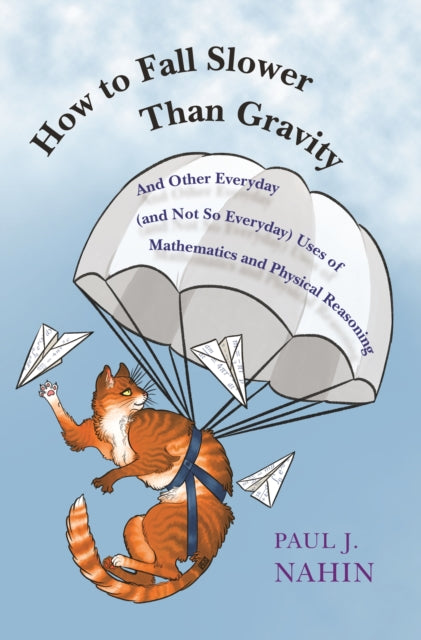
Princeton University Press How to Fall Slower Than Gravity
Book SynopsisTrade Review"This book is without a doubt the most enjoyable, stimulating book of mathematical physics (and occasionally more pure branches of maths) puzzles that I have ever read. It’s essentially a series of cleverly, and occasionally fiendishly put-together mathematics and physics challenge questions, each of which gets you thinking in a new and fascinating way."---Jonathan Shock, Mathemafrica"Reading Nahin is like reading through a select library of ancient Babylonian mathematical clay tablets. Surprises abound. . . . Nahin weaves much colorful history into his narrative."---Andrew Simoson, Mathematical Intelligencer"Engaging. . . . The book contains a wealth of original problems. . . . An enjoyable read."---Antonín Slavík, Zentralblatt MATH"This reviewer found himself being drawn to a variety of unfamiliar settings with much interest and even fascination." * Choice *"I certainly enjoyed [the book]!"---Alan Stevens, Mathematics Today"The potential audience for this book should be fairly large and go from highly talented high school students up through professionals in any STEM field."---Geoffrey Dietz, MAA Reviews
£19.80
Princeton University Press How to Fall Slower Than Gravity
Book SynopsisTrade Review"This book is without a doubt the most enjoyable, stimulating book of mathematical physics (and occasionally more pure branches of maths) puzzles that I have ever read. It’s essentially a series of cleverly, and occasionally fiendishly put-together mathematics and physics challenge questions, each of which gets you thinking in a new and fascinating way."---Jonathan Shock, Mathemafrica"Reading Nahin is like reading through a select library of ancient Babylonian mathematical clay tablets. Surprises abound. . . . Nahin weaves much colorful history into his narrative."---Andrew Simoson, Mathematical Intelligencer"Engaging. . . . The book contains a wealth of original problems. . . . An enjoyable read."---Antonín Slavík, Zentralblatt MATH"This reviewer found himself being drawn to a variety of unfamiliar settings with much interest and even fascination." * Choice *"I certainly enjoyed [the book]!"---Alan Stevens, Mathematics Today"The potential audience for this book should be fairly large and go from highly talented high school students up through professionals in any STEM field."---Geoffrey Dietz, MAA Reviews
£15.29

Princeton University Press Problems in Analysis
Book SynopsisThe present volume reflects both the diversity of Bochner's pursuits in pure mathematics and the influence his example and thought have had upon contemporary researchers. Originally published in 1971. The Princeton Legacy Library uses the latest print-on-demand technology to again make available previously out-of-print books from the distinguisheTable of Contents*Frontmatter, pg. i*Foreword, pg. vii*Contents, pg. ix*On the Group of Automorphisms of a Symplectic Manifold, pg. 1*On the Minimal Immersions of the Two-sphere in a Space of Constant Curvature, pg. 27*Intersections of Cantor Sets and Transversality of Semigroups, pg. 41*Kahlersche Mannigfaltigkeiten mit hyper-q-konvexem Rand, pg. 61*Iteration of Analytic Functions of Several Variables, pg. 81*A Class of Positive-Difinite Functions, pg. 93*Local Noncommutative Analysis, pg. 111*Linearization of the Product omicronf Orthogonal Polynomials, pg. 131*Eisenstein Series on Tube Domains, pg. 139*Laplace-Fourier Transformation, the Foundation for Quantum Information Theory and Linear Physics, pg. 157*An Integral Equation Related to the Schroedinger Equation with an Application to Integration in Function Space, pg. 175*A Lower Bound for the Smallest Eigenvalue of the Laplacian, pg. 195*The Integral Equation Method in Scattering Theory, pg. 201*Group Algebra Bundles, pg. 229*Quadratic Periods of Hjperelliptic Abelian Integrals, pg. 239*The Existence of Complementary Series, pg. 249*Some Recent Developments in the Theory of Singular Perturbations, pg. 261*Sequential Convergence in Lattice Groups, pg. 273*A Group-theoretic Lattice-point Problem, pg. 291*The Riemann Surface of Klein with 168 Automorphisms, pg. 297*Envelopes of Holomorphy of Domains in Complex Lie Groups, pg. 309*Automorphisms of Commutative Banach Algebras, pg. 319*Historical Notes on Analyticity as a Concept in Functional Analysis, pg. 325*A -Almost Automorphic Functions, pg. 345
£55.25
American Mathematical Society Fundamentals of the Theory of Operator Algebras
Book SynopsisPresents an introduction to functional analysis and the initial fundamentals of $C^*$- and von Neumann algebra theory in a form suitable for both intermediate graduate courses and self-study. The authors provide an account of the introductory portions of this important and technically difficult subject.Table of ContentsLinear spaces Basics of Hilbert space and linear operators Banach algebras Elementary $C^*$-algebra theory Elementary von Neumann algebra theory Bibliography Index of notation Index.
£79.20

MP-AMM American Mathematical Selected Works of Frederick J. Almgren Jr
Book SynopsisA collection of some of the work of Frederick J Almgren, Jr, the man most noted for defining the shape of geometric variational problems and for his role in founding The Geometry Center. It includes a summary by Sheldon Chang of the famous 1,700 page paper on singular sets of area-minimizing $m$-dimensional surfaces in $R^n$.Table of ContentsThe mathematics of F. J. Almgren, Jr. by B. White On Almgren's regularity result by S. X. Chang The homotopy groups of the integral cycle groups by F. J. Almgren, Jr. An isoperimetric inequality by F. J. Almgren, Jr. Three theorems on manifolds with bounded mean curvature by F. J. Almgren, Jr. Existence and regularity almost everywhere of solutions to elliptic variational problems among surfaces of varying topological type and singularity structure by F. J. Almgren, Jr. Measure theoretic geometry and elliptic variational problems by F. J. Almgren, Jr. The structure of limit varifolds associated with minimizing sequences of mappings by F. J. Almgren, Jr. Existence and regularity almost everywhere of solutions to elliptic variational problems with constraints by F. J. Almgren, Jr. The structure of stationary one dimensional varifolds with positive density by W. K. Allard and F. J. Almgren, Jr. The geometry of soap films and soap bubbles by F. J. Almgren, Jr. and J. E. Taylor Examples of unknotted curves which bound only surfaces of high genus within their convex hulls by F. J. Almgren, Jr. and W. P. Thurston Regularity and singularity estimates on hypersurfaces minimizing parametric elliptic variational integrals by R. Schoen, L. Simon, and F. J. Almgren, Jr. Dirichlet's problem for multiple valued functions and the regularity of mass minimizing integral currents by F. J. Almgren, Jr. Liquid crystals and geodesics by R. N. Thurston and F. J. Almgren $\mathbf{Q}$ valued functions minimizing Dirichlet's integral and the regularity of area minimizing rectifiable currents up to codimension two by F. J. Almgren, Jr. Optimal isoperimetric inequalities by F. Almgren Co-area, liquid crystals, and minimal surfaces by F. Almgren, W. Browder, and E. Lieb Singularities of energy minimizing maps from the ball to the sphere: Examples, counterexamples, and bounds by F. J. Almgren, Jr. and E. H. Lieb Symmetric decreasing rearrangement is sometimes continuous by F. J. Almgren, Jr. and E. H. Lieb Questions and answers about area-minimizing surfaces and geometric measure theory by F. Almgren Curvature-driven flows: A variational approach by F. Almgren, J. E. Taylor, and L. Wang Questions and answers about geometric evolution processes and crystal growth by F. Almgren.
£125.40

MP-AMM American Mathematical Algebra an Elementary TextBook for the Higher
Book SynopsisIn addition to the standard topics, this volume includes topics not often found in an algebra book, such as inequalities, and the elements of substitution theory. Especially extensive is Chrystal's treatment of the infinite series, infinite products, and (finite and infinite) continued fractions.
£55.80

MP-AMM American Mathematical Topological Degree Methods in Nonlinear Boundary
Book SynopsisContains lectures from the CBMS Regional Conference held at Harvey Mudd College, June 1977. This monograph consists of applications to nonlinear differential equations of the author's coincidental degree. It includes an bibliography covering many aspects of the modern theory of nonlinear differential equations and the theory of nonlinear analysis.Table of ContentsIntroduction Suggestions for the readerSuggestions for the reader Fredholm mappings of index zero and linear boundary value problems Degree theory for some classes of mappings Duality theorems for several fixed point operators associated to periodic problems for ordinary differential equations Existence theorems for equations in normed spaces Boundary value problems for second order nonlinear vector differential equations Periodic solutions of ordinary differential equations with one-sided growth restrictions Bound sets for functional differential equations The index of isolated zeros of some mappings Bifurcation theory Periodic solutions of autonomous ordinary differential equations around an equilibrium References.
£23.70
American Mathematical Society Problems in Mathematical Analysis Volume 2
Book SynopsisHelps in the understanding of continuous and differentiable functions. This book emphasises on real functions of a single variable. It contains topics that include: continuous functions, the intermediate value property, uniform continuity, mean value theorems, Taylors formula, convex functions, and sequences and series of functions.Trade ReviewA very stimulating problem book ... a useful supplement to any graduate textbok in mathematical analysis MAA OnlineTable of ContentsProblems: Limits and continuity Differentiation Sequences and series of functions Solutions: Limits and continuity Differentiation Sequences and series of functions Bibliography Index.
£999.99

MP-AMM American Mathematical Lectures on Tensor Categories and Modular
Book SynopsisGives an exposition of the relations among the following three topics: monoidal tensor categories (such as a category of representations of a quantum group), 3-dimensional topological quantum field theory, and 2-dimensional modular functors (which naturally arise in 2-dimensional conformal field theory).Table of ContentsIntroduction Braided tensor categories Ribbon categories Modular tensor categories 3-dimensional topological quantum field theory Modular functor Moduli spaces and complex modular functor Wess-Zumino-Witten model Bibliography Index Index of notation.
£51.14

MP-AMM American Mathematical Plateaus Problem
Book SynopsisThere have been many wonderful developments in the theory of minimal surfaces and geometric measure theory. This book covers variational geometry. It focuses on Plateau's Problem, which is concerned with surfaces that model the behavior of soap films.Table of ContentsThe phenomena of least area problems Integration of differential forms over rectifiable sets Varifolds Variational problems involving varifolds References Additional references Index.
£39.56

MP-AMM American Mathematical Topics in Nonlinear Functional Analysis
Book SynopsisIntroduces the notion of topological degree and develops its basic properties. This book uses these properties in the discussion of bifurcation theory (the possible branching of solutions as parameters vary), including the proof of Rabinowitz's global bifurcation theorem. It is suitable as a graduate level textbook and a supplementary course text.Trade Reviewextremely stimulating Zentralblatt fur MathematikTable of ContentsTopological approach: Finite dimensions Topological degree in Banach space Bifurcation theory Further topological methods Monotone operators and the min-max theorem Generalized implicit function theorems Bibliography.
£25.60

MP-AMM American Mathematical Analytic Function Theory Volume 2
Book SynopsisEmphasizes the conceptual and historical continuity of analytic function theory. This work covers topics including elliptic functions, entire and meromorphic functions, as well as conformal mapping. It features chapters on majorization and on functions holomorphic in a half-plane.Table of ContentsVolume II:; 10. Analytic continuation:; 10.1 Introduction; 10.2 Rearrangements of power series; 10.3 Analytic functions; 10.4 Singularities; 10.5 Borel monogenic functions; 10.6 Multivalued functions and Riemann surfaces; 10.7 Law of permanence of functional equations; 11. Singularities and representation of analytic functions:; 11.1 Holomorphy-preserving transformations: I. Integral operators; 11.2 Holomorphy-preserving transformations: II. Differential operators; 11.3 Power series with analytic coefficients; 11.4 Analytic continuation in a star; 11.5 Polynomial series; 11.6 Composition theorems; 11.7 Gap theorems and noncontinuable power series; 12. Algebraic functions:; 12.1 Local properties; 12.2 Critical points; 12.3 Newton's diagram; 12.4 Riemann surfaces; some concepts of algebraic geometry; 12.5 Rational functions on the surface and Abelian integrals; 13. Elliptic functions:; 13.1 Doubly-periodic functions; 13.2 The functions of Weierstrass; 13.3 Some further properties of elliptic functions; 13.4 On the functions of Jacobi; 13.5 The theta functions; 13.6 Modular functions; 14. Entire and meromorphic functions:; 14.1 Order relations for entire functions; 14.2 Entire functions of finite order; 14.3 Functions with real zeros; 14.4 Characteristic functions; 14.5 Picard's and Landau's theorems; 14.6 The second fundamental theorem; 14.7 Defect relations; 15. Normal families:; 15.1 Schwarz's lemma and hyperbolic measure; 15.2 Normal families; 15.3 Induced convergence; 15.4 Applications; 16. Lemniscates:; 16.1 Chebichev polynomials; 16.2 The transfinite diameter; 16.3 Additive set functions; Radon-Stieltjes integrals; 16.4 Logarithmic capacity; 16.5 Green's function; Hilbert's theorem; 16.6 Runge's theorem; 16.7 Overconvergence; 17. Conformal mapping:; 17.1 Riemann's mapping theorem; 17.2 The kernel function; 17.3 Fekete polynomials and the exterior mapping problem; 17.4 Univalent functions; 17.5 The boundary problem; 17.6 Special mappings; 17.7 The theorem of Bloch; 18. Majorization:; 18.1 The Phragmen-Lindelof principle; 18.2 Dirichlet's problem; Lindelof's principle; 18.3 Harmonic measure; 18.4 The Nevanlinna-Ahlfors-Heins theorems; 18.5 Subordination; 19. Functions holomorphic in a half-plane:; 19.1 The Hardy-Lebesgue classes; 19.2 Bounded functions; 19.3 Growth-measuring functions; 19.4 Remarks on Laplace-Stieltjes integrals Bibliography Index.
£47.70

MP-AMM American Mathematical Meromorphic Functions and Linear Algebra
Book SynopsisDescribes in monograph form important applications in numerical methods of linear algebra. This book studies the behavior of the resolvent of a matrix under the perturbation by low rank matrices. It also introduces the basics of value distribution theory of meromorphic scalar functions.Table of ContentsPrologue Chapter 1 Chapter 2 Chapter 3 Chapter 4 Chapter 5 Chapter 6 Chapter 7 Chapter 8 Chapter 9 Chapter 10 Epilogue Bibliography.
£51.30

MP-AMM American Mathematical Functional Integration and Quantum Physics
Book SynopsisFocuses on probabilistic foundations of the Feynman-Kac formula. Starting with main examples of Gaussian processes (the Brownian motion, the oscillatory process, and the Brownian bridge), this book presents four different proofs of the Feynman-Kac formula.Table of ContentsIntroduction The basic processes Bound state problems Inequalities Magnetic fields and stochastic integrals Asymptotics Other topics References Index Bibliographic supplement Bibliography.
£46.95

MP-AMM American Mathematical Applied Asymptotic Analysis
Book SynopsisA survey of asymptotic methods set in the applied research context of wave propagation. It stresses rigorous analysis in addition to formal manipulations. It is suitable for a beginning graduate course on asymptotic analysis in applied mathematics and is aimed at students of pure and applied mathematics as well as science and engineering.Table of ContentsFundamentals: Themes of asymptotic analysis The nature of asymptotic approximations Asymptotic analysis of exponential integrals: Fundamental techniques for integrals Laplace's method for asymptotic expansions of integrals The method of steepest descents for asymptotic expansions of integrals The method of stationary phase for asymptotic analysis of oscillatory integrals Asymptotic analysis of differential equations: Asymptotic behavior of solutions of linear second-order differential equations in the complex plane Introduction to asymptotics of solutions of ordinary differential equations with respect to parameters Asymptotics of linear boundary-value problems Asymptotics of oscillatory phenomena Weakly nonlinear waves Appendix: Fundamental inequalities Bibliography Index of names Subject index.
£106.20

MP-AMM American Mathematical Introduction to Functional Equations
Book Synopsis
£44.06

MP-AMM American Mathematical Harmonic Analysis From Fourier to Wavelets
Book SynopsisTrade ReviewThe presentation of the material is very clear and illustrated by a number of enlightening figures. Many motivating remarks and discussions are provided. A number of proofs in the more elementary chapters are omitted, but precise pointers to the literature are given. Also numerous exercises are posed as well as some more involved 'projects' which motivate the reader to get active herself." - R. Steinbauer, Monatshefte für Mathematik"This is a gentle introduction to Fourier analysis and wavelet theory that requires little background but still manages to explain some of the applications of Fourier and wavelet methods and touch on several current research topics. ... The authors have taken care to be accessible to undergraduate mathematicians. ... Compared to standard texts, this book is characterised by more personal and historical information, including footnotes. ... It comes with many projects for interested students, and lists a number of open-ended problems that suggest further developments and should engage interested students. ... In summary, this is a well-written and lively introduction to harmonic analysis that is accessible and stimulating for undergraduates and instructive and amusing for the more sophisticated reader. It could also be argued that the material herein should be part of the knowledge of most undergraduates in mathematics, given that the modern world relies more and more on data compression. It is therefore timely as well. It has certainly earned my enthusiastic recommendation." - Michael Cowling, Gazette of the Australian Mathematical Society"A wonderful introduction to harmonic analysis and applications. The book is intended for advanced undergraduate and beginning graduate students and it is right on target. Pereyra and Ward present in a captivating style a substantial amount of classical Fourier analysis as well as techniques and ideas leading to current research. ... It is a great achievement to be able to present material at this level with only a minimal prerequisite of advanced calculus and linear algebra and a set of Useful Tools included in the appendix. I recommend this excellent book with enthusiasm and I encourage every student majoring in math to take a look." - Florin Catrina, MAA Reviews"[T]he panorama of harmonic analysis presented in the book includes very recent achievements like the connection of the dyadic shift operator with the Hilbert transform. This gives to an interested reader a good chance to see concrete examples of contemporary research problems in harmonic analysis. I highly recommend this book as a good source for undergraduate and graduate courses as well as for individual studies." - Krzysztof Stempak, Zentralblatt MATHTable of Contents Contents List of figures List of tables IAS/Park City Mathematics Institute Preface Fourier series: Some motivation Interlude: Analysis concepts Pointwise convergence of Fourier series Summability methods Mean-square convergence of Fourier series A tour of discrete Fourier and Haar analysis The Fourier transform in paradise Beyond paradise From Fourier to wavelets, emphasizing Haar Zooming properties of wavelets Calculating with wavelets The Hilbert transform Useful tools Alexander’s dragon Bibliography Name index Subject index
£46.80

MP-AMM American Mathematical A Course in Complex Analysis and Riemann Surfaces
Book SynopsisTrade Review[T]his is an extremely valuable textbook for graduate classical complex analysis in one variable both for lecturers and students not following the increasing standardization trends of student's curricula... The presentation style is excellent, a very well contemplated pleasant reading throughout, rich in interesting outlooks. I recommend this work to all the mathematical libraries at universities as an extremely helpful material in teaching or studying complex analysis." - László L. Stachó, ACTA Sci. Math.Table of Contents From i to z: the basics of complex analysis From z to the Riemann mapping theorem: some finer points of basic complex analysis Harmonic functions Riemann surfaces: definitions, examples, basic properties Analytic continuation, covering surfaces, and algebraic functions Differential forms on Riemann surfaces The theorems of Riemann-Roch, Abel, and Jacobi Uniformization Review of some basic background material Bibliography Index
£108.00
American Mathematical Society The Calderon Problem
a huge range and FREE tracked UK delivery on ALL orders.
£104.40

John Wiley & Sons Inc Permutation Tests for Complex Data
Book SynopsisTimely update of a popular edition on permutation testing with numerous case studies included throughout The newly revised and updated Second Edition of Permutation Tests for Complex Data describes permutation tests from the point of view of experimental design, with methodological details and illustrating the process of devising an appropriate permutation test through case studies. In addition to the text, this book includes two open source packages for permutation tests in Python and R which include a comprehensive code base to implement common permutation tests as well as code to implement each of the book's case studies. The focus of this book is the permutation approach to a variety of univariate and multivariate problems of hypothesis testing in a typical nonparametric framework. The book examines the most up-to-date methodologies of univariate and multivariate permutation testing, includes real case studies from both experimental and observational studies, and presents and discu
£95.00

John Wiley & Sons Inc Research Design and Analysis
Book SynopsisA concise, straightforward overview of research design and analysis, helping readers form a general basis for designing and conducting research The practice of designing and analyzing research continues to evolve with advances in technology that enable greater technical analysis of datastrengthening the ability of researchers to study the interventions and relationships of factors and assisting consumers of research to understand and evaluate research reports. Research Design and Analysis is an accessible, wide-ranging overview of how to design, conduct, analyze, interpret, and present research. This book helps those in the sciences conduct their own research without requiring expertise in statistics and related fields and enables informed reading of published research. Requiring no background in statistics, this book reviews the purpose, ethics, and rules of research, explains the fundamentals of research design and validity, and describes how to select Table of ContentsList of Figures xiii List of Tables xv Introduction xix Section 1 The Purpose, Ethics, and Rules of Research 1 1 The Purpose and Ethics of Research 3 1.1 The Purpose and Risks of Research 3 1.2 History of Harm to Humans 4 1.3 Ethical Issues in the Social Sciences 9 1.4 History of Harm to Animal Subjects in Research 10 1.4.1 Summary 12 1.5 Ethics, Principles, and Guidelines 12 1.6 Statutes and Regulations Protecting Humans and Animals in Research 16 1.7 More About Informed Consent 18 1.8 The Importance of Freedom to Withdraw 22 1.9 Separation of Provider–Researcher Role 22 1.10 Undue Influence 24 1.11 Anonymity 24 1.12 Summary 25 Section 2 Basic Research Designs and Validity 27 2 Research Validity 29 2.1 Internal Validity 30 2.1.1 History 30 2.1.2 Maturation 31 2.1.3 Measurement Error 32 2.1.4 Selection Bias and Random Assignment 33 2.1.5 Attrition 35 2.1.6 Experimenter Bias 35 2.1.7 Expectation 36 2.1.8 Sensitization and Practice Effects 36 2.1.9 Incorrect Conclusions of Causality 37 2.2 External Validity 37 2.3 Summary 45 3 Research Designs 47 3.1 The Lingo 47 3.2 Between‐Subjects Designs 49 3.2.1 More Examples of Between‐Subjects Designs 49 3.2.2 Statistical Analyses for Between‐Subjects Designs 50 3.3 Within‐Subjects Designs/Repeated Measures 52 3.3.1 Statistical Analyses for Within‐Subjects Designs 53 3.4 Between–Within Subjects Designs (Mixed Factorial/Split‐Plot Designs) 54 3.4.1 Statistical Analyses for Between–Within Subjects Designs 55 3.5 Latin Square Designs 57 3.5.1 Summary 59 3.5.2 Double Latin Square Designs 59 3.5.3 Graeco‐Latin and Hyper Graeco‐Latin Square Designs 59 3.6 Nesting 60 3.7 Matching 60 3.8 Blocking 61 3.9 Nonexperimental Research 62 3.10 Case Studies 62 3.11 Summary 64 Section 3 The Nuts and Bolts of Data Analysis 65 4 Interpretation 67 4.1 Probability and Significance 67 4.2 The Null Hypothesis, Type I (α), and Type II (β) Errors 68 4.3 Power 69 4.4 Managing Error Variance to Improve Power 71 4.5 Power Analyses 72 4.6 Effect Size 72 4.7 Confidence Intervals and Precision 74 4.8 Summary 76 5 Parametric Statistical Techniques 77 5.1 A Little More Lingo 77 5.1.1 Population Parameters Versus Sample Statistics 78 5.1.2 Data 78 5.1.2.1 Ratio and Interval Data 78 5.1.2.2 Ordinal Data 78 5.1.2.3 Nominal Data 79 5.1.3 Central Tendency 79 5.1.3.1 Mode 79 5.1.3.2 Median 79 5.1.3.3 Mean 86 5.1.4 Distributions 86 5.1.5 Dependent Variables 92 5.1.5.1 To Scale or Not to Scale 95 5.1.6 Summary 97 5.2 t Tests 97 5.2.1 Independent Samples t Tests 97 5.2.2 Matched Group Comparison 98 5.2.3 Assumptions of t Tests 99 5.2.4 More Examples of Studies Employing t Tests 100 5.2.5 Statistical Software Packages for Conducting t Tests 101 5.3 The NOVAs and Mixed Linear Model Analysis 101 5.3.1 ANOVA 102 5.3.1.1 ANOVA with a Multifactorial Design 104 5.3.1.2 Main Effects and Interactions 104 5.3.1.3 More Illustrations of Interactions and Main Effects 106 5.3.1.4 Assumptions of ANOVA 107 5.3.2 ANCOVA 109 5.3.3 MANOVA/MANCOVA 111 5.3.4 Statistical Software Packages for Conducting ANOVA/ANCOVA/MANOVA 114 5.3.5 Repeated Measures: ANOVA‐RM and Mixed Linear Model Analysis 114 5.3.5.1 ANOVA‐RM 114 5.3.5.2 Mixed Linear Model Analysis 116 5.3.5.3 ANCOVA 117 5.3.5.4 Statistical Software Packages for Conducting Repeated Measures Analyses 117 5.3.6 Summary 119 5.4 Correlation and Regression 120 5.4.1 Correlation and Multiple Correlation 120 5.4.2 Regression and Multiple Regression 121 5.4.3 Statistical Software Packages for Conducting Correlation and Regression 124 5.5 Logistic Regression 126 5.5.1 Statistical Software Packages for Conducting Logistic Regression 128 5.6 Discriminant Function Analysis 128 5.6.1 Statistical Software Packages for Conducting Discriminant Function Analysis 128 5.7 Multiple Comparisons 129 5.8 Summary 131 6 Nonparametric Statistical Techniques 133 6.1 Chi‐Square 134 6.1.1 Statistical Software Packages for Conducting Chi‐Square 136 6.2 Median Test 137 6.2.1 Statistical Software Packages for Conducting Median Tests 137 6.3 Phi Coefficient 137 6.3.1 Statistical Software Packages for Calculating the Phi Coefficient 139 6.4 Mann–Whitney U Test (Wilcoxon Rank Sum Test) 139 6.4.1 Statistical Software Packages for Conducting a Mann–Whitney U Test 141 6.5 Sign Test and Wilcoxon Signed‐rank Test 142 6.5.1 Statistical Software Packages for Conducting Sign Tests 143 6.6 Kruskal–Wallis Test 144 6.6.1 Statistical Software Packages for Conducting a Kruskal–Wallis Test 144 6.7 Rank‐Order Correlation 145 6.7.1 Statistical Software Packages for Conducting Rank‐order Correlations 146 6.8 Summary 147 7 Meta‐Analytic Studies 149 7.1 The File Drawer Effect 150 7.2 Analyzing the Meta‐Analytic Data 151 7.3 How to Read and Interpret a Paper Reporting a Meta‐Analysis 153 7.4 Statistical Software Packages for Conducting Meta‐Analyses 155 7.5 Summary 155 Section 4 Reporting, Understanding, and Communicating Research Findings 157 8 Disseminating Your Research Findings 159 8.1 Preparing a Research Report 159 8.2 Presenting Your Findings at a Conference 167 8.3 Summary 168 9 Concluding Remarks 169 9.1 Why is it Important to Understand Research Design and Analysis as a Consumer? 169 9.2 Research Ethics and Responsibilities of Journalists 175 9.3 Responsibilities of Researchers 177 9.4 Conclusion 178 Appendix A Data Sets and Databases 179 Appendix B Statistical Analysis Packages 195 Appendix C Helpful Statistics Resources 217 Glossary 221 References 233 Index 243
£93.56

Johns Hopkins University Press An Equation for Every Occasion
Book SynopsisSmartly conceived and fast paced, his book offers something for anyone curious about math and its impacts.Trade ReviewThe wide ranging essays touch on history, art, architecture, biology, astrophysics, geology, economics, engineering, and many aspects of everyday life. They are supplemented with helpful graphics and written in a lively and clear style appropriate for non-specialist readers, including high school students. Mathematical Reviews An intriguing, thought provoking and humorous book... Highly entertaining treatises for nature lovers as well as science, mathematics and art enthusiasts. London Mathematical Society Newsletter Henshaw's stories about each formula are interesting, humorous, and oftentimes surprising. The range of formulas in [ An Equation for Every Occasion] is appealing, no matter where one's interests lie... This book is a must for teachers who teach formulas. This book provides both interesting stories and historial context to pass on to students Mathematical Association of America From the links between music and math and the importance of the concept of friction to either the success or failure of athletes to estimating the size of a crowd by understanding principles of density, these applications are not only lively discussions of daily living, but require no prior math knowledge from their readers, making An Equation for Every Occasion a recommended pick for lay audiences interested in math's intersections with real-world concerns. Donovan's Literary Services Recommended. All readers. ChoiceTable of ContentsPreface1. As the Earth Draws the Apple2. And All the Children Are Above Average3. The Lady with the Mystic Smile4. The Heart Has Its Reasons5. AC/DC6. The Doppler Effect7. Do I Look Fat in These Jeans?8. Zeros and Ones9. Tsunami10. When the Chips Are Down11. A Stretch of the Imagination12. Woodstock Nation13. What Is (Pi)?14. No Sweat15. Road Range16. The Bends17. It's Not the Heat, It's the Humidity18. The World's Most Beautiful Equation19. Breaking the Law20. The Mars Curse21. Eureka!22. A Penny Saved . . .23. If I Only Had a Brain24. Because It Was There25. Four Eyes26. Bee Sting27. Here Comes the Sun28. A Leg to Stand On29. Love Is a Roller Coaster30. Loss Factor31. A Slippery Slope32. Transformers33. A House of Cards34. Let There Be Light35. Smarty Pants36. As Old as the Hills37. Can You Hear Me Now?38. Decay Heat39. Zero, One, Infinity40. Terminal Velocity41. Water, Water, Everywhere42. Dog Days43. Body Heat44. Red Hot45. A Bolt from the Blue46. Like Oil and Water47. Fish Story48. Making Waves49. A Drop in the Bucket50. Fracking Unbelievable51. Take Two Aspirins and Call Me in the Morning52. The World's Most Famous EquationBibliographyIndex
£22.50
University of Toronto Press ngons
Book SynopsisThis book, a translation of the German volume n-Ecke, presents an elegant geometric theory which, starting from quite elementary geometrical observations, exhibits an interesting connection between geometry and fundamental ideas of modern algebra in a form that is easily accessible to the student who lacks a sophisticated background in mathematics. It stimulates geometrical thought by applying the tools of linear algebra and the algebra of polynomials to a concrete geometrical situation to reveal some rather surprising insights into the geometry of n-gons. The twelve chapters treat n-gons, classes of n-gons, and mapping of the set of n-gons into itself. Exercises are included throughout, and two appendixes, by Henner Kinder and Eckart Schmidt, provide background material on lattices and cyclotomic polynomials.(Mathematical Expositions No. 18)
£19.79
Springer Linear Operators in Hilbert Spaces
Book Synopsis1 Vector spaces with a scalar product, pre-Hilbert spaces.- 1.1 Sesquilinear forms.- 1.2 Scalar products and norms.- 2 Hilbert spaces.- 2.1 Convergence and completeness.- 2.2 Topological notions.- 3 Orthogonality.- 3.1 The projection theorem.- 3.2 Orthonormal systems and orthonormal bases.- 3.3 Existence of orthonormal bases, dimension of a Hilbert space.- 3.4 Tensor products of Hilbert spaces.- 4 Linear operators and their adjoints.- 4.1 Basic notions.- 4.2 Bounded linear operators and functionals.- 4.3 Isomorphisms, completion.- 4.4 Adjoint operator.- 4.5 The theorem of Banach-Steinhaus, strong and weak convergence.- 4.6 Orthogonal projections, isometric and unitary operators.- 5 Closed linear operators.- 5.1 Closed and closable operators, the closed graph theorem.- 5.2 The fundamentals of spectral theory.- 5.3 Symmetric and self-adjoint operators.- 5.4 Self-adjoint extensions of symmetric operators.- 5.5 Operators defined by sesquilinear forms (Friedrichs' extension).- 5.6 Normal opTable of Contents1 Vector spaces with a scalar product, pre-Hilbert spaces.- 1.1 Sesquilinear forms.- 1.2 Scalar products and norms.- 2 Hilbert spaces.- 2.1 Convergence and completeness.- 2.2 Topological notions.- 3 Orthogonality.- 3.1 The projection theorem.- 3.2 Orthonormal systems and orthonormal bases.- 3.3 Existence of orthonormal bases, dimension of a Hilbert space.- 3.4 Tensor products of Hilbert spaces.- 4 Linear operators and their adjoints.- 4.1 Basic notions.- 4.2 Bounded linear operators and functionals.- 4.3 Isomorphisms, completion.- 4.4 Adjoint operator.- 4.5 The theorem of Banach-Steinhaus, strong and weak convergence.- 4.6 Orthogonal projections, isometric and unitary operators.- 5 Closed linear operators.- 5.1 Closed and closable operators, the closed graph theorem.- 5.2 The fundamentals of spectral theory.- 5.3 Symmetric and self-adjoint operators.- 5.4 Self-adjoint extensions of symmetric operators.- 5.5 Operators defined by sesquilinear forms (Friedrichs’ extension).- 5.6 Normal operators.- 6 Special classes of linear operators.- 6.1 Finite rank and compact operators.- 6.2 Hilbert-Schmidt operators and Carleman operators.- 6.3 Matrix operators and integral operators.- 6.4 Differential operators on L2(a, b) with constant coefficients.- 7 The spectral theory of self-adjoint and normal operators.- 7.1 The spectral theorem for compact operators, the spaces Bp (H1H2).- 7.2 Integration with respect to a spectral family.- 7.3 The spectral theorem for self-adjoint operators.- 7.4 Spectra of self-adjoint operators.- 7.5 The spectral theorem for normal operators.- 7.6 One-parameter unitary groups.- 8 Self-adjoint extensions of symmetric operators.- 8.1 Defect indices and Cayley transforms.- 8.2 Construction of self-adjoint extensions.- 8.3 Spectra of self-adjoint extensions of a symmetric operator.- 8.4 Second order ordinary differential operators.- 8.5 Analytic vectors and tensor products of self-adjoint operators.- 9 Perturbation theory for self-adjoint operators.- 9.1 Relatively bounded perturbations.- 9.2 Relatively compact perturbations and the essential spectrum.- 9.3 Strong resolvent convergence.- 10 Differential operators on L2(?m).- 10.1 The Fourier transformation on L2(?m).- 10.2 Sobolev spaces and differential operators on L2(?m) with constant coefficients.- 10.3 Relatively bounded and relatively compact perturbations.- 10.4 Essentially self-adjoint Schrödinger operators.- 10.5 Spectra of Schrödinger operators.- 10.6 Dirac operators.- 11 Scattering theory.- 11.1 Wave operators.- 11.2 The existence and completeness of wave operators.- 11.3 Applications to differential operators on L2(?m).- A.1 Definition of the integral.- A.2 Limit theorems.- A.3 Measurable functions and sets.- A.4 The Fubini-Tonelli theorem.- A.5 The Radon-Nikodym theorem.- References.- Index of symbols.- Author and subject index.
£66.49

Springer-Verlag New York Inc. Ramanujans Lost Notebook Part IV
Book SynopsisIts discovery has frequently been deemed the mathematical equivalent of finding Beethoven's tenth symphony.This volume is the fourth of five volumes that the authors plan to write on Ramanujan’s lost notebook. In contrast to the first three books on Ramanujan's Lost Notebook, the fourth book does not focus on q-series.Table of ContentsPreface.- 1 Introduction.- 2 Double Series of Bessel Functions and the Circle and Divisor Problems.- 3 Koshliakov's Formula and Guinand's Formula.- 4 Theorems Featuring the Gamma Function.- 5 Hypergeometric Series.- 6 Euler's Constant.- 7 Problems in Diophantine Approximation.- 8 Number Theory.- 9 Divisor Sums.- 10 Identities Related to the Riemann Zeta Function and Periodic Zeta Functions.- 11 Two Partial Unpublished Manuscripts on Sums Involving Primes.- 12 Infinite Series.- 13 A Partial Manuscript on Fourier and Laplace Transforms.- 14 Integral Analogues of Theta Functions adn Gauss Sums.- 15 Functional Equations for Products of Mellin Transforms.- 16 Infinite Products.- 17 A Preliminary Version of Ramanujan's Paper, On the Integral ∫_0^x tan^(-1)t)/t dt.- 18 A Partial Manuscript Connected with Ramanujan's Paper, Some Definite Integrals.- 19 Miscellaneous Results in Analysis.- 20 Elementary Results.- 21 A Strange, Enigmatic Partial Manuscript.- Location Guide.- Provenance.- References.- Index.
£97.49

Springer-Verlag New York Inc. Measure Integral Derivative
Book SynopsisFeaturing over 180 exercises, this text for a one-semester course in Lebesgue's theory takes an elementary approach, making it easily accessible to both upper-undergraduate- and lower-graduate-level students.Trade ReviewFrom the reviews:“It is accessible to upper-undergraduate and lower graduate level students, and the only prerequisite is a course in elementary real analysis. … The book proposes 187 exercises where almost always the reader is proposed to prove a statement. … this book is a very helpful tool to get into Lebesgue’s theory in an easy manner.” (Daniel Cárdenas-Morales, zbMATH, Vol. 1277, 2014)“This is a brief … but enjoyable book on Lebesgue measure and Lebesgue integration at the advanced undergraduate level. … The presentation is clear, and detailed proofs of all results are given. … The book is certainly well suited for a one-semester undergraduate course in Lebesgue measure and Lebesgue integration. In addition, the long list of exercises provides the instructor with a useful collection of homework problems. Alternatively, the book could be used for self-study by the serious undergraduate student.” (Lars Olsen, Mathematical Reviews, December, 2013)Table of Contents1 Preliminaries.- 2 Lebesgue Measure.- 3 Lebesgue Integration.- 4 Differentiation and Integration.- A Measure and Integral over Unbounded Sets.- Index.
£46.74

MP-AMM American Mathematical Pearls from a Lost City
Book SynopsisTrade ReviewMany journal articles have been devoted to various aspects of mathematics in Lvov or to biographies of Lvov mathematicians, but Duda's book is the first comprehensive exposition...In summary, I conclude that Duda's book is a must for everyone interested in the history of functional analysis or in the history of mathematics in Poland." - Lech Maligranda, Mathematical Intelligencer"This eagerly awaited translation of the book Pearls describes a world-class Polish school of mathematics at Lvov (now the Ukrainian Lviv) that thrived during the interwar period and has left an enduring legacy that remains part of the folklore today. Published in English translation after a somewhat protracted period of negotiation, this important work fills a niche in the history of science and should become a standard source of mathematics in Poland, especially the genesis of functional analysis during its Golden Age, 1918-1939. Moreover, the translator, Oxford's Daniel Davies, explains material that is unlikely to be familiar to readers outside Poland." - Isis, A Journal of the History of Science Society"Many journal articles have been devoted to various aspects of mathematics in Lwów or to biographies of Lwów mathematicians, but Duda's book is the first comprehensive exposition. It is a must-read for everyone interested in the history of functional analysis or of mathematics in Poland, where the original Polish edition from 2007 ... has been highly successful. There is good reason to assume that the English version will be likewise successful." - Dirk Werner, ZMATH"This book gives the history of Lvov as a mathematical center, from pre-WWI to Soviet and Ukrainian times, looking especially at the interwar golden age and the special favorable environment for mathematical scholarship. The author also describes the ways in which the Soviets and Germans destroyed this rich environment. The book includes a list, with biographical sketches, of mathematicians associated with Lvov, and a Lvov biography. It was a special time and place for mathematics, disrupted by war and politics and oppression and murder, and one wonders what more could have been achieved in a peaceful environment." - CHOICE Reviews"The book under review is well and carefully written. The translation from Polish into English is polished and lively... I highly recommend the book for all university libraries, and I recommend it to those interested in the history of mathematics. The general mathematical reader will find it an entertaining and informative story about mathematicians and a truly extraordinary mathematical community." - Henry Heatherly, MAA ReviewsTable of Contents Background The University and the Polytechnic in Lvov Polish mathematics at the turn of the twentieth century Sierpiski's stay at the University of Lvov (1908-1914) The University in Warsaw and Janiszewski's program (1915-1920) World mathematics (active fields in Poland) around 1920 The golden age: Individuals and community The mathematical community in Lvov after World War I Mathematical studies and students Journals, monographs, and congresses The popularization of mathematics Social life (the Scottish Café, the Scottish Book) The Polish Mathematical Society Collaboration with other centers In the eyes of others The golden age: Achievements Stefan Banach's doctoral thesis and priority claims Probability theory Measure theory Game theory: A revelation without follow-up Operator theory in the 1920s Methodological audacity Banach's monograph: Polishing the pearls Operator theory in the 1930s: The dazzle of pearls New perspectives for which time did not allow On the periphery Oblivion Ukrainization the Soviet way (1939-1941) The German occupation (1941-1944) The expulsion of Poles (1945-1946) Historical significance Chronological overview Chronology of events as perceived elsewhere Influence on mathematics of the Lvov school A tentative summary Mathematics in Lvov after 1945 List of Lvov mathematicians Mathematicians associated with Lvov Bibliographies List of illustrations Index of names
£99.90

MP-AMM American Mathematical Gaussian Measures
Book SynopsisProvides a systematic exposition of the modern theory of Gaussian measures. It presents complete and detailed proofs fundamental facts about finite and infinite dimensional Gaussian distributions. Covered topics include linear properties, convexity, linear and nonlinear transformations, and applications to Gaussian and diffusion processes.Table of Contents Finite dimensional Gaussian distributions Infinite dimensional Gaussian distributions Radon Gaussian measures Convexity of Gaussian measures Sobolev classes over Gaussian measures Nonlinear transformations of Gaussian measures Applications Locally convex spaces, operators, and measures Bibliographical comments References Index
£101.70

MP-AMM American Mathematical Differentiable Dynamical Systems An Introduction
Book SynopsisTrade ReviewThis book introduces the reader to some basic concepts of hyperbolic theory of dynamical systems with emphasis on structural stability. It is well written, the proofs are presented with great attention to details, and every chapter ends with a good collection of exercises. It is suitable for a semester-long course on the basics of dynamical systems"". - Yakov Pesin, Penn State University""Lan Wen's book is a thorough introduction to the ``classical'' theory of (uniformly) hyperbolic dynamics, updated in light of progress since Smale's seminal 1967 Bulletin article. The exposition is aimed at newcomers to the field and is clearly informed by the author's extensive experience teaching this material. A thorough discussion of some canonical examples and basic technical results culminates in the proof of the Omega-stability theorem and a discussion of structural stability. A fine basic text for an introductory dynamical systems course at the graduate level"". - Zbigniew Nitecki, Tufts University"...[T]he introductory parts of the book are quite suitable for graduate students, and the more advanced sections can be useful even for experts in the field." - S. Yu. Pilyugin, Mathematical ReviewsTable of Contents Basics of dynamical systems Hyperbolic fixed points Horseshoes, toral automorphisms, and solenoids Hyperbolic sets Axiom A, no-cycle condition, and Ω-stability Quasi-hyperbolicity and linear transversality Bibliography Index
£108.00

MP-AMM American Mathematical Introduction to the Theory of Valuations
Book SynopsisTable of Contents Basic definitions and examples McMullen's decomposition theorem Valuations on the line McMullen's description of $(n-1)$-homogeneous valuations The Klain-Schneider characterization of simple valuations Digression on the theory of generalized functions on manifolds The Goodey-Weil imbedding Digression on vector bundles The irreducibility theorem Further developments Bibliography
£44.06

MP-AMM American Mathematical Mathematical Biology
Book SynopsisConsiders models that are described by systems of partial differential equations, focusing on modelling rather than on numerical methods and simulations. The models studied are concerned with population dynamics, cancer, risk of plaque growth associated with high cholesterol, and wound healing.Table of Contents Introductory biology Introduction to modeling Models of population dynamics Cancer and the immune system Parameters estimation Mathematical analysis inspired by cancer models Mathematical model of artherosclerosis: Risk of high cholesterol Mathematical analysis inspired by the atherosclerosis model Mathematical models of chronic wounds Mathematical analysis inspired by the chronic wound model Introduction to PDEs Bibliography Index
£44.06

MP-AMM American Mathematical Analytic Trends in Mathematical Physics
Book SynopsisThis volume contains the proceedings of the “Arizona School of Analysis and Mathematical Physics”, held in March 2018, at the University of Arizona. The articles in this volume reflect recent progress and innovative techniques developed within mathematical physics.Table of Contents H. Abdul-Rahman, M. Lemm, A. Lucia, B. Nachtergaele, and A. Young, A class of two-dimensional AKLT models with a gap S. Bachmann, A. Bols, W. De Roeck, and M. Fraas, Note on linear response for interacting Hall insulators S. Bachmann, W. De Roeck, and M. Fraas, The adiabatic theoerm in a quantum many-body setting R. DeMuse and M. Yin, Perspectives on exponential random graphs C. Fischbacher, A Schrodinger operator approach to higher spin XXZ systems on general graphs Y. Latushkin and S. Sukhtaiev, An index theorem for Schrodinger operators on metric graphs M. Lemm, Finite-size criteria for spectral gaps in $D$-dimensional quantum spin systems A. Saenz, The KPZ universality class and related topics G. Stolz, Aspects of the mathematical theory of disordered quantum spin chains.
£94.50

MP-AMM American Mathematical Linear and Quasilinear Parabolic Systems Sobolev
Book SynopsisPresents a systematic theory of weak solutions in Hilbert-Sobolev spaces of initial-boundary value problems for parabolic systems of partial differential equations with general essential and natural boundary conditions and minimal hypotheses on coefficients.Table of Contents Introduction Differential equations in Hilbert space Linear parabolic systems: Basic theory Elliptic systems: Higher order regularity Parabolic systems: Higher order regularity Applications to quasilinear systems Selected topics in analysis Bibliography Index
£109.80

MP-AMM American Mathematical Complex Function Theory
Book SynopsisProvides a concise and rigorous introduction to the theory of functions of a complex variable. Sarason covers the basic material through Cauchy's theorem and applications, plus the Riemann mapping theorem. The book is suitable for either an introductory graduate course or an undergraduate course for students with adequate preparation.Trade ReviewFrom a review of the previous edition: ""The exposition is clear, rigorous, and friendly."" —Zentralblatt MATHTable of Contents Complex numbers Complex differentiation Linear-fractional transformations Elementary functions Power series Complex integration Core versions of Cauchy's theorem, and consequences Laurent series and isolated singularities Cauchy's theorem Further development of basic complex function theory Appendix 1: Sufficient condition for differentiability Appendix 2: Two instances of the chain rule Appendix 3: Groups, and linear-fractional transformations Appendix 4: Differentiation under the integral sign References Index
£38.66
MP-AMM American Mathematical Analysis and Linear Algebra The Singular Value
Book SynopsisProvides an elementary analytically inclined journey to a fundamental result of linear algebra: the Singular Value Decomposition (SVD). SVD is a workhorse in many applications of linear algebra to data science. Four important applications relevant to data science are considered throughout the book.Table of Contents Introduction Linear algebra and normed vector spaces Main tools The spectral theorem The singular value decomposition Applications revisited A glimpse towards infinite dimensions Bibliography Index of notation Index
£46.80

MP-AMM American Mathematical Analytic Number Theory for Beginners
Book SynopsisPresents a friendly introduction to analytic number theory for both advanced undergraduate and beginning graduate students, and offers a comfortable transition between the two levels. Each chapter provides examples and exercises of varying difficulty and ends with a section of notes.Table of Contents Review of elementary number theory Arithmetic functions I The floor function Summation formulas Arithmetic functions II Elementary results on the distribution of primes Characters and Dirichlet's theorem The Riemann zeta function Prime number theorem and some extensions Introduction to other topics Hints for selected exercises Bibliography Subject index Name Index
£46.50
MP-AMM American Mathematical Applied Stochastic Analysis
Book SynopsisPresents the basic mathematical foundations of stochastic analysis (probability theory and stochastic processes) as well as some important practical tools and applications (e.g., the connection with differential equations, numerical methods, path integrals, random fields, statistical physics, chemical kinetics, and rare events).Trade ReviewThis book strikes a nice balance between mathematical formalism and intuitive arguments; a style that is most suited for applied mathematicians. Readers can learn both the rigorous treatment of stochastic analysis as well as practical applications in modeling and simulation."" —Peter Rabinovitch, MAA Reviews Table of Contents Fundamentals: Random variables Limit theorems Markov chains Monte Carlo methods Stochastic processes Wiener process Stochastic differential equations Fokker-Planck equation Advanced topics: Path integral Random fields Introduction to statistical mechanics Rare events Introduction to chemical reaction kinetics Appendix Bibliography Index
£999.99
MP-AMM American Mathematical Recent Trends in Formal and Analytic Solutions of
Book SynopsisCovers recent advances in the study of formal and analytic solutions of different kinds of equations such as ordinary differential equations, difference equations, $q$-difference equations, partial differential equations, and moment differential equations.Table of Contents A. D. Bruno, Normal forms of a polynomial ODE A. B. Batkhin, Computation of homological equations for Hamiltonian normal form E. Ciechanowicz, A note on value distribution of solutions of certain second order ODEs G. Filipuk, A. Ligeza, and A. Stokes, Relations between different Hamiltonian forms of the third Painleve equation T. Aoki and S. Uchida, Degeneration structures of the Voros coefficients of the generalized hypergeometric differential equations with a large parameter T. Oshima, Riemann-Liouville transform and linear differential equations on the Riemann sphere M. Cafasso and S. Tarricone, The Riemann-Hilbert approach to the generating function of the higher order Airy point processes Y. Chen, G. Filipuk, and M. N. R. Rebocho, A system of nonlinear difference equations for recurrence relation coefficients of a modified Jacobi weight S. Sasaki, S. Takagi, and K. Takemura, $q$-Heun equation and initial-value space of $q$-Painleve equation H. Ogawara, Differential transcendence of solutions for $q$-difference equation of Ramanujan function C. Zhang, On the positive powers of $q$-analogs of Euler series M. Suwinska, Summability of formal solutions for a family of linear moment integro-differential equations H. Tahara, Uniqueness of the solution of some nonlinear singular partial differential equations of the second order M. Yoshino, Solution with movable singular points of some Hamiltonian system A. Lastra, S. Michalik, and M. Suwinska, Some notes on moment partial differential equations. Application to fractional functional equations.
£102.60

MP-AMM American Mathematical SYZ Geometry for CalabiYau 3folds TaubNUT and
Book Synopsis
£68.40

MP-AMM American Mathematical Topics in Applied Mathematics and Modeling
Book SynopsisThe subjects explored in the book are dimensional analysis and scaling, dynamical systems, perturbation methods, and calculus of variations. These are immense subjects of wide applicability and a fertile ground for critical thinking and quantitative reasoning, in which every student of mathematics should have some experience.Table of Contents Dimensional analysis Scaling One-dimensional dynamics Two-dimensional dynamics Perturbation methods Calculus of variations Bibliography Index
£68.40
MP-AMM American Mathematical Topics in Random Matrix Theory
Book SynopsisThe field of random matrix theory has seen an explosion of activity in recent years, with connections to many areas of mathematics and physics. However, this makes the current state of the field almost too large to survey in a single book. In this graduate text, we focus on one specific sector of the field, namely the spectral distribution of random Wigner matrix ensembles (such as the Gaussian Unitary Ensemble), as well as iid matrix ensembles. The text is largely self-contained and starts with a review of relevant aspects of probability theory and linear algebra. With over 200 exercises, the book is suitable as an introductory text for beginning graduate students seeking to enter the field.Trade Review“This is a well-written book, providing a very accessible introduction for those with a solid background in probability and analysis. It is a terrific introduction to the subject, as the author constantly emphasizes where the various techniques can and cannot be used, and why. The author has succeeded in providing a good tour through an important part of random matrix theory, and readers will be well-prepared to continue further after reading this book.” - Mathematical Reviews“The text is well-written and contains a large number of exercises, many of which are crucial for the main text. It will provide a good starting point for everybody interested in this area who has a solid background in measure theory and probability.” - SpringerTable of Contents Preparatory material Random matrices Related articles Bibliography Index
£999.99
American Mathematical Society Existence of NonTrivial NonConcentrated Compactly Supported Stationary Solutions of the 2D Euler Equation with Finite Energy
£65.70
American Mathematical Society Advances in Dimension Theory Fractal Functions and Measures
£104.40
John Wiley & Sons Noncommutative Choquet Theory
£65.70

APress Innovative SAP SuccessFactors Recruiting
Book SynopsisGet creative and optimize your SAP SuccessFactors Recruiting implementation with this guide, which examines a variety of integration and automation opportunities throughout the recruiting process outside of the standard integrations. Innovative SAP SuccessFactors Recruiting walks you through the end-to-end recruiting process and highlights opportunities to create interfaces and automation at each stage using a variety of methods and tools. After a brief overview of the market demands driving growth in this area and an introduction to OData, Anand Athanur, Mark Ingram and Michael A. Wellens detail each step in the recruiting process, starting with automating and integrating requisition creation using APIs and middleware. They then explore ways of enhancing candidate attraction and experience for the initial application process. After that, they jump into automation for overall candidate selection and processing, including automation using Robotic Process Automation, Integration centerTable of ContentsChapter 1: OData Overview Chapter Goal: Introduce the reader to basic OData concepts that are needed to understand the remainder of the book. No of pages: 20 Sub - Topics 1. What is OData 2. How to execute simple Odata calls 3. Example: Reading a requisition using Postman 4. Setting up required users and permissions 5. Executing 6. End result 7. Closing remarks Chapter 2: Automatic Requisition creation Chapter Goal: Walk the reader through the tools and steps needed to automatically create requisitions in SAP SuccessFactors No of pages: 25 Sub - Topics: 1. Introduction / Business Scenario 2. Architectural Overview 3. Review of Relevant Odata API objects and functions 4. End User Experience 5. Closing Remarks Chapter 3: Preparing Requisitions Automatically Using Middleware Chapter Goal: Introduce to the reader another tool available for integration (middleware) while taking on the next logical step in the recruiting process (preparing the requisition for posting) No of pages: 40 Sub - Topics: 1. Introduction 2. What is middleware / when would it be used? (e.g. when 2 systems house data, but don’t have the capability to actively make requests to one another, also data mapping scenarios, also mention CPI) 3. Case Study: Automatic question creation on a requisition 4. Conclusions Chapter 4: Expanding Posting Capabilities to expand Candidate Attraction Chapter Goal: Continuing on to the next step in the recruiting process, explore how SAP SuccessFactors makes posting information available on the internet and describe how to use that information to expand its posting capabilities using an example case study. No of pages: 25 Sub - Topics: 1. Introduction / What is candidate attraction 2. Strategies for increasing candidate attraction vs. simple out-of-box funcitonality 3. How SAP SuccessFactors exposes posting information 4. Case Study: Re-posting using Wodpress 5. Conclusions Chapter 5: Enhancing Candidate Engagement Chapter Goal: After candidates are attracted, we need to keep them engaged! This chapter explores a creative ways to expand SAP SuccessFactors candidate engagement capabilities through a case study. No of pages: 25 Sub - Topics: 1. Introduction / What is Candidate Engagement? 2. Strategies and tools for Increasing Candidate Engagement 3. Review of Relevant OData API objects and functions 4. Case Study: Chatbots 5. Conclusions Chapter 6: Using Robotic Process Automation to Streamline Candidate Selection Chapter Goal: In this chapter we see how bots can help automate tasks for recruiters to streamline the recruiting selection process. No of pages: 20 Sub - Topics: 1. Introduction 2. Pros and Cons of RPA technology 3. Review of Relevant OData API objects and functions 4. Case Study: Chatbots 5. Conclusions Chapter 7: Candidate Selection Automation using Integration Center Chapter Goal: In this chapter we see the integration center can help automate tasks for recruiters to streamline the recruiting selection process. No of pages: 20 Sub - Topics: 1. Introduction 2. Using the integration center 3. Review of Relevant OData API objects and functions 4. Case Study: Advancing candidates based on attributes 5. Conclusions Chapter 8: Assessment Integration Framework Chapter Goal: In this chapter we explore the functionality of SAP SuccessFactors that allows 3rd party assessment vendors to integrate directly into the SAP SuccessFactors candidate selection process. No of pages: 20 Sub - Topics: 1. Introduction 2. What is the assessment integration framework? 3. How does the assessment integration framework work? 4. Case Study 5. Conclusions Chapter 9: Custom OData Integrations Chapter Goal: Here we explore how Odata can also be used to help with the candidate selection process by allowing vendors (such as assessment vendors or others) another method to access and update SAP SuccessFactors recruiting. No of pages: 25 Sub - Topics: 1. Introduction 2. Odata API Review 3. Sample business Scenarios using available Odata API objects 4. Case Study: Assessing Candidates using AI 5. Conclusions Chapter 10: Background Check Integration Framework Chapter Goal: In this chapter we explore the functionality of SAP SuccessFactors that allows 3rd party background vendors to integrate directly into the SAP SuccessFactors candidate selection process. No of pages: 30 Sub - Topics: 1. Introduction 2. What is the background integration framework? 3. How does the background integration framework work? 4. Case Study 5. Conclusions Chapter 11: Candidate Offer Automation Using Business Rules Chapter Goal: This chapter shows the reader how the offer process can be streamlined using business rules. No of pages: 20 Sub - Topics: 1. Introduction 2. How to configure business rules 3. Case Study: Calculating a recommended offer amount 4. Conclusions Chapter 12: Using Intelligent Services to Ease the Onboarding Process Chapter Goal: In this chapter we No of pages: 30 Sub - Topics: 1. Introduction 2. What are Intelligent services 3. Example use case scenarios 4. Case Study: Pushing Candidate Data to ServiceNow using Intelligent Services 5. Conclusions Chapter 13: Hiring Integration with Non-SAP Systems Chapter Goal:This chapter shows the reader how the SAP SuccessFactors Recruiting OData APIs can be used to integrate with 3rd party systems to complete the hiring process. No of pages: 25 Sub - Topics: 1. Introduction 2. Example systems integrations 3. Review of relevant OData API objects and functions 4. Case Study 5. Conclusions Chapter 14: Conclusion Chapter Goal: In this chapter we review the concepts we have covered across the book. The reader should leave understanding the integration and automation opportunities at each step of the recruiting process and the variety of methods and tools available for making these possible. No of pages: 5 Sub - Topics: 1. Introduction 2. Review of concepts across chapters 3. Realizing business value 4. More Concepts / ideas for integrations and automations not covered 5. Final Conclusions
£35.99

Springer Elementary Analysis
Book SynopsisPreface.- 1 Introduction.- 2 Sequences.- 3 Continuity.- 4 Sequences and Series of Functions.- 5 Differentiation.- 6 Integration.- 7 Capstone.- Appendix on Set Notation.- Selected Hints and Answers.- References.- Index.Trade ReviewFrom the reviews of the first edition:"This book is intended for the student who has a good, but naïve, understanding of elementary calculus and now wishes to gain a thorough understanding of a few basic concepts in analysis, such as continuity, convergence of sequences and series of numbers, and convergence of sequences and series of functions. There are many nontrivial examples and exercises, which illuminate and extend the material. The author has tried to write in an informal but precise style, stressing motivation and methods of proof, and, in this reviewer’s opinion, has succeeded admirably."—MATHEMATICAL REVIEWS"This book occupies a niche between a calculus course and a full-blown real analysis course. … I think the book should be viewed as a text for a bridge or transition course that happens to be about analysis … . Lots of counterexamples. Most calculus books get the proof of the chain rule wrong, and Ross not only gives a correct proof but gives an example where the common mis-proof fails." —Allen Stenger (The Mathematical Association of America, June, 2008)Table of ContentsPreface.- 1 Introduction.- 2 Sequences.- 3 Continuity.- 4 Sequences and Series of Functions.- 5 Differentiation.- 6 Integration.- 7 Capstone.- Appendix on Set Notation.- Selected Hints and Answers.- References.- Index.
£34.84

Centre for the Study of Language & Information Inference and Disputed Authorship
Book SynopsisThe 1964 publication of "Inference and Disputed Authorship" made the cover of "Time" magazine and drew the attention of academics and the public alike for its use of statistical methodology to solve one of American history's most notorious questions: the disputed authorship of the "Federalist Papers". Back in print for a new generation of readers, this classic volume applies mathematics, including the once-controversial Bayesian analysis, to the heart of a literary and historical problem by studying frequently used words in the texts. The reissue of this landmark book will be welcomed by anyone interested in the juncture of history, political science, and authorship.
£24.00


