
Algebra Books

Princeton University Press Algebraic Curves over a Finite Field
Book SynopsisPresents an introduction to the theory of algebraic curves over a finite field, a subject that has applications in areas such as finite geometry, number theory, error-correcting codes, and cryptology. This book emphasizes the algebraic geometry rather than the function field approach to algebraic curves.Trade Review"This book is well-written and I greatly enjoyed reading it. The wealth of information and examples in this book give the reader a firm foundation and develop an intuition for the subject. The authors have used it as a textbook for a two-year course, and it would be a fine introduction to any advanced undergraduate or graduate student wanting to learn this subject."--Thomas Hagedorn, MAA ReviewsTable of ContentsPreface xi PART 1. GENERAL THEORY OF CURVES 1 Chapter 1. Fundamental ideas 3 1.1 Basic definitions 3 1.2 Polynomials 6 1.3 Affine plane curves 6 1.4 Projective plane curves 9 1.5 The Hessian curve 13 1.6 Projective varieties in higher-dimensional spaces 18 1.7 Exercises 18 1.8 Notes 19 Chapter 2. Elimination theory 21 2.1 Elimination of one unknown 21 2.2 The discriminant 30 2.3 Elimination in a system in two unknowns 31 2.4 Exercises 35 2.5 Notes 36 Chapter 3. Singular points and intersections 37 3.1 The intersection number of two curves 37 3.2 B'ezout's Theorem 45 3.3 Rational and birational transformations 49 3.4 Quadratic transformations 51 3.5 Resolution of singularities 55 3.6 Exercises 61 3.7 Notes 62 Chapter 4. Branches and parametrisation 63 4.1 Formal power series 63 4.2 Branch representations 75 4.3 Branches of plane algebraic curves 81 4.4 Local quadratic transformations 84 4.5 Noether's Theorem 92 4.6 Analytic branches 99 4.7 Exercises 107 4.8 Notes 109 Chapter 5. The function field of a curve 110 5.1 Generic points 110 5.2 Rational transformations 112 5.3 Places 119 5.4 Zeros and poles 120 5.5 Separability and inseparability 122 5.6 Frobenius rational transformations 123 5.7 Derivations and differentials 125 5.8 The genus of a curve 130 5.9 Residues of differential forms 138 5.10 Higher derivatives in positive characteristic 144 5.11 The dual and bidual of a curve 155 5.12 Exercises 159 5.13 Notes 160 Chapter 6. Linear series and the Riemann-Roch Theorem 161 6.1 Divisors and linear series 161 6.2 Linear systems of curves 170 6.3 Special and non-special linear series 177 6.4 Reformulation of the Riemann-Roch Theorem 180 6.5 Some consequences of the Riemann-Roch Theorem 182 6.6 The Weierstrass Gap Theorem 184 6.7 The structure of the divisor class group 190 6.8 Exercises 196 6.9 Notes 198 Chapter 7. Algebraic curves in higher-dimensional spaces 199 7.1 Basic definitions and properties 199 7.2 Rational transformations 203 7.3 Hurwitz's Theorem 208 7.4 Linear series composed of an involution 211 7.5 The canonical curve 216 7.6 Osculating hyperplanes and ramification divisors 217 7.7 Non-classical curves and linear systems of lines 228 7.8 Non-classical curves and linear systems of conics 230 7.9 Dual curves of space curves 238 7.10 Complete linear series of small order 241 7.11 Examples of curves 254 7.12 The Linear General Position Principle 257 7.13 Castelnuovo's Bound 257 7.14 A generalisation of Clifford's Theorem 260 7.15 The Uniform Position Principle 261 7.16 Valuation rings 262 7.17 Curves as algebraic varieties of dimension one 268 7.18 Exercises 270 7.19 Notes 271 PART 2. CURVES OVER A FINITE FIELD 275 Chapter 8. Rational points and places over a finite field 277 8.1 Plane curves defined over a finite field 277 8.2 Fq-rational branches of a curve 278 8.3 Fq-rational places, divisors and linear series 281 8.4 Space curves over Fq 287 8.5 The Stohr-Voloch Theorem 292 8.6 Frobenius classicality with respect to lines 305 8.7 Frobenius classicality with respect to conics 314 8.8 The dual of a Frobenius non-classical curve 326 8.9 Exercises 327 8.10 Notes 329 Chapter 9. Zeta functions and curves with many rational points 332 9.1 The zeta function of a curve over a finite field 332 9.2 The Hasse-Weil Theorem 343 9.3 Refinements of the Hasse-Weil Theorem 348 9.4 Asymptotic bounds 353 9.5 Other estimates 356 9.6 Counting points on a plane curve 358 9.7 Further applications of the zeta function 369 9.8 The Fundamental Equation 373 9.9 Elliptic curves over Fq 378 9.10 Classification of non-singular cubics over Fq 381 9.11 Exercises 385 9.12 Notes 388 PART 3. FURTHER DEVELOPMENTS 393 Chapter 10. Maximal and optimal curves 395 10.1 Background on maximal curves 396 10.2 The Frobenius linear series of a maximal curve 399 10.3 Embedding in a Hermitian variety 407 10.4 Maximal curves lying on a quadric surface 421 10.5 Maximal curves with high genus 428 10.6 Castelnuovo's number 431 10.7 Plane maximal curves 439 10.8 Maximal curves of Hurwitz type 442 10.9 Non-isomorphic maximal curves 446 10.10 Optimal curves 447 10.11 Exercises 453 10.12 Notes 454 Chapter 11. Automorphisms of an algebraic curve 458 11.1 The action of K-automorphisms on places 459 11.2 Linear series and automorphisms 464 11.3 Automorphism groups of plane curves 468 11.4 A bound on the order of a K-automorphism 470 11.5 Automorphism groups and their fixed fields 473 11.6 The stabiliser of a place 476 11.7 Finiteness of the K-automorphism group 480 11.8 Tame automorphism groups 483 11.9 Non-tame automorphism groups 486 11.10 K-automorphism groups of particular curves 501 11.11 Fixed places of automorphisms 509 11.12 Large automorphism groups of function fields 513 11.13 K-automorphism groups fixing a place 532 11.14 Large p-subgroups fixing a place 539 11.15 Notes 542 Chapter 12. Some families of algebraic curves 546 12.1 Plane curves given by separated polynomials 546 12.2 Curves with Suzuki automorphism group 564 12.3 Curves with unitary automorphism group 572 12.4 Curves with Ree automorphism group 575 12.5 A curve attaining the Serre Bound 585 12.6 Notes 587 Chapter 13. Applications: codes and arcs 590 13.1 Algebraic-geometry codes 590 13.2 Maximum distance separable codes 594 13.3 Arcs and ovals 599 13.4 Segre's generalisation of Menelaus' Theorem 603 13.5 The connection between arcs and curves 607 13.6 Arcs in ovals in planes of even order 611 13.7 Arcs in ovals in planes of odd order 612 13.8 The second largest complete arc 615 13.9 The third largest complete arc 623 13.10 Exercises 625 13.11 Notes 625 Appendix A. Background on field theory and group theory 627 A.1 Field theory 627 A.2 Galois theory 633 A.3 Norms and traces 635 A.4 Finite fields 636 A.5 Group theory 638 A.6 Notes 649 Appendix B. Notation 650 Bibliography 655 Index 689
£124.20
Princeton University Press Hadamard Matrices and Their Applications
Book SynopsisOffers an account of cocyclic Hadamard matrices and their applications in signal and data processing. This work translates physical applications into terms a pure mathematician will appreciate, and theoretical structures into ones an applied mathematician, computer scientist, or communications engineer can adapt and use.Trade Review"This book is a marvelous and timely contribution to a rapidly developing field, with new oflshoots into physics, engineering and algebra... Overall, the text gives an excellent introduction to Hadamard matrices, a masterful short survey of applications the field of communications, and a wild ride through these new algebraic tools and new combinatorial objects of study being spawned by this modern approach. Absolutely up-to-date and useful, his is a must-have text for all researchers in this field, and a must-read for aspiring researchers of Hadamard matrices, their generalizations, and their applications."--Robert Craigen, Mathematical ReviewsTable of ContentsPreface xi Chapter 1. Introduction 1 PART 1. HADAMARD MATRICES, THEIR APPLICATIONS AND GENERALISATIONS 7 Chapter 2. Hadamard Matrices 9 2.1 Classical Constructions 10 2.1.1 Sylvester Hadamard matrices 11 2.1.2 Paley Hadamard matrices 11 2.1.3 Hadamard designs 12 2.1.4Williamson Hadamard matrices 15 2.2 Equivalence Classes 16 2.3 The First Link: Group Developed Constructions 20 2.3.1 Menon Hadamard matrices 21 2.3.2 Ito Hadamard matrices 23 2.4 Towards the Hadamard Conjecture 25 Chapter 3. Applications in Signal Processing, Coding and Cryptography 27 3.1 Spectroscopy: Walsh-Hadamard Transforms 28 3.1.1 Signal analysis and synthesis 28 3.1.2 The Walsh-Hadamard Transform 29 3.1.3 The Fast Hadamard Transform 33 3.1.4 Hadamard spectroscopy 33 3.2 Error Correction: Hadamard Codes 35 3.2.1 Error-correcting codes 36 3.2.2 Hadamard codes 39 3.3 Signal Modulation and Separation: Hadamard Codes 43 3.3.1 CDMA for mobile, wireless and optical communications 45 3.3.2 3-D holographic memory for data storage and retrieval 47 3.4 Signal Correlation: Perfect Sequences and Arrays 48 3.4.1 Timing and synchronisation: Perfect binary sequences 49 3.4.2 Signal array correlation: Perfect binary arrays 50 3.5 Cryptography: Nonlinear Functions 53 3.5.1 Binary bent functions and maximally nonlinear functions 55 3.5.2 Perfect and almost perfect nonlinear functions 59 Chapter 4. Generalised Hadamard Matrices 62 4.1 Butson Matrices 63 4.2 Complex Hadamard Matrices 66 4.2.1 Quaternary complex Hadamard matrices 67 4.2.2 Unimodular complex Hadamard matrices 69 4.3 Generalised Hadamard Matrices 70 4.3.1 Generalised Hadamard matrix constructions 71 4.3.2 Generalised Hadamard matrices and Butson matrices 73 4.3.3 Generalised Hadamard matrices and class regular divisible designs 74 4.3.4 Group developed GH(w; v=w) and semiregular relative difference sets 75 4.4 Applications of Complex and Generalised Hadamard Matrices 78 4.4.1 Quaternary complex Hadamard transforms 78 4.4.2 Perfect quaternary sequences and arrays 79 4.4.3 Quaternary error-correcting codes 81 4.4.4 Generalised Hadamard matrices and Hadamard codes 83 4.5 Unification: Generalised Butson Hadamard Matrices and Transforms 84 4.5.1 The jacket matrix construction 85 4.5.2 The Generalised Hadamard Transform 90 Chapter 5. Higher Dimensional Hadamard Matrices 92 5.1 Classical Constructions 94 5.1.1 Boolean function construction for order 2 95 5.1.2 Product construction 97 5.1.3 Group developed construction 97 5.1.4 Perfect binary array construction 98 5.2 Equivalence Classes 99 5.3 Applications in Spectroscopy, Coding and Cryptography 100 5.3.1 Multidimensional Walsh Hadamard transforms 101 5.3.2 Error-correcting array codes 102 5.3.3 Cryptography: bent functions and the strict avalanche criterion 105 5.4 The Second Link: Cocyclic Construction 106 PART 2. COCYCLIC HADAMARD MATRICES 111 Chapter 6. Cocycles and Cocyclic Hadamard Matrices 113 6.1 Cocycles and Group Cohomology 114 6.2 Cocycles are Everywhere! 116 6.2.1 Examples of cocycles 116 6.2.2 New from old 117 6.2.3 Characteristic properties 119 6.2.4 Orthogonality and its inheritance 121 6.3 Computation of Cocycles 122 6.3.1 Algorithm 1-- abelian groups 124 6.3.2 Algorithm 2-- MAGMA implementation 126 6.3.3 Algorithm 3-- Homological perturbation 127 6.4 Cocyclic Hadamard Matrices 128 6.4.1 Sylvester Hadamard matrices 128 6.4.2 Menon Hadamard matrices 129 6.4.3Williamson Hadamard matrices 129 6.4.4 Ito Hadamard matrices 129 6.4.5 Generalisations of Ito Hadamard matrices 130 6.4.6 Numerical results 131 6.5 The Cocyclic Hadamard Conjecture 133 6.5.1 Noncocyclic Hadamard matrix constructions? 134 6.5.2 Status report--research problems in cocyclic Hadamard matrices 137 Chapter 7. The Five-fold Constellation 139 7.1 Factor Pairs and Extensions 139 7.2 Orthogonality for Factor Pairs 143 7.3 All the Cocyclic Generalised Hadamard Matrices 146 7.3.1 Cocyclic generalised Hadamard matrix constructions 149 7.4 The Five-fold Constellation 151 7.4.1 Restrictions on existence of cocyclic generalised Hadamard matrices 158 7.4.2 Two approaches 160 Chapter 8. Bundles and Shift Action 162 8.1 Bundles and the Five-fold Constellation 163 8.1.1 Equivalence of transversals 163 8.1.2 Bundles of factor pairs 165 8.2 Bundles of Functions--The Splitting Case 170 8.3 Bundles of Cocycles--The Central Case 174 8.3.1 Automorphism action versus shift action 174 8.3.2 A taxonomy for central semiregular RDSs 176 8.3.3 Bundles with trivial shift action--the multiplicative cocycles 178 8.4 Shift Action--The Central Case 181 8.4.1 Orbit structure for cyclic groups 184 8.4.2 Relationship between orbit structures in distinct cohomology classes 185 8.5 Shift Orbits--The Central Splitting Case 185 8.5.1 When C is an elementary abelian p-group 187 8.5.2 When C is an elementary abelian p-group and G is a p-group 188 Chapter 9. The Future: Novel Constructions and Applications 192 9.1 New Applications of Cocycles 192 9.1.1 Computation in Galois rings 192 9.1.2 Elliptic curve cryptosystems 195 9.1.3 Cocyclic codes 197 9.1.4 Cocyclic Butson matrices and codes 202 9.2 New Group Developed Generalised Hadamard Matrices 204 9.2.1 Group developed GH matrices and PN functions 204 9.2.2 PN functions and a theory of highly nonlinear functions 208 9.3 New Cocyclic Generalised Hadamard Matrices 212 9.3.1 Direct sum constructions 212 9.3.2 Multiplicative orthogonal cocycles and presemifields 216 9.3.3 Swing action 224 9.4 New Hadamard Codes 225 9.4.1 Class A cocyclic Hadamard codes 225 9.4.2 Class B cocyclic Hadamard codes 227 9.4.3 Class C cocyclic Hadamard codes 229 9.5 New Highly Nonlinear Functions 230 9.5.1 1-D differential uniformity 230 9.5.2 Differential 2-row uniformity and APN functions 233 9.5.3 2-D total differential uniformity 235 Bibliography 238 Index 259
£76.50
Princeton University Press Totally Nonnegative Matrices
a huge range and FREE tracked UK delivery on ALL orders.
£54.00
Princeton University Press Spatiotemporal Data Analysis
Book SynopsisIntroduces advanced undergraduate students, graduate students, and researchers to the statistical and algebraic methods used to analyze spatiotemporal data in a range of fields, including climate science, geophysics, ecology, astrophysics, and medicine.Trade Review"I believe practitioners and theoreticians from many diverse fields will find the book comprehensive, detailed and beneficial. The material is applicable to a broad range of topics, and the author has a clear presentation with an in-class lecturing tone."--Elvan Ceyhan, Mathematical Reviews ClippingsTable of ContentsPreface xi Acknowledgments xv> Part 1. Foundations Chapter One: Introduction and Motivation 1 Chapter Two: Notation and Basic Operations 3 Chapter Three: Matrix Properties, Fundamental Spaces, Orthogonality 12 3.1 Vector Spaces 12 3.2 Matrix Rank 18 3.3 Fundamental Spaces Associated with A d R M # N 23 3.4 Gram-Schmidt Orthogonalization 41 3.5 Summary 45 Chapter Four: Introduction to Eigenanalysis 47 4.1 Preface 47 4.2 Eigenanalysis Introduced 48 4.3 Eigenanalysis as Spectral Representation 57 4.4 Summary 73 Chapter Five: The Algebraic Operation of SVD 75 5.1 SVD Introduced 75 5.2 Some Examples 80 5.3 SVD Applications 86 5.4 Summary 90 Part 2. Methods of Data Analysis Chapter Six: The Gray World of Practical Data Analysis: An Introduction to Part 2 95 Chapter Seven Statistics in Deterministic Sciences: An Introduction 96 7.1 Probability Distributions 99 7.2 Degrees of Freedom 104 Chapter Eight: Autocorrelation 109 8.1 Theoretical Autocovariance and Autocorrelation Functions of AR(1) and AR(2) 118 8.2 Acf-derived Timescale 123 8.3 Summary of Chapters 7 and 8 125 Chapter Nine: Regression and Least Squares 126 9.1 Prologue 126 9.2 Setting Up the Problem 126 9.3 The Linear System Ax = b 130 9.4 Least Squares: The SVD View 144 9.5 Some Special Problems Giving Rise to Linear Systems 149 9.6 Statistical Issues in Regression Analysis 165 9.7 Multidimensional Regression and Linear Model Identification 185 9.8 Summary 195 Chapter Ten:. The Fundamental Theorem of Linear Algebra 197 10.1 Introduction 197 10.2 The Forward Problem 197 10.3 The Inverse Problem 198 Chapter Eleven:. Empirical Orthogonal Functions 200 11.1 Introduction 200 11.2 Data Matrix Structure Convention 201 11.3 Reshaping Multidimensional Data Sets for EOF Analysis 201 11.4 Forming Anomalies and Removing Time Mean 204 11.5 Missing Values, Take 1 205 11.6 Choosing and Interpreting the Covariability Matrix 208 11.7 Calculating the EOFs 218 11.8 Missing Values, Take 2 225 11.9 Projection Time Series, the Principal Components 228 11.10 A Final Realistic and Slightly Elaborate Example: Southern New York State Land Surface Temperature 234 11.11 Extended EOF Analysis, EEOF 244 11.12 Summary 260 Chapter Twelve:. The SVD Analysis of Two Fields 261 12.1 A Synthetic Example 265 12.2 A Second Synthetic Example 268 12.3 A Real Data Example 271 12.4 EOFs as a Prefilter to SVD 273 12.5 Summary 274 Chapter Thirteen:. Suggested Homework 276 13.1 Homework 1, Corresponding to Chapter 3 276 13.2 Homework 2, Corresponding to Chapter 3 283 13.3 Homework 3, Corresponding to Chapter 3 290 13.4 Homework 4, Corresponding to Chapter 4 292 13.5 Homework 5, Corresponding to Chapter 5 296 13.6 Homework 6, Corresponding to Chapter 8 300 13.7 A Suggested Midterm Exam 303 13.8 A Suggested Final Exam 311 Index 313
£100.00

Princeton University Press Stability and Stabilization An Introduction
Book SynopsisCovers stability and stabilization of equilibria for both linear and nonlinear time-invariant systems of ordinary differential equations. Suitable for advanced undergraduates and beginning graduate students in the sciences, engineering, and mathematics, this book takes a modern approach that bridges the gap between linear and nonlinear systems.Trade Review"This book takes a unique modern approach that bridges the gap between linear and nonlinear systems... Clear formulated definitions and theorems, correct proofs and many interesting examples and exercises make this textbook very attractive."--Ferenc Szenkovits, MathematicaTable of ContentsList of Figures xi Preface xiii Chapter 1: Introduction 1 1.1 Open Loop Control 1 1.2 The Feedback Stabilization Problem 2 1.3 Chapter and Appendix Descriptions 5 1.4 Notes and References 11 Chapter 2: Mathematical Background 12 2.1 Analysis Preliminaries 12 2.2 Linear Algebra and Matrix Algebra 12 2.3 Matrix Analysis 17 2.4 Ordinary Differential Equations 30 2.4.1 Phase Plane Examples: Linear and Nonlinear 35 2.5 Exercises 44 2.6 Notes and References 48 Chapter 3: Linear Systems and Stability 49 3.1 The Matrix Exponential 49 3.2 The Primary Decomposition and Solutions of LTI Systems 53 3.3 Jordan Form and Matrix Exponentials 57 3.3.1 Jordan Form of Two-Dimensional Systems 58 3.3.2 Jordan Form of n-Dimensional Systems 61 3.4 The Cayley-Hamilton Theorem 67 3.5 Linear Time Varying Systems 68 3.6 The Stability Definitions 71 3.6.1 Motivations and Stability Definitions 71 3.6.2 Lyapunov Theory for Linear Systems 73 3.7 Exercises 77 3.8 Notes and References 81 Chapter 4: Controllability of Linear Time Invariant Systems 82 4.1 Introduction 82 4.2 Linear Equivalence of Linear Systems 84 4.3 Controllability with Scalar Input 88 4.4 Eigenvalue Placement with Single Input 92 4.5 Controllability with Vector Input 94 4.6 Eigenvalue Placement with Vector Input 96 4.7 The PBH Controllability Test 99 4.8 Linear Time Varying Systems: An Example 103 4.9 Exercises 105 4.10 Notes and References 108 Chapter 5: Observability and Duality 109 5.1 Observability, Duality, and a Normal Form 109 5.2 Lyapunov Equations and Hurwitz Matrices 117 5.3 The PBH Observability Test 118 5.4 Exercises 121 5.5 Notes and References 123 Chapter 6: Stabilizability of LTI Systems 124 6.1 Stabilizing Feedbacks for Controllable Systems 124 6.2 Limitations on Eigenvalue Placement 128 6.3 The PBH Stabilizability Test 133 6.4 Exercises 134 6.5 Notes and References 136 Chapter 7: Detectability and Duality 138 7.1 An Example of an Observer System 138 7.2 Detectability, the PBH Test, and Duality 142 7.3 Observer-Based Dynamic Stabilization 145 7.4 Linear Dynamic Controllers and Stabilizers 147 7.5 LQR and the Algebraic Riccati Equation 152 7.6 Exercises 156 7.7 Notes and References 159 Chapter 8: Stability Theory 161 8.1 Lyapunov Theorems and Linearization 161 8.1.1 Lyapunov Theorems 162 8.1.2 Stabilization from the Jacobian Linearization 171 8.1.3 Brockett's Necessary Condition 172 8.1.4 Examples of Critical Problems 173 8.2 The Invariance Theorem 176 8.3 Basin of Attraction 181 8.4 Converse Lyapunov Theorems 183 8.5 Exercises 183 8.6 Notes and References 187 Chapter 9: Cascade Systems 189 9.1 The Theorem on Total Stability 189 9.1.1 Lyapunov Stability in Cascade Systems 192 9.2 Asymptotic Stability in Cascades 193 9.2.1 Examples of Planar Systems 193 9.2.2 Boundedness of Driven Trajectories 196 9.2.3 Local Asymptotic Stability 199 9.2.4 Boundedness and Global Asymptotic Stability 202 9.3 Cascades by Aggregation 204 9.4 Appendix: The Poincar'e-Bendixson Theorem 207 9.5 Exercises 207 9.6 Notes and References 211 Chapter 10: Center Manifold Theory 212 10.1 Introduction 212 10.1.1 An Example 212 10.1.2 Invariant Manifolds 213 10.1.3 Special Coordinates for Critical Problems 214 10.2 The Main Theorems 215 10.2.1 Definition and Existence of Center Manifolds 215 10.2.2 The Reduced Dynamics 218 10.2.3 Approximation of a Center Manifold 222 10.3 Two Applications 225 10.3.1 Adding an Integrator for Stabilization 226 10.3.2 LAS in Special Cascades: Center Manifold Argument 228 10.4 Exercises 229 10.5 Notes and References 231 Chapter 11: Zero Dynamics 233 11.1 The Relative Degree and Normal Form 233 11.2 The Zero Dynamics Subsystem 244 11.3 Zero Dynamics and Stabilization 248 11.4 Vector Relative Degree of MIMO Systems 251 11.5 Two Applications 254 11.5.1 Designing a Center Manifold 254 11.5.2 Zero Dynamics for Linear SISO Systems 257 11.6 Exercises 263 11.7 Notes and References 267 Chapter 12: Feedback Linearization of Single-Input Nonlinear Systems 268 12.1 Introduction 268 12.2 Input-State Linearization 270 12.2.1 Relative Degree n 271 12.2.2 Feedback Linearization and Relative Degree n 272 12.3 The Geometric Criterion 275 12.4 Linearizing Transformations 282 12.5 Exercises 285 12.6 Notes and References 287 Chapter 13: An Introduction to Damping Control 289 13.1 Stabilization by Damping Control 289 13.2 Contrasts with Linear Systems: Brackets, Controllability, Stabilizability 296 13.3 Exercises 299 13.4 Notes and References 300 Chapter 14: Passivity 302 14.1 Introduction to Passivity 302 14.1.1 Motivation and Examples 302 14.1.2 Definition of Passivity 304 14.2 The KYP Characterization of Passivity 306 14.3 Positive Definite Storage 309 14.4 Passivity and Feedback Stabilization 314 14.5 Feedback Passivity 318 14.5.1 Linear Systems 321 14.5.2 Nonlinear Systems 325 14.6 Exercises 327 14.7 Notes and References 330 Chapter 15: Partially Linear Cascade Systems 331 15.1 LAS from Partial-State Feedback 331 15.2 The Interconnection Term 333 15.3 Stabilization by Feedback Passivation 336 15.4 Integrator Backstepping 349 15.5 Exercises 355 15.6 Notes and References 357 Chapter 16: Input-to-State Stability 359 16.1 Preliminaries and Perspective 359 16.2 Stability Theorems via Comparison Functions 364 16.3 Input-to-State Stability 366 16.4 ISS in Cascade Systems 372 16.5 Exercises 374 16.6 Notes and References 376 Chapter 17: Some Further Reading 378 Appendix A: Notation: A Brief Key 381 Appendix B: Analysis in R and Rn 383 B.1 Completeness and Compactness 386 B.2 Differentiability and Lipschitz Continuity 393 Appendix C: Ordinary Differential Equations 393 C.1 Existence and Uniqueness of Solutions 393 C.2 Extension of Solutions 396 C.3 Continuous Dependence 399 Appendix D: Manifolds and the Preimage Theorem; Distributions and the Frobenius Theorem 403 D.1 Manifolds and the Preimage Theorem 403 D.2 Distributions and the Frobenius Theorem 410 Appendix E: Comparison Functions and a Comparison Lemma 420 E.1 Definitions and Basic Properties 420 E.2 Differential Inequality and Comparison Lemma 424 Appendix F: Hints and Solutions for Selected Exercises 430 Bibliography 443 Index 451
£90.00

Princeton University Press Taming the Unknown
Book SynopsisWhat is algebra? For some, it is an abstract language of x's and y's. For mathematics majors and professional mathematicians, it is a world of axiomatically defined constructs like groups, rings, and fields. This title considers how these two seemingly different types of algebra evolved and how they relate.Trade Review"An excellent book; its accurate historical and pedagogical purpose offers an accessible read for historians and mathematicians."--Raffaele Pisano, Metascience "Well written and engaging with a wealth of useful material and a substantial bibliography for further reading, this book is a valuable resource for anyone with a serious interest in the history of algebra. With Taming the Unknown, Victor Katz and Karen Parshall have created a comprehensive synthesis of recent research on the subject, accessible to mathematicians, historians of mathematics and anyone involved in the teaching of algebra."--Adrian Rice, BSHM Bulletin "The authors have ... pitched their writing perfectly for their intended audience. The broad outline of the story is expressed in clear prose, combined with a judicious use of that other 'native tongue' of the college mathematics graduate, symbolic algebra... There is an extensive bibliography presenting the more detailed historical research that has been carried out... You could base a really nice third-year course on this book."--John Hannah, AestimatioTable of ContentsAcknowledgments xi 1 Prelude: What Is Algebra? 1 Why This Book? 3 Setting and Examining the Historical Parameters 4 The Task at Hand 10 2 Egypt and Mesopotamia 12 Proportions in Egypt 12 Geometrical Algebra in Mesopotamia 17 3 The Ancient Greek World 33 Geometrical Algebra in Euclid's Elements and Data 34 Geometrical Algebra in Apollonius's Conics 48 Archimedes and the Solution of a Cubic Equation 53 4 Later Alexandrian Developments 58 Diophantine Preliminaries 60 A Sampling from the Arithmetica: The First Three Greek Books 63 A Sampling from the Arithmetica: The Arabic Books 68 A Sampling from the Arithmetica: The Remaining Greek Books 73 The Reception and Transmission of the Arithmetica 77 5 Algebraic Thought in Ancient and Medieval China 81 Proportions and Linear Equations 82 Polynomial Equations 90 Indeterminate Analysis 98 The Chinese Remainder Problem 100 6 Algebraic Thought in Medieval India 105 Proportions and Linear Equations 107 Quadratic Equations 109 Indeterminate Equations 118 Linear Congruences and the Pulverizer 119 The Pell Equation 122 Sums of Series 126 7 Algebraic Thought in Medieval Islam 132 Quadratic Equations 137 Indeterminate Equations 153 The Algebra of Polynomials 158 The Solution of Cubic Equations 165 8 Transmission, Transplantation, and Diffusion in the Latin West 174 The Transplantation of Algebraic Thought in the Thirteenth Century 178 The Diffusion of Algebraic Thought on the Italian Peninsula and Its Environs from the Thirteenth Through the Fifteenth Centuries 190 The Diffusion of Algebraic Thought and the Development of Algebraic Notation outside of Italy 204 9 The Growth of Algebraic Thought in Sixteenth-Century Europe 214 Solutions of General Cubics and Quartics 215 Toward Algebra as a General Problem-Solving Technique 227 10 From Analytic Geometry to the Fundamental Theorem of Algebra 247 Thomas Harriot and the Structure of Equations 248 Pierre de Fermat and the Introduction to Plane and Solid Loci 253 Albert Girard and the Fundamental Theorem of Algebra 258 Rene Descartes and The Geometry 261 Johann Hudde and Jan de Witt, Two Commentators on The Geometry 271 Isaac Newton and the Arithmetica universalis 275 Colin Maclaurin's Treatise of Algebra 280 Leonhard Euler and the Fundamental Theorem of Algebra 283 11 Finding the Roots of Algebraic Equations 289 The Eighteenth-Century Quest to Solve Higher-Order Equations Algebraically 290 The Theory of Permutations 300 Determining Solvable Equations 303 The Work of Galois and Its Reception 310 The Many Roots of Group Theory 317 The Abstract Notion of a Group 328 12 Understanding Polynomial Equations in n Unknowns 335 Solving Systems of Linear Equations in n Unknowns 336 Linearly Transforming Homogeneous Polynomials in n Unknowns: Three Contexts 345 The Evolution of a Theory of Matrices and Linear Transformations 356 The Evolution of a Theory of Invariants 366 13 Understanding the Properties of "Numbers" 381 New Kinds of "Complex" Numbers 382 New Arithmetics for New "Complex" Numbers 388 What Is Algebra?: The British Debate 399 An "Algebra" of Vectors 408 A Theory of Algebras, Plural 415 14 The Emergence of Modern Algebra 427 Realizing New Algebraic Structures Axiomatically 430 The Structural Approach to Algebra 438 References 449 Index 477
£45.00

Princeton University Press Numerical Methods Design Analysis and Computer
Book SynopsisProvides an exploration of standard numerical analysis topics, as well as non-traditional ones, including mathematical modeling, Monte Carlo methods, Markov chains, and fractals. This textbook considers modern application areas, such as information retrieval and animation, and classical topics from physics and engineering.Trade Review"Distinguishing features are the inclusion of many recent applications of numerical methods and the extensive discussion of methods based on Chebyshev interpolation. This book would be suitable for use in courses aimed at advanced undergraduate students in mathematics, the sciences, and engineering."--Choice "An instructor could assemble several different one-semester courses using this book--numerical linear algebra and interpolation, or numerical solutions of differential equations--or perhaps a two-semester sequence. This is a charming book, well worth consideration for the next numerical analysis course."--William J. Satzer, MAA FocusTable of ContentsPreface xiii Chapter 1: MATHEMATICAL MODELING 1 1.1 Modeling in Computer Animation 2 1.1.1 A Model Robe 2 1.2 Modeling in Physics: Radiation Transport 4 1.3 Modeling in Sports 6 1.4 Ecological Models 8 1.5 Modeling a Web Surfer and Google 11 1.5.1 The Vector Space Model 11 1.5.2 Google's PageRank 13 1.6 Chapter 1 Exercises 14 Chapter 2: BASIC OPERATIONS WITH MATLAB 19 2.1 Launching MATLAB 19 2.2 Vectors 20 2.3 Getting Help 22 2.4 Matrices 23 2.5 Creating and Running .m Files 24 2.6 Comments 25 2.7 Plotting 25 2.8 Creating Your Own Functions 27 2.9 Printing 28 2.10 More Loops and Conditionals 29 2.11 Clearing Variables 31 2.12 Logging Your Session 31 2.13 More Advanced Commands 31 2.14 Chapter 2 Exercises 32 Chapter 3: MONTE CARLO METHODS 41 3.1 A Mathematical Game of Cards 41 3.1.1 The Odds in Texas Holdem 42 3.2 Basic Statistics 46 3.2.1 Discrete Random Variables 48 3.2.2 Continuous Random Variables 51 3.2.3 The Central Limit Theorem 53 3.3 Monte Carlo Integration 56 3.3.1 Buffon's Needle 56 3.3.2 Estimating pi 58 3.3.3 Another Example of Monte Carlo Integration 60 3.4 Monte Carlo Simulation of Web Surfing 64 3.5 Chapter 3 Exercises 67 Chapter 4: SOLUTION OF A SINGLE NONLINEAR EQUATION IN ONE UNKNOWN 71 4.1 Bisection 75 4.2 Taylor's Theorem 80 4.3 Newton's Method 83 4.4 Quasi-Newton Methods 89 4.4.1 Avoiding Derivatives 89 4.4.2 Constant Slope Method 89 4.4.3 Secant Method 90 4.5 Analysis of Fixed Point Methods 93 4.6 Fractals, Julia Sets, and Mandelbrot Sets 98 4.7 Chapter 4 Exercises 102 Chapter 5: FLOATING-POINT ARITHMETIC 107 5.1 Costly Disasters Caused by Rounding Errors 108 5.2 Binary Representation and Base 2 Arithmetic 110 5.3 Floating-Point Representation 112 5.4 IEEE Floating-Point Arithmetic 114 5.5 Rounding 116 5.6 Correctly Rounded Floating-Point Operations 118 5.7 Exceptions 119 5.8 Chapter 5 Exercises 120 Chapter 6: CONDITIONING OF PROBLEMS; STABILITY OF ALGORITHMS 124 6.1 Conditioning of Problems 125 6.2 Stability of Algorithms 126 6.3 Chapter 6 Exercises 129 Chapter 7: DIRECT METHODS FOR SOLVING LINEAR SYSTEMS AND LEAST SQUARES PROBLEMS 131 7.1 Review of Matrix Multiplication 132 7.2 Gaussian Elimination 133 7.2.1 Operation Counts 137 7.2.2 LU Factorization 139 7.2.3 Pivoting 141 7.2.4 Banded Matrices and Matrices for Which Pivoting Is Not Required 144 7.2.5 Implementation Considerations for High Performance 148 7.3 Other Methods for Solving Ax = b 151 7.4 Conditioning of Linear Systems 154 7.4.1 Norms 154 7.4.2 Sensitivity of Solutions of Linear Systems 158 7.5 Stability of Gaussian Elimination with Partial Pivoting 164 7.6 Least Squares Problems 166 7.6.1 The Normal Equations 167 7.6.2 QR Decomposition 168 7.6.3 Fitting Polynomials to Data 171 7.7 Chapter 7 Exercises 175 Chapter 8: POLYNOMIAL AND PIECEWISE POLYNOMIAL INTERPOLATION 181 8.1 The Vandermonde System 181 8.2 The Lagrange Form of the Interpolation Polynomial 181 8.3 The Newton Form of the Interpolation Polynomial 185 8.3.1 Divided Differences 187 8.4 The Error in Polynomial Interpolation 190 8.5 Interpolation at Chebyshev Points and chebfun 192 8.6 Piecewise Polynomial Interpolation 197 8.6.1 Piecewise Cubic Hermite Interpolation 200 8.6.2 Cubic Spline Interpolation 201 8.7 Some Applications 204 8.8 Chapter 8 Exercises 206 Chapter 9: NUMERICAL DIFFERENTIATION AND RICHARDSON EXTRAPOLATION 212 9.1 Numerical Differentiation 213 9.2 Richardson Extrapolation 221 9.3 Chapter 9 Exercises 225 Chapter 10: NUMERICAL INTEGRATION 227 10.1 Newton-Cotes Formulas 227 10.2 Formulas Based on Piecewise Polynomial Interpolation 232 10.3 Gauss Quadrature 234 10.3.1 Orthogonal Polynomials 236 10.4 Clenshaw-Curtis Quadrature 240 10.5 Romberg Integration 242 10.6 Periodic Functions and the Euler-Maclaurin Formula 243 10.7 Singularities 247 10.8 Chapter 10 Exercises 248 Chapter 11: NUMERICAL SOLUTION OF THE INITIAL VALUE PROBLEM FOR ORDINARY DIFFERENTIAL EQUATIONS 251 11.1 Existence and Uniqueness of Solutions 253 11.2 One-Step Methods 257 11.2.1 Euler's Method 257 11.2.2 Higher-Order Methods Based on Taylor Series 262 11.2.3 Midpoint Method 262 11.2.4 Methods Based on Quadrature Formulas 264 11.2.5 Classical Fourth-Order Runge-Kutta and Runge-Kutta-Fehlberg Methods 265 11.2.6 An Example Using MATLAB's ODE Solver 267 11.2.7 Analysis of One-Step Methods 270 11.2.8 Practical Implementation Considerations 272 11.2.9 Systems of Equations 274 11.3 Multistep Methods 275 11.3.1 Adams-Bashforth and Adams-Moulton Methods 275 11.3.2 General Linear m-Step Methods 277 11.3.3 Linear Difference Equations 280 11.3.4 The Dahlquist Equivalence Theorem 283 11.4 Stiff Equations 284 11.4.1 Absolute Stability 285 11.4.2 Backward Differentiation Formulas (BDF Methods) 289 11.4.3 Implicit Runge-Kutta (IRK) Methods 290 11.5 Solving Systems of Nonlinear Equations in Implicit Methods 291 11.5.1 Fixed Point Iteration 292 11.5.2 Newton's Method 293 11.6 Chapter 11 Exercises 295 Chapter 12: MORE NUMERICAL LINEAR ALGEBRA: EIGENVALUES AND ITERATIVE METHODS FOR SOLVING LINEAR SYSTEMS 300 12.1 Eigenvalue Problems 300 12.1.1 The Power Method for Computing the Largest Eigenpair 310 12.1.2 Inverse Iteration 313 12.1.3 Rayleigh Quotient Iteration 315 12.1.4 The QR Algorithm 316 12.1.5 Google's PageRank 320 12.2 Iterative Methods for Solving Linear Systems 327 12.2.1 Basic Iterative Methods for Solving Linear Systems 327 12.2.2 Simple Iteration 328 12.2.3 Analysis of Convergence 332 12.2.4 The Conjugate Gradient Algorithm 336 12.2.5 Methods for Nonsymmetric Linear Systems 334 12.3 Chapter 12 Exercises 345 Chapter 13: NUMERICAL SOLUTION OF TWO-POINT BOUNDARY VALUE PROBLEMS 350 13.1 An Application: Steady-State Temperature Distribution 350 13.2 Finite Difference Methods 352 13.2.1 Accuracy 354 13.2.2 More General Equations and Boundary Conditions 360 13.3 Finite Element Methods 365 13.3.1 Accuracy 372 13.4 Spectral Methods 374 13.5 Chapter 13 Exercises 376 Chapter 14: NUMERICAL SOLUTION OF PARTIAL DIFFERENTIAL EQUATIONS 379 14.1 Elliptic Equations 381 14.1.1 Finite Difference Methods 381 14.1.2 Finite Element Methods 386 14.2 Parabolic Equations 388 14.2.1 Semidiscretization and the Method of Lines 389 14.2.2 Discretization in Time 389 14.3 Separation of Variables 396 14.3.1 Separation of Variables for Difference Equations 400 14.4 Hyperbolic Equations 402 14.4.1 Characteristics 402 14.4.2 Systems of Hyperbolic Equations 403 14.4.3 Boundary Conditions 404 14.4.4 Finite Difference Methods 404 14.5 Fast Methods for Poisson's Equation 409 14.5.1 The Fast Fourier Transform 411 14.6 Multigrid Methods 414 14.7 Chapter 14 Exercises 418 APPENDIX A REVIEW OF LINEAR ALGEBRA 421 A.1 Vectors and Vector Spaces 421 A.2 Linear Independence and Dependence 422 A.3 Span of a Set of Vectors; Bases and Coordinates; Dimension of a Vector Space 423 A.4 The Dot Product; Orthogonal and Orthonormal Sets; the Gram-Schmidt Algorithm 423 A.5 Matrices and Linear Equations 425 A.6 Existence and Uniqueness of Solutions; the Inverse; Conditions for Invertibility 427 A.7 Linear Transformations; the Matrix of a Linear Transformation 431 A.8 Similarity Transformations; Eigenvalues and Eigenvectors 432 APPENDIX B TAYLOR'S THEOREM IN MULTIDIMENSIONS 436 References 439 Index 445
£76.00

Princeton University Press Hypoelliptic Laplacian and Orbital Integrals
Book SynopsisThe hypoelliptic Laplacian is a family of operators that is supposed to interpolate between the ordinary Laplacian and the geodesic flow. This book uses the hypoelliptic Laplacian to evaluate semisimple orbital integrals in a formalism that unifies index theory and the trace formula.Table of Contents*FrontMatter, pg. i*Contents, pg. vii*Acknowledgments, pg. xi*Introduction, pg. 1*Chapter One. Clifford and Heisenberg algebras, pg. 12*Chapter Two. The hypoelliptic Laplacian on X = G/K, pg. 22*Chapter Three. The displacement function and the return map, pg. 48*Chapter Four. Elliptic and hypoelliptic orbital integrals, pg. 76*Chapter Five. Evaluation of supertraces for a model operator, pg. 92*Chapter Six. A formula for semisimple orbital integrals, pg. 113*Chapter Seven. An application to local index theory, pg. 120*Chapter Eight. The case where [k (gamma); p0] = 0, pg. 138*Chapter Nine. A proof of the main identity, pg. 142*Chapter Ten. The action functional and the harmonic oscillator, pg. 161*Chapter Eleven. The analysis of the hypoelliptic Laplacian, pg. 187*Chapter Twelve. Rough estimates on the scalar heat kernel, pg. 212*Chapter Thirteen. Refined estimates on the scalar heat kernel for bounded b, pg. 248*Chapter Fourteen. The heat kernel qXb;t for bounded b, pg. 262*Chapter Fifteen. The heat kernel qXb;t for b large, pg. 290*Bibliography, pg. 317*Subject Index, pg. 323*Index of Notation, pg. 325
£63.75

Princeton University Press PowerUp
Book SynopsisTrade Review"Lane explores secondary, or hidden, mathematical gems that a player might discover upon mature reflection. . . . Just as most car drivers prefer not to inquire how the internal combustion engine works, most video-type users prefer not to ask how computer magic works. For the few who do ask questions, Lane assures us and as his book testifies, 'there's a lot of mathematics under the surface'."---Andrew James Simoson, MathSciNet"Lane explains some pretty technical concepts in an accessible way. . . . A fun survey of interesting maths related through the lens of video games."---Paul Taylor, Aperiodical"The examples [in Power-Up] were carefully chosen from very popular games, so even the most casual player will have heard of the vast majority of the games discussed. In general, Lane's writing is easy to digest, and the use of color and high-quality paper gives the book a nice look and feel." * Choice *"PowerUp is a very readable book based on examples taken from popular video games. . . . It is a pity that too many people are deprived of the pleasure of finding things out via the intellectual game of mathematics. Hopefully, the effort of the likes of Matthew Lane will someday solve the severe marketing problem of mathematics." * Computing Reviews *"Overall the book is excellent. Lane has written a high readable text with colorful illustrations. You won’t regret reading it and maybe Power-Up will add a new level of insight to your computer gaming." * MAA Reviews *"Matthew Lane explores the mathematical underpinning many popular video games in this well-written and very enjoyable book that is pitched at a very broad audience"---Dominic Thorrington, Mathematics TodayTable of ContentsAcknowledgments xi Introduction 1 1. Let's Get Physical 7 1.1 Platforming Perils 7 1.2 Platforming in Three Dimensions 10 1.3 LittleBigPlanet: Exploring Physics through Gameplay 12 1.4 From 2D to 3D: Bending Laws in Portal 14 1.5 Exploring Reality with A Slower Speed of Light 18 1.6 Exploring Alternative Realities 21 1.7 Beyond Physics: Minecraft or Mine Field? 26 1.8 Closing Remarks 27 1.9 Addendum: Describing Distortion 29 2. Repeat Offenders 34 2.1 Let's Play the Feud! 34 2.2 Game Shows and Birthdays 36 2.3 Beyond the First Duplicate 39 2.4 The Draw Something Debacle 41 2.5 Delayed Repetition: Increasing N 46 2.6 Delayed Repetition:Weight Lifting 48 2.7 The Completionist's Dilemma 53 2.8 Closing Remarks 55 2.9 Addendum: In Search of a Minimal k 55 3. Get Out the Voting System 58 3.1 Everybody Votes, but Not for Everything 58 3.2 Plurality Voting: An Example 60 3.3 Ranked-Choice Voting Systems and Arrow's Impossibility Theorem 61 3.4 An Escape from Impossibility? 66 3.5 Is There a "Best" System? 68 3.6 What Game Developers Know that Politicians Don't 71 3.7 The Best of the Rest 76 3.8 Closing Remarks 82 3.9 Addendum: TheWilson Score Confidence Interval 83 4. Knowing the Score 86 4.1 Ranking Players 86 4.2 Orisinal Original 87 4.3 What's in a Score? 91 4.4 Threes! Company 98 4.5 A Mathematical Model of Threes! 100 4.6 Invalid Scores 105 4.7 Lowest of the Low 109 4.8 Highest of the High 116 4.9 Closing Remarks 121 5. The Thrill of the Chase 122 5.1 I'ma GonnaWin! 122 5.2 Shell Games 123 5.3 Green-Shelled Monsters 125 5.4 Generalizations and Limitations 129 5.5 Seeing Red 131 5.6 Apollonius Circle Pursuit 134 5.7 Overview of aWinning Strategy 136 5.8 Pinpointing the Intersections 141 5.9 Blast Radius 145 5.10 The Pursuer and Pursued in Ms. Pac-Man 148 5.11 Concluding Remarks 153 5.12 Addendum: The Pursuit Curve for Red Shells and a Refined Inequality 153 6. Gaming Complexity 158 6.1 From Russia with Fun 158 6.2 P, NP, and Kevin Bacon 160 6.3 Desktop Diversions 165 6.4 Platforming Problems 169 6.5 Fetch Quests: An Overview 170 6.6 Fetch Quests and Traveling Salesmen 175 6.7 Closing Remarks 183 7. The Friendship Realm 184 7.1 Taking It to the Next Level 184 7.2 Friendship as Gameplay: The Sims and Beyond 186 7.3 A Game-Inspired Friendship Model 190 7.4 Approximations to the Model 193 7.5 The Cost of Maintaining a Friendship 195 7.6 From Virtual Friends to Realistic Romance 198 7.7 Modeling Different Personalities 200 7.8 Improving the Model (Again!) 203 7.9 Concluding Remarks 209 8. Order in Chaos 210 8.1 The Essence of Chaos 210 8.2 Love in the Time of Chaos 211 8.3 Shell Games Revisited 216 8.4 How's theWeather? 223 8.5 Concluding Remarks 225 9. The Value of Games 227 9.1 More Important Than Math 227 9.2 Why Games? 230 9.3 What Next? 242 Notes 244 Bibliography 269 Index 273
£25.20
Princeton University Press Positive Definite Matrices
Book SynopsisThis book represents the first synthesis of the considerable body of new research into positive definite matrices. These matrices play the same role in noncommutative analysis as positive real numbers do in classical analysis. They have theoretical and computational uses across a broad spectrum of disciplines, including calculus, electrical engineeTrade Review"Written by an expert in the area, the book presents in an accessible manner a lot of important results from the realm of positive matrices and of their applications... The book can be used for graduate courses in linear algebra, or as supplementary material for courses in operator theory, and as a reference book by engineers and researchers working in the applied field of quantum information."--S. Cobzas, Studia Universitatis Babes-Bolyai, Mathematica "There is no obvious competitor for Bhatia's book, due in part to its focus, but also because it contains some very recent material drawn from research articles. Beautifully written and intelligently organised, Positive Definite Matrices is a welcome addition to the literature. Readers who admired his Matrix Analysis will no doubt appreciate this latest book of Rajendra Bhatia."--Douglas Farenick, Image "This is an outstanding book. Its exposition is both concise and leisurely at the same time."--Jaspal Singh Aujla, Zentralblatt MATHTable of ContentsPreface vii Chapter 1: Positive Matrices 1 1.1 Characterizations 1 1.2 Some Basic Theorems 5 1.3 Block Matrices 12 1.4 Norm of the Schur Product 16 1.5 Monotonicity and Convexity 18 1.6 Supplementary Results and Exercises 23 1.7 Notes and References 29 Chapter 2: Positive Linear Maps 35 2.1 Representations 35 2.2 Positive Maps 36 2.3 Some Basic Properties of Positive Maps 38 2.4 Some Applications 43 2.5 Three Questions 46 2.6 Positive Maps on Operator Systems 49 2.7 Supplementary Results and Exercises 52 2.8 Notes and References 62 Chapter 3: Completely Positive Maps 65 3.1 Some Basic Theorems 66 3.2 Exercises 72 3.3 Schwarz Inequalities 73 3.4 Positive Completions and Schur Products 76 3.5 The Numerical Radius 81 3.6 Supplementary Results and Exercises 85 3.7 Notes and References 94 Chapter 4: Matrix Means 101 4.1 The Harmonic Mean and the Geometric Mean 103 4.2 Some Monotonicity and Convexity Theorems 111 4.3 Some Inequalities for Quantum Entropy 114 4.4 Furuta's Inequality 125 4.5 Supplementary Results and Exercises 129 4.6 Notes and References 136 Chapter 5: Positive Definite Functions 141 5.1 Basic Properties 141 5.2 Examples 144 5.3 Loewner Matrices 153 5.4 Norm Inequalities for Means 160 5.5 Theorems of Herglotz and Bochner 165 5.6 Supplementary Results and Exercises 175 5.7 Notes and References 191 Chapter 6: Geometry of Positive Matrices 201 6.1 The Riemannian Metric 201 6.2 The Metric Space Pn 210 6.3 Center of Mass and Geometric Mean 215 6.4 Related Inequalities 222 6.5 Supplementary Results and Exercises 225 6.6 Notes and References 232 Bibliography 237 Index 247 Notation 253
£28.80
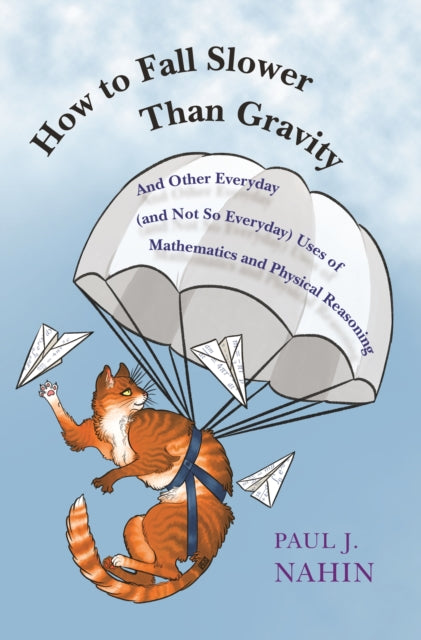
Princeton University Press How to Fall Slower Than Gravity
Book SynopsisTrade Review"This book is without a doubt the most enjoyable, stimulating book of mathematical physics (and occasionally more pure branches of maths) puzzles that I have ever read. It’s essentially a series of cleverly, and occasionally fiendishly put-together mathematics and physics challenge questions, each of which gets you thinking in a new and fascinating way."---Jonathan Shock, Mathemafrica"Reading Nahin is like reading through a select library of ancient Babylonian mathematical clay tablets. Surprises abound. . . . Nahin weaves much colorful history into his narrative."---Andrew Simoson, Mathematical Intelligencer"Engaging. . . . The book contains a wealth of original problems. . . . An enjoyable read."---Antonín Slavík, Zentralblatt MATH"This reviewer found himself being drawn to a variety of unfamiliar settings with much interest and even fascination." * Choice *"I certainly enjoyed [the book]!"---Alan Stevens, Mathematics Today"The potential audience for this book should be fairly large and go from highly talented high school students up through professionals in any STEM field."---Geoffrey Dietz, MAA Reviews
£19.80

Princeton University Press Pentagons and Pentagrams
Book SynopsisTrade Review"A Choice Outstanding Academic Title of the Year"
£19.00

Princeton University Press Taming the Unknown
Book SynopsisTrade Review"An excellent book; its accurate historical and pedagogical purpose offers an accessible read for historians and mathematicians."---Raffaele Pisano, Metascience"Well written and engaging with a wealth of useful material and a substantial bibliography for further reading, this book is a valuable resource for anyone with a serious interest in the history of algebra. With Taming the Unknown, Victor Katz and Karen Parshall have created a comprehensive synthesis of recent research on the subject, accessible to mathematicians, historians of mathematics and anyone involved in the teaching of algebra."---Adrian Rice, BSHM Bulletin"The authors have . . . pitched their writing perfectly for their intended audience. The broad outline of the story is expressed in clear prose, combined with a judicious use of that other ‘native tongue' of the college mathematics graduate, symbolic algebra. . . . There is an extensive bibliography presenting the more detailed historical research that has been carried out. . . . You could base a really nice third-year course on this book."---John Hannah, Aestimatio
£33.25

Princeton University Press Supersingular padic Lfunctions MaassShimura
Book Synopsis
£58.50
Princeton University Press How to Fall Slower Than Gravity
Book SynopsisTrade Review"This book is without a doubt the most enjoyable, stimulating book of mathematical physics (and occasionally more pure branches of maths) puzzles that I have ever read. It’s essentially a series of cleverly, and occasionally fiendishly put-together mathematics and physics challenge questions, each of which gets you thinking in a new and fascinating way."---Jonathan Shock, Mathemafrica"Reading Nahin is like reading through a select library of ancient Babylonian mathematical clay tablets. Surprises abound. . . . Nahin weaves much colorful history into his narrative."---Andrew Simoson, Mathematical Intelligencer"Engaging. . . . The book contains a wealth of original problems. . . . An enjoyable read."---Antonín Slavík, Zentralblatt MATH"This reviewer found himself being drawn to a variety of unfamiliar settings with much interest and even fascination." * Choice *"I certainly enjoyed [the book]!"---Alan Stevens, Mathematics Today"The potential audience for this book should be fairly large and go from highly talented high school students up through professionals in any STEM field."---Geoffrey Dietz, MAA Reviews
£15.29

MP-AMM American Mathematical Kvant Selecta Part 1
Book SynopsisPresents the Russian tradition of expository mathematical writing. Suitable for students and teachers who want to study its various aspects, this book includes topics in number theory. It treats diverse aspects of analysis and algebra.Table of ContentsThe arithmetic of binomial coefficients by D. B. Fuchs and M. B. Fuchs Do you like messing around with integers? by M. I. Bashmakov On Bertrand's conjecture by M. I. Bashmakov On best approximations. I by D. B. Fuchs and M. B. Fuchs On best approximations. II by D. B. Fuchs and M. B. Fuchs On a certain property of binomial coefficients by A. I. Shirshov On $n!$ and the number $e$ (Several approaches to a certain problem) by L. G. Limanov Rational approximations and transcendence by D. B. Fuchs and M. B. Fuchs Close fractions by V. N. Vaguten On the equation $\binom{n}{m} = \binom{n+1}{m-1}$ by A. I. Shirshov On regular polygons, Euler's function, and Fermat numbers by A. Kirillov 2-adic numbers by B. Bekker, S. Vostokov, and Yu. Ionin On the number $e$ by E. Kuzmin and A. Shirshov Markov's Diophantine equation by M. G. Krein The arithmetic of Gaussian integers by A. B. Goncharov Three formulas of Ramanujan by V. S. Shevelev Amazing adventures in the land of repeating decimals by V. G. Stolyar, E. A. Kuraev, Z. K. Silogadze, G. A. Galperin, and A. V. Korlyukov.
£38.90

MP-AMM American Mathematical Algebraic Geometry A Problem Solving Approach
Book SynopsisAlgebraic Geometry has been at the centre of much of mathematics for hundreds of years. It is not an easy field to break into, despite its humble beginnings in the study of circles, ellipses, hyperbolas, and parabolas. This text consists of a series of exercises, plus some background information and explanations, starting with conics and ending with sheaves and cohomology.
£47.70

MP-CTM National Council of T Algebra Patterns Functions and Change Casebook
Book SynopsisPresents twenty-nine cases, written by teachers describing real situations and actual student thinking in their classrooms, that provide the basis of each session's investigation of specific mathematical concepts and teaching strategies.
£41.61

John Wiley & Sons Inc Galois Theory 2e
Book SynopsisPraise for the First Edition . . .will certainly fascinate anyone interested in abstract algebra: a remarkable book! Monatshefte fur Mathematik Galois theory is one of the most established topics in mathematics, with historical roots that led to the development of many central concepts in modern algebra, including groups and fields. Covering classic applications of the theory, such as solvability by radicals, geometric constructions, and finite fields, Galois Theory, Second Edition delves into novel topics like Abel's theory of Abelian equations, casus irreducibili, and the Galois theory of origami. In addition, this book features detailed treatments of several topics not covered in standard texts on Galois theory, including: The contributions of Lagrange, Galois, and Kronecker How to compute Galois groups Galois''s results about irreducible polynomials of prime orprime-squared degreTrade Review“There is barely a better introduction to the subject, in all its theoretical and practical aspects, than the book under review.” (Zentralblatt MATH, 1 December 2012)"the great merit of this book (one of many expositions of the subject) is that everything is taken at a slow pace, with many examples to illustrate every idea. You get the (probably true) impression that the author loves this material, has taught it to undergraduates at Amherst College many times, has learned by experience the ideas which students find difficult, and has then taken great trouble to dissect these ideas and to pick out exactly the right examples and exercises to make them part of the reader’s mental equipment." (The Mathematical Gazette 2016) Table of ContentsPreface to the First Edition xvii Preface to the Second Edition xxi Notation xxiii 1 Basic Notation xxiii 2 Chapter-by-Chapter Notation xxv PART I POLYNOMIALS 1 Cubic Equations 3 1.1 Cardan's Formulas 4 1.2 Permutations of the Roots 10 1.3 Cubic Equations over the Real Numbers 15 2 Symmetric Polynomials 25 2.1 Polynomials of Several Variables 25 2.2 Symmetric Polynomials 30 2.3 Computing with Symmetric Polynomials (Optional) 42 2.4 The Discriminant 46 3 Roots of Polynomials 55 3.1 The Existence of Roots 55 3.2 The Fundamental Theorem of Algebra 62 PART II FIELDS 4 Extension Fields 73 4.1 Elements of Extension Fields 73 4.2 Irreducible Polynomials 81 4.3 The Degree of an Extension 89 4.4 Algebraic Extensions 95 5 Normal and Separable Extensions 101 5.1 Splitting Fields 101 5.2 Normal Extensions 107 5.3 Separable Extensions 109 5.4 Theorem of the Primitive Element 119 6 The Galois Group 125 6.1 Definition of the Galois Group 125 6.2 Galois Groups of Splitting Fields 130 6.3 Permutations of the Roots 132 6.4 Examples of Galois Groups 136 6.5 Abelian Equations (Optional) 143 7 The Galois Correspondence 147 7.1 Galois Extensions 147 7.2 Normal Subgroups and Normal Extensions 154 7.3 The Fundamental Theorem of Galois Theory 161 7.4 First Applications 167 7.5 Automorphisms and Geometry (Optional) 173 PART III APPLICATIONS 8 Solvability by Radicals 191 8.1 Solvable Groups 191 8.2 Radical and Solvable Extensions 196 8.3 Solvable Extensions and Solvable Groups 201 8.4 Simple Groups 210 8.5 Solving Polynomials by Radicals 215 8.6 The Casus Irreducbilis (Optional) 220 9 Cyclotomic Extensions 229 9.1 Cyclotomic Polynomials 229 9.2 Gauss and Roots of Unity (Optional) 238 10 Geometric Constructions 255 10.1 Constructible Numbers 255 10.2 Regular Polygons and Roots of Unity 270 10.3 Origami (Optional) 274 11 Finite Fields 291 11.1 The Structure of Finite Fields 291 11.2 Irreducible Polynomials over Finite Fields (Optional) 301 PART IV FURTHER TOPICS 12 Lagrange, Galois, and Kronecker 315 12.1 Lagrange 315 12.2 Galois 334 12.3 Kronecker 347 13 Computing Galois Groups 357 13.1 Quartic Polynomials 357 13.2 Quintic Polynomials 368 13.3 Resolvents 386 13.4 Other Methods 400 14 Solvable Permutation Groups 413 14.1 Polynomials of Prime Degree 413 14.2 Imprimitive Polynomials of Prime-Squared Degree 419 14.3 Primitive Permutation Groups 429 14.4 Primitive Polynomials of Prime-Squared Degree 444 15 The Lemniscate 463 15.1 Division Points and Arc Length 464 15.2 The Lemniscatic Function 470 15.3 The Complex Lemniscatic Function 482 15.4 Complex Multiplication 489 15.5 Abel's Theorem 504 A Abstract Algebra 515 A.1 Basic Algebra 515 A.2 Complex Numbers 524 A.3 Polynomials with Rational Coefficients 528 A.4 Group Actions 530 A.5 More Algebra 532 Index 557
£59.36

John Wiley & Sons Inc Introduction to Abstract Algebra
Book SynopsisPraise for the Third Edition . . . an expository masterpiece of the highest didactic value that has gained additional attractivity through the various improvements . . .Zentralblatt MATH The Fourth Edition of Introduction to Abstract Algebra continues to provide an accessible approach to the basic structures of abstract algebra: groups, rings, and fields. The book''s unique presentation helps readers advance to abstract theory by presenting concrete examples of induction, number theory, integers modulo n, and permutations before the abstract structures are defined. Readers can immediately begin to perform computations using abstract concepts that are developed in greater detail later in the text. The Fourth Edition features important concepts as well as specialized topics, including: The treatment of nilpotent groups, including the Frattini and Fitting subgroups Symmetric polynomials The pTrade Review “This could also be an excellent adjunct to more theoretically oriented textbooks used in more intensive courses.” (Computing Reviews, 5 November 2012) Table of ContentsPREFACE ix ACKNOWLEDGMENTS xvii NOTATION USED IN THE TEXT xix A SKETCH OF THE HISTORY OF ALGEBRA TO 1929 xxiii 0 Preliminaries 1 0.1 Proofs / 1 0.2 Sets / 5 0.3 Mappings / 9 0.4 Equivalences / 17 1 Integers and Permutations 23 1.1 Induction / 24 1.2 Divisors and Prime Factorization / 32 1.3 Integers Modulo n / 42 1.4 Permutations / 53 1.5 An Application to Cryptography / 67 2 Groups 69 2.1 Binary Operations / 70 2.2 Groups / 76 2.3 Subgroups / 86 2.4 Cyclic Groups and the Order of an Element / 90 2.5 Homomorphisms and Isomorphisms / 99 2.6 Cosets and Lagrange’s Theorem / 108 2.7 Groups of Motions and Symmetries / 117 2.8 Normal Subgroups / 122 2.9 Factor Groups / 131 2.10 The Isomorphism Theorem / 137 2.11 An Application to Binary Linear Codes / 143 3 Rings 159 3.1 Examples and Basic Properties / 160 3.2 Integral Domains and Fields / 171 3.3 Ideals and Factor Rings / 180 3.4 Homomorphisms / 189 3.5 Ordered Integral Domains / 199 4 Polynomials 202 4.1 Polynomials / 203 4.2 Factorization of Polynomials Over a Field / 214 4.3 Factor Rings of Polynomials Over a Field / 227 4.4 Partial Fractions / 236 4.5 Symmetric Polynomials / 239 4.6 Formal Construction of Polynomials / 248 5 Factorization in Integral Domains 251 5.1 Irreducibles and Unique Factorization / 252 5.2 Principal Ideal Domains / 264 6 Fields 274 6.1 Vector Spaces / 275 6.2 Algebraic Extensions / 283 6.3 Splitting Fields / 291 6.4 Finite Fields / 298 6.5 Geometric Constructions / 304 6.6 The Fundamental Theorem of Algebra / 308 6.7 An Application to Cyclic and BCH Codes / 310 7 Modules over Principal Ideal Domains 324 7.1 Modules / 324 7.2 Modules Over a PID / 335 8 p-Groups and the Sylow Theorems 349 8.1 Products and Factors / 350 8.2 Cauchy’s Theorem / 357 8.3 Group Actions / 364 8.4 The Sylow Theorems / 371 8.5 Semidirect Products / 379 8.6 An Application to Combinatorics / 382 9 Series of Subgroups 388 9.1 The Jordan–H¨older Theorem / 389 9.2 Solvable Groups / 395 9.3 Nilpotent Groups / 401 10 Galois Theory 412 10.1 Galois Groups and Separability / 413 10.2 The Main Theorem of Galois Theory / 422 10.3 Insolvability of Polynomials / 434 10.4 Cyclotomic Polynomials and Wedderburn’s Theorem / 442 11 Finiteness Conditions for Rings and Modules 447 11.1 Wedderburn’s Theorem / 448 11.2 The Wedderburn–Artin Theorem / 457 Appendices 471 Appendix A Complex Numbers / 471 Appendix B Matrix Algebra / 478 Appendix C Zorn’s Lemma / 486 Appendix D Proof of the Recursion Theorem / 490 BIBLIOGRAPHY 492 SELECTED ANSWERS 495 INDEX 523
£117.85

John Wiley & Sons Inc Linear Algebra Solutions Manual
Book SynopsisThis Student Solutions Manual to Accompany Linear Algebra: Ideas and Applications, Fourth Edition contains solutions to the odd numbered problems to further aid in reader comprehension, and an Instructor''s Solutions Manual (inclusive of suggested syllabi) is available via written request to the Publisher. Both the Student and Instructor Manuals have been enhanced with further discussions of the applications sections, which is ideal for readers who wish to obtain a deeper knowledge than that provided by pure algorithmic approaches. Linear Algebra: Ideas and Applications, Fourth Edition provides a unified introduction to linear algebra while reinforcing and emphasizing a conceptual and hands-on understanding of the essential ideas. Promoting the development of intuition rather than the simple application of methods, this book successfully helps readers to understand not only how to implement a technique, but why its use is important.Table of ContentsSTUDENT MANUAL 1 1 SYSTEMS OF LINEAR EQUATIONS 3 1.1 The Vector Space of m × n Matrices / 3 1.1.2 Applications to Graph Theory I / 7 1.2 Systems / 8 1.2.2 Applications to Circuit Theory / 11 1.3 Gaussian Elimination / 13 1.3.2 Applications to Traffic Flow / 18 1.4 Column Space and Nullspace / 19 2 LINEAR INDEPENDENCE AND DIMENSION 26 2.1 The Test for Linear Independence / 26 2.2 Dimension / 33 2.2.2 Applications to Differential Equations / 37 2.3 Row Space and the Rank-Nullity Theorem / 38 3 LINEAR TRANSFORMATIONS 43 3.1 The Linearity Properties / 43 3.2 Matrix Multiplication (Composition) / 49 3.2.2 Applications to Graph Theory II / 55 3.3 Inverses / 55 3.3.2 Applications to Economics / 60 3.4 The LU Factorization / 61 3.5 The Matrix of a Linear Transformation / 62 4 DETERMINANTS 67 4.1 Definition of the Determinant / 67 4.2 Reduction and Determinants / 69 4.2.1 Volume / 72 4.3 A Formula for Inverses / 74 5 EIGENVECTORS AND EIGENVALUES 76 5.1 Eigenvectors / 76 5.1.2 Application to Markov Processes / 79 5.2 Diagonalization / 80 5.2.1 Application to Systems of Differential Equations / 82 5.3 Complex Eigenvectors / 83 6 ORTHOGONALITY 85 6.1 The Scalar Product in ℝn / 85 6.2 Projections: The Gram-Schmidt Process / 87 6.3 Fourier Series: Scalar Product Spaces / 89 6.4 Orthogonal Matrices / 92 6.5 Least Squares / 93 6.6 Quadratic Forms: Orthogonal Diagonalization / 94 6.7 The Singular Value Decomposition (SVD) / 97 6.8 Hermitian Symmetric and Unitary Matrices / 98 7 GENERALIZED EIGENVECTORS 100 7.1 Generalized Eigenvectors / 100 7.2 Chain Bases / 104 8 NUMERICAL TECHNIQUES 107 8.1 Condition Number / 107 8.2 Computing Eigenvalues / 108
£24.65

John Wiley & Sons Inc Global Dynamics
Book SynopsisA world model: economies, trade, migration, security and development aid. This bookprovides the analytical capability to understand and explore the dynamics of globalisation. It is anchored in economic input-output models of over 200 countries and their relationships through trade, migration, security and development aid. The tools of complexity science are brought to bear and mathematical and computer models are developed both for the elements and for an integrated whole. Models are developed at a variety of scales ranging from the global and international trade through a European model of inter-sub-regional migration to piracy in the Gulf and the London riots of 2011. The models embrace the changing technology of international shipping, the impacts of migration on economic development along with changing patterns of military expenditure and development aid. A unique contribution is the level of spatial disaggregation which presents each of 200+ countries and their muTable of ContentsNotes on Contributors xiii Acknowledgements xvii Part I GLOBAL DYNAMICS AND THE TOOLS OF COMPLEXITY SCIENCE 1 Global Dynamics and the Tools of Complexity Science 3Alan Wilson Reference 7 Part II TRADE AND ECONOMIC DEVELOPMENT 2 The Global Trade System and Its Evolution 11Simone Caschili and Francesca Medda 2.1 The Evolution of the Shipping and Ports’ System 11 2.2 Analyses of the Cargo Ship Network 12 2.3 A Complex Adaptive Systems (CASs) Perspective 15 2.4 Conclusions: The Benefits of a Systems Perspective 20 References 21 Appendix 23 A.1 Complexity Science and Complex Adaptive Systems: Key Characteristics 23 A.1.1 Four Properties 24 A.1.2 Three Mechanisms 25 3 An Interdependent Multi-layer Model for Trade 26Simone Caschili, Francesca Medda, and Alan Wilson 3.1 Introduction 26 3.2 The Interdependent Multi-layer Model: Vertical Integration 27 3.3 Model Layers 30 3.3.1 Economic Layer 30 3.3.2 Social and Cultural Layer (Socio-cultural) 33 3.3.3 Physical Layer 34 3.4 The Workings of the Model 34 3.5 Model Calibration 35 3.6 Result 1: Steady State 39 3.7 Result 2: Estimation and Propagation of Shocks in the IMM 42 3.8 Discussion and Conclusions 48 References 48 4 A Global Inter-country Economic Model Based on Linked Input–Output Models 51Robert G. Levy, Thomas P. Oléron Evans, and Alan Wilson 4.1 Introduction 51 4.2 Existing Global Economic Models 52 4.3 Description of the Model 53 4.3.1 Outline 53 4.3.2 Introduction to Input–Output Tables 53 4.3.3 A Single Country Model 55 4.3.4 An International Trade Model 57 4.3.5 Setting Model Coefficients from Data 58 4.4 Solving the Model 58 4.4.1 The Leontief Equation 58 4.4.2 The Drawbacks of Mathematical Elegance 59 4.4.3 Algorithm for an Iterative Solution 59 4.5 Analysis 61 4.5.1 Introduction 61 4.5.2 Simple Modelling Approaches 61 4.5.3 A Unified Network Approach 64 4.5.4 Comparison with a Multi-region Input–Output Model 67 4.6 Conclusions 67 Acknowledgements 69 References 69 Appendix 71 A.1 Modelling the ‘Rest of the World’ 71 A.2 Services Trade Data 71 A.2.1 Importing Own Exports 72 A.2.2 The Rest of the World for Sectors 72 Part III MIGRATION 5 Global Migration Modelling: A Review of Key Policy Needs and Research Centres 75Adam Dennett and Pablo Mateos 5.1 Introduction 75 5.2 Policy and Migration Research 76 5.2.1 Key Policy Issues in Contemporary Migration Research 76 5.2.2 Linking Policy Issues to Modelling Challenges 81 5.2.3 Policy-related Research Questions for Modellers 82 5.2.4 Other International Migration Modelling Research 83 5.3 Conclusion 84 References 84 Appendix 87 A.1 United Kingdom 87 A.2 Rest of Europe 90 A.3 Rest of the World 94 6 Estimating Inter-regional Migration in Europe 97Adam Dennett and Alan Wilson 6.1 Introduction 97 6.2 The Spatial System and the Modelling Challenge 98 6.3 Biproportional Fitting Modelling Methodology 100 6.3.1 Model (i) 104 6.3.2 Model (ii) 105 6.3.3 Model (iii) 105 6.3.4 Model (iv) 108 6.3.5 Model (v) 109 6.3.6 Model (vi) 110 6.4 Model Parameter Calibration 110 6.5 Model Experiments 113 6.6 Results 118 6.7 Conclusions and Comments on the New Framework for Estimating Inter-regional, Inter-country Migration Flows in Europe 121 References 123 7 Estimating an Annual Time Series of Global Migration Flows – An Alternative Methodology for Using Migrant Stock Data 125Adam Dennett 7.1 Introduction 125 7.2 Methodology 129 7.2.1 Introduction 129 7.2.2 Calculating Migration Probabilities 129 7.2.3 Calculating Total Migrants in the Global System 130 7.2.4 Generating a Consistent Time Series of Migration Probabilities 133 7.2.5 Producing Annual Bilateral Estimates 135 7.3 Results and Validation 135 7.3.1 Introduction 135 7.3.2 IMEM comparison 135 7.3.3 UN Flow Data Comparison 136 7.4 Discussion 138 7.5 Conclusions 140 References 140 Part IV SECURITY 8 Conflict Modelling: Spatial Interaction as Threat 145Peter Baudains and Alan Wilson 8.1 Introduction 145 8.2 Conflict Intensity: Space–Time Patterning of Events 146 8.3 Understanding Conflict Onset: Simulation-based Models 148 8.4 Forecasting Global Conflict Hotspots 150 8.5 A Spatial Model of Threat 150 8.6 Discussion: The Use of a Spatial Threat Measure in Models of Conflict 153 8.6.1 Threat in Models for Operational Decision-Making 153 8.6.2 Threat in a Model of Conflict Escalation 154 8.6.3 Threat in Modelling Global Military Expenditure 156 8.6.4 Summary 156 References 157 9 Riots 159Peter Baudains 9.1 Introduction 159 9.2 The 2011 Riots in London 160 9.2.1 Space–Time Interaction 162 9.2.2 Journey to Crime 164 9.2.3 Characteristics of Rioters 165 9.3 Data-Driven Modelling of Riot Diffusion 166 9.4 Statistical Modelling of Target Choice 169 9.5 A Generative Model of the Riots 171 9.6 Discussion 172 References 173 10 Rebellions 175Peter Baudains, Jyoti Belur, Alex Braithwaite, Elio Marchione and Shane D. Johnson 10.1 Introduction 175 10.2 Data 176 10.3 Hawkes model 177 10.4 Results 181 10.5 Discussion 183 References 185 11 Spatial Interaction as Threat: Modelling Maritime Piracy 187Elio Marchione and Alan Wilson 11.1 The Model 187 11.2 The Test Case 188 11.3 Uses of the Model 189 Reference 191 Appendix 192 A.1 Volume Field of Type k Ship 192 A.2 Volume Field of Naval Units 193 A.3 Pirates Ports and Mother Ships 193 12 Space–Time Modelling of Insurgency and Counterinsurgency in Iraq 195Alex Braithwaite and Shane Johnson 12.1 Introduction 195 12.2 Counterinsurgency in Iraq 196 12.3 Counterinsurgency Data 200 12.4 Diagnoses of Space, Time and Space–Time Distributions 202 12.4.1 Introduction 202 12.4.2 Spatial Distribution 202 12.4.3 Temporal Distribution 203 12.4.4 Space–Time Distribution 203 12.4.5 Univariate Knox Analysis 206 12.4.6 Bivariate Knox Analysis 208 12.5 Concluding Comments 210 References 212 13 International Information Flows, Government Response and the Contagion of Ethnic Conflict 214Janina Beiser 13.1 Introduction 214 13.2 Global Information Flows 216 13.3 The Effect of Information Flows on Armed Civil Conflict 220 13.4 The Effect of Information Flows on Government Repression 225 13.5 Conclusion 226 References 226 Appendix 229 Part V AID AND DEVELOPMENT 14 International Development Aid: A Complex System 233Belinda Wu 14.1 Introduction: A Complex Systems’ Perspective 233 14.2 The International Development Aid System: Definitions 234 14.3 Features of International Development Aid as a Complex System 235 14.3.1 Introduction 235 14.3.2 Non-linearity 235 14.3.3 Connectedness 237 14.3.4 Self-Adapting and Self-Organising 238 14.3.5 Emergence 238 14.4 Complexity and Approaches to Research 238 14.4.1 Organisations 238 14.4.2 The Range of Issues 239 14.4.3 Research Approaches 240 14.4.4 The Complexity Science Approach 242 14.5 The Assessment of the Effectiveness of International Development Aid 242 14.5.1 Whether Aid Can Be Effective 242 14.5.2 Complexity in the Measurement of Aid Effectiveness 244 14.5.3 Complexity in Methods/Standards of Measurement of Aid Effectiveness 245 14.5.4 Standardising Aid Effectiveness 246 14.6 Relationships and Interactions 248 14.6.1 Relationships between Donor and Recipient Countries 248 14.6.2 Relationships between Aid and Other Systems 249 14.7 Conclusions 251 References 252 15 Model Building for the Complex System of International Development Aid 257Belinda Wu, Sean Hanna and Alan Wilson 15.1 Introduction 257 15.2 Data Collection 258 15.2.1 Introduction 258 15.2.2 Aid Data 258 15.2.3 Trade Data 260 15.2.4 Security Data 261 15.2.5 Migration Data 261 15.2.6 Geographical Data 261 15.2.7 Data Selected 262 15.3 Model Building 263 15.3.1 Modelling Approach 263 15.3.2 Alesina and Dollar Model 263 15.3.3 Our Models 264 15.3.4 Model B: Introducing Donor Interactions and Modification of the Model 267 15.3.5 Findings from Model B 267 15.3.6 Model C: Introducing Interactions with Trade System and Further Modification of the Model 267 15.3.7 Findings from Model C 268 15.4 Discussion and Future Work 268 References 269 16 Aid Allocation: A Complex Perspective 271Robert J. Downes and Steven R. Bishop 16.1 Aid Allocation Networks 271 16.1.1 Introduction 271 16.1.2 Why Networks? 272 16.1.3 Donor Motivation in Aid Allocation 273 16.2 Quantifying Aid via a Mathematical Model 273 16.2.1 Overview of Approach 273 16.2.2 Basic Set-Up 274 16.2.3 The Network of Nations 275 16.2.4 Preference Functions 275 16.2.5 Specifying the Preference Functions 275 16.2.6 Recipient Selection by Donors 276 16.3 Application of the Model 277 16.3.1 Introduction 277 16.3.2 Scenario 1. No Feedback 277 16.3.3 Scenario 2. Bandwagon Feedback 281 16.3.4 Scenario 3. Aid Effectiveness Feedback 283 16.3.5 Aid Usage Mechanism 284 16.3.6 Application 286 16.3.7 Conclusions 287 16.4 Remarks 287 Acknowledgements 288 References 288 Appendix 290 A.1 Common Functional Definitions 290 Part VI GLOBAL DYNAMICS: AN INTEGRATED MODEL AND POLICY CHALLENGES 17 An Integrated Model 293Robert G. Levy 17.1 Introduction 293 17.2 Adding Migration 294 17.2.1 Introduction 294 17.2.2 The Familiarity Effect 295 17.2.3 Consumption Similarity 301 17.2.4 Conclusions 304 17.3 Adding Aid 304 17.3.1 Introduction 304 17.3.2 Estimating ‘Exportness’ 305 17.3.3 Modelling Approach 306 17.3.4 Results 306 17.3.5 Conclusions 314 17.4 Adding Security 316 17.4.1 Introduction 316 17.4.2 Literature Review 316 17.4.3 Measures of Threat and the Global Dynamics Model 317 17.4.4 Trade during Changing Security Conditions 318 17.4.5 An Experiment of Increased Threat in the Global Dynamics Model 318 17.4.6 Conclusions 322 17.5 Concluding Comments 323 References 324 Index 327
£65.50

John Wiley & Sons Inc Matrix Algebra Useful for Statistics
Book SynopsisA thoroughly updated guide to matrix algebra and it uses in statistical analysis and features SAS, MATLAB, and R throughout This Second Edition addresses matrix algebra that is useful in the statistical analysis of data as well as within statistics as a whole. The material is presented in an explanatory style rather than a formal theorem-proof format and is self-contained. Featuring numerous applied illustrations, numerical examples, and exercises, the book has been updated to include the use of SAS, MATLAB, and R for the execution of matrix computations. In addition, André I. Khuri, who has extensive research and teaching experience in the field, joins this new edition as co-author. The Second Edition also: Contains new coverage on vector spaces and linear transformations and discusses computational aspects of matrices Covers the analysis of balanced linear models using direct products of matrices Analyzes multiresponse linTrade Review"Matrix Algebra Useful for Statistics, Second Edition is an ideal textbook for advanced undergraduate and first-year graduate level courses in statistics and other related disciplines. The book is also appropriate as a reference for independent readers who use statistics and wish to improve their knowledge of matrix algebra." Mathematical Reviews, Sept 2017 Table of ContentsPREFACE xvii PREFACE TO THE FIRST EDITION xix INTRODUCTION xxi ABOUT THE COMPANION WEBSITE xxxi PART I DEFINITIONS, BASIC CONCEPTS, AND MATRIX OPERATIONS 1 1 Vector Spaces, Subspaces, and Linear Transformations 3 1.1 Vector Spaces 3 1.2 Base of a Vector Space 5 1.3 Linear Transformations 7 2 Matrix Notation and Terminology 11 2.1 Plotting of a Matrix 14 2.2 Vectors and Scalars 16 2.3 General Notation 16 3 Determinants 21 3.1 Expansion by Minors 21 3.2 Formal Definition 25 3.3 Basic Properties 27 3.4 Elementary Row Operations 34 3.5 Examples 37 3.6 Diagonal Expansion 39 3.7 The Laplace Expansion 42 3.8 Sums and Differences of Determinants 44 3.9 A Graphical Representation of a 3 × 3 Determinant 45 4 Matrix Operations 51 4.1 The Transpose of a Matrix 51 4.2 Partitioned Matrices 52 4.3 The Trace of a Matrix 55 4.4 Addition 56 4.5 Scalar Multiplication 58 4.6 Equality and the Null Matrix 58 4.7 Multiplication 59 4.8 The Laws of Algebra 74 4.9 Contrasts With Scalar Algebra 76 4.10 Direct Sum of Matrices 77 4.11 Direct Product of Matrices 78 4.12 The Inverse of a Matrix 80 4.13 Rank of a Matrix—Some Preliminary Results 82 4.14 The Number of LIN Rows and Columns in a Matrix 84 4.15 Determination of the Rank of a Matrix 85 4.16 Rank and Inverse Matrices 87 4.17 Permutation Matrices 87 5 Special Matrices 97 5.1 Symmetric Matrices 97 5.2 Matrices Having All Elements Equal 102 5.3 Idempotent Matrices 104 5.4 Orthogonal Matrices 106 5.5 Parameterization of Orthogonal Matrices 109 5.6 Quadratic Forms 110 5.7 Positive Definite Matrices 113 6 Eigenvalues and Eigenvectors 119 6.1 Derivation of Eigenvalues 119 6.2 Elementary Properties of Eigenvalues 122 6.3 Calculating Eigenvectors 125 6.4 The Similar Canonical Form 128 6.5 Symmetric Matrices 131 6.6 Eigenvalues of Orthogonal and Idempotent Matrices 135 6.7 Eigenvalues of Direct Products and Direct Sums of Matrices 138 6.8 Nonzero Eigenvalues of AB and BA 140 7 Diagonalization of Matrices 145 7.1 Proving the Diagonability Theorem 145 7.2 Other Results for Symmetric Matrices 148 7.3 The Cayley–Hamilton Theorem 152 7.4 The Singular-Value Decomposition 153 8 Generalized Inverses 159 8.1 The Moore–Penrose Inverse 159 8.2 Generalized Inverses 160 8.3 Other Names and Symbols 164 8.4 Symmetric Matrices 165 9 Matrix Calculus 171 9.1 Matrix Functions 171 9.2 Iterative Solution of Nonlinear Equations 174 9.3 Vectors of Differential Operators 175 9.4 Vec and Vech Operators 179 9.5 Other Calculus Results 181 9.6 Matrices with Elements That Are Complex Numbers 188 9.7 Matrix Inequalities 189 PART II APPLICATIONS OF MATRICES IN STATISTICS 199 10 Multivariate Distributions and Quadratic Forms 201 10.1 Variance-Covariance Matrices 202 10.2 Correlation Matrices 203 10.3 Matrices of Sums of Squares and Cross-Products 204 10.4 The Multivariate Normal Distribution 207 10.5 Quadratic Forms and ;;2-Distributions 208 10.6 Computing the Cumulative Distribution Function of a Quadratic Form 213 11 Matrix Algebra of Full-Rank Linear Models 219 11.1 Estimation of ;; by the Method of Least Squares 220 11.2 Statistical Properties of the Least-Squares Estimator 226 11.3 Multiple Correlation Coefficient 229 11.4 Statistical Properties under the Normality Assumption 231 11.5 Analysis of Variance 233 11.6 The Gauss–Markov Theorem 234 11.7 Testing Linear Hypotheses 237 11.8 Fitting Subsets of the x-Variables 246 11.9 The Use of the R(.|.) Notation in Hypothesis Testing 247 12 Less-Than-Full-Rank Linear Models 253 12.1 General Description 253 12.2 The Normal Equations 256 12.3 Solving the Normal Equations 257 12.4 Expected Values and Variances 259 12.5 Predicted y-Values 260 12.6 Estimating the Error Variance 261 12.7 Partitioning the Total Sum of Squares 262 12.8 Analysis of Variance 263 12.9 The R(⋅|⋅) Notation 265 12.10 Estimable Linear Functions 266 12.11 Confidence Intervals 272 12.12 Some Particular Models 272 12.13 The R(⋅|⋅) Notation (Continued) 277 12.14 Reparameterization to a Full-Rank Model 281 13 Analysis of Balanced Linear Models Using Direct Products of Matrices 287 13.1 General Notation for Balanced Linear Models 289 13.2 Properties Associated with Balanced Linear Models 293 13.3 Analysis of Balanced Linear Models 298 14 Multiresponse Models 313 14.1 Multiresponse Estimation of Parameters 314 14.2 Linear Multiresponse Models 316 14.3 Lack of Fit of a Linear Multiresponse Model 318 PART III MATRIX COMPUTATIONS AND RELATED SOFTWARE 327 15 SAS/IML 329 15.1 Getting Started 329 15.2 Defining a Matrix 329 15.3 Creating a Matrix 330 15.4 Matrix Operations 331 15.5 Explanations of SAS Statements Used Earlier in the Text 354 16 Use of MATLAB in Matrix Computations 363 16.1 Arithmetic Operators 363 16.2 Mathematical Functions 364 16.3 Construction of Matrices 365 16.4 Two- and Three-Dimensional Plots 371 17 Use of R in Matrix Computations 383 17.1 Two- and Three-Dimensional Plots 396 Exercises 408 APPENDIX 413 INDEX 475
£103.46

John Wiley and Sons Ltd Practical Finite Element Modeling in Earth
Book SynopsisMathematical models have become a crucial way for the Earth scientist to understand and predict how our planet functions and evolves through time and space. The finite element method (FEM) is a remarkably flexible and powerful tool with enormous potential in the Earth Sciences.Table of ContentsPreface xiii Symbols xv About the Companion Website xvii Part I The Finite Element Method with Matlab 1 1 Preliminaries 3 1.1 Mathematical Models 3 1.2 Boundary and Initial Conditions 4 1.3 Analytical Solutions 5 1.4 Numerical Solutions 5 1.5 Numerical Solution Methods 7 1.6 Matlab Script 8 1.7 Exercises 10 Suggested Reading 12 2 Beginning with the Finite Element Method 13 2.1 The Governing PDE 13 2.2 Approximating the Continuous Variable 14 2.3 Minimizing the Residual 15 2.4 Evaluating the Element Matrices 17 2.5 Time Discretization 18 2.6 Assembly 19 2.7 Boundary and Initial Conditions 21 2.8 Solution of the Algebraic Equations 21 2.9 Exercises 22 Suggested Reading 23 3 Programming the Finite Element Method in Matlab 25 3.1 Program Structure and Philosophy 25 3.2 Summary of the Problem 25 3.3 Discretized Equations 26 3.4 The Program 27 3.4.1 Preprocessor Stage 27 3.4.2 Solution Stage 29 3.4.3 Postprocessor Stage 30 3.5 Matlab Script 30 3.6 Exercises 33 Suggested Reading 34 4 Numerical Integration and Local Coordinates 35 4.1 Gauss–Legendre Quadrature 36 4.2 Local Coordinates 37 4.3 Evaluating the Integrals 39 4.4 Variable Material Properties 40 4.5 Programming Considerations 41 4.6 Matlab Script 43 4.7 Exercises 45 Suggested Reading 47 5 The Finite Element Method in Two Dimensions 49 5.1 Discretization 50 5.2 Geometry and Nodal Connectivity 52 5.3 Integration of Element Matrices 54 5.4 Multielement Assembly 57 5.5 Boundary Conditions and Solution 60 5.6 Matlab Script 61 5.7 Exercises 65 Suggested Reading 66 6 The Finite Element Method in Three Dimensions 67 6.1 Discretization 67 6.2 Element Integration 69 6.3 Assembly for Multielement Mesh 72 6.4 Boundary Conditions and Solution 73 6.5 Matlab Program 74 6.6 Exercises 79 Suggested Reading 80 7 Generalization of Finite Element Concepts 81 7.1 The FEM for an Elliptic Problem 84 7.2 The FEM for a Hyperbolic Problem 96 7.3 The FEM for Systems of Equations 102 7.4 Exercises 116 Suggested Reading 116 Part II Applications of the Finite Element Method in Earth Science 119 8 Heat Transfer 121 8.1 Conductive Cooling in an Eroding Crust 122 8.2 Conductive Cooling of an Intrusion 126 Suggested Reading 135 9 Landscape Evolution 137 9.1 Evolution of a 1D River Profile 138 9.2 Evolution of a Fluvially Dissected Landscape 143 Suggested Reading 150 10 Fluid Flow in Porous Media 151 10.1 Fluid Flow Around a Fault 152 10.2 Viscous Fingering 157 Suggested Reading 166 11 Lithospheric Flexure 167 11.1 Governing Equations 167 11.2 FEM Discretization 168 11.3 Matlab Implementation 171 Suggested Reading 181 12 Deformation of Earth’s Crust 183 12.1 Governing Equations 183 12.2 Rate Formulation 185 12.3 FEM Discretization 186 12.4 Viscoelastoplasticity 188 12.5 Matlab Implementation 190 Suggested Reading 205 13 Going Further 207 13.1 Optimization 207 13.2 Using Other FEMs 213 13.3 Use of Existing Finite Element Software 215 Appendix A Derivation of the Diffusion Equation 217 Appendix B Basics of Linear Algebra with Matlab 221 Appendix C Comparison between Different Numerical Methods 227 Appendix D Integration by Parts 237 Appendix E Time Discretization 239 References 241 Index 245
£73.76

John Wiley & Sons Linear Algebra with Applications
Book Synopsis
£137.70

Springer London Graphs and Matrices
Book SynopsisTable of ContentsPreliminaries.- Incidence Matrix.- Adjacency Matrix.- Laplacian Matrix.- Cycles and Cuts.- Regular Graphs.- Line Graph of a Tree.- Algebraic Connectivity.- Distance Matrix of a Tree.- Resistance Distance.- Laplacian Eigenvalues of Threshold Graphs.- Positive Definite Completion Problem.- Matrix Games Based on Graphs.
£61.74

MP-AMM American Mathematical Number Systems An Introduction to Algebra and
Book SynopsisOffers a rigorous and coherent introduction to the five basic number systems of mathematics - natural numbers, integers, rational numbers, real numbers, and complex numbers. The great merit of the book lies in its extensive list of exercises following each chapter. These exercises are designed to assist the instructor and to enhance the learning experience of the students.Table of Contents Natural numbers Integers Rational numbers Real numbers Complex numbers Sets, relations, functions Bibliography Index
£63.00

MP-AMM American Mathematical Mathematics
Book SynopsisTrade ReviewThe book under review contains six chapters that can be read independently, each one surveying one mathematical topic. ... It is carefully written, and it is better than a collection of lecture notes. Such books are needed for students, as a complement to the standard textbooks and to present more specialized applications of classical mathematics. The reviewer wishes there were many more such books." - Athanase Papadopoulos, Zentralblatt MATH"This book has its origins, we are told, in the authors' experiences teaching graduate students in computer science, who needed background in certain mathematical topics. Since these topics were not covered in the basic courses that these students had taken, the authors undertook to introduce them in courses spanning several semesters, the lecture notes of which, suitably expanded, became this text. ... I like expository books, because I think, particularly in these days of increasing specialization, that they serve a valuable purpose, not only for students but also professionals who want to see what's going on in other areas, or who need some background in one area for research in another. This book is a fine example of that genre." - Mark Hunacek, MAA ReviewsTable of Contents Measaure and integral High-dimensional geometry and measure concentration Fourier analysis Representations of finite groups Polynomials Topology Index
£47.70

American Mathematical Society Automorphic Forms and Related Topics
Book SynopsisAddresses various aspects of the theory of automorphic forms and its relations with the theory of $L$-functions, the theory of elliptic curves, and representation theory. This volume is intended for researchers interested in expanding their own areas of focus, thus allowing them to build bridges to mathematical questions in other fields.Table of Contents S. Anni, A note on the minimal level of realization for a mod $\ell$ eigenvalue system A. Arnold-Roksandich, A discussion on the number eta-quotients of prime level C. Burrin, Dedekind sums, reciprocity, and non-arithmetic groups G. Chinta, I. Horozov, and C. O'Sullivan, Noncommutative modular symbols and Eisenstein series A. Espinosa, An annotated discussion of a panel presentation on improving diversity in mathematics J. S. Friedman, J. Jorgenson, and L. Smajlovic, Superzeta functions, regularized products, and the Selberg zeta function on hyperbolic manifolds with cusps X. Guitart and M. Masdeu, Computing $p$-adic periods of abelian varieties from automorphic forms A. Haensch and B. Kane, An algebraic and analytic approach to spinor exceptional behavior in translated lattices A. K. Jha and B. Sahu, Differential operators on Jacobi forms and special values of certain Dirichlet series J. Jorgenson and L. Smajlovic, Some results in study of Kronecker limit formula and Dedekind sums D. Kelmer, Equidistribution of shears and their arithmetic applications K. Khuri-Makdisi, Fake proofs for identities involving products of Eisenstein series K. Khuri-Makdisi, Modular forms constructed from moduli of elliptic curves, with applications to explicit models of modular curves B. Kumar, J. Meher, and S. Pujahari, Some remarks on the coefficients of symmetric power $L$-functions J. Li, On primes in arithmetic progressions B. Linowitz and L. Thompson, The Fourier coefficients of Eisenstein series newforms K. Maurischat, Properties of Sturm's formula A. Odzak and L. Sceta, An application of a special form of a Tauberian theorem A. Odzak and L. Sceta, On the zeros of some $L$ functions from the extended Selberg class E. Ozman, Rational points on twisted modular curves B. Ramakrishnan, B. Sahu, and A. K. Singh, On the number of representations of certain quadratic forms in 8 variables M. Roy, Level of Siegel modular forms constructed via $\textrm{sym}^3$ lifting F. Stromberg, Dimension formulas and kernel functions for Hilbert modular forms H. Then, An explicit evaluation of the Hauptmoduli at elliptic points for certain arithmetic groups A. Trbovic, Torsion groups of elliptic curves over quadratic fields S. Wagh, Maass space for lifting from SL(2,$\mathbb{R}$) to GL(2,B) over a division quaternion algebra N. Walji, On the occurrence of large positive Hecke eigenvalues for GL(2) L. H. Walling, Representations by quadratic forms and the Eichler Commutation Relation S. Yamana, Degenerate principal series and Langlands classification.
£102.60

MP-AMM American Mathematical Conformal Symmetry Breaking Differential
Book Synopsis
£68.40

MP-AMM American Mathematical Singularities Mirror Symmetry and the Gauged
Book SynopsisContains the proceedings of the workshop ‘Crossing the Walls in Enumerative Geometry’, held in May 2018. The volume features a collection of both expository and research articles about mirror symmetry, quantized singularity theory (FJRW theory), and the gauged linear sigma model.Table of Contents R. Webb, Quasimaps and some examples of stacks for everybody E. Clader, Introduction to the gauged linear sigma model D. Ross, Localization and mirror symmetry W.-P. Li, A brief introduction to cosection localization and $P$-fields M. Shoemaker, Virtual classes for hypersurfaces via two-periodic complexes J. Oh, Localized Chern characters for 2-periodic complexes and virtual cycles T. Milanov, Singularity theory and mirror symmetry U. Whitcher, Counting points with Berglund-Hubsch-Kravitz mirror symmetry H. Fan and Y.-P. Lee, Variations on the theme of quantum Lefschetz R. Mi, Type II extremal transitions in Gromov-Witten theory C.-C. M. Liu, A lecture on holomorphic anomaly equations and extended holomorphic anomaly equation
£96.30

MP-AMM American Mathematical Organized Collapse An Introduction to Discrete
Book SynopsisProvides a gentle introduction into discrete Morse theory. Using a combinatorial approach, the author emphasizes acyclic matchings as the central object of study. The first two parts of the book can be used as a stand-alone introduction to homology, the last two parts delve into the core of discrete Morse theory.Table of Contents Preamble Preface The idea of homology The idea of discrete Morse theory A sample application How to use this book Prerequisites Guide to the literature Part 1 . Introduction to Homology Chapter 1. The First Steps Chapter 2. Simplicial Homology Chapter 3. Beyond the Simplicial Setting Part 2 . Further Aspects of Homology Theory Chapter 4. Category of Chain Complexes Chapter 5. Chain Homotopy Chapter 6. Connecting Homomorphism Chapter 7. Singular Homology Chapter 8. Cellular Homology Suggested further reading for Parts 1 and 2 Part 3 . Basic Discrete Morse Theory Chapter 9. Simplicial Collapses Chapter 10. Organizing Collapsing Sequences Chapter 11. Internal Collapses and Discrete Morse Theory Chapter 12. Explicit Homology Classes Associated to Critical Cells Chapter 13. The Critical Morse Complex Chapter 14. Implications and Variations Suggested further reading for Part 3 Part 4 . Extensions of Discrete Morse Theory Chapter 15. Algebraic Morse Theory Chapter 16. Discrete Morse Theory for Posets Chapter 17. Discrete Morse Theory for CW Complexes Chapter 18. Discrete Morse Theory and Persistence Suggested further reading for Part 4 Index List of Figures List of Tables Bibliography Index Preview Material Preface Table of Contents
£70.20
MP-AMM American Mathematical An Invitation to Arithmetic Geometry
Book Synopsis
£999.99

MP-AMM American Mathematical Compactifications Configurations and Cohomology
Book SynopsisFocuses on new and existing connections between three types of compactifications, thereby setting the stage for further research. The book draws on the discipline-specific expertise of all contributors, and at the same time gives a unified, self-contained reference for compactifications and related constructions in different contexts.Table of ContentsA. Balibanu, A quasi-Poisson structure on the multiplicative Grothendieck-Springer resolution; P. Brosnan, Volumes of definable sets in o-minimal expansions and affine GAGA theorems; P. Crooks and R. Roser, Hessenberg varieties and Poisson slices; G. Denham and A. Steiner, Geometry of logarithmic derivations of hyperplane arrangements; I. Halacheva, Shift of argument algebras and de Concini-Procesi spaces; B. Knudsen, Projection spaces and twisted Lie algebras; A. I. Suciu, Cohomology, Bocksteins, and resonance varieties in characteristic 2.
£103.50

MP-AMM American Mathematical Groups and Topological Dynamics
Book SynopsisFocuses on group-theoretic aspects of topological dynamics such as studying groups using their actions on topological spaces, using group theory to study symbolic dynamics, and other connections between group theory and dynamical systems.Table of Contents Dynamical systems Group actions Groupoids Iterated monodromy groups Groups from groupoids Growth and amenability Bibliography Index
£67.50

American Mathematical Society MilnorWitt Motives
£65.70

American Mathematical Society MacDonald Theory and Beyond
Book Synopsis
£104.40

American Mathematical Society Decomposition Matrices for Groups of Lie Type in Nondefining Characteristic
£999.99

American Mathematical Society Continuous Combinatorics of Abelian Group Actions
£65.70

American Mathematical Society Commuting Partial Normal Subgroups and Regular Localities
£65.70

John Wiley & Sons Arithmetic Geometry Cryptography and Coding Theory
£104.40

American Mathematical Society Algebraic Structures and Applications
£104.40

American Mathematical Society Iwasawa Theory and Its Perspective Volumes 13
£269.10
Springer Us Submanifold Theory Beyond an Introduction
Book SynopsisSeveral relevant classes of submanifolds are also discussed, including constant curvature submanifolds, submanifolds of nonpositive extrinsic curvature, conformally flat submanifolds and real Kaehler submanifolds.Trade Review“I can recommend this book to anyone interested in submanifold theory: from students with a background in basic Riemannian geometry to experienced researchers in the field.” (Joeri Van der Veken, Mathematical Reviews, January, 2021)Table of ContentsThe basic equations of a submanifold.- Reduction of codimension.- Minimal submanifolds.- Local rigidity of submanifolds.- Constant curvature submanifolds.- Submanifolds with nonpositive extrinsic curvature.- Submanifolds with relative nullity.- Isometric immersions of Riemannian products.- Conformal immersions.- Isometric immersions of warped products.- The Sbrana-Cartan hypersurfaces.- Genuine deformations.- Deformations of complete submanifolds.- Innitesimal bendings.- Real Kaehler submanifolds.- Conformally at submanifolds.- Conformally deformable hypersurfaces.- Vector bundles.
£55.99

Centre for the Study of Language & Information Selected Papers on Discrete Mathematics
Book SynopsisDonald Knuth's influence in computer science ranges from the invention of literate programming to the development of the TeX programming language. One of the foremost figures in the field of mathematical sciences, his papers are widely referenced and stand as milestones of development over a wide range of topics. This volume assembles more than three dozen of Professor Knuth's pioneering contributions to discrete mathematics. It includes a variety of topics in combinatorial mathematics (finite geometries, graph theory, enumeration, partitions, tableaux, matroids, codes); discrete algebra (finite fields, groupoids, closure operators, inequalities, convolutions, Pfaffians); and concrete mathematics (recurrence relations, special numbers and notations, identities, discrete probability). Of particular interest are two fundamental papers in which the evolution of random graphs is studied by means of generating functions.Table of Contents1. Discussion of Mr. Riordan's paper 'Abel identities and inverse relations'; 2. Duality in addition chains; 3. Combinatorial analysis and computers; 4. Tables of finite fields; 5. Finite semifields and projective planes; 6. A class of projective planes; 7. Construction of a random sequence; 8. Oriented subtrees of an arc digraph; 9. Another enumeration of trees; 10. Notes on central groupoids; 11. Permutations, matrices, and generalized Young tableaux; 12. A note on solid partitions; 13. Subspaces, subsets, and partitions; 14. Enumeration of plane partitions; 15. Complements and transitive closures; 16. Permutations with nonnegative partial sums; 17. Wheels within wheels; 18. The asymptotic number of geometries; 19. Random matroids; 20. Identities from partition involutions; 21. Huffman's algorithm via algebra; 22. A permanent inequality; 23. Efficient balanced codes; 24. The power of a prime that divides a generalized binomial coefficient; 25. The first cycles in an evolving graph; 26. The birth of the giant component; 27. Polynomials involving the floor function; 28. The sandwich theorem; 29. Aztec diamonds, checkerboard graphs, and spanning trees.
£30.40

Information Age Publishing How Students Think When Doing Algebra
Book SynopsisAlgebra is the gateway to college and careers, yet it functions as the eye of the needle because of low pass rates for the middle school/high school course and students’ struggles to understand. We have forty years of research that discusses the ways students think and their cognitive challenges as they engage with algebra. This book is a response to the National Council of Teachers of Mathematics’ (NCTM) call to better link research and practice by capturing what we have learned about students’ algebraic thinking in a way that is usable by teachers as they prepare lessons or reflect on their experiences in the classroom. Through a Fund for the Improvement of Post-Secondary Education (FIPSE) grant, 17 teachers and mathematics educators read through the past 40 years of research on students’ algebraic thinking to capture what might be useful information for teachers to know—over 1000 articles altogether. The resulting five domains addressed in the book (Variables & Expressions, Algebraic Relations, Analysis of Change, Patterns & Functions, and Modeling & Word Problems) are closely tied to CCSS topics.Over time, veteran math teachers develop extensive knowledge of how students engage with algebraic concepts—their misconceptions, ways of thinking, and when and how they are challenged to understand—and use that knowledge to anticipate students’ struggles with particular lessons and plan accordingly. Veteran teachers learn to evaluate whether an incorrect response is a simple error or the symptom of a faulty or naïve understanding of a concept. Novice teachers, on the other hand, lack the experience to anticipate important moments in the learning of their students. They often struggle to make sense of what students say in the classroom and determine whether the response is useful or can further discussion (Leatham, Stockero, Peterson, & Van Zoest 2011; Peterson & Leatham, 2009). The purpose of this book is to accelerate early career teachers’ “experience” with how students think when doing algebra in middle or high school as well as to supplement veteran teachers’ knowledge of content and students. The research that this book is based upon can provide teachers with insight into the nature of the student’s struggles with particular algebraic ideas—to help teachers identify patterns that imply underlying thinking.Our book, How Students Think When Doing Algebra, is not intended to be a “how to” book for teachers. Instead, it is intended to orient new teachers to the ways students think and be a book that teachers at all points in their career continually pull of the shelf when they wonder, “how might my students struggle with this algebraic concept I am about to teach?” The primary audience for this book is early career mathematics teachers who don’t have extensive experience working with students engaged in mathematics. However, the book can also be useful to veteran teachers to supplement their knowledge and is an ideal resource for mathematics educators who are preparing preservice teachers.Table of Contents Chapter 1: Introduction Chapter 2: Variables and Expressions Chapter 3: Algebraic Relations Chapter 4: Analysis of Change (Graphing) Chapter 5: Patterns & Functions Chapter 6: Modeling and Word Problems
£49.95

Information Age Publishing How Students Think When Doing Algebra
Book SynopsisAlgebra is the gateway to college and careers, yet it functions as the eye of the needle because of low pass rates for the middle school/high school course and students’ struggles to understand. We have forty years of research that discusses the ways students think and their cognitive challenges as they engage with algebra. This book is a response to the National Council of Teachers of Mathematics’ (NCTM) call to better link research and practice by capturing what we have learned about students’ algebraic thinking in a way that is usable by teachers as they prepare lessons or reflect on their experiences in the classroom. Through a Fund for the Improvement of Post-Secondary Education (FIPSE) grant, 17 teachers and mathematics educators read through the past 40 years of research on students’ algebraic thinking to capture what might be useful information for teachers to know—over 1000 articles altogether. The resulting five domains addressed in the book (Variables & Expressions, Algebraic Relations, Analysis of Change, Patterns & Functions, and Modeling & Word Problems) are closely tied to CCSS topics.Over time, veteran math teachers develop extensive knowledge of how students engage with algebraic concepts—their misconceptions, ways of thinking, and when and how they are challenged to understand—and use that knowledge to anticipate students’ struggles with particular lessons and plan accordingly. Veteran teachers learn to evaluate whether an incorrect response is a simple error or the symptom of a faulty or naïve understanding of a concept. Novice teachers, on the other hand, lack the experience to anticipate important moments in the learning of their students. They often struggle to make sense of what students say in the classroom and determine whether the response is useful or can further discussion (Leatham, Stockero, Peterson, & Van Zoest 2011; Peterson & Leatham, 2009). The purpose of this book is to accelerate early career teachers’ “experience” with how students think when doing algebra in middle or high school as well as to supplement veteran teachers’ knowledge of content and students. The research that this book is based upon can provide teachers with insight into the nature of the student’s struggles with particular algebraic ideas—to help teachers identify patterns that imply underlying thinking.Our book, How Students Think When Doing Algebra, is not intended to be a “how to” book for teachers. Instead, it is intended to orient new teachers to the ways students think and be a book that teachers at all points in their career continually pull of the shelf when they wonder, “how might my students struggle with this algebraic concept I am about to teach?” The primary audience for this book is early career mathematics teachers who don’t have extensive experience working with students engaged in mathematics. However, the book can also be useful to veteran teachers to supplement their knowledge and is an ideal resource for mathematics educators who are preparing preservice teachers.Table of Contents Chapter 1: Introduction Chapter 2: Variables and Expressions Chapter 3: Algebraic Relations Chapter 4: Analysis of Change (Graphing) Chapter 5: Patterns & Functions Chapter 6: Modeling and Word Problems
£87.40

Arcler Education Inc An Introduction to Algebraic and Combinatorial
Book SynopsisAn Introduction to Algebraic and Combinatorial Coding Theory is a comprehensive book that offers a thorough exploration of the principles and techniques of coding theory. It serves as a valuable resource for readers interested in gaining a deeper understanding of error detection and correction in communication systems. With its well-structured chapters covering coding theory fundamentals, algebraic codes, cyclic codes, block codes, and advanced coding techniques, this book caters to the needs of students, researchers, and professionals in the field. It provides a solid foundation in coding theory and showcases its practical applications in various domains, including telecommunications, data storage, and cryptography.Table of Contents Chapter 1 Introduction Chapter 2 Digital Image Information Hiding Algorithm Research Based on LDPC Code Chapter 3 Rate-Adaptive BCH Codes for Distributed Source Coding Chapter 4 Reducing the Overhead of BCH Codes: New Double Error Correction Codes Chapter 5 Ideals of Numerical Semigroups and Error-Correcting Codes Chapter 6 Turbo Codes for Multi-Hop Wireless Sensor Networks with Decode-and-Forward Mechanism Chapter 7 Entanglement-Assisted Quantum Codes from Cyclic Codes Chapter 8 Low-Complexity Chase Decoding of Reed–Solomon Codes Using Channel Evaluation Chapter 9 How Reed-Solomon Codes Can Improve Steganographic Schemes Chapter 10 A New Minimize Matrix Computation Coding Method for Distributed Storage Systems Chapter 11 Permutation-Based Block Code for Short Packet Communication Systems Chapter 12 A Simple Neural-Network-Based Decoder for Short Binary Linear Block Codes Chapter 13 An Analytical Approach to Error Detection and Correction for Onboard Nanosatellites Chapter 14 Application of Forward Error Correction (FEC) Codes in Wireless Acoustic Emission Structural Health Monitoring on Railway Infrastructures Chapter 15 Blind Recognition of Forward Error Correction Codes Based on Recurrent Neural Network
£158.40


