
Topology Books

MP-AMM American Mathematical Smooth Homotopy of InfiniteDimensional Cinfty
Book SynopsisWe use homotopical algebra (or abstract homotopical methods) to study smooth homotopical problems of infinite-dimensional C$C^{\infty }$-manifolds in convenient calculus. More precisely, we discuss the smoothing of maps, sections, principal bundles, and gauge transformations.
£68.40

American Mathematical Society Geometry Revisited
Book SynopsisAmong the many beautiful and nontrivial theorems in geometry found in Geometry Revisited are the theorems of Ceva, Menelaus, Pappus, Desargues, Pascal, and Brianchon. The transformational point of view is emphasized: reflections, rotations, translations, similarities, inversions, and affine and projective transformations.
£51.30

MP-AMM American Mathematical Computational Topology An Introduction
Book SynopsisTrade Review“This book is a very welcome, untraditional, thorough and well-organized introduction to a young and quickly developing discipline on the crossroads between mathematics, computer science, and engineering.” —DMV NewsletterTable of Contents Computational geometric topology: Graphs Surfaces Complexes Computational algebraic topology: Homology Duality Morse functions Computational persistent topology: Persistence Stability Applications References Index
£59.40

MP-AMM American Mathematical SYZ Geometry for CalabiYau 3folds TaubNUT and
Book Synopsis
£68.40

MP-AMM American Mathematical Eulerian Spaces
Book Synopsis
£67.50

American Mathematical Society Differential Geometry of Plane Curves
Book SynopsisFeatures plane curves to illustrate many deep and inspiring results in the field in an elementary and accessible way. After an introduction to the basic properties of plane curves, the authors introduce a number of complex and beautiful topics, including the rotation number, rotation index, Jordan curve theorem, and isoperimetric inequality.Table of Contents Plane curves Winding number Rotation index Jordan curve theorem Isoperimetric inequality Convex curves The four-vertex theorem Curve-shortening flow Appendix A: The class $\mathcal{C}^\infty$ convergence of the curvature function under the curve-shortening flow Appendix B: Answers to selected exercises Bibliography Index
£46.80
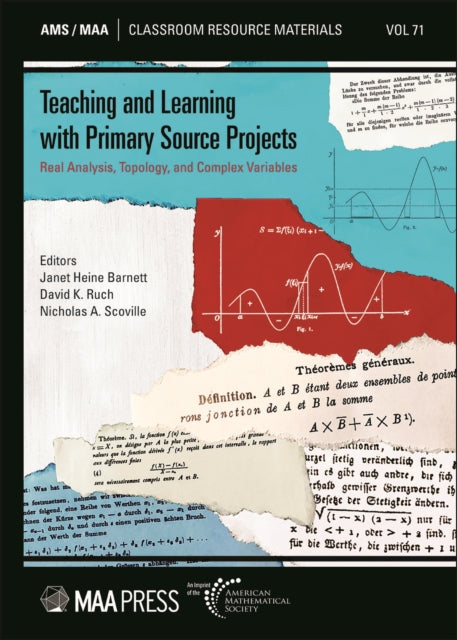
American Mathematical Society Teaching and Learning with Primary Source
Book SynopsisA collection of 24 classroom modules (PSPs) produced by TRIUMPHS that incorporate the reading of primary source excerpts to teach core mathematical topics. The selected excerpts are intertwined with thoughtfully designed student tasks that prompt students to actively engage with and explore the source material.Trade ReviewPrimary sources provide motivation in the words of the original discoverers of new mathematics, draw attention to subtleties, encourage reflection on today's paradigms, and enhance students' ability to participate equally, regardless of their background. These beautifully written primary source projects that adopt an ``inquiry'' approach are rich in features lacking in modern textbooks. Prompted by the study of historical sources, students will grapple with uncertainties, ask questions, interpret, conjecture, and compare multiple perspectives, resulting in a unique and vivid guided learning experience. -- David Pengelley, Oregon State UniversityTable of ContentsJ. H. Barnett, D. K. Ruch, and N. A. Scoville, Contents; Introduction: J. H. Barnett, D. K. Ruch, and N. A. Scoville, Teaching and Learning with Primary Source Projects; J. H. Barnett, D. K. Ruch, and N. A. Scoville, PSP Summaries: The Collection at a Glance; J. H. Barnett, Historical Overview; Real Analysis: J. H. Barnett, Why Be So Critical? Nineteenth-Century Mathematics and the Origins of Analysis; D. Ruch, Investigations into Bolzano's Bounded Set Theorem; M. P. Saclolo, Stitching Dedekind Cuts to Construct the Real Numbers; D. Ruch, Investigations into d'Alembert's Definition of Limit; D. Ruch, Bolzano on Continuity and the Intermediate Value Theorem; N. Somasunderam, Understanding Compactness: Early Work, Uniform Continuity to the Heine-Borel Theorem; D. Ruch, An Introduction to a Rigorous Definition of Derivative; J. H. Barnett, Rigorous Debates over Debatable Rigor: Monster Functions in Introductory Analysis; D. Ruch, The Mean Value Theorem; D. Ruch, Euler's Rediscovery of $e$; D. Ruch, Abel and Cauchy on a Rigorous Approach to Infinite Series; D. Ruch, The Definite Integrals of Cauchy and Riemann; J. H. Barnett, Henri Lebesgue and the Development of the Integral Concept; Topology: N. A. Scoville, The Cantor Set before Cantor; N. A. Scoville, Topology from Analysis; N. A. Scoville, Nearness without Distance; N. A. Scoville, Connectedness: Its Evolution and Applications; N. A. Scoville, Connecting Connectedness; N. A. Scoville, From Sets to Metric Spaces to Topological Spaces; N. A. Scoville, The Closure Operation as the Foundation of Topology; N. A. Scoville, A Compact Introduction to a Generalized Extreme Value Theorem; Complex Variables: D. Klyve, The Logarithm of $-1$; D. Ruch, Riemann's Development of the Cauchy-Riemann Equations; D. Ruch, Gauss and Cauchy on Complex Integration.
£51.30

MP-AMM American Mathematical Compactifications Configurations and Cohomology
Book SynopsisFocuses on new and existing connections between three types of compactifications, thereby setting the stage for further research. The book draws on the discipline-specific expertise of all contributors, and at the same time gives a unified, self-contained reference for compactifications and related constructions in different contexts.Table of ContentsA. Balibanu, A quasi-Poisson structure on the multiplicative Grothendieck-Springer resolution; P. Brosnan, Volumes of definable sets in o-minimal expansions and affine GAGA theorems; P. Crooks and R. Roser, Hessenberg varieties and Poisson slices; G. Denham and A. Steiner, Geometry of logarithmic derivations of hyperplane arrangements; I. Halacheva, Shift of argument algebras and de Concini-Procesi spaces; B. Knudsen, Projection spaces and twisted Lie algebras; A. I. Suciu, Cohomology, Bocksteins, and resonance varieties in characteristic 2.
£103.50

American Mathematical Society Amenability of Discrete Groups by Examples
Book SynopsisPuts together main approaches to study amenability. A novel feature of the book is that the exposition of the material starts with examples which introduce a method rather than illustrating it. This allows the reader to quickly move on to meaningful material without learning and remembering a lot of additional definitions and preparatory results.
£98.10

American Mathematical Society Multidimensional Residue Theory and Applications
Book SynopsisDefines and studies multidimensional residues via analytic continuation for holomorphic bundle-valued current maps. This point of view offers versatility and flexibility to the tools and constructions proposed, allowing these residues to be defined and studied outside the classical case of complete intersection.Table of ContentsResidue calculus in one variable; Residue currents: A multiplicative approach; Residue currents: A bundle approach; Bochner-Martinelli kernels and weights; Integral closure, Briancon-Skoda type theorems; Residue calculus and trace formulae; Miscellaneous applications: Intersection, division; Complex manifolds and analytic spaces; Holomorphic bundles over complex analytic spaces; Positivity on complex analytic spaces; Various concepts in algebraic or analytic geometry; Bibliography; Index.
£101.70

MP-AMM American Mathematical Groups and Topological Dynamics
Book SynopsisFocuses on group-theoretic aspects of topological dynamics such as studying groups using their actions on topological spaces, using group theory to study symbolic dynamics, and other connections between group theory and dynamical systems.Table of Contents Dynamical systems Group actions Groupoids Iterated monodromy groups Groups from groupoids Growth and amenability Bibliography Index
£67.50

MP-AMM American Mathematical Geometric Structures on Manifolds
Book SynopsisFocuses on several successful classification problems. Namely, fix a geometry in the sense of Klein and a topological manifold. Then the different ways of locally putting the geometry on the manifold lead to a moduli space'.Table of Contents Part 1. Affine and projective geometry: Affine geometry Projective geometry Duality and non-Euclidean geometry Convexity Part 2. Geometric manifolds: Locally homogeneous geometric structures Examples of geometric structures Classification Completeness Part 3. Affine and projective structures: Affine structures on surfaces and the Euler characteristic Affine Lie groups Parallel volume and completeness Hyperbolicity Projective structures on surfaces Complex-projective structures Geometric structures on 3-manifolds Appendices: Appendix A. Transformation groups Appendix B. Affine connections Appendix C. Representations of nilpotent groups Appendix D. 4-dimensional filiform nilpotent Lie algebras Appendix E. Semicontinuous functions Appendix F. $\mathsf{SL}(2,\mathbb{C})$ and $O(3,1)$ Appendix G. Lagrangian foliations of symplectic manifolds Bibliography Index
£68.40

MP-AMM American Mathematical Hamiltons Ricci Flow
Book SynopsisRicci flow is a powerful analytic method for studying the geometry and topology of manifolds. This book is an introduction to Ricci flow for graduate students and mathematicians interested in working in the subject. To this end, the first chapter is a review of the relevant basics of Riemannian geometry. For the benefit of the student, the text includes a number of exercises of varying difficulty. The book also provides brief introductions to some general methods of geometric analysis and other geometric flows. Comparisons are made between the Ricci flow and the linear heat equation, mean curvature flow, and other geometric evolution equations whenever possible. Several topics of Hamilton's program are covered, such as short time existence, Harnack inequalities, Ricci solitons, Perelman's no local collapsing theorem, singularity analysis, and ancient solutions. A major direction in Ricci flow, via Hamilton's and Perelman's works, is the use of Ricci flow as an approach to solving the Poincare conjecture and Thurston's geometrization conjecture.Trade Review“The style of the book is very pleasant, including lots of motivations and background material, course outlines and exercises (with solutions), the bibliography is rather comprehensive. This work is certain to become one of the main references in this field of great current interest.” - M. Kunzinger“This book is a very well written introduction to and resource for study of the Ricci flow. It is quite self-contained, but relevant references are provided at appropriate points. The style of the book renders it accessible to graduate students (suggested course outlines and many relevant further references are provided), while its substance provides an essential resource for background, key concepts and fundamental ideas for further study in the area.” - James McCoy, Mathematical Reviews Table of Contents Riemannian geometry Fundamentals of the Ricci flow equation Closed 3-manifolds with positive Ricci curvature Ricci solitons and special solutions Isoperimetric estimates and no local collapsing Preparation for singularity analysis High-dimensional and noncompact Ricci flow Singularity analysis Ancient solutions Differential Harnack estimates Space-time geometry Appendix A. Geometric analysis related to Ricci flow Appendix B. Analytic techniques for geometric flows Appendix S. Solutions to selected exercises Bibliography Index
£73.80

MP-AMM American Mathematical Ricci Solitons in Low Dimensions
Book SynopsisFocuses on Ricci solitons, shedding light on their role in understanding singularity formation in Ricci flow and formulating surgery-based Ricci flow, which holds potential applications in topology.Table of Contents Ricci flow singularity formation The Ricci soliton equation The $2$-dimensional classification Estimates for shrinking Ricci solitons Classification of $3$-dimensional shrinkers The Bryant soliton Expanding and steady GRS and the flying wing Brendle's theorem on the uniqueness of $3$-dimensional steadies Geometric preliminaries Analytic preliminaries Bibliography Index
£100.80
American Mathematical Society 4Manifolds and Kirby Calculus
Book SynopsisSince the early 1980s, there has been an explosive growth in 4-manifold theory, particularly due to the influx of interest and ideas from gauge theory and algebraic geometry. This book offers an exposition of the subject from the topological point of view. It bridges the gap to other disciplines and presents classical but important topological techniques that have not previously appeared in the literature. Part I of the text presents the basics of the theory at the second-year graduate level and offers an overview of current research. Part II is devoted to an exposition of Kirby calculus, or handlebody theory on 4-manifolds. It is both elementary and comprehensive. Part III offers in-depth treatments of a broad range of topics from current 4-manifold research. Topics include branched coverings and the geography of complex surfaces, elliptic and Lefschetz fibrations, $h$-cobordisms, symplectic 4-manifolds, and Stein surfaces. The authors present many important applications. The textTrade Review“This book is important and valuable in that both gives a comprehensive and accessible picture of an area which has developed rapidly in the past 20 years and also provides readers with techniques to begin research in the field. The book is pedagogically very strong, with many examples and exercises. The material will not go out of date, and however the field may develop in the future, this will be an important reference for many years to come.” - Bulletin of the London Mathematical Society“This book gives an excellent introduction into the theory of $4$-manifolds and can be strongly recommended to beginners in this field ... carefully and clearly written; the authors have evidently paid great attention to the presentation of the material ... contains many really pretty and interesting examples and a great number of exercises; the final chapter is then devoted to solutions of some of these ... this type of presentation makes the subject more attractive and its study easier.” - European Mathematical Society Newsletter“A complete record of the folklore related to handle calculus ... All of the mathematical statements are given in absolutely precise language, and the notation and terminology used are well chosen ... a very comprehensive book ... Most low-dimensional topologists will want to have access to this as a reference book ... any student ... will be rewarded with a thorough understanding of this fascinating field.” - Bulletin of the AMS“The book under review introduces the current state of 4-manifold topology; it is almost unique in that it does so from the point of view of differential topology. Part I of the book ... would be priceless for algebraic geometers and gauge theorists who want to learn the topological aspects of the theory. Part II ... is essentially independent of Part I and would make for an excellent graduate text on its own.” - Mathematical Reviews“I greatly recommend this wonderful book to any researcher in 4-manifold topology for the novel ideas, techniques, constructions, and computations on the topic, presented in a very fascinating way. I think really that every student, mathematician, and researcher interested in 4-manifold topology, should own a copy of this beautiful book.” - Zentralblatt MATH“Provides a unique and comprehensive account of almost all that is known about the topology of 4-manifolds and the existing techniques for studying them ... This book is important and valuable in that it gives a comprehensive and accessible picture of an area which has developed rapidly in the past 20 years and also provides the reader with techniques to begin research in the field. The book is pedagogically very strong, with many examples and exercises (including solutions to selected exercises). The material will not go out of date, and however the field may develop in the future, this will be an important reference for many years to come.” - Bulletin of the London Mathematical SocietyTable of Contents 4-manifolds: Introduction Surfaces in 4-manifolds Complex surfaces Kirby calculus: Handlebodies and Kirby diagrams Kirby calculus More examples Applications: Branched covers and resolutions Elliptic and Lefschetz fibrations Cobordisms, $h$-cobordisms and exotic ${\mathbb{R}}^{4,}$s Symplectic 4-manifolds Stein surfaces Appendices: Solutions Notation, important figures Bibliography Index
£66.60

MP-AMM American Mathematical Discrete Differential Geometry Integrable Structure
Book SynopsisAn emerging field of discrete differential geometry aims at the development of discrete equivalents of notions and methods of classical differential geometry. The latter appears as a limit of a refinement of the discretization. Current interest in discrete differential geometry derives not only from its importance in pure mathematics but also from its applications in computer graphics, theoretical physics, architecture, and numerics. Rather unexpectedly, the very basic structures of discrete differential geometry turn out to be related to the theory of integrable systems. One of the main goals of this book is to reveal this integrable structure of discrete differential geometry. For a given smooth geometry one can suggest many different discretizations. Which one is the best? This book answers this question by providing fundamental discretization principles and applying them to numerous concrete problems. It turns out that intelligent theoretical discretizations are distinguished also by their good performance in applications. The intended audience of this book is threefold. It is a textbook on discrete differential geometry and integrable systems suitable for a one semester graduate course. On the other hand, it is addressed to specialists in geometry and mathematical physics. It reflects the recent progress in discrete differential geometry and contains many original results. The third group of readers at which this book is targeted is formed by specialists in geometry processing, computer graphics, architectural design, numerical simulations, and animation. They may find here answers to the question ""How do we discretize differential geometry?"" arising in their specific field. Prerequisites for reading this book include standard undergraduate background (calculus and linear algebra). No knowledge of differential geometry is expected, although some familiarity with curves and surfaces can be helpful.Trade Review“This book gives new life to old concepts of classical differential geometry, and a beautiful introduction to new notions of discrete integrable systems. It should be of interest to researchers in several areas of mathematics (integrable systems, differential geometry, numerical approximation of special surfaces), but also to advanced students interested in a good introduction to several classical areas of mathematics. Parts of it could well be used for graduate or possibly advanced undergraduate courses in mathematics.” - Mathematical Reviews“It can serve as a very good introduction into contemporary research and it seems to be the first book devoted to the topic. ... The book is well and clearly written.” - EMS Newsletter Table of Contents Classical differential geometry Discretization principles. Multidimensional nets Discretization principles. Nets in quadrics Special classes of discrete surfaces Approximation Consistency as integrability Discrete complex analysis. Linear theory Discrete complex analysis. Integrable circle patterns Foundations Solutions of selected exercises Bibliography Notations Index
£63.90

American Mathematical Society The Slice Spectral Sequence of a C4Equivariant
Book Synopsis
£63.90

American Mathematical Society Collected Works of William P. Thurston with
Book SynopsisWilliam Thurston's work has had a profound influence on mathematics. He connected whole mathematical subjects in entirely new ways and changed the way mathematicians think about geometry, topology, foliations, group theory, dynamical systems, and the way these areas interact. This four-part collection brings together Thurston's major writings.
£93.60

MP-AMM American Mathematical Collected Works of William P. Thurston with Comm
Book SynopsisWilliam Thurston's work has had a profound influence on mathematics. He connected whole mathematical subjects in entirely new ways and changed the way mathematicians think about geometry, topology, foliations, group theory, dynamical systems, and the way these areas interact. This four-part collection brings together Thurston's major writings.
£93.60

ISTE Ltd and John Wiley & Sons Inc Topology Optimization Design of Heterogeneous
Book SynopsisThis book pursues optimal design from the perspective of mechanical properties and resistance to failure caused by cracks and fatigue. The book abandons the scale separation hypothesis and takes up phase-field modeling, which is at the cutting edge of research and is of high industrial and practical relevance. Part 1 starts by testing the limits of the homogenization-based approach when the size of the representative volume element is non-negligible compared to the structure. The book then introduces a non-local homogenization scheme to take into account the strain gradient effects. Using a phase field method, Part 2 offers three significant contributions concerning optimal placement of the inclusion phases. Respectively, these contributions take into account fractures in quasi-brittle materials, interface cracks and periodic composites. The topology optimization proposed has significantly increased the fracture resistance of the composites studied.Table of ContentsIntroduction ix Part 1. Multiscale Topology Optimization in the Context of Non-separated Scales 1 Chapter 1. Size Effect Analysis in Topology Optimization for Periodic Structures Using the Classical Homogenization 3 1.1. The classical homogenization method 4 1.1.1. Localization problem 4 1.1.2. Definition and computation of the effective material properties 7 1.1.3. Numerical implementation for the local problem with PER 9 1.2. Topology optimization model and procedure 10 1.2.1. Optimization model and sensitivity number 10 1.2.2. Finite element meshes and relocalization scheme 12 1.2.3. Optimization procedure 14 1.3. Numerical examples 16 1.3.1. Doubly clamped elastic domain 17 1.3.2. L-shaped structure 19 1.3.3. MBB beam 24 1.4. Concluding remarks 25 Chapter 2. Multiscale Topology Optimization of Periodic Structures Taking into Account Strain Gradient 29 2.1. Non-local filter-based homogenization for non-separated scales 30 2.1.1. Definition of local and mesoscopic fields through the filter 30 2.1.2. Microscopic unit cell calculations 33 2.1.3. Mesoscopic structure calculations 39 2.2. Topology optimization procedure 41 2.2.1. Model definition and sensitivity numbers 41 2.2.2. Overall optimization procedure 42 2.3. Validation of the non-local homogenization approach 43 2.4. Numerical examples 45 2.4.1. Cantilever beam with a concentrated load 46 2.4.2. Four-point bending lattice structure 52 2.5. Concluding remarks 55 Chapter 3. Topology Optimization of Meso-structures with Fixed Periodic Microstructures 57 3.1. Optimization model and procedure 58 3.2. Numerical examples 61 3.2.1. A double-clamped beam 61 3.2.2. A cantilever beam 64 3.3. Concluding remarks 66 Part 2. Topology Optimization for Maximizing the Fracture Resistance 67 Chapter 4. Topology Optimization for Optimal Fracture Resistance of Quasi-brittle Composites 69 4.1. Phase field modeling of crack propagation 71 4.1.1. Phase field approximation of cracks 71 4.1.2. Thermodynamics of the phase field crack evolution 72 4.1.3. Weak forms of displacement and phase field problems 75 4.1.4. Finite element discretization 76 4.2. Topology optimization model for fracture resistance 78 4.2.1. Model definitions 78 4.2.2. Sensitivity analysis 80 4.2.3. Extended BESO method 85 4.3. Numerical examples 87 4.3.1. Design of a 2D reinforced plate with one pre-existing crack notch 88 4.3.2. Design of a 2D reinforced plate with two pre-existing crack notches 93 4.3.3. Design of a 2D reinforced plate with multiple pre-existing cracks 96 4.3.4. Design of a 3D reinforced plate with a single pre-existing crack notch surface 98 4.4. Concluding remarks 101 Chapter 5. Topology Optimization for Optimal Fracture Resistance Taking into Account Interfacial Damage 103 5.1. Phase field modeling of bulk crack and cohesive interfaces 104 5.1.1. Regularized representation of a discontinuous field 104 5.1.2. Energy functional 106 5.1.3. Displacement and phase field problems 108 5.1.4. Finite element discretization and numerical implementation 111 5.2. Topology optimization method 114 5.2.1. Model definitions 114 5.2.2. Sensitivity analysis 116 5.3. Numerical examples 119 5.3.1. Design of a plate with one initial crack under traction 120 5.3.2. Design of a plate without initial cracks for traction loads 123 5.3.3. Design of a square plate without initial cracks in tensile loading 125 5.3.4. Design of a plate with a single initial crack under three-point bending 128 5.3.5. Design of a plate containing multiple inclusions 130 5.4. Concluding remarks 133 Chapter 6. Topology Optimization for Maximizing the Fracture Resistance of Periodic Composites 135 6.1. Topology optimization model 136 6.2. Numerical examples 138 6.2.1. Design of a periodic composite under three-point bending 138 6.2.2. Design of a periodic composite under non-symmetric three-point bending 146 6.3. Concluding remarks 151 Conclusion 153 References 157 Index 173
£125.06

Springer International Publishing AG Fixed Point Theory in Generalized Metric Spaces
Book SynopsisThis book presents fixed point theory, one of the crucial tools in applied mathematics, functional analysis, and topology, which has been used to solve distinct real-world problems in computer science, engineering, and physics. The authors begin with an overview of the extension of metric spaces. Readers are introduced to general fixed-point theorems while comparing and contrasting important and insignificant metric spaces. The book is intended to be self-contained and serves as a unique resource for researchers in various disciplines.Table of ContentsMetric Spaces.- Extension of Metric Spaces.- Fixed Point Theorems on Extended Metric Spaces.
£44.99

Springer International Publishing AG Dialogues Between Physics and Mathematics: C. N.
Book SynopsisThis volume celebrates the 100th birthday of Professor Chen-Ning Frank Yang (Nobel 1957), one of the giants of modern science and a living legend. Starting with reminiscences of Yang's time at the research centre for theoretical physics at Stonybrook (now named C. N. Yang Institute) by his successor Peter van Nieuwenhuizen, the book is a collection of articles by world-renowned mathematicians and theoretical physicists. This emphasizes the Dialogue Between Physics and Mathematics that has been a central theme of Professor Yang’s contributions to contemporary science. Fittingly, the contributions to this volume range from experimental physics to pure mathematics, via mathematical physics. On the physics side, the contributions are from Sir Anthony Leggett (Nobel 2003), Jian-Wei Pan (Willis E. Lamb Award 2018), Alexander Polyakov (Breakthrough Prize 2013), Gerard 't Hooft (Nobel 1999), Frank Wilczek (Nobel 2004), Qikun Xue (Fritz London Prize 2020), and Zhongxian Zhao (Bernd T. Matthias Prize 2015), covering an array of topics from superconductivity to the foundations of quantum mechanics. In mathematical physics there are contributions by Sir Roger Penrose (Nobel 2022) and Edward Witten (Fields Medal 1990) on quantum twistors and quantum field theory, respectively. On the mathematics side, the contributions by Vladimir Drinfeld (Fields Medal 1990), Louis Kauffman (Wiener Gold Medal 2014), and Yuri Manin (Cantor Medal 2002) offer novel ideas from knot theory to arithmetic geometry.Inspired by the original ideas of C. N. Yang, this unique collection of papers b masters of physics and mathematics provides, at the highest level, contemporary research directions for graduate students and experts alike.Table of Contents1 Frank Yang at Stony Brook and the Beginning of Supergravity.- 2. A Stacky Approach to Crystals.- 3 The Potts Model, the Jones Polynomial and Link Homology.- 4 The Penrose–Onsager–Yang Approach to Superconductivity and Superfluidity.- 5 Quantum Operads.- 6 Quantum computational complexity withphotons and linear optics.- 7 Quantized Twistors, G2*, and the Split Octonions.- 8 Kronecker Anomalies and Gravitational Striction.- 9 Projecting Local and Global Symmetries to the Planck Scale.- 10 Gauge Symmetry in Shape Dynamics.- 11 Why Does Quantum Field Theory In Curved Spacetime Make Sense? And What Happens To The Algebra of Observables In The Thermodynamic Limit?.- 12 Quantum Anomalous Hall Effect.- 13 Magic Superconducting States in Cuprates.
£104.49
Springer-Verlag Berlin and Heidelberg GmbH & Co. KG Introduction to Piecewise-Linear Topology
Book SynopsisThe first five chapters of this book form an introductory course in piece wise-linear topology in which no assumptions are made other than basic topological notions. This course would be suitable as a second course in topology with a geometric flavour, to follow a first course in point-set topology, andi)erhaps to be given as a final year undergraduate course. The whole book gives an account of handle theory in a piecewise linear setting and could be the basis of a first year postgraduate lecture or reading course. Some results from algebraic topology are needed for handle theory and these are collected in an appendix. In a second appen dix are listed the properties of Whitehead torsion which are used in the s-cobordism theorem. These appendices should enable a reader with only basic knowledge to complete the book. The book is also intended to form an introduction to modern geo metric topology as a research subject, a bibliography of research papers being included. We have omitted acknowledgements and references from the main text and have collected these in a set of "historical notes" to be found after the appendices.Table of Contents1. Polyhedra and P.L. Maps.- Basic Notation.- Joins and Cones.- Polyhedra.- Piecewise-Linear Maps.- The Standard Mistake.- P. L. Embeddings.- Manifolds.- Balls and Spheres.- The Poincaré Conjecture and the h-Cobordism Theorem..- 2. Complexes.- Simplexes.- Cells.- Cell Complexes.- Subdivisions.- Simplicial Complexes.- Simplicial Maps.- Triangulations.- Subdividing Diagrams of Maps.- Derived Subdivisions.- Abstract Isomorphism of Cell Complexes.- Pseudo-Radial Projection.- External Joins.- Collars.- Appendix to Chapter 2. On Convex Cells.- 3. Regular Neighbourhoods.- Full Subcomplexes.- Derived Neighbourhoods.- Regular Neighbourhoods.- Regular Neighbourhoods in Manifolds.- Isotopy Uniqueness of Regular Neighbourhoods.- Collapsing.- Remarks on Simple Homotopy Type.- Shelling.- Orientation.- Connected Sums.- Schönflies Conjecture.- 4. Pairs of Polyhedra and Isotopies.- Links and Stars.- Collars.- Regular Neighbourhoods.- Simplicial Neighbourhood Theorem for Pairs.- Collapsing and Shelling for Pairs.- Application to Cellular Moves.- Disc Theorem for Pairs.- Isotopy Extension.- 5. General Position and Applications.- General Position.- Embedding and Unknotting.- Piping.- Whitney Lemma and Unlinking Spheres.- Non-Simply-Connected Whitney Lemma.- 6. Handle Theory.- Handles on a Cobordism.- Reordering Handles.- Handles of Adjacent Index.- Complementary Handles.- Adding Handles.- Handle Decompositions.- The CW Complex Associated with a Decomposition.- The Duality Theorems.- Simplifying Handle Decompositions.- Proof of the h-Cobordism Theorem.- The Relative Case.- The Non-Simply-Connected Case.- Constructing h-Cobordisms.- 7. Applications.- Unknotting Balls and Spheres in Codimension ? 3.- A Criterion for Unknotting in Codimension 2.- Weak 5-Dimensional Theorems.- Engulfing.- Embedding Manifolds.- Appendix A. Algebraic Results.- A. 1 Homology.- A. 2 Geometric Interpretation of Homology.- A. 3 Homology Groups of Spheres.- A. 4 Cohomology.- A. 5 Coefficients.- A. 6 Homotopy Groups.- A. 8 The Universal Cover.- Appendix B. Torsion.- B. 1 Geometrical Definition of Torsion.- B. 2 Geometrical Properties of Torsion.- B. 3 Algebraic Definition of Torsion.- B. 4 Torsion and Polyhedra.- B. 5 Torsion and Homotopy Equivalences.- Historical Notes.
£85.49
Springer-Verlag Berlin and Heidelberg GmbH & Co. KG The Higher Infinite: Large Cardinals in Set Theory from Their Beginnings
Book SynopsisOver the years, this book has become a standard reference and guide in the set theory community. It provides a comprehensive account of the theory of large cardinals from its beginnings and some of the direct outgrowths leading to the frontiers of contemporary research, with open questions and speculations throughout.Table of ContentsPreliminaries.- Beginnings.- Partition Properties.- Forcing and Sets of Reals.- Aspects of Measurability.- Strong Hypotheses.- Determinacy.
£104.49

Springer-Verlag Berlin and Heidelberg GmbH & Co. KG The Classical Groups and K-Theory
Book SynopsisIt is a great satisfaction for a mathematician to witness the growth and expansion of a theory in which he has taken some part during its early years. When H. Weyl coined the words "classical groups", foremost in his mind were their connections with invariant theory, which his famous book helped to revive. Although his approach in that book was deliberately algebraic, his interest in these groups directly derived from his pioneering study of the special case in which the scalars are real or complex numbers, where for the first time he injected Topology into Lie theory. But ever since the definition of Lie groups, the analogy between simple classical groups over finite fields and simple classical groups over IR or C had been observed, even if the concept of "simplicity" was not quite the same in both cases. With the discovery of the exceptional simple complex Lie algebras by Killing and E. Cartan, it was natural to look for corresponding groups over finite fields, and already around 1900 this was done by Dickson for the exceptional Lie algebras G and E • However, a deep reason for this 2 6 parallelism was missing, and it is only Chevalley who, in 1955 and 1961, discovered that to each complex simple Lie algebra corresponds, by a uniform process, a group scheme (fj over the ring Z of integers, from which, for any field K, could be derived a group (fj(K).Table of ContentsNotation and Conventions.- 1. General Linear Groups, Steinberg Groups, and K-Groups.- 2. Linear Groups over Division Rings.- 3. Isomorphism Theory for the Linear Groups.- 4. Linear Groups over General Classes of Rings.- 5. Unitary Groups, Unitary Steinberg Groups, and Unitary K-Groups.- 6. Unitary Groups over Division Rings.- 7. Clifford Algebras and Orthogonal Groups over Commutative Rings.- 8. Isomorphism Theory for the Unitary Groups.- 9. Unitary Groups over General Classes of Form Rings.- Concluding Remarks.- Index of Concepts.- Index of Symbols.
£89.99
Springer-Verlag Berlin and Heidelberg GmbH & Co. KG Algebraic Operads
Book SynopsisIn many areas of mathematics some “higher operations” are arising. These havebecome so important that several research projects refer to such expressions. Higher operationsform new types of algebras. The key to understanding and comparing them, to creating invariants of their action is operad theory. This is a point of view that is 40 years old in algebraic topology, but the new trend is its appearance in several other areas, such as algebraic geometry, mathematical physics, differential geometry, and combinatorics. The present volume is the first comprehensive and systematic approach to algebraic operads. An operad is an algebraic device that serves to study all kinds of algebras (associative, commutative, Lie, Poisson, A-infinity, etc.) from a conceptual point of view. The book presents this topic with an emphasis on Koszul duality theory. After a modern treatment of Koszul duality for associative algebras, the theory is extended to operads. Applications to homotopy algebra are given, for instance the Homotopy Transfer Theorem. Although the necessary notions of algebra are recalled, readers are expected to be familiar with elementary homological algebra. Each chapter ends with a helpful summary and exercises. A full chapter is devoted to examples, and numerous figures are included. After a low-level chapter on Algebra, accessible to (advanced) undergraduate students, the level increases gradually through the book. However, the authors have done their best to make it suitable for graduate students: three appendices review the basic results needed in order to understand the various chapters. Since higher algebra is becoming essential in several research areas like deformation theory, algebraic geometry, representation theory, differential geometry, algebraic combinatorics, and mathematical physics, the book can also be used as a reference work by researchers.Trade ReviewFrom the reviews:“It is a welcome addition to the existing literature and will, no doubt, become a standard reference for many authors working in this quickly developing field. … it is an impressive piece of work, which gives a comprehensive account of the foundations of the theory of algebraic operads, starting from the most basic notions, such as associative algebras and modules. It will be of interest to a broad swath of mathematicians: from undergraduate students to experts in the field.” (Andrey Yu. Lazarev, Mathematical Reviews, March, 2013)Table of ContentsPreface.- 1.Algebras, coalgebras, homology.- 2.Twisting morphisms.- 3.Koszul duality for associative algebras.- 4.Methods to prove Koszulity of an algebra.- 5.Algebraic operad.- 6 Operadic homological algebra.- 7.Koszul duality of operads.- 8.Methods to prove Koszulity of an operad.- 9.The operads As and A\infty.- 10.Homotopy operadic algebras.- 11.Bar and cobar construction of an algebra over an operad.- 12.(Co)homology of algebras over an operad.- 13.Examples of algebraic operads.- Apendices: A.The symmetric group.- B.Categories.- C.Trees.- References.- Index.- List of Notation.
£104.49
Springer-Verlag Berlin and Heidelberg GmbH & Co. KG Lagrangian Manifolds and the Maslov Operator
Book SynopsisThis book presents Maslov's canonical operator method for finding asymptotic solutions of pseudo differential equations. The classical WKB method, so named in honor of its authors: Wentzel, Kramers and Brillouin, was created for finding quasi classical approximations in quantum mechanics. The simplicity, obviousness and "physicalness" of this method quickly made it popular: specialists in mathematical physics accepted it unequivocally as one of the weapons in their arsenal. The number of publications which are connected with the WKB method in one way or another can probably no longer be counted. The alternative name of the WKB method in diffraction problem- the ray method or the method of geometric optics - indicates that the approximations in the WKB method are constructed by means of rays. More precisely, the first approximation of the WKB method is constructed by means of rays (isolating the singular part), after which the usual methods of the (regular) theory of perturbations are applied. However, the ray method is not applicable at the points of space where the rays focus or form a caustic. Mathematically this fact expresses itself in the fact that the amplitude of the waves at such points become infinite.Table of ContentsI. The Topology of Lagrangian Manifolds.- 1. Some Topological Considerations.- 1.1 Manifolds and Bundles.- 1.2 Theorems on Transversal Regularity.- 1.3 The Index of Intersection of Submanifolds.- 1.4 Homotopy Groups.- 2. The Geometry of Real Lagrangian Manifolds.- 2.1 Lagrangian Manifolds in Hamiltonian Space.- 2.2 The Cohomology of the Lagrangian Grassmannian.- 2.3 Characteristic Classes of Lagrangian Manifolds.- 2.4 Lagrangian Manifolds in General Position.- 3. Complex Lagrangian Manifolds.- 3.1 The Grassmannian of Positive Lagrangian Planes.- 3.2 The Maslov Index of Complex Lagrangian Manifolds.- 3.3 Analysis on s-Analytic Manifolds.- 3.4 Positive Lagrangian s-Analytic Manifolds.- II. Maslov’s Canonical Operator on a Real Lagrangian Manifold.- 4. Maslov’s Canonical Operator (Real Case).- 4.1 The Construction of Maslov’s Elementary Canonical Operator.- 4.2 Commutation of Maslov’s Canonical Operator and the Hamiltonian Operator.- 5. The Asymptotics of Integrals of Rapidly Oscillating Functions with a Complex Phase.- 5.1 The Formula for Asymptotic Expansion of the Integral of a Rapidly-Oscillating Function.- 5.2 Proof of Proposition 1.2.- 6. Maslov’s Canonical Operator (Complex Case).- 6.1 Maslov’s Elementary Operator on a Complex Lagrangian Manifold.- 6.2 Commutation of the Canonical Operator and the Hamiltonian (Elementary Theory).- 6.3 Commutation of Maslov’s Canonical Operator and the Hamiltonian (General Theory).- 6.4 Other Approaches.- 6.5 Appendix. The 1/h-Fourier Transform.- 7. Some Applications.- 7.1 Asymptotic Solutions of the Cauchy Problem.- 7.2 Asymptotics of the Spectrum of 1/h-Pseudodifferential Operators.- 7.3 Systems of Equations.- Appendix. Fourier-Maslov Integral Operators (The Smooth Theory of Maslov’s Canonical Operator).- Notation Index.
£44.99

Springer Fachmedien Wiesbaden Differentialrechnung für Höhlenmenschen und
Book SynopsisJürgen Beetz führt zuerst in den Ursprung der erdachten Geschichten der Mathematik aus der Steinzeit ein. Im Anschluss daran stellt er die zentrale Fragestellung der „Infinitesimalrechnung“ anhand eines einfachen Beispiels dar. Dann erläutert der Autor die Grundproblematik des Differenzierens: die Steigung (d. h. die Richtung der Tangente) an einer beliebigen Stelle einer Funktion y=f(x) festzustellen. Als praktische Beispiele des Differenzierens behandelt er die Hyperbel und die Sinusfunktion. Ein eigenes Kapitel widmet Jürgen Beetz den Besonderheiten der Exponentialfunktion.Table of ContentsDas Maß für Veränderung.- Die Praxis der Differentialrechnung.- Die Exponentialfunktion beweist ihre königliche Eigenschaft.
£11.77

Springer Verlag, Singapore Topological Dynamics and Topological Data
Book SynopsisThis book collects select papers presented at the International Workshop and Conference on Topology & Applications, held in Kochi, India, from 9–11 December 2018. The book discusses topics on topological dynamical systems and topological data analysis. Topics are ranging from general topology, algebraic topology, differential topology, fuzzy topology, topological dynamical systems, topological groups, linear dynamics, dynamics of operator network topology, iterated function systems and applications of topology. All contributing authors are eminent academicians, scientists, researchers and scholars in their respective fields, hailing from around the world. The book is a valuable resource for researchers, scientists and engineers from both academia and industry.Table of ContentsH. Bruin, An Overview of Unimodal Inverse Limit Spaces.- B. Barany, M. Rams, K. Simon, Dimension Theory of Some Non Markovian Rapellers Part I: A General Introduction.- B. Barany, M. Rams, K. Simon, Dimension Theory of Some Non Markovian Repellers: Part II: Dynamically Defined Function Graphs.- K. Lesniak, Iterated Function Systems – A Topological Approach Attractors.- H. Kato, Zero Dimensional Covers of Dynamical Systems.- H. Kato, Chaotic Continua in Chaotic Dynamical Systems.- R. L. Devaney, S. M. Marotta, Mandelpinski Necklaces in the Parameter Planes of Rational Maps.- Kit C Chan, Some Examples of Hypercyclic Operators and Universal Sequences of Operators.- Kit C Chan, Some Basic Properties of Hypercyclic Operators.- Kit C Chan, The Testing Ground of Weighted Shift Operators for Hypercyclicity.- D. Drozdov, M. Samuel, A. Tetenov, On -deformations of Polygonal Dendrites.- A. Tetenov, K. Kamalutdinov, V. Aseev, General Position Theorems and its Applications.- A. Raj P, V. Kumar P B, The nth iterate of a map with dense orbit.- Aswathy R K, S. Mathew, Finite Products of Irregular Iterated Function Systems and Their Separation Properties.- A. Akbar, Mubeena T, Periodic Points of N-dimensional Toral Automorphisms.- S. Jose, V. Kumar P B, Julia Sets in Topological Spaces.- K U Sreeja, V. Kumar P B, Ramkumar P B, Julia, Sets of Some Graphs Using Independence Polynomials.- P. Frosini, An Introduction to the Notion of Natural Pseudo Distance in Topological Data Analysis.- A. Cerri, P. Frosini, A Brief Introduction to Multidimensional Persistent Betti Numbers.- N. Quercioli, Some New Methods to Build Group Equivariant Non Expansive Operators in TDA.- Y. Dabaghian, Topological Stability of the Hippocampal Spatial Map and Synaptic Transience.- A. Jacob, Ramkumar P B, Intuitionistic Fuzzy Graph Morphological Topology.- A. G. Pillai, Ramkumar P B, Some Properties of the Bitopological Space Associated with the 3-Uniform Semigraph of Cycle graph.- D. Chandran R, Ramkumar P B, Hypergraph Topology.
£143.99

Springer Verlag, Singapore Basic Topology 1: Metric Spaces and General
Book SynopsisThis first of the three-volume book is targeted as a basic course in topology for undergraduate and graduate students of mathematics. It studies metric spaces and general topology. It starts with the concept of the metric which is an abstraction of distance in the Euclidean space. The special structure of a metric space induces a topology that leads to many applications of topology in modern analysis and modern algebra, as shown in this volume. This volume also studies topological properties such as compactness and connectedness. Considering the importance of compactness in mathematics, this study covers the Stone–Cech compactification and Alexandroff one-point compactification. This volume also includes the Urysohn lemma, Urysohn metrization theorem, Tietz extension theorem, and Gelfand–Kolmogoroff theorem. The content of this volume is spread into eight chapters of which the last chapter conveys the history of metric spaces and the history of the emergence of the concepts leading to the development of topology as a subject with their motivations with an emphasis on general topology. It includes more material than is comfortably covered by beginner students in a one-semester course. Students of advanced courses will also find the book useful. This book will promote the scope, power, and active learning of the subject, all the while covering a wide range of theories and applications in a balanced unified way.Trade Review“With an encyclopedic range of topics and terse exposition, Basic Topology 1 may make a reasonable reference for self-motivated learners … .” (Timothy Clark, MAA Reviews, March 20, 2023)Table of Contents1. Prerequisites: Sets, Algebraic Systems, and Classical Analysis.- 2. Metric Spaces and Normed Linear Spaces.- 3. Topological Spaces and Continuous Maps.- 4. Separation Axioms.- 5. Compactness and Connectedness.- 6. Real-valued Continuous Functions.- 7. Countability, Separability and Embedding.- 8. Brief History of General Topology.
£56.99

Springer Verlag, Singapore Basic Topology 2: Topological Groups, Topology
Book SynopsisThis second of the three-volume book is targeted as a basic course in topology for undergraduate and graduate students of mathematics. It focuses on many variants of topology and its applications in modern analysis, geometry, algebra, and the theory of numbers. Offering a proper background on topology, analysis, and algebra, this volume discusses the topological groups and topological vector spaces that provide many interesting geometrical objects which relate algebra with geometry and analysis. This volume follows a systematic and comprehensive elementary approach to the topology related to manifolds, emphasizing differential topology. It further communicates the history of the emergence of the concepts leading to the development of topological groups, manifolds, and also Lie groups as mathematical topics with their motivations. This book will promote the scope, power, and active learning of the subject while covering a wide range of theories and applications in a balanced unified way.Table of Contents1. Background on Topology, Analysis and Algebra.- 2. Topological Groups.- 3. Topology of Manifolds.- 4. Lie Groups and Lie Algebra.- 5. Brief History of Topological Groups, Manifold and Lie Groups.
£42.74

Springer Advances in Topology Dynamical Systems and
Book SynopsisChapter 1 Closure Functions Induced by * and psi Operators.- Chapter 2 PNDP Manifolds.- Chapter 3 A Unified Study of Normal Spaces.
£123.49

Springer Low Dimensional Topology and Number Theory
Book SynopsisK. L. Baker, K. Motegi and T. Takata, The Strong Slope Conjecture and crossing numbers for Mazur doubles of knots.- H. Furusho and N. Komiyama, Notes on Kashiwara-Vergne and double shuffle Lie algebras.- S. Hirose and E. Kin, Braids, entropies and fibered 2-fold branched covers of 3-manifolds.- T. Kohno, Homological representations of braid groups at roots of unity and the space of conformal blocks.- T. Matsusaka, Hikami's observations on unified WRT invariants and false theta functions.- H. Murakami and Anh T. Tran, On the asymptotic behavior of the colored Jones polynomial of the figure-eight knot associated with a real number.- J. Murakami and A. T. Tran, Potential function, A-polynomial and Reidemeister torsion of hyperbolic links.- H. Nakamura and D. Shiraishi, Landen's trilogarithm functional equation and l-adic Galois multiple polylogarithms.- T. Ohtsuki, On the Bloch groups of finite fields and their quotients by the relation corresponding to a tetrahedral symmetry.- R. Tange, On adjoint homological Selmer modules for SL2-augmented tautological representations of knot groups.- J. Ueki and A. Yasuda, A note on units and surfaces.- M. Wakui, ??-deformed integers derived from pairs of coprime integers and its applications.- Z. Wojtkowiak, Canonical One-cocycle and Main Conjecture, I.- Hyuga Yoshizaki, Weber's class number problem and its variants.
£170.99

Springer Verlag, Singapore A Comprehensive Textbook on Metric Spaces
Book SynopsisThis textbook provides a comprehensive course in metric spaces. Presenting a smooth takeoff from basic real analysis to metric spaces, every chapter of the book presents a single concept, which is further unfolded and elaborated through related sections and subsections. Apart from a unique new presentation and being a comprehensive textbook on metric spaces, it contains some special concepts and new proofs of old results, which are not available in any other book on metric spaces. It has individual chapters on homeomorphisms and the Cantor set. This book is almost self-contained and has an abundance of examples, exercises, references and remarks about the history of basic notions and results. Every chapter of this book includes brief hints and solutions to selected exercises. It is targeted to serve as a textbook for advanced undergraduate and beginning graduate students of mathematics. Table of ContentsReal Analysis.- Metric Spaces.- Topology.- Completeness.- Compactness.- Connectedness.- Cardinality.- Denseness.-Homeomorphisms.- The Cantor Set.- Appendixes.- Bibliography.- Index.
£66.49
Taylor & Francis Ltd Math and Art
a huge range and FREE tracked UK delivery on ALL orders.
£142.50
Taylor & Francis Ltd Introduction to Lorentz Geometry
Book SynopsisLorentz Geometry is a very important intersection between Mathematics and Physics, being the mathematical language of General Relativity. Learning this type of geometry is the first step in properly understanding questions regarding the structure of the universe, such as: What is the shape of the universe? What is a spacetime? What is the relation between gravity and curvature? Why exactly is time treated in a different manner than other spatial dimensions? Introduction to Lorentz Geometry: Curves and Surfaces intends to provide the reader with the minimum mathematical background needed to pursue these very interesting questions, by presenting the classical theory of curves and surfaces in both Euclidean and Lorentzian ambient spaces simultaneously. Features: Over 300 exercises Suitable for senior undergraduates and graduates studying Mathematics and Physics Written in an accessible style wTable of Contents1. Welcome to Lorentz-Minkowski Space. 1.1. Pseudo–Euclidean Spaces. 1.2. Subspaces of Rᵑᵥ. 1.3. Contextualization in Special Relativity. 1.4. Isometries in Rᵑᵥ. 1.5. Investigating O1(2, R) And O1(3, R). 1.6 Cross Product in Rᵑᵥ. 2. Local Theory of Curves. 2.1. Parametrized Curves in Rᵑᵥ. 2.2. Curves in the Plane. 2.3. Curves in Space. 3. Surfaces in Space. 3.1. Basic Topology of Surfaces. 3.2. Casual type of Surfaces, First Fundamental Form. 3.3. Second Fundamental Form and Curvatures. 3.4. The Diagonalization Problem. 3.5. Curves in Surface. 3.6. Geodesics, Variational Methods and Energy. 3.7. The Fundamental Theorem of Surfaces. 4. Abstract Surfaces and Further Topics. 4.1. Pseudo-Riemannian Metrics. 4.2. Riemann’s Classification Theorem. 4.3. Split-Complex Numbers and Critical Surfaces. 4.4 Digression: Completeness and Causality
£36.99
Taylor & Francis Ltd FourDimensional Manifolds and Projective Structure
a huge range and FREE tracked UK delivery on ALL orders.
£99.75
Taylor & Francis Ltd Differential Geometry and Its Visualization
Book SynopsisDifferential Geometry and Its Visualization is suitable for graduate level courses in differential geometry, serving both students and teachers. It can also be used as a supplementary reference for research in mathematics and the natural and engineering sciences.Differential geometry is the study of geometric objects and their properties using the methods of mathematical analysis. The classical theory of curves and surfaces in three-dimensional Euclidean space is presented in the first three chapters. The abstract and modern topics of tensor algebra, Riemannian spaces and tensor analysis are studied in the last two chapters. A great number of illustrating examples, visualizations and genuine figures created by the authors' own software are included to support the understanding of the presented concepts and results, and to develop an adequate perception of the shapes of geometric objects, their properties and the relations between them.FeatuTable of Contents1. Curves in Three–dimensional Euclidean Space. 1.1. Points and Vectors. 1.2. Vector–valued Functions of a Real Variable. 1.3. The General Concept of Curves. 1.4. Some Examples of Planar Curves. 1.5. The Arc Length of a Curve. 1.6. The Vectors of the Trihedron of a Curve. 1.7. Frenet’s Formulae. 1.8. The Geometric Significance of Curvature and Torsion. 1.9. Osculating Circles and Spheres. 1.10. Involutes and Evolutes. 1.11. The Fundamental Theorem of Curves. 1.12. Lines of Constant Slope. 1.13. Spherical Images of a Curve. 2. Surfaces in Three–dimensional Euclidean Space. 2.1. Surfaces and Curves on Surfaces. 2.2. The Tangent Planes and Normal Vectors of a Surface. 2.3. The Arc Length, Angles and Gauss’s First Fundamental Coefficients. 2.4. the Curvature of Curves on Surfaces, Geodesic and Normal Curvature. 2.5. The Normal, Principal, Gaussian and Mean Curvature. 2.6. The Shape of a Surface in the Neighbourhood of a Point. 2.7. Dupin’s Indicatrix. 2.8. Lines of Curvature and Asymptotic Lines. 2.9. Triple Orthogonal Systems. 2.10. the Weingarten Equations. 3. The Intrinsic Geometry of Surfaces. 3.1. the Christoffel Symbols. 3.2. Geodesic Lines. 3.3. Geodesic Lines on Surfaces with Orthogonal Parameters. 3.4. Geodesic Lines on Surfaces of Revolution. 3.5. the Minimum Property of Geodesic Lines. 3.6. Orthogonal and Geodesic Parameters. 3.7. Levi–civitá Parallelism. 3.8. Theorema Egregium. 3.9. Maps Between Surfaces. 3.10. the Gauss–bonnet Theorem. 3.11. Minimal Surfaces. 4. Tensor Algebra and Riemannian Geometry. 4.1. Differentiable Manifolds. 4.2. Transformation of Bases. 4.3. Linear Functionals and Dual Spaces. 4.4. Tensors of Second Order. 4.5. Symmetric Bilinear Forms and Inner Products. 4.6. Tensors of Arbitary Order. 4.7. Symmetric and Anti–symmetric Tensors. 4.8. Riemann Spaces. 4.9. the Christoffel Symbols. 5. Tensor Analysis. 5.1. Covariant Differentiation. 5.2. the Covariant Derivative of an (R, S)–tensor. 5.3. the Interchange of Order for Covariant Differentiation and Ricci’s Identity. 5.4. Bianchi’s Identities for the Covariant Derivative of the Tensors of Curvature. 5.5. Beltrami’s Differentiators. 5.6. a Geometric Meaning of the Covariant Differentiation, the Levi–civitá Parallelism. 5.7. The Fundamental Theorem for Surfaces. 5.8. A Geometric Meaning of the Riemann Tensor of Curvature. 5.9. Spaces With Vanishing Tensor of Curvature. 5.10. An Extension of Frenet’s Formulae. 5.11. Riemann Normal Coordinates and the Curvature of Spaces.
£80.74
Cambridge University Press Topology for Computing 16 Cambridge Monographs on Applied and Computational Mathematics Series Number 16
a huge range and FREE tracked UK delivery on ALL orders.
£47.49
Cambridge University Press Real and Complex Singularities
a huge range and FREE tracked UK delivery on ALL orders.
£62.54
Cambridge University Press Typical Dynamics of Volume Preserving Homeomorphisms 139 Cambridge Tracts in Mathematics Series Number 139
a huge range and FREE tracked UK delivery on ALL orders.
£36.87
Cambridge University Press Electromagnetic Theory and Computation A Topological Approach 48 Mathematical Sciences Research Institute Publications Series Number 48
a huge range and FREE tracked UK delivery on ALL orders.
£49.39
Cambridge University Press Deterministic Observation Theory and Applications
a huge range and FREE tracked UK delivery on ALL orders.
£35.14
Cambridge University Press Topology of Stratified Spaces
a huge range and FREE tracked UK delivery on ALL orders.
£133.95
Cambridge University Press Differentiable Germs and Catastrophes 17 London Mathematical Society Lecture Note Series Series Number 17
a huge range and FREE tracked UK delivery on ALL orders.
£45.16
Cambridge University Press Fixed Point Theorems with Applications to Economics and Game Theory
a huge range and FREE tracked UK delivery on ALL orders.
£44.64
Cambridge University Press Complex Polynomials 75 Cambridge Studies in Advanced Mathematics Series Number 75
a huge range and FREE tracked UK delivery on ALL orders.
£133.95
Cambridge University Press Geometry of Sporadic Groups Volume 1 Petersen and Tilde Geometries Encyclopedia of Mathematics and its Applications Series Number 76
a huge range and FREE tracked UK delivery on ALL orders.
£122.55


