
Popular science Books

Harvard University Press Rational Fog
Book SynopsisScientists have long been intimately connected with warfare, called upon to supply fighters with tools of killing. Some scientists have attempted to reorient the morality of their disciplines. Rational Fog takes stock of these efforts and explores the quandary of scientific productivity today, in an era of perpetual war.Trade ReviewRational Fog demonstrates that [scientists’] expertise is remarkably effective when combined with militaristic goals…One may doubt the ‘science’ of climate change or vaccines, but the power of science is displayed every time a drone carries out a remote strike, a jet breaks the sound barrier, or a nuclear warhead ‘explodes’ inside of a computer simulation. It may be inconvenient, but those truths are neither nebulous nor negligible. They are lethal. -- W. Patrick McCray * Los Angeles Review of Books *Lindee…begins her study of technoscientific warfare by observing that the eroticism of modern weaponry has mesmerized the public…Lindee’s plainest ambition in Rational Fog consists in what she calls an ‘audit’ of the key moments in history when science was regrettably appropriated for warfare. Her unflinching examination abrades a naïve picture of science…as ‘uniquely neutral, universalistic, and benevolent…a calling, not a profession.’ -- Trevor Quirk * Virginia Quarterly Review *Offers the reader a journey through some of the most prominent examples of the ambivalent achievements of human scientific and engineering ingenuity: machines and technical and organic systems of destruction…Casts the history of modern scientific expertise as a process of groping in the fog of war…Lindee goes on to offer a set of arguments to bolster her call for opposition to the militarization of technoscience. -- Egle Rindzeviciute * H-Diplo Reviews *Lindee has not written a typical monograph on the relationship between science and warfare. Rational Fog is a long essay on the systematic relation between the growth of scientific knowledge and violence and an insightful reflection on the ultimate consequences of this closeness…A book for all those intrigued—and let’s be honest, who is not, right now?—by the daily paradox of the achievements of science and technology, which simultaneously threaten and open possibilities for the Earth and humankind. -- Edna Suárez-Díaz * Isis *There is a voluminous literature on science, technology, and warfare, but most of it focuses on a particular science, a particular technology, or a particular war. In this ambitious, synthetic work, M. Susan Lindee explores the relationship between technical knowledge and violence across a wide historical expanse. A highly original and fascinating book. -- Naomi Oreskes, author of Why Trust Science?This book brilliantly illuminates how the ‘fog of war’ creeps beyond the battlefield, engulfing the collaborative and analytical systems of scientists and engineers in the production of weapon systems for the modern age. -- Robert Jacobs, Hiroshima Peace InstituteThis fascinating book compels us to reckon with how science has been developed and directed by the military—and how scientific knowledge and technology underlie the ghastly deadliness of modern warfare, from gunshot wounds to the atomic bomb. M. Susan Lindee presents the coupling of science to the defense state as integral and systemic, not a matter of a few bad actors or the corruption of research. Vital reading. -- Angela N. H. Creager, author of Life Atomic: A History of Radioisotopes in Science and Medicine
£33.96

Harvard University Press Neptunes Laboratory
Book SynopsisWe have long been fascinated with the oceans and sought “to pierce the profundity” of their depths. But the history of marine science also tells us a lot about ourselves. Antony Adler explores the ways in which scientists, politicians, and the public have invoked ocean environments in imagining the fate of humanity and of the planet.Trade ReviewIn his entertaining, readable history of marine science, [Adler] shows how humanity’s fundamental ignorance about the sea has often fed fantastical ideas of it as savior, battlefield, playground, storehouse, angry beast or hapless victim…Left me with a sense of urgency about the ocean’s perilous state…Enlightening. -- Boris Worm * Nature *The best narrative of oceanography’s history that I have ever read, Neptune’s Laboratory elucidates humanity’s relationship with the ocean. Compelling, imaginative, and exceptionally well researched, this book will make a difference in the world by offering insight into the fears and fantasies that forged our understandings of the ocean in the past and how, against mounting environmental challenges, they continue to shape our courses of action. -- Helen Rozwadowski, author of Vast Expanses: A History of the OceansA social and cultural history of how Western societies have, over the last two hundred years, conceptualized the oceans as a place that can be scientifically understood…Thoughtful and well conceived. It communicates a changing understanding and imagining of the oceans… While of obvious interest to scholars of the ‘oceanic turn,’ it should also find a much broader audience among those interested in how the public interacts with science and with the environment, and how these interests feed and are fed by political goals and fears. -- Penelope K. Hardy * British Journal for the History of Science *Neptune’s Laboratory is a major accomplishment. Adler contributes penetrating new insights into marine research and technology from the last two centuries, and examines how that scholarship has shaped scientists’ hopes and fears for the future. The result is a sophisticated, evocative, and highly original approach to subject matter that challenges easy analysis. -- Eric Mills, author of The Fluid Envelope of Our Planet: How the Study of Ocean Currents Became a ScienceThis book presents a remarkable account of the imagined futures that scientists, politicians, explorers, and mariners built around marine environments over two centuries. Taking us through the history of marine sciences from the nineteenth century to the present, Adler argues for a picture of oceanography that takes seriously practice, context, and a profound human engagement with the oceans. Neptune’s Laboratory will appeal to anyone interested in the history of the future. -- Simon Werrett, author of Thrifty Science: Making the Most of Materials in the History of ExperimentAn engaging new book about the history of humanity’s relationship with, and improving understanding of, the ocean…Neptune’s Laboratory is not only about the history of modern marine science but also about how we perceive the ocean—and how that perception has changed over time. -- David Shiffman * Issues in Science and Technology *
£32.36

Harvard University Press Life through Time and Space
Book SynopsisAll humans share three origins: the beginning of our individual lives, the appearance of life on Earth, and the formation of our planetary home. Wallace Arthur combines embryological, evolutionary, and cosmological perspectives to tell the story of life on Earth and its potential to exist elsewhere in the universe.Trade ReviewArthur writes clearly about many complex and varied subjects, and his enthusiasm for the material shows. -- Marcos Huerta * Science *I can recommend this book without reservation. It contains an authoritative and fascinating account of evolution on Earth and, perhaps, further afield. Brilliant and thought-provoking in every way. -- Sir Arnold Wolfendale, FRS, 14th Astronomer RoyalScience, as Wallace Arthur shows us in this delightful and blessedly jargon-free book, reveals to us things as they are, for what they are. Offering astronomical and biological perspectives on origins, life cycles, structure and function, and endings, Arthur shows that human existence is only one tiny, temporary strand in the endless weave of reality. -- Ronald Jenner, Natural History Museum, LondonArthur takes the reader on a breathtaking journey through time and space, astronomy and biology. What a delightfully written and intellectually stimulating book. -- Alessandro Minelli, Professor Emeritus of Zoology in the Faculty of Mathematical, Physical, and Natural Sciences, University of PaduaA farsighted, original, and thought-provoking trip through the evolution of life and the universe. -- Rudolf Raff, Distinguished Professor and James H. Rudy Professor of Biology, Indiana UniversityIn an imaginative and highly enjoyable journey from atoms to galaxies, Wallace Arthur explores commonalities in cosmology, embryology, and evolution. -- Vivian Irish, Professor of Molecular, Cellular, and Developmental Biology, Yale UniversityWhat a lovely book. Its scope is very ambitious—it brings together several different fields and perspectives that are all equally fascinating. And it deals with them in an intertwined way, moving from Earthly creatures to dying stars to alien life with a fluid curiosity that is infectious. -- Julia Sigwart, Queen’s University, Belfast[Arthur] has a refreshingly jargon-free approach to science writing…The book tackles some immense scientific questions that are beyond our current capability to answer and, despite their complexity, gives the reader a framework to understand and contemplate their significance…Life through Time and Space takes the reader on a journey through the furthest regions of the universe, but ends with an introverted look at our own species. -- Tiffany Taylor * Times Higher Education *For those of you curious about how a respected scientist whose specialty is in zoology (and evo-devo) might view life on our planet, Arthur’s perspective is an intriguing treat, giving us a new spin on an old cosmic tale, with novel details emphasized over what you might have heard before. -- Ethan Siegel * Forbes *Life through Time and Space is an interesting look at an overwhelming subject…[Arthur's] treatment of the stages of formation and ultimately life as we know it is well done and intriguing. It would be difficult to find a more thorough, thought-provoking exercise…Arthur does a remarkable job of describing ‘evo-devo’ and eventually offers some predictions about the future of humans and species extinction. -- F. W. Yow * Choice *
£32.36

Harvard University Press Ingenious
Book SynopsisThe trouble with innovation is that it can seldom be undone. We invent technologies to modify our environments in immediately beneficial ways, but the long-term consequences can be costly. From obesity to antibiotic resistance, we pay for our successes. Peter Gluckman and Mark Hanson explore what happens when our creations lead nature to bite back.Trade ReviewThis fascinating book offers a panoramic perspective of how social interactions, and our understanding of them, has emerged. The distinguished authors have the expertise to share ideas across a range of subjects, including evolutionary biology, history, and sociology. Their insights deserve wide readership. -- Martin Rees, author of On the FutureIngenious is a magisterial, wonderfully entertaining, superbly written overview of the history of our species, its attempts to escape nature, and the price of our success. -- Randolph Nesse, author of Good Reasons for Bad FeelingsGluckman and Hanson make the compelling argument that creativity and ingenuity are uniquely human traits, ones that shape our course of evolution with potential inadvertent consequences. This is a new and important dimension to our understanding of evolution and its aftermaths. -- Alan I. Leshner, American Association for the Advancement of ScienceA fascinating tour of humanity and its capacity for innovation. Part explanation, part users’ guide, Ingenious combines knowledge from evolutionary theory, genomics, environmental studies, and science and technology policy to produce compelling insights regarding our past, present, and technology-driven future. -- Eric M. Meslin, Council of Canadian AcademiesTogether, the authors have published many highly technical articles that challenge received wisdom about how evolution works. In Ingenious they apply these views to argue not only that technological change is best understood as an evolutionary process but also that traditional understandings of evolution fail to capture the role and rate of technological change in society. -- G. Pascal Zachary * Stanford Social Innovation Review *Usefully critiques the unchecked faith—common in developed nations—in our abilities to create technologies that will save us from any potential harm. -- Steve Elliott * Quarterly Review of Biology *
£24.26

Harvard University Press Fraud in the Lab
Book SynopsisFrom manipulated results and fake data to retouched illustrations and plagiarism, cases of scientific fraud have skyrocketed in the past two decades. In a damning exposé, Nicolas Chevassus-au-Louis details the circumstances enabling the decline in scientific standards and highlights efforts to curtail future misconduct.Trade ReviewPart exposé and part manifesto…No time should be lost confronting the kinds of misconduct outlined in Fraud in the Lab and reaffirming the ideals of scientific inquiry. * Wall Street Journal *This bracing critical analysis…skewers the ‘publish or perish’ lab culture driving scientific fraud…Shows the serious, real-life impacts of ‘data beautification,’ manipulated images, and plagiarism. * Nature *Sees journalist Nicolas Chevassus-au-Louis, a former lab researcher, investigate cases of deception in science, from made-up data and manipulated results to retouching and plagiarism. * New Scientist *Fraud in the Lab has an analytic structure that builds a patient case. -- Philip Kitcher * Los Angeles Review of Books *Chevassus-au-Louis charts some of the more egregious examples of recent scientific deceit: plagiarism, manipulated results, outright falsification. The problem, he argues, is that the intense pressure on scientists today—to ‘publish or perish’—is corrupting the culture of science and positively incentivizing misconduct and dishonesty. -- Nick Spencer * The Tablet *A convincing, concise, and critical analysis of the growing cases of deviant science, from botched experiments to data embellishment and outright fabrication. -- Yves Gingras, author of Bibliometrics and Research Evaluation: Uses and AbusesFraud in the Lab makes a convincing case that today’s scientific culture, emphasizing speed and quantity of publication, breeds fraud and secrecy, destroys lives, and cheats society. Chevassus-au-Louis advocates a responsibility to turn to slow science, emphasizing the quality of both thinking and evidence, as the path to better science for a better world. -- Anne Tsui, Cofounder, Responsible Research in Business and ManagementTackles the issue of scientific fraud head-on, with some tough love for the scientific community. The book should be read by everyone interested in the sciences. -- Matthew Wills * JSTOR Daily *A disturbing account on fraud or, more broadly, on misconduct within the scientific community. -- Marcel Herbst * European Legacy *Offers anyone interested in scientific integrity and research misconduct an excellent point of entry into the field, enabling them to identify the relevant themes, the most high-profile cases, and the way in which scientists handle research misconduct (or not). These are all essential elements for approaching scientific integrity and research misconduct as a field of research. -- Olivier Leclerc * Metascience *
£28.76

Princeton University Press Eight Preposterous Propositions
Book SynopsisEvaluates the evidence for the sort of strange-sounding ideas that can shape our lives. This book takes up issues such as global warming, the dangers of cholesterol, and the effectiveness of placebos. It shows readers how to use the tools of science to judge the accuracy of strange ideas and the trustworthiness of ubiquitous experts.Trade Review"Ehrlich insists that, with little homework, anyone can tool up enough mentally to discriminate between the wholly plausible and the downright dodgy."--Anjana Ahuja, The Times (London) "Ehrlich has set himself the heroic task, concealed beneath his flippant title, of confronting the tide of irrationality in what is in effect a manual of scientific reasoning... He has dug consistently deep and marshaled the evidence in masterly style."--Walter Gratzer, Nature "A thoroughly responsible, persuasive collection of science demystification."--Michael Pakenham, Baltimore Sun "Ehrlich impressively covers a wide range of topics, and we are once again reminded of the tentative nature of many assertions made about the world... I believe the vast majority of the readers of this book will learn a good deal, even if they disagree with some of Ehrlich's conclusions."--Peter Lamal, Skeptical Inquirer "U.S. physicist Ehrlich, author of more than 20 books, here calmly and intelligently confronts what has been called a 'tide of irrationality' in modern thinking, including not just the two subjects in the subtitle, but one of great current interest: Is Intelligent Design a Scientific Alternative to Evolution? (The short answer: No.)"--H.J. Kirchhoff, Toronto Globe and Mail "Some of Ehrlich's discussions surprised and enlightened me. Nearly all of them left me smiling in satisfaction that here was both a congenial author and an elegant, critical scientific thinker."--Dr. Richard Isaacman, BridgesTable of ContentsAcknowledgments ix 1. Introduction 1 2. Is Homosexuality Primarily Innate? 8 3. Is Intelligent Design a Scientific Alternative to Evolution? 41 4. Are People Getting Smarter or Dumber? 78 5. Can We Influence Matter by Thought Alone? 104 6. Should You Worry about Global Warming? 138 7. Is Complex Life in the Universe Very Rare? 188 8. Can a Sugar Pill Cure You? 222 9. Should You Worry about Your Cholesterol? 263 10. Epilogue 305 Notes 311 Index 337
£28.80

Princeton University Press Its About Time
Book SynopsisReveals that some of our most intuitive notions about time are shockingly wrong, and that the real nature of time discovered by Einstein can be rigorously explained without advanced mathematics. This book is suitable for intellectually curious readers of various kinds, including professional physicists.Trade Review"Mermin's premise is that everyone should know about relativity in order to understand the real nature of time... What is remarkable in his approach is his reliance on developing the reader's skills to analyze events in more than one frame of reference. This is the key to understanding relativity: being able to translate with ease from one frame of reference (a moving train) to another (a station)."--Simon Mitton, Times Higher Education Supplement "This is a book full of insight with an engaging style. I recommend it to anyone who has to teach the subject to either [non scientists or undergraduate and graduate students]: it's a brilliant basis for a set of lecture notes."--Derek Raine, Nature "It's About Time is a book that should join the very best systematic popular expositions of science written in the last 50 years."--Peter L. Galison, American Scientist "In this highly readable book, Mermin argues that a working knowledge of relativity requires no more than basic algebra and geometry. He makes a valid point. Special relativity is more fundamental, up-to-date and accurate than Newtonian physics, and Einstein's presence in the classroom may inspire the most uninterested student."--Amanda Gefter, New Scientist "There's a profound difference between knowing about something, and knowing it, and Mermin succeeds at instilling the latter."--Gilbert Taylor, Booklist "Mermin has taught relativity for 40 years and has clearly thought about the best way to teach the subject. It's About Time offers a serious, yet accessible approach to relativity."--Kara shane Colley, MAA Reviews "What makes the book as a whole so enjoyable to read is the steady pace at which the subject unfolds. The author spends as much time on each idea as he considers necessary... Nowhere is the book too intense, and the learning curve for readers has a fairly constant slope... David Mermin [is] a master teacher at work--and instructors will almost certainly include some of the ideas in their own teaching."--Nigel Dowrick, Physics Today "Requiring nothing more than a basic understanding of algebra, [this book] provides the clearest and most insightful treatment of special relativity I've ever encountered... It's About Time brings the practice and foundation of physics together through the question of time."--Arkady Plotnitsky, Foundations of Physics "The reader will find some of the best non-technical description of the special theory of relativity ever written."--Jaume J. Carot, Mathematical Reviews "An excellent book on Einstein's special theory of relativity... I clearly see the strength of this book in lucid, self-contained, lively, down-to-earth, and meticulous presentation... I have no hesitation in saying that this is the best book on the special theory of relativity at a semi-popular level I have ever read."--K. S. Birbhadra, The ObservatoryTable of ContentsPreface: Why Another Relativity Book ix Note to Readers xiv Chapter One: The Principle of Relativity 1 Chapter Two: Combining (Small)Velocities 14 Chapter Three: The Speed of Light 19 Chapter Four: Combining (Any)Velocities 28 Chapter Five: Simultaneous Events;Synchronized Clocks 45 Chapter Six: Moving Clocks Run Slowly;Moving Sticks Shrink 58 Chapter Seven: Looking At a Moving Clock 73 Chapter Eight: The Interval between Events 79 Chapter Nine: Trains of Rockets 89 Chapter Ten: Space-Time Geometry 102 Chapter Eleven: E =M2 144 Chapter Twelve: A Bit about General Relativity 171 Chapter Thirteen: What Makes It Happen? 179 Index 187
£22.50
Princeton University Press The Origin Then and Now
Book SynopsisCharles Darwin's "Origin of Species" is one of the most widely cited books in modern science. This guide to Darwin's masterwork examines "Origin" within the historical context in which it was written, and modern examples are used to reveal how this work remains a relevant and living document for today.Trade Review"Reznick ... succeeds where others have failed--instead of annotating the dense, Victorian prose of the Origin or recasting it as a popular narrative, he paraphrases each chapter of the book, adding fascinating elaborations on why Darwin chose a certain phrase, where he turned out to be wrong, and how the intervening 150 years have changed our theories. His account is a welcome tool for those who'd like to hear evolution from Darwin himself but find the master impenetrable."--SEED Magazine "Books to Read Now" "During the past decade, a number of writers have hoped to rectify this situation with books that summarize, modernize, or otherwise elucidate this seminal work of evolutionary biology. Within this growing corpus of 'guides' and 'companions,' this new book by Reznick (Univ. of California, Riverside) occupies a place somewhere between the easygoing narrative of Darwin's Ghost by Steve Jones ... and the scholarly analysis of The Cambridge Companion to the Origin of Species, edited by Michael Ruse and Robert J. Richards... Major post-Darwinian concepts are discussed as needed to explain the modem repercussions of the Origin. Overall, this is a very readable and insightful guide that will provide readers with both the understanding and the motivation to tackle the original. Summing Up: Highly recommended. All levels of academic, public, and professional libraries."--Choice "David Reznick succeeds in producing a highly engaging and informative 'interpretive guide' to the original On the Origin of Species with an approach that will prove quite useful in different ways to different groups of readers. Those who have read Darwin but perhaps lack knowledge of contemporary evolutionary biology will find the case studies, examples, and discussion of modern context highly instructive; modern biologists will gain much insight into the state of evolutionary thinking at its genesis, a la Darwin... I join Resnick in hoping that his interpretive guide will inspire readers to pick up the Origin and enjoy Darwin with a whole new level of comprehension and appreciation."--James T. Costa, BioScience "Reznick attempts to recast Origin in a more contemporary and useful form, integrating both new ideas and new data. He accomplishes this goal in an admirable fashion... The Origin Then and Now is a significant book of value to many diverse audiences... We can hope that Reznick's admirable volume will convince his lay audience that not only is Darwin's theory one of the central concepts of science but that it must be included in any worthwhile science curriculum."--George E. Webb, Evolution Education & Outreach Journal "There is clearly a need for the general public to understand what Darwin did or did not say, and Reznick's interpretive guide is a great place to begin... Then and Now is an excellent book. Reznick offers insightful analysis and compelling present-day examples, and is wonderfully readable in the process."--Piers J. Hale, Reports of the National Center for Science Education "Reznick's metatext [has] intrigue and appeal and provides value-add. Last but not least, worthwhile future research projects include in-depth explorations and comparisons of Reznick's metatext to other recent commentaries (and metatexts) by giants of the Darwin Industry."--Rasmus Gronfeldt Winther, Metascience "Rzsnick's book is useful in giving lay readers a clear view of the main lines of modern evolutionary biology."--George Levine, Victorian StudiesTable of ContentsPreface ix Acknowledgments xv Introduction: Charles Darwin and the Origin of Species 3 Michael Ruse Part One: Natural Selection Chapter 1: Preamble to Natural Selection 29 Chapter 2: Variation under Domestication 38 Chapter 3: Variation under Nature I 56 Chapter 4: The Struggle for Existence 66 Chapter 5: Natural Selection I 77 Chapter 6: Laws of Variation 102 Chapter 7: E volution Today: A Modern Perspective on Natural Selection 119 Part Two: Speciation Chapter 8: Preamble to Speciation 137 Chapter 9: Variation under Nature II 152 Chapter 10: Natural Selection II 164 Chapter 11: Hybridism 190 Chapter 12: E volution Today: The Mosquitoes of the London Underground 205 Part Three: Theory Chapter 13: Preamble: What Is a Theory? 219 Chapter 14: Difficulties on Theory 227 Chapter 15: Instinct 250 Chapter 16: Geology I: Background 264 Chapter 17: Geology II: On the Imperfection of the Geological Record 275 Chapter 18: Geology III: On the Geological Succession of Organic Beings 288 Chapter 19: Geology IV: Evolution Today 301 Chapter 20: Geographical Distribution 314 Chapter 21: Geographical Distribution, Continued 331 Chapter 22: Mutual Affinities of Organic Beings: Morphology: Embryology: Rudimentary Organs 346 Chapter 23: Recapitulation and Conclusion 381 Chapter 24: E volution Today: The Witness Has Been Found, Again and Again 401 Illustration Credits 417 Index 419
£25.20

Princeton University Press The Long Thaw
Book SynopsisThe human impact on Earth's climate is often treated as a hundred-year issue lasting as far into the future as 2100, the year in which most climate projections cease. In The Long Thaw, David Archer, one of the world's leading climatologists, reveals the hard truth that these changes in climate will be "locked in," essentially forever. If you thinkTrade ReviewWinner of the 2009 Walter P. Kistler Award, The Foundation For the Future One of The Australian's Best Books of 2009 Selected to appear on ClimateUnited's Booklist of Top Books on Climate Change "Worried about warming but confused about carbon? Try [The Long Thaw], which tells you nearly everything you need to know with down-to-earth clarity and brevity."--Evan Hadingham, PBS's NOVA blog "Archer ... presents the dire and long-lasting consequences of our fossil-fuel dependency but concludes that it's not too late for us to go a different, better way."--Avital Binshtock, Sierra Club Blog "Archer has perfectly pitched answers to the most basic questions about global warming while providing a sound basis for understanding the complex issues frequently misrepresented by global warming skeptics. With a breezy, conversational style, he breaks complex concepts into everyday analogies. Divided into three parts--the Present, the Past and the Future--Archer provides a complete picture of climate change now, in the past, and what we can expect in years and centuries to come. His models, though conservative, imply that humans won't survive the environmental consequences of severe warming over the next thousand years. While Archer is neither grim nor pessimistic, he is forthright about what's at stake, and what must do to avert catastrophe."--Publishers Weekly "It is comprehensive, well written and includes numerous useful vignettes from climate history. Archer leads the reader to a simple yet accurate picture of climate changes, ranging from geological time scales to current warming, ice ages and prospects for the future."--Susan Solomon, Nature "The Long Thaw is written for anyone who wishes to know what cutting-edge science tells us about the modern issue of global warming and its effects on the pathways of atmospheric chemistry, as well as global and regional temperatures, rainfall, sea level, Arctic sea-ice coverage, melting of the continental ice sheets, cyclonic storm frequency and intensity and ocean acidification. This book will also appeal to scientists who want a clear and unbiased picture of the global-warming problem and how it may progress in the future. It encapsulates Archer's own efforts in the field of climate research, which I found invaluable."--Fred T. Mackenzie, Nature Geoscience "The power of Archer's book is to show that such [climate] changes, which we can bring about through just a few centuries of partying on carbon, can only be matched by the earth itself over vastly longer periods... It's the kind of perspective we need in order to realize how insane we're being."--Chris Mooney, American Prospect "Global climate change is the subject of thousands of books; this short volume is distinctive in multiple ways. Archer is a geophysicist (and a look-alike--except for stubble--for late British actor David Niven), whose scientific background lets him place climate change in the context of its variations in geological history. He points out that the Earth's orbital cycles had poised it to enter a new ice age when human influences began to override natural forces."--F.T. Manheim, Choice "If you think global warming is going to stop in its tracks as soon as our fossil fuel fix runs its course, think again. Intensifying hurricanes, mega-droughts, and the mass extinction of species are just the beginning, says leading climatologist David Archer, renowned in part for his work with the respected blog RealClimate. Though we still have time to avert the worst of climate change, he says, the ramifications of our carbon spewing (think a ten-foot rise in ocean levels) will last well beyond even our grandchildren's years. A good storyteller, Archer walks us through the history of climate change, starting in the 1800s, when the term 'greenhouse effect' first made its way into scientific parlance. Tempering techie speak with accessible analogies, Archer manages in the James Hansen-approved volume to speak to scientists and laymen alike."--Plenty "Notice to climate change deniers: I don't want to hear another word about the Little Ice Age, cosmic rays of the Palaeocene Eocene thermal maximum event 55 million years ago until you've read David Archer's little book. He's a geophysical scientist at the University of Chicago and he knows his stuff. He sets out the latest scientific understanding of climate change through geological time, human time, and beyond. It's the clearest introduction I've seen yet to the complexity of the planet's climate system and how a certain bipedal species may know it gally wonk."--Leigh Dayton, The Australian "The great appeal of this short book lies in Archer's ability to find easily comprehensible analogies and his no-nonsense prose... This is a true rarity. A book about climate change written by an expert everyone can understand."--Sydney Morning Herald, "Pick of the Week" "David Archer has written a highly engaging and accessible review of the scientific bases for anthropogenic global warming and the dilemmas of what, as a global community, we should do next. The text is written for a general audience, reflecting the aims of the Science Essentials series of which it is a part, namely, to bring the findings of cutting-edge scientific research to the public."--Tim Denham, Journal of Archaeological Science "If you have time in your busy schedule to read only one book on climate change and climate science basics, this would be a good choice. Archer, an oceanographer and University of Chicago geosciences professor, has written a conversational, engaging, and short (remember, you are busy) book that covers the last 500 million years or so of the Earth's climate."--Disaster Prevention and Management "David Archer's The Long Thaw ... tells you nearly everything you need to know with down-to-earth clarity and brevity... [R]eading The Long Thaw is sobering and enlightening rather than depressing. It's packed with informative, accessible background on past climate cycles and why they are relevant to assessing today's warming."--Evan Hadingham, Inside NOVA "[T]he ideas expounded in the book are of great importance to the debate on climate change and deserve to be more widely appreciated. Let us hope that Archer's message becomes widely understood and acted upon before we find that we have already committed ourselves to damaging (and potentially irreversible) climate change."--John King, Journal of Polar Record "A beautifully written primer on why climate change matters hugely for our future--on all time scales."--New Scientist "If you have time in your busy schedule to read only one book on climate change and climate science basics, this would be a good choice. Archer, an oceanographer and University of Chicago geosciences professor, has written a conversational, engaging, and short (remember, you're busy) book."--Natural Hazards ObserverTable of ContentsPreface to the Princeton Science Library Edition xi Acknowledgments xiiii Prologue. Global Warming in Geologic Time. 1 An overview of the thrust of the book: human-induced climate change in the context of geologic time, in the past and in the future. SECTION I: THE PRESENT Chapter 1. The Greenhouse Effect. 15 Fourier and greenhouse theory Early CO2 measurements Arrhenius and the forecast. Climate science since then. Chapter 2: We've Seen It with Our Own Eyes. 30 Testing the forecast. Impacts already. Chapter 3: Forecast of the Century. 45 A century-timescale climate spike. Temperature, rainfall, sea level, and storms. SECTION II: THE PAST Chapter 4: Millennial Climate Cycles. 57 Abrupt climate transitions, and climate cycles on millennial timescales. The Little Ice Age and the Medieval Optimum climates. Chapter 5: Glacial Climate Cycles. 69 History of their discovery. Ice flows and melts in quirky ways. Orbital forcing and CO2 forcing. 69 Chapter 6: Geologic Climate Cycles. 78 Our ice age is unusual. The Earth is breathing. Chapter 7: The Present in the Bosom of the Past. 91 Climate change so far and in the coming century, compared with deglaciation, abrupt climate change, the Eocene hothouse, the Paleocene/Eocene thermal maximum event, and the K/T boundary. SECTION III: THE FUTURE Chapter 8: The Fate of Fossil Fuel CO2. 101 Reservoirs of carbon, breathing. New carbon from fossil fuels equilibrates with the ocean and the land. Chapter 9: Acidifying the Ocean. 114 CO2 is an acid. CaCO3 is a base. Neutralization takes millennia. CO2 remains higher than natural for hundreds of millennia. Chapter 10: Carbon Cycle Feedbacks. 125 The short-term prognosis. The long-term prognosis. Chapter 11: Sea Level in the Deep Future. 137 If the past is the key to the future, we have the capacity to raise sea level by 50 meters, eventually. Chapter 12: Orbits, CO2 , and the Next Ice Age. 149 Interplay between orbital and CO2 climate forcings. The next ice age is about to be canceled. Epilogue: Carbon Economics and Ethics. 158 What the options are and how we decide. Further Reading 175 Index 179
£14.24

Princeton University Press Primates and Philosophers
Book SynopsisCan virtuous behavior be explained by nature, and not by human rational choice? "It's the animal in us," we often hear when we've been bad. But why not when we're good? Primates and Philosophers tackles this question by exploring the biological foundations of one of humanity's most valued traits: morality. In this provocative book, renowned primatoTrade Review"Frans de Waal defends against philosopher critics his view that the roots of morality can be seen in the social behavior of monkeys and apes... [H]e argues that human morality would be impossible without certain emotional buildings blocks that are clearly at work in chimps and monkey societies... Dr. de Waal sees human morality as having grown out of primate sociality, but with two extra levels of sophistication. People enforce their society's moral codes much more rigorously with rewards, punishments and reputation building. They also apply a degree of judgment and reason, for which there are no parallels in animals."--Nicholas Wade, The New York Times "De Waal is one of the world's foremost authorities on nonhuman primates, and his thoughtful contribution to Primates and Philosophers is enriched by decades of close observation of their behavior... He argues that humans are like their closest evolutionary kin in being moral by nature... [A]n impressively well-focused collection of essays."--John Gray, New York Review of Books "Celebrated primatologist Frans de Waal ... demonstrates through his empirical work with primates the evolutionary basis for ethics."--Publishers Weekly "Frans de Waal ... argues that ... morality is actually a gift from animal ancestors and that people are good not by choice but by nature... He argues that ... critics fail to recognize that while animals are not human, humans are animals."--Science News "Dutch-born psychologist, ethologist and primatologist Frans de Waal has spent his career watching the behavior of apes and monkeys, mostly captive troupes in zoos... His work ... has helped lift Darwin's conjectures about the evolution of morality to a new level... [De Waal argues that] sympathy, empathy, right and wrong are feelings that we share with other animals; even the best part of human nature, the part that cares about ethics and justice, is also part of nature."--Jonathan Weiner, Scientific American "Frans de Waal ... show[s] how elements of morality such as empathy, sympathy, community concern and a sense of fairness also exist in our closest primate relatives."--David Sloan Wilson, American Scientist "Exceptionally rich but always lucid... Intellectual soul food for biology-minded ethicists."--Ray Olsen, Booklist "In his new book, Primates and Philosophers, Frans de Waal argues that the origins of human goodness can be seen in apes and monkeys. He claims that we have evolved from a long line of social animals for whom close co-operation is 'not an option but a survival strategy'. Not only are we nice by nature, but our ancestors were too, ever since they came down from the proverbial trees."--Stephen Cave, Financial Times "Frans de Waal, an acclaimed primatologist, has much to say about what he considers the biological origins of morality. Unlike many recent antireligion writers such as Richard Dawkins, Sam Harris, and Daniel Dennett, who use the latest socio-biological research to campaign against religion, de Waal has no antireligious agenda. This both keeps his writing more focused and helps him avoid many of the argumentative errors of Dawkins and company...De Waal is a keen social observer, but he focuses mostly on what we can learn from what he knows best-the study of primates, including the human variety."--Joe Pettit, Commonweal "[A] remarkably interesting and rich set of reflections about the nature of morality, the social experiences of nonhuman primates, and the continuities and differences between the social experiences of human and nonhuman primates. The book can be read both as discussion on the nature of evolution and as a primer on ethical theory... All in all this is an extremely interesting book on a central human preoccupation-the question of our relationship with Nature-and is a demonstration that the collaboration of sympathetic points of view can produce a wider and wiser whole."--Eric Dayton, The StructuristTable of ContentsAcknowledgments vii Introduction by Josiah Ober and Stephen Macedo ix PART I: Morally Evolved: Primate Social Instincts,Human Morality, and the Rise and Fall of "Veneer Theory" by Frans de Waal 1 Appendix A: Anthropomorphism and Anthropodenial 59 Appendix B: Do Apes Have a Theory of Mind? 69 Appendix C: Animal Rights 75 PART II: Comments: The Uses of Anthropomorphism by Robert Wright 83 Morality and the Distinctiveness of Human Action by Christine M. Korsgaard 98 Ethics and Evolution: How to Get Here from There by Philip Kitcher 120 Morality, Reason, and the Rights of Animals by Peter Singer 140 PART III: Response to Commentators: The Tower of Morality by Frans de Waal 161 References 183 Contributors 197 Index 201
£14.24

Princeton University Press The Extravagant Universe
Book SynopsisTrade ReviewWinner of the 2002 Award for Best Professional/Scholarly Book in Physics and Astronomy, Association of American Publishers Finalist for the 2003 Aventis General Prize "Kirshner is a talented writer, and both experts and general readers will find his book a consistently enjoyable read... The Extravagant Universe is a personal book... For the general reader interested in the excitement of how science is done, this strategy makes for a fascinating account... The story ... is irresistible in its own right, and is related with verve and good humor... Books like this one will help inspire the next generation of physicists."--Sean Carroll, Nature "An extravagant and thoroughly enjoyable account of our amazing universe."--Michael S. Turner, Science "Robert Kirshner has written an excellent insider's account of the race to discover the fate of the cosmos... Kirshner shows an impressively deft touch with complex explanations, and he doesn't hesitate to bridge gaps in the reader's knowledge with an apt metaphor... The Extravagant Universe delivers the promise of its subtitle extremely well, and should serve as the definitive insider's story of how Kirshner led his motley group of astronomers to glory in their search to find the fate of the universe."--Donald Goldsmith, Natural History "Fellow astronomers--and generations of Harvard undergraduates--have long appreciated [Kirshner] as a raconteur of exceptional eloquence, so it is hard to imagine anyone better suited to give us the inside story on the new discoveries. [He] does not disappoint. He tells, in large part, a story of how improved technology has enabled astronomers to look farther into the distance and thus further into the past."--Laurence Marschall, Discover Magazine "The Extravagant Universe is hugely enjoyable... It's wonderful ... an entertaining and witty account of one of the biggest scientific stories of the past 10 years: how exploding supernovae show that the expansion of the Universe is accelerating... Do buy this delightful book."--Michael Rowan-Robinson, New Scientist "More than one book already exists about this momentous discovery, but this new entry, The Extravagant Universe, by Robert Kirshner, is probably the best one to read... This is an insider's account of how the work was done. Besides giving an up-to-the-minute account of the science, Mr. Kirshner lets us share vicariously in the thrill of discovery."--The Economist "[A] witty new book."--Sharon Begley, Wall Street Journal "A pleasure to read."--Maggie McDonald, New Scientist "The Extravagant Universe isn't the only accessible book about dark energy and cosmic acceleration on the market. However, it provides a unique behind-the-scenes feeling for the heady days leading up to the discovery. I found it ever harder to put down as I drew closer to the crucial moment when Kirshner and his colleagues found themselves staring the cosmological constant in the face."--Joshua Roth, Sky & Telescope "Talented researcher Kirshner clearly describes the scientific detective work responsible for current ideas about the history of the universe... Kirshner has been at the forefront of these developments... He brings everything together using simple, effective, and often humorous analogies and anecdotes to explain how research teams interact as they built the chronology of how the universe developed and evolved to where it is today."--Choice "The gripping story of how two competing groups of scientists came to make, and finally believe, the surprising measurements on which a radical new view of the universe depends... It is an evocative reminder that cosmology, too, is now a true observational, experimental science, securely grounded in the messy practical realities of making measurements."--Michael Riordan, The New York Times Book Review "[A] delightful and accessible book... And Kirshner's unique combination of after-dinner-style repartee and physics-for-novices analogies makes for a very entertaining read."--Richard Ellis, Physics World "An insider's scoop on what is arguably the hottest astronomy story of our time. Kirshner has written a book that is not only history of modern cosmology, but also a case study in the scientific process... Kirshner uses wonderfully simple and sometimes amusing analogies to explain complicated concepts."--Jennifer Birriel, Mercury "A wonderfully informative and engaging book on one of the most exciting developments in modern cosmology."--Alex Filippenko, Astronomy "A readable, entertaining, and informative account of an ancient and familiar--yet newly reinvigorated--branch of science."--James Case, SIAM News "I loved this book. Kirschner writes with passion, humanity and generosity."--Margaret Dobbins, The Daily Telegraph "Kirshner's book represents a high point in popular science publishing. It works at several levels, especially the personal, in which he offers a well-written, even classic, account of the life of a working scientist... The Extravagant Universe is a book that will be read for pleasure... Kirshner has a real gift for visualizing the shape and structure of the universe."--Martin Ince, Times Higher Education Supplement "The first eight chapters provide an introduction to cosmology at the level of Astronomy 101... That tale is often told, but seldom so engagingly. The analogies are apt, the anecdotes are amusing, and the writing is brisk and witty--in places downright funny... Kirshner succeeds in conveying the difficulty and excitement of the hunt for remote supernovae."--David Branch, Physics TodayTable of ContentsPREFACE ix CHAPTER 1: The Big Picture 1 CHAPTER 2: Violent Agents of Cosmic Change 15 CHAPTER 3: Another Way to Explode 34 CHAPTER 4: Einstein Adds a Constant 49 CHAPTER 5: Cosmic Expansion 60 CHAPTER 6: What Time Is It? 83 CHAPTER 7: A Hot Day in Holmdel 114 CHAPTER 8: Learning to Swim 136 CHAPTER 9: Getting It First 158 CHAPTER 10: Getting It Right 194 CHAPTER 11: The Smoking Gun? 234 NOTES 263 ACKNOWLEDGMENTS 275 INDEX 277
£17.09
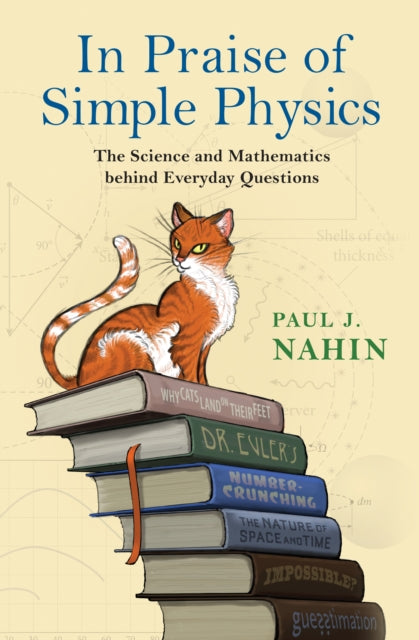
Princeton University Press In Praise of Simple Physics
Book SynopsisTrade Review"Nahin's writing style, as in previous books, is clear, conversational, humorous and chatty... [A]nd the discussions in the book are careful and appropriately rigorous."--MAA Reviews "Fun, accessible physics/math problems along with some humor."--Antonio Cangiano, Math-Blog "[Nahin] knows how to catch the attention of his reader. You will not regret buying any of his books, and I am sure after reading it, you will pick up this one to check again on one of his models and his solution methods."--European Mathematical Society "A superb book... [D]emonstrates clever ways to solve simply physics problems."--ChoiceTable of ContentsForeword by T. M. Helliwell ix Preface with Challenge Problems xi 1 How's Your Math? 1 2 The Traffic-Light Dilemma 20 3 Energy from Moving Air 25 4 Dragsters and Space Station Physics 32 5 Merry-Go-Round Physics and the Tides 42 6 Energy from Moving Water 51 7 Vectors and Bad Hair Days 63 8 An Illuminating Problem 67 9 How to Measure Depth with a Stopwatch 74 10 Doing the Preface Problems 79 11 The Physics of Stacking Books 92 12 Communication Satellite Physics 103 13 Walking a Ladder Upright 110 14 Why Is the Sky Dark at Night? 115 15 How Some Things Float (or Don't) 126 16 A Reciprocating Problem 141 17 How to Catch a Baseball (or Not) 146 18 Tossing Balls and Shooting Bullets Uphill 153 19 Rapid Travel in a Great Circle Transit Tube 163 20 Hurtling Your Body through Space 177 21 The Path of a Punt 194 22 Easy Ways to Measure Gravity in Your Garage 200 23 Epilogue Newton's Gravity Calculation Mistake 218 Postscript 227 Acknowledgments
£16.14

Princeton University Press The Calculus of Happiness
Book SynopsisTrade Review“Surveys a wide variety of ways that mathematics can be used to improve decision making and general well-being.”—Chris Wilson, TIME.com“Readers are sure to get a sense of how content from algebra and precalculus can help inform us about important decisions that are almost universally relevant.”—Jason M. Graham, MAA Reviews“Brilliant. . . . Once you realise it all boils down to maths, you will wake up happier, wealthier and healthier tomorrow morning, and we have Oscar E. Fernandez to thank for that.”—Nick Smith, Engineering and Technology“The Calculus of Happiness . . . demonstrate[s] how mathematics can yield powerful insights into everyday life."—Helen Thomson, New Scientist“Fernandez generates such enthusiasm [for studying math] by considering topics that people do want to learn more about—food, money, other people—and skillfully weaving solid mathematical concepts within these topics.”—Sandra L. Arlinghaus, Mathematical Reviews
£13.29

Princeton University Press Hard to Break
Book SynopsisTrade Review"As he explores why humans evolved to be so habit-driven, Poldrack considers dopamine, which is crucial in forming habits for its impacts on brain plasticity; questions the efficacy of mindfulness (now a 'billion-dollar industry'); and covers the formation of addictions, which he calls 'habits gone bad.' Poldrack's study is strongest when he describes experiments on interrupting habit formation on a cellular level, which can potentially help one shed such undesirable behaviors as smoking and overeating. . . . This is a worthy intellectual adventure, one that’s well articulated for readers looking for rigorous study." * Publishers Weekly *
£18.00

Princeton University Press Ptolemys Philosophy
Book SynopsisTrade Review"Shortlisted for the Pickstone Prize, British Society for the History of Science""Feke’s book deserves a place on the shelves of historians of science, philosophers, and classicists alike."---Marco Romani Mistretta, Bryn Mawr Classical Review"This important study will significantly improve our historical understanding of the originality of Ptolemy’s position."---Alain Bernard, Journal of the History of Astronomy"The book can be accessed and appreciated with a little sustained effort. For those of us who practice the history of mathematics, Feke’s work is a nice illustration that our historical actors’ philosophical commitments often can be identified, and they can help us to focus our readings more precisely. It’s a good lesson, and well worth the endeavour."---Glen Van Brummelen, British Journal for the History of Mathematics
£999.99
Princeton University Press Tales of Impossibility
Book SynopsisTrade Review"I greatly enjoyed Richeson's Tales of Impossibility. It deserves to become a classic and can be highly recommended."---Robin Wilson, Times Higher Education"Even if you never read a single proof through to its conclusion, you’ll enjoy the many entertaining side trips into a geometry far beyond what you learned in high school."---Jim Stein, New Books in Mathematics"The whole book, both informative and amusing, is a highly recommended read."---Adhemar Bulteel, European Mathematical Society"This book was a pleasure to read and I would recommend it for anybody who wants a lovely overview of many areas of the history of mathematics, with a focus on some very easy to understand problems."---Jonathan Shock, Mathemafrica"Richeson clearly explains what it means to be impossible to solve a problem, cites other impossibility results, goes into detail about geometric constructions with various instruments, and discusses the defective proofs and the cranks that have turned up along the way." * Mathematics Magazine *"This fascinating text will appeal to all those interested in the history of mathematics, not leasy because of its helpful notes on each chapter and its two dozen pages of references for further reading"---Laurence E. Nicholas CMath FIMA, Mathematics Today"A fact-filled, insightful, panoramic view of how mathematics developed to what it is today transformed by folks thinking both inside and outside of G so as to resolve the impossible."---Andrew J. Simoson, Mathematical Intelligencer
£17.09

Princeton University Press The Spike
Book SynopsisTrade Review"Finalist for the PROSE Award in Biomedicine, Association of American Publishers""[A] vivid tale." * New Scientist *"Humphries has woven together strands of experimental results and theoretical insights to compose a book that is engrossing, excites the imagination, beautifully encapsulates contemporary neuroscience in a light and breezy package, and points the way to future discovery."---Sean Noah, Knowing Neurons"A thorough and interesting description of what we know and don't know about neural spikes, as well as why they matter."---R. Forbes-Lorman, Choice
£15.19

Princeton University Press Hard to Break
Book SynopsisTrade Review"As he explores why humans evolved to be so habit-driven, Poldrack considers dopamine, which is crucial in forming habits for its impacts on brain plasticity; questions the efficacy of mindfulness (now a 'billion-dollar industry'); and covers the formation of addictions, which he calls 'habits gone bad.' Poldrack's study is strongest when he describes experiments on interrupting habit formation on a cellular level, which can potentially help one shed such undesirable behaviors as smoking and overeating. . . . This is a worthy intellectual adventure, one that’s well articulated for readers looking for rigorous study." * Publishers Weekly *
£15.19

Princeton University Press Lifes Engines
Book SynopsisTrade Review"A work full of surprises. . . . Immensely rewarding."---Tim Flannery, New York Review of Books"Entertaining, easy-to-read and historically rich."---Adrian Woolfson, Nature"Personal stories, hard facts, and illuminative illustrations each contribute to this engaging examination of our microbial overlords . . . Paul Falkowski's decades of study in various earth and life sciences fuel this excellent addition. . . . Falkowski effectively uses analogies to convey abstract and complicated ideas."---Rachel Jagareski, Foreword Reviews"Falkowski's loving examination sets out, life on this planet is organized by and for bacteria--the rest of us are just along for the ride."---Brian Bethune, Macleans"Falkowski brings a formidable breadth of scientific understanding to the task of explaining this, having worked as a biologist, an oceanographer and an astrobiologist. He moves easily between biological and earth sciences to help us understand the steps microscopic single-celled organisms took to make the planet habitable." * Cosmos *"[The] wonderful and awe-inspiring universe of the microbes, unseen creatures that have shaped the planet such that we may live in it, is engagingly presented by Paul Falkowski in a remarkable text entitled Life's Engines. . . . The book's success is its utter simplicity. It tells the story of the history of life on our planet from a very personal perspective. . . . I was so enthralled by this book from the get-go that I invite you to have a short taste of it."---Roberto Kolter, Cell"A pleasure to read, the book touches on virtually every topic covered in a college biology curriculum by seamlessly weaving concepts with personal anecdotes and analogies. Presenting scientific facts and the fascinating history of their discovery, Falkowski (Rutgers Univ.) intersperses evolutionary theory with biochemistry, ecology, microbiology, molecular biology, anatomy, and even anthropology and economics. He also presents a fact-based, nonpolitical vision for the future of biotechnology. . . . This reviewer came away inspired to learn more. Easily understood by anyone with a passing knowledge of science, this volume poses innumerable questions for further investigation." * Choice *"What is known about the hidden world of the microbes and their fundamental roles in sustaining planetary habitability is insightfully revealed by Paul Falkowski in this authoritative, comprehensive, and delightful book. The author is uniquely qualified, perhaps singularly so, to cover topics ranging over broad time and space scales with a scholarly, transdisciplinary perspective that ranges from fundamental physics and chemistry, to Earth and ocean sciences. I cannot think of any other scientist who would accept such a challenge. . . . He is a gifted scientist and writer, and legendary storyteller."---David M. Karl, Association for the Sciences of Limnology and Oceanography Bulletin"Not a microbial biologist, I approached this book with a bit of trepidation, imaging lengthy discussions of biochemistry. Instead, I was immediately engaged by Falkowski's conversational, fluid writing, personal anecdotes, and interesting choice of topics. . . . Life's Engines [is] easily accessible to the lay reader but engaging for the scientist as well." * American Biology Teacher *"An outstanding attempt to popularize the role of microbes, especially bacteria and archaea, in making multicellular eukaryotic life possible. . . . A superb introduction to the broader consequences of life and its study."---Elof Axel Carlson, Quarterly Review of Biology
£16.14

Princeton University Press The Odd Quantum
Book SynopsisTrade Review"Like a master craftsman intent on reducing his accumulated skills into a compendium of traditions and practices for his apprentices, Treiman tries to be as clear, precise, and succinct as possible. A vast store of experience in research and teaching informs every page."---Hans Christian von Baeyer, Science"For quantum mechanics fans looking for a bridge between books that provide vague, qualitative descriptions and those that require an extensive background in mathematics to be understood, Sam Treiman's The Odd Quantum offers a concise introduction to the field's concepts and practices, as well as guides to its most essential equations." * Publishers Weekly *"Treiman's book is outstanding. . . . This is not at all a qualitative pictorial description of the quantum world, but a rigorous formulation of its axioms in a casual language. . . . [A] wonderful guided tour through quantum mechanics."---Asher Peres, Physics World"A concise and beautifully written summary of an expert's view of the subject."---Barry R. Holstein, American Journal of Physics"In Treiman's book, we have as good a shot as we may hope for an intelligible (if demanding) account of a very advanced topic in physics. He covers much material in a short space. . . . An exposition of how the exciting intellectual tool of quantum theory has grown in scope and application."---Brian Pippard, Times Literary Supplement"Writing for persons with a background in physics or mathematics, [Treiman] does an excellent job of looking at the difficult and unusual aspects of theory." * Choice *
£17.09

Johns Hopkins University Press Gold Medal Physics
Book SynopsisFun, witty, and imbued throughout with admiration for the simple beauty of physics, Gold Medal Physics is sure to inspire readers to think differently about the next sporting event they watch.Trade ReviewGoff... is more than comfortable analyzing a variety of feats of physical prowess... Sports fans with a knowledge of geometry and trigonometry will enjoy Goff's cheerful revisiting of memorable athletic events. Publishers Weekly 2009 A lively, pleasant read with plenty of real physics and mathematical details. American Journal of Physics 2010 Sports libraries will find this engrossing. Midwest Book Review 2010Table of ContentsPreface1. The Pre-Game Show2. It's Not Over Until the Trombone Player Goes Down: Vectors and How to Think Like a Physicist3. All Hail Flutie: Gravity and Projectiles4. Vive le Lance: Simplifying the Complicated5. A Leap into the Unknown: More Projectiles and Angular Momentum6. Amazing Spins in and around All Kinds of Water: Rotations in Water Sports7. Soccer Kicks Gone Bananas: Off-Center Kicking and the Magnus Force8. Four Olympics and Four Straight Gold Medals: Centripetal Motion and Lift9. It Takes More Than a Big Gut: Caloric Consumption and Linear Momentum10. The Post-Game ShowFurther ReadingIndex
£23.85

Johns Hopkins University Press Seven Wonders of the Universe That You Probably
Book Synopsis9% nothing, but the thoughts it will inspire are massive.Trade Review[James'] conversational and at times humourous approach attempts to re-inspire the audience to look more closely at everything around them... If you'd like to understand more about how science affects the world around you without complicated scientific jargon that goes with it, this book is for you. It's an informative and accessible read that'll make you rethink whether taking the rubbish out is as boring as you previously thought. -- Nina Pace Cosmos 2011 James provides a satisfying and entertaining read for those of us who have a latent curiosity, for those who watch Nova or listen to Stephen Hawking and are still left scratching our heads, for those with curious children who demand more than "just because" in answer to their questions, and for science teachers looking for student-friendly explanations... she doesn't claim to have the mathematical intelligence of Einstein, but she has something he didn't: the ability to explain esoteric scientific theories and concepts so that you understand them. -- Ruth Douillette Internet Review of Books 2011Table of ContentsPrefaceAcknowledgmentsIntroduction1. Nights1.1. Of Snowballs and Ice-Skaters1.2. Putting the Brakes On1.3. Why Is Space Dark? Answer #1: Location, Location, Location1.4. Why Is Space Dark? Answer #2: Because1.5. Why Is Space Dark? Answer #3: Actually It Isn'tSmall Wonder: Day and Night on MercurySmall Wonder: Keeping the Night Sky Dark2. Light2.1. Codebreaking Basics2.2. The Little Orphan Annie Secret Decoder CD2.3. More Than Meets the Eye2.4. Evading the Question2.5. Making Light of the UniverseSmall Wonder: Why Is the Sky Blue? And Why Are Sunsets Red?Small Wonder: The Early Universe—A Made-for-TV Movie!3. Stuff3.1. It's Element-ary3.2. Element Factories3.3. In the Beginning . . .3.4. Making Light of Evil Twins3.5. The Good Guys Always Win . . . But Why?Small Wonder: What Are You Really Made Of?4. Gravity4.1. A Penny for Your Thoughts?4.2. Earth, the 6 Trillion Trillion Kilogram Weakling4.3. Of Apples and Orbits and Confused Astronauts4.4. But Wait . . . There's More!4.5. Surprise! Gravity Isn't a Force!Small Wonder: How to Lose Weight and Keep It Off, Guaranteed!5. Time5.1. Got a Second?5.2. Time in a Bottle—or in a Black Hole5.3. A One-Way Ticket to Disorder5.4. Time: The Grand Illusion?Small Wonder: So What Causes Daylight Saving Time to Happen?Small Wonder: Why Are There Seven Days in a Week?Small Wonder: What Would Happen if You Fell into a Black Hole?6. Home6.1. Goldilocks and the Three Planets6.2. Goldilocks and the Three Stars6.3. Goldilocks in Suburbia, Traffic, and Time6.4. Why Goldilocks Could Never Have Been a Successful Real Estate AgentSmall Wonder: Looking for a Home Away from HomeSmall Wonder: Do Aliens Exist?Small Wonder: No, Really. Do Aliens Exist?Small Wonder: Wanted—Alien Hunters7. Wonder7.1. Life—The Ultimate Eating Machine7.2. There's More to Life Than Eating7.3. It's All in Your Head . . . Maybe7.4. It's a Wonder-Full LifeSmall Wonder: Small WondersAfterwordFor Further ReadingIndex
£54.40

MP-FLO Uni Press of Florida When Science Sheds Light on History
Book SynopsisPhilippe Charlier, the ""Indiana Jones of the graveyards"", travels the globe with his forensics team to unravel historic mysteries. Exploring how our ancestors lived and how they died, the forty cases in this book tackle some of history's most enduring questions and illustrate the power of science to reveal the secrets of the past.Trade ReviewCharlier deftly incorporates complex medical terminology with the voice of a storyteller." - Forbes
£14.36

University of Arizona Press SCIENCE SOCIETY AND THE SEARCH FOR LIFE IN THE UNIVERSE
£16.96

University of Arizona Press Worlds in the Sky
£24.71
University of Pittsburgh Press No Easy Answers Science and the Pursuit of Knowledge
a huge range and FREE tracked UK delivery on ALL orders.
£38.95

Curtis Press Afterglow
Book Synopsis
£23.96

University of Chicago Press The Science of Myths and Vice Versa
Book Synopsis
£10.98

WW Norton & Co Einsteins Monsters
Book SynopsisThe astonishing science of black holes, and their role in understanding the history and future of our universe.Trade Review"Black holes were originally flights of theoretical fancy, difficult for even professional physicists to wrap their brains around. In Einstein's Monsters, Chris Impey shows how modern astronomy has brought them into vivid focus, and conveys how much more we're learning about these extreme beasts with every passing year." -- Sean Carroll, author of The Big Picture: On the Origins of Life, Meaning, and the Universe Itself"In Einstein's Monsters, Impey provides a history of black holes and an overview of investigations into their supremely counter-intuitive behaviour...[he] addresses the seeming absurdities of [the] subject with authority and wit." -- Nature"Impey does an admirable job describing multiple facets of the often contradictory field of black hole astrophysics... Einstein's Monsters will be sure to capture the imagination of most who pick it up, simultaneously convincing the reader that these monsters, while in fact quite certainly real, should be loved and not feared." -- Science"Astronomer Impey's accessible approach breaks down complex scientific concepts with ease and flair, name-checking everyone from Edgar Allen Poe to Pink Floyd as he lays out what we think we know about black holes—and what remains mysterious." -- Discover"Impey skilfully weaves a fascinating tale out of the work and ideas of the scientists who... pieced together the history of black holes by understanding the evolution of stars and how they can, depending on their mass, end up as white dwarfs, ultra-dense neutronstars, rapidly spinning pulsars or as an exploding supernova." -- Financial Times"Einstein's Monsters cuts through the "fiendishly complex" mathematics to set out the evidence for black holes, and how they are born and die." -- Times Higher Education"The book gives an awe-inspiring account of the complexity and beauty of black holes that were there before our Galaxy formed and will probably be there after everything else has been shredded apart by the forces of an ever-expanding Universe." -- Nature
£19.94

Johns Hopkins University Press Lights On
Book SynopsisFor those who wish to delve deeper into the science, a technical appendix provides estimations for a variety of power generators.Anyone who is interested in how energy works and how it is transformed to power our lives will get a charge out of Lights On!Trade ReviewIn Lights On!, prolific science writer/theoretical physicist Denny explains the history of power generation and presents important facts about renewable energy... The examples provided will help readers understand complex concepts. ChoiceTable of ContentsAcknowledgmentsIntroduction1. Newton's Legacy2. What All the World Wants3. The Vital Spark4. Old King Coal5. The Seven Sisters—Old and New6. Water, Water, Everywhere7. Too Cheap to Meter8. Here Comes the SunAfterwordAppendixNotesBibliographyIndex
£48.60

Cornell University Press Origins
Book SynopsisFossils are the fragments from which, piece by laborious piece, the great mosaic of the history of life has been constructed. Here and there, we can supplement these meager scraps by the use of biochemical markers or geochemical signatures that add useful information, but, even with such additional help, our reconstructions and our models of descent are often tentative. For the fossil record is, as we have seen, as biased as it is incomplete. But fragmentary, selective, and biased though it is, the fossil record, with all its imperfections, is still a treasure. Though whole chapters are missing, many pages lost, and the earliest pages so damaged as to be, as yet, virtually unreadable, thisthe greatest biography of allis one in whose closing pages we find ourselves.from OriginsIn Origins, Frank H. T. Rhodes explores the origin and evolution of living things, the changing environments in which they have developed, and the challenges we now face on an increasingly Trade Review"In Origins, an overview of the history of life on Earth for the nonspecialist reader, Frank H. T. Rhodes starts with origins and traces a winding path to human evolution. This book is a highly readable treatment of an important and interesting topic." -- Michael Foote, University of Chicago"In this compact and elegant volume, Frank H. T. Rhodes does far more than beautifully updating his classic 1962 book The Evolution of Life. He provides a new narrative of the history of life on Earth for a new set of generations. He covers familiar territory with a fresh and lyrical prose that reveals new insights into both species past and present and the people who have studied them. This is a perfect introduction by a virtuoso." -- Warren D. Allmon, Director, Paleontological Research InstitutionTable of Contents1. Defrosting the Mammoth 2. Terrestrial Timepieces 3. "From So Simple a Beginning" 4. Classification: The Diversity of Life 5. Spineless Wonders 6. Bone, Scales, and Fins: The Early Vertebrates 7. The Greening of the Land 8. The Amphibian Foothold 9. The Reign of the Reptiles 10. The Air 11. The Blossoming Earth 12. The Rise of the Mammals 13. The Mammalian Explosion 14. The Leakeys' Legacy 15. "Endless Forms, Most Beautiful and Most Wonderful" 16. On Extinction 17. "Have Been and Are Being Evolved": The Development of Life Epilogue
£22.79

Purdue University Press Spacewalker: My Journey in Space and Faith as
Book SynopsisFrom the age of ten, looking up at the stars, Jerry Ross knew that he wanted to journey into space. This autobiography tells the story of how he came not only to achieve that goal, but to become the most-launched astronaut in history, as well as a NASA veteran whose career spanned the entire US Space Shuttle program. From his childhood in rural Indiana, through education at Purdue University, and a career in the US Air Force, Ross charted a path to NASA after overcoming many setbacks—from failing to qualify for Air Force pilot training because of “bad” eyesight, to an initial failure to be selected into the astronaut program.The majority of the book is an insider’s account of the US Space Shuttle program, including the unforgettable experience of launch, the delights of weightless living, and the challenges of constructing the International Space Station. Ross is a uniquely qualified narrator. During seven spaceflights, he spent 1,393 hours in space, including 58 hours and 18 minutes on nine space walks. Life on the ground is also described, including the devastating experiences of the Challenger and Columbia disasters.For readers who have followed the space program from Mercury through the International Space Station and wonder what comes next, this book provides fascination; for young people interested in space exploration and reaching for their dreams, whatever they might be, this book provides inspiration. Full of stories of spaceflight that few humans have ever experienced, told with humor and honesty, Spacewalker presents a unique perspective on the hard work, determination, and faith necessary to travel beyond this world.Key Points: An insider’s account of the US Space Shuttle program, from before its first launch through the final landing, and the building of the International Space Station. A firsthand account of life in space from the first human to fly seven missions. An inspirational story of a personal journey from rural Indiana to outer space, powered by a deep Christian faith. Trade ReviewSpacewalker is the book for anyone who ever dreamed of flying in space." —Neil Armstrong"This book is the story of a common man from the Midwest who became an American hero . . . a model for the youth of our nation and for those who will accept the challenge to follow in his footsteps.” —Gene Kranz, NASA Flight Director for Gemini and Apollo
£15.26

University of South Carolina Press Introducing Science Through Images: Cases of
Book SynopsisAn examination of how images can serve as communication tools to popularize science in the public eyeAs funding for basic scientific research becomes increasingly difficult to secure, public support becomes essential. Because of its promise for captivating nonexpert publics, the practice of merging art and imagery with science has been gaining traction in the scientific community. While images have been used with greater frequency in recent years, their value is often viewed as largely superficial. To the contrary, Maria E. Gigante posits in Introducing Science through Images, the value of imagery goes far beyond mere aesthetics—visual elements are powerful communication vehicles.The images examined in this volume, drawn from a wide range of historical periods, serve an introductory function—that is, they appear in a position of primacy relative to text and, like the introduction to a speech, have the potential to make audiences attentive and receptive to the forthcoming content. Gigante calls them “portal” images and explicates their utility in science communication, both to popularize and mystify science in the public eye.Gigante analyzes how science has been represented by various types of portal images: frontispieces, portraits of scientists, popular-science magazine covers, and award-winning scientific images from Internet visualization competitions. Using theories of rhetoric and visual communication, she addresses the weak connection between scientific communities and the public and explores how visual elements can best be employed to garner public support for research.
£32.36
NewSouth Publishing The Best Australian Science Writing 2018
Book SynopsisForeword by UNSW Scientia Professor Michelle Simmons. This popular yearly anthology gives a snapshot of the very best science writing Australia has to offer, including everything from the most esoteric philosophical questions about ourselves and the universe, through to practical questions about the environment in which we live. Now in its eighth year, The Best Australian Science Writing 2018 draws on the knowledge and insight of Australia’s brightest authors, journalists and scientists to challenge perceptions of the world we think we know. This year’s selection includes the best of Australia’s science writing talent: Jo Chandler, Andrew Leigh, Michael Slezak, Elizabeth Finkel, Bianca Nogrady, Ashley Hay, Joel Werner, Margaret Wertheim and many more.
£999.99

NewSouth Publishing Future Superhuman: Our transhuman lives in a
Book SynopsisIt's humanity's make-or-break-century.In breathtakingly original prose, Elise Bohan argues that we're hurtling towards a superhuman future — or, if we blunder, extinction. The only way out of our existential crises, from global warming to the risks posed by nuclear weapons, novel and bioengineered pathogens and unaligned AI, is up. We'll need more technology to safeguard our future — and we're going to invent (and perhaps even merge with) some of that technology.What does that mean for our 20th century life-scripts? Are the robots coming for our jobs? How will human relationships change when AI knows us inside out? Will we still be having human babies by the century's end? Bohan unflinchingly explores possibilities most of us are afraid to imagine: the impacts of automation on our jobs, livelihoods and dating and mating careers, the stretching out of 'the-circle-of-life' as life-extension technologies mature, the rise of AI friends and lovers, the liberation of women from pregnancy, childbirth and breastfeeding, and the impending global baby-bust – and attendant proliferation of digital minds.Strap in for an exhilarating, and starkly honest, take on the promise and peril of life in the 21st century.
£17.06

NewSouth Publishing The Best Australian Science Writing 2020
Book SynopsisCan fish feel pain? Does it matter if a dingo is different from a dog? Is there life in a glob of subterranean snot? Science tackles some unexpected questions. At a time when the world is buffeted by the effects of a pandemic, climate change and accelerating technology, the fruits of scientific labour and enquiry have never been more in demand. Who better to navigate us through these unprecedented days than Australia’s best science writers. Now in its tenth year, this much-loved anthology selects the most riveting, entertaining, poignant and fascinating science stories and essays from Australian writers, poets and scientists. In their expert hands such ordinary objects as milk and sticky tape become imbued with new meaning, while the furthest reaches of our universe are made more familiar and comprehensible. With a foreword from Nobel laureate and immunologist Peter C Doherty, this collection brings fresh perspective to the world you thought you knew.
£18.86

NewSouth Publishing The Best Australian Science Writing 2021
Book SynopsisThis much-loved anthology showcases the nation's best science writing. New voices join prominent science writers and journalists, taking us to the depths of the ocean, the fuels of the future, and to the Ryugu asteroid and back. The anthology also takes us straight the heart of complex ethical dilemmas and the calamitous crises frustrating scientists and writers alike.
£18.86

NewSouth Publishing The Best Australian Science Writing 2022
Book SynopsisWhat can a microbial gravesite on a moon teach us? Why are scientists risking their lives to safeguard a seed bank? How does a virus detective story show us why we need to be vigilant about the next disease outbreak? Great science writing compels us to pay attention to parts of the world often unseen, from a dusty gold mine which could help answer one of the biggest questions in astrophysics to a delightful date with the misunderstood blobfish. This acclaimed anthology—now in its twelfth year—selects the most riveting, entertaining, poignant, and fascinating science stories and essays from Australian writers, poets, and scientists. With a foreword by health broadcaster and commentator Dr. Norman Swan, this collection covers another remarkable year, not only filled with seismic moments in science, but also shining a light on important work that would otherwise be overlooked.Table of ContentsForeword Norman SwanIntroduction Ivy ShihThe hunt for alien life on Phobos, one of Mars’ mystifying moons Jackson RyanSpillover in suburbia Olivia WillisEarth is getting a black box to record our climate change actions, and it’ s already started listening Nick KilvertDeep down and Dark: Stawell’ s genius lair Jacinta BowlerThe curious case of the hidden ancestor Elizabeth Finkel 2029 Headlines Amanda AnastasiApes, robots and men: the life and death of the first space chimp Alice GormanLove and fear Kate Cole-AdamsChecking in on the fugly fish that broke the internet Angus DaltonThe chemical question Bianca NogradyArtificial intelligence is misreading human emotion Kate Crawford A Syrian seed bank’ s fight to survive Helen SullivanProfessor Amnon Neeman doesn’ t really mind whether you read this story or not Tabitha Carvan Rise of the preprint: how rapid data sharing during COVID-19 changed science forever Clare Watson Jenner, sure, but here’ s to the real pioneers of immunisation Jane McCredieWhen cats are not as cute John Pickrell Anticipation of light Alice SometimesTime travel and tipping points Lauren FugeRising in the yeast Kelly WongCOVID-19 rarely spreads through surfaces. So why are we still deep cleaning? Dyani LewisMy Father’ s beautiful brain Suzannah LyonsThe scientific genius that eschewed fame Robyn ArianrhodEel Odyssey Louise Wakeling Why discovering ‘ nothing’ in science can be so incredibly important Michelle StarrSwamp Sentinels Kate EvansCulture shock: how loss of animals’ shared knowledge threatens their survival Zoe Kean Mind machines Christine KenneallyWombat dental gags and monster whale needles Angela HeathcoteCould biobanking offer Australian animals a last hope against extinction? Lydia HalesFish out of mortar Drew Rooke
£18.86
NewSouth Publishing Dr Rip’s Essential Beach Book: Everything you need to know about surf, sand and rips
Book SynopsisAustralia's leading beach scientist shares everything you need to know about how beaches work and how to swim safely, with examples from Australia and across the globe.How do waves break and what makes good surfing conditions? Why do beaches have different coloured sand? What are dangerous rip currents and how do you spot one - and what would you do if you got caught in one?Australia's best known surf scientist, Rob 'Dr Rip' Brander answers all of these questions and more as we discover how beaches form, the science of waves and currents, how sand dunes work and the myth of collapsing sand bars, and the human impacts on our beaches and how they will respond to storms and climate change. Dr Rip's Essential Beach Book is filled with practical information on how to use the beach, from keeping your family safe in the surf to what to do in the (unlikely) event you find yourself swimming with a shark.Whether you're a surfer looking for the perfect wave or someone just enjoying a stroll along the sandy shoreline, this guide to the beach is a must-read for all ocean lovers.
£999.99
NewSouth Publishing Liars cheats and copycats
£17.09

Reaktion Books Hyperactive: A History of ADHD
Book SynopsisAttention deficit hyperactivity disorder, or ADHD, is one of the most common developmental disorders, with an average of 9 per cent of children between the ages of five and seventeen diagnosed per year in the USA. It is also one of the most controversial. Since the 1950s, when hyperactivity in children was first diagnosed, psychiatrists, educators, parents and politicians have debated the causes, treatment and implications of the disorder. Hyperactive: The Controversial History of ADHD is the first history of the disorder. Matthew Smith highlights the limitations of regarding ADHD as simply neurological, and contends that hyperactive children are also a product of their social, cultural, political and educational environment. Instead of simply accepting conventional understandings of ADHD, this book addresses the questions central to the emergence of the disorder: Why were children first diagnosed with the disorder? Why did biological explanations become predominant? Why did powerful drugs become the preferred treatment? And why have alternative explanations failed to achieve legitimacy?By thinking through these issues Smith demonstrates how knowledge of the disorder's history can be used to empower those affected to make better choices about diagnosis and treatment. As a historian with past experience of working with troubled children and youth, Matthew Smith offers a history that is not only rigorous, but also accessible and highly relevant to those working with and caring for those diagnosed with ADHD. A revealing and clear-headed study of a controversial and emotive subject, this is an essential book for psychologists, teachers, policy makers and, above all, parents.Trade Review'Matthew Smith persuasively demonstrates the historical contingency of our ideas about hyperactivity. Well written, complex yet sharply argued, this book is a sorely needed corrective to today's therapeutic "common sense" and the ocean of pharmaceuticals it sanctions.' - -- David Herzberg, Associate Professor author of Happy Pills in America: From Miltown to Prozac 'As Matthew Smith demonstrates in this excellent study, there is arguably no more contentious childhood condition than hyperactivity or ADHD. Since the term was first introduced in the decades following the Second World War, hyperactivity has been variably explained in terms of genetic constitution, faulty parenting, an inability to cope with the pace and pressure of modern life, and increased sensitivity to food additives. Hyperactive explores debates about the biological, social and cultural contours of a condition that continues to puzzle doctors, frustrate teachers, and destroy families. It will surely be of value not only to historians of medicine, but also to the parents, teachers, psychiatrists and policy-makers involved in the daily struggle to cope with hyperactive children.' - -- Mark Jackson, Professor of the History of Medicine at the University of Exeter
£25.00

Reaktion Books Planet Hunters: The Search for Extraterrestrial
Book SynopsisAstronomers are on the verge of answering one of the most profound questions ever asked: are we alone in the universe? The ability to detect life in remote solar systems is at last within sight. Its discovery, even if only in microbial form, would revolutionize our self-image. Planet Hunters tells a delightful tale of smart-alec nerds, the search for extraterrestrial life and the history of an academic discipline. Professional astronomer Lucas Ellerbroek takes readers on a fantastic voyage through space, time, history and the future. He describes the field of exoplanet research in its proper historical perspective, from the early ideas of sixteenth-century heretic Giordano Bruno and the rise of science fiction to the discovery of the first exoplanet in 1995 and the invention of the Kepler space telescope. He travels the world to talk to leading scientists in the field, including first exoplanet discoverer Michel Mayor, NASA Kepler mission scientist Bill Borucki and MIT astrophysicist Sara Seager. Presenting cutting-edge research in a dynamic, fun and accessible way, this book will appeal to everyone with an interest in astronomy and space.
£20.99

Reaktion Books Five Photons: Remarkable Journeys of Light Across
Book SynopsisThe story of the Universe is written in the light that travels through it – light that we can capture. Nearly everything we know about how the Universe works on its grandest scale comes from the analysis of the light – photons – that may have travelled nearly fourteen billion years from the Big Bang itself to reach us. Have you ever wondered what is the most distant source of light we can see, or how a star shines? Did you know that black holes can blaze like cosmic beacons across intergalactic space, and that ancient radio waves might herald the ignition of the very first stars? Have you ever thought about what light really is? Five Photons explains all with the tales of five fascinating astrophysical processes through the journeys of light across space and time. They are tales of quantum physics and general relativity, stars and black holes, dark matter and dark energy. Let yourself be swept away on a journey of discovery towards a deeper understanding of the Universe.Trade Review`With his elegant, supremely clear writing, Geach has succeeded at creating both a state-of-the-art cosmic overview and a rather wonderful meditation on the nature of our reality.’ – Caleb Scharf, author of The Zoomable Universe; `Geach’s beautiful cosmic biography takes readers on a sweeping tour of all that was, is, and ever will be. Five Photons is as elegant as it is enlightening.’ – Lee Billings, author of Five Billion Years of Solitude
£16.10

Reaktion Books Twenty Worlds: The Extraordinary Story of Planets
Book SynopsisThirty years ago the only planets we knew were the ones orbiting our own sun; we now know of thousands of other worlds orbiting distant stars. In this book astronomer Niall Deacon journeys to twenty of these globes: from giant, blisteringly hot planets orbiting close to their parent stars to frozen planets that float through space alone, and from dead stars shredding asteroids to worlds made of diamond and even planets that may be similar to the Earth. Deacon also takes in the latest exoplanet discoveries, and explains how astronomers have come to learn so much about these strange and distant worlds. Twenty Worlds tells a sweeping story, of real planets around other stars, and appeals to the wide audience for popular science and astronomy.Trade Review"This is the perfect book to introduce exoplanet science. . . . But Twenty Worlds is not really for those who want to find out more about any one of the planets covered. Rather it reveals what each of them represents to the field in general. Its real value is in the analogies that Deacon uses to clarify difficult and complex exoplanetary scientific methods to the reader. Nowhere will you find a more descriptive book to understand the processes used to learn about the existence of these worlds. Five stars." * BBC Sky at Night Magazine *"With thousands of exoplanets currently known, it must be a daunting task to choose twenty of them to highlight. Yet, that is exactly what Deacon sets out to do. The book, rather than presenting a cornucopia of bizarre exoplanets (and there are many of them out there), uses a curated sample of twenty exoplanets to tell a story about how these systems are detected, studied and what they can tell us about the birth, evolution and even death of planets, as well as their interaction with their host stars. The sheer diversity of the exoplanets detected poses a fascinating challenge to planet-formation theorists and exoplanet observers alike." * Nature Astronomy *“This is an attractive, well-produced book providing much information about new and exciting discoveries being achieved by good old-fashioned astronomical methods, albeit highly sophisticated. It is refreshingly free from the dilemmas existing in other areas of cosmology—wave/particle duality, string theory, multiverses, et cetera—and I recommend it as well worth reading by any interested layman (who doesn’t feel too strongly about Pluto).” * Observatory Magazine *"This is a truly entertaining and informative book, but the reason I’m giving it the full five stars has as much to do with the refreshing novelty of the author’s style as anything else. There’s novelty in the subject-matter too—the wide variety of recently discovered exoplanets orbiting other stars. . . . He’s a professional astronomer too, though you wouldn’t guess that from his writing style, which is as straightforward and lucid as science writing gets." * PopularScience.co.uk *"Twenty Worlds describes planets beyond our solar system. Though long imagined in science fiction novels and films, these 'exoplanets' have only been discovered since the 1990s. Author Deacon, an expert on this topic affiliated at the Max Planck Institute for Astronomy in Heidelberg, writes in a conversational manner that is far different from the stiff exposition of a science textbook. Yet he conveys as much about how astronomers deduce the physical and chemical properties of exoplanets as he does about the planets themselves. While thousands of exoplanets are now known, Deacon's text comprises only twenty short chapters, each devoted to a single planet, or to a solar system of planets orbiting around their own sun. These are not necessarily the most interesting or unusual planets, but each one is exploited to introduce one method or another by which researchers have deduced the nature of objects of its type, such as their size, mass, and orbit, or whether they are rocky, gaseous, atmosphere-bearing, aqueous, possibly habitable, or even perhaps composed of diamond. The reader who sets out to enjoy a popular account may end up with a serious understanding . . . of these alien worlds. Recommended." * Choice *"With Deacon's book we not only see that there are a multitude of worlds out there, but the variety and conditions in which they were born are as strange as we could hope to imagine. They all have individual characteristics, some similar to our own family, others bizarrely different. His choice of worlds, I feel, has been carefully done, to show the known variety in the family of discovered planets. . . . Deacon's style of writing is easy to follow and keeps the reader interested throughout. . . . The book was very enjoyable to read and the 200 pages kept the reader wanting more, I genuinely felt I was both entertained and informed." * Physics Education *"A wonderfully enjoyable tour of twenty diverse worlds that orbit distant stars. Deacon uses simple ideas from science to show us how each world has its own personality—its own story. Twenty Worlds is an accessible introduction to some of the most exciting discoveries in astronomy." -- Michael E. Summers, professor of planetary sciences and astronomy, George Mason University
£15.15
Reaktion Books Nature Fast and Nature Slow: How Life Works, from Fractions of a Second to Billions of Years
Book SynopsisThis book is a vision of biology set within the entire timescale of the universe. It is about the timing of life, from microsecond movements to evolutionary changes over millions of years. Human consciousness is riveted to seconds, but a split-second time delay in perception means that we are unaware of anything until it has already happened. We live in the very recent past. Over longer timescales, this book examines the lifespans of the oldest organisms, prospects for human life extension, the evolution of whales and turtles, and the explosive beginning of life 4 billion years ago. With its poetry, social commentary and humour, this book will appeal to everyone interested in the natural world.Trade ReviewAfter reading Nicholas P. Money’s deeply fascinating book, I realised I was looking at the world around me in a completely different way. It takes the reader on a journey that starts with a fraction of a second and ends with a billion years, in a book about the passage of time that is different from any other I have ever read.-Torbjørn Ekelund, author of 'In Praise of Paths: Walking Through Time and Nature' (2020)Table of ContentsPreface 1 BALLISTICS - Fractions of Seconds 2 BEATS - Seconds 3 BATS - Minutes and Hours 4 BLOSSOMS - Days, Weeks and Months 5 BROODS - Years 6 BEARS - Decades 7 BOWHEADS - Centuries 8 BRISTLECONES - Millennia 9 BASILOSAURS - Millions of years 10 BEGINNINGS - Billions of Years References Acknowledgements Photo Acknowledgements Index
£25.87

Reaktion Books Invented Knowledge False History Fake Science and Pseudoreligions
Book SynopsisInvented Knowledge explores legends such as the lost continent of Atlantis; the fabled original settlers of the Americas; beliefs of religious groups such as the Nation of Islam and Christian Identity; and books such as Chariots of the Gods, and The Da Vinci Code.
£16.10

Springer Nature Switzerland AG Close Encounters of Art and Physics: An Artist's
Book SynopsisClose Encounters of Art and Physics is a voyage in time through the abstract ideas harboured in the minds of humans, starting from the graffiti art of cave dwellers and extending to the street art of contemporary men and women. In seeking parallels with science, the author looks far back to the first geometric ideas of our ancestors as well as ahead to the contemporary science of present-day physicists. The parallelism and analogies between these two fields bear witness to a real entanglement in the human brain. The second part of the book contains about 25 colour images showing the author's stunning glass artwork representing ideas such as dark matter, quantum entanglement, cellular automata and many others that are almost impossible to capture in words. Furthermore, many of the physicists who have themselves made major contributions in these fields provide their comments and analysis of the works. The book provides entertaining and informative reading, not only for practicing artists and physicists, but also anyone curious about art and physics.Table of ContentsPart I Parallels Between Art and Physics.- Rock Paintings: Primordial Graffiti.- A Sense of the Beauty of Forms.- Were the Dark Ages Really Dark?.- Rebirth!.- The Age of Reason: The Enlightenment.- Impressive Impressions.- What You See Is Not What You Get.- Is Reality Really Real?.- Abstraction: Pure Thought.- Timeless Time.- Does it Belong to the Elite?.- Part II Collaborations.- What Time Is It?.- A Longer History of Time.- Just Call Me Jim.- Quintessence: The Spirit of the World.- Resolving the Unresolved.- The Brain Is an Orchestra.- Let’s Play Chess.- Are There Real Crystals in the Universe?.- Brain and Mind.- In Memory of Tom Kibble.- Conclusion.- Bibliography
£25.19

Springer Nature Switzerland AG Are Electromagnetic Fields Making Me Ill?: How
Book SynopsisElectricity and Magnetism (E&M) underlies many lifesaving medical devices, such as magnetic resonance imaging scanners, neural stimulators, and heart pacemakers. But E&M also attracts its share of bogus health claims, such as biomagnetic therapy. How do you separate the good from the bad? Sometimes it’s not easy: experiments are prone to artifacts, theories are limited by assumptions, and clinical trials can result in ambiguities. In this book, the author separates the wheat from the chaff, showing which applications of E&M are bogus and which are not. This book takes the reader on a tour through a range of fascinating phenomena, from effects that are constant in time at one extreme, such as transcranial direct current stimulation of the brain, to the millimeter-wave whole-body scanners which are familiar to frequent flyers at the other. Along the way, the author looks in depth at the dispute about power line magnetic fields and leukemia, a case study in what can go wrong when dubious claims inflame unjustified fears. The debate about cell phones and brain cancer still rages today, particularly for the microwave frequencies encountered with new 5G technology. Recently, the so-called Havana Syndrome has been attributed to microwave weapons, but the underlying biophysics of such weapons is unclear. For all these encounters with electricity and magnetism, the author, an eminent biophysicist, uses science and evidence to sort out fact from fantasy. This book is aimed at general readers who want to make sense of the mysterious and often controversial ways in which E&M interacts with the human body. It is also ideal for students and professionals in bioscience and health-related fields who want to learn more without getting overwhelmed by theory.Trade Review“This book is an essential reference that would be a great addition to every skeptic’s bookshelf. It summarizes the evidence about the health effects of electromagnetism and provides ammunition for debunking pseudoscientific rumors. It’s short, inexpensive, well-written, and full of interesting facts. I was particularly intrigued to learn that an electric eel has its own Twitter account.” (Harriet Hall, Science-Based Medicine, sciencebasedmedicine.org, June 14, 2022)Table of ContentsChapter 1: Can Magnets Cure All Your Ills?Chapter 2: Can a 9-Volt Battery Make You Smarter? Chapter 3: Do Power Lines Cause Cancer? Chapter 4: Can Electrical Stimulation Eliminate Pain? Chapter 5: Is Your Cell Phone Killing You? Chapter 6: Did Cubans Attack an American Embassy with Microwaves? Chapter 7: Are Whole Body Scanners at Airports Dangerous?
£23.74


