
Mathematics Books

McGraw-Hill Education - Europe Corrective Mathematics Subtraction Teacher
Book SynopsisTeacher Materials include: Presentation Books include a Guide section containing information for presenting exercises, correcting mistakes, and administering the pre-skill and placement tests. There is also a Presentation section that contains detailed lessons plans. Answer Key Booklets quickly and easily compare students' work with the actual calculations and word problem results.
£206.15
Clarendon Press Statistical Data Analysis
Book SynopsisThis book is a guide to the practical application of statistics in data analysis as typically encountered in the physical sciences. It is primarily addressed at students and professionals who need to draw quantitative conclusions from experimental data. Although most of the examples are taken from particle physics, the material is presented in a sufficiently general way as to be useful to people from most branches of the physical sciences. The first part of the book describes the basic tools of data analysis: concepts of probability and random variables, Monte Carlo techniques, statistical tests, and methods of parameter estimation. The last three chapters are somewhat more specialized than those preceding, covering interval estimation, characteristic functions, and the problem of correcting distributions for the effects of measurement errors (unfolding).Trade Review"Glen Cowan is a particle physicist who seems to have got everything right. Results are stated clearly, without mathematical proof but with enough explanation to satisfy the physicist's need to understand not only how, but also why...Those teaching an advanced undergraduate or graduate course in statistics or physicists will find this a good textbook...Do not be fooled by the fact that it does not have the "textbook look" - the exercises have been made available separately on a Web site. " CERN Courier"The material presented in this book is dense.In less than two hundred pages, it takes the reader from the basic notions of probability, through neural networks, Monte Carlo methods, and regularization techniques." Short Book ReviewsTable of ContentsPreface ; Notation ; 1. Fundamental Concepts ; 2. Examples of Probability Functions ; 3. The Monte Carlo Method ; 4. Statistical Tests ; 5. General Concepts of Parameter Estimation ; 6. The Method of Maximum Likelihood ; 7. The Method of Least Squares ; 8. The Method of Moments ; 9. Statistical Errors, Confidence Intervals and Limits ; 10. Characteristic Functions and Related Examples ; 11. Unfolding ; Bibliography ; Index
£43.22

McGraw-Hill Education - Europe Corrective Mathematics Fractions Decimals and
Book SynopsisTeacher Materials include: Presentation Books include a Guide section containing information for presenting exercises, correcting mistakes, and administering the pre-skill and placement tests. There is also a Presentation section that contains detailed lessons plans. Answer Key Booklets quickly and easily compare students' work with the actual calculations and word problem results.
£206.15

HarperCollins Publishers Inc Coyotes All Around
Book SynopsisA pack of coyotes tries to determine how many roadrunners and other creatures are in their vicinity, and while some count different groups and add their totals together, Clever Coyote rounds off and estimates.
£8.76

McGraw-Hill Education - Europe Corrective Mathematics Multiplication Workbook
Book SynopsisWorkbooks include daily worksheets and point summary charts for recording student performance and awarding grades.
£18.62

McGraw-Hill Education - Europe Everyday Mathematics Grades K6 Straws Package of
Book SynopsisClear, plastic straws can be used for counting and making shapes.
£9.67

Pearson Education Introductory and Intermediate Algebra Global
Book Synopsis
£48.59
Taylor & Francis Introductory Econometrics
a huge range and FREE tracked UK delivery on ALL orders.
£82.64

John Wiley & Sons Inc Matrix Differential Calculus with Applications in
Book SynopsisMatrix Differential Calculus With Applications in Statistics and Econometrics Revised Edition Jan R. Magnus, CentER, Tilburg University, The Netherlands and Heinz Neudecker, Cesaro, Schagen, The Netherlands .deals rigorously with many of the problems that have bedevilled the subject up to the present time. - Stephen Pollock, Econometric Theory I continued to be pleasantly surprised by the variety and usefulness of its contents - Isabella Verdinelli, Journal of the American Statistical Association Continuing the success of their first edition, Magnus and Neudecker present an exhaustive and self-contained revised text on matrix theory and matrix differential calculus. Matrix calculus has become an essential tool for quantitative methods in a large number of applications, ranging from social and behavioural sciences to econometrics. While the structure and successful elements of the first edition remain, this revised and updated edition contains many new examples and exercises. * CoTrade Review"...the best book to learn matrix and related ideas...statisticians, econometricians, computer scientists, engineers, and psychometricians will find this extremely useful." (Journal of Statistical Computation and Simulation, March 2006) "a most welcome revision" (Computational Statistics & Data Analysis, 28 August 2001)Table of ContentsPreface xv Preface to the first revised printing xvii Preface to the second revised printing xviii Part One- Matrices Part Two- Differentials: the theory Part Three- Differentials: the practice Part Four- Inequalities Part Five- The linear model Part Six- Applications to maximum likelihood estimation Bibliography 379 Index of Symbols 387 Subject Index 390
£89.06

John Wiley & Sons Inc Abstract Algebra
Book SynopsisWidely acclaimed algebra text. This book is designed to give the reader insight into the power and beauty that accrues from a rich interplay between different areas of mathematics.Table of ContentsPreface. Preliminaries. PART I: GROUP THEORY. Chapter 1. Introduction to Groups. Chapter 2. Subgroups. Chapter 3. Quotient Group and Homomorphisms. Chapter 4. Group Actions. Chapter 5. Direct and Semidirect Products and Abelian Groups. Chapter 6. Further Topics in Group Theory. PART II: RING THEORY. Chapter 7. Introduction to Rings. Chapter 8. Euclidean Domains, Principal Ideal Domains and Unique Factorization Domains. Chapter 9. Polynomial Rings. PART III: MODULES AND VECTOR SPACES. Chapter 10. Introduction to Module Theory. Chapter 11. Vector Spaces. Chapter 12. Modules over Principal Ideal Domains. PART IV: FIELD THEORY AND GALOIS THEORY. Chapter 13. Field Theory. Chapter 14. Galois Theory. PART V: AN INTRODUCTION TO COMMUTATIVE RINGS, ALGEBRAIC GEOMETRY, AND HOMOLOGICAL ALGEBRA. Chapter 15. Commutative Rings and Algebraic Geometry. Chapter 16. Artinian Rings, Discrete Valuation Rings, and Dedekind Domains. Chapter 17. Introduction to Homological Algebra and Group Cohomology. PART VI: INTRODUCTION TO THE REPRESENTATION THEORY OF FINITE GROUPS. Chapter 18. Representation Theory and Character Theory. Chapter 19. Examples and Applications of Character Theory. Appendix I: Cartesian Products and Zorn's Lemma. Appendix II: Category Theory. Index.
£128.20

John Wiley & Sons Inc Molecular Symmetry and Group Theory
Book SynopsisA Thorough But Understandable Introduction To Molecular Symmetry And Group Theory As Applied To Chemical Problems! In a friendly, easy--to--understand style, this new book invites the reader to discover by example the power of symmetry arguments for understanding theoretical problems in chemistry.Table of ContentsFundamental Concepts. Representations of Groups. Techniques and Relationships for Chemical Applications. Symmetry and Chemical Bonding. Equations for Wave Functions. Vibrational Spectroscopy. Transition Metal Complexes. Appendices. Index.
£112.46

John Wiley & Sons Inc Bayesian Analysis for the Soci 845 Wiley Series
Book SynopsisIt provides an introduction to Bayesian methods, specifically tailored for students of the social sciences. Includes detailed definitions of key Bayesian ideas, assuming little background knowledge. Each chapter contains graded exercises to help further the student's understanding of the methods and applications.Trade Review“This is a comprehensive text on applied Bayesian statistics. Though it is primarily aimed at social scientists with strong computational and statistical backgrounds, its scope should appeal to a wider readership. I recommend it to anybody interested in actually applying Bayesian methods.” (Significance, 1 June 2010) "As in many texts, each chapter ends with a collection of exercises which would make this text suitable for teaching a one-semester course in Bayesian methods with applications in the social sciences . . . with this small caveat, I was impressed with the text and believe it would be a worthy candidate for a first Bayesian courses that gives the student a balanced view of the theory and practice of Bayesian thinking." (The American Statistician, 1 February 2011)Table of ContentsList of Figures. List of Tables. Preface. Acknowledgments. Introduction. Part I: Introducing Bayesian Analysis. 1. The foundations of Bayesian inference. 1.1 What is probability? 1.2 Subjective probability in Bayesian statistics. 1.3 Bayes theorem, discrete case. 1.4 Bayes theorem, continuous parameter. 1.5 Parameters as random variables, beliefs as distributions. 1.6 Communicating the results of a Bayesian analysis. 1.7 Asymptotic properties of posterior distributions. 1.8 Bayesian hypothesis testing. 1.9 From subjective beliefs to parameters and models. 1.10 Historical note. 2. Getting started: Bayesian analysis for simple models. 2.1 Learning about probabilities, rates and proportions. 2.2 Associations between binary variables. 2.3 Learning from counts. 2.4 Learning about a normal mean and variance. 2.5 Regression models. 2.6 Further reading. Part II: Simulation Based Bayesian Analysis. 3. Monte Carlo methods. 3.1 Simulation consistency. 3.2 Inference for functions of parameters. 3.3 Marginalization via Monte Carlo integration. 3.4 Sampling algorithms. 3.5 Further reading. 4. Markov chains. 4.1 Notation and definitions. 4.2 Properties of Markov chains. 4.3 Convergence of Markov chains. 4.4 Limit theorems for Markov chains. 4.5 Further reading. 5. Markov chain Monte Carlo. 5.1 Metropolis-Hastings algorithm. 5.2 Gibbs sampling. 6. Implementing Markov chain Monte Carlo. 6.1 Software for Markov chain Monte Carlo. 6.2 Assessing convergence and run-length. 6.3 Working with BUGS/JAGS from R. 6.4 Tricks of the trade. 6.5 Other examples. 6.6 Further reading. Part III: Advanced Applications in the Social Sciences. 7. Hierarchical Statistical Models. 7.1 Data and parameters that vary by groups: the case for hierarchical modeling. 7.2 ANOVA as a hierarchical model. 7.3 Hierarchical models for longitudinal data. 7.4 Hierarchical models for non-normal data. 7.5 Multi-level models. 8. Bayesian analysis of choice making. 8.1 Regression models for binary responses. 8.2 Ordered outcomes. 8.3 Multinomial outcomes. 8.4 Multinomial probit. 9. Bayesian approaches to measurement. 9.1 Bayesian inference for latent states. 9.2 Factor analysis. 9.3 Item-response models. 9.4 Dynamic measurement models. Part IV: Appendices. Appendix A: Working with vectors and matrices. Appendix B: Probability review. B.1 Foundations of probability. B.2 Probability densities and mass functions. B.3 Convergence of sequences of random variabales. Appendix C: Proofs of selected propositions. C.1 Products of normal densities. C.2 Conjugate analysis of normal data. C.3 Asymptotic normality of the posterior density. References. Topic index. Author index.
£52.20

John Wiley & Sons Inc Linear Programming and Network Flows
Book SynopsisThe authoritative guide to modeling and solving complex problems with linear programmingextensively revised, expanded, and updated The only book to treat both linear programming techniques and network flows under one cover, Linear Programming and Network Flows, Fourth Edition has been completely updated with the latest developments on the topic. This new edition continues to successfully emphasize modeling concepts, the design and analysis of algorithms, and implementation strategies for problems in a variety of fields, including industrial engineering, management science, operations research, computer science, and mathematics. The book begins with basic results on linear algebra and convex analysis, and a geometrically motivated study of the structure of polyhedral sets is provided. Subsequent chapters include coverage of cycling in the simplex method, interior point methods, and sensitivity and parametric analysis. Newly added topics in the Fourth Edition<Trade Review"The book can be used both as reference and as textbook for advanced undergraduate students and first-year graduate students in the fields of industrial engineering, management, operation research, computer science, mathematics and other engineering disciplines that deal with the subjects of linear programming and network flows." (Zentralblatt MATH, 2011) Table of ContentsPreface. ONE: INTRODUCTION. 1.1 The Linear Programming Problem. 1.2 Linear Programming Modeling and Examples. 1.3 Geometric Solution. 1.4 The Requirement Space. 1.5 Notation. Exercises. Notes and References. TWO: LINEAR ALGEBRA, CONVEX ANALYSIS, AND POLYHEDRAL SETS. 2.1 Vectors. 2.2 Matrices. 2.3 Simultaneous Linear Equations. 2.4 Convex Sets and Convex Functions. 2.5 Polyhedral Sets and Polyhedral Cones. 2.6 Extreme Points, Faces, Directions, and Extreme Directions of Polyhedral Sets: Geometric Insights. 2.7 Representation of Polyhedral Sets. Exercises. Notes and References. THREE: THE SIMPLEX METHOD. 3.1 Extreme Points and Optimality. 3.2 Basic Feasible Solutions. 3.3 Key to the Simplex Method. 3.4 Geometric Motivation of the Simplex Method. 3.5 Algebra of the Simplex Method. 3.6 Termination: Optimality and Unboundedness. 3.7 The Simplex Method. 3.8 The Simplex Method in Tableau Format. 3.9 Block Pivoting. Exercises. Notes and References. FOUR: STARTING SOLUTION AND CONVERGENCE. 4.1 The Initial Basic Feasible Solution. 4.2 The Two-Phase Method. 4.3 The Big-M Method. 4.4 How Big Should Big-M Be? 4.5 The Single Artificial Variable Technique. 4.6 Degeneracy, Cycling, and Stalling. 4.7 Validation of Cycling Prevention Rules. Exercises. Notes and References. FIVE: SPECIAL SIMPLEX IMPLEMENTATIONS AND OPTIMALITY CONDITIONS. 5.1 The Revised Simplex Method. 5.2 The Simplex Method for Bounded Variables. 5.3 Farkas’ Lemma via the Simplex Method. 5.4 The Karush-Kuhn-Tucker Optimality Conditions. Exercises. Notes and References. SIX: DUALITY AND SENSITIVITY ANALYSIS. 6.1 Formulation of the Dual Problem. 6.2 Primal-Dual Relationships. 6.3 Economic Interpretation of the Dual. 6.4 The Dual Simplex Method. 6.5 The Primal-Dual Method. 6.6 Finding an Initial Dual Feasible Solution: The Artificial Constraint Technique. 6.7 Sensitivity Analysis. 6.8 Parametric Analysis. Exercises. Notes and References. SEVEN: THE DECOMPOSITION PRINCIPLE. 7.1 The Decomposition Algorithm. 7.2 Numerical Example. 7.3 Getting Started. 7.4 The Case of Unbounded Region X. 7.5 Block Diagonal or Angular Structure. 7.6 Duality and Relationships with other Decomposition Procedures. Exercises. Notes and References. EIGHT: COMPLEXITY OF THE SIMPLEX ALGORITHM AND POLYNOMIAL-TIME ALGORITHMS. 8.1 Polynomial Complexity Issues. 8.2 Computational Complexity of the Simplex Algorithm. 8.3 Khachian’s Ellipsoid Algorithm. 8.4 Karmarkar’s Projective Algorithm. 8.5 Analysis of Karmarkar’s Algorithm: Convergence, Complexity, Sliding Objective Method, and Basic Optimal Solutions. 8.6 Affine Scaling, Primal-Dual Path-Following, and Predictor-Corrector Variants of Interior Point Methods. Exercises. Notes and References. NINE: MINIMAL-COST NETWORK FLOWS. 9.1 The Minimal-Cost Network Flow Problem. 9.2 Some Basic Definitions and Terminology from Graph Theory. 9.3 Properties of the A Matrix. 9.4 Representation of a Nonbasic Vector in Terms of the Basic Vectors. 9.5 The Simplex Method for Network Flow Problems. 9.6 An Example of the Network Simplex Method. 9.7 Finding an Initial Basic Feasible Solution. 9.8 Network Flows with Lower and Upper Bounds. 9.9 The Simplex Tableau Associated with a Network Flow Problem. 9.10 List Structures for Implementing the Network Simplex Algorithm. 9.11 Degeneracy, Cycling, and Stalling. 9.12 Generalized Network Problems. Exercises. Notes and References. TEN: THE TRANSPORTATION AND ASSIGNMENT PROBLEMS. 10.1 Definition of the Transportation Problem. 10.2 Properties of the A Matrix. 10.3 Representation of a Nonbasic Vector in Terms of the Basic Vectors. 10.4 The Simplex Method for Transportation Problems. 10.5 Illustrative Examples and a Note on Degeneracy. 10.6 The Simplex Tableau Associated with a Transportation Tableau. 10.7 The Assignment Problem: (Kuhn’s) Hungarian Algorithm. 10.8 Alternating Path Basis Algorithm for Assignment Problems. 10.9 A Polynomial-Time Successive Shortest Path Approach for Assignment Problems. 10.10 The Transshipment Problem. Exercises. Notes and References. ELEVEN: THE OUT-OF-KILTER ALGORITHM. 11.1 The Out-of-Kilter Formulation of a Minimal Cost Network Flow Problem. 11.2 Strategy of the Out-of-Kilter Algorithm. 11.3 Summary of the Out-of-Kilter Algorithm. 11.4 An Example of the Out-of-Kilter Algorithm. 11.5 A Labeling Procedure for the Out-of-Kilter Algorithm. 11.6 Insight into Changes in Primal and Dual Function Values. 11.7 Relaxation Algorithms. Exercises. Notes and References. TWELVE: MAXIMAL FLOW, SHORTEST PATH, MULTICOMMODITY FLOW, AND NETWORK SYNTHESIS PROBLEMS. 12.1 The Maximal Flow Problem. 12.2 The Shortest Path Problem. 12.3 Polynomial-Time Shortest Path Algorithms for Networks Having Arbitrary Costs. 12.4 Multicommodity Flows. 12.5 Characterization of a Basis for the Multicommodity Minimal-Cost Flow Problem. 12.6 Synthesis of Multiterminal Flow Networks. Exercises. Notes and References. BIBLIOGRAPHY. INDEX.
£111.56

John Wiley & Sons Inc Sampling
Book SynopsisPraise for the Second Edition This book has never had a competitor. It is the only book that takes a broad approach to sampling . . . any good personal statistics library should include a copy of this book. Technometrics Well-written . . . an excellent book on an important subject. Highly recommended. Choice An ideal reference for scientific researchers and other professionals who use sampling. Zentralblatt Math Features new developments in the field combined with all aspects of obtaining, interpreting, and using sample data Sampling provides an up-to-date treatment of both classical and modern sampling design and estimation methods, along with sampling methods for rare, clustered, and hard-to-detect populations. This Third Edition retains the general organization of the two previous editions, but incorporates extensive new materialsections, exercises, and examplesthroughout. Inside, readers wilTable of ContentsPreface xv Preface to the Second Edition xvii Preface to the First Edition xix 1 Introduction 1 1.1 Basic Ideas of Sampling and Estimation, 2 1.2 Sampling Units, 4 1.3 Sampling and Nonsampling Errors, 5 1.4 Models in Sampling, 5 1.5 Adaptive and Nonadaptive Designs, 6 1.6 Some Sampling History, 7 PART I BASIC SAMPLING 9 2 Simple Random Sampling 11 2.1 Selecting a Simple Random Sample, 11 2.2 Estimating the Population Mean, 13 2.3 Estimating the Population Total, 16 2.4 Some Underlying Ideas, 17 2.5 Random Sampling with Replacement, 19 2.6 Derivations for Random Sampling, 20 2.7 Model-Based Approach to Sampling, 22 2.8 Computing Notes, 26 Entering Data in R, 26 Sample Estimates, 27 Simulation, 28 Further Comments on the Use of Simulation, 32 Exercises, 35 3 Confidence Intervals 39 3.1 Confidence Interval for the Population Mean or Total, 39 3.2 Finite-Population Central Limit Theorem, 41 3.3 Sampling Distributions, 43 3.4 Computing Notes, 44 Confidence Interval Computation, 44 Simulations Illustrating the Approximate Normality of a Sampling Distribution with Small n and N, 45 Daily Precipitation Data, 46 Exercises, 50 4 Sample Size 53 4.1 Sample Size for Estimating a Population Mean, 54 4.2 Sample Size for Estimating a Population Total, 54 4.3 Sample Size for Relative Precision, 55 Exercises, 56 5 Estimating Proportions, Ratios, and Subpopulation Means 57 5.1 Estimating a Population Proportion, 58 5.2 Confidence Interval for a Proportion, 58 5.3 Sample Size for Estimating a Proportion, 59 5.4 Sample Size for Estimating Several Proportions Simultaneously, 60 5.5 Estimating a Ratio, 62 5.6 Estimating a Mean, Total, or Proportion of a Subpopulation, 62 Estimating a Subpopulation Mean, 63 Estimating a Proportion for a Subpopulation, 64 Estimating a Subpopulation Total, 64 Exercises, 65 6 Unequal Probability Sampling 67 6.1 Sampling with Replacement: The Hansen–Hurwitz Estimator, 67 6.2 Any Design: The Horvitz–Thompson Estimator, 69 6.3 Generalized Unequal-Probability Estimator, 72 6.4 Small Population Example, 73 6.5 Derivations and Comments, 75 6.6 Computing Notes, 78 Writing an R Function to Simulate a Sampling Strategy, 82 Comparing Sampling Strategies, 84 Exercises, 88 PART II MAKING THE BEST USE OF SURVEY DATA 91 7 Auxiliary Data and Ratio Estimation 93 7.1 Ratio Estimator, 94 7.2 Small Population Illustrating Bias, 97 7.3 Derivations and Approximations for the Ratio Estimator, 99 7.4 Finite-Population Central Limit Theorem for the Ratio Estimator, 101 7.5 Ratio Estimation with Unequal Probability Designs, 102 7.6 Models in Ratio Estimation, 105 Types of Estimators for a Ratio, 109 7.7 Design Implications of Ratio Models, 109 7.8 Computing Notes, 110 Exercises, 112 8 Regression Estimation 115 8.1 Linear Regression Estimator, 116 8.2 Regression Estimation with Unequal Probability Designs, 118 8.3 Regression Model, 119 8.4 Multiple Regression Models, 120 8.5 Design Implications of Regression Models, 123 Exercises, 124 9 The Sufficient Statistic in Sampling 125 9.1 The Set of Distinct, Labeled Observations, 125 9.2 Estimation in Random Sampling with Replacement, 126 9.3 Estimation in Probability-Proportional-to-Size Sampling, 127 9.4 Comments on the Improved Estimates, 128 10 Design and Model 131 10.1 Uses of Design and Model in Sampling, 131 10.2 Connections between the Design and Model Approaches, 132 10.3 Some Comments, 134 10.4 Likelihood Function in Sampling, 135 PART III SOME USEFUL DESIGNS 139 11 Stratified Sampling 141 11.1 Estimating the Population Total, 142 With Any Stratified Design, 142 With Stratified Random Sampling, 143 11.2 Estimating the Population Mean, 144 With Any Stratified Design, 144 With Stratified Random Sampling, 144 11.3 Confidence Intervals, 145 11.4 The Stratification Principle, 146 11.5 Allocation in Stratified Random Sampling, 146 11.6 Poststratification, 148 11.7 Population Model for a Stratified Population, 149 11.8 Derivations for Stratified Sampling, 149 Optimum Allocation, 149 Poststratification Variance, 150 11.9 Computing Notes, 151 Exercises, 155 12 Cluster and Systematic Sampling 157 12.1 Primary Units Selected by Simple Random Sampling, 159 Unbiased Estimator, 159 Ratio Estimator, 160 12.2 Primary Units Selected with Probabilities Proportional to Size, 161 Hansen–Hurwitz (PPS) Estimator, 161 Horvitz–Thompson Estimator, 161 12.3 The Basic Principle, 162 12.4 Single Systematic Sample, 162 12.5 Variance and Cost in Cluster and Systematic Sampling, 163 12.6 Computing Notes, 166 Exercises, 169 13 Multistage Designs 171 13.1 Simple Random Sampling at Each Stage, 173 Unbiased Estimator, 173 Ratio Estimator, 175 13.2 Primary Units Selected with Probability Proportional to Size, 176 13.3 Any Multistage Design with Replacement, 177 13.4 Cost and Sample Sizes, 177 13.5 Derivations for Multistage Designs, 179 Unbiased Estimator, 179 Ratio Estimator, 181 Probability-Proportional-to-Size Sampling, 181 More Than Two Stages, 181 Exercises, 182 14 Double or Two-Phase Sampling 183 14.1 Ratio Estimation with Double Sampling, 184 14.2 Allocation in Double Sampling for Ratio Estimation, 186 14.3 Double Sampling for Stratification, 186 14.4 Derivations for Double Sampling, 188 Approximate Mean and Variance: Ratio Estimation, 188 Optimum Allocation for Ratio Estimation, 189 Expected Value and Variance: Stratification, 189 14.5 Nonsampling Errors and Double Sampling, 190 Nonresponse, Selection Bias, or Volunteer Bias, 191 Double Sampling to Adjust for Nonresponse: Callbacks, 192 Response Modeling and Nonresponse Adjustments, 193 14.6 Computing Notes, 195 Exercises, 197 PART IV METHODS FOR ELUSIVE AND HARD-TO-DETECT POPULATIONS 199 15 Network Sampling and Link-Tracing Designs 201 15.1 Estimation of the Population Total or Mean, 202 Multiplicity Estimator, 202 Horvitz–Thompson Estimator, 204 15.2 Derivations and Comments, 207 15.3 Stratification in Network Sampling, 208 15.4 Other Link-Tracing Designs, 210 15.5 Computing Notes, 212 Exercises, 213 16 Detectability and Sampling 215 16.1 Constant Detectability over a Region, 215 16.2 Estimating Detectability, 217 16.3 Effect of Estimated Detectability, 218 16.4 Detectability with Simple Random Sampling, 219 16.5 Estimated Detectability and Simple Random Sampling, 220 16.6 Sampling with Replacement, 222 16.7 Derivations, 222 16.8 Unequal Probability Sampling of Groups with Unequal Detection Probabilities, 224 16.9 Derivations, 225 Exercises, 227 17 Line and Point Transects 229 17.1 Density Estimation Methods for Line Transects, 230 17.2 Narrow-Strip Method, 230 17.3 Smooth-by-Eye Method, 233 17.4 Parametric Methods, 234 17.5 Nonparametric Methods, 237 Estimating f (0) by the Kernel Method, 237 Fourier Series Method, 239 17.6 Designs for Selecting Transects, 240 17.7 Random Sample of Transects, 240 Unbiased Estimator, 241 Ratio Estimator, 243 17.8 Systematic Selection of Transects, 244 17.9 Selection with Probability Proportional to Length, 244 17.10 Note on Estimation of Variance for the Kernel Method, 246 17.11 Some Underlying Ideas about Line Transects, 247 Line Transects and Detectability Functions, 247 Single Transect, 249 Average Detectability, 249 Random Transect, 250 Average Detectability and Effective Area, 251 Effect of Estimating Detectability, 252 Probability Density Function of an Observed Distance, 253 17.12 Detectability Imperfect on the Line or Dependent on Size, 255 17.13 Estimation Using Individual Detectabilities, 255 Estimation of Individual Detectabilities, 256 17.14 Detectability Functions other than Line Transects, 257 17.15 Variable Circular Plots or Point Transects, 259 Exercise, 260 18 Capture–Recapture Sampling 263 18.1 Single Recapture, 264 18.2 Models for Simple Capture–Recapture, 266 18.3 Sampling Design in Capture–Recapture: Ratio Variance Estimator, 267 Random Sampling with Replacement of Detectability Units, 269 Random Sampling without Replacement, 270 18.4 Estimating Detectability with Capture–Recapture Methods, 271 18.5 Multiple Releases, 272 18.6 More Elaborate Models, 273 Exercise, 273 19 Line-Intercept Sampling 275 19.1 Random Sample of Lines: Fixed Direction, 275 19.2 Lines of Random Position and Direction, 280 Exercises, 282 PART V SPATIAL SAMPLING 283 20 Spatial Prediction or Kriging 285 20.1 Spatial Covariance Function, 286 20.2 Linear Prediction (Kriging), 286 20.3 Variogram, 289 20.4 Predicting the Value over a Region, 291 20.5 Derivations and Comments, 292 20.6 Computing Notes, 296 Exercise, 299 21 Spatial Designs 301 21.1 Design for Local Prediction, 302 21.2 Design for Prediction of Mean of Region, 302 22 Plot Shapes and Observational Methods 305 22.1 Observations from Plots, 305 22.2 Observations from Detectability Units, 307 22.3 Comparisons of Plot Shapes and Detectability Methods, 308 PART VI ADAPTIVE SAMPLING 313 23 Adaptive Sampling Designs 315 23.1 Adaptive and Conventional Designs and Estimators, 315 23.2 Brief Survey of Adaptive Sampling, 316 24 Adaptive Cluster Sampling 319 24.1 Designs, 321 Initial Simple Random Sample without Replacement, 322 Initial Random Sample with Replacement, 323 24.2 Estimators, 323 Initial Sample Mean, 323 Estimation Using Draw-by-Draw Intersections, 323 Estimation Using Initial Intersection Probabilities, 325 24.3 When Adaptive Cluster Sampling Is Better than Simple Random Sampling, 327 24.4 Expected Sample Size, Cost, and Yield, 328 24.5 Comparative Efficiencies of Adaptive and Conventional Sampling, 328 24.6 Further Improvement of Estimators, 330 24.7 Derivations, 333 24.8 Data for Examples and Figures, 336 Exercises, 337 25 Systematic and Strip Adaptive Cluster Sampling 339 25.1 Designs, 341 25.2 Estimators, 343 Initial Sample Mean, 343 Estimator Based on Partial Selection Probabilities, 344 Estimator Based on Partial Inclusion Probabilities, 345 25.3 Calculations for Adaptive Cluster Sampling Strategies, 347 25.4 Comparisons with Conventional Systematic and Cluster Sampling, 349 25.5 Derivations, 350 25.6 Example Data, 352 Exercises, 352 26 Stratified Adaptive Cluster Sampling 353 26.1 Designs, 353 26.2 Estimators, 356 Estimators Using Expected Numbers of Initial Intersections, 357 Estimator Using Initial Intersection Probabilities, 359 26.3 Comparisons with Conventional Stratified Sampling, 362 26.4 Further Improvement of Estimators, 364 26.5 Example Data, 367 Exercises, 367 Answers to Selected Exercises 369 References 375 Author Index 395 Subject Index 399
£98.96

Penguin Putnam Inc The Official Book of Hanjie 150 Puzzles Follow
Book SynopsisHanjie (pronounced Han-JEA to rhyme with ninja) is the massively popular Japanese puzzle craze. Number clues and simple logic lead you to fill in some boxes while leaving others blank. If you fill in the boxes correctly, a picture will emerge! This game is perfect for anyone addicted to Sudoku and looking for a new challenge. Puzzle master Timothy E. Parker, named by Guinness World Records as “the world’s most syndicated puzzle compiler,” provides instructions and 100 mind-bending puzzles ranging from easy to medium to hard. The harder the puzzle, the more subtle and beautiful the resulting picture will be. How to Play: The numbers tell you the sequence of black squares you must fill in. Each group of black squares is separated by at least one white (empty) square. Successfully completing the puzzle will reveal a surprising picture.
£10.80

Oxford University Press Numbers
Book SynopsisNumbers are integral to our everyday lives and feature in everything we do. In this Very Short Introduction Peter M. Higgins, the renowned mathematics writer, unravels the world of numbers; demonstrating its richness, and providing a comprehensive view of the idea of the number. Higgins paints a picture of the number world, considering how the modern number system matured over centuries. Explaining the various number types and showing how they behave, he introduces key concepts such as integers, fractions, real numbers, and imaginary numbers. By approaching the topic in a non-technical way and emphasising the basic principles and interactions of numbers with mathematics and science, Higgins also demonstrates the practical interactions and modern applications, such as encryption of confidential data on the internet. ABOUT THE SERIES: The Very Short Introductions series from Oxford University Press contains hundreds of titles in almost every subject area. These pocket-sized books are the perfect way to get ahead in a new subject quickly. Our expert authors combine facts, analysis, perspective, new ideas, and enthusiasm to make interesting and challenging topics highly readable.Trade Reviewcoridial guide to number theory * The Guardian *Table of Contents1. How not to think about numbers: the trouble with bases ; 2. The unending series of primes ; 3. Perfect and not so perfect numbers ; 4. Cryptography: the secret life of the primes ; 5. Numbers that count ; 6. A peek below the waterline of the number iceberg ; 7. To infinity and beyond ; 8. Numbers but not as we know them ; Further Reading ; Index
£9.49

John Wiley & Sons Inc Principles of Algebraic Geometry
Book SynopsisA comprehensive, self-contained treatment presenting general results of the theory. Establishes a geometric intuition and a working facility with specific geometric practices. Emphasizes applications through the study of interesting examples and the development of computational tools. Coverage ranges from analytic to geometric.Table of ContentsFoundational Material. Complex Algebraic Varieties. Riemann Surfaces and Algebraic Curves. Further Techniques. Surfaces. Residues. The Quadric Line Complex. Index.
£131.35

John Wiley & Sons Inc Competing Risks A Practical Perspective 22
Book SynopsisThe need to understand, interpret and analyse competing risk data is key to many areas of science, particularly medical research.Trade Review"Competing Risks: A Practical Perspective is a second text in the field that will help statisticians and researchers understand the complexity of the competing-risks problem and to complete the required analysis. I am glad to have it on my shelf. It meets the state goal of the Statistics in Practice series." (Technometrics, August 2008) "Will help statisticians and researchers understand the complexity of the competing-risks problem and to complete the analysis. I am glad to have it on my shelf." (Technometrics, August 2008) "...a concise introduction to the field of competing risks in survival analysis, especially useful for practitioners and researchers in the biostatistics field." (Zentralblatt MATH, 2007)Table of ContentsPreface. Acknowledgements. 1. Introduction. 1.1 Historical notes. 1.2 Defining competing risks. 1.3 Use of the Kaplan–Meier method in the presence of competing risks. 1.4 Testing in the competing risk framework. 1.5 Sample size calculation. 1.6 Examples. 1.6.1 Tamoxifen trial. 1.6.2 Hypoxia study. 1.6.3 Follicular cell lymphoma study. 1.6.4 Bone marrow transplant study. 1.6.5 Hodgkin’s disease study. 2. Survival – basic concepts. 2.1 Introduction. 2.2 Definitions and background formulae. 2.2.1 Introduction. 2.2.2 Basic mathematical formulae. 2.2.3 Common parametric distributions. 2.2.4 Censoring and assumptions. 2.3 Estimation and hypothesis testing. 2.3.1 Estimating the hazard and survivor functions. 2.3.2 Nonparametric testing: log-rank and Wilcoxon tests. 2.3.3 Proportional hazards model. 2.4 Software for survival analysis. 2.5 Closing remarks. 3. Competing risks – definitions. 3.1 Recognizing competing risks. 3.1.1 Practical approaches. 3.1.2 Common endpoints in medical research. 3.2 Two mathematical definitions. 3.2.1 Competing risks as bivariate random variable. 3.2.2 Competing risks as latent failure times. 3.3 Fundamental concepts. 3.3.1 Competing risks as bivariate random variable. 3.3.2 Competing risks as latent failure times. 3.3.3 Discussion of the two approaches. 3.4 Closing remarks. 4. Descriptive methods for competing risks data. 4.1 Product-limit estimator and competing risks. 4.2 Cumulative incidence function. 4.2.1 Heuristic estimation of the CIF. 4.2.2 Nonparametric maximum likelihood estimation of the CIF. 4.2.3 Calculating the CIF estimator. 4.2.4 Variance and confidence interval for the CIF estimator. 4.3 Software and examples. 4.3.1 Using R. 4.3.2 Using SAS. 4.4 Closing remarks. 5. Testing a covariate. 5.1 Introduction. 5.2 Testing a covariate. 5.2.1 Gray’s method. 5.2.2 Pepe and Mori’s method. 5.3 Software and examples. 5.3.1 Using R. 5.3.2 Using SAS. 5.4 Closing remarks. 6. Modelling in the presence of competing risks. 6.1 Introduction. 6.2 Modelling the hazard of the cumulative incidence function. 6.2.1 Theoretical details. 6.2.2 Model-based estimation of the CIF. 6.2.3 Using R. 6.3 Cox model and competing risks. 6.4 Checking the model assumptions. 6.4.1 Proportionality of the cause-specific hazards. 6.4.2 Proportionality of the hazards of the CIF. 6.4.3 Linearity assumption. 6.5 Closing remarks. 7. Calculating the power in the presence of competing risks. 7.1 Introduction. 7.2 Sample size calculation when competing risks are not present. 7.3 Calculating power in the presence of competing risks. 7.3.1 General formulae. 7.3.2 Comparing cause-specific hazards. 7.3.3 Comparing hazards of the subdistributions. 7.3.4 Probability of event when the exponential distribution is not a valid assumption. 7.4 Examples. 7.4.1 Introduction. 7.4.2 Comparing the cause-specific hazard. 7.4.3 Comparing the hazard of the subdistribution. 7.5 Closing remarks. 8. Other issues in competing risks. 8.1 Conditional probability function. 8.1.1 Introduction. 8.1.2 Nonparametric estimation of the CP function. 8.1.3 Variance of the CP function estimator. 8.1.4 Testing a covariate. 8.1.5 Using R. 8.1.6 Using SAS. 8.2 Comparing two types of risk in the same population. 8.2.1 Theoretical background. 8.2.2 Using R. 8.2.3 Discussion. 8.3 Identifiability and testing independence. 8.4 Parametric modelling. 8.4.1 Introduction. 8.4.2 Modelling the marginal distribution. 8.4.3 Modelling the Weibull distribution. 9. Food for thought. Problem 1: Estimation of the probability of the event of interest. Problem 2: Testing a covariate. Problem 3: Comparing the event of interest between two groups when the competing risks are different for each group. Problem 4: Information needed for sample size calculations. Problem 5: The effect of the size of the incidence of competing risks on the coefficient obtained in the model. Problem 6: The KLY test and the non-proportionality of hazards. Problem 7: The KLY and Wilcoxon tests. A: Theoretical background. B: Analysing competing risks data using R and SAS. References. Index.
£75.56
Cambridge University Press Solitons An Introduction 2 Cambridge Texts in
Book SynopsisThis textbook is an introduction to the theory of solitons and its diverse applications to nonlinear systems that arise in the physical sciences. The authors explain the generation and properties of solitons, introducing the mathematical technique known as the Inverse Scattering Transform. Their aim is to present the essence of inverse scattering clearly, rather than rigorously or completely. Thus, the prerequisites (i.e., partial differential equations, calculus of variations, Fourier integrals, linear waves and SturmâLiouville theory), and more advanced material is explained in the text with useful references to further reading given at the end of each chapter. Worked examples are frequently used to help the reader follow the various ideas, and the exercises at the end of each chapter not only contain applications but also test understanding. Answers, or hints to the solution, are given at the end of the book. Sections and exercises that contain more difficult material are indicated Trade Review"...should find an enthusiastic following, and the author is to be congratulated on a job well done." American Scientist"...a fine book, certainly the one that I would choose as the text for an introductory course on solitons." SIAM Review"All things considered, I cannot think of a clearer introduction to the subject from a mathematical point of view." Physics Today"...an excellent book, achieving its goals both concisely and comprehensively." John G. Harris, Applied Mechanics ReviewTable of ContentsPreface; 1. The Kortewag–de Vries equation; 2. Elementary solutions of the Korteweg–de Vries equation; 3. The scattering and inverse scattering problems; 4. The initial-value problem for the Korteweg–de Vries equation; 5. Further properties of the Korteweg–de Vries equation; 6. More general inverse methods; 7. The Painlevé property, perturbations and numerical methods; 8. Epilogue; Answers and hints; Bibliography and author index; Motion picture index; Subject index.
£42.74
Cambridge University Press The Geometry of Moduli Spaces of Sheaves
Book SynopsisThis edition has been updated to reflect recent advances in the theory of semistable coherent sheaves and their moduli spaces. The authors review changes in the field and point the reader towards further literature. An ideal text for graduate students or mathematicians with a background in algebraic geometry.Trade Review'The authors have created a true masterpiece of mathematical exposition. Bringing together disparate ideas developed gradually over the last fifty years into a cohesive whole, Huybrechts and Lehn provide a compelling and comprehensive view of an essential topic in algebraic geometry. The new edition is full of gems that have been discovered since the first edition. This inspiring book belongs in the hands of any mathematician who has ever encountered a vector bundle on an algebraic variety.' Max Lieblich, University of Washington'This book fills a great need: it is almost the only place the foundations of the moduli theory of sheaves on algebraic varieties appears in any kind of expository form. The material is of basic importance to many further developments: Donaldson–Thomas theory, mirror symmetry, and the study of derived categories.' Rahul Pandharipande, Princeton University'This is a wonderful book; it's about time it was available again. It is the definitive reference for the important topics of vector bundles, coherent sheaves, moduli spaces and geometric invariant theory; perfect as both an introduction to these subjects for beginners, and as a reference book for experts. Thorough but concise, well written and accurate, it is already a minor modern classic. The new edition brings the presentation up to date with discussions of more recent developments in the area.' Richard Thomas, Imperial College London'Serving as a perfect introduction for beginners in the field, an excellent guide to the forefront of research in various directions, a valuable reference for active researchers, and as an abundant source of inspiration for mathematicians and physicists likewise, this book will certainly maintain both its particular significance and its indispensability for further generations of researchers in the field of algebraic sheaves (or vector bundles) and their moduli spaces.' Zentralblatt MATHTable of ContentsPreface to the second edition; Preface to the first edition; Introduction; Part I. General Theory: 1. Preliminaries; 2. Families of sheaves; 3. The Grauert–Müllich Theorem; 4. Moduli spaces; Part II. Sheaves on Surfaces: 5. Construction methods; 6. Moduli spaces on K3 surfaces; 7. Restriction of sheaves to curves; 8. Line bundles on the moduli space; 9. Irreducibility and smoothness; 10. Symplectic structures; 11. Birational properties; Glossary of notations; References; Index.
£47.49

John Wiley & Sons Inc Risk Analysis
Book SynopsisA practical guide to the varied challenges presented in the ever-growing field of risk analysis. Risk Analysis presents an accessible and concise guide to performing risk analysis, in a wide variety of field, with minimal prior knowledge required. Forming an ideal companion volume to Aven''s previous Wiley text Foundations of Risk Analysis, it provides clear recommendations and guidance in the planning, execution anduse of risk analysis. This new edition presents recent developments related to risk conceptualization, focusing on related issues on risk assessment and their application. New examples are also featured to clarify the reader''s understanding in the application of risk analysis and the risk analysis process. Key features: Fully updated to include recent developments related to risk conceptualization and related issues on risk assessments and their applications. Emphasizes the decision making context oTable of ContentsPreface ix 1 What is a risk analysis? 1 1.1 Why risk analysis? 3 1.2 Risk management 4 1.2.1 Decision-making under uncertainty 6 1.3 Examples: decision situations 11 1.3.1 Risk analysis for a tunnel 11 1.3.2 Risk analysis for an offshore installation 11 1.3.3 Risk analysis related to a cash depot 12 2 What is risk? 13 2.1 The risk concept and its description 13 2.2 Vulnerability 19 2.3 How to describe risk quantitatively 19 2.3.1 Description of risk in a financial context 21 2.3.2 Description of risk in a safety context 22 2.4 Qualitative judgements 24 3 The risk analysis process: planning 28 3.1 Problem definition 28 3.2 Selection of analysis method 33 3.2.1 Checklist-based approach 35 3.2.2 Risk-based approach 36 4 The risk analysis process: risk assessment 38 4.1 Identification of initiating events 38 4.2 Cause analysis 39 4.3 Consequence analysis 40 4.4 Probabilities and uncertainties 42 4.5 Risk picture: risk presentation 43 4.5.1 Handling the background knowledge 46 4.5.2 Risk evaluation 47 5 The risk analysis process: risk treatment 49 5.1 Comparisons of alternatives 49 5.1.1 How to assess measures? 51 5.2 Management review and judgement 53 6 Risk analysis methods 55 6.1 Coarse risk analysis 55 6.2 Job safety analysis 60 6.3 Failure modes and effects analysis 62 6.3.1 Strengths and weaknesses of an FMEA 68 6.4 Hazard and operability studies 69 6.5 SWIFT 70 6.6 Fault tree analysis 70 6.6.1 Qualitative analysis 73 6.6.2 Quantitative analysis 75 6.7 Event tree analysis 77 6.7.1 Barrier block diagrams 79 6.8 Bayesian networks 79 6.9 Monte Carlo simulation 82 7 Safety measures for a road tunnel 84 7.1 Planning 84 7.1.1 Problem definition 84 7.1.2 Selection of analysis method 85 7.2 Risk assessment 86 7.2.1 Identification of initiating events 86 7.2.2 Cause analysis 88 7.2.3 Consequence analysis 88 7.2.4 Risk picture 91 7.3 Risk treatment 93 7.3.1 Comparison of alternatives 93 7.3.2 Management review and decision 93 8 Risk analysis process for an offshore installation 95 8.1 Planning 95 8.1.1 Problem definition 95 8.1.2 Selection of analysis method 96 8.2 Risk analysis 96 8.2.1 Hazard identification 96 8.2.2 Cause analysis 96 8.2.3 Consequence analysis 99 8.3 Risk picture and comparison of alternatives 101 8.4 Management review and judgement 102 9 Production assurance 103 9.1 Planning 103 9.2 Risk analysis 103 9.2.1 Identification of failures 103 9.2.2 Cause analysis 104 9.2.3 Consequence analysis 104 9.3 Risk picture and comparison of alternatives 106 9.4 Management review and judgement. Decision 107 10 Risk analysis process for a cash depot 108 10.1 Planning 108 10.1.1 Problem definition 108 10.1.2 Selection of analysis method 109 10.2 Risk analysis 110 10.2.1 Identification of hazards and threats 110 10.2.2 Cause analysis 110 10.2.3 Consequence analysis 113 10.3 Risk picture 115 10.4 Risk-reducing measures 117 10.4.1 Relocation of the NOKAS facility 118 10.4.2 Erection of a wall 118 10.5 Management review and judgement. Decision 119 10.6 Discussion 119 11 Risk analysis process for municipalities 121 11.1 Planning 121 11.1.1 Problem definition 121 11.1.2 Selection of analysis method 122 11.2 Risk assessment 122 11.2.1 Hazard and threat identification 122 11.2.2 Cause and consequence analysis. Risk picture 125 11.3 Risk treatment 126 12 Risk analysis process for the entire enterprise 128 12.1 Planning 128 12.1.1 Problem definition 128 12.1.2 Selection of analysis method 129 12.2 Risk analysis 129 12.2.1 Price risk 129 12.2.2 Operational risk 132 12.2.3 Health, environment and safety (HES) 134 12.2.4 Reputation risk 135 12.3 Overall risk picture 137 12.4 Risk treatment 138 13 Discussion 139 13.1 Risk analysis as a decision support tool 139 13.2 Risk is more than the calculated probabilities and expected values 140 13.3 Risk analysis has both strengths and weaknesses 141 13.3.1 Precision of a risk analysis: uncertainty and sensitivity analysis 141 13.3.2 Terminology 143 13.3.3 Risk acceptance criteria (tolerability limits) 145 13.4 Reflection on approaches, methods and results 148 13.5 Limitations of the causal chain approach 148 13.6 Risk perspectives 150 13.7 Scientific basis 153 13.8 The implications of the limitations of risk assessment 155 13.9 Critical systems and activities 157 13.10 On the difference between risk as seen from the perspectives of the analysts and management 162 13.11 Conclusions 165 A Probability calculus and statistics 167 A.1 The meaning of a probability 167 A.2 Probability calculus 168 A.3 Probability distributions: expected value 170 A.3.1 Binomial distribution 171 A.4 Statistics (Bayesian statistics) 172 B Introduction to reliability analysis 174 B.1 Reliability of systems composed of components 174 B.2 Production system 176 B.3 Safety system 176 C Approach for selecting risk analysis methods 178 C.1 Expected consequences 178 C.2 Uncertainty factors 179 C.3 Frame conditions 182 C.4 Selection of a specific method 182 D Terminology 184 D.1 Risk management: Relationships between key terms 186 Bibliography 188 Index 195
£56.95

John Wiley & Sons Inc Fundamentals of Supply Chain Theory
Book SynopsisComprehensively teaches the fundamentals of supply chain theory This book presents the methodology and foundations of supply chain management and also demonstrates how recent developments build upon classic models. The authors focus on strategic, tactical, and operational aspects of supply chain management and cover a broad range of topics from forecasting, inventory management, and facility location to transportation, process flexibility, and auctions. Key mathematical models for optimizing the design, operation, and evaluation of supply chains are presented as well as models currently emerging from the research frontier. Fundamentals of Supply Chain Theory, Second Edition contains new chapters on transportation (traveling salesman and vehicle routing problems), integrated supply chain models, and applications of supply chain theory. New sections have also been added throughout, on topics including machine learning models for forecasting, conic optimizaTable of ContentsList of Figures xxi List of Tables xxvii List of Algorithms xxix Preface xxxi 1 Introduction 1 1.1 The Evolution of Supply Chain Theory 1 1.2 Definitions and Scope 2 1.3 Levels of Decision Making in Supply Chain Management 4 2 Forecasting and Demand Modeling 5 2.1 Introduction 5 2.2 Classical Demand Forecasting Methods 6 2.3 Forecast Accuracy 15 2.4 Machine Learning in Demand Forecasting 17 2.5 Demand Modeling Techniques 23 2.6 Bass Diffusion Model 24 2.7 Leading Indicator Approach 30 2.8 Discrete Choice Models 33 Case Study: Semiconductor Demand Forecasting at Intel 38 Problems 39 3 Deterministic Inventory Models 45 3.1 Introduction to Inventory Modeling 45 3.2 Continuous Review: The Economic Order Quantity Problem 51 3.3 Power of Two Policies 57 3.4 The EOQ with Quantity Discounts 60 3.5 The EOQ with Planned Backorders 67 3.6 The Economic Production Quantity Model 70 3.7 Periodic Review: The Wagner–Whitin Model 72 Case Study: Ice Cream Production and Inventory at Scotsburn Dairy Group 76 Problems 77 4 Stochastic Inventory Models: Periodic Review 87 4.1 Inventory Policies 87 4.2 Demand Processes 89 4.3 Periodic Review with Zero Fixed Costs: Base-Stock Policies 89 4.4 Periodic Review with Nonzero Fixed Costs: (s; S) Policies 114 4.5 Policy Optimality 123 4.6 Lost Sales 136 Case Study: Optimization of Warranty Inventory at Hitachi 138 Problems 140 5 Stochastic Inventory Models: Continuous Review 155 5.1 (r; Q) Policies 155 5.2 Exact (r; Q) Problem with Continuous Demand Distribution 156 5.3 Approximations for (r; Q) Problem with Continuous Distribution 161 5.4 Exact (r; Q) Problem with Continuous Distribution: Properties of Optimal r and Q 170 5.5 Exact (r; Q) Problem with Discrete Distribution 177 Case Study: (r; Q) Inventory Optimization at Dell 180 Problems 182 6 Multiechelon Inventory Models 187 6.1 Introduction 187 6.2 Stochastic-Service Models 191 6.3 Guaranteed-Service Models 203 6.4 Closing Thoughts 217 Case Study: Multiechelon Inventory Optimization at Procter & Gamble 222 Problems 223 7 Pooling and Flexibility 229 7.1 Introduction 229 7.2 The Risk-Pooling Effect 230 7.3 Postponement 236 7.4 Transshipments 237 7.5 Process Flexibility 243 7.6 A Process Flexibility Optimization Model 253 Case Study: Risk Pooling and Inventory Management at Yedioth Group 257 Problems 259 8 Facility Location Models 267 8.1 Introduction 267 8.2 The Uncapacitated Fixed-Charge Location Problem 269 8.3 Other Minisum Models 295 8.4 Covering Models 305 8.5 Other Facility Location Problems 314 8.6 Stochastic and Robust Location Models 317 8.7 Supply Chain Network Design 321 Case Study: Locating Fire Stations in Istanbul 332 Problems 335 9 Supply Uncertainty 355 9.1 Introduction to Supply Uncertainty 355 9.2 Inventory Models with Disruptions 356 9.3 Inventory Models with Yield Uncertainty 365 9.4 A Multisupplier Model 372 9.5 The Risk-Diversification Effect 384 9.6 A Facility Location Model with Disruptions 387 Case Study: Disruption Management at Ford 395 Problems 396 10 The Traveling Salesman Problem 403 10.1 Supply Chain Transportation 403 10.2 Introduction to the TSP 404 10.3 Exact Algorithms for the TSP 408 10.4 Construction Heuristics for the TSP 416 10.5 Improvement Heuristics for the TSP 436 10.6 Bounds and Approximations for the TSP 442 10.7 World Records 452 Case Study: Routing Meals on Wheels Deliveries 453 Problems 455 11 The Vehicle Routing Problem 463 11.1 Introduction to the VRP 463 11.2 Exact Algorithms for the VRP 468 11.3 Heuristics for the VRP 475 11.4 Bounds and Approximations for the VRP 495 11.5 Extensions of the VRP 498 Case Study: ORION: Optimizing Delivery Routes at UPS 501 Problems 502 12 Integrated Supply Chain Models 511 12.1 Introduction 511 12.2 A Location–Inventory Model 512 12.3 A Location–Routing Model 529 12.4 An Inventory–Routing Model 531 Case Study: Inventory–Routing at Frito-Lay 534 Problems 535 13 The Bullwhip Effect 539 13.1 Introduction 539 13.2 Proving the Existence of the Bullwhip Effect 541 13.3 Reducing the Bullwhip Effect 552 13.4 Centralizing Demand Information 555 Case Study: Reducing the Bullwhip Effect at Philips Electronics 556 Problems 559 14 Supply Chain Contracts 563 14.1 Introduction 563 14.2 Introduction to Game Theory 564 14.3 Notation 565 14.4 Preliminary Analysis 566 14.5 The Wholesale Price Contract 568 14.6 The Buyback Contract 574 14.7 The Revenue Sharing Contract 578 14.8 The Quantity Flexibility Contract 581 Case Study: Designing a Shared-Savings Contract at McGriff Treading Company 584 Problems 586 15 Auctions 591 15.1 Introduction 591 15.2 The English Auction 593 15.3 Combinatorial Auctions 595 15.4 The Vickrey–Clarke–Groves Auction 599 Case Study: Procurement Auctions for Mars 608 Problems 610 16 Applications of Supply Chain Theory 615 16.1 Introduction 615 16.2 Electricity Systems 615 16.3 Health Care 625 16.4 Public Sector Operations 632 Case Study: Optimization of the Natural Gas Supply Chain in China 639 Problems 641 Appendix A: Multiple-Chapter Problems 643 Problems 643 Appendix B: How to Write Proofs: A Short Guide 651 B.1 How to Prove Anything 651 B.2 Types of Things You May Be Asked to Prove 653 B.3 Proof Techniques 655 B.4 Other Advice 657 Appendix C: Helpful Formulas 661 C.1 Positive and Negative Parts 661 C.2 Standard Normal Random Variables 662 C.3 Loss Functions 662 C.4 Differentiation of Integrals 665 C.5 Geometric Series 666 C.6 Normal Distributions in Excel and MATLAB 666 C.7 Partial Expectations 667 Appendix D: Integer Optimization Techniques 669 D.1 Lagrangian Relaxation 669 D.2 Column Generation 675 References 681 Subject Index 712 Author Index 725
£98.96

John Wiley & Sons Inc An Accidental Statistician The Life and Memories
Book SynopsisPraise for George E.P. Box and An Accidental Statistician I found most interesting the parts describing how he developed as a statistician, the intellectual influences on him, and the genesis of the ideas for which he is so well known...Trade ReviewMentioned in The Economist - 20 December 2014Table of ContentsForeword xi Second Foreword xv Preface xix Acknowledgments xxi From ThePublisher xxiii 1 Early Years 1 ‘‘Who in the world am I? Ah, that’s the great puzzle.’’ 2 Army Life 19 ‘‘Contrarywise, if it was so, it might be: and if it were so, it would be: but as it isn’t, it ain’t. That’s logic.’’ 3 ICI and the Statistical Methods Panel 44 ‘‘Can you answer useful questions?’’ 4 George Barnard 53 ‘‘When I use a word . . . it means just what I choose it to mean–neither more nor less.’’ 5 An Invitation to the United States 63 ‘‘The time has come, ‘the walrus said,’ to talk of many things. Of shoes and ships and sealing wax, of cabbages and kings.’’ 6 Princeton 78 ‘‘Ah! Then yours wasn’t a really good school.’’ 7 A New Life in Madison 94 ‘‘Digging for apples, your honor!’’ 8 Time Series 124 ‘‘What do you know about this business?’’ 9 George Tiao and the Bayes Book 139 ‘‘It gets easier further on.’’ 10 GrowingUp (Helen and Harry) 144 ‘‘There are 364 days when you might get unbirthday presents, and only 1 for birthday presents, you know.’’ 11 Fisher—Father and Son 151 ‘‘I only hope the boat won’t tipple over!’’ 12 Bill Hunter and Some Ideas on Experimental Design 157 ‘‘There goes Bill!’’ 13 The Quality Movement 181 ‘‘The race is over!. . . ‘Everybody has won and all must have prizes.’’’ 14 Adventures with Claire 197 ‘‘What else had you to learn?’’ ‘‘Well, there was Mystery.’’ 15 The Many Sides of Mac 209 ‘‘There’s nothing like eating hay when you’re feeling faint.’’ 16 Life in England 218 ‘‘What matters is how far we go? There is another shore, you know, upon the other side.’’ 17 Journeys to Scandinavia 224 ‘‘What sort of people live here?’’ 18 A Second Home in Spain 228 ‘‘I know something interesting is sure to happen.’’ 19 The Royal Society of London 245 20 Conclusion 247 21 Memories 248 Index 265
£27.16

John Wiley & Sons Inc Making Sense of Data I
Book SynopsisPraise for the First Edition . a well-written book on data analysis and data mining that provides an excellent foundation. CHOICE This is a must-read book for learning practical statistics and data analysis.Table of ContentsPREFACE ix 1 INTRODUCTION 1 1.1 Overview 1 1.2 Sources of Data 2 1.3 Process for Making Sense of Data 3 1.4 Overview of Book 13 1.5 Summary 16 Further Reading 16 2 DESCRIBING DATA 17 2.1 Overview 17 2.2 Observations and Variables 18 2.3 Types of Variables 20 2.4 Central Tendency 22 2.5 Distribution of the Data 24 2.6 Confidence Intervals 36 2.7 Hypothesis Tests 40 Exercises 42 Further Reading 45 3 PREPARING DATA TABLES 47 3.1 Overview 47 3.2 Cleaning the Data 48 3.3 Removing Observations and Variables 49 3.4 Generating Consistent Scales Across Variables 49 3.5 New Frequency Distribution 51 3.6 Converting Text to Numbers 52 3.7 Converting Continuous Data to Categories 53 3.8 Combining Variables 54 3.9 Generating Groups 54 3.10 Preparing Unstructured Data 55 Exercises 57 Further Reading 57 4 UNDERSTANDING RELATIONSHIPS 59 4.1 Overview 59 4.2 Visualizing Relationships Between Variables 60 4.3 Calculating Metrics About Relationships 69 Exercises 81 Further Reading 82 5 IDENTIFYING AND UNDERSTANDING GROUPS 83 5.1 Overview 83 5.2 Clustering 88 5.3 Association Rules 111 5.4 Learning Decision Trees from Data 122 Exercises 137 Further Reading 140 6 BUILDING MODELS FROM DATA 141 6.1 Overview 141 6.2 Linear Regression 149 6.3 Logistic Regression 161 6.4 k-Nearest Neighbors 167 6.5 Classification and Regression Trees 172 6.6 Other Approaches 178 Exercises 179 Further Reading 182 APPENDIX A ANSWERS TO EXERCISES 185 APPENDIX B HANDS-ON TUTORIALS 191 B.1 Tutorial Overview 191 B.2 Access and Installation 191 B.3 Software Overview 192 B.4 Reading in Data 193 B.5 Preparation Tools 195 B.6 Tables and Graph Tools 199 B.7 Statistics Tools 202 B.8 Grouping Tools 204 B.9 Models Tools 207 B.10 Apply Model 211 B.11 Exercises 211 BIBLIOGRAPHY 227 INDEX 231
£59.36
Cambridge University Press A Synopsis of Elementary Results in Pure and Applied Mathematics Containing Propositions Formulae And Methods Of Analysis With Abridged Cambridge Library Collection Mathematics
Book SynopsisOriginally published between 1880 and 1886, this two-volume work by George Shoobridge Carr (1837–1914) was intended as an aid to students preparing for the Cambridge Mathematical Tripos. Most notably, it played an important part in the mathematical education of the Indian prodigy Srinivasa Ramanujan (1887–1920).Table of ContentsPart I. 1. Mathematical tables; 2. Algebra; 3. Theory of equations; 4. Plane trigonometry; 5. Spherical trigonometry; 6. Elementary geometry; 7. Geometrical conics.
£26.99

The University of Chicago Press Wittgensteins Lectures on the Foundations of
Book SynopsisFrom his return to Cambridge in 1929 to his death in 1951, Wittgenstein influenced philosophy almost exclusively through teaching and discussion. These lecture notes indicate what he considered to be salient features of his thinking in this period of his life.
£24.00
Clarendon Press Set Theory and Its Philosophy
Book SynopsisMichael Potter presents a comprehensive new philosophical introduction to set theory. Anyone wishing to work on the logical foundations of mathematics must understand set theory, which lies at its heart.Potter offers a thorough account of cardinal and ordinal arithmetic, and the various axiom candidates. He discusses in detail the project of set-theoretic reduction, which aims to interpret the rest of mathematics in terms of set theory. The key question here is how to deal with the paradoxes that bedevil set theory. Potter offers a strikingly simple version of the most widely accepted response to the paradoxes, which classifies sets by means of a hierarchy of levels.What makes the book unique is that it interweaves a careful presentation of the technical material with a penetrating philosophical critique. Potter does not merely expound the theory dogmatically but at every stage discusses in detail the reasons that can be offered for believing it to be true. Set Theory and its PhilosophTrade Reviewa wonderful new book . . . Potter has written the best philosophical introduction to set theory on the market * Timothy Bays, Notre Dame Philosophical Reviews *Table of ContentsI. SETS ; II. NUMBERS ; III. CARDINALS AND ORDINALS ; IV. FURTHER AXIOMS
£31.49

MIT Press Ltd Mathematics in Biology
Book SynopsisA text on mathematical methods in the life sciences, aimed at advanced undergraduate & graduate students, providing a foundation for understanding the methods used in today''s quantitative biology--
£99.00

John Wiley & Sons Inc Fundamentals of Queueing Theory
Book SynopsisThe definitive guide to queueing theory and its practical applicationsfeaturesnumerous real-world examples of scientific, engineering, and business applications Thoroughly updated and expanded to reflect the latest developments in the field,Fundamentals of Queueing Theory, Fifth Editionpresents the statistical principles and processes involved in the analysis of the probabilistic nature of queues. Rather than focus narrowly on a particular application area, the authors illustrate the theory in practice across a range of fields, from computer science and various engineering disciplines to business and operations research. Critically, the text also provides a numerical approach to understanding and making estimations with queueing theory and provides comprehensive coverage of both simple and advanced queueing models. As with all preceding editions, this latest update of the classic text features a unique blend of the theoretical and timely real-world applicTable of ContentsPreface ix Acknowledgments xi About the Companion Website xiii 1 Introduction 1 1.1 Measures of System Performance 2 1.2 Characteristics of Queueing Systems 4 1.3 The Experience of Waiting 9 1.4 Little’s Law 10 1.5 General Results 19 1.6 Simple Bookkeeping for Queues 22 1.7 Introduction to the QtsPlus Software 26 Problems 27 2 Review of Stochastic Processes 35 2.1 The Exponential Distribution 35 2.2 The Poisson Process 39 2.3 Discrete-Time Markov Chains 49 2.4 Continuous-Time Markov Chains 62 Problems 69 3 Simple Markovian Queueing Models 73 3.1 Birth-Death Processes 73 3.2 Single-Server Queues (M=M=1) 77 3.3 Multiserver Queues (M=M=c) 90 3.4 Choosing the Number of Servers 97 3.5 Queues with Truncation (M=M=c=K) 100 3.6 Erlang’s Loss Formula (M=M=c=c) 105 3.7 Queues with Unlimited Service (M=M=1) 108 3.8 Finite-Source Queues 109 3.9 State-Dependent Service 115 3.10 Queues with Impatience 119 3.11 Transient Behavior 121 3.12 Busy-Period Analysis 126 Problems 127 4 Advanced Markovian Queueing Models 147 4.1 Bulk Input (M[X]=M=1) 147 4.2 Bulk Service (M=M[Y ]=1) 153 4.3 Erlang Models 158 4.4 Priority Queue Disciplines 172 4.5 Retrial Queues 191 Problems 204 5 Networks, Series, and Cyclic Queues 213 5.1 Series Queues 215 5.2 Open Jackson Networks 221 5.3 Closed Jackson Networks 229 5.4 Cyclic Queues 243 5.5 Extensions of Jackson Networks 244 5.6 NonJackson Networks 246 Problems 248 6 General Arrival or Service Patterns 255 6.1 General Service, Single Server (M=G=1) 255 6.2 General Service, Multiserver (M=G=c=_,M=G=1) 290 6.3 General Input (G=M=1, G=M=c) 295 Problems 306 7 General Models and Theoretical Topics 313 7.1 G=Ek=1, G[k]=M=1, and G=PHk=1 313 7.2 General Input, General Service (G=G=1) 320 7.3 Poisson Input, Constant Service, Multiserver (M=D=c) 330 7.4 Semi-Markov and Markov Renewal Processes in Queueing 332 7.5 Other Queue Disciplines 337 7.6 Design and Control of Queues 342 7.7 Statistical Inference in Queueing 353 Problems 361 8 Bounds and Approximations 365 8.1 Bounds 366 8.2 Approximations 378 8.3 Deterministic Fluid Queues 392 8.4 Network Approximations 400 Problems 411 9 Numerical Techniques and Simulation 417 9.1 Numerical Techniques 417 9.2 Numerical Inversion of Transforms 433 9.3 Discrete-Event Stochastic Simulation 446 Problems 469 References 475 Appendix A: Symbols and Abbreviations 487 Appendix B: Tables 495 Appendix C: Transforms and Generating Functions 503 C.1 Laplace Transforms 503 C.2 Generating Functions 510 Appendix D: Differential and Difference Equations 515 D.1 Ordinary Differential Equations 515 D.2 Difference Equations 531 Appendix E: QtsPlus Software 537 E.1 Instructions for Downloading 540 Index 541
£95.36

Princeton University Press Dynamics in One Complex Variable
Book SynopsisHelps you study the dynamics of iterated holomorphic mappings from a Riemann surface to itself, concentrating on the classical case of rational maps of the Riemann sphere. This title introduces some key ideas in the field, and to form a basis for further study.Trade Review"John Milnor's book provides a solid foundation and the kind of bird's eye view that perhaps only a mathematician of his caliber can offer."--William J. Satzer, MAA ReviewsTable of Contents*FrontMatter, pg. i*Table Of Contents, pg. v*List of Figures, pg. vi*Preface to the Third Edition, pg. vii*Chronological Table, pg. viii*Riemann Surfaces, pg. 1*Iterated Holomorphic Maps, pg. 39*Local Fixed Point Theory, pg. 76*Periodic Points: Global Theory, pg. 142*Structure of the Fatou Set, pg. 161*Using the Fatou Set to Study the Julia Set, pg. 174*Appendix A. Theorems from Classical Analysis, pg. 219*Appendix B. Length-Area-Modulus Inequalities, pg. 226*Appendix C. Rotations, Continued Fractions, and Rational Approximation, pg. 234*Appendix D. Two or More Complex Variables, pg. 246*Appendix E. Branched Coverings and Orbifolds, pg. 254*Appendix F. No Wandering Fatou Components, pg. 259*Appendix G. Parameter Spaces, pg. 266*Appendix H. Computer Graphics and Effective Computation, pg. 271*References, pg. 277*Index, pg. 293
£69.70

Princeton University Press The Mathematics of the Heavens and the Earth
Book SynopsisPresents the history in English of the origins and early development of trigonometry. This book identifies the earliest known trigonometric precursors in ancient Egypt, Babylon, and Greece, and examines the revolutionary discoveries of Hipparchus. It traces trigonometry's development into a full-fledged mathematical discipline in India and Islam.Trade Review"Fans of the history of mathematics will be richly rewarded by this exhaustively researched book, which focuses on the early development of trigonometry... Finally, the generous and lucid explanations provided throughout the text make Van Brummelen's history a rewarding one for the mathematical tourist."--Mathematics Teacher "[T]his new and comprehensive history of trigonometry is more than welcome--even more so because it is the first in English... [T]his book will be appreciated by many with an interest--general or more specific--in the history of mathematics."--Steven Wepster, Centaurus "[T]his book will have wide appeal, for students, researchers, and teachers of history and/or trigonometry. The excerpts selected are balanced and their significances well articulated... It is a book written by an expert after many years of exposure to individual sources and in this way Van Brummelen uniquely advances the field. The book will no doubt become a necessary addition to the libraries of mathematicians and historians alike."--Clemency Montelle and Kathleen M. Clark, Aestimatio "Van Brummelen's history does far more than simply fill a vacant spot in the historical literature of mathematics. He recounts the history of trigonometry in a way that is both captivating and yet more than satisfying to the crankiest and most demanding of scholars... The Mathematics of the Heavens and the Earth should be a part of every university library's mathematics collection. It's also a book that most mathematicians with an interest in the history of the subject will want to own."--Rob Bradley, MAA Reviews "I highly recommend the book to all those interested in the way in which the ancient people solve their practical problems and hope that the next volume of this interesting history of spherical and plane trigonometry will appear soon."--Cristina Blaga, Studia MathematicaTable of ContentsPreface xi The Ancient Heavens 1 Chapter 1: Precursors 9 What Is Trigonometry? 9 The Seqed in Ancient Egypt 10 * Text 1.1 Finding the Slope of a Pyramid 11 Babylonian Astronomy, Arc Measurement, and the 360 Circle 12 The Geometric Heavens: Spherics in Ancient Greece 18 A Trigonometry of Small Angles? Aristarchus and Archimedes on Astronomical Dimensions 20 * Text 1.2 Aristarchus, the Ratio of the Distances of the Sun and Moon 24 Chapter 2: Alexandrian Greece 33 Convergence 33 Hipparchus 34 A Model for the Motion of the Sun 37 * Text 2.1 Deriving the Eccentricity of the Sun's Orbit 39 Hipparchus's Chord Table 41 The Emergence of Spherical Trigonometry 46 Theodosius of Bithynia 49 Menelaus of Alexandria 53 The Foundations of Spherical Trigonometry: Book III of Menelaus's Spherics 56 * Text 2.2 Menelaus, Demonstrating Menelaus's Theorem 57 Spherical Trigonometry before Menelaus? 63 Claudius Ptolemy 68 Ptolemy's Chord Table 70 Ptolemy's Theorem and the Chord Subtraction/Addition Formulas 74 The Chord of 1 76 The Interpolation Table 77 Chords in Geography: Gnomon Shadow Length Tables 77 * Text 2.3 Ptolemy, Finding Gnomon Shadow Lengths 78 Spherical Astronomy in the Almagest 80 Ptolemy on the Motion of the Sun 82 * Text 2.4 Ptolemy, Determining the Solar Equation 84 The Motions of the Planets 86 Tabulating Astronomical Functions and the Science of Logistics 88 Trigonometry in Ptolemy's Other Works 90 * Text 2.5 Ptolemy, Constructing Latitude Arcs on a Map 91 After Ptolemy 93 Chapter 3: India 94 Transmission from Babylon and Greece 94 The First Sine Tables 95 Aryabhata's Difference Method of Calculating Sines 99 * Text 3.1 Aryabhata, Computing Sines 100 Bhaskara I's Rational Approximation to the Sine 102 Improving Sine Tables 105 Other Trigonometric Identities 107 * Text 3.2 Varahamihira, a Half-angle Formula 108 * Text 3.3 Brahmagupta, the Law of Sines in Planetary Theory? 109 Brahmagupta's Second-order Interpolation Scheme for Approximating Sines 111 * Text 3.4 Brahmagupta, Interpolating Sines 111 Taylor Series for Trigonometric Functions in Madhava's Kerala School 113 Applying Sines and Cosines to Planetary Equations 121 Spherical Astronomy 124 * Text 3.5 Varahamihira, Finding the Right Ascension of a Point on the Ecliptic 125 Using Iterative Schemes to Solve Astronomical Problems 129 * Text 3.6 Paramesvara, Using Fixed-point Iteration to Compute Sines 131 Conclusion 133 Chapter 4: Islam 135 Foreign Junkets: The Arrival of Astronomy from India 135 Basic Plane Trigonometry 137 Building a Better Sine Table 140 * Text 4.1 Al-Samaw'al ibn Yahya al-Maghribi, Why the Circle Should Have 480 Degrees 146 Introducing the Tangent and Other Trigonometric Functions 149 * Text 4.2 Abu'l-Rayhan al-Biruni, Finding the Cardinal Points of the Compass 152 Streamlining Astronomical Calculation 156 * Text 4.3 Kushyar ibn Labban, Finding the Solar Equation 156 Numerical Techniques: Approximation, Iteration, Interpolation 158 * Text .4 Ibn Yunus, Interpolating Sine Values 164 Early Spherical Astronomy: Graphical Methods and Analemmas 166 * Text 4.5 Al-Khwarizmi, Determining the Ortive Amplitude Geometrically 168 Menelaus in Islam 173 * Text 4.6 Al-Kuhi, Finding Rising Times Using the Transversal Theorem 175 Menelaus's Replacements 179 Systematizing Spherical Trigonometry: Ibn Mucadh's Determination of the Magnitudes and Nasir al-Din al-Tusi's Transversal Figure 186 Applications to Religious Practice: The Qibla and Other Ritual Needs 192 * Text 4.7 Al-Battani, a Simple Approximation to the Qibla 195 Astronomical Timekeeping: Approximating the Time of Day Using the Height of the Sun 201 New Functions from Old: Auxiliary Tables 205 * Text 4.8 Al-Khalili, Using Auxiliary Tables to Find the Hour-angle 207 Trigonometric and Astronomical Instruments 209 * Text 4.9 Al-Sijzi (?), On an Application of the Sine Quadrant 213 Trigonometry in Geography 215 Trigonometry in al-Andalus 217 Chapter 5: The West to 1550 223 Transmission from the Arab World 223 An Example of Transmission: Practical Geometry 224 * Text 5.1 Hugh of St. Victor, Using an Astrolabe to Find the Height of an Object 225 * Text 5.2 Finding the Time of Day from the Altitude of the Sun 227 Consolidation and the Beginnings of Innovation: The Trigonometry of Levi ben Gerson, Richard of Wallingford, and John of Murs 230 * Text 5.3 Levi ben Gerson, The Best Step Size for a Sine Table 233 * Text 5.4 Richard of Wallingford, Finding Sin(1 ) with Arbitrary Accuracy 237 Interlude: The Marteloio in Navigation 242 * Text 5.5 Michael of Rhodes, a Navigational Problem from His Manual 244 From Ptolemy to Triangles: John of Gmunden, Peurbach, Regiomontanus 247 * Text 5.6 Regiomontanus, Finding the Side of a Rectangle from Its Area and Another Side 254 * Text 5.7 Regiomontanus, the Angle-angle-angle Case of Solving Right Triangles 255 Successors to Regiomontanus: Werner and Copernicus 264 * Text 5.8 Copernicus, the Angle-angle-angle Case of Solving Triangles 267 * Text 5.9 Copernicus, Determining the Solar Eccentricity 270 Breaking the Circle: Rheticus, Otho, Pitiscus and the Opus Palatinum 273 Concluding Remarks 284 Bibliography 287 Index 323
£51.00

Princeton University Press Handbook of Metaanalysis in Ecology and Evolution
Book SynopsisMeta-analysis is a powerful statistical methodology for synthesizing research evidence across independent studies. This is the first comprehensive handbook of meta-analysis written specifically for ecologists and evolutionary biologists, and it provides an invaluable introduction for beginners as well as an up-to-date guide for experienced meta-anaTrade Review"[T]his is a comprehensive and up-to-date compendium of all relevant aspects for meta-analysis conduction in ecology, evolution, and related topics. Scientists from these areas who already have some knowledge on meta-analysis will find valuable guidance."--Daniela Vetter, Quarterly Review of BiologyTable of ContentsPreface xi SECTION I: Introduction & Planning 1.Place of Meta-analysis among Other Methods of Research Synthesis 3 Julia Koricheva & Jessica Gurevitch 2.The Procedure of Meta-analysis in a Nutshell 14 Isabelle M. Cote & Michael D. Jennions SECTION II : Initiating a Meta-analysis 3.First Steps in Beginning a Meta-analysis 27 Gavin B. Stewart, Isabelle M. Cote, Hannah R. Rothstein, & Peter S. Curtis 4.Gathering Data: Searching Literature & Selection Criteria 37 Isabelle M. Cote, Peter S. Curtis, Hannah R. Rothstein, & Gavin B. Stewart 5.Extraction & Critical Appraisal of Data 52 Peter S. Curtis, Kerrie Mengersen, Marc J. Lajeunesse, Hannah R. Rothstein, & Gavin B. Stewart 6.Effect Sizes: Conventional Choices & Calculations 61 Michael S. Rosenberg, Hannah R. Rothstein, & Jessica Gurevitch 7.Using Other Metrics of Effect Size in Meta-analysis 72 Kerrie Mengersen & Jessica Gurevitch SECTION III : Essential Analytic Models & Methods 8.Statistical Models & Approaches to Inference 89 Kerrie Mengersen, Christopher H. Schmid, Michael D. Jennions, & Jessica Gurevitch 9.Moment & Least-Squares Based Approaches to Meta-analytic Inference 108 Michael S. Rosenberg 10.Maximum Likelihood Approaches to Meta-analysis 125 Kerrie Mengersen & Christopher H. Schmid 11.Bayesian Meta-analysis 145 Christopher H. Schmid & Kerrie Mengersen 12.Software for Statistical Meta-analysis 174 Christopher H. Schmid, Gavin B. Stewart, Hannah R. Rothstein, Marc J. Lajeunesse, & Jessica Gurevitch SECTION IV: Statistical Issues & Problems 13.Recovering Missing or Partial Data from Studies: A Survey of Conversions & Imputations for Meta-analysis 195 Marc J. Lajeunesse 14.Publication & Related Biases 207 Michael D. Jennions, Christopher J. Lortie, Michael S. Rosenberg, & Hannah R. Rothstein 15.Temporal Trends in Effect Sizes: Causes, Detection, & Implications 237 Julia Koricheva, Michael D. Jennions, & Joseph Lau 16.Statistical Models for the Meta-analysis of Nonindependent Data 255 Kerrie Mengersen, Michael D. Jennions, & Christopher H. Schmid 17.Phylogenetic Nonindependence & Meta-analysis 284 Marc J. Lajeunesse, Michael S. Rosenberg, & Michael D. Jennions 18.Meta-analysis of Primary Data 300 Kerrie Mengersen, Jessica Gurevitch, & Christopher H. Schmid 19.Meta-analysis of Results from Multisite Studies 313 Jessica Gurevitch SECTION V: Presentation & Interpretation of Results 20.Quality St&ards for Research Syntheses 323 Hannah R. Rothstein, Christopher J. Lortie, Gavin B. Stewart, Julia Koricheva, & Jessica Gurevitch 21.Graphical Presentation of Results 339 Christopher J. Lortie, Joseph Lau, & Marc J. Lajeunesse 22.Power Statistics for Meta-analysis: Tests for Mean Effects & Homogeneity 348 Marc J. Lajeunesse 23.Role of Meta-analysis in Interpreting the Scientific Literature 364 Michael D. Jennions, Christopher J. Lortie, & Julia Koricheva 24.Using Meta-analysis to Test Ecological & Evolutionary Theory 381 Michael D. Jennions, Christopher J. Lortie, & Julia Koricheva SECTION VI: Contributions of Meta-analysis in Ecology & Evolution 25.History & Progress of Meta-analysis 407 Joseph Lau, Hannah R. Rothstein, & Gavin B. Stewart 26.Contributions of Meta-analysis to Conservation & Management 420 Isabelle M. Cote & Gavin B. Stewart 27.Conclusions: Past, Present, & Future of Meta-analysis in Ecology & Evolution 426 Jessica Gurevitch & Julia Koricheva Glossary 433 Frequently Asked Questions 441 References 447 List of Contributors 487 Subject Index 489
£100.30

Princeton University Press How Round Is Your Circle
Book SynopsisInvites readers to explore many of the same fundamental questions that working engineers deal with every day. This title illustrates how physical models are created from abstract mathematical ones.Trade Review"There are many books that include ideas or instructions for making mathematical models. What is special about this one is the emphasis on the relation of model- or tool-building with the physical world. The authors have devoted themselves to making wood or metal models of most of the constructions presented; 33 color plates nicely show off their success in this area."--Stan Wagon, American Scientist "The question posed by this book turns out to be a real toughie, but nevertheless the authors urge you to answer it. This gem of a book tackles several such questions, revealing why they are crucial to engineering and to our understanding of our everyday world. With a nice emphasis on practical experiments, the authors do a refreshing job of bringing out the mathematics you learned in school but sadly never knew why. And they show just how intuitive it can be."--Matthew Killeya, New Scientist "Mathematics teachers and Sudoku addicts will simply be unable to put the book down... Part magic show, part history lesson, and all about geometry, How Round Is Your Circle? is an eloquent testimonial to the authors' passion for numbers. Perhaps it will spark a similar interest in some young numerophile-to-be."--Civil Engineering "This is a great book for engineers and mathematicians, as well as the interested lay person. Although some of the theoretical mathematics may not be familiar, you can skip it without losing the point. For school teachers and lecturers seeking to inspire, this is a fantastic resource."--Owen Smith, Plus Magazine "This book is very clearly written and beautifully illustrated, with line drawings and a collection of photographs of practical models. I can strongly recommend it to anyone with a bit of math knowledge and an interest in engineering problems--a terrific book."--Norman Billingham, Journal of the Society of Model and Experimental Engineers "This book has many gems and rainbows... The book will appeal to all recreational mathematicians ... not just because of the way it is written, but also because of the way puzzles, plane dissections and packing and the odd paper folding or origami task are used to bring a point home... More than one copy of this book should be in every school library... It should help to inspire a new generation into mathematics or engineering as well as be accessible to the general reader to show how much mathematics has made the modern world."--John Sharp, LMS Newsletter "This book can be dense, but it is great for dipping into, a rich resource of interesting thinking and project ideas. Bryant and Sangwin, the engineer and the mathematician, must have had a great time putting this book together. Their enthusiasm and humor shine through."--Tim Erickson, Mathematics Teacher "The book is very nicely printed and contains many nice figures and photographs of physical models, as well as an extensive bibliography. It can be recommended as a formal or recreational lecture both for mathematicians and engineers."--EMS NewsletterTable of ContentsPreface xiii Acknowledgements xix Chapter 1: Hard Lines 1 1.1 Cutting Lines 5 1.2 The Pythagorean Theorem 6 1.3 Broad Lines 10 1.4 Cutting Lines 12 1.5 Trial by Trials 15 Chapter 2: How to Draw a Straight Line 17 2.1 Approximate-Straight-Line Linkages 22 2.2 Exact-Straight-Line Linkages 33 2.3 Hart's Exact-Straight-Line Mechanism 38 2.4 Guide Linkages 39 2.5 Other Ways to Draw a Straight Line 41 Chapter 3: Four-Bar Variations 46 3.1 Making Linkages 49 3.2 The Pantograph 51 3.3 The Crossed Parallelogram 54 3.4 Four-Bar Linkages 56 3.5 The Triple Generation Theorem 59 3.6 How to Draw a Big Circle 60 3.7 Chebyshev's Paradoxical Mechanism 62 Chapter 4: Building the World's First Ruler 65 4.1 Standards of Length 66 4.2 Dividing the Unit by Geometry 69 4.3 Building the World's First Ruler 73 4.4 Ruler Markings 75 4.5 Reading Scales Accurately 81 4.6 Similar Triangles and the Sector 84 Chapter 5: Dividing the Circle 89 5.1 Units of Angular Measurement 92 5.2 Constructing Base Angles via Polygons 95 5.3 Constructing a Regular Pentagon 98 5.4 Building the World's First Protractor 100 5.5 Approximately Trisecting an Angle 102 5.6 Trisecting an Angle by Other Means 105 5.7 Trisection of an Arbitrary Angle 106 5.8 Origami 110 Chapter 6: Falling Apart 112 6.1 Adding Up Sequences of Integers 112 6.2 Duijvestijn's Dissection 114 6.3 Packing 117 6.4 Plane Dissections 118 6.5 Ripping Paper 120 6.6 A Homely Dissection 123 6.7 Something More Solid 125 Chapter 7: Follow My Leader 127 Chapter 8: In Pursuit of Coat-Hangers 138 8.1 What Is Area? 141 8.2 Practical Measurement of Areas 149 8.3 Areas Swept Out by a Line 151 8.4 The Linear Planimeter 153 8.5 The Polar Planimeter of Amsler 158 8.6 The Hatchet Planimeter of Prytz 161 8.7 The Return of the Bent Coat-Hanger 165 8.8 Other Mathematical Integrators 170 Chapter 9: All Approximations Are Rational 172 9.1 Laying Pipes under a Tiled Floor 173 9.2 Cogs and Millwrights 178 9.3 Cutting a Metric Screw 180 9.4 The Binary Calendar 182 9.5 The Harmonograph 184 9.6 A Little Nonsense! 187 Chapter 10: How Round Is Your Circle? 188 10.1 Families of Shapes of Constant Width 191 10.2 Other Shapes of Constant Width 193 10.3 Three-Dimensional Shapes of Constant Width 196 10.4 Applications 197 10.5 Making Shapes of Constant Width 202 10.6 Roundness 204 10.7 The British Standard Summit Tests of BS3730 206 10.8 Three-Point Tests 210 10.9 Shapes via an Envelope of Lines 213 10.10 Rotors of Triangles with Rational Angles 218 10.11 Examples of Rotors of Triangles 220 10.12 Modern and Accurate Roundness Methods 224 Chapter 11: Plenty of Slide Rule 227 11.1 The Logarithmic Slide Rule 229 11.2 The Invention of Slide Rules 233 11.3 Other Calculations and Scales 237 11.4 Circular and Cylindrical Slide Rules 240 11.5 Slide Rules for Special Purposes 241 11.6 The Magnameta Oil Tonnage Calculator 245 11.7 Non-Logarithmic Slide Rules 247 11.8 Nomograms 249 11.9 Oughtred and Delamain's Views on Education 251 Chapter 12: All a Matter of Balance 255 12.1 Stacking Up 255 12.2 The Divergence of the Harmonic Series 259 12.3 Building the Stack of Dominos 261 12.4 The Leaning Pencil and Reaching the Stars 265 12.5 Spiralling Out of Control 267 12.6 Escaping from Danger 269 12.7 Leaning Both Ways! 270 12.8 Self-Righting Stacks 271 12.9 Two-Tip Polyhedra 273 12.10 Uni-Stable Polyhedra 274 Chapter 13: Finding Some Equilibrium 277 13.1 Rolling Uphill 277 13.2 Perpendicular Rolling Discs 279 13.3 Ellipses 287 13.4 Slotted Ellipses 291 13.5 The Super-Egg 292 Epilogue 296 References 297 Index 303
£25.20

Princeton University Press Mathematical Modeling of Earths Dynamical Systems
Book SynopsisGives earth scientists the essential skills for translating chemical and physical systems into mathematical and computational models that provide enhanced insight into Earth's processes. This book identifies the important geological variables of physical-chemical geoscience problems and describes the mechanisms that control these variables.Trade Review"The authors do a good job of deriving the mathematical models from physical considerations, and then showing how the equations can be solved by finite difference methods."--Choice "Where was this book when I was in university? ... I enjoyed this book very much and recommend it to students and researchers with an interest in this field."--Ray Wood, Leading EdgeTable of ContentsPreface xi Chapter 1: Modeling and Mathematical Concepts 1 Pros and Cons of Dynamical Models 2 An Important Modeling Assumption 4 Some Examples 4 Example I: Simulation of Chicxulub Impact and Its Consequences 5 Example II: Storm Surge of Hurricane Ivan in Escambia Bay 7 Steps in Model Building 8 Basic Definitions and Concepts 11 Nondimensionalization 13 A Brief Mathematical Review 14 Summary 22 Chapter 2: Basics of Numerical Solutions by Finite Difference 23 First Some Matrix Algebra 23 Solution of Linear Systems of Algebraic Equations 25 General Finite Difference Approach 26 Discretization 27 Obtaining Difference Operators by Taylor Series 28 Explicit Schemes 29 Implicit Schemes 30 How Good Is My Finite Difference Scheme? 33 Stability Is Not Accuracy 35 Summary 37 Modeling Exercises 38 Chapter 3: Box Modeling: Unsteady, Uniform Conservation of Mass 39 Translations 40 Example I: Radiocarbon Content of the Biosphere as a One-Box Model 40 Example II: The Carbon Cycle as a Multibox Model 48 Example III: One-Dimensional Energy Balance Climate Model 53 Finite Difference Solutions of Box Models 57 The Forward Euler Method 57 Predictor-Corrector Methods 59 Stiff Systems 60 Example IV: Rothman Ocean 61 Backward Euler Method 65 Model Enhancements 69 Summary 71 Modeling Exercises 71 Chapter 4: One-Dimensional Diffusion Problems 74 Translations 75 Example I: Dissolved Species in a Homogeneous Aquifer 75 Example II: Evolution of a Sandy Coastline 80 Example III: Diffusion of Momentum 83 Finite Difference Solutions to 1-D Diffusion Problems 86 Summary 86 Modeling Exercises 87 Chapter 5: Multidimensional Diffusion Problems 89 Translations 90 Example I: Landscape Evolution as a 2-D Diffusion Problem 90 Example II: Pollutant Transport in a Confined Aquifer 96 Example III: Thermal Considerations in Radioactive Waste Disposal 99 Finite Difference Solutions to Parabolic PDEs and Elliptic Boundary Value Problems 101 An Explicit Scheme 102 Implicit Schemes 103 Case of Variable Coefficients 107 Summary 108 Modeling Exercises 109 Chapter 6: Advection-Dominated Problems 111 Translations 112 Example I: A Dissolved Species in a River 112 Example II: Lahars Flowing along Simple Channels 116 Finite Difference Solution Schemes to the Linear Advection Equation 122 Summary 126 Modeling Exercises 128 Chapter 7: Advection and Diffusion (Transport) Problems 130 Translations 131 Example I: A Generic 1-D Case 131 Example II: Transport of Suspended Sediment in a Stream 134 Example III: Sedimentary Diagenes Influence of Burrows 138 Finite Difference Solutions to the Transport Equation 143 QUICK Scheme 144 QUICKEST Scheme 146 Summary 147 Modeling Exercises 147 Chapter 8: Transport Problems with a Twist: The Transport of Momentum 151 Translations 152 Example I: One-Dimensional Transport of Momentum in a Newtonian Fluid (Burgers' Equation) 152 An Analytic Solution to Burgers' Equation 157 Finite Difference Scheme for Burgers' Equation 158 Solution Scheme Accuracy 160 Diffusive Momentum Transport in Turbulent Flows 163 Adding Sources and Sinks of Momentum: The General Law of Motion 165 Summary 166 Modeling Exercises 167 Chapter 9: Systems of One-Dimensional Nonlinear Partial Differential Equations 169 Translations 169 Example I: Gradually Varied Flow in an Open Channel 169 Finite Difference Solution Schemes for Equation Sets 175 Explicit FTCS Scheme on a Staggered Mesh 175 Four-Point Implicit Scheme 177 The Dam-Break Problem: An Example 180 Summary 183 Modeling Exercises 185 Chapter 10: Two-Dimensional Nonlinear Hyperbolic Systems 187 Translations 188 Example I: The Circulation of Lakes, Estuaries, and the Coastal Ocean 188 An Explicit Solution Scheme for 2-D Vertically Integrated Geophysical Flows 197 Lake Ontario Wind-Driven Circulation: An Example 202 Summary 203 Modeling Exercises 206 Closing Remarks 209 References 211 Index 217
£46.75

Princeton University Press Stable and Random Motions in Dynamical Systems
Book SynopsisPresents an account of two pillars of the techniques of nonlinear dynamics and chaos theory: stable and chaotic behavior. This title discusses cases in which N-body motions are stable, covering topics such as Hamiltonian systems, the (Moser) twist theorem, and aspects of Kolmogorov-Arnold-Moser theory.Table of ContentsForeward ix I. INTRODUCTION 3 1. The stability problem 3 2. Historical comments 3 3. Other problems 8 4. Unstable and statistical behavior 14 5. Plan 18 II. STABILITY PROBLEM 21 1. A model problem in the complex 21 2. Normal forms for Hamiltonian and reversible systems 30 3. Invariant manifolds 38 4. Twist theorem 50 III. STATISTICAL BEHAVIOR 61 1. Bernoulli shift. Example 61 2. Shift as a topological mapping 66 3. Shift as a subsystem 68 4. Alternate conditions for C'-mappings 76 5. The restricted three-body problem 83 6. Homoclinic points 99 IV. FINAL REMARKS 113 V. EXISTENCE PROOF IN THE PRESENCE OF SMALL DIVISORS 113 1. Reformulation of Theorem 2.9 113 2. Construction of the root of a function 120 3. Proof of Theorem 5.1 127 4. Generalities 138 A. Appendix to Chapter V 149 a. Rate of convergence for scheme of s.2b) 149 b. The improved scheme by Hald 151 VI. PROOFS AND DETAILS FOR CHAPTER III 153 1. Outline 153 2. Behavior near infinity 154 3. Proof of Lemmas 1 and 2 of Chapter III 160 4. Proof of Lemma 3 of Chapter III 163 5. Proof of Lemma 4 of Chapter III 167 6. Proof of Lemma 5 of Chapter III 171 7. Proof of Theorem 3.7, concerning homoclinic points 181 8. Nonexistence of intergals 188 BOOKS AND SURVEY ARTICLES 191
£63.75

MP-AMM American Mathematical New Horizons in Geometry
Book SynopsisRepresents the fruits of 15 years of work in geometry by prize-winning authors Tom Apostol and Mamikon Mnatsakanian. Using new and intuitively rich methods, they give beautifully illustrated proofs of results, the majority of which are new, and frequently develop extensions of familiar theorems.Trade ReviewIn a remarkable display of mathematical versatility and imagination, the authors present us with a wealth of geometrical gems. These beautiful and often surprising results deal with a multitude of geometric forms, their interrelationships, and in many cases, their connection with patterns underlying the laws of nature."" - Don Chakerian""New Horizons in Geometry is a compendium of joint work produced by the authors during the period 1998-2012, most of it published in the American Mathematical Monthly, Math Horizons, Mathematics Magazine, and The Mathematical Gazette. The published papers have been edited, augmented and rearranged into 15 chapters dealing with several parts of classical geometry. The authors provide fresh and powerful insights into geometry that requires only a modest background in mathematics. Using new and intuitively rich methods, they give beautifully illustrated proofs of results and extensions of familiar theorems. Lengths, areas and volumes of curves, surfaces and solids are explored from a visually captivating perspective. Powerful geometric methods are used to solve standard calculus problems. Constructions and mechanical interpretations in the spirit of Archimedes involving centroids and moments are carried to new heights and to higher dimensional spaces. The hundreds of full color illustrations are visually enticing and provide great motivation to read further and savor the wonderful results. This book is a must have for any geometer."" - Dirk Keppen, Zentrallblatt MATH""Readers of New Horizons in Geometry are in for a great ride in the spirit of Archimedes through a beautiful geometrical landscape that will give you considerable pleasure and a heightened appreciation for a wonderful subject."" - Don Albers, former Director of MAA Publications
£67.50

Princeton University Press Number Theory
Book SynopsisEmphasizes the historical development of number theory, describing methods, theorems, and proofs in the contexts in which they originated, and providing an accessible introduction to one of the subjects in mathematics. This title includes helpful hints for when students are unsure of how to get started on a given problem.Trade Review"An excellent contribution to the list of elementary number theory textbooks. Number theory, it is true, has as rich a history as any branch of mathematics, and Watkins has done terrific work in integrating the stories of the people behind this subject with the traditional topics of elementary number theory. There is more than enough material here for a one-semester course, and while this is standard for textbooks at this level, the added historical and biographical material--which cover mathematical developments and people well into the 20th century--are well worth the increased weight of the text."--Mark Bollman, MAA Reviews
£71.40

Princeton University Press The Calculus of Friendship
Book SynopsisTells the story of an extraordinary connection between a teacher and a student. This title describes the transformation that takes place in a student's heart, as he and his teacher reverse roles, as they age, as they are buffeted by life itself.Trade Review"An intimate view of mentorship is revealed by US mathematician Steven Strogatz in The Calculus of Friendship, a compilation of letters exchanged with his high-school math teacher over 30 years. Through their correspondence they share problems in calculus, chaos theory and major life events, from professional and sporting successes to family bereavements and divorce. The book touchingly charts their changing roles and relationship, from student to professor, teacher to retirement."--Nature "The spring of his freshman year in college, Strogatz began to exchange letters with his high school calculus teacher, Don Joffray. At some point, their amiable correspondence about math problems led to a true friendship. In The Calculus of Friendship, Strogatz weaves their letters into reflections on the philosophical similarities between calculus and human relationships and portrays a friendship firmly founded on a love of dreaming up and solving calculus problems ... One can also feel the personality and humor of these pen pals emerging through their symbol-sprinkled sentences."--Science "Part biography, part autobiography and part off-the-beaten-path guide to calculus, this quick read details 30 years of correspondence between Strogatz and Joffray. Calculus, Isaac Newton's ingenious invention for modeling change mathematically, serves as both text and subtext for the letters that pass between Strogatz and Joff. Focusing almost exclusively on questions of mathematics, these brief notes frame the unlikely friendship of a teacher and his star student. With the precision of an award-winning mathematician and the clarity of a best-selling science author, Strogatz leads us on an excursion through some of the lesser-known mathematical sights--the ones usually reserved for the 'members only' tour... The mathematics covered in these letters is impressive for such a short volume."--American Scientist "There is no better English-language explicator of complex quantitative concepts than Steven Strogatz. His work is a model for how mathematics needs to be popularized."--Michael Schrage, Harvard Business Review "This story will draw in both the novice and the veteran. Teachers of mathematics will appreciate the long-term effect their teaching can have on students. The included mathematics can be related to both high school and undergraduate calculus sequences to demonstrate some interesting, thought-provoking, and 'big picture' connections to these courses."--Mathematics Teacher "[A] beautiful book, bound to become a classic in the mathematical literature... Like Hardy's A Mathematician's Apology, you don not have to know any mathematics whatsoever to read this book. It is a candid and all-too-human story told with brutal honesty, warts and all, sharing with the reader the elation and sincere regrets bound up in the relationship--but in the end, the victories, too. With some beautiful mathematics throughout!"--Lawrence S. Braden, Notices of the American Mathematical Society "You wouldn't guess it from the title, but The Calculus of Friendship is a genuine tearjerker. I defy anyone to follow the correspondence between mathematician Steven Strogatz and his high school teacher Don Joffray (affectionately nicknamed 'Joff') without getting just a little lachrymose. If you don't, check to see if there is a heart in your chest. If there is, ensure that it's not just a cold slab of stone."--Bookslut "The story of the correspondence between these two men is at once charming and subtly powerful. Strogatz writes directly and honestly, telling the story of a slow-growing friendship that was at once somewhat stilted and yet deep and sustaining. The immediacy and intimacy of Strogatz's writing transform the pleasures and tragedies of normal life into the elements of a compelling narrative, and because the book works so well on this human level, it also very effective in presenting some important lessons about education and about mathematics."--Mathrecreation blogTable of ContentsPrologue ix Continuity (1974-75) 1 Pursuit (1976) 8 Relativity (1977) 13 Irrationality (1978-79) 23 Shifts (1980-89) 34 Proof on a Place Mat (March 1989) 42 The Monk and the Mountain (1989-90) 71 Randomness (1990-91) 84 Infinity and Limits (1991) 94 Chaos (1992-95) 107 Celebration (1996-99) 115 The Path of Quickest Descent (2000-2003) 118 Bifurcation (2004) 128 Hero's Formula (2005-Present) 140 Acknowledgments 155 Further Reading 157 Bibliography 161 Photography Credits 163 Index of Math Problems 165
£17.09

Princeton University Press Modeling Infectious Diseases in Humans and
Book SynopsisOffers an introduction to the modeling of infectious diseases in humans and animals. This book moves from modeling with simple differential equations to more complex models, where spatial structure, seasonal 'forcing', or stochasticity influence the dynamics, and where computer simulation needs to be used to generate theory.Trade Review"Matt Keeling and Pejman Rohani...have made important and original contributions to epidemiology...and are well qualified to deliver an authoritative, comprehensive and up-to-date review. [The authors] advocate...the use of mathematical models to help design disease-control programs. They recognize that modeling is a partnership between modelers and empiricists. For that reason, I hope that [readership] will extend beyond existing and new devotees of this challenging and exciting discipline."--Mark Woolhouse, Nature "This book represents a valuable step toward educating readers to have greater appreciation and understanding of the development of mathematical models in infectious diseases."--Carol Y. Lin, Biometrics Book Reviews "[T]he authors have created a well written and essential reference for epidemiologists, mathematicians and other scientists interested in the mathematical modeling of infectious diseases."--Michael Hohle, Biometrical JournalTable of ContentsAcknowledgments xiii Chapter 1: Introduction 1 1.1 Types of Disease 1 1.2 Characterization of Diseases 3 1.3 Control of Infectious Diseases 5 1.4 What Are Mathematical Models? 7 1.5 What Models Can Do 8 1.6 What Models Cannot Do 10 1.7 What Is a Good Model? 10 1.8 Layout of This Book 11 1.9 What Else Should You Know? 13 Chapter 2: Introduction to Simple Epidemic Models 15 2.1 Formulating the Deterministic SIR Model 16 2.1.1 The SIR Model Without Demography 19 2.1.1.1 The Threshold Phenomenon 19 2.1.1.2 Epidemic Burnout 21 2.1.1.3 Worked Example: Influenza in a Boarding School 26 2.1.2 The SIR Model With Demography 26 2.1.2.1 The Equilibrium State 28 2.1.2.2 Stability Properties 29 2.1.2.3 Oscillatory Dynamics 30 2.1.2.4 Mean Age at Infection 31 2.2 Infection-Induced Mortality and SI Models 34 2.2.1 Mortality Throughout Infection 34 2.2.1.1 Density-Dependent Transmission 35 2.2.1.2 Frequency Dependent Transmission 36 2.2.2 Mortality Late in Infection 37 2.2.3 Fatal Infections 38 2.3 Without Immunity: The SIS Model 39 2.4 Waning Immunity: The SIRS Model 40 2.5 Adding a Latent Period: The SEIR Model 41 2.6 Infections with a Carrier State 44 2.7 Discrete-Time Models 46 2.8 Parameterization 48 2.8.1 Estimating R0 from Reported Cases 50 2.8.2 Estimating R0 from Seroprevalence Data 51 2.8.3 Estimating Parameters in General 52 2.9 Summary 52 Chapter 3: Host Heterogeneities 54 3.1 Risk-Structure: Sexually Transmitted Infections 55 3.1.1 Modeling Risk Structure 57 3.1.1.1 High-Risk and Low-Risk Groups 57 3.1.1.2 Initial Dynamics 59 3.1.1.3 Equilibrium Prevalence 62 3.1.1.4 Targeted Control 63 3.1.1.5 Generalizing the Model 64 3.1.1.6 Parameterization 64 3.1.2 Two Applications of Risk Structure 69 3.1.2.1 Early Dynamics of HIV 71 3.1.2.2 Chlamydia Infections in Koalas 74 3.1.3 Other Types of Risk Structure 76 3.2 Age-Structure: Childhood Infections 77 3.2.1 Basic Methodology 78 3.2.1.1 Initial Dynamics 80 3.2.1.2 Equilibrium Prevalence 80 3.2.1.3 Control by Vaccination 81 3.2.1.3 Parameterization 82 3.2.2 Applications of Age Structure 84 3.2.2.1 Dynamics of Measles 84 3.2.2.2 Spread and Control of BSE 89 3.3 Dependence on Time Since Infection 93 3.3.1 SEIR and Multi-Compartment Models 94 3.3.2 Models with Memory 98 3.3.3 Application: SARS 100 3.4 Future Directions 102 3.5 Summary 103 Chapter 4: Multi-Pathogen/Multi-Host Models 105 4.1 Multiple Pathogens 106 4.1.1 Complete Cross-Immunity 107 4.1.1.1 Evolutionary Implications 109 4.1.2 No Cross-Immunity 112 4.1.2.1 Application: The Interaction of Measles and Whooping Cough 112 4.1.2.2 Application: Multiple Malaria Strains 115 4.1.3 Enhanced Susceptibility 116 4.1.4 Partial Cross-Immunity 118 4.1.4.1 Evolutionary Implications 120 4.1.4.2 Oscillations Driven by Cross-Immunity 122 4.1.5 A General Framework 125 4.2 Multiple Hosts 128 4.2.1 Shared Hosts 130 4.2.1.1 Application: Transmission of Foot-and-Mouth Disease 131 4.2.1.2 Application: Parapoxvirus and the Decline of the Red Squirrel 133 4.2.2 Vectored Transmission 135 4.2.2.1 Mosquito Vectors 136 4.2.2.2 Sessile Vectors 141 4.2.3 Zoonoses 143 4.2.3.1 Directly Transmitted Zoonoses 144 4.2.3.2 Vector-Borne Zoonoses: West Nile Virus 148 4.3 Future Directions 151 4.4 Summary 153 Chapter 5: Temporally Forced Models 155 5.1 Historical Background 155 5.1.1 Seasonality in Other Systems 158 5.2 Modeling Forcing in Childhood Infectious Diseases: Measles 159 5.2.1 Dynamical Consequences of Seasonality: Harmonic and Subharmonic Resonance 160 5.2.2 Mechanisms of Multi-Annual Cycles 163 5.2.3 Bifurcation Diagrams 164 5.2.4 Multiple Attractors and Their Basins 167 5.2.5 Which Forcing Function? 171 5.2.6 Dynamical Trasitions in Seasonally Forced Systems 178 5.3 Seasonality in Other Diseases 181 5.3.1 Other Childhood Infections 181 5.3.2 Seasonality in Wildlife Populations 183 5.3.2.1 Seasonal Births 183 5.3.2.2 Application: Rabbit Hemorrhagic Disease 185 5.4 Summary 187 Chapter 6: Stochastic Dynamics 190 6.1 Observational Noise 193 6.2 Process Noise 193 6.2.1 Constant Noise 195 6.2.2 Scaled Noise 197 6.2.3 Random Parameters 198 6.2.4 Summary 199 6.2.4.1 Contrasting Types of Noise 199 6.2.4.2 Advantages and Disadvantages 200 6.3 Event-Driven Approaches 200 6.3.1 Basic Methodology 201 6.3.1.1 The SIS Model 202 6.3.2 The General Approach 203 6.3.2.1 Simulation Time 203 6.3.3 Stochastic Extinctions and The Critical Community Size 205 6.3.3.1 The Importance of Imports 209 6.3.3.2 Measures of Persistence 212 6.3.3.3 Vaccination in a Stochastic Environment 213 6.3.4 Application: Porcine Reproductive and Respiratory Syndrome 214 6.3.5 Individual-Based Models 217 6.4 Parameterization of Stochastic Models 219 6.5 Interaction of Noise with Heterogeneities 219 6.5.1 Temporal Forcing 219 6.5.2 Risk Structure 220 6.5.3 Spatial Structure 221 6.6 Analytical Methods 222 6.6.1 Fokker-Plank Equations 222 6.6.2 Master Equations 223 6.6.3 Moment Equations 227 6.7 Future Directions 230 6.8 Summary 230 Chapter 7: Spatial Models 232 7.1 Concepts 233 7.1.1 Heterogeneity 233 7.1.2 Interaction 235 7.1.3 Isolation 236 7.1.4 Localized Extinction 236 7.1.5 Scale 236 7.2 Metapopulations 237 7.2.1 Types of Interaction 240 7.2.1.1 Plants 240 7.2.1.2 Animals 241 7.2.1.3 Humans 242 7.2.1.4 Commuter Approximations 243 7.2.2 Coupling and Synchrony 245 7.2.3 Extinction and Rescue Effects 246 7.2.4 Levins-Type Metapopulations 250 7.2.5 Application to the Spread of Wildlife Infections 251 7.2.5.1 Phocine Distemper Virus 252 7.2.5.2 Rabies in Raccoons 252 7.3 Lattice-Based Models 255 7.3.1 Coupled Lattice Models 255 7.3.2 Cellular Automata 257 7.3.2.1 The Contact Process 258 7.3.2.2 The Forest-Fire Model 259 7.3.2.3 Application: Power laws in Childhood Epidemic Data 260 7.4 Continuous-Space Continuous-Population Models 262 7.4.1 Reaction-Diffusion Equations 262 7.4.2 Integro-Differential Equations 265 7.5 Individual-Based Models 268 7.5.1 Application: Spatial Spread of Citrus Tristeza Virus 269 7.5.2 Applilcation: Spread of Foot-and-mouth Disease in the United Kingdom 274 7.6 Networks 276 7.6.1 Network Types 277 7.6.1.1 Random Networks 277 7.6.1.2 Lattices 277 7.6.1.3 Small World Networks 279 7.6.1.4 Spatial Networks 279 7.6.1.5 Scale-Free Networks 279 7.6.2 Simulation of Epidemics on Networks 280 7.7 Which Model to Use? 282 7.8 Approximations 283 7.8.1 Pair-Wise Models for Networks 283 7.8.2 Pair-Wise Models for Spatial Processes 286 7.9 Future Directions 287 7.10 Summary 288 Chapter 8: Controlling Infectious Diseases 291 8.1 Vaccination 292 8.1.1 Pediatric Vaccination 292 8.1.2 Wildlife Vaccination 296 8.1.3 Random Mass Vaccination 297 8.1.4 Imperfect Vaccines and Boosting 298 8.1.5 Pulse Vaccination 301 8.1.6 Age-Structured Vaccination 303 8.1.6.1 Application: Rubella Vaccination 304 8.1.7 Targeted Vaccination 306 8.2 Contact Tracing and Isolation 308 8.2.1 Simple Isolation 309 8.2.2 Contact Tracing to Find Infection 312 8.3 Case Study: Smallpox, Contact Tracing, and Isolation 313 8.4 Case Study: Foot-and-Mouth Disease, Spatial Spread, and Local Control 321 8.5 Case Study: Swine Fever Virus, Seasonal Dynamics, and Pulsed Control 327 8.5.1 Equilibrium Properties 329 8.5.2 Dynamical Properties 331 8.6 Future Directions 333 8.7 Summary 334 References 337 Index 361 Parameter Glossary 367
£70.40
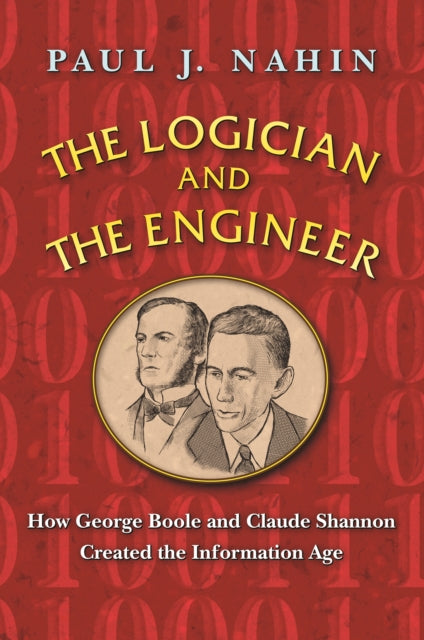
Princeton University Press The Logician and the Engineer
Book SynopsisThird printing. First paperback printing. Original copyright date: 2013.Trade Review"Meshing logic problems with the stories of two extraordinary men ... Paul Nahin fashions a tale of innovation and discovery. Alongside a gripping account of how Shannon built on Boole's work, Nahin explores others key to the technological revolution, from Georg Cantor to Alan Turing."--Nature "Engaging... Nahin assumes some rudimentary knowledge but expertly explains concepts such as relay circuits, Turing machines, and quantum computing. Reasoning through the problems and diagrams will give persistent readers genuine aha moments and an understanding of the two revolutionaries who helped to lay the foundation of our digital world."--Scientific American "Part biography, part history, and part a review of basic information theory, this book does an excellent job of fitting these interlocking elements together."--Library Journal "The reader is taken on a journey from the development of some abstract mathematical ideas through a nearly ubiquitous application of those ideas within the modern world with so many embedded digital computers... I enjoyed the discussion of Claude Shannon. In the history of the computer and development of the internet and World Wide Web, his ideas and contributions are too often overlooked. He is one of my heroes and I believe that everyone that reads this book will come to the same conclusion."--Charles Ashbacher, MAA Reviews "Paul J. Nahin really knows how to tell a good story... The Logician and the Engineer is truly a gem."--New York Journal of Books "A short but fairly detailed exploration of the genesis of Boolean logic and Shannon's information theory... [G]ood background reading for anyone studying electronics or computer science."--Christine Evans-Pughe, Engineering & Technology "Although the book is technical, it is always easily understandable for anyone (for those who need it, some basic rules for electrical circuits are collected in a short appendix). It is not only understandable but also pleasantly bantering and at occasions even facetious."--A. Bultheel, European Mathematical Society "Most valuable to this reviewer, and likely to many potential readers, is the closing chapter, aptly titled Beyond Boole and Shannon. Here is provided an introduction to quantum computing and its logic, possibly portending the future of computers, yet unmistakably bearing the footprints of the two early pioneers. It is an unexpected yet fitting conclusion to this thoroughly enjoyable read."--Ronald E. Prather, Mathematical Reviews Clippings "Nahin has had the very good idea of connecting the very different worlds and times of Boole, Shannon, and others to demonstrate that a little Victorian algebra can turn out to be very useful."--SIAM Review "The exposition is clear and does not assume any prior knowledge except elementary mathematics and a few basic facts from physics. I recommend this well-written book to all readers interested in the history of computer science, as well as those who are curious about the fundamental principles of digital computing."--Antonin Slavik, Zentralblatt MATH "[T]his is a useful and often interesting introduction to the life and work of two intellectual giants who are largely unknown to the general public."--Gareth and Mary Jones, London Mathematical Society Newsletter "The problems are varied and indeed intriguing, and the solutions are delightful."--Mathematics Magazine "This book is not light reading. It would be excellent for advanced high school juniors or seniors with a strong interest in computer science as well as mathematics."--Tom Ottinger, Mathematics Teacher "Nahin leavens the math and engineering with humor and an infectious intellectual curiosity, and the parallels between Boole and Shannon are convincingly drawn... [The Logician and the Engineer] will give your brain a workout, but an enjoyable one."--San Francisco Book ReviewTable of ContentsPreface xi 1 What You Need to Know to Read This Book 1 Notes and References 5 2 Introduction 6 Notes and References 14 3 George Boole and Claude Shannon: Two Mini-Biographies 17 *3.1 The Mathematician 17 *3.2 The Electrical Engineer 28 * Notes and References 39 4 Boolean Algebra 43 *4.1 Boole's Early Interest in Symbolic Analysis 43 *4.2 Visualizing Sets 44 *4.3 Boole's Algebra of Sets 45 *4.4 Propositional Calculus 48 *4.5 Some Examples of Boolean Analysis 52 *4.6 Visualizing Boolean Functions 59 * Notes and References 65 5 Logical Switching Circuits 67 *5.1 Digital Technology: Relays versus Electronics 67 *5.2 Switches and the Logical Connectives 68 *5.3 A Classic Switching Design Problem 71 *5.4 The Electromagnetic Relay and the Logical NOT 73 *5.5 The Ideal Diode and the Relay Logical AND and OR 76 *5.6 The Bi-Stable Relay Latch 81 * Notes and References 84 6 Boole, Shannon, and Probability 88 *6.1 A Common Mathematical Interest 88 *6.2 Some Fundamental Probability Concepts 89 *6.3 Boole and Conditional Probability 96 *6.4 Shannon, Conditional Probability, and Relay Reliability 99 *6.5 Majority Logic 106 * Notes and References 110 7 Some Combinatorial Logic Examples 114 *7.1 Channel Capacity, Shannon's Theorem, and Error-Detection Theory 114 *7.2 The Exclusive-OR Gate (XOR) 122 *7.3 Error-Detection Logic 127 *7.4 Error-Correction Theory 128 *7.5 Error-Correction Logic 132 * Notes and References 137 8 Sequential-State Digital Circuits 139 *8.1 Two Sequential-State Problems 139 *8.2 The NOR Latch 142 *8.3 The Clocked RS Flip-Flop 146 *8.4 More Flip-Flops 154 *8.5 A Synchronous, Sequential-State Digital Machine Design Example 158 * Notes and References 160 9 Turing Machines 161 *9.1 The First Modern Computer 162 *9.2 Two Turing Machines 164 *9.3 Numbers We Can't Compute 168 * Notes and References 173 10 Beyond Boole and Shannon 176 *10.1 Computation and Fundamental Physics 176 *10.2 Energy and Information 178 *10.3 Logically Reversible Gates 180 *10.4 Thermodynamics of Logic 184 *10.5 A Peek into the Twilight Zone: Quantum Computers 188 *10.6 Quantum Logic--and Time Travel, Too! 197 Notes and References 205 Epilogue For the Future: The Anti-Amphibological Machine 210 Appendix Fundamental Electric Circuit Concepts 219 Acknowledgments 223 Index 225
£16.14

Princeton University Press Étale Cohomology
Book SynopsisTable of Contents*Frontmatter, pg. i*Contents, pg. vii*Preface, pg. ix*Terminology and Conventions, pg. xiii*Chapter I. Etale Morphisms, pg. 1*Chapter II. Sheaf Theory, pg. 46*Chapter III. Cohomology, pg. 82*Chapter IV. The Brauer Group, pg. 136*Chapter V. The Cohomology of Curves and Surfaces, pg. 155*Chapter VI. The Fundamental Theorems, pg. 220*Appendix A. Limits, pg. 304*Appendix B. Spectral Sequences, pg. 307*Appendix C. Hypercohomology, pg. 310*Bibliography, pg. 313*Index, pg. 321
£38.25

Princeton University Press The Fascinating World of Graph Theory
Book SynopsisTrade ReviewOne of Choice's Outstanding Academic Titles for 2015 "The Fascinating World of Graph Theory shows its pedagogic value. Traditional courseware develops subject matter from the bottom on up, going from basic definitions to the more complex. [This book] is different, not starting with the simplest structures or algorithms but with interesting problems to be solved, puzzles that use graphs and networks... [It is] readable and 'student-friendly'--more so than the typical math textbook."--New York Journal of Books "[The authors] have set out to make graph theory not only accessible to people with a limited mathematics background, but also to make it interesting. They have--by virtue of very clear writing, combined with a greater-than-usual emphasis on the historical and personal side of the subject--succeeded admirably."--MAA Reviews "The book is written masterfully; the narrative in each chapter flows naturally, engagingly... [I]t's a popular but also comprehensive introduction into graph theory."--Alexander Bogomolny, Cut the Knot blog "A fun and interesting tour of graph theory, leaving each visitor with a feeling of accomplishment and a satisfying understanding of this unusual mathematical world... This is an entertaining book for those who enjoy solving problems, plus readers will learn about some powerful mathematical ideas along the way!"--Choice "Here is a book with an enjoyable mix of mathematics and its applications, spiced with liberal amounts of history and anecdote... The value of books like this is that they make mathematics come alive to a broad range of readers who might not look twice at a textbook or monograph."--Norman Biggs, London Mathematical Society Newsletter "Deftly written and dynamic...The Fascinating World of Graph Theoryis an aptly named book, able to present a wide variety of central topics in graph theory, including the history behind them... in a lively and entertaining manner... A superb example of approachable mathematical writing."--SIAM Review "The authors manage to motivate all topics with interesting applications, historical problems and discussion of concepts from an intuitive point of view."--Radu Trimbitas, Studia Mathematica "I am not going to try to list the topics that are covered, since there is a great variety. This breadth, along with the superb writing, make the book a must-have for anyone with serious interest in graph theory."--James M. Cargal, UMAP JournalTable of ContentsPreface vii Prologue xiii 1 Introducing Graphs 1 2 Classifying Graphs 22 3 Analyzing Distance 45 4 Constructing Trees 67 5 Traversing Graphs 91 6 Encircling Graphs 108 7 Factoring Graphs 125 8 Decomposing Graphs 143 9 Orienting Graphs 164 10 Drawing Graphs 183 11 Coloring Graphs 206 12 Synchronizing Graphs 226 Epilogue Graph Theory: A Look Back-The Road Ahead 251 Exercises 255 Selected References 309 Index of Names 317 Index of Mathematical Terms 319
£17.09

Harvard University Press The Politics of Large Numbers
Book SynopsisIn this sophisticated study of the history of statistics, Desrosières shows how the evolution of modern statistics has been inextricably bound up with the knowledge and power of governments. He traces the complex reciprocity between modern governments and the mathematical artifacts that dictate the duties of the state and measure its successes.Trade ReviewStatistics works in and on the world, simultaneously describing and remaking. It straddles the chasm between the invented and the discovered, the real and the constructed--oppositions that have structured an increasingly sterile debate about the nature of science among historians, philosophers, sociologists, and scientists. The great merit of Desrosières' study is that it points the way beyond this impasse by showing how statistical entities are simultaneously real and constructed, invented and discovered. -- Lorraine Daston * London Review of Books *This is a good book...The strength of Alain Desrosières's account lies in the rich and insightful way he has analysed his subject--statistical reasoning... Anyone interested in the history of science and economics and, particularly, applied mathematics, will be stimulated by this book. -- Hugh Pennington * Times Higher Education Supplement *Statistics, with its aura of dispassionate dustiness, does not have a good image. It is detested by generations of social-science students, a grim necessity for medical researchers, distrusted by the general public. Many of these--and some statisticians--would be surprised to discover how often statistics has responded to social developments or even influenced them. The broad theme of [The Politics of Large Numbers] is that statistical measures and probabilistic concepts are most usefully seen as matters of convention, rather than of objective reality. The social context generates the need to make things countable and to interpret the counts; it also conditions the conventions that emerge. -- Jonathan Rosenhead * Nature *This is a work of tremendous erudition that is far broader in scope and significance than its title suggests. Coming at the end of an explosive 15-year period of research, here and in Europe, on the history of statistical thinking, Desrosières's book is at once a powerful synthesis of recent scholarship and a path-setting effort to extend this research into important areas that have gone relatively unattended... His case for the applicability of the actor-network approach to the historical development of statistical thought is a compelling one, which is very effective at sociologically integrating many of the different currents that formed this broad development. -- Charles Camic * American Journal of Sociology *Desrosières' discussion of the various translations statistics has been able to achieve is both scholarly and erudite. It is also now one of a number of recent histories of statistics published over the last fifteen years that offers a critical approach to statistics. Rather than accepting that statistics is necessarily correct because it is based on the seemingly universal logic of mathematics, The Politics of Large Numbers, and other works in the same genre, are keen to show that statistics is a contingent and local enterprise, one shot through with the peculiarities of the particular social, cultural, and political context in which it is practised... Desrosières' book is a fine piece of work. -- Trevor J. Barnes * Environment and Planning *Alain Desrosières's ambitious and critical study seeks to reconstruct the modern historical contexts in which the use of statistics and statistical methods evolved rapidly... There is no other book quite like The Politics of Large Numbers. Its uniqueness lies in its impressive historical and intellectual sweep. In addition to tracing the changing connections between state construction, scientific development, and statistical reasoning in modern times, it highlights their recent intersections in ways that may be of particular interest to readers. -- Joseph P. Smaldone * Perspectives on Political Science *[The Politics of large Numbers] shows, with many historical details, that biometrics did not become a subject for mathematical statistics alone, but for administrative statistics as well. -- Jochen Fleischhacker * Population Studies *This is an ambitious, complex and sophisticated 'sociology of numbers,' a study of the history of statistics and an analysis of its function within the state. It covers the relevant technical mathematical subjects as well as the epistemological questions raised by the reification of numbers with impressive erudition and subtlety... Desrosières' work is an impressive synthesis of technical, historical, and philosophical thinking on statistics and the state in the modern Western world, available no where else. The book seems destined to be a standard reference in the areas of statistics, government, history and economics as well as other disciplines like psychology where 'reasoning through numbers' plays an essential role. The style is sophisticated and while demanding, is generally engaging. -- Carol Blum, State University of New York at Stony BrookThe book is a critical, scholarly and accurate synthesis of an extremely broad spectrum of the history of statistics, with an emphasis on the conceptual development of social statistics, culminating in twentieth-century applied econometrics. Desrosières' treatment is not highly technical, although he does exhibit an easy competence with the technical side. A significant strength of the work are the discussions of the relationships of the development of statistics to national and international statistical agencies, and the relationship of economic ideas to the statistical constructs employed to measure them. No other work exhibits the same breadth--probability, mathematical statistics, psychology, economics, sociology, surveys, public health, medical statistics. -- Stephen M. Stigler, University of ChicagoTable of ContentsIntroduction: Arguing from Social Facts Prefects and Geometers Judges and Astronomers Averages and the Realism of Aggregates Correlation and the Realism of Causes Statistics and the State: France and Great Britain Statistics and the State: Germany and the United States The Part for the Whole: Monographs or Representative Sampling Classifying and Encoding Modeling and Adjusting Conclusion: Disputing the Indisputable
£999.99
Nattygrafix The Simpler Polyhedra Being the Third Part of
Book SynopsisPolytheora; 3-dimensional regular solids assembled from regular polygons.
£7.82

Penguin Random House India Super 30
Book SynopsisStirring and heart-wrenching, this is the extraordinary story of a visionary who has elevated these bright sparks and, through education, given them hope to rise above crippling poverty.
£12.39
Taylor & Francis Inc Generalized Estimating Equations
Book SynopsisGeneralized Estimating Equations, Second Edition updates the best-selling previous edition, which has been the standard text on the subject since it was published a decade ago. Combining theory and application, the text provides readers with a comprehensive discussion of GEE and related models. Numerous examples are employed throughout the text, along with the software code used to create, run, and evaluate the models being examined. Stata is used as the primary software for running and displaying modeling output; associated R code is also given to allow R users to replicate Stata examples. Specific examples of SAS usage are provided in the final chapter as well as on the book's website.This second edition incorporates comments and suggestions from a variety of sources, including the Statistics.com course on longitudinal and panel models taught by the authors. Other enhancements include an examination of GEE marginal effects; a more thorough presentatiTrade Review"Overall, I found this to be a very useful book on GEE, and would recommend it to anyone planning to use GEE models in their data analysis. Both the theory and practical aspects of constructing and analysing such models is covered. Inclusion of code for many of the analyses is an excellent feature."—Ken J. Beath, Macquarie University, Australia, Australian and New Zealand Journal of Statistics, April 2017" … the authors expand the text with several additions: (I) they examine and include entirely new topics related to GEE and the estimation of clustered and longitudinal models; (2) they add more detailed discussions of previously presented topics, including expanding the discussion of various models associated with GEE (penalized GEE, survey GEE, and quasi-least-square regression), adding material on hypothesis testing and diagnostics, and introducing alternative models for ordered categorical outcomes and an extension of the QIC, which is a model selection criterion measure; (3) they expand the amount of computer code by adding R code to duplicate the Stata examples wherever possible. In my opinion, the second edition is enhanced by the additions mentioned above, providing an excellent review of the GEE, wide coverage of its variations, and many useful computing techniques. I believe it would be a very useful reference book for practicing researchers and graduate students who are interested in research topics related to GEE."—CindyYu, Iowa State University in the Journal of the American Statistical Association, December 2013"The second edition … adds a few new topics related to various extensions of GEE … [and replaces] outdated S-PLUS codes with R scripts. Also, the number of exercises increased significantly … . For those who want to use this book in the classroom, including me, having extra exercise sets is certainly a welcome addition. … One main strength of this book is its comprehensive coverage of Stata implementation of the GEE. … a valuable reference and is particularly useful for practitioners. It can serve as supplemental reading in longitudinal data analysis classes as well."—Woncheol Jang, Biometrics, September 2013Praise for the First Edition:"… well-written chapters … . The book contains challenging problems in exercises and is suitable to be a textbook in a graduate-level course on estimating functions. The references are up-to-date and exhaustive. … I enjoyed reading [this book] and recommend [it] very highly to the statistical community."—Journal of Statistical Computation and Simulation, February 2005"[The book] is comprehensive and covers much useful material with formulas presented in detail … a useful and recommendable book both for those who already work with GEE methods and for newcomers to the field."—Per Kragh Andersen, University of Copenhagen, Statistics in Medicine, 2004"Generalized Estimating Equations is the first and only book to date dedicated exclusively to generalized estimating equations (GEE). I find it to be a good reference text for anyone using generalized linear models (GLIM).The authors do a good job of not only presenting the general theory of GEE models, but also giving explicit examples of various correlation structures, link functions and a comparison between population-averaged and subject-specific models. Furthermore, there are sections on the analysis of residuals, deletion diagnostics, goodness-of-fit criteria, and hypothesis testing. Good data-driven examples that give comparisons between different GEE models are provided throughout the book. Perhaps the greatest strength of this book is its completeness. It is a thorough compendium of information from the GEE literature. Overall, Generalized Estimating Equations contains a unique survey of GEE models in an attempt to unify notation and provide the most in-depth treatment of GEEs. I believe that it serves as a valuable reference for researchers, teachers, and students who study and practice GLIM methodology."—Journal of the American Statistics Association, March 2004"Generalized Estimating Equations is a good introductory book for analysing continuous and discrete data using GEE methods ... . This book is easy to read, and it assumes that the reader has some background in GLM. Many examples are drawn from biomedical studies and survey studies, and so it provides good guidance for analysing correlated data in these and other areas."—Technometrics, 2003"Overall, I found this to be a very useful book on GEE, and would recommend it to anyone planning to use GEE models in their data analysis. Both the theory and practical aspects of constructing and analysing such models is covered. Inclusion of code for many of the analyses is an excellent feature."—Ken J. Beath, Macquarie University, Australia, Australian and New Zealand Journal of Statistics, April 2017"The second edition … adds a few new topics related to various extensions of GEE … [and replaces] outdated S-PLUS codes with R scripts. Also, the number of exercises increased significantly … . For those who want to use this book in the classroom, including me, having extra exercise sets is certainly a welcome addition. … One main strength of this book is its comprehensive coverage of Stata implementation of the GEE. … a valuable reference and is particularly useful for practitioners. It can serve as supplemental reading in longitudinal data analysis classes as well."—Woncheol Jang, Biometrics, September 2013Praise for the First Edition:"… well-written chapters … . The book contains challenging problems in exercises and is suitable to be a textbook in a graduate-level course on estimating functions. The references are up-to-date and exhaustive. … I enjoyed reading [this book] and recommend [it] very highly to the statistical community."—Journal of Statistical Computation and Simulation, February 2005"[The book] is comprehensive and covers much useful material with formulas presented in detail … a useful and recommendable book both for those who already work with GEE methods and for newcomers to the field."—Per Kragh Andersen, University of Copenhagen, Statistics in Medicine, 2004"Generalized Estimating Equations is the first and only book to date dedicated exclusively to generalized estimating equations (GEE). I find it to be a good reference text for anyone using generalized linear models (GLIM).The authors do a good job of not only presenting the general theory of GEE models, but also giving explicit examples of various correlation structures, link functions and a comparison between population-averaged and subject-specific models. Furthermore, there are sections on the analysis of residuals, deletion diagnostics, goodness-of-fit criteria, and hypothesis testing. Good data-driven examples that give comparisons between different GEE models are provided throughout the book. Perhaps the greatest strength of this book is its completeness. It is a thorough compendium of information from the GEE literature. Overall, Generalized Estimating Equations contains a unique survey of GEE models in an attempt to unify notation and provide the most in-depth treatment of GEEs. I believe that it serves as a valuable reference for researchers, teachers, and students who study and practice GLIM methodology."—Journal of the American Statistics Association, March 2004"Generalized Estimating Equations is a good introductory book for analysing continuous and discrete data using GEE methods ... . This book is easy to read, and it assumes that the reader has some background in GLM. Many examples are drawn from biomedical studies and survey studies, and so it provides good guidance for analysing correlated data in these and other areas."—Technometrics, 2003Table of ContentsIntroduction. Model Construction and Estimating Equations. Generalized Estimating Equations. Residuals, Diagnostics, and Testing. Programs and Datasets. References. Author Index. Subject Index.
£92.14
LEGARE STREET PR A Monograph of the British Desmidiaceæ Volume 1
a huge range and FREE tracked UK delivery on ALL orders.
£26.55
HarperCollins Publishers Around the World in 80 Games
Book Synopsis''BRILLIANTLY CLEAR AND CAPTIVATING PROSE'' STEPHEN FRYA WATERSTONES BOOK OF YEAR 2023An award-winning mathematician explores the maths behind the games we love and why we love to play them.Where should you move first in Connect 4?Which property is best in Monopoly?How can pi help you win Rock Paper Scissors?Crossing oceans, continents and millennia, award-winning mathematician Marcus du Sautoy explores how maths and games have always been deeply intertwined. As well as being integral to human psychology and culture throughout the ages, games provided the first opportunities for deep mathematical insight into the world. This grand adventure teaches us how to strategise, play better and win more often.The subject matter is fun (I mean, isn't it quite literally the definition of fun?) and du Sautoy's enthusiasm is infectious' THE SUNDAY TIMES''A delightful and addictive celebration of games. You'll keep wanting one more go'' DARA Ó BRIAIN, author of Is There Anybody Out There?Lively, creative and humane exactly as one would expect from Marcus du Sautoy' TIM HARFORD, author of How To Make The World Add UpYou do not need to be a seasoned player nor a skilled mathematician to relish this enchanting read. However, this book may just encourage you to become the one or the other' REINER KNIZIA, award-winning game designerTrade Review‘With the lightest of touches du Sautoy manages persuasively to show how games are both narratives that speak about us and structures whose ideas underlie everything in our known universe. And on top of it, the book serves as an absolutely indispensable compendium. Rainy weekends in Cornwall will now be welcomed’ Stephen Fry 'A delightful and addictive celebration of games. You’ll keeping wanting one more go' Dara Ó Briain ‘Whether your game is Go, Dungeons and Dragons, or Chocolate Chilli Roulette, you'll find this book adorable. It's lively, creative and humane – exactly as one would expect from Marcus du Sautoy’ Tim Harford, author of How To Make The World Add Up ‘The book encapsulates the very essence of human ingenuity and our intrinsic love for play and exploration. You do not need to be a seasoned player nor a skilled mathematician to relish this enchanting read. However, this book may just encourage you to become the one or the other’ Reiner Knizia, award-winning game designer
£999.99


