
Mathematics Books
Princeton University Press The Real Analysis Lifesaver
Book SynopsisTrade Review"This well-written book prepares readers to take a real analysis course by carefully defining and proving all concepts one needs for this type of course. . . . Throughout the book, the style is incredibly reader friendly, and the author's enthusiasm for the subject is very clear." * Choice *"I can imagine this book proving useful to a motivated student who is finding the transition into analysis challenging through traditional textbooks."---Dominic Yeo, Mathematical GazetteTable of ContentsPreliminaries 1 1 Introduction 3 2 Basic Math and Logic* 6 3 Set Theory* 14 Real Numbers 25 4 Least Upper Bounds* 27 5 The Real Field* 35 6 Complex Numbers and Euclidean Spaces 46 Topology 59 7 Bijections 61 8 Countability 68 9 Topological Definitions* 79 10 Closed and Open Sets* 90 11 Compact Sets* 98 12 The Heine-Borel Theorem* 108 13 Perfect and Connected Sets 117 Sequences 127 14 Convergence* 129 15 Limits and Subsequences* 138 16 Cauchy and Monotonic Sequences* 148 17 Subsequential Limits 157 18 Special Sequences 166 19 Series* 174 20 Conclusion 183 Acknowledgments 187 Bibliography 189 Index 191
£22.50

Princeton University Press Symmetry
Book SynopsisTrade Review"This short book on a vast subject is the work of a master. With a few sure and authoritative words [Weyl] gives us the heart of the matter. There is no book ... quite like this one on the subject of symmetry and I doubt if any book will be written in the future that will not in some way lean upon this one... [I]t contains so much besides mathematics that it can still be read with profit and enjoyed by someone who has not advanced beyond long division."--John Tyler Bonner, Science "Dr. Weyl presents a masterful and fascinating survey of the applications of the principle of symmetry in sculpture, painting, architecture, ornament, and design; its manifestations in organic and inorganic nature; and its philosophical and mathematical significance."--Scientific American "Weyl offers deep insight into [the concept of symmetry], its foundations in group theory, its applications in physics, chemistry, and biology, and its role in art."--Manfred Eigen and Ruthild Winkler in Laws of the Game "Vivid and picturesque... [Weyl is] an outstanding thinker."--Wolfgang Yourgrau, Philosophy and Phenomenological ResearchTable of ContentsBilateral symmetry 3 Translatory, rotational, and related symmetries 41 Ornamental Symmetry 83 Crystals. The General mathmatical idea of symmetry 119 Appendices A. Determination of all finite groups of proper rotations in 3-space 149 B. Inclusion of improper rotations 155 Acknowledgements 157 Index 161
£14.24

Princeton University Press Enlightening Symbols A Short History of
Book SynopsisTrade Review"Mazur (Euclid in the Rainforest) gives readers the fascinating history behind the mathematical symbols we use, and completely take for granted, every day. Mathematical notation turns numbers into sentences--or, to the uninitiated, a mysterious and impenetrable code. Mazur says the story of math symbols begins some 3,700 years ago, in ancient Babylon, where merchants incised tallies of goods on cuneiform tablets, along with the first place holder--a blank space. Many early cultures used letters for both numbers and an alphabet, but convenient objects like rods, fingers, and abacus beads, also proved popular. Mazur shows how our 'modern' system began in India, picking up the numeral 'zero' on its way to Europe, where it came into common use in the 16th century, thanks to travelers and merchants as well as mathematicians like Fibonacci. Signs for addition, subtraction, roots, and equivalence followed, but only became standardized through the influence of scientists and mathematicians like Rene Descartes and Gottfried Leibniz. Mazur's lively and accessible writing makes what could otherwise be a dry, arcane history as entertaining as it is informative."--Publishers Weekly "[A] fascinating narrative... This is a nuanced, intelligently framed chronicle packed with nuggets--such as the fact that Hindus, not Arabs, introduced Arabic numerals. In a word: enlightening."--George Szpiro, Nature "Mazur begins by illustrating how the ancient Incas and Mayans managed to write specific, huge numbers. Then, for more than 200 pages, he traces the history of division signs, square roots, pi, exponents, graph axes and other symbols in the context of cognition, communication, and analysis."--Washington Post "Mazur delivers a solid exposition of an element of mathematics that is fundamental to its history."--Library Journal "Mazur treats only a subset of F. Cajori's monumental A History of Mathematical Notation (Dover, 1993 first edition 1922) and there is overlap with many other mathematical history books, but Mazur adds new findings and insights and it is so much more entertaining ... and these features make it an interesting addition to the existing literature for anybody with only a slight interest in mathematics or its history."--European Mathematical Society "Symbols like '+' and '=' are so ingrained that it's hard to conceive of math without them. But a new book, Enlightening Symbols: A Short History of Mathematical Notation and its Hidden Power, offers a surprising reminder: Until the early 16th century, math contained no symbols at all."--Kevin Hartnett, Boston Globe "Enlightening Symbols retraces the winding road that has led to the way we now teach, study, and conceive mathematics... Thanks to Mazur's playful approach to the subject, Enlightening Symbols offers an enjoyable read."--Gaia Donati, Science "If you enjoy reading about history, languages and science, then you'll enjoy this book... The best part is the writing is compelling enough that you don't have to be a mathematician to enjoy this informative book."--Guardian.com's GrrlScientist blog "[I]nformative, highly readable and scholarly."--Brian Rotman, Literary Review "[T]his insightful account of the historical development of a highly characteristic feature of the mathematical enterprise also represents a valuable contribution to our understanding of the nature of mathematics."--Eduard Glas, Mathematical Reviews Clippings "Joseph Mazur's beautiful book Enlightening Symbols tells the story of human civilization through the development of mathematical notation. Surprises abound... The book is visually exquisite, great care having been taken with illustrations and figures. Mazur's discussion of the emergence of particular symbols affords the reader an overview of the often difficult primary literature."--Donal O'Shea, Sarasota Herald-Tribune "At whatever depth one chooses to read it, Enlightening Symbols has something for everyone. It is entertaining and eclectic, and Mazur's personal and easy style helps connect us with those who led the long and winding search for the best ways to quantify and analyze our world. Their success has liberated us from 'the shackles of our physical impressions of space'--and of the particular and the concrete--'enabling imagination to wander far beyond the tangible world we live in, and into the marvels of generality.'"--Robyn Arianrhod, Notices of the Notices of the American Mathematical Society "Mazur introduces the reader to major characters, weaves in relevant aspects of wider culture and gives a feel for the breadth of mathematical history. It is a useful book for both student and interested layperson alike."--Mark McCartney, London Mathematical Society "[T]his is a good book. It is well written by an experienced author and is full of interesting facts about how the symbols used in mathematics have arisen. It would certainly interest anyone who studies the history of mathematics."--Phil Dyke, Leonardo "Mazur is a master story teller."--John Stillwell, Bulletin of the American Mathematical SocietyTable of ContentsIntroduction ix Definitions xxi Note on the Illustrations xxiii Part 1 Numerals 1 1. Curious Beginnings 3 2. Certain Ancient Number Systems 10 3. Silk and Royal Roads 26 4. The Indian Gift 35 5. Arrival in Europe 51 6. The Arab Gift 60 7. Liber Abbaci 64 8. Refuting Origins 73 Part 2 Algebra 81 9. Sans Symbols 85 10. Diophantus's Arithmetica 93 11. The Great Art 109 12. Symbol Infancy 116 13. The Timid Symbol 127 14. Hierarchies of Dignity 133 15. Vowels and Consonants 141 16. The Explosion 150 17. A Catalogue of Symbols 160 18. The Symbol Master 165 19. The Last of the Magicians 169 Part 3 The Power of Symbols 177 20. Rendezvous in the Mind 179 21. The Good Symbol 189 22. Invisible Gorillas 192 23. Mental Pictures 210 24. Conclusion 216 Appendix A Leibniz's Notation 221 Appendix B Newton's Fluxion of xn 223 Appendix C Experiment 224 Appendix D Visualizing Complex Numbers 228 Appendix E Quaternions 230 Acknowledgments 233 Notes 235 Index 269
£999.99

Princeton University Press The Great Formal Machinery Works
Book SynopsisTrade Review"An important contribution to the study of the history of mathematics, and any student, educator, or practitioner of mathematics or computer science, would benefit from reading this work."---Mark Causapin, MAA Reviews"In reading von Plato’s book the attention of the scholarly reader will be always captured."---L. Bellotti, History and Philosophy of Logic"This book presents an informed and informative hisotry of a crucially important part of mathematics. . . . a valuable addition to our corporate understanding."---Rob Ashmore, Mathematics Today
£28.80

Princeton University Press H246lder Continuous Euler Flows in Three
Book Synopsis
£130.40

Princeton University Press Hölder Continuous Euler Flows in Three Dimensions
Book Synopsis
£63.75

Princeton University Press Finding Fibonacci
Book SynopsisTrade Review"In his jaunty book Finding Fibonacci, Keith Devlin sets out to tell the elusive story of the 13th-century mathematician Leonardo of Pisa."--James Ryerson, New York Times Book Review "Devlin leads a cheerful pursuit to rediscover the hero of 13th-century European mathematics, taking readers across centuries and through the back streets of medieval and modern Italy in this entertaining and surprising history... Devlin relates Leonardo's adventures with brio and charm. Readers will enjoy this deft and engaging mix of history, mathematics, and personal travelogue."--Publishers Weekly "Finding Fibonacci showcases Devlin's writerly flair. My favourite passages are the incredible story of how Liber Abaci (or at least, the edition he wrote in 1228, the sole surviving one) became available in English for the first time - to this day the only modern-language translation."--Davide Castelvecchi, Nature "[Devlin] talks his way into Italian research libraries in search of early manuscripts, photographs all 11 street signs on Via Leonardo Fibonacci in Florence and strives to cultivate a love for numbers in his readers."--Andrea Marks, Scientific American "Finding Fibonacci [does] much to restore Leonardo to his proper place in contemporary Western culture."--Dan Friedman, Los Angeles Review of Books "[E]ngaging and entertaining."--Library Journal "A charming new book."--Martijn van Calmthout, de Volkskrant "All in all a book to be recommended. If you already read The Man of Numbers it is most informative to read this 'behind the scenes' version and know how it came about (and what happened after its publication). If you didn't know The Man of Numbers, you at least get a summary of what is in there too. Only it is told in a much more personal and lively version."--Adhemar Bultheel, European Mathematical Society "[A] good beach read for the nerdier among us."--Math FrolicTable of ContentsPrelude Sputnik and Calculus 1 1 The Flood Plain 5 2 The Manuscript 18 3 First Steps 35 4 The Statue 42 5 A Walk along the Pisan Riverbank 56 6 A Very Boring Book? 64 7 Franci 72 8 Publishing Fibonacci: From the Cloister to Amazon.com 85 9 Translation 97 10 Reading Fibonacci 116 11 Manuscript Hunting, Part I (Failures) 138 12 Manuscript Hunting, Part II (Success at Last) 151 13 The Missing Link 167 14 This Will Change the World 181 15 Leonardo and the Birth of Modern Finance 192 16 Reflections in a Medieval Mirror 213 Appendix Guide to the Chapters of Liber abbaci 228 Bibliography 236 Index 239
£25.20

Princeton University Press Noncooperative Game Theory
Book SynopsisTrade Review"Noncooperative Game Theory offers students a fresh way of approaching engineering and computer science applications." * Mathematical Reviews *Table of ContentsPreamble xi I INTRODUCTION 1 Noncooperative Games 1.1 Elements of a Game 3 1.2 Cooperative vs. Noncooperative Games: Rope-Pulling 4 1.3 Robust Designs: Resistive Circuit 8 1.4 Mixed Policies: Network Routing 9 1.5 Nash Equilibrium 11 1.6 Practice Exercise 11 2 Policies 2.1 Actions vs. Policies: Advertising Campaign 13 2.2 Multi-Stage Games:War of Attrition 16 2.3 Open vs. Closed-Loop: Zebra in the Lake 18 2.4 Practice Exercises 19 II ZERO-SUM GAMES 3 Zero-Sum Matrix Games 3.1 Zero-Sum Matrix Games 25 3.2 Security Levels and Policies 26 3.3 Computing Security Levels and Policies with MATLAB(R) 27 3.4 Security vs. Regret: Alternate Play 28 3.5 Security vs. Regret: Simultaneous Plays 28 3.6 Saddle-Point Equilibrium 29 3.7 Saddle-Point Equilibrium vs. Security Levels 30 3.8 Order Interchangeability 32 3.9 Computational Complexity 32 3.10 Practice Exercise 34 3.11 Additional Exercise 34 4 Mixed Policies 4.1 Mixed Policies: Rock-Paper-Scissor 35 4.2 Mixed Action Spaces 37 4.3 Mixed Security Policies and Saddle-Point Equilibrium 38 4.4 Mixed Saddle-Point Equilibrium vs. Average Security Levels 41 4.5 General Zero-Sum Games 43 4.6 Practice Exercises 47 4.7 Additional Exercise 50 5 Minimax Theorem 5.1 Theorem Statement 52 5.2 Convex Hull 53 5.3 Separating Hyperplane Theorem 54 5.4 On theWay to Prove the Minimax Theorem 55 5.5 Proof of the Minimax Theorem 57 5.6 Consequences of the Minimax Theorem 58 5.7 Practice Exercise 58 6 Computation of Mixed Saddle-Point Equilibrium Policies 6.1 Graphical Method 60 6.2 Linear Program Solution 61 6.3 Linear Programs with MATLAB(R) 63 6.4 Strictly Dominating Policies 64 6.5 "Weakly" Dominating Policies 66 6.6 Practice Exercises 67 6.7 Additional Exercise 70 7 Games in Extensive Form 7.1 Motivation 71 7.2 Extensive Form Representation 72 7.3 Multi-Stage Games 72 7.4 Pure Policies and Saddle-Point Equilibria 74 7.5 Matrix Form for Games in Extensive Form 75 7.6 Recursive Computation of Equilibria for Single-Stage Games 77 7.7 Feedback Games 79 7.8 Feedback Saddle-Point for Multi-Stage Games 79 7.9 Recursive Computation of Equilibria for Multi-Stage Games 83 7.10 Practice Exercise 85 7.11 Additional Exercises 86 8 Stochastic Policies for Games in Extensive Form 8.1 Mixed Policies and Saddle-Point Equilibria 87 8.2 Behavioral Policies for Games in Extensive Form 90 8.3 Behavioral Saddle-Point Equilibria 91 8.4 Behavioral vs. Mixed Policies 92 8.5 Recursive Computation of Equilibria for Feedback Games 93 8.6 Mixed vs. Behavioral Order Interchangeability 95 8.7 Non-Feedback Games 95 8.8 Practice Exercises 96 8.9 Additional Exercises 102 III NON-ZERO-SUM GAMES 9 Two-Player Non-Zero-Sum Games 9.1 Security Policies and Nash Equilibria 105 9.2 Bimatrix Games 107 9.3 Admissible Nash Equilibria 108 9.4 Mixed Policies 110 9.5 Best-Response Equivalent Games and Order Interchangeability 111 9.6 Practice Exercises 114 9.7 Additional Exercises 116 10 Computation of Nash Equilibria for Bimatrix Games 10.1 Completely Mixed Nash Equilibria 118 10.2 Computation of Completely Mixed Nash Equilibria 120 10.3 Numerical Computation of Mixed Nash Equilibria 121 10.4 Practice Exercise 124 10.5 Additional Exercise 126 11 N-Player Games 11.1 N-Player Games 127 11.2 Pure N-Player Games in Normal Form 129 11.3 Mixed Policies for N-Player Games in Normal Form 130 11.4 Completely Mixed Policies 131 12 Potential Games 12.1 Identical Interests Games 133 12.2 Potential Games 135 12.3 Characterization of Potential Games 138 12.4 Potential Games with Interval Action Spaces 139 12.5 Practice Exercises 142 12.6 Additional Exercise 144 13 Classes of Potential Games 13.1 Identical Interests Plus Dummy Games 145 13.2 Decoupled Plus Dummy Games 146 13.3 Bilateral Symmetric Games 147 13.4 Congestion Games 148 13.5 Other Potential Games 149 13.6 Distributed Resource Allocation 150 13.7 Computation of Nash Equilibria for Potential Games 153 13.8 Fictitious Play 156 13.9 Practice Exercises 159 13.10 Additional Exercises 167 IV DYNAMIC GAMES 14 Dynamic Games 14.1 Game Dynamics 171 14.2 Information Structures 173 14.3 Continuous-Time Differential Games 175 14.4 Differential Games with Variable Termination Time 177 15 One-Player Dynamic Games 15.1 One-Player Discrete-Time Games 178 15.2 Discrete-Time Cost-To-Go 179 15.3 Discrete-Time Dynamic Programming 179 15.4 Computational Complexity 184 15.5 Solving Finite One-Player Games with MATLAB(R) 186 15.6 Linear Quadratic Dynamic Games 187 15.7 Practice Exercise 187 15.8 Additional Exercise 189 16 One-Player Differential Games 16.1 One-Player Continuous-Time Differential Games 190 16.2 Continuous-Time Cost-To-Go 191 16.3 Continuous-Time Dynamic Programming 191 16.4 Linear Quadratic Dynamic Games 195 16.5 Differential Games with Variable Termination Time 196 16.6 Practice Exercise 198 17 State-Feedback Zero-Sum Dynamic Games 17.1 Zero-Sum Dynamic Games in Discrete Time 201 17.2 Discrete-Time Dynamic Programming 203 17.3 Solving Finite Zero-Sum Games with MATLAB(R) 205 17.4 Linear Quadratic Dynamic Games 206 17.5 Practice Exercise 209 18 State-Feedback Zero-Sum Differential Games 18.1 Zero-Sum Dynamic Games in Continuous Time 214 18.2 Linear Quadratic Dynamic Games 216 18.3 Differential Games with Variable Termination Time 219 18.4 Pursuit-Evasion 220 18.5 Practice Exercise 222 References 223 Index 225
£57.80

Princeton University Press The Best Writing on Mathematics 2016
Book SynopsisTrade Review"[O]ne of my favorite series of books, an annual compilation of high-quality mathematical writing combined with a valuable list of additional resources prepared by the editor."--Mark Hunacek, MAA Reviews "Mircea Pitici's yearly Best Writing on Mathematics volume is a great reminder of just how much accessible math there is! ... Every year I end up saying 'this year's edition [of Pitici's effort] seems like the best one yet.' And so it does... [The Best Writing on Mathematics 2016] is beautifully-produced... As always, Pitici is impressive with the eclectic diversity of his choices for inclusion... I'm already anxious for [Pitici's] 2017 edition!"--Math Tango blog Praise for previous editions: "A volume of unexpectedly fascinating mathematical research, musings, and studies that explore subjects from art to medicine... [R]eaders from many disciplines will find much to pique their interest."--Publishers Weekly Praise for previous editions: "Entertaining and informative."--Ian D. Gordon, Library Journal Praise for previous editions: "Wonderful... [C]annot be recommended highly enough!"--Robert Schaefer, New York Journal of Books Praise for previous editions: "A wonderful and varied bouquet of texts... I highly recommend this book to everyone with an interest in mathematics."--Stephen Buckley, Irish Mathematical Society BulletinTable of ContentsIntroduction Mircea Pitici xi Mathematics and Teaching, Hyman Bass 1 In Defense of Pure Mathematics, Daniel S. Silver 17 G. H. Hardy: Mathematical Biologist, Hannah Elizabeth Christenson and Stephan Ramon Garcia 27 The Reasonable Ineffectiveness of Mathematics, Derek Abbott 32 Stacking Wine Bottles Revisited, Burkard Polster 48 The Way the Billiard Ball Bounces, Joshua Bowman 66 The Intersection Game, Burkard Polster 77 Tonight! Epic Math Battles: Counting vs. Matching, Jennifer J. Quinn 86 Mathematicians Chase Moonshine's Shadow, Erica Klarreich 96 The Impenetrable Proof, Davide Castelvecchi 105 A Proof That Some Spaces Can't Be Cut, Kevin Hartnett 114 Einstein's First Proof, Steven Strogatz 122 Why String Theory Still Offers Hope We Can Unify Physics, Brian Greene 132 The Pioneering Role of the Sierpinski Gasket, Tanya Khovanova, Eric Nie, and Alok Puranik 140 Fractals as Photographs Marc Frantz 149 Math at the Met, Joseph Dauben and Marjorie Senechal 155 Common Sense about the Common Core, Alan H. Schoenfeld 187 Explaining Your Math: Unnecessary at Best, Encumbering at Worst, Katharine Beals and Barry Garelick 196 Teaching Applied Mathematics, David Acheson, Peter R. Turner, Gilbert Strang, and Rachel Levy 203 Circular Reasoning: Who First Proved that C Divided by d Is a Constant? David Richeson 224 A Medieval Mystery: Nicole Oresme's Concept of Curvitas, Isabel M. Serrano and Bogdan D. Suceava 238 The Myth of Leibniz's Proof of the Fundamental Theorem of Calculus, Viktor Blasjo 249 The Spirograph and Mathematical Models from Nineteenth-Century Germany, Amy Shell-Gellasch 261 What Does "Depth" Mean in Mathematics? John Stillwell 268 Finding Errors in Big Data, Marco Puts, Piet Daas, and Ton de Waal 291 Programs and Probability, Brian Hayes 300 Lottery Perception, Jorge Almeida 311 Why Acknowledging Uncertainty Can Make You a Better Scientist, Andrew Gelman 316 For Want of a Nail: Why Unnecessarily Long Tests May Be Impeding the Progress of Western Civilization, Howard Wainer and Richard Feinberg 321 How to Write a General Interest Mathematics Book, Ian Stewart 331 Contributors 345 Notable Writings 355 Acknowledgments 373 Credits 375
£27.00

Princeton University Press Calculus Simplified
Book SynopsisTrade Review"A well-produced and well-written introduction to calculus which nicely balances the technical “how do you do it” and motivational “why are we doing this” aspects of the subject."---Nick Lord, Mathematical Gazette
£18.04

Princeton University Press Asymptotic Differential Algebra and Model Theory
Book SynopsisTable of ContentsPreface xiii Conventions and Notations xv Leitfaden xvii Dramatis Personae xix Introduction and Overview 1 A Differential Field with No Escape 1 Strategy and Main Results 10 Organization 21 The Next Volume 24 Future Challenges 25 A Historical Note on Transseries 26 1 Some Commutative Algebra 29 1.1 The Zariski Topology and Noetherianity 29 1.2 Rings and Modules of Finite Length 36 1.3 Integral Extensions and Integrally Closed Domains 39 1.4 Local Rings 43 1.5 Krull's Principal Ideal Theorem 50 1.6 Regular Local Rings 52 1.7 Modules and Derivations 55 1.8 Differentials 59 1.9 Derivations on Field Extensions 67 2 Valued Abelian Groups 70 2.1 Ordered Sets 70 2.2 Valued Abelian Groups 73 2.3 Valued Vector Spaces 89 2.4 Ordered Abelian Groups 98 3 Valued Fields 110 3.1 Valuations on Fields 110 3.2 Pseudoconvergence in Valued Fields 126 3.3 Henselian Valued Fields 136 3.4 Decomposing Valuations 157 3.5 Valued Ordered Fields 171 3.6 Some Model Theory of Valued Fields 179 3.7 The Newton Tree of a Polynomial over a Valued Field 186 4 Differential Polynomials 199 4.1 Differential Fields and Differential Polynomials 199 4.2 Decompositions of Differential Polynomials 209 4.3 Operations on Differential Polynomials 214 4.4 Valued Differential Fields and Continuity 221 4.5 The Gaussian Valuation 227 4.6 Differential Rings 231 4.7 Differentially Closed Fields 237 5 Linear Differential Polynomials 241 5.1 Linear Differential Operators 241 5.2 Second-Order Linear Differential Operators 258 5.3 Diagonalization of Matrices 264 5.4 Systems of Linear Differential Equations 270 5.5 Differential Modules 276 5.6 Linear Differential Operators in the Presence of a Valuation 285 5.7 Compositional Conjugation 290 5.8 The Riccati Transform 298 5.9 Johnson's Theorem 303 6 Valued Differential Fields 310 6.1 Asymptotic Behavior of vP 311 6.2 Algebraic Extensions 314 6.3 Residue Extensions 316 6.4 The Valuation Induced on the Value Group 320 6.5 Asymptotic Couples 322 6.6 Dominant Part 325 6.7 The Equalizer Theorem 329 6.8 Evaluation at Pseudocauchy Sequences 334 6.9 Constructing Canonical Immediate Extensions 335 7 Differential-Henselian Fields 340 7.1 Preliminaries on Differential-Henselianity 341 7.2 Maximality and Differential-Henselianity 345 7.3 Differential-Hensel Configurations 351 7.4 Maximal Immediate Extensions in the Monotone Case 353 7.5 The Case of Few Constants 356 7.6 Differential-Henselianity in Several Variables 359 8 Differential-Henselian Fields with Many Constants 365 8.1 Angular Components 367 8.2 Equivalence over Substructures 369 8.3 Relative Quantifier Elimination 374 8.4 A Model Companion 377 9 Asymptotic Fields and Asymptotic Couples 378 9.1 Asymptotic Fields and Their Asymptotic Couples 379 9.2 H-Asymptotic Couples 387 9.3 Application to Differential Polynomials 398 9.4 Basic Facts about Asymptotic Fields 402 9.5 Algebraic Extensions of Asymptotic Fields 409 9.6 Immediate Extensions of Asymptotic Fields 413 9.7 Differential Polynomials of Order One 416 9.8 Extending H-Asymptotic Couples 421 9.9 Closed H-Asymptotic Couples 425 10 H-Fields 433 10.1 Pre-Differential-Valued Fields 433 10.2 Adjoining Integrals 439 10.3 The Differential-Valued Hull 443 10.4 Adjoining Exponential Integrals 445 10.5 H-Fields and Pre-H-Fields 451 10.6 Liouville Closed H-Fields 460 10.7 Miscellaneous Facts about Asymptotic Fields 468 11 Eventual Quantities, Immediate Extensions, and Special Cuts 474 11.1 Eventual Behavior 474 11.2 Newton Degree and Newton Multiplicity 482 11.3 Using Newton Multiplicity and Newton Weight 487 11.4 Constructing Immediate Extensions 492 11.5 Special Cuts in H-Asymptotic Fields 499 11.6 The Property of l-Freeness 505 11.7 Behavior of the Function ! 511 11.8 Some Special Definable Sets 519 12 Triangular Automorphisms 532 12.1 Filtered Modules and Algebras 532 12.2 Triangular Linear Maps 541 12.3 The Lie Algebra of an Algebraic Unitriangular Group 545 12.4 Derivations on the Ring of Column-Finite Matrices 548 12.5 Iteration Matrices 552 12.6 Riordan Matrices 563 12.7 Derivations on Polynomial Rings 568 12.8 Application to Differential Polynomials 579 13 The Newton Polynomial 585 13.1 Revisiting the Dominant Part 586 13.2 Elementary Properties of the Newton Polynomial 593 13.3 The Shape of the Newton Polynomial 598 13.4 Realizing Cuts in the Value Group 606 13.5 Eventual Equalizers 610 13.6 Further Consequences of w-Freeness 615 13.7 Further Consequences of l-Freeness 622 13.8 Asymptotic Equations 628 13.9 Some Special H-Fields 635 14 Newtonian Differential Fields 640 14.1 Relation to Differential-Henselianity 641 14.2 Cases of Low Complexity 645 14.3 Solving Quasilinear Equations 651 14.4 Unravelers 657 14.5 Newtonization 665 15 Newtonianity of Directed Unions 671 15.1 Finitely Many Exceptional Values 671 15.2 Integration and the Extension K(x) 672 15.3 Approximating Zeros of Differential Polynomials 673 15.4 Proof of Newtonianity 676 16 Quantifier Elimination 678 16.1 Extensions Controlled by Asymptotic Couples 680 16.2 Model Completeness 685 16.3 LW-Cuts and LW-Fields 688 16.4 Embedding Pre-LW-Fields into w-Free LW-Fields 697 16.5 The Language of LW-Fields 701 16.6 Elimination of Quantifiers with Applications 704 A Transseries 712 B Basic Model Theory 724 B.1 Structures and Their Definable Sets 724 B.2 Languages 729 B.3 Variables and Terms 734 B.4 Formulas 738 B.5 Elementary Equivalence and Elementary Substructures 744 B.6 Models and the Compactness Theorem 749 B.7 Ultraproducts and Proof of the Compactness Theorem 755 B.8 Some Uses of Compactness 759 B.9 Types and Saturated Structures 763 B.10 Model Completeness 767 B.11 Quantifier Elimination 771 B.12 Application to Algebraically Closed and Real Closed Fields 776 B.13 Structures without the Independence Property 782 Bibliography 787 List of Symbols 817 Index 833
£63.75

Princeton University Press Single Digits
Book SynopsisTrade Review"Fascinating... Chamberland offers enticing explanations that will leave readers hungry to know more. This wonderful book never loses its focus or momentum."--Publishers Weekly "[B]oth amateur and professional mathematicians alike will find new items of interest here... [A] welcome, splendid, fruitful addition to my math bookshelf."--Math Tango blog "The collection is outright delightful. It will agitate the minds of students and shake the sense of know-all off many a professional and most of the amateurs."--Alexander Bogomolny, Cut the Knot blog "Boring deep into the innocuous-looking number one, Chamberland opens an unexpected entry point into a dizzying maze of infinities... A bracing mathematical adventure."--Booklist "The exotics like pi and e have gotten their share of attention in the world of popular mathematical writing. Now it's time to give proper attention to the integers 1 through 9... [Single Digits] is consistently entertaining and well-written."--MAA Reviews "Chamberland takes readers on a fascinating exploration of small numbers, from one to nine, looking at their history, applications, and connections to various areas of mathematics, including number theory, geometry, chaos theory, numerical analysis, and mathematical physics... Appealing to high-school and college students, professional mathematicians, and those mesmerized by patterns, this book shows that single digits offer a plethora of possibilities that readers can count on."--DVD, Lunar and Planetary Information Bulletin "Chamberland makes this an entertaining and historical exposition, using wit and humor throughout."--Math Horizons "To put it simply, this book is a delight. Chamberland has assembled a fascinating collection of vignettes, each tied to a digit from one to nine, that inform, entertain, and intrigue... This wide spectrum of ideas is consistently interesting, and the author's skill in mining each nugget is worthy of great respect."--Choice "The range of topics included virtually guarantees that any reader will find new and unfamiliar material to enjoy... [Single Digits] is a very enjoyable book which, at many points, makes some very deep mathematics quite accessible. Highly recommended."--Keith Johnson, CMS Notes "For instructors of math courses of all levels, the vignettes in Single Digits can provide a very readable introduction or jumping-off point for discussions and projects... In an introductory group theory course, it would be a good exercise for students to consider perfect riffle shuffles in decks of size other than 52. Finally, a statistics class collecting and analyzing real-world data sets could consider whether Benford's Law applies in their situation."--Matthew Welz, MAA Focus "I highly recommend Single Digits: In Praise of Small Numbers. It would be a fine addition to any high school or math department library. As a carefully curated set of interesting topics, it would serve as a good place to start exploring the ocean of ideas in mathematics."--Bruce Cohen, NCTMTable of Contents*Frontmatter, pg. i*Contents, pg. v*Preface, pg. xi*Chapter 1. The Number One, pg. 1*Chapter 2. The Number Two, pg. 24*Chapter 3. The Number Three, pg. 69*Chapter 4. The Number Four, pg. 111*Chapter 5. The Number Five, pg. 132*Chapter 6. The Number Six, pg. 156*Chapter 7. The Number Seven, pg. 170*Chapter 8. The Number Eight, pg. 191*Chapter 9. The Number Nine, pg. 205*Chapter 10. Solutions, pg. 216*Further reading, pg. 219*Credits for illustrations, pg. 223*Index, pg. 225
£16.14

Princeton University Press Everyday Calculus
Book SynopsisTrade ReviewAmerican Association for the Advancement of Science's Books for General Audiences and Young Adults One of American Association for the Advancement of Science's Books for General Audiences and Young Adults 2014 "Fernandez's witty, delightful approach makes for a winning introduction to the wonderland of math behind the scenes of everyday life."--Publishers Weekly "Written in a bright conversational tone, [Everyday Calculus] wonderfully integrates calculus into everyday life."--Guardian "Fernandez is a delightfully quirky writer and his bookEveryday Calculusis lighthearted and compelling."--New York Journal of Books "The author earnestly and excitedly seeks to make the principles of calculus near and natural, without the intimidation of a five-pound textbook dense with equations... Fernandez invites the reader along on this work day and telegraphs an enthusiasm for seeing calculus, with hints of differential equations, presented to him. This excitement will communicate itself to the math enthusiast becoming acquainted with calculus through the author's style, which is both lively and confident."--Tom Schulte, MAA Reviews "Written in a bright conversational tone, this book wonderfully integrates calculus into everyday life."--GrrrlScientist "[T]he book is perfect for a reader who really wants to know what mathematics are governing our lives and who wants to learn and understand or polish up his rusty knowledge of these mathematics."--A. Bultheel, European Mathematical Society "A delightful read. [Everyday Calculus] will make you laugh and capture your imagination... [A] triumph in the pursuit of the lofty goal of comprehending the world."--San Francisco Book Review "Fernandez presents a broad array of ordinary events like REM sleep, drinking coffee, commuting to work, setting aside money for retirement, catching a cold, enjoying tandoori chicken, and watching a movie... [T]hen ties each aspect to pertinent mathematics... As the subtitle of the book suggests, the thrust is more one of 'discovering the hidden math all around us' rather than showing 'how mathematics is used,' which provides an honest and very pleasurable journey."--Choice "The book offers in clear and concise fashion much of the material found in a traditional calculus textbook, but presents it beginning with a real world observation and then developing the mathematics needed to understand the observation."--AAAS "A very captivating read, and certainly contains something for everyone... [E]asy to drop into for individual chapters, or to read when you have a couple hours spare. [Everyday Calculus] will certainly open the eyes of any reader who wishes to appreciate the mathematics and calculus which surrounds us."--Mathematics TodayTable of ContentsPreface ix Calculus Topics Discussed by Chapter xi CHAPTER 1 Wake Up and Smell the Functions 1 What's Trig Got to Do with Your Morning? 2 How a Rational Function Defeated Thomas Edison, and Why Induction Powers the World 5 The Logarithms Hidden in the Air 10 The Frequency of Trig Functions 14 Galileo's Parabolic Thinking 17 CHAPTER 2 Breakfast at Newton's 21 Introducing Calculus, the CNBC Way 21 Coffee Has Its Limits 25 A Multivitamin a Day Keeps the Doctor Away 30 Derivatives Are about Change 34 CHAPTER 3 Driven by Derivatives 35 Why Do We Survive Rainy Days? 36 Politics in Derivatives, or Derivatives in Politics? 39 What the Unemployment Rate Teaches Us about the Curvature of Graphs 41 America's Ballooning Population 44 Feeling Derivatives 46 The Calculus of Time Travel 47 CHAPTER 4 Connected by Calculus 51 E-Mails, Texts, Tweets, Ah! 51 The Calculus of Colds 53 What Does Sustainability Have to Do with Catching a Cold? 56 What Does Your Retirement Income Have to Do with Traffic? 58 The Calculus of the Sweet Tooth 61 CHAPTER 5 Take a Derivative and You'll Feel Better 65 I "Heart" Differentials 65 How Life (and Nature) Uses Calculus 67 The Costly Downside of Calculus 73 The Optimal Drive Back Home 75 Catching Speeders Efficiently with Calculus 77 CHAPTER 6 Adding Things Up, the Calculus Way 81 The Little Engine That Could ... Integrate 82 The Fundamental Theorem of Calculus 90 Using Integrals to Estimate Wait Times 93 CHAPTER 7 Derivatives Integrals: The Dream Team 97 Integration at Work-Tandoori Chicken 98 Finding the Best Seat in the House 101 Keeping the T Running with Calculus 104 Look Up to Look Back in Time 108 The Ultimate Fate of the Universe 109 The Age of the Universe 113 Epilogue 116 Appendix A Functions and Graphs 119 Appendices 1-7 125 Notes 147 Index 149
£16.14
Princeton University Press The Golden Ticket
Book SynopsisTrade ReviewOne of Amazon.com's 2013 Best Science Books One of Choice's Outstanding Academic Titles for 2013 Honorable Mention for the 2013 PROSE Award in Popular Science & Mathematics, Association of American Publishers "As Fortnow describes... P versus NP is 'one of the great open problems in all of mathematics' not only because it is extremely difficult to solve but because it has such obvious practical applications. It is the dream of total ease, of the confidence that there is an efficient way to calculate nearly everything, 'from cures to deadly diseases to the nature of the universe,' even 'an algorithmic process to recognize greatness.'... To postulate that P ? NP, as Fortnow does, is to allow for a world of mystery, difficulty, and frustration--but also of discovery and inquiry, of pleasures pleasingly delayed."--Alexander Nazaryan, New Yorker "Fortnow effectively initiates readers into the seductive mystery and importance of P and NP problems."--Publishers Weekly "Fortnow's book is just the ticket for bringing one of the major theoretical problems of our time to the level of the average citizen--and yes, that includes elected officials."--Veit Elser, Science "Without bringing formulas or computer code into the narrative, Fortnow sketches the history of this class of questions, convincingly demonstrates their surprising equivalence, and reveals some of the most far-reaching implications that a proof of P = NP would bring about. These might include tremendous advances in biotechnology (for instance, more cures for cancer), information technology, and even the arts. Verdict: Through story and analogy, this relatively slim volume manages to provide a thorough, accessible explanation of a deep mathematical question and its myriad consequences. An engaging, informative read for a broad audience."--J.J.S. Boyce, Library Journal "A provocative reminder of the real-world consequences of a theoretical enigma."--Booklist "The definition of this problem is tricky and technical, but in The Golden Ticket, Lance Fortnow cleverly sidesteps the issue with a boiled-down version. P is the collection of problems we can solve quickly, NP is the collection of problems we would like to solve. If P = NP, computers can answer all the questions we pose and our world is changed forever. It is an oversimplification, but Fortnow, a computer scientist at Georgia Institute of Technology, Atlanta, knows his stuff and aptly illustrates why NP problems are so important."--Jacob Aron, New Scientist "Fortnow's book does a fine job of showing why the tantalizing question is an important one, with implications far beyond just computer science."--Rob Hardy, Commercial Dispatch "A great book... [Lance Fortnow] has written precisely the book about P vs. NP that the interested layperson or IT professional wants and needs."--Scott Aaronson, Shtetl-Optimized blog "[The Golden Ticket] is a book on a technical subject aimed at a general audience... Lance's mix of technical accuracy with evocative story telling works."--Michael Trick, Michael Trick's Operations Research Blog "Thoroughly researched and reviewed. Anyone from a smart high school student to a computer scientist is sure to get a lot of this book. The presentation is beautiful. There are few formulas but lots of facts."--Daniel Lemire's Blog "An entertaining discussion of the P versus NP problem."--Andrew Binstock, Dr. Dobb's "The Golden Ticketis an extremely accessible and enjoyable treatment of the most important question of theoretical computer science, namely whether P is equal to NP."--Choice "The book is accessible and useful for practically anyone from smart high school students to specialists... [P]erhaps the interest sparked by this book will be the 'Golden Ticket' for further accessible work in this area. And perhaps P=NP will start to become as famous as E=mc2."--Michael Trick, INFORMS Journal of Computing "In any case, it is excellent to have a nontechnical book about the P versus NP question. The Golden Ticket offers an inspiring introduction for nontechnical readers to what is surely the most important open problem in computer science."--Leslie Ann Goldberg, LMS Newsletter "The Golden Ticket does a good job of explaining a complex concept in terms that a secondary-school student will understand--a hard problem in its own right, even if not quite NP."--Physics World "[The Golden Ticket] is fun to read and can be fully appreciated without any knowledge in (theoretical) computer science. Fortnow's efforts to make the difficult material accessible to non-experts should be commended."--Andreas Maletti, Zentralblatt MATH "This is a fabulous book for both educators and students at the secondary school level and above. It does not require any particular mathematical knowledge but, rather, the ability to think. Enjoy the world of abstract ideas as you experience an intriguing journey through mathematical thinking."--Gail Kaplan, Mathematics Teacher "Fortnow's book provides much of the background and personal information on the main characters involved in this problem--notably Steven Cook, with a cameo appearance by Kurt Godel--that one does not get in the more technical treatments. There is a lot of information in this book, and the serious computer science student is sure to learn from it."--James M. Cargal, UMAP JournalTable of ContentsPreface ix Chapter 1 The Golden Ticket 1 Chapter 2 The Beautiful World 11 Chapter 3 P and NP 29 Chapter 4 The Hardest Problems in NP 51 Chapter 5 The Prehistory of P versus NP 71 Chapter 6 Dealing with Hardness 89 Chapter 7 Proving P <> NP 109 Chapter 8 Secrets 123 Chapter 9 Quantum 143 Chapter 10 The Future 155 Acknowledgments 163 Chapter Notes and Sources 165 Index 171
£999.99
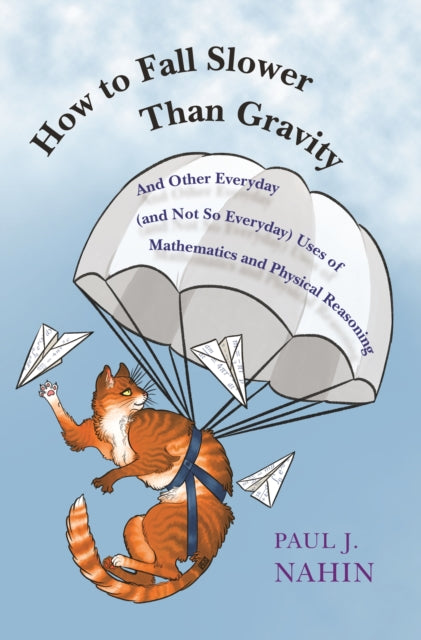
Princeton University Press How to Fall Slower Than Gravity
Book SynopsisTrade Review"This book is without a doubt the most enjoyable, stimulating book of mathematical physics (and occasionally more pure branches of maths) puzzles that I have ever read. It’s essentially a series of cleverly, and occasionally fiendishly put-together mathematics and physics challenge questions, each of which gets you thinking in a new and fascinating way."---Jonathan Shock, Mathemafrica"Reading Nahin is like reading through a select library of ancient Babylonian mathematical clay tablets. Surprises abound. . . . Nahin weaves much colorful history into his narrative."---Andrew Simoson, Mathematical Intelligencer"Engaging. . . . The book contains a wealth of original problems. . . . An enjoyable read."---Antonín Slavík, Zentralblatt MATH"This reviewer found himself being drawn to a variety of unfamiliar settings with much interest and even fascination." * Choice *"I certainly enjoyed [the book]!"---Alan Stevens, Mathematics Today"The potential audience for this book should be fairly large and go from highly talented high school students up through professionals in any STEM field."---Geoffrey Dietz, MAA Reviews
£19.80
Princeton University Press Reverse Mathematics
Book SynopsisTrade Review"If you are not familiar with this relatively new research about the foundations and and minimal assumptions needed to develop the massive mathematical structure, this provides a good informal guideline."---Adhemar Bultheel, European Mathematical Society"John Stillwell’s book gives a clear and engaging introduction to an intriguing area of mathematics: reverse mathematics."---Martyn Prigmore, Mathematics Today"The book is rich in examples and historical perspectives, is clearly argued and immaculately presented."---Graham Hoare, Mathematical Gazette
£27.00

Princeton University Press Fashion Faith and Fantasy in the New Physics of
Book SynopsisTrade ReviewWinner of the 2017 PROSE Award in Chemistry & Physics, Association of American Publishers "Physics has been at an awkward impasse for the past century. Two theories--quantum mechanics and general relativity--are widely believed to be true... But they contradict each other in basic ways--they cannot both be entirely true. InFashion, Faith, and Fantasy in the New Physics of the Universe... Roger Penrose, an elder statesman of physics, considers the problem. As intellectually offbeat as he is eminent... he ventures here some novel ways in which the two theories might be reconciled."--Wall Street Journal "Penrose gets to the heart of modern physics' problem with subjectivity in this insightful and provocative pop-sci title... [A] rewarding discussion of scientific stumbles in the search for truth."--Publishers Weekly "It is always inspiring to read Penrose's uncompromisingly independent perspec-tive on physics."--Richard Dawid, Nature "An extremely original, rich, and thoughtful survey of today's most fashionable attempts to decipher the cosmos on its smallest and largest scales."--Science "I can't recommend [Fashion, Faith, and Fantasy in the New Physics of the Universe] too highly to anyone with a serious interest in fundamental questions about physics."--Peter Woit, Not Even Wrong blog "In standing outside the fray and criticising the central dogmas of fundamental physics, Penrose is playing the role of Einstein, who forced quantum theorists to defend and hone their ideas, and Sir Fred Hoyle, who persistently challenged Big Bang theorists to sharpen their ideas. This is an extremely important role, and long may Penrose fulfill it."--Times Higher Education "[A] beautifully produced, beautifully laid-out and diagrammed book... There is possibly no better or more original expositor than Penrose to draw from. If modern physics theory is of interest to you, you certainly won't want to ignore this book."--Math Frolic "The book is replete with phenomenal visual representations of the physics under discussion, a reminder of Penrose's ability to see and describe physics in a unique way... Ultimately, what is most valuable about the book is the excellent example he offers in how to ask questions."--Chanda Prescod-Weinstein, Physics World "Something is rotten in the state of physics... The eminent mathematician and physicist Roger Penrose identifies several possible sources of the rot... He is not one to be intimidated by an overwhelming majority, no matter how illustrious and vocal it is. He sets out his objections politely and with exemplary patience towards the keepers of physics orthodoxy... Time will tell whether any of his judgments are correct. In the meantime, his critics would do well to remember George Bernard Shaw's warning: 'The minority is sometimes right; the majority is always wrong.'"--Graham Farmelo, Guardian "A valuable insight into what one of the most prominent theoretical physicists of recent times makes of reality's relationship to ideas in quantum theory, standard cosmology, and theories that pretend to replace them."--Richard Webb, New Scientist "The strength of this book is how the reader can appreciate science as a human undertaking."--Choice "The most important thing is not exactly what he writes about string theory, cosmology and quantum mechanics in his latest book ... but that a book so wide and deep in its erudition could be written at all. If his successors cannot do the same, science will be all the poorer."--Philip Ball, ProspectTable of ContentsAcknowledgements ix Preface xi Are fashion, faith, or fantasy relevant to fundamental science? xi 1 Fashion 1 1.1 Mathematical elegance as a driving force 1 1.2 Some fashionable physics of the past 10 1.3 Particle-physics background to string theory 17 1.4 The superposition principle in QFT 20 1.5 The power of Feynman diagrams 25 1.6 The original key ideas of string theory 32 1.7 Time in Einstein's general relativity 42 1.8 Weyl's gauge theory of electromagnetism 52 1.9 Functional freedom in Kaluza-Klein and string models 59 1.10 Quantum obstructions to functional freedom? 69 1.11 Classical instability of higher-dimensional string theory 77 1.12 The fashionable status of string theory 82 1.13 M-theory 90 1.14 Supersymmetry 95 1.15 AdS/CFT 104 1.16 Brane-worlds and the landscape 117 2 Faith 121 2.1 The quantum revelation 121 2.2 Max Planck's E = hnu 126 2.3 The wave-particle paradox 133 2.4 Quantum and classical levels: C, U, and R 138 2.5 Wave function of a point-like particle 145 2.6 Wave function of a photon 153 2.7 Quantum linearity 158 2.8 Quantum measurement 164 2.9 The geometry of quantum spin 174 2.10 Quantum entanglement and EPR effects 182 2.11 Quantum functional freedom 188 2.12 Quantum reality 198 2.13 Objective quantum state reduction: a limit to the quantum faith? 204 3 Fantasy 216 3.1 The Big Bang and FLRW cosmologies 216 3.2 Black holes and local irregularities 230 3.3 The second law of thermodynamics 241 3.4 The Big Bang paradox 250 3.5 Horizons, comoving volumes, and conformal diagrams 258 3.6 The phenomenal precision in the Big Bang 270 3.7 Cosmological entropy? 275 3.8 Vacuum energy 285 3.9 Inflationary cosmology 294 3.10 The anthropic principle 310 3.11 Some more fantastical cosmologies 323 4 A New Physics for the Universe? 334 4.1 Twistor theory: an alternative to strings? 334 4.2 Whither quantum foundations? 353 4.3 Conformal crazy cosmology? 371 4.4 A personal coda 391 Appendix A Mathematical Appendix 397 A.1 Iterated exponents 397 A.2 Functional freedom of fields 401 A.3 Vector spaces 407 A.4 Vector bases, coordinates, and duals 413 A.5 Mathematics of manifolds 417 A.6 Manifolds in physics 425 A.7 Bundles 431 A.8 Functional freedom via bundles 439 A.9 Complex numbers 445 A.10 Complex geometry 448 A.11 Harmonic analysis 458 References 469 Index 491
£15.19

Princeton University Press An Introduction to Analysis
Book SynopsisTrade Review"One would expect that this book offers a demanding, sophisticated look at this material, done rapidly and concisely. One would be correct. . . . [F]or very sophisticated honors courses with exceptionally well-prepared students who are prepared to work hard, it would certainly offer a vivid, exciting and informative introduction to this material."---Mark Hunacek, MAA Reviews"The ideal textbook to cover the foundations of mathematics. . . . This is one of the best books at the undergraduate level that I’ve ever read."---Jonathan Shock, Mathemafrica"The book is clearly written, with elegant proofs, and a clever selection of the topics, allowing to present in one volume in a coherent and self-contained manner, several topics, starting with background results in abstract algebra and topology and culminating with Stokes’ theorem. . . . The book will be of great help for teachers on advanced courses in analysis, or for self-study by students, giving them a quick but rigorous acquittance with somefundamental results of mathematical analysis."---Tiberiu Trif, Studia Mathematica"Tested and proven in classroom, this unique undergraduate textbook presents various basic topics in one coherent primer of reasonable size, and that in a very elegant style."---Werner Kleinert, Zentralblatt MATH"Every prospective master’s student should work through this fantastic book in order to acquire a sound background on the fundamentals of analysis."---R. Donninger, International Math News
£68.00

Princeton University Press Essential Discrete Mathematics for Computer
Book SynopsisTrade Review"I want to share with everybody my enjoyment of this excellent textbook."---Narciso Marti-Oliet, European Math Society"Those teaching computer scientists who take discrete mathematics alongside other mathematics modules such as linear algebra and calculus (as is the case with the CS20 students at Harvard), and who need a book with an emphasis on proof, will likely and this book a very good choice for their students."---London Mathematical Society, Glenn Hawe
£63.75
Princeton University Press The Discrete Charm of the Machine
Book SynopsisTrade Review"Computer scientist Steiglitz examines the global transformation from analog to digital and the ways it changed how we calculate, communicate and entertain ourselves. He describes the nuts and bolts of taking something analog, such as waves traveling through the air that make sound, and converting them into 0s and 1s, all in witty and cogent language."---Clara Moskowitz, Scientific American"This is an engaging and enjoyable book. Readers interested in the differences between analogue and digital approaches to computation and signal processing will not find a better popular treatment."---Thomas Haigh, Nature Electronics"Reading this book was a great pleasure and there is lots to be effusive about. . . .this book deserves to be read by everyone interested in, or influenced by, modern digital technologies. When you think about it, this is pretty much everyone. So, in this reviewer's opinion, this book is destined to become a modern classic."---Rob Ashmore, Mathematics Today
£999.99

Princeton University Press Scouting and Scoring
Book SynopsisTrade Review"Winner of a SABR Baseball Research Award, Society for American Baseball Research""Finalist for the CASEY Award for Best Baseball Book of the Year, Spitball Magazine""The subject of Christopher Phillips’s Scouting and Scoring is baseball, but it’s worth reading for more than just the baseball. The book is an effort to help us understand one of the oldest problems in modern societies, which is how to evaluate human beings."---Louis Menand, New Yorker"Phillips’ book is an enticing read for baseball data enthusiasts and, more broadly, those interested in thinking about notions such as ‘fact’ and ‘truth,’ how one measures the seemingly immeasurable, and attempts to quantify human potential."---Russ Goodman, MAA Reviews
£19.80

Princeton University Press Hybrid Feedback Control
Book Synopsis
£59.50

Princeton University Press Formal Verification of Control System Software
Book SynopsisTrade Review“Innovative, mathematically exact, and very well written. Garoche is a rare resource, and his book will enrich the knowledge of both the computer-science and control-systems communities.”—Eric Feron, Georgia Institute of Technology "This book makes a timely contribution at the crossroads of formal computer science, optimization, and control. It should be of interest to computer scientists and control engineers."—Didier Henrion, LAAS-CNRS Toulouse and Czech Technical University in Prague“A pleasure to read. Garoche’s excellent and timely book presents state-of-the-art methods building on convex optimization to perform static analysis for control systems and software.”—Taylor Johnson, Vanderbilt University
£46.75

Princeton University Press Calculus Reordered
Book SynopsisTrade Review"In an orderly sense, the writer introduces the context and then proceeds to state exactly what was the major draw back in the context during the relevant period of time. . . The progression, as well as the way in which he uses simple techniques to demolish towers of problems in the same sense as it was done back in the day is certainly worth appreciation." * Mathemafrica *"Any lover of mathematics will appreciate the time spent among these pages."---A. Misseldine, Choice"A great companion for students studying analysis, and calculus instructors will find it an enriching experience." * Mathematics Magazine *"I thoroughly enjoyed reading this accessible, insightful and well-written book."---Nick Lord, Mathematical Gazette
£29.75

Princeton University Press The Norm Residue Theorem in Motivic Cohomology
Book Synopsis
£130.40

Princeton University Press Weils Conjecture for Function Fields
Book SynopsisTrade Review"The book is written in a clear and vivid style, pays attention to foundations and details, and yet elucidates motivations and ideas. It should be highly useful for researchers working with stacks and higher category theory."---Stefan Schröer, Zentralblatt MATH
£63.75

Princeton University Press The Mathematics of Various Entertaining Subjects
Book SynopsisThis volume brings together authors from a variety of specialties to present fascinating problems and solutions in recreational mathematics.Trade Review"This is a fantastic (and entertaining) book on various aspects of recreational mathematics which are also at the forefront of research level mathematics."---Manjil Pratim Saikia, Zentralblatt MATH
£40.50

Princeton University Press Millions Billions Zillions
Book SynopsisTrade Review"Having a healthy skepticism toward numbers and giving readers the tools to think about math more logically is the purpose of this easily read, slight book. Brian W. Kernighan adroitly distills complex issues. His tone is more that of a mellow friend breaking down a concept that flummoxes you rather than an Ivy League professor expounding on the elegance of numbers."---Jacqueline Cutler, NJ.com"Numbers, graphs and statistics can often be misleading and misrepresented. In Millions, Billions, Zillions: Defending Yourself in a World of Too Many Numbers, Kernighan provides the reader with an entertaining and useful guide to avoid becoming a victim of number abuse."---Ben Rothke, RSA Conference"I can wholeheartedly recommend reading this book, because of the infectious way the author describes his interaction with numbers."---J. Herret, International Mathematical News"This is a must-read for anyone looking to cure their “number numbness”"---Tibi Puiu, ZME Science
£17.09

Princeton University Press Making Up Your Own Mind
Book SynopsisTo help readers become better at solving real-world problems, this enlightening, entertaining, and inspiring book teaches simple, effective thinking techniques. The goal is not to quickly solve each challenge but to come up with as many different ways of thinking about it as possible.Trade Review"[Making Up Your Own Mind] is an elegant blend of entertainment and enlightenment."---Tom Schulte, MAA Reviews
£15.29

Princeton University Press The Calculus Gallery
Book SynopsisTrade Review"This is a book that should be part of the personal library of any mathematician."---Mark Hunacek, Mathematical Gazette
£15.29
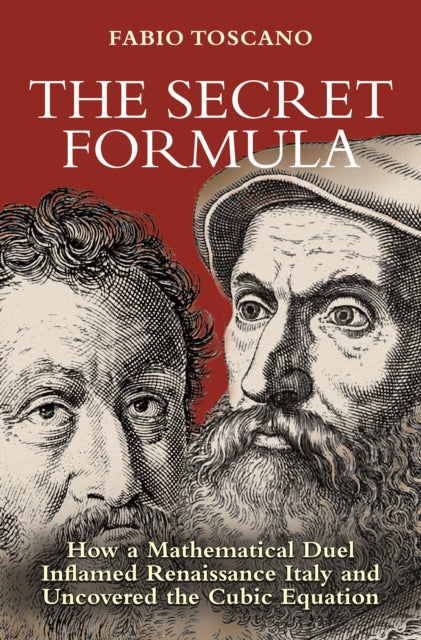
Princeton University Press The Secret Formula
Book SynopsisTrade Review"The yeast of the story has been told already many times, but it has never been told like Toscano does in this book."---Adhemar Bultheel, European Mathematical Society"The cubic formula will always be beyond my grasp . . . but the story of its discovery and of the men who battled over it, so memorably recounted in The Secret Formula, is one I am glad to know."---Jeff Jacoby, Boston Globe"Toscano weaves together his sources deftly to make the story as lively and exciting as a novel, with mathematics an organic part of the tale."---Daniel J. Curtin, MAA Reviews"Toscano is able to provide a realistic and accurate view that captures the complexity of the story of the cubic formula and the very different mathematical practices of this time. Anyone interested in learning about the history of mathematics will likely find it an interesting and informative read."---Patrick Love, London Mathematical Society Newsletter
£18.00

Princeton University Press A Dynamical Systems Theory of Thermodynamics
Book SynopsisTrade Review“This remarkable book studies thermodynamics within the framework of dynamical systems theory. A major contribution by any standard, it is a gem in the tiara of books being written by one of the most prolific, deep-thinking, and insightful researchers working today.”—Frank Lewis, University of Texas, Arlington“Haddad develops an original mathematical framework for thermodynamics deeply rooted in modern systems theory, threading postulates and analyses of a science that has evolved from the seemingly mundane quest for efficiency in steam engines to the flow of time and the workings of the cosmos and life itself. He succeeds in presenting an all-encompassing treatise, from the early works of Carnot and Clausius to the insights of relativity and the conundrum of the time arrow, in a lucid exposition that systematically details a rigorous base for future generations of scientists and theorists.”—Tryphon Georgiou, University of California, Irvine"By applying ideas and techniques from compartmental systems theory, Haddad’s treatise places thermodynamics on a solid foundation for the twenty-first century."—Dennis Bernstein, University of Michigan"This effective blend of thermodynamics and the theory of dynamical systems provides a unified, coherent, and mathematically accurate framework that is currently missing in the literature. This is a significant contribution to several fields spanning dynamical systems, mathematics, physics, chemistry, and more. It will provide the underlying foundation for additional research and conceptual understanding of physical phenomena."—Kyriakos G. Vamvoudakis, Georgia Institute of Technology
£78.20

Princeton University Press The Master Equation and the Convergence Problem
Book SynopsisTrade Review"This book . . . . is a major contribution to the state of the art in MFGs which is a must read for researchers in the field. . . . . The authors use the book format (and not a more compact paper format) to explain all their steps carefully. Because of its structured approach, it could be used as a textbook for an advanced course on the subject."---Adhemar Bultheel, European Mathematical Society
£124.00

Princeton University Press The Master Equation and the Convergence Problem
Book SynopsisThis book describes the latest advances in the theory of mean field games, which are optimal control problems with a continuum of players, each of them interacting with the whole statistical distribution of a population.Trade Review"This book . . . . is a major contribution to the state of the art in MFGs which is a must read for researchers in the field. . . . . The authors use the book format (and not a more compact paper format) to explain all their steps carefully. Because of its structured approach, it could be used as a textbook for an advanced course on the subject."---Adhemar Bultheel, European Mathematical Society
£59.50

Princeton University Press The Norm Residue Theorem in Motivic Cohomology
Book Synopsis
£63.75
Princeton University Press Hot Molecules Cold Electrons
Book SynopsisTrade Review"[A] treat . . . I think that students studying this material would not only find Paul’s treatments easy to follow, but would benefit greatly by learning something of the history that surrounds the development of the analysis and applications of the heat equation."---Jim Stein, New Books in Mathematics"Nahin knows how to write a book mixing physics and (a lot of) mathematics and (still) make it readable."---Adhemar Bultheel, European Mathematical Society"Hot Molecules, Cold Electrons has provided me with a new perspective on what I thought to be a rather tedious topic. . . . I would recommend it to anyone who wants to work out their maths muscles and learn something along the way."---Louis Ammon, Chemistry World
£999.99

Princeton University Press Introductory Lectures on Equivariant Cohomology
Book SynopsisTrade Review"Very well-written, self contained and gives a clear introductory account of equivariant cohomology, a central topic in algebraic topology."---Marek Golasiński, Zentralblatt MATH
£130.40

Princeton University Press Introductory Lectures on Equivariant Cohomology
Book Synopsis
£63.75

Princeton University Press The Calculus of Happiness
Book SynopsisTrade Review“Surveys a wide variety of ways that mathematics can be used to improve decision making and general well-being.”—Chris Wilson, TIME.com“Readers are sure to get a sense of how content from algebra and precalculus can help inform us about important decisions that are almost universally relevant.”—Jason M. Graham, MAA Reviews“Brilliant. . . . Once you realise it all boils down to maths, you will wake up happier, wealthier and healthier tomorrow morning, and we have Oscar E. Fernandez to thank for that.”—Nick Smith, Engineering and Technology“The Calculus of Happiness . . . demonstrate[s] how mathematics can yield powerful insights into everyday life."—Helen Thomson, New Scientist“Fernandez generates such enthusiasm [for studying math] by considering topics that people do want to learn more about—food, money, other people—and skillfully weaving solid mathematical concepts within these topics.”—Sandra L. Arlinghaus, Mathematical Reviews
£13.29

Princeton University Press The Joy of SET
Book SynopsisTrade Review“A model of mathematical exposition. The quality of writing is consistently high: clear but not condescending, humorous, chatty, and a genuine pleasure to read.”—Mark Hunacek, MAA Reviews“The book shows how budding interest in mathematics can be fostered and developed.”—Alexander Bogomolny, Cut the Knot“What I love about The Joy of SET is that it is written in such a way that it can be read and enjoyed by both SET enthusiasts and someone that has never played SET before.”—Sarah Carter, Math Equals Love“As the authors convincingly demonstrate . . . the mathematics behind SET actually goes very deep."—Brent Yorgey, Math Less Traveled“The Joy of SET uses a popular and very simple card game as a springboard for a whirlwind tour through probability, combinatorics, finite geometries, and experimental mathematics. Whether or not you play SET, you’ll find a lot of great math to play with in this book.”—Jordan Ellenberg, author of How Not to Be Wrong: The Power of Mathematical Thinking
£16.19

Princeton University Press Islands of Order
Book SynopsisTrade Review"A major achievement. The breadth and depth of this brilliant book, from rich ethnography to elaborate agent-based models, are awe inspiring and standard setting."—Scott E. Page, author of The Diversity Bonus: How Great Teams Pay Off in the Knowledge Economy"This exceptional book is chock-full of ideas that can inspire a new generation of researchers in the study of human societies using the framework of complex systems."—Mark Moritz, Ohio State University
£59.50

Princeton University Press Islands of Order
Book SynopsisTrade Review"A major achievement. The breadth and depth of this brilliant book, from rich ethnography to elaborate agent-based models, are awe inspiring and standard setting."—Scott E. Page, author of The Diversity Bonus: How Great Teams Pay Off in the Knowledge Economy"This exceptional book is chock-full of ideas that can inspire a new generation of researchers in the study of human societies using the framework of complex systems."—Mark Moritz, Ohio State University
£22.50

Princeton University Press Chicago Price Theory
Book SynopsisPrice theory is a powerful analytical toolkit for measuring, explaining, and predicting human behavior in the marketplace. This incisive textbook provides an essential introduction to the subject, offering a diverse array of practical methods that empower students to learn by doing.Trade Review"A tremendous resource. This comprehensive and innovative book brings together in one great package the Chicago way of thinking about price theory."—Douglas A. Irwin, author of Free Trade under Fire
£54.00

Princeton University Press Arithmetic and Geometry
Book Synopsis
£124.00

Princeton University Press Graph Theory in America
Book SynopsisTrade Review"[A] very informative and very readable book."---Adhemar Bultheel, MAA Reviews"Recommended."---J.W. Dauben, Choice"The thing about this book is that it delivers. . . .Throughout, Graph Theory in America celebrates the work of scholars, capturing the spirit of their main contribution to the subject, sometimes during challenging historical times."---Aida Abiad Monge, Nieuw Archief voor Wiskunde
£27.00
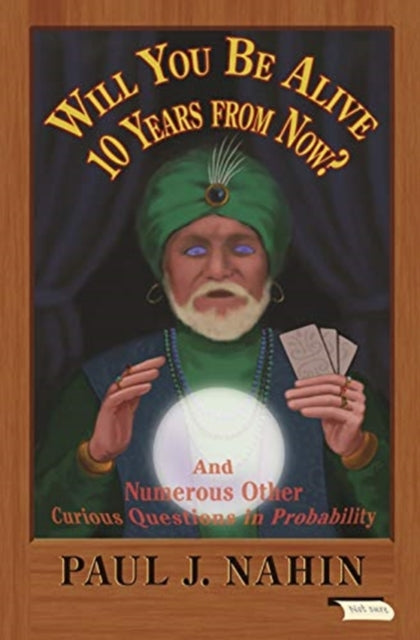
Princeton University Press Will You Be Alive 10 Years from Now
Book SynopsisTrade Review"Genuinely captivating and surprising."—Popular Science"A wonderful book for trained math lovers who enjoy the mental stimulation provided by a good mathematics puzzle."—Harold D. Shane, Library Journal"Prolific mathematics author Nahin presents a series of thought-provoking probability questions designed to intrigue the reader."—Choice"The author's infectious enthusiasm is evident here. . . . Students at various levels and other fans of mathematics will find much to engage their interest and challenge their minds."—G. A. Heuer, Mathematical Reviews
£15.19

Princeton University Press Wizards Aliens and Starships
Book SynopsisTrade Review"Co-Winner of the 2015 AIP Science Writing Award for Books, American Institute of Physics""One of Physics World's Top Ten Books of the Year for 2014""One of The Guardian’s Best Popular Physical Science Books of 2014, chosen by GrrlScientist"
£15.29

Princeton University Press Perspective and Projective Geometry
Book SynopsisTrade Review"Offering a plethora of discussion starters, conjecture catalysts, and exercises, Perspective and Projective Geometry invites students to connect math with art and aesthetics. It pulls no punches with respect to the rigor of the mathematics. But it also gives newer math students the necessary tools to engage with the material and discover knowledge for themselves."—Evelyn Lamb, blogger for Scientific American"For years, Annalisa Crannell has brought her insights and excitement for perspective, both in geometry and art, to her teaching, writing, and workshops. Now, with coauthors Mark Frantz and Fumiko Futamura, she has produced a superb textbook on this subject, ideal for classes or self-study."—Thomas Banchoff, former president of the Mathematical Association of America"Filled with ideas for rich and highly original classroom activities, Perspective and Projective Geometry guides students to make deep connections to the geometry in art. It is wholly different than any other textbook I’ve seen on projective geometry."—Jessica Sidman, Mount Holyoke College"From Menelaus and elations to window taping and writing mathematics, this book provides a delightful mesh of classical geometry, perspective in art, beautiful graphics, and an exploratorium of exercises. Perspective and Projective Geometry is enjoyable reading and a valuable textbook for a variety of courses."—Doug Norton, Villanova University
£46.75


