
Mathematics Books

Princeton University Press Weyl Group Multiple Dirichlet Series
Book SynopsisWeyl group multiple Dirichlet series are generalizations of the Riemann zeta function. Like the Riemann zeta function, they are Dirichlet series with analytic continuation and functional equations, having applications to analytic number theory. This book proves foundational results about these series and develops their combinatorics.Table of Contents*FrontMatter, pg. i*Contents, pg. v*Preface, pg. vii*Chapter One. Type A Weyl Group Multiple Dirichlet Series, pg. 1*Chapter Two. Crystals and Gelfand-Tsetlin Patterns, pg. 10*Chapter Three. Duality, pg. 22*Chapter Four. Whittaker Functions, pg. 26*Chapter Five. Tokuyama's Theorem, pg. 31*Chapter Six. Outline of the Proof, pg. 36*Chapter Seven. Statement B Implies Statement A, pg. 51*Chapter Eight. Cartoons, pg. 54*Chapter Nine. Snakes, pg. 58*Chapter Ten. Noncritical Resonances, pg. 64*Chapter Eleven. Types, pg. 67*Chapter Twelve. Knowability, pg. 74*Chapter Thirteen. The Reduction to Statement D, pg. 77*Chapter Fourteen. Statement E Implies Statement D, pg. 87*Chapter Fifteen. Evaluation of LAMBDAGAMMA and LAMBDADELTA, and Statement G, pg. 89*Chapter Sixteen. Concurrence, pg. 96*Chapter Seventeen. Conclusion of the Proof, pg. 104*Chapter Eighteen. Statement B and Crystal Graphs, pg. 108*Chapter Nineteen. Statement B and the Yang-Baxter Equation, pg. 115*Chapter Twenty. Crystals and p-adic Integration, pg. 132*Bibliography, pg. 143*Notation, pg. 149*Index, pg. 155
£49.30

Princeton University Press Mathematics for the Life Sciences
Book SynopsisThe life sciences deal with a vast array of problems at different spatial, temporal, and organizational scales. The mathematics necessary to describe, model, and analyze these problems is similarly diverse, incorporating quantitative techniques that are rarely taught in standard undergraduate courses. This textbook provides an accessible introductiTrade Review"Textbooks are not always fun, but this one is... The engaging, colourful and sharp style of Mathematics for the Life Sciences makes it a refreshing new entry into the world of bioscience textbooks."--George Pryn Ford, The Biologist
£67.20

Princeton University Press Numerical Methods Design Analysis and Computer
Book SynopsisProvides an exploration of standard numerical analysis topics, as well as non-traditional ones, including mathematical modeling, Monte Carlo methods, Markov chains, and fractals. This textbook considers modern application areas, such as information retrieval and animation, and classical topics from physics and engineering.Trade Review"Distinguishing features are the inclusion of many recent applications of numerical methods and the extensive discussion of methods based on Chebyshev interpolation. This book would be suitable for use in courses aimed at advanced undergraduate students in mathematics, the sciences, and engineering."--Choice "An instructor could assemble several different one-semester courses using this book--numerical linear algebra and interpolation, or numerical solutions of differential equations--or perhaps a two-semester sequence. This is a charming book, well worth consideration for the next numerical analysis course."--William J. Satzer, MAA FocusTable of ContentsPreface xiii Chapter 1: MATHEMATICAL MODELING 1 1.1 Modeling in Computer Animation 2 1.1.1 A Model Robe 2 1.2 Modeling in Physics: Radiation Transport 4 1.3 Modeling in Sports 6 1.4 Ecological Models 8 1.5 Modeling a Web Surfer and Google 11 1.5.1 The Vector Space Model 11 1.5.2 Google's PageRank 13 1.6 Chapter 1 Exercises 14 Chapter 2: BASIC OPERATIONS WITH MATLAB 19 2.1 Launching MATLAB 19 2.2 Vectors 20 2.3 Getting Help 22 2.4 Matrices 23 2.5 Creating and Running .m Files 24 2.6 Comments 25 2.7 Plotting 25 2.8 Creating Your Own Functions 27 2.9 Printing 28 2.10 More Loops and Conditionals 29 2.11 Clearing Variables 31 2.12 Logging Your Session 31 2.13 More Advanced Commands 31 2.14 Chapter 2 Exercises 32 Chapter 3: MONTE CARLO METHODS 41 3.1 A Mathematical Game of Cards 41 3.1.1 The Odds in Texas Holdem 42 3.2 Basic Statistics 46 3.2.1 Discrete Random Variables 48 3.2.2 Continuous Random Variables 51 3.2.3 The Central Limit Theorem 53 3.3 Monte Carlo Integration 56 3.3.1 Buffon's Needle 56 3.3.2 Estimating pi 58 3.3.3 Another Example of Monte Carlo Integration 60 3.4 Monte Carlo Simulation of Web Surfing 64 3.5 Chapter 3 Exercises 67 Chapter 4: SOLUTION OF A SINGLE NONLINEAR EQUATION IN ONE UNKNOWN 71 4.1 Bisection 75 4.2 Taylor's Theorem 80 4.3 Newton's Method 83 4.4 Quasi-Newton Methods 89 4.4.1 Avoiding Derivatives 89 4.4.2 Constant Slope Method 89 4.4.3 Secant Method 90 4.5 Analysis of Fixed Point Methods 93 4.6 Fractals, Julia Sets, and Mandelbrot Sets 98 4.7 Chapter 4 Exercises 102 Chapter 5: FLOATING-POINT ARITHMETIC 107 5.1 Costly Disasters Caused by Rounding Errors 108 5.2 Binary Representation and Base 2 Arithmetic 110 5.3 Floating-Point Representation 112 5.4 IEEE Floating-Point Arithmetic 114 5.5 Rounding 116 5.6 Correctly Rounded Floating-Point Operations 118 5.7 Exceptions 119 5.8 Chapter 5 Exercises 120 Chapter 6: CONDITIONING OF PROBLEMS; STABILITY OF ALGORITHMS 124 6.1 Conditioning of Problems 125 6.2 Stability of Algorithms 126 6.3 Chapter 6 Exercises 129 Chapter 7: DIRECT METHODS FOR SOLVING LINEAR SYSTEMS AND LEAST SQUARES PROBLEMS 131 7.1 Review of Matrix Multiplication 132 7.2 Gaussian Elimination 133 7.2.1 Operation Counts 137 7.2.2 LU Factorization 139 7.2.3 Pivoting 141 7.2.4 Banded Matrices and Matrices for Which Pivoting Is Not Required 144 7.2.5 Implementation Considerations for High Performance 148 7.3 Other Methods for Solving Ax = b 151 7.4 Conditioning of Linear Systems 154 7.4.1 Norms 154 7.4.2 Sensitivity of Solutions of Linear Systems 158 7.5 Stability of Gaussian Elimination with Partial Pivoting 164 7.6 Least Squares Problems 166 7.6.1 The Normal Equations 167 7.6.2 QR Decomposition 168 7.6.3 Fitting Polynomials to Data 171 7.7 Chapter 7 Exercises 175 Chapter 8: POLYNOMIAL AND PIECEWISE POLYNOMIAL INTERPOLATION 181 8.1 The Vandermonde System 181 8.2 The Lagrange Form of the Interpolation Polynomial 181 8.3 The Newton Form of the Interpolation Polynomial 185 8.3.1 Divided Differences 187 8.4 The Error in Polynomial Interpolation 190 8.5 Interpolation at Chebyshev Points and chebfun 192 8.6 Piecewise Polynomial Interpolation 197 8.6.1 Piecewise Cubic Hermite Interpolation 200 8.6.2 Cubic Spline Interpolation 201 8.7 Some Applications 204 8.8 Chapter 8 Exercises 206 Chapter 9: NUMERICAL DIFFERENTIATION AND RICHARDSON EXTRAPOLATION 212 9.1 Numerical Differentiation 213 9.2 Richardson Extrapolation 221 9.3 Chapter 9 Exercises 225 Chapter 10: NUMERICAL INTEGRATION 227 10.1 Newton-Cotes Formulas 227 10.2 Formulas Based on Piecewise Polynomial Interpolation 232 10.3 Gauss Quadrature 234 10.3.1 Orthogonal Polynomials 236 10.4 Clenshaw-Curtis Quadrature 240 10.5 Romberg Integration 242 10.6 Periodic Functions and the Euler-Maclaurin Formula 243 10.7 Singularities 247 10.8 Chapter 10 Exercises 248 Chapter 11: NUMERICAL SOLUTION OF THE INITIAL VALUE PROBLEM FOR ORDINARY DIFFERENTIAL EQUATIONS 251 11.1 Existence and Uniqueness of Solutions 253 11.2 One-Step Methods 257 11.2.1 Euler's Method 257 11.2.2 Higher-Order Methods Based on Taylor Series 262 11.2.3 Midpoint Method 262 11.2.4 Methods Based on Quadrature Formulas 264 11.2.5 Classical Fourth-Order Runge-Kutta and Runge-Kutta-Fehlberg Methods 265 11.2.6 An Example Using MATLAB's ODE Solver 267 11.2.7 Analysis of One-Step Methods 270 11.2.8 Practical Implementation Considerations 272 11.2.9 Systems of Equations 274 11.3 Multistep Methods 275 11.3.1 Adams-Bashforth and Adams-Moulton Methods 275 11.3.2 General Linear m-Step Methods 277 11.3.3 Linear Difference Equations 280 11.3.4 The Dahlquist Equivalence Theorem 283 11.4 Stiff Equations 284 11.4.1 Absolute Stability 285 11.4.2 Backward Differentiation Formulas (BDF Methods) 289 11.4.3 Implicit Runge-Kutta (IRK) Methods 290 11.5 Solving Systems of Nonlinear Equations in Implicit Methods 291 11.5.1 Fixed Point Iteration 292 11.5.2 Newton's Method 293 11.6 Chapter 11 Exercises 295 Chapter 12: MORE NUMERICAL LINEAR ALGEBRA: EIGENVALUES AND ITERATIVE METHODS FOR SOLVING LINEAR SYSTEMS 300 12.1 Eigenvalue Problems 300 12.1.1 The Power Method for Computing the Largest Eigenpair 310 12.1.2 Inverse Iteration 313 12.1.3 Rayleigh Quotient Iteration 315 12.1.4 The QR Algorithm 316 12.1.5 Google's PageRank 320 12.2 Iterative Methods for Solving Linear Systems 327 12.2.1 Basic Iterative Methods for Solving Linear Systems 327 12.2.2 Simple Iteration 328 12.2.3 Analysis of Convergence 332 12.2.4 The Conjugate Gradient Algorithm 336 12.2.5 Methods for Nonsymmetric Linear Systems 334 12.3 Chapter 12 Exercises 345 Chapter 13: NUMERICAL SOLUTION OF TWO-POINT BOUNDARY VALUE PROBLEMS 350 13.1 An Application: Steady-State Temperature Distribution 350 13.2 Finite Difference Methods 352 13.2.1 Accuracy 354 13.2.2 More General Equations and Boundary Conditions 360 13.3 Finite Element Methods 365 13.3.1 Accuracy 372 13.4 Spectral Methods 374 13.5 Chapter 13 Exercises 376 Chapter 14: NUMERICAL SOLUTION OF PARTIAL DIFFERENTIAL EQUATIONS 379 14.1 Elliptic Equations 381 14.1.1 Finite Difference Methods 381 14.1.2 Finite Element Methods 386 14.2 Parabolic Equations 388 14.2.1 Semidiscretization and the Method of Lines 389 14.2.2 Discretization in Time 389 14.3 Separation of Variables 396 14.3.1 Separation of Variables for Difference Equations 400 14.4 Hyperbolic Equations 402 14.4.1 Characteristics 402 14.4.2 Systems of Hyperbolic Equations 403 14.4.3 Boundary Conditions 404 14.4.4 Finite Difference Methods 404 14.5 Fast Methods for Poisson's Equation 409 14.5.1 The Fast Fourier Transform 411 14.6 Multigrid Methods 414 14.7 Chapter 14 Exercises 418 APPENDIX A REVIEW OF LINEAR ALGEBRA 421 A.1 Vectors and Vector Spaces 421 A.2 Linear Independence and Dependence 422 A.3 Span of a Set of Vectors; Bases and Coordinates; Dimension of a Vector Space 423 A.4 The Dot Product; Orthogonal and Orthonormal Sets; the Gram-Schmidt Algorithm 423 A.5 Matrices and Linear Equations 425 A.6 Existence and Uniqueness of Solutions; the Inverse; Conditions for Invertibility 427 A.7 Linear Transformations; the Matrix of a Linear Transformation 431 A.8 Similarity Transformations; Eigenvalues and Eigenvectors 432 APPENDIX B TAYLOR'S THEOREM IN MULTIDIMENSIONS 436 References 439 Index 445
£76.00

Princeton University Press Hypoelliptic Laplacian and Orbital Integrals
Book SynopsisThe hypoelliptic Laplacian is a family of operators that is supposed to interpolate between the ordinary Laplacian and the geodesic flow. This book uses the hypoelliptic Laplacian to evaluate semisimple orbital integrals in a formalism that unifies index theory and the trace formula.Table of Contents*FrontMatter, pg. i*Contents, pg. vii*Acknowledgments, pg. xi*Introduction, pg. 1*Chapter One. Clifford and Heisenberg algebras, pg. 12*Chapter Two. The hypoelliptic Laplacian on X = G/K, pg. 22*Chapter Three. The displacement function and the return map, pg. 48*Chapter Four. Elliptic and hypoelliptic orbital integrals, pg. 76*Chapter Five. Evaluation of supertraces for a model operator, pg. 92*Chapter Six. A formula for semisimple orbital integrals, pg. 113*Chapter Seven. An application to local index theory, pg. 120*Chapter Eight. The case where [k (gamma); p0] = 0, pg. 138*Chapter Nine. A proof of the main identity, pg. 142*Chapter Ten. The action functional and the harmonic oscillator, pg. 161*Chapter Eleven. The analysis of the hypoelliptic Laplacian, pg. 187*Chapter Twelve. Rough estimates on the scalar heat kernel, pg. 212*Chapter Thirteen. Refined estimates on the scalar heat kernel for bounded b, pg. 248*Chapter Fourteen. The heat kernel qXb;t for bounded b, pg. 262*Chapter Fifteen. The heat kernel qXb;t for b large, pg. 290*Bibliography, pg. 317*Subject Index, pg. 323*Index of Notation, pg. 325
£63.75
Princeton University Press Calculus of Variations and Optimal Control Theory
Book SynopsisOffers an introduction to calculus of variations and optimal control theory, and is a self-contained resource for graduate students in engineering, applied mathematics, and related subjects. This book traces the historical development of the subject and features numerous exercises, notes and references at the end of each chapter.Trade Review"Each chapter ends with a rich and useful section of notes and references. The exercises are merely problems or even theorems. The author of the book presents a large list of references and a detailed index of notions, names, and symbols. The graphical presentation of the book is pleasant... [T]his book is well written, it fully deserves all its goals mentioned at the beginning of the review, and is a pleasure to read it."--Marian Muresan, Mathematica "This is an extremely well-crafted textbook. If you plan to teach a first course to advanced students on the calculus of variations and optimal control and you like the selection of topics that the author has chosen to present (and I do), it is the text you need. What impresses me most is the careful balance between the formal derivations and the explanations that precede or accompany the statements and proofs... All in all, it is a first-rate, enjoyable text."--Zvi Artstein, Mathematical Reviews Clippings
£999.99

Princeton University Press A Mathematical Nature Walk
Book SynopsisHow heavy is that cloud? Why can you see farther in rain than in fog? Why are the droplets on that spider web spaced apart so evenly? This book presents ninety-six questions about many common natural phenomena - and a few uncommon ones - and then shows how to answer them using mostly basic mathematics.Trade Review"[A] snappy guide to the mathematics of the outdoors... A sharp eye and an ingenious mind are at work on every page... Read this book with pencil and paper in hand. Then go forth, enjoy the view, and impress your friends."--Laurence A. Marschall, Natural History "Mathematics professor John Adam has come up with a novel combination. This book will provide anyone with a solid grounding in mathematics with enough conversation starters to keep fellow walkers' brains working as hard as their legs."--Dominic Lenton, Engineering & Technology "A catalogue of playful inquiries and their mathematical solutions."--Conservation Magazine "Adam has written a terrific book that takes his earlier work a step further... [T]his is a well written guide not only to seeing our world with simplified and useful models and mathematics, but to asking good questions of what we see and then answering those questions on our own. I found the book delightful, engaging, and interesting. It's written for anyone with a calculus background, and that's all one needs. If you're looking for a fun book with a touch of complexity, this is a good one."--David S. Mazel, MAA Reviews "For teachers who are interested in seeing how what they teach might be used or for students or parents who might be interested in seeing how mathematics might be used, this is an intriguing book."--Mathematics Teacher "[A]dam's love of both nature and mathematics is obvious, and his chatty style and sense of humour--look out for the question about spontaneously combusting haystacks--enliven a book that will get readers thinking as well as itching for a pleasant stroll."--Physics World "Indeed, Adam has deliberately reworked topics treated in Mathematics in Nature to make them accessible to a larger audience. Beyond insights into specific questions about nature, the general reader will find here a remarkably lucid explanation of how mathematicians create a formulaic model that mimics the key features of some natural phenomenon. Adam particularly highlights the importance in this process of solving inverse problems. Ordinary math becomes adventure."--Booklist "If you are a walker, as I am, your daypack probably contains sunscreen, a poncho, a floppy hat, and a pair of binoculars. After reading this snappy guide to the mathematics of the outdoors, by John Adam, a professor of mathematics at Old Dominion University in Virginia, you might consider tossing in a programmable calculator... A sharp eye and an ingenious mind are at work on every page... Read this book with pencil and paper in hand. Then go forth, enjoy the view, and impress your friends."--Natural History "There are now few (if any) areas of science where mathematics does not play a role and, by extension, many of the sights and sounds of nature can be studied using mathematics. This is the motivation behind A Mathematical Nature Walk by John Adam, which considers some of the natural phenomena that might be encountered on a walk in the countryside (or even just a wander around one's own garden)."--Sarah Shepherd, iSquared "[S]urprising and entertaining... Adam's book is lucidly written, making it suitable for people of all ages."--Good Book Guide "The dedicated reader stands a lot to gain from delving into the text and thinking hard about the problems posed. As the saying goes, 'mathematics is not a spectator sport,' so if this book is read with pencil and paper at hand, to scribble along and confirm understanding of the mathematical trains of thought--all the better."--Philip McIntosh, Suite101.comTable of ContentsPreface xv Acknowledgments xix Introduction 1 AT THE BEGINNING ... 11 (General questions to challenge our powers of observation, estimation, and physical intuition) Q.1-Q.6: Rainbows 11 Q.7: Shadows 11 Q.8-9: Clouds and cloud droplets 12 Q.10: Light 12 Q.11: Sound 12 Q.12-13: The rotation of the Earth 12 Q.14: The horizon 12 Q.15: The appearance of distant hills 12 IN THE "PLAYGROUND" 13 (just to get our feet wet...) Q.16: Loch Ness--how long to empty it? 13 Q.17: The Grand Canyon--how long to fill it with sand? 14 Q.18: Just how large an area is a million acres? 15 Q.19: Twenty-five billion hamburgers--how many have you eaten? 16 Q.20: How many head of cattle would be required to satisfy the (1978) daily demand for meat in the United States? 16 Q.21: Why could King Kong never exist? 17 Q.22: Why do small bugs dislike taking showers? 18 Q.23: How fast is that raindrop falling? 18 Q.24: Why can haystacks explode if they're too big? 20 In the garden 24 Q.25: Why can I see the "whole universe" in my garden globe? 24 Q.26: How long is that bee going to collect nectar? 25 Q.27: Why are those drops on the spider's web so evenly spaced? 27 Q.28: What is the Fibonacci sequence? 31 Q.29: So what is the "golden angle"? 35 Q.30: Why are the angles between leaves "just so"? 36 IN THE NEIGHBORHOOD 43 Q.31: Can you infer fencepost (or bridge) "shapes" just by walking past them? 43 Q.32: Can you weigh a pumpkin just by carefully looking at it? 48 Q.33: Can you determine the paths of low-flying ducks? 53 IN THE SHADOWS 58 Q.34: How high is that tree? (An estimate using elliptical light patches) 58 Q.35: Does my shadow accelerate? 59 Q.36: How long is the Earth's shadow? 61 Q.37: And Jupiter's? And Neptune's? 63 Q.38: How wide is the Moon's shadow? 63 IN THE SKY 64 Q.39: How far away is the horizon (neglecting refraction)? 64 Q.40: How far away is that cloud? 66 Q.41: How well is starlight reflected from a calm body of water? 67 Q.42: How heavy is that cloud? 71 Q.43: Why can we see farther in rain than in fog? 72 Q.44: How far away does that "road puddle" mirage appear to be? 73 Q.45: Why is the sky blue? 77 Q.46: So how much more is violet light scattered than red? 79 Q.47: What causes variation in colors of butterfly wings, bird plumage, and oil slicks? 80 Q.48: What causes the metallic colors in that cloud? 84 Q.49: How do rainbows form? And what are those fringes underneath the primary bow? 85 Q.50: What about the secondary rainbow? 92 Q.51: Are there higher-order rainbows? 93 Q.52: So what is that triple rainbow? 95 Q.53: Is there a "zeroth"-order rainbow? 98 Q.54: Can bubbles produce "rainbows"? 99 Q.55: What would "diamondbows" look like? 100 Q.56: What causes that ring around the Sun? 101 Q.57: What is that shaft of light above the setting Sun? 109 Q.58: What is that colored splotch of light beside the Sun? 111 Q.59: What's that "smiley face" in the sky? 113 Q.60: What are those colored rings around the shadow of my plane? 116 Q.61: Why does geometrical optics imply infinite intensity at the rainbow angle? 118 IN THE NEST 122 Q.62: How can you model the shape of birds' eggs? 122 Q.63: What is the sphericity index? 123 Q.64: Can the shape of an egg be modeled trigonometrically? 124 Q.65: Can the shape of an egg be modeled algebraically? 127 Q.66: Can the shape of an egg be modeled using calculus? 130 Q.67: Can the shape of an egg be modeled geometrically? 134 IN (OR ON) THE WATER 137 Q.68: What causes a glitter path? 137 Q.69: What is the path of wave intersections? 140 Q.70: How fast do waves move on the surface of water? 141 Q.71: How do moving ships produce that wave pattern? 148 Q.72: How do rocks in a flowing stream produce different patterns? 152 Q.73: Can waves be stopped by opposing streams? 154 Q.74: How far away is the storm? 157 Q.75: How fast is the calm region of that "puddle wave" expanding? 158 Q.76: How much energy do ocean waves have? 160 Q.77: Does a wave raise the average depth of the water? 162 Q.78: How can ship wakes prove the Earth is "round"? 164 In the forest 168 Q.79: How high can trees grow? 168 Q.80: How much shade does a layer of leaves provide for the layer below? 172 Q.81: What is the "murmur of the forest"? 174 Q.82: How opaque is a wood or forest? 176 Q.83: Why do some trees have "tumors"? 179 IN THE NATIONAL PARK 183 Q.84: What shapes are river meanders? 183 Q.85: Why are mountain shadows triangular? 189 Q.86: Why does Zion Arch appear circular? 191 IN THE NIGHT SKY 194 Q.87: How are star magnitudes measured? 194 Q.88: How can I stargaze with a flashlight? 196 Q.89: How can you model a star? 197 Q.90: How long would it take the Sun to collapse? 205 Q.91: What are those small rings around the Moon? 207 Q.92: How can you model an eclipse of the Sun? 210 AT THE END ... 217 Q.93: How can you model walking? 217 Q.94: How "long" is that tree? 221 Q.95: What are those "rays" I sometimes see at or after sunset? 224 Q.96: How can twilight help determine the height of the atmosphere? 228 Appendix 1: A very short glossary of mathematical terms and functions 231 Appendix 2: Answers to questions 1-15 234 Appendix 3: Newton's law of cooling 238 Appendix 4: More mathematical patterns in nature 240 References 243 Index 247
£18.00

Princeton University Press Picturing the Uncertain World
Book SynopsisExplores how graphs can serve as maps to guide us when the information we have is ambiguous or incomplete. This work takes readers on an extraordinary graphical adventure, revealing how the visual communication of data offers answers to vexing questions yet also highlights the measure of uncertainty in almost everything we do.Trade Review"In Picturing the Uncertain World, Howard Wainer approaches this problem through stories, and every one is a gem. This is territory that has long been dominated by the books of Edward Tufte ... but Wainer's approach is refreshingly different. He has himself been involved in many policy debates and understands well that the same information can be interpreted in a variety of ways to support widely divergent positions... Like two of Wainer's earlier books ... this one makes for very fine reading and would be an excellent text for a general-education seminar."--Michael Goodchild, American Scientist "As enjoyable to read as it is enlightening, [Picturing the Uncertain World] includes far more than its title indicates. Throughout, Wainer illuminates many of the big ideas of statistics in ways that help the reader understand and value the ideas. He provides contrasting graphical forms to demonstrate good data displays and incorporates analogies to help readers understand why certain logical arguments are flawed... Anyone would enjoy reading this book."--Mathematics Teacher "This is a very well-written book with subtle analyses and a refreshing approach to the field of statistics. For information designers the book offers ideal access to the science of uncertainty. Moreover ... Wainer has succeeded in linking together two disciplines: statistical thinking and visual communication."--Wibke Weber, Information Design Journal "Howard Wainer's book of the science of uncertainty (his label for the science of statistics), and how to recognize and manage it, is a combination of breezy, clever writing and unique visual examples with tutorials to clarify the technical aspects. It belongs on graphic artist's bookshelves."--Peter F. Eder, World Future Review "Even an experienced statistician will find valuable insights in this book of careful thought, clear exposition, and fine visualization."--Mathematics MagazineTable of ContentsPreface and Acknowledgments xv I. Introduction and Overview Chapter 1: The Most Dangerous Equation 5 In this chapter we nominate De Moivre's1 description of the expected variation in the arithmetic mean for the title of the most dangerous equation. To support this conclusion we describe five separate examples where ignorance of this equation has led to enormous wastes of time, money, and human resources. These five examples span almost a thousand years and areas as diverse as monetary policy, education policy, medical practice, and the genetic basis of sex differences in intelligence. II. Political Issues In this section we show how five different kinds of issues that emerged from essentially political arguments could be illuminated with more careful thought and a graph or two. In chapter 6, we introduce a very simple probabilistic model that yields surprising richness of understanding, which apparently escaped the editorial writers of the New York Times. Chapter 2: Curbstoning IQ and the 2000 Presidential Election 23 Sometimes, when facts are hard to come by, people who are tasked to gather those facts simply substitute a guess. When this is done by census workers it is called "curbstoning" (as in sitting down on the curbstone in front of a house and guessing how many people live there). Curbstone estimates, although illegal and grounds for dismissal, have shown themselves to be remarkably accurate. In this chapter we look at a piece of political propaganda meant to highlight the intellectual and financial differences between red and blue states. Although it was clearly based on someone's biases and not actual data, the conclusions we would draw from the faked data are close to actual results. Chapter 3: Stumbling on the Path toward the Visual Communication of Complexity 31 An op-ed piece in the New York Times written by former secretary of state George Schultz contained a statistical graph that showed the economic superiority of the two Bush administrations to the Clinton administration that was sandwiched in between. We show how this graphic distorts our perceptions by plotting rates of change instead of the actual GDP. The result is exactly the opposite of what former Secretary Schultz argues. Chapter 4: Using Graphs to Simplify the Complex: Th e Medicare Drug Plan as an Example 35 The Medicare drug plan, although passed with great fanfare, quickly resolved itself into a complex puzzle. In this chapter we simplify one part of the puzzle by drawing a graph that makes clear who should sign up. The graph is not a full solution, for how the costs will be paid remains shrouded in a deep mystery indeed. Chapter 5: A Political Statistic 39 Neither graphs nor tables are guarantees of truth. Incorrect stories can be concocted with data displays just as they can with words. In this chapter we investigate a graph produced by the U.S. Department of Education that vividly shows how fourth graders' reading scores remain stubbornly flat despite skyrocketing increases in federal expenditures for education. A more careful look indicates that there is a strong positive relationship between students' test scores and money spent on education. Chapter 6: A Catch -22 in Assigning Primary Delegates 47 As the 2008 election loomed ever closer, states maneuvered in various ways to try to gain increased influence. The New York Times argued that New York's citizens were not fully enfranchised because of the all-or-none delegate assignment rule used in the primaries. Using a simple mathematical model, we show that exactly the opposite is true. III. Educational Testing In the four thousand years since its inception in ancient China, mental testing has promised to provide an important tool toward a true meritocratic society. Replacing family connections with an individual's ability as the key to opening the doors to economic and social success remains a principal goal of modern societies. Progress toward this goal has been impressive, but it has occurred in fits and starts. In this section we examine three proposals to aid in using test scores toward making this a more just society. The first uses a statistical method commonly employed in other circumstances to solve a vexing problem. In chapter 8 we examine a well-meaning but, at its heart, flawed scheme aimed at reducing intergroup differences. And finally, in chapter 9, we look at a recent court case involving test scoring and show that the defense's case was based on a misunderstanding of the meaning of uncertainty. Chapter 7: Testing the Disabled: Using Statistics to Navigate between the Sc ylla of Standards and the Charybdis of Court Decisions 55 Test companies are in a logical bind. Standards of testing require that individual scores on tests given under nonstandard conditions (for instance, with extra time) be so labeled, while courts mandate that examinees with disabilities (who are often given accommodations like extra time) not be identified. In this chapter we show a statistical method that can provide a way to be responsive to these two seemingly contradictory requirements. Chapter 8: Ethnic Bias or Statistical Artifact? Freedle's Folly 63 Social scientist Roy Freedle startled the testing world in 2003 when he showed that black examinees outperformed matched white examinees on hard SAT items. He suggested that ethnic group differences in test performance could be reduced dramatically and tests thus made fairer by making the tests harder. In this chapter we look into the validity of this remarkable conclusion. Chapter 9: Insignificant Is Not Zero: Musing on the College Board's Understanding of Uncertainty 74 On October 8, 2005, NCS Pearson, Inc., under contract to the College Entrance Examination Board, scored an administration of the SAT Reasoning test. Subsequently it was discovered that there was a scoring error that had affected 5,024 examinees' scores. After rescoring it was revealed that 4,411 test scores were too low and 613 were too high. The exams that were underscored were revised upward and the revised scores were reported to the designated colleges and universities. The College Board decided that "it would be unfair to re-report the scores of the 613 test takers" whose scores were improperly too high and hence did not correct them. They reached this conclusion because of a misunderstanding of statistical error. In this chapter we discuss their argument and its flaws. IV. Mostly Methodological This section is a bit more technical than the others, focusing more explicitly on the statistical tool, with its application being secondary. In chapter 10 we look at the validity of linear extrapolation through unexpectedly consistent improvements in the world record for men running a mile that have occurred over the course of the twentieth century and speculate whether it should have been predictable, and what, if anything, it means about future improvements in the twenty-first century. The eleventh chapter looks at statistical graphics in the popular media. Chapter 12 demonstrates how a mixture of statistical tools, statistical thinking, and various graphic forms combine to provide us with a guided pathway of discovery. The last two chapters are perhaps the most narrowly focused of all, looking first at ways to show our uncertainty graphically and next at one way in which powerful computing when combined with our desire for simplicity at all costs can be used to mislead us. Chapter 10: How Long Is Short? 87 All functions are well approximated by a straight line for a short part of their length. But how can we know for how long the linear approximation is suitable? Obviously, when the entire data series is in hand it is easy, but what about when it is not? What do we do when we wish to extrapolate from what appears to be linear beyond the data? For a very short extrapolation it is usually fine, but how long is short? In this chapter we look at a century's progress in the world records in the mile run for help in answering this question. Chapter 11: Improving Data Displays 92 The communication media's stock and trade is the distillation and communication of possibly complex information. To do this effectively the print media use an especially broad range of graphical formats. Sometimes they do this poorly, but sometimes they do it very well indeed. In this chapter we look at some displays devised by the media that set a standard for excellence hard to imagine given their time deadlines, as well as others that were seriously flawed. Chapter 12: Old Mother Hubbard and the United Nations 106 Statistical thinking and data-based graphics are two tools used together to understand the world. This chapter tells a story of how a detective might use them to track down and expose some surprising aspects of poverty. Chapter 13: Depicting Error 121 Communicating data without some measure of their precision can lead to misinterpretation and incorrect inferences. In this chapter, we describe and illustrate several conventions for displaying errors along with the data they modify. We also offer some alternatives that seem to provide improvements in the effective communication of error as well as increasing the ease, and hence the likelihood, of their use. These alternatives are illustrated principally with data from the National Assessment of Educational Progress. Chapter 14: The Mendel Effect 148 Data are often examined after being grouped into categories. For example, we might see a plot of income shown as a function of education level, in which amount of education is collapsed (binned) into specified categories like 0-8 years, 9-11, 12, 13-15, 16 or more. A typical summary plot shows the mean value of income as a function of the binned education variable, and trends are interpreted. In this chapter, I demonstrate how such trends can be epiphenomenal and are the creation of the number of bins used and their boundaries. I provide an algorithm that can take trendless data and create trends in any direction. V. History We understand best those things we see grow from their very beginnings. --Aristotle, Metaphysics The Science of Uncertainty has been under development for a long time. In this section, I pay homage to our forebears by using modern tools to investigate ancient puzzles (chapters 15 and 16), by exploring the origins of some of these modern tools (chapters 17 and 19), by defending the wisdom of the ancients from contemporary misuses (chapter 18), by communicating the wisdom of a modern master (chapter 20), and finally by a heart-rending use of graphics to paint an evocative picture of one part of what was perhaps the greatest horror in all human history. Chapter 15: Truth Is Slower than Fiction 161 Novelists often use the latest scientific findings as essential plot elements in their stories. In this chapter, we follow how some of the findings of the nineteenth-century British polymath Francis Galton were used by Arthur Conan Doyle, by Mark Twain, and by Jules Verne, and speculate on who got there first and why. Chapter 16: Galton's Normal 168 Francis Galton was an early adopter of the normal distribution as a means of making inferences about the frequency of occurrence of various human characteristics. In his 1869 book Hereditary Genius, he explains how to do this with a hypothetical graph showing the heights of British men. But the graph Galton made up revealed a serious misunderstanding he had about the normal distribution. In this chapter, we uncover the error and suggest its source. Chapter 17: Nobody's Perfect 173 In 1786, the remarkable Scot William Playfair published a small book in which he invented three of the four basic graphical formats (bar charts, line charts, and pie charts). He did not invent the scatter plot. In this chapter we ask and try to answer the obvious question, "why not?" Chapter 18: When Form Violates Fu nction 179 The title of "finest statistical graphic ever prepared" is generally awarded to the nineteenth-century Frenchman Charles Joseph Minard's remarkable six-dimensional plot showing the fate of the French army as it trekked between the Niemen River on the Poland-Russia border to Moscow and back during Napoleon's ill-fated 1812-1813 campaign. In this chapter, we examine one failing attempt to usurp Minard's famous format for another purpose. Chapter 19: A Graphical Legacy of Charles Joseph Minard: Tw o Jewels from Th e Past 186 Not all of those who sought to emulate Minard's success with data of their own failed. In this chapter, we show how followers of Minard produced treasures of their own by following in the footsteps of the master. Chapter 20: La Diffusion de Qu elques Idees: A Master's Voice 193 Jacques Bertin (1918-) is a French semiologist, trained in Paris, whose seminal work La Semiologie Graphique (1969) laid the groundwork for modern research in graphics. Almost forty years after its publication it still provides important lessons to all those interested in the effective display of quantitative information. In 2002 he sent me a note detailing his most recent developments and asked that I continue to help him in "la diffusion de quelques idees." This chapter tries to do exactly that. Chapter 21: Numbers and the Remembrance of Things Past 199 A single death is a tragedy; a million deaths is a statistic. --Joseph Stalin (1879-1953) Unquestionably cold and cruel, this epigram conveys a sentiment that sadly captures an aspect of human psychology. The mind is limited in its capacity to fathom cataclysmic events. Great numbers of deaths, particularly if they are distant in time or space, typically do not elicit the same reaction as fewer deaths nearer to us. Sponsors and designers of memorials face the challenge of stirring emotion, memory, and understanding. In this final chapter we show and discuss data displays produced by the inhabitants of the Kovno Ghetto to record their own deaths--so that they might transform what could have been only a statistic into the tragedy that it undeniably was. VI. Epilogue Notes 211 References 215 Source Material 225 Index 229
£20.90

Princeton University Press Henri Poincaré
Book SynopsisHenri Poincar (1854-1912) was not just one of the most inventive, versatile, and productive mathematicians of all time - he was also a leading physicist who almost won a Nobel Prize for physics. This book explores all the fields that Poincar touched, the debates sparked by his investigations, and how his discoveries still contribute to society.Trade ReviewOne of Choice's Outstanding Academic Titles for 2013 "[M]asterly ... Gray encapsulates Poincare's multiple dimensions; his intellectual biography is both a tour de force and a triumph of readability."--George Szpiro, Nature "Gray shows us the full dazzling sweep of what Poincare accomplished, including the work on dynamical systems and chaos that only came into its own in recent years. A tour de force, Gray's masterful treatment will long remain an invaluable resource for all who want to understand Poincare, so embedded within his times and yet so far ahead of them."--Peter Pesic, Science "[A] comprehensive but uncluttered guide to Poincare's extensive oeuvres."--Madeline Muntersbjorn, Times Higher Education "Full of the mathematical, physical and metaphysical ideas of a man who was not only a dispassionate observer of the world around us, but of our way of understanding it."--Mark Ronan, Standpoint Magazine (U.K.) "[A] comprehensive assessment of Poincare's work and its importance, essential for anyone interested in Poincare's scholarship or the history of mathematics."--Laura Tarwater Scharp, Sacramento Book Review "Comprehensive."--Science News "A fundamental study of the scientific work of one of the greatest mathematicians and mathematical physicists of the three decades straddling the 19th and 20th centuries... Chapters are organized topically, not chronologically. Each illuminates in depth one or other of Poincare's works but all are set in context both historical and temathic such that each can serve as an introduction into the many subjects to which Poincare made a contribution."--Alexander Bogomolny, CTK Insights "Poincare's work is fully alive in science today. This biography is one of the first thorough introductions to his work, it should get the attention of mathematicians, natural scientists and philosophers."--Ferdinand Verhulst, European Legacy "Gray, a mathematics historian and scholar on the life and work of Henry Poincare, has, with the support of a Leverhulme Research Fellowship, produced this comprehensive and definitive 'scientific biography.' Gray offers abundant rich information on Poincare's ideas and scientific process, the evolution and maturity of his mathematics including missteps, the dexterity of his reasoning, and the influences that shaped his thought."--Choice "I recommend [this] book highly."--Robert E. O'Malley, Jr., SIAM Review "Jeremy Gray's book on Poincare's mathematics, physics, and philosophy is an important contribution to the literature and a huge step towards a full biography of this pioneer of modern science."--Reinhard Siegmund-Schultze, Zentralblatt MATH "Gray's book is a comprehensive scientific biography of Poincare. It embraces the broad scope of Poincare's work, from his philosophical speculations to his popular writing, and gives a thorough overview of his extensive mathematical researches."--Peter Lynch, Irish Mathematical Society Bulletin "[T]he author does not simply give platitudes when writing about Poincare's ideas: mathematicians will enjoy reading about his discoveries concerning the three-body problem, the theory of functions, topology, number theory, Lie theory, algebraic geometry, and probability. This scientific biography is the first to comprehensively cover all of Poincare's main contributions to mathematics, philosophy, and physics."--Alan S. McRae, Mathemematical Reviews Clippings "Jeremy Gray has done a marvelous job of exposition and of binding together the many different cognitive, social and biographical strands into the coherent whole of a challenging, but highly rewarding, 'scientific biography'."--Klaus Hentschel, British Journal for the History of Science "A good intellectual biography of an artist should help the reader see how a particular worldview shapes the pursuit of art. Gray's book does that most admirably."--Daniel S. Alexander, H-France Review "Henry Poincare is likely to remain the standard by which scientific biographies, at least those that concern physicists and mathematicians, are judged for some time."--Christopher Cumo, Canadian Journal of History "I warmly recommend the book to anyone with an interest in the development of modern mathematics. It will surely be the definitive scientific biography of Poincare for the foreseeable future."--John Stillwell, Notices of the AMS "Gray describes Poincare's scientific epoch in a beautiful way. Due attention is paid to the mathematical and further scientific aspects of his life, and the intellectual complexity of his achievements, both in their range and their depth, are amply discussed. Gray displays a mastery of his material that is rare even among historians of mathematics and science, and his biography is richly rewarding, engrossing, and informative. He deserves our congratulations."--H. W. Broer, Journal of the British Society for the History of Mathematics "Gray succeeds admirably in presenting both the conceptual and the historical context necessary to appreciate Poincare's contributions. Gray's masterful biography may well serve as a standard example for future endeavors of this kind."--Tilman Sauer, Isis "The obvious virtue of this book is its comprehensiveness. The deeper virtue is to connect Poincare's views of all the parts of his work and to encourage more of that. Gray gives us Poincare's view of Science as a whole."--Colin McLarty, Mathematical Intelligencer "The book is an endless source of interesting insights by Poincare... I would recommend the book for mathematicians, mathematics educators, and philosophers in higher education who want a rich understanding of Poincare, his work, and his times."--Mary L. Garner, Mathematics TeacherTable of ContentsList of Figures ix Preface xi Introduction 1 * Views of Poincare 3 * Poincare's Way of Thinking 6 1 The Essayist 27 * Poincare and the Three Body Problem 27 * Poincare's Popular Essays 34 * Paris Celebrates the New Century 59 * Science, Hypothesis, Value 67 * Poincare and Projective Geometry 76 * Poincare's Popular Writings on Physics 100 * The Future of Mathematics 112 * Poincare among the Logicians 123 * Poincare's Defenses of Science 144 2 Poincare's Career 153 * Childhood, Schooling 153 * The Ecole Polytechnique 157 * The Ecole des Mines 158 * Academic Life 160 * The Dreyfus Affair 165 * National Spokesman 169 * Contemporary Technology 177 * International Representative 187 * The Nobel Prize 192 *"1911", "1912" 200 * Remembering Poincare 202 3 The Prize Competition of 1880 207 * The Competition 207 * Fuchs, Schwarz, Klein, and Automorphic Functions 224 * Uniformization, 1882 to 1907 247 4 The Three Body Problem 253 * Flows on Surfaces 253 * Stability Questions 265 * Poincare's Essay and Its Supplements 266 *Les Methodes Nouvelles de la Mecanique Celeste 281 * Poincare Returns 291 5 Cosmogony 300 * Rotating Fluid Masses 300 6 Physics 318 * Theories of Electricity before Poincare: Maxwell 318 * Poincare's Electricite et Optique, 1890 329 * Larmor and Lorentz: The Electron and the Ether 338 * Poincare on Hertz and Lorentz 346 * St. Louis, 1904 356 * The Dynamics of the Electron 361 * Poincare and Einstein 367 * Early Quantum Theory 378 7 Theory of Functions and Mathematical Physics 382 * Function Theory of a Single Variable 382 * Function Theory of Several Variables 391 * Poincare's Approach to Potential Theory 402 * The Six Lectures in Gottingen, 1909 416 8 Topology 427 * Topology before Poincare 427 * Poincare's Work, 1895 to 1905 432 9 Interventions in Pure Mathematics 467 * Number Theory 467 * Lie Theory 489 * Algebraic Geometry 498 10 Poincare as a Professional Physicist 509 * Thermodynamics 513 * Probability 518 11 Poincare and the Philosophy of Science 525 * Poincare: Idealist, Skeptic, or Structural Realist? 525 12 Appendixes 543 * Elliptic and Abelian Functions 543 * Maxwell's Equations 545 * Glossary 548 References 553 * Articles and Books by Poincare 554 * Other Authors 564 Name Index 585 Subject Index 589
£36.00

Princeton University Press Invisible in the Storm
Book SynopsisTrade ReviewWinner of the 2015 Louis J. Battan Author's Award, American Meteorological Society "Mathematicians Ian Roulstone and John Norbury demystify the maths behind meteorology. Trailblazers' work is vividly evoked, from eighteenth-century mathematician Leonhard Euler on hydrostatics to physicist Vilhelm Bjerknes's numerical weather prediction. The pace cranks up with twentieth-century advances such as Jule Gregory Charney's harnessing of the gargantuan ENIAC computer for his work in the 1940s and 1950s on forecasting pressure patterns."--Nature "[O]ne of the great strengths of the book is the way it picks apart the challenge of making predictions about a chaotic system, showing what improvements we might yet hope for and what factors confound them."--Philip Ball, Prospect "A welcome and authoritative account of the 20th-century contributions of mathematically sophisticated meteorologists such as Vilhelm Berknes (1862--1951), Carl-Gustav Rossby (1898--1957), Jule Charney (1917--1981), and Ed Lorenz (1917--2008)... Clearly, this book is informative and inspirational, leaving plenty of room for innovations by future generations of mathematicians and modelers."--James Rodger Fleming, MAA Reviews "This book gives a deep insight of the mathematics involved in the forecast of weather... The authors have done a brilliant work to collect a huge amount of historical information, as well as mathematical information, but keeping always a level in the explanations that makes the text accessible to undergraduate students in the first years, and even to people not so familiar with mathematics. All in all, this is a very interesting and enjoyable reading."--Vicente Munoz, European Mathematical Society "Shows how much modern weather forecasting depends on mathematics... A superior read."--Alexander Bogolomny, CTK Insights "Takes readers on a journey, starting with the initial vision of Bjerknes, and then leads them through the early unsuccessful hand-calculated attempts at forecasting the weather mathematically, progressing to the use of early electronic computers which, even though successful, could not produce a timely forecast. It concludes by describing the current methods of Numerical Weather Prediction ... a book that will appeal to the intelligent 'popular science' enthusiast without disengaging the more theoretically-versed reader."--David-John Gibbs, Weather "UK mathematicians Roulstone and Norbury provide a lively account of the evolution of numerical weather prediction, focusing on the individuals involved in advancing measurement of atmospheric properties and the implementation of numerical methods to describe and predict atmospheric processes... This unique historical narrative will interest scholars of the history and philosophy of science."--Choice "Roulstone and Norbury do well within the constraints of this species of book. The story they tell is far from exhausted. I hope they write a sequel!"--John P. Boyd, Mathematical Reviews "[A] fascinating account of science's admirable but ultimately inadequate attempts to get to grips with the natural environment upon which we depend for life itself, but which is equally capable of visiting death and destruction upon us."--Jonathan Gornall, The National "[T]he authors have done well to create a book that will appeal to the intelligent 'popular science' enthusiast without disengaging the more theoretically-versed reader."--David-John Gibbs, Weather "Accessible and timely, Invisible in the Storm explains the crucial role of mathematics in understanding the ever-changing weather."--Nina Shokina, Zentralblatt MATH "[T]his is a well-written book giving a generally clear and accessible account of how weather forecasts are prepared. The historical detail enlivens the narrative and makes for an enjoyable read. The authors have considerable knowledge and expertise, and the book is scientifically sound. It can be warmly recommended to anyone who wishes to understand, in broad terms, how modern weather forecasts are made and how we may use models of the atmosphere to anticipate changes in the earth's climate."--Peter Lynch, Notices of the AMS "This very readable book provides an excellent insight into the history of forecasting the weather, with a considerable, but not too challenging, mathematical bent."--Colin J W Czapiewski, Actuary "Invisible in the Storm: The Role of Mathematics in Understanding Weather explores how mathematics and meteorology come together to improve weather and climate prediction, taking readers on a fascinating journey through the work of trailblazing scientists over the past 100 years."--University of Surrey website "I really enjoyed reading the book and I would recommend it to specialists who want to get an overview of the history of numerical weather prediction. I think it is also well worth reading for anyone who wishes to understand the developments in the science of meteorology that has led to the present level of forecast skill."--Erland Kallen, ECMWF Newsletter "Roulstone and Norbury have done an outstanding job and provide readers a fine bibliography to continue their education on this fascinating topic."--Robert E. O'malley, Jr., SIAM Review "Accessible and timely, Invisible in the Storm explains the crucial role of mathematics in understanding the ever-changing weather."--World Book Industry "[T]his is a well-written book giving a generally clear and accessible account of how weather forecasts are prepared. The historical detail enlivens the narrative and makes for an enjoyable read. The authors have considerable knowledge and expertise, and the book is scientifically sound. It can be warmly recommended to anyone who wishes to understand, in broad terms, how modern weather forecasts are made, and how we may use models of the atmosphere to anticipate changes in the Earth's climate."--Peter Lynch, Irish Math Society Bulletin "This book is highly readable and gives a bird's eye view of development of meteorology... It is strongly recommended to practitioners of meteorology and those interested in understanding this complex subject."--Ravi S. Nanjundiah, Current Science "The authors have to be applauded for having succeeded in writing a very entertaining and accessible book... The book must be considered essential reading for anyone interested in the history and mathematics of weather prediction."--Sebastian Reich, Jahresbericht der DMV "I recommend Invisible in the Storm both to mathematics undergraduates and educators who are interested in applied mathematics, weather forecasting, or both."--Steven Boyce, Mathematics TeacherTable of ContentsPreface vii Prelude: New Beginnings 1 ONE The Fabric of a Vision 3 TWO From Lore to Laws 47 THREE Advances and Adversity 89 FOUR When the Wind Blows the Wind 125 Interlude: A Gordian Knot 149 FIVE Constraining the Possibilities 153 SIX The Metamorphosis of Meteorology 187 Color Insert follows page 230 SEVEN Math Gets the Picture 231 EIGHT Predicting in the Presence of Chaos 271 Postlude: Beyond the Butterfly 313 Glossary 317 Bibliography 319 Index 323
£36.00

Princeton University Press The Ambient Metric
Book SynopsisDevelops and applies a theory of the ambient metric in conformal geometry. This title includes the derivation of the ambient obstruction tensor and an analysis of the cases of conformally flat and conformally Einstein spaces. It concludes with a construction and characterization of scalar conformal invariants in terms of ambient curvature.Trade Review"[T]his careful exposition has been well worth the wait!"--Michael G. Eastwood, Mathematical Reviews Clippings "It is concise, but detailed, accurate, and comprehensive in its treatment of the topics it covers, including their technical details. The book will be of interest to anyone working in, or using, conformal geometry or closely related structures for mathematics, theoretical physics, or physical applications."--Rod Gover, SIAM Review "Nowadays, it seems that any of the more subtle advances in local conformal differential geometry depend on the ambient metric in an essential way. Such advances continue apace. The careful exposition provided by the ambient metric has been well worth the wait!"--Michael Eastwood, Bulletin of the American Mathematical SocietyTable of ContentsChapter 1. Introduction 1 Chapter 2. Ambient Metrics 9 Chapter 3. Formal Theory 17 Chapter 4. Poincar'e Metrics 42 Chapter 5. Self-dual Poincar'e Metrics 50 Chapter 6. Conformal Curvature Tensors 56 Chapter 7. Conformally Flat and Conformally Einstein Spaces 67 Chapter 8. Jet Isomorphism 82 Chapter 9. Scalar Invariants 97 Bibliography 107 Index 113
£55.25

Princeton University Press The Best Writing on Mathematics 2011
Book SynopsisThe year''s finest writing on mathematics from around the worldThis anthology brings together the year''s finest mathematics writing from around the world. Featuring promising new voices alongside some of the foremost names in the field, The Best Writing on Mathematics 2011 makes available to a wide audience many articles not easily found anywhere elseand you don''t need to be a mathematician to enjoy them. These writings offer surprising insights into the nature, meaning, and practice of mathematics today. They delve into the history, philosophy, teaching, and everyday occurrences of math, and take readers behind the scenes of today''s hottest mathematical debates. Here Ian Hacking discusses the salient features that distinguish mathematics from other disciplines of the mind; Doris Schattschneider identifies some of the mathematical inspirations of M. C. Escher''s art; Jordan Ellenberg describes compressed sensing, a mathematical field that is reshaping the way people use large sets of data; Erica Klarreich reports on the use of algorithms in the job market for doctors; and much, much more.In addition to presenting the year''s most memorable writings on mathematics, this must-have anthology includes a foreword by esteemed physicist and mathematician Freeman Dyson. This book belongs on the shelf of anyone interested in where math has taken usand where it is headed.Trade Review"Mathematics instructor Pitici turns out a second volume of unexpectedly fascinating mathematical research, musings, and studies that explore subjects from art to medicine... From a discussion of the utility of mathematics in stone and bronze sculptures to a study of computing and its interaction with the sciences, readers from many disciplines will find much to pique their interest."--Publishers Weekly "This wonderful book is not just a collection of essays; there are also references including a list of notable texts, links to mathematics websites, and biographies of the contributors, which may prove to be as valuable to the reader as the essays themselves. The Best Writing on Mathematics 2011 cannot be recommended highly enough!"--Robert Schaefer, New York Journal of Books "[E]ntertaining and informative."--Ian D. Gordon, Library Journal "I invite the reader of this review to read the book; it contains many more interesting aspects of the interplay between mathematics and the real life than the ones I can explain."--European Mathematical Society "The volume is a single-shot source to keep in touch with all that is going on in the world of mathematics."--Vaidehi Nathan, Organiser "To my mind, though, there is circumstantial evidence that the contributions in this booklet are pretty close to what the title promises. This volume is the very ticket for any mathematician and--beyond that--for anybody who enjoys a sense of delight in the beauty of writing."--J. Lang, International Mathematical NewsTable of Contents*FrontMatter, pg. i*Contents, pg. vii*Foreword: Recreational Mathematics, pg. xi*Introduction, pg. xvii*What is Mathematics For?, pg. 1*A Tisket, a Tasket, an Apollonian Gasket, pg. 13*The Quest for God's Number, pg. 27*Meta-morphism: From Graduate Student to Networked Mathematician, pg. 35*One, Two, Many: Individuality and Collectivity in Mathematics, pg. 43*Reflections on the Decline of Mathematical Tables, pg. 51*Under-Represented Then Over-Represented:, pg. 55*Did Over-Reliance on Mathematical Models for Risk Assessment Create the Financial Crisis?, pg. 67*Fill in the Blanks:, pg. 75*The Great Principles of Computing, pg. 82*Computer Generation of Ribbed Sculptures, pg. 93*Lorenz System Offers Manifold Possibilities for Art, pg. 115*Celebrating Mathematics in Stone and Bronze, pg. 150*Mathematics Education, pg. 169*Thinking and Comprehending in the Mathematics Classroom, pg. 188*Teaching Research: Encouraging Discoveries, pg. 203*Reflections of an Accidental Theorist, pg. 219*The Conjoint Origin of Proof and Theoretical Physics, pg. 236*What Makes Mathematics Mathematics?, pg. 257*What Anti-realism in Philosophy of Mathematics Must Offer, pg. 286*Seeing Numbers, pg. 312*Autism and Mathematical Talent, pg. 330*How Much Math is Too Much Math?, pg. 336*Hidden Dimensions, pg. 347*Playing with Matches, pg. 356*Notable Texts, pg. 367*Contributors, pg. 371*Acknowledgments, pg. 379*Credits, pg. 381
£15.29

Princeton University Press The Decomposition of Global Conformal Invariants
Book SynopsisAddresses a basic question in differential geometry that was first considered by physicists Stanley Deser and Adam Schwimmer in 1993 in their study of conformal anomalies.Table of Contents*FrontMatter, pg. i*Contents, pg. v*Acknowledgments, pg. vii*1. Introduction, pg. 1*2. An Iterative Decomposition of Global Conformal Invariants: The First Step, pg. 19*3. The Second Step: The Fefferman-Graham Ambient Metric and the Nature of the Decomposition, pg. 71*4. A Result on the Structure of Local Riemannian Invariants: The Fundamental Proposition, pg. 135*5. The Inductive Step of the Fundamental Proposition: The Simpler Cases, pg. 211*6. The Inductive Step of the Fundamental Proposition: The Hard Cases, Part I, pg. 297*7. The Inductive Step of the Fundamental Proposition: The Hard Cases, Part II, pg. 361*A. Appendix, pg. 403*Bibliography, pg. 443*Index of Authors and Terms, pg. 447*Index of Symbols, pg. 449
£170.00

Princeton University Press The Decomposition of Global Conformal Invariants
Book SynopsisAddresses a basic question in differential geometry that was first considered by physicists Stanley Deser and Adam Schwimmer in 1993 in their study of conformal anomalies.Table of Contents*FrontMatter, pg. i*Contents, pg. v*Acknowledgments, pg. vii*1. Introduction, pg. 1*2. An Iterative Decomposition of Global Conformal Invariants: The First Step, pg. 19*3. The Second Step: The Fefferman-Graham Ambient Metric and the Nature of the Decomposition, pg. 71*4. A Result on the Structure of Local Riemannian Invariants: The Fundamental Proposition, pg. 135*5. The Inductive Step of the Fundamental Proposition: The Simpler Cases, pg. 211*6. The Inductive Step of the Fundamental Proposition: The Hard Cases, Part I, pg. 297*7. The Inductive Step of the Fundamental Proposition: The Hard Cases, Part II, pg. 361*A. Appendix, pg. 403*Bibliography, pg. 443*Index of Authors and Terms, pg. 447*Index of Symbols, pg. 449
£74.80

Princeton University Press Fréchet Differentiability of Lipschitz Functions
Book SynopsisFocuses on the difficult question of existence of Frchet derivatives of Lipschitz maps of Banach spaces into higher dimensional spaces. This book provides a bridge between descriptive set theory and the classical topic of existence of derivatives of vector-valued Lipschitz functions.Trade Review"The book is well written--as one would expect from its distinguished authors, including the late Joram Lindestrauss (1936-2012). It contains many fascinating and profound results. It no doubt will become an important resource for anyone who is seriously interested in the differentiability of functions between Banach spaces."--J. Borwein and Liangjin Yao, Mathematical Reviews Clippings "[T]his is a very deep and complete study on the differentiability of Lipschitz mappings between Banach spaces, an unavoidable reference for anyone seriously interested in this topic."--Daniel Azagra, European Mathematical Society "We should be grateful to (the late) Joram Lindenstrauss, David Preiss, and Jaroslav Tiser for providing us with this splendid book which dives into the deepest fields of functional analysis, where the basic but still strange operation called differentiation is investigated. More than a century after Lebesgue, our understanding is not complete. But thanks to the contribution of these three authors, and thanks to this book, we know a fair share of beautiful theorems and challenging problems."--Gilles Godefroy, Bulletin of the American Mathematical SocietyTable of Contents*FrontMatter, pg. i*Contents, pg. vii*Chapter One: Introduction, pg. 1*Chapter Two: Gateaux differentiability of Lipschitz functions, pg. 12*Chapter Three: Smoothness, convexity, porosity, and separable determination, pg. 23*Chapter Four: epsilon-Frechet differentiability, pg. 46*Chapter Five: GAMMA-null and GAMMAn-null sets, pg. 72*Chapter Six: Ferchet differentiability except for GAMMA-null sets, pg. 96*Chapter Seven: Variational principles, pg. 120*Chapter Eight: Smoothness and asymptotic smoothness, pg. 133*Chapter Nine: Preliminaries to main results, pg. 156*Chapter Ten: Porosity, GAMMAn- and GAMMA-null sets, pg. 169*Chapter Eleven: Porosity and epsilon-Frechet differentiability, pg. 202*Chapter Twelve: Frechet differentiability of real-valued functions, pg. 222*Chapter Thirteen: Frechet differentiability of vector-valued functions, pg. 262*Chapter Fourteen: Unavoidable porous sets and nondifferentiable maps, pg. 319*Chapter Fifteen: Asymptotic Frechet differentiability, pg. 355*Chapter Sixteen: Differentiability of Lipschitz maps on Hilbert spaces, pg. 392*Bibliography, pg. 415*Index, pg. 419*Index of Notation, pg. 423
£74.80
Princeton University Press Hybrid Dynamical Systems
Book SynopsisHybrid dynamical systems exhibit continuous and instantaneous changes, having features of continuous-time and discrete-time dynamical systems. This title unifies and generalizes earlier developments in continuous-time and discrete-time nonlinear systems.Trade Review"The book is carefully written and contains many examples. It will be a good resource for both researchers already familiar with hybrid systems and those starting from scratch."--Daniel Liberzon, Mathematical Reviews Clippings "The book presents a clean and self-contained exposition of hybrid systems, starting from the elementary definitions, continuing with the basic tools and finishing with more recent contributions in the literature."--Marco Castrillon Lopez, European Mathematical SocietyTable of ContentsPreface ix Chapter 1: Introduction 1 1.1 The modeling framework 1 1.2 Examples in science and engineering 2 1.3 Control system examples 7 1.4 Connections to other modeling frameworks 15 1.5 Notes 22 Chapter 2 The solution concept 25 2.1 Data of a hybrid system 25 2.2 Hybrid time domains and hybrid arcs 26 2.3 Solutions and their basic properties 29 2.4 Generators for classes of switching signals 35 2.5 Notes 41 Chapter 3 Uniform asymptotic stability, an initial treatment 43 3.1 Uniform global pre-asymptotic stability 43 3.2 Lyapunov functions 50 3.3 Relaxed Lyapunov conditions 60 3.4 Stability from containment 64 3.5 Equivalent characterizations 68 3.6 Notes 71 Chapter 4 Perturbations and generalized solutions 73 4.1 Differential and difference equations 73 4.2 Systems with state perturbations 76 4.3 Generalized solutions 79 4.4 Measurement noise in feedback control 84 4.5 Krasovskii solutions are Hermes solutions 88 4.6 Notes 94 Chapter 5 Preliminaries from set-valued analysis 97 5.1 Set convergence 97 5.2 Set-valued mappings 101 5.3 Graphical convergence of hybrid arcs 107 5.4 Differential inclusions 111 5.5 Notes 115 Chapter 6 Well-posed hybrid systems and their properties 117 6.1 Nominally well-posed hybrid systems 117 6.2 Basic assumptions on the data 120 6.3 Consequences of nominal well-posedness 125 6.4 Well-posed hybrid systems 132 6.5 Consequences of well-posedness 134 6.6 Notes 137 Chapter 7 Asymptotic stability, an in-depth treatment 139 7.1 Pre-asymptotic stability for nominally well-posed systems 141 7.2 Robustness concepts 148 7.3 Well-posed systems 151 7.4 Robustness corollaries 153 7.5 Smooth Lyapunov functions 156 7.6 Proof of robustness implies smooth Lyapunov functions 161 7.7 Notes 167 Chapter 8 Invariance principles 169 8.1 Invariance and omega-limits 169 8.2 Invariance principles involving Lyapunov-like functions 170 8.3 Stability analysis using invariance principles 176 8.4 Meagre-limsup invariance principles 178 8.5 Invariance principles for switching systems 181 8.6 Notes 184 Chapter 9 Conical approximation and asymptotic stability 185 9.1 Homogeneous hybrid systems 185 9.2 Homogeneity and perturbations 189 9.3 Conical approximation and stability 192 9.4 Notes 196 Appendix: List of Symbols 199 Bibliography 201 Index 211
£78.20
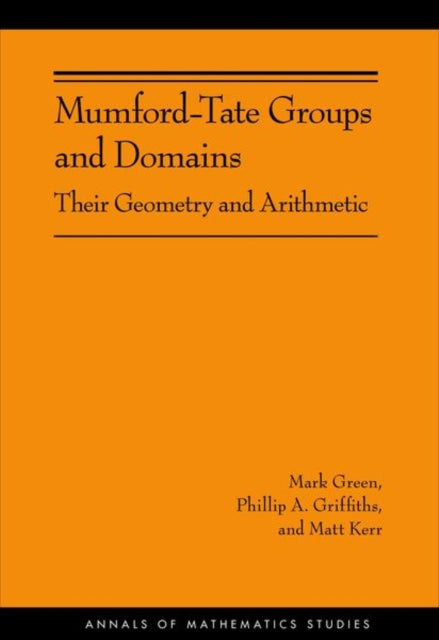
Princeton University Press MumfordTate Groups and Domains
Book SynopsisMumford-Tate groups are the fundamental symmetry groups of Hodge theory, a subject which rests at the center of contemporary complex algebraic geometry. This book provides a comprehensive exploration of Mumford-Tate groups and domains.Trade Review"The brilliance of the results and their broad spectrum of their applications makes this book an outstanding piece. Yet, there is more to write and to develop: the authors suggest the existence of future lines of research for a next book."--Jonathan Sanchez Hernandez, European Mathematical SocietyTable of ContentsIntroduction 1 I Mumford-Tate Groups 28 I.A Hodge structures 28 I.B Mumford-Tate groups 32 I.C Mixed Hodge structures and their Mumford-Tate groups 38 II Period Domains and Mumford-Tate Domains 45 II.A Period domains and their compact duals 45 II.B Mumford-Tate domains and their compact duals 55 II.C Noether-Lefschetz loci in period domains 61 III The Mumford-Tate Group of a Variation of Hodge Structure 67 III.A The structure theorem for variations of Hodge structures 69 III.B An application of Mumford-Tate groups 78 III.C Noether-Lefschetz loci and variations of Hodge structure .81 IV Hodge Representations and Hodge Domains 85 IV.A Part I: Hodge representations 86 IV.B The adjoint representation and characterization of which weights give faithful Hodge representations 109 IV.C Examples: The classical groups 117 IV.D Examples: The exceptional groups 126 IV.E Characterization of Mumford-Tate groups 132 IV.F Hodge domains 149 IV.G Mumford-Tate domains as particular homogeneous complex manifolds 168 Appendix: Notation from the structure theory of semisimple Lie algebras 179 V Hodge Structures with Complex Multiplication 187 V.A Oriented number fields 189 V.B Hodge structures with special endomorphisms 193 V.C A categorical equivalence 196 V.D Polarization and Mumford-Tate groups . 198 V.E An extended example 202 V.F Proofs of Propositions V.D.4 and V.D.5 in the Galois case 209 VI Arithmetic Aspects of Mumford-Tate Domains 213 VI.A Groups stabilizing subsets of D 215 VI.B Decomposition of Noether-Lefschetz into Hodge orientations 219 VI.C Weyl groups and permutations of Hodge orientations 231 VI.D Galois groups and fields of definition 234 Appendix: CM points in unitary Mumford-Tate domains 239 VII Classification of Mumford-Tate Subdomains 240 VII.A A general algorithm 240 VII.B Classification of some CM-Hodge structures 243 VII.C Determination of sub-Hodge-Lie-algebras 246 VII.D Existence of domains of type IV(f) 251 VII.E Characterization of domains of type IV(a) and IV(f) 253 VII.F Completion of the classification for weight 3 256 VII.G The weight 1 case 260 VII.H Algebro-geometric examples for the Noether-Lefschetzlocus types 265 VIII Arithmetic of Period Maps of Geometric Origin 269 VIII.A Behavior of fields of definition under the period Map -- image and preimage 270 VIII.B Existence and density of CM points in motivic VHS 275 Bibliography 277 Index 287
£170.00

Princeton University Press MumfordTate Groups and Domains
Book SynopsisMumford-Tate groups are the fundamental symmetry groups of Hodge theory, a subject which rests at the center of contemporary complex algebraic geometry. This book provides a comprehensive exploration of Mumford-Tate groups and domains.Trade Review"The brilliance of the results and their broad spectrum of their applications makes this book an outstanding piece. Yet, there is more to write and to develop: the authors suggest the existence of future lines of research for a next book."--Jonathan Sanchez Hernandez, European Mathematical SocietyTable of ContentsIntroduction 1 I Mumford-Tate Groups 28 I.A Hodge structures 28 I.B Mumford-Tate groups 32 I.C Mixed Hodge structures and their Mumford-Tate groups 38 II Period Domains and Mumford-Tate Domains 45 II.A Period domains and their compact duals 45 II.B Mumford-Tate domains and their compact duals 55 II.C Noether-Lefschetz loci in period domains 61 III The Mumford-Tate Group of a Variation of Hodge Structure 67 III.A The structure theorem for variations of Hodge structures 69 III.B An application of Mumford-Tate groups 78 III.C Noether-Lefschetz loci and variations of Hodge structure .81 IV Hodge Representations and Hodge Domains 85 IV.A Part I: Hodge representations 86 IV.B The adjoint representation and characterization of which weights give faithful Hodge representations 109 IV.C Examples: The classical groups 117 IV.D Examples: The exceptional groups 126 IV.E Characterization of Mumford-Tate groups 132 IV.F Hodge domains 149 IV.G Mumford-Tate domains as particular homogeneous complex manifolds 168 Appendix: Notation from the structure theory of semisimple Lie algebras 179 V Hodge Structures with Complex Multiplication 187 V.A Oriented number fields 189 V.B Hodge structures with special endomorphisms 193 V.C A categorical equivalence 196 V.D Polarization and Mumford-Tate groups . 198 V.E An extended example 202 V.F Proofs of Propositions V.D.4 and V.D.5 in the Galois case 209 VI Arithmetic Aspects of Mumford-Tate Domains 213 VI.A Groups stabilizing subsets of D 215 VI.B Decomposition of Noether-Lefschetz into Hodge orientations 219 VI.C Weyl groups and permutations of Hodge orientations 231 VI.D Galois groups and fields of definition 234 Appendix: CM points in unitary Mumford-Tate domains 239 VII Classification of Mumford-Tate Subdomains 240 VII.A A general algorithm 240 VII.B Classification of some CM-Hodge structures 243 VII.C Determination of sub-Hodge-Lie-algebras 246 VII.D Existence of domains of type IV(f) 251 VII.E Characterization of domains of type IV(a) and IV(f) 253 VII.F Completion of the classification for weight 3 256 VII.G The weight 1 case 260 VII.H Algebro-geometric examples for the Noether-Lefschetzlocus types 265 VIII Arithmetic of Period Maps of Geometric Origin 269 VIII.A Behavior of fields of definition under the period Map -- image and preimage 270 VIII.B Existence and density of CM points in motivic VHS 275 Bibliography 277 Index 287
£74.80

Princeton University Press The Mathematical Mechanic
Book SynopsisDid you know it's possible to derive the Pythagorean theorem by spinning a fish tank filled with water? Or that the line of best fit for a data set can be found using a mechanical contraption made from a rod and springs? This title demonstrates how to use physical intuition to solve these and other math problems.Trade ReviewOne of Amazon.com science editors' Top 10 list for Science, Best for 2009 One of Choice's Outstanding Academic Titles for 2009 "The Mathematical Mechanic documents novel ways of viewing physics as a method of understanding mathematics. Levi uses physical arguments as tools to conjecture about mathematical concepts before providing rigorous proofs... The Mathematical Mechanic is an excellent display of creative, interdisciplinary problem-solving strategies. The author has explained complex concepts with simplicity, yet the mathematics is accurate."--Mathematics Teacher "A most interesting book... Many of the ideas in it could be used as motivational or illustrative examples to support the teaching of non-specialists, especially physicists and engineers. In conclusion--a thoroughly enjoyable and thought-provoking read."--Nigel Steele, London Mathematical Society Newsletter "The Mathematical Mechanic reverses the usual interaction of mathematics and physics... Careful study of Levi's book may train readers to think of physical companions to mathematical problems... Mathematicians will find The Mathematical Mechanic provides exercise in new ways of thinking. Instructors will find it contains material to supplement mathematics courses, helping physically-minded students approach mathematics and helping mathematically-minded students appreciate physics."--John D. Cook, MAA Reviews "Mark Levi reverses the old stereotype that math is merely a tool to aid physicists by showing that many questions in mathematics can be easily solved by interpreting them as physical problems... Some sections of the book require readers to brush up on their calculus but Levi's clear explanations, witty footnotes, and fascinating insights make the extra effort painless."--SEED Magazine "The book is chock-full of these seemingly magical physical thought experiments involving bicycle wheels, pistons, springs, soap films, pendulums, and electric circuits, with applications to geometry, maximization and minimization problems, inequalities, optics, integrals, and complex functions... I highly recommend it to anyone who is (even slightly) interested in physics, and appreciates mathematical elegance and cleverness. It would make a great gift for almost anyone, whether a high school student or university professor, armchair physicist or professional mathematician."--Boris Yorgey, The Math Less Traveled "The Mathematical Mechanic is a pleasant surprise."--E. Kincanon, Choice "This is a delightful and unusual book that is a welcome addition to the literature. Certainly, any calculus teacher and many others of us as well will want to have it on the shelf for ready reference. It not only will enhance our teaching experience but will also teach us (the instructors) something in the process."--Steven G. Krantz, UMAP JournalTable of Contents*FrontMatter, pg. i*Contents, pg. v*1 Introduction, pg. 1*2 The Pythagorean Theorem, pg. 9*3 Minima and Maxima, pg. 27*4 Inequalities by Electric Shorting, pg. 76*5 Center of Mass: Proofs and Solutions, pg. 84*6 Geometry and Motion, pg. 99*7 Computing Integrals Using Mechanics, pg. 109*8. The Euler-Lagrange Equation via Stretched Springs, pg. 115*9 Lenses, Telescopes, and Hamiltonian Mechanics, pg. 120*10 A Bicycle Wheel and the Gauss-Bonnet Theorem, pg. 133*11 Complex Variables Made Simple(r), pg. 148*Appendix. Physical Background, pg. 161*Bibliography, pg. 183*Index, pg. 185
£14.24

Princeton University Press Enlightening Symbols A Short History of
Book SynopsisWhat did mathematicians rely on for their work before then? And how did mathematical notations evolve into what we know today? This book explains the history behind the development of our mathematical notation system.Trade Review"Mazur (Euclid in the Rainforest) gives readers the fascinating history behind the mathematical symbols we use, and completely take for granted, every day. Mathematical notation turns numbers into sentences--or, to the uninitiated, a mysterious and impenetrable code. Mazur says the story of math symbols begins some 3,700 years ago, in ancient Babylon, where merchants incised tallies of goods on cuneiform tablets, along with the first place holder--a blank space. Many early cultures used letters for both numbers and an alphabet, but convenient objects like rods, fingers, and abacus beads, also proved popular. Mazur shows how our 'modern' system began in India, picking up the numeral 'zero' on its way to Europe, where it came into common use in the 16th century, thanks to travelers and merchants as well as mathematicians like Fibonacci. Signs for addition, subtraction, roots, and equivalence followed, but only became standardized through the influence of scientists and mathematicians like Rene Descartes and Gottfried Leibniz. Mazur's lively and accessible writing makes what could otherwise be a dry, arcane history as entertaining as it is informative."--Publishers Weekly "[A] fascinating narrative... This is a nuanced, intelligently framed chronicle packed with nuggets--such as the fact that Hindus, not Arabs, introduced Arabic numerals. In a word: enlightening."--George Szpiro, Nature "Mazur begins by illustrating how the ancient Incas and Mayans managed to write specific, huge numbers. Then, for more than 200 pages, he traces the history of division signs, square roots, pi, exponents, graph axes and other symbols in the context of cognition, communication, and analysis."--Washington Post "Mazur delivers a solid exposition of an element of mathematics that is fundamental to its history."--Library Journal "Mazur treats only a subset of F. Cajori's monumental A History of Mathematical Notation (Dover, 1993 first edition 1922) and there is overlap with many other mathematical history books, but Mazur adds new findings and insights and it is so much more entertaining ... and these features make it an interesting addition to the existing literature for anybody with only a slight interest in mathematics or its history."--European Mathematical Society "Symbols like '+' and '=' are so ingrained that it's hard to conceive of math without them. But a new book, Enlightening Symbols: A Short History of Mathematical Notation and its Hidden Power, offers a surprising reminder: Until the early 16th century, math contained no symbols at all."--Kevin Hartnett, Boston Globe "Enlightening Symbols retraces the winding road that has led to the way we now teach, study, and conceive mathematics... Thanks to Mazur's playful approach to the subject, Enlightening Symbols offers an enjoyable read."--Gaia Donati, Science "If you enjoy reading about history, languages and science, then you'll enjoy this book... The best part is the writing is compelling enough that you don't have to be a mathematician to enjoy this informative book."--Guardian.com's GrrlScientist blog "[I]nformative, highly readable and scholarly."--Brian Rotman, Literary Review "[T]his insightful account of the historical development of a highly characteristic feature of the mathematical enterprise also represents a valuable contribution to our understanding of the nature of mathematics."--Eduard Glas, Mathematical Reviews Clippings "Joseph Mazur's beautiful book Enlightening Symbols tells the story of human civilization through the development of mathematical notation. Surprises abound... The book is visually exquisite, great care having been taken with illustrations and figures. Mazur's discussion of the emergence of particular symbols affords the reader an overview of the often difficult primary literature."--Donal O'Shea, Sarasota Herald-Tribune "At whatever depth one chooses to read it, Enlightening Symbols has something for everyone. It is entertaining and eclectic, and Mazur's personal and easy style helps connect us with those who led the long and winding search for the best ways to quantify and analyze our world. Their success has liberated us from 'the shackles of our physical impressions of space'--and of the particular and the concrete--'enabling imagination to wander far beyond the tangible world we live in, and into the marvels of generality.'"--Robyn Arianrhod, Notices of the Notices of the American Mathematical Society "Mazur introduces the reader to major characters, weaves in relevant aspects of wider culture and gives a feel for the breadth of mathematical history. It is a useful book for both student and interested layperson alike."--Mark McCartney, London Mathematical Society "[T]his is a good book. It is well written by an experienced author and is full of interesting facts about how the symbols used in mathematics have arisen. It would certainly interest anyone who studies the history of mathematics."--Phil Dyke, Leonardo "Mazur is a master story teller."--John Stillwell, Bulletin of the American Mathematical SocietyTable of ContentsIntroduction ix Definitions xxi Note on the Illustrations xxiii Part 1 Numerals 1 1. Curious Beginnings 3 2. Certain Ancient Number Systems 10 3. Silk and Royal Roads 26 4. The Indian Gift 35 5. Arrival in Europe 51 6. The Arab Gift 60 7. Liber Abbaci 64 8. Refuting Origins 73 Part 2 Algebra 81 9. Sans Symbols 85 10. Diophantus's Arithmetica 93 11. The Great Art 109 12. Symbol Infancy 116 13. The Timid Symbol 127 14. Hierarchies of Dignity 133 15. Vowels and Consonants 141 16. The Explosion 150 17. A Catalogue of Symbols 160 18. The Symbol Master 165 19. The Last of the Magicians 169 Part 3 The Power of Symbols 177 20. Rendezvous in the Mind 179 21. The Good Symbol 189 22. Invisible Gorillas 192 23. Mental Pictures 210 24. Conclusion 216 Appendix A Leibniz's Notation 221 Appendix B Newton's Fluxion of xn 223 Appendix C Experiment 224 Appendix D Visualizing Complex Numbers 228 Appendix E Quaternions 230 Acknowledgments 233 Notes 235 Index 269
£29.75

Princeton University Press X and the City
Book SynopsisExplores a range of entertaining questions about urban life such as: How do you estimate the number of dental or doctor's offices, gas stations, restaurants, or movie theaters in a city of a given size? How can mathematics be used to maximize traffic flow through tunnels? And, more.Trade Review"[Adam's] writing is fun and accessible... College or even advanced high school mathematics instructors will find plenty of great examples here to supplement the standard calculus problem sets."--Library Journal "For mathematics professionals, especially those engaged in teaching, this book does contain some novel examples that illustrate topics such as probability and analysis."--Choice "Read this book and come away with a fresh view of how cities work. Enjoy it for the connections between mathematics and the real world. Share it with your friends, family, and maybe even a municipal planning commissioner or two!"--Sandra L. Arlinghaus, Mathematical Reviews Clippings "It goes without saying that the exposition is very friendly and lucid: this makes the vast majority of material accessible to a general audience interested in mathematical modeling and real life applications. This excellent book may well complement standard texts on engineering mathematics, mathematical modeling, applied mathematics, differential equations; it is a delightful and entertaining reading itself. Thank you, Vickie Kearn, the editor of A Mathematical Nature Walk, for suggesting the idea of this book to Professor Adam--your idea has been delightfully implemented!"--Svitlana P. Rogovchenko, Zentralblatt MATH "[Y]ou'll find this book quite extensive in how many different areas you can apply mathematics in the city and just how revealing even a simple model can be... A Mathematical Nature Walk opened my eyes to nature and now Adam has done the same for cities."--David S. Mazel, MAA Reviews "The author has an entertaining style, interweaving clever stories with the process of mathematical modeling. This book is not designed as a textbook, although it could certainly be used as an interesting source of real-world problems and examples for advanced high school mathematics courses."--Theresa Jorgensen, Mathematics TeacherTable of ContentsPreface xiii Acknowledgments xvii Chapter 1 Introduction: Cancer, Princess Dido, and the city 1 Chapter 2 Getting to the city 7 Chapter 3 Living in the city 15 Chapter 4 Eating in the city 35 Chapter 5 Gardening in the city 41 Chapter 6 Summer in the city 47 Chapter 7 Not driving in the city! 63 Chapter 8 Driving in the city 73 Chapter 9 Probability in the city 89 Chapter 10 Traffic in the city 97 Chapter 11 Car following in the city--I 107 Chapter 12 Car following in the city--II 113 Chapter 13 Congestion in the city 121 Chapter 14 Roads in the city 129 Chapter 15 Sex and the city 135 Chapter 16 Growth and the city 149 Chapter 17 The axiomatic city 159 Chapter 18 Scaling in the city 167 Chapter 19 Air pollution in the city 179 Chapter 20 Light in the city 191 Chapter 21 Nighttime in the city--I 209 Chapter 22 Nighttime in the city--II 221 Chapter 23 Lighthouses in the city? 233 Chapter 24 Disaster in the city? 247 Chapter 25 Getting away from the city 255 Appendix 1 Theorems for Princess Dido 261 Appendix 2 Dido and the sinc function 263 Appendix 3 Taxicab geometry 269 Appendix 4 The Poisson distribution 273 Appendix 5 The method of Lagrange multipliers 277 Appendix 6 A spiral braking path 279 Appendix 7 The average distance between two random points in a circle 281 Appendix 8 Informal "derivation" of the logistic differential equation 283 Appendix 9 A miniscule introduction to fractals 287 Appendix 10 Random walks and the diffusion equation 291 Appendix 11 Rainbow/halo details 297 Appendix 12 The Earth as vacuum cleaner? 303 Annotated references and notes 309 Index 317
£22.50

Princeton University Press Across the Board
Book SynopsisFocuses on chessboard problems. From the Knight's Tour Problem and Queens Domination to their many variations, this work surveys the well-known problems in this surprisingly fertile area of recreational mathematics. Using visual language of graph theory, it guides the reader to the forefront of research in mathematics.Trade Review"This book is extremely well written and is, no doubt, the best exposition of the connection between the chessboard problems and recreational mathematics. The author surveys all the well-known problems about chess and the chessboard... The problems are treated in depth from their beginnings through to their status today."--Mohammed Aassila, MAA Review "Torus-shaped boards, three-dimensional boards, a shape called the Klein bottle--the simple checkerboard pattern proves to be creatively malleable when Watkins puts his mind to his hobbylike subject. Watkins' invitational tone ensures attention from the finite but enthusiastic audience for mathematical recreation."--Booklist "Watkins offers an excellent invitation to serious mathematics."--Choice "I would be happy to recommend this book to you... The book is an easy and entertaining read that shows numerous paths into various branches of discrete mathematics and graph theory."--Paul J. Campbell, Mathematics Magazine "This is not just about chess, but also the three centuries of 'recreational mathematics' that the game has inspired. From simple questions, such as whether it is possible for a knight to land on each square of the board on its path, Watkins wades into graph theory, the mathematics of three-dimensional chess and even chess on a torus."--Nature Physics "This book is stimulating and very well written. It is admirably clear... Definitely the book is highly recommended and is of much interest. This book is, no doubt, the newly best exposition of the interconnection between amusing recreational mathematics and the interesting chessboard problems. I feel sure that it will be of great use both to students of graph theory, geometry, topology and mathematics, in general, and captivate to scholars, instructors, chess enthusiasts, puzzle devotees, and to those intervening in amusing and recreational mathematics."--Francisco Jose Cano Sevilla, European Mathematical Society "A most enjoyable book that will surely offer new and original avenues for problem solvers of all kinds in need of new techniques, approaches or problems to solve."--Robert Bilinski, CruxTable of ContentsPreface ix Chapter One Introduction 1 Chapter Two Knight's Tours 25 Chapter Three The Knight's Tour Problem 39 Chapter Four Magic Squares 53 Chapter Five The Torus and the Cylinder 65 Chapter Six The Klein Bottle and Other Variations 79 Chapter Seven Domination 95 Chapter Eight Queens Domination 113 Chapter Nine Domination on Other Surfaces 139 Chapter Ten Independence 163 Chapter Eleven Other Surfaces, Other Variations 191 Chapter Twelve Eulerian Squares 213 Chapter Thirteen Polyominoes 223 References 247 Index 251
£15.19

Princeton University Press Slicing Pizzas Racing Turtles and Further
Book SynopsisA collection of puzzles. Covering a range of fields, from geography and environmental studies to map- and flag-making, it uses basic algebra and geometry to solve problems. It is suitable for readers interested in sharpening their thinking and mathematical skills.Trade Review"[Banks displays] a playful imagination and love of the fantastic that one would not ordinarily associate with a mathematical engineer... Banks's style is entertaining but never condescending."--The Christian Science Monitor "Banks turns trivial questions into mind-expanding demonstrations of the magical powers of mathematics. Nor does he restrict himself to trivial questions: his shrewd analyses coax secrets out of such weighty topics as global population growth and the melting of polar ice caps... Not a math textbook which teaches readers how to solve set types of problems, this collection of puzzles does something far more important: it teaches us how to delight in unexpected challenges to our numerical imagination."--BooklistTable of ContentsPreface ix Acknowledgments xiii Chapter 1 Broad Stripes and Bright Stars 3 Chapter 2 More Stars, Honeycombs, and Snowflakes 13 Chapter 3 Slicing Things Like Pizzas and Watermelons 23 Chapter 4 Raindrops Keep Falling on My Head and Other Goodies 34 Chapter 5 Raindrops and Other Goodies Revisited 44 Chapter 6 Which Major Rivers Flow Uphill? 49 Chapter 7 A Brief Look at pi, e, and Some Other Famous Numbers 57 Chapter 8 Another Look at Some Famous Numbers 69 Chapter 9 Great Number Sequences: Prime, Fibonacci, and Hailstone 78 Chapter 10 A Fast Way to Escape 97 Chapter 11 How to Get Anywhere in About Forty-Two Minutes 105 Chapter 12 How Fast Should You Run in the Rain? 114 Chapter 13 Great Turtle Races: Pursuit Curves 123 Chapter 14 More Great Turtle Races: Logarithmic Spirals 131 Chapter 15 How Many People Have Ever Lived? 138 Chapter 16 The Great Explosion of 2023 146 Chapter 17 How to Make Fairly Nice Valentines 153 Chapter 18 Somewhere Over the Rainbow 163 Chapter 19 Making Mathematical Mountains 177 Chapter 20 How to Make Mountains out of Molehills 184 Chapter 21 Moving Continents from Here to There 196 Chapter 22 Cartography: How to Flatten Spheres 204 Chapter 23 Growth and Spreading and Mathematical Analogies 219 Chapter 24 How Long Is the Seam on a Baseball? 232 Chapter 25 Baseball Seams, Pipe Connections, and World Travels 247 Chapter 26 Lengths, Areas, and Volumes of All Kinds of Shapes 256 References 279 Index 285
£15.19
Princeton University Press Duelling Idiots and Other Probability Puzzlers
Book SynopsisWhat are your chances of dying on your next flight, being called for jury duty, or winning the lottery? We all encounter probability problems in our everyday lives. This title challenges us to think creatively about the laws of probability as they apply in playful, sometimes deceptive, ways to a fascinating array of speculative situations.Trade Review"Nahin's sophisticated puzzles, and their accompanying explanations, have a far better than even chance of fascinating and preoccupying the mathematically literate readership they seek."--Publisher's Weekly "An entertaining, thought-provoking collection of twenty-one puzzles...These puzzles invite the reader to think intuitively, mathematically, and creatively about the laws of probability as they apply in lighthearted, often counterintuitive ways to a diverse collection of practical and speculative situations."--Mathematics Teacher "By following Nahin's informal style it is possible to set [the examples] up quickly from first principles and slip them into courses on calculus, algebra, or scientific programming. They also offer a wealth of topics for undergraduate projects. Those duelling idiots are fighting over a goldmine."--Des Higham, MSOR ConnectionsTable of ContentsAcknowledgments ix Preface xi Introduction 3 The Problems 15 1. How to ask an Embarrassing question 15 2. When Idiots duel 16 3. Will the light Bulb glow? 22 4. Tho Underdog and the World Series 26 5. The Curious Case of the Snowy Birthdays 27 6. When Human Flesh Begins to Fail 34 7. Baseball Again, and Mortal Flesh Too 51 8. Ball Madness 56 9. Who Pays for the Coffee? 42 10. The Chess Champ versus the Gunslinger 45 11. A Different Slice of Probabilistic Pi 49 12. When Negativity is a No-No 50 15. The Power of Randomness 51 14. The Random Radio 52 15. An Inconceivable Difficulty 55 16. The Unsinkable Tub is Sinking! How to Find Her, Fast 57 17. A Walk in the Garden 58 18. Two Flies Stuck on a Piece of Flypaper--How Far Apart? 61 19.The Blind Spider and the Fly 62 20. Reliably Unreliable 68 21. When Theory Fails, There is always the Computer 71 The Solutions 81 Random Number Generators 176 "Some things Just Have to be Done By Hand!" 198 MATLAB Programs 202 Index 267 About the Author 271
£15.19
Princeton University Press Chases and Escapes
Book SynopsisWe all played tag when we were kids. What most of us don't realize is that this simple chase game is in fact an application of pursuit theory. This book gives us the complete history of this area of mathematics, from its classical analytical beginnings to the present day.Trade Review"In the 18th century, mathematicians began to tease apart how best to track down and intercept prey, inspired by pirate ships bearing down on merchant vessels. The mathematics is by no means trivial, and quickly becomes fiendish if the merchant ship takes evasive action. This is just one of the colorful problems in Paul Nahin's fascinating history of the mathematics of pursuit, in which he guides us masterfully through the maths itself--think lions and Christians, submarines and torpedoes, and the curvaceous flight of fighter aircraft."--New Scientist "This is a highly readable book that offers several colorful applications of differential equations and good examples of non-trivial integrals for calculus students. It would be a good source of examples for the classroom and or a starting point for an independent project."--Bill Satzer, MAA Review "This book contains a well-written, well-organized collection of solutions to twenty-one challenging calculus and differential equation problems that concern pursuit and evasion as well as the historical background of each problem type."--Mathematics Teacher "I am sure that this book will appeal to everyone who is interested in mathematics and game theory. Excellent work."--Prabhat Kumar Mahanti, Zentralblatt Math "Chases and Escapes is a wonderful collection of interesting and classic pursuit and evasion problems... If you are interested in in dogs chasing ducks, pirates chasing merchants, and submarines hiding, then this book is for you."--Mathematics TeacherTable of ContentsPreface to the Paperback Edition xiii What You Need to Know to Read This Book (and How I Learned What I Needed to Know to Write It) xxvii Introduction 1 Chapter 1. The Classic Pursuit Problem 7 *1.1 Pierre Bouguer's Pirate Ship Analysis 7 *1.2 A Modern Twist on Bouguer 17 *1.3 Before Bouguer: The Tractrix 23 *1.4 The Myth of Leonardo da Vinci 27 *1.5 Apollonius Pursuit and Ramchundra's Intercept Problem 29 Chapter 2. Pursuit of (Mostly) Maneuvering Targets 41 *2.1 Hathaway's Dog-and-Duck Circular Pursuit Problem 41 *2.2 Computer Solution of Hathaway's Pursuit Problem 52 *2.3 Velocity and Acceleration Calculations for a Moving Body 64 *2.4 Houghton's Problem: A Circular Pursuit That Is Solvable in Closed Form 78 *2.5 Pursuit of Invisible Targets 85 *2.6 Proportional Navigation 93 Chapter 3. Cyclic Pursuit 106 *3.1 A Brief History of the n-Bug Problem, and Why It Is of Practical Interest 106 *3.2 The Symmetrical n-Bug Problem 110 *3.3 Morley's Nonsymmetrical 3-Bug Problem 116 Chapter 4. Seven Classic Evasion Problems 128 *4.1 The Lady-in-the-Lake Problem 128 *4.2 Isaacs's Guarding-the-Target Problem 138 *4.3 The Hiding Path Problem 143 *4.4 The Hidden Object Problem: Pursuit and Evasion as a Simple Two-Person, Zero-Sum Game of Attack-and-Defend 156 *4.5 The Discrete Search Game for a Stationary Evader -- Hunting for Hiding Submarines 168 *4.6 A Discrete Search Game with a Mobile Evader -- Isaacs's Princess-and-Monster Problem 174 *4.7 Rado's Lion-and-Man Problem and Besicovitch's Astonishing Solution 181 Appendix A Solution to the Challenge Problems of Section 1.1 187 Appendix B Solutions to the Challenge Problems of Section 1.2 190 Appendix C Solution to the Challenge Problem of Section 1.5 198 Appendix D Solution to the Challenge Problem of Section 2.2 202 Appendix E Solution to the Challenge Problem of Section 2.3 209 Appendix F Solution to the Challenge Problem of Section 2.5 214 Appendix G Solution to the Challenge Problem of Section 3.2 217 Appendix H Solution to the Challenge Problem of Section 4.3 219 Appendix I Solution to the Challenge Problem of Section 4.4 222 Appendix J Solution to the Challenge Problem of Section 4.7 224 Appendix K Guelman's Proof 229 Notes 235 Bibliography 245 Acknowledgments 249 Index 251
£15.19
Princeton University Press Mathematical Tools for Understanding Infectious
Book SynopsisMathematical modeling is critical to our understanding of how infectious diseases spread at the individual and population levels. This book explains how to translate biological assumptions into mathematics to construct useful and consistent models, and how to use the biological interpretation and mathematical reasoning to analyze these models.Trade Review"A much needed book. Mathematical Tools for Understanding Infectious Disease Dynamics is a welcome addition to the current literature and will hopefully help to unify the many different views in the field."--Laura Matrajt, SIAM Review "The overtly pedagogical features of this text make it an outstanding choice for someone trying to learn the basic tools of the trade. The mathematician who makes a serious study of this text will be in an excellent position to work fruitfully with biologists or epidemiologists on either theoretical or data-driven problems of disease transmission."--Carl A. Toews, Mathematical Reviews "This book will soon be a classic in the theoretical epidemiology and modeling literature."--Mirjam Kretzschmar, Biometrical JournalTable of ContentsPreface xi A brief outline of the book xii I The bare bones: Basic issues in the simplest context 1 *1 The epidemic in a closed population 3 *1.1 The questions (and the underlying assumptions) 3 *1.2 Initial growth 4 *1.3 The final size 14 *1.4 The epidemic in a closed population: summary 28*2 Heterogeneity: The art of averaging 33 *2.1 Differences in infectivity 33 *2.2 Differences in infectivity and susceptibility 39 *2.3 The pitfall of overlooking dependence 41 *2.4 Heterogeneity: a preliminary conclusion 43*3 Stochastic modeling: The impact of chance 45 *3.1 The prototype stochastic epidemic model 46 *3.2 Two special cases 48 *3.3 Initial phase of the stochastic epidemic 51 *3.4 Approximation of the main part of the epidemic 58 *3.5 Approximation of the final size 60 *3.6 The duration of the epidemic 69 *3.7 Stochastic modeling: summary 71*4 Dynamics at the demographic time scale 73 *4.1 Repeated outbreaks versus persistence 73 *4.2 Fluctuations around the endemic steady state 75 *4.3 Vaccination 84 *4.4 Regulation of host populations 87 *4.5 Tools for evolutionary contemplation 91 *4.6 Markov chains: models of infection in the ICU 101 *4.7 Time to extinction and critical community size 107 *4.8 Beyond a single outbreak: summary 124*5 Inference, or how to deduce conclusions from data 127 *5.1 Introduction 127 *5.2 Maximum likelihood estimation 127 *5.3 An example of estimation: the ICU model 130 *5.4 The prototype stochastic epidemic model 134 *5.5 ML-estimation of alpha and ss in the ICU model 146 *5.6 The challenge of reality: summary 148 II Structured populations 151 *6 The concept of state 153 *6.1 i-states 153 *6.2 p-states 157 *6.3 Recapitulation, problem formulation and outlook 159*7 The basic reproduction number 161 *7.1 The definition of R0 161 *7.2 NGM for compartmental systems 166 *7.3 General h-state 173 *7.4 Conditions that simplify the computation of R0 175 *7.5 Sub-models for the kernel 179 *7.6 Sensitivity analysis of R0 181 *7.7 Extended example: two diseases 183 *7.8 Pair formation models 189 *7.9 Invasion under periodic environmental conditions 192 *7.10 Targeted control 199 *7.11 Summary 203*8 Other indicators of severity 205 *8.1 The probability of a major outbreak 205 *8.2 The intrinsic growth rate 212 *8.3 A brief look at final size and endemic level 219 *8.4 Simplifications under separable mixing 221*9 Age structure 227 *9.1 Demography 227 *9.2 Contacts 228 *9.3 The next-generation operator 229 *9.4 Interval decomposition 232 *9.5 The endemic steady state 233 *9.6 Vaccination 234*10 Spatial spread 239 *10.1 Posing the problem 239 *10.2 Warming up: the linear diffusion equation 240 *10.3 Verbal reflections suggesting robustness 242 *10.4 Linear structured population models 244 *10.5 The nonlinear situation 246 *10.6 Summary: the speed of propagation 248 *10.7 Addendum on local finiteness 249*11 Macroparasites 251 *11.1 Introduction 251 *11.2 Counting parasite load 253 *11.3 The calculation of R0 for life cycles 260 *11.4 A 'pathological' model 261*12 What is contact? 265 *12.1 Introduction 265 *12.2 Contact duration 265 *12.3 Consistency conditions 272 *12.4 Effects of subdivision 274 *12.5 Stochastic final size and multi-level mixing 278 *12.6 Network models (an idiosyncratic view) 286 *12.7 A primer on pair approximation 302 III Case studies on inference 307 *13 Estimators of R0 derived from mechanistic models 309 *13.1 Introduction 309 *13.2 Final size and age-structured data 311 *13.3 Estimating R0 from a transmission experiment 319 *13.4 Estimators based on the intrinsic growth rate 320*14 Data-driven modeling of hospital infections 325 *14.1 Introduction 325 *14.2 The longitudinal surveillance data 326 *14.3 The Markov chain bookkeeping framework 327 *14.4 The forward process 329 *14.5 The backward process 333 *14.6 Looking both ways 334*15 A brief guide to computer intensive statistics 337 *15.1 Inference using simple epidemic models 337 *15.2 Inference using 'complicated' epidemic models 338 *15.3 Bayesian statistics 339 *15.4 Markov chain Monte Carlo methodology 341 *15.5 Large simulation studies 344 IV Elaborations 347 *16 Elaborations for Part I 349 *16.1 Elaborations for Chapter 1 349 *16.2 Elaborations for Chapter 2 368 *16.3 Elaborations for Chapter 3 375 *16.4 Elaborations for Chapter 4 380 *16.5 Elaborations for Chapter 5 402*17 Elaborations for Part II 407 *17.1 Elaborations for Chapter 7 407 *17.2 Elaborations for Chapter 8 432 *17.3 Elaborations for Chapter 9 445 *17.4 Elaborations for Chapter 10 451 *17.5 Elaborations for Chapter 11 455 *17.6 Elaborations for Chapter 12 465*18 Elaborations for Part III 483 *18.1 Elaborations for Chapter 13 483 *18.2 Elaborations for Chapter 15 488 Bibliography 491 Index 497
£89.25

Princeton University Press John Napier
Book SynopsisJohn Napier (1550-1617) is celebrated today as the man who invented logarithms--an enormous intellectual achievement that would soon lead to the development of their mechanical equivalent in the slide rule: the two would serve humanity as the principal means of calculation until the mid-1970s. Yet, despite Napier's pioneering efforts, his life andTrade Review"John Napier fills a gap concerning an important, and often ignored, chapter of mathematical history."--George Szpiro, Nature "In this engaging book, we learn more about Napier the mathematician, the religious zealot, the person."--Devorah Bennu, The Guardian, Grrl Scientist "Edinburgh born John Napier, the inventor of logarithms, is in danger of fading into the shadows of the scientific landscape. In the new book John Napier: Life, Logarithms, and Legacy, Julian Havil does a marvelous job of bringing Napier back into the spotlight."--Stephanie Blanda, American Mathematical Society blog "I'm sure after reading this entertaining and enjoyable book, Napier will climb some rungs on your ladder of famous mathematicians."--A. Bultheel, European Mathematical Society "Havil ... gives a rich history of Napier's involvement in the Protestant reformation, his introduction of logarithms, and his legacy."--Choice "With this book, the author continues his impressive series of illuminating, accessible monographs on the history of mathematics."--Bart J. I. Van Kerkhove, Mathematical Review "This book fills a clear gap in published work on Napier and is likely to be the standard point of departure for those interested in his life and work for some years to come."--Mark McCartney, London Mathematical Society Newsletter "It is clearly a very interesting book."--Ernesto Nungesser, Irish Math Society Bulletin "Havil's attention to detail is without equal in the opinion of this reviewer."--John A. Adam, ScotiaTable of ContentsAcknowledgments xv Introduction 1 Chapter One Life and Lineage 8 Chapter Two Revelation and Recognition 35 Chapter Three A New Tool for Calculation 62 Chapter Four Constructing the Canon 96 Chapter Five Analogue and Digital Computers 131 Chapter Six Logistics: The Art of Computing Well 155 Chapter Seven Legacy 179 Epilogue 207 Appendix A Napier's Works 209 Appendix B The Scottish Science Hall of Fame 210 Appendix C Scotland and Conflict 211 Appendix D Scotland and Reformation 216 Appendix E A Stroll Down Memory Lane 220 Appendix F Methods of Multiplying 229 Appendix G Amending Napier's Kinematic Model 232 Appendix H Napier's Inequalities 233 Appendix I Hos Ego Versiculos Feci 236 Appendix J The Rule of Three 238 Appendix K Mercator's Map 250 Appendix L The Swiss Claimant 264 References 270 Index 275
£31.50

Princeton University Press Jane Austen Game Theorist
Book SynopsisGame theory--the study of how people make choices while interacting with others--is one of the most popular technical approaches in social science today. But as Michael Chwe reveals in his insightful new book, Jane Austen explored game theory's core ideas in her six novels roughly two hundred years ago. Jane Austen, Game Theorist shows how this belTrade Review"Jane Austen, Game Theorist ... is more than the larky scholarly equivalent of 'Pride and Prejudice and Zombies.'... Mr. Chwe argues that Austen isn't merely fodder for game-theoretical analysis, but an unacknowledged founder of the discipline itself: a kind of Empire-waisted version of the mathematician and cold war thinker John von Neumann, ruthlessly breaking down the stratagems of 18th-century social warfare."--Jennifer Schuessler, New York Times "[A] convincing case for how mathematical models and fictional narratives can work towards reciprocal illustration."--Jonathan Sachs, Times Literary Supplement "This is insightful literary analysis at its most accessible and enjoyable."--Kate Hutchings, Huffington Post Books "Jane Austen, Game Theorist should join the list of strategic classics like The Art of War ... on the shelf of everybody who wants to be effective in life."--Diane Coyle, Enlightenment Economics "Chwe makes an argument for Austen as a founder of decision science in this 2013 book that boasts an impressive array of diagrams and hard-nosed textual analysis."--Evelyn Crowley, Vogue.com "This is such a fabulous book--carefully written, thoughtful and insightful."--Guardian.co.uk's Grrl Scientist blog "[B]lends two very different subjects--game theory and literature--delightfully."--Siddarth Singh, Mint "Well researched and with an excellent index, the book will appeal to Austen fans who can see her characters in another light."--Choice "When an intelligent, knowledgeable reader with a new distinctive viewpoint engages intensely with a great work of literature, the results are usually worthy of attention. There is much that is valuable in Chwe's book."--Ernest Davis, SIAM NewsTable of ContentsPreface xi Abbreviations xiii CHAPTER ONE The Argument 1 CHAPTER TWO Game Theory in Context 9 * Rational Choice Theory 9 * Game Theory 12 * Strategic Thinking 15 * How Game Theory Is Useful 19 * Criticisms 25 * Game Theory and Literature 30 CHAPTER THREE Folktales and Civil Rights 35 CHAPTER FOUR Flossie and the Fox 43 CHAPTER FIVE Jane Austen's Six Novels 49 *Pride and Prejudice 50 *Sense and Sensibility 54 *Persuasion 60 *Northanger Abbey 67 *Mansfield Park 75 *Emma 86 CHAPTER SIX Austen's Foundations of Game Theory 97 * Choice 97 * Preferences 102 * Revealed Preferences 105 * Names for Strategic Thinking 107 * Strategic Sophomores 111 * Eyes 113 CHAPTER SEVEN Austen's Competing Models 115 * Emotions 115 * Instincts 119 * Habits 121 * Rules 124 * Social Factors 127 * Ideology 128 * Intoxication 130 * Constraints 130 CHAPTER EIGHT Austen on What Strategic Thinking Is Not 133 * Strategic Thinking Is Not Selfish 133 * Strategic Thinking Is Not Moralistic 134 * Strategic Thinking Is Not Economistic 135 * Strategic Thinking Is Not About Winning Inconsequential Games 137 CHAPTER NINE Austen's Innovations 141 * Partners in Strategic Manipulation 141 * Strategizing About Yourself 153 * Preference Change 158 * Constancy 167 CHAPTER TEN Austen on Strategic Thinking's Disadvantages 171 CHAPTER ELEVEN Austen's Intentions 179 CHAPTER TWELVE Austen on Cluelessness 188 * Lack of Natural Ability 188 * Social Distance 198 * Excessive Self-Reference 200 * High-Status People Are Not Supposed to Enter the Minds of Low-Status People 202 * Presumption Sometimes Works 205 * Decisive Blunders 205 CHAPTER THIRTEEN Real-World Cluelessness 211 * Cluelessness Is Easier 211 * Difficulty Embodying Low-Status Others 213 * Investing in Social Status 217 * Improving Your Bargaining Position 219 * Empathy Prevention 224 * Calling People Animals 225 CHAPTER FOURTEEN Concluding Remarks 228 References 235 Index 251
£40.80

Princeton University Press The GrossZagier Formula on Shimura Curves
Book SynopsisOffers a comprehensive account of the Gross-Zagier formula on Shimura curves over real fields relates the heights of Heegner points on abelian varieties to the derivatives of L-series. This title begins with a conceptual formulation of the Gross-Zagier formula in terms of incoherent quaternion algebras and incoherent automorphic representations.Table of ContentsPreface vii 1 Introduction and Statement of Main Results 1 1.1 Gross-Zagier formula on modular curves ... 1 1.2 Shimura curves and abelian varieties ... 2 1.3 CM points and Gross-Zagier formula ... 6 1.4 Waldspurger formula ... 9 1.5 Plan of the proof ... 12 1.6 Notation and terminology ... 20 2 Weil Representation and Waldspurger Formula 28 2.1 Weil representation ... 28 2.2 Shimizu lifting ... 36 2.3 Integral representations of the L-function ... 40 2.4 Proof of Waldspurger formula ... 43 2.5 Incoherent Eisenstein series ... 44 3 Mordell-Weil Groups and Generating Series 58 3.1 Basics on Shimura curves ... 58 3.2 Abelian varieties parametrized by Shimura curves ... 68 3.3 Main theorem in terms of projectors ... 83 3.4 The generating series ... 91 3.5 Geometric kernel ... 97 3.6 Analytic kernel and kernel identity ... 100 4 Trace of the Generating Series 106 4.1 Discrete series at infinite places ... 106 4.2 Modularity of the generating series ... 110 4.3 Degree of the generating series ... 117 4.4 The trace identity ... 122 4.5 Pull-back formula: compact case ... 128 4.6 Pull-back formula: non-compact case ... 138 4.7 Interpretation: non-compact case ... 153 5 Assumptions on the Schwartz Function 171 5.1 Restating the kernel identity ... 171 5.2 The assumptions and basic properties ... 174 5.3 Degenerate Schwartz functions I ... 178 5.4 Degenerate Schwartz functions II ... 181 6 Derivative of the Analytic Kernel 184 6.1 Decomposition of the derivative ... 184 6.2 Non-archimedean components ... 191 6.3 Archimedean components ... 196 6.4 Holomorphic projection ... 197 6.5 Holomorphic kernel function ... 202 7 Decomposition of the Geometric Kernel 206 7.1 Neron-Tate height ... 207 7.2 Decomposition of the height series ... 216 7.3 Vanishing of the contribution of the Hodge classes ... 219 7.4 The goal of the next chapter ... 223 8 Local Heights of CM Points 230 8.1 Archimedean case ... 230 8.2 Supersingular case ... 233 8.3 Superspecial case ... 239 8.4 Ordinary case ... 244 8.5 The j -part ... 245 Bibliography 251 Index 255
£148.75

Princeton University Press The Best Writing on Mathematics 2012
Book SynopsisOffers surprising insights into the nature, meaning, and practice of mathematics. This book explains mathematical aspects of origami foldings; discusses the frequency and distribution of the prime numbers; ponders whether mathematics is invented or discovered; and describes what is special about a ball in five dimensions.Trade Review"Compiling a good anthology is no easy task, but here Mircea Pitici has succeeded in putting together a wonderful and varied bouquet of texts related to mathematics... I highly recommend this book to everyone with an interest in mathematics, whether they are professional mathematician, graduate or undergraduate students, teachers, or enthusiastic amateurs."--Stephen Buckley, Irish Mathematical Society Bulletin "The book addresses not only mathematicians but everyone who is interested in this field. The range of topics that are covered in this book is really impressing... The editor has selected articles that really deserve to be read again. I can warmly recommend this book."--Ehrhard Behrends, Zentralblatt MATH "I recommend this book to Gazette readers as enjoyable bedside reading."--Phill Schultz, Australian Mathematics Society Gazette "The volume is suitable for casual browsing and for extended reading. The choices are entirely worthy of inclusion in a volume of the 'best' mathematics writing."--Mark Bollman, Mathematical Reviews "Mircea Pitici, the editor, pulls together work at various levels of complexity and from authors who pursue their subjects from a number of angles: historical or biographical narrative, philosophical speculation both professional and amateur, journalistic commentary on the state of math education and its discontents. And the arrangement of the material is ... intelligent and even artful. Certain figures and questions weave in and out of this volume--making it more unified than 'best of' annuals tend to be."--ScottMcLemee, Inside Higher Ed "Each of the essays is interesting, readable, and purposeful... The contributors are some of the best brains from universities all over the world."--R. Balashankar, Organiser "This is indeed a collection of the most wonderful writings on mathematics that have appeared recently. Not elementary at all and yet accessible to a general audience. Of course this is just the top of a gigantic iceberg, a top that has been selected on the basis of space and copyright limitations."--A. Bultheel, European Mathematical Society "[B]e sure to take a look at the book; odds are good that you'll find something in it that strikes your fancy. As somebody who enjoys expository articles but generally doesn't have the time to track them down and read them, finding a hand-picked collection like this assembled in one place was a delight."--Mark Hunacek, MAA Reviews "Long ago it was possible for physics and mathematics (both applied and pure) to coexist in one person's mind, where developments in all three could occur. Archimedes calculated the volume of a sphere and created the lever. Newton did calculus and studied gravity. With the growth of these fields, however, it is no longer possible to deeply study them all. This is why, even with expositions for the layperson, writings like this are so important."--Edward Charles Keppelmann, Mathematical Reviews Clippings "It is clear from this, and from many other essays in this book, that mathematical creativity is still alive and well."--Gerry Leversham, Mathematical GazetteTable of ContentsForeword: The Synergy of Pure and Applied Mathematics, of the Abstract and the Concrete David Mumford ix Introduction Mircea Pitici xvii Why Math Works Mario Livio 1 Is Mathematics Discovered or Invented? Timothy Gowers 8 The Unplanned Impact of Mathematics Peter Rowlett 21 An Adventure in the Nth Dimension Brian Hayes 30 Structure and Randomness in the Prime Numbers Terence Tao 43 The Strangest Numbers in String Theory John C. Baez and John Huerta 50 Mathematics Meets Photography: The Viewable Sphere David Swart and Bruce Torrence 61 Dancing Mathematics and the Mathematics of Dance Sarah-Marie Belcastro and Karl Schaffer 79 Can One Hear the Sound of a Theorem? Rob Schneiderman 93 Flat-Unfoldability and Woven Origami Tessellations Robert J. Lang 113 A Continuous Path from High School Calculus to University Analysis Timothy Gowers 129 Mathematics Teachers' Subtle, Complex Disciplinary Knowledge Brent Davis 135 How to Be a Good Teacher Is an Undecidable Problem Erica Flapan 141 How Your Philosophy of Mathematics Impacts Your Teaching Bonnie Gold 149 Variables in Mathematics Education Susanna S. Epp 163 Bottom Line on Mathematics Education David Mumford and Sol Garfunkel 173 History of Mathematics and History of Science Reunited? Jeremy Gray 176 Augustus De Morgan behind the Scenes Charlotte Simmons 186 Routing Problems: A Historical Perspective Giuseppe Bruno, Andrea Genovese, and Gennaro Improta 197 The Cycloid and Jean Bernoulli Gerald L. Alexanderson 209 Was Cantor Surprised? Fernando Q. Gouvea 216 Why Is There Philosophy of Mathematics at All? Ian Hacking 234 Ultimate Logic: To Infinity and Beyond Richard Elwes 255 Mating, Dating, and Mathematics: It's All in the Game Mark Colyvan 262 Contributors 273 Notable Texts 281 Acknowledgments 285 Credits 287
£15.29
Princeton University Press Will You Be Alive 10 Years from Now
Book SynopsisWhat are the chances of a game-show contestant finding a chicken in a box? Is the Hanukkah dreidel a fair game? Will you be alive ten years from now? This book offers these probability puzzles.Trade Review"A wonderful book for trained math lovers who enjoy the mental stimulation provided by a good mathematics puzzle."--Harold D. Shane, Library Journal "Prolific mathematics author Nahin presents a series of thought-provoking probability questions designed to intrigue the reader... In general, the solutions rely only on basic rules of probability and algebraic manipulation, while ranging in difficulty from the very straightforward to the highly challenging."--Choice "The author's infectious enthusiasm is evident here as in his earlier books. Students at various levels and other fans of mathematics will find much to engage their interest and challenge their minds."--G. A. Heuer, Mathematical Reviews "[T]he book provides useful problems for an instructor wishing to improve their student's ability at combinatorics, statistical distribution theory and calculus (specifically integration)... [T]he book also provides motivation for an interested student or reader to pursue the study of probability and statistics to a deeper level."--Gabrielle Kelly, Irish Mathematical Society Bulletin "For mathematicians with an interest in probability theory, this is a fun holiday book."--Eos blog "I found it both enjoyable and enlightening. I am happy to recommend it."--Ed Barbeau, CruxTable of ContentsPreface xv Introduction: Classic Puzzles from the Past 1 I.1 A Gambling Puzzle of Gombaud and Pascal 1 I.2 Galileo's Dice Problem 3 I.3 Another Gombaud-Pascal Puzzle 4 I.4 Gambler's Ruin and De Moivre 6 I.5 Monte Carlo Simulation of Gambler's Ruin 10 I.6 Newton's Probability Problem 13 I.7 A Dice Problem That Would Have Surprised Newton 17 I.8 A Coin-Flipping Problem 18 I.9 Simpson's Paradox, Radio-Direction Finding, and the Spaghetti Problem 21 Challenge Problems 30 1Breaking Sticks 36 1.1 The Problem 36 1.2 Theoretical Analysis 36 1.3 Computer Simulation 38 2The Twins 42 2.1 The Problem 42 2.2 Theoretical Analysis 43 2.3 Computer Simulation 44 3Steve's Elevator Problem 47 3.1 The Problem 47 3.2 Theoretical Analysis by Shane Henderson 48 3.3 Computer Simulation 51 4Three Gambling Problems Newton Would "Probably" Have Liked 52 4.1 The Problems 52 4.2 Theoretical Analysis 1 54 4.3 Computer Simulation 1 55 4.4 Theoretical Analysis 2 57 4.5 Computer Simulation 2 58 4.6 Theoretical Analysis 3 59 5Big Quotients--Part 1 62 5.1 The Problem 62 5.2 Theoretical Analysis 62 5.3 Computer Simulation 64 6Two Ways to Proofread 66 6.1 The Problem 66 6.2 Theoretical Analysis 67 7Chain Letters That Never End 70 7.1 The Problem 70 7.2 Theoretical Analysis 70 8Bingo Befuddlement 74 8.1 The Problem 74 8.2 Computer Simulation 75 9Is Dreidel Fair? 79 9.1 The Problem 79 9.2 Computer Simulation 80 10Hollywood Thrills 83 10.1 The Problem 83 10.2 Theoretical Analysis 83 11The Problem of the n-Liars 87 11.1 The Problem 87 11.2 Theoretical Analysis 87 11.3 Computer Simulation 89 12The Inconvenience of a Law 90 12.1 The Problem 90 12.2 Theoretical Analysis 90 13A Puzzle for When the Super Bowl is a Blowout 93 13.1 The Problem 93 13.2 Theoretical Analysis 94 14Darts and Ballistic Missiles 96 14.1 The Problem 96 14.2 Theoretical Analysis 97 15Blood Testing 103 15.1 The Problem 103 15.2 Theoretical Analysis 103 16Big Quotients--Part 2 107 16.1 The Problem 107 16.2 Theoretical Analysis 107 17To Test or Not to Test? 117 17.1 The Problem 117 17.2 Theoretical Analysis 119 18Average Distances on a Square 126 18.1 The Problem(s) 126 18.2 Theoretical Analyses 127 18.3 Computer Simulations 136 19When Will the Last One Fail? 139 19.1 The Problem 139 19.2 Theoretical Analyses 142 20Who's Ahead? 147 20.1 The Problem 147 20.2 Theoretical Analysis 148 21Plum Pudding 151 21.1 The Problem 151 21.2 Computer Simulation 152 21.3 Theoretical Analysis 153 22Ping-Pong, Squash, and Difference Equations 156 22.1 Ping-Pong Math 156 22.2 Squash Math Is Harder! 161 23Will You Be Alive 10 Years from Now? 168 23.1 The Problem 168 23.2 Theoretical Analysis 169 24Chickens in Boxes 176 24.1 The Problem (and Some Warm-ups, Too) 176 24.2 Theoretical Analysis 180 25Newcomb's Paradox 183 25.1 Some History 183 25.2 Decision Principles in Conflict 186 Challenge Problem Solutions 189 Technical Note on MATLAB(R)'s Random Number Generator 213 Acknowledgments 217 Index 219
£23.75

Princeton University Press Sourcebook in the Mathematics of Medieval Europe
Book SynopsisTrade Review"An equal to its companion volume, The Mathematics of Egypt, Mesopotamia, China, India, and Islam: A Sourcebook this scholarly effort fills a noticeable void... Any individual who enjoys mathematics will learn a great amount about mathematical history in a context that is often not discussed or covered."--Choice "[A] very deep and detailed dive into the mathematics of the medieval era."--Charles Ashbacher, MAA ReviewsTable of Contents*Frontmatter, pg. i*Contents, pg. v*Preface, pg. xi*Permissions, pg. xiii*General Introduction, pg. 1*Chapter 1. The Latin Mathematics of Medieval Europe, pg. 4*Chapter 2. Mathematics in Hebrew in Medieval Europe, pg. 224*Chapter 3. Mathematics in the Islamic World in Medieval Spain and North Africa, pg. 381*Appendices, pg. 549*Editors and Contributors, pg. 567*Index, pg. 571
£78.20

Princeton University Press Degenerate Diffusion Operators Arising in
Book SynopsisThis book provides the mathematical foundations for the analysis of a class of degenerate elliptic operators defined on manifolds with corners, which arise in a variety of applications such as population genetics, mathematical finance, and economics. The results discussed in this book prove the uniqueness of the solution to the Martingale problem aTable of ContentsPreface xi 1 Introduction 1*1.1 Generalized Kimura Diffusions 3 *1.2 Model Problems 5 *1.3 Perturbation Theory 9 *1.4 Main Results 10 *1.5 Applications in Probability Theory 13 *1.6 Alternate Approaches 14 *1.7 Outline of Text 16 *1.8 Notational Conventions 20 I Wright-Fisher Geometry and the Maximum Principle 23 2 Wright-Fisher Geometry 25*2.1 Polyhedra and Manifolds with Corners 25 *2.2 Normal Forms and Wright-Fisher Geometry 29 3 Maximum Principles and Uniqueness Theorems 34*3.1 Model Problems 34 *3.2 Kimura Diffusion Operators on Manifolds with Corners 35 *3.3 Maximum Principles for theHeat Equation 45 II Analysis of Model Problems 49 4 The Model Solution Operators 51*4.1 The Model Problemin 1-dimension 51 *4.2 The Model Problem in Higher Dimensions 54 *4.3 Holomorphic Extension 59 *4.4 First Steps Toward Perturbation Theory 62 5 Degenerate Holder Spaces 64*5.1 Standard Holder Spaces 65 *5.2 WF-Holder Spaces in 1-dimension 66 6 Holder Estimates for the 1-dimensional Model Problems 78*6.1 Kernel Estimates for Degenerate Model Problems 80 *6.2 Holder Estimates for the 1-dimensional Model Problems 89 *6.3 Propertiesof the Resolvent Operator 103 7 Holder Estimates for Higher Dimensional CornerModels 107*7.1 The Cauchy Problem 109 *7.2 The Inhomogeneous Case 122 *7.3 The Resolvent Operator 135 8 Holder Estimates for Euclidean Models 137*8.1 Holder Estimates for Solutions in the Euclidean Case 137 *8.2 1-dimensional Kernel Estimates 139 9 Holder Estimates for General Models 143*9.1 The Cauchy Problem 145 *9.2 The Inhomogeneous Problem 149 *9.3 Off-diagonal and Long-time Behavior 166 *9.4 The Resolvent Operator 169 III Analysis of Generalized Kimura Diffusions 179 10 Existence of Solutions 181*10.1 WF-Holder Spaces on a Manifold with Corners 182 *10.2 Overview of the Proof 187 *10.3 The Induction Argument 191 *10.4 The Boundary Parametrix Construction 194 *10.5 Solution of the Homogeneous Problem 205 *10.6 Proof of the Doubling Theorem 208 *10.7 The Resolvent Operator and C0-Semi-group 209 *10.8 Higher Order Regularity 211 11 The Resolvent Operator 218*11.1 Construction of the Resolvent 220 *11.2 Holomorphic Semi-groups 229 *11.3 DiffusionsWhere All Coefficients Have the Same Leading Homogeneity 230 12 The Semi-group on C0(P) 235*12.1 The Domain of the Adjoint 237 *12.2 The Null-space of L 240 *12.3 Long Time Asymptotics 243 *12.4 Irregular Solutions of the Inhomogeneous Equation 247 A Proofs of Estimates for the Degenerate 1-d Model 251* A.1 Basic Kernel Estimates 252 * A.2 First Derivative Estimates 272 * A.3 Second Derivative Estimates 278 * A.4 Off-diagonal and Large-t Behavior 291 Bibliography 301 Index 305
£68.00

Princeton University Press Spaces of PL Manifolds and Categories of Simple
Book SynopsisSince its introduction by Friedhelm Waldhausen in the 1970s, the algebraic K-theory of spaces has been recognized as the main tool for studying parametrized phenomena in the theory of manifolds. However, a full proof of the equivalence relating the two areas has not appeared until now. This book presents such a proof, essentially completing WaldhauTrade Review"The book has been written with enormous patience but it is not for impatient readers. For me, appreciation came gradually with meditations on the vast historical context of the book and the fascinating pitfalls of combinatorial topology."--Michael Weiss, Jahresber "It is a welcome event, after 35 years, to have available a complete proof of Waldhausen's program."--Bruce Hughes, Zentralblatt MATHTable of ContentsIntroduction 1 1.The stable parametrized h-cobordism theorem 7 1.1. The manifold part 7 1.2. The non-manifold part 13 1.3. Algebraic K-theory of spaces 15 1.4. Relation to other literature 20 2.On simple maps 29 2.1. Simple maps of simplicial sets 29 2.2. Normal subdivision of simplicial sets 34 2.3. Geometric realization and subdivision 42 2.4. The reduced mapping cylinder 56 2.5. Making simplicial sets non-singular 68 2.6. The approximate lifting property 74 2.7. Subdivision of simplicial sets over DELTAq 83 3.The non-manifold part 99 3.1. Categories of simple maps 99 3.2. Filling horns 108 3.3. Some homotopy fiber sequences 119 3.4. Polyhedral realization 126 3.5. Turning Serre fibrations into bundles 131 3.6. Quillen's Theorems A and B 134 4.The manifold part 139 4.1. Spaces of PL manifolds 139 4.2. Spaces of thickenings 150 4.3. Straightening the thickenings 155 Bibliography 175 Symbols 179 Index 181
£68.00

Princeton University Press Towing Icebergs Falling Dominoes and Other
Book SynopsisAlthough we seldom think of it, our lives are played out in a world of numbers. Such common activities as throwing baseballs, skipping rope, growing flowers, playing football, measuring savings accounts, and many others are inherently mathematical. So are more speculative problems that are simply fun to ponder in themselves--such as the best way to score Olympic events. Here Robert Banks presents a wide range of musings, both practical and entertaining, that have intrigued him and others: How tall can one grow? Why do we get stuck in traffic? Which football player would have a better chance of breaking away--a small, speedy wide receiver or a huge, slow linebacker? Can California water shortages be alleviated by towing icebergs from Antarctica? What is the fastest the 100-meter dash will ever be run? The book''s twenty-four concise chapters, each centered on a real-world phenomenon, are presented in an informal and engaging manner. Banks shows how math and simple reasoning together may produce elegant models that explain everything from the federal debt to the proper technique for ski-jumping. This book, which requires of its readers only a basic understanding of high school or college math, is for anyone fascinated by the workings of mathematics in our everyday lives, as well as its applications to what may be imagined. All will be rewarded with a myriad of interesting problems and the know-how to solve them.Trade ReviewOne of Choice's Outstanding Academic Titles for 1999 "Robert Banks's study of everyday phenomena is infused with infectious enthusiasm."--Publishers Weekly "There is something here for every mathematically inclined reader. The aerodynamics of balls in sport, the spread of diseases, traffic flow, the effect of meteor impacts--[Banks] deals with these and much more in engaging, well-judged detail."--Robert Matthews, New Scientist "A fabulous exposition of adventures in applied mathematics. It's already one of my favourite books. It's so good I find it hard to lay aside."--B. L. Henry, Physicist "This book provides an entertaining look at some simple and interesting mathematical models for a range of topics... The choice of modeling subjects is imaginative... Every chapter is interesting, and the self-contained nature of each section of the book means that one can happily 'dip in and out' without losing the thread of the text."--Alistair Fitt, London Mathematical Society Newsletter "The book stands out because the examples are all treated as real-life examples with real data, and taking into account all the complications that are usually left out in academic examples: the earth is not a perfect sphere, a baseball is rough because of its stitches, it is thrown with spin, there is resistance of the air, and the resistance differs with the height, etc. Even though, there are a lot of formulas and numbers, the reading is pleasant and smooth."--A. Bultheel, European Mathematical SocietyTable of ContentsPreface ix Acknowledgments xiii Chapter 1 Units and Dimensions and Mach Numbers 3 Chapter 2 Alligator Eggs and the Federal Debt 15 Chapter 3 Controlling Growth and Perceiving Spread 24 Chapter 4 Little Things Falling from the Sky 31 Chapter 5 Big Things Falling from the Sky 42 Chapter 6 Towing and Melting Enormous Icebergs: Part I 54 Chapter 7 Towing and Melting Enormous Icebergs: Part II 68 Chapter 8 A Better Way to Score the Olympics 79 Chapter 9 How to Calculate the Economic Energy of a Nation 93 Chapter 10 How to Start Football Games, and Other Probably Good Ideas 10 Chapter 11 Gigantic Numbers and Extreme Exponents 121 Chapter 12 Ups and Downs of Professional Football 133 Chapter 13 A Tower, a Bridge, and a Beautiful Arch 150 Chapter 14 Jumping Ropes and Wind Turbines 168 Chapter 15 The Crisis of the Deficit: Gompertz to the Rescue 179 Chapter 16 How to Reduce the Population with Differential Equations 189 Chapter 17 Shot Puts, Basketballs, and Water Fountains 201 Chapter 18 Balls and Strikes and Home Runs 219 Chapter 19 Hooks and Slices and Holes in One 234 Chapter 20 Happy Landings in the Snow 243 Chapter 21 Water Waves and Falling Dominoes 254 Chapter 22 Something Shocking about Highway Traffic 270 Chapter 23 How Tall Will I Grow? 283 Chapter 24 How Fast Can Runners Run? 300 References 321 Index 327
£13.29

Princeton University Press Trigonometric Delights
Book SynopsisTrigonometry has always been an underappreciated branch of mathematics. It has a reputation as a dry and difficult subject, a glorified form of geometry complicated by tedious computation. In this book, Eli Maor draws on his remarkable talents as a guide to the world of numbers to dispel that view. Rejecting the usual arid descriptions of sine, cosTrade Review"Maor's presentation of the historical development of the concepts and results deepens one's appreciation of them, and his discussion of the personalities involved and their politics and religions puts a human face on the subject. His exposition of mathematical arguments is thorough and remarkably easy to understand. There is a lot of material here that teachers can use to keep their students awake and interested. In short, Trigonometric Delights should be required reading for everyone who teaches trigonometry and can be highly recommended for anyone who uses it."--George H. Swift, American Mathematics Monthly "[Maor] writes enthusiastically and engagingly... Delightful reading from cover to cover. Trigonometric Delights is a welcome addition."--Sean Bradley, MAA Online "Maor clearly has a great love of trigonometry, formulas and all, and his enthusiasm shines through... If you always wanted to know where trigonometry came from, and what it's good for, you'll find plenty here to enlighten you."--Ian Stewart, New Scientist "This book will appeal to a general audience interested in the history of mathematics. I highly recommend [it] to teachers who would like to ground their lessons in the sort of mathematical investigations that were undertaken throughout history."--Richard S. Kitchen, Mathematics TeacherTable of ContentsPreface xi Prologue: Ahmes the Scribe, 1650 B.C. 3 Recreational Mathematics in Ancient Egypt 11 1.Angles 15 2.Chords 20 Plimpton 322: The Earliest Trigonometric Table? 30 3.Six Functions Come of Age 35 Johann Muller, alias Regiomontanus 41 4.Trigonometry Becomes Analytic 50 Francois Viete 56 5.Measuring Heaven and Earth 63 Abraham De Moivre 80 6.Two Theorems from Geometry 87 7.Epicycloids and Hypocycloids 95 Maria Agnesi and Her "Witch" 108 8.Variations on a Theme by Gauss 112 9.Had Zeno Only Known This! 117 10.(sin x)/x 129 11.A Remarkable Formula 139 Jules Lissajous and His Figures 145 12.tan x 150 13.A Mapmaker's Paradise 165 14.sin x = 2: Imaginary Trigonometry 181 Edmund Landau: The Master Rigorist 192 15. Fourier's Theorem 198 Appendixes 211 1.Let's Revive an Old Idea 213 2.Barrow's Integration of sec o 218 3.Some Trigonometric Gems 220 4.Some Special Values of sin alpha 222 Bibliography 225 Credits for Illustrations 229 Index 231
£15.19

Princeton University Press Digital Dice
Book SynopsisSome probability problems are so difficult that they stump the smartest mathematicians. But even the hardest of these problems can often be solved with a computer and a Monte Carlo simulation, in which a random-number generator simulates a physical process, such as a million rolls of a pair of dice. This is what Digital Dice is all about: how to geTrade Review"The problems are accessible but still realistic enough to be engaging, and the solutions in the back of the book will get you through any sticky spots. Writing your own versions of a few of these programs will acquaint you with a useful approach to problem solving and a novel style of thinking."--Brian Hayes, American Scientist "Digital Dice will appeal to recreational mathematicians who have even a limited knowledge of computer programming, and even nonprogrammers will find most of the problems entertaining to ponder."--Games Magazine "[An] enjoyable read, as [Nahin] writes clearly, with humour and is not afraid to include equations where necessary. Nahin spices the book throughout with factual and anecdotal snippets. Digital Dice will appeal to all who like recreational mathematics."--Alan Stevens, Mathematics Today "[T]he book is targeted at teachers and students of probability theory or computer science, as well as aficionados of recreational mathematics, but anyone who is familiar with the basics of probability and is capable of writing simple computer programs will have no problem working their way through this interesting and rewarding book."--Physics World "After the appearance of the author's earlier book on probability problems, [Duelling Idiots And Other Probability Puzzlers], one has high expectations for this book, and one is not disappointed... The book will certainly have great appeal to all three of the targeted audiences."--G A. Hewer, Mathematical Reviews "This well-written entertaining collection of twenty-one probability problems presents their origin and history as well as their computer solutions... These problems could be used in a computer programming course or a probability course that includes Monte Carlo simulations."--Thomas Sonnabend, Mathematics Teacher "All of the books by Nahin and Havil are worth having, including others not listed here. I particularly recommend Digital Dice for the task of teaching undergraduates in mathematics the fundamentals of computation and simulation."--James M. Cargal, The UMAP JournalTable of ContentsPreface to the Paperback Edition xiii Introduction 1 The Problems 35 1. The Clumsy Dishwasher Problem 37 2. Will Lil and Bill Meet at the Malt Shop? 38 3. A Parallel Parking Question 40 4. A Curious Coin-Flipping Game 42 5. The Gamow-Stern Elevator Puzzle 45 6. Steve's Elevator Problem 48 7. The Pipe Smoker's Discovery 51 8. A Toilet Paper Dilemma 53 9. The Forgetful Burglar Problem 59 10. The Umbrella Quandary 61 11. The Case of the Missing Senators 63 12. How Many Runners in a Marathon? 65 13. A Police Patrol Problem 69 14. Parrondo's Paradox 74 15. How Long Is the Wait to Get the Potato Salad? 77 16. The Appeals Court Paradox 81 17. Waiting for Buses 83 18. Waiting for Stoplights 85 19. Electing Emperors and Popes 87 20. An Optimal Stopping Problem 91 21. Chain Reactions, Branching Processes, and Baby Boys 96 MATLAB Solutions To The Problems 101 1. The Clumsy Dishwasher Problem 103 2. Will Lil and Bill Meet at the Malt Shop? 105 3. A Parallel Parking Question 109 4. A Curious Coin-Flipping Game 114 5. The Gamow-Stern Elevator Puzzle 120 6. Steve's Elevator Problem 124 7. The Pipe Smoker's Discovery 129 8. A Toilet Paper Dilemma 140 9. The Forgetful Burglar Problem 144 10. The Umbrella Quandary 148 11. The Case of the Missing Senators 153 12. How Many Runners in a Marathon? 157 13. A Police Patrol Problem 160 14. Parrondo's Paradox 169 15. How Long is the Wait to Get the Potato Salad? 176 16. The Appeals Court Paradox 184 17. Waiting for Buses 187 18. Waiting for Stoplights 191 19. Electing Emperors and Popes 197 20. An Optimal Stopping Problem 204 21. Chain Reactions, Branching Processes, and Baby Boys 213 Appendix 1. One Way to Guess on a Test 221 Appendix 2. An Example of Variance-Reduction in the Monte Carlo Method 223 Appendix 3. Random Harmonic Sums 229 Appendix 4. Solving Montmort's Problem by Recursion 231 Appendix 5. An Illustration of the Inclusion-Exclusion Principle 237 Appendix 6. Solutions to the Spin Game 244 Appendix 7. How to Simulate Kelvin's Fair Coin with a Biased Coin 248 Appendix 8. How to Simulate an Exponential Random Variable 252 Appendix 9. Index to Author-Created MATLAB m-Files in the Book 255 Glossary 257 Acknowledgments 259 Index 261 Also by Paul J. Nahin 265
£15.29

Princeton University Press Four Colors Suffice
Book SynopsisOn October 23, 1852, Professor Augustus De Morgan wrote a letter to a colleague, unaware that he was launching one of the most famous mathematical conundrums in history - one that would confound thousands of puzzlers for more than a century. This book tells the amazing story of how the "map problem" was solved.Trade Review"The simplicity of the four-color conjecture is deceptive. Just how deceptive is made clear by Robin Wilson's delightful history of the quest to resolve it... Four Colors Suffice is strewn with good anecdotes, and the author ... proves himself skillful at making the mathematics accessible."--Jim Holt, New York Review of Books "Wilson's lucid history weaves together lively anecdotes, biographical sketches, and a non-technical account of the mathematics."--Science "Earlier books ... relate some of the relevant history in their introductions, but they are primarily technical. In contrast, Four Colors Suffice is a blend of history anecdotes and mathematics. Mathematical arguments are presented in a clear, colloquial style, which flows gracefully."--Daniel S. Silver, American Scientist "Robin Wilson appeals to the mathematical novice with an unassuming lucidity. It's thrilling to see great mathematicians fall for seductively simple proofs, then stumble on equally simple counter-examples. Or swallow their pride."--Jascha Hoffman, The Boston Globe "A thoroughly accessible history of attempts to prove the four-color theorem. Wilson defines the problem and explains some of the methods used by those trying to solve it. His descriptions of the contributions made by dozens of dedicated, and often eccentric, mathematicians give a fascinating insight into how mathematics moves forward, and how approaches have changed over the past 50 years... It's comforting to know that however indispensable computers become, there will always be a place for the delightfully eccentric mathematical mind. Let's hope that Robin Wilson continues to write about them."--Elizabeth Sourbut, New Scientist "An attractive and well-written account of the solution of the Four Color Problem... It tells in simple terms an exciting story. It ... give[s] the reader a view into the world of mathematicians, their ideas and methods, discussions, competitions, and ways of collaboration. As such it is warmly recommended."--Bjarne Toft, Notices of the American Mathematical Society "Recreational mathematicians will find Wilson's history of the conjecture an approachable mix of its technical and human aspects... Wilson explains all with exemplary clarity and an accent on the eccentricities of the characters."--Booklist "Wilson gives a clear account of the proof ... enlivened by historical tales."--Alastair Rae, Physics World "Wilson provides a lively narrative and good, easy-to-read arguments showing not only some of the victories but the defeats as well... Even those with only a mild interest in coloring problems or graphs or topology will have fun reading this book... [It is] entertaining, erudite and loaded with anecdotes."--G.L. Alexanderson, MAA OnlineTable of ContentsForeword by Ian Stewart xi Preface to the Revised Color Edition xiii Preface to the Original Edition xv 1The Four-Color Problem 1 What Is the Four-Color Problem? | Why Is It Interesting? | Is It Important? | What Is Meant by "Solving" It? | Who Posed It, and How Was It Solved? | Painting by Numbers | Two Examples 2The Problem Is Posed 12 De Morgan Writes a Letter | Hotspur and the Athenaeum | Mobius and the Five Princes | Confusion Reigns 3Euler's Famous Formula 28 Euler Writes a Letter | From Polyhedra to Maps | Only Five Neighbors | A Counting Formula 4Cayley Revives the Problem ... 45 Cayley's Query | Knocking Down Dominoes | Minimal Criminals | The Six-Color Theorem 5... and Kempe Solves It 55 Sylvester's New Journal | Kempe's Paper | Kempe Chains | Some Variations | Back to Baltimore 6A Chapter of Accidents 71 A Challenge for the Bishop | A Visit to Scotland | Cycling around Polyhedra | A Voyage around the World | Wee Planetoids 7A Bombshell from Durham 86 Heawood's Map | A Salvage Operation | Coloring Empires | Maps on Bagels | Picking Up the Pieces 8Crossing the Atlantic 105 Two Fundamental Ideas | Finding Unavoidable Sets | Finding Reducible Configurations | Coloring Diamonds | How Many Ways? 9A New Dawn Breaks 124 Bagels and Traffic Cops | Heinrich Heesch | Wolfgang Haken | Enter the Computer | Coloring Horseshoes 10Success! 139 A Heesch-Haken Partnership? | Kenneth Appel | Getting Down to Business | The Final Onslaught | A Race against Time | Aftermath 11Is It a Proof? 157 Cool Reaction | What Is a Proof Today? | Meanwhile ... | A New Proof | Into the Next Millennium | The Future Chronology of Events 171 Notes and References 175 Glossary 187 Picture Credits 193 Index 195
£20.90

Princeton University Press Office Hours with a Geometric Group Theorist
Book SynopsisTrade Review"One of Choice Reviews' Outstanding Academic Titles of 2018""In a book with this many authors, it might be expected that their individual contributions would vary significantly in terms of accessibility and readability, but in fact this turned out (presumably as a result of careful editing) not to be the case: the office hours are of uniformly high quality in both of these regards. Their informal, conversational tone should appeal to students (and also to non-specialist faculty who want to learn something about these topics)."---Mark Hunacek, Mathematical Gazette
£42.50

Princeton University Press AgentZero
Book SynopsisIntroduces a theoretical entity: Agent_Zero. This title weaves a computational tapestry with threads from Plato, Hume, Darwin, Pavlov, Smith, Tolstoy, Marx, James, and Dostoevsky, among others.Trade Review"Agent Zero offers a solution to some of social science's great puzzles. Its behavioral basis is the interplay of emotion, cognition, and network contagion effects. It elegantly explains why so many human actions are so manifestly dysfunctional, and why some are downright evil."—George Akerlof, Nobel Laureate in Economics"Rarely has a book stimulated me intellectually as much as this one. Particularly exciting is the incorporation of agents who feel (affect) and deliberate, as well as influence one another through social interaction. Epstein is a brilliantly creative scholar and the range of applications showcased here is stunning. In sum, this is a pathbreaking book."—Paul Slovic, University of Oregon"Joshua Epstein proposes a parsimonious but powerful model of individual behavior that can generate an extraordinary range of group behaviors, including mob violence, manias and financial panics, rebellions, network dynamics, and a host of other complex social phenomena. This is a highly original, beautifully conceived, and important book."—Peyton Young, University of Oxford"In social science generally and most notably in economics, the rational actor model has long been the benchmark for policy analysis and institutional design. Epstein now offers a worthy alternative: Agent_Zero, a mathematically and computationally tractable agent whose inner workings are grounded in neuroscience. Much like you and me, Agent_Zero is influenced by emotion, reason, and social pressures. Epstein demonstrates that collections of Agent Zeros perform amazingly like real groups, teams, and societies and can therefore serve as the fundamental building blocks for what he calls Generative Social Science. The rational actor now has a true competitor. Agent_Zero is a major advance."—Scott Page, University of Michigan"This is social science based on how our brains actually work. Epstein's computerized 'agents' can feel passion and fear, and can influence each other emotionally. And when they interact, we see many of the realities of social life, from the dynamics of juries to racist violence to Arab springs. A remarkable and original piece of work."—W. Brian Arthur, Santa Fe InstituteTable of ContentsForeword xi Preface xiii Acknowledgments xv INTRODUCTION 1 MOTIVATION 1 Generate Social Dynamics 2 A Core Target 2 THE MODEL COMPONENTS 5 Model Overview 6 Skeletal Equation 8 Specific Components 9 ORGANIZATION 10 Part I: Mathematical Model 10 Part II: Agent-Based Model 11 Part III: Extensions 13 Replicability and Research Resources on the Princeton University Press Website 16 Part IV: Future Research and Conclusions 17 PART 1. MATHEMATICAL MODEL 19 I.1. THE PASSIONS: FEAR CONDITIONING 19 Fear Circuitry and the Perils of Fitness 20 Nomenclature of Conditioning 29 The Rescorla-Wagner Model 33 Social Examples 37 Fear Extinction 41 I.2. REASON: THE COGNITIVE COMPONENT 46 I.3. THE SOCIAL COMPONENT 51 Simple Version of the Core Target 55 Examples of Fear Contagion 57 Mechanisms of Fear Contagion 59 Conformist Empirical Estimates 63 Generalizing Rescorla-Wagner 67 The Central Case 69 Tolstoy: The First Agent Modeler 71 A Mathematical Aside on Social Norms as Vector Fields 74 Extinction of Majorities 78 I.4. INTERIM CONCLUSIONS 80 PART II. AGENT-BASED COMPUTATIONAL MODEL 81 Affective Component 84 "Rational" Component 85 Social Component 88 Action 89 Pseudocode 89 II.1. COMPUTATIONAL PARABLES 90 Parable 1: The Slaughter of Innocents through Dispositional Contagion 90 Parable 2: Agent_Zero Initiates: Leadership as Susceptibility to Dispositional Contagion 94 Run 3. Information Cuts Both Ways 96 Run 4. A Day in the Life of Agent_Zero: How Affect and Probability Can Change on Different Time Scales 98 Run 5. Lesion Studies 102 PART III. EXTENSIONS 107 III.1. ENDOGENOUS DESTRUCTIVE RADIUS 107 III.2. AGE AND IMPULSE CONTROL 109 III.3. FIGHT VS. FLIGHT 110 Case 1: Fight 111 Case 2: Flight 112 Capital Flight 114 III.4. REPLICATING THE Latane-DARLEY EXPERIMENT 114 Threshold Imputation 115 The Dialogue 118 III.5. MEMORY 118 III.6. COUPLINGS: ENTANGLEMENT OF PASSION AND REASON 122 Mathematical Treatment 124 III.7.ENDOGENOUS DYNAMICS OF CONNECTION STRENGTH 128 Affective Homophily 128 General Setup 130 Agent-Based Model: Nonequlibrium Dynamics 135 III.8. GROWING THE 2011 ARAB SPRING 138 III.9. JURY PROCESSES 143 Phase 1. Public Phase 143 Phase 2. Courtroom Trial Phase 145 Phase 3. Jury Phase 147 III.10. EMERGENT DYNAMICS OF NETWORK STRUCTURE 152 Network Structure Dynamics as a Poincare Map 153 Relation to Literature 159 III.11. MULTIPLE SOCIAL LEVELS 160 Agent_Zero as Witness to History 161 III.12. THE 18TH BRUMAIRE OF AGENT_ZERO 165 III.13. INTRODUCTION OF PRICES AND SEASONAL ECONOMIC CYCLES 168 Prices 168 A Christmas Story 173 III.14. SPIRALS OF MUTUAL ESCALATION 176 PART IV. FUTURE RESEARCH AND CONCLUSION 181 IV.1. FUTURE RESEARCH 181 IV.2. CONCLUSION 187 Civil Violence 187 Economics 188 Health Behavior 189 Psychology 190 Jury Dynamics 191 The Formation and Dynamics of Networks 191 Mutual Escalation Dynamics 192 Birth and Intergenerational Transmission 192 IV.3. TOWARD NEW GENERATIVE FOUNDATIONS 192 Appendix I. Threshold Imputation Bounds 195 Appendix II. Mathematica Code 197 Appendix III. Agent_Zero NetLogo Source Code 213 Appendix IV. Parameter Settings for Model Runs 221 References 227 Index 243
£46.75

Princeton University Press A Mathematics Course for Political and Social
Book SynopsisSuitable for students and researchers in political science and sociology, this book begins with the fundamental building blocks of mathematics and basic algebra, then goes on to cover essential subjects such as calculus in one and more than one variable, including optimization, constrained optimization, and implicit functions.Trade Review"This book by Moore and Siegel, intended for the advanced political and social science student, appropriately avoids mathematical proofs and unnecessarily formal definitions while maintaining rigor and proper terminology... When needed, the clear illustrations accompany the material, providing strong visualization of the related concept."--Choice "Written in an intuitive and accessible way, this book can be used as a primer for math novices in the social sciences as well as a handy reference for the researchers in this area."--Nicolae Popovici, Studia MathematicaTable of ContentsList of Figures xi List of Tables xii Preface xv I Building Blocks 1 1 Preliminaries 3 1.1 Variables and Constants 3 1.2 Sets 5 1.3 Operators 9 1.4 Relations 13 1.5 Level of Measurement 14 1.6 Notation 18 1.7 Proofs, or How Do We Know This? 22 1.8 Exercises 26 2 Algebra Review 28 2.1 Basic Properties of Arithmetic 28 2.2 Algebra Review 30 2.3 Computational Aids 40 2.4 Exercises 41 3 Functions, Relations, and Utility 44 3.1 Functions 45 3.2 Examples of Functions of One Variable 53 3.3 Preference Relations and Utility Functions 74 3.4 Exercises 78 4 Limits and Continuity, Sequences and Series, and More on Sets 81 4.1 Sequences and Series 81 4.2 Limits 84 4.3 Open, Closed, Compact, and Convex Sets 92 4.4 Continuous Functions 96 4.5 Exercises 99 II Calculus in One Dimension 101 5 Introduction to Calculus and the Derivative 103 5.1 A Brief Introduction to Calculus 103 5.2 What Is the Derivative? 105 5.3 The Derivative, Formally 109 5.4 Summary 114 5.5 Exercises 115 6 The Rules of Differentiation 117 6.1 Rules for Differentiation 118 6.2 Derivatives of Functions 125 6.3 What the Rules Are, and When to Use Them 130 6.4 Exercises 131 7 The Integral 133 7.1 The Defnite Integral as a Limit of Sums 134 7.2 Indefnite Integrals and the Fundamental Theorem of Calculus 136 7.3 Computing Integrals 140 7.4 Rules of Integration 148 7.5 Summary 149 7.6 Exercises 150 8 Extrema in One Dimension 152 8.1 Extrema 153 8.2 Higher-Order Derivatives, Concavity, and Convexity 157 8.3 Finding Extrema 162 8.4 Two Examples 169 8.5 Exercises 170 III Probability 173 9 An Introduction to Probability 175 9.1 Basic Probability Theory 175 9.2 Computing Probabilities 182 9.3 Some Specifc Measures of Probabilities 192 9.4 Exercises 194 9.5 Appendix 197 10 An Introduction to (Discrete) Distributions 198 10.1 The Distribution of a Single Concept (Variable) 199 10.2 Sample Distributions 202 10.3 Empirical Joint and Marginal Distributions 206 10.4 The Probability Mass Function 209 10.5 The Cumulative Distribution Function 216 10.6 Probability Distributions and Statistical Modeling 218 10.7 Expectations of Random Variables 229 10.8 Summary 239 10.9 Exercises 239 10.10 Appendix 241 11 Continuous Distributions 242 11.1 Continuous Random Variables 242 11.2 Expectations of Continuous Random Variables 249 11.3 Important Continuous Distributions for Statistical Modeling 258 11.4 Exercises 271 11.5 Appendix 272 IV Linear Algebra 273 12 Fun with Vectors and Matrices 275 12.1 Scalars 276 12.2 Vectors 277 12.3 Matrices 282 12.4 Properties of Vectors and Matrices 297 12.5 Matrix Illustration of OLS Estimation 298 12.6 Exercises 300 13 Vector Spaces and Systems of Equations 304 13.1 Vector Spaces 305 13.2 Solving Systems of Equations 310 13.3 Why Should I Care? 320 13.4 Exercises 324 13.5 Appendix 326 14 Eigenvalues and Markov Chains 327 14.1 Eigenvalues, Eigenvectors, and Matrix Decomposition 328 14.2 Markov Chains and Stochastic Processes 340 14.3 Exercises 351 V Multivariate Calculus and Optimization 353 15 Multivariate Calculus 355 15.1 Functions of Several Variables 356 15.2 Calculus in Several Dimensions 359 15.3 Concavity and Convexity Redux 371 15.4 Why Should I Care? 372 15.5 Exercises 374 16 Multivariate Optimization 376 16.1 Unconstrained Optimization 377 16.2 Constrained Optimization: Equality Constraints 383 16.3 Constrained Optimization: Inequality Constraints 391 16.4 Exercises 398 17 Comparative Statics and Implicit Differentiation 400 17.1 Properties of the Maximum and Minimum 401 17.2 Implicit Differentiation 405 17.3 Exercises 411 Bibliography 413 Index 423
£38.25

Princeton University Press Undiluted HocusPocus The Autobiography of Martin
Book SynopsisIncludes topics as diverse as magic, philosophy, religion, pseudoscience, and Alice in Wonderland. This title takes readers from author's childhood in Oklahoma to his college days at the University of Chicago, his service in the navy, and his varied and professional pursuits.Trade ReviewOne of American Association for the Advancement of Science's Books for General Audiences and Young Adults 2014 "His radiant self lives on in his massive and luminous literary output and shines at its sweetest, wittiest and most personal in Undiluted Hocus-Pocus."--Teller, New York Times Book Review "For those of us who believe that the sciences and the humanities don't have to be enemies, Martin Gardner is an inspiring model. Undiluted Hocus-Pocus reveals a man immersed in philosophy, religion and literature, even as he makes a career writing about science."--Jordan Ellenberg, Wall Street Journal "Readers who only know Gardner for his math and science writing will be surprised at his focus on religion, and this autobiography demonstrates his passion to explain and understand the world around him."--Publishers Weekly "For half a century, Martin Gardner (1914-2010) was an international scientific treasure... Gardner's passion for writing and his warmth and humour shine forth on every page of this book, making it a memoir of a great human being."--David Singmaster, Nature "Zealously debunking science fads and declaring his bafflement at the human brain, maths writer Martin Gardner was on fine form in this posthumous memoir."--Nature "The style is that of a memoir, conversationally phrased, and not afraid to be sidetracked occasionally by an amusing aside. Gardner paints vividly an inside picture of American intellectual life in the twentieth century, coloured by honest accounts of the many influential figures with whom he came into contact."--Alexander Shannon, Plus magazine "His illuminating autobiography, Undiluted Hocus-Pocus ... offers a rare, intimate look at Gardner's life and work."--Mother Nature Network "In summary, I give this book the highest praise that I can possibly give an autobiography: it was much too short."--Charles Ashbacher, MAA Reviews "[Undiluted Hocus-Pocus] is the most sincere, unadulterated biography I ever read... [D]etails of his life and personality exposed in the book help create a more complete picture of this fascinating person... Martin Gardner had tremendous influence on several generations of young minds; his autobiography will help his fans appreciate how that came about. This is a book no one who ever heard his name would want to miss."--Cut the Knot Insights blog "I only wish his autobiography was twice as long, for I never tire of reading him and feeling enriched... And thank you Martin for this last, final, further peek into your brilliant, fertile, curious, nimble, incisive, probing, captivating life and mind."--Math Tango blog "Undiluted Hocus-Pocus reminds us how Gardner taught many of us how to play the game of mathematics better."--Mathrecreation blog "A case can be made, in purely practical terms, for Martin Gardner as one of the most influential writers of the 20th century. His popularizations of science and mathematical games in Scientific American, over the 25 years he wrote for them, might have helped create more young mathematicians and computer scientists than any other single factor prior to the advent of the personal computer... Gardner was capable of appealing to the literary side of left-brained sorts, and did so with ... taste and restraint... Undiluted Hocus-Pocus, his posthumously published autobiography ... reveals the sort of mentality that shaped itself around his encyclopedic interests."--David Auerbach, Los Angeles Review of Books "[This book] will be an eye-opener knowing that Martin Gardner was active on so many diverse fields."--European Mathematical Society "The book is just a delight to read."--Stephen Hirtle, Pittsburgh Post-Gazette "Here my guru and sage brought together, over the course of two hundred pages, the full range of his interests--math, magic, philosophy, stories, poetry, science, religion, politics--and combined these disparate topics with an account of his private life and intellectual development. I enjoyed every page of this book."--Ted Gioia, Millions "Reading Martin Gardner's autobiography is like spending a pleasant afternoon in the company of a 95-year-old man with sharp memories and a twinkle in his eye. Oh wait, that's what it is."--Science Musings blog "This book describes some of the pivotal moments in the life of prolific author/journalist Martin Gardner (1914-2010), who is best known for his illuminating and entertaining contributions to Scientific American magazine from 1956 to 1981. Fans of Martin Gardner will find this posthumously published autobiography fascinating."--Choice "[H]ighly readable. Even those well familiar with Gardner's writings, although they will be acquainted with much of the ground covered, will still make several new discoveries. The foreword by Persi Diaconis will also interest mathematicians."--Leon Harkleroad, Zentralblatt Math "A delightful book."--Peter E. Blau, Red Circle Society "For all his fame, Gardner was a humble, generous man, always modest about his mathematical achievements. His humanity, humor, and sheer decency shine through every page. Reading this book is like chatting with him about his intellectually adventure-filled life for a whole weekend."--Colm Mulcahy, Math Horizons "At the age of 95 he wrote this ... charming and informative autobiography covering an incredibly prolific and productive life that should inspire anyone who encounters it."--AAAS "Martin Gardner as one of those rare and valuable writers who could venture into the worlds of science and mathematics as an intelligent and interested layman, and then entertain the rest of us with his discoveries."--Jon Wainwright, Skeptic Magazine "A very interesting read."--Christopher Hollings, Mathematics TodayTable of ContentsForeword: Magic, Mathematics, and Mysterians, by Persi Diaconis xi Preface xxiii Prologue: I Am a Mysterian xxv 1 Earliest Memories 1 2 Lee School 10 3 Tulsa Central High, I 21 4 Central High, II 28 5 Hutchins and Adler 40 6 Richard McKeon 47 7 I Lose My Faith 53 8 Chicago, I 62 9 Chicago, II 76 10 I Become a Journalist 88 11 Mother and Dad 98 12 The Navy, I 111 13 The Navy, II 119 PHOTO ESSAY follows page 124 14 Esquire and Humpty 125 15 Scientific American 134 16 Pseudoscience 150 17 Math and Magic Friends 160 18 Charlotte 173 19 Bob and Betty 185 20 God 191 21 My Philosophy 195 Afterword: My Most Elegant Friend ... , by James Randi 209 Index 215
£22.00

Princeton University Press Count Like an Egyptian
Book SynopsisThe mathematics of ancient Egypt was fundamentally different from our math today. Contrary to what people might think, it wasn't a primitive forerunner of modern mathematics. This title provides an introduction to the intuitive and often-surprising art of ancient Egyptian math.Trade Review"Count Like an Egyptian would make an excellent addition to math classrooms at many different levels. Reimer includes problems in the text and solutions in the back of the book, so the reader can practice techniques and get a feel for exactly how the system works as they go through the book. The mathematics is basic enough to be helpful for children learning fractions or multiplication for the first time, but it's also different enough from the methods most of us know that adults will get a lot out of it as well."--Evelyn Lamb, Scientific American "History lovers will gain much more than just insight into the Egyptian mind-set. The author interleaves mathematical exposition with short essays on Egyptian history, culture, geography, mythology--all, like the rest of the book, beautifully illustrated... For a lively and inquiring mind the book has a good deal to offer. It is well written, lavishly illustrated, and just awfully interesting. The book is a pleasure to hold, to browse, and to read."--Alexander Bogomolny, Cut the Knot "You get the feeling that David Reimer must be a pretty entertaining teacher. An associate professor of mathematics at the College of New Jersey, he has taken on the task of explaining ancient math systems by having you use them. And though it's not easy, he manages to lead you, step by step, through a hieroglyphic based calculation of how many 10-pesu loaves of bread you can make from seven hekat of grain."--Nancy Szokan, Washington Post "An interesting combination of history, ancient literature and mythology, arithmetic puzzles and mathematics, and lavishly illustrated with numerous colour diagrams, this engaging book is unusual, thought-provoking and just plain fun to read."--Devorah Bennu, GrrlScientist, The Guardian "Count Like an Egyptian is a beautifully illustrated and well-written book... Reimer's overriding goal is to demonstrate that Egyptian fraction arithmetic is fascinating, versatile, and well suited for whatever calls fractions into existence... By working through the material Reimer patiently and gently presents, the reader will have a more thorough understanding and appreciation of how Egyptian scribes made the calculations needed to administer an empire bent on building pyramids and granaries, surveying flooded riverside property, digging irrigation basins, and rationing or exchanging bread and beer supplies amongst its gangs of workers... This book should find a home in libraries used by middle school and high school mathematics teachers. It also provides a good resource for mathematics education professors and their students on the college level as they explore historical beginnings of mathematical ideas, make cultural comparisons, and develop interdisciplinary connections."--Calvin Jongsma, MAA Reviews "An interesting combination of history, ancient literature and mythology, arithmetic puzzles and mathematics, and lavishly illustrated with numerous colour diagrams, this engaging book is unusual, thought-provoking and just plain fun to read."--GrrrlScientist "This amusing popular introduction to an uncommon subject is a mental adventure that sheds new light on the thought processes of a lost civilization and will appeal both to those who enjoy mathematical puzzles and to Egyptophiles."--Edward K. Werner, Library Journal "In general I really like this book and believe it is, if not necessarily a must for all Egyptophiles, then definitely one to put on the wish list as an interesting addition to your bookshelf... It is fun way of working through complicated and yet practical mathematics which makes the Rhind Papyrus come alive and gives an insight into the logical brain of ancient Egyptian scribes."--Charlotte Booth, charlottesegypt.com "Reimer succeeds very well in transferring his enthusiasm tor the Egyptian system to the reader. The reactions from his students who were used tor a try-out are claimed to be positive. But even if you do not want to graduate as an Egyptian scribe, you may be charmed by the witty Egyptian system and you will be delighted by the colourful illustrations and Reimer's entertaining account of it all."--A. Bultheel, European Mathematical Society "Count Like an Egyptian takes the reader step-by-step through the ancient Egyptian methods, which are surprisingly different from our own, and yet, in the capable hands of author David Reimer, surprisingly understandable. This lovely book has fun illustrations to demonstrate the various operations, basic geometry, and other tasks faced by the scribes... This book is a pleasure to read and makes Egyptian math a pleasure to learn."--Gretchen Wagner, San Francisco Book Review "The book is intended to be used as a teaching tool and includes practice examples for the student. It would be difficult to imagine a work that more effectively covers this aspect of the ancient civilization."--JPP, Ancient Egypt "David Reimer succeeds in keeping the mathematics in Count Like an Egyptian clever and light, raising this book into a rare category: a coffee table book that is serious and fun."--Robert Schaefer, New York Journal of Books "This volume is ideal for anyone, and I truly mean anyone, young or old, mathematician, student or teacher, who wants to learn how the ancient Egyptians did mathematics... This book has all the Egyptian mathematics a general mathematician, teacher or student could ever want to learn. In particular it would be a perfect resource for a schoolteacher, elementary through lower division college. The material is presented in a direct and accessible manner."--Amy Shell-Gellasch, CSHPM Bulletin "Overall this is a didactic and well written book, with many important illustrations, with some incursions in the mathematics of other ancient cultures."--European Mathematical Society "With Reimer's guidance, motivating stories, and lighthearted remarks, readers can become facile with Egyptian algorithms and the insights they reveal... Valuable for all readers looking for a guided of an alternative to traditional school arithmetic and the torpor that algorithmic training causes."--Choice "[T]his book is a worthwhile read for anyone interested in seeing exactly how ancient Egyptians dealt with mathematics. It will help put our present algorithms into perspective as simply one of many possible algorithms one could use to perform arithmetic operations."--Victor J. Katz, Mathematical Reviews Clippings "[Reimer] ... set himself to understand and explain the ancient methods, and the result is an approachable, thorough and lavishly-produced book."--Owen Toller, Mathematical Gazette "Count like an Egyptian is a beautifully glossy and colourful book; the presentation of hieroglyphs is particularly well done, and fully interated into the surrounding text... This book has given me a new perspective on day-to-day arithmetic."--Christopher Hollings, Mathematics Today "This is a wonderful book, very well written, filled with illustrations on every page, witty, addressing anyone interested in grade school arithmetic."--Victor V. Pambuccian, Zentralblatt MATH "Count Like an Egyptian is important for anyone interested in alternative algorithms... If you want to roll up your sleeves and learn some new mathematics, this is the book for you."--Michael Manganello, Mathematics Teacher "An engaging and beautifully illustrated book that deals with the basics of ancient Egyptian mathematics, set in the wider context of other ancient mathematical systems."--Corinna Rossi, Aestimatio "A great approach and a dedicated effort. One hopes the book will reflect that persistence and it does... This is a book that comes recommended, for anyone who wants to know where our current basis of mathematics comes from through to those with an interest in maths and history."--Gordon Clarke, Gazette of the Australian Mathematical SocietyTable of ContentsPreface vii Introduction ix Computation Tables xi 1 Numbers 1 2 Fractions 13 3 Operations 22 4 Simplification 55 5 Techniques and Strategies 80 6 Miscellany 121 7 Base-Based Mathematics 144 8 Judgment Day 182 Practice Solutions 209 Index 235
£25.20

Princeton University Press The Best Writing on Mathematics 2013
Book SynopsisOffers a panoramic view of mathematics in contemporary society; Terence Tao discusses aspects of universal mathematical laws in complex systems; Ian Stewart explains how in mathematics everything arises out of nothing; and Erin Maloney and Sian Beilock consider the mathematical anxiety experienced by many students and suggest effective remedies.Trade Review"A marvelous selection of papers about mathematics written by the best... Highly recommended to all with a broad interest in science, history, art, education, philosophy ... which is almost anybody."--A. Bultheel, European Mathematical Society Reviews "In addition to presenting the year's most memorable writings on mathematics, this must-have anthology includes a foreword by esteemed physicist and mathematician Freeman Dyson. This book belongs on the shelf of anyone interested in where math has taken us--and where it is headed."--World Book Industry "These selections provide a sampling of the state of the art through topics ranging from math anxiety to modern applications to the history of mathematics. With great emphasis on the interactions of mathematics with modern civilization, the arts, and philosophy, these articles can be a source of intellectual stimulation for educated lay readers and will provide, for working mathematicians or scientists, exposure to parts of the subject outside of their research range... A well-chosen collection supplemented by an outstanding bibliography of suggested further reading."--Harold D. Shane, Library Journal "[T]his is a marvelous selection of papers about mathematics written by the best. They do not draw the reader into the mathematical jargon that is only of interest to the mathematical literate. In fact practically no mathematics is needed and formulas are almost completely absent. It is the best possible way of communicating mathematics to the non-mathematician and even the ones suffering from mathematical anxiety will enjoy reading the booklet. Of course this is only a relatively small selection but for the reader longing for more, Pitici gives in his introduction an even longer list of books, papers, websites and blogs that are equally worth reading. Pitici did once more an excellent job, and the result is highly recommended to all with a broad interest in science, history, art, education, philosophy ... which is almost anybody."--A. Bultheel, European Mathematical Society "The list of titles of the essays reprinted in this volume would be almost enough to persuade many people that they will enjoy reading it, and indeed that they could profitably put it in front of anyone who wants to know what mathematics is about. It's a partial and selective picture, of course, but it's fresh, varied, and as its title might suggest, well written."--Jeremy Gray, LMS Newsletter "Most of the articles presented here are entertaining and enlightening, and the book should be recommended to everyone interested in mathematics."--Zentralblatt MATH Praise for Princeton's previous editions: "A wonderful and varied bouquet of texts... I highly recommend this book to everyone with an interest in mathematics."--Stephen Buckley, Irish Mathematical Society BulletinTable of ContentsForeword Roger Penrose ix Introduction Mircea Pitici xv The Prospects for Mathematics in a Multimedia Civilization Philip J. Davis 1 Fearful Symmetry Ian Stewart 23 E pluribus unum: From Complexity, Universality Terence Tao 32 Degrees of Separation Gregory Goth 47 Randomness Charles Seife 52 Randomness in Music Donald E. Knuth 56 Playing the Odds Soren Johnson 62 Machines of the Infinite John Pavlus 67 Bridges, String Art, and Bezier Curves Renan Gross 77 Slicing a Cone for Art and Science Daniel S. Silver 90 High Fashion Meets Higher Mathematics Kelly Delp 109 The Jordan Curve Theorem Is Nontrivial Fiona Ross and William T. Ross 120 Why Mathematics? What Mathematics? Anna Sfard 130 Math Anxiety: Who Has It, Why It Develops, and How to Guard against It Erin A. Maloney and Sian L. Beilock 143 How Old Are the Platonic Solids? David R. Lloyd 149 Early Modern Mathematical Instruments Jim Bennett 163 A Revolution in Mathematics? What Really Happened a Century Ago and Why It Matters Today Frank Quinn 175 Errors of Probability in Historical Context Prakash Gorroochurn 191 The End of Probability Elie Ayache 213 An abc Proof Too Tough Even for Mathematicians Kevin Hartnett 225 Contributors 231 Notable Texts 237 Acknowledgments 241 Credits 243
£19.00

Princeton University Press Three Views of Logic
Book SynopsisDemonstrating the different roles that logic plays in the disciplines of computer science, mathematics, and philosophy, this title covers select topics from three different areas of logic: proof theory, computability theory, and nonclassical logic. It presents relevance logic with applications.Trade Review"Overall, this is a well-written text with challenging exercises, proofs of important theorems, and a modern integrated approach."--Choice "The book can serve as material for a course that teaches the role of logic in several disciplines. It can also be used as a supplementary text for a logic course that emphasizes the more traditional topics of logic but wishes to include a few special topics. Moreover, it can be a valuable resource for researchers and academics."--Roman Murawski, Zentralblatt MATH "It's always interesting to find a text that reimagines, and offers a novel approach to, a fairly standard subject. This book does that for logic... There is a lot of interesting and well-presented material found here that cannot be easily found elsewhere in a book at this level."--Mark Hunacek, Mathematical Association of America blog "An instructor of a logic course offered by a mathematics department who is interested in some experimentation will undoubtedly find this book quite rewarding... Even an instructor who is not planning to teach a course along these lines, but who is interested in the subject, will want to look at this text; there is a lot of interesting and well-presented material found here that cannot be easily found elsewhere in a book at this level."--Mark Hunacek, MAA blogTable of ContentsPreface ix Acknowledgments xiii PART 1. Proof Theory 1 Donald Loveland 1Propositional Logic 3 1.1 Propositional Logic Semantics 5 1.2 Syntax: Deductive Logics 13 1.3 The Resolution Formal Logic 14 1.4 Handling Arbitrary Propositional Wffs 26 2Predicate Logic 31 2.1 First-Order Semantics 32 2.2 Resolution for the Predicate Calculus 40 2.2.1 Substitution 41 2.2.2 The Formal System for Predicate Logic 45 2.2.3 Handling Arbitrary Predicate Wffs 54 3An Application: Linear Resolution and Prolog 61 3.1 OSL-Resolution 62 3.2 Horn Logic 69 3.3 Input Resolution and Prolog 77 Appendix A: The Induction Principle 81 Appendix B: First-Order Valuation 82 Appendix C: A Commentary on Prolog 84 References 91 PART 2. Computability Theory 93 Richard E. Hodel 4Overview of Computability 95 4.1 Decision Problems and Algorithms 95 4.2 Three Informal Concepts 107 5A Machine Model of Computability 123 5.1 RegisterMachines and RM-Computable Functions 123 5.2 Operations with RM-Computable Functions; Church-Turing Thesis; LRM-Computable Functions 136 5.3 RM-Decidable and RM-Semi-Decidable Relations; the Halting Problem 144 5.4 Unsolvability of Hilbert's Decision Problem and Thue'sWord Problem 154 6A Mathematical Model of Computability 165 6.1 Recursive Functions and the Church-Turing Thesis 165 6.2 Recursive Relations and RE Relations 175 6.3 Primitive Recursive Functions and Relations; Coding 187 6.4 Kleene Computation Relation Tn(e, a1, ... , an, c) 197 6.5 Partial Recursive Functions; Enumeration Theorems 203 6.6 Computability and the Incompleteness Theorem 216 List of Symbols 219 References 220 PART 3. Philosophical Logic 221 S. G. Sterrett 7Non-Classical Logics 223 7.1 Alternatives to Classical Logic vs. Extensions of Classical Logic 223 7.2 From Classical Logic to Relevance Logic 228 7.2.1 The (So-Called) "Paradoxes of Implication" 228 7.2.2 Material Implication and Truth Functional Connectives 234 7.2.3 Implication and Relevance 238 7.2.4 Revisiting Classical Propositional Calculus: What to Save,What to Change, What to Add? 240 8Natural Deduction: Classical and Non-Classical 243 8.1 Fitch's Natural Deduction System for Classical Propositional Logic 243 8.2 Revisiting Fitch's Rules of Natural Deduction to Better Formalize the Notion of Entailment-Necessity 251 8.3 Revisiting Fitch's Rules of Natural Deduction to Better Formalize the Notion of Entailment-Relevance 253 8.4 The Rules of System FE (Fitch-Style Formulation ofthe Logic of Entailment) 261 8.5 The Connective "Or," Material Implication,and the Disjunctive Syllogism 281 9Semantics for Relevance Logic: A Useful Four-Valued Logic 288 9.1 Interpretations, Valuations, and Many Valued Logics 288 9.2 Contexts in Which This Four-Valued Logic Is Useful 290 9.3 The Artificial Reasoner's (Computer's) "State of Knowledge" 291 9.4 Negation in This Four-Valued Logic 295 9.5 Lattices: A Brief Tutorial 297 9.6 Finite Approximation Lattices and Scott's Thesis 302 9.7 Applying Scott's Thesis to Negation, Conjunction, and Disjunction 304 9.8 The Logical Lattice L4 307 9.9 Intuitive Descriptions of the Four-Valued Logic Semantics 309 9.10 Inferences and Valid Entailments 312 10Some Concluding Remarks on the Logic of Entailment 315 References 316 Index 319
£45.00
Princeton University Press A Course on Surgery Theory
Book Synopsis
£999.99

Princeton University Press Chow Rings Decomposition of the Diagonal and the
Book SynopsisProvides an introduction to algebraic cycles on complex algebraic varieties, to the major conjectures relating them to cohomology, and even more precisely to Hodge structures on cohomology. This title delves into arguments originating in Nori's work that have been further developed by others.Trade Review"This dense, fascinating book by Voisin is a report of some of the exciting discoveries she has made in the quest of the secrets of algebraic cycles."--Alberto Collino, Zentralblatt MATH "[An advanced] reader will find a rich collection of ideas as well as detailed machinery with which to attack difficult problems in the field. Any complex geometer interested in the interplay between algebraic cycles, Hodge theory and algebraic topology should have this book on his or her shelf."--C. A. M. Peters, Mathematical Reviews ClippingsTable of ContentsPreface vii 1Introduction 1 1.1 Decomposition of the diagonal and spread 3 1.2 The generalized Bloch conjecture 7 1.3 Decomposition of the small diagonal and application to the topology of families 9 1.4 Integral coefficients and birational invariants 11 1.5 Organization of the text 13 2Review of Hodge theory and algebraic cycles 15 2.1 Chow groups 15 2.2 Hodge structures 24 3Decomposition of the diagonal 36 3.1 A general principle 36 3.2 Varieties with small Chow groups 44 4Chow groups of large coniveau complete intersections 55 4.1 Hodge coniveau of complete intersections 55 4.2 Coniveau 2 complete intersections 64 4.3 Equivalence of generalized Bloch and Hodge conjectures for general complete intersections 67 4.4 Further applications to the Bloch conjecture on 0-cycles on surfaces 86 5On the Chow ring of K3 surfaces and hyper-Kahler manifolds 88 5.1 Tautological ring of a K3 surface 88 5.2 A decomposition of the small diagonal 96 5.3 Deligne's decomposition theorem for families of K3 surfaces 106 6Integral coefficients 123 6.1 Integral Hodge classes and birational invariants 123 6.2 Rationally connected varieties and the rationality problem 127 6.3 Integral decomposition of the diagonal and the structure of the Abel-Jacobi map 139 Bibliography 155 Index 163
£148.75

Princeton University Press Chow Rings Decomposition of the Diagonal and the
Book SynopsisProvides an introduction to algebraic cycles on complex algebraic varieties, to the major conjectures relating them to cohomology, and even more precisely to Hodge structures on cohomology. This title delves into arguments originating in Nori's work that have been further developed by others.Trade Review"This dense, fascinating book by Voisin is a report of some of the exciting discoveries she has made in the quest of the secrets of algebraic cycles."--Alberto Collino, Zentralblatt MATH "[An advanced] reader will find a rich collection of ideas as well as detailed machinery with which to attack difficult problems in the field. Any complex geometer interested in the interplay between algebraic cycles, Hodge theory and algebraic topology should have this book on his or her shelf."--C. A. M. Peters, Mathematical Reviews ClippingsTable of ContentsPreface vii 1Introduction 1 1.1 Decomposition of the diagonal and spread 3 1.2 The generalized Bloch conjecture 7 1.3 Decomposition of the small diagonal and application to the topology of families 9 1.4 Integral coefficients and birational invariants 11 1.5 Organization of the text 13 2Review of Hodge theory and algebraic cycles 15 2.1 Chow groups 15 2.2 Hodge structures 24 3Decomposition of the diagonal 36 3.1 A general principle 36 3.2 Varieties with small Chow groups 44 4Chow groups of large coniveau complete intersections 55 4.1 Hodge coniveau of complete intersections 55 4.2 Coniveau 2 complete intersections 64 4.3 Equivalence of generalized Bloch and Hodge conjectures for general complete intersections 67 4.4 Further applications to the Bloch conjecture on 0-cycles on surfaces 86 5On the Chow ring of K3 surfaces and hyper-Kahler manifolds 88 5.1 Tautological ring of a K3 surface 88 5.2 A decomposition of the small diagonal 96 5.3 Deligne's decomposition theorem for families of K3 surfaces 106 6Integral coefficients 123 6.1 Integral Hodge classes and birational invariants 123 6.2 Rationally connected varieties and the rationality problem 127 6.3 Integral decomposition of the diagonal and the structure of the Abel-Jacobi map 139 Bibliography 155 Index 163
£68.00

Princeton University Press The Mathematics of Shock ReflectionDiffraction
Book Synopsis
£138.55


