
Mathematics Books

John Wiley & Sons Inc The Data Science Handbook
Book SynopsisPractical, accessible guide to becoming a data scientist, updated to include the latest advances in data science and related fields. Becoming a data scientist is hard. The job focuses on mathematical tools, but also demands fluency with software engineering, understanding of a business situation, and deep understanding of the data itself. This book provides a crash course in data science, combining all the necessary skills into a unified discipline. The focus of The Data Science Handbook is on practical applications and the ability to solve real problems, rather than theoretical formalisms that are rarely needed in practice. Among its key points are: Readers of the third edition of Construction Graphics will also find: An emphasis on software engineering and coding skills, which play a significant role in most real data science problems. Extensive sample code, detailed discussions of important libraries, and a solid grounding in core concep
£54.00

John Wiley & Sons Fractions For Dummies
Book Synopsis
£13.59

John Wiley & Sons Inc Inclusive By Design
Book SynopsisDiscover how to incorporate DEI principles into your everyday life and environment In Inclusive By Design: Crafting Products and Services for a More Equitable World, diversity, equity, and inclusion (DEI) strategist and designer Mathieu Aguesse delivers a powerful and practical new playbook for equitable design. He walks you through the concepts and practices that will help you integrate your DEI goals into your community and workplace. You'll learn about the principles that undergird inclusive design, how to apply them in real-world scenariosfrom the drawing room to the classroom and boardroomand how to advocate for systemic change within your environment. You'll also discover: Engaging case studies that span a wide range of sectors and demographicsActionable insights and methodologies tailored to help you apply the concepts discussed in the bookStrategies for intentional design that can influence, enhance, and benefit society by implementing DEI principles into everyday practices Pe
£34.19

John Wiley & Sons Financial Literacy for All
Book Synopsis
£12.60

John Wiley & Sons Elementary Linear Algebra International Adaptation
£56.99

Hodder Education How to Pass Advanced Higher Maths
Book SynopsisExam board: SQALevel: Advanced HigherSubject: MathematicsFirst teaching: August 2019First exam: Summer 2021Trust Scotland''s most popular revision guides to deliver the results you want. The How to Pass series is chosen by students, parents and teachers again and again.> Recap and remember course content. Concise summaries and diagrams cover the important points for each Key Area in the latest SQA specification.> Test your skills and knowledge. Regular ''check-up'' questions throughout the text help you to see if a topic is secure before you move on. This style of active revision is much more effective than simply reading.> Practise exam-style questions. Formal questions with mark allocations are provided at the end of each Key Area, reflecting the types of questions you will face in the exam.> Get expert tips for exam success. Hints on how to achieve top marks and avoid mistakes are ba
£14.99

Springer-Verlag New York Inc. The Computational Structure of Life Cycle
Book SynopsisLife Cycle assessment (LCA) is a tool for environmental decision-support in relation to products from the cradle to the grave. Until now, more emphasis has been put on the inclusion quantitative models and databases and on the design of guidebooks for applying LCA than on the integrative aspect of combining these models and data.Trade Review"Heijungs and Suh's Computational Structure of Life Cycles Assessment fills a gap in the methodological literature supporting life-cycle assessments (LCA). It provides a consistent approach, terminology, and notation previously lacking and only partially addressed by archival literature and standardization efforts. Much of the book focuses on the computational aspects of inventory analysis using linear algebra. The construction has atleast three advantages. First, the method is compatible with current inventory data collection and management practices…Second, the computational structure forces the practitioner to account for the full life cycle of material and energy flows and explicitly accounts for "complications"….Third, the matrix structure facilitates impact assessment and interpretation as currently applied by LCA practitioners…Even though the linear algebra concepts used are quite basic, the text is really designed for the atleast somewhat experienced LCA practitioner or the graduate student with some level of comfort in applying mathematical models to complex systems…Finally, the computational structure presented is complete in taking the practitioner from inventory analysis through interpretation.. Practitioners who read this text will benefit from the author’s experiences in applying LCA and developing LCA methods…" Journal of Industrial Ecology, 7:2 (2003)Table of ContentsPreface. 1. Introduction. 2. The basic model for inventory analysis. 3. The refined model for inventory analysis. 4. Advanced topics in inventory analysis*. 5. Relation with input-output analysis*. 6. Perturbation theory. 7. Structural theory. 8. Beyond the inventory analysis. 9. Further extensions*. 10. Issues of implementation*. A. Matrix algebra. B. Main terms and symbols. C. Matlab code for most important algorithms. References. Index.
£123.49

John Wiley and Sons Ltd Choosing and Using Statistics
Book SynopsisChoosing and Using Statistics remains an invaluable guide for students using a computer package to analyse data from research projects and practical class work. The text takes a pragmatic approach to statistics with a strong focus on what is actually needed. There are chapters giving useful advice on the basics of statistics and guidance on the presentation of data. The book is built around a key to selecting the correct statistical test and then gives clear guidance on how to carry out the test and interpret the output from four commonly used computer packages: SPSS, Minitab, Excel, and (new to this edition) the free program, R. Only the basics of formal statistics are described and the emphasis is on jargon-free English but any unfamiliar words can be looked up in the extensive glossary. This new 3rd edition of Choosing and Using Statistics is a must for all students who use a computer package to apply statistics in practical and project work. Features neTrade Review"Written in a concise and direct style, this book presents a selection of some of the most widely used statistical tests and data exploration techniques." (Biological Conservation, 1 March 2012) "Written in a concise and direct style, this book presents a selection of some of the most widely used statistical tests and data exploration techniques ... In general, this book is a very good primer for students with no statistical expertise." (Biological Conservation Reviews, 2011) "This book makes everything so easy. Complicated tests are effortlessly condensed, and the instructions are almost too easy to follow. Diagrams and sample data sets are used frequently so you can practise using tests before applying them to your own data sets, whilst the logical layout guides you toward the correct test for both your data, and what you want to prove (or disprove)." (Animals & Men, February 2011)Table of ContentsPreface xiii The third edition xiv How to use this book xiv Packages used xv Example data xv Acknowledgements for the first edition xv Acknowledgements for the second edition xv Acknowledgements for the third edition xvi 1 Eight steps to successful data analysis 1 2 The basics 2 Observations 2 Hypothesis testing 2 P-values 3 Sampling 3 Experiments 4 Statistics 4 Descriptive statistics 5 Tests of difference 5 Tests of relationships 5 Tests for data investigation 6 3 Choosing a test: a key 7 Remember: eight steps to successful data analysis 7 The art of choosing a test 7 A key to assist in your choice of statistical test 8 4 Hypothesis testing, sampling and experimental design 23 Hypothesis testing 23 Acceptable errors 23 P-values 24 Sampling 25 Choice of sample unit 25 Number of sample units 26 Positioning of sample units to achieve a random sample 26 Timing of sampling 27 Experimental design 27 Control 28 Procedural controls 28 Temporal control 28 Experimental control 29 Statistical control 29 Some standard experimental designs 29 5 Statistics, variables and distributions 32 What are statistics? 32 Types of statistics 33 Descriptive statistics 33 Parametric statistics 33 Non-parametric statistics 33 What is a variable? 33 Types of variables or scales of measurement 34 Measurement variables 34 Continuous variables 34 Discrete variables 35 How accurate do I need to be? 35 Ranked variables 35 Attributes 35 Derived variables 36 Types of distribution 36 Discrete distributions 36 The Poisson distribution 36 The binomial distribution 37 The negative binomial distribution 39 The hypergeometric distribution 39 Continuous distributions 40 The rectangular distribution 40 The normal distribution 40 The standardized normal distribution 40 Convergence of a Poisson distribution to a normal distribution 41 Sampling distributions and the 'central limit theorem' 41 Describing the normal distribution further 41 Skewness 41 Kurtosis 43 Is a distribution normal? 43 Transformations 43 An example 44 The angular transformation 44 The logit transformation 45 The t-distribution 46 Confidence intervals 47 The chi-square distribution 47 The exponential distribution 47 Non-parametric 'distributions' 48 Ranking, quartiles and the interquartile range 48 Box and whisker plots 48 6 Descriptive and presentational techniques 49 General advice 49 Displaying data: summarizing a single variable 49 Box and whisker plot (box plot) 49 Displaying data: showing the distribution of a single variable 50 Bar chart: for discrete data 50 Histogram: for continuous data 51 Pie chart: for categorical data or attribute data 52 Descriptive statistics 52 Statistics of location or position 52 Arithmetic mean 53 Geometric mean 53 Harmonic mean 53 Median 53 Mode 53 Statistics of distribution, dispersion or spread 55 Range 55 Interquartile range 55 Variance 55 Standard deviation (SD) 55 Standard error (SE) 56 Confidence intervals (CI) or confidence limits 56 Coefficient of variation 56 Other summary statistics 56 Skewness 57 Kurtosis 57 Using the computer packages 57 General 57 Displaying data: summarizing two or more variables 62 Box and whisker plots (box plots) 62 Error bars and confidence intervals 63 Displaying data: comparing two variables 63 Associations 63 Scatterplots 64 Multiple scatterplots 64 Trends, predictions and time series 65 Lines 65 Fitted lines 67 Confidence intervals 67 Displaying data: comparing more than two variables 68 Associations 68 Three-dimensional scatterplots 68 Multiple trends, time series and predictions 69 Multiple fitted lines 69 Surfaces 70 7 The tests 1: tests to look at differences 72 Do frequency distributions differ? 72 Questions 72 G-test 72 An example 73 Chi-square test 75 An example 76 Kolmogorov–Smirnov test 86 An example 87 Anderson–Darling test 89 Shapiro–Wilk test 90 Graphical tests for normality 90 Do the observations from two groups differ? 92 Paired data 92 Paired t-test 92 Wilcoxon signed ranks test 96 Sign test 99 Unpaired data 103 t-test 103 One-way ANOVA 111 Mann–Whitney U 119 Do the observations from more than two groups differ? 123 Repeated measures 123 Friedman test (for repeated measures) 123 Repeated-measures ANOVA 127 Independent samples 128 One-way ANOVA 129 Post hoc testing: after one-way ANOVA 138 Kruskal–Wallis test 142 Post hoc testing: after the Kruskal–Wallis test 145 There are two independent ways of classifying the data 145 One observation for each factor combination (no replication) 146 Friedman test 146 Two-way ANOVA (without replication) 152 More than one observation for each factor combination (with replication) 160 Interaction 160 Two-way ANOVA (with replication) 163 An example 164 Scheirer–Ray–Hare test 175 An example 175 There are more than two independent ways to classify the data 182 Multifactorial testing 182 Three-way ANOVA (without replication) 183 Three-way ANOVA (with replication) 184 An example 184 Multiway ANOVA 191 Not all classifications are independent 192 Non-independent factors 192 Nested factors 192 Random or fixed factors 193 Nested or hierarchical designs 193 Two-level nested-design ANOVA 193 An example 193 8 The tests 2: tests to look at relationships 199 Is there a correlation or association between two variables? 199 Observations assigned to categories 199 Chi-square test of association 199 An example 200 Cramér coefficient of association 208 Phi coefficient of association 209 Observations assigned a value 209 'Standard' correlation (Pearson's product-moment correlation) 210 An example 210 Spearman's rank-order correlation 214 An example 215 Kendall rank-order correlation 218 An example 218 Regression 219 An example 220 Is there a cause-and-effect relationship between two variables? 220 Questions 220 'Standard' linear regression 221 Prediction 221 Interpreting r2 222 Comparison of regression and correlation 222 Residuals 222 Confidence intervals 222 Prediction interval 223 An example 223 Kendall robust line-fit method 230 Logistic regression 230 An example 231 Model II regression 235 Polynomial, cubic and quadratic regression 235 Tests for more than two variables 236 Tests of association 236 Questions 236 Correlation 236 Partial correlation 237 Kendall partial rank-order correlation 237 Cause(s) and effect(s) 237 Questions 237 Regression 237 Analysis of covariance (ANCOVA) 238 Multiple regression 242 Stepwise regression 242 Path analysis 243 9 The tests 3: tests for data exploration 244 Types of data 244 Observation, inspection and plotting 244 Principal component analysis (PCA) and factor analysis 244 An example 245 Canonical variate analysis 251 Discriminant function analysis 251 An example 251 Multivariate analysis of variance (MANOVA) 256 An example 256 Multivariate analysis of covariance (MANCOVA) 259 Cluster analysis 259 DECORANA and TWINSPAN 263 Symbols and letters used in statistics 264 Greek letters 264 Symbols 264 Upper-case letters 265 Lower-case letters 266 Glossary 267 Assumptions of the tests 282 What if the assumptions are violated? 284 Hints and tips 285 Using a computer 285 Sampling 286 Statistics 286 Displaying the data 287 A table of statistical tests 289 Index 291
£31.30

Springer-Verlag New York Inc. Complex Analysis
This unusual and lively textbook offers a clear and intuitive approach to the classical and beautiful theory of complex variables. With very little dependence on advanced concepts from several-variable calculus and topology, the text focuses on the authentic complex-variable ideas and techniques. Accessible to students at their early stages of mathematical study, this full first year course in complex analysis offers new and interesting motivations for classical results and introduces related topics stressing motivation and technique. Numerous illustrations, examples, and now 300 exercises, enrich the text. Students who master this textbook will emerge with an excellent grounding in complex analysis, and a solid understanding of its wide applicability.
£44.99

Hodder Education Answers to First Aid in Mathematics
Book SynopsisAchieve the best possible standard with this essential companion to the bestselling book of traditional practice and guidance.This supporting book contains all the answers to the exercises in the bestselling First Aid in Mathematics. This series provides all the help and support for learning and practising Mathematics, with comprehensive coverage of core mathematical topics in clear and accessible language.First Aid in Mathematics:- Develops a strong basis of understanding with core topics covered in clear and accessible language- Improves student''s ability to work through problems with plenty of practice exercises and revision tests- Reflects its international readership with terms and information that are appropriate for students worldwide
£13.15

Hodder Education First Aid in Mathematics Colour Edition
Book SynopsisAchieve the best possible standard with this bestselling book of practice and guidance - now in colour First Aid in Mathematics is written in clear and concise language to provide all the help, support and practice needed to master the key topics in basic mathematics. The book contains over 1,000 carefully planned practice questions to help readers reinforce their knowledge. Revision tests are provided at the end of each chapter. First Aid in Mathematics is ideal for use in the classroom or as a reference and revision book for those wanting to improve their mathematical skills.
£15.59

Springer London Ltd Logic and Structure
Book SynopsisDirk van Dalen''s popular textbook Logic and Structure, now in its fifth edition, provides a comprehensive introduction to the basics of classical and intuitionistic logic, model theory and Gödel''s famous incompleteness theorem. Propositional and predicate logic are presented in an easy-to-read style using Gentzen''s natural deduction. The book proceeds with some basic concepts and facts of model theory: a discussion on compactness, Skolem-Löwenheim, non-standard models and quantifier elimination. The discussion of classical logic is concluded with a concise exposition of second-order logic. In view of the growing recognition of constructive methods and principles, intuitionistic logic and Kripke semantics is carefully explored. A number of specific constructive features, such as apartness and equality, the Gödel translation, the disjunction and existence property are also included. The last chapter on Gödel''s first incompleteness theorem is self-contaiTrade ReviewFrom the reviews of the fifth edition:“This is the fifth edition of van Dalen’s respected and enduring logic textbook, first published in 1980. ... Intended as a text for an undergraduate course in logic, this text contains considerably more material than can be covered in one semester. … this is quite a good book and is certainly a very serious contender as a text for an undergraduate course, and should be carefully looked at by anybody teaching such a course.” (Mark Hunacek, MAA Reviews, June, 2013)Table of ContentsIntroduction.- Propositional Logic.- Predicate Logic.- Completeness and Applications.- Second Order Logic.- Intuitionistic Logic.- Normalization.- Gödel's theorem.
£56.99

Springer London Ltd Introduction to Transportation Analysis Modeling
Book SynopsisThis comprehensive textbook/reference provides an in-depth overview of the key aspects of transportation analysis, with an emphasis on modeling real transportation systems and executing the models.Table of ContentsComputational Foundation in Transportation and Transportation Systems Modeling Transportation ModelsTraffic Assignment to Transportation NetworksIntegration Framework and Empirical EvaluationSimulation Tools in TransportationTransportation Use Cases
£75.99

O'Reilly Media Statistics in a Nutshell
Book SynopsisNeed to learn statistics as part of your job, or want help passing a statistics course? Statistics in a Nutshell is a clear and concise introduction and reference for anyone who's new to the subject. This book gives you a solid understanding of statistics without being too simple, yet without the numbing complexity of most college texts.
£35.19

Taylor & Francis Inc Statistical Computing with R Second Edition
Book SynopsisPraise for the First Edition:. . . the book serves as an excellent tutorial on the R language, providing examples that illustrate programming concepts in the context of practical computational problems. The book will be of great interest for all specialists working on computational statistics and Monte Carlo methods for modeling and simulation. Tzvetan Semerdjiev, Zentralblatt MathComputational statistics and statistical computing are two areas within statistics that may be broadly described as computational, graphical, and numerical approaches to solving statistical problems. Like its bestselling predecessor, Statistical Computing with R, Second Edition covers the traditional core material of these areas with an emphasis on using the R language via an examples-based approach. The new edition is up-to-date with the many advances that have been made in recent years. Features Provides an overview of cTrade ReviewPraise for the First Edition:"… an excellent tutorial on the R language, providing examples that illustrate programming concepts in the context of practical computational problems. The book will be of great interest for all specialists working on computational statistics and Monte Carlo methods for modeling and simulation." —Tzvetan Semerdjiev, Zentralblatt Math, 2008, Vol. 1137 "Statistical computing and computational statistics are two areas of statistics described as computational, graphical, and numerical approaches to solving statistical problems. Statistical Computing with R comprises, thorough and examples-based approach, the conventional core material of computational statistics with an emphasis on R... This book includes standard statistical computing topics using the R language... All examples in the text are realised in R. Software is actively maintained, it has good connectivity to various types of data and other systems, and it is versatile. In addition, R is very stable and reliable... The book also includes exercises and applications in all chapters, as well as coverage of recent advances including R Studio. Many examples are included, fully implemented in the R statisticalcomputing environment, and the R code for the examples can be downloaded from the author’s website. Most examples and exercises apply datasets accessible in the R distribution or simulated data. The author, Maria L. Rizzo, is a Full Professor at the Department of Mathematics and Statistics of Bowling Green State University (US) and is an expert on Applied Statistics, Statistical Computing, and Energy Statistics... After finishing the book, I feel that it is a well-written text useful for biostatisticians and graduate teachers, principally because it is written by a leading expert who is engaged in statistical modelling and methodological developments and applications in the real world. In my opinion, the book is a must-have for the interested biostatistician audience."- Luca Bertolaccini, ISCB December 2019 Praise for the First Edition:"… an excellent tutorial on the R language, providing examples that illustrate programming concepts in the context of practical computational problems. The book will be of great interest for all specialists working on computational statistics and Monte Carlo methods for modeling and simulation." —Tzvetan Semerdjiev, Zentralblatt Math, 2008, Vol. 1137 "Statistical computing and computational statistics are two areas of statistics described as computational, graphical, and numerical approaches to solving statistical problems. Statistical Computing with R comprises, thorough and examples-based approach, the conventional core material of computational statistics with an emphasis on R... This book includes standard statistical computing topics using the R language... All examples in the text are realised in R. Software is actively maintained, it has good connectivity to various types of data and other systems, and it is versatile. In addition, R is very stable and reliable... The book also includes exercises and applications in all chapters, as well as coverage of recent advances including R Studio. Many examples are included, fully implemented in the R statistical computing environment, and the R code for the examples can be downloaded from the author’s website. Most examples and exercises apply datasets accessible in the R distribution or simulated data. The author, Maria L. Rizzo, is a Full Professor at the Department of Mathematics and Statistics of Bowling Green State University (US) and is an expert on Applied Statistics, Statistical Computing, and Energy Statistics... After finishing the book, I feel that it is a well-written text useful for biostatisticians and graduate teachers, principally because it is written by a leading expert who is engaged in statistical modelling and methodological developments and applications in the real world. In my opinion, the book is a must-have for the interested biostatistician audience."- Luca Bertolaccini, ISCB December 2019 "...This book tries to keep a balance between theory and practice, with more focus on the latter...also provides plenty of R codes to help the readers practice what they learned from the book. As stated in the preface, the targeted readers of this book are graduate students and advanced undergraduates with preparation in the relevant mathematics foundations. From this point of view, the content of the book fits well to the anticipated audience...I really appreciate the section on “finding source code” in Chapter 15. A lot of the libraries in R are written in C or Fortran. Occasionally, we need to dig into those codes and make changes to suit our needs. It is very helpful in our daily research to be able to find the source code and compile the changes...Finally, I would like to give credit to the author on making their code available on github. This makes it convenient for readers to try the code themselves without lots of typing. It also allows the authors to easily make updated code available to readers."- Ling Leng, JASA, September 2020 Table of ContentsIntroduction. Probability and Statistics Review. Methods for Generating Random Variables. Visualization of Multivariate Data. Monte Carlo Integration and Variance Reduction. Monte Carlo Methods in Inference. Bootstrap and Jackknife. Permutation Tests. Markov Chain Monte Carlo Methods. Probability Density Estimation. Smoothing and Nonparametric Regression. High Dimensional Data. Numerical Methods in R. Optimization.
£65.54

American Mathematical Society Sage for Undergraduates
Book SynopsisAs the open-source and free alternative to expensive software, Sage offers anyone with a web browser the ability to use cutting-edge mathematical software and share the results with others, often with stunning graphics. This book is a gentle introduction to Sage for undergraduate students.Trade ReviewFrom the previous edition:"Professor Bard has provided a valuable service by carefully explaining everything an undergraduate student of mathematics, or a teacher of these topics, needs to get started with Sage quickly and easily. It will also be useful for any student or teacher of another STEM discipline. There is an excellent mix of the most frequently used commands, along with warnings about common pitfalls or caveats. I highly recommend it for anyone new to Sage, or who desires an overview of the system's impressive capabilities."—Robert A. Beezer, University of Puget Sound"This book is a sort of ""Missing Manual"" that explains how Sage can be used in a range of standard mathematics courses, instead of targeting specialists like much existing Sage documentation. The depth of content is very impressive, and describes--in a single coherent narrative--how to successfully use Sage for a wide swath of undergraduate applied topics."—William Stein, University of Washington, SeattleTable of Contents Welcome to Sage! Fun projects using Sage Advanced plotting techniques Advanced features of Sage Programming in Sage and Python Building interactive webpages with Sage What to do when frustrated! Transitioning to SageMathCloud Translating Python2 to Python3 Acknowledgments for the second edition Acknowledgments for the first edition Bibliography Index
£54.15

Hodder Education MEI A Level Mathematics Year 2 4th Edition
Book SynopsisExam Board: MEILevel: A-levelSubject: MathematicsFirst Teaching: September 2018First Exam: June 2019An OCR endorsed textbook.Encourage every student to develop a deeper understanding of mathematical concepts and their applications with textbooks that draw on the well-known MEI (Mathematics in Education and Industry) series, updated and tailored to the 2017 OCR (MEI) specification and developed by subject experts and MEI.- Develop problem-solving, proof and modelling skills with plenty of questions and well-structured exercises that build skills and mathematical techniques.- Build connections between topics, using real-world contexts to help develop mathematical modelling skills, thus providing a fuller and more coherent understanding of mathematical concepts.- Prepare students for assessment with practice questions written by subject experts.- Ensure coverage of the new s
£40.83

Hodder Education MEI A Level Further Mathematics Core Year 1 AS
Book SynopsisExam Board: MEILevel: A-levelSubject: MathematicsFirst Teaching: September 2017First Exam: June 2018An OCR endorsed textbookHelp students to develop their knowledge and apply their reasoning to mathematical problems with textbooks that draw on the well-known MEI (Mathematics in Education and Industry) series, updated and tailored to the 2017 OCR (MEI) specification and developed by subject experts and MEI.- Ensure targeted development of reasoning and problem-solving skills with plenty of practice questions and structured exercises that build mathematical skills and techniques.- Build connections between topics, using real-world contexts to help develop mathematical modelling skills, thus providing a fuller and more coherent understanding of mathematical concepts.- Address the new statistics requirements with five dedicated statistics chapters and questions around the use of larg
£30.93

Hodder Education MEI A Level Further Mathematics Core Year 2 4th
Book SynopsisExam Board: MEILevel: A-levelSubject: MathematicsFirst Teaching: September 2018First Exam: June 2019An OCR endorsed textbookHelp students to develop their knowledge and apply their reasoning to mathematical problems with textbooks that draw on the well-known MEI (Mathematics in Education and Industry) series, updated and tailored to the 2017 OCR (MEI) specification and developed by subject experts and MEI.- Ensure targeted development of reasoning and problem-solving skills with plenty of practice questions and structured exercises that build mathematical skills and techniques.- Build connections between topics, using real-world contexts to help develop mathematical modelling skills, thus providing a fuller and more coherent understanding of mathematical concepts.- Address the new statistics requirements with five dedicated statistics chapters and questions around the use of large data sets.
£30.93

Hodder Education MEI A Level Further Mathematics Statistics 4th
Book SynopsisExam Board: MEILevel: A-levelSubject: MathematicsFirst Teaching: September 2017First Exam: June 2018An OCR endorsed textbookHelp students to develop their knowledge and apply their reasoning to mathematical problems with textbooks that draw on the well-known MEI (Mathematics in Education and Industry) series, updated and tailored to the 2017 OCR (MEI) specification and developed by subject experts and MEI.- Ensure targeted development of reasoning and problem-solving skills with plenty of practice questions and structured exercises that build mathematical skills and techniques.- Build connections between topics, using real-world contexts to help develop mathematical modelling skills, thus providing a fuller and more coherent understanding of mathematical concepts.- Help students to overcome misconceptions and develop insight into problem solving with annotated worked examples.- Develop u
£31.92

Hodder Education MEI A Level Further Mathematics Mechanics 4th
Book SynopsisExam Board: MEILevel: A-levelSubject: MathematicsFirst Teaching: September 2017First Exam: June 2018An OCR endorsed textbookHelp students to develop their knowledge and apply their reasoning to mathematical problems with textbooks that draw on the well-known MEI (Mathematics in Education and Industry) series, updated and tailored to the 2017 OCR (MEI) specification and developed by subject experts and MEI.- Ensure targeted development of reasoning and problem-solving skills with plenty of practice questions and structured exercises that build mathematical skills and techniques.- Build connections between topics, using real-world contexts to help develop mathematical modelling skills, thus providing a fuller and more coherent understanding of mathematical concepts.- Help students to overcome misconceptions and develop insight into problem solving with annotated worked examples.
£32.91

Hodder Education Essential Maths Skills for ASA Level Chemistry
Book SynopsisIf your students struggle with changing the subject of an equation or drawing tangents to find rate of change, this is the book for them. This textbook companion will help improve their essential maths skills for chemistry, whichever awarding body specification you''re following. You can use it throughout the course, whenever you feel they need some extra help.- Develop understanding of both maths and chemistry with all worked examples and questions within a chemistry context- Improve confidence with a step-by-step approach to every maths skill- Measure progress with guided and non-guided questions - Understand misconceptions with full worked solutions to every question - Feel confident in expert guidance from experienced teacher and examiner Nora Henry, reviewed by Paul Yates, Strategic Academic Development Adviser at the University of Chester and author of the mathematics skills column for the Royal Society of Chemistry magazine ''Education in ChemistryTrade ReviewIt is a book that I was looking for. Even for students who are good in maths, this book shows the math needed to grasp the quantitative aspects of A level chemistry book. I recommend this book -- Mr Waleed Al-Rwaishan * Mr Waleed Al-Rwaishan *
£15.09

Hodder Education AQA A Level Further Mathematics Core Year 1 AS
Book SynopsisExam Board: AQALevel: AS/A-levelSubject: MathematicsFirst Teaching: September 2017First Exam: June 2018AQA ApprovedDevelop your students'' knowledge, skills and understanding so that they can reason and apply mathematical techniques in solving problems; with resources developed specifically for the AQA specification by subject specialists and MEI (Mathematics in Education and Industry).- Ensure targeted development of reasoning and problem-solving skills with practice questions and differentiated exercises that build mathematical techniques.- Help build connections between topics with points of interest and things to notice such as links to real world examples and noticing patterns in the mathematics.- Develop understanding, address misconceptions and progress skills further with a variety of worked examples and solutions, practice questions and activities.- Enhance individual understand
£19.50

Hodder Education AQA A Level Further Mathematics Core Year 2
Book SynopsisExam board: AQALevel: A-levelSubject: MathematicsFirst teaching: September 2017First exams: Summer 2019Develop your students'' knowledge, skills and understanding so that they can reason and apply mathematical techniques in solving problems; with resources developed specifically for the AQA specification by subject specialists and MEI (Mathematics in Education and Industry).- Ensure targeted development of reasoning and problem-solving skills with practice questions and differentiated exercises that build mathematical techniques.- Help build connections between topics with points of interest and things to notice such as links to real world examples and noticing patterns in the mathematics.- Develop understanding, address misconceptions and progress skills further with a variety of worked examples and solutions, practice questions and activities.- Enhance individual understanding with discussion points
£30.93

Bloomsbury Publishing PLC Reeds Vol 1 Mathematics for Marine Engineers
Book SynopsisThis exciting new edition covers the core subject areas of arithmetic, algebra, mensuration in 2D and 3D, trigonometry and geometry, graphs, calculus and statistics and probability for Marine Engineering students for the Merchant Navy OOW qualification.Initial examples have been designed purely to practise mathematical technique and, once these skills have been mastered, further examples focus on engineering situations where the appropriate skills may be utilised. The practical questions are primarily from a marine engineering background but questions from other disciplines, such as electrical engineering, will also be covered, and reference made to the use of advanced calculators where relevant.Table of Contents1. Indices and Logarithms \ 2. Algebra \ 3. Simple Equations and Transposition \ 4. Simultaneous Linear Equations \ 5. Quadratic and Cubic equations \ 6. Graphs \ 7. trigonometry and Geometry \ 8. Solution of Triangles \ 9. Mensuration of areas \ 10. Mensuration of Volumes and Masses \ 11. Differential Calculus \ 12. Integral Calculus and Advanced Applications \ 13. Statistics \ 14. Specimen Exam Questions and Worked Solutions \ Appendix I: the Basics \ Appendix II: Complex Numbers \ Appendix III: Laplace Transforms \ Appendix IV: Fourier Analysis \ Appendix V; Exam Standard Questions and Solutions \ Appendix VI: Formulae
£54.00

John Murray Press Bad Choices
Book SynopsisThe wildly popular author of Bad Arguments returns with a funny, smart introduction to algorithms -- those perennially misunderstand, increasingly important problem-solving rules that can save you time and lead to better choices, every day.Trade ReviewOne of the more clever ways of introducing computational thinking to the general public * Vint Cerf, Turing Award winner, Chief Internet Evangelist at Google, a 'Father of the Internet' *
£11.07

John Murray Press Maths Unwrapped
Book SynopsisWhy do so many of us struggle to remember the maths we were taught at school? The answer is that we can successfully memorise things for a short period but we only retain those memories long term if we understand them. Mattias Ribbing is a Grand Master of Memory who will show you how to remember maths through truly understanding it. His methods are simple but will last for life, and unwrap the puzzle of maths forever.The key to confidence with numbers is not remembering complex rules surrounding long division or algebra; it''s understanding the critical components of maths and being able to clearly visualise problems and solutions. This illuminating guide to improving your maths provides logical, long-term strategies that will enable you to finally get maths and hold on to that level of confidence thereafter.
£13.49

Orion Publishing Co Pluses and Minuses
Book SynopsisA concise guide to the wonderful world of mathematics, that makes connections with the world around usTrade ReviewAn illuminating history of mathematics that also touches on fascinating philosophical questions surrounding maths. * Publishers Weekly *
£9.49

Taylor & Francis Inc Essentials of Computational Fluid Dynamics
Book SynopsisCovered from the vantage point of a user of a commercial flow package, Essentials of Computational Fluid Dynamics provides the information needed to competently operate a commercial flow solver. This book provides a physical description of fluid flow, outlines the strengths and weaknesses of computational fluid dynamics (CFD), presents the basics of the discretization of the equations, focuses on the understanding of how the flow physics interact with a typical finite-volume discretization, and highlights the approximate nature of CFD. It emphasizes how the physical concepts (mass conservation or momentum balance) are reflected in the CFD solutions while minimizing the required mathematical/numerical background. In addition, it uses cases studies in mechanical/aero and biomedical engineering, includes MATLAB and spreadsheet examples, codes and exercise questions. The book also provides practical demonstrations on core principles and key behaviors and incorporates a wide rangeTrade Review"The book strikes a good balance between practical advice and mathematically oriented explanations. It covers some of the most important real-life CFD topics in depth, such as the issue of turbulence modeling, meshing, or the choice of the boundary conditions."Marek Behr, RWTH Aachen University, Germany"Well written and easy to understand. It describes the basic concepts of accuracy, artificial viscosity and stability in a systematic and logical way. Moreover, the introduction of [artificial] viscosity and flux limiters are rarely found or discussed in the other CFD textbooks. This is an excellent textbook to have for students, lecturers and practicing professionals alike. I would like to have this book on my shelf."Dr. K. Djidjeli, University of Southampton, UK"This relatively short book is intended for the user of commercial computational fluid dynamics (CFD) packages, as opposed to the developer of such programs. Müeller (Queen Mary Univ. of London, UK) taught CFD to undergraduate students for many years, and he developed the book to accompany a first course on the topic for aerospace or mechanical engineering students. The first eight chapters emphasize the basic physics and the microscopic description of the mathematical equations of fluid mechanics (both laminar and turbulent) and the description and application of finite element mesh modeling of these equations in the vicinity of various geometrical bodies, with appropriate boundary conditions. The sources of errors and the pros and cons of the various turbulent models are also described. Chapter 9 presents several case studies, and chapter 10, the appendix, is a program for a 2-D finite volume application. A short list of exercises follows each chapter. Students will need a solid grounding in basic fluid mechanics and numerical analysis to follow this text."CHOICE, July 2016 Issue"The book strikes a good balance between practical advice and mathematically oriented explanations. It covers some of the most important real-life CFD topics in depth, such as the issue of turbulence modeling, meshing, or the choice of the boundary conditions."Marek Behr, RWTH Aachen University, Germany"Well written and easy to understand. It describes the basic concepts of accuracy, artificial viscosity and stability in a systematic and logical way. Moreover, the introduction of [artificial] viscosity and flux limiters are rarely found or discussed in the other CFD textbooks. This is an excellent textbook to have for students, lecturers and practicing professionals alike. I would like to have this book on my shelf."Dr. K. Djidjeli, University of Southampton, UK"This relatively short book is intended for the user of commercial computational fluid dynamics (CFD) packages, as opposed to the developer of such programs. Müeller (Queen Mary Univ. of London, UK) taught CFD to undergraduate students for many years, and he developed the book to accompany a first course on the topic for aerospace or mechanical engineering students. The first eight chapters emphasize the basic physics and the microscopic description of the mathematical equations of fluid mechanics (both laminar and turbulent) and the description and application of finite element mesh modeling of these equations in the vicinity of various geometrical bodies, with appropriate boundary conditions. The sources of errors and the pros and cons of the various turbulent models are also described. Chapter 9 presents several case studies, and chapter 10, the appendix, is a program for a 2-D finite volume application. A short list of exercises follows each chapter. Students will need a solid grounding in basic fluid mechanics and numerical analysis to follow this text."CHOICE, July 2016 IssueTable of ContentsForeword -- 1 Introduction -- 1.1 CFD, the virtual wind tunnel -- 1.2 Examples of CFD applications -- 1.3 Prerequisites -- 1.4 Literature -- 1.5 Ingredients -- 1.6 Organisation of the chapters -- 1.7 Exercises -- 2 Physical and mathematical principles of modern CFD -- 2.1 The physical model -- 2.1.1 Continuum assumption -- 2.1.2 Lagrangian vs. Eulerian description -- 2.1.3 Conservation principles -- 2.2 The mathematical model: the equations of fluid flow -- 2.2.1 Mass conservation in 1-D -- 2.2.2 Mass conservation in 3-D -- 2.2.3 Divergence and gradient operators, total derivative -- 2.2.4 The total or material derivative -- 2.2.5 The divergence form of the total derivative -- 2.2.6 Reynolds’ transport theorem -- 2.2.7 Transport of a passive scalar -- 2.3 The momentum equations -- 2.3.1 Examples of momentum balance -- 2.3.2 The inviscid momentum equation — the Euler equation -- 2.3.3 The viscous momentum equations — Navier-Stokes -- 2.3.4 The incompressible Navier-Stokes equations -- 2.3.5 Energy balance -- 2.3.6 Summary of properties for the Navier-Stokes equations -- 2.4 Simplified model equations -- 2.4.1 Linear advection equation -- 2.4.2 Inviscid Burgers’ equation -- 2.4.3 Heat equation -- 2.5 Excercises -- 3 Discretisation of the equations -- 3.1 Discretisation of the linear advection equation -- 3.1.1 Finite difference discretisation of linear advection . -- 3.1.2 Solving the finite difference approximation -- 3.1.3 Mesh refinement -- 3.1.4 Finite volume discretisation of the 1-D advection . -- 3.1.5 Solving the finite volume approximation -- 3.1.6 Finite difference vs. finite volume formulations . . -- 3.2 Burgers’ equation: non-linear advection and conservation -- 3.3 Heat equation in 1-D -- 3.3.1 Discretising second derivatives -- 3.3.2 1-D Heat equation, differential form -- 3.3.3 Solving the 1-D heat equation -- 3.4 Advection equation in 2-D -- 3.4.1 Discretisation on a structured grid -- 3.5 Solving the Navier-Stokes equations -- 3.6 The main steps in the finite volume method -- 3.6.1 Discretisation on arbitrary grids -- 3.6.2 Transport through an arbitrary face -- 3.6.3 The concept of pseudotime-stepping -- 3.6.4 Time-stepping for compressible flows -- 3.6.5 Iterative methods for incompressible flows -- 3.6.6 The SIMPLE scheme -- 3.7 Exercises -- 4 Analysis of discretisations -- 4.1 Forward, backward and central differences -- 4.2 Taylor analysis: consistency, first- and second-order accuracy -- 4.2.1 Round-off errors -- 4.2.2 Order of accuracy and mesh refinement -- 4.3 Stability, artificial viscosity and second-order accuracy . . -- 4.3.1 Artificial viscosity -- 4.3.2 Artificial viscosity and finite volume methods -- 4.3.3 Stable second-order accurate discretisations for CFD -- 4.3.4 Monotonicity and second-order accuracy: limiters . -- 4.4 Summary of spatial discretisation approaches -- 4.5 Convergence of the time-stepping iterations -- 4.5.1 Explicit methods -- 4.5.2 Implicit methods -- 4.5.3 Increasing mesh resolution -- 4.5.4 Multigrid -- 4.6 Excercises -- 5 Boundary conditions and flow physics -- 5.1 Selection of boundary conditions -- 5.1.1 Some simple examples -- 5.1.2 Selecting boundary conditions to satisfy the equations -- 5.2 Characterisation of partial differential equations -- 5.2.1 Wave-like solutions: hyperbolic equations -- 5.2.2 Smoothing-type solutions: elliptic equations -- 5.2.3 The borderline case — parabolic equations -- 5.2.4 The domain of dependence, the domain of influence -- 5.2.5 Example of characterisation: surface waves -- 5.2.6 Compressible and incompressible flows -- 5.2.7 Characterisation of the Navier-Stokes equations . . -- 5.3 Choice of boundary conditions -- 5.3.1 Boundary conditions for incompressible flow -- 5.3.2 Boundary conditions for hyperbolic equations -- 5.4 Exercises -- 6 Turbulence modelling -- 6.1 The challenges of turbulent flow for CFD -- 6.2 Description of turbulent flow -- 6.3 Self-similar profiles through scaling -- 6.3.1 Laminar velocity profiles -- 6.3.2 Turbulent velocity profile -- 6.4 Velocity profiles of turbulent boundary layers -- 6.4.1 Outer scaling: friction velocity -- 6.4.2 Inner scaling: non-dimensional wall distance y+ -- 6.5 Levels of turbulence modelling -- 6.5.1 Direct Numerical Simulation (DNS) -- 6.5.2 Reynolds-Averaged Navier-Stokes (RANS) -- 6.5.3 Large Eddy (LES) & Detached Eddy Simulation (DES) -- 6.5.4 Summary of approaches to turbulence modelling . -- 6.6 Eddy viscosity models -- 6.6.1 Mixing length model -- 6.6.2 The Spalart-Allmaras model -- 6.6.3 The k—e model -- 6.7 Near-wall mesh requirements -- 6.7.1 Estimating the wall distance of the first point -- 6.8 Exercises -- 7 Mesh quality and grid generation -- 7.1 Influence of mesh quality on the accuracy -- 7.1.1 Maximum angle condition -- 7.1.2 Regularity -- 7.1.3 Size variation -- 7.2 Requirements for the ideal mesh generator -- 7.3 Structured grids -- 7.3.1 Algebraic grids using transfinite interpolation -- 7.4 Unstructured grids -- 7.4.1 The Advancing Front Method -- 7.4.2 Delaunay triangulation -- 7.4.3 Hierarchical grid Methods -- 7.4.4 Hexahedral unstructured mesh generation -- 7.4.5 Hybrid mesh generation for viscous flow -- 7.5 Mesh adaptation -- 7.5.1 Mesh movement: r-refinement -- 7.5.2 Mesh refinement: h-refinement -- 7.6 Exercises -- 8 Analysis of the results -- 8.1 Types of errors -- 8.1.1 Incorrect choice of boundary conditions -- 8.1.2 Insufficient convergence -- 8.1.3 Artificial viscosity -- 8.1.4 Modelling errors -- 8.2 Mesh convergence -- 8.2.1 Cost of error reduction -- 8.3 Validation -- 8.4 Summary -- 8.5 Exercises -- 9 Case studies -- 9.1 Aerofoil in 2-D, inviscid flow -- 9.1.1 Case description -- 9.1.2 Flow physics -- 9.1.3 Meshes -- 9.1.4 Simulation results for the C-mesh -- 9.1.5 Comparison of C- vs O-mesh -- 9.1.6 Analysis of lift and drag values -- 9.2 Blood vessel bifurcation in 2-D -- 9.2.1 Geometry and flow parameters -- 9.2.2 Flow physics and boundary conditions -- 9.2.3 Velocity and pressure fields -- 9.2.4 Velocity profile in the neck -- 9.2.5 Effect of outlet boundary condition -- 9.3 Aerofoil in 2-D, viscous flow -- 9.3.1 Flow physics -- 9.3.2 Turbulence modelling -- 9.3.3 Flow results -- 9.3.4 Lift and drag -- 10 Appendix -- 10.1 Finite-volume implementation of 2-D advection -- Bibliography -- Index.
£96.99

Taylor & Francis Inc Stochastic Volatility Modeling
Book SynopsisPacked with insights, Lorenzo Bergomi's Stochastic Volatility Modeling explains how stochastic volatility is used to address issues arising in the modeling of derivatives, including: Which trading issues do we tackle with stochastic volatility? How do we design models and assess their relevance? How do we tell which models are usable and when does calibration make sense? This manual covers the practicalities of modeling local volatility, stochastic volatility, local-stochastic volatility, and multi-asset stochastic volatility. In the course of this exploration, the author, Risk's 2009 Quant of the Year and a leading contributor to volatility modeling, draws on his experience as head quant in Société Générale's equity derivatives division. Clear and straightforward, the book takes readers through various modeling challenges, all originating in actual trading/hedging issTrade Review"With this book, Bergomi has actually offered a precious gift to the whole quant community: his very rich and concrete experience on volatility modelling organized in 500 pages and 12 chapters full of insights; and to the academic community as well: new ideas, points of view, and questions that could well feed their research for years."- Julien Guyon, Quantitative Finance"[Stochastic Volatility Modeling] should be read by practitioners, as it is the only one providing a strong quantitative framework to the (Delta and Vega) hedging of Equity derivatives. It should also be read by academics who will benefit from practical insights. It should finally be read by (motivated) students, who will definitely find areas to dig deeper in, both theoretically and numerically […] This book should be seen as a strong case for the need of a deeper understanding of derivatives' modelling (and their risks). Lorenzo Bergomi provides us here with new tools (variance curve models, metrics such as the At-The-Money Forward Skew and the Skew Stickiness Ratio) as well as new results on hedging and P&L computations of actual trading strategies, which have been so far too much overlooked in mathematical finance research. Welcome to the new era of Derivatives Modelling!"- Antoine Jacquier, Newsletter of the Bachelier Finance Society, November 2017Table of ContentsIntroduction. Local volatility. Forward-start options. Stochastic volatility: introduction. Variance swaps. An example of one-factor dynamics: the Heston model. Forward variance models. The smile of stochastic volatility models. Linking static and dynamic properties of stochastic volatility models. What causes equity smiles? Multi-asset stochastic volatility. Local-stochastic volatility models.
£80.74

O'Reilly Media Football Analytics with Python R
Book SynopsisBaseball is not the only sport to use "moneyball." American football fans, teams, and gamblers are increasingly using data to gain an edge against the competition. This concise book provides a clear introduction to using statistical models to analyze football data.
£39.74

Springer New York User Guides Manuals and Technical Writing A Guide to Professional English Guides to Professional English
a huge range and FREE tracked UK delivery on ALL orders.
£26.99

Hodder Education MEI Further Maths: Extra Pure Maths
Book SynopsisDevelop a deeper understanding of mathematical concepts and their applications with new and updated editions from our bestselling series.- Build connections between topics using real-world contexts that develop mathematical modelling skills, thus providing your students with a fuller and more coherent understanding of mathematical concepts.- Develop fluency in problem-solving, proof and modelling with plenty of questions and well-structured exercises.- Overcome misconceptions and develop mathematical insight with annotated worked examples.- Enhance understanding and map your progress with graduated exercises that support you at every stage of your learning.
£25.98

Hodder Education My Revision Notes: AQA A Level Maths (Applied)
Book SynopsisExam board: AQALevel: A-levelSubject: MathematicsFirst teaching: September 2017First exams: Summer 2019Target success in AQA A Level Mathematics with this proven formula for effective, structured revision; key content coverage and plentiful worked examples are combined with exam-style and multiple choice questions to create a revision guide that students can rely on to review, strengthen and test their knowledge.- Help develop the key skills needed for success with skills-focused questions around problem-solving, proof, modelling and the use of ICT (spreadsheets, graphing software and graphing calculators).- Strategically target revision with diagnostic questions to establish which areas need focus. - Get assessment-ready with exam-style questions and advice on common examination pitfalls.- Embed knowledge and identify weaknesses with hundreds of multiple choice 'Test Yourself' questions, all carefully written to elicit misconceptions; full worked solutions online offer detailed, instructive explanations for all choices (whether they are correct or incorrect)- Consolidate revision with summaries for each topic that focus on what to concentrate on in the build-up to exams, with special focus on common pitfalls such as how to show correct workings.-Access answers at the back of the book, with detailed step-by-step worked solutions for ALL questions available for free online.Includes all Year 1 and Year 2 A-level Maths content.
£16.41

Hodder Education Cambridge IGCSE and O Level Additional
Book SynopsisExam board: Cambridge Assessment International EducationLevel: IGCSESubject: MathematicsFirst teaching: September 2018First exams: Summer 2020This title is endorsed by Cambridge Assessment International Education for learner support.Reinforce learning and deepen understanding of the key concepts covered in the Cambridge IGCSE and O Level Additional Mathematics syllabuses (0606/4037) for last examination in 2024; an ideal course companion or homework book for use throughout the course.- Develop and strengthen skills and knowledge with a wealth of additional exercises that perfectly supplement the Student's Book. - Build confidence with extra practice for each lesson to ensure that a topic is thoroughly understood before moving on. - Ensure students know what to expect with hundreds of rigorous practice and exam-style questions. - Keep track of students' work with ready-to-go write-in exercises. - Save time with all answers available in the Boost Core SubscriptionAvailable in this series:Student Textbook (ISBN 9781510421646)Workbook (ISBN 9781510421653)Student Book Boost eBook (ISBN 9781398333802)Boost Core Subscription (ISBN 9781398340992)
£13.61

Hodder Education Cambridge International AS & A Level Mathematics
Book SynopsisExam board: Cambridge Assessment International EducationLevel: A-levelSubject: MathematicsFirst teaching: September 2018First exams: Summer 2020Reinforce learning and deepen understanding of the key concepts covered in the syllabus; an ideal course companion or homework book for use throughout the course.- Develop and strengthen skills and knowledge with a wealth of additional exercises that perfectly supplement the Student's Book. - Build confidence with extra practice for each lesson to ensure that a topic is thoroughly understood before moving on. - Ensure students know what to expect with hundreds of rigorous practice and exam-style questions. - Keep track of students' work with ready-to-go write-in exercises. - Save time with all answers available for free online: www.hoddereducation.co.uk/cambridgeextras.This book covers the syllabus content for Pure Mathematics 1, including quadratics, functions, coordinate geometry, circular measure, trigonometry, series, differentiation and integration. This title has not been through the Cambridge Assessment International Education endorsement process.Available in this series:Five textbooks fully covering the latest Cambridge International AS & A Level Mathematics syllabus (9709) are accompanied by a Workbook, and Student and Whiteboard eTextbooks.Pure Mathematics 1: Student Textbook (ISBN 9781510421721), Student eTextbook (ISBN 9781510420762), Whiteboard eTextbook (ISBN 9781510420779), Workbook (ISBN 9781510421844)Pure Mathematics 2 and 3: Student Textbook (ISBN 9781510421738), Student eTextbook (ISBN 9781510420854), Whiteboard eTextbook (ISBN 9781510420878), Workbook (ISBN 9781510421851)Mechanics: Student Textbook (ISBN 9781510421745), Student eTextbook (ISBN 9781510420953), Whiteboard eTextbook (ISBN 9781510420977), Workbook (ISBN 9781510421837)Probability & Statistics 1: Student Textbook (ISBN 9781510421752), Student eTextbook (ISBN 9781510421066), Whiteboard eTextbook (ISBN 9781510421097), Workbook (ISBN 9781510421875)Probability & Statistics 2: Student Textbook (ISBN 9781510421776), Student eTextbook (ISBN 9781510421158), Whiteboard eTextbook (ISBN 9781510421165), Workbook (9781510421882)
£15.59

Manchester University Press Mathematics for Economists: An Introductory
Book SynopsisThis book is a self-contained treatment of all the mathematics needed by undergraduate and masters-level students of economics, econometrics and finance. Building up gently from a very low level, the authors provide a clear, systematic coverage of calculus and matrix algebra. The second half of the book gives a thorough account of probability, dynamics and static and dynamic optimisation. The last four chapters are an accessible introduction to the rigorous mathematical analysis used in graduate-level economics. The emphasis throughout is on intuitive argument and problem-solving. All methods are illustrated by examples, exercises and problems selected from central areas of modern economic analysis. The book's careful arrangement in short chapters enables it to be used in a variety of course formats for students with or without prior knowledge of calculus, for reference and for self-study.The preface to the new edition and full table of contents are available from https://www.manchesterhive.com/page/mathematics-for-economists-supplementary-materialsTrade Review'This is the best mathematics for economists textbook that I have come across. It is very clearly written, starts at a basic level, and gradually advances all the way up to dynamic optimization in continuous time. I find that students understand dynamic economic models much better after having studied Pemberton and Rau's textbook.' Paul S. Segerstrom, Professor of International Economics, Stockholm School of Economics -- .Table of Contents1 Linear equations2 Linear inequalities3 Sets and functions4 Quadratics, indices and logarithms5 Sequences, series and limits6 Introduction to differentiation7 Methods of differentiation8 Maxima and minima9 Exponential and logarithmic functions10 Approximations11 Matrix algebra12 Systems of linear equations 13 Determinants and quadratic forms 14 Functions of several variables 15 Implicit relations16 Optimisation with several variables17 Principles of constrained optimisation18 Further topics in constrained optimisation 19 Integration 20 Aspects of integral calculus21 Probability22 Expectation 23 Introduction to dynamics 24 The circular functions25 Complex numbers 26 Further dynamics 27 Eigenvalues and eigenvectors 28 Dynamic systems 29 Dynamic optimisation in discrete time 30 Dynamic optimisation in continuous time31 Introduction to analysis32 Metric spaces and existence theorems33 Further linear algebra34 Convex analysis Notes on further readingIndex
£47.49

Quercus Publishing Can Fish Count?: What Animals Reveal about our
Book Synopsis'What I like best about this fascinating book is the detail. Brian Butterworth doesn't just tell us stories of animals with numerical abilities: he tells us about the underlying science. Elegantly written and a joy to read' - Professor Ian Stewart, author of What's the Use? and Taming the Infinite'Full of thought-provoking studies and animal observations' - Booklist'Enlightening and entertaining' - Publishers WeeklyThe Hidden Genius of Animals: Every pet owner thinks their own dog, cat, fish or hamster is a genius. What makes CAN FISH COUNT? so exciting is the way it unveils just how widespread intelligence is in nature. Pioneering psychologist Brian Butterworth describes the extraordinary numerical feats of all manner of species ranging from primates and mammals to birds, reptiles, fish and insects. Whether it's lions deciding to fight or flee, frogs competing for mates, bees navigating their way to food sources, fish assessing which shoal to join, or jackdaws counting friends when joining a mob - every species shares an ability to count.Homo Sapiens may think maths is our exclusive domain, but this book shows that every creature shares a deep-seated Darwinian ability to understand the intrinsic language of our universe: mathematics CAN FISH COUNT? is that special sort of science book - a global authority in his field writing an anecdotally-rich and revelatory narrative which changes the way you perceive something we take for granted.Trade ReviewHis densely detailed but remarkably clear exploration, illuminated by fascinating experiments, maps our understanding of numeration in the animal kingdom * Nature *
£11.69
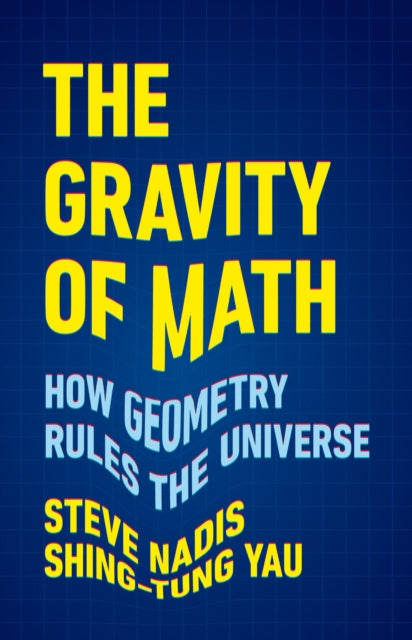
Basic Books The Gravity of Math
Book Synopsis'A must-read.”―Avi Loeb, New York Times–bestselling author of Extraterrestrial One of the preeminent mathematicians of the past half century shows how physics and math were combined to give us the theory of gravity and the dizzying array of ideas and insights that has come from it Mathematics is far more than just the language of science. It is a critical underpinning of nature. The famed physicist Albert Einstein demonstrated this in 1915 when he showed that gravity—long considered an attractive force between massive objects—was actually a manifestation of the curvature, or geometry, of space and time. But in making this towering intellectual leap, Einstein needed the help of several mathematicians, including Marcel Grossmann, who introduced him to the geometrical framework upon which his theory rest. In The Gravity of Math, Steve Nadis and Shing-Tung Yau consider how math can dr
£22.50
Taylor & Francis Inc Wavelets, Images, and Surface Fitting
Book SynopsisThis volume documents the results and presentations relating to the use of wavelet theory and other methods in surface fitting and image reconstruction of the Second International Conference on Curves and Surfaces, held in Chamonix in 1993. The papers represent directions for future research and development in many areas of application.
£115.00

Taylor & Francis Inc Logical Dilemmas: The Life and Work of Kurt Gödel
Book SynopsisThis authoritative biography of Kurt Goedel relates the life of this most important logician of our time to the development of the field. Goedel's seminal achievements that changed the perception and foundations of mathematics are explained in the context of his life from the turn of the century Austria to the Institute for Advanced Study in Princeton.Trade ReviewDawson's book remains a starting point for our view into the life and work of the man who gave the world incompleteness. -- The Review of Modern Logic, March 2007Table of Contents1. Der Herr Warum (1920-1924) 2. Intellectual Maturation (1924-29) 3. Excursus: A Capsule History of the Development of Logic to 1928 4. Moment of Impact (1929-31) 5. Dozent in absentia (1932-37) 6. “Jetzt, Mengenlehre” (1937-39) 7. Homecoming and Hegira (1939-40) 8. Years of Transition (1940-46) 9. Philosophy and Cosmology (1946-51) 10. Recognition and Reclusion (1951-61) 11. New Light on the Continuum Problem (1961-68) 12. Withdrawal (1969-78) 13. Aftermath 14. Reflections on Gödel’s Life and Legacy
£42.99

Taylor & Francis Inc generatingfunctionology: Third Edition
Book SynopsisGenerating functions, one of the most important tools in enumerative combinatorics, are a bridge between discrete mathematics and continuous analysis. Generating functions have numerous applications in mathematics, especially in - Combinatorics - Probability Theory - Statistics - Theory of Markov Chains - Number Theory One of the most important and relevant recent applications of combinatorics lies in the development of Internet search engines whose incredible capabilities dazzle even the mathematically trained user.Trade Review" ""Wilf's writing is clear and friendly; his exorcises are instructive and plentiful... This book is valuable reading for even the best of specialists..."" -E. Rodney Canfield, The Mathematical Intelligencer , March 1993 ""This is a first rate, carefully planned and executed book written by a 'black belt gereratingfunctionologist.' I'll be using it the next time I teach..."" -George Andrews, SIAM News, October 1994 ""Wilf's book is very well-written and easy to read by any serious mathematics student. Scientists in other disciplines often encounter the need to study sequences that naturally arise in their own discipline. The book is well-suited fo them, too."" -Short Book Reviews, January 2006"Table of ContentsIntroductory Ideas and Examples. Series. Cards, Decks and Hands: The Exponential Formula. Applications of Generating Functions. Analytic and Asymptotic Models. Appendix: Using Maple and Mathematica Solutions. References.
£50.34

Taylor & Francis Inc Introduction to Credit Risk Modeling
Book SynopsisContains Nearly 100 Pages of New MaterialThe recent financial crisis has shown that credit risk in particular and finance in general remain important fields for the application of mathematical concepts to real-life situations. While continuing to focus on common mathematical approaches to model credit portfolios, Introduction to Credit Risk Modeling, Second Edition presents updates on model developments that have occurred since the publication of the best-selling first edition.New to the Second Edition An expanded section on techniques for the generation of loss distributions Introductory sections on new topics, such as spectral risk measures, an axiomatic approach to capital allocation, and nonhomogeneous Markov chains Updated sections on the probability of default, exposure-at-default, loss-given-default, and regulatory capital A new section on multi-period models Recent developments in structured credit The financial crisis illustrated the importance of effectively communicating model outcomes and ensuring that the variation in results is clearly understood by decision makers. The crisis also showed that more modeling and more analysis are superior to only one model. This accessible, self-contained book recommends using a variety of models to shed light on different aspects of the true nature of a credit risk problem, thereby allowing the problem to be viewed from different angles. Trade Review… this is a concise book for exploring the limitations of credit risk models and, to a lesser degree, asset valuation models. Read this book for a companionable journey through some of the limiting assumptions that make the models tractable. … it may be the first one [book] that wastes no time in getting to the point, and moving on.—Annals of Actuarial Science, Vol. 5, June 2011Bluhm, Overbeck, and Wagner offer help to mathematicians and physicists leaving the academy to work as risk or portfolio managers. For this introduction, they focus on main themes rather than details, and on portfolio rather than single obligor risk. … this second [edition] takes account of problems in the banking industry [from] 2007-09.—SciTech Book News, February 2011Having a valid and up-to-date credit risk model (or models) is one of the most important aspects in today’s risk management. The models require quite a bit of technical as well as practical know-how. Introduction to Credit Risk Modeling serves this purpose well. … it would best fit the practitioner’s needs. For students it can also be of great use, as an introductory course for credit risk models. A great first step into credit risk modeling. … The book provides a nice coherent overview of the methods used in capital allocation. … The book is written in a mixture of theorem-proof and applied styles. … I find this rather pleasing, as it gives the reader the edge of theoretical exposition, which is extremely important. … One really useful side of the book is that it provides step-by-step guide to methods presented. This should be really appreciated in industry and among students. …—MAA Reviews, January 2011Praise for the First EditionThis is an outstanding book on the default models that are used internally by financial institutions. This practical book delves into the mathematics, the assumptions and the approximations that practitioners apply to make these models work.—Glyn A. Holton, Contingency AnalysisThere are so many financial tools available today and numbers are likely to grow in the future. If you work in this field of credit risk modeling, it is worth looking at the theoretical background, and this book is a well-rounded introduction.—Journal of the Operational Research SocietyAs an introductory survey, it does an admirable job. … this book is an important guide into the field of credit risk models. Mainly for the practitioner … It is well written, fairly easy to follow.—Horst Behncke, Zentralblatt MATH… this is a concise book for exploring the limitations of credit risk models and, to a lesser degree, asset valuation models. Read this book for a companionable journey through some of the limiting assumptions that make the models tractable. … it may be the first one [book] that wastes no time in getting to the point, and moving on.—Annals of Actuarial Science, Vol. 5, June 2011Bluhm, Overbeck, and Wagner offer help to mathematicians and physicists leaving the academy to work as risk or portfolio managers. For this introduction, they focus on main themes rather than details, and on portfolio rather than single obligor risk. … this second [edition] takes account of problems in the banking industry [from] 2007-09.—SciTech Book News, February 2011Having a valid and up-to-date credit risk model (or models) is one of the most important aspects in today’s risk management. The models require quite a bit of technical as well as practical know-how. Introduction to Credit Risk Modeling serves this purpose well. … it would best fit the practitioner’s needs. For students it can also be of great use, as an introductory course for credit risk models. A great first step into credit risk modeling. … The book provides a nice coherent overview of the methods used in capital allocation. … The book is written in a mixture of theorem-proof and applied styles. … I find this rather pleasing, as it gives the reader the edge of theoretical exposition, which is extremely important. … One really useful side of the book is that it provides step-by-step guide to methods presented. This should be really appreciated in industry and among students. …—MAA Reviews, January 2011Praise for the First EditionThis is an outstanding book on the default models that are used internally by financial institutions. This practical book delves into the mathematics, the assumptions and the approximations that practitioners apply to make these models work.—Glyn A. Holton, Contingency AnalysisThere are so many financial tools available today and numbers are likely to grow in the future. If you work in this field of credit risk modelling it is worth looking at the theoretical background, and this book is a well-rounded introduction.—Journal of the Operational Research SocietyAs an introductory survey it does an admirable job. … this book is an important guide into the field of credit risk models. Mainly for the practitioner … It is well written, fairly easy to follow.—Horst Behncke, Zentralblatt MATHTable of ContentsThe Basics of Credit Risk Management. Modeling Correlated Defaults. Asset Value Models. The CreditRisk+ Model. Risk Measures and Capital Allocation. Term Structure of Default Probability. Credit Derivatives. Collateralized Debt Obligations. References. Index.
£161.50
Stata Press An Introduction to Survival Analysis Using Stata,
Book SynopsisAn Introduction to Survival Analysis Using Stata, Revised Third Edition is the ideal tutorial for professional data analysts who want to learn survival analysis for the first time or who are well versed in survival analysis but are not as dexterous in using Stata to analyze survival data. This text also serves as a valuable reference to those readers who already have experience using Stata’s survival analysis routines.The revised third edition has been updated for Stata 14, and it includes a new section on predictive margins and marginal effects, which demonstrates how to obtain and visualize marginal predictions and marginal effects using the margins and marginsplot commands after survival regression models.Survival analysis is a field of its own that requires specialized data management and analysis procedures. To meet this requirement, Stata provides the st family of commands for organizing and summarizing survival data.This book provides statistical theory, step-by-step procedures for analyzing survival data, an in-depth usage guide for Stata's most widely used st commands, and a collection of tips for using Stata to analyze survival data and to present the results. This book develops from first principles the statistical concepts unique to survival data and assumes only a knowledge of basic probability and statistics and a working knowledge of Stata.The first three chapters of the text cover basic theoretical concepts: hazard functions, cumulative hazard functions, and their interpretations; survivor functions; hazard models; and a comparison of nonparametric, semiparametric, and parametric methodologies. Chapter 4 deals with censoring and truncation. The next three chapters cover the formatting, manipulation, stsetting, and error checking involved in preparing survival data for analysis using Stata's st analysis commands. Chapter 8 covers nonparametric methods, including the Kaplan–Meier and Nelson–Aalen estimators and the various nonparametric tests for the equality of survival experience.Chapters 9–11 discuss Cox regression and include various examples of fitting a Cox model, obtaining predictions, interpreting results, building models, model diagnostics, and regression with survey data. The next four chapters cover parametric models, which are fit using Stata's streg command. These chapters include detailed derivations of all six parametric models currently supported in Stata and methods for determining which model is appropriate, as well as information on stratification, obtaining predictions, and advanced topics such as frailty models. Chapter 16 is devoted to power and sample-size calculations for survival studies. The final chapter covers survival analysis in the presence of competing risks.Trade Review"This is an application-oriented introduction to survival analysis using Stata. The authors have focused on intuitions without getting into technical details. For example … the rather mysterious partial likelihood was elegantly illustrated with a small dataset and simple derivations for conditional probabilities. The book provides an excellent coverage of commonly used nonparametric, semiparametric, and parametric analyses of survival data, with ample application examples. The implementation of each survival approach has been carefully laid out in Stata syntax and real data analyses. Moreover, the material covered in the book is surprisingly comprehensive, including Coxmodels with time-varying covariates, shared frailty models, multiple imputations, and competing risk regression. Those topics are often encountered in practice but usually missing from an introductory book of survival analysis. The revised third edition has been updated to reflect the welcome additions in Stata 14 relative to previous versions. … The revised third edition provides not only an excellent tutorial to anyone who is interested in learning survival models with examples, but also an extremely handy reference to researchers who would like to perform survival analyses in Stata."—Yu Cheng, University of Pittsburgh, in The American Statistician, April 2018Table of ContentsThe problem of survival analysis. Describing the distribution of failure times. Hazard models. Censoring and truncation. Recording survival data. Using stset. After stet. Nonparametric analysis. Using stcox. Model building using stcox. The Cox model: Diagnostics. Parametric models. The exponential model. Postestimation commands for parametric models. Generalizing the parametric regression model. Power and sample-size determination for survival analysis. Competing risks.
£70.29

Stata Press Survey Weights: A Step-by-step Guide to
Book SynopsisSurvey Weights: A Step-by-Step Guide to Calculation is the first guide geared toward Stata users that systematically covers the major steps taken in creating survey weights. These weights are used to project a sample to some larger population and can be computed for either probability or nonprobability samples. Sample designs can range from simple, single-stage samples to more complex, multistage samples, each of which may use specialized steps in weighting to account for selection probabilities, nonresponse, inaccurate coverage of a population by a sample, and auxiliary data to improve precision and compensate for coverage errors. The authors provide many examples with Stata code.Table of ContentsOverview of weighting. Initial steps in weighting probability samples. Adjustments for nonresponse. Calibration and other uses of auxiliary data in weighting. Use of weights in variance estimation. Nonprobability samples. Weighting for some special cases. Quality of survey weights.
£49.39

Stata Press Introduction to Time Series Using Stata, Revised
Book SynopsisIntroduction to Time Series Using Stata, Revised Edition provides a step-by-step guide to essential time-series techniques–from the incredibly simple to the quite complex– and, at the same time, demonstrates how these techniques can be applied in the Stata statistical package. The emphasis is on an understanding of the intuition underlying theoretical innovations and an ability to apply them. Real-world examples illustrate the application of each concept as it is introduced, and care is taken to highlight the pitfalls, as well as the power, of each new tool. The Revised Edition has been updated for Stata 16.Table of ContentsJust enough Stata Getting startedAll about dataLooking at dataStatisticsOdds and endsMaking a dateTyping dates and date variablesLooking aheadJust enough statistics Random variables and their momentsHypothesis testsLinear regressionMultiple-equation modelsTime seriesFiltering time-series dataPreparing to analyze a time seriesThe four components of a time seriesSome simple filtersAdditional filtersPoints to rememberA first pass at forecastingForecast fundamentalsFilters that forecastPoints to rememberLooking aheadAutocorrelated disturbancesAutocorrelationRegression models with autocorrelated disturbancesTesting for autocorrelationEstimation with first-order autocorrelated dataEstimating the mortgage rate equation Points to rememberUnivariate time-series modelsThe general linear processLag polynomials: Notation or prestidigitations?The ARMA modelStationarity and invertibilityWhat can ARMA models do?Points to rememberLooking aheadModeling a real-world time seriesGetting ready to model a time seriesThe Box-Jenkins approachSpecifying an ARMA modelEstimationLooking for trouble: Model diagnostic checkingForecasting with ARIMA modelsComparing forecastsPoints to rememberWhat have we learned so far?Looking aheadTime-varying volatilityExamples of time-varying volatilityARCH: A model of time-varying volatility Extensions to the ARCH modelPoints to rememberModel of multiple time seriesVector autoregressionsA VAR of the U.S. macroeconomyWho’s on first?SVARsPoints to rememberLooking aheadModels of nonstationary times seriesTrend and unit rootsTesting for unit rootsCointegration: Looking for a long-term relationshipCointegrating relationships and VECMFrom intuition to VECM: An examplePoints to rememberLooking aheadClosing observationsMaking sense of it allWhat did we miss?FarewellReferences
£58.89

Stata Press An Introduction to Stata for Health Researchers
Book SynopsisAn Introduction to Stata for Health Researchers, Fifth Edition updates this classic book that has become a standard reference for health researchers. As with previous editions, readers will learn to work effectively in Stata to perform data management, compute descriptive statistics, create meaningful graphs, fit regression models, and perform survival analysis. The fifth edition adds examples of performing power, precision, and sample-size analysis; working with Unicode characters; managing data with ICD-9 and ICD-10 codes; and creating customized tables.With many worked examples and downloadable datasets, this text is the ideal resource for hands-on learning, whether for students in a statistics course or for researchers in fields such as epidemiology, biostatistics, and public health who are learning to use Stata's tools for health research.Table of ContentsI The basics 1. Getting started 2. Getting help—and more 3. Command syntax II Data management 4. Variables 5. Getting data in and out of Stata 6. Adding explanatory text to data 7. Calculations 8. Commands affecting data structure 9. Taking good care of your data III Analysis 10. Description and simple analysis 11. Regression analysis 12. Time-to-event data 13. Power, precision, and sample-size analysis 14. Measurement and diagnosis 15. Miscellaneous IV Graphs 16. Graphs V Advanced topics 17. Advanced topics
£56.99

Stata Press Data Management Using Stata: A Practical Handbook
Book SynopsisThis second edition of Data Management Using Stata focuses on tasks that bridge the gap between raw data and statistical analysis. It has been updated throughout to reflect new data management features that have been added over the last 10 years. Such features include the ability to read and write a wide variety of file formats, the ability to write highly customized Excel files, the ability to have multiple Stata datasets open at once, and the ability to store and manipulate string variables stored as Unicode. Further, this new edition includes a new chapter illustrating how to write Stata programs for solving data management tasks. As in the original edition, the chapters are organized by data management areas: reading and writing datasets, cleaning data, labeling datasets, creating variables, combining datasets, processing observations across subgroups, changing the shape of datasets, and programming for data management. Within each chapter, each section is a self-contained lesson illustrating a particular data management task (for instance, creating date variables or automating error checking) via examples. This modular design allows you to quickly identify and implement the most common data management tasks without having to read background information first. In addition to the “nuts and bolts” examples, author Michael Mitchell alerts users to common pitfalls (and how to avoid them) and provides strategic data management advice. This book can be used as a quick reference for solving problems as they arise or can be read as a means for learning comprehensive data management skills. New users will appreciate this book as a valuable way to learn data management, while experienced users will find this information to be handy and time saving—there is a good chance that even the experienced user will learn some new tricks.Table of ContentsIntroduction. Reading and importing data files. Saving and exporting data files. Data cleaning. Labeling datasets. Creating variables. Combining datasets. Processing observations across subgroups. Changing the shape of your data. Programming for data management: Part I. Programming for data management: Part II.
£58.89


