
Mathematical foundations Books

Princeton University Press Count Like an Egyptian
Book SynopsisThe mathematics of ancient Egypt was fundamentally different from our math today. Contrary to what people might think, it wasn't a primitive forerunner of modern mathematics. This title provides an introduction to the intuitive and often-surprising art of ancient Egyptian math.Trade Review"Count Like an Egyptian would make an excellent addition to math classrooms at many different levels. Reimer includes problems in the text and solutions in the back of the book, so the reader can practice techniques and get a feel for exactly how the system works as they go through the book. The mathematics is basic enough to be helpful for children learning fractions or multiplication for the first time, but it's also different enough from the methods most of us know that adults will get a lot out of it as well."--Evelyn Lamb, Scientific American "History lovers will gain much more than just insight into the Egyptian mind-set. The author interleaves mathematical exposition with short essays on Egyptian history, culture, geography, mythology--all, like the rest of the book, beautifully illustrated... For a lively and inquiring mind the book has a good deal to offer. It is well written, lavishly illustrated, and just awfully interesting. The book is a pleasure to hold, to browse, and to read."--Alexander Bogomolny, Cut the Knot "You get the feeling that David Reimer must be a pretty entertaining teacher. An associate professor of mathematics at the College of New Jersey, he has taken on the task of explaining ancient math systems by having you use them. And though it's not easy, he manages to lead you, step by step, through a hieroglyphic based calculation of how many 10-pesu loaves of bread you can make from seven hekat of grain."--Nancy Szokan, Washington Post "An interesting combination of history, ancient literature and mythology, arithmetic puzzles and mathematics, and lavishly illustrated with numerous colour diagrams, this engaging book is unusual, thought-provoking and just plain fun to read."--Devorah Bennu, GrrlScientist, The Guardian "Count Like an Egyptian is a beautifully illustrated and well-written book... Reimer's overriding goal is to demonstrate that Egyptian fraction arithmetic is fascinating, versatile, and well suited for whatever calls fractions into existence... By working through the material Reimer patiently and gently presents, the reader will have a more thorough understanding and appreciation of how Egyptian scribes made the calculations needed to administer an empire bent on building pyramids and granaries, surveying flooded riverside property, digging irrigation basins, and rationing or exchanging bread and beer supplies amongst its gangs of workers... This book should find a home in libraries used by middle school and high school mathematics teachers. It also provides a good resource for mathematics education professors and their students on the college level as they explore historical beginnings of mathematical ideas, make cultural comparisons, and develop interdisciplinary connections."--Calvin Jongsma, MAA Reviews "An interesting combination of history, ancient literature and mythology, arithmetic puzzles and mathematics, and lavishly illustrated with numerous colour diagrams, this engaging book is unusual, thought-provoking and just plain fun to read."--GrrrlScientist "This amusing popular introduction to an uncommon subject is a mental adventure that sheds new light on the thought processes of a lost civilization and will appeal both to those who enjoy mathematical puzzles and to Egyptophiles."--Edward K. Werner, Library Journal "In general I really like this book and believe it is, if not necessarily a must for all Egyptophiles, then definitely one to put on the wish list as an interesting addition to your bookshelf... It is fun way of working through complicated and yet practical mathematics which makes the Rhind Papyrus come alive and gives an insight into the logical brain of ancient Egyptian scribes."--Charlotte Booth, charlottesegypt.com "Reimer succeeds very well in transferring his enthusiasm tor the Egyptian system to the reader. The reactions from his students who were used tor a try-out are claimed to be positive. But even if you do not want to graduate as an Egyptian scribe, you may be charmed by the witty Egyptian system and you will be delighted by the colourful illustrations and Reimer's entertaining account of it all."--A. Bultheel, European Mathematical Society "Count Like an Egyptian takes the reader step-by-step through the ancient Egyptian methods, which are surprisingly different from our own, and yet, in the capable hands of author David Reimer, surprisingly understandable. This lovely book has fun illustrations to demonstrate the various operations, basic geometry, and other tasks faced by the scribes... This book is a pleasure to read and makes Egyptian math a pleasure to learn."--Gretchen Wagner, San Francisco Book Review "The book is intended to be used as a teaching tool and includes practice examples for the student. It would be difficult to imagine a work that more effectively covers this aspect of the ancient civilization."--JPP, Ancient Egypt "David Reimer succeeds in keeping the mathematics in Count Like an Egyptian clever and light, raising this book into a rare category: a coffee table book that is serious and fun."--Robert Schaefer, New York Journal of Books "This volume is ideal for anyone, and I truly mean anyone, young or old, mathematician, student or teacher, who wants to learn how the ancient Egyptians did mathematics... This book has all the Egyptian mathematics a general mathematician, teacher or student could ever want to learn. In particular it would be a perfect resource for a schoolteacher, elementary through lower division college. The material is presented in a direct and accessible manner."--Amy Shell-Gellasch, CSHPM Bulletin "Overall this is a didactic and well written book, with many important illustrations, with some incursions in the mathematics of other ancient cultures."--European Mathematical Society "With Reimer's guidance, motivating stories, and lighthearted remarks, readers can become facile with Egyptian algorithms and the insights they reveal... Valuable for all readers looking for a guided of an alternative to traditional school arithmetic and the torpor that algorithmic training causes."--Choice "[T]his book is a worthwhile read for anyone interested in seeing exactly how ancient Egyptians dealt with mathematics. It will help put our present algorithms into perspective as simply one of many possible algorithms one could use to perform arithmetic operations."--Victor J. Katz, Mathematical Reviews Clippings "[Reimer] ... set himself to understand and explain the ancient methods, and the result is an approachable, thorough and lavishly-produced book."--Owen Toller, Mathematical Gazette "Count like an Egyptian is a beautifully glossy and colourful book; the presentation of hieroglyphs is particularly well done, and fully interated into the surrounding text... This book has given me a new perspective on day-to-day arithmetic."--Christopher Hollings, Mathematics Today "This is a wonderful book, very well written, filled with illustrations on every page, witty, addressing anyone interested in grade school arithmetic."--Victor V. Pambuccian, Zentralblatt MATH "Count Like an Egyptian is important for anyone interested in alternative algorithms... If you want to roll up your sleeves and learn some new mathematics, this is the book for you."--Michael Manganello, Mathematics Teacher "An engaging and beautifully illustrated book that deals with the basics of ancient Egyptian mathematics, set in the wider context of other ancient mathematical systems."--Corinna Rossi, Aestimatio "A great approach and a dedicated effort. One hopes the book will reflect that persistence and it does... This is a book that comes recommended, for anyone who wants to know where our current basis of mathematics comes from through to those with an interest in maths and history."--Gordon Clarke, Gazette of the Australian Mathematical SocietyTable of ContentsPreface vii Introduction ix Computation Tables xi 1 Numbers 1 2 Fractions 13 3 Operations 22 4 Simplification 55 5 Techniques and Strategies 80 6 Miscellany 121 7 Base-Based Mathematics 144 8 Judgment Day 182 Practice Solutions 209 Index 235
£25.20

Princeton University Press Summing It Up From One Plus One to Modern Number
Book SynopsisTrade Review"Offers a clear and beautiful progression from addition to modern number theory."--Math-Blog "The authors did a remarkable job in making some aspects of modern number theory very accessible to readers with only a minimal knowledge of mathematics, say a student who had a first calculus course. However, also mathematicians who do not have number theory as their main focus will enjoy this book."--Adhemar Bultheel, European Mathematical Society "Ash and Gross do a masterful job of leading students from finite sums to modular forms and to the forefront of modern number theory... This is an excellent piece of mathematical writing."--Choice "[A]n accessible and fun introduction to modular forms... [Summing It Up] is engaging and conversational, without losing accuracy or essential rigor."--Dominic Lanphier, American Mathematical MonthlyTable of Contents*Frontmatter, pg. i*CONTENTS, pg. vii*PREFACE, pg. xi*ACKNOWLEDGMENTS, pg. xv*INTRODUCTION: WHAT THIS BOOK IS ABOUT, pg. 1*CHAPTER 1. PROEM, pg. 11*CHAPTER 2. SUMS OF TWO SQUARES, pg. 22*CHAPTER 3. SUMS OF THREE AND FOUR SQUARES, pg. 32*CHAPTER 4. SUMS OF HIGHER POWERS: WARING'S PROBLEM, pg. 37*CHAPTER 5. SIMPLE SUMS, pg. 42*CHAPTER 6. SUMS OF POWERS, USING LOTS OF ALGEBRA, pg. 50*CHAPTER 7. INFINITE SERIES, pg. 73*CHAPTER 8. CAST OF CHARACTERS, pg. 96*CHAPTER 9. ZETA AND BERNOULLI, pg. 103*CHAPTER 10. COUNT THE WAYS, pg. 110*CHAPTER 11. THE UPPER HALF-PLANE, pg. 127*CHAPTER 12. MODULAR FORMS, pg. 147*CHAPTER 13. HOW MANY MODULAR FORMS ARE THERE?, pg. 160*CHAPTER 14. CONGRUENCE GROUPS, pg. 179*CHAPTER 15. PARTITIONS AND SUMS OF SQUARES REVISITED, pg. 186*CHAPTER 16. MORE THEORY OF MODULAR FORMS, pg. 201*CHAPTER 17. MORE THINGS TO DO WITH MODULAR FORMS: APPLICATIONS, pg. 213*BIBLIOGRAPHY, pg. 225*INDEX, pg. 227
£19.80

Princeton University Press Millions Billions Zillions
Book SynopsisTrade Review"Having a healthy skepticism toward numbers and giving readers the tools to think about math more logically is the purpose of this easily read, slight book. Brian W. Kernighan adroitly distills complex issues. His tone is more that of a mellow friend breaking down a concept that flummoxes you rather than an Ivy League professor expounding on the elegance of numbers."---Jacqueline Cutler, NJ.com"Numbers, graphs and statistics can often be misleading and misrepresented. In Millions, Billions, Zillions: Defending Yourself in a World of Too Many Numbers, Kernighan provides the reader with an entertaining and useful guide to avoid becoming a victim of number abuse."---Ben Rothke, RSA Conference"I can wholeheartedly recommend reading this book, because of the infectious way the author describes his interaction with numbers."---J. Herret, International Mathematical News"This is a must-read for anyone looking to cure their “number numbness”"---Tibi Puiu, ZME Science
£17.09
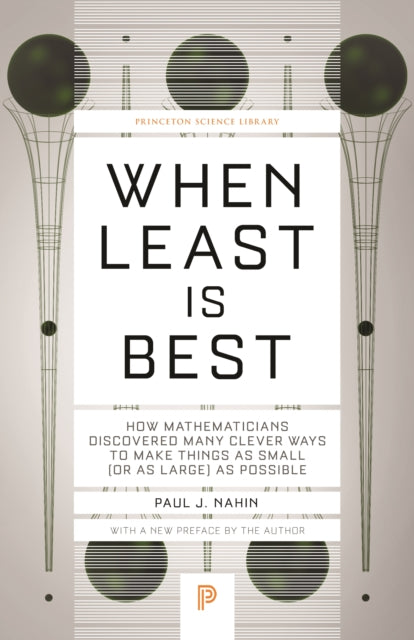
Princeton University Press When Least Is Best
Book SynopsisTrade Review"Nahin has written a beautifully clear, fascinating book on a topic which is truly vital to so many areas of science and I would recommend anyone who enjoys puzzle solving and having new tools to tackle old (or new) problems should read it."---Jonathan Shock, Mathemafrica
£15.19
Springer Mathematical Logic for Computer Science
Book SynopsisPreface.- Introduction.- Propositional Logic: Formulas, Models, Tableaux.- Propositional Logic: Deductive Systems.- Propositional Logic: Resolution.- Propositional Logic: Binary Decision Diagrams.- Propositional Logic: SAT Solvers.- First-Order Logic: Formulas, Models, Tableaux.- First-Order Logic: Deductive Systems.- First-Order Logic: Terms and Normal Forms.- First-Order Logic: Resolution.- First-Order Logic: Logic Programming.- First-Order Logic: Undecidability and Model Theory.- Temporal Logic: Formulas, Models, Tableaux.- Temporal Logic: A Deductive System.- Verification of Sequential Programs.- Verification of Concurrent Programs.- Set Theory.- Index of Symbols.- Index of Names.- Subject Index.Trade ReviewAsst. Prof. Manoj Raut, Dhirubhai Ambani Institute of Information and Communication Technology, IndiaExcerpts from full review posted Jan 15 2013 to Computing Reviews [Review #: CR140831]I have used the second edition of this book for my class. I find this new third edition more interesting and more elaborately written; I like it very much, and applaud the author for his work.Table of ContentsPreface.- Introduction.- Propositional Logic: Formulas, Models, Tableaux.- Propositional Logic: Deductive Systems.- Propositional Logic: Resolution.- Propositional Logic: Binary Decision Diagrams.- Propositional Logic: SAT Solvers.- First-Order Logic: Formulas, Models, Tableaux.- First-Order Logic: Deductive Systems.- First-Order Logic: Terms and Normal Forms.- First-Order Logic: Resolution.- First-Order Logic: Logic Programming.- First-Order Logic: Undecidability and Model Theory.- Temporal Logic: Formulas, Models, Tableaux.- Temporal Logic: A Deductive System.- Verification of Sequential Programs.- Verification of Concurrent Programs.- Set Theory.- Index of Symbols.- Index of Names.- Subject Index.
£54.99
American Mathematical Society Strongly Minimal Sets and Categoricity in Continuous Logic
£65.70

Springer-Verlag New York Inc. Amazing and Aesthetic Aspects of Analysis
Book SynopsisLively prose and imaginative exercises draw the reader into this unique introductory real analysis textbook. Motivating the fundamental ideas and theorems that underpin real analysis with historical remarks and well-chosen quotes, the author shares his enthusiasm for the subject throughout. A student reading this book is invited not only to acquire proficiency in the fundamentals of analysis, but to develop an appreciation for abstraction and the language of its expression. In studying this book, students will encounter: the interconnections between set theory and mathematical statements and proofs; the fundamental axioms of the natural, integer, and real numbers; rigorous e-N and e-d definitions; convergence and properties of an infinite series, product, or continued fraction; series, product, and continued fraction formulæ for the various elementary functions and constants. ITrade Review Table of ContentsPreface.- Some of the most beautiful formulæ in the world.- Part 1. Some standard curriculum.- 1. Very naive set theory, functions, and proofs.- 2. Numbers, numbers, and more numbers.- 3. Infinite sequences of real and complex numbers.- 4. Limits, continuity, and elementary functions.- 5. Some of the most beautiful formulæ in the world I-III.- Part 2. Extracurricular activities.- 6. Advanced theory of infinite series.- 7. More on the infinite: Products and partial fractions.- 8. Infinite continued fractions.- Bibliography.- Index.
£55.99

Springer Nature Switzerland AG Fuzzy Logic: Recent Applications and Developments
Book SynopsisSince its inception, fuzzy logic has attracted an incredible amount of interest, and this interest continues to grow at an exponential rate. As such, scientists, researchers, educators and practitioners of fuzzy logic continue to expand on the applicability of what and how fuzzy can be utilised in the real-world. In this book, the authors present key application areas where fuzzy has had significant success. The chapters cover a plethora of application domains, proving credence to the versatility and robustness of a fuzzy approach. A better understanding of fuzzy will ultimately allow for a better appreciation of fuzzy. This book provides the reader with a varied range of examples to illustrate what fuzzy logic can be capable of and how it can be applied. The text will be ideal for individuals new to the notion of fuzzy, as well as for early career academics who wish to further expand on their knowledge of fuzzy applications. The book is also suitable as a supporting text for advanced undergraduate and graduate-level modules on fuzzy logic, soft computing, and applications of AI.Table of ContentsRecognising Handwritten Digits Using a Fuzzy Neural Network Joshua Reynolds and Tianhua Chen Fuzzy Assessment of Student Academic Performances Shangen Yang and Tianhua Chen A Hybrid Fuzzy Neural Network for Image Recognition Samaresh Nayak and Tianhua Chen A Fuzzy Diagnostic System for Heart Disease Siyue Song, Tianhua Chen, and Grigoris Antoniou Analysing Medical Notes using Fuzzy Logic Siyue Song, Tianhua Chen, and Grigoris Antoniou Fostering Positive Personalisation through Fuzzy Clustering Raymond Moodley Fuzzy Logic in Modern Information Retrieval Steve Wade Fuzzy Applied to Sentiment Analysis Orestes Appel Fuzzy Logic, a Logicians Perspective Patrick Fogarty Applications of Fuzzy Logic in an Automated Warehouse Patrick Fogarty Can Fuzzy Systems Assist with Project Planning? Daniel Maia and Arjab Khuman Fuzzy Logic in Autonomous Vehicles David McDougall and Arjab Khuman AI Spawning Fuzzy Logic Fuzzy Inference System Reece Carey and Arjab Khuman The Application of Fuzzy Logic on Intelligent Transportation Systems Nath Lloyd and Arjab Khuman Fuzzy Logic Applied to Water Processes Will Chapman and Arjab Khuman Applications of Fuzzy Logic in Autonomous Vehicles Sam Asquith and Arjab Khuman Predicting Cyber Threats using Fuzzy Logic Jarrad Morden and Arjab Khuman Implementations of Fuzzy Logic in Camera Systems Sophie Hughes and Arjab Khuman Application of a Fuzzy Logic Control System for Stock Market Prediction Based on Technical Indicators and Fundamental Analysis Humza Nazir and Arjab Khuman The Application of Fuzzy Logic in Determining Outcomes of Sporting Events Spencer Deane and Arjab Khuman Using Fuzzy Logic to Educate People on Phishing Harry Taylor and Arjab Khuman
£123.49

Springer Nature Switzerland AG Hiroakira Ono on Substructural Logics
Book SynopsisThis volume is dedicated to Hiroakira Ono life’s work on substructural logics. Chapters, written by well-established academics, cover topics related to universal algebra, algebraic logic and the Full Lambek calculus; the book includes a short biography about Hiroakira Ono. The book starts with detailed surveys on universal algebra, abstract algebraic logic, topological dualities, and connections to computer science.It further contains specialised contributions on connections to formal languages (recognizability in residuated lattices and connections to the finite embedding property), covering systems for modal substructural logics, results on the existence and disjunction properties and finally a study of conservativity of expansions. This book will be primarily of interest to researchers working in algebraic and non-classical logic.Table of ContentsChapter 1. A scientific autobiography (Hiroakira Ono).- Part I: Expository and survey chapters.- Chapter 2. Universal algebraic methods for non-classical logics (James G. Raftery).- Chapter 3. Abstract algebraic logic - An introductory chapter (Josep Maria Font).- Chapter 4. Topological duality and algebraic completions (Mai Gehrke).- Chapter 5. An algebraic glimpse at bunched implications and separation logic (Peter Jipsen and Tadeusz Litak).- Part II: Special topics.- Chapter 6. Recognizability in Residuated Lattices (José Gil-Férez and Constantine Tsinakis).- Chapter 7. Finite embeddability property for residuated lattices via regular languages (Rostislav Horčík). Chapter 8. Cover systems for the modalities of linear logic (Robert Goldblatt).- Chapter 9. A negative solution to Ono’s Problem P52: Existence and disjunction properties in intermediate predicate logic (Nobu-Yuki Suzuki).- Chapter 10. Conservative expansions of substructural logics (Jacopo Amidei, Rodolfo C. Ertola-Biraben and Franco Montagna).
£104.49

Springer Nature Switzerland AG Foundations of Software Science and Computation
Book SynopsisThis open access book constitutes the proceedings of the 25th International Conference on Foundations of Software Science and Computational Structures, FOSSACS 2022, which was held during April 4-6, 2022, in Munich, Germany, as part of the European Joint Conferences on Theory and Practice of Software, ETAPS 2022. The 23 regular papers presented in this volume were carefully reviewed and selected from 77 submissions. They deal with research on theories and methods to support the analysis, integration, synthesis, transformation, and verification of programs and software systems.
£33.24

Springer International Publishing AG Dynamic Logic. New Trends and Applications: 4th
Book SynopsisThis book constitutes revised selected papers from the refereed proceedings of the 4th International Workshop on Dynamic Logic, DaLí 2022, held in Haifa, Israel, in July/August 2022.The 8 full papers presented in this volume were carefully reviewed and selected from 22 submissions. They deal with new trends and applications in the area of Dynamic Logic. Table of ContentsFirst steps in updating knowing how.- Parametrized modal logic II: the unidimensional case.- Relating Kleene algebras.- Dynamic epistemic logic for budget-constrained agents.- Action models for coalition logic.- Quantum logic for observation of physical quantities.- Cautious distributed belief.- A STIT logic of intentionality.
£42.74

Springer International Publishing AG Logic and Its Applications: 10th Indian
Book SynopsisEdited in collaboration with FoLLI, this book constitutes the refereed proceedings of the 10th Indian Conference on Logic and Its Applications, ICLA 2023, which was held in Indore, India, in March 2023.Besides 6 invited papers presented in this volume, there are 9 contributed full papers which were carefully reviewed and selected from 18 submissions. The volume covers a wide range of topics. These topics are related to modal and temporal logics, intuitionistic connexive and imperative logics, systems for reasoning with vagueness and rough concepts, topological quasi-Boolean logic and quasi-Boolean based rough set models, and first-order definability of path functions of graphs.Table of ContentsA Note on the Ontology of Mathematics.- Boolean Functional Synthesis: From Under the Hood of Solvers.- Labelled Calculi for Lattice-based Modal Logics.- Two Ways to Scare a Gruffalo.- Determinacy Axioms and Large Cardinals.- Big ideas from logic for mathematics and computing education.- Modal Logic of Generalized Separated Topological Spaces.- Multiple-valued Semantics for Metric Temporal Logic.- Segment transit function of the induced path function of graphs and its first-order definability.- Fuzzy Free Logic with Dual Domain Semantics.- A New Dimension of Imperative Logic. -Quasi-Boolean based models in Rough Set theory: A case of Covering.- Labelled calculi for the logics of rough concepts.- An Infinity of Intuitionistic Connexive Logics.- Relational Semantics for Normal Topological Quasi-Boolean Logic.
£47.49

Springer International Publishing AG Formal Methods Teaching: 5th International
Book SynopsisThis book constitutes the proceedings of the 5th International Workshop on Formal Methods Teaching, FMTea 2023, which was held in Lübeck, Germany, in March 2023.The 7 full papers presented in this volume were carefully reviewed and selected from 10 submissions. FMTea 2023 aim is to support a worldwide improvement in learning Formal Methods, mainly by teaching but also via self-learning.Table of ContentsAutomated Exercise Generation for Satisfiability Checking.- Graphical Loop Invariant Based Programming.- A Gentle Introduction to Verification of Parameterized Reactive Systems.- Model Checking Concurrent Programs for Autograding in pseuCo Book.- Teaching TLA+ to Engineers at Microsoft.- Teaching and Training in Formalisation with B.- Teaching low-code Formal Methods with Coloured Petri Nets.
£42.74
De Gruyter General Topology
Book Synopsis
£73.62

Springer International Publishing AG Logical Foundations of Mathematics and
Book SynopsisThe two main themes of this book, logic and complexity, are both essential for understanding the main problems about the foundations of mathematics. Logical Foundations of Mathematics and Computational Complexity covers a broad spectrum of results in logic and set theory that are relevant to the foundations, as well as the results in computational complexity and the interdisciplinary area of proof complexity. The author presents his ideas on how these areas are connected, what are the most fundamental problems and how they should be approached. In particular, he argues that complexity is as important for foundations as are the more traditional concepts of computability and provability.Emphasis is on explaining the essence of concepts and the ideas of proofs, rather than presenting precise formal statements and full proofs. Each section starts with concepts and results easily explained, and gradually proceeds to more difficult ones. The notes after each section present some formal definitions, theorems and proofs.Logical Foundations of Mathematics and Computational Complexity is aimed at graduate students of all fields of mathematics who are interested in logic, complexity and foundations. It will also be of interest for both physicists and philosophers who are curious to learn the basics of logic and complexity theory.Trade Review“This monograph by the outstanding Czech logician Pavel Pudlák provides a broad but also deep survey of work in logic and computer science relevant to foundational issues, interpreted in a wide sense. … This is a fine overview of logic and complexity theory that can be confidently recommended to anybody who would like to orient themselves in an increasingly intricate and difficult field.” (Alasdair Urquhart, Philosophia Mathematica, Vol. 23 (3), October, 2015)“For the non-expert it offers indeed a ‘gentle introduction’ to logic that is well selected and excellently explained. And for the logician it certainly offers some of the best introductions to those topics outside their area of direct expertise. … it contains plenty of informal explanations, intuition and motivation. … It is truly a gift to the logic and wider communities … . This book is very enjoyable to read and I wish it all success.” (Olaf Beyersdorff, Mathematical Reviews, August, 2014)“It spans the historical, logical, and at times philosophical underpinnings of the theory of computational complexity. Students of mathematics seeking a transition to higher mathematics will find it helpful, as will mathematicians with expertise in other areas. … an excellent choice for a first text in studying complexity, or as a clarifying adjunct to any assigned text in this area. … a compact guide for graduate students with a need for or interest in computational complexity and its foundations.” (Tom Schulte, MAA Reviews, July, 2014)“This book, exactly as indicated by its title, deals with the main philosophical, historical, logical and mathematical aspects … in a quite approachable and attractive way. … the prospective readers of this book are mathematicians with an interest in the foundations, philosophers with a good background in mathematics, and also philosophically minded scientists. Due to the author’s nice style, the book will be a very good choice for the first text in studying this subject.” (Branislav Boričić, zbMATH, Vol. 1270, 2013)Table of ContentsMathematician’s world.- Language, logic and computations.- Set theory.- Proofs of impossibility.- The complexity of computations.- Proof complexity.- Consistency, Truth and Existence.- References.
£112.49

Springer International Publishing AG Saved from the Cellar: Gerhard Gentzen’s
Book SynopsisGerhard Gentzen is best known for his development of the proof systems of natural deduction and sequent calculus, central in many areas of logic and computer science today. Another noteworthy achievement is his resolution of the embarrassing situation created by Gödel's incompleteness results, especially the second one about the unprovability of consistency of elementary arithmetic. After these successes, Gentzen dedicated the rest of his short life to the main problem of Hilbert's proof theory, the question of the consistency of analysis. He was arrested in the summer of 1945 with other professors of the German University of Prague and died soon afterward of starvation in a prison cell. Attempts at locating his lost manuscripts failed at the time, but several decades later, two slim folders of shorthand notes were found. In this volume, Jan von Plato gives an overview of Gentzen's life and scientific achievements, based on detailed archival and systematic studies, and essential for placing the translations of shorthand manuscripts that follow in the right setting. The materials in this book are singular in the way they show the birth and development of Gentzen's central ideas and results, sometimes in a well-developed form, and other times as flashes into the anatomy of the workings of a unique mind.Trade Review“This book is obviously indispensable to historians of logic in the immediate wake of Gödel’s 1931 incompleteness theorems. … Saved from the Cellar is also valuable for less specialist readers (like myself ) who wish to understand the broader outlines of what proof theory has meant to several of its leading creators.” (Colin McLarty, Isis, Vol. 111 (1), 2020)“The book contains translations of shorthand notes which survived in the Nachlass of the mathematical logician Gerhard Gentzen. ... The book is valuable source for the history of modern logic; the editor did an excellent work in getting the shorthand notes, first transcribed in normal German text, and then translating it to English.” (Reinhard Kahle, zbMath 1414.03002, 2019)“Every general reader interested in modern logic and its history, … may find a source of inspiration in Genzen’s unpublished notes of the thirties, as well as for the philosopher concerned with epistemological aspects of modern logic.” (Adrian Rezus, Studia Logica, Vol. 107, 2019)“This is an account and transcription of two slim folders of stenographic material in Gerhard Gentzen's handwriting that were found in 1984. … this book is a valuable contribution to the history of the development of mathematical logic in the first half of the twentieth century.” (Henry Africk, Mathematical Reviews, December, 2017)Table of ContentsPart I: A Sketch of Gentzen's Life and Work.- 1. Overture.- 2. Gentzen's years of study.- Dr. Gentzen's arduous years in Nazi Germany.- 4. The scientific accomplishments.- 5. Loose ends.- 6. Gentzen's genuis.- Part II: Overview of the Shorthand Notes.- 1. Gentzen's series of stenographic manuscripts.- 2. The items in this collection.- Practical remarks on the manuscripts.- Manuscript illustrations.- The German alphabet in Latin, Sutterlin, and Fraktur Type.- Bibliography for parts I and II.- Index of names for Parts I and II.- Part III: The Original Writings.- 1. Reduction of number-theoretic problems to predicate logic.- 2. Replacement of functions by predicates.- 3. The formation of abstract concepts.- 4. Five different forms of natural calculi.- 5. Formal conception of correctness in arithmetic I.- 6. Investigations into logical inferences.- 7. Reduction of classical to intuitionistic logic.- 8. CV of the candidate Gerhard Gentzen.-0 9. Letters to Heyting.- 10. Formal conception of correctness in arithmetic II.- 11. Proof theory of number theory.- 12. Consistency of artihmetic, for publication.- 13. Correspondence with Paul Bernays.- 14. Forms of type theory.- 15. Predicate logic.- 16. Propositional logic.- 17. Foundational research in mathematics.- Table of cross-references in the Gentzen papers.- Index of names in the Gentzen papers.- Index of subjects in the Gentzen papers.
£95.99

Springer International Publishing AG Selected Works I
Book SynopsisThis is a two-volume collection presenting the selected works of Herbert Busemann, one of the leading geometers of the twentieth century and one of the main founders of metric geometry, convexity theory and convexity in metric spaces. Busemann also did substantial work (probably the most important) on Hilbert’s Problem IV. These collected works include Busemann’s most important published articles on these topics. Volume I of the collection features Busemann’s papers on the foundations of geodesic spaces and on the metric geometry of Finsler spaces. Volume II includes Busemann’s papers on convexity and integral geometry, on Hilbert’s Problem IV, and other papers on miscellaneous subjects. Each volume offers biographical documents and introductory essays on Busemann’s work, documents from his correspondence and introductory essays written by leading specialists on Busemann’s work. They are a valuable resource for researchers in synthetic and metric geometry, convexity theory and the foundations of geometry. Table of ContentsPreface.- Introduction to Volume I.- List of publications of Herbert Busemann.- Acknowledgements.- Essays.- A. Papadpoulos: Herbert Busemann (1905-1994).- A. Papadopoulos and M. Troyanov: On three early papers by Herbert Busemann on the foundations of geometry.- M. Troyanov: On Pasch's Axiom and Desargues' Theorem in Busemann's work.- V. N. Berestovskiy: Busemann's results, ideas, questions on locally compact homogeneous geodesic spaces.- A. Papadopoulos and S. Yamada: Busemann's problems on G-spaces.- Busemann's metric theory of timelike spaces.- A. Papadopoulos: Chronogeometry.- W. M. Boothby: Review of Busemann's book The geometry of Geodesics.- F. A. Ficken: Review of Busemann's book Metric Methods in Finsler Spaces and in the Foundations of Geometry.- Busemann's papers on the foundations of geodesic spaces and on the metric geometry of Finsler spaces.
£95.62
Birkhauser Verlag AG Methods of Solving Number Theory Problems
Book SynopsisThrough its engaging and unusual problems, this book demonstrates methods of reasoning necessary for learning number theory. Every technique is followed by problems (as well as detailed hints and solutions) that apply theorems immediately, so readers can solve a variety of abstract problems in a systematic, creative manner. New solutions often require the ingenious use of earlier mathematical concepts - not the memorization of formulas and facts. Questions also often permit experimental numeric validation or visual interpretation to encourage the combined use of deductive and intuitive thinking. The first chapter starts with simple topics like even and odd numbers, divisibility, and prime numbers and helps the reader to solve quite complex, Olympiad-type problems right away. It also covers properties of the perfect, amicable, and figurate numbers and introduces congruence. The next chapter begins with the Euclidean algorithm, explores the representations of integer numbers in different bases, and examines continued fractions, quadratic irrationalities, and the Lagrange Theorem. The last section of Chapter Two is an exploration of different methods of proofs. The third chapter is dedicated to solving Diophantine linear and nonlinear equations and includes different methods of solving Fermat’s (Pell’s) equations. It also covers Fermat’s factorization techniques and methods of solving challenging problems involving exponent and factorials. Chapter Four reviews the Pythagorean triple and quadruple and emphasizes their connection with geometry, trigonometry, algebraic geometry, and stereographic projection. A special case of Waring’s problem as a representation of a number by the sum of the squares or cubes of other numbers is covered, as well as quadratic residuals, Legendre and Jacobi symbols, and interesting word problems related to the properties of numbers. Appendices provide a historic overview of number theory and its main developments from the ancient cultures in Greece, Babylon, and Egypt to the modern day. Drawing from cases collected by an accomplished female mathematician, Methods in Solving Number Theory Problems is designed as a self-study guide or supplementary textbook for a one-semester course in introductory number theory. It can also be used to prepare for mathematical Olympiads. Elementary algebra, arithmetic and some calculus knowledge are the only prerequisites. Number theory gives precise proofs and theorems of an irreproachable rigor and sharpens analytical thinking, which makes this book perfect for anyone looking to build their mathematical confidence.Table of ContentsPreface.- Numbers: Problems Involving Integers.- Further Study of Integers.- Diophantine Equations and More.- Pythagorean Triples, Additive Problems, and More.- Homework.
£38.24
Springer-Verlag Berlin and Heidelberg GmbH & Co. KG Cambridge Summer School in Mathematical Logic: Held in Cambridge /U. K., August 1-21, 1971
Book SynopsisLectures on intuitionism.- Realizability: A retrospective survey.- Some applications of Kleene's methods for intuitionistic systems.- Notes on intuitionistic second order arithmetic.- Some properties of intuitionistic zermelo-frankel set theory.- Ouelques Resultats sur les Interpretations Fonctionnelles.- Combinator realizability of constructive finite type analysis.- The arithmetic theory of constructions.- The priority method for the construction of recursively enumerable sets.- Admissible ordinals and priority arguments.- Abstract computability versus analog-generability (a survey).- Infinitary combinatorics.- The maximum sum of a family of ordinals.- Effective implications between the "finite" choice axioms.- On descendingly complete ultrafilters.- XVI. A model for the negation of the axiom of choice.- Filters closed under MAHLO's and GAIFMAN's operation.- On chromatic number of graphs and set systems.- Countable models of set theories.- Errata.- Descriptive set theory in .- Modal model theory.- A preservation theorem for interpretations.- Vaught sentences and Lindström's regular relations.Table of ContentsLectures on intuitionism.- Realizability: A retrospective survey.- Some applications of Kleene's methods for intuitionistic systems.- Notes on intuitionistic second order arithmetic.- Some properties of intuitionistic zermelo-frankel set theory.- Ouelques Resultats sur les Interpretations Fonctionnelles.- Combinator realizability of constructive finite type analysis.- The arithmetic theory of constructions.- The priority method for the construction of recursively enumerable sets.- Admissible ordinals and priority arguments.- Abstract computability versus analog-generability (a survey).- Infinitary combinatorics.- The maximum sum of a family of ordinals.- Effective implications between the "finite" choice axioms.- On descendingly complete ultrafilters.- XVI. A model for the negation of the axiom of choice.- Filters closed under MAHLO's and GAIFMAN's operation.- On chromatic number of graphs and set systems.- Countable models of set theories.- Errata.- Descriptive set theory in .- Modal model theory.- A preservation theorem for interpretations.- Vaught sentences and Lindström's regular relations.
£35.99
Springer-Verlag Berlin and Heidelberg GmbH & Co. KG The Higher Infinite: Large Cardinals in Set Theory from Their Beginnings
Book SynopsisOver the years, this book has become a standard reference and guide in the set theory community. It provides a comprehensive account of the theory of large cardinals from its beginnings and some of the direct outgrowths leading to the frontiers of contemporary research, with open questions and speculations throughout.Table of ContentsPreliminaries.- Beginnings.- Partition Properties.- Forcing and Sets of Reals.- Aspects of Measurability.- Strong Hypotheses.- Determinacy.
£104.49
Springer Fachmedien Wiesbaden Die Gödel'schen Unvollständigkeitssätze: Eine geführte Reise durch Kurt Gödels historischen Beweis
Book SynopsisIm Jahr 1931 erschien im Monatsheft für Mathematik und Physik ein Artikel mit dem geheimnisvoll klingenden Titel Über formal unentscheidbare Sätze der Principia Mathematica und verwandter Systeme I. In dieser Arbeit hat Kurt Gödel zwei Unvollständigkeitssätze bewiesen, die unseren Blick auf die Mathematik von Grund auf verändert haben. Gödels Sätze manifestieren, dass zwischen dem Begriff der Wahrheit und dem Begriff der Beweisbarkeit eine Kluft besteht, die wir nicht überwinden können. Die Mathematik fügt sich in kein formales Korsett.Seit ihrer Entdeckung sind die Unvollständigkeitssätze in aller Munde und eine Flut an Büchern widmet sich ihrem fulminanten Inhalt. Doch kaum ein Werk behandelt die Gödel‘sche Arbeit in ihrer ursprünglichen Form − und dies hat triftige Gründe: Seine komplexen, in akribischer Präzision beschriebenen Argumentationsketten, die vielen Definitionen und Sätze und die heute weitgehend überholte Notation machen Gödels historisches Meisterwerk zu einer schwer zu lesenden Arbeit.In diesem Buch wird Gödels Beweis aus dem Jahr 1931 detailliert aufgearbeitet. Alle Einzelschritte werden erläutert und anhand zahlreicher Beispiele verständlich erklärt. Doch dieses Buch ist mehr als eine kommentierte Fassung der historischen Arbeit. Die Beweise der Unvollständigkeitssätze in vollem Umfang zu verstehen, bedingt, die Geschichte zu verstehen, und so versetzen zahlreiche Exkurse den Leser in die Zeit zu Beginn des zwanzigsten Jahrhunderts zurück. Es ist die Zeit, in der die Mathematik die größte Krise ihrer Geschichte durchlebte, die Typentheorie und die axiomatische Mengenlehre Gestalt annahmen und sich Hilberts formalistische Logik und Brouwers intuitionistische Mathematik mit offenem Visier gegenüber standen.Die 2. Auflage ist vollständig durchgesehen.Stimme zur ersten Auflage: „...eine didaktisch sehr gut gemachte Darstellung.“ Prof. Dr. Matthias Homeister, FH BrandenburgTable of ContentsEinleitung.- Die formalen Grundlagen der Mathematik.- Beweisskizze.- Das System P.- Primitiv-rekursive Funktionen.- Die Grenzen der Mathematik.- Epilog.
£36.09

Birkhauser Verlag AG Algorithmische Methoden: Zahlen, Vektoren,
Book SynopsisDas Lehrbuch diskutiert gängige Fragen der Analysis und linearen Algebra und verwendet für die rechnergestützten Antworten die Software Matlab und Mathematica. Es stellt mathematische Standard-Algorithmen im Detail vor und zeigt deren Umsetzung in die Programme. Zusätzlich erläutert es, wie deren Funktionen Probleme lösen. Die Inhalte sind nach Datentypen (Polynome, reelle Funktionen, Matrizen) gegliedert. Im Vordergrund: die Objekte am Rechner, Grundoperationen an diesen Objekten und typische Fragen. Mit Algorithmen in Pseudocode. Plus zum Download: Programme für Mathematica und Matlab, alle Beispiele, Grafiken, interaktive Elemente.Trade ReviewFrom the reviews:“Algorithmic methods are useful tools for solving technical, scientific, or industrial problems. … This book for students in the first or second year presents the basic knowledge necessary for applying the methods to different problems. … The presentation is given in mathematical rigorous style and no further reading … to be required to read the text or design a course. … underlying course was designed for students of technical mathematics, but is as well suited for computer science students in the area of scientific computing.” (Thomas Rauber, Zentralblatt MATH, Vol. 1181, 2010)Table of ContentsEinleitung.- I. Grundbegriffe und Grundfragen einer algorithmischen Mathematik:1. Probleme, Lösungen und Algorithmen.- 2 Einführende Beispiele zur algorithmischen Lösung am Computer.- 3. Kondition eines Problems.- 4. Eigenschaften von Algorithmen.- II. Zahlbereiche: 5. Natürliche und ganze Zahlen.- 6. Kongruenzklassen modulo m.- 7. Rationale Zahlen.- 8. Reelle Zahlen.- III. Vektoren: 9. Mathematische Grundlagen.- 10. Vektoren am Computer.- 11. Euklidsches Skalarprodukt in Rm.- 12. Orthonormalisierung in Rm.- IV. Univariate Polynome: 13. Mathematische Grundlagen.- 14. Polynome am Computer.- 15. Polynomdivision und größter gemeinsamer Teiler.- 16. Polynomauswertung in R.- 17. Polynominterpolation in R.
£17.09

Springer Verlag, Singapore Advances in Mathematical Logic: Dedicated to the
Book SynopsisGaisi Takeuti was one of the most brilliant, genius, and influential logicians of the 20th century. He was a long-time professor and professor emeritus of mathematics at the University of Illinois at Urbana-Champaign, USA, before he passed away on May 10, 2017, at the age of 91. Takeuti was one of the founders of Proof Theory, a branch of mathematical logic that originated from Hilbert's program about the consistency of mathematics. Based on Gentzen's pioneering works of proof theory in the 1930s, he proposed a conjecture in 1953 concerning the essential nature of formal proofs of higher-order logic now known as Takeuti's fundamental conjecture and of which he gave a partial positive solution. His arguments on the conjecture and proof theory in general have had great influence on the later developments of mathematical logic, philosophy of mathematics, and applications of mathematical logic to theoretical computer science. Takeuti's work ranged over the whole spectrum of mathematical logic, including set theory, computability theory, Boolean valued analysis, fuzzy logic, bounded arithmetic, and theoretical computer science. He wrote many monographs and textbooks both in English and in Japanese, and his monumental monograph Proof Theory, published in 1975, has long been a standard reference of proof theory. He had a wide range of interests covering virtually all areas of mathematics and extending to physics. His publications include many Japanese books for students and general readers about mathematical logic, mathematics in general, and connections between mathematics and physics, as well as many essays for Japanese science magazines. This volume is a collection of papers based on the Symposium on Advances in Mathematical Logic 2018. The symposium was held September 18–20, 2018, at Kobe University, Japan, and was dedicated to the memory of Professor Gaisi Takeuti. Table of ContentsS. Fuchino and A. Ottenbreit Ottenbreit Maschio Rodrigues, Reflection principles, generic large cardinals, and the Continuum Problem.- D. Ikegami and N. Trang, On supercompactness of ω1.- S. Iwata, Interpolation properties for Sacchetti’s logics.- T. Kurahashi, Rosser provability and the second incompleteness theorem.- H. Kurokawa, On Takeuti’s early view of the concept of set.- Yo Matsubara and T. Usuba, On Countable Stationary Towers.- M. Ozawa, Reforming Takeuti’s Quantum Set Theory to Satisfy De Morgan’s Laws.- T. Usuba, Choiceless Lowenheim-Skolem property and uniform definability of grounds.- M. Yasugi, Y. Tsujii, T. Mori, Irrational-based computability of functions.- M. Yasugi, “Gaisi Takeuti’s finitist standpoint” and its mathematical embodiment.- Y. Yoshinobu, Properness under closed forcing.
£103.99
Taylor & Francis Ltd An Introduction to Mathematical Proofs
a huge range and FREE tracked UK delivery on ALL orders.
£87.39
Taylor & Francis Ltd Algorithmic and Computational Robotics New Directions 2000 WAFR
a huge range and FREE tracked UK delivery on ALL orders.
£54.14
Taylor & Francis Ltd Unmatched
a huge range and FREE tracked UK delivery on ALL orders.
£99.75
Taylor & Francis Ltd Separation of Variables and Exact Solutions to Nonlinear PDEs
a huge range and FREE tracked UK delivery on ALL orders.
£128.25
Taylor & Francis Ltd Discrete Problems in Nature Inspired Algorithms
a huge range and FREE tracked UK delivery on ALL orders.
£45.99
Taylor & Francis Ltd Data Structure Practice
a huge range and FREE tracked UK delivery on ALL orders.
£42.74
Taylor & Francis Ltd Multiscale Theory of Composites and Random Media
a huge range and FREE tracked UK delivery on ALL orders.
£44.99
Taylor & Francis Ltd Divided Spheres
a huge range and FREE tracked UK delivery on ALL orders.
£99.75
Taylor & Francis Ltd Games Gambling and Probability
Book SynopsisThe goal for this textbook is to complement the inquiry-based learning movement. According to the author, concepts and ideas will stick with the reader more when they are motivated in an interesting way. Topics are presented mathematically as questions about the games themselves are posed.Table of Contents1. Mathematics and Probability. 1.1. Introduction. 1.2. About Mathematics. 1.3. Probability. 1.4. Candy (Yum)! 1.5. Exercises. 2. Roulette and Craps: Expected Value. 2.1. Roulette. 2.2. Summations. 2.3. Craps. 2.4. Exercises. 3. Counting: Poker Hands. 3.1. Cards and Counting. 3.2. Seven Card Pokers. 3.3. Texas Hold'Em. 3.4. Exercises. 4. More Dice: Counting and Combinations, and Statistics. 4.1. Liar's Dice. 4.2. Arkham Horror. 4.3. Yahtzee. 4.4. Exercises. 5. Game Theory: Poker Bluffing and Other Games. 5.1. Bluffing. 5.2. Game Theory Basics. 5.3. Non-Zero Sum Games. 5.4. Three-Player Game Theory. 5.5. Exercises. 6. Probability/Stochastic Matrices: Board Game Movement. 6.1. Board Game Movement. 6.2. Pay Day (The Board Game). 6.3. Monopoly. 6.4. Spread, Revisited. 6.5. Exercises. 7. Sports Mathematics: Probability Meets Athletics. 7.1. Sports Betting. 7.2. Game Theory and Sports. 7.3. Probability Matrices and Sports. 7.4. Winning a Tennis Tournament. 7.5. Repeated Play: Best of Seven. 7.6. Exercises 8. Blackjack: Previous Methods Revisited. 8.1. Blackjack. 8.2. Blackjack Variants. 8.3. Exercises. 9. A Mix of Other Games. 9.1. The Lottery. 9.2. Bingo. 9.3. Uno. 9.4. Baccarat. 9.5. Farkle. 9.6. Scrabble. 9.7. Backgammon. 9.8. Memory. 9.9. Zombie Dice. 9.10. Exercises. 10. Betting Systems: Can You Beat the System? 10.1. Betting Systems. 10.2. Gambler's Ruin. 10.3. Exercises. 11. Potpourri: Assorted Adventures in Probability. 11.1. True Randomness? 11.2. Three Dice "Craps". 11.3. Counting "Fibonacci" Coins "Circularly". 11.4. Compositions and Probabilities. 11.5. Sicherman Dice. 11.6. Traveling Salesmen. 11.7. Random Walks and Generating Functions. 11.8. More Probability! Appendices. Index.
£80.74
Taylor & Francis Frege Dedekind and Peano on the Foundations of Arithmetic Routledge Revivals
a huge range and FREE tracked UK delivery on ALL orders.
£128.25
Taylor & Francis Frege Dedekind and Peano on the Foundations of Arithmetic Routledge Revivals
a huge range and FREE tracked UK delivery on ALL orders.
£51.29
Taylor & Francis Ltd The Geometry of Vector Fields Routledge Revivals
a huge range and FREE tracked UK delivery on ALL orders.
£92.14
Taylor & Francis Ltd The Geometry of Vector Fields Routledge Revivals
a huge range and FREE tracked UK delivery on ALL orders.
£33.99
Taylor & Francis Ltd Approximation with QuasiSplines
a huge range and FREE tracked UK delivery on ALL orders.
£137.75
Taylor & Francis Ltd Mathematical Conundrums
Book SynopsisWant to sharpen your mathematical wits? If so, then Mathematical Conundrums is for you. Daily Telegraph enigmatologist, Barry R. Clarke, presents over 120 fiendish problems that will test both your ingenuity and persistence. Between these covers are puzzles in geometry, arithmetic, and algebra (there is even a section for computer programmers). And, for the smartest readers who wish to stretch their mind to its limits, a selection of engaging logic and visual lateral puzzles is included. Although no puzzle requires a greater knowledge of mathematics than the high school curriculum, this collection will take you to the edge. But are you equal to the challenge? Features High-school level of mathematics is the only pre-requisite Variety of algebraic, route-drawing, and geometrical conundrums Hints section for the lateral puzzles Warm-up excercises to sharpen the wits Full solutions to every problem Barry R. Clarke has published over 1,500 puzzles in The Daily Telegraph and has contributed enigmas to New Scientist, The Sunday Times, Readerâs Digest, The Sunday Telegraph, and Prospect magazine. His book Challenging Logic Puzzles Mensa has sold over 100,000 copies. As well as a PhD in Shakespeare Studies, Barry has a masterâs degree and academic publications in quantum physics. He is now working on a revised theory of the hydrogen atom. Other skills include mathematics tutor, filmmaker, comedy-sketch writer, cartoonist, computer programmer, and blues guitarist! For more information please visit http://barryispuzzled.com.Table of Contents1. Introduction. 2. Mind sharpeners. 3. Geometry. 4. Arithmetic. 5. Algebra. 6. Programmable Puzzles. 7. Logic. 8. Visual-lateral
£23.99
Taylor & Francis Ltd Electronic String Art
Book SynopsisString art is a well-known and popular activity that uses string, a board, and nails to produce artistic images (although there are variations that use different modalities). This activity is beloved because simple counting rules are used to create beautiful images that can both adorn walls and excite young minds. The downside of this highly tactile activity is that it is quite time-consuming and rigid. By contrast, electronic string art offers much more flexibility to set up or change nail locations and counting rules, and the images created from those changes change instantaneously.Electronic String Art: Rhythmic Mathematics invites readers to use the author's digital resources available on the ESA website to play with the parameters inherent in string art models while offering concise, accessible explanations of the underlying mathematical principles regarding how the images were created and how they change. Readers will have the opportunity to creaTable of ContentsPart I. Preliminary Issues. 1. Introduction and Overview. 2. How Polygons are Drawn. 3. String Art Basics. 4. Issues involving Commonality. 5. Cycles. 6. Alternative ways to Obtain an Image. 7. Levels of Subdivision Points. 8. Shape-Shifting Polygons. 9. An Overarching Question. 10. Functionally Modified String Art files. 11. A sampling of Image Archetypes. 12. n = P images. 13. 60-Second Images. 14. Challenge Questions for Part II. 15. Centered-Point Flowers. 16. Double Jump Models. 17. Four Color Clock Arithmetic. 18. Larger Jump Set Models. 19. Busting out of our Polygonal Constraint. 20. Challenge Questions for Part III. 21. Basic Properties of Numbers. 22. Angles in Polygons and Stars. 23. Modular Arithmetic. 24. Modular Multiplicative Inverses, MMI. 25. A Guide to the Web Model. 26. Suggestions for Mathematics Teachers.
£37.99
Cambridge University Press Proof Theory
a huge range and FREE tracked UK delivery on ALL orders.
£35.14
Cambridge University Press Handbook of Categorical Algebra Categories and Structures v 2 Encyclopedia of Mathematics and its Applications 51 Volume 2 Categories and and its Applications Series Number 51
Book SynopsisThe Handbook of Categorical Algebra is designed to give, in three volumes, a detailed account of what should be known by everybody working in, or using, category theory. As such it will be a unique reference. The volumes are written in sequence. The second introduces important classes of categories that have played a fundamental role in the subject's development and applications.Table of ContentsPreface; Introduction to the handbook; 1. Abelian categories; 2. Regular categories; 3. Algebraic theories; 4. Monads; 5. Accessible categories; 6. Enriched category theory; 7. Topological categories; 8. Fibred categories; Bibliography; Index.
£76.94
Cambridge University Press Domains and Lambda Calculi 46 Cambridge Tracts in Theoretical Computer Science Series Number 46
a huge range and FREE tracked UK delivery on ALL orders.
£52.60
Cambridge University Press Consequences of Martins Axiom 84 Cambridge Tracts in Mathematics Series Number 84
a huge range and FREE tracked UK delivery on ALL orders.
£50.95
Cambridge University Press Mathematical Logic with Special Reference to the Natural Numbers
a huge range and FREE tracked UK delivery on ALL orders.
£55.91
Cambridge University Press Elementary Matrices
a huge range and FREE tracked UK delivery on ALL orders.
£39.89
Cambridge University Press Theory of Matroids 26 Encyclopedia of Mathematics and its Applications Series Number 26
a huge range and FREE tracked UK delivery on ALL orders.
£59.22
Cambridge University Press Introduction to Categories Homological Algebra and Sheaf Cohomology
a huge range and FREE tracked UK delivery on ALL orders.
£39.89
Cambridge University Press Approximation Theory and Optimization
a huge range and FREE tracked UK delivery on ALL orders.
£39.89


