
Mathematical foundations Books

Pearson Education Thinking Mathematically
Book SynopsisJohn Mason is a Professor Emeritus at the Open University and a Senior Research Fellow at the University of Oxford. Kaye Stacey is a Foundation Professor of Mathematics Education at the Melbourne Graduate School of Education, University of MelbourneTrade Review‘Every student doing a mathematics degree should read this book.’James Blowey, Durham University ‘The ideas I encountered in Thinking Mathematically continue to influence the way in which I work today.’David J Wraith, National University of Ireland, Maynooth ‘[This book] transformed my attitude to mathematics from apathy to delight’Nichola Clarke, Oxford University 'Thinking Mathematically has always been one of my favorite books. Expanded and updated, this version is a must for my bookshelf and should be for yours too.'Alan Schoenfeld, University ofCalifornia, BerkeleyTable of Contents1. Everyone can start 2. Phases of work 3. Responses to being STUCK 4. ATTACK: conjecturing 5. ATTACK: justifying and convincing 6. Still STUCK? 7. Developing an internal monitor 8. On becoming your own questioner 9. Developing mathematical thinking 10. Something to think about 11. Thinking mathematically in curriculum topics Bibliography &nb
£40.99

Hodder Education MEI Further Maths: Further Pure Maths with
Book SynopsisDevelop a deeper understanding of mathematical concepts and their applications with new and updated editions from our bestselling series.- Build connections between topics using real-world contexts that develop mathematical modelling skills, thus providing your students with a fuller and more coherent understanding of mathematical concepts.- Develop fluency in problem-solving, proof and modelling with plenty of questions and well-structured exercises.- Overcome misconceptions and develop mathematical insight with annotated worked examples.- Enhance understanding and map your progress with graduated exercises that support you at every stage of your learning.
£25.98

Duckworth Books Mathematics for the Million: How to Master the
Book SynopsisOne of the most illuminating, useful and exciting books ever published in the mathematical field Taking only a modicum of knowledge for granted, Lancelot Hogben leads readers of this famous book through the whole course from simple arithmetic to calculus. His illuminating explanation is addressed to the person who wants to understand the place of mathematics in modern civilization but who has been intimidated by its supposed difficulty. Mathematics is the language of size, shape, and order – a language Hogben shows one can both master and enjoy.Trade Review'It makes alive the contents of the elements of mathematics' Albert Einstein'Deals with maths in a way that they never taught us at school' Daily Express'If only I had been brought up on this book, the sense and meaning of mathematics would have been made clear to me... The book combines utmost brilliance with extraordinarily good common sense' A. L. Rowse'A great book of first-class importance' H. G. Wells
£10.44

John Wiley & Sons Inc Journey Through Genius
Book SynopsisPraise for William Dunham s Journey Through Genius The Great Theorems of Mathematics Dunham deftly guides the reader through the verbal and logical intricacies of major mathematical questions and proofs, conveying a splendid sense of how the greatest mathematicians from ancient to modern times presented their arguments.Table of ContentsPreface v Acknowledgements ix Chapter 1 Hippocrates' Quadrature of the Lune (ca 440 BC) 1 Chapter 2 Euclid's Proof of the Pythagorean Theorem (ca 300 BC) 27 Chapter 3 Euclid and the Infinitude of Primes (ca 300 BC) 61 Chapter 4 Archimedes' Determination of Circular Area (ca 225 BC) 84 Chapter 5 Heron's Formula for Triangular Area (ca AD 75) 113 Chapter 6 Cardano and the Solution of the Cubic (1545) 133 Chapter 7 A Gem from Isaac Newton (Late 1660s) 155 Chapter 8 The Bernoullis and the Harmonic Series (1689) 184 Chapter 9 The Extraordinary Sums of Leonhard Euler (1734) 207 Chapter 10 A Sampler of Euler's Number Theory (1736) 223 Chapter 11 The Non-Denumerability of the Continuum (1874) 245 Chapter 12 Cantor and the Transfinite Realm (1891) 267 Afterword 285 Chapter Notes 287 References 291 Index 295
£24.00

Taylor & Francis Ltd Crocheting Adventures with Hyperbolic Planes
Book SynopsisWinner, Euler Book Prize, awarded by the Mathematical Association of America. With over 200 full color photographs, this non-traditional, tactile introduction to non-Euclidean geometries also covers early development of geometry and connections between geometry, art, nature, and sciences. For the crafter or would-be crafter, there are detailed instructions for how to crochet various geometric models and how to use them in explorations. New to the 2nd Edition; Daina Taimina discusses her own adventures with the hyperbolic planes as well as the experiences of some of her readers. Includes recent applications of hyperbolic geometry such as medicine, architecture, fashion & quantum computing.Trade Review"This beautifully and profusely illustrated second edition of "Crocheting Adventures with Hyperbolic Planes" is a unique and extraordinary instructional manual and guide that is unreservedly recommended for personal, professional, community, and academic library"—James A. Cox, Editor-in-Chief, Midwest Book Review"This book shows just how fun deep mathematics can be and reveals the importance of thinking of mathematics with your hands, eyes and body — not just the brain. More importantly, it shows how good mathematics needs input from all sorts of people and cultures, in particular here the geometry essential to fibre arts."—Professor Edmund Harris, University of Arkansas, co-author of Patterns/Visions of the Universe with Alex Bellos"This is a lovely introduction to hyperbolic geometry and how to represent it in a tactile, playful way. The book takes you through a wonderful history of both the maths and the art, exploring how we have perceived the world around us over the centuries and how this applies today. You get to explore the concepts with your own hands and really see how it all works. As both a mathematician and a crocheter I’m itching to make my own hyperbolic planes and use them in all sorts of places!"—Samantha Durbin, The Royal Institution of Great BritainThis is the second edition of the book Crocheting Adventures with Hyperbolic Planes, which won the 2012 Euler Book Prize[. . . . ]This book presents an amazing hybrid approach to two seemingly different audiences: mathematicians and fiber artists.For the mathematician, the book presents a tactile approach to the very theoretical concepts in hyperbolic geometry, providing clear directions on how to construct objects in hyperbolic geometry. This book is a great introduction to hyperbolic geometry for anyone wanting to know about the subject and would be a great asset to any undergraduate math student studying non-Euclidean geometries.For the fiber artist interested in crochet, the book does a great job of explaining very advanced mathematics in an inviting and understanding way, encouraging artists to pursue more mathematics to incorporate into their creative works. It also provides insight into the creative process of developing mathematics, showing that mathematicians and artists both use very creative processes.This book is extremely well-written and organized. [. . . .] The book also weaves together the history and development of non-Euclidean geometries and their connections to many different areas such as art, biology and nature, physics, computer science, music, chemistry, and architecture. Each chapter has a clear purpose, and the imagery really complements the writing. At the end of the book, there is a section on how to make models. For the artist interested in crochet, the directions are a little bit more mathematical, but they are presented clearly. It will definitely be quite different than any pattern you have read before! For the mathematician who would like to have some tactile hyperbolic models, there are directions for making models out of paper as well. This book is more than just a great introduction to hyperbolic geometry, it is a great book to showcase the work of mathematicians and the process of discovering mathematics. As mathematicians, we often only present our finished and most-polished versions of our work, and we don’t let many people see the process by which this polished mathematics was developed.This book gives the reader insight into that process and illuminates the creativity involved in the development of mathematics.—Rachelle Bouchat, MAA Reviews October 2019Praise for previous edition"2012 Euler Book Prize Winner ...elegant, novel approach... that is perfectly capable of standing on its mathematical feet as a clear, rigorous, and beautifully illustrated introduction to hyperbolic geometry. It is truly a book where art, craft, science, and mathematics come together in perfect harmony."—MAA, December 2011"This book is richly illustrated with photographs and colored illustrations and it has been produced on high-quality paper. It would be a useful addition to the library of a school or university."—Gazette-Australia, May 2011"Daina's crochet models break through the austere, formal stereotype of mathematics and present a path to a whole-brain understanding of a beautiful cluster of simple and significant ideas. The book helps to change the way of thinking about mathematics - an art of human understanding!"—Corina Mohorianu, Zentralblatt MATH, September 2009"The models illustrated in this book are prime examples of art influencing mathematics. Daina provides the necessary instructions for even novices to crochet and create hyperbolic models of their own."—Swami Swaminathan, Canadian Mathematical Society Notes, October 2009"It lays out the fundamental knowledge for appreciation of tactile hyperbolic manifolds cautiously and accessibly. ... an enjoyable read for a general audience."—David Jacob Wildstrom, Mathematical Reviews, December 2009Table of ContentsForeword by William Thurston. Introduction. What Is the Hyperbolic Plane? Can We Crochet It?. What Can You Learn from Your Model?. Four Strands in the History of Geometry. Tidbits from the History of Crochet. What is Non-Euclidean Geometry?. Pseudosphere. Metamorphoses of the Hyperbolic Plane. Other Surfaces with Negative Curvature. Looking for Applications of Hyperbolic Geometry. Hyperbolic Crochet goes Viral. Appendix: How to Make Models.
£62.58

Cambridge University Press Templets and the Explanation of Complex Patterns
a huge range and FREE tracked UK delivery on ALL orders.
£35.14

Cambridge University Press Design Theory
a huge range and FREE tracked UK delivery on ALL orders.
£39.89

CRC Press More Monthly Problem Gems
a huge range and FREE tracked UK delivery on ALL orders.
£36.99

Taylor & Francis Ltd Mastering Geometry Puzzles
Book SynopsisThis book will challenge mathematical skills in a totally different way from the usual geometric puzzles. These 120 puzzles are visually intriguing. Mastering Geometry Puzzles has 5 chapters of puzzles, each one corresponding to a level of difficulty, from the very easy to the very hard.Even if mathematical puzzles are new to the reader, this book is a great place to start. Puzzle solving is not only fun; it will also enhance the reader's understanding of mathematics. More experienced puzzlers will also find very challenging opportunities.There are three types of geometry puzzles in this book:â No shape-based puzzles, i.e., triangles, circles, etc.â General shape-based puzzles, i.e., a hamburger, a bird, etc.â Japanese shape-based puzzles, i.e., a samurai, a bonsai, etc.The first chapter, Solving a Puzzle, offers a typical puzzle, which then is solved step-by-step. It presents how geometry is used to solve it, and the logical thinking leading to the solution.Puzzles should not only be fun in their design, but they should also be fun to solve. Their shape should be appealing to arouse curiosity in the reader. The information given to solve the puzzle should be as minimal as possible, sometimes to the point that the reader might think that it is not possible to solve it. This is part of the challenge of puzzles.All the puzzles have step-by-step solutions. The puzzles can be solved by geometry puzzle lovers of all ages. The puzzler does not need to be an ace in geometry to solve them.A warning: these puzzles can lead to a serious puzzle addiction! Enjoy the challenge!
£26.99

Springer International Publishing AG Homological Methods, Representation Theory, and
Book SynopsisThis text presents six mini-courses, all devoted to interactions between representation theory of algebras, homological algebra, and the new ever-expanding theory of cluster algebras. The interplay between the topics discussed in this text will continue to grow and this collection of courses stands as a partial testimony to this new development. The courses are useful for any mathematician who would like to learn more about this rapidly developing field; the primary aim is to engage graduate students and young researchers. Prerequisites include knowledge of some noncommutative algebra or homological algebra. Homological algebra has always been considered as one of the main tools in the study of finite-dimensional algebras. The strong relationship with cluster algebras is more recent and has quickly established itself as one of the important highlights of today’s mathematical landscape. This connection has been fruitful to both areas—representation theory provides a categorification of cluster algebras, while the study of cluster algebras provides representation theory with new objects of study.The six mini-courses comprising this text were delivered March 7–18, 2016 at a CIMPA (Centre International de Mathématiques Pures et Appliquées) research school held at the Universidad Nacional de Mar del Plata, Argentina. This research school was dedicated to the founder of the Argentinian research group in representation theory, M.I. Platzeck.The courses held were: Advanced homological algebra Introduction to the representation theory of algebras Auslander-Reiten theory for algebras of infinite representation type Cluster algebras arising from surfaces Cluster tilted algebras Cluster characters Introduction to K-theory Brauer graph algebras and applications to cluster algebras Table of ContentsIntroduction to the Representation Theory of Finite-Dimensional Algebras: The Functorial Approach (M. I. Platzeck).- Auslander–Reiten Theory for Finite-Dimensional Algebras (P. Malicki).- Cluster Algebras From Surfaces (R. Schiffler).- Cluster Characters (P.-G. Plamondon).- A Course on Cluster Tilted Algebras (I. Assem).- Brauer Graph Algebras (S. Schroll).
£41.24

John Wiley & Sons Inc Basic Math PreAlgebra AllinOne For Dummies
Book SynopsisTable of ContentsIntroduction 1 About This Book 1 Foolish Assumptions 2 Icons Used in This Book 2 Beyond the Book 3 Where to Go from Here 3 Unit 1: Getting Started with Basic Math & Pre-algebra 5 Chapter 1: Playing the Numbers Game 7 Inventing Numbers 8 Understanding Number Sequences 8 Evening the odds 8 Counting by threes, fours, fives, and so on 9 Getting square with square numbers 9 Composing yourself with composite numbers 10 Stepping out of the box with prime numbers 11 Multiplying quickly with exponents 12 Four Important Sets of Numbers 13 Counting on the counting numbers 13 Introducing integers 13 Staying rational 14 Getting real 14 Chapter 2: The Big Four Operations 15 The Big Four Operations 15 Adding things up: Addition 16 Take it away: Subtraction 16 A sign of the times: Multiplication 17 Doing math lickety-split: Division 18 Applying the Big Four Operations to Larger Numbers 18 Calculating stacked addition 18 Performing stacked subtraction 19 Calculating with stacked multiplication 21 Understanding long division 22 Unit 2: the Big Four Operations: Addition, Subtraction, Multiplication, and Division 25 Chapter 3: Counting on Success: Numbers and Digits 27 Knowing Your Place Value 28 Counting to ten and beyond 28 Telling placeholders from leading zeros 29 Reading long numbers 30 Close Enough for Rock ‘n’ Roll: Rounding and Estimating 30 Rounding numbers 30 Estimating value to make problems easier 32 Practice Questions Answers and Explanations 34 Whaddya Know? Chapter 3 Quiz 35 Answers to Chapter 3 Quiz 36 Chapter 4: Staying Positive with Negative Numbers 37 Understanding Where Negative Numbers Come From 38 Sign-Switching: Understanding Negation and Absolute Value 39 Addition and Subtraction with Negative Numbers 41 Starting with a negative number 41 Adding a negative number 41 Subtracting a negative number 42 Knowing Signs of the Times (and Division) for Negative Numbers 44 Practice Questions Answers and Explanations 47 Whaddya Know? Chapter 4 Quiz 51 Answers to Chapter 4 Quiz 52 Chapter 5: Putting the Big Four Operations to Work 55 Switching Things Up with Inverse Operations and the Commutative Property 56 Getting with the In-Group: Parentheses and the Associative Property 59 Distribution to lighten the load 61 Understanding Inequalities 63 Doesn’t equal (≠) 63 Less than (<) and greater than (>) 63 Less than or equal to (≤) and greater than or equal to (≥) 64 Approximately equals (≈) 64 Moving Beyond the Big Four: Exponents and Square Roots 65 Understanding exponents 66 Discovering your roots 67 Practice Questions Answers and Explanations 69 Whaddya Know? Chapter 5 Quiz 72 Answers to Chapter 5 Quiz 73 Unit 3: Getting a Handle on Whole Numbers 75 Chapter 6: Please Excuse My Dear Aunt Sally: Evaluating Arithmetic Expressions with PEMDAS 77 The Three E’s of Math: Equations, Expressions, and Evaluation 78 Seeking equality for all: Equations 78 Hey, it’s just an expression 78 Evaluating the situation 79 Putting the Three E’s together 79 Introducing Order of Operations (PEMDAS) 80 Expressions with only addition and subtraction 81 Expressions with only multiplication and division 81 Mixed-operator expressions 82 Handling Powers Responsibly 83 Prioritizing parentheses 84 Pulling apart parentheses and powers 85 Figuring out nested parentheses 86 Bringing It All Together: The Order of Operations 87 Practice Questions Answers and Explanations 89 Whaddya Know? Chapter 6 Quiz 98 Answers to Chapter 6 Quiz 99 Chapter 7: Turning Words into Numbers: Basic Math Word Problems 103 Dispelling Two Myths about Word Problems 104 Word problems aren’t always hard 104 Word problems are useful 104 Solving Basic Word Problems 105 Turning word problems into word equations 105 Plugging in numbers for words 109 Send in the clowns 109 Our house in the middle of our street 110 I hear the train a-comin’ 110 Solving More-Complex Word Problems 113 When numbers get serious 113 Too much information 115 Practice Questions Answers and Explanations 120 Whaddya Know? Chapter 7 Quiz 124 Answers to Chapter 7 Quiz 125 Chapter 8: Divisibility and Prime Numbers 127 Knowing the Divisibility Tricks 128 Counting everyone in: Numbers you can divide everything by 128 In the end: Looking at the final digits 128 Count it up: Checking divisibility by adding and subtracting digits 130 Less is more: Checking divisibility by subtracting 134 Cross-checking: Using multiple tests 135 Identifying Prime and Composite Numbers 136 Practice Questions Answers and Explanations 139 Whaddya Know? Chapter 8 Quiz 142 Answers to Chapter 8 Quiz 143 Chapter 9: Divided Attention: Factors and Multiples 145 Knowing Six Ways to Say the Same Thing 146 Understanding Factors and Multiples 146 Finding Fabulous Factors 148 Deciding when one number is a factor of another 148 Understanding factor pairs 148 Generating a Number’s Factors 149 Decomposing a Number into Its Prime Factors 150 Finding the Greatest Common Factor 151 Generating the Multiples of a Number 153 Finding the Least Common Multiple 153 Practice Questions Answers and Explanations 155 Whaddya Know? Chapter 9 Quiz 158 Answers to Chapter 9 Quiz 159 Unit 4: Fractions 161 Chapter 10: Understanding Fractions 163 Slicing a Cake into Fractions 164 Knowing the Fraction Facts of Life 165 Telling the numerator from the denominator 165 Flipping for reciprocals 166 Using ones and zeros 166 Mixing things up 167 Knowing proper from improper 167 Increasing and Reducing Terms of Fractions 169 Increasing the terms of fractions 170 Reducing fractions to lowest terms (simplifying fractions) 171 Converting between Improper Fractions and Mixed Numbers 174 Knowing the parts of a mixed number 174 Converting a mixed number to an improper fraction 175 Converting an improper fraction to a mixed number 176 Comparing Fractions with Cross-Multiplication 178 Working with Ratios and Proportions 180 Practice Questions Answers and Explanations 182 Whaddya Know? Chapter 10 Quiz 188 Answers to Chapter 10 Quiz 189 Chapter 11: Fractions and the Big Four Operations 191 Multiplying and Dividing Fractions 192 Multiplying numerators and denominators straight across 192 Doing a flip to divide fractions 194 Adding and Subtracting Fractions with the Same Denominator 196 Adding and Subtracting Fractions with Different Denominators 198 The easy case: Increasing the terms of one fraction 198 The difficult case: Increasing the terms of both fractions 200 Practice Questions Answers and Explanations 202 Whaddya Know? Chapter 11 Quiz 208 Answers to Chapter 11 Quiz 209 Chapter 12: Mixing Things Up with Mixed Numbers 213 Multiplying and Dividing Mixed Numbers 214 Adding Mixed Numbers 216 Adding mixed numbers that have the same denominator 216 Adding mixed numbers that have different denominators 217 Adding mixed numbers with carrying 217 Subtracting Mixed Numbers 220 Subtracting mixed numbers that have the same denominator 220 Subtracting mixed numbers that have different denominators 221 Subtracting mixed numbers with borrowing 222 Practice Questions Answers and Explanations 225 Whaddya Know? Chapter 12 Quiz 233 Answers to Chapter 12 Quiz 234 Unit 5: Decimals and Percents 241 Chapter 13: Getting to the Point with Decimals 243 Understanding Basic Decimal Stuff 244 Counting dollars and decimals 244 Identifying the place value of decimals 246 Knowing the decimal facts of life 247 Performing the Big Four Operations with Decimals 252 Adding decimals 253 Subtracting decimals 254 Multiplying decimals 256 Dividing decimals 257 Converting between Decimals and Fractions 262 Simple Decimal-Fraction Conversions 262 Changing decimals to fractions 264 Changing fractions to decimals 267 Practice Questions Answers and Explanations 271 Whaddya Know? Chapter 13 Quiz 279 Answers to Chapter 13 Quiz 280 Chapter 14: Playing the Percentages 285 Making Sense of Percentages 285 Dealing with Percentages Greater than 100% 286 Converting to and from Percentages, Decimals, and Fractions 287 Converting Percentages to Decimals 287 Changing Decimals to Percentages 288 Switching from Percentages to Fractions 288 Converting Fractions to Percentages 289 Solving Percentage Problems 290 Figuring out simple percent problems 291 Turning the problem around 292 Deciphering more-difficult percent problems 293 Putting All the Percent Problems Together 294 Identifying the three types of percent problems 294 Solving Percent Problems with Equations 295 Practice Questions Answers and Explanations 299 Whaddya Know? Chapter 14 Quiz 303 Answers to Chapter 14 Quiz 304 Chapter 15: Word Problems with Fractions, Decimals, and Percentages 307 Adding and Subtracting Parts of the Whole in Word Problems 308 Sharing a pizza: Fractions 308 Buying by the pound: Decimals 309 Splitting the vote: Percentages 309 Problems about Multiplying Fractions 310 Renegade grocery shopping: Buying less than they tell you to 310 Easy as pie: Working out what’s left on your plate 311 Multiplying Decimals and Percentages in Word Problems 313 To the end: Figuring out how much money is left 313 Finding out how much you started with 314 Handling Percent Increases and Decreases in Word Problems 316 Raking in the dough: Finding salary increases 316 Earning interest on top of interest 316 Getting a deal: Calculating discounts 317 Practice Questions Answers and Explanations 319 Whaddya Know? Chapter 15 Quiz 322 Answers to Chapter 15 Quiz 324 Unit 6: Reaching the Summit: Advanced Pre-algebra Topics 327 Chapter 16: Powers and Roots 329 Memorizing Powers and Roots 329 Remembering square numbers and square roots 330 Keeping track of cubic numbers and cube roots 330 Knowing a few powers of 2 and their related roots 331 Changing the Base 332 Negating a number raised to an exponent 332 Finding powers of negative numbers 332 Finding powers of fractions 333 Mixing negative numbers and fractions with exponents 333 Exponents of 0 and Negative Numbers 334 Exponents of 0 334 Negative exponents 335 Fractional Exponents 337 Exponents of 1 2 337 Exponents of 1 3 338 Exponents of 1 4 , 1 5 , 1 , and so forth 6 339 Other fractional exponents 339 Practice Questions Answers and Explanations 341 Whaddya Know? Chapter 16 Quiz 343 Answers to Chapter 16 Quiz 344 Chapter 17: A Perfect Ten: Condensing Numbers with Scientific Notation 347 First Things First: Using Powers of Ten as Exponents 348 Counting zeros and writing exponents 348 Exponential Arithmetic: Multiplying and Dividing Powers of Ten 350 Working with Scientific Notation 352 Writing in scientific notation 352 Understanding order of magnitude 354 Multiplying with scientific notation 355 Dividing with Scientific Notation 356 Practice Questions Answers and Explanations 357 Whaddya Know? Chapter 17 Quiz 360 Answers to Chapter 17 Quiz 361 Chapter 18: How Much Have You Got? Weights and Measures 363 Understanding Units 364 Adding and subtracting units 364 Multiplying and dividing units 364 Examining Differences between the English and Metric Systems 365 Looking at the English system 365 Looking at the metric system 369 Estimating and Converting between the English and Metric Systems 372 Estimating in the metric system 373 Converting units of measurement 375 Converting between English and Metric Units 377 Practice Questions Answers and Explanations 381 Whaddya Know? Chapter 18 Quiz 388 Answers to Chapter 18 Quiz 389 Chapter 19: Getting the Picture with Geometry 393 Getting on the Plane: Points, Lines, Angles, and Shapes 394 Making some points 394 Knowing your lines 394 Figuring the angles 395 Shaping things up 396 Getting in Shape: Polygon (and Non-Polygon) Basics 396 Closed Encounters: Shaping Up Your Understanding of 2-D Shapes 397 Polygons 397 Circles 399 Squaring Off with Quadrilaterals 400 Making a Triple Play with Triangles 403 Getting Around with Circle Measurements 405 Taking a Trip to Another Dimension: Solid Geometry 406 The many faces of polyhedrons 407 3-D shapes with curves 408 Building Solid Measurement Skills 409 Solving Geometry Word Problems 413 Working from words and images 413 Breaking out those sketching skills 415 Practice Questions Answers and Explanations 418 Whaddya Know? Chapter 19 Quiz 425 Answers to Chapter 19 Quiz 427 Chapter 20: Figuring Your Chances: Statistics and Probability 431 Gathering Data Mathematically: Basic Statistics 432 Understanding differences between qualitative and quantitative data 432 Working with qualitative data 433 Working with quantitative data 436 Looking at Likelihoods: Basic Probability 439 Figuring the probability 440 Oh, the possibilities! Counting outcomes with multiple coins 441 Practice Questions Answers and Explanations 444 Whaddya Know? Chapter 20 Quiz 447 Answers to Chapter 20 Quiz 449 Chapter 21: Setting Things Up with Basic Set Theory 451 Understanding Sets 451 Elementary, my dear: Considering what’s inside sets 452 Sets of numbers 454 Performing Operations on Sets 455 Union: Combined elements 455 Intersection: Elements in common 456 Relative complement: Subtraction (sorta) 457 Complement: Feeling left out 457 Practice Questions Answers and Explanations 459 Whaddya Know? Chapter 21 Quiz 461 Answers to Chapter 21 Quiz 462 Unit 7: the X-files: Introduction to Algebra 463 Chapter 22: Working with Algebraic Expressions 465 Seeing How X Marks the Spot 466 Expressing Yourself with Algebraic Expressions 466 Evaluating Algebraic Expressions 467 Knowing the Terms 470 Making the commute: Rearranging your terms 471 Identifying the coefficient and variable 472 Adding and Subtracting Like Terms 473 Identifying like terms 473 Adding and subtracting terms 474 Multiplying and Dividing Terms 475 Simplifying Expressions by Combining Like Terms 479 Removing Parentheses from an Algebraic Expression 481 Drop everything: Parentheses with a plus sign 481 Sign turnabout: Parentheses with a negative sign 481 Distribution: Parentheses with no sign 482 FOILing: Dealing with Two Sets of Parentheses 484 Practice Questions Answers and Explanations 487 Whaddya Know? Chapter 22 Quiz 495 Answers to Chapter 22 Quiz 496 Chapter 23: Solving Algebraic Equations 499 Understanding Algebraic Equations 500 Using X in Equations 500 Choosing among four ways to solve algebraic equations 501 The Balancing Act: Solving for x 503 Striking a balance 504 Using the Balance Scale to Isolate X 504 Rearranging Equations and Isolating x 506 Rearranging terms on one side of an equation 506 Moving terms to the other side of the equals sign 507 Removing parentheses from equations 509 Cross-multiplying 512 Practice Questions Answers and Explanations 515 Whaddya Know? Chapter 23 Quiz 525 Answers to Chapter 23 Quiz 526 Chapter 24: Tackling Algebra Word Problems 531 Solving Algebra Word Problems in Five Steps 531 Declaring a variable 532 Setting up the equation 533 Solving the equation 533 Answering the question 534 Checking your work 534 Choosing Your Variable Wisely 536 Solving More-Complex Algebraic Problems 539 Charting four people 539 Crossing the finish line with five people 540 Practice Questions Answers and Explanations 545 Whaddya Know? Chapter 24 Quiz 549 Answers to Chapter 24 Quiz 550 Chapter 25: Graphing Algebraic Equations 553 Graphing on the xy-Plane 554 Understanding the axes, the origin, and the quadrants 554 Plotting coordinates on the xy-plane 554 Graphing equations on the xy-plane 555 Understanding Linear Equations 559 Knowing the most basic linear equation 559 Changing the slope (m) 560 Changing the y-intercept (b) 561 Understanding slope-intercept form 562 Measuring the Slope of a Line 564 Estimating slope 564 Eyeballing slope on the xy-plane 566 Using the two-point slope formula 569 Graphing Linear Equations Using the Slope and y-intercept 572 Practice Questions Answers and Explanations 574 Whaddya Know? Chapter 25 Quiz 577 Answers to Chapter 25 Quiz 581 Index 583
£24.79

Oxford University Press Alcuins Recreational Mathematics
Book SynopsisPropositiones ad acuendos juvenes (Problems to Sharpen the Young) is a ninth-century book written by medieval teacher and scholar Alcuin of York. Today, it has become one of the foundational texts in what is commonly called recreational mathematics. The book has been translated in many languages and analysed from various mathematical angles and perspectives, from contemporary arithmetic and geometry to the nature of sequences. It is not only a collection of ingenious and challenging puzzles, but the core ideas collected in this book have become major themes and branches of mathematics.Here, Marcel Danesi revisits all fifty-three problems in Alcuin''s original text, providing detailed solutions and analyses. Alcuin''s Recreational Mathematics examines the problems in the Propositiones in easy-to-follow language, extracting from them the notions and techniques that today constitute basic mathematics. Each chapter discusses Alcuin''s problems more broadly, and ends with ten exploratory puzzles based on Alcuin''s original problems and related themes. Answers and detailed solutions are included at the back.Alcuin''s Recreational Mathematics demonstrates how Alcuin''s Propositiones puts basic mathematical thinking on display via ingenious problems that often require outside-of-the-box thinking, constituting an original and imaginative investigation of mathematics in its essence.
£23.75

Springer Us A Short Introduction to Intuitionistic Logic University Series in Mathematics
Book SynopsisIntuitionistic logic is presented here as part of familiar classical logic which allows mechanical extraction of programs from proofs.Trade Review`This is the most welcome addition to the literature on intuitionistic logic, providing a substantial reference of value comparable to that of better established references for classical mathematical logic. The development of Mints' book is natural, elegant and accessible, with a minimum of fuss but no lack of attention to important detail. Overall, the book is an excellent addition to the literature.' Mathematical Reviews, 2002bTable of ContentsIntroduction. I: Intuitionistic Propositional Logic. 1. Preliminaries. 2. Natural Deduction for Propositional Logic. 3. Negative Translation: Glivenko's Theorem. 4. Program Interpretation of Intuitionistic Logic. 5. Computations with Deductions. 6. Coherence Theorem. 7. Kripke Models. 8. Gentzen-type Propositional System LJpm. 9. Topological Completeness. 10. Proof-Search. 11. System LJpm. 12. Interpolation Theorem. II: Intuitionistic Predicate Logic. 13. Natural Deduction System NJ. 14. Kripke Models for Predicate Logic. 15. Systems LJm, LJ. 16. Proof-Search in Predicate Logic. References. Index.
£107.99

CRC Press Luck Logic and White Lies
Book SynopsisPraise for the First EditionLuck, Logic, and White Lies teaches readers of all backgrounds about the insight mathematical knowledge can bring and is highly recommended reading among avid game players, both to better understand the game itself and to improve one's skills. Midwest Book ReviewThe best book I''ve found for someone new to game math is Luck, Logic and White Lies by Jörg Bewersdorff. It introduces the reader to a vast mathematical literature, and does so in an enormously clear manner. . . Alfred Wallace, Musings, Ramblings, and Things Left UnsaidThe aim is to introduce the mathematics that will allow analysis of the problem or game. This is done in gentle stages, from chapter to chapter, so as to reach as broad an audience as possible . . . Anyone who likes games and has a taste for analytical thinking will enjoy this book. Peter Fillmore, CMS NotesLuck, Logic, and Trade Review"The book presents mathematical explanation of problems related to playing games of chance, combinatorial and strategic games, with descriptions of their historical perspectives and recreational aspects. [. . .] The author notes that people play games investigating the unknown outcomes, in amusement and hope of winning in conditions of uncertainty caused by three possible mechanisms: chance, a large number of combinations of various moves, and different states of information among the individual players. Respectively, the games can be divided to three classes: games of chance (e.g., dice, cards, roulette) where the random processes dominate the players decisions; combinatorial games (chess, go) where the uncertainty rests on the multiplicity of possible moves; and strategic games (rock-paper-scissors) where the players’ uncertainty arises from imperfect information. Many games have mixed features (backgammon, poker, skat), and the degree of influence of the three main causes of uncertainty defines specifics of each game. The book introduces mathematical methods developed for description and solutions of games: the games of chance can be analyzed with the help of probability theory, the combinatorial games are considered by variety of methods used in particular problems, and the strategic games are studied by the game theory models for decision-making in the interactive optimizing economic processes. The book is organized in four parts containing 51 chapters on various topics.[. . .] All topics are illustrated by multiple figures and numerical tables. [. . .] It can be useful to instructors, students, and readers wishing to extend understanding of the games’ intrinsic features needed to improve ability to win in actual playing."- Stan Lipovetsky, Technometrics"As the title indicates, Bewersdorff’s book is intended to span the mathematics of games in general – not only games of chance but also including strategic and skill games. The author covers all the big categories of games – casino, tournament, and house or social games. In fact, the skill-strategic dimension of the games balanced with the chance-uncertainty dimension is the central element around which the author presents games as an important field of application of mathematics; he takes them as a good opportunity to advocate for the beauty and power of mathematics. To that point, the book is written so as to be both popular and scholarly, and these attributes are not at all inconsistent with each other for such a general topic, content, and style. [. . .] The book leaves the impression of its author’s being a skilled advocate of the unlimited power of mathematics, shown through the examples of games. Not only is mathematics able to describe the games and the way we play them, but it is entitled to address fundamental questions beyond the problem-solving aspects of games and gaming. It is mainly game theory and probability theory that grant mathematics such a virtue. [. . .] Although the chapters can mostly be read independent of each other, and the mathematical content is not systematized throughout the book, the mathematically-inclined reader can put things together to have an objective overview of one of the most interesting fields in application of mathematics – games – which themselves shaped the development of mathematics."– International Gambling Studies"The author provides a great deal of insight into a wide variety of games, all inspected from a mathematical point of view. He develops the prerequisites mathematically, so that someone with a good high-school background in mathematics and a willingness to learn will be able to build up the necessary tools for successful play. Moreover, the author’s arguments are often very detailed, so that even a novice can easily follow them. The numerous diagrams also help.I find Bewersdorff's writing to be clear and detailed. He has taken care in the presentation of the ideas. The book, the size of which has now grown to 568 pages, provides a great deal of information, and the reader can easily pick and choose topics of interest without having to absorb the entire treatise. The level of Mathematical skill needed, however, does vary greatly from chapter to chapter. When necessary, the reader can make use of previous chapters to develop the required background to proceed. To the prospective reader, good luck, and may your play be a winning one!"– The Mathematical IntelligencerThis book, successor to the first edition (2005) and translated from the 7th German edition, treats games of chance (“luck”), combinatorial games (“logic”), and games of strategy (bluff, or “white lies”). The first part develops succinctly the needed theory of probability and investigates the nature of randomness. The second part explores minimax optimization, Grundy values, Conway’s theory of games, and complexity theory. The third part is based on the fact that in a symmetric two-person zero-sum game, the players are guaranteed optimal mixed strategies; for some games, finding such strategies can be done by linear programming. This edition adds a fourth part that investigates measuring the proportion of skill in a game, with particular application to poker. The reader needs to be comfortable with algebra and summation signs, and infinite series make appearances; end-of-chapter notes and footnotes contribute further mathematical depth.– Mathematics Magazine, MAA"Exceptionally well written, organized and presented, Luck, Logic, and White Lies: The Mathematics of Games is a unique and unreservedly recommended addition to professional, community, college, and university library Game Theory & Mathematics collections."– Midwest Books Review"A great variety of games are analyzed in an accessible way. The treatment of blackjack, in particular, is superb."– Stewart Ethier, Professor Emeritus, University of Utah and author of The Doctrine of Chances: Probabilistic Aspects of Gambling "People play games for fun and for profit. To become better at a game, you need to study it. In Luck, Logic and White Lies, Jörg Bewersdorff takes you, almost imperceptibly, from the history of numerous concrete games to their mathematical analysis. This touches upon a wide range of techniques, not only in mathematics, but also in computing and psychology. If you get the hang of it, you can apply these techniques to other areas of life, such as business, economics, biology, and sociology."– Tom Verhoeff, Dept. Math & CS, Eindhoven University of TechnologyPraise for the First Edition"Luck, Logic, and White Lies teaches readers of all backgrounds about the insight mathematical knowledge can bring and is highly recommended reading among avid game players, both to better understand the game itself and to improve one's skills."– Midwest Book Review"The best book I've found for someone new to game math is Luck, Logic and White Lies by Jörg Bewersdorff. It introduces the reader to a vast mathematical literature, and does so in an enormously clear manner. . ."– Alfred Wallace, Musings, Ramblings, and Things Left Unsaid"The aim is to introduce the mathematics that will allow analysis of the problem or game. This is done in gentle stages, from chapter to chapter, so as to reach as broad an audience as possible [. . .] Anyone who likes games and has a taste for analytical thinking will enjoy this book."– Peter Fillmore, CMS NotesTable of ContentsI. Games of Chance. 1. Dice and Probability. 2. Waiting for a Double. 3. Tips on Playing the Lottery: More Equal Than Equal? 4. A Fair Division: But How? 5. The Red and the Black: The Law of Large Numbers. 6. Asymmetric Dice: Are They Worth Anything? 7. Probability and Geometry. 8. Chance and Mathematical Certainty: Are They Reconcilable? 9. In Quest of the Equiprobable. 10. Winning the Game: Probability and Value. 11. Which Die Is Best? 12. A Die Is Tested. 13. The Normal Distribution: A Race to the Finish! 14. And Not Only at Roulette: The Poisson Distribution. 15. When Formulas Become Too Complex: The Monte Carlo Method. 16. Markov Chains and the Game Monopoly. 17 Blackjack: A Las Vegas Fairy Tale. II. Combinatorial Games. 18. Which Move Is Best? 19. Chances of Winning and Symmetry. 20. A Game for Three. 21. Nim: The Easy Winner! 22. Lasker Nim: Winning Along a Secret Path. 23. Black-and-White Nim: To Each His (or Her) Own. 24. A Game with Dominoes: Have We Run Out of Space Yet? 25. Go: A Classical Game with a Modern Theory. 26. Misere Games: Loser Wins! 27. The Computer as Game Partner. 28. Can Winning Prospects Always Be Determined? 29. Games and Complexity: When Calculations Take Too Long. 30. A Good Memory and Luck: And Nothing Else? 31. Backgammon: To Double or Not to Double? 32. Mastermind: Playing It Safe. III. Strategic Games. 33. Rock–Paper–Scissors: The Enemy's Unknown Plan. 34. Minimax Versus Psychology: Even in Poker? 35. Bluffing in Poker: Can It Be Done Without Psychology? 36. Symmetric Games: Disadvantages Are Avoidable, but How? 37. Minimax and Linear Optimization: As Simple as Can Be. 38. Play It Again, Sam: Does Experience Make Us Wiser? 39. Le Her: Should I Exchange? 40. Deciding at Random: But How? 41. Optimal Play: Planning Efficiently. 42. Baccarat: Draw from a Five? 43. Three-Person Poker: Is It a Matter of Trust? 44 QUAAK! Child's Play? 45 Mastermind: Color Codes and Minimax. 46. A Car, Two Goats–and a Quizmaster. IV. Epilogue: Chance, Skill, and Symmetry. 47. A Player's Inuence and Its Limits. 48. Games of Chance and Games of Skill. 49. In Quest of a Measure. 50. Measuring the Proportion of Skill. 51. Poker: The Hotly Debated Issue.
£45.99

Springer-Verlag New York Inc. Sheaves in Geometry and Logic
Book SynopsisSheaves also appear in logic as carriers for models of set theory. Beginning with several examples, it explains the underlying ideas of topology and sheaf theory as well as the general theory of elementary toposes and geometric morphisms and their relation to logic.Trade ReviewFrom the reviews: "A beautifully written book, a long and well motivated book packed with well chosen clearly explained examples. … authors have a rare gift for conveying an insider’s view of the subject from the start. This book is written in the best Mac Lane style, very clear and very well organized. … it gives very explicit descriptions of many advanced topics--you can learn a great deal from this book that, before it was published, you could only learn by knowing researchers in the field." (Wordtrade, 2008)Table of ContentsPreface; Prologue; Categorical Preliminaries; 1. Categories of Functors; 2. Sheaves of Sets; 3. Grothendieck Topologies and Sheaves; 4. First Properties of Elementary Topoi; 5. Basic Constructions of Topoi; 6. Topoi and Logic; 7. Geometric Morphisms; 8. Classifying Topoi; 9. Localic Topoi; 10. Geometric Logic and Classifying Topoi; Appendix: Sites for Topoi; Epilogue; Bibliography; Index of Notations; Index
£61.74

Pearson Education Limited Level Up Maths Pupil Book Level 57
Book SynopsisTo ensure clear progression for every pupil, we have divided the course into four Pupil Books, supported by three Access Workbooks. Maths is put into contexts that make sense to pupils, showing them how it relates to other subjects and how useful it is in everyday life. With each concept presented in a clear, relevant and engaging way, pupils will be inspired to succeed!Table of ContentsIntroduction Unit 1 Getting things in order - Number/Algebra 1 Unit 2 Get in line - Geometry and measures 1 Unit 3 Definitely maybe - Statistics 1 Unit 4 Look the part - Number 2 Unit 5 Function frenzy - Algebra 2 Unit 6 Measure up - Geometry and measures 2 Revision 1 Unit 7 Into the unknown - Algebra 3 Unit 8 Clever calculations - Number 3 Unit 9 Tons of transformations - Geometry and measures 3 Unit 10 Under construction - Algebra 4 Unit 11 Dealing with data - Statistics 2 Revision 2 Unit 12 Number know-how - Number 4 Unit 13 The plot thickens - Algebra 5 Unit 14 Putting things in proportion - Solving problems 1 Unit 15 Back to the drawing board - Geometry and measures 4 Unit 16 Statistically speaking - Statistics 3 Revision 3 Index
£33.13

Cambridge University Press Introduction to Proofs and Proof Strategies
Book SynopsisEmphasizing the creative nature of mathematics, this conversational textbook guides students through the process of discovering a proof as they transition to advanced mathematics. Using several strategies, students will develop the thinking skills needed to tackle mathematics when there is no clear algorithm or recipe to follow.Trade Review'Every student in the sciences should be exposed to the basic language of modern mathematics, and standard courses such as calculus or linear algebra do not play this role. The ideal textbook for such a course should not attempt to be encyclopedic and should not assume special prerequisites. It should cover a carefully chosen selection of topics efficiently, engagingly, thoroughly, without being overbearing. Fuchs' text fits this description admirably. The level is right, the math is rock solid, the writing is very pleasant. The book talks to the reader, without ever sounding patronizing. A vast selection of problems, many including solutions, will be splendidly helpful both in a classroom setting and for self-study.' Paolo Aluffi, Florida State University'This well-written text strikes a good balance between conciseness and clarity. Students are led from looking more deeply into familiar topics, such as the quadratic formula, to an understanding of the nature, structure, and methods of proof. The examples and problems are a strong point. I look forward to teaching from it.' Eric Gottlieb, Rhodes College'Fuchs' text is an excellent addition to the 'transitions to proof' literature. I will use it when I next teach such a course. Except for the excellent 'Additional Topics' sections, the content is standard, but the spiraling presentation and helpful narrative around proofs are what truly elevate this text. Fuchs has made every attempt to connect the structure and rigor of mathematics with the intuition of the student. For example, the notion of function arises in three different chapters, with two increasingly rigorous 'provisional definitions,' before a complete definition is given within a wider discussion of relations. I anticipate this approach resonating with students. Fuchs' Chapter 3, which introduces logic and proof strategies, is the most usable presentation of the material I have seen or used. The practice of mathematics and mathematical thinking is communicated well, while opportunities for confusion and obfuscation via a blizzard of symbols are minimized.' Ryan Grady, Montana State University'This book is a must-have resource for an undergraduate mathematics student or interested reader to learn the fundamental topics in how to prove things. The text is thorough and of top quality, yet it is conversational and easy to absorb. Maybe the most important quality, it offers advice about how to approach problems, making it perfect for an introduction to proofs class.' Andrew McEachern, York University, Canada'This is a great choice of textbook for any course introducing undergraduates to mathematical proofs. What makes this book stand out are the early chapters, as well as the 'Additional Topics,' both with accompanying exercises. The book begins by gently introducing proof-based thinking by posing well-motivated prompts and exercises concerning familiar arithmetic of real numbers and the integers. It then introduces fields as a playground to practice working with axioms and drawing (sometimes surprising) conclusions from them. The book proceeds with introducing formal logic, mathematical induction, set theory, and relations on sets. The book's design nicely enables framing classes around a choice sampling among the abundant exercises. The book's 'Additional Topics' can serve to engage those students with a brimming imagination and who are already familiar with basic notions of proofs.' David Ayala, Montana State University'Fuchs' Introduction to Proofs and Proof Strategies is an excellent textbook choice for an undergraduate proof-writing course. The author takes a friendly and conversational approach, giving many worked examples throughout each section. Furthermore, each section is replete with exercises for the reader, along with fully worked solutions at chapter's end. This is exactly the 'get your hands dirty' approach students and readers will benefit greatly from!' Frank Patane, Samford University'The book Introduction to Proofs and Proof Strategies by Shay Fuchs takes the problem-solving approach to the forefront by accompanying the reader in the construction and deconstruction of proofs through numerous examples and challenging exercises. The fundamental principles of mathematics are introduced in a creative and innovative way, making learning an enjoyable journey.' Roberto Bruni, Università di Pisa'This textbook is easy to read and designed to enhance students' problem-solving skills in their first year of university. The book really stands out due to the variety and quality of exercises at the end of each chapter. The latter chapters dive into more advanced topics for interested students.' Marina Tvalavadze, University of Toronto MississaugaTable of ContentsContents; Preface; Part I. Core Material; 1. Numbers, Quadratics and Inequalities; 2. Sets, Functions and the Field Axioms; 3. Informal Logic and Proof Strategies; 4. Mathematical Induction; 5. Bijections and Cardinality; 6. Integers and Divisibility; 7. Relations; Part II. Additional Topics; 8. Elementary Combinatorics; 9. Preview of Real Analysis – Limits and Continuity; 10. Complex Numbers; 11. Preview of Linear Algebra; Notes; References; Index.
£33.24

Taylor & Francis Ltd Quantitative Literacy Through Games and Gambling
Book SynopsisThis book was developed to address a need. Quantitative Literacy courses have been established in the mathematics curriculum for decades now. The students in these courses typically dislike and fear mathematics, and the result is often a class populated by many students who are unmotivated and uninterested in the material. This book is a text for such a course; however, it is focused on a single idea that most students seem to already have some intrinsic interest in and is written at an accessible level. It covers the basic ideas of discrete probability and shows how these ideas can be applied to familiar games (roulette, poker, blackjack, etc.). The gambling material is interweaved through the book and introduced as soon as the necessary mathematics has been developed. Throughout, mathematical formalism and symbolism have been avoided, and numerous examples are provided. The book starts with a simple definition of probability, goes through some basic
£50.89

Springer London Ltd Logic and Structure
Book SynopsisDirk van Dalen''s popular textbook Logic and Structure, now in its fifth edition, provides a comprehensive introduction to the basics of classical and intuitionistic logic, model theory and Gödel''s famous incompleteness theorem. Propositional and predicate logic are presented in an easy-to-read style using Gentzen''s natural deduction. The book proceeds with some basic concepts and facts of model theory: a discussion on compactness, Skolem-Löwenheim, non-standard models and quantifier elimination. The discussion of classical logic is concluded with a concise exposition of second-order logic. In view of the growing recognition of constructive methods and principles, intuitionistic logic and Kripke semantics is carefully explored. A number of specific constructive features, such as apartness and equality, the Gödel translation, the disjunction and existence property are also included. The last chapter on Gödel''s first incompleteness theorem is self-contaiTrade ReviewFrom the reviews of the fifth edition:“This is the fifth edition of van Dalen’s respected and enduring logic textbook, first published in 1980. ... Intended as a text for an undergraduate course in logic, this text contains considerably more material than can be covered in one semester. … this is quite a good book and is certainly a very serious contender as a text for an undergraduate course, and should be carefully looked at by anybody teaching such a course.” (Mark Hunacek, MAA Reviews, June, 2013)Table of ContentsIntroduction.- Propositional Logic.- Predicate Logic.- Completeness and Applications.- Second Order Logic.- Intuitionistic Logic.- Normalization.- Gödel's theorem.
£56.99

Springer Nature Switzerland AG Interactions of Quantum Affine Algebras with
Book SynopsisThis volume collects chapters that examine representation theory as connected with affine Lie algebras and their quantum analogues, in celebration of the impact Vyjayanthi Chari has had on this area. The opening chapters are based on mini-courses given at the conference “Interactions of Quantum Affine Algebras with Cluster Algebras, Current Algebras and Categorification”, held on the occasion of Chari’s 60th birthday at the Catholic University of America in Washington D.C., June 2018. The chapters that follow present a broad view of the area, featuring surveys, original research, and an overview of Vyjayanthi Chari’s significant contributions. Written by distinguished experts in representation theory, a range of topics are covered, including: String diagrams and categorification Quantum affine algebras and cluster algebras Steinberg groups for Jordan pairs Dynamical quantum determinants and Pfaffians Interactions of Quantum Affine Algebras with Cluster Algebras, Current Algebras and Categorification will be an ideal resource for researchers in the fields of representation theory and mathematical physics.Table of ContentsPublications of Vyjayanthi Chari.- Students of Vyjayanthi Chari.- Part I: Courses.- String Diagrams and Categorification.- Quantum Affine Algebras and Cluster Algebras.- Part II: Surveys.- Work of Vyjayanthi Chari.- Steinberg Groups for Jordan Pairs - An Introduction with Open Problems.- On the Hecke-Algebraic Approach for General Linear Groups over a p-adic Field.- Part III: Papers.- Categorical Representations and Classical p-adic Groups.- Formulae of l-Divided Powers in Uq(sl2),II.- Longest Weyl Group Elements in Action.- Dual Kashiwara Functions for the B(∞) Crystal in the Bipartite Case.- Lusztig's t-Analogue of weight multiplicity via Crystals.- Conormal Varieties on the Cominuscule Grassmannian.- Evaluation Modules for Quantum Toroidal gln Algebras.- Dynamical Quantum Determinants and Pfaffians.
£53.99

Alpha Edition Mathematical Essays and Recreations
Book Synopsis
£30.59

World Scientific Publishing Co Pte Ltd Learning Trigonometry By Problem Solving
Book SynopsisIn this book, trigonometry is presented mainly through the solution of specific problems. The problems are meant to help the reader consolidate their knowledge of the subject. In addition, they serve to motivate and provide context for the concepts, definitions, and results as they are presented. In this way, it enables a more active mastery of the subject, directly linking the results of the theory with their applications. Some historical notes are also embedded in selected chapters.The problems in the book are selected from a variety of disciplines, such as physics, medicine, architecture, and so on. They include solving triangles, trigonometric equations, and their applications. Taken together, the problems cover the entirety of material contained in a standard trigonometry course which is studied in high school and college.We have also added some interesting, in our opinion, entertainment problems. To solve them, no special knowledge is required. While they are not directly related to the subject of the book, they reflect its spirit and contribute to a more lighthearted reading of the material.
£40.50

Princeton University Press Millions Billions Zillions
Book Synopsis
£13.29

CRC Press The Shape of Space
Book SynopsisThe Shape of Space, Third Edition maintains the standard of excellence set by the previous editions. This lighthearted textbook covers the basic geometry and topology of two- and three-dimensional spacesâstretching studentsâ minds as they learn to visualize new possibilities for the shape of our universe.Written by a master expositor, leading researcher in the field, and MacArthur Fellow, its informal exposition and engaging exercises appeal to an exceptionally broad audience, from liberal arts students to math undergraduate and graduate students looking for a clear intuitive understanding to supplement more formal texts, and even to laypeople seeking an entertaining self-study book to expand their understanding of space.Features of the Third Edition: Full-color figures throughout Picture proofs have replaced algebraic proofs Simpler handles-and-crosscaps approach to surfaces Updated discussiTable of ContentsPart I Surfaces and Three-Manifolds Flatland Gluing Vocabulary Orientability Classification of Surfaces Products Flat Manifolds Orientability vs. Two-Sidedness Part II Geometries on Surfaces The Sphere The Hyperbolic Plane Geometries on Surfaces Gauss-Bonnet Formula and Euler Number Part III Geometries on Three-Manifolds Four-Dimensional Space The Hypersphere Hyperbolic Space Geometries on Three-Manifolds I Bundles Geometries on Three-Manifolds II Part IV The Universe The Universe The History of Space Appendix A: Answers Appendix B: Bibliography Appendix C: Conway’s ZIP Proof
£49.99
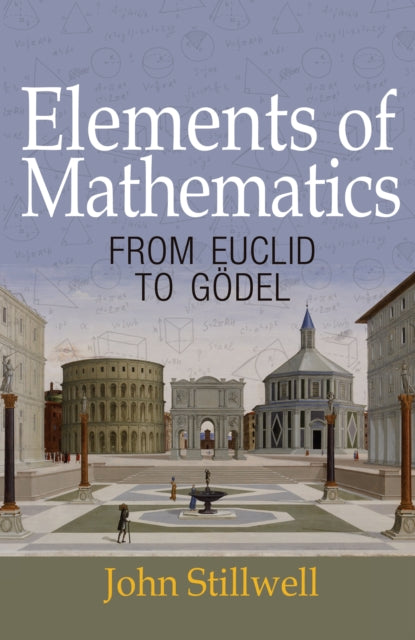
Princeton University Press Elements of Mathematics
Book SynopsisTrade Review"[Stillwell] writes clearly and engagingly... [Elements of Mathematics] can appeal to various constituencies at different levels of mathematical sophistication."--Mark Hunacek, MAA Reviews "A great exploration of elementary mathematics, its limitations, how infinity complicates things, and how various branches of mathematics fit together."--Antonio Cangiano, Math-Blog "Stillwell is ... One of the better current mathematical authors: he writes clearly and engagingly, and makes more of an effort than most to provide historical detail and a sense of how various mathematical ideas tie in with one another... The features we have learned to expect from Stillwell (including, but not limited to, excellent writing) are present in [Elements of Mathematics] as well."--MAA Reviews "An accessible read... Stillwell breaks down the basics, providing both historical and practical perspectives from arithmetic to infinity."--Gemma Tarlach, Discover "[A] sophisticated treatment of topics usually described as elementary."--John Allen Paulos "[Elements of Mathematics] is quite a tour de force, organized by areas of mathematics--arithmetic, computation, algebra, geometry, calculus, and so on--and in each area Stillwell manages to distill down the big ideas and the connections with other areas. He is a master expositor, and the text manages to be engaging and accessible without watering down the mathematics. I definitely learned new things from the book!"--Brent Yorgey, Math Less Traveled blog "From a lifetime of teaching, Stillwell has distilled some nice examples from the entire gamut of elementary mathematics."--Mathematical Reviews Clippings "[A] wonderful book... I think that [Elements of Mathematics] will itself become a modern classic and a reference work for anyone trying to learn basic topics in any of the major fields of mathematics."--Victor Katz, Bulletin of the American Mathematical Society "Elements of Mathematicsis a fine ... overview of the field of mathematics... The writing is clear, succinct, organized, and the diagrams [and] illustrations excellent... While some of the discussion is introductory or elementary, it always leads to deeper, more challenging ideas... [T]his will make a fine basic addition to most mathematicians' bookshelves."--Math Tango "Stillwell uses his broad and impressive command of mathematics to transport a reader through each topic and to a higher level of understanding and questioning."--Convergence "[A] wonderful book ... I think that [Elements of Mathematics] will itself become a modern classic and a reference work for anyone trying to learn basic topics in any of the major fields of mathematics."--Victor Katz, Bulletin of the American Mathematical Society "[Elements of Mathematics] is a book that everybody should read. You will be the better for it."--Reuben Hersh, American Mathematical MonthlyTable of Contents*Frontmatter, pg. i*Contents, pg. vii*Preface, pg. xi*1. Elementary Topics, pg. 1*2. Arithmetic, pg. 35*3. Computation, pg. 73*4. Algebra, pg. 106*5. Geometry, pg. 148*6. Calculus, pg. 193*7. Combinatorics, pg. 243*8. Probability, pg. 279*9. Logic, pg. 298*10. Some Advanced Mathematics, pg. 336*Bibliography, pg. 395*Index, pg. 405
£18.00
CRC Press The Magic Theorem
Book SynopsisThe Magic Theorem: a Greatly-Expanded, Much-Abridged Edition of The Symmetries of Things presents a wonderfully unique re-imagining of the classic book, The Symmetries of Things. Begun as a standard second edition by the original author team, it changed in scope following the passing of John Conway. This version of the book fulfils the original vision for the project: an elementary introduction to the orbifold signature notation and the theory behind it.The Magic Theorem features all the material contained in Part I of The Symmetries of Things, now redesigned and even more lavishly illustrated, along with new and engaging material suitable for a novice audience. This new book includes hands-on symmetry activities for the home or classroom and an online repository of teaching materials.
£26.08

CRC Press CurvedFolding Origami Design
The origami introduced in this book is based on simple techniques. Some were previously known by origami artists and some were discovered by the author. Curved-Folding Origami Design shows a way to explore new area of origami composed of curved folds. Each technique is introduced in a step-by-step fashion, followed by some beautiful artwork examples. A commentary explaining the theory behind the technique is placed at the end of each chapter.Features Explains the techniques for designing curved-folding origami in seven chapters Contains many illustrations and photos (over 140 figures), with simple instructions Contains photos of 24 beautiful origami artworks, as well as their crease patterns Some basic theories behind the techniques are introduced
£37.99

Taylor & Francis Ltd Encyclopedia of Knot Theory
Book SynopsisKnot theory is a fascinating mathematical subject, with multiple links to theoretical physics. This enyclopedia is filled with valuable information on a rich and fascinating subject. Ed Witten, Recipient of the Fields MedalI spent a pleasant afternoon perusing the Encyclopedia of Knot Theory. It's a comprehensive compilation of clear introductions to both classical and very modern developments in the field. It will be a terrific resource for the accomplished researcher, and will also be an excellent way to lure students, both graduate and undergraduate, into the field. Abigail Thompson, Distinguished Professor of Mathematics at University of California, Davis Knot theory has proven to be a fascinating area of mathematical research, dating back about 150 years. Encyclopedia of Knot Theory provides short, interconnected articles on a variety of active areas in knot theory, and includes beautiful pictures, deeTrade Review"Knot theory is a fascinating mathematical subject, with multiple links to theoretical physics. This enyclopedia is filled with valuable information on a rich and fascinating subject."– Ed Witten, Recipient of the Fields Medal"I spent a pleasant afternoon perusing the Encyclopedia of Knot Theory. It’s a comprehensive compilation of clear introductions to both classical and very modern developments in the field. It will be a terrific resource for the accomplished researcher, and will also be an excellent way to lure students, both graduate and undergraduate, into the field." – Abigail Thompson, Distinguished Professor of Mathematics at University of California, Davis "An encyclopedia is expected to be comprehensive, and to include independent expository articles on many topics. The Encyclopedia of Knot Theory is all this. This book will be an excellent introduction to topics in the field of knot theory for advanced undergraduates, graduate students, and researchers interested in knots from many directions."– MAA Reviews"Knot theory is an area of mathematics that requires no introduction, and while this massive tome is certainly no introductory text, it does give a panoramic — and, well, encyclopaedic — view of this vast subject.[. . . ] A book with such an ambitious remit is bound to contain omissions and oddities. [. . .] But this is a small point compared to what has been achieved by this encyclopaedia, which would make a fine addition to any personal or departmental library, or to a departmental coffee table."– London Mathematical SocietyThe Encyclopedia of Knot Theory is close to 1000 pages, and every section, article, paragraph, and sentence inspires the reader to want to learn more knot theory. A wonderful attribute of this text is the reference section at the end of each article as opposed to the end of the book. This allows readers to highlight different sources that will allow them to dive deeper into the topic of that section. [. . .] And while it is nearly impossible to include discussions of every branch of the knot theorytree, the editors made a great choice to focus on current topics showing how the area is still a living subject. [. . .] As a knot theory enthusiast, I truly enjoyed reading about topics I was more familiar with while also exploring topics that were new to me. As an educator, I am excited to share this book with my students and encourage them to read more articles on the topics. Some of the articles in the book include thoughtful open questions for researchers in the field to enjoy, while also providing background for anyone new to knot theory research to use as a foundation. All in all, I loved this text.– American Mathematical MonthlyTable of ContentsI Introduction and History of Knots. 1. Introduction to Knots. II Standard and Nonstandard Representations of Knots. 2. Link Diagrams. 3. Gauss Diagrams. 4. DT Codes. 5. Knot Mosaics. 6. Arc Presentations of Knots and Links. 7. Diagrammatic Representations of Knots and Links as Closed Braids. 8. Knots in Flows. 9. Multi-Crossing Number of Knots and Links. 10. Complementary Regions of Knot and Link Diagrams. 11. Knot Tabulation. III Tangles. 12. What Is a Tangle? 13. Rational and Non-Rational Tangles. 14. Persistent Invariants of Tangles. IV Types of Knots. 15. Torus Knots. 16. Rational Knots and Their Generalizations. 17. Arborescent Knots and Links. 18. Satellite Knots. 19. Hyperbolic Knots and Links. 20. Alternating Knots. 21. Periodic Knots. V Knots and Surfaces. 22. Seifert Surfaces and Genus. 23. Non-Orientable Spanning Surfaces for Knots. 24. State Surfaces of Links. 25. Turaev Surfaces. VI Invariants Defined in Terms of Min and Max. 26. Crossing Numbers. 27. The Bridge Number of a Knot. 28. Alternating Distances of Knots. 29. Superinvariants of Knots and Links. VII Other Knotlike Objects. 30. Virtual Knot Theory. 31. Virtual Knots and Surfaces. 32. Virtual Knots and Parity. 33. Forbidden Moves,Welded Knots and Virtual Unknotting. 34. Virtual Strings and Free Knots. 35. Abstract and Twisted Links. 36. What Is a Knotoid? 37. What Is a Braidoid? 38. What Is a Singular Knot? 39. Pseudoknots and Singular Knots. 40. An Introduction to the World of Legendrian and Transverse Knots 41. Classical Invariants of Legendrian and Transverse Knots. 42. Ruling and Augmentation Invariants of Legendrian Knots. VIII Higher Dimensional Knot Theory. 43. Broken Surface Diagrams and Roseman Moves. 44. Movies and Movie Moves. 45. Surface Braids and Braid Charts. 46. Marked Graph Diagrams and Yoshikawa Moves. 47. Knot Groups. 48. Concordance Groups. IX Spatial Graph Theory. 49. Spatial Graphs. 50. A Brief Survey on Intrinsically Knotted and Linked Graphs. 51. Chirality in Graphs. 52. Symmetries of Graphs Embedded in Sᶟ and Other 3-Manifolds. 53. Invariants of Spatial Graphs. 54. Legendrian Spatial Graphs. 55. Linear Embeddings of Spatial Graphs. 56. Abstractly Planar Spatial Graphs. X Quantum Link Invariants. 57. Quantum Link Invariants. 58. Satellite and Quantum Invariants. 59. Quantum Link Invariants: From QYBE and Braided Tensor Categories. 60. Knot Theory and Statistical Mechanics. XI Polynomial Invariants. 61. What Is the Kauffman Bracket? 62. Span of the Kauffman Bracket and the Tait Conjectures. 63. Skein Modules of 3-Manifold. 64. The Conway Polynomial. 65. Twisted Alexander Polynomials. 66. The HOMFLYPT Polynomial. 67. The Kauffman Polynomials. 68. Kauffman Polynomial on Graphs. 69. Kauffman Bracket Skein Modules of 3-Manifolds. XII Homological Invariants. 70. Khovanov Link Homology. 71. A Short Survey on Knot Floer Homolog. 72. An Introduction to Grid Homology. 73. Categorification. 74. Khovanov Homology and the Jones Polynomial. 75. Virtual Khovanov Homology. XIII Algebraic and Combinatorial Invariants. 76. Knot Colorings. 77. Quandle Cocycle Invariants. 78. Kei and Symmetric Quandles. 79. Racks, Biquandles and Biracks. 80. Quantum Invariants via Hopf Algebras and Solutions to the Yang-Baxter Equation. 81. The Temperley-Lieb Algebra and Planar Algebras. 82. Vassiliev/Finite Type Invariants. 83. Linking Number and Milnor Invariants. XIV Physical Knot Theory. 84. Stick Number for Knots and Links. 85. Random Knots. 86. Open Knots. 87. Random and Polygonal Spatial Graphs. 88. Folded Ribbon Knots in the Plane. XV Knots and Science. 89. DNA Knots and Links. 90. Protein Knots, Links, and Non-Planar Graphs. 91. Synthetic Molecular Knots and Links.
£48.99

Cambridge University Press Nonnegative Matrices and Applications
Book SynopsisAn integrated approach to the theory of nonnegative matrices, emphasising connections with game theory, optimisation, mathematical programming, mathematical economics and statistics. The minimal prerequisites make this accessible to new graduate students.Trade Review"It is a great work; great by its dimensions, written with extreme love and care, concentrating the knowledge of a generation which was supreme in the history of matrix theory. It is a very illuminating and highly readable exposition of interesting topics which are of great relevance both to theory and applications." Mathematical Reviews Clippings 98hTable of ContentsPreface; 1. Perron-Frobenius theory and matrix games; 2. Doubly stochastic matrices; 3. Inequalities; 4. Conditionally positive definite matrices; 5. Topics in combinatorial theory; 6. Scaling problems and their applications; 7. Special matrices in economic models; References; Index; Author index.
£122.55

Cambridge University Press Derivation and Computation
Book SynopsisThe is an introduction to simple type theory, exploring the relationship between proof and calculation. Each of its 52 sections ends with a set of exercises, some 200 in total. These are designed to help the reader get to grips with the subject. An appendix contains complete solutions to them.Trade Review'A well-written introduction to proof theory and its connections with computability.' Leon Harkleroad, Zentralblatt für Mathematik'… recommended for the student or researcher who's been exposed to bits and pieces of the Curry-Howard correspondence, but wants a sharper idea of the big picture and is willing to work through the exercises to see how the details fit together. Simmons has succeeded in pulling together the main fruits of the correspondence for simple types in a single text. … It can't be emphasized enough that the great thing about this book is its many well-chosen completely solved exercises. This alone makes it a valuable text, especially for self-study.' ACM SIGACT NewsTable of ContentsIntroduction; Preview; Part I. Development and Exercises: 1. Derivation systems; 2. Computation mechanisms; 3. The typed combinator calculus; 4. The typed l-calculus; 5. Substitution algorithms; 6. Applied l-calculi; 7. Multi-recursive arithmetic; 8. Ordinals and ordinal notation; 9. Higher order recursion; Part II. Solutions: A. Derivation systems; B. Computation mechanisms; C. The typed combinator calculus; D. The typed l-calculus; E. Substitution algorithms; F. Applied l-calculi; G. Multi-recursive arithmetic; H. Ordinals and ordinal notation; I. Higher order recursion; Postview; Bibliography; Commonly used symbols; Index.
£122.55

Cambridge University Press Affine Hecke Algebras and Orthogonal Polynomials 157 Cambridge Tracts in Mathematics Series Number 157
a huge range and FREE tracked UK delivery on ALL orders.
£107.35

Taylor & Francis Ltd Expanding Mathematical Toolbox Interweaving
Book SynopsisExpanding Mathematical Toolbox: Interweaving Topics, Problems, and Solutions offers several topics from different mathematical disciplines and shows how closely they are related. The purpose of this book is to direct the attention of readers who have an interest in and talent for mathematics to engaging and thought-provoking problems that should help them change their ways of thinking, entice further exploration and possibly lead to independent research and projects in mathematics. In spite of the many challenging problems, most solutions require no more than a basic knowledge covered in a high-school math curriculum.To shed new light on a deeper appreciation for mathematical relationships, the problems are selected to demonstrate techniques involving a variety of mathematical ideas. Included are some interesting applications of trigonometry, vector algebra and Cartesian coordinate system techniques, and geometrical constructions and inversion in solving mechanical engineering problems and in studying models explaining non-Euclidean geometries.This book is primarily directed at secondary school teachers and college professors. It will be useful in teaching mathematical reasoning because it emphasizes how to teach students to think creatively and strategically and how to make connections between math disciplines. The text also can be used as a resource for preparing for mathematics Olympiads. In addition, it is aimed at all readers who want to study mathematics, gain deeper understanding and enhance their problem-solving abilities. Readers will find fresh ideas and topics offering unexpected insights, new skills to expand their horizons and an appreciation for the beauty of mathematics.Trade ReviewThis is a collection of mathematical theory and exercises organized in chapters, each one devoted to a different topic (geometrical constructions, Euclidean vectors, inequalities, trigonometry, etc.). The format of each chapter is a general introduction about the topic including some theory followed by a, usually short, problem formulation, and an extensive discussion of the solution which may include more theory and proofs, triggering new exercises etc. Emphasis is on the interaction of topics that are usually treated separately in classical text books. The assumed mathematical knowledge of the reader is at the level of secondary schools or beginning university.The problems can look astonishingly difficult at first sight, baffling the reader. Applying straightforward methods, is usually not the way to solve them. The proposed solution may illustrate some clever trick that makes the problem easy to solve. So the problem formulation is supposed to trigger curiosity and stimulate to look for the appropriate key to crack it. The diversity of the topics and the kind of problems, gives it the allure of a puzzle book. Thinking outside the box and recognizing patterns is often more important than the mathematical prerequisites. The latter are provided anyway, including proofs, either in the solution or in the appendix. There are also excursions beyond the exercises, like for example a short introduction to non-Euclidean geometry.So this is an unusual mixture of theory and exercises. The latter are certainly not of the drilling type, some even reach the level of mathematical Olympiads. Most problems have some geometrical aspect, even the algebraic ones, because these problems are easier to understand by a general public. This implies that calculus and analysis are more in the background. It is an excellent book to prepare for mathematics Olympiads, and teachers may find here inspiration for their lessons.Reviewer: Adhemar Bultheel (Leuven)MSC:00A09Popularization of mathematics51-01Introductory exposition (textbooks, tutorial papers, etc.) pertaining to geometryKeywords:geometry; algebraic geometry; trigonometry; Euclidean vector space; puzzles; math Olympiad; inequalitiesThis is a collection of mathematical theory and exercises organized in chapters, each one devoted to a different topic (geometrical constructions, Euclidean vectors, inequalities, trigonometry, etc.). The format of each chapter is a general introduction about the topic including some theory followed by a, usually short, problem formulation, and an extensive discussion of the solution which may include more theory and proofs, triggering new exercises etc. Emphasis is on the interaction of topics that are usually treated separately in classical text books. The assumed mathematical knowledge of the reader is at the level of secondary schools or beginning university.The problems can look astonishingly difficult at first sight, baffling the reader. Applying straightforward methods, is usually not the way to solve them. The proposed solution may illustrate some clever trick that makes the problem easy to solve. So the problem formulation is supposed to trigger curiosity and stimulate to look for the appropriate key to crack it. The diversity of the topics and the kind of problems, gives it the allure of a puzzle book. Thinking outside the box and recognizing patterns is often more important than the mathematical prerequisites. The latter are provided anyway, including proofs, either in the solution or in the appendix. There are also excursions beyond the exercises, like for example a short introduction to non-Euclidean geometry.So this is an unusual mixture of theory and exercises. The latter are certainly not of the drilling type, some even reach the level of mathematical Olympiads. Most problems have some geometrical aspect, even the algebraic ones, because these problems are easier to understand by a general public. This implies that calculus and analysis are more in the background. It is an excellent book to prepare for mathematics Olympiads, and teachers may find here inspiration for their lessons.Reviewer: Adhemar Bultheel (Leuven)MSC:00A09Popularization of mathematics51-01Introductory exposition (textbooks, tutorial papers, etc.) pertaining to geometryKeywords:geometry; algebraic geometry; trigonometry; Euclidean vector space; puzzles; math Olympiad; inequalitiesTable of Contents1. Beauty in Mathematics. 2. Euclidean Constructions. 3. Inversion and its properties. 4. Using Geometry for Algebra. Classic Mean Averages’ geometrical interpretations. 5. Using Algebra for Geometry. 6. Trigonometrical explorations. 7. Euclidean Vectors. 8. Cartesian coordinates in problem solving. 9. Inequalities Wonderland. 10. Guess and Check game.
£45.99

Taylor & Francis Ltd Sports Math
Book SynopsisCan you really keep your eye on the ball? How is massive data collection changing sports?Sports science courses are growing in popularity. The author's course at Roanoke College is a mix of physics, physiology, mathematics, and statistics. Many students of both genders find it exciting to think about sports. Sports problems are easy to create and state, even for students who do not live sports 24/7. Sports are part of their culture and knowledge base, and the opportunity to be an expert on some area of sports is invigorating. This should be the primary reason for the growth of mathematics of sports courses: the topic provides intrinsic motivation for students to do their best work.From the Author:The topics covered in Sports Science and Sports Analytics courses vary widely. To use a golfing analogy, writing a book like this is like hitting a drive at a driving range; there are many Trade ReviewThe book is written at a level that is accessible to a large audience. It contains a small number of applications that make use of calculus; otherwise, only a high school level mathematics background is required. Furthermore, one can easily skip over those sections that require calculus and still have plenty of accessible material to read.Sports Math is well written and easy to read. The book should appeal to anyone interested in the quantitative aspects of athletics. Each chapter of the books ends with a fairly large number of exercises and also pointers to further reading. Thus, the book could be used not only as a textbook for a course but also as a nice resource for student projects.~Mathematical Reviews, 2017Minton presents a textbook based on the current status of a sport science course that has evolved since he began teaching it in 1988. He offers a sample of topics that he knows something about and finds interesting, and hopes that instructors and students will find the book useful. His topics are projectile motion, rotational motion, sports illusions, collisions, ratings systems, voting systems, saber- and other metrics, randomness in sports, sports strategies, and big data and beyond.~ProtoView, 2017 This work discusses how mathematics is used to analyze popular American sports like football, baseball, and basketball. Minton (mathematics, Roanoke College) has based this book on several of his undergraduate courses. The book covers two major aspects: the physics involved in sports (e.g., the motion of a ball) and the statistics used to make probabilistic ratings of performance and success. The beginning chapters consider topics from mechanics, such as “Projectile Motion,” “Rotational Motion,” and “Collisions.” The rest of the text is devoted to statistics used in sports ratings and analysis, with many examples from specific games played in the big leagues or by major colleges. The material covered is selective and quirky; the level of analytical mathematics and statistics ranges from simple to advanced, including calculus, matrixes, and game theory. Each chapter has solved examples and end-of-chapter questions, problems, and suggestions for projects. There are pictures and graphs interspersed throughout the text. The book is not suitable as a standard text in any conventional course—it will best serve as a supplement.--N. Sadanand, Central Connecticut State University 2018The book is written at a level that is accessible to a large audience. It contains a small number of applications that make use of calculus; otherwise, only a high school level mathematics background is required. Furthermore, one can easily skip over those sections that require calculus and still have plenty of accessible material to read.Sports Math is well written and easy to read. The book should appeal to anyone interested in the quantitative aspects of athletics. Each chapter of the books ends with a fairly large number of exercises and also pointers to further reading. Thus, the book could be used not only as a textbook for a course but also as a nice resource for student projects.~Mathematical Reviews, 2017Minton presents a textbook based on the current status of a sport science course that has evolved since he began teaching it in 1988. He offers a sample of topics that he knows something about and finds interesting, and hopes that instructors and students will find the book useful. His topics are projectile motion, rotational motion, sports illusions, collisions, ratings systems, voting systems, saber- and other metrics, randomness in sports, sports strategies, and big data and beyond.~ProtoView, 2017This work discusses how mathematics is used to analyze popular American sports like football, baseball, and basketball. Minton (mathematics, Roanoke College) has based this book on several of his undergraduate courses. The book covers two major aspects: the physics involved in sports (e.g., the motion of a ball) and the statistics used to make probabilistic ratings of performance and success. The beginning chapters consider topics from mechanics, such as “Projectile Motion,” “Rotational Motion,” and “Collisions.” The rest of the text is devoted to statistics used in sports ratings and analysis, with many examples from specific games played in the big leagues or by major colleges. The material covered is selective and quirky; the level of analytical mathematics and statistics ranges from simple to advanced, including calculus, matrixes, and game theory. Each chapter has solved examples and end-of-chapter questions, problems, and suggestions for projects. There are pictures and graphs interspersed throughout the text. The book is not suitable as a standard text in any conventional course—it will best serve as a supplement.--N. Sadanand, Central Connecticut State University 2018Table of ContentsProjectile Motion. Rotational Motion. Sports Illusions. Collisions. Rating Systems. Voting Systems. Saber- and Other Metrics. Randomness in Sports. In-Game Strategies. Predictive Analytics.
£43.99

CRC Press Teaching and Learning Mathematics Online
Book SynopsisTeaching and Learning Mathematics Online, Second Edition continues to present meaningful and practical solutions for teaching mathematics and statistics online. It focuses on the problems observed by mathematics instructors currently working in the field who strive to hone their craft and share best practices with the community. The book provides a set of standard practices, improving the quality of online teaching and the learning of mathematics. Instructors will benefit from learning new techniques and approaches to delivering content. New to the Second Edition Nine brand new chapters Reflections on the lessons of COVID-19 Explorations of new technological opportunities.
£51.29

CRC Press Number Systems
Book SynopsisNumber Systems: A Path into Rigorous Mathematics aims to introduce number systems to an undergraduate audience in a way that emphasises the importance of rigour, and with a focus on providing detailed but accessible explanations of theorems and their proofs.The book continually seeks to build upon students' intuitive ideas of how numbers and arithmetic work, and to guide them towards the means to embed this natural understanding into a more structured framework of understanding. The authorâs motivation for writing this book is that most previous texts, which have complete coverage of the subject, have not provided the level of explanation needed for first-year students. On the other hand, those that do give good explanations tend to focus broadly on Foundations or Analysis and provide incomplete coverage of Number Systems.Features Approachable for first year undergraduates, but still of interest to more advanced students and postgraduates Does not merely present definitions, theorems and proofs, but also motivates them in terms of intuitive knowledge and discusses methods of proof Draws attention to connections with other areas of mathematics Plenty of exercises for students, both straightforward problems and more in-depth investigations Introduces many concepts that are required in more advanced topics in mathematicsNew to the second edition Complete solutions to all exercises, and hints for the in-depth investigations Extensive changes to chapters 4 and 5, including defining integral domains as distinct from commutative rings, a more complete discussion of irreducibles, primes and unique factorisation, and more topics in elementary number theory A completely revised chapter 8, giving a more coherent account of quadratic rings and their unique (or non-unique) factorisation properties A thorough correction of typos and errors across all chapters Updates to the bibliography
£50.34

Cambridge University Press Fourier Analysis 85 London Mathematical Society Student Texts Series Number 85
Book SynopsisFourier analysis aims to decompose functions into a superposition of simple trigonometric functions, whose special features can be exploited to isolate specific components into manageable clusters before reassembling the pieces. This two-volume text presents a largely self-contained treatment, comprising not just the major theoretical aspects (Part I) but also exploring links to other areas of mathematics and applications to science and technology (Part II). Following the historical and conceptual genesis, this book (Part I) provides overviews of basic measure theory and functional analysis, with added insight into complex analysis and the theory of distributions. The material is intended for both beginning and advanced graduate students with a thorough knowledge of advanced calculus and linear algebra. Historical notes are provided and topics are illustrated at every stage by examples and exercises, with separate hints and solutions, thus making the exposition useful both as a course Trade Review'[Fourier Analysis: Volume l - Theory is] fabulous … Constantin structures his exercise sets beautifully, I think: they are abundant and long, covering a spectrum of levels of difficulty; each set is followed immediately by a section of hints (in one-one correspondence); finally the hints sections are followed by very detailed and well-written solutions (also bijectively). Can there be any clearer homage to the maxim that to learn mathematics one has to get one's hands really dirty? To boot, attention to detail is ubiquitous: it's everywhere in Constantin's presentation of proofs and arguments, as well as examples, all throughout the narrative itself. The entire presentation is very much to the point and the student who works through this book will come out knowing some real mathematics very well.' Michael Berg, MAA ReviewsTable of Contents1. Introduction; 2. The Lebesgue measure and integral; 3. Elements of functional analysis; 4. Convergence results for Fourier series; 5. Fourier transforms; 6. Multi-dimensional Fourier analysis; 7. A glance at some advanced topics; Appendix: historical notes; References; Index.
£42.74

CRC Press The Shape of Space
Book SynopsisThe Shape of Space, Third Edition maintains the standard of excellence set by the previous editions. This lighthearted textbook covers the basic geometry and topology of two- and three-dimensional spacesâstretching studentsâ minds as they learn to visualize new possibilities for the shape of our universe.Written by a master expositor, leading researcher in the field, and MacArthur Fellow, its informal exposition and engaging exercises appeal to an exceptionally broad audience, from liberal arts students to math undergraduate and graduate students looking for a clear intuitive understanding to supplement more formal texts, and even to laypeople seeking an entertaining self-study book to expand their understanding of space.Features of the Third Edition: Full-color figures throughout Picture proofs have replaced algebraic proofs Simpler handles-and-crosscaps approach to surfaces Updated discussiTable of ContentsPart I Surfaces and Three-Manifolds Flatland Gluing Vocabulary Orientability Classification of Surfaces Products Flat Manifolds Orientability vs. Two-Sidedness Part II Geometries on Surfaces The Sphere The Hyperbolic Plane Geometries on Surfaces Gauss-Bonnet Formula and Euler Number Part III Geometries on Three-Manifolds Four-Dimensional Space The Hypersphere Hyperbolic Space Geometries on Three-Manifolds I Bundles Geometries on Three-Manifolds II Part IV The Universe The Universe The History of Space Appendix A: Answers Appendix B: Bibliography Appendix C: Conway’s ZIP Proof
£128.25
Taylor & Francis Ltd Quantifying Counterfactual Military History
Book SynopsisForces shaping human history are complex, but the course of history is undeniably changed on many occasions by conscious acts. These may be premeditated or responsive, calmly calculated or performed under great pressure. They may also be successful or catastrophic, but how are historians to make such judgements and appeal to evidence in support of their conclusions? Further, and crucially, how exactly are we to distinguish probable unrealized alternatives from improbable ones? This book describes some of the modern statistical techniques that can begin to answer this question, as well as some of the difficulties in doing so. Using simple, well-quantified cases drawn from military history, we claim that statistics can now help us to navigate the near-truths, the envelope around the events with which any meaningful historical analysis must deal, and to quantify the basis of such analysis. Quantifying Counterfactual Military History is intended for a general audience who are intTable of Contents1. Could History Have Been Otherwise? 2. Could the Germans Have Won the Battle of Jutland? 3. Could the Germans Have Won the Battle of Britain? 4. Could the United States Have Prevailed in Vietnam? 5. The Road to Able Archer: Counterfactual Reasoning and the Dangerous History of Nuclear Deterrence 1945–1983 6. Conclusions
£23.99

Taylor & Francis Inc Mathematical Puzzles: A Connoisseur's Collection
Book SynopsisCollected over several years by Peter Winkler, of Bell Labs, dozens of elegant, intriguing challenges are presented in Mathematical Puzzles. The answers are easy to explain, but without this book, devilishly hard to find. Creative reasoning is the key to these puzzles. No involved computation or higher mathematics is necessary, but your ability to construct a mathematical proof will be severly tested--even if you are a professional mathematician. For the truly adventurous, there is even a chapter on unsolved puzzles.Trade Review" Winkler's book will certainly appeal to the mathematician, as well as to students of all ages—high-school, college, and graduate. His philosophy of what constitutes a good puzzle is right on the mark, showing that this Connoisseur's Collection really is of quality and depth. -James Tanton, MAA Online, September 2004 ""I have gained great satisfaction from those [puzzles] I've managed to solve . . . This is a great collection of seriously hard questions."" -The Mathematical Gazette, March 2006 ""As an enthusiastic solver and collector of mathematical puzzles myself, I was absolutely delighted with this book. The sheer density of mathematical ideas and challenges sets it apart from other books of a similar nature while the lucid yet informal style of exposition makes the journey from ignorance to enlightenment enjoyable."" -Norman Do, The Australian Mathematical Society Gazette, July 2004"Table of ContentsPreface, Insight, Numbers, Combinatorics, Probability, Geometry, Geography(!), Games, Algorithms, More Games, Handicaps, Toughies, Unsolved Puzzles, Afterword, Index of Puzzles
£27.84
Taylor & Francis Inc 3D Math Primer for Graphics and Game Development
Book SynopsisThis engaging book presents the essential mathematics needed to describe, simulate, and render a 3D world. Reflecting both academic and in-the-trenches practical experience, the authors teach you how to describe objects and their positions, orientations, and trajectories in 3D using mathematics. The text provides an introduction to mathematics for game designers, including the fundamentals of coordinate spaces, vectors, and matrices. It also covers orientation in three dimensions, calculus and dynamics, graphics, and parametric curves.Trade Review"With solid theory and references, along with practical advice borne from decades of experience, all presented in an informal and demystifying style, Dunn & Parberry provide an accessible and useful approach to the key mathematical operations needed in 3D computer graphics."—Eric Haines, author of Real-Time Rendering"The book describes the mathematics involved in game development in a very clear and easy to understand way, layered on the practical background of years of game engine programming experience."—Wolfgang Engel, editor of GPU ProTable of ContentsCartesian Coordinate Systems. Vectors. Multiple Coordinate Spaces. Introduction to Matrices. Matrices and Linear Transformations. More on Matrices. Polar Coordinate Systems. Rotation in Three Dimensions. Geometric Primitives. Mathematical Topics from 3D Graphics. Mechanics 1: Linear Kinematics and Calculus. Mechanics 2: Linear and Rotational Dynamics. Curves in 3D. Afterword. Appendices. Bibliography. Index.
£105.00

Baby Professor Simple Addition & Subtraction First Grade Math
Book Synopsis
£10.19

Lulu.com Simple Patterns In Mathematics: True Patterns of
Book Synopsis
£63.13
Springer Nature Switzerland AG Foundations of Finitely Supported Structures: A Set Theoretical Viewpoint
a huge range and FREE tracked UK delivery on ALL orders.
£85.49

Springer International Publishing AG The Real Numbers: An Introduction to Set Theory
Book SynopsisWhile most texts on real analysis are content to assume the real numbers, or to treat them only briefly, this text makes a serious study of the real number system and the issues it brings to light. Analysis needs the real numbers to model the line, and to support the concepts of continuity and measure. But these seemingly simple requirements lead to deep issues of set theory—uncountability, the axiom of choice, and large cardinals. In fact, virtually all the concepts of infinite set theory are needed for a proper understanding of the real numbers, and hence of analysis itself.By focusing on the set-theoretic aspects of analysis, this text makes the best of two worlds: it combines a down-to-earth introduction to set theory with an exposition of the essence of analysis—the study of infinite processes on the real numbers. It is intended for senior undergraduates, but it will also be attractive to graduate students and professional mathematicians who, until now, have been content to "assume" the real numbers. Its prerequisites are calculus and basic mathematics.Mathematical history is woven into the text, explaining how the concepts of real number and infinity developed to meet the needs of analysis from ancient times to the late twentieth century. This rich presentation of history, along with a background of proofs, examples, exercises, and explanatory remarks, will help motivate the reader. The material covered includes classic topics from both set theory and real analysis courses, such as countable and uncountable sets, countable ordinals, the continuum problem, the Cantor–Schröder–Bernstein theorem, continuous functions, uniform convergence, Zorn's lemma, Borel sets, Baire functions, Lebesgue measure, and Riemann integrable functions.Trade Review“This is a book of both analysis and set theory, and the analysis begins at an elementary level with the necessary treatment of completeness of the reals. … the analysis makes it valuable to the serious student, say a senior or first-year graduate student. … Stillwell’s book can work well as a text for the course in foundations, with its good treatment of the cardinals and ordinals. … This enjoyable book makes the connection clear.” (James M. Cargal, The UMAP Journal, Vol. 38 (1), 2017)“This book is an interesting introduction to set theory and real analysis embedded in properties of the real numbers. … The 300-plus problems are frequently challenging and will interest both upper-level undergraduate students and readers with a strong mathematical background. … A list of approximately 100 references at the end of the book will help students to further explore the topic. … Summing Up: Recommended. Lower-division undergraduates.” (D. P. Turner, Choice, Vol. 51 (11), August, 2014)“This is an informal look at the nature of the real numbers … . There are extensive historical notes about the evolution of real analysis and our understanding of real numbers. … Stillwell has deliberately set out to provide a different sort of construction where you understand what the foundation is supporting and why it is important. I think this is very successful, and his book … is much more informative and enjoyable.” (Allen Stenger, MAA Reviews, February, 2014)“This book will be fully appreciated by either professional mathematicians or those students, who already have passed a course in analysis or set theory. … The book contains a quantity of motivation examples, worked examples and exercises, what makes it suitable also for self-study.” (Vladimír Janiš, zbMATH, 2014)“The book offers a rigorous foundation of the real number system. It is intended for senior undergraduates who have already studied calculus, but a wide range of readers will find something interesting, new, or instructive in it. … This is an extremely reader-friendly book. It is full of interesting examples, very clear explanations, historical background, applications. Each new idea comes after proper motivation.” (László Imre Szabó, Acta Scientiarum Mathematicarum (Szeged), Vol. 80 (1-2), 2014)Table of ContentsThe Fundamental Questions.- From Discrete to Continuous.- Infinite Sets.- Functions and Limits.- Open Sets and Continuity.- Ordinals.- The Axiom of Choice.- Borel Sets.- Measure Theory.- Reflections.- Bibliography.- Index.
£32.39
Birkhauser Verlag AG Number Theory: An Introduction via the Density of
Book SynopsisNow in its second edition, this textbook provides an introduction and overview of number theory based on the density and properties of the prime numbers. This unique approach offers both a firm background in the standard material of number theory, as well as an overview of the entire discipline. All of the essential topics are covered, such as the fundamental theorem of arithmetic, theory of congruences, quadratic reciprocity, arithmetic functions, and the distribution of primes. New in this edition are coverage of p-adic numbers, Hensel's lemma, multiple zeta-values, and elliptic curve methods in primality testing.Key topics and features include: A solid introduction to analytic number theory, including full proofs of Dirichlet's Theorem and the Prime Number Theorem Concise treatment of algebraic number theory, including a complete presentation of primes, prime factorizations in algebraic number fields, and unique factorization of ideals Discussion of the AKS algorithm, which shows that primality testing is one of polynomial time, a topic not usually included in such texts Many interesting ancillary topics, such as primality testing and cryptography, Fermat and Mersenne numbers, and Carmichael numbers The user-friendly style, historical context, and wide range of exercises that range from simple to quite difficult (with solutions and hints provided for select exercises) make Number Theory: An Introduction via the Density of Primes ideal for both self-study and classroom use. Intended for upper level undergraduates and beginning graduates, the only prerequisites are a basic knowledge of calculus, multivariable calculus, and some linear algebra. All necessary concepts from abstract algebra and complex analysis are introduced where needed.Trade Review“In this text, Fine (mathematics, Fairfield Univ.) and Rosenberger (Univ. of Hamburg, Germany) successfully present number theory from the inception of primes to recent developments in algebraic and analytic number theory and cryptography. … Numerous exercises and open problems are provided. The breadth and depth of topics covered are impressive, making this an excellent text for those interested in the field of number theory. Summing Up: Recommended. Upper-division undergraduates and graduate students.” (J. T. Zerger, Choice, Vol. 54 (9), May, 2017)“The book is chatty and leisurely, with lots of historical notes and lots of worked examples. The exercises at the end of each chapter are good and there are a reasonable number of them. … a good text for an introductory course … .” (Allen Stenger, MAA Reviews, maa.org, November, 2016)Table of ContentsIntroduction and Historical Remarks.- Basic Number Theory.- The Infinitude of Primes.- The Density of Primes.- Primality Testing: An Overview.- Primes and Algebraic Number Theory.- The Fields Q_p of p-adic Numbers: Hensel's Lemma.- References.- Index.
£44.99

Springer International Publishing AG Martin Davis on Computability, Computational
Book SynopsisThis book presents a set of historical recollections on the work of Martin Davis and his role in advancing our understanding of the connections between logic, computing, and unsolvability. The individual contributions touch on most of the core aspects of Davis’ work and set it in a contemporary context. They analyse, discuss and develop many of the ideas and concepts that Davis put forward, including such issues as contemporary satisfiability solvers, essential unification, quantum computing and generalisations of Hilbert’s tenth problem. The book starts out with a scientific autobiography by Davis, and ends with his responses to comments included in the contributions. In addition, it includes two previously unpublished original historical papers in which Davis and Putnam investigate the decidable and the undecidable side of Logic, as well as a full bibliography of Davis’ work. As a whole, this book shows how Davis’ scientific work lies at the intersection of computability, theoretical computer science, foundations of mathematics, and philosophy, and draws its unifying vision from his deep involvement in Logic.Trade Review“It is welcome indeed to have the book under review on my desk and in my possession, particularly given that it’s something of a Festschrift, sporting all sorts of goodies. … To real logicians or even to folks like me … this is a wonderful book to have.” (Michael Berg, MAA Reviews, January 2018)Table of ContentsChapter 1. My Life as a Logician (Martin Davis).- Chapter 2. Martin Davis and Hilbert’s Tenth Problem (Yuri Matiyasevich).- Chapter 3. Extensions of Hilbert’s Tenth Problem: Definability and Decidability in Number Theory (Alexandra Shlapentokh).- Chapter 4. A Story of Hilbert’s Tenth Problem (Laura Elena Morales Guerrero).- Chapter 5. Hyperarithmetical Sets (Yiannis N. Moschovakis).- Chapter 6. Honest Computability and Complexity (Udi Boker and Nachum Dershowitz).- Chapter 7. Why Post Did [Not] Have Turing’s Thesis (Wilfried Sieg).- Chapter 8. On Quantum Computation, Anyons, and Categories (Andreas Blass).
£80.99

Springer-Verlag Berlin and Heidelberg GmbH & Co. KG Parameterized Complexity in the Polynomial Hierarchy: Extending Parameterized Complexity Theory to Higher Levels of the Hierarchy
Book SynopsisParameterized Complexity in the Polynomial Hierarchy was co-recipient of the E.W. Beth Dissertation Prize 2017 for outstanding dissertations in the fields of logic, language, and information. This work extends the theory of parameterized complexity to higher levels of the Polynomial Hierarchy (PH). For problems at higher levels of the PH, a promising solving approach is to develop fixed-parameter tractable reductions to SAT, and to subsequently use a SAT solving algorithm to solve the problem. In this dissertation, a theoretical toolbox is developed that can be used to classify in which cases this is possible. The use of this toolbox is illustrated by applying it to analyze a wide range of problems from various areas of computer science and artificial intelligence.Table of ContentsComplexity Theory and Non-determinism.- Parameterized Complexity Theory.- Fpt-Reducibility to SAT.- The Need for a New Completeness Theory.- A New Completeness Theory.- Fpt-algorithms with Access to a SAT Oracle.- Problems in Knowledge Representation and Reasoning.- Model Checking for Temporal Logics.- Problems Related to Propositional Satisfiability.- Problems in Judgment Aggregation.- Planning Problems.- Graph Problems.- Relation to Other Topics in Complexity Theory.- Subexponential-Time Reductions.- Non-Uniform Parameterized Complexity.- Open Problems and Future Research Directions.- Conclusion.- Compendium of Parameterized Problems.- Generalization to Higher Levels of the Polynomial Hierarchy.
£62.99

Up to Change AB My Little Big Math Book
Book Synopsis
£17.21


