
History of mathematics Books
Springer Research Connections
Book SynopsisChapter 1: On Partially Ordered Sets and the 1/3-2/3 Conjecture.- Chapter 2: Group Actions and Riemann Surfaces.- Chapter 3: Challenges in Using Data for Public Policy Decisions.- Chapter 4: A Taste of Discretized Differential Geometry: Communicating Mathematics With Conceptual Metaphor.- Chapter 5: The Scholarship of Teaching and Learning.- Chapter 6: My Journey In Geometry.- Chapter 7: Continued Fractions Connecting Number Theory, Dynamical Systems, And Hyperbolic Geometry.- Chapter 8: Stochastic Models in Biology.- Chapter 9: Finding Your Path.
£113.99
Birkhäuser Bernhard Riemann On the Hypotheses Which Lie at the Bases of Geometry
Book SynopsisIntroduction.- Historical background.- Riemann's habilitation.- Presentation of the texts.- Reception and impact on history.- Modern research.- Bibliography.
£116.99

De Gruyter Thabit ibn Qurra: Science and Philosophy in
Book SynopsisThabit ibn Qurra (826–901) was one of history’s most original thinkers and displayed expertise in the most difficult disciplines of this time: geometry, number theory, and astronomy as well as ontology, physics, and metaphysics. Approximately a dozen of this shorter mathematical and philosophical writings are collected in this volume. Critically edited with accompanying commentary, these writings show how Thabit Ibn Qurra developed and reconceived the intellectual inheritance of ancient Greece in all areas of knowledge.
£175.50
Birkhauser Verlag AG Architecture and Mathematics from Antiquity to the Future: Volume I: Antiquity to the 1500s
Book SynopsisEvery age and every culture has relied on the incorporation of mathematics in their works of architecture to imbue the built environment with meaning and order. Mathematics is also central to the production of architecture, to its methods of measurement, fabrication and analysis. This two-volume edited collection presents a detailed portrait of the ways in which two seemingly different disciplines are interconnected. Over almost 100 chapters it illustrates and examines the relationship between architecture and mathematics. Contributors of these chapters come from a wide range of disciplines and backgrounds: architects, mathematicians, historians, theoreticians, scientists and educators. Through this work, architecture may be seen and understood in a new light, by professionals as well as non-professionals.Volume I covers architecture from antiquity through Egyptian, Mayan, Greek, Roman, Medieval, Inkan, Gothic and early Renaissance eras and styles. The themes that are covered range from symbolism and proportion to measurement and structural stability. From Europe to Africa, Asia and South America, the chapters span different countries, cultures and practices.Trade Review“It presents several alternative historical and theoretical contexts of the relationship between architecture and mathematics which has been pushed to the foreground during the past decades with the increasing use of computer-aided design in their profession … . Historians of mathematics, too, will no doubt find useful material here for their research, especially if they are interested in the more practical concerns that have shaped the development of their field … .” (Yelda Nasifoglu, BSHM Bulletin, Vol. 31 (3), October, 2016)“The study of connections between mathematics and the arts has grown considerably in recent decades, influenced by the work of Doris Schattschneider, Jay Kappraff, and Michele Emmer, among others. The use of mathematics is particularly a necessity in architecture, so the present set is welcome. … This is a valuable resource for mathematics, architecture, and the arts in general. Summing Up: Highly recommended. All readers.” (C. A. Gorini, Choice, Vol. 53 (2), October, 2015)“The ambitious goal is to describe both the intimate relation but also the alienation between mathematics and architecture and between mathematicians and architects. … It is an important and highly inspiring collection of papers that will be of interest to researchers from as many disciplines as illustrated by the diversity of the background of the authors. … Highly recommended for readers who do not want to drown or hide in their own abyss of specialization.” (Adhemar Bultheel, euro-math-soc.eu, June, 2015)Table of ContentsPart I: Introduction.- Part II: From 2000 BC to 300AD.- Part III: Theories of Measurement and Structure.- Part IV: From 1100 AD to 1400 AD.- Part V: Theories of Proportion, Symmetry, Periodicity.- Part VI: From 1500 AD to 1600 AD.- Index.- Acknowledgements.
£123.49
Birkhauser Verlag AG Architecture and Mathematics from Antiquity to the Future: Volume II: The 1500s to the Future
Book SynopsisEvery age and every culture has relied on the incorporation of mathematics in their works of architecture to imbue the built environment with meaning and order. Mathematics is also central to the production of architecture, to its methods of measurement, fabrication and analysis. This two-volume edited collection presents a detailed portrait of the ways in which two seemingly different disciplines are interconnected. Over almost 100 chapters it illustrates and examines the relationship between architecture and mathematics. Contributors of these chapters come from a wide range of disciplines and backgrounds: architects, mathematicians, historians, theoreticians, scientists and educators. Through this work, architecture may be seen and understood in a new light, by professionals as well as non-professionals.Volume II covers architecture from the Late Renaissance era, through Baroque, Ottoman, Enlightenment, Modern and contemporary styles and approaches. Key figures covered in this volume include Palladio, Michelangelo, Borromini, Sinan, Wren, Wright, Le Corbusier, Breuer, Niemeyer and Kahn. Mathematical themes which are considered include linear algebra, tiling and fractals and the geographic span of the volume’s content includes works in the United States of America and Australia, in addition to those in Europe and Asia.Trade Review“It presents several alternative historical and theoretical contexts of the relationship between architecture and mathematics which has been pushed to the foreground during the past decades with the increasing use of computer-aided design in their profession … . Historians of mathematics, too, will no doubt find useful material here for their research, especially if they are interested in the more practical concerns that have shaped the development of their field … .” (Yelda Nasifoglu, BSHM Bulletin, Vol. 31 (3), October, 2016)Table of ContentsPart VII: Theories of Representation.- Part VIII: From 1600 AD to 1900 AD.- Part IX: 1900–2000.- Part X: Contemporary Approaches to Design and Analysis.- Part XI: Theories and Applications of Computer Sciences.- Index.- Acknowledgements.
£123.49
Birkhauser Verlag AG The Life and Work of Leon Henkin: Essays on His Contributions
Book SynopsisThis is a comprehensive book on the life and works of Leon Henkin (1921–2006), an extraordinary scientist and excellent teacher whose writings became influential right from the beginning of his career with his doctoral thesis on “The completeness of formal systems” under the direction of Alonzo Church. Upon the invitation of Alfred Tarski, Henkin joined the Group in Logic and the Methodology of Science in the Department of Mathematics at the University of California Berkeley in 1953. He stayed with the group until his retirement in 1991. This edited volume includes both foundational material and a logic perspective. Algebraic logic, model theory, type theory, completeness theorems, philosophical and foundational studies are among the topics covered, as well as mathematical education. The work discusses Henkin’s intellectual development, his relation to his predecessors and contemporaries and his impact on the recent development of mathematical logic. It offers a valuable reference work for researchers and students in the fields of philosophy, mathematics and computer science.Table of ContentsPart I Biographical Studies.- Leon Henkin.- Lessons from Leon.- Tracing back “Logic in Wonderland” to my work with Leon Henkin.- Henkin and the Suit.- A Fortuitous Year with Leon Henkin.- Leon Henkin and a Life of Service.- Part II Henkin‘s Contribution to XX Century Logic.- Leon Henkin and Cylindric Algebras.- A Bit of History Related to Logic Based on Equality.- Pairing Logical and Pedagogical Foundations for the Theory of Positive Rational Numbers. Henkin‘s unfinished work.- Leon Henkin the Reviewer.- Henkin‘s Theorem in Textbooks.- Henkin on Completeness.- Part III Extensions and Perspectives in Henkin‘s Work.- The Countable Henkin Principle.- Reflections on a Theorem of Henkin.- Henkin‘s Completeness Proof and Glivenko‘s Theorem.- From Classical to Fuzzy Type Theory.- The Henkin Sentence.- April the 19th.- Henkin and Hybrid Logic.- Changing a Semantics: Oportunism or Courage?.- Appendix Curriculum Vitae: Leon Henkin.
£44.99
Springer-Verlag Berlin and Heidelberg GmbH & Co. KG Der das Unendliche kannte: Das Leben des genialen Mathematikers Srinivasa Ramanujan
Book SynopsisDer Bericht über das vielleicht größte mathematische Genie des 20. Jahrhunderts liest sich wie ein spannender Roman.Table of ContentsProlog - In der Kühle des Tempels (1887 - 1903) - Lust auf Forschung (1903 - 1908) - Auf der Suche nach Mäzenen (1908 - 1913) - Hardy (GH Hardy bis 1903) - 'Darf ich mich vorstellen ...' (1913 - 1914) - Ramanujans Blütezeit (1914 - 1916) - Die englische Kälte (1916 - 1918) - Nicht ganz gesund (ab 1918) - Epilog
£37.99
Springer-Verlag Berlin and Heidelberg GmbH & Co. KG Eléments d'histoire des mathématiques
Book SynopsisCe volume rassemble les notes historiques parues dans les différents livres des éléments de mathématique de l'auteur. Elles concernent donc l'ensemble des matières abordées dans ce traité : théorie des ensembles, algèbre, topologie, fonctions d'une variable réelle, espaces vectoriels topologiques, intégration, algèbre commutative, groupes et algèbres de Lie.Table of ContentsFondements des mathématiques; logique; théorie des ensembles.- Numération; analyse combinatoire.- L’evolution de l’algèbre.- Algèbre linéaire et algèbre multilinéaire.- Polynomes et corps commutatifs.- Divisibilité ; corps ordonnés.- Algèbre commutative; théorie des nombres algébriques.- Algèbre non commutativ.- Formes quadratiques; géometrie élémentaire.- Espaces topologiques.- Espaces uniformes.- Nombres réels.- Exponentielles et logarithmes.- Espaces à n dimensions.- Nombres complexes; mesure des angles.- Espaces métriques.- Calcul ininitésimal.- Développements asymptotiques.- La fonction gamma.- Espaces fonctionnels.- Espaces vectoriels topologiques.- Intégration dans les espaces localement compacts.- Mesure de Haar; convolution.- Intégration dans les espaces non localement compacts.- Groupes de Lie et algèbres de Lie.- Groupes engendrés par des réflections. Systèmes de racines.
£54.99
Springer-Verlag Berlin and Heidelberg GmbH & Co. KG Geometry Revealed: A Jacob's Ladder to Modern
Book SynopsisBoth classical geometry and modern differential geometry have been active subjects of research throughout the 20th century and lie at the heart of many recent advances in mathematics and physics. The underlying motivating concept for the present book is that it offers readers the elements of a modern geometric culture by means of a whole series of visually appealing unsolved (or recently solved) problems that require the creation of concepts and tools of varying abstraction. Starting with such natural, classical objects as lines, planes, circles, spheres, polygons, polyhedra, curves, surfaces, convex sets, etc., crucial ideas and above all abstract concepts needed for attaining the results are elucidated. These are conceptual notions, each built "above" the preceding and permitting an increase in abstraction, represented metaphorically by Jacob's ladder with its rungs: the 'ladder' in the Old Testament, that angels ascended and descended... In all this, the aim of the book is to demonstrate to readers the unceasingly renewed spirit of geometry and that even so-called "elementary" geometry is very much alive and at the very heart of the work of numerous contemporary mathematicians. It is also shown that there are innumerable paths yet to be explored and concepts to be created. The book is visually rich and inviting, so that readers may open it at random places and find much pleasure throughout according their own intuitions and inclinations. Marcel Berger is the author of numerous successful books on geometry, this book once again is addressed to all students and teachers of mathematics with an affinity for geometry.Trade Review“It is a must own book for anyone serious about developing a conceptual understanding of the interconnected web of modern geometry and the ever-growing intertwining of geometry with practically all other branches of mathematics. … It is remarkable for a book to provide such a detailed glimpse of contemporary geometry via well developed discussions of so many questions of current interest. It provides the most extensive exposition of geometric thinking I’ve ever seen in a book at this level.” (William H. Barker, MAA Reviews, August, 2017)“Geometry Revealed is to give the reader a feel for the conceptual frameworks of modern geometry, attempting to reach as far as possible with a minimum of assumed knowledge and formal scaffolding. … Geometry Revealed being useful for research mathematicians as a still reasonably up-to-date survey. … Geometry Revealed offered an ascent into the wonders of a new world.” (Danny Yee, Danny Yee’s Book Reviews, dannyreviews.com, July, 2015)“By considering a hierarchy of ‘natural’ geometrical objects … it sets out to investigate significant geometrical problems which are either unsolved or were solved only recently. … it is undoubtedly a major tour de force, and if you really want to gain an idea of where geometry is going in the 21st century, you will find plenty of exquisite material here.” (Gerry Leversha, The Mathematical Gazette, Vol. 96 (356), July, 2012)“The book contains twelve chapters, each of them is a collection of such problems about geometric objects with more and more complexity … . The chapters are independent from each other, any of them can serve as a course. Researchers in geometry can use it as a source for further research. … the book is accessible to a wide audience of people who are interested in geometry.” (János Kincses, Acta Scientiarum Mathematicarum (Szeged), Vol. 78 (1-2), 2012)“‘Geometry Revealed’ is a massive text of 831 pages which is organized in twelve chapters and which additionally provides indices for names, subjects and symbols … throughout the author quite carefully lays out the historical perspective. … a typical chapter starts with an observation or a problem in elementary geometry. Large parts of the text are very accessible, and a reader who likes (mathematical) physics will often get something extra.” (Michael Joswig, Zentralblatt MATH, Vol. 1232, 2012)“The author provides the reader with an enormous amount of detailed information and thus yields deep insight into the various topics. … All in all an overwhelming book which is a must … for everyone having sufficient mathematical knowledge.” (G. Kowol, Monatshefte für Mathematik, Vol. 164 (2), October, 2011)“The book is a very readable account of several branches of geometry, classical and modern, elementary and advanced. … Every chapter is extremely interesting and alive. … The book is rich in ideas, written in an informal style, with no formulae and no unnecessary technical details. … Every part of this book is interesting and should be accessible to a wide audience of mathematicians. … Every mathematician will experience great pleasure in reading this book.” (Athanase Papadopoulos, Mathematical Reviews, Issue 2011 m)Table of ContentsPoints and lines in the plane.- Circles and spheres.- The sphere by itself: can we distribute points on it evenly?.- Conics and quadrics.- Plane curves.- Smooth surfaces.- Convexity and convex sets.- Polygons, polyhedra, polytopes.- Lattices, packings and tilings in the plane.- Lattices and packings in higher dimensions.- Geometry and dynamics I: billiards.- Geometry and dynamics II: geodesic flow on a surface.
£51.29
Springer-Verlag Berlin and Heidelberg GmbH & Co. KG Mathematik im mittelalterlichen Islam
Book SynopsisDie Mathematik im mittelalterlichen Islam hatte großen Einfluss auf die allgemeine Entwicklung des Faches. Der Autor beschreibt diese Periode der Geschichte der Mathematik und bezieht sich dabei auf die arabischsprachigen Quellen. Zu den behandelten Themen gehören Dezimalrechnen, Geometrie, ebene und sphärische Trigonometrie, Algebra sowie die Approximation von Wurzeln von Gleichungen. Das Buch wendet sich an Mathematikhistoriker und -studenten, aber auch an alle Interessierten mit Mathematikkenntnissen der weiterführenden Schule.Trade ReviewAus den Rezensionen:“... hat neuere Entwicklungen der Forschung aufgenommen und bekannte Fehler der englischsprachigen Version beseitigt. Der Verlag hat – der Zeit und den modernen Druckmedien angemessen – nun farbige Abbildungen zugelassen und das tut dem Erscheinungsbild des Buches natürlich sehr gut. ... Die Einbeziehung von Beschreibungen dieser historisch-kulturellen Entwicklungen macht einen der Reize dieses Buches aus. Ein weiterer großer Pluspunkt ist die Konzentration auf die Quellen. ... ist hervorragend lesbar ... die Übersetzerin Petra Schmidl in Zussamenarbeit mit Heinz Klaus Strick hervorragend gearbeitet haben ...“ (in: Mathematische Semesterberichte, September/2011)Aus den Rezensionen zur englischen Ausgabe "Episodes in the Mathematics of Medieval Islam":"This is a most scholarly book. The presentation is in the style of a textbook; each of the six chapters being followed by a set of exercises and a bibliography. … There is a good table of contents and a comprehensive index. … This is an excellent book full of information and thought-provoking ideas. It is worthy of careful study which will lead to a greater understanding of what the Islamic world has contributed to mathematics." (D.Stander, The Mathematical Gazette, Vol. 89 (515), 2005)"Written in 1986 and inspired by Asger Aaboe’s classic Episodes in the Early History of Mathematics, this book contains a wealth of classroom-ready examples of much of the mathematics one finds in high school and early college … . Springer has taken the right step by issuing a paperback edition to get the book into the hands of a more general readership. … The re-issue of this gem is significant and welcomed. It will enrich your classes and deepen your perspective on mathematics and culture." (Glen van Brummelen, The MAA Mathematical Sciences Digital Library, January, 2004)
£27.99
Springer-Verlag Berlin and Heidelberg GmbH & Co. KG Geometry by Its History
Book SynopsisIn this textbook the authors present first-year geometry roughly in the order in which it was discovered. The first five chapters show how the ancient Greeks established geometry, together with its numerous practical applications, while more recent findings on Euclidian geometry are discussed as well. The following three chapters explain the revolution in geometry due to the progress made in the field of algebra by Descartes, Euler and Gauss. Spatial geometry, vector algebra and matrices are treated in chapters 9 and 10. The last chapter offers an introduction to projective geometry, which emerged in the 19thcentury.Complemented by numerous examples, exercises, figures and pictures, the book offers both motivation and insightful explanations, and provides stimulating and enjoyable reading for students and teachers alike.Trade ReviewFrom the book reviews:Choice - Outstanding Academic Title in 2012“This is an excellent, challenging textbook as well as a valuable resource for historical information, problems, and student projects. The historical content is broad based, comprehensive, and reliable. Each chapter has extensive exercises, many taken directly from or based on historical sources … . Hints and solutions for all problems are given in an appendix. Thorough bibliography. Summing Up: Highly recommended. Lower-division undergraduates and above.” (C. A. Gorini, Choice, Vol. 50 (3), November, 2012)“The book under review is a treasure chest of interesting theorems and problems in geometry together with their illuminating histories. … This is the kind of book that one would enjoy browsing through and reading while sitting relaxedly in an armchair without any paper or pencil and starting at almost any page or paragraph. It should be on the shelf of every lover of geometry.” (Mowaffaq Hajja, zbMATH, Vol. 1288, 2014)“This book belongs on the bookshelf of every geometer. … The authors have penned their book with students of geometry as well as science in mind. In fact, the book would serve well as a second year mathematics course in a classical liberal arts setting. … the book treats many interesting and beautiful problems, introducing powerful concepts along the way, and yet is written at a level suitable for an introductory course of geometry or even advanced mathematics.” (Alan S. McRae, Mathematical Reviews, February, 2013)“There is a lot of interesting material in this book, supplemented by a lot of very nice artwork and many interesting exercises … . I would think that any other college instructor … with an interest in geometry would also want a copy on his or her shelf.” (Mark Hunacek, The Mathematical Association of America, June, 2012)Table of ContentsPreface.- Part I: Classical Geometry.- Thales and Pythagoras.- The Elements of Euclid.- Conic Sections.- Further Results on Euclidean Geometry.- Trigonometry.- Part II: Analytic Geometry.- Descartes' Geometry.- Cartesian Coordinates.- To be Constructible, or not to be.- Spatial Geometry and Vector Algebra.- Matrices and Linear Mappings.- Projective Geometry.- Solutions to Exercises.- References.- Figure Source and Copyright.- Index.
£71.24
Springer-Verlag Berlin and Heidelberg GmbH & Co. KG Gesammelte Abhandlungen mathematischen und
Book SynopsisTable of ContentsInhaltsübersicht: Abhandlungen zur Zahlentheorie und Algebra.- Abhandlungen zur Funktionentheorie.- Abhandlungen zur Mengenlehre.- Abhandlungen zur Geschichte der Mathematik und zur Philosophie des Unendlichen.- Anhang: Aus dem Briefwechsel zwischen Cantor und Dedekind.- Das Leben Georg Cantors.- Bibliographie weiterer Arbeiten von Georg Cantor.
£54.99
Springer-Verlag Berlin and Heidelberg GmbH & Co. KG Mathematical Statistics: Essays on History and
Book SynopsisThis book presents a detailed description of the development of statistical theory. In the mid twentieth century, the development of mathematical statistics underwent an enduring change, due to the advent of more refined mathematical tools. New concepts like sufficiency, superefficiency, adaptivity etc. motivated scholars to reflect upon the interpretation of mathematical concepts in terms of their real-world relevance. Questions concerning the optimality of estimators, for instance, had remained unanswered for decades, because a meaningful concept of optimality (based on the regularity of the estimators, the representation of their limit distribution and assertions about their concentration by means of Anderson’s Theorem) was not yet available. The rapidly developing asymptotic theory provided approximate answers to questions for which non-asymptotic theory had found no satisfying solutions. In four engaging essays, this book presents a detailed description of how the use of mathematical methods stimulated the development of a statistical theory. Primarily focused on methodology, questionable proofs and neglected questions of priority, the book offers an intriguing resource for researchers in theoretical statistics, and can also serve as a textbook for advanced courses in statisticc.Table of ContentsIntroduction.- Sufficiency.- Descriptive Statistics.- Optimality of unbiased estimators: nonasymptotic theory.- Asymptotic optimality of estimators.- Bibliography.- Index.
£113.99
Springer Meister von Raum und Zahl
Book SynopsisAm Anfang war die Geometrie-Thales von Milet.- Die natürlichen Zahlen und die Harmonie der Welt - Pythagoras von Samos.- Raum ist Zahl - Eudoxos von Knidos.- Grundlagen der Geometrie - Euklid.- Ein Pionier der Infinitesimalrechnung - Archimedes.- Die Kegelschnitte- Apollonios von Perga.- Die Berechnung der Quadratwurzel - Heron von Alexandria.- Der Vater der Algebra - Diophantos von Alexandria.- Ein Schritt in Richtung auf die projektive Geometrie - Pappos von Alexandria.- Das Ende der griechischen Mathematik - Hypatia von Alexandria.- Das Reich der Mitte - Sun Zi.- Indien - auf den Spuren von Diophant - Aryabhata.- Die Zahl Null und die negativen Zahlen - Brahmagupta.- Die Pflege des griechischen Erbes im Kalifat von Bagdad -.- Abu Abdullah Muhammad ibn Musa al-Chwarizmi.- Primzahlen und befreundete Zahlen - Al-Sabi Thabit ibn Qurra al-Harrani.- Polynome und Gleichungen höheren Grades - Abu Kamil Shuja ibn Aslam ibn Muhammad ibn Shuja.- Dezimalbrüche - Abu’l Hasan Ahmad ibn Ibrahim Al-Uqlidisi.- Der Sinus - Beginn der Trigonometrie - Abu Mahmud Hamid ibn al-Khidr Al-Khujandi.- Die vollständige Induktion - Abu Bakr ibn Muhammad ibn al-Husayn al-Karaji.- Ein Universalgelehrter im frühen Mittelalter - Abu Ali al-Hasan ibn al-Haytham.- Ein muslimischer Galilei - Abu Nasr Mansur ibn Ali ibn Iraq und Abu Raihan a-Biruni.- Die Gleichung dritten Grades -Arithmetische und geometrische Folgen - Bhaskara.- Die ganzen Zahlen - Ibn Yahya al-Maghribi al-Samawal.- Klassifikation der Gleichungen 2.und 3.Grades - Sharaf al-Din al-Muzaffar ibn Muhammad ibn al-Muzaffar al-Tusi.- Die Rückkehr der Mathematik nach Europa- Leonardo Pisano Fibonacci.- Das Ende der muslimischen Mathematik - Muhammad ibn Muhammad ibn al-Hasan al-Tusi.- Erstes Lehrbuch der Trigonometrie in Europa - Johann Müller, genannt Regiomontanus.- Die doppelte Buchführung - Luca Pacioli.- Die Lösung der Gleichung 3.Grades -Scipione del Ferro.- Mathematik in der Kunst - Albrecht Dürer.- Der Abschied vom geozentrischen Weltbild - Nikolaus Kopernikus.- Potenzrechnung und Logarithmen - Michael Stifel.- Der Mann, der den Deutschen das Rechnen beibrachte -Adam Ries.- Streit um die Gleichung 3. Grades - Niccolo Fontana Tartaglia.- Das Wagnis, neue Zahlen einzuführen - Gerolamo Cardano.- Die Faktorisierung des Polynoms 2. Grades - François Viète.- Die Popularisierung der Dezimalbrüche - Simon Stevin.- Noch einmal der Logarithmus - Jhone Neper.- Ein glänzender Kommunikator- Henry Briggs.- Emanzipation der Wissenschaft - Galileo Galilei.- Die neue Harmonie des Kosmos - Friedrich Johannes Kepler.- Ein Katalysator der Wissenschaften - Marin Mersenne.- Die erste Rechenmaschine - Wilhelm Schickard.- Spätfolgen von Diophant: ein schwer lösbares Problem -Pierre de Fermat.- Eine wissenschaftliche Methode - René Descartes.- Anfänge der Wahrscheinlichkeitsrechnung- Blaise Pascal.- Mechanik und Infinitesimalrechnung- Isaac Newton.- Die beste aller Welten -Gottfried Wilhelm Leibniz.- Die Anwendungen der Infinitesimalrechnung - Die Brüder Bernoulli.- Funktionen als Potenzreihe oder „unendliche Polynome“ - Brook Taylor.- Ein streitbarer Kreativer - Jean le Rond d’Alembert.- Die mathematisch elegante Formulierung der Mechanik- Joseph Louis Lagrange.- Ein begnadeter Geometer - Gaspard Monge.- Die Berechenbarkeit der Welt -Pierre-Simon Laplace.- Elliptische Integrale, quadratische Reste - Adrien-Marie Legendre.- Trigonometrische Reihen -Jean Baptiste Joseph Fourier.- Eine Amateurin beschämt die Profis -Marie-Sophie Germain.- Der Fürst der Mathematiker - Johann Carl Friedrich Gauß.- Die Einführung der Strenge in die Mathematik - Augustin Louis Cauchy.- Ein Vorläufer des Computers – aus Zahnrädern - Charles Babbage.- Die nicht-Euklidische Geometrie - Nikolai Iwanowitsch Lobatschewski.- Ein Genie aus dem hohen Norden - Niels Henrik Abel.- Die elliptischen Funktionen - Carl Gustav Jacob Jacobi.- Die Analytische Zahlentheorie- Johann Peter Gustav Lejeune Dirichlet.- Eine großartige Erfindung - Sir William Rowan Hamilton.- Ideale Zahlen - Ernst Eduard Kummer.- Ein revolutionärer Geist - Évariste Galois.- Die Algebra der Logik - George Boole.- Der Konstrukteur der Funktionen - Karl Theodor Wilhelm Weierstraß.- Die Poetin der Mathematik - Augusta Ada King, Countess of Lovelace.- Koordinaten für abstrakte Räume - Pafnuti Lwowitsch Tschebyschow.- Die Gruppentheorie - Arthur Cayley.-Die erste transzendente Zahl - Charles Hermite.- Der Papst der Mathematik - Leopold Kronecker.- Geometrische Funktionentheorie - Georg Friedrich Bernhard Riemann.- Reelle Zahlen - Julius Wilhelm Richard Dedekind.- Die Struktur endlicher Gruppen - Peter Ludwig Mejdell Sylow.- Die Gruppentheorie in der Geometrie- Marius Sophus Lie.- Die Mengenlehre - Georg Ferdinand Ludwig Philipp Cantor.- Ein Leuchtturm der skandinavischen Mathematik - Magnus Gösta Mittag-Leffler.- Ein umfassendes System der Logik - Friedrich Ludwig Gottlob Frege.- Die Gründung der mathematischen Hochburg Göttingen- Felix Christian Klein.- Die erste Mathematikprofessorin -Sofia Wassiljewna Kowalewskaja.- Der letzte Universalist - Jules Henri Poincaré.- Das Axiomensystem der Arithmetik -Giuseppe Peano.- Der Großmeister des mathematischen Wissens - David Hilbert.- Der Beweis des Primzahlsatzes - Jacques Salomon Hadamard.- Die mengentheoretische Topologie - Felix Hausdorff.- Ein Schachmeister - Emanuel Lasker.- Die Legitimierung des Rechnens mit Differentialen - Élie Joseph Cartan.- Maß und Wahrscheinlichkeit - Félix Edouard Justin Émile Borel.- Die Principia Mathematica, eine logische Begründung der Mathematik- Bertrand Arthur William Russell.- Ein Differentialkalkül für die Relativitätstheorie - Tullio Levi-Cività.- Ein Wanderer zwischen den Welten -Constantin Carathéodory.- Eine Alternative zum Riemann-Integral -Henri Léon Lebesgue.- Drei große britische Mathematiker - Godfrey Harold Hardy und John Edensor Littlewood.- Ein Meister der Klarheit - Edmund Georg Hermann Landau.- Die abstrakten Räume - Maurice René Fréchet.- Die Anfänge der Funktionalanalysis -Frigyes Riesz.- Der Intuitionismus - Luitzen Egbertus Jan Brouwer.- Die Mutter der Algebra - Emmy Amalie Noether.- Ein Mathematiker, der fremd ging - John Maynard Keynes.- Ein Förderer der amerikanischen Mathematik - George David Birkhoff.- Ein Geometer im Spannungsfeld der Politik - Wilhelm Johann Eugen Blaschke.- Ein Aesthet der Mathematik - Hermann Klaus Hugo Weyl.- Ein Mathematiker auf Abwegen - Ludwig Georg Elias Moses Bieberbach.- Ein Großmeister aus Indien - Srinivasa Aiyangar Ramanujan.- Algebraische Kurven - Louis Joel Mordell.- Der Ausbau der Funktionalanalysis - Stefan Banach.- Mathematik der Knoten - Kurt Werner Friedrich Reidemeister.- Die Kybernetik - Norbert Wiener.- Ein Leben für die Mathematik- Carl Ludwig Siegel.- Der tragische Unfall eines jungen Genies - Pawel Samuilowitsch Urysohn.- Die Lösung zweier Hilbertscher Probleme -Emil Artin.- Die Axiome der Wahrscheinlichkeitsrechnung - Andrei Nikolajewitsch Kolmogorow.- Die Architektur des Computers - John von Neumann.- Die Gruppe Bourbaki - Henri Paul Cartan.- Die Unerschöpflichkeit der Mathematik - Kurt Gödel.
£29.99
Springer-Verlag Berlin and Heidelberg GmbH & Co. KG Gesammelte Abhandlungen II
Book Synopsis From the Preface: “The name of Hermann Weyl is enshrined in the history of mathematics. A thinker of exceptional depth, and a creator of ideas, Weyl possessed an intellect which ranged far and wide over the realm of mathematics, and beyond. His mind was sharp and quick, his vision clear and penetrating. Whatever he touched he adorned. His personality was suffused with humanity and compassion, and a keen aesthetic sensibility. Its fullness radiated charm. He was young at heart to the end. By precept and example, he inspired many mathematicians, and influenced their lives. The force of his ideas has affected the course of science. He ranks among the few universalists of our time. This collection of papers is a tribute to his genius. It is intended as a service to the mathematical community….These papers will no doubt be a source of inspirations to scholars through the ages.” Volume II comprises 38 articles written between 1918 and 1926.Table of Contents38 articles.- 38 Originalartikel.- Reine Ininitesimalgeometrie.- Graviatation und Elektrizität.- Einsteinsche Relativitätstheorie.- Electricity and graviation.- Raumproblem.
£54.99
Springer-Verlag Berlin and Heidelberg GmbH & Co. KG Gesammelte Abhandlungen III
Book SynopsisFrom the Preface: “The name of Hermann Weyl is enshrined in the history of mathematics. A thinker of exceptional depth, and a creator of ideas, Weyl possessed an intellect which ranged far and wide over the realm of mathematics, and beyond. His mind was sharp and quick, his vision clear and penetrating. Whatever he touched he adorned. His personality was suffused with humanity and compassion, and a keen aesthetic sensibility. Its fullness radiated charm. He was young at heart to the end. By precept and example, he inspired many mathematicians, and influenced their lives. The force of his ideas has affected the course of science. He ranks among the few universalists of our time. This collection of papers is a tribute to his genius. It is intended as a service to the mathematical community….These papers will no doubt be a source of inspirations to scholars through the ages.” Volume III comprises 52 articles written between 1926 and 1940. Table of Contents52 articles. - 52 Originalartikel.- For example: Integralgleichungen und fastperiodische Funktionen.- Quantenmechanik und Gruppentheorie.- Consistency in mathematics.- On the foundations on infinitesimal geometry.- Graviation and the electron.- The problem of symmetry in quantum mechanics.- Universum und Atom.- The Ghost of Modality.
£54.99
Springer-Verlag Berlin and Heidelberg GmbH & Co. KG Das Unendliche: Mathematiker ringen um einen
Book SynopsisPhilosophen und Theologen haben über das Unendliche nachgedacht. Doch die wahre Wissenschaft vom Unendlichen ist die Mathematik.Rudolf Taschner gelingt es, diesen zentralen Begriff auch dem mathematischen Laien zu vermitteln. Auf anschauliche Weise beschreibt er, wie bereits Pythagoras, Archimedes und Euklid versucht haben, das Unendliche zu fassen. Er macht uns mit Newton und Leibniz bekannt, die entdeckten, dass das Phänomen von Bewegung und Wandel nur durch die Erforschung des Unendlichen verständlich wird. Mit Spannung kann der Leser den dramatischen Streit zwischen den unterschiedlichen Positionen von Cantor, Hilbert und Brouwer verfolgen - ein Streit, der nach den Erkenntnissen Gödels unentschiedener ist denn je. Table of ContentsPythagoras und das Unendliche im Pentagramm.- Euklid und die Unendlichkeit der Primzahlen.- Archimedes und die unendliche Erschöpfung.- Newton und die Unendlichkeit in der Bewegung.- Cantor und die unendlichen Dezimalzahlen.- Hilbert und die unendliche Gewissheit.- Brouwer und die unendliche Freiheit.
£21.53
Springer-Verlag Berlin and Heidelberg GmbH & Co. KG Gesichter der Mathematik: 111 Porträts und
Book SynopsisWelcher Mathematiker berechnete das Datum des Weltuntergangs? Wer war die Frau, die ihre Liebe zur Mathematik durch Tapeten entdeckte? Welcher Pionier des Computerzeitalters trug seinen Pyjama unter dem Sakko? Und welche Mathematikerin musste sich als Mann ausgeben, um studieren zu können? Das erfahren Sie in diesem Buch. Sie lernen nicht, was eine abelsche Varietät ist oder wann genau Emmy Noether Abitur machte. Das können Sie in Lehrbüchern lesen oder auf Wikipedia nachschlagen. Hier geht es um die Menschen hinter der Mathematik: Wie haben sie gelebt, was hat sie bewegt und wie sahen sie aus? Der oft leider geschichtslos vermittelten Mathematik wird durch 111 gezeichnete Porträts und Geschichten ein Gesicht gegeben. Es geht also um Mathematik, jedoch (keine Angst!) nicht um die „richtige“ Mathematik mit Formeln und Herleitungen, sondern um ihren Platz in der Kultur und in der Geschichte – und um das, was sie mit den Menschen macht, die sie machen. Im Buch geht es locker zu und Sie können es nach Lust und Laune irgendwo aufschlagen und dort einfach mit dem Lesen anfangen. Damit Sie sich – im wahrsten Sinne des Wortes – ein Bild machen können. Table of ContentsVorwort.- Die Antike und das Mittelalter.- Die Neuzeit.- Die Moderne.- Die Gegenwart. Weiterführende Literatur.- Index
£21.53

Springer Diesseits und jenseits
Book SynopsisVorwort.- Grundlagen.- Allgegenwart von Grenzen.- Ziele Ansätze Gliederung.- Begriffe von Grenzen.- Zweiseitigkeit und Dreiseitigkeit.- Phänomenologie.- Grenzerkundungen.- Eigenschaft/Merkmal Gemeinsamkeit/Unterschied.- Versuch einer Einteilung.- Mathematik: Zahlen und Größen.- Zusammenhänge.- Ausdehnungen.- Annäherungen.- Randbetrachtungen.- Physik, Chemie Stoffe und Wechselwirkungen.- Grenzen als Ordnungsleistungen.- Grenzen im Modell.- Besondere Grenzen Schwellenwerte.- Besondere Grenzen Nichts.- Besondere Grenzen Netz, Feld.- Besondere Grenzen Behälter/Gefäß.- Besondere Grenzen Abstand.- Raumfragen Raumschaffungen.- Wechselwirkungen Wettbewerbe.- Kultur und Recht.- Zeit-Punkt des Hier und Jetzt.- Baukörper.- Bauen und Wohnen.- Die Stadt.- Raumgliederungen.- Entscheiden und Handeln.- Nachwort.
£21.84
Books on Demand Die Zahl Pi, Kreiszahl, Ludophsche Zahl oder
Book Synopsis
£19.85
Birkhauser Verlag AG The Apprenticeship of a Mathematician
Book SynopsisFrom reviews: "Extremely readable... rare testimony of a period of the history of 20th century mathematics. Includes very interesting recollections on the author's participation in the formation of the Bourbaki Group, tells of his meetings and conversations with leading mathematicians, reflects his views on mathematics. The book describes an extraordinary career of an exceptional man and mathematicians. Strongly recommended to specialists as well as to the general public." --EMS Newsletter (1992)Table of ContentsI Growing Up.- II At the Ecole Normale.- III First Journeys, First Writings.- IV India.- V Strasbourg and Bourbaki.- VI The War and I: A Comic Opera in Six Acts.- Prelude.- Finnish Fugue.- Arctic Intermezzo.- Under Lock and Key.- Serving the Colors.- A Farewell to Arms.- VII The Americas; Epilogue.- Index of Names.
£94.99
Birkhauser Verlag AG Leonhard Euler
Book SynopsisEuler was not only by far the most productive mathematician in the history of mankind, but also one of the greatest scholars of all time. He attained, like only a few scholars, a degree of popularity and fame which may well be compared with that of Galilei, Newton, or Einstein. Moreover he was a cosmopolitan in the truest sense of the word; he lived during his first twenty years in Basel, was active altogether for more than thirty years in Petersburg and for a quarter of a century in Berlin. Leonhard Euler’s unusually rich life and broadly diversified activity in the immediate vicinity of important personalities which have made history, may well justify an exposition. This book is based in part on unpublished sources and comes right out of the current research on Euler. It is entirely free of formulae as it has been written for a broad audience with interests in the history of culture and science.Trade ReviewThis is the only biography of Leonhard Euler currently available in English, and it would be worth having for that reason alone. (...) The book is a good introductory biography of Euler, and it is handsomely produced, with nice paper and lots of illustrations. It is a welcome addition to the literature on Euler. Fellmann has chosen to make this a non-technical biography. There are no mathematical details and no formulas. Short accounts of Euler's work are included, but few details are given. Even then, the sections that go into Euler's work are marked with asterisks so that readers who are not willing to delve into specifics can skip them. With non-technical readers in mind, Fellmann privileges those aspects of Euler's work that are more accessible, so his music theory gets much more attention than his work on elliptic integrals and his lunar theory and optics more than the geometry or number theory. —MAA ReviewsTable of ContentsBasel 1707–1727.- The first Petersburg period 1727–1741.- The Berlin period 1741–1766.- The second Petersburg period 1766–1783.- Epilogue.
£44.99
Birkhauser Verlag AG Labyrinth of Thought: A History of Set Theory and Its Role in Modern Mathematics
Book Synopsis"José Ferreirós has written a magisterial account of the history of set theory which is panoramic, balanced, and engaging. Not only does this book synthesize much previous work and provide fresh insights and points of view, but it also features a major innovation, a full-fledged treatment of the emergence of the set-theoretic approach in mathematics from the early nineteenth century." --Bulletin of Symbolic Logic (Review of first edition)Trade ReviewFrom the book reviews:“The book is a thorough, deep, fascinating work. It is not only recommended, it is compulsory for anyone interested in the history of mathematical ideas.” (László I. Szabó, Acta Scientiarum Mathematicarum (Szeged), Vol. 75 (1-2), 2009)Table of ContentsThe Emergence of Sets within Mathematics.- Institutional and Intellectual Contexts in German Mathematics, 1800–1870.- A New Fundamental Notion: Riemann’s Manifolds.- Dedekind and the Set-theoretical Approach to Algebra.- The Real Number System.- Origins of the Theory of Point-Sets.- Entering the Labyrinth-Toward Abstract Set Theory.- The Notion of Cardinality and the Continuum Hypothesis.- Sets and Maps as a Foundation for Mathematics.- The Transfinite Ordinals and Cantor’s Mature Theory.- In Search of an Axiom System.- Diffusion, Crisis, and Bifurcation: 1890 to 1914.- Logic and Type Theory in the Interwar Period.- Consolidation of Axiomatic Set Theory.
£64.59
Vince Inc Press, VIP Philosophy of Mathematics: 5 Questions
£24.00
Hawk Press A Mathematician's Apology
£23.47
Pegasus Books Think Like a Mathematician
£22.46
Homebred Press The Annotated Gödel: A Reader's Guide to his Classic Paper on Logic and Incompleteness
£11.64

Penguin Putnam Inc A Beautiful Question
Book SynopsisDoes the universe embody beautiful ideas? Artists as well as scientists throughout human history have pondered this “beautiful question.” With Nobel laureate Frank Wilczek as your guide, embark on a voyage of related discoveries, from Plato and Pythagoras up to the present. Wilczek’s groundbreaking work in quantum physics was inspired by his intuition to look for a deeper order of beauty in nature. This is the deep logic of the universe—and it is no accident that it is also at the heart of what we find aesthetically pleasing and inspiring. Wilczek is hardly alone among great scientists in charting his course using beauty as his compass. As he reveals in A Beautiful Question, this has been the heart of scientific pursuit from Pythagoras and the ancient belief in the music of the spheres to Galileo, Newton, Maxwell, Einstein, and into the deep waters of twentieth-century physics. Wilczek brings us right to the edge of knowledge today, where the core insights of even the craziest quantum ideas apply principles we all understand. The equations for atoms and light are almost the same ones that govern musical instruments and sound; the subatomic particles that are responsible for most of our mass are determined by simple geometric symmetries. Gorgeously illustrated, A Beautiful Question is a mind-shifting book that braids the age-old quest for beauty and the age-old quest for truth into a thrilling synthesis. It is a dazzling and important work from one of our best thinkers, whose humor and infectious sense of wonder animate every page. Yes: The world is a work of art, and its deepest truths are ones we already feel, as if they were somehow written in our souls.
£15.00
Forgotten Books A Brief History of Mathematics An Authorized Translation of Dr Karl Finks Geschichte Der ElementarMathematik Classic Reprint
£26.49
Farrar, Straus & Giroux Inc The Riemann Hypothesis
£22.80

Prometheus Books Magnificent Mistakes in Mathematics
Book SynopsisTwo veteran math educators demonstrate how some "magnificent mistakes" had profound consequences for our understanding of mathematics' key concepts. In the nineteenth century, English mathematician William Shanks spent fifteen years calculating the value of pi, setting a record for the number of decimal places. Later, his calculation was reproduced using large wooden numerals to decorate the cupola of a hall in the Palais de la Decouverte in Paris. However, in 1946, with the aid of a mechanical desk calculator that ran for seventy hours, it was discovered that there was a mistake in the 528th decimal place. Today, supercomputers have determined the value of pi to trillions of decimal places. This is just one of the amusing and intriguing stories about mistakes in mathematics in this layperson's guide to mathematical principles. In another example, the authors show that when we "prove" that every triangle is isosceles, we are violating a concept not even known to Euclid - that of "betweenness." And if we disregard the time-honored Pythagorean theorem, this is a misuse of the concept of infinity. Even using correct procedures can sometimes lead to absurd - but enlightening - results. Requiring no more than high-school-level math competency, this playful excursion through the nuances of math will give you a better grasp of this fundamental, all-important science.
£26.33
Checkpoint Press THE Logic of Scientific Revolutions
£20.13

Springer Fachmedien Wiesbaden 6000 Jahre Mathematik: Eine kulturgeschichtliche
Book SynopsisMit dem Namen Euler wird der Beginn der modernen Mathematik verknüpft. Ausgehend von Eulers Leben und seiner wissenschaftlichen Arbeit illustriert der Autor im 2. Teil der mathematisch-kulturhistorischen Zeitreise den Werdegang der heutigen Mathematik. Dabei konzentriert er sich angesichts der hoch komplexen und fragmentierten Entwicklung der Mathematik im ausgehenden 20. Jahrhundert auf wichtige und exemplarische Entwicklungen. Ein spannendes Lesevergnügen für Mathematiker und alle, die sich für die Kulturgeschichte der Mathematik interessieren.Trade ReviewAus den Rezensionen:"… Bei Springer erschien Hans Wußings bedeutende kulturgeschichtliche Zeitreise durch die Geschichte der Mathematik, deren erster Band in dieser Zeitung schon besprochen worden ist. Noch rechtzeitig vor Jahresende wird nun auch der zweite Band, von Euler bis zur Gegenwart, erscheinen, auf den schon jetzt aufmerksam gemacht werden soll ..." (Günter Kröber, in: Neues Deutschland, 29.-30. Nov. 2008, S. 16) "Das zweibändige Springer-Lehrbuch … von Hans Wußing, der seit 1957 in Leipzig Geschichte der Mathematik lehrt, versprach schon vor seinem Erscheinen ein Klassiker zu werden, der in keiner gut sortierten, allgemein bildenden Bibliothek Fehlen sollte. Auf insgesamt 1204 Seiten wurden diese Erwartungen nach einem Gesamtüberblick über die Geschichte der Mathematik von den Anfängen bis heute voll und ganz erfüllt." (in: fachbuch journal, 2009, Vol. 1, Issue 1, S. 65) "Zwei Bücher mit Garantie: Wer auch nur irgendeine Seite aufschlägt, wird sich sofort festlesen und, gefangengenommen von der anschaulichen Darstellung, fasziniert im Zaubergarten der Mathematik umherstreifen." (in: c´t 2009, Heft 8) "… Abgerundet wird das Buch … mit Gedanken und einem Ausblick zur Mathematik, den Eberhard Zeidler geschrieben hat. … Das … Buch bietet einen guten Überblick über die verschiedenen Gebiete des Fachs … Wie im ersten Band überzeugt Wußings Werk erneut durch viele farbige Abbildungen … und dem mit voller Freude geschriebenen Text. Insgesamt kann beide Bände jedem ans Herz legen, der einen detaillierten Gesamtüberblick über die kulturgeschichtliche Entwicklung der Mathematik … bekommen möchte und dabei Wert auf Anschauung und lebendige Sprache legt. Insgesamt ein fantastisches Werk." (http://www.spektrumdirekt.de/artikel/988679) Aus den Rezensionen:"Mit dem Band ‘Von Euler bis zur Gegenwart‘ setzt Wußing seine kulturgeschichtliche Reise durch ‘6000 Jahre Mathematik‘ … fort. … Es entstehen wichtige Teildisziplinen der Mathematik … Zur Fortsetzung. Grundlegendes Werk zur Mathematikgeschichte …" (Olaf Kaptein, in: ekz-Informationsdienst Einkaufszentrale für öffentliche Bibliotheken, ID 16/2009 - BA 5/2009) "... Positiv anzumerken ist ... die Prägnanz. Erwähnenswert sind ... die sorgsam ausgewählten und ... zum Nachdenken anregenden Zitate. Viele prachtvolle und farbige Abbildungen lassen den optischem [sic] Eindruck dem erzählerischen in nichts nach stehen. ... Die Motivation zur Entwicklung mathematischer Theorien wird hier meist besser als in den meisten Lehrbüchern vollbracht. Für mich ist ‘6000 Jahre Mathematik‘ auch deshalb vor allem eine Geschichte der mathematischen Ideen, die mit diesem zweiten Band ein geglücktes Ende gefunden hat." (in: Rho, July/2009) "... Die Texte von Wußing sind informations- und zitatenreich, halten geschickt das Gleichgewicht zwischen der Darstellung mathematischer Probleme und Inhalte, historischen Hintergründen und Biographischem, wobei gelegentlich auch Anekdotisches wohl ausgewogen zur Sprache kommt. Sie beziehen auch kulturhistorische Facetten, z. B. einige Gedichte über Mathematik und Mathematiker, ein. ... Der Text endet wie schon im Titel angekündigt mit einem Ausblick auf die aktuelle und zukünftige Entwicklung der Mathematik ... das schöne Buch ..." (Peter Schreiber, in: Mathematische Semesterberichte, 28/July/2009) "Nach dem begrifflichen Unterschied zwischen Geschichte der Mathematik und Historiographie ... verdeutlichte Hans Wußing sein Vorhaben: ‘ ... die Idee, eine die Fächer übergreifende Historiographie der Mathematik ins Auge zu fassen, leicht lesbar, mit wenigen Formeln, dafür ... reichlich kulturellen, philosophischen und historischen Bezügen, alle Zeiten und Kulturen berührend‘ ... Man kann ihm zum Gelingen dieser Absicht gratulieren: In zwei Bänden, betitelt 6000 Jahre Mathematik, ist ihm dies wahrlilch gelungen! ... Wer bereits gewohnt, lockert er die Lesbarkeit durch eine große Anzahl von Abbilgungen auf ..." (W. Kaunzner, in: Zentralblatt MATH, 2009, Vol. 1167)“... Diese erfreulich flüssig zu lesende Werk ist in der Lage, Historiker der Naturwissenschaften sowie andere, kulturhistoriche interessierte Historiker zur Mathematikgeschischte hinzuführen. Auch für alle mathematikhistorisch interessierten Philosophen, Mathematiker (z.B. Studenten und Lehrer), Naturwissenschaftler, Ingenieure kann es als solide Einführung dienen.“ (Uta Lindgren, in: Sudhoffs Archiv, 2011, Vol. 95, Issue 1, S. 125 f.)Table of ContentsMathematik im Zeitalter des Absolutismus und der Aufklärung.- Mathematik während der Industriellen Revolution.- Globalisierung der Mathematik seit dem Ende des 19. Jahrhunderts.- Gedanken zur Zukunft der Mathematik – Ein Ausblick von Eberhard Zeidler.
£37.43

Springer Verkannt verfemt vergessen
Book Synopsis
£23.74

The University of Chicago Press The Best of All Possible Worlds Mathematics and
Book SynopsisTracing the impact of optimization and the ways in which it has influenced the study of mathematics, biology, economics, and even politics, this title reveals how the idea has driven some of our greatest intellectual breakthroughs.Trade Review"The deity of Leibniz and Maupertuis can only make action stationary; to us remains the challenge to make the world as good as possible.... We can neither evade such problems nor address them without science. Ekeland's admirable account gives us the tools to consider these important questions in greater depth." - Peter Pesic, Times Literary Supplement "A vivid picture of human history and destiny.... Ekeland moves easily from mathematics to physics, biology, ethics, and philosophy." - Freeman Dyson, New York Review of Books "[Ekeland's] explanations are clear and elegant... and his prose is fluid, exhilarating, and suspenseful. I tried to put this book down after chapter 4 but couldn't. It was as if some compelling force of nature had a purpose, an opposing directive in the best of all possible worlds." - Joseph Mazur, Nature"
£16.72

Indiana University Press Women in Mathematics The Addition of Difference
Book SynopsisThe role of gender in making and shaping mathematicians.Trade Review'Mathematicians do their best work in their youth'; 'mathematicians work in complete isolation'; 'mathematics and politics don't mix.'These and other myths are discussed and debunked—in both theoretical and concrete terms—in the particular context of the role of women in mathematics. Henrion studies the nature of the participation of women in mathematical research and surrounding issues of gender and race by weaving her narrative around detailed profiles of nine respected women mathematicians (including two African American women). The individual biographies themselves make for enthralling, often inspiring, reading; combined with Henrion's careful, generally evenhanded, and tightly conceived commentary, this volume should be compelling reading for women mathematics students and professionals. A fine addition to the literature on women in science and, as it is written by a mathematical 'insider,' it is all the more likely to receive attention by the mathematics community. Highly recommended. Undergraduates through faculty. -- S. J. Colley * Choice *
£16.14

John Wiley & Sons Inc History of Probability Statistics P 501 Wiley
Book SynopsisStatistics have helped shape every area of science. Without the means to analyze critical data, none of the great disoveries of the past would be possible. This paperback reprint of a Wiley bestseller shows the development of these data analysis tools and the manner in which they aided technological development prior to 1750.Trade Review"...the account goes into great detail...very accessible...useful for teachers..." (Short Book Reviews, Vol 24(1), 2004)Table of Contents1. The Book and Its Relation to Other Works. 2. A Sketch of the Background in Mathematics and Natural Philosophy. 3. Early Concepts of Probability and Chance. 4. Cardano and Liber de Ludo Aleae, c. 1565. 5. The Foundation of Probability Theory by Pascal and Fermat in 1654. 6. Huygens and De Ratiociniis in Ludo Aleae, 1657. 7. John Graunt and the Observations Made upon the Bills of Mortality, 1662. 8. The Probabilistic Interpretation of Graunt's Life Table. 9. The Early History of Life Insurance Mathematics. 10. Mathematical Models and Statistical Methods in Astronomy from Hipparchus to Kepler and Galileo. 11. The Newtonian Revolution in Mathematics and Science. 12. Miscellaneous Contributions Between 1657 and 1708. 13. The Great Leap Forward, 1708 - 1718: A Survey. 14. New Solutions to Old Problems, 1708 - 1718. 15. James Bernoulli and Ars Conjectandi, 1713. 16. Bernoulli's Theorem. 17. Tests of Significance Based on the Sex Ratio at Birth and the Binomial Distribution, 1712 - 1713. 18. Montmort and the Essay d'Analyse sur les Jeux de Hazard, 1708 and 1713. 19. The Problem of Coincidences and the Compound Probability Theorem. 20. The Problems of the Duration of Play, 1708–1718. 21. Nicholas Bernoulli. 22. De Moivre and the Doctrine of Chances, 1718, 1738, and 1756. 23. The Problem of the Duration of Play and the Method of Difference Equations. 24. De Moivre's Normal Approximation to the Binomial Distribution, 1733. 25. The Insurance Mathematics of de Moivre and Simpson, 1725-1756. References. Index.
£129.56

Harvard University Press Philosophy of Mathematics in the Twentieth
Book SynopsisIn these selected essays, Charles Parsons surveys the contributions of philosophers and mathematicians who shaped the philosophy of mathematics over the past century: Brouwer, Hilbert, Bernays, Weyl, Gödel, Russell, Quine, Putnam, Wang, and Tait.Trade ReviewParsons is a much admired and highly respected philosopher of mathematics and logic, well-known for his thoughtful and careful reflections on both the great historical figures and on work of the previous century. He is also an astute commentator on the current literature, engaging the contemporary debates and offering illuminating insights about its content and direction. This volume offers a unique opportunity for those not fortunate enough to have attended classes of Parsons’s to form some idea of what such an experience would be like. -- William Demopoulos, University of Western OntarioThis is a truly superb book. Parsons is quite possibly the most distinguished writer on philosophy of mathematics now working and certainly the most careful and probing. These essays examine a rather wide range of historical opinion on mathematical matters, both with an eye to demanding more careful interpretations and formulations from important writers such as Kant or Gödel while remaining sympathetic to their overall philosophical ambitions. Parsons’s treatments are unsurpassed. -- Mark Wilson, University of Pittsburgh
£49.26

Princeton University Press Fixing Frege
Book SynopsisSurveys the assortment of methods put forth for fixing Frege's system, in an attempt to determine just how much of mathematics can be reconstructed in each. This work considers every proposed fix, each with its distinctive philosophical advantages and drawbacks.Trade ReviewCo-Winner of the 2007 Shoenfield Prize, Association for Symbolic Logic "Fixing Frege fills a serious gap in the Frege's literature (always increasing but perhaps with an excessive attention paid to semantics and the philosophy of language) and should remain for a long time a necessary reference for scholars in the field."--Ignacio Angelelli, Review of Modern LogicTable of ContentsAcknowledgments ix CHAPTER 1: Frege, Russell, and After 1 CHAPTER 2: Predicative Theories 86 CHAPTER 3: Impredicative Theories 146 Tables 215 Notes 227 References 241 Index 249
£63.00
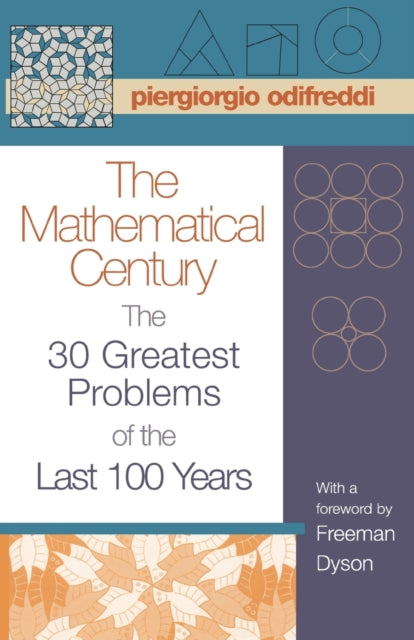
Princeton University Press The Mathematical Century
Book SynopsisConcentrates on thirty highlights of pure and applied mathematics. This book opens by discussing the four main philosophical foundations of mathematics of the nineteenth century and ends by describing the four important open mathematical problems of the twenty-first century.Trade Review"Odifreddi's overview is of course a personal one, but it is hard to argue with either his choices or his organization. This is a perfect handle on an otherwise bewildering proliferation of ideas."--Ben Longstaff, New Scientist "Odifreddi clearly and concisely describes important 20th-century developments in pure and applied mathematics... Unlike similar volumes, this book keeps descriptions general and contains a short section on the philosophical foundations of mathematics to help non-mathematicians easily navigate the material."--Library Journal "This is an astonishingly readable, succinct, and wonderful account of twentieth-century mathematics! It is a great book for mathematics majors, students in liberal-arts courses in mathematics, and the general public. I am amazed at how easily the author has set out the achievements in a broad array of mathematical fields. The writing appears effortless."--Paul Campbell, Mathematics Magazine "Piergiogio Odifreddi's book successfully portrays the major developments in 20th century mathematics by an examination of the mathematical problems that have gained prominence during the past 100 years... [T]he literary style is such that the contents are made accessible to a very wide readership, but with no hint of oversimplification."--P.N. Ruane, MathDL "Odifreddi ... has an engaging and effective style and a knack for compact but comprehensible summaries, making his presentation seem effortless. The Mathematical Century can be dabbled in, read through, or perhaps even used as a quick reference."--Danny Yee, Danny ReviewsTable of ContentsForeword xi Acknowledgments xvii Introduction 1 CHAPTER 1: THE FOUNDATIONS 8 1.1. The 1920s: Sets 10 1.2. The 1940s: Structures 14 1.3. The 1960s: Categories 17 1.4. The 1980s: Functions 21 CHAPTER TWO: PURE MATHEMATICS 25 2.1. Mathematical Analysis: Lebesgue Measure (1902) 29 2.2. Algebra: Steinitz Classification of Fields (1910) 33 2.3. Topology: Brouwer's Fixed-Point Theorem (1910) 37 2.4. Number Theory: Gelfand Transcendental Numbers (1929) 39 2.5. Logic: Godel's Incompleteness Theorem (1931) 43 2.6. The Calculus of Variations: Douglas's Minimal Surfaces (1931) 47 2.7. Mathematical Analysis: Schwartz's Theory of Distributions (1945) 52 2.8. Differential Topology: Milnor's Exotic Structures (1956) 56 2.9. Model Theory: Robinson's Hyperreal Numbers (1961) 59 2.10. Set Theory: Cohen's Independence Theorem (1963) 63 2.11. Singularity Theory: Thom's Classification of Catastrophes (1964) 66 2.12. Algebra: Gorenstein's Classification of Finite Groups (1972) 71 2.13. Topology: Thurston's Classification of 3-Dimensional Surfaces (1982) 78 2.14. Number Theory: Wiles's Proof of Fermat's Last Theorem (1995) 82 2.15. Discrete Geometry: Hales's Solution of Kepler's Problem (1998) 87 CHAPTER THREE: APPLIED MATHEMATICS 92 3.1. Crystallography: Bieberbach's Symmetry Groups (1910) 98 3.2. Tensor Calculus: Einstein's General Theory of Relativity (1915) 104 3.3. Game Theory: Von Neumann's Minimax Theorem (1928) 108 3.4. Functional Analysis: Von Neumann's Axiomatization of Quantum Mechanics (1932) 112 3.5. Probability Theory: Kolmogorov's Axiomatization (1933) 116 3.6. Optimization Theory: Dantzig's Simplex Method (1947) 120 3.7. General Equilibrium Theory: The Arrow-Debreu Existence Theorem (1954) 122 3.8. The Theory of Formal Languages: Chomsky's Classification (1957) 125 3.9. Dynamical Systems Theory: The KAM Theorem (1962) 128 3.10. Knot Theory: Jones Invariants (1984) 132 CHAPTER FOUR: MATHEMATICS AND THE COMPUTER 139 4.1. The Theory of Algorithms: Turing's Characterization (1936) 145 4.2. Artificial Intelligence: Shannon's Analysis of the Game of Chess (1950) 148 4.3. Chaos Theory: Lorenz's Strange Attractor (1963) 151 4.4. Computer-Assisted Proofs: The Four-Color Theorem of Appel and Haken (1976) 154 4.5. Fractals: The Mandelbrot Set (1980) 159 CHAPTER FIVE: OPEN PROBLEMS 165 5.1. Arithmetic: The Perfect Numbers Problem (300 BC) 166 5.2. Complex Analysis: The Riemann Hypothesis (1859) 168 5.3. Algebraic Topology: The Poincare Conjecture (1904) 172 5.4. Complexity Theory: The P=NP Problem (1972) 176 Conclusion 181 References and Further Reading 187 Index 189
£25.20

Princeton University Press Benjamin Franklins Numbers
Book SynopsisRevealing the mathematical side of Benjamin Franklin, this book explains the mathematics behind Franklin's popular "Poor Richard's Almanac", which featured such things as population estimates and a host of mathematical digressions. It includes optional math problems that challenge readers to match wits with the Founding Father himself.Trade Review"Pasles...speculates gleefully on the oft-denied mathematical genius of Benjamin Franklin...Drawing on Franklin's letters and journals as well as modern-day reconstructions of his library, Pasles touches on Franklin's fondness for magazines of mathematical diversions; publication of arithmetic problems in Poor Richard's Almanac; startlingly accurate projections of population growth and cost-benefit arguments against slavery."--Publisher's Weekly "In Franklin's Numbers, a book mixing intellectual history and mathematical puzzles (with solutions appended), Paul Pasles brings out a less-celebrated sphere of Franklin's intellect. He makes the case for the founding father as a mathematician."--Jared Wunsch, Nature "Pasles delivers surprising news to Sudoku lovers: Benjamin Franklin once shared their passion...Pasles illuminates Franklin's innovative use of mathematical logic in settling moral questions and in assessing population trends. Franklin's mathematical pursuits thus emerge as a complement to his much-lauded work in politics and science. An unexpected but welcome perspective on the genial genius of Philadelphia."--Bryce Christensen, Booklist "There is hardly a discipline on which Franklin did not stamp his mark during the 18th century. But the role that mathematics played in his life has been overlooked, argues Paul Pasles. Franklin, for instance, was fascinated with magic squares, and this book provides plenty of background to help the reader admire his interest."--New Scientist "[This is] a book that is an easy read for the innumerate but which also provides nourishment for those more skilled in the niceties of math...Also included are some contemporary puzzles that offer the reader the chance to contest skills with Franklin himself."--James Srodes, The Washington Times "Making frequent use of Franklin's writings as well as mathematical brainteasers of the type that Franklin enjoyed, Benjamin Franklin's Numbers is an engaging and thoroughly unique biography of a singular figure in American history."--Ray Bert, Civil Engineering "I thoroughly enjoyed reading this book. It is written in a pleasant, conversational style and the author's enthusiasm for his subject is infectious. The text is richly embroidered with colorful details, both mathematical and historical."--Eugene Boman, Convergence: A Magazine of the Mathematical Association of America "Pasles has succeeded in writing a book dealing with mathematics that is accessible to readers at all levels, yet thoroughly referenced and scholarly enough to satisfy researchers. His endeavor was eased by the fact that the bulk of the material concerns Franklin's magic squares and circles, which only require that the reader have the ability to add. Unexpectedly, Pasles contributes much that is new; he corrects the errors of previous authors and presents new ideas through literary sleuthing and mathematical analysis."--C. Bauer, Choice "Pasles makes a convincing case for Franklin as the last true Renaissance man in what is an entertaining and informative book that will even appeal to readers with only limited knowledge of mathematics."--Physics World "With seven years of diligent study, by going through a vast amount of archive material, references including primary sources and books and research papers, the author has produced a carefully documented and fascinating account to substantiate the theme he makes, namely, that Franklin 'possessed a mathematical mind.'"--Man Keung Siu, Mathematical Reviews "[Paul C. Pasles] and the publisher should ... be commended for producing a highly aesthetically pleasing book, with a color centerpiece showing many of Franklin's beloved magic squares in their full glory."--Eli Maor, SIAM Review "This book will appeal to readers with an interdisciplinary interest in both history and mathematics. Teachers who enjoy showing students the many ways in which they can draw on mathematics to construct logical, real-world arguments will find useful examples for the classroom. The book also includes a variety of number puzzles that can be used to challenge students."--Michelle Cirillo, Mathematics Teacher "I found Benjamin Franklin's Numbers a delightful book. I enjoyed studying and playing with the magic squares and patterns, and I was fascinated by the biographical tidbits about Franklin. This book is very well written, and I highly recommend it to anyone with an interest in mathematics or in Benjamin Franklin."--James V. Rauff, Mathematics and Computer EducationTable of ContentsPreface ix Chapter 1: The Book Franklin Never Wrote 1 Chapter 2: A Brief History of Magic 20 Chapter 3: Almanacs and Assembly 61 Interlude: Philomath Math 83 Chapter 4: Publisher, Theorist, Inventor, Innovator 87 Chapter 5: A Visit to the Country 117 Chapter 6: The Mutation Spreads (Adventures Among the English) 141 Chapter 7: Circling the Square 158 Chapter 8: Newly Unearthed Discoveries 191 Chapter 9: Legacy 226 Acknowledgements 243 Appendix 245 Index 253
£19.80

Princeton University Press Graphic Discovery A Trout in the Milk and Other
Book SynopsisPlotting humankind's efforts to visualize data, this book discusses atheoretical plotting of data to reveal suggestive patterns. It includes chapters illustrating the uses and abuses of this invention (plotting), from a murder trial in Connecticut to the Vietnam War's effect on college admissions.Trade ReviewOne of Choice's Outstanding Academic Titles for 2005 "Well written and innovative... The book is fascinating with its wide view, including introductions to historical personalities, analyses of statistical paradoxes, and well-documented discussions of actual uses of visual data to mislead viewers."--Choice "During a dairyman's strike in 19th century New England, when there was suspicion of milk being watered down, Henry David Thoreau wrote, 'Sometimes circumstantial evidence can be quite convincing; like when you find a trout in the milk.' Howard Wainer uses this as a metaphor in his entertaining, informative, and persuasive book on graphs, or the visual communication of information. Sometimes a well-designed graph tells a very convincing story."--Raymond N. Greenwell, MAA Online "Wainer's wit and broad intellect make this a very entertaining book."--Linda Pickle, ,American Statistician "[A] personalized and readable jaunt through the history of charting."--The Economist "This book may be seen as a chronology of graphic date presentation beginning with Playfair to the present and pointing toward the future... It is a remarkable value that every practitioner of statistics can afford."--Malcolm James Ree, Personnel Psychology "Graphic Discovery is a welcome addition to the literature on investigation and effective communication through graphic display. It contains a wealth of information and opinions, which are motivated and illustrated through a plethora of real life examples which can be easily incorporated into any educational setting: classroom, seminar, self-enhancement... This book will be useful to and it can be mastered by a diverse readership."--Thomas E. Bradstreet, Computational StatisticsTable of ContentsPreface xiii Introduction 1 In the sixteenth century, the bubonic plague provided the motivation for the English to begin gathering data on births, marriages, and deaths. These data, the Bills of Mortality, were the grist that Dr. John Arbuthnot used to prove the existence of God. Unwittingly, he also provided strong evidence that data graphs were not yet part of a scientist's tools. Part I: William Playfair and the Origins of Graphical Display Chapter 1: Why Playfair? 9 All of the pieces were in place for the invention of statistical graphics long before Playfair was born. Why didn't anyone else invent them? Why did Playfair? Chapter 2: Who Was Playfair? 20 by Ian Spence and Howard Wainer William Playfair (1759-1823) was an inventor and ardent advocate of statistical graphics. Here we tell a bit about his life. Chapter 3: William Playfair: A Daring Worthless Fellow 24 by Ian Spence and Howard Wainer Audacity was an important personality trait for the invention of graphics because the inventor had to move counter to the Cartesian approach to science. We illustrate this quality in Playfair by describing his failed attempt to blackmail one of the richest lords of Great Britain. Chapter 4: Scaling the Heights (and Widths) 28 The message conveyed by a statistical graphic can be distorted by manipulating the aspect ratio, the ratio of a graph's width to its height. Playfair deployed this ability in a masterly way, providing a guide to future display technology. Chapter 5: A Priestley View of International Currency Exchanges 39 A recent plot of the operating hours of international currency exchanges confuses matters terribly. Why? We find that when we use a different graphical form, developed by Joseph Priestley in 1765, the structure becomes clear. We also learn how Priestley discovered the latent graphicacy in his (and our) audiences. Chapter 6: Tom's Veggies and the American Way 44 European intellectuals were not the only ones graphing data. During a visit to Paris (and prompted by letters from Benjamin Franklin), Thomas Jefferson learned of this invention and he later put it to a more practical use than the depiction of the life spans of heroes from classical antiquity. Chapter 7: The Graphical Inventions of Dubourg and Ferguson: Two Precursors to William Playfair 47 Although he developed the line chart independently, Priestley was not the first to do so. The earliest seems to be the Parisian physician Jacques Barbeau-Dubourg (1709-1779), who created a wonderful graphical scroll in 1753. Graphical representation must have been in the air, for the Scottish philosopher Adam Ferguson (1723-1816) added his version of time lines to the mix in 1780. Chapter 8: Winds across Europe: Francis Galton and the Graphic Discovery of Weather Patterns 52 In 1861, Francis Galton organized weather observatories throughout Western Europe to gather data in a standardized way. He organized these data and presented them as a series of ninety-three maps and charts, from which he confirmed the existence of the anticyclonic movement of winds around a low-pressure zone. Part II: Using Graphical Displays to Understand the Modern World Chapter 9: A Graphical Investigation of the Scourge of Vietnam 59 During the Vietnam War, average SAT scores went down for those students who were not in the military. In addition, the average ASVAB scores (the test used by the military to classify all members of the military) also declined. This Lake Wobegon-like puzzle is solved graphically. Chapter 10: Two Mind-Bending Statistical Paradoxes 63 The odd phenomenon observed with test scores during the Vietnam War is not unusual. We illustrate this seeming paradox with other instances, show how to avoid them, and then discuss an even subtler statistical pitfall that has entrapped many illustrious would-be data analysts. Chapter 11: Order in the Court 72 How one orders the elements of a graph is critical to its comprehensibility. We look at a New York Times graphic depicting the voting records of U.S. Supreme Court justices and show that reordering the graphic provides remarkable insight into the operation of the court. Chapter 12: No Order in the Court 78 We examine one piece of the evidence presented in the 1998 murder trial of State v. Gibbs and show how the defense attorneys, by misordering the data in the graph shown to the judge, miscommunicated a critical issue in their argument. Chapter 13: Like a Trout in the Milk 81 Thoreau pointed out that sometimes circumstantial evidence can be quite convincing, as when you find a trout in the milk. We examine a fascinating graph that provides compelling evidence of industrial malfeasance. Chapter 14: Scaling the Market 86 We examine the stock market and show that different kinds of scalings provide the answers to different levels of questions. One long view suggests a fascinating conjecture about the trade-offs between investing in stocks and investing in real estate. Chapter 15: Sex, Smoking, and Life Insurance: A Graphical View 90 We examine two risk factors for life insurance--sex and smoking--and uncover the implicit structure that underlies insurance premiums. Chapter 16: There They Go Again! 97 The New York Times is better than most media sources for statistical graphics, but even the Times has occasional relapses to an earlier time in which confusing displays ran rampant over its pages. We discuss some recent slips and compare them with prior practice. Chapter 17: Sex and Sports: How Quickly Are Women Gaining? 103 A simple graph of winning times in the Boston Marathon augmented by a fitted line provides compelling, but incorrect, evidence for the relative gains that women athletes have made over the past few decades. A more careful analysis provides a better notion of the changing size of the sex differences in athletic performances. Chapter 18: Clear Thinking Made Visible: Redesigning Score Reports for Students 109 Too often communications focus on what the transmitter thinks is important rather than on what the receiver is most critically interested in. The standard SAT score report that is sent to more than one million high school students annually is one such example. Here we revise this report using principles abstracted from another missive sent to selected high school students. Part III: Graphical Displays in the Twenty-first Century The three chapters of this section grew out of a continuing conversation with John W. Tukey, the renowned Princeton polymath, on the graphical tools that were likely to be helpful when data were displayed on a computer screen rather than a piece of paper. These conversations began shortly after Tukey's eighty-fourth birthday and continued for more than a year, ending the night before he died. Chapter 19: John Wilder Tukey: The Father of Twenty-first-Century Graphical Display 117 Chapter 20: Graphical Tools for the Twenty-first Century: I. Spinning and Slicing 125 Chapter 21: Graphical Tools for the Twenty-first Century: II. Nearness and Smoothing Engines 134 Chapter 22: Epilogue: A Selection of Selection Anomalies 142 Graphical displays are only as good as the data from which they are composed. In this final chapter we examine an all too frequent data flaw. The effects of nonsampling errors deserve greater attention, especially when randomization is absent. Formal statistical analysis treats only some of the uncertainties. In this chapter we describe three examples of how flawed inferences can be made from nonrandomly obtained samples and suggest a strategy to guard against flawed inferences. Conclusion 150 Dramatis Personae 151 This graphical epic has more than one hundred characters. Some play major roles, but most are cameos. To help keep straight who is who, this section contains thumbnail biographies of all the players. Notes 173 References 177 Index 185
£31.50

Princeton University Press Circles Disturbed
Book SynopsisRecalls the last words of the great Greek mathematician Archimedes before he was slain by a Roman soldier - "Don't disturb my circles" - words that seem to refer to two radically different concerns: that of the practical person living in the concrete world of reality, and that of the theoretician lost in a world of abstraction.Trade Review"Editors Doxiadis and Mazur have compiled a collection of 15 essays that look at the many possible roles narrative can play in mathematics, which is usually considered far removed from storytelling... Circles Disturbed will be of special value to collections in history of mathematics, philosophy of mathematics, and mathematical pedagogy."--Choice "Circles Disturbed presents a cohesive narrative whose strength lies in helping each side to understand the other. It should encourage scientists to grasp the logic behind storytelling and literary critics to sense the allure of mathematics."--Mel Bayley, British Society for the History of Mathematics Bulletin "Well thought and well written and with a careful balance between erudition and down-to-earthness all through it, Circles Disturbed is a highly recommended reading for mathematicians and students of mathematics, as well as for anyone who wishes to better understand what it is to do mathematics and why they are done the way they are done."--Capi Corrales Rodriganez, European Mathematical Society "Circles Disturbed will spark interest in younger readers in the commonalities among these three disciplines as well as engage other readers. Further, readers with greater background in one or more topics can see the intra- and the intersections rather naturally and inquisitively. The diverse perspectives represented by the various authors are quite refreshing."--Farshid Safi, Mathematics TeacherTable of ContentsIntroduction vii Chapter 1: From Voyagers to Martyrs: Toward a Storied History of Mathematics 1 By AMIR ALEXANDER Chapter 2 Structure of Crystal, Bucket of Dust 52 By PETER GALISON Chapter 3: Deductive Narrative and the Epistemological Function of Belief in Mathematics: On Bombelli and Imaginary Numbers 79 By FEDERICA LANAVE Chapater 4: Hilbert on Theology and Its Discontents: The Origin Myth of Modern Mathematics 105 By COLIN MCLARTY Chapter 5: Do Androids Prove Theorems in Their Sleep? 130 By MICHAEL HARRIS Chapter 6: Visions, Dreams, and Mathematics 183 By BARRY MAZUR Chapter 7: Vividness in Mathematics and Narrative 211 By TIMOTHY GOWERS Chapter 8: Mathematics and Narrative: Why Are Stories and Proofs Interesting? 232 By BERNARD TEISSIER Chapter 9: Narrative and the Rationality of Mathematical Practice 244 By DAVID CORFIELD Chapter 10: A Streetcar Named (among Other Things) Proof: From Storytelling to Geometry, via Poetry and Rhetoric 281 By APOSTOLOS DOXIADIS Chapter 11: Mathematics and Narrative: An Aristotelian Perspective 389 By G .E .R . LLOYD Chapter 12: Adventures of the Diagonal: Non-Euclidean Mathematics and Narrative 407 By ARADY PLOTNITSKY Chapter 13: Formal Models in Narrative Analysis 447 By DAVID HERMAN Chapter 14: Mathematics and Narrative: A Narratological Perspective 481 By URI MARGOL N Chapter 15: Tales of Contingency, Contingencies of Telling: Toward an Algorithm of Narrative Subjectivity 508 By JAN CHRISTOPH MEISTER Contributors 541 Index 545
£52.20

Princeton University Press Three Views of Logic
Book SynopsisDemonstrating the different roles that logic plays in the disciplines of computer science, mathematics, and philosophy, this title covers select topics from three different areas of logic: proof theory, computability theory, and nonclassical logic. It presents relevance logic with applications.Trade Review"Overall, this is a well-written text with challenging exercises, proofs of important theorems, and a modern integrated approach."--Choice "The book can serve as material for a course that teaches the role of logic in several disciplines. It can also be used as a supplementary text for a logic course that emphasizes the more traditional topics of logic but wishes to include a few special topics. Moreover, it can be a valuable resource for researchers and academics."--Roman Murawski, Zentralblatt MATH "It's always interesting to find a text that reimagines, and offers a novel approach to, a fairly standard subject. This book does that for logic... There is a lot of interesting and well-presented material found here that cannot be easily found elsewhere in a book at this level."--Mark Hunacek, Mathematical Association of America blog "An instructor of a logic course offered by a mathematics department who is interested in some experimentation will undoubtedly find this book quite rewarding... Even an instructor who is not planning to teach a course along these lines, but who is interested in the subject, will want to look at this text; there is a lot of interesting and well-presented material found here that cannot be easily found elsewhere in a book at this level."--Mark Hunacek, MAA blogTable of ContentsPreface ix Acknowledgments xiii PART 1. Proof Theory 1 Donald Loveland 1Propositional Logic 3 1.1 Propositional Logic Semantics 5 1.2 Syntax: Deductive Logics 13 1.3 The Resolution Formal Logic 14 1.4 Handling Arbitrary Propositional Wffs 26 2Predicate Logic 31 2.1 First-Order Semantics 32 2.2 Resolution for the Predicate Calculus 40 2.2.1 Substitution 41 2.2.2 The Formal System for Predicate Logic 45 2.2.3 Handling Arbitrary Predicate Wffs 54 3An Application: Linear Resolution and Prolog 61 3.1 OSL-Resolution 62 3.2 Horn Logic 69 3.3 Input Resolution and Prolog 77 Appendix A: The Induction Principle 81 Appendix B: First-Order Valuation 82 Appendix C: A Commentary on Prolog 84 References 91 PART 2. Computability Theory 93 Richard E. Hodel 4Overview of Computability 95 4.1 Decision Problems and Algorithms 95 4.2 Three Informal Concepts 107 5A Machine Model of Computability 123 5.1 RegisterMachines and RM-Computable Functions 123 5.2 Operations with RM-Computable Functions; Church-Turing Thesis; LRM-Computable Functions 136 5.3 RM-Decidable and RM-Semi-Decidable Relations; the Halting Problem 144 5.4 Unsolvability of Hilbert's Decision Problem and Thue'sWord Problem 154 6A Mathematical Model of Computability 165 6.1 Recursive Functions and the Church-Turing Thesis 165 6.2 Recursive Relations and RE Relations 175 6.3 Primitive Recursive Functions and Relations; Coding 187 6.4 Kleene Computation Relation Tn(e, a1, ... , an, c) 197 6.5 Partial Recursive Functions; Enumeration Theorems 203 6.6 Computability and the Incompleteness Theorem 216 List of Symbols 219 References 220 PART 3. Philosophical Logic 221 S. G. Sterrett 7Non-Classical Logics 223 7.1 Alternatives to Classical Logic vs. Extensions of Classical Logic 223 7.2 From Classical Logic to Relevance Logic 228 7.2.1 The (So-Called) "Paradoxes of Implication" 228 7.2.2 Material Implication and Truth Functional Connectives 234 7.2.3 Implication and Relevance 238 7.2.4 Revisiting Classical Propositional Calculus: What to Save,What to Change, What to Add? 240 8Natural Deduction: Classical and Non-Classical 243 8.1 Fitch's Natural Deduction System for Classical Propositional Logic 243 8.2 Revisiting Fitch's Rules of Natural Deduction to Better Formalize the Notion of Entailment-Necessity 251 8.3 Revisiting Fitch's Rules of Natural Deduction to Better Formalize the Notion of Entailment-Relevance 253 8.4 The Rules of System FE (Fitch-Style Formulation ofthe Logic of Entailment) 261 8.5 The Connective "Or," Material Implication,and the Disjunctive Syllogism 281 9Semantics for Relevance Logic: A Useful Four-Valued Logic 288 9.1 Interpretations, Valuations, and Many Valued Logics 288 9.2 Contexts in Which This Four-Valued Logic Is Useful 290 9.3 The Artificial Reasoner's (Computer's) "State of Knowledge" 291 9.4 Negation in This Four-Valued Logic 295 9.5 Lattices: A Brief Tutorial 297 9.6 Finite Approximation Lattices and Scott's Thesis 302 9.7 Applying Scott's Thesis to Negation, Conjunction, and Disjunction 304 9.8 The Logical Lattice L4 307 9.9 Intuitive Descriptions of the Four-Valued Logic Semantics 309 9.10 Inferences and Valid Entailments 312 10Some Concluding Remarks on the Logic of Entailment 315 References 316 Index 319
£45.00

Princeton University Press The Mathematics of Various Entertaining Subjects
Book SynopsisThe history of mathematics is filled with major breakthroughs resulting from solutions to recreational problems. Problems of interest to gamblers led to the modern theory of probability, for example, and surreal numbers were inspired by the game of Go. Yet even with such groundbreaking findings and a wealth of popular-level books exploring puzzlesTrade ReviewOne of Choice's Outstanding Academic Titles for 2016 "Beineke and Rosenhouse have compiled and edited a fantastic collection of essays dealing with popular mathematics... Anybody who enjoys reading about recreation mathematics should definitely explore these writings."--ChoiceTable of ContentsForeword by Raymond Smullyan vii Preface and Acknowledgments x PART I VIGNETTES 1 Should You Be Happy? 3 Peter Winkler 2 One-Move Puzzles with Mathematical Content 11 Anany Levitin 3 Minimalist Approaches to Figurative Maze Design 29 Robert Bosch, Tim Chartier, and Michael Rowan 4 Some ABCs of Graphs and Games 43 Jennifer Beineke and Lowell Beineke PART II PROBLEMS INSPIRED BY CLASSIC PUZZLES 5 Solving the Tower of Hanoi with Random Moves 65 Max A. Alekseyev and Toby Berger 6 Groups Associated to Tetraflexagons 81 Julie Beier and Carolyn Yackel 7 Parallel Weighings of Coins 95 Tanya Khovanova 8 Analysis of Crossword Puzzle Difficulty Using a Random Graph Process 105 John K. McSweeney 9 From the Outside In: Solving Generalizations of the Slothouber-Graatsma-Conway Puzzle 127 Derek Smith PART III PLAYING CARDS 10 Gallia Est Omnis Divisa in Partes Quattuor 139 Neil Calkin and Colm Mulcahy 11 Heartless Poker 149 Dominic Lanphier and Laura Taalman 12 An Introduction to Gilbreath Numbers 163 Robert W. Vallin PART IV GAMES 13 Tic-tac-toe on Affine Planes 175 Maureen T. Carroll and Steven T. Dougherty 14 Error Detection and Correction Using SET 199 Gary Gordon and Elizabeth McMahon 15 Connection Games and Sperner's Lemma 213 David Molnar PART V FIBONACCI NUMBERS 16 The Cookie Monster Problem 231 Leigh Marie Braswell and Tanya Khovanova 17 Representing Numbers Using Fibonacci Variants 245 Stephen K. Lucas About the Editors 261 About the Contributors 263 Index 269
£40.50

Princeton University Press Alan Turings Systems of Logic
Book SynopsisBetween inventing the concept of a universal computer in 1936 and breaking the German Enigma code during World War II, Alan Turing (1912-1954), the British founder of computer science and artificial intelligence, came to Princeton University to study mathematical logic. Some of the greatest logicians in the world--including Alonzo Church, Kurt GodeTrade Review"This book presents the story of Turing's work at Princeton University and includes a facsimile of his doctoral dissertation, 'Systems of Logic Based on Ordinals,' which he completed in 1936. The author includes a detailed history of Turing's work in computer science and the attempts to ground the field in formal logic."--Mathematics Teacher "This book is not for the faint hearted, as with the great masters of painting it will insist that some thought goes into appreciating it... I love the book as a book. It is a collectors item and after all what better pursuit can one have than collecting books!"--Patrick Fogarty, Mathematics TodayTable of ContentsPreface ix The Birth of Computer Science at Princeton in the 1930s Andrew W. Appel 1 Turing's Thesis Solomon Feferman 13 Notes on the Manuscript 27 Systems of Logic Based on Ordinals Alan Turing 31 A Remarkable Bibliography 141 Contributors 143
£12.34

Princeton University Press Mathematical Knowledge and the Interplay of
Book SynopsisThis book presents a new approach to the epistemology of mathematics by viewing mathematics as a human activity whose knowledge is intimately linked with practice. Charting an exciting new direction in the philosophy of mathematics, Jose Ferreiros uses the crucial idea of a continuum to provide an account of the development of mathematical knowledgTrade Review"Both philosophers and mathematicians can find ample food for thought in this study."--Choice "Ferreiros has published a fascinating book which consists of an impressive combination of thought-provoking philosophical ideas and mathematical material. As such, it can be interesting for philosophers of mathematics, mathematicians, and other people interested in the topics of mathematical knowledge and mathematical practice."--Joachim Frans, MathScieNetTable of ContentsList of Illustrations ix Foreword xi 1 On Knowledge and Practices: A Manifesto 1 2 The Web of Practices 17 2.1. Historical Work on Practices 18 2.2. Philosophers Working on Practices 22 2.3. What Is Mathematical Practice, Then? 28 2.4. The Multiplicity of Practices 34 2.5. The Interplay of Practices and Its Basis 39 3 Agents and Frameworks 44 3.1. Frameworks and Related Matters 45 3.2. Interlude on Examplars 55 3.3. On Agents 59 3.4. Counting Practices and Cognitive Abilities 65 3.5. Further Remarks on Mathematics and Cognition 74 3.6. Agents and "Metamathematical" Views 79 3.7. On Systematic Links 83 4 Complementarity in Mathematics 89 4.1. Formula and Meaning 89 4.2. Formal Systems and Intended Models 94 4.3. Meaning in Mathematics: A Tentative Approach 99 4.4. The Case of Complex Numbers 104 5 Ancient Greek Mathematics: A Role for Diagrams 112 5.1. From the Technical to the Mathematical 113 5.2. The Elements: Getting Started 117 5.3. On the Euclidean Postulates: Ruling Diagrams (and Their Reading) 127 5.4. Diagram-Based Mathematics and Proofs 131 5.5. Agents, Idealization, and Abstractness 137 5.6. A Look at the Future-Our Past 147 6 Advanced Math: The Hypothetical Conception 153 6.1. The Hypothetical Conception: An Introduction 154 6.2. On Certainty and Objectivity 159 6.3. Elementary vs. Advanced: Geometry and the Continuum 163 6.4. Talking about Objects 170 6.5. Working with Hypotheses: AC and the Riemann Conjecture 176 7 Arithmetic Certainty 182 7.1. Basic Arithmetic 182 7.2. Counting Practices, Again 184 7.3. The Certainty of Basic Arithmetic 189 7.4. Further Clarifications 195 7.5. Model Theory of Arithmetic 198 7.6. Logical Issues: Classical or Intuitionistic Math? 200 8 Mathematics Developed: The Case of the Reals 206 8.1. Inventing the Reals 207 8.2. "Tenths" to the Infinite: Lambert and Newton 215 8.3. The Number Continuum 221 8.4. The Reinvention of the Reals 227 8.5. Simple Infinity and Arbitrary Infinity 231 8.6. Developing Mathematics 236 8.7. Mathematical Hypotheses and Scientific Practices 241 9 Objectivity in Mathematical Knowledge 247 9.1. Objectivity and Mathematical Hypotheses: A Simple Case 249 9.2. Cantor's "Purely Arithmetical" Proofs 253 9.3. Objectivity and Hypotheses, II: The Case of p() 257 9.4. Arbitrary Sets and Choice 261 9.5. What about Cantor's Ordinal Numbers? 265 9.6. Objectivity and the Continuum Problem 273 10 The Problem of Conceptual Understanding 281 10.1. The Universe of Sets 283 10.2. A "Web-of- Practices" Look at the Cumulative Picture 290 10.3. Conceptual Understanding 296 10.4. Justifying Set Theory: Arguments Based on the Real-Number Continuum 305 10.5. By Way of Conclusion 310 References 315 Index 331
£37.80

Princeton University Press Approximating Perfection A Mathematicians
Book SynopsisThis is a book for those who enjoy thinking about how and why Nature can be described using mathematical tools. Approximating Perfection considers the background behind mechanics as well as the mathematical ideas that play key roles in mechanical applications. Concentrating on the models of applied mechanics, the book engages the reader in the typeTrade Review"A well-written general-interest introduction to classical mechanics."--ChoiceTable of ContentsPreface vii Chapter 1. The Tools of Calculus 1 1.1 Is Mathematical Proof Necessary? 2 1.2 Abstraction, Understanding, Infinity 6 1.3 Irrational Numbers 8 1.4 What Is a Limit? 11 1.5 Series 15 1.6 Function Continuity 19 1.7 How to Measure Length 21 1.8 Antiderivatives 33 1.9 Definite Integral 35 1.10 The Length of a Curve 42 1.11 Multidimensional Integrals 44 1.12 Approximate Integration 47 1.13 On the Notion of a Function 52 1.14 Differential Equations 53 1.15 Optimization 59 1.16 Petroleum Exploration and Recovery 61 1.17 Complex Variables 63 1.18 Moving On 65 Chapter 2. The Mechanics of Continua 67 2.1 Why Do Ships Float? 67 2.2 The Main Notions of Classical Mechanics 71 2.3 Forces, Vectors, and Objectivity 74 2.4 More on Forces; Statics 76 2.5 Hooke's Law 80 2.6 Bending of a Beam 84 2.7 Stress Tensor 94 2.8 Principal Axes and Invariants of the Stress Tensor 100 2.9 On the Continuum Model and Limit Passages 102 2.10 Equilibrium Equations 104 2.11 The Strain Tensor 108 2.12 Generalized Hooke's Law 113 2.13 Constitutive Laws 114 2.14 Boundary Value Problems 115 2.15 Setup of Boundary Value Problems of Elasticity 118 2.16 Existence and Uniqueness of Solution 120 2.17 Energy; Minimal Principle for a Spring 126 2.18 Energy in Linear Elasticity 128 2.19 Dynamic Problems of Elasticity 132 2.20 Oscillations of a String 134 2.21 Lagrangian and Eulerian Descriptions of Continuum Media 137 2.22 The Equations of Hydrodynamics 140 2.23 D'Alembert-Euler Equation of Continuity 142 2.24 Some Other Models of Hydrodynamics 144 2.25 Equilibrium of an Ideal Incompressible Liquid 145 2.26 Force on an Obstacle 148 Chapter 3. Elements of the Strength of Materials 151 3.1 What Are the Problems of the Strength of Materials? 151 3.2 Hooke's Law Revisited 152 3.3 Objectiveness of Quantities in Mechanics Revisited 157 3.4 Plane Elasticity 159 3.5 Saint-Venant's Principle 161 3.6 Stress Concentration 163 3.7 Linearity vs. Nonlinearity 165 3.8 Dislocations, Plasticity, Creep, and Fatigue 166 3.9 Heat Transfer 172 3.10 Thermoelasticity 175 3.11 Thermal Expansion 177 3.12 A Few Words on the History of Thermodynamics 178 3.13 Thermodynamics of an Ideal Gas 180 3.14 Thermodynamics of a Linearly Elastic Rod 182 3.15 Stability 186 3.16 Static Stability of a Straight Beam 188 3.17 Dynamical Tools for Studying Stability 193 3.18 Additional Remarks on Stability 195 3.19 Leak Prevention 198 Chapter 4. Some Questions of Modeling in the Natural Sciences 201 4.1 Modeling and Simulation 201 4.2 Computerization and Modeling 203 4.3 Numerical Methods and Modeling in Mechanics 206 4.4 Complexity in the Real World 208 4.5 The Role of the Cosine in Everyday Measurements 209 4.6 Accuracy and Precision 211 4.7 How Trees Stand Up against the Wind 213 4.8 Why King Kong Cannot Be as Terrible as in the Movies 216 Afterword 219 Recommended Reading 221 Index 223
£23.75


