
Geometry Books

De Gruyter Irreducible Cartesian Tensors
£103.55

£104.02
De Gruyter Graded Algebras in Algebraic Geometry
Book SynopsisThe objective of this book is to look at certain commutative graded algebras that appear frequently in algebraic geometry. By studying classical constructions from geometry from the point of view of modern commutative algebra, this carefully-written book is a valuable source of information, offering a careful algebraic systematization and treatment of the problems at hand, and contributing to the study of the original geometric questions. In greater detail, the material covers aspects of rational maps (graph, degree, birationality, specialization, combinatorics), Cremona transformations, polar maps, Gauss maps, the geometry of Fitting ideals, tangent varieties, joins and secants, Aluffi algebras. The book includes sections of exercises to help put in practice the theoretic material instead of the mere complementary additions to the theory.
£118.75
De Gruyter Spaces of Dynamical Systems
Book Synopsis Table of ContentsFrontmatter -- Contents -- Preface to the first edition -- Preface to the second edition -- List of main symbols -- 1. Dynamical systems -- 2. Topologies on spaces of dynamical systems -- 3. Equivalence relations -- 4. Hyperbolic fixed point -- 5. Hyperbolic rest point and hyperbolic closed trajectory -- 6. Transversality -- 7. Hyperbolic sets -- 8. Anosov diffeomorphisms -- 9. Smale’s horseshoe and chaos -- 10. Closing lemma -- 11. C0-generic properties of dynamical systems -- 12. Shadowing of pseudotrajectories in dynamical systems -- 13. Invariant measures -- A. Scheme of the proof of the Mañé theorem -- B. Lectures on selected chapters of the history of differential equations and dynamical systems -- Bibliography -- Index
£149.62

De Gruyter Real Hypersurfaces in Hermitian Symmetric Spaces
Book SynopsisHermitian symmetric spaces are an important class of manifolds that can be studied with methods from Kähler geometry and Lie theory. This work gives an introduction to Hermitian symmetric spaces and their submanifolds, and presents classifi cation results for real hypersurfaces in these spaces, focusing on results obtained by Jürgen Berndt and Young Jin Suh in the last 20 years.
£147.72
De Gruyter Finer Thermodynamic Formalism – Distance Expanding Maps and Countable State Subshifts of Finite Type, Conformal GDMSs, Lasota-Yorke Maps and Fractal Geometry
Book SynopsisThis book consists of three volumes. The first volume contains introductory accounts of topological dynamical systems, fi nite-state symbolic dynamics, distance expanding maps, and ergodic theory of metric dynamical systems acting on probability measure spaces, including metric entropy theory of Kolmogorov and Sinai. More advanced topics comprise infi nite ergodic theory, general thermodynamic formalism, topological entropy and pressure. Thermodynamic formalism of distance expanding maps and countable-alphabet subshifts of fi nite type, graph directed Markov systems, conformal expanding repellers, and Lasota-Yorke maps are treated in the second volume, which also contains a chapter on fractal geometry and its applications to conformal systems. Multifractal analysis and real analyticity of pressure are also covered. The third volume is devoted to the study of dynamics, ergodic theory, thermodynamic formalism and fractal geometry of rational functions of the Riemann sphere.
£117.80

De Gruyter Representation Theory and Geometry of the Flag Variety
Book SynopsisThis comprehensive reference begins with a review of the basics followed by a presentation of flag varieties and finite- and infinite-dimensional representations in classical types and subvarieties of flag varieties and their singularities. Associated varieties and characteristic cycles are covered as well and Kazhdan-Lusztig polynomials are treated. The coverage concludes with a discussion of pattern avoidance and singularities and some recent results on Springer fibers.
£107.35
LAP Lambert Academic Publishing The Road to 3D Geometry
£31.68
Betascript Publishing W. V. D. Hodge
£117.00

MP-AMM American Mathematical Mapping Degree Theory
Book SynopsisTreats the classical parts of mapping degree theory, with a detailed account of its history traced back to the first half of the 18th century. This title includes 180 exercises and problems of different scope and difficulty.
£78.30

American Mathematical Society Analytic Functions of Several Complex Variables
Book SynopsisThe theory of analytic functions of several complex variables enjoyed a period of remarkable development in the middle part of the twentieth century. After initial successes by Poincare and others in the late 19th and early 20th centuries, the theory encountered obstacles that prevented it from growing quickly into an analogue of the theory for functions of one complex variable. Beginning in the 1930s, initially through the work of Oka, then H. Cartan, and continuing with the work of Grauert, Remmert, and others, new tools were introduced into the theory of several complex variables that resolved many of the open problems and fundamentally changed the landscape of the subject. These tools included a central role for sheaf theory and increased uses of topology and algebra. The book by Gunning and Rossi was the first of the modern era of the theory of several complex variables, which is distinguished by the use of these methods. The intention of Gunning and Rossi's book is to provide aTrade ReviewIt is a pure pleasure to read: the prose is crystal clear and anything but prolix. ... They are happy to get into relatively elementary material in some detail, and sophisticated stuff. And the i's are dotted and the t's are crossed. It's a wonderful book!" —MAA ReviewsTable of Contents Holomorphic functions Local rings of holomorphic functions Varieties Analytic sheaves Analytic spaces Cohomology theory Stein spaces, geometric theory Stein spaces, sheaf theory Pseudoconvexity Partitions of unity The theorem of Schwartz on Frechet spaces References Bibliography Index
£999.99
Green Lion Press Euclid's Elements
Book SynopsisThe classic Heath translation, in a completely new layout with plenty of space and generous margins. An affordable but sturdy sewn hardcover student and teacher edition in one volume, with minimal notes and a new index/glossary.
£33.25

Tarquin Publications Mathematical Window Patterns: The Art of Creating
Book Synopsis
£999.99

Tarquin Publications Mindful Maths 2: Use your Geometry to Solve these
Book Synopsis
£999.99

Tarquin Publications Birds, Bees and Burgers: Puzzling Geometry from
Book Synopsis
£11.46

Tarquin Publications Compound Polyhedra: Modular Origam
Book Synopsis
£23.70

Springer Nature Switzerland AG Symmetry: A Mathematical Exploration
Book SynopsisThis textbook is perfect for a math course for non-math majors, with the goal of encouraging effective analytical thinking and exposing students to elegant mathematical ideas. It includes many topics commonly found in sampler courses, like Platonic solids, Euler’s formula, irrational numbers, countable sets, permutations, and a proof of the Pythagorean Theorem. All of these topics serve a single compelling goal: understanding the mathematical patterns underlying the symmetry that we observe in the physical world around us.The exposition is engaging, precise and rigorous. The theorems are visually motivated with intuitive proofs appropriate for the intended audience. Students from all majors will enjoy the many beautiful topics herein, and will come to better appreciate the powerful cumulative nature of mathematics as these topics are woven together into a single fascinating story about the ways in which objects can be symmetric.Trade Review“This book has much to recommend it. The material is presented clearly and enthusiastically … . there are a lot of well-chosen exercises, ranging from very easy to more challenging. … this is a well-written book, covering interesting material, that can serve a number of possible audiences. … many math majors will never have seen many of the topics discussed in this book … technical details by the instructor, serve as a useful text for a capstone course for majors.” (Mark Hunacek MAA Reviews, November 14, 2021)Table of ContentsPreface.- 1. Introduction to Symmetry.- 2. The Algebra of Symmetry.- 3. The Classification Theorems.- 4. Isomorphic Groups.- 5. Subgroups & Product Groups.- 6. Permutation Groups.- 7. Symmetries of 3D Objects.- 8. The Five Platonic Solids.- 9. Symmetry and Optimization.- 10. What is a Number?.- 11. Excursions in Numbers.- 12. Rigid Motions as Functions.- 13. Rigid Motions as Matrices.- Image Credits.- Index.
£42.74

Springer Nature Switzerland AG Algebra and Geometry with Python
Book SynopsisThis book teaches algebra and geometry. The authors dedicate chapters to the key issues of matrices, linear equations, matrix algorithms, vector spaces, lines, planes, second-order curves, and elliptic curves. The text is supported throughout with problems, and the authors have included source code in Python in the book. The book is suitable for advanced undergraduate and graduate students in computer science. Trade Review“It is most interesting to combine a classical mathematical topic with a new evolving programming language and exactly this is obtained by this book. … This material is used as a case study for their implementation for solving problems in theoretical and practical cryptography. The ‘roadmap’ of the content of this also quite interesting.” (Panayiotis Vlamos, zbMATH 1480.00002, 2022)Table of ContentsMatrices and Matrix Algorithms.- Matrix Algebra.- Systems of Linear Equations.- Complex Numbers and Matrices.- Vector Spaces.- Vectors in a Three-Dimensional Space.- Equation of a Straight Line on a Plane.- Equation of a Plane in Space.- Equation of a Line in Space.- Bilinear and Quadratic Forms.- Curves of the Second-Order.- Elliptic Curves.- Appendix A, Basic Operators in Python and C.- Appendix B, Trigonometric Formulae.- Appendix C, The Greek Alphabet.- References.- Name Index.- Subject Index.
£999.99

Springer International Publishing AG University of Toronto Mathematics Competition
Book SynopsisThis text records the problems given for the first 15 annual undergraduate mathematics competitions, held in March each year since 2001 at the University of Toronto. Problems cover areas of single-variable differential and integral calculus, linear algebra, advanced algebra, analytic geometry, combinatorics, basic group theory, and number theory. The problems of the competitions are given in chronological order as presented to the students. The solutions appear in subsequent chapters according to subject matter. Appendices recall some background material and list the names of students who did well. The University of Toronto Undergraduate Competition was founded to provide additional competition experience for undergraduates preparing for the Putnam competition, and is particularly useful for the freshman or sophomore undergraduate. Lecturers, instructors, and coaches for mathematics competitions will find this presentation useful. Many of the problems are of intermediate difficulty and relate to the first two years of the undergraduate curriculum. The problems presented may be particularly useful for regular class assignments. Moreover, this text contains problems that lie outside the regular syllabus and may interest students who are eager to learn beyond the classroom.Trade Review“The book under review is mainly intended for undergraduate and graduate students in mathematics, as well as for researchers engaged in the interplay among applied analysis, mathematical physics, and numerical analysis.” (Teodora-Liliana Rădulescu, zbMATH 1357.97001, 2017)“This book is the compilation of the problems from those competitions from 2001 to 2015, along with their solutions, an appendix of notation and key results, and an appendix listing the top ranking students. … This books seems most useful as a supplementary resource for a problem solving or Putnam prep group, class, or math club.” (Megan Patnott, MAA Reviews, maa.org, August, 2016)Table of ContentsPreface.- 1. Problems of the Contests.- 2. Algebra.- 3. Inequalities.- 4. Sequences and Series.- 5. Calculus and its Applications.- 6. Other Topics in Analysis.- 7. Linear Algebra.- 8. Geometry.- 9. Group Theory.- 10. Combinatorics and Finite Mathematics.- 11. Number Theory.- Appendix A: Definitions, Conventions, Notation, and Basics.- Appendix B: Top-Ranking Students.- Index.
£999.99
Springer International Publishing AG Convex Functions and Their Applications: A
Book SynopsisThorough introduction to an important area of mathematics Contains recent results Includes many exercisesTable of ContentsConvex Functions on Intervals.- Convex Sets in Real Linear Spaces.- Convex Functions on a Normed Linear Space.- Convexity and Majorization.- Convexity in Spaces of Matrices.- Duality and Convex Optimization.- Special Topics in Majorization Theory.- A. Generalized Convexity on Intervals.- B. Background on Convex Sets.- C. Elementary Symmetric Functions.- D. Second Order Differentiability of Convex Functions.- E. The Variational Approach of PDE.
£61.74

Springer Verlag, Japan Geometric Aspects of General Topology
Book SynopsisThis book is designed for graduate students to acquire knowledge of dimension theory, ANR theory (theory of retracts), and related topics. These two theories are connected with various fields in geometric topology and in general topology as well. Hence, for students who wish to research subjects in general and geometric topology, understanding these theories will be valuable. Many proofs are illustrated by figures or diagrams, making it easier to understand the ideas of those proofs. Although exercises as such are not included, some results are given with only a sketch of their proofs. Completing the proofs in detail provides good exercise and training for graduate students and will be useful in graduate classes or seminars.Researchers should also find this book very helpful, because it contains many subjects that are not presented in usual textbooks, e.g., dim X × I = dim X + 1 for a metrizable space X; the difference between the small and large inductive dimensions; a hereditarily infinite-dimensional space; the ANR-ness of locally contractible countable-dimensional metrizable spaces; an infinite-dimensional space with finite cohomological dimension; a dimension raising cell-like map; and a non-AR metric linear space. The final chapter enables students to understand how deeply related the two theories are.Simplicial complexes are very useful in topology and are indispensable for studying the theories of both dimension and ANRs. There are many textbooks from which some knowledge of these subjects can be obtained, but no textbook discusses non-locally finite simplicial complexes in detail. So, when we encounter them, we have to refer to the original papers. For instance, J.H.C. Whitehead's theorem on small subdivisions is very important, but its proof cannot be found in any textbook. The homotopy type of simplicial complexes is discussed in textbooks on algebraic topology using CW complexes, but geometrical arguments using simplicial complexes are rather easy.Trade ReviewFrom the book reviews:“This excellent book is designed for different graduate courses in geometric topology, as well as in general topology. At the same time it contains complete proofs of results interesting also for the specialist in geometric topology … .” (Vesko Valov, Mathematical Reviews, September, 2014)
£98.99

Taylor & Francis Ltd Wondrous One Sheet Origami
Book SynopsisWondrous One Sheet Origami is a how-to book full of beautiful origami designs covering a wide range of folding levels from simple to high intermediate, with more emphasis on the latter. The book is meant for audiences 12 years of age and above, and children folding at higher than age level. Most of the designs are flat and suitable for mounting on cards or framing as gifts.Features Richly illustrated full-color book with clear, crisp diagrams following international standard, and an abundance of photographs of finished models Select designs hand-picked by the author based on social media responses Most of the designs incorporate color-change, a technique showing both sides of paper for enhanced beauty Trade Review"Meenakshi Mukerji's work is both intricate and lovely. She's greatly respected in the origami world, one of the well-known world leaders in modular origami. Her books offer a nice exposition of the mathematical elements, but you're not being hit over the head with math lessons. You learn things without even realizing that you have." –Dr. Robert J. Lang"Meenakshi Mukerji is one of today's masters of modular origami, designs comprised of multiple pieces of paper. She also brings her ingenuity and creativity to designs made from a single piece of paper. Among the most appealing aspects of her single sheet work is the way she subtly manipulates a purely geometric form to fold a flower, a leaf, a butterfly, or card suits." –Peter Engel"Meenakshi Mukerji's new book Wondrous One Sheet Origami is not simply an origami instruction book. It is a celebration of the myriad wonders of the natural world and the infinite variety of their color and form. Mukerji recreates this rich world with her ingenious sense of design and shares it with readers using clear, accessible instructions. A valuable addition to any origami library!"–Meher McArthur"The Wondrous One Sheet Origami by Meenakshi Mukerji is exactly the kind of thing our members like to fold. The more advanced fractal designs at the end of the book found a lot of interest, and some of the flower folds were so inviting that many wanted to fold them right away"–Anna Kastlunger, Origami Society of Austria"This is an updated and extended edition of a book that was first published in 2013. The 35 models range from simple designs to complex recursives, and there are a number of variations of the classics, [. . .] Many of the models were designed by Meenakshi Mukerji herself, but there are also contributions from Evan Zodl, Dasa Serova, Christiane Bettens, and Roman Diaz/Endre Somos. [. . .] The second edition includes 39 additional pages and 15 new models, [ . . .] The diagrams are clear and generally easy to follow, and there's advice on experimentation so you can create variations of some of the flower designs. [. . .] The print quality is high, and there are full-colour photographs of many of the models. In conclusion, this book is definitely worth adding to your collection [. . .] This edition also available in ebook form for the more technologically minded."–Stephen Hill, British Origami Society"Profusely illustrated with clear step-by-step instructions, Wondrous One Sheet Origami is thoroughly 'user friendly' in tone, commentary, organization and presentation. While especially and unreservedly recommended for school, community and academic library Origami instructional reference collections, it should be noted for the personal lists of students, professionals, and non-specialist general readers with an interest in the subject."–The Crafts Shelf, Midwest Book ReviewTable of Contents1. Orgami Basics. 2. Simple Designs. 3. Four-Sink Base Flowers. 4. Kusumita and Derivatives. 5. Leaves. 6. Octagonal Collapse Flowers. 7. Recursive Designs. 8. Decorative Boxes.
£30.57

Dover Publications Inc. Geometry Relativity and the Fourth Dimension
Book SynopsisExposition of 4th dimension, concepts of relativity as Flatland characters continue adventures. Popular, easily followed yet accurate, profound. Topics include curved space time as a higher dimension, special relativity, and shape of space-time. Accessible to lay readers but also of interest to specialists. Includes 141 illustrations.
£999.99

Dover Publications Inc. Ghyka M Geometry of Art and Life
Book SynopsisThis classic study probes the geometric interrelationships between art and life in discussions ranging from dissertations by Plato, Pythagoras, and Archimedes to examples of modern architecture and art. Other topics include the Golden Section, geometrical shapes on the plane, geometrical shapes in space, crystal lattices, and other fascinating subjects. 80 plates and 64 figures.
£10.44

Princeton University Press Beautiful Geometry
Book SynopsisTrade ReviewHonorable Mention for the 2015 PROSE Award in Popular Science & Popular Mathematics, Association of American Publishers "A book that stimulates the mind as well as the eye."--Scientific American "The combination of art and exposition was quite effective. The writing is accessible to most reasonably well-educated laypeople, and I imagine that many such people would derive considerable pleasure dipping into this attractive and interesting book."--Mark Hunacek, MAA Reviews "Eli Maor's lively writing benefits in equal parts from the geometry of ancient Greece and the eye-popping images conjured by artist Eugen Jost."--Bill Cannon, Scientist's Bookshelf "Graphic illustrations serve as both beautiful abstract art and helpful explanations in this overview of geometric theorems and patterns."--Science News "[Beautiful Geometry] achieves its aim to demonstrate that there is visual beauty in Mathematics. I heartily recommend it."--LSE Review of Books "The explanations are clear, and cover the background to the paintings in a manner that will be appreciated by readers whatever their level of mathematical knowledge... Anyone with any interest in visual mathematics will love this book."--Times Higher Education "A good-looking, large-format book suitable for the coffee table, but with lots of mathematical ideas packed in among the colorful illustrations... [A] handsome book for browsing and for some deep thought, and would be a superb gift for anyone (especially a young person) who has interest in mathematics."--Rob Hardy, Columbus Dispatch "It is a handsome book for browsing and for some deep thought, and would be a superb gift for anyone (especially a young person) who has interest in mathematics."--Rob Hardy, Dispatch "The book by Maor and Jost should be given to everyone--young or old--embarking on the study of mathematics or anyone teaching mathematics. The book will act as a source of inspiration and as a reminder of why it is that mathematics has fascinated the human race for millennia."--Henrik Jeldtoft Jensen, LMS Newsletter "The content is accessible to anyone with even a high school course in geometry. The writing is very clear."--Choice "Clear and lively... The mathematics in this book is first-rate, but the real surprise is how well the art reflects and illuminates the topic at hand... All of it is lovely to look at... [Beautiful Geometry] rises to the level of a coffee-table art book, only with a lot more depth."--Mathematical Reviews "[E]erily captivating book... Maor's style of writing is conversational, and the writing is engaging."--Annalisa Crannell, Journal of Mathematics and the Arts "At a very reasonable price, this is a book which would grace the coffee-table of any mathematics department, and many of the ideas in it will stimulate valuable discussions in the classroom."--Gerry Leversha, Mathematical Gazette "It presents as a coffee-table book for mathematicians and would be a good addition to a classroom library, available for students of all ages to explore."--Susan Mielechowsky, Mathematics Teaching in the Middle School "Visually stunning... [Beautiful Geometry] raises fundamental questions, answered thousands of years later and evidencing the progress made... This is an engaging book of broad appeal and a colourful approach to the history of geometry."--Mathematics TodayTable of ContentsPrefaces ix 1.Thales of Miletus 1 2.Triangles of Equal Area 3 3.Quadrilaterals 6 4.Perfect Numbers and Triangular Numbers 9 5.The Pythagorean Theorem I
£23.75
Princeton University Press How to Fall Slower Than Gravity
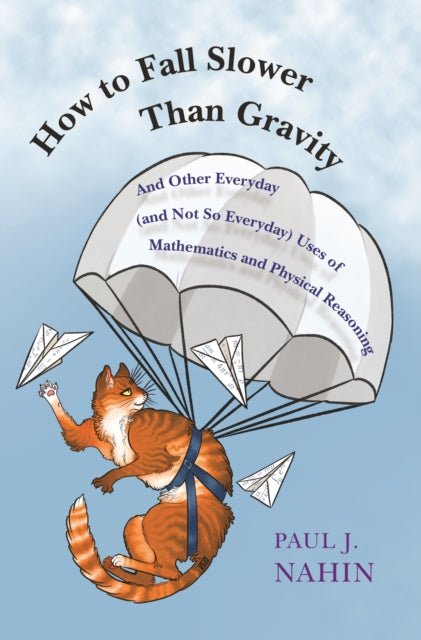
Book SynopsisTrade Review"This book is without a doubt the most enjoyable, stimulating book of mathematical physics (and occasionally more pure branches of maths) puzzles that I have ever read. It’s essentially a series of cleverly, and occasionally fiendishly put-together mathematics and physics challenge questions, each of which gets you thinking in a new and fascinating way."---Jonathan Shock, Mathemafrica"Reading Nahin is like reading through a select library of ancient Babylonian mathematical clay tablets. Surprises abound. . . . Nahin weaves much colorful history into his narrative."---Andrew Simoson, Mathematical Intelligencer"Engaging. . . . The book contains a wealth of original problems. . . . An enjoyable read."---Antonín Slavík, Zentralblatt MATH"This reviewer found himself being drawn to a variety of unfamiliar settings with much interest and even fascination." * Choice *"I certainly enjoyed [the book]!"---Alan Stevens, Mathematics Today"The potential audience for this book should be fairly large and go from highly talented high school students up through professionals in any STEM field."---Geoffrey Dietz, MAA Reviews
£19.80

Princeton University Press The Pythagorean Theorem
Book SynopsisTrade Review"There is something intoxicating about seeing one truth revealed in so many ways. It all makes for hours of glorious mathematical distraction."—Ben Longstaff, New Scientist"A popular account of important ideas and their development."—Peter M. Neumann, Times Higher Education Supplement"If one has never read a book by Eli Maor, this book is a great place to start."—J. Johnson, Choice"Maor expertly tells the story of how this simple theorem known to schoolchildren is part and parcel of much of mathematics itself."—Amy Shell-Gellasch, MAA Reviews"At last, a popular book that isn't afraid to print a mathematical formula in all its symbolic glory! Thanks to Eli Maor for proving—in his delightful, playful way—the eternal importance of a three-sided idea as old as humankind."—Dava Sobel, author of Longitude
£14.24
Legare Street Press Dynamic Symmetry
Book Synopsis
£15.95
Legare Street Press A Textbook Of Euclids Elements For The Use Of
Book Synopsis
£21.80
Legare Street Press Nueva trigonometría plana y esférica
Book Synopsis
£24.65

Cambridge University Press Geometry
Book SynopsisPopular with students and instructors alike, this accessible and highly readable undergraduate textbook has now been revised to include end-of-chapter summaries, more challenging exercises, new results and a list of further reading. Complete solutions to all of the exercises are also provided in a new Instructors' Manual available online.Trade Review'This is a textbook that demonstrates the excitement and beauty of geometry … richly illustrated and clearly written.' L'Enseignement Mathématique'… this is a remarkable and nicely written introduction to classical geometry.' Zentralblatt MATH'… could form the basis of courses in geometry for mathematics undergraduates. It will also appeal to the general mathematical reader.' John Stone, The Times Higher Education Supplement'It conveys the beauty and excitement of the subject, avoiding the dryness of many geometry texts.' J. I. Hall, Mathematical Association of America'To my mind, this is the best introductory book ever written on introductory university geometry … readers are introduced to the notions of Euclidean congruence, affine congruence, projective congruence and certain versions of non-Euclidean geometry (hyperbolic, spherical and inversive). Not only are students introduced to a wide range of algebraic methods, but they will encounter a most pleasing combination of process and product.' P. N. Ruane, MAA Focus'… an excellent and precisely written textbook that should be studied in depth by all would-be mathematicians.' Hans Sachs, American Mathematical SocietyTable of ContentsPreface; Introduction: geometry and geometries; 1. Conics; 2. Affine geometry; 3. Projective geometry: lines; 4. Projective geometry: conics; 5. Inversive geometry; 6. Hyperbolic geometry: the disc model; 7. Elliptic geometry: the spherical model; 8. The Kleinian view of geometry; Special symbols; Further reading; Appendix 1. A primer of group theory; Appendix 2. A primer of vectors and vector spaces; Appendix 3. Solutions to the problems; Index.
£60.10

McGraw-Hill Education Must Know High School Geometry Second Edition
Book SynopsisA unique and effective way to learn Geometryâupdated with the latest instruction and reviewMust Know High School Geometry provides a fresh approach to learning. As part of our Must Know series, this new edition makes sure what you really need to know is clear up-front. Rather than starting with goals to be met, chapters begin by telling you the most important concepts about the topic at handâand then show you exactly how these concepts help you accomplish your goals.Written by expert geometry educators, Must Know High School Geometry, Second Edition provides updated lesson content and useful examples to help clarify each topic. Every chapter closes with reinforcing exercises to get you the practice you need to gain confidence. New features to this edition focus on extra support and helping you avoid common mistakes. In the end, you get everything you need to build your geometry skills quickly and painlessly.Features:More than 250
£14.98
Springer-Verlag New York Inc. Mathematics and Its History
Book SynopsisThe Theorem of Pythagoras.- Greek Geometry.- Greek Number Theory.- Infinity in Greek Mathematics.- Number Theory in Asia.- Polynomial Equations.- Analytic Geometry.- Projective Geometry.- Calculus.- Infinite Series.- The Number Theory Revival.- Elliptic Functions.- Mechanics.- Complex Numbers in Algebra.- Complex Numbers and Curves.- Complex Numbers and Functions.- Differential Geometry.- Non-Euclidean Geometry.- Group Theory.- Hypercomplex Numbers.- Algebraic Number Theory.- Topology.- Simple Groups.- Sets, Logic, and Computation.- Combinatorics.Trade Review“Mathematics and Its History is an original, engaging and effective book, which I think would be enjoyed by students, lay readers with the right background, or indeed mathematicians themselves.” (Danny Yee, Danny Yee's Book Reviews, dannyreviews.com, March, 2019)From the reviews of the third edition:"The author’s goal for Mathematics and its History is to provide a “bird’s-eye view of undergraduate mathematics.” (p. vii) In that regard it succeeds admirably. ... Mathematics and its History is a joy to read. The writing is clear, concise and inviting. The style is very different from a traditional text. ... The author has done a wonderful job of tying together the dominant themes of undergraduate mathematics. ... While Stillwell does a wonderful job of tying together seemingly unrelated areas of mathematics, it is possible to read each chapter independently. I would recommend this fine book for anyone who has an interest in the history of mathematics. For those who teach mathematics, it provides lots of information which could easily be used to enrich an opening lecture in most any undergraduate course. It would be an ideal gift for a department’s outstanding major or for the math club president. Pick it up at your peril — it is hard to put down!"(Richard Wilders, MAA Reviews)“I appreciate and recommend Stillwell’s presentation of mathematics and history written in a lively style. The author’s concept (history mostly as the means of approaching mathematics) remains a matter of interest for both the mathematician and the historian … .” (Rüdiger Thiele, Zentralblatt MATH, Vol. 1207, 2011)From the reviews of the second edition:"This book covers many interesting topics not usually covered in a present day undergraduate course, as well as certain basic topics such as the development of the calculus and the solution of polynomial equations. The fact that the topics are introduced in their historical contexts will enable students to better appreciate and understand the mathematical ideas involved...If one constructs a list of topics central to a history course, then they would closely resemble those chosen here."(David Parrott, Australian Mathematical Society)"The book...is presented in a lively style without unnecessary detail. It is very stimulating and will be appreciated not only by students. Much attention is paid to problems and to the development of mathematics before the end of the nineteenth century... This book brings to the non-specialist interested in mathematics many interesting results. It can be recommended for seminars and will be enjoyed by the broad mathematical community." (European Mathematical Society)"Since Stillwell treats many topics, most mathematicians will learn a lot from this book as well as they will find pleasant and rather clear expositions of custom materials. The book is accessible to students that have already experienced calculus, algebra and geometry and will give them a good account of how the different branches of mathematics interact."(Denis Bonheure, Bulletin of the Belgian Society)Table of ContentsPreface to the Third Edition.- Preface to the Second Edition.- Preface to the First Edition.- The Theorem of Pythagoras.- Greek Geometry.- Greek Number Theory.- Infinity in Greek Mathematics.- Number Theory in Asia.- Polynomial Equations.- Analytic Geometry.- Projective Geometry.- Calculus.- Infinite Series.- The Number Theory Revival.- Elliptic Functions.- Mechanics.- Complex Numbers in Algebra.- Complex Numbers and Curves.- Complex Numbers and Functions.- Differential Geometry.- Non-Euclidean Geometry.- Group Theory.- Hypercomplex Numbers.- Algebraic Number Theory.- Topology.- Simple Groups.- Sets, Logic, and Computation.- Combinatorics.- Bibliography.- Index.-
£999.99

O'Reilly Media Make - Geometry
Book SynopsisGeometry, of all the branches of mathematics, is the one that is most easily visualized by making something. However, it is all too easy to reduce it to reams of formulas to memorize and proofs to replicate. This book aims to take geometry back to its practical roots with 3D printed models and puzzles as well as demonstrations with household objects like flashlights and paper towel tubes. This is not a traditional geometry textbook, but rather builds up understanding of geometry concepts while also bringing in elements of concepts normally learned much later. Some of the models are counterintuitive, and figuring out how and why they work will both entertain and give insights. Two final chapters suggesting open-ended projects in astronomy and physics, and art and architecture, allow for deeper understanding and integration of the learning in the rest of the book.
£999.99
Nattygrafix The Simpler Polyhedra Being the Third Part of
Book SynopsisPolytheora; 3-dimensional regular solids assembled from regular polygons.
£7.82
Cambridge University Press Period Mappings and Period Domains
Book SynopsisThis up-to-date introduction to Griffiths' theory of period maps and period domains focusses on algebraic, group-theoretic and differential geometric aspects. The second edition has been thoroughly revised and now includes a new third section covering recent and important new developments in the field.Trade ReviewReview of previous edition: 'This book, dedicated to Philip Griffiths, provides an excellent introduction to the study of periods of algebraic integrals and their applications to complex algebraic geometry. In addition to the clarity of the presentation and the wealth of information, this book also contains numerous problems which render it ideal for use in a graduate course in Hodge theory.' Mathematical ReviewsReview of previous edition: '… generally more informal and differential-geometric in its approach, which will appeal to many readers … the book is a useful introduction to Carlos Simpson's deep analysis of the fundamental groups of compact Kähler manifolds using harmonic maps and Higgs bundles.' Burt Totaro, University of Cambridge'This monograph provides an excellent introduction to Hodge theory and its applications to complex algebraic geometry.' Gregory Pearlstein, Nieuw Archief voor WeskundeTable of ContentsPart I. Basic Theory: 1. Introductory examples; 2. Cohomology of compact Kähler manifolds; 3. Holomorphic invariants and cohomology; 4. Cohomology of manifolds varying in a family; 5. Period maps looked at infinitesimally; Part II. Algebraic Methods: 6. Spectral sequences; 7. Koszul complexes and some applications; 8. Torelli theorems; 9. Normal functions and their applications; 10. Applications to algebraic cycles: Nori's theorem; Part III. Differential Geometric Aspects: 11. Further differential geometric tools; 12. Structure of period domains; 13. Curvature estimates and applications; 14. Harmonic maps and Hodge theory; Part IV. Additional Topics: 15. Hodge structures and algebraic groups; 16. Mumford–Tate domains; 17. Hodge loci and special subvarieties; Appendix A. Projective varieties and complex manifolds; Appendix B. Homology and cohomology; Appendix C. Vector bundles and Chern classes; Appendix D. Lie groups and algebraic groups; References; Index.
£87.00
Cambridge University Press Künneth Geometry
Book Synopsis
£80.00

American Mathematical Society Amenability of Discrete Groups by Examples
Book SynopsisPuts together main approaches to study amenability. A novel feature of the book is that the exposition of the material starts with examples which introduce a method rather than illustrating it. This allows the reader to quickly move on to meaningful material without learning and remembering a lot of additional definitions and preparatory results.
£98.10
Nova Science Publishers Inc Uniform Classification of Open Manifolds
Book SynopsisA certain classification of open manifolds has been a continuous problem in geometry, topology and global analysis. The background for this is the fact that in any dimension greater than one, there are innumerous homotopy types. A solution to this problem seemed almost hopeless. In this monograph, the author offers an approach by decomposing the classification into two fundamental steps. This book introduces certain uniform structures in the set of all proper metric spaces under consideration (complexes, Riemannian manifolds, etc.), then considers the components of this uniform space by classifying the components adapted by homology theories (Gromov-Hausdorff and Lipschitz cohomology). The author then moves on to classifying the elements inside a component. For the second step, a geometric bordism theory for open manifolds and describes geometric generators is introduced. The main achievements include the invariance of a spectral gap under uniform homotopy equivalences and the vanishing of the K-theoretic signature in the geometric bordism theory. Concerning surgery, the absolutely fundamental achievements of Maumary and Taylor are included. Repeated motivations and explanations should make this monograph fairly legible to a vast audience. In particular, guidance is given on the ways in which supply chains can be diagnosed for vulnerabilities and the remedies that may be applied. One such countermeasure, virtual dualization, is explained in detail as a means for achieving both supply chain robustness and competitiveness for complex products that require intense coordination in their design and production. A common theme that runs throughout the chapter is the importance of building trust among the participants in a supply chain.
£195.19
Nova Science Publishers Inc Understanding Quaternions
Book SynopsisQuaternions are members of a noncommutative division algebra first invented by William Rowan Hamilton. They form an interesting algebra where each object contains 4 scalar variables, instead of Euler angles, which is useful to overcome the gimbal lock phenomenon when treating the rotation of objects. This book is about the mathematical basics and applications of quaternions. The first four chapters mainly concerns the mathematical theories, while the latter three chapters are related with three application aspects. It is expected to provide useful clues for researchers and engineers in the related area. In detail, this book is organized as follows: In Chapter 1, mathematical basics including the quaternion algebra and operations with quaternions, as well as the relationships of quaternions with other mathematical parameters and representations are demonstrated. In Chapter 2, how quaternions are formulated in Clifford Algebra, how it is used in explaining rotation group in symplectic vector space and parallel transformation in holonomic dynamics are presented. In Chapter 3, the wave equation for a spin 3/2 particle, described by 16-component vector-bispinor, is investigated in spherical coordinates. In Chapter 4, hyperbolic Lobachevsky and spherical Riemann models, parameterized coordinates with spherical and cylindric symmetry are studied. In Chapter 5, ship hydrodynamics with allowance of trim and sinkage is investigated and validated with experiments. In Chapter 6, the ballast flying phenomenon based on Discrete Discontinuous Analysis is presented. In Chapter 7, a numerical study is proposed to analyze the effect of the caisson sliding subjected to a hydrodynamic loading in the stability of the rear side of the rubble mound breakwater.
£67.99

Nova Science Publishers Inc Handbook of Geometrical Methods for Scientists &
Book SynopsisThe ''Handbook of Geometrical Methods for Scientists and Engineers'' is an undergraduate applied mathematics text, compiled as a collection of concepts and formulas of modern geometrical and topological methods designed for use in science and engineering. These geometrical methods are currently being used for modelling complex systems in theoretical physics, chemistry and biology, non-linear dynamics and non-linear control, as well as mathematically -- enriched human sciences (medicine, psychology, sociology and economics). This book contains an easy-to-follow essence of geometrical and topological methods for modelling complex dynamical systems, extracted from our five graduate -- level monographs (including over 2000 cited references in total): 1. Geometrical Dynamics of Complex Systems: A Unified Modelling Approach to Physics, Control, Biomechanics, Neurodynamics and Psycho- Socio-Economical Dynamics. Springer, 2006; 2. Complex Dynamics: Advanced System Dynamics in Complex Variables, Springer, 2007; 3. Applied Differential Geometry: A Modern Introduction. World Scientific,2007; 4. Complex Nonlinearity: Chaos, Phase Transitions, Topology Change and Path Integrals, Springer, 2008; and 5. Quantum Leap: From Dirac and Feynman, Across the Universe, to Human Body and Mind. World Scientific, Singapore, 2008. The only necessary background for efficient understanding and using of the Handbook is standard Engineering Mathematics IB (namely, Calculus and Linear Algebra).
£999.99
Prometheus Books The Pythagorean Theorem: The Story of Its Power
Book SynopsisThe Pythagorean theorem may be the best-known equation in mathematics. Its origins reach back to the beginnings of civilization, and today every student continues to study it. What most nonmathematicians don't understand or appreciate is why this simply stated theorem has fascinated countless generations. In this entertaining and informative book, a veteran math educator makes the importance of the Pythagorean theorem delightfully clear. He begins with a brief history of Pythagoras and the early use of his theorem by the ancient Egyptians, Babylonians, Indians, and Chinese, who used it intuitively long before Pythagoras's name was attached to it. He then shows the many ingenious ways in which the theorem has been proved visually using highly imaginative diagrams. Some of these go back to ancient mathematicians; others are comparatively recent proofs, including one by the twentieth president of the United States, James A. Garfield. After demonstrating some curious applications of the theorem, the author then explores the Pythagorean triples, pointing out the many hidden surprises of the three numbers that can represent the sides of the right triangle (e.g, 3, 4, 5 and 5, 12, 13). And many will truly amaze the reader. He then turns to the "Pythagorean means" (the arithmetic, geometric, and harmonic means). By comparing their magnitudes in a variety of ways, he gives the reader a true appreciation for these mathematical concepts. The final two chapters view the Pythagorean theorem from an artistic point of view - namely, how Pythagoras's work manifests itself in music and how the Pythagorean theorem can influence fractals. The author's lucid presentation and gift for conveying the significance of this key equation to those with little math background will inform, entertain, and inspire the reader, once again demonstrating the power and beauty of mathematics!
£17.99
Green Lion Press Euclid's Elements Book One with Questions for
Book SynopsisPresents Book One of Euclid''s Elements for students in humanities and for general readers. This treatment raises deep questions about the nature of human reason and its relation to the world. Dana Densmore''s Questions for Discussion are intended as examples, to urge readers to think more carefully about what they are watching unfold, and to help them find their own questions in a genuine and exhilarating inquiry.
£9.98
Peter Lang AG Lebendige Geometrie: Ueberlegungen Zu Einem
Book SynopsisKonrad Krainer erhielt den Kardinal-Innitzer-Förderungspreis 1991 für herausragende wissenschaftliche Leistungen im Bereich Mathematik, Naturwissenschaften und Technik. In der Laudatio wurde vor allem das Buch Lebendige Geometrie gewürdigt. Die Arbeit versteht sich als Plädoyer für einen sinnvollen, lebendigen Geometrieunterricht in der Sekundarstufe I. Es wird versucht, die Thematik anhand des Winkelbegriffes exemplarisch zu vertiefen, dabei aber das Allgemeine und Prinzipielle stets mitzureflektieren und in entsprechenden Kapiteln auch bewußt in den Mittelpunkt zu stellen. Es werden Argumente gesammelt, z.T. bestehende Tendenzen zu einer trennenden und reduzierenden Geometriedidaktik zugunsten einer integrativen Sicht von Geometrie aufzulösen. Als Möglichkeit einer Konkretisierung wird das Aufstellen von didaktisch konzipierten Aufgabensystemen erörtert und schließlich anhand des Winkelbegriffes verwirklicht.
£56.61

Arnoldsche Mandala – Auf der Suche nach Erleuchtung: Heilige
Book SynopsisHailing from the cultural realm of India, the mandala signifies in its original sense a sacred circle. It serves as a meditation aid and at the same time reflects an ancient symbolism of strictly geometric basic forms accompanied by an interpretation of its sacred content. As an expression of the awareness of higher affinities, the symmetrically arranged geometry can be found in a variety of pictorial works and the architecture of various epochs and cultural realms, for example in medieval book illumination, the floor plan of the Blue Mosque in Istanbul, in Kazimir Malevich’s Black Square, or in various objects of the indigenous peoples of Africa, Asia, Australia, and the Americas. Based on these and other masterpieces from renowned museums and private collections and illustrated in fascinating photographs of unique buildings and rituals, this publication offers an impressive first analysis of the phenomenon of sacred geometry in art and architecture and their underlying ideologies. Text in German.
£51.20

Mathematical Society of Japan Groups Of Diffeomorphisms: In Honor Of Shigeyuki
Book SynopsisThis volume consists of selected paper on recent trends and results in the study of various groups of diffeomorphisms, including mapping class groups, from the point of view of algebraic and differential topology, as well as dynamical ones involving foliations and symplectic or contact diffeomorphisms. Most of the authors were invited speakers or participants of the International Symposium on Groups of Diffeomorphisms 2006, which was held at the University of Tokyo (Komaba) in September 2006.This volume is dedicated to Professor Shigeyuki Morita on the occasion of his 60th anniversary. We believe that the scope of this volume well reflects Shigeyuki Morita's mathematical interests. We hope this volume to inspire not only the specialists in these fields but also a wider audience of mathematicians.Published by Mathematical Society of Japan and distributed by World Scientific Publishing Co. for all markets except North America
£67.45
S Chand & Co Ltd Vectors and Three Dimensional Geometry
Book Synopsis
£11.24
World Scientific Publishing Co Pte Ltd Symplectic Twist Maps: Global Variational
Book SynopsisThis book concentrates mainly on the theorem of existence of periodic orbits for higher dimensional analogs of Twist maps. The setting is that of a discrete variational calculus and the techniques involve Conley-Zehnder-Morse Theory. They give rise to the concept of ghost tori which are of interest in the dimension 2 case (ghost circles). The debate is oriented somewhat toward the open problem of finding orbits of all (in particular, irrational) rotation vectors.Trade Review"... this book constitutes a fundamental monograph on the subject and gives a beautiful treatment of many results in the area that previously have only been accessible in original research papers." Mathematical ReviewsTable of ContentsTwist maps of the annulus; the Aubry-Mather theorem; ghost circles; symplectic twist maps; periodic orbits for symplectic twist maps of Tn x IRn; invariant manifolds; Hamiltonian systems vs. twist maps; periodic orbits for Hamiltonian systems; generalizations of the Aubry-Mather theorem; generating phases and symplectic topology.
£63.65


