
Biography: science, technology and medicine Books

The University of Chicago Press Fermi Remembered
Book SynopsisNobel laureate and scientific luminary Enrico Fermi (1901-54) was a pioneering nuclear physicist whose contributions to the field were numerous, profound, and lasting. This title features archival material - including correspondence between Fermi and physicist Leo Szilard and a letter from Harry Truman.Trade Review"A lively collection of reminiscences about the greatest Italian scientist of the twentieth century." (New Scientist) "Fermi Remembered provides fascinating insights into Fermi's style and the beginning of the Manhattan project." (Times Higher Education) "As a researcher and a teacher, Fermi inspired two generations and two continents-a man whose charismatic nature attracted many talented scientists and students to Chicago. What emerges from this book is the gratitude of so many extraordinary physicists to their master, who instilled in them a passion that has lasted a lifetime: the passion for physics." (Physics World)"
£28.00

The University of Chicago Press Making Marie Curie
Book SynopsisHow did one create and maintain for oneself the persona of scientist at the beginning of the twentieth century? What special conditions bore upon scientific women, and on married women in particular? This book provides a composite picture not only of the making of Marie Curie, but the making of modern science itself.Trade Review"A gripping account of the episodes in Marie Curie's life when her involvement with intellectual property, the press, celebrity culture, and the international management of information became especially consequential. Through these episodes, Hemmungs Wirten traces the creation of the Curie 'brand'-a term and a legal concept that the European Union has explicitly adopted. She reveals a fascinating process through which scientific persona and publicity intersect." (Adrian Johns, University of Chicago)
£76.00

The University of Chicago Press The Experimental Self
Book Synopsis
£26.00

The University of Chicago Press Helmholtz
Book SynopsisDefinitive biography covering the life, world, and work of pioneering nineteenth-century German polymath Hermann von Helmholtz.
£45.60

The University of Chicago Press Dreamers Visionaries and Revolutionaries in the
Book SynopsisThe third in a series of collections of brief lives of prominent scientists, this one focuses on the life sciences and thus features some major names, from Darwin to Crick to Goodall.
£33.25

The University of Chicago Press Alexander von Humboldt A Metabiography
Book SynopsisAlexander von Humboldt (1769-1859) is famous for his work in physical geography, botanical geography, and climatology, and his role as a popularizer of the sciences. This volume traces Humboldt's biographical identities through Germany's collective past to shed light on the historical instability of our scientists.Trade Review"Rupke's study... will doubtless become a standard reference for the Humboldt industry and for writers of scientific metabiographies to come." - Isis "Engaging.... Rupke's meticulous analysis is fascinating on many scores." - Times Higher Education Supplement "A study born of considerable scholarship and one with important methodological implications for historians of geography." - Charles W. J. Withers, Progress in Human Geography "Rupke is right to draw attention to the fact that shifting biographical traditions make one person have many lives, and his metabiography helps us to appreciate the historical instability of any scientific life, not just one as complex as Humboldt's.... Rupke has given us a Humboldt just right for our own less certain and more self-conscious times - fractured, multiple and unstable." - Steven Shapin, Nature"
£24.00

The University of Chicago Press The Man Who Flattened the Earth
Book SynopsisSelf-styled adventurer, literary wit, and statesman of science, Pierre-Louis Moreau de Maupertuis stood at the center of Enlightenment science and culture. This work offers a portrait of this man, revealing how his private life and public works made him a man of science in eighteenth-century Europe.Trade Review"Terrall's work is scholarship in the best sense. Her explanations of arcane eighteenth-century French physics, mathematics, astronomy, and biology are among the most lucid available in any language." - Virginia P. Dawson, American Historical Review "As a guide to the public world of post-Newtonian European science, this well-written, scholarly work has much to offer." - Jeremy Black, Times Higher Education Supplement"
£34.20

The University of Chicago Press Oppenheimer
Book SynopsisAt a time when the Manhattan Project was synonymous with large-scale science, physicist J Robert Oppenheimer (1904-67) represented the new sociocultural power of the American intellectual. This title traces the making - and unmaking - of Oppenheimer's wartime and postwar scientific identity.Trade Review"A fascinating new perspective.... Thorpe's book provides the best perspective yet for understanding Oppenheimer's Los Alamos years, which were critical, after all, not only to his life but, for better or worse, the history of mankind." - Catherine Westfall, Nature "This is an outstandingly well-researched book, a pleasure to read and distinguished by the high quality of its observations and judgments. It will be of special interest to scholars of modern history, but non-specialist readers will enjoy the clarity that Thorpe brings to common misunderstandings about his subject." - Graham Farmelo, Times Higher Education Supplement"
£76.00

The University of Chicago Press Oppenheimer
Book SynopsisAt a time when the Manhattan Project was synonymous with large-scale science, physicist J Robert Oppenheimer (1904-67) represented the new sociocultural power of the American intellectual. This title traces the making - and unmaking - of Oppenheimer's wartime and postwar scientific identity.Trade Review"A fascinating new perspective.... Thorpe's book provides the best perspective yet for understanding Oppenheimer's Los Alamos years, which were critical, after all, not only to his life but, for better or worse, the history of mankind." - Catherine Westfall, Nature "This is an outstandingly well-researched book, a pleasure to read and distinguished by the high quality of its observations and judgments. It will be of special interest to scholars of modern history, but non-specialist readers will enjoy the clarity that Thorpe brings to common misunderstandings about his subject." - Graham Farmelo, Times Higher Education Supplement"
£28.00
University of Chicago Press Crafting Medicine
£87.40

Columbia University Press The Caring Heirs of Doctor Samuel Bard
Book SynopsisPeter Wortsman offers a selection of profiles of Columbia-educated doctors who have made a fundamental difference in the lives of others. The physicians profiled in this book represent the complete spectrum of MDs.Trade ReviewIn these profiles of some of America’s most notable, influential, and fascinating MDs, Peter Wortsman merges social history, theory of the professions, and an intimate local cultural anthropology of Columbia University’s medical center. Our Columbian history provides a microcosm of the history of medicine writ large, showing the obligatory interweaving of clinical practice and basic science breakthroughs. The Caring Heirs of Doctor Samuel Bard will be an inestimable resource for all interested in medicine and its interface with society, as well as a source of inspiration to medical students and applicants to medical school. -- Rita Charon, MD, PhD, Professor and Chair of Medical Humanities and Ethics and Executive Director of Columbia Narrative MedicineTable of ContentsAcknowledgmentsTaking Doctors’ Histories, a Preface1. A New Dean Digs in at Boston University School of Medicine, by Karen Antman ʼ742. A Champion of Health Equality at the Helm of the NYC Department of Health, by Mary T. Bassett ʼ793. New Jersey’s Health Care Crusader, by Stanley S. Bergen, Jr. ʼ554. A Nobel Laureate’s Lifelong Commitment to Curiosity, by Baruch Blumberg ʼ515. Babies’ Best Friend, by T. Berry Brazelton ʼ43D6. Musings of a University President Emeritus, by Keith Brodie ʼ657. Promoting Respect for “Our Future Selves,” by Robert N. Butler ʼ538. A Neurosurgeon at the Helm of the AMA, by Peter Carmel MSD ʼ709. A Vitreoretinal Visionary, by Stanley Chang ʼ7410. Protecting Imperiled Populations, by Davida Coady ʼ6511. How Three P&S Alumni Bucked the Odds and Made It Big in Biotech, by Ron Cohen ʼ81, Paul Maddon MD ʼ88 MD PhD, and George Yancopoulos MD ʼ86, PhD ʼ8712. An American Odyssey, by Robert Coles ʼ5413. Medicine by the Book, by Robin B. Cook ʼ6614. A Shared Life in Medicine, Canadian Style, by Richard ʼ55 and Sylvia Cruess ʼ5515. Surgeon-Scientist Takes Knowledge to the Cutting Edge, by Patricia Donahoe ʼ6416. Tuning-up the Engine of Public Health in the Motor City, by Abdul El-Sayed ʼ1417. The Un-Retiring Dean of American Rheumatologists, by Ephraim P. Engleman ʼ3718. From Student to Surgeon to University Trustee—a Columbia Journey, by Kenneth Forde ʼ5919. From Endocrinology to Admissions, a Life in Medicine, by Andrew G. Frantz ʼ5520. Practicing the “Art of the Possible,” by The Outgoing Director of the CDC Reflects on His Time at the Helm, by Thomas R. Frieden MD/MPH ʼ8621. Medicine by Bench, Bedside, and Book, by Jerome Groopman ʼ7622. A Pioneer in Adolescent Medicine Committed to Health and Well-being for All, by Karen Hein ʼ7023. At Home in High Places, by Charles S. Houston ʼ3924. An All-Star on the Team Against TB, by Michael Iseman ʼ6525. Championing Intellectual Rigor and Risk at the American University of Beirut, by Fadlo R. Khuri ʼ8926. Making Health Care Happen, a Committed Primary Care Practitioner in the Deep South, by Karen Kinsell ʼ9327. Urologist, Historian, Collector, Sleuth, by John K. Lattimer ʼ3828. Yes, There Is Balm in Gilead, by Margaret Morgan Lawrence ʼ4029. A Doctor in the House—the White House, That Is, by Burton J. Lee, III ʼ5630. Receptive to Receptors, by Robert J. Lefkowitz ʼ6631. Adventures in Virology, by Jay Levy ʼ6532. A Digital Pioneer at the National Library of Medicine, by Donald A.B. Lindberg ʼ5833. Out of Anguish into Africa, by Martha M. MacGuffie ʼ4934. Battling Invisibility—a Primary Care Clinician and Spokesperson for the Care of Lesbians, Gays, Bisexuals, and Transgender People, by Harvey J. Makadon ʼ7735. At the Cancer Command, by Paul Marks ʼ4936. A Pivotal Player at P&S and Presbyterian Hospital Throws in the White Coat37. A Surgeon in Space, by F. Story Musgrave ʼ6438. A Military Neurologist on the Front Against Chemical Attack, by Col. Jonathan Newmark, MC, USAR ʼ7839. It Takes Heart, by Suzanne Oparil ʼ6540. An Educator Not Afraid to Stick His Neck Out, by Calvin H. Plimpton MSD ʼ51 41. Notes of a Pioneering Neurosurgeon, by J. Lawrence Pool MD ʼ32, MSD ʼ4042. First Woman of Medicine, by Helen Ranney ʼ4743. Medicine by Blue Pencil, by Arnold Relman ʼ4644. A Doctor to the World, by Allan Rosenfield ʼ5945. Kidneys are Color-blind, by Velma Scantlebury ʼ8146. The Hands-On Surgeon-in-Chief of the Hospital for Special Surgery, by Thomas P. Sculco ʼ6947. The Assistant Secretary for Health is a Doctor First and Foremost, by Eve Slater ʼ7148. Rebel Doctor with a Cause, by Benjamin Spock ʼ2949. A Veteran NIH Investigator Takes on Complementary and Alternative Medicine, by Stephen E. Straus ʼ7250. A Pioneering African American Perinatologist Looks Back with Pride, by Yvonne Thornton MD ʼ73, MPH ʼ9651. Merck’s MD at the Top, by P. Roy Vagelos ʼ5452. Nobel Laureate at the NIH, by Harold Varmus ʼ6653. for Women’s Health, by Lila Wallis ʼ5154. A Matter of Heart, by Clyde Y. C. Wu ʼ5655. The Scientific Wunderkind of Biotech Makes Proteins Do the Right Thing, by George D. Yancopoulos PhD ʼ86, MD’87Author’s BioPhoto Credits
£29.75

University of Illinois Press Locomotive to Aeromotive
Book SynopsisThe first in-depth look at an influential engineer and aviation pioneerTrade Review"Exhaustively researched and persuasively argued, Short's biography of Chanute fills a long-lamented void in civil engineering and early flight historiography."--Library Journal "An important biography of an extraordinary man. Highly recommended."--Choice"Simine Short has brought a worthy addition to the corpus of aviation literature continuing to come from the United States."--The Aerospace Professional “With this book, Simine Short has done us all a great service. Locomotive to Aeromotive is a well written, serious work with an attention to detail that will appeal to historians."--Technical Soaring"As the first detailed biography of civil engineer and aeronautic pioneer Octave Chanute, this book fills a gap in the existing literature and is suitable for both the lay reader and the expert."--Anthony M. Springer, editor of Aerospace Design: Aircraft, Spacecraft, and the Art of Modern Flight"We have waited a long time for a solid biography of Octave Chanute. Simine Short has given us a book worth waiting for. She succeeds in situating the details of Chanute’s long life and extraordinary career squarely in the context of his time.”--from the foreword by Tom D. Crouch, senior curator of aeronautics, National Air and Space Museum, Smithsonian Institution"A fascinating, detailed, and intimate portrait of an engineering giant."--Civil Engineering"An amazing trip back in time – to the time of steam ships and steam locomotives."--Soaring "Simine Short has written the first full biography of Chanute, and has done a remarkable job."--Technology and Culture "An impressive, truly significant addition to the field of engineering and aeronautical history. Simine Short shows how Octave Chanute's personality and method of problem-solving enabled him to make meaningful contributions in diverse fields such as railroad and bridge engineering, stockyard design, and the early phase of aviation."--Robert W. Jackson, licensed glider pilot and author of Rails across the Mississippi: A History of the St. Louis BridgeTable of ContentsIntroduction by Tom D. Crouch: Octave Chanute and "The Course of Human Progress" Prologue Book 1 The Formative Years; Book 2 The University of Experience, Starting an Engineering Career; Book 3 Opening The West; Book 4 At the Top; Book 5 Self Realization; Book 6 Preserving Timber, Business Owner and Consulting Engineer; Book 7 From the Locomotive to the Aeromotive; Book 8 Encouraging Progress in Flying Machines Acknowledgments; Endnotes and References; Index
£28.80

University of Illinois Press C. Francis Jenkins Pioneer of Film and Television
Book SynopsisPresents the biography of the important American inventor Charles Francis Jenkins (1867-1934). This book documents the life of Jenkins from his childhood in Indiana and early life in the West to his work as a prolific inventor whose productivity was cut short by an early death.Trade Review"Almost eighty years following Jenkins’ death, the story of his life and many achievements is finally being told."--Robin Vierbuchen Sproul, Vice President and Washington Bureau Chief, ABC News "With his biography of Francis Jenkins (indeed, the first ever), Don Godfrey again demonstrates his "chops" as a historian willing to do the archival digging necessary to rescue a story worth telling. As in his earlier study of Philo Farnsworth, Godfrey sorts out the sometimes controversial pieces of a career that--for a time--seemed to show the way to widespread use of television. Especially interesting is Jenkins' creative work in both film and television at their very dawning. This is a life well worth reading."--Christopher H. Sterling, author of Stay Tuned: A Concise History of American Broadcasting and Sounds of Change: A History of FM Broadcasting in America"C. Francis Jenkins, Pioneer of Film and Television makes a substantial contribution to the literature on film and electronic communication. Godfrey's scholarship is exceptional and exhaustive. He left no stone unturned in compiling his resources to write this book." --Louise M. Benjamin, author of The NBC Advisory Council and Radio Programming, 1926-1945"Godfrey has produced a biography of the underappreciated inventor that excels both in its completeness and in its engaging readability. The book is an excellent example of history that is both thoroughly researched and eminently readable."--Journalism History"Media historians have not overlooked Charles Francis Jenkins, but neither have they given his story its due. Don Godfrey corrects this imbalance by probing traditional sources and cultivating evidence buried in unusual records--including Jenkins's 283 patents. C. Francis Jenkins is a much-needed improvement to existing histories and an indispensable reference for any future treatments of media technology. . . . brings an American visionary to life."--Journalism & Mass Communication Quarterly
£38.70

University of Illinois Press Women and Ideas in Engineering
Book SynopsisTrade Review"A significant contribution to the field. While this book includes some well-known women, many of those described are not widely recognized and the book does a good job of demonstrating the variety of roles that women engineers at Illinois have played."--Margaret E. Layne, editor of Women in Engineering: Pioneers and Trailblazers "Mixes stories by/about women in STEM that go beyond the 'great names' whose biographies have multiplied. It is also good to have accounts of women from different decades, from different fields. The first chapter, detailing the history of women in engineering at Illinois, is particularly significant [and] adds to our knowledge about the early entry of women into these fields."--Amy Sue Bix, author of Girls Coming to Tech! A History of American Engineering Education for Women"Women and Ideas in Engineering is a signpost pointing us in the direction of a more enlightened and informed future, one where equal representation in STEM fields is more than just a given, it is a boon to all." --BTN LiveBIG Book Club
£18.99

Indiana University Press Lynton Keith Caldwell
Book Synopsis*Based on interviews the author conducted with Caldwell and on unrestricted access to his memorabilia, photos, and records.Trade ReviewWertz has given a signal service in providing the field with a resource through which we can learn about this remarkable scholar. Her coverage of the NEPA, often regarded as the 'Magna Carta' of U.S. environmental policy, is deeply insightful . . . The field of environmental policy is richer for this addition. * H-Net Reviews *[T]his is a solid overview of both Caldwell's contributions and the development of the environmental movement in the US; it will interest readers in the fields of environmental policy, environmental history, and environmental studies. . . . Recommended. * Choice *
£35.15

Indiana University Press Frank Julian Sprague
Book SynopsisThe definitive biography of "The Father of Electric Traction"Trade ReviewNo one has previously used Sprague's personal papers in a published biography . . . Recommended.May 2010 * Choice *The authors weave this biography through time, with technological and political details that make Sprague human, a creative soul pressing his ideas with a sports-like outcome—some wins, some losses, and some ties. . . . I recommend this well-written book detailing the life of the 'Father of Electric Traction' to explain the development of what we so casually take for granted.April 2010 * Trains *Frank Sprague . . . is a major historical figure who for decades lacked a significant biography. This void has been ably and engagingly filled in this book by the dean of electric traction authors, William D. Middleton, and his son, William III.Summer 2010 * Classic Trains *This definitive, and long-awaited, biography of the 'Father of Electric Traction' details the life and times of an exceptional engineer, maverick innovator, entrepreneur, and businessman.August 2010 * NMRA Magazine *Anyone interested in American history, urban affairs, and related topics will find this book very interesting. 12/1/2009 * bookviewsbyalancaruba.blogsport.com *Table of ContentsForeword by John L. Sprague Acknowledgments1. A Boyhood in New England2. The Midshipman Inventor3. Sprague and the New World of Electricity4. Triumph at Richmond5. Sprague and the Electric Elevator6. Frank Sprague and the Multiple Unit Train7. Electrifying the Main Line Railroads8. The Naval Consulting Board and the Great War9. Sprague and Railroad Safety10. A Diverse Inventor11. An Inventor and Engineer to the End12. EpilogueAppendix A. Frank Julian Sprague PatentsAppendix B. Frank Julian Sprague Honors and AwardsAppendix C. Common Electrical TermsNotesSelected BibliographyIndex
£31.35

University of Notre Dame Press Long Road from Quito
Book SynopsisThe incredible story of David Gaus, who has dedicated his life to bringing modern health care and medicine to rural communities in Ecuador.Trade Review"The book succeeds in helping readers understand the lack of medical care in rural areas—the 'urban bias' of where doctors want to practice—and the unique geographic and social problems that complicate access to health care." —Mark Curnutte, Cincinnati Enquirer, author of A Promise in Haiti"Long Road from Quito: Transforming Health Care in Rural Latin America is well written and captures the attention of the reader; the many examples provide a colorful and vivid narrative that makes this book a page turner. Tony Hiss knows how to tell a story, and the reader gets an excellent in-depth impression of the context based on the vivid descriptions provided." —Clemens Sedmak, author of A Church of the Poor"If you are lucky, a few times in life you will come across a person who is able to hew out of the mountain of despair a stone of hope. It is even rarer still to find in such a leader a genuine sense of humility and a depth of soul that radiates joy and laughter. I know you will enjoy and be inspired by this story of a modern-day man who is as holy as he is innovative, who is as determined as he is fun, and who is both visionary and focused on the set of eyes before him at any given moment." —Lou Nanni, from the foreword“[David] Gaus’ journey from an accounting undergraduate to a medical doctor hailed as a hero in Ecuador, with hesburgh as inspiration and partner, is recounted in the new book, Long Road from Quito, by journalist Tony Hiss.” —Notre Dame Magazine"Long Road from Quito by Tony Hiss is an extraordinary combination of biography and history . . . an especially and unreservedly recommended addition to community and academic library Contemporary American Biography collections in general, and Latin American Medical History supplemental studies reading lists in particular. . . . With a charming conversational style that's a pleasure to read, Hiss shows . . . Gaus's vision and determination . . . in a story with equal parts interest for Notre Dame readers, health practitioners, medical anthropologists, Latin American students and scholars, and the general public." —John Taylor, Midwest Book Review"[This] narrative has the contents, structure, and timing to engage the reader with the details of the philosophy, biography, and determination of David Gaus, a young accountant who took a charity trip to Quito in 1984. His trip ended up transforming him into a physician for the poor, a hospital builder, and an educator in rural Ecuador." —Choice“Long Road from Quito also depicts a challenge far greater than geographic isolation—namely, how rural populations differ from urban populations in their perception of health and disease. Such insights are essential not just in Ecuador but in much of the world, including industrialized nations.” —American Journal of Tropical Medicine and Hygiene"For family physicians with an interest in global health, rural medicine, and tropical disease, plus an appreciation for a well-told story, this book is a great read. Thoroughly entertaining while still conveying a message about how global health can be done well and responsibly, the book gives a sense of hope and energy." —Family Medicine
£20.89

Pennsylvania State University Press A Conservative Environmentalist
Book Synopsis
£75.56

University of Washington Press George Perkins Marsh
Book SynopsisGeorge Perkins Marsh (1801-1882) was the first to reveal the menace of environmental misuse, to explain its causes, and to prescribe reforms. This book offers insights, from sources, into Marsh's career and shows his relevance.Trade Review"This is a keenly felt and carefully written biography by one of our leading geographers.Every page, almost every line, of this remarkable book shines with scholarship, learning, and insight of both the subject and author. I don't know whom I admire more— Marsh or Lowenthal." * Historical Geography *"This superbly written biography provides a brilliant insight into the life and background of one who was influential in the development of today's environmental movement." * The Naturalist *"Learned in twenty languages, a lawyer, (unsuccessful) businessman, several-term congressional representative, sometimes university lecturer, lexicographer, grammarian, archaeological enthusiast, veteran diplomat, and ceaseless pursuer of sundry projects civic and scholarly, Marsh was a rare example of amateurish Yankee ingenuity transformed into a disciplined, cosmopolitan intelligence." * The Journal of American History *"Every page, almost every line, of this remarkable book shines with the scholarship, learning, and insight of both the subject and the author." * Historical Geography *"Truly remarkable. . . Lowenthal is masterful in weaving together the whole of Marsh's remarkable life: his wide ranging scholarly interests, diverse personal experience, command of myriad languages, and his ability to constantly criticize and reverse himself in the light of new evidence and experience." * Northern Woodlands *"A vivid portrait of Marsh against his intellectual and social background. . . . Lowenthal is the ideal biographer. . . . Everyone should come away with a better appreciation of a man who was a century ahead in recognizing many of our environmental problems and who addressed them at a fundamental level." * Nature *"Brings to life the career and ideas of an important green forerunner [whose] book was one of the founding works of modern environmentalism." * The Economist *"The history of science in 19th-century U.S., the political culture of the diplomatic world, the politics of Italian independence— all are commented on by two brilliant scholars: Marsh and Lowenthal." * Choice *"Classic. . . a compelling read." * Boston Globe *"This book is well written, well constructed, and thoughtful— valuable as a biography of a fascinating American Victorian amateur scholar, politician, and diplomat, and essential as a contribution to the history of environmental thought." * American Historical Review *Table of ContentsList of Illustrations Foreword by William Cronon Preface Woodstock and the First Watershed Burlington: Blunders and Bereavements Puritans, Vikings, Goths Congress and the Smithsonian American History from the Ground Up Constantinople and the Desert Missionary Miseries, Mediterranean Jaunts Debts and Dromedaries Vermont Public Servant The English Language Risorgimento and Civil War Turin and the Alps Man and Nature: The Making Man and Nature: The Meaning Florence and Unfinished Italy Last Watersheds: Rome, Cravairola, Vallombrosa Retrospect: Forming a Life Prospect: Reforming Nature Abbreviations in Notes and bibliography Notes Bibliography Illustration credits Index
£33.98

University of Washington Press Jack Ward Thomas
Book SynopsisTrade Review"You won't know Jack Ward Thomas—13th chief of the USDA Forest Service—until you have read this remarkable volume..Skillfully edited and introduced by Harold K. Steen, preeminent historian of American forestry, this book offers a blunt set of insights into and a disturbing feel for environmental politics during the Clinton years." * Journal of Forestry *"This is living history at its best, an intimate glimpse into the life of a man whose dedication to public service gives new meaning to the role of leadership in government and the broader conservation movement..A complete 'course' in natural resource policy, public administration, ethics, and personal courage—a course in philosophy tempered by experience." * American Forests *Table of ContentsIntroduction 1990 1991 1992 1993 1994 1995 1996 Index
£110.48
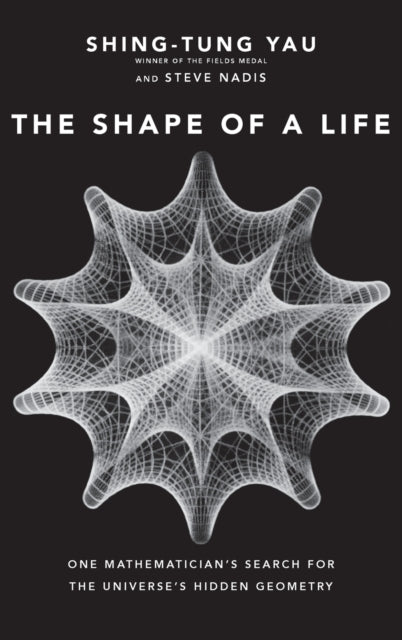
Yale University Press The Shape of a Life
Book SynopsisTrade Review“The book is an unexpectedly intimate look into a highly accomplished man, his colleagues and friends, the development of a new field of geometric analysis, and a glimpse into a truly uncommon mind.”—Nina MacLaughlin, Boston Globe"For decades, mathematician Shing-Tung Yau—a winner of the 1982 Fields Medal—has been central to the cross-fertilization between modern mathematics and physics. His work in geometry, for instance, underlies much of string theory. This volume, co-authored with science writer Steve Nadis, is an intimate account of Yau’s life”—Barbara Kiser, Nature“An eye-opening and insightful account. . . . Yau’s life story is an inspiring example of the power of education.”—Dan Eady, South China Morning Post“A real story of a remarkable mathematician and of contemporary mathematics, written with passion by one of the key players”—Peter Giblin, The Mathematical GazetteFinalist in the PROSE Awards mathematics category, sponsored by the Association of American Publishers“Yau and Nadis’s The Shape of a Life opens a window into the fascinating mind and world of today’s equivalent of Apollonius of Perga, ‘The Great Geometer’ of antiquity.”—Mario Livio, author of Brilliant Blunders"The interesting life of a remarkably influential modern mathematician."—Juan Maldacena, Institute for Advanced Study“This book tells a fascinating story of a life lived between multiple cultures—China and the West, and mathematics and physics. Yau's journey from poverty in Hong Kong to the top levels of the mathematics world was not a simple one.”—Edward Witten, Institute for Advanced Study"Candid, deep, and truly inspiring, The Shape of a Life is studded with unexpected insights into Yau's thinking. An extraordinary story about an extraordinary person."—Gish Jen, author of The Girl at the Baggage Claim: Explaining the East-West Culture Gap“The remarkable story of one of the world's most accomplished mathematicians, Shing-Tung Yau, who has made profound contributions in pure mathematics, general relativity, and string theory. Yau’s personal journey—from escaping China as a youngster, leading a gang outside Hong Kong, becoming captivated by mathematics, to making breakthroughs that thrust him on the world stage—inspires us all with humankind's irrepressible spirit of discovery.”—Brian Greene, author of The Elegant Universe
£19.00

Yale University Press Einstein on the Run
Book SynopsisThe first account of the role Britain played in Einstein's life—first by inspiring his teenage passion for physics, then by providing refuge from the NazisTrade Review“Highly readable.” —Andrew Crumey, Wall Street Journal “Deeply interesting”—Naomi Pasachoff, Metascience“Robinson’s evocative account of a transitional phase in Einstein’s life offers a valuable new perspective on this great scientist’s personality.”—Martin Rees, Astronomer Royal and former president of the Royal Society“A well-researched and very readable book about a less well-known period in Einstein’s life – his contact with England and English scientists.”—Jocelyn Bell Burnell, Visiting Professor of Astrophysics, University of Oxford“I absolutely adore this book – it’s insightful and very well-written. Einstein’s time in and relation to Britain from an Anglophile perspective is a new and valuable contribution. Robinson is also a very fine storyteller.”—Steven Gimbel, author of Einstein: His Space and Times“The very first study of its kind. It wears its thorough and conscientious scholarship lightly on its sleeve—a splendidly entertaining read.”—Ze’ev Rosenkranz, editor of The Travel Diaries of Albert Einstein“A compelling tale of Einstein’s reception in Britain. Robinson casts in bold relief important insights into the nature and character of British and German societies in the interwar period.”—Robert Schulmann, Former head of the Einstein Papers Project
£11.99
University of California Press Barnum Brown
Book SynopsisBarnum Brown led a remarkable life (1873-1963), spending most of it searching for fossils - and sometimes oil - in every corner of the globe. This biography discloses the details about his life and travels - from his youth on the western frontier to his spying for the US government under cover of his expeditions.Trade Review"A rollicking recollection of Brown." -- Jen Barone Discover Magazine "It is about time someone wrote this book ... this book tells the story very well ... Highly recommended." -- M. A. Wilson Choice "Dingus and Norell do justice to the unconventional, many-faceted if somewhat mysterious Brown." Publishers Weekly "An authoritative biography of Barnum Brown has long been wanting, and the authors of the new volume have done an overall excellent job of summarizing the achievements of one of the most famous fossil hunters of all time." -- Brian Switek Smithsonian.com/Dinosaur Tracking Blog "The definitive account of the life and times of a singular man and a superlative fossil hunter." The Birdbooker Report "The definitive account of the life and times of a singular man and a superlative fossil hunter." Science Blogs "Well written." -- Donald M. Henderson Great Plains Research "Intriguing." College & Research Libraries News "Brown liked bonhomie, incurred woman trouble from time to time, and had a wife whose embellishments of life in the field enliven the biography ...her letter writing and published books about subsequent digs round out this biography and indicate the public interest in "Mr. Bones" during his lifetime. Dingus and Norell ably revive that in this gap-filling scientific biography." -- Gilbert Taylor Booklist "Comprehensive and enjoyable ... A monumental amount of careful research, consultation with colleagues and source checking clearly went into this volume and it will stand forever as the definitive work on this most important character." -- Darren Naish Historical Biology "Occasionally, a biography strikes the perfect note ... The exhaustive research pays off big for the reader, placing Barnum Brown in the upper ranks of well-written biographies." -- Claire Rudy Foster Foreword "An extremely good book." -- Jeffrey W. Martz Journal Vertebrate Paleontology "A scholarly but very readable book. Brown emerges as a character one might enjoy sitting beside on a long airplane flight." -- Jane Manaster Sacramento & San Francisco Book RevsTable of ContentsContents List of Illustrations Prologue: The Mindset of Barnum Brown 1. Child of the Frontier (1873--1889) 2. Student ... of Sorts (1889--1896) 3. Apprentice Extraordinaire (1896--1898) 4. To Land's End: Patagonia (1898--1900) 5. To the Depths of Hell Creek (1900--1903) 6. Love (1903--1906) 7. Loss (1906--1910) 8. The Canadian Dinosaur Bone Rush (1910--1916) 9. Cuba, Abyssinia, and Other Intrigues (1916--1921) 10. Jewels from the Orient: Raj India (1921--1923) 11. Perils and Pearls Up the Irrawaddy: Burma (1923) 12. Samos: Isle of Intrigue (1923--1925) 13. Ancient Americans Hunting Bison? Birds as Dinosaurs? (1925--1931) 14. Digging--and Flying--for Dinosaurs: Howe Quarry and the Aerial Survey of Western Fossil Beds (1931--1935) 15. Toward the Golden Years: The Mystery Track-Maker and the Glen Rose Trackway (1935--1942) 16. Brown as a Spy, Movie Consultant, and Showman at the World's Fair (1942--1963) Epilogue Appendix 1. List of Major Specimens Collected by Barnum Brown on Display in the AMNH Fossil Halls Appendix 2. Memoirs of Barnum Brown: Discovery, Excavation and Preparation of the Type Specimen Tyrannosaurus rex Appendix 3. Summary of Fossil Collections by Barnum Brown and His AMNH Crews Notes Bibliography Acknowledgments Index
£42.50

University of California Press Ernst Mach
Book Synopsis
£35.70

University of California Press H. G. J. Moseley
Book Synopsis
£64.00
University of California Press Theodor Boveri
a huge range and FREE tracked UK delivery on ALL orders.
£63.90

Harvard University Press Charles A. Janeway
Book SynopsisThis biography of the most visible U.S. pediatrician of the twentieth century describes his illustrious medical family and his remarkable tenure of nearly three decades as professor of pediatrics at Harvard Medical School and as head of the department of medicine at Children's Hospital, Boston.Trade ReviewRobert Haggerty and Frederick Lovejoy, two of Janeway's most devoted and distinguished trainees (and there were hundreds of them), have composed a well-written biography of Janeway that details his family background and his career. These are accounts that embrace the history of academic medicine. Although the major intended audience of this well documented and illustrated book includes physicians who served or trained at Boston Children's Hospital, the wider readership will be those who are fascinated by cultural and particularly medical history...Haggerty and Lovejoy have done Janeway justice. For that and for their own diverse academic contributions, we remain deeply grateful. -- David G. Nathan * Journal of the American Medical Association *This is a wonderful book about a very special person...The book is full of interesting antidotes. I encourage every pediatrician to read it, but especially those who are in pediatric academia or research. -- Jerold F. Lucey * Pediatrics *
£26.96

Harvard University Press Einstein and Oppenheimer
Book SynopsisEinstein and Oppenheimer belonged to different generations, with the boundary marked by the advent of quantum mechanics. By exploring how these men differed—in their worldview, in their work, and in their day—this book provides powerful insights into the lives of two critical figures and into the scientific culture of their times.Trade ReviewWith sensitivity and masterful insight Schweber explores aspects of the lives, thought and personalities of Einstein and Oppenheimer—their philosophical and ethical positions, and their ethnic and cultural commitments—as well as their uneasy interaction with each other, their differing views on the unification of physics, and even the role of Buddhist detachment in their thinking. The end result is a book that offers new perspectives on how both scientists responded to the transformations in physics and its relationship with public and political developments brought about by the opening of the atomic age. -- David C. Cassidy, author of J. Robert Oppenheimer and the American Century and Einstein and Our WorldYou'd be forgiven for thinking there is little we don't know already about Einstein and Oppenheimer. Yet this book plots the lives of the 20th century's most charismatic physicists to a greater end than biography. Focusing on the cultural milieus in which they thrived, Schweber investigates Einstein and Oppenheimer's very different manifestations of genius--one solitary, one social. Schweber's depth of analysis, particularly in describing both scientists' affinities for Buddhist thought, insists that there is much more to learn about each. * Seed *The real interest of Mr. Schweber's account--and what makes his dual biography unusual--is the emphasis he places not on Einstein's or Oppenheimer's scientific achievements, which have been often enough described, but on their later careers, when both found themselves, for different reasons, strangely sidelined. -- Eric Ormsby * New York Sun *Schweber has set himself quite a task in seeking to add to our understanding [of Einstein and Oppenheimer]. By my reckoning he has succeeded, not so much by uncovering significant new material as by reflecting wisely and eloquently on Einstein's and Oppenheimer's politics, their relationships with their colleagues, and their contributions to science. -- Lawrence Black * Times Higher Education Supplement *Have we not heard enough of these two men? Yet Silvan S. Schweber shows us in his new book, Einstein and Oppenheimer, that there is still more to say. What we know about these two giants of physics largely concerns their genius--their formidable mental powers--but this focus tends to foreground the individual at the expense of intellectual and scientific context. Schweber's aim is ambitious: to capture another quality that he calls the greatness of Einstein and Oppenheimer--to show how their actions altered humanity's "ideas concerning what human beings can be or do." We know much about the genius of these two men, Schweber implies, but little of their greatness. -- Robert P. Crease * American Scientist *In a brief review, it is not possible to do full justice to Schweber's probing book, which merits careful reading. -- Michael W. Friedlander * Physics World *In six illuminating essays focusing on the later years of these fascinating figures, Schweber shows that no scientist--however great--is an island. -- P.D. Smith * The Guardian *Table of Contents*1. Einstein and Nuclear Weapons * Introduction * Einstein and the Atomic Bomb * After Hiroshima and Nagasaki * Einstein on World Government * Hydrogen Bombs * Individual versus Collective Stands * The Einstein--Russell Manifesto * Epilogue *2. Einstein and the Founding of Brandeis University * Introduction * Israel Goldstein * Rabbinic Connections * The Harold Laski Episode * Denouement * Epilogue *3. J. Robert Oppenheimer: Proteus Unbound * Introduction * The Early Years * Becoming a Physicist: Oppenheimer and His School * Los Alamos * The Postwar Years * Hydrogen Bombs * Epilogue *4. J. Robert Oppenheimer and American Pragmatism * The Director's Fund * Philosophy * Harvard Overseer * The William James Lectures *5. Einstein, Oppenheimer, and the Extension of Physics * Unification * Einstein and Unification * The MIT Centennial Celebration. * A Bird's-eye View of General Relativity, 1915--1960 *6. Einstein, Oppenheimer, and the Meaning of Community * The Einstein--Oppenheimer Interaction * Eulogies and Memorial Speeches * Roots and Tradition * Philosophy * Epilogue * Some Concluding Remarks * Appendix: The Russell--Einstein Manifesto * Notes * Bibliography * Acknowledgments * Index
£24.26
Harvard University Press August Weismann
Book SynopsisAugust Weismann’s 1892 theory that inheritance is transmitted through eggs and sperm provided the biological mechanism for natural selection. In this full-length biography, Frederick Churchill situates Weismann in the swirling intellectual currents of his day and shows how his work paved the way for the modern synthesis of genetics and evolution.Trade ReviewWe come away from this monumental study with a much greater appreciation of this biologist, and an understanding of why [Ernst] Mayr designated him ‘one of the great biologists of all time.’ -- W. F. Bynum * Times Literary Supplement *A monumental study of an important but surprisingly little-studied biologist, August Weismann represents half a century of scholarly investment by historian of science Frederick Churchill… That anybody can write this kind of book these days is awe-inspiring. -- Jane Maienschein * Nature *[A] magisterial biography… It is hard to imagine a better match than between the late Frederick Churchill and the object of his lifelong affection… Will be the definitive biography of August Weismann for decades to come. -- Manfred D. Laubichler * Isis *Those who know the topic that science historian Churchill has been working on these past years have eagerly awaited this definitive biography of August Weismann (1834–1914), whose germ layer of heredity revolutionized the understanding of organismal evolution… The present book places Weismann at the center of the fields of heredity, evolution, and embryonic development, fields that dominated both late-19th- and late-20th-century biology. The scholarship is rock solid, the writing smooth as silk, and the importance of the book central to the flow of the intellectual history of natural science and society. Unreservedly recommended. -- B. K. Hall * Choice *This will be considered the definitive scientific biography of August Weismann, as well as a brilliant account of the golden age of embryology. -- Paul Farber, Distinguished Professor Emeritus, Oregon State UniversityA courageous, meticulous study of a major figure. Churchill shows how Weismann turned from his study of natural history and butterflies to provide the grounding for our understanding of chromosomes and germ lines. A truly impressive volume. -- Jane Maienschein, author of Whose View of Life? and Embryos under the Microscope
£999.99

Princeton University Press Volta Science and Culture in the Age of
Book SynopsisSets us within the cosmopolitan cultures of Enlightenment Europe to tell the story of Alessandro Volta - the brilliant man whose name is forever attached to electromotive force. This work depicts Volta as an inventor who used his international network of acquaintances to further his quest to harness the power of electricity.Trade Review"This is by far the best book about Volta in English... It is contextual, unawed, and enriched by new manuscript material. It is also far more than just a biography. Based on this study of one individual's electrical activities, Pancaldi makes general arguments about the culture of science at the end of the Enlightenment."--Patricia Fara, Times Literary Supplement "In this detailed and ambitious book, Volta's life and the fascinating and complicated patterns that led to the battery are beautifully described... Every chapter has an interesting and original thesis, shows detailed and painstaking knowledge of manuscripts and adds to our knowledge of Volta and his time."--Fabio Bevilacqua, American Scientist "An insightful chronicle of an individual genius riding global tides of cultural transformation... A fascinating mix of science and biography."--Booklist "Giuliano Pancaldi's engaging book contributes substantially to a reappraisal of the sciences of the Enlightenment, as well as providing a wealth of information about Volta's life and accomplishments... [I]t is an impressive accomplishment that significantly advances the historiography of the sciences in enlightened Europe."--Jan Golinski, American Historical Review "This is a remarkable study of Alessandro Volta's science of electricity in its social and cultural context, one that adds significantly to the scholarship on Enlightenment science and technology. The first monograph on Volta to appear in English, it offers an in-depth contextual analysis of his experimental practice founded on Guiliano Pancaldi's detailed knowledge of the sources."--Massimo Mazzotti, Technology and Culture "This is by far the best book about Volta in English... It is also far more than just a biography. Based on this study of one individual's electrical activities, Pancaldi makes general arguments about the culture of science at the end of the enlightenment."--Patricia Fara, Chemical Heritage "Giuliano Pancaldi's study of Alessandro Volta reveals the vast international trade in scientific knowledge that, by the end of the eighteenth century, had transformed the promotion of experiment. Pancaldi's treatment of Volta as a major figure in the revolutionary world of the late eighteenth century is an important addition to studies of a scientific public."--Larry Stewart, Business History ReviewTable of ContentsIllustrations xi Acknowledgments xiii Abbreviations xvii Introduction 1 Chapter 1 THE MAKING OF A NATURAL PHILOSOPHER From Amateur, to Expert, to Public Servant 7 The Town 9 The Family 12 Lifestyle 14 Education 15 "A More Enlightened Age" 19 Literary Interests 21 Views on Religion and Secularization 22 From Amateur, to Expert, to Public Servant 27 Emotional Life 33 Investigative Style 39 Conclusion 41 Chapter 2 ENLIGHTENMENT SCIENCE SOUTH OF THE ALPS The Italian Scientific Community in the Age of Volta 44 The Soil and the Institutions 48 The Scholars: Provenance and Fields of Interest 52 Prosopography 56 The Circulation of Enlightenment Literature 62 Views from the Outside 65 Conclusion 70 Chapter 3 THE ELECTROPHORUS Theory, Instrument Design, and the Social Uses of Scientific Apparatus 73 Fire, Magnetism, Electricity 76 "Vindicating Electricity" 83 Attraction and the Atmospheres 86 Disenchanted Theorist 90 Scientific Instruments and Their Social Uses 91 The Path to the Electrophorus 95 Instrument Design 100 Publicizing Discovery 104 Conclusion 108 Chapter 4 VOLTA'S SCIENCE OF ELECTRICITY Conception, Laboratory Work, and Public Recognition 110 Reluctant Theorist 110 Midrange Conceptualization and a New Machine: Capacity, Tension, "Actuation," and the Condensatore 112 Natural Philosopher or Inventor of Amusements Electriques? 121 Explanatory Models and Presentation Strategies: True Causes vs. Instrumentalism 125 Volta's Laboratory: Measuring Electricity 129 Volta on Coulomb 137 Conclusion 141 Chapter 5 THE COSMOPOLITAN NETWORK Volta and Communication among Experts in Late Enlightenment Europe 146 Overcoming Isolation 149 Exploring the Republic of Letters: The Neighborhoods 153 Facing the Peers: Paris in 1782 156 Anglophilia 160 Continental Europe and the German-Speaking Countries 164 After 1789 168 Conclusion 172 Chapter 6 THE BATTERY Invention, Instrumentalism, and Competitive Imitation 178 Galvanism, Electrometer in Hand 179 The Hunt for Weak Electricity 186 The Electricity of Animals 190 Nicholson's Contribution to Volta's Discovery 196 Building the Battery 202 Conclusion: Invention, Instrumentalism, and Competitive Imitation 207 Chapter 7 APPROPRIATING INVENTION The Reception of the Voltaic Battery in Europe 211 Spreading the News 212 Replicating the Instrument 221 Appropriating the Battery 224 A Name for All Purposes 246 From Philosophic Instrument to Patented Device 248 Conclusion 250 Chapter 8 THE SCIENTIST AS HERO Volta and the Uses of Past Science in the Industrial Era 257 Admitted to "Galileo's Tribune" 258 Secular Saint in the Positivist Calendar 259 "The Triumph of Science" 261 In the Nobel Laureates' Era 263 Conclusion 270 Chapter 9 CONCLUSION: SCIENCE, TECHNOLOGY, AND CONTINGENCY Enlightenment Legacies 273 Invention 273 "Useful Knowledge" and Unintended Consequences 275 "The Quantifying Spirit" 278 Investment 279 Value Assessments 280 Contingency 283 Enlightenment Legacies 286 Notes 291 Bibliography 337 Index 367
£37.80

Princeton University Press Karl Pearson The Scientific Life in a
Book SynopsisRecounts Karl Pearson's extraordinary intellectual adventure and sheds light on the inner life of science. In this book, a leading historian of modern science investigates the interior experience of one man's scientific life while placing it in a tapestry of social, political, and intellectual movements.Trade Review"Theodore Porter's book on Pearson is not a biography in the conventional sense. It focuses on the early part of his career in an effort to show how he was drawn to the study of statistics and eventually conceived it as the key to a new philosophy of nature, which was to become his life's work... The great value of Porter's book is that this focus on the early phase of Pearson's career highlights the complex route by which his quest for emotional and intellectual satisfaction led him towards the project that would, in effect, create modern statistics."--Peter J. Bowler, Nature "[A] brilliant biography, one can hardly imagine a better summary of Karl Pearson's fascinating life and complicated persona... [Porter] reveals more about the origins, aspirations, and consequences of modern statistics than any technical treatise of the same length could possibly accomplish. As Porter emphasizes, Pearson's life was a tour de force [and] extremely fascinating to the reader."--Manfred D. Laubichler, Science "Porter's biography of the young Pearson, the statistician in embryo, exceeds all expectations in recreating the intellectual worlds in which Pearson tried to find a home. The breadth of the reading and the depth of interpretation are impressive... Porter shows us a young Pearson, clever and brave, who has a burning passion to understand things."--John Aldrich, American Scientist "This book is a remarkable achievement."--Jenny Marie, Journal of the History of Biology "Pearson's story can ... be read as a triumph of statistics in which a powerful intellect comes to see our field as a great source of enlightenment. As [Theodore M.] Porter writes in a wonderful first sentence, 'Beginning in 1892, when he took up statistics as his scientific vocation, Karl Pearson devoted himself relentlessly to a project of almost universal quantification.' That sentence very effectively conveys what I try to tell my students in a first statistics course, that this is a way of thinking which will allow them to see the world in a new and beautiful way, though I do hope that they avoid adopting Pearson's unwavering commitment that statistics is the only way to view the world."--Richard J. Cleary, The American Statistician "Theodore Porter's Karl Pearson explores the fullness and richness of Pearson's intellectual and emotional life, shows us how 'the toil of the years' led to the revolution he wrought in statistics... The book would ... be a source of both pleasure and profit to any serious reader."--Ramachandran Bharath, MAA ReviewsTable of ContentsPreface and Acknowledgments vii CHAPTER ONE Introduction: An Improbable Personage 1 CHAPTER TWO Lehrjahre of a Poetic Wrangler 13 CHAPTER THREE Apostle of Renunciation: A New Werther 43 CHAPTER FOUR Pearson's Progress: A Nineteenth-Century Passion Play 69 CHAPTER FIVE Cultural Historian in a Political Age 91 CHAPTER SIX Intellectual Love and the Woman Question 125 CHAPTER SEVEN Ether Squirts and the Inaccessibility of Nature 178 CHAPTER EIGHT Scientific Education and Graphical Statistics 215 CHAPTER NINE The Statistical Reformation 249 CHAPTER TEN Epilogue: Composing a Life 297 Bibliography 315 Index 329
£37.80
Princeton University Press Richters Scale Measure of an Earthquake Measure
Book SynopsisBy developing the scale that bears his name, Charles Richter not only invented the concept of magnitude as a measure of earthquake size, he turned himself into a household word. This work takes the reader into Richter's life story, setting it in the context of his family and interpersonal attachments, and the history of seismology.Trade Review"The true value of Richter's Scale resides in its unspoken commemoration of a nearly extinct mode of scientific endeavor."--Claudio Vita-Finzi, Times Literary Supplement "One thing this book, written by one professional scientist about another, communicates very clearly, is what it is actually like to be a scientist--a welcome contribution."--Roger M. W. Musson, Times Higher Education Supplement "[An] illuminating biography."--Emily Banham, Nature "[This book] reveals an unfamiliar side of the scientist famous for developing the first magnitude scale for earthquakes in 1935... Most of [Richter's] colleagues remained unaware of the scope of his thoughts and interests. Richter's Scale will change this. It reveals Richter to be an individual with more than his share of flaws, but also as an iconoclastic scientist worthy of his fame and of our admiration."--Gregory C. Beroza, Nature "Hough draws on a wealth of documents left behind by Richter ... to chronicle his rise to fame and explain his place in the history of seismology... The author describes Richter's tumultuous upbringing, his penchant for nudism, and his prolific writing of poems--many included in the book."--Science News "Written by a seismologist about the most famous seismologist, this biography of Charles Richter (1900-85) is the first researched from Richter's papers... Hough's inspections of Richter's psyche may expand her readership beyond that interested in earthquakes... Richter, however difficult to like in life--he had few friends, according to Hough--proves to have had the turbulent inner life and struggles with the external world of which compelling biographies are made."--Gilbert Taylor,Booklist "This is very much a behind-the-headlines portrait of the private man... The portrait that emerges is that of a scientist who was initially far more interested in astronomy and stargazing than seismology; who possessed powerful poetic longings, and, above all, abiding decency."--Steven Carroll, The Age "This thoughtful, well-researched book explores a central question: why Richter--an admittedly quirky, plainspoken scientist--became so much better known than some of his more accomplished colleagues... Richter's ability to communicate his findings with a general audience through the press, Hough demonstrates, gave him the kind of public profile that cemented his position in the popular lexicon."--Juliet Eilperin, Washington Post Book World "By developing the scale that bears his name, Charles Richter not only invented the concept of magnitude as a measure of earthquake size, he also turned his name into a household word. This behind-the-scenes look at Richter, the man, is an artful interweaving of the stories of Richter's life with the history of earthquakes exploration and seismology."--Natural Hazards Observer "Richter's Scale will last as long as this earth lasts and so will this story by Susan Hough Her exemplary work the like of which we do not see often, both in terms of content and humane and conscious approach, is of great importance to our present times. While it should have been written earlier, it could not have been written better. One almost falls in love with Susan Hough for this remarkably successful attempt to bring Richter back to life and make him stand before us. Many thanks, Susan Hough! We shall remember you for this wonderer gift to the scientific-minded and to most many others less so minded."--Current Engineering Practice "Susan Hough has done her job extraordinarily well, turning a tangled-up story of a man hardly understood by others into a very fascinating biography."--Pawel Wiejacz, Pure and Applied GeophysicsTable of ContentsPreface ix CHAPTER 1: The Magnitude of the Problem 1 CHAPTER 2: Formative Years 9 CHAPTER 3: Margaret Rose 25 CHAPTER 4: Harnessing the Horses 36 CHAPTER 5: Earthquake Exploration 51 CHAPTER 6: The Kresge Era 62 CHAPTER 7: Beno Gutenberg 82 CHAPTER 8: Earthquake! 102 CHAPTER 9: Richter Scale 112 CHAPTER 10: Charlie 132 CHAPTER 11: Lillian 153 CHAPTER 12: Richter's Women 181 CHAPTER 13: Autumn 192 CHAPTER 14: Asperger's Syndrome 212 CHAPTER 15: Here It Comes Again 241 CHAPTER 16: Predicting the Unpredictable 253 CHAPTER 17: Sizing Up Earthquake Hazard 269 CHAPTER 18: Hazard in a Nuclear Age 276 CHAPTER 19: Supernova 286 APPENDIX A Belated Farewell 309 Bibliography 313 Acknowledgments 325 Index 331 Earthquakes by Date 337
£999.99

Princeton University Press Henri Poincaré
Book SynopsisHenri Poincar (1854-1912) was not just one of the most inventive, versatile, and productive mathematicians of all time - he was also a leading physicist who almost won a Nobel Prize for physics. This book explores all the fields that Poincar touched, the debates sparked by his investigations, and how his discoveries still contribute to society.Trade ReviewOne of Choice's Outstanding Academic Titles for 2013 "[M]asterly ... Gray encapsulates Poincare's multiple dimensions; his intellectual biography is both a tour de force and a triumph of readability."--George Szpiro, Nature "Gray shows us the full dazzling sweep of what Poincare accomplished, including the work on dynamical systems and chaos that only came into its own in recent years. A tour de force, Gray's masterful treatment will long remain an invaluable resource for all who want to understand Poincare, so embedded within his times and yet so far ahead of them."--Peter Pesic, Science "[A] comprehensive but uncluttered guide to Poincare's extensive oeuvres."--Madeline Muntersbjorn, Times Higher Education "Full of the mathematical, physical and metaphysical ideas of a man who was not only a dispassionate observer of the world around us, but of our way of understanding it."--Mark Ronan, Standpoint Magazine (U.K.) "[A] comprehensive assessment of Poincare's work and its importance, essential for anyone interested in Poincare's scholarship or the history of mathematics."--Laura Tarwater Scharp, Sacramento Book Review "Comprehensive."--Science News "A fundamental study of the scientific work of one of the greatest mathematicians and mathematical physicists of the three decades straddling the 19th and 20th centuries... Chapters are organized topically, not chronologically. Each illuminates in depth one or other of Poincare's works but all are set in context both historical and temathic such that each can serve as an introduction into the many subjects to which Poincare made a contribution."--Alexander Bogomolny, CTK Insights "Poincare's work is fully alive in science today. This biography is one of the first thorough introductions to his work, it should get the attention of mathematicians, natural scientists and philosophers."--Ferdinand Verhulst, European Legacy "Gray, a mathematics historian and scholar on the life and work of Henry Poincare, has, with the support of a Leverhulme Research Fellowship, produced this comprehensive and definitive 'scientific biography.' Gray offers abundant rich information on Poincare's ideas and scientific process, the evolution and maturity of his mathematics including missteps, the dexterity of his reasoning, and the influences that shaped his thought."--Choice "I recommend [this] book highly."--Robert E. O'Malley, Jr., SIAM Review "Jeremy Gray's book on Poincare's mathematics, physics, and philosophy is an important contribution to the literature and a huge step towards a full biography of this pioneer of modern science."--Reinhard Siegmund-Schultze, Zentralblatt MATH "Gray's book is a comprehensive scientific biography of Poincare. It embraces the broad scope of Poincare's work, from his philosophical speculations to his popular writing, and gives a thorough overview of his extensive mathematical researches."--Peter Lynch, Irish Mathematical Society Bulletin "[T]he author does not simply give platitudes when writing about Poincare's ideas: mathematicians will enjoy reading about his discoveries concerning the three-body problem, the theory of functions, topology, number theory, Lie theory, algebraic geometry, and probability. This scientific biography is the first to comprehensively cover all of Poincare's main contributions to mathematics, philosophy, and physics."--Alan S. McRae, Mathemematical Reviews Clippings "Jeremy Gray has done a marvelous job of exposition and of binding together the many different cognitive, social and biographical strands into the coherent whole of a challenging, but highly rewarding, 'scientific biography'."--Klaus Hentschel, British Journal for the History of Science "A good intellectual biography of an artist should help the reader see how a particular worldview shapes the pursuit of art. Gray's book does that most admirably."--Daniel S. Alexander, H-France Review "Henry Poincare is likely to remain the standard by which scientific biographies, at least those that concern physicists and mathematicians, are judged for some time."--Christopher Cumo, Canadian Journal of History "I warmly recommend the book to anyone with an interest in the development of modern mathematics. It will surely be the definitive scientific biography of Poincare for the foreseeable future."--John Stillwell, Notices of the AMS "Gray describes Poincare's scientific epoch in a beautiful way. Due attention is paid to the mathematical and further scientific aspects of his life, and the intellectual complexity of his achievements, both in their range and their depth, are amply discussed. Gray displays a mastery of his material that is rare even among historians of mathematics and science, and his biography is richly rewarding, engrossing, and informative. He deserves our congratulations."--H. W. Broer, Journal of the British Society for the History of Mathematics "Gray succeeds admirably in presenting both the conceptual and the historical context necessary to appreciate Poincare's contributions. Gray's masterful biography may well serve as a standard example for future endeavors of this kind."--Tilman Sauer, Isis "The obvious virtue of this book is its comprehensiveness. The deeper virtue is to connect Poincare's views of all the parts of his work and to encourage more of that. Gray gives us Poincare's view of Science as a whole."--Colin McLarty, Mathematical Intelligencer "The book is an endless source of interesting insights by Poincare... I would recommend the book for mathematicians, mathematics educators, and philosophers in higher education who want a rich understanding of Poincare, his work, and his times."--Mary L. Garner, Mathematics TeacherTable of ContentsList of Figures ix Preface xi Introduction 1 * Views of Poincare 3 * Poincare's Way of Thinking 6 1 The Essayist 27 * Poincare and the Three Body Problem 27 * Poincare's Popular Essays 34 * Paris Celebrates the New Century 59 * Science, Hypothesis, Value 67 * Poincare and Projective Geometry 76 * Poincare's Popular Writings on Physics 100 * The Future of Mathematics 112 * Poincare among the Logicians 123 * Poincare's Defenses of Science 144 2 Poincare's Career 153 * Childhood, Schooling 153 * The Ecole Polytechnique 157 * The Ecole des Mines 158 * Academic Life 160 * The Dreyfus Affair 165 * National Spokesman 169 * Contemporary Technology 177 * International Representative 187 * The Nobel Prize 192 *"1911", "1912" 200 * Remembering Poincare 202 3 The Prize Competition of 1880 207 * The Competition 207 * Fuchs, Schwarz, Klein, and Automorphic Functions 224 * Uniformization, 1882 to 1907 247 4 The Three Body Problem 253 * Flows on Surfaces 253 * Stability Questions 265 * Poincare's Essay and Its Supplements 266 *Les Methodes Nouvelles de la Mecanique Celeste 281 * Poincare Returns 291 5 Cosmogony 300 * Rotating Fluid Masses 300 6 Physics 318 * Theories of Electricity before Poincare: Maxwell 318 * Poincare's Electricite et Optique, 1890 329 * Larmor and Lorentz: The Electron and the Ether 338 * Poincare on Hertz and Lorentz 346 * St. Louis, 1904 356 * The Dynamics of the Electron 361 * Poincare and Einstein 367 * Early Quantum Theory 378 7 Theory of Functions and Mathematical Physics 382 * Function Theory of a Single Variable 382 * Function Theory of Several Variables 391 * Poincare's Approach to Potential Theory 402 * The Six Lectures in Gottingen, 1909 416 8 Topology 427 * Topology before Poincare 427 * Poincare's Work, 1895 to 1905 432 9 Interventions in Pure Mathematics 467 * Number Theory 467 * Lie Theory 489 * Algebraic Geometry 498 10 Poincare as a Professional Physicist 509 * Thermodynamics 513 * Probability 518 11 Poincare and the Philosophy of Science 525 * Poincare: Idealist, Skeptic, or Structural Realist? 525 12 Appendixes 543 * Elliptic and Abelian Functions 543 * Maxwell's Equations 545 * Glossary 548 References 553 * Articles and Books by Poincare 554 * Other Authors 564 Name Index 585 Subject Index 589
£36.00

Princeton University Press Undiluted HocusPocus The Autobiography of Martin
Book SynopsisIncludes topics as diverse as magic, philosophy, religion, pseudoscience, and Alice in Wonderland. This title takes readers from author's childhood in Oklahoma to his college days at the University of Chicago, his service in the navy, and his varied and professional pursuits.Trade ReviewOne of American Association for the Advancement of Science's Books for General Audiences and Young Adults 2014 "His radiant self lives on in his massive and luminous literary output and shines at its sweetest, wittiest and most personal in Undiluted Hocus-Pocus."--Teller, New York Times Book Review "For those of us who believe that the sciences and the humanities don't have to be enemies, Martin Gardner is an inspiring model. Undiluted Hocus-Pocus reveals a man immersed in philosophy, religion and literature, even as he makes a career writing about science."--Jordan Ellenberg, Wall Street Journal "Readers who only know Gardner for his math and science writing will be surprised at his focus on religion, and this autobiography demonstrates his passion to explain and understand the world around him."--Publishers Weekly "For half a century, Martin Gardner (1914-2010) was an international scientific treasure... Gardner's passion for writing and his warmth and humour shine forth on every page of this book, making it a memoir of a great human being."--David Singmaster, Nature "Zealously debunking science fads and declaring his bafflement at the human brain, maths writer Martin Gardner was on fine form in this posthumous memoir."--Nature "The style is that of a memoir, conversationally phrased, and not afraid to be sidetracked occasionally by an amusing aside. Gardner paints vividly an inside picture of American intellectual life in the twentieth century, coloured by honest accounts of the many influential figures with whom he came into contact."--Alexander Shannon, Plus magazine "His illuminating autobiography, Undiluted Hocus-Pocus ... offers a rare, intimate look at Gardner's life and work."--Mother Nature Network "In summary, I give this book the highest praise that I can possibly give an autobiography: it was much too short."--Charles Ashbacher, MAA Reviews "[Undiluted Hocus-Pocus] is the most sincere, unadulterated biography I ever read... [D]etails of his life and personality exposed in the book help create a more complete picture of this fascinating person... Martin Gardner had tremendous influence on several generations of young minds; his autobiography will help his fans appreciate how that came about. This is a book no one who ever heard his name would want to miss."--Cut the Knot Insights blog "I only wish his autobiography was twice as long, for I never tire of reading him and feeling enriched... And thank you Martin for this last, final, further peek into your brilliant, fertile, curious, nimble, incisive, probing, captivating life and mind."--Math Tango blog "Undiluted Hocus-Pocus reminds us how Gardner taught many of us how to play the game of mathematics better."--Mathrecreation blog "A case can be made, in purely practical terms, for Martin Gardner as one of the most influential writers of the 20th century. His popularizations of science and mathematical games in Scientific American, over the 25 years he wrote for them, might have helped create more young mathematicians and computer scientists than any other single factor prior to the advent of the personal computer... Gardner was capable of appealing to the literary side of left-brained sorts, and did so with ... taste and restraint... Undiluted Hocus-Pocus, his posthumously published autobiography ... reveals the sort of mentality that shaped itself around his encyclopedic interests."--David Auerbach, Los Angeles Review of Books "[This book] will be an eye-opener knowing that Martin Gardner was active on so many diverse fields."--European Mathematical Society "The book is just a delight to read."--Stephen Hirtle, Pittsburgh Post-Gazette "Here my guru and sage brought together, over the course of two hundred pages, the full range of his interests--math, magic, philosophy, stories, poetry, science, religion, politics--and combined these disparate topics with an account of his private life and intellectual development. I enjoyed every page of this book."--Ted Gioia, Millions "Reading Martin Gardner's autobiography is like spending a pleasant afternoon in the company of a 95-year-old man with sharp memories and a twinkle in his eye. Oh wait, that's what it is."--Science Musings blog "This book describes some of the pivotal moments in the life of prolific author/journalist Martin Gardner (1914-2010), who is best known for his illuminating and entertaining contributions to Scientific American magazine from 1956 to 1981. Fans of Martin Gardner will find this posthumously published autobiography fascinating."--Choice "[H]ighly readable. Even those well familiar with Gardner's writings, although they will be acquainted with much of the ground covered, will still make several new discoveries. The foreword by Persi Diaconis will also interest mathematicians."--Leon Harkleroad, Zentralblatt Math "A delightful book."--Peter E. Blau, Red Circle Society "For all his fame, Gardner was a humble, generous man, always modest about his mathematical achievements. His humanity, humor, and sheer decency shine through every page. Reading this book is like chatting with him about his intellectually adventure-filled life for a whole weekend."--Colm Mulcahy, Math Horizons "At the age of 95 he wrote this ... charming and informative autobiography covering an incredibly prolific and productive life that should inspire anyone who encounters it."--AAAS "Martin Gardner as one of those rare and valuable writers who could venture into the worlds of science and mathematics as an intelligent and interested layman, and then entertain the rest of us with his discoveries."--Jon Wainwright, Skeptic Magazine "A very interesting read."--Christopher Hollings, Mathematics TodayTable of ContentsForeword: Magic, Mathematics, and Mysterians, by Persi Diaconis xi Preface xxiii Prologue: I Am a Mysterian xxv 1 Earliest Memories 1 2 Lee School 10 3 Tulsa Central High, I 21 4 Central High, II 28 5 Hutchins and Adler 40 6 Richard McKeon 47 7 I Lose My Faith 53 8 Chicago, I 62 9 Chicago, II 76 10 I Become a Journalist 88 11 Mother and Dad 98 12 The Navy, I 111 13 The Navy, II 119 PHOTO ESSAY follows page 124 14 Esquire and Humpty 125 15 Scientific American 134 16 Pseudoscience 150 17 Math and Magic Friends 160 18 Charlotte 173 19 Bob and Betty 185 20 God 191 21 My Philosophy 195 Afterword: My Most Elegant Friend ... , by James Randi 209 Index 215
£22.00

Princeton University Press Einstein on Politics
Book SynopsisThe most famous scientist of the twentieth century, Albert Einstein was also one of the century's most outspoken political activists. This title gathers his important public and private political writings and puts them into historical context.Trade ReviewOne of Choice's Outstanding Academic Titles for 2007 "A goldmine for readers interested in Einstein as an engaged intellectual of his era. Editors David E. Rowe and Robert Schulmann have done an excellent job of collecting, thematically assembling and historically contextualizing Einstein's private letters and public statements on the great political issues of his time."--Yaron Ezrahi, Nature "Editors David E. Rowe and Robert Schulmann have done an excellent job of collecting, thematically assembling and historically contextualizing Einstein's private letters and public statements on the great political issues of his time. The book is also a fascinating record of Einstein's private thoughts and public stance on the reception of the relativity revolution. Included here are his reaction to the virulent anti-Semitic, anti-relativity German scientists, his tortured relations with the Prussian Academy of Sciences after the rise of the Nazis and his later expressed identification with Galileo for his struggle 'to overcome the anthropocentric and mythical thinking of his contemporaries and to lead them back to an objective and causal attitude towards the cosmos.'"--C. R. Macauley, Nature "Einstein on Politics treats all these issues in detail by combining his most important statements--both public and private--in thematic chapters and by carefully contextualizing each statement. The result is fascinating, illuminating and sometimes moving, resonating both with today's noisy debates about nuclear weapons, international terrorism and civil liberties, and with the ethical dilemmas with which we struggle in the quieter recesses of the mind."--Andrew Robinson, New Scientist "[G]reat as Einstein's allure remains, the majority of people will probably wish to read just one Einstein book, and this is one they should strongly consider. In addition to being comprehensive, accessible and well written, it is clearly the most up to date, making sensible use of the latest and most authoritative scholarship."--Daniel J. Kennefick, American Scientist online "This brilliant anthology of [Einstein's] journalism and private correspondence brings to life his lucid contributions to the raging debates of the last century over the bomb, his humanitarian objections to war, his belief in a socialist economy and the apparent contradiction between his advocacy of internationalism and his support for Zionism."--David Harounoff, Tribune "To enhance understanding of Einstein's humanism and activism, Rowe and Schulmann have gathered, organized, and explicated a full spectrum of his reflections, allowing the reader direct access to Einstein's reasoning as he confronts a world of violence rendered exponentially more catastrophic by virtue of his own scientific breakthroughs. Powerful in its personal and political disclosures, this is an essential primary source."--Booklist "Offers readers a panoramic view of his writings on Zionism and anti-Semitism, nationalism, the fate of Jews during the Holocaust, war, peace, pacifism and nuclear proliferation. Einstein was a vigorous stylist and these selections from his private correspondence attest to his fluency with words."--Sheldon Kirshner, Canadian Jewish News "Anyone with an interest in Einstein's non-scientific activities in the public realm will profit from reading this book."--Hubert Goenner, Nature Physics "The most renowned scientist of the last century was famous not only for his seminal contributions to making sense of the universe, from the very large to the very small, but also for his humanism and interest in promoting the possibility of a world without conflict. This book collects many of Einstein's letters and essays that discuss issues pertaining exclusively to his views on the latter. They cover an incredible range of topics from WWI to the UN and much that embroiled the Western world in between. The editors have provided good introductions to each chapter, following Einstein's discursions in chronological order."--N. Sadanand, Choice "Utilizing a meticulously collected set of both published and unpublished materials, the editors set forth in admirable detail his writings on the issues of the day, which are inextricably connected to his support for the Zionist movement and the creation of Israel. If readers connect Einstein only to the world of science and mathematics, this volume will clearly serve to expand their horizons."--Sanford R. Silverburg, AJL Newsletter "[T]he documents presented are quite valuable, and the book deserves a wide readership for that alone."--Matthew Stanley, Historical Studies in Natural Sciences "Einstein was an important man, and Rowe and Schulmann edited an important book about him"--Antoine Capet, H-Net "This book, ingeniously put together by Rowe and Schulmann, provides a thematic and chronological frame of reference that allows a lucid view of Einstein's political passions, which up to now have been largely unknown even to the interested public. It is a multiply rewarding book, one that all readers are bound to enjoy."--Kosta Tsipis, Journal of Cold War Studies "Einstein on Politics is an excellent and thought-provoking volume, which can be of interest to scholars as well as to the public at large."--Giorgio Baruchello, European Legacy "David E. Rowe and Robert Schulmann have compiled exactly the book readers ... may want to consult during or after reading a biography of the 'mere scientist' who held passionate and often outspoken views on the major issues of his time."--Stuart Mitchner, Town Topics (Princeton, NJ)Table of ContentsList of Texts vii Preface xix Note on Sources and Method xxxi Acknowledgments xxxiii Historical Introduction 1 Chapter 1. The First World War and Its Impact, 1914-1921 61 Chapter 2. Science Meets Politics: The Relativity Revolution, 1918-1923 93 Chapter 3. Anti-Semitism and Zionism, 1919-1930 136 Chapter 4. Internationalism and European Security, 1922-1932 189 Chapter 5. Articles of Faith, 1930-1933 223 Chapter 6. Hitler's Germany and the Threat to European Jewry, 1933-1938 266 Chapter 7. The Fate of the Jews, 1939-1949 315 Chapter 8. The Second World War, Nuclear Weapons, and World Peace, 1939-1950 356 Chapter 9. Soviet Russia, Political Economy, and Socialism, 1918-1952 406 Chapter 10. Political Freedom and the Threat of Nuclear War, 1931-1955 459 Bibliography 509 Index 515 Plate Credits 524
£18.00

Princeton University Press Einstein and the Quantum
Book SynopsisEinstein and the Quantum reveals for the first time the full significance of Albert Einstein's contributions to quantum theory. Einstein famously rejected quantum mechanics, observing that God does not play dice. But, in fact, he thought more about the nature of atoms, molecules, and the emission and absorption of light--the core of what we now knoTrade ReviewWinner of the 2014 Phi Beta Kappa Award in Science, Phi Beta Kappa Society One of Physics World's Top Ten Books of the Year for 2014 One of Choice's Outstanding Academic Titles for 2014 One of Scientific American's Best 2013 Books for the Physics Fan, chosen by Jennifer Ouellette One of Science Friday's Science Book Picks for 2013, chosen by Ira Flatow One of nbc.com's "Holiday Gift Books Span the Science Spectrum" for 2014 "Brief, pacey and lucid... The breadth and depth of Einstein's contribution in this area becomes overwhelmingly clear... Worth a read because it demonstrates that there is more to Einstein's oeuvre than even most quantum physicists know. Stone concludes that Einstein's work was worthy of four Nobel prizes, and it is a measure of the book's achievement that his claim sounds quite reasonable."--Graham Farmelo, Nature "Albert Einstein (1879-1955) is as famous for his paradigm-shifting theories of relativity as he is for his grudge against quantum mechanics, but Stone's (Physics/Yale Univ.) engaging history of Einstein's ardent search for a unifying theory tells a different story. Einstein's creative mind was behind almost every single major development in quantum mechanics... The author adeptly weaves his subject's personal life and scientific fame through the tumult of world war and, in accessible and bright language, brings readers deep into Einstein's struggle with both the macroscopic reality around him and the quantum reality he was trying to unlock... A wonderful reminder that Einstein's monumental role in the development of contemporary science is even more profound than history has allowed."--Kirkus Reviews "A fascinating book, so well written lay people can easily understand this. It is full of science and personality."--Ira Flatow, Science Friday, NPR "In Einstein and the Quantum: The Quest of the Valiant Swabian (Princeton University Press), a historical analysis leavened by many personal stories about Albert Einstein, A. Douglas Stone argues persuasively and engagingly that although this iconic scientist rejected quantum theory as a final theory of microscopic physics, he was responsible for most of its central concepts, including wave-particle duality, indeterminacy and the implications of identicalness."--Sir Michael Berry, Times Higher Education "Professor Douglas Stone has written an engaging book about Einstein's contributions to early quantum theory. He makes a convincing case that these contributions, most of which were made in the 20 year period between 1905 and 1925, have been historically undervalued and that it was Einstein himself, not Planck or Bohr, who deserves most credit for the initial development of quantum theory... Excellent."--Paul Edwards, Australian Physics "This is an excellent book that I recommend without reservation... Any academic library should acquire this book as should any medium-to-large public library system. It would also make a wonderful gift for the physics or science fan in your life."--John Dupuis, Confessions of a Science Librarian "In consummate detail and with a flair for the written word, [Stone] delves into Einstein's original rationale for espousing the quantum, his use of it to account for the mysterious behavior of specific heats at low temperatures, his explanations of spontaneous and stimulated emissions, and the derivation of the statistics of integer-spin particles. Readers benefit from Stone's deep understanding of quantum physics as well as his thoroughness in citing primary Einstein documents--rather than regurgitating the opinions of others--to support his conclusions... There are only a few books on the history of physics that I can heartily recommend to both scholarly historians and physicists interested in the history of their discipline. Because of Stone's extensive research and writing abilities, Einstein and the Quantum is indeed one of those books."--Michael Riordan, Forum on the History of Physics "Einstein and the Quantum is delightful to read, with numerous historical details that were new to me and cham1ing vignettes of Einstein and his colleagues. By avoiding mathematics, Stone makes his book accessible to general readers, but even physicists who are well versed in Einstein and his physics are likely to find new insights into the most remarkable mind of the modern era."--Daniel Kleppner, Physics Today "This engaging book shows that Einstein spent more of his career on quantum physics than on relativity theory and was deeply involved in discussions that shaped current understanding of the subject... His well-written book makes often-trod history fresh, with new perspectives and unfamiliar quotations from Einstein and his peers. Anyone with an interest in the subject, from scholars to laypersons, can read and enjoy this book."--Choice "The book is probably best suited to readers who are already familiar with the basic principles of late classical and early quantum physics. However, in many cases, Stone's explanations are better and more intuitive than those found in traditional textbooks; for this reason, Einstein and the Quantum would make excellent 'further reading' for undergraduate courses in thermodynamics, modern physics or the history of science. Stone also has a knack for summing up complex ideas in a way that even novices will understand."--Physics World "A five star, standout book... If you really want a feel for where quantum physics came from ... it is well worth it."--Popular Science (U.K.) "Stone is a talented writer. Employing a sharp, clean and ironic prose, he translates into intuitive images and limpid reasoning a set of complex physics arguments, which might appear at first sight incomprehensible without a clear understanding of the technical terms. It is remarkable that the author manages to do this by employing just a handful of elementary equations. Even the uninitiated reader can grasp the essential features of Einstein's groundbreaking proposals as well as of the theoretical problems he was facing. In my opinion, this is the major strength of Stone's book, which makes it much more accessible than other scholarly works that present Einstein's involvement in the development of quantum theory in a more technical fashion."--Roberto Lalli, Metascience "[S]ome background knowledge in physics is required in order to understand the discipline-specific terminology and to fully appreciate the depth of Stone's elaborations. Having said that, even specialized physicists will not be disappointed by the author's scholarly efforts."--Christopher B. Germann, Leonardo Reviews "This excellent book can be best recommended to everybody interested is the early history of quantum theory and the impact of A. Einstein."--K. E. Hellwig, Zentralblatt MATHTable of ContentsPreface to the Paperback Edition ix Acknowledgments ix Introduction A Hundred Times More Than Relativity Theory 1 Chapter 1 "An Act of Desperation" 5 Chapter 2 The Impudent Swabian 15 Chapter 3 The Gypsy Life 21 Chapter 4 Two Pillars of Wisdom 26 Chapter 5 The Perfect Instruments of the Creator 36 Chapter 6 More Heat Than Light 44 Chapter 7 Difficult Counting 51 Chapter 8 Those Fabulous Molecules 62 Chapter 9 Tripping the Light Heuristic 70 Chapter 10 Entertaining the Contradiction 80 Chapter 11 Stalking the Planck 86 Chapter 12 Calamity Jeans 94 Chapter 13 Frozen Vibrations 103 Chapter 14 Planck's Nobel Nightmare 111 Chapter 15 Joining the Union 122 Chapter 16 Creative Fusion 129 Chapter 17 The Importance of Being Nernst 141 Chapter 18 Lamenting the Ruins 149 Chapter 19 A Cosmic Interlude 160 Chapter 20 Bohr's Atomic Sonata 168 Chapter 21 Relying on Chance 181 Chapter 22 Chaotic Ghosts 193 Chapter 23 Fifteen Million Minutes of Fame 204 Chapter 24 The Indian Comet 215 Chapter 25 Quantum Dice 228 Chapter 26 The Royal Marriage: E = mc2 = hnu 241 Chapter 27 The Viennese Polymath 254 Chapter 28 Confusion and Then Uncertainty 268 Chapter 29 Nicht diese Tone 279 Appendix 1: The Physicists 287 Appendix 2: The Three Thermal Radiation Laws 291 Notes 295 References 319 Index 325
£17.09

Princeton University Press The Quotable Darwin
Book SynopsisTrade Review"’At last gleams of light have come. . . . I think I have found out (here’s presumption!) the simple way by which species become exquisitely adapted to various ends.’ Thus, Charles Darwin to botanist Joseph Dalton Hooker in an 1844 letter--just one gem from Janet Browne’s selected excerpts. Darwin vividly emerges as a crack shot with a tin ear for music, a loving father, a would-be anthropologist struggling to understand indigenous peoples and the consummate scientist, working ‘from a sort of instinct to try to make out truth’."---Barbara Kiser, Nature"Fans of Janet Browne's epic two-volume biography of Charles Darwin will not want to miss her new book, The Quotable Darwin, which features a broad selection of Darwin's personal and professional observations on life, liberty, and of course science."---John Farrell, Forbes.com"The selection of quotes from Darwin’s books and his letters are grouped into chapters with headings that are expected, such as Species or Survival of the Fittest, and less expected, such as one of my favourites, Barnacles." * The Australian *"This book works because [Darwin’s] own words paint an unexpectedly complete and truthful picture of the man (brilliance, wit, sickness), his times--and limitations."---Liz Else, New Scientist"[Browne's] book delves into the mind of Darwin, revealing his insights, humor, and understanding of the world as he knew it. Darwin’s words never get old, and Browne’s treatment of his wisdom does not disappoint. Her book is a must for any dedicated student of Charles Darwin, and the novice reader alike."---Howard O. Clark, Jr., Sonoran Herpetologist"The Quotable Darwin is fascinating, funny, and humanizing. It brings an icon to life."---Glenn Dallas, San Fransisco Book Review
£18.00

Princeton University Press Undiluted HocusPocus The Autobiography of Martin
Book SynopsisMartin Gardner wrote the Mathematical Games column for Scientific American for twenty-five years and published more than seventy books on topics as diverse as magic, religion, and Alice in Wonderland. Gardner's illuminating autobiography is a candid self-portrait by the man evolutionary theorist Stephen Jay Gould called our "single brightest beaconTrade ReviewOne of American Association for the Advancement of Science's Books for General Audiences and Young Adults 2014 "His radiant self lives on in his massive and luminous literary output and shines at its sweetest, wittiest and most personal in Undiluted Hocus-Pocus."--Teller, New York Times Book Review "For those of us who believe that the sciences and the humanities don't have to be enemies, Martin Gardner is an inspiring model. Undiluted Hocus-Pocus reveals a man immersed in philosophy, religion and literature, even as he makes a career writing about science."--Jordan Ellenberg, Wall Street Journal "Readers who only know Gardner for his math and science writing will be surprised at his focus on religion, and this autobiography demonstrates his passion to explain and understand the world around him."--Publishers Weekly "For half a century, Martin Gardner (1914-2010) was an international scientific treasure... Gardner's passion for writing and his warmth and humour shine forth on every page of this book, making it a memoir of a great human being."--David Singmaster, Nature "Zealously debunking science fads and declaring his bafflement at the human brain, maths writer Martin Gardner was on fine form in this posthumous memoir."--Nature "The style is that of a memoir, conversationally phrased, and not afraid to be sidetracked occasionally by an amusing aside. Gardner paints vividly an inside picture of American intellectual life in the twentieth century, coloured by honest accounts of the many influential figures with whom he came into contact."--Alexander Shannon, Plus magazine "His illuminating autobiography, Undiluted Hocus-Pocus ... offers a rare, intimate look at Gardner's life and work."--Mother Nature Network "In summary, I give this book the highest praise that I can possibly give an autobiography: it was much too short."--Charles Ashbacher, MAA Reviews "[Undiluted Hocus-Pocus] is the most sincere, unadulterated biography I ever read... [D]etails of his life and personality exposed in the book help create a more complete picture of this fascinating person... Martin Gardner had tremendous influence on several generations of young minds; his autobiography will help his fans appreciate how that came about. This is a book no one who ever heard his name would want to miss."--Cut the Knot Insights blog "I only wish his autobiography was twice as long, for I never tire of reading him and feeling enriched... And thank you Martin for this last, final, further peek into your brilliant, fertile, curious, nimble, incisive, probing, captivating life and mind."--Math Tango blog "Undiluted Hocus-Pocus reminds us how Gardner taught many of us how to play the game of mathematics better."--Mathrecreation blog "A case can be made, in purely practical terms, for Martin Gardner as one of the most influential writers of the 20th century. His popularizations of science and mathematical games in Scientific American, over the 25 years he wrote for them, might have helped create more young mathematicians and computer scientists than any other single factor prior to the advent of the personal computer... Gardner was capable of appealing to the literary side of left-brained sorts, and did so with ... taste and restraint... Undiluted Hocus-Pocus, his posthumously published autobiography ... reveals the sort of mentality that shaped itself around his encyclopedic interests."--David Auerbach, Los Angeles Review of Books "[This book] will be an eye-opener knowing that Martin Gardner was active on so many diverse fields."--European Mathematical Society "The book is just a delight to read."--Stephen Hirtle, Pittsburgh Post-Gazette "Here my guru and sage brought together, over the course of two hundred pages, the full range of his interests--math, magic, philosophy, stories, poetry, science, religion, politics--and combined these disparate topics with an account of his private life and intellectual development. I enjoyed every page of this book."--Ted Gioia, Millions "Reading Martin Gardner's autobiography is like spending a pleasant afternoon in the company of a 95-year-old man with sharp memories and a twinkle in his eye. Oh wait, that's what it is."--Science Musings blog "This book describes some of the pivotal moments in the life of prolific author/journalist Martin Gardner (1914-2010), who is best known for his illuminating and entertaining contributions to Scientific American magazine from 1956 to 1981. Fans of Martin Gardner will find this posthumously published autobiography fascinating."--Choice "[H]ighly readable. Even those well familiar with Gardner's writings, although they will be acquainted with much of the ground covered, will still make several new discoveries. The foreword by Persi Diaconis will also interest mathematicians."--Leon Harkleroad, Zentralblatt Math "A delightful book."--Peter E. Blau, Red Circle Society "For all his fame, Gardner was a humble, generous man, always modest about his mathematical achievements. His humanity, humor, and sheer decency shine through every page. Reading this book is like chatting with him about his intellectually adventure-filled life for a whole weekend."--Colm Mulcahy, Math Horizons "At the age of 95 he wrote this ... charming and informative autobiography covering an incredibly prolific and productive life that should inspire anyone who encounters it."--AAAS "Martin Gardner as one of those rare and valuable writers who could venture into the worlds of science and mathematics as an intelligent and interested layman, and then entertain the rest of us with his discoveries."--Jon Wainwright, Skeptic Magazine "A very interesting read."--Christopher Hollings, Mathematics TodayTable of ContentsForeword: Magic, Mathematics, and Mysterians, by Persi Diaconis xi Preface xxiii Prologue: I Am a Mysterian xxv 1 Earliest Memories 1 2 Lee School 10 3 Tulsa Central High, I 21 4 Central High, II 28 5 Hutchins and Adler 40 6 Richard McKeon 47 7 I Lose My Faith 53 8 Chicago, I 62 9 Chicago, II 76 10 I Become a Journalist 88 11 Mother and Dad 98 12 The Navy, I 111 13 The Navy, II 119 PHOTO ESSAY follows page 124 14 Esquire and Humpty 125 15 Scientific American 134 16 Pseudoscience 150 17 Math and Magic Friends 160 18 Charlotte 173 19 Bob and Betty 185 20 God 191 21 My Philosophy 195 Afterword: My Most Elegant Friend ... , by James Randi 209 Index 215
£17.09

Princeton University Press Complexities
Book SynopsisTrade ReviewWinner of the 2006 Book Award, Mathematics/Computer Science category, Alpha Sigma Nu, and the Association of Jesuit Colleges and Universities "A definitive work, very carefully written, Complexities will inspire a wide range of women mathematicians and scientists for a long period of time... By far this is the most important study of women in mathematics that even a giant amongst men mathematicians will find himself reading with sheer pleasure."--Current Engineering Practice "[T]he variation in [the book's] content and writing styles ... is exactly its strength--it is both an excellent reference for a professor wishing to provide a student with a few inspiring gems and a comprehensive overall picture of the life of women in mathematics. Its lessons are gleaned from the trials and tribulations of a specific group, but the advice is universal."--Lisa DeKeukelaere, MAA Online "The collection documents the complex nature of the conditions women have faced while pursuing their careers in mathematics. It shows the pleasure women had in discovering new mathematics, and energy to do a good job!"--Silke Gobel, Zentralblatt "As a female mathematics student, I found that reading this book increased my appreciation for the courage and determination of the women who entered mathematics before me, while also building my personal confidence in the prospect of finding a rewarding and fulfilling life in the mathematical community."--Gwen Spencer, Math Horizons
£28.80

Princeton University Press A WellOrdered Thing
Book SynopsisTrade Review"Fascinating."—Publishers Weekly "The periodic chart now hangs on the wall of countless classrooms, and occupies textbooks, websites and T-shirts. . . . Working long before nuclear scientists reached Los Alamos, Mendeleev was this kingdom’s first successful cartographer."—Simon Schaffer, London Review of Books "Engaging. . . . [T]he most comprehensive biography in English about Mendeleev."—Ursula Klein, Physics Today "Highly readable."—Bernadette Bensaude-Vincent, Nature "This fine book presents a compelling portrait of Mendeleev as a Russian thinker, a member of the small cohort of Petersburg elite who shaped Russian science, politics, and culture. . . . For anyone interested in Mendeleev or the place of science in late nineteenth-century Russia, this is required reading."—Mark B. Adams, Slavic Review "A serious and interesting exploration of the life and times of Dmitrii Mendeleev."—Carmen Giunta, Foundations of Chemistry
£28.80

Princeton University Press Richters Scale Measure of an Earthquake Measure
Book SynopsisTrade Review"The true value of Richter's Scale resides in its unspoken commemoration of a nearly extinct mode of scientific endeavor."--Claudio Vita-Finzi, Times Literary Supplement "One thing this book, written by one professional scientist about another, communicates very clearly, is what it is actually like to be a scientist--a welcome contribution."--Roger M. W. Musson, Times Higher Education Supplement "[An] illuminating biography."--Emily Banham, Nature "[This book] reveals an unfamiliar side of the scientist famous for developing the first magnitude scale for earthquakes in 1935... Most of [Richter's] colleagues remained unaware of the scope of his thoughts and interests. Richter's Scale will change this. It reveals Richter to be an individual with more than his share of flaws, but also as an iconoclastic scientist worthy of his fame and of our admiration."--Gregory C. Beroza, Nature "Hough draws on a wealth of documents left behind by Richter ... to chronicle his rise to fame and explain his place in the history of seismology... The author describes Richter's tumultuous upbringing, his penchant for nudism, and his prolific writing of poems--many included in the book."--Science News "Written by a seismologist about the most famous seismologist, this biography of Charles Richter (1900-85) is the first researched from Richter's papers... Hough's inspections of Richter's psyche may expand her readership beyond that interested in earthquakes... Richter, however difficult to like in life--he had few friends, according to Hough--proves to have had the turbulent inner life and struggles with the external world of which compelling biographies are made."--Gilbert Taylor,Booklist "This is very much a behind-the-headlines portrait of the private man... The portrait that emerges is that of a scientist who was initially far more interested in astronomy and stargazing than seismology; who possessed powerful poetic longings, and, above all, abiding decency."--Steven Carroll, The Age "This thoughtful, well-researched book explores a central question: why Richter--an admittedly quirky, plainspoken scientist--became so much better known than some of his more accomplished colleagues... Richter's ability to communicate his findings with a general audience through the press, Hough demonstrates, gave him the kind of public profile that cemented his position in the popular lexicon."--Juliet Eilperin, Washington Post Book World "By developing the scale that bears his name, Charles Richter not only invented the concept of magnitude as a measure of earthquake size, he also turned his name into a household word. This behind-the-scenes look at Richter, the man, is an artful interweaving of the stories of Richter's life with the history of earthquakes exploration and seismology."--Natural Hazards Observer "Richter's Scale will last as long as this earth lasts and so will this story by Susan Hough Her exemplary work the like of which we do not see often, both in terms of content and humane and conscious approach, is of great importance to our present times. While it should have been written earlier, it could not have been written better. One almost falls in love with Susan Hough for this remarkably successful attempt to bring Richter back to life and make him stand before us. Many thanks, Susan Hough! We shall remember you for this wonderer gift to the scientific-minded and to most many others less so minded."--Current Engineering Practice "Susan Hough has done her job extraordinarily well, turning a tangled-up story of a man hardly understood by others into a very fascinating biography."--Pawel Wiejacz, Pure and Applied GeophysicsTable of ContentsPreface ix CHAPTER 1: The Magnitude of the Problem 1 CHAPTER 2: Formative Years 9 CHAPTER 3: Margaret Rose 25 CHAPTER 4: Harnessing the Horses 36 CHAPTER 5: Earthquake Exploration 51 CHAPTER 6: The Kresge Era 62 CHAPTER 7: Beno Gutenberg 82 CHAPTER 8: Earthquake! 102 CHAPTER 9: Richter Scale 112 CHAPTER 10: Charlie 132 CHAPTER 11: Lillian 153 CHAPTER 12: Richter's Women 181 CHAPTER 13: Autumn 192 CHAPTER 14: Asperger's Syndrome 212 CHAPTER 15: Here It Comes Again 241 CHAPTER 16: Predicting the Unpredictable 253 CHAPTER 17: Sizing Up Earthquake Hazard 269 CHAPTER 18: Hazard in a Nuclear Age 276 CHAPTER 19: Supernova 286 APPENDIX A Belated Farewell 309 Bibliography 313 Acknowledgments 325 Index 331 Earthquakes by Date 337
£19.00

Princeton University Press The Travel Diaries of Albert Einstein
Book SynopsisTrade Review"The Travel Diaries is a substantially revised version of the 2012 translation that comes with an illuminating introduction and astonishingly comprehensive end-notes by Ze’ev Rosenkranz. . . . Anyone interested in Einstein’s complex, sometimes self-contradictory, character will be enjoyably provoked by reading his piquant Travel Diaries."---Andrew Robinson, Science"In this travel journal, clearly written for his eyes only, we see [Einstein] at his most human, capable of making boorish, unthinking and even racist remarks. Indeed, it shows that Einstein was first and foremost a brilliant scientist and that though he undoubtedly had an unequalled insight into the laws of physics, his understanding of human nature and of other cultures was far from profound. It seems that even a genius is, in the end, only human."---P. D. Smith, Times Literary Supplement"An eye-opening collection of travel diaries from the legendary scientist and thinker." * Kirkus Reviews *"The handwritten diary shows Einstein in an unfamiliar light, as a tourist—in the real, earthbound sense, not (as in his famous thought experiment) riding a light beam through space-time. Never intended for publication, it records his thoughts and impressions as they occurred, unmediated and unfiltered by considerations of how they would affect his image."---Jerry Adler, Smithsonian"Few know of Einstein’s writings on travel. . . . That shortcoming may now be remedied with the publication of a fascinating narrative of his first main travels outside of Europe."---Michael Curtis, New English Review"[Rosenkranz] has prepared a luxuriously enriched edition with a thoughtful introduction and extensive notes for the wider audience."---David Bodanis, Literary Review
£22.50

Princeton University Press Finding Fibonacci
Book SynopsisTrade Review"In his jaunty book Finding Fibonacci, Keith Devlin sets out to tell the elusive story of the 13th-century mathematician Leonardo of Pisa."--James Ryerson, New York Times Book Review "Devlin leads a cheerful pursuit to rediscover the hero of 13th-century European mathematics, taking readers across centuries and through the back streets of medieval and modern Italy in this entertaining and surprising history... Devlin relates Leonardo's adventures with brio and charm. Readers will enjoy this deft and engaging mix of history, mathematics, and personal travelogue."--Publishers Weekly "Finding Fibonacci showcases Devlin's writerly flair. My favourite passages are the incredible story of how Liber Abaci (or at least, the edition he wrote in 1228, the sole surviving one) became available in English for the first time - to this day the only modern-language translation."--Davide Castelvecchi, Nature "[Devlin] talks his way into Italian research libraries in search of early manuscripts, photographs all 11 street signs on Via Leonardo Fibonacci in Florence and strives to cultivate a love for numbers in his readers."--Andrea Marks, Scientific American "Finding Fibonacci [does] much to restore Leonardo to his proper place in contemporary Western culture."--Dan Friedman, Los Angeles Review of Books "[E]ngaging and entertaining."--Library Journal "A charming new book."--Martijn van Calmthout, de Volkskrant "All in all a book to be recommended. If you already read The Man of Numbers it is most informative to read this 'behind the scenes' version and know how it came about (and what happened after its publication). If you didn't know The Man of Numbers, you at least get a summary of what is in there too. Only it is told in a much more personal and lively version."--Adhemar Bultheel, European Mathematical Society "[A] good beach read for the nerdier among us."--Math FrolicTable of ContentsPrelude Sputnik and Calculus 1 1 The Flood Plain 5 2 The Manuscript 18 3 First Steps 35 4 The Statue 42 5 A Walk along the Pisan Riverbank 56 6 A Very Boring Book? 64 7 Franci 72 8 Publishing Fibonacci: From the Cloister to Amazon.com 85 9 Translation 97 10 Reading Fibonacci 116 11 Manuscript Hunting, Part I (Failures) 138 12 Manuscript Hunting, Part II (Success at Last) 151 13 The Missing Link 167 14 This Will Change the World 181 15 Leonardo and the Birth of Modern Finance 192 16 Reflections in a Medieval Mirror 213 Appendix Guide to the Chapters of Liber abbaci 228 Bibliography 236 Index 239
£25.20

Princeton University Press On the Life of Galileo
Book SynopsisTrade Review"Works by Galileo’s seventeenth-century contemporaries, translated by Stefano Gattei, reveal at first hand the making of his myth in a tumultuous era."---Barbara Kiser, Nature"This book is a major scholarly achievement and represents the first collection and translation into English of the earliest biographical accounts of Galileo’s life . . . The book gives readers many fascinating key insights into Galileo’s life, work and character." * Paradigm Explorer *"This volume is a splendid contribution to Galileo’s afterlife."---Eileen Reeves, Journal for the History of Astronomy"Gattei’s philological and translation work is impeccable and the volume is completed by a rich apparatus as well as numerous historical illustrations. A gem in the editorial market on Galileo."---Matteo Valleriani, Metascience
£40.50

Princeton University Press Einstein in Bohemia
Book SynopsisTrade Review"Meticulous in scholarship and erudite in tone . . . [Einstein in Bohemia] will doubtless become an essential reference for anyone researching what has usually been seen as a minor chapter in Einstein’s life."---Andrew Crumey, Wall Street Journal"Einstein in Bohemia is as much a series of essays on historical method and memory as it is a biography that uses Einsteinian ideas about perspective and spacetime to riff about the relationship between past and present, space and place. It’s also very much a book about Prague. It works in movements, looking backward and forward from Einstein’s Bohemian interlude to explore issues of biography, physics, Czech and German nationalism, the philosophy of science, literature, Jewishness, and public monuments. It is best savored in chunks, to better indulge in moments of reflection."---Audra J. Wolfe, Los Angeles Review of Books"His original and illuminating study . . . is a fascinating mix of urban and scientific history, and a genuinely original contribution to Einstein studies that explores both the effect of the city on the scientist and the lasting impact Einstein’s presence had on the cultural and scientific life of Prague itself."---P. D. Smith, Times Literary Supplement"Gordin explores unknown connections and forgotten biographies with impressive scholarly meticulousness and fervor."---Tilman Sauer, Science"[Gordin] explodes the narrative out of what he calls the 'spacetime interval' of 1911–12 to follow a host of figures who were involved with Einstein in Prague, in some cases very tangentially. In so doing, he careers through the history of ideas as well as the political turmoil of Bohemia (now part of the Czech Republic) during most of the twentieth century, touching on physics, philosophy, nationhood, anti-Semitism and the rise of Prague as a centre of intellectual life."---Pedro Ferreira, Nature"A meticulously researched, accessible, and fascinating portrait of Einstein."---Glenn C. Altschuler, Jerusalem Post"Gordin's Einstein in Bohemia affords us a refreshingly different kind of perspective on Einstein in context. The book treats its location - Prague in 1911 and 1912 - not merely as a backdrop, but as an integral part of the drama."---Don Howard, Physics Today"[A] deeply researched, wide-ranging and original book."---Andrew Robinson, Physics World"I was gripped . . . this is such a delightful and unusual book."---Richard Joyner, Times Higher Education"Einstein in Bohemia is a methodological confection, carefully concocted from an unlikely pairing of the textures and flavors of two historical ingredients: Einstein and Prague."---M. Norton Wise, ISIS"[This] book paints a rich picture of a small part in Einstein's life that will be fascinating to anyone interested not only in the scientist but also his historical context." * Nature Astronomy *"Through extensive primary sources, Gordin explores the effect that Prague’s rich history infused into Einstein’s life, and the way that Einstein made his own significant mark on Bohemia’s story."---Alden Hunt, Princeton Alumni Weekly"Gordin handles the theme of ‘belonging’ with great nuance and understanding."---David Luhrssen, The Shepherd Express"In this deeply researched and documented study, Gordin treats this brief period in Einstein's life as a prism through which the physicist refracts a broad range of intellectual, personal, scientific, and religious topics. The author sees Einstein as a window to understand Prague, and vice-versa, and reveals, in elegant and engaging prose, stimulating insights into many larger issues."---P. W. Knoll, Choice"[Gordin] is a vivid writer who uses a biographical approach to bring the past and its people alive. . . . This account of [Einstein's] challenging interlude in Bohemia is at once informative, engaging, and enjoyable."---Simon Mitton, The Observatory"Einstein in Bohemia is a stunning book that should make one think differently about place, time, identity, and historical causation. It is provocative and methodologically fascinating – indeed, one could teach an entire graduate methods seminar just from the introduction. It is beautifully written from start to finish and is compelling on every page. This is a must-read for historians of science, or really historians in general – and anyone interested in what it means to be in a place, at a time, and how those affect who someone is."---Matthew Stanley, Annals of Science"Gordin’s book is refreshing, engaging, sucks you into Eastern Europe where all the magic happened in the 1910s."---Adam Tamas Tuboly, Review of History of Philosophy of Science Books"[A] fascinating volume on the undersung importance of the sixteen months Albert Einstein spent in Prague (the capital of Bohemia) as a professor of theoretical physics at the German University there from early April 1911 to late July 1912."---Naomi Pasachoff, Metascience
£22.50

Princeton University Press The Collected Papers of Albert Einstein Volume 15
Book Synopsis
£55.80

Princeton University Press Einstein on Einstein
Book SynopsisTrade Review"Physicist Hanoch Gutfreund and historian Jürgen Renn provide a sparky commentary."---Andrew Robinson, Nature"[Einstein on Einstein] provides context, commentary, and background and explores Einstein’s thinking, theories, and contributions."---Dan Aubrey, U.S. 1"The opportunity to read Einstein’s musings, interpreted by two current leaders in Einstein studies, is valuable to all interested in the history or philosophy of physics as well as in Einstein himself."---Jay Paschoff, The Key Reporter"The main commentaries give hugely valuable insights into the development of Einstein’s thinking and how he positioned himself with respect to his predecessors and contemporaries."---David Lorimer, Paradigm Explorer
£31.50

Princeton University Press No Shadow of a Doubt
Book SynopsisTrade Review"Finalist for the PROSE Award in History of Science, Medicine, and Technology, Association of American Publishers""One of BBC Sky at Night Magazine's Best Astronomy and Space Books of 2019""One of Nature's Top Ten Books of 2019""[No Shadow of a Doubt] offers a richly detailed account of the protagonists and their success against long odds. Mr. Kennefick is at his most compelling when dissecting and refuting accusations of bias that have shrouded the historic feat."---Ray Jayawardhana, Wall Street Journal"Kennefick brings a thrilling mix of ingredients together into a . . . rewarding read: the chutzpah of Einstein; the glamour, luck and sense of adventure of eclipse-chasing; the audacity of planning such a demanding experiment during the first world war and executing it in its chaotic aftermath."---Anjana Ahuja, Financial Times"Physicist Kennefick narrates the buildup to, and fallout from, the experiment that confirmed Einstein’s radical idea and made him an international star."---Andrea Gawrylewski, Scientific American"Meticulously researched and vividly written, [this] account is sure to become the standard reference work on this fascinating example of ‘Big Science’."---Peter Coles, Nature"[An] insightful biography."---Simon Ings, The Spectator"This is a fascinating book, full of insights into the relationship between theory and experimental proof, and the relationship between science, internationalism, and war."---Emily Winterburn, BBC Sky at Night Magazine"A detailed and scholarly examination of the 1919 eclipse expeditions . . . a wonderfully rich and authoritative study of the way science worked in 1919 (“a golden age for astronomy”)."---P. D. Smith, Times Literary Supplement"[Kennefick’s] purpose is to very thoroughly rebut the skeptics, which he accomplishes in part through a careful and technical review of the instruments, the data, and an astronomer’s 1978 reanalysis of the data using a computer, but also by standing up for Frank Dyson."---Karen Olsson, Bookforum"Daniel Kennefick’s wonderful No Shadow of a Doubt has something for everyone, and I highly recommend it, especially in this centennial year."---Jay M. Pasachoff, Key Reporter"[An] excellent book . . . [this] story, in Kennefick’s hands, is well told, with plenty to interest the non-specialist and the more expert reader alike"---Andy Sawyers, British Astronomical Association"Even if shadows and doubts about the 1919 findings remain, this thoughtful and rigorous book at least lays several old myths to rest."---Suman Seth, American Scientist"Daniel Kennefick’s is the most detailed study of the eclipse expedition to date."---Alexei B. Kojevnikov, American Journal of Physics"[Kennefick] celebrates the 100th anniversary of that eclipse by providing us with a detailed, engagingly written, and extremely well-referenced account of the results and their purported confirmation of General Relativity."---David W. Hughes, The Observatory"Rather than privileging the roles of Eddington and Einstein, as other works have done, Kennefick places Einstein and even, to some extent, Eddington in the back seat, focusing instead on Sir Frank Dyson, the instruments and methods used, and the astronomical institutions associated with the expedition. Such an approach shows that the experimental verification of a theory does not lie with single figures but is often driven by several individuals and institutions—their environments, epoch, and instrumentation."---Tiffany Nichols, Isis
£22.50


